SUCCESSES & FAILURES OF UNITED NATIONS
INTRODUCTIONWar and peace have been two most important subject of international politics. War represents negative aspects of human nature(selfishness, greed, violence). Peace represents positive aspect symbolizing cooperation, chivalry. UN was created at the end of second world war to maintain world peace and security based on respect for human rights. It has so far been the most perfect of all international organizations.
UN charter was adopted on June 26th 1945. Dominant role was played by the great power– US, USSR, France , Britain and China.    Article 1 of the charter states the purposes of UN : To maintain international peace and security.To develop friendly relations among nations.To achieve international cooperation in solving economic , social, cultural and humanitarian problems.To be a centre for harmonizing the action of nations in the attainment of these common ends.      Its main aim was to maintain peace and security in the world and save future generations from the scourge of war.
UN comprises of 192 members.No provision in the charter for withdrawal of membership.Principal organs of UN:General AssemblySecurity Council.Economic and Social Council.Trusteeship Council.International Court of Justice.Secretariat.
Post 1945 era has been one of unprecedented changes in every part of the globe.Decolonization – emergence of host of newly independent nations on the world scene.Cold war between the super powers.Continuing nuclear arms.Struggle for modernization and development in the third world.Recurring regional conflicts.
SUCCESSESPolitical – Suez crisis(1956)Egypt nationalized the Suez canal in 1956.
United Nations Emergency Force was established.
The block was cleared by the UN.
UNEF was withdrawn from Egypt in May 1967.Cuban missile crisis(1962)UN played an important role in averting a nuclear war between the two super powers-US and USSR.Congo(1960)UN helped in averting a civil strife.Gulf war(1990)Iraq was labeled as an aggressor.
Collective force was used by UN against Iraq.
Kuwait was liberated and a wide range of diplomatic and economic sanctions were imposed on the aggressor.Peace keepingIt has been one of the major innovations under the UN charter.
The Uniting for Peace Resolution.
UN provided the forum for debate and negotiations and a channel for quite diplomacy.
Agenda For PeaceTerrorism.A major challenge to international peace and security.
UN adopted International Convention and Resolution for Prevention of Terrorism. Important ones include:International Convention on taking of hostages-1979Convention against Recruitment, Use, Finance and Training of Mercenaries-1989Resolution to eliminate International Terrorism-1991
Disarmament and arms control.Use of two atom bombs in 1945 created the urgency to the cause of disarmament.
Two commissions were set up:Atomic energy commission-1946Commission on Conventional Armaments-1947.Various efforts have been made for arms control.Social Promoting and protecting human rightsAdopted Universal Declaration of Human rights in 1948.
Two international covenants on human rights:Covenant on economic, social and cultural rights.Covenant on civil and political rights.Promoted human rights of children, women, refugees, indigenous people.

Un

  • 1.
    SUCCESSES & FAILURESOF UNITED NATIONS
  • 2.
    INTRODUCTIONWar and peacehave been two most important subject of international politics. War represents negative aspects of human nature(selfishness, greed, violence). Peace represents positive aspect symbolizing cooperation, chivalry. UN was created at the end of second world war to maintain world peace and security based on respect for human rights. It has so far been the most perfect of all international organizations.
  • 3.
    UN charter wasadopted on June 26th 1945. Dominant role was played by the great power– US, USSR, France , Britain and China. Article 1 of the charter states the purposes of UN : To maintain international peace and security.To develop friendly relations among nations.To achieve international cooperation in solving economic , social, cultural and humanitarian problems.To be a centre for harmonizing the action of nations in the attainment of these common ends. Its main aim was to maintain peace and security in the world and save future generations from the scourge of war.
  • 4.
    UN comprises of192 members.No provision in the charter for withdrawal of membership.Principal organs of UN:General AssemblySecurity Council.Economic and Social Council.Trusteeship Council.International Court of Justice.Secretariat.
  • 5.
    Post 1945 erahas been one of unprecedented changes in every part of the globe.Decolonization – emergence of host of newly independent nations on the world scene.Cold war between the super powers.Continuing nuclear arms.Struggle for modernization and development in the third world.Recurring regional conflicts.
  • 6.
    SUCCESSESPolitical – Suezcrisis(1956)Egypt nationalized the Suez canal in 1956.
  • 7.
    United Nations EmergencyForce was established.
  • 8.
    The block wascleared by the UN.
  • 9.
    UNEF was withdrawnfrom Egypt in May 1967.Cuban missile crisis(1962)UN played an important role in averting a nuclear war between the two super powers-US and USSR.Congo(1960)UN helped in averting a civil strife.Gulf war(1990)Iraq was labeled as an aggressor.
  • 10.
    Collective force wasused by UN against Iraq.
  • 11.
    Kuwait was liberatedand a wide range of diplomatic and economic sanctions were imposed on the aggressor.Peace keepingIt has been one of the major innovations under the UN charter.
  • 12.
    The Uniting forPeace Resolution.
  • 13.
    UN provided theforum for debate and negotiations and a channel for quite diplomacy.
  • 14.
    Agenda For PeaceTerrorism.Amajor challenge to international peace and security.
  • 15.
    UN adopted InternationalConvention and Resolution for Prevention of Terrorism. Important ones include:International Convention on taking of hostages-1979Convention against Recruitment, Use, Finance and Training of Mercenaries-1989Resolution to eliminate International Terrorism-1991
  • 16.
    Disarmament and armscontrol.Use of two atom bombs in 1945 created the urgency to the cause of disarmament.
  • 17.
    Two commissions wereset up:Atomic energy commission-1946Commission on Conventional Armaments-1947.Various efforts have been made for arms control.Social Promoting and protecting human rightsAdopted Universal Declaration of Human rights in 1948.
  • 18.
    Two international covenantson human rights:Covenant on economic, social and cultural rights.Covenant on civil and political rights.Promoted human rights of children, women, refugees, indigenous people.
  • 19.
    Certain conventions anddeclarations have been made for the same.
  • 20.
    the office ofUN High Commissioner for Human Rights(UNHCR) has been established by the general assembly.EconomicUNDP, UNCTAD, World food programmeUNDP is the world’s largest international agency providing international assistance for development.
  • 21.
    Economic institutions likeIMF, World Bank, have helped developing economies overcome major crises.
  • 22.
    UN has beensuccessful to a great extent in alleviating chronic hunger and rural poverty in developing nations.Environmental issues Climate change & Global warmingUN has provided help and is trying to find solutions to many global problems.
  • 23.
    United Nations EnvironmentProgramme (UNEP)provides for the protection of the environment and also prepares global agenda for the same.
  • 24.
    UNFCC is aninternational environment treaty aimed at stabilizing green house gas concentration in the atmosphereSpecialized agencies FAO, UNESCO, WHO, etc.UN has established certain agencies having wide international responsibilities in economic, social, cultural, health and related fields.
  • 25.
    There are 14specialized agencies.
  • 26.
    Other related organizationsare WTO, IAEA, etc.Apartheid in South Africa-: UN a major role in ending apartheid in South Africa. 1978- International Anti-Apartheid Year.
  • 27.
    1989- General Assemblyadopted the Declaration on Apartheid and its Destructive Consequences in Southern Africa.
  • 28.
    Sep 1992- AUN Observer Mission in South Africa was deployed by Security Council.
  • 29.
    June 23rd 1994 South Africa once again took its place in General Assembly. FAILURESExcessive use of veto power.Unable to resolve West Asian Crises.Has not been able to restore peace in countries like Somalia, Angola, Rwanda, Sudan.Financial Bankruptcy.UN does not maintain any independent army.Recent failure- Russia, Israel.
  • 30.
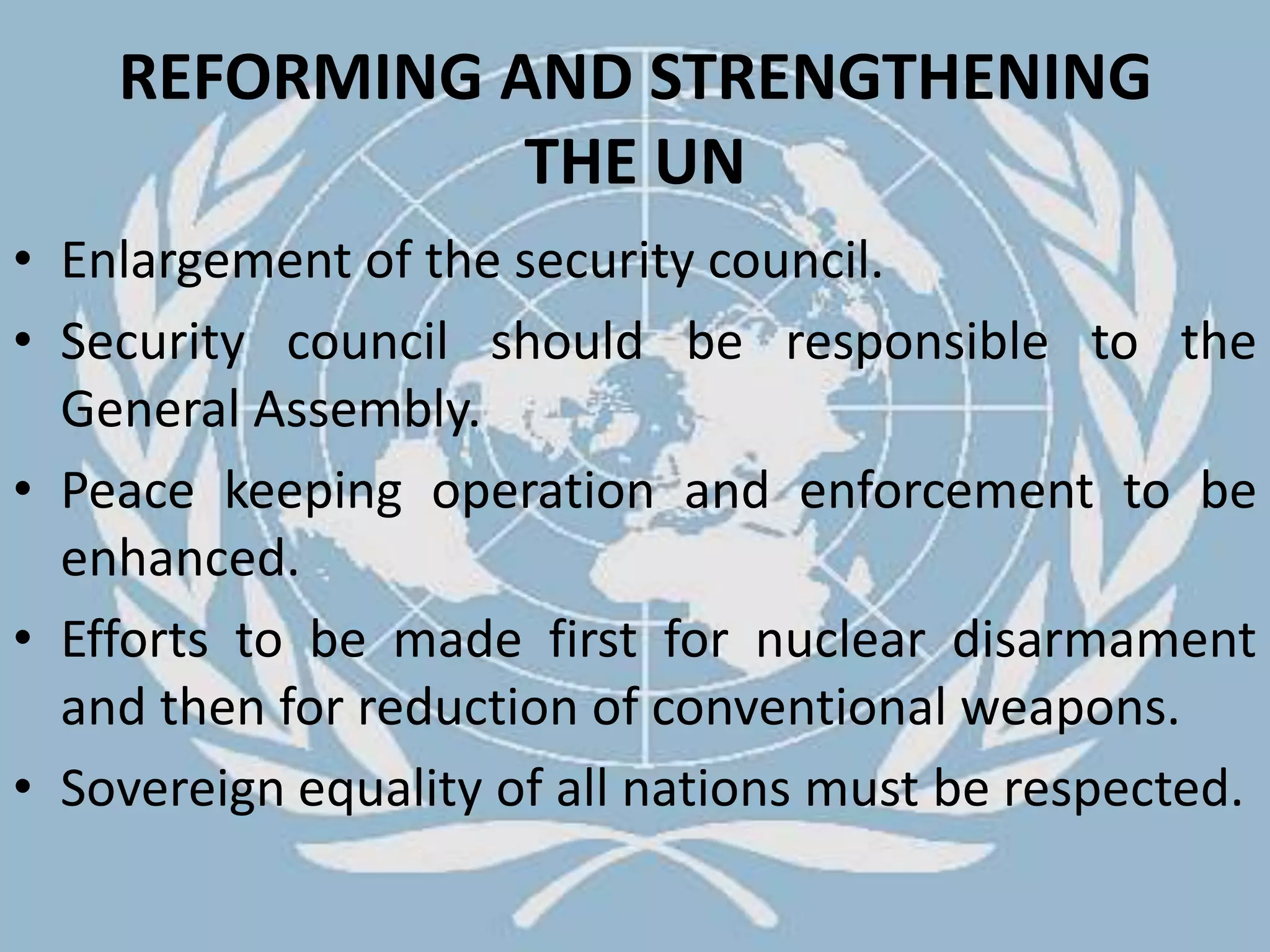
    REFORMING AND STRENGTHENINGTHE UNEnlargement of the security council.Security council should be responsible to the General Assembly.Peace keeping operation and enforcement to be enhanced.Efforts to be made first for nuclear disarmament and then for reduction of conventional weapons.Sovereign equality of all nations must be respected.
  • 31.

Editor's Notes