Shanghai Cooperation Organization
Origins and Perspectives
Lukáš Visingr
BSS 457 Regionalization of Security
Contents
1. History
2. Membership
3. Structure
4. Activities
5. SWOT analysis
6. Conclusions
Russian: Шанхайская организация сотрудничества
Chinese: 上海合作 (Shanghai Hezuo Zuzhi)
1. History
• 1996: Treaty on Deepening Military Trust in Border Regions, so-
called „Shanghai Five“ (RF, PRC, Kaz., Kyr., Taj.)
• 1997: Treaty on Reduction of Military Forces in Border Regions
• 2001: Shanghai Cooperation Organization (with Uzb.), Treaty of
Good-Neighbourliness and Friendly Cooperation (RF, PRC)
• 2002: Shanghai Cooperation Organization Charter
• 2003: proposal of free-trade area (by PRC)
• 2004: Regional Anti-Terrorist Structure
• 2005: USA urged to set a timetable for withdrawing their forces
from SCO members, observer status refused
• 2007: agreement with CSTO to broaden cooperation
2. Membership
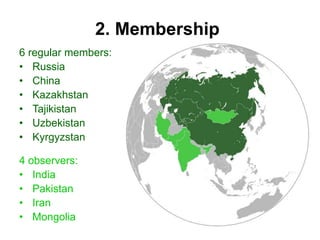
6 regular members:
• Russia
• China
• Kazakhstan
• Tajikistan
• Uzbekistan
• Kyrgyzstan
4 observers:
• India
• Pakistan
• Iran
• Mongolia
2. Membership
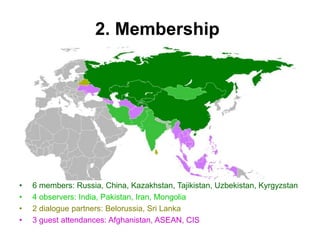
• 6 members: Russia, China, Kazakhstan, Tajikistan, Uzbekistan, Kyrgyzstan
• 4 observers: India, Pakistan, Iran, Mongolia
• 2 dialogue partners: Belorussia, Sri Lanka
• 3 guest attendances: Afghanistan, ASEAN, CIS
2. Membership
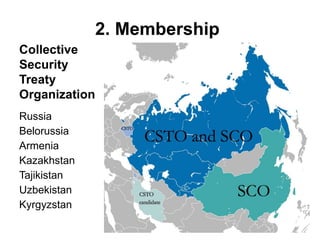
Collective
Security
Treaty
Organization
Russia
Belorussia
Armenia
Kazakhstan
Tajikistan
Uzbekistan
Kyrgyzstan
3. Structure
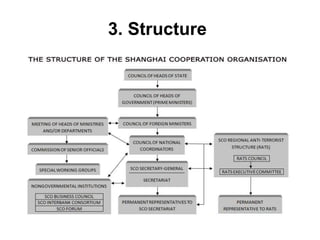
• The Council of Heads of State (annual summits in capitals)
• The Council of Heads of Government (annual summits)
• The Council of Foreign Ministers (regular meetings)
• The Council of National Coordinators (multilateral cooperation)
• The Secretariat of the SCO (primary executive organ)
• The Regional Anti-Terrorist Structure (permanent organ)
• Non-governmental institutions: SCO Business Council, SCO
Interbank Consortium, SCO Forum
3. Structure
4. Activities
SECURITY COOPERATION:
• Shift from border security issues to broader cooperation
in stabilizing the Central Asia
• The official goal is to counter „three evils“ of terrorism,
separatism and extremism
• Although the SCO declares no intentions to become a
military bloc, full-scale involvement of military forces is
seen as a necessary tool
• Joint military exercises; however, the Russian-Chinese
Peace Mission exercises are held outside of the SCO
4. Activities
ECONOMIC COOPERATION:
• Trade: Chinese proposal of free-trade area
• Finances: Interbank Consortium, actions against global
financial crisis (Chinese loans)
• Energy: joint resources projects (oil, gas, water)
CULTURAL COOPERATION:
• Arts, festivals, exhibitions… (mainly symbolic)
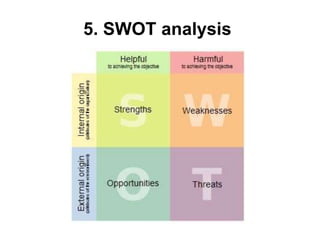
5. SWOT analysis
5. SWOT analysis
STRENGTHS:
• Gigantic potential: area over 30 million km2, population
over 1,5 milliard people, GDP almost 10 billion USD
• Enormous natural resources of Russia and Central Asia
• Strong national economy of China
• Powerful military forces of Russia and China
5. SWOT analysis
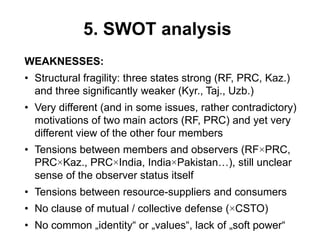
WEAKNESSES:
• Structural fragility: three states strong (RF, PRC, Kaz.)
and three significantly weaker (Kyr., Taj., Uzb.)
• Very different (and in some issues, rather contradictory)
motivations of two main actors (RF, PRC) and yet very
different view of the other four members
• Tensions between members and observers (RF×PRC,
PRC×Kaz., PRC×India, India×Pakistan…), still unclear
sense of the observer status itself
• Tensions between resource-suppliers and consumers
• No clause of mutual / collective defense (×CSTO)
• No common „identity“ or „values“, lack of „soft power“
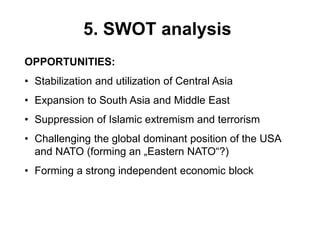
5. SWOT analysis
OPPORTUNITIES:
• Stabilization and utilization of Central Asia
• Expansion to South Asia and Middle East
• Suppression of Islamic extremism and terrorism
• Challenging the global dominant position of the USA
and NATO (forming an „Eastern NATO“?)
• Forming a strong independent economic block
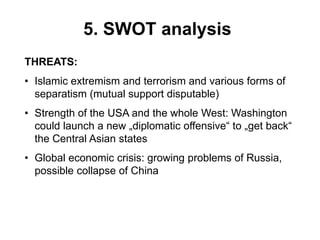
5. SWOT analysis
THREATS:
• Islamic extremism and terrorism and various forms of
separatism (mutual support disputable)
• Strength of the USA and the whole West: Washington
could launch a new „diplomatic offensive“ to „get back“
the Central Asian states
• Global economic crisis: growing problems of Russia,
possible collapse of China
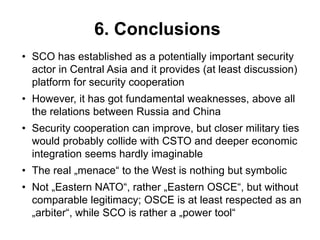
6. Conclusions
• SCO has established as a potentially important security
actor in Central Asia and it provides (at least discussion)
platform for security cooperation
• However, it has got fundamental weaknesses, above all
the relations between Russia and China
• Security cooperation can improve, but closer military ties
would probably collide with CSTO and deeper economic
integration seems hardly imaginable
• The real „menace“ to the West is nothing but symbolic
• Not „Eastern NATO“, rather „Eastern OSCE“, but without
comparable legitimacy; OSCE is at least respected as an
„arbiter“, while SCO is rather a „power tool“
Main sources
• Cohen, A.: Competition over Eurasia: Are the U.S. and Russia on a
Collision Course?, on-line text
(http://www.heritage.org/Research/RussiaandEurasia/hl901.cfm).
• Cohen, A.: The Russia-China Friendship and Cooperation Treaty: A
Strategic Shift in Eurasia?, on-line text
(http://www.heritage.org/Research/RussiaandEurasia/BG1459.cfm).
• Horák, S.: Rusko a Střední Asie po rozpadu SSSR, Praha: Univerzita
Karlova – Nakladatelství Karolinum 2008.
• Shanghai Cooperation Organization, WWW site (http://www.sectsco.org/).
• Sznajder, A. P.: China’s Shanghai Cooperation Organisation Strategy, on-
line text (http://irps.ucsd.edu/assets/004/5367.pdf).
• Weitz, R.: SCO fails to solve its expansion dilemma, on-line text
(http://www.cacianalyst.org/?q=node/4697).

shanghai cooperation organization

  • 1.
    Shanghai Cooperation Organization Originsand Perspectives Lukáš Visingr BSS 457 Regionalization of Security
  • 2.
    Contents 1. History 2. Membership 3.Structure 4. Activities 5. SWOT analysis 6. Conclusions Russian: Шанхайская организация сотрудничества Chinese: 上海合作 (Shanghai Hezuo Zuzhi)
  • 3.
    1. History • 1996:Treaty on Deepening Military Trust in Border Regions, so- called „Shanghai Five“ (RF, PRC, Kaz., Kyr., Taj.) • 1997: Treaty on Reduction of Military Forces in Border Regions • 2001: Shanghai Cooperation Organization (with Uzb.), Treaty of Good-Neighbourliness and Friendly Cooperation (RF, PRC) • 2002: Shanghai Cooperation Organization Charter • 2003: proposal of free-trade area (by PRC) • 2004: Regional Anti-Terrorist Structure • 2005: USA urged to set a timetable for withdrawing their forces from SCO members, observer status refused • 2007: agreement with CSTO to broaden cooperation
  • 4.
    2. Membership 6 regularmembers: • Russia • China • Kazakhstan • Tajikistan • Uzbekistan • Kyrgyzstan 4 observers: • India • Pakistan • Iran • Mongolia
  • 5.
    2. Membership • 6members: Russia, China, Kazakhstan, Tajikistan, Uzbekistan, Kyrgyzstan • 4 observers: India, Pakistan, Iran, Mongolia • 2 dialogue partners: Belorussia, Sri Lanka • 3 guest attendances: Afghanistan, ASEAN, CIS
  • 6.
  • 7.
    3. Structure • TheCouncil of Heads of State (annual summits in capitals) • The Council of Heads of Government (annual summits) • The Council of Foreign Ministers (regular meetings) • The Council of National Coordinators (multilateral cooperation) • The Secretariat of the SCO (primary executive organ) • The Regional Anti-Terrorist Structure (permanent organ) • Non-governmental institutions: SCO Business Council, SCO Interbank Consortium, SCO Forum
  • 8.
  • 9.
    4. Activities SECURITY COOPERATION: •Shift from border security issues to broader cooperation in stabilizing the Central Asia • The official goal is to counter „three evils“ of terrorism, separatism and extremism • Although the SCO declares no intentions to become a military bloc, full-scale involvement of military forces is seen as a necessary tool • Joint military exercises; however, the Russian-Chinese Peace Mission exercises are held outside of the SCO
  • 10.
    4. Activities ECONOMIC COOPERATION: •Trade: Chinese proposal of free-trade area • Finances: Interbank Consortium, actions against global financial crisis (Chinese loans) • Energy: joint resources projects (oil, gas, water) CULTURAL COOPERATION: • Arts, festivals, exhibitions… (mainly symbolic)
  • 11.
  • 12.
    5. SWOT analysis STRENGTHS: •Gigantic potential: area over 30 million km2, population over 1,5 milliard people, GDP almost 10 billion USD • Enormous natural resources of Russia and Central Asia • Strong national economy of China • Powerful military forces of Russia and China
  • 13.
    5. SWOT analysis WEAKNESSES: •Structural fragility: three states strong (RF, PRC, Kaz.) and three significantly weaker (Kyr., Taj., Uzb.) • Very different (and in some issues, rather contradictory) motivations of two main actors (RF, PRC) and yet very different view of the other four members • Tensions between members and observers (RF×PRC, PRC×Kaz., PRC×India, India×Pakistan…), still unclear sense of the observer status itself • Tensions between resource-suppliers and consumers • No clause of mutual / collective defense (×CSTO) • No common „identity“ or „values“, lack of „soft power“
  • 14.
    5. SWOT analysis OPPORTUNITIES: •Stabilization and utilization of Central Asia • Expansion to South Asia and Middle East • Suppression of Islamic extremism and terrorism • Challenging the global dominant position of the USA and NATO (forming an „Eastern NATO“?) • Forming a strong independent economic block
  • 15.
    5. SWOT analysis THREATS: •Islamic extremism and terrorism and various forms of separatism (mutual support disputable) • Strength of the USA and the whole West: Washington could launch a new „diplomatic offensive“ to „get back“ the Central Asian states • Global economic crisis: growing problems of Russia, possible collapse of China
  • 16.
    6. Conclusions • SCOhas established as a potentially important security actor in Central Asia and it provides (at least discussion) platform for security cooperation • However, it has got fundamental weaknesses, above all the relations between Russia and China • Security cooperation can improve, but closer military ties would probably collide with CSTO and deeper economic integration seems hardly imaginable • The real „menace“ to the West is nothing but symbolic • Not „Eastern NATO“, rather „Eastern OSCE“, but without comparable legitimacy; OSCE is at least respected as an „arbiter“, while SCO is rather a „power tool“
  • 17.
    Main sources • Cohen,A.: Competition over Eurasia: Are the U.S. and Russia on a Collision Course?, on-line text (http://www.heritage.org/Research/RussiaandEurasia/hl901.cfm). • Cohen, A.: The Russia-China Friendship and Cooperation Treaty: A Strategic Shift in Eurasia?, on-line text (http://www.heritage.org/Research/RussiaandEurasia/BG1459.cfm). • Horák, S.: Rusko a Střední Asie po rozpadu SSSR, Praha: Univerzita Karlova – Nakladatelství Karolinum 2008. • Shanghai Cooperation Organization, WWW site (http://www.sectsco.org/). • Sznajder, A. P.: China’s Shanghai Cooperation Organisation Strategy, on- line text (http://irps.ucsd.edu/assets/004/5367.pdf). • Weitz, R.: SCO fails to solve its expansion dilemma, on-line text (http://www.cacianalyst.org/?q=node/4697).