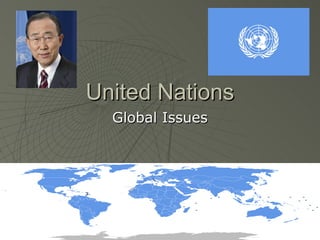
United Nations
  Global Issues
THE UNITED NATIONS
1.   How UN came into existence.
2.   Atlantic Charter.
3.   Declaration by United Nations.
4.   United Nations Day.
5.   Aim of UN
6.   Who/ What/ Where of UN
7.   Organs of UN
8.   Achievements
9.   India in UN
THE UNITED NATIONS
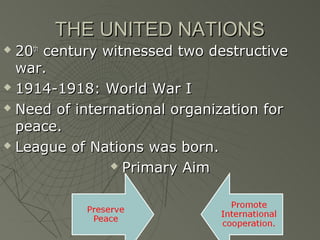
 20th century witnessed two destructive
  war.
 1914-1918: World War I

 Need of international organization for

  peace.
 League of Nations was born.

                 Primary Aim
THE UNITED NATIONS
 1939 – 45 World War II
 Most terrible. Towns cities were razed to

  ground.
 In this war atom bombs were used for

  the first time.
THE UNITED NATIONS
 During the course of war efforts were
  made to establish an international
  Organization.
 In the year 1941 British PM and US

  President met aboard battleship
  somewhere in Atlantic Ocean. This
  declaration came to be known as Atlantic
  Charter. They agreed that after war
  mankind must have some guaranteed
  basic rights.
THE UNITED NATIONS
   Four basic freedom :-

    1.    The freedom from want.
    2.   Freedom of speech.
    3.   Freedom of religious belief.
    4.   Freedom from fear.
United Nations Day
 1945 conference at Yalta in Russia.
 Membership was open to all peace loving

  states.
 1945 : In April, 50 nations met at San

  Francisco and on 26 June last day of
  conference UN Charter was signed.
 24 Oct. Charter came into force and this

  day was known as United Nation Day.
How the UN Works
   Established on 24 October 1945

   51 countries were committed to preserving
    peace through international cooperation

   UN Membership: 192 countries

   States agree to accept obligations of the
    UN Charter, an international treaty that sets out
    basic principles
How the UN Works
   According to the Charter the UN has 5
    basic principles:
    1. Maintain international peace and security

    2. Develop friendly relations among nations

    3. Cooperate in solving international problems
       and promote respect for human rights

    4. Be the center for harmonizing the actions of
       nations
    5. Save succeeding generations and humanity
       from war.
How the UN Works
   The UN is not a world government
   It does not make laws
   Large or small, rich or poor, and with
    differing political views and social
    systems:

    • All member states have a voice

    • All member states have a vote
W’s of UN
   Membership:

     1.   Peace loving nations. Ready to accept UN
          charter.

     2.   Admission made by General Assembly on
          recommendation of Security Council.

     3.   Members can be expelled by General
          Assembly on recommendation of Security
          Council.
W’s of UN
   Language:

     1.   French and English are commonly
          used language.

     2.   Official languages are E.F.R.C.A.S.

     3.   Speeches of delegates are translated
          in all these languages.
W’s of UN
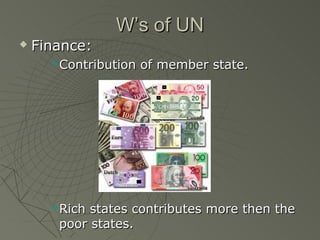
   Finance:
         Contribution of member state.


         Rich states contributes more then the
          poor states.
W’s of UN
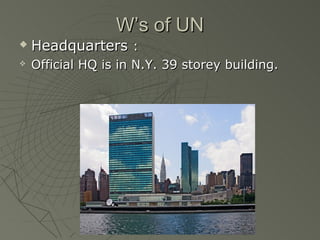
   Headquarters :
   Official HQ is in N.Y. 39 storey building.
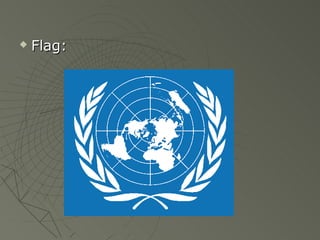
   Flag:
Main Bodies
   General Assembly (New York)
   Security Council (NY)
   Economic and Social Council (NY)
   Trusteeship Council (NY)
   Secretariat (NY)
   International Court of Justice (Netherlands)
General Assembly
   The main deliberative organ of the UN
   Composed of all member states
   Each member has one vote.
   Decisions on important issues require two
    thirds majority vote
    •   Peace and Security
    •   Admissions of new members
    •   Budget matters
   Decisions on other issues: simple majority
Functions and Powers
   Maintain international peace and security
   Make recommendations to the Security council
   Promote international political cooperation
   Promote human rights
   Over see international collaboration in the
    economic, social, humanitarian, cultural, and
    educational and health fields
Functions and Powers
   Receive and consider reports from the Security
    Council and other UN organs

   Consider and approve UN budget

   Establish financial assessments of Member
    States

   Appoint Secretary General
Security Council
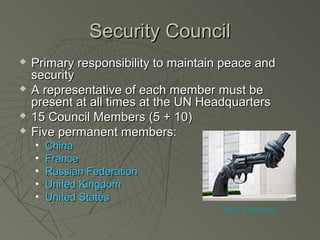
   Primary responsibility to maintain peace and
    security
   A representative of each member must be
    present at all times at the UN Headquarters
   15 Council Members (5 + 10)
   Five permanent members:
    •   China
    •   France
    •   Russian Federation
    •   United Kingdom
    •   United States
                                     “Non Violence”
Security Council

   Permanent member enjoys veto power.

   The Council makes recommendations to the
    General Assembly on:
    • appointment of Secretary General
    • admission of new Members to the UN
The composition of the Security Council
 does not reflect present day realities

   Britain and France are members of the
    Security Council only because they were
    victors in World War 2. Should they still be
    there?
   Similarly, Japan, the world’s second largest
    economy is not a Security Council member.
   Efforts to expand Security Council
    membership have failed because countries
    cannot decide on how it should be done.
   Probable candidates: Japan, India, Brazil and
    one African country (Nigeria?)
In more than 50 years, the UN Security
Council has only authorized military action in
            the following cases
 Korea
 Somalia

 Bosnia

 Gulf War

 In all these cases different countries

  have undertaken military action with
  the permission of the UN. The UN
  itself has not gone to war
Typical UN operations are peacekeeping not
                   war fighting

   These operations usually come into effect
    once a war is over
   They monitor ceasefires, and help to maintain
    a buffer between the warring parties
   The peacekeepers are there at the request of
    the warring parties
   Their main role is to calm things and build
    confidence among the warring parties
   Soldiers from different countries are assigned
    to the UN, and are responsible to the United
    Nations, not their own countries
   The UN has no military force of its own, and
    is dependent on other countries to provide
    military forces
   The UN Charter requires countries to maintain
    a certain part of their forces for the use of the
    UN. This has never been done
   Instead of representing the world, the UN is
    often pushed into becoming an instrument of
    its most powerful members
Economic and Social Council
   Council has 54 members

    • Elected by the General Assembly
    • Three year terms

   Serves as central forum for discussing
    international economic and social issues
Economic and Social Council
   This Council is responsible for:
    • Promoting higher standards of living
    • Full employment
    • Economic and social progress
    • Identifying solutions to international economic,
      social and health problems
    • Facilitating international cultural and
      educational cooperation
    • Encourage universal respect for human rights
      and fundamental freedoms
Trusteeship Council
   Set up immediately after II World War.
   Supervise administration of territory which were
    under foreign rule ( Germany, Japan, Italy)
   Lead these territory towards self government or
    independence.
   11 states were under these all have attended
    independence.
   Now they meet if required.
   Suspended operation 1 Nov, 1994
   Palau: last remaining UN trust territory
International Court of Justice
 Hears cases involving legal disputes
  among governments
 Clarifies questions of international law

 Interprets the UN Charter

 Composed of 15 judges, elected to office

  for 9 year terms by UN GA&SC
 Official languages are English and French
International Court of Justice
 No two judges can be of the same
  nationality.
 They can be re-elected.

 The court elects its President and Vice

  President for 3 yrs. Can be re-elected.
 It acts only if both the parties agrees to

  go.
Secretariat
 Main administrative organ.
 Head Secretary General.

 Carry out diverse day to day work of the

  UN
 Survey economic and social trends

 Prepare studies on human rights and

  sustainable development
 Inform the media about work of the UN
Secretariat
 Organize international conferences
 Interpret speeches

 Translate documents

 Staff 16000 under a regular budget

  from some 170 countries
 Take oath not to seek or receive

  instructions from any government
Specialized Agencies
   Linked to the UN but remain autonomous
    (independent)
   ILO – International Labor Organization: improve
    working conditions and employment agencies
   WHO – World Health Organization: solve health
    problems, health education, immunizations
   The World Bank – provides loans and economic
    assistance to nations
   WTO – World Trade Organization: oversees
    world trade
India and the UN
   India is the original member of UN
   India has always supported its policies.
   Helped countries to gain freedom.
    •   Indonesia
    •   Libya
    •   Malaysia
    •   Tunisia
    •   Ghana
    •   Morocco
    •   Algeria
    •   Bangladesh
India and the UN
   Admit new members to UN
   Supported admission of China
   Always opposed racial discrimination.
   Leading role in conferences on
    disarmament.
   Chairman for the supervision of the truce
    in Indo-China.
   Arranged for the repatriation for the
    prisoners of the war. (Korea)
India and the UN
   Despite the setting up of the UN, world is
    split up into two power blocs and has
    resulted in signing of many pacts.
   India tries to bridge the gap between
    these    two    blocs   and   safeguarded
    international peace.

United nations for students

  • 1.
    United Nations Global Issues
  • 2.
    THE UNITED NATIONS 1. How UN came into existence. 2. Atlantic Charter. 3. Declaration by United Nations. 4. United Nations Day. 5. Aim of UN 6. Who/ What/ Where of UN 7. Organs of UN 8. Achievements 9. India in UN
  • 3.
    THE UNITED NATIONS 20th century witnessed two destructive war.  1914-1918: World War I  Need of international organization for peace.  League of Nations was born.  Primary Aim
  • 4.
    THE UNITED NATIONS 1939 – 45 World War II  Most terrible. Towns cities were razed to ground.  In this war atom bombs were used for the first time.
  • 5.
    THE UNITED NATIONS During the course of war efforts were made to establish an international Organization.  In the year 1941 British PM and US President met aboard battleship somewhere in Atlantic Ocean. This declaration came to be known as Atlantic Charter. They agreed that after war mankind must have some guaranteed basic rights.
  • 6.
    THE UNITED NATIONS  Four basic freedom :- 1. The freedom from want. 2. Freedom of speech. 3. Freedom of religious belief. 4. Freedom from fear.
  • 7.
    United Nations Day 1945 conference at Yalta in Russia.  Membership was open to all peace loving states.  1945 : In April, 50 nations met at San Francisco and on 26 June last day of conference UN Charter was signed.  24 Oct. Charter came into force and this day was known as United Nation Day.
  • 8.
    How the UNWorks  Established on 24 October 1945  51 countries were committed to preserving peace through international cooperation  UN Membership: 192 countries  States agree to accept obligations of the UN Charter, an international treaty that sets out basic principles
  • 9.
    How the UNWorks  According to the Charter the UN has 5 basic principles: 1. Maintain international peace and security 2. Develop friendly relations among nations 3. Cooperate in solving international problems and promote respect for human rights 4. Be the center for harmonizing the actions of nations 5. Save succeeding generations and humanity from war.
  • 10.
    How the UNWorks  The UN is not a world government  It does not make laws  Large or small, rich or poor, and with differing political views and social systems: • All member states have a voice • All member states have a vote
  • 11.
    W’s of UN  Membership: 1. Peace loving nations. Ready to accept UN charter. 2. Admission made by General Assembly on recommendation of Security Council. 3. Members can be expelled by General Assembly on recommendation of Security Council.
  • 12.
    W’s of UN  Language: 1. French and English are commonly used language. 2. Official languages are E.F.R.C.A.S. 3. Speeches of delegates are translated in all these languages.
  • 13.
    W’s of UN  Finance:  Contribution of member state.  Rich states contributes more then the poor states.
  • 14.
    W’s of UN  Headquarters :  Official HQ is in N.Y. 39 storey building.
  • 15.
    Flag:
  • 16.
    Main Bodies  General Assembly (New York)  Security Council (NY)  Economic and Social Council (NY)  Trusteeship Council (NY)  Secretariat (NY)  International Court of Justice (Netherlands)
  • 17.
    General Assembly  The main deliberative organ of the UN  Composed of all member states  Each member has one vote.  Decisions on important issues require two thirds majority vote • Peace and Security • Admissions of new members • Budget matters  Decisions on other issues: simple majority
  • 18.
    Functions and Powers  Maintain international peace and security  Make recommendations to the Security council  Promote international political cooperation  Promote human rights  Over see international collaboration in the economic, social, humanitarian, cultural, and educational and health fields
  • 19.
    Functions and Powers  Receive and consider reports from the Security Council and other UN organs  Consider and approve UN budget  Establish financial assessments of Member States  Appoint Secretary General
  • 20.
    Security Council  Primary responsibility to maintain peace and security  A representative of each member must be present at all times at the UN Headquarters  15 Council Members (5 + 10)  Five permanent members: • China • France • Russian Federation • United Kingdom • United States “Non Violence”
  • 21.
    Security Council  Permanent member enjoys veto power.  The Council makes recommendations to the General Assembly on: • appointment of Secretary General • admission of new Members to the UN
  • 22.
    The composition ofthe Security Council does not reflect present day realities  Britain and France are members of the Security Council only because they were victors in World War 2. Should they still be there?  Similarly, Japan, the world’s second largest economy is not a Security Council member.  Efforts to expand Security Council membership have failed because countries cannot decide on how it should be done.  Probable candidates: Japan, India, Brazil and one African country (Nigeria?)
  • 23.
    In more than50 years, the UN Security Council has only authorized military action in the following cases  Korea  Somalia  Bosnia  Gulf War  In all these cases different countries have undertaken military action with the permission of the UN. The UN itself has not gone to war
  • 24.
    Typical UN operationsare peacekeeping not war fighting  These operations usually come into effect once a war is over  They monitor ceasefires, and help to maintain a buffer between the warring parties  The peacekeepers are there at the request of the warring parties  Their main role is to calm things and build confidence among the warring parties  Soldiers from different countries are assigned to the UN, and are responsible to the United Nations, not their own countries
  • 25.
    The UN has no military force of its own, and is dependent on other countries to provide military forces  The UN Charter requires countries to maintain a certain part of their forces for the use of the UN. This has never been done  Instead of representing the world, the UN is often pushed into becoming an instrument of its most powerful members
  • 26.
    Economic and SocialCouncil  Council has 54 members • Elected by the General Assembly • Three year terms  Serves as central forum for discussing international economic and social issues
  • 27.
    Economic and SocialCouncil  This Council is responsible for: • Promoting higher standards of living • Full employment • Economic and social progress • Identifying solutions to international economic, social and health problems • Facilitating international cultural and educational cooperation • Encourage universal respect for human rights and fundamental freedoms
  • 28.
    Trusteeship Council  Set up immediately after II World War.  Supervise administration of territory which were under foreign rule ( Germany, Japan, Italy)  Lead these territory towards self government or independence.  11 states were under these all have attended independence.  Now they meet if required.  Suspended operation 1 Nov, 1994  Palau: last remaining UN trust territory
  • 29.
    International Court ofJustice  Hears cases involving legal disputes among governments  Clarifies questions of international law  Interprets the UN Charter  Composed of 15 judges, elected to office for 9 year terms by UN GA&SC  Official languages are English and French
  • 30.
    International Court ofJustice  No two judges can be of the same nationality.  They can be re-elected.  The court elects its President and Vice President for 3 yrs. Can be re-elected.  It acts only if both the parties agrees to go.
  • 31.
    Secretariat  Main administrativeorgan.  Head Secretary General.  Carry out diverse day to day work of the UN  Survey economic and social trends  Prepare studies on human rights and sustainable development  Inform the media about work of the UN
  • 32.
    Secretariat  Organize internationalconferences  Interpret speeches  Translate documents  Staff 16000 under a regular budget from some 170 countries  Take oath not to seek or receive instructions from any government
  • 33.
    Specialized Agencies  Linked to the UN but remain autonomous (independent)  ILO – International Labor Organization: improve working conditions and employment agencies  WHO – World Health Organization: solve health problems, health education, immunizations  The World Bank – provides loans and economic assistance to nations  WTO – World Trade Organization: oversees world trade
  • 34.
    India and theUN  India is the original member of UN  India has always supported its policies.  Helped countries to gain freedom. • Indonesia • Libya • Malaysia • Tunisia • Ghana • Morocco • Algeria • Bangladesh
  • 35.
    India and theUN  Admit new members to UN  Supported admission of China  Always opposed racial discrimination.  Leading role in conferences on disarmament.  Chairman for the supervision of the truce in Indo-China.  Arranged for the repatriation for the prisoners of the war. (Korea)
  • 36.
    India and theUN  Despite the setting up of the UN, world is split up into two power blocs and has resulted in signing of many pacts.  India tries to bridge the gap between these two blocs and safeguarded international peace.