SONO, PHOTOAND SONOPHOTOCATALYTIC
DECONTAMINATION OFORGANIC
POLLUTANTS IN WATER: INVESTIGATIONS
ON THE LACK OFCORRELATION BETWEEN
THE POLLUTANT DEGRADATIONAND
CONCURRENTLYFORMED H2O2
School of Environmental Studies
Cochin University of Science and Technology
Kochi-682022, Kerala, India.
JYOTHI K P, SUGUNA YESODHARAN,
YESODHARAN E P*
Advanced Oxidation Process
• Advanced oxidation processes (AOPs) are those processes
which are based on production and utilization of hydroxyl
radicals.
• AOPs are very efficient methods for destruction and
mineralization of recalcitrant organic compounds in industrial
effluents.
• They act through the use of free radicals, particularly reactive
•OH. These radicals are able to oxidize organic pollutants non-
selectively to form carbon dioxide (CO2), water (H2O) and
inorganic mineral salts.
• In order to generate more free radicals, various AOP
combination methods have been investigated and reported in
literature.
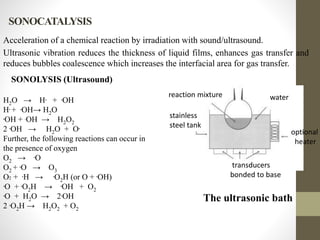
SONOCATALYSIS
Acceleration of a chemical reaction by irradiation with sound/ultrasound.
Ultrasonic vibration reduces the thickness of liquid films, enhances gas transfer and
reduces bubbles coalescence which increases the interfacial area for gas transfer.
SONOLYSIS (Ultrasound)
H2O → H. + .OH
H. + .OH→ H2O
.OH + .OH → H2O2
2 .OH → H2O + O.
Further, the following reactions can occur in
the presence of oxygen
O2 → .O
O2 + .O → O3
O2 + .H → .O2H (or O + .OH)
.O + .O2H → .OH + O2
.O + H2O → 2.OH
2 .O2H → H2O2 + O2
reaction mixture water
stainless
steel tank
optional
heater
transducers
bonded to base
The ultrasonic bath
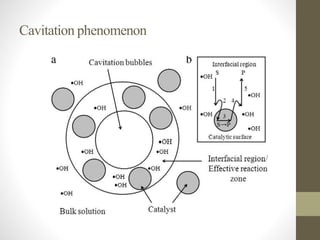
Cavitation phenomenon
e-
+
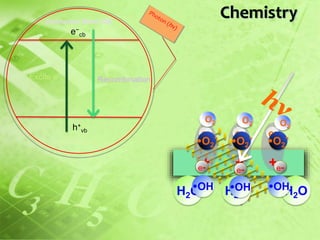
Chemistry
O2
e-
+
e-
+
O2 O2
O2
- O2
- O2
-
H2O H2O H2O
e- e- e-
OH OH OH
Conduction Band (CB)
Valence Band (VB)
e−
cb
h+
vb
Excite e-
Recombination
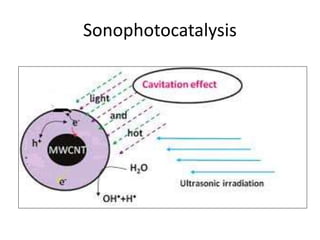
Sonophotocatalysis
US UV US+UV
0
20
40
60
80
%
Degradation
of
phenol
[ZnO] : 100mg/L
[Phenol] : 40mg/L
pH : 5.5
Time : 2 hr
Fig 1: Sono, Photo and Sonophotocatalytic degradation
of phenol in presence of ZnO
0 30 60 90 120 150 180
0
5
10
15
20
25
30
Conc
of
H
2
O
2
(mg/L)
Time(min)
US
UV
US+UV
[ZnO] : 100 mg/L
[Phenol] : 40 mg/L
pH : 5.5
Fig 2: Concentration of H2O2 during the Sono, Photo and Sonophotocatalytic
degradation of phenol in presence of ZnO
0.00 0.05 0.10 0.15 0.20 0.25
10
20
30
40
50
60
70
80
90
%
Degradation
of
phenol
ZnO loading(g/L)
US
UV
US+UV
[Phenol]: 40 mg/L
pH : 5.5
Vol. : 50 mL
Time : 2 hr
Fig 3: Effect of catalyst loading on the Sono, Photo and Sonophotocatalytic
degradation of phenol in presence of ZnO
0 30 60 90 120 150 180
0
5
10
15
20
25
30
35
Conc.
of
H
2
O
2
(mg/L)
Time (min)
US
US+H2O2
UV
UV+H2O2
US+UV
US+UV+H2O2
[ZnO] : 100mg/L
[Phenol] : 40mg/L
[H2O2] : 15mg/L
pH : 5.5
Fig 4: Effect of added H2O2 on the net concentration of H2O2
under Sono, Photo and Sonophotocatalysis
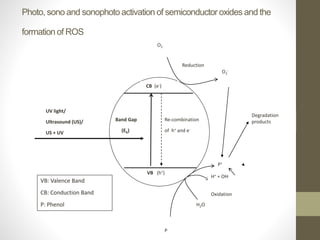
Photo, sono and sonophoto activation of semiconductor oxides and the
formation of ROS
O2
VB (h+)
CB (e-)
Band Gap
(Eb)
Re-combination
of h+ and e-
UV light/
Ultrasound (US)/
US + UV
O2
-
Reduction
Oxidation
P+
H2O
H+ + OH.
Degradation
products
P
VB: Valence Band
CB: Conduction Band
P: Phenol
Conclusion
• Sono-, photo- and sonophoto-catalytic degradation of phenol
in water in presence of ZnO generates H2O2 as an intermediate
as well as final product.
• The H2O2 thus formed undergoes concurrent decomposition
resulting in oscillation in its concentration in sonocatalysis and
photocatalysis ad stabilization in the case of
sonophotocatalysis.
• The oscillation is concentration-dependent with formation or
decomposition dominating at any point in time leading to
increase or decrease in its concentration.
• In the absence of sufficient concentration of oxygen, H2O2
itself functions as an electron acceptor and plays a significant
role in the overall degradation process.
Thank you for your attention
We welcome your questions, suggestions and comments!

Advanced Oxidation Process and Son Photo Catalysis

  • 1.
    SONO, PHOTOAND SONOPHOTOCATALYTIC DECONTAMINATIONOFORGANIC POLLUTANTS IN WATER: INVESTIGATIONS ON THE LACK OFCORRELATION BETWEEN THE POLLUTANT DEGRADATIONAND CONCURRENTLYFORMED H2O2 School of Environmental Studies Cochin University of Science and Technology Kochi-682022, Kerala, India. JYOTHI K P, SUGUNA YESODHARAN, YESODHARAN E P*
  • 2.
    Advanced Oxidation Process •Advanced oxidation processes (AOPs) are those processes which are based on production and utilization of hydroxyl radicals. • AOPs are very efficient methods for destruction and mineralization of recalcitrant organic compounds in industrial effluents. • They act through the use of free radicals, particularly reactive •OH. These radicals are able to oxidize organic pollutants non- selectively to form carbon dioxide (CO2), water (H2O) and inorganic mineral salts. • In order to generate more free radicals, various AOP combination methods have been investigated and reported in literature.
  • 3.
    SONOCATALYSIS Acceleration of achemical reaction by irradiation with sound/ultrasound. Ultrasonic vibration reduces the thickness of liquid films, enhances gas transfer and reduces bubbles coalescence which increases the interfacial area for gas transfer. SONOLYSIS (Ultrasound) H2O → H. + .OH H. + .OH→ H2O .OH + .OH → H2O2 2 .OH → H2O + O. Further, the following reactions can occur in the presence of oxygen O2 → .O O2 + .O → O3 O2 + .H → .O2H (or O + .OH) .O + .O2H → .OH + O2 .O + H2O → 2.OH 2 .O2H → H2O2 + O2 reaction mixture water stainless steel tank optional heater transducers bonded to base The ultrasonic bath
  • 4.
  • 5.
    e- + Chemistry O2 e- + e- + O2 O2 O2 - O2 -O2 - H2O H2O H2O e- e- e- OH OH OH Conduction Band (CB) Valence Band (VB) e− cb h+ vb Excite e- Recombination
  • 6.
  • 7.
    US UV US+UV 0 20 40 60 80 % Degradation of phenol [ZnO]: 100mg/L [Phenol] : 40mg/L pH : 5.5 Time : 2 hr Fig 1: Sono, Photo and Sonophotocatalytic degradation of phenol in presence of ZnO
  • 9.
    0 30 6090 120 150 180 0 5 10 15 20 25 30 Conc of H 2 O 2 (mg/L) Time(min) US UV US+UV [ZnO] : 100 mg/L [Phenol] : 40 mg/L pH : 5.5 Fig 2: Concentration of H2O2 during the Sono, Photo and Sonophotocatalytic degradation of phenol in presence of ZnO
  • 10.
    0.00 0.05 0.100.15 0.20 0.25 10 20 30 40 50 60 70 80 90 % Degradation of phenol ZnO loading(g/L) US UV US+UV [Phenol]: 40 mg/L pH : 5.5 Vol. : 50 mL Time : 2 hr Fig 3: Effect of catalyst loading on the Sono, Photo and Sonophotocatalytic degradation of phenol in presence of ZnO
  • 11.
    0 30 6090 120 150 180 0 5 10 15 20 25 30 35 Conc. of H 2 O 2 (mg/L) Time (min) US US+H2O2 UV UV+H2O2 US+UV US+UV+H2O2 [ZnO] : 100mg/L [Phenol] : 40mg/L [H2O2] : 15mg/L pH : 5.5 Fig 4: Effect of added H2O2 on the net concentration of H2O2 under Sono, Photo and Sonophotocatalysis
  • 12.
    Photo, sono andsonophoto activation of semiconductor oxides and the formation of ROS O2 VB (h+) CB (e-) Band Gap (Eb) Re-combination of h+ and e- UV light/ Ultrasound (US)/ US + UV O2 - Reduction Oxidation P+ H2O H+ + OH. Degradation products P VB: Valence Band CB: Conduction Band P: Phenol
  • 13.
    Conclusion • Sono-, photo-and sonophoto-catalytic degradation of phenol in water in presence of ZnO generates H2O2 as an intermediate as well as final product. • The H2O2 thus formed undergoes concurrent decomposition resulting in oscillation in its concentration in sonocatalysis and photocatalysis ad stabilization in the case of sonophotocatalysis. • The oscillation is concentration-dependent with formation or decomposition dominating at any point in time leading to increase or decrease in its concentration. • In the absence of sufficient concentration of oxygen, H2O2 itself functions as an electron acceptor and plays a significant role in the overall degradation process.
  • 14.
    Thank you foryour attention We welcome your questions, suggestions and comments!