Technical Aspects
and Sustainability
Aalto University
23.2.2015
• Real Estate Consulting
• Energy and Environment
• HVAC & Plumbing
• Building Controls
• Electrical
Granlund 500+ people
Leading building services expert in Finland
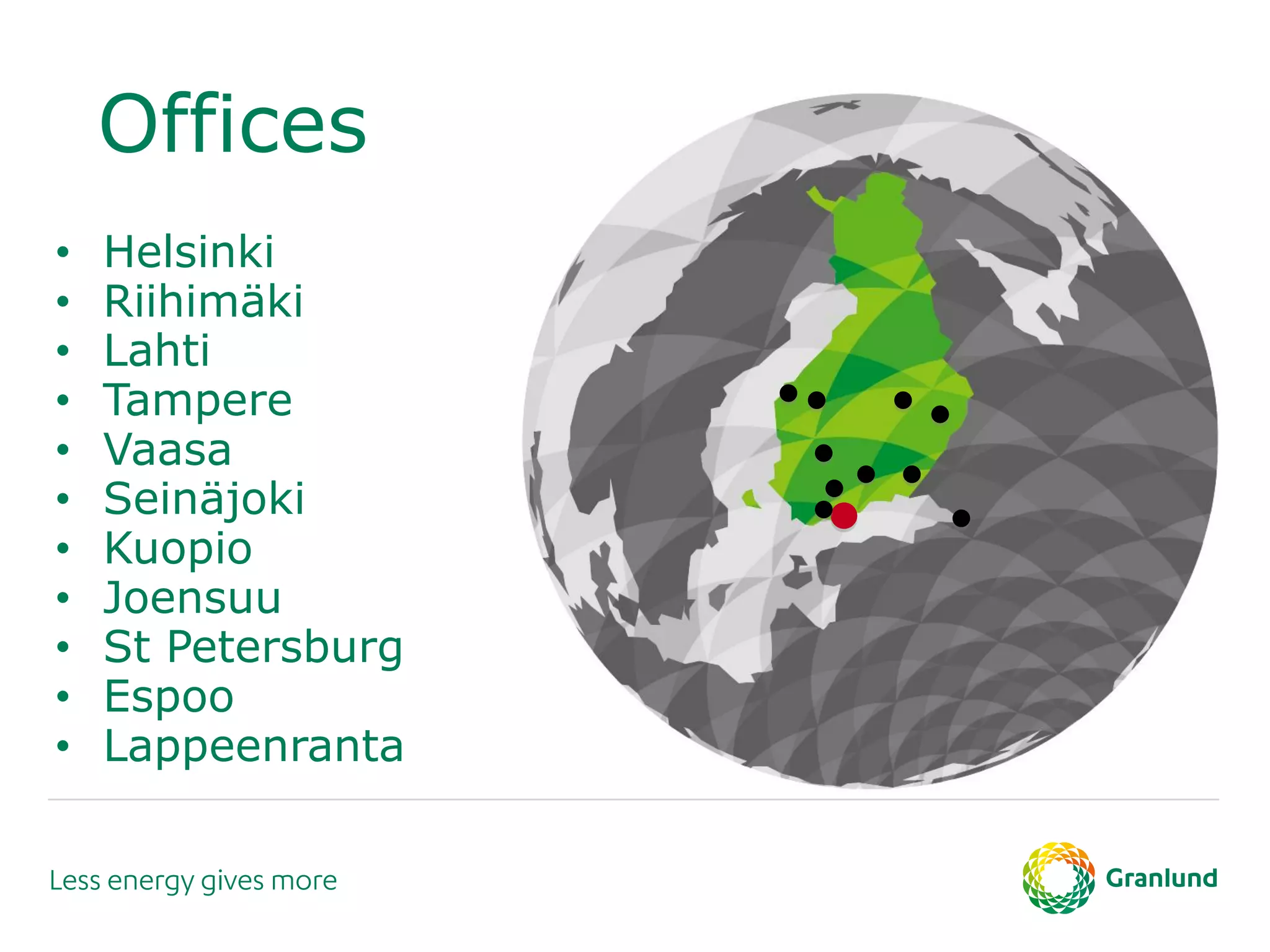
Offices
• Helsinki
• Riihimäki
• Lahti
• Tampere
• Vaasa
• Seinäjoki
• Kuopio
• Joensuu
• St Petersburg
• Espoo
• Lappeenranta
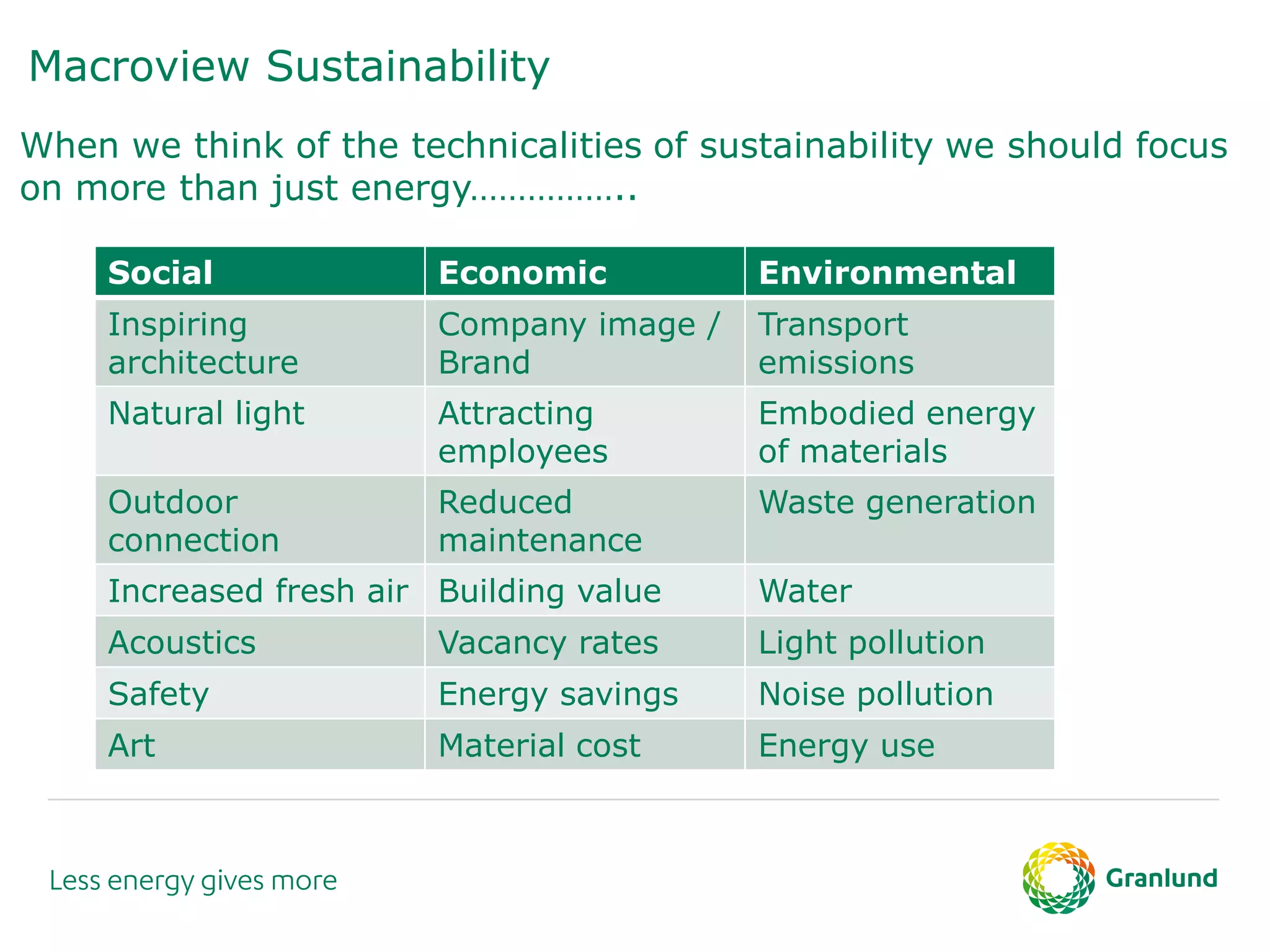
Macroview Sustainability
When we think of the technicalities of sustainability we should focus
on more than just energy……………..
Social Economic Environmental
Inspiring
architecture
Company image /
Brand
Transport
emissions
Natural light Attracting
employees
Embodied energy
of materials
Outdoor
connection
Reduced
maintenance
Waste generation
Increased fresh air Building value Water
Acoustics Vacancy rates Light pollution
Safety Energy savings Noise pollution
Art Material cost Energy use
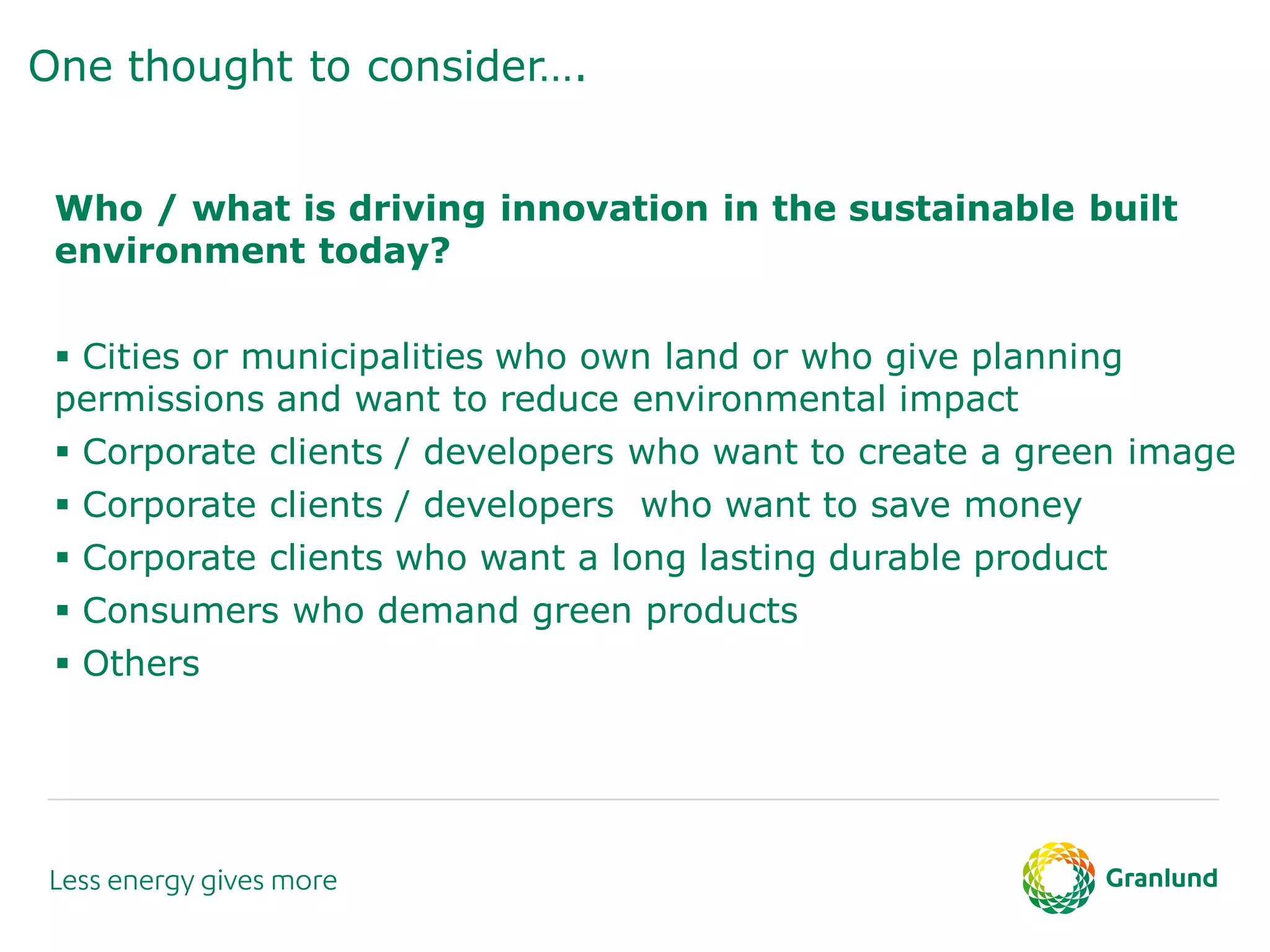
One thought to consider….
Who / what is driving innovation in the sustainable built
environment today?
 Cities or municipalities who own land or who give planning
permissions and want to reduce environmental impact
 Corporate clients / developers who want to create a green image
 Corporate clients / developers who want to save money
 Corporate clients who want a long lasting durable product
 Consumers who demand green products
 Others
Social Sustainabiliy:
Inspiration and Interaction
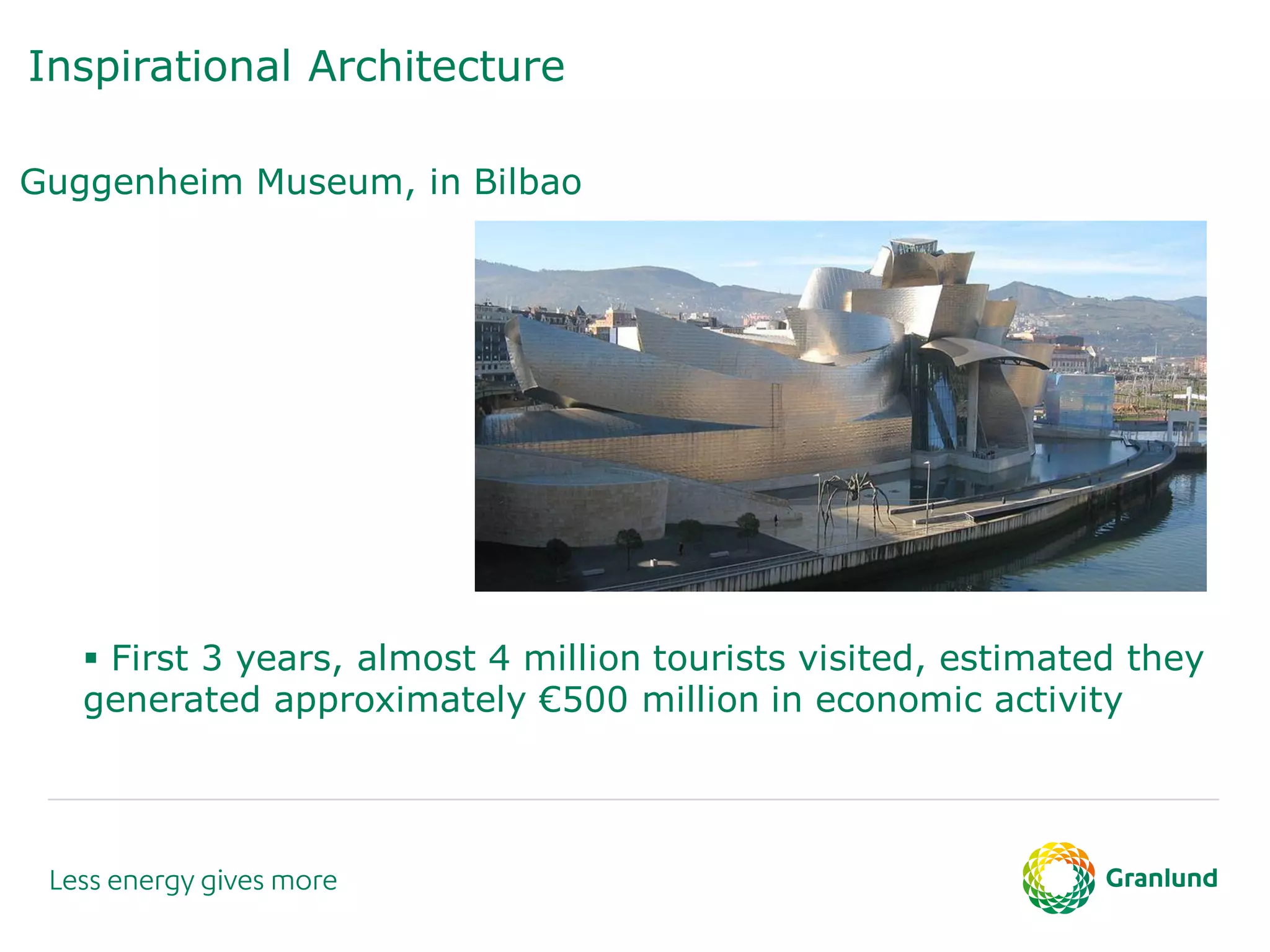
Inspirational Architecture
Guggenheim Museum, in Bilbao
 First 3 years, almost 4 million tourists visited, estimated they
generated approximately €500 million in economic activity
Community Interaction
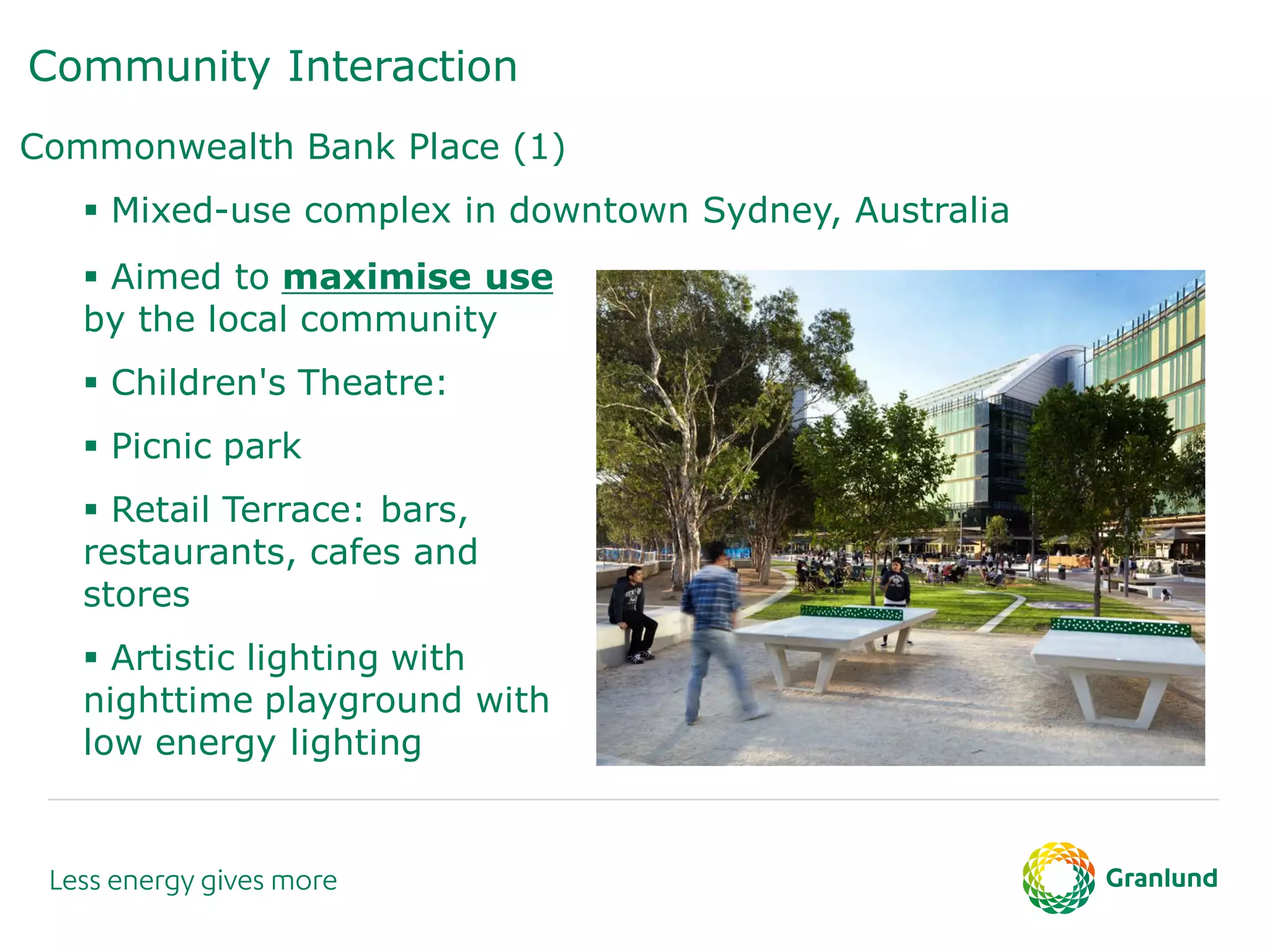
Commonwealth Bank Place (1)
 Mixed-use complex in downtown Sydney, Australia
 Aimed to maximise use
by the local community
 Children's Theatre:
 Picnic park
 Retail Terrace: bars,
restaurants, cafes and
stores
 Artistic lighting with
nighttime playground with
low energy lighting
Community Interaction
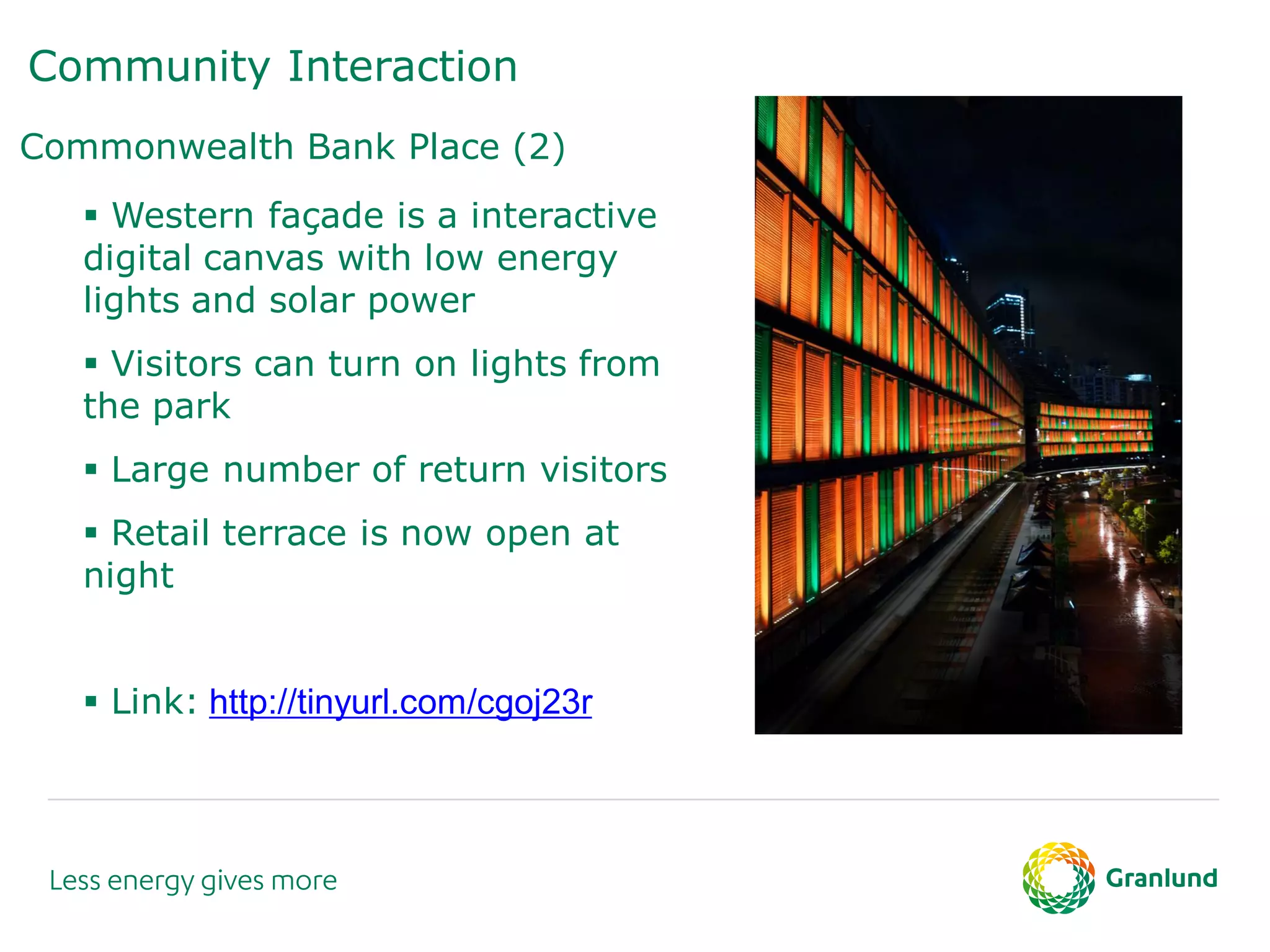
Commonwealth Bank Place (2)
 Western façade is a interactive
digital canvas with low energy
lights and solar power
 Visitors can turn on lights from
the park
 Large number of return visitors
 Retail terrace is now open at
night
 Link: http://tinyurl.com/cgoj23r
Maximise Use
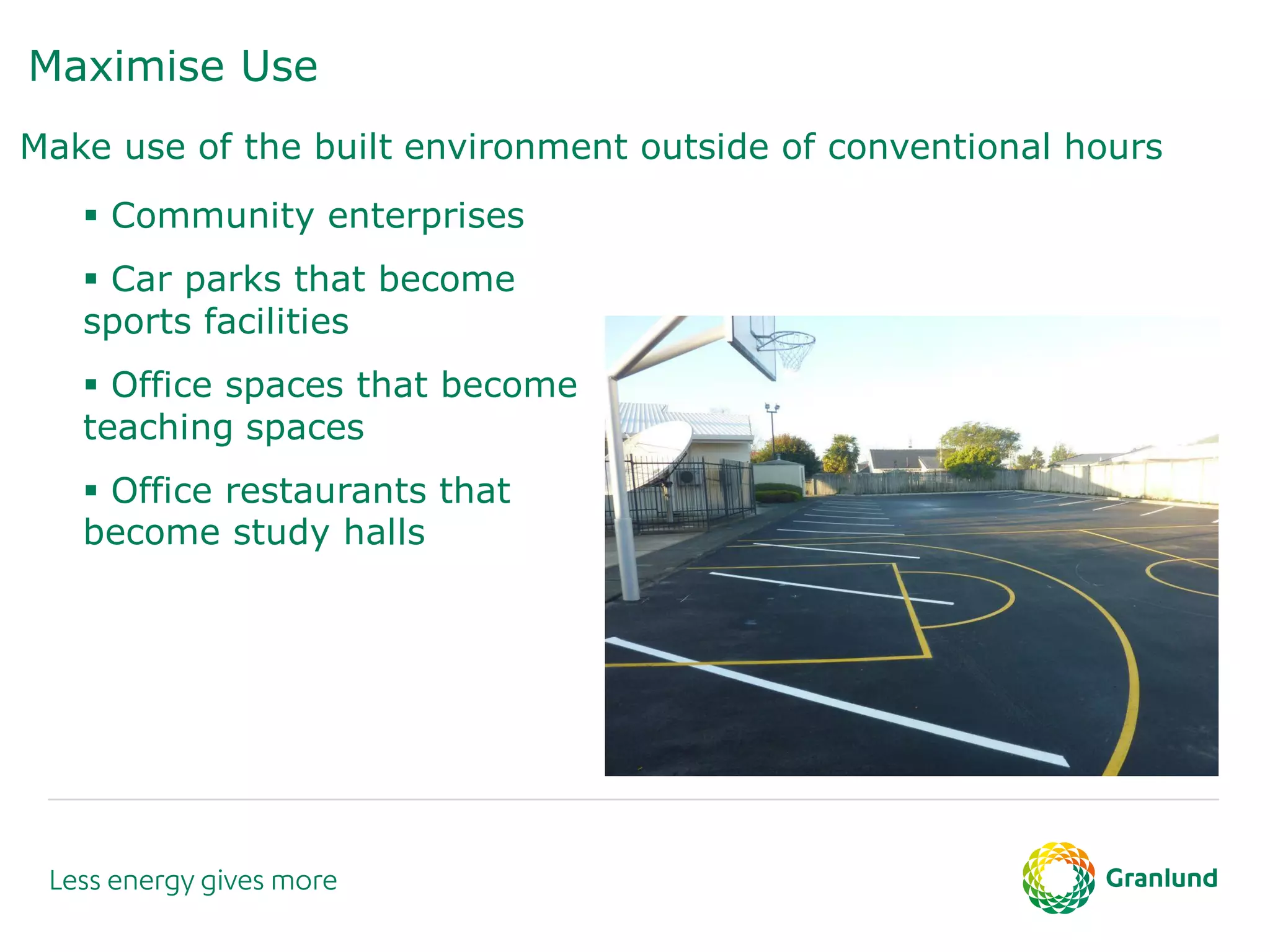
Make use of the built environment outside of conventional hours
 Community enterprises
 Car parks that become
sports facilities
 Office spaces that become
teaching spaces
 Office restaurants that
become study halls
Inspirational Architecture
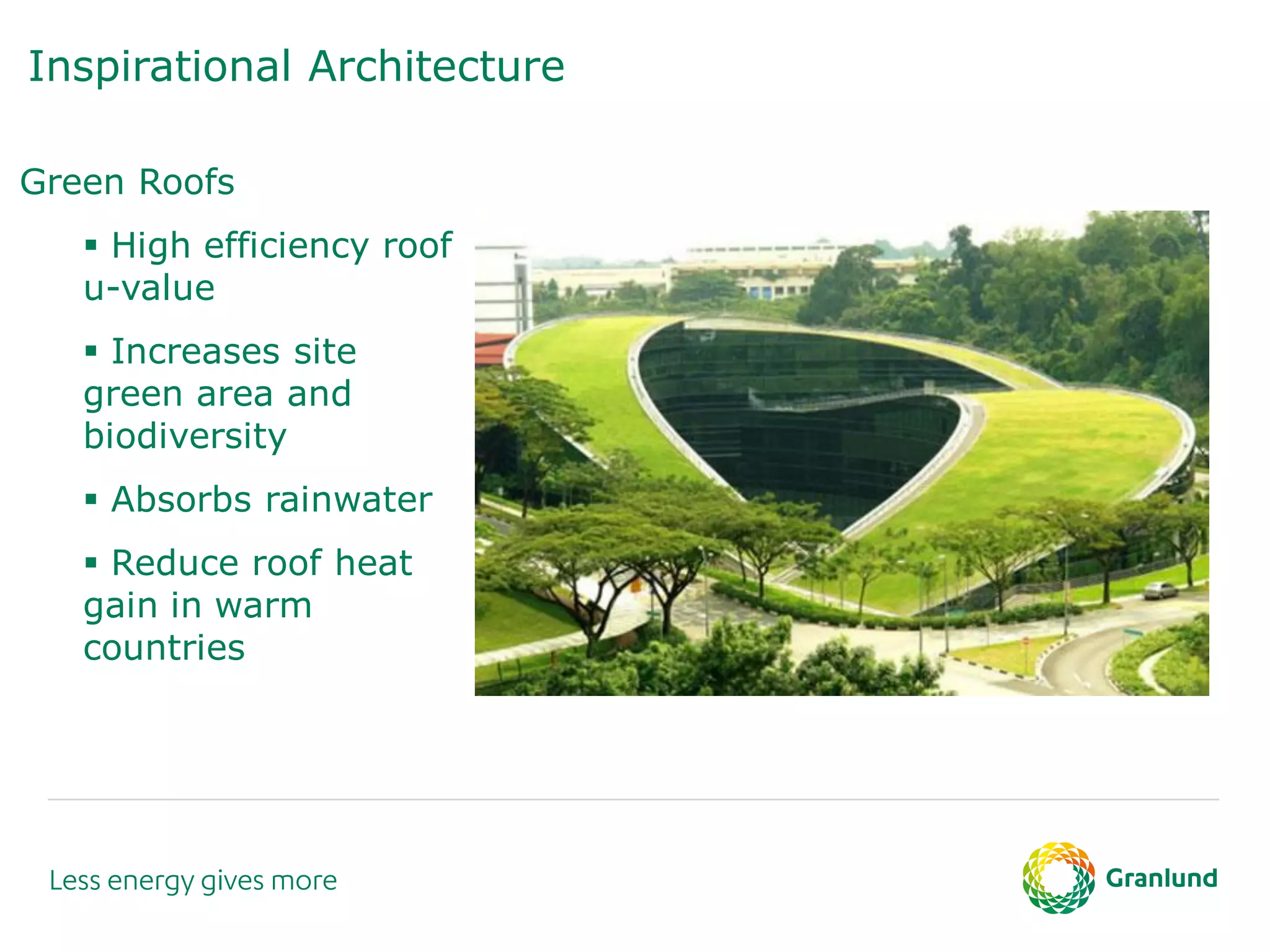
Green Roofs
 High efficiency roof
u-value
 Increases site
green area and
biodiversity
 Absorbs rainwater
 Reduce roof heat
gain in warm
countries
Simulation Technology:
Optimising Design
Passive & Social Sustainable Design
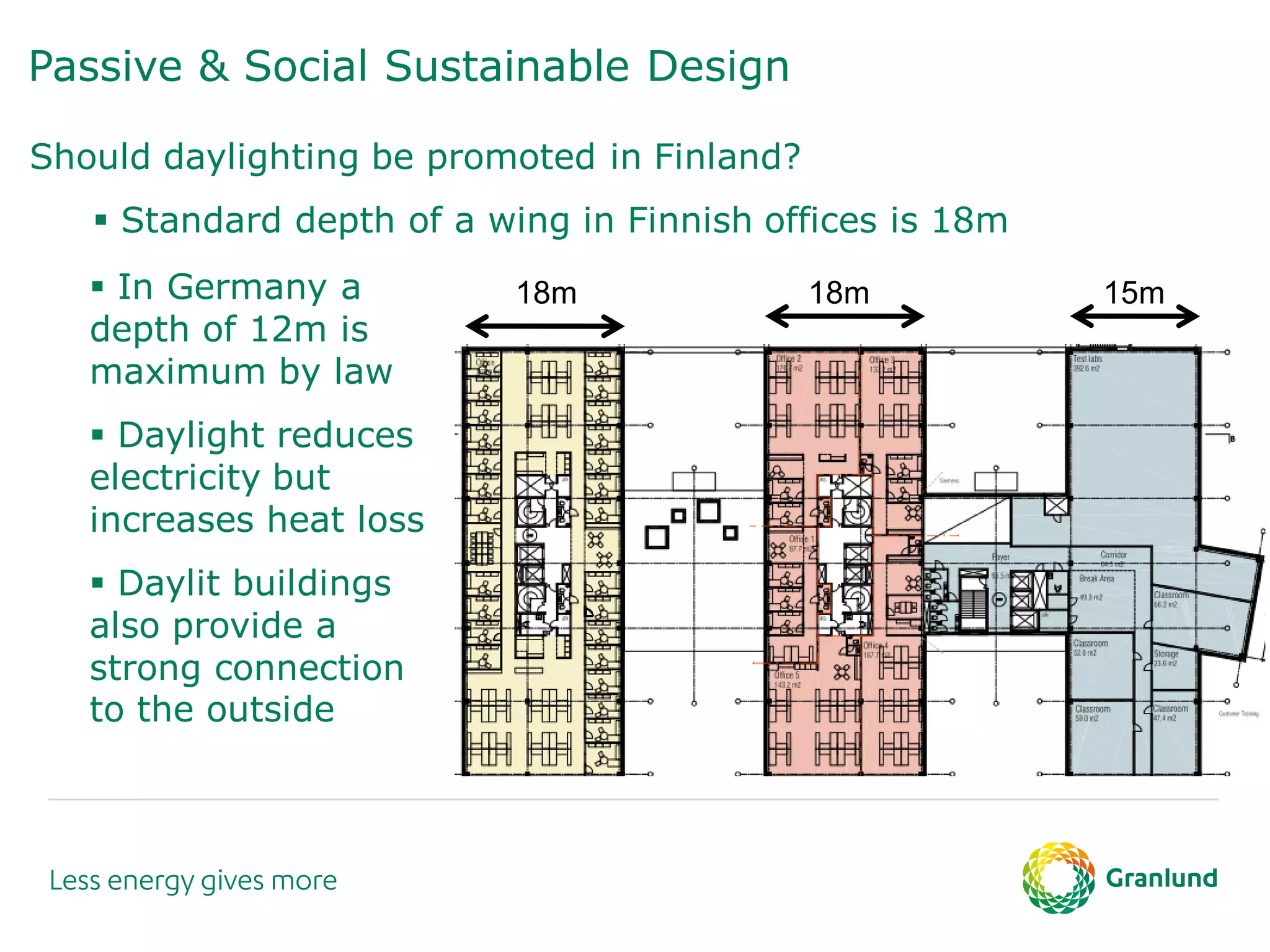
Should daylighting be promoted in Finland?
 Standard depth of a wing in Finnish offices is 18m
18m 18m 15m In Germany a
depth of 12m is
maximum by law
 Daylight reduces
electricity but
increases heat loss
 Daylit buildings
also provide a
strong connection
to the outside
Passive & Social Sustainable Design
Daylighting
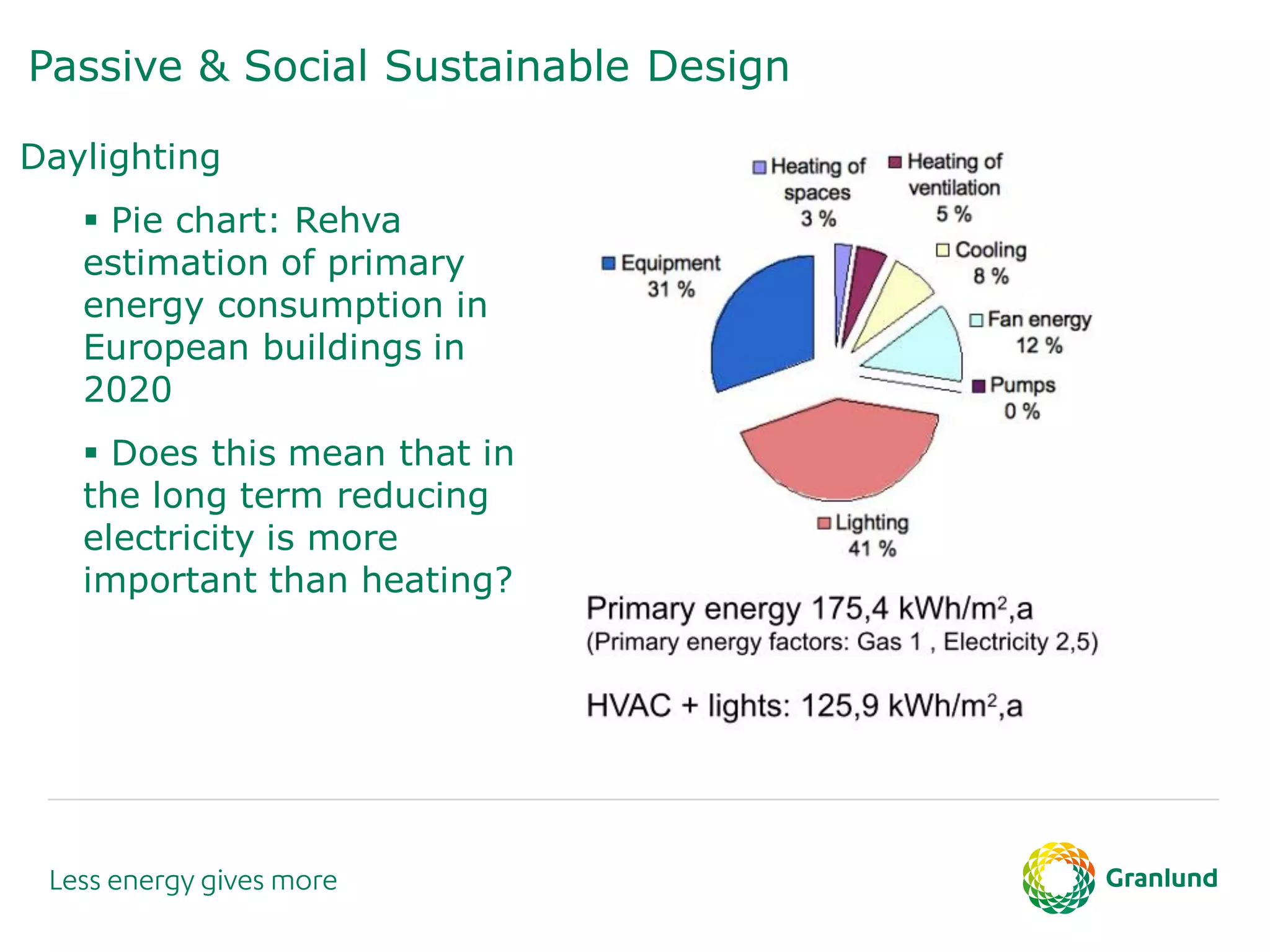
 Pie chart: Rehva
estimation of primary
energy consumption in
European buildings in
2020
 Does this mean that in
the long term reducing
electricity is more
important than heating?
Social Sustainable Design
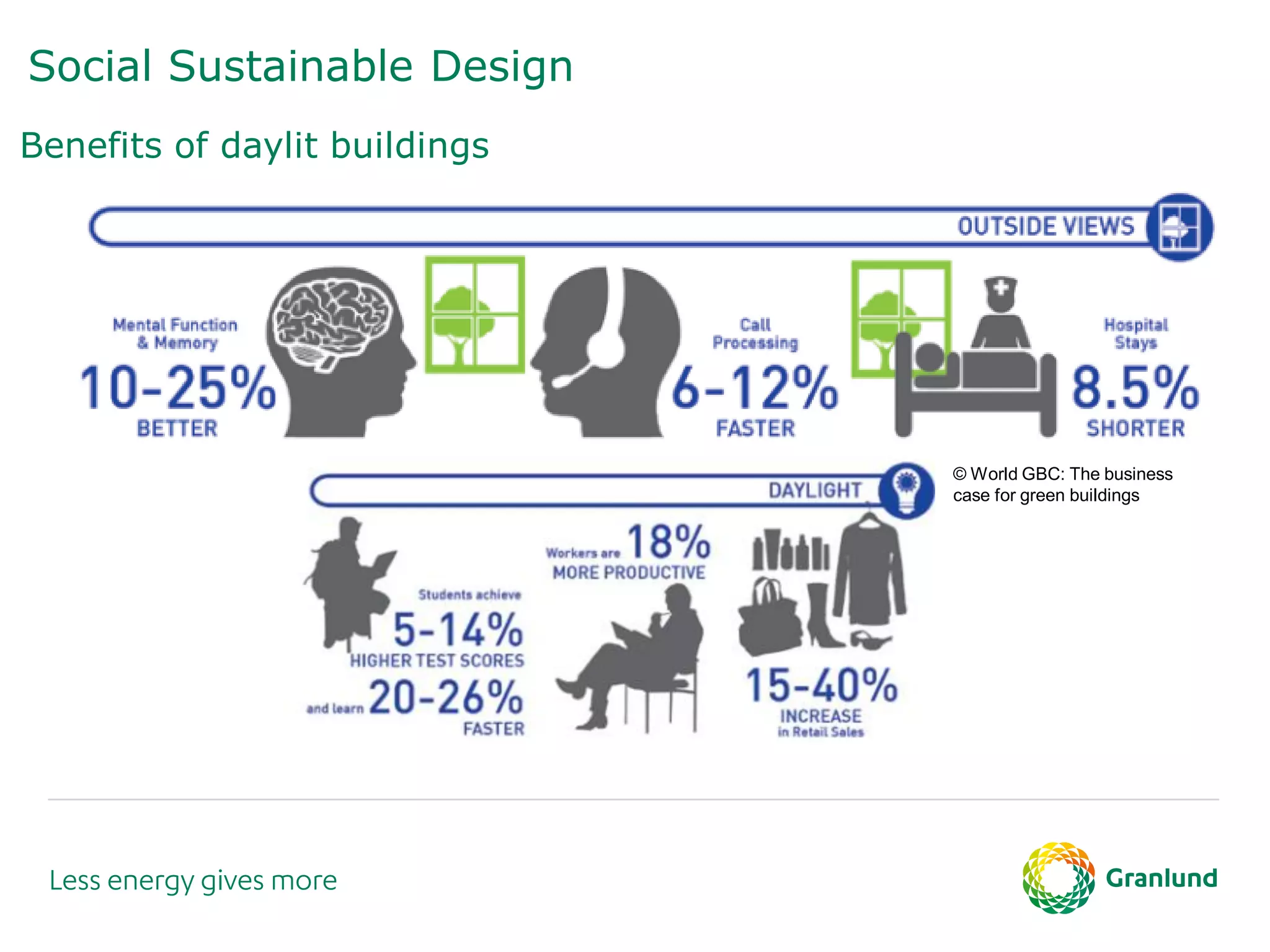
Benefits of daylit buildings
© World GBC: The business
case for green buildings
Social Sustainable Design
Daylighting
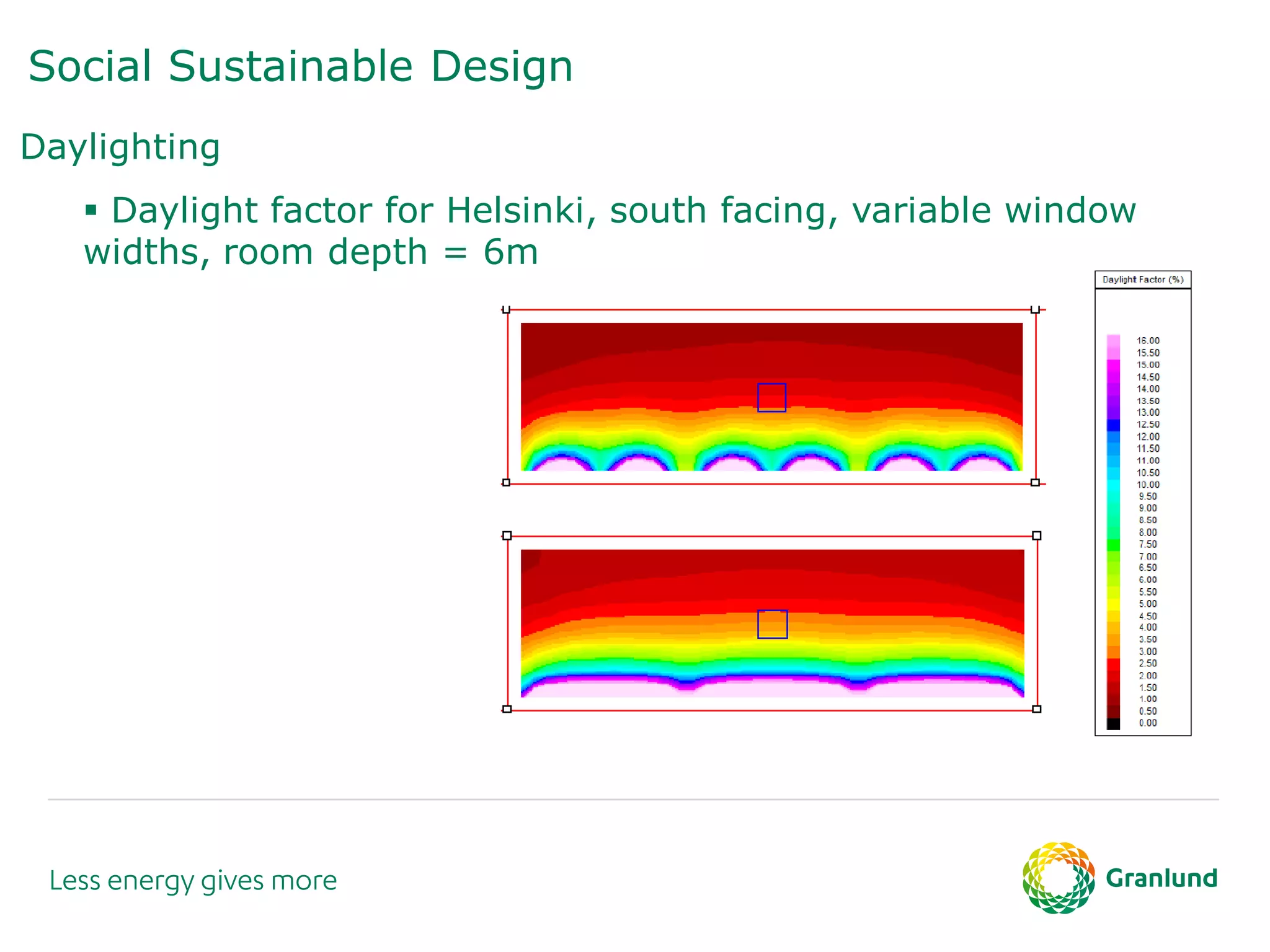
 Daylight factor for Helsinki, south facing, variable window
widths, room depth = 6m
Passive & Social Sustainable Design
Natural Ventilation
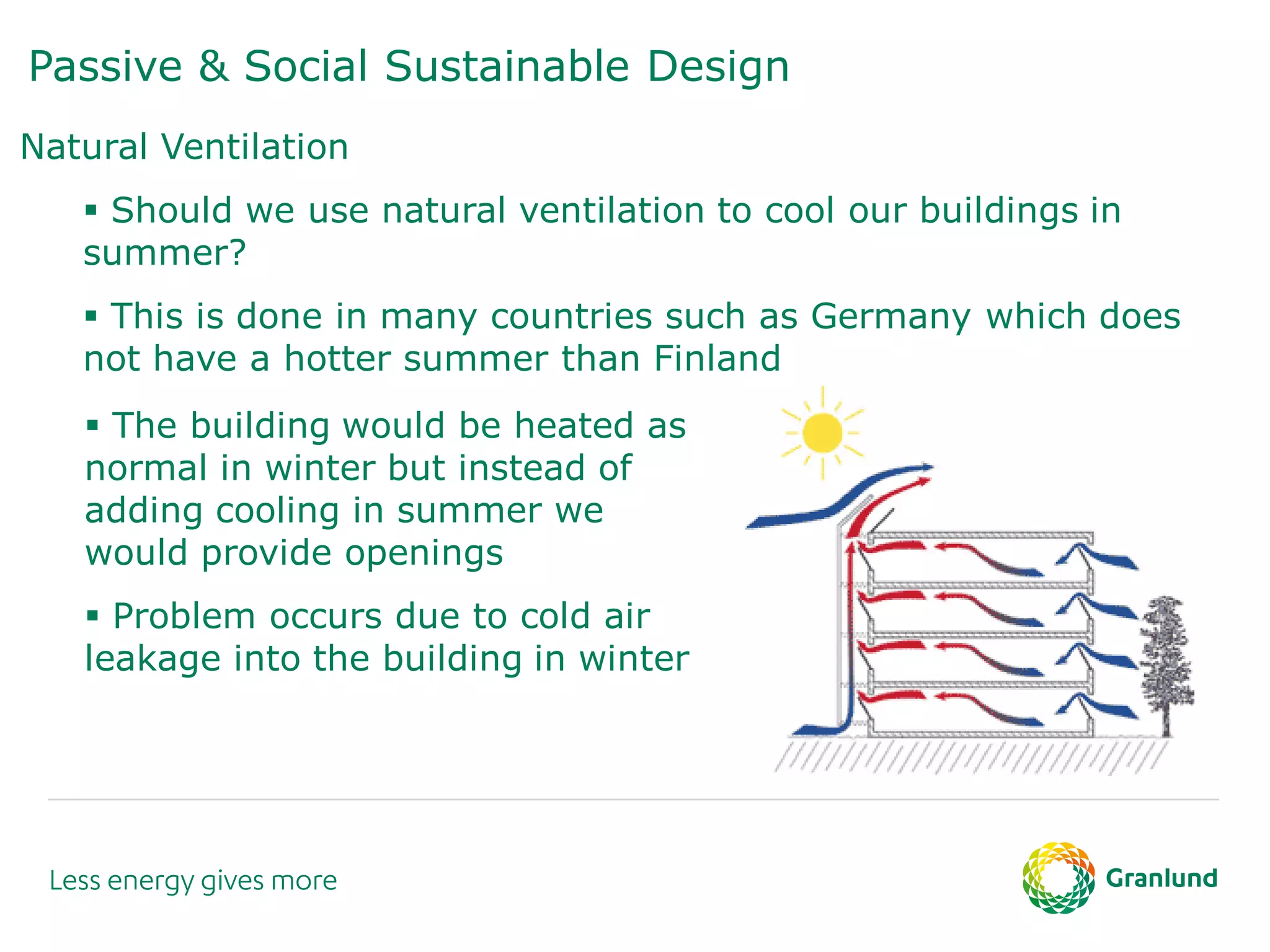
 Should we use natural ventilation to cool our buildings in
summer?
 This is done in many countries such as Germany which does
not have a hotter summer than Finland
 The building would be heated as
normal in winter but instead of
adding cooling in summer we
would provide openings
 Problem occurs due to cold air
leakage into the building in winter
Passive & Social Sustainable Design
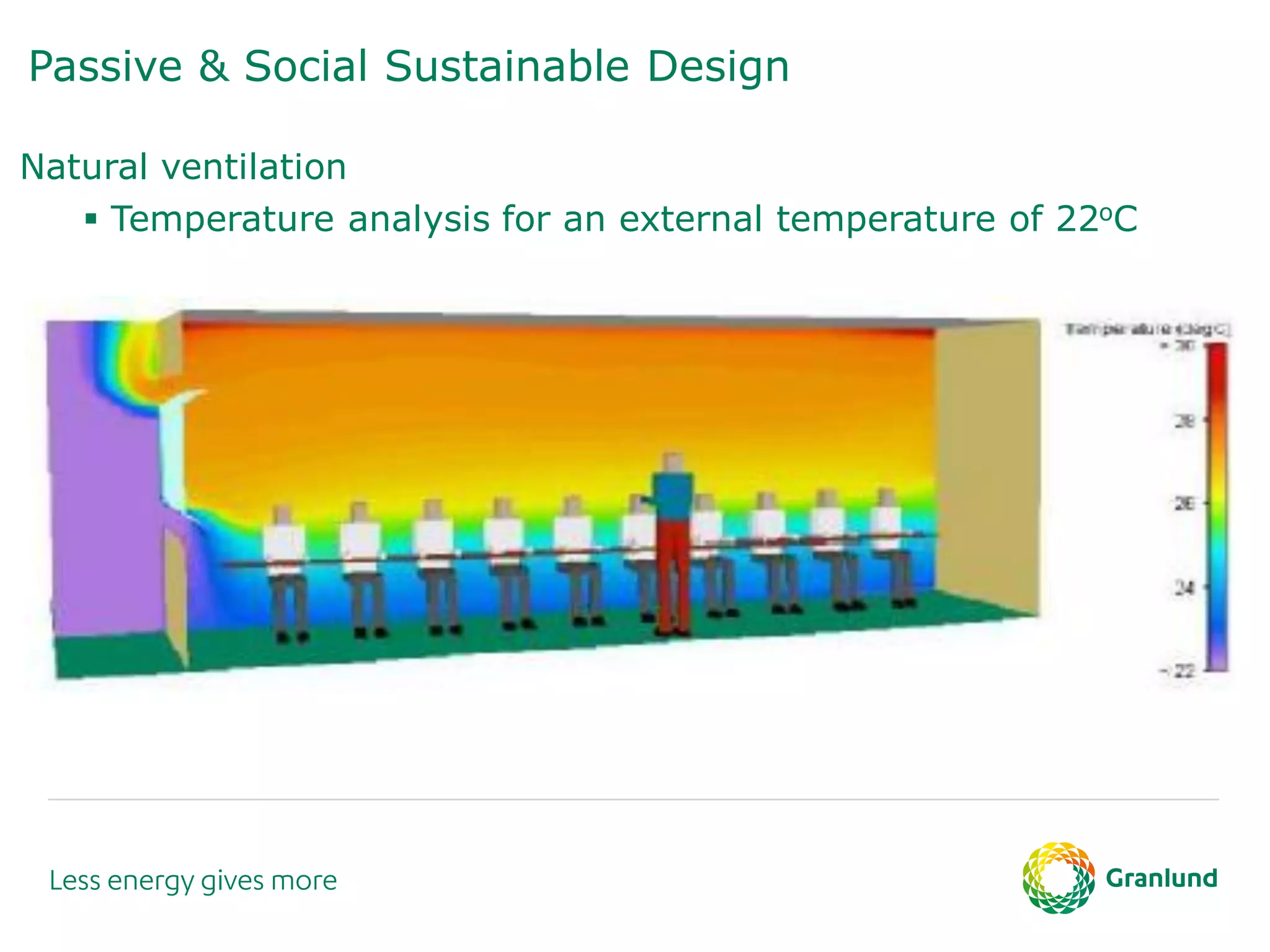
Natural ventilation
 Temperature analysis for an external temperature of 22oC
Passive & Social Sustainable Design
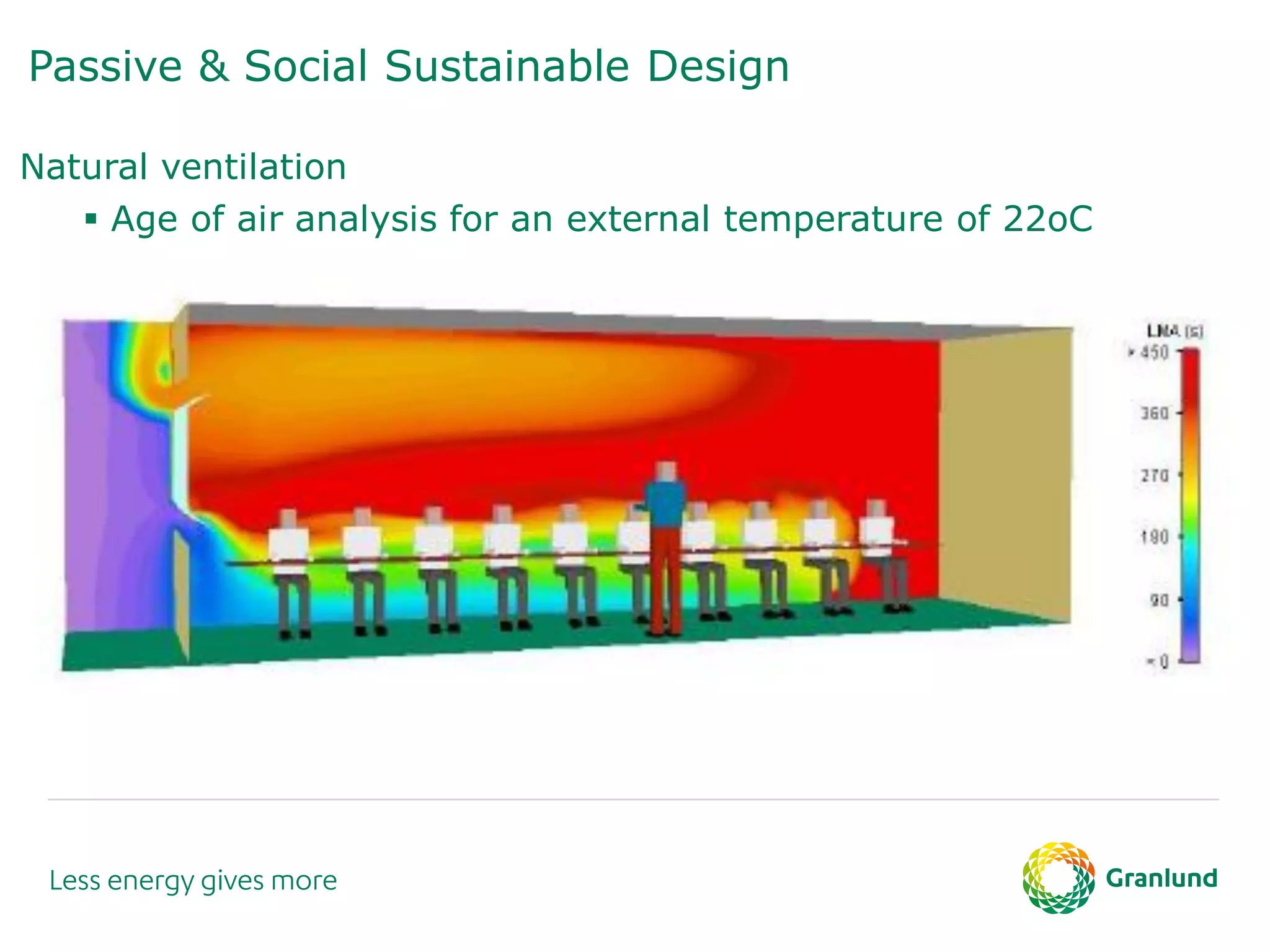
Natural ventilation
 Age of air analysis for an external temperature of 22oC
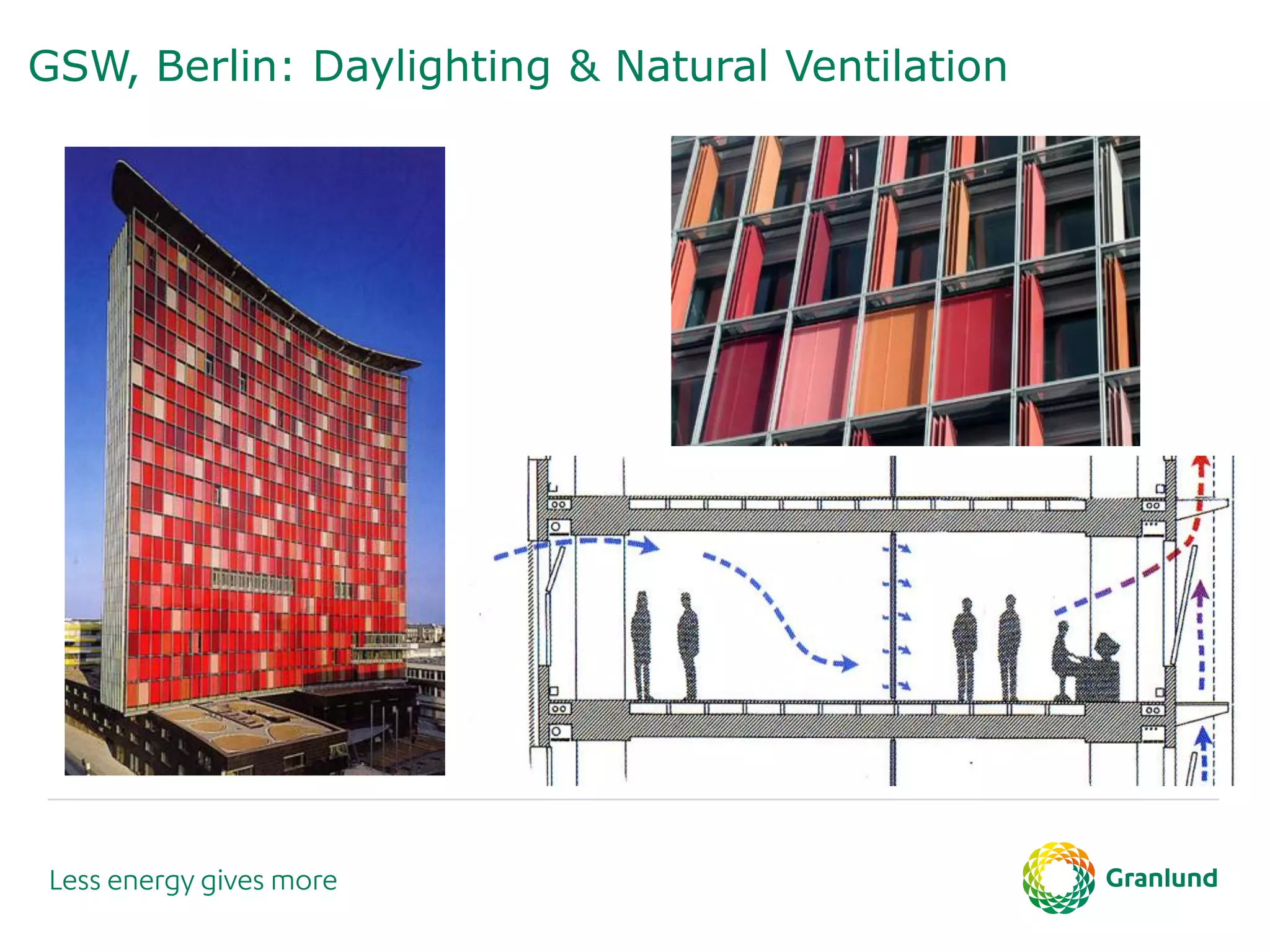
GSW, Berlin: Daylighting & Natural Ventilation
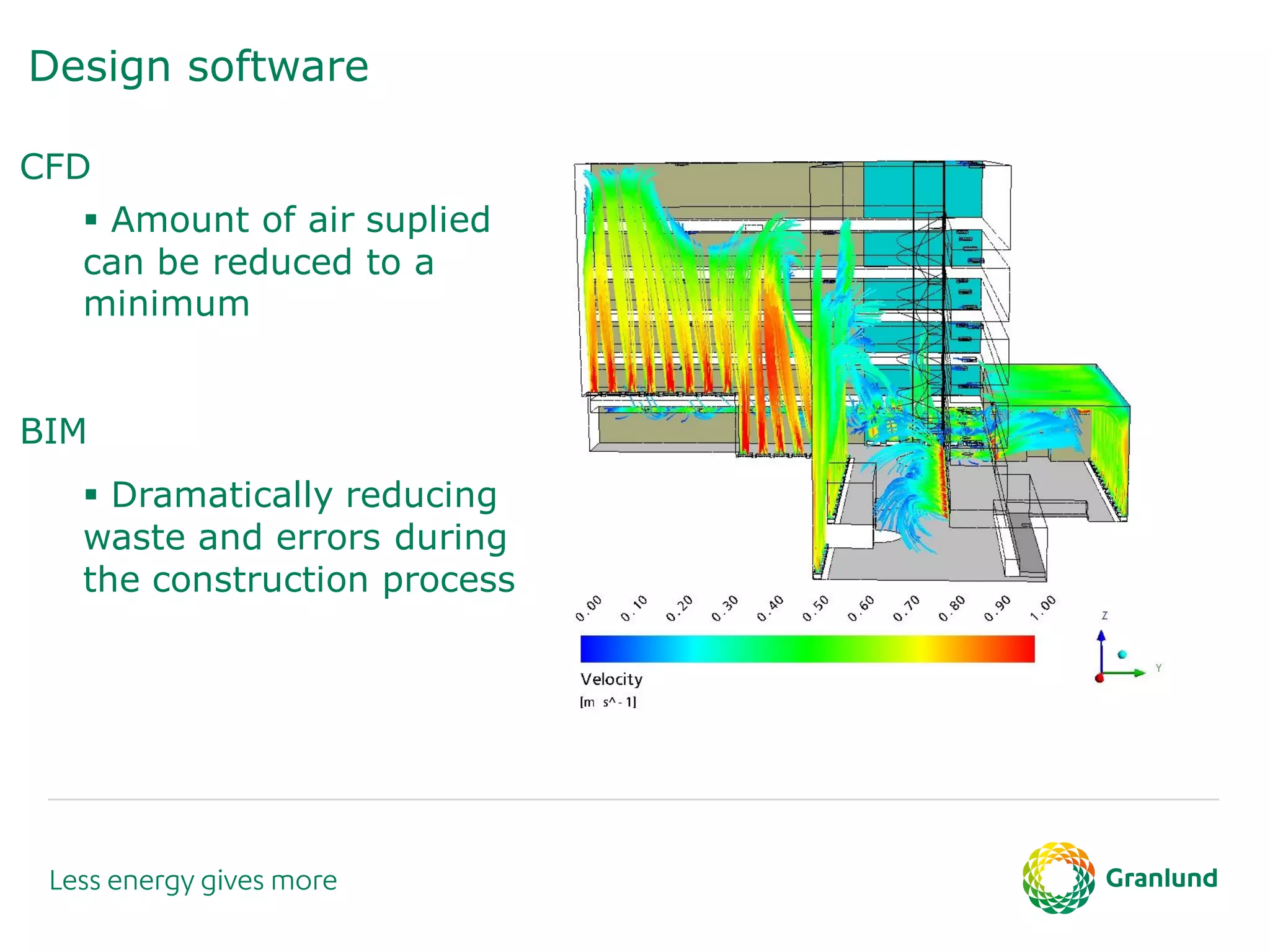
Design software
CFD
 Amount of air suplied
can be reduced to a
minimum
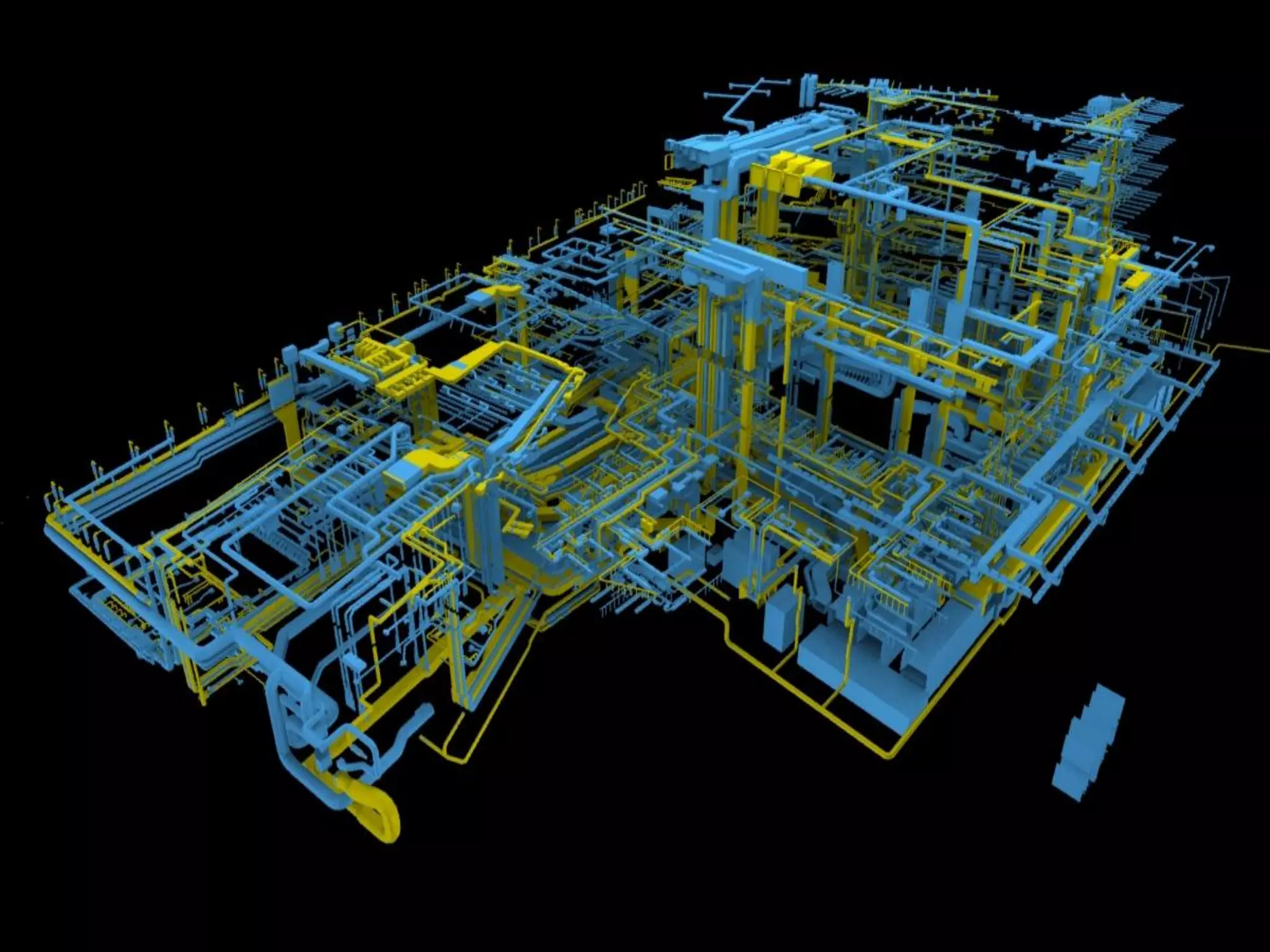
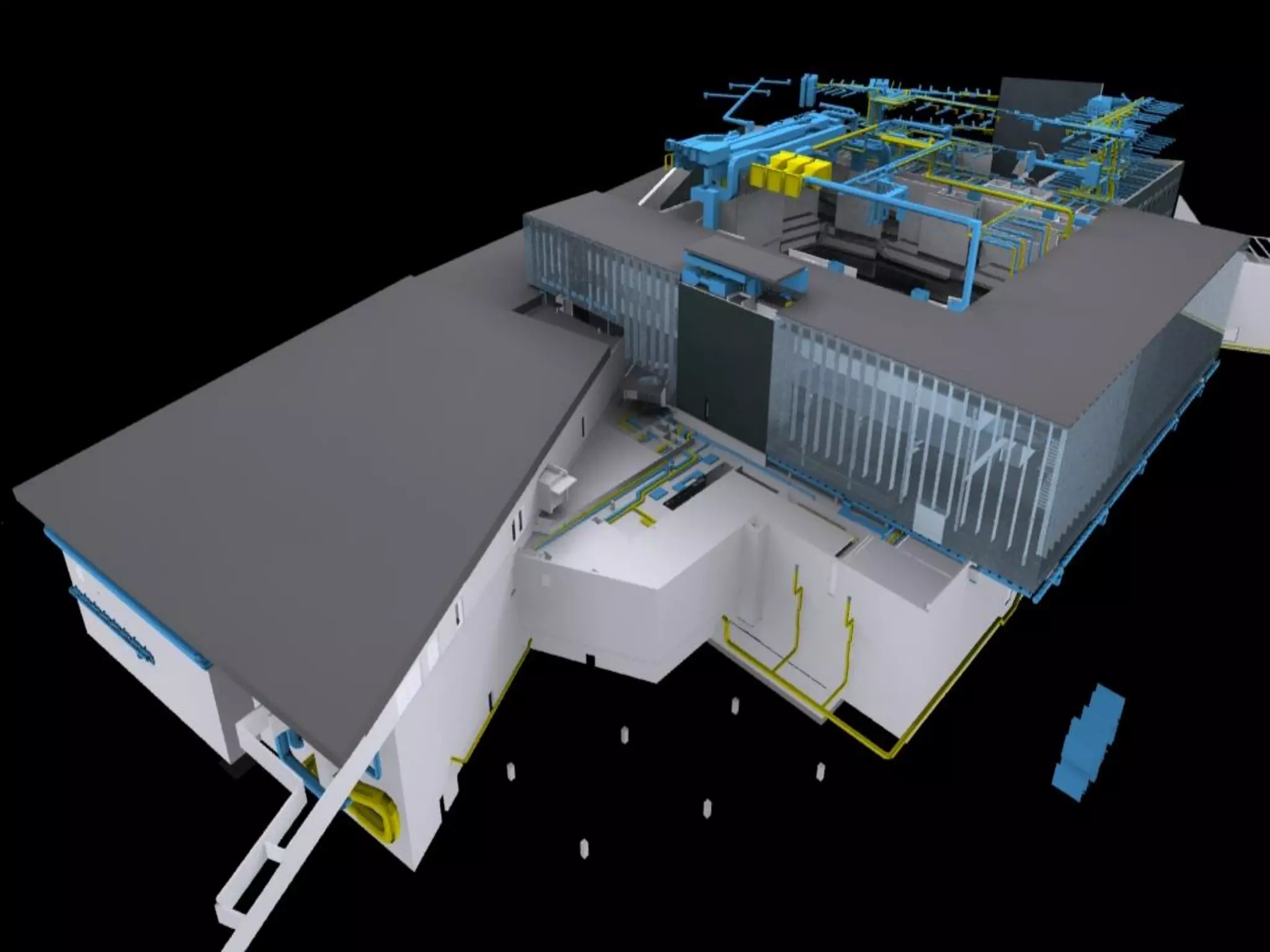
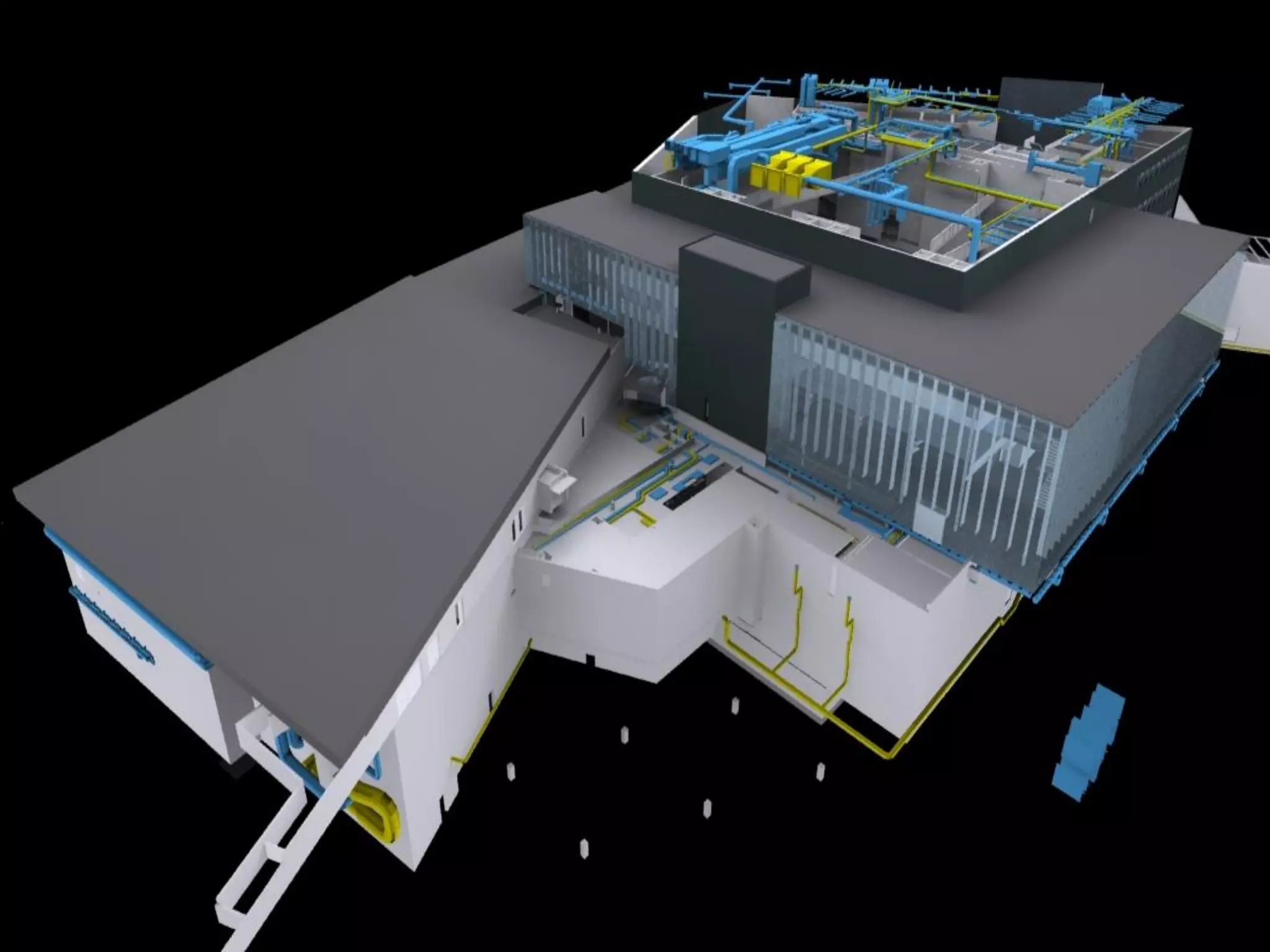
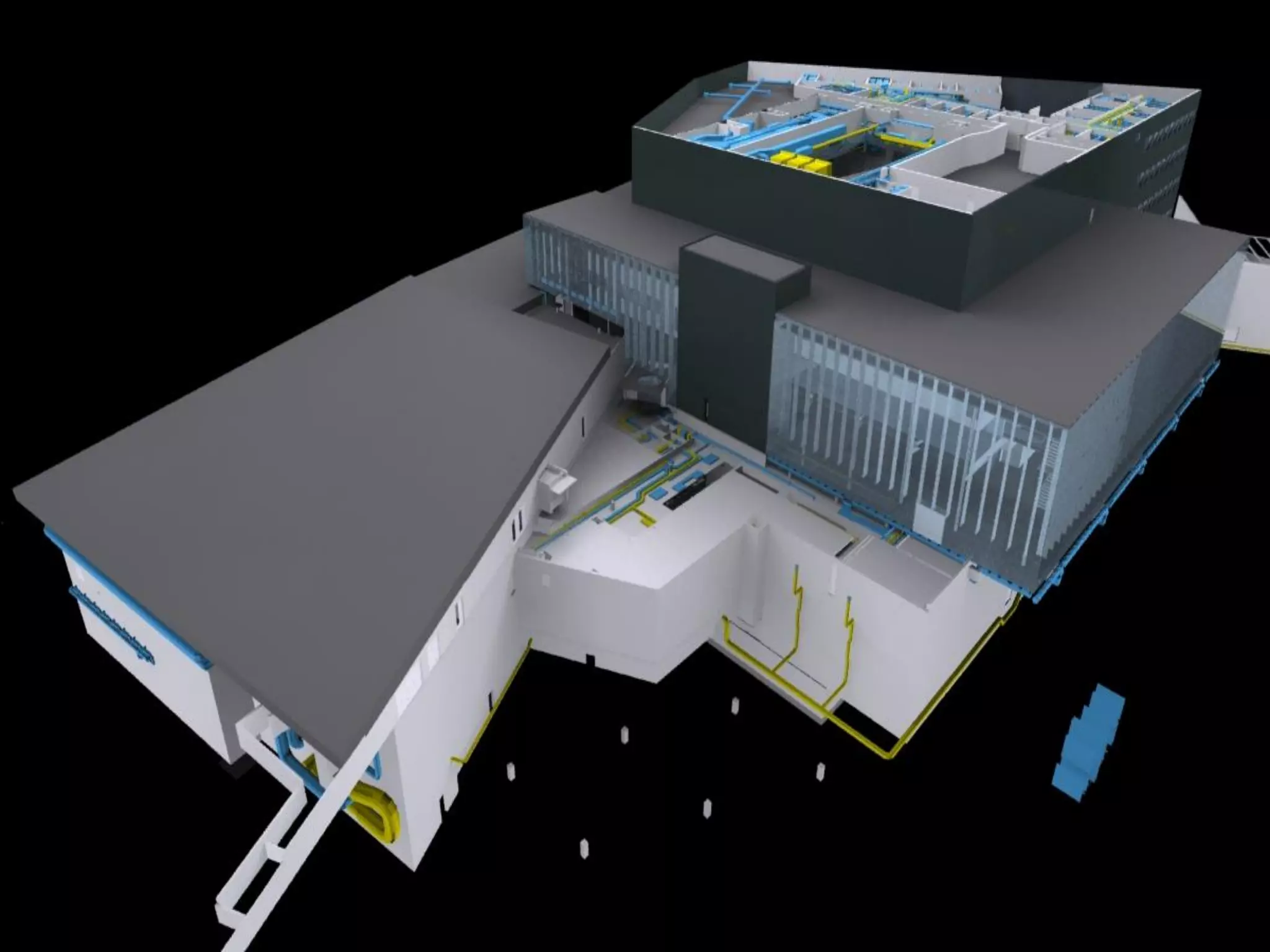
BIM
 Dramatically reducing
waste and errors during
the construction process
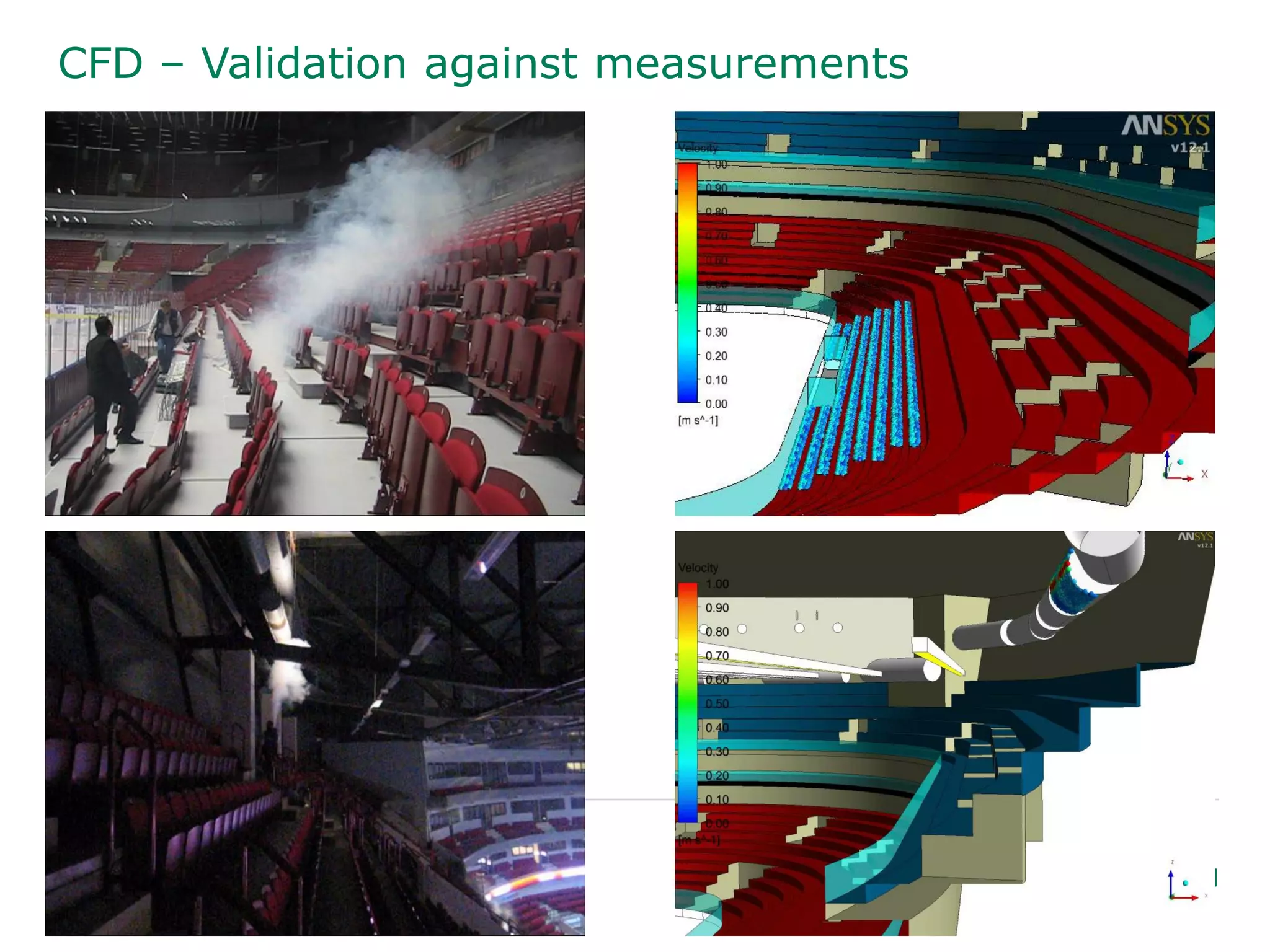
CFD – Validation against measurements
Water Efficient:
Technologies
Water Efficiency
Reducing water consumption
 Not a Finnish priority (187, 888 lakes)
 Low water using fittings
Difficult with building regulations D1
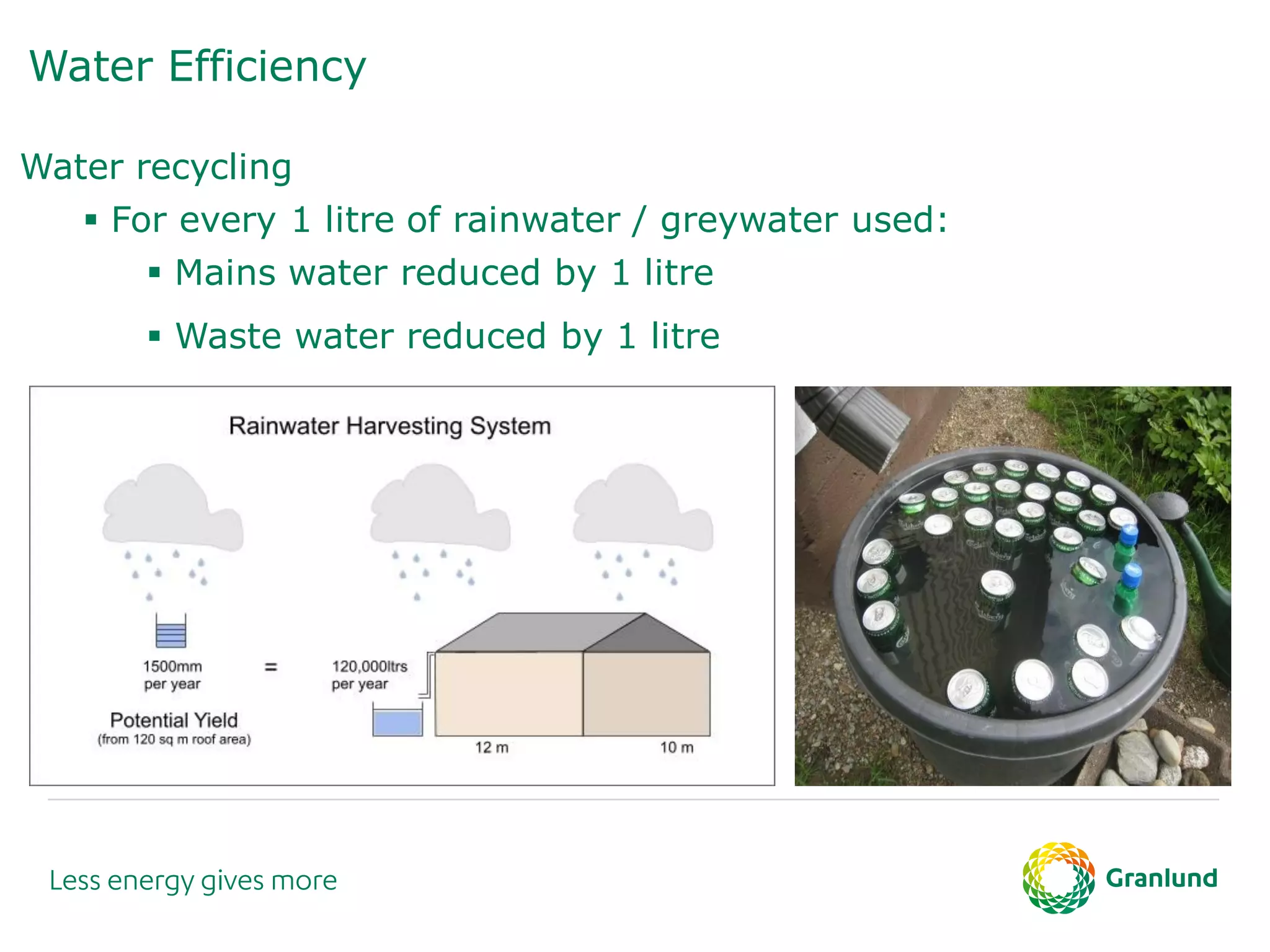
 Water recycling
 Rainwater harvesting
 Greywater recycling
 Blackwater recycling
 1 Bligh Street, Sydney
 Approx. 100,000 litres of water will be saved per day
Water Efficiency
Water recycling
 For every 1 litre of rainwater / greywater used:
 Mains water reduced by 1 litre
 Waste water reduced by 1 litre
Service Innovations
For Environmental Impact Reduction
x
x
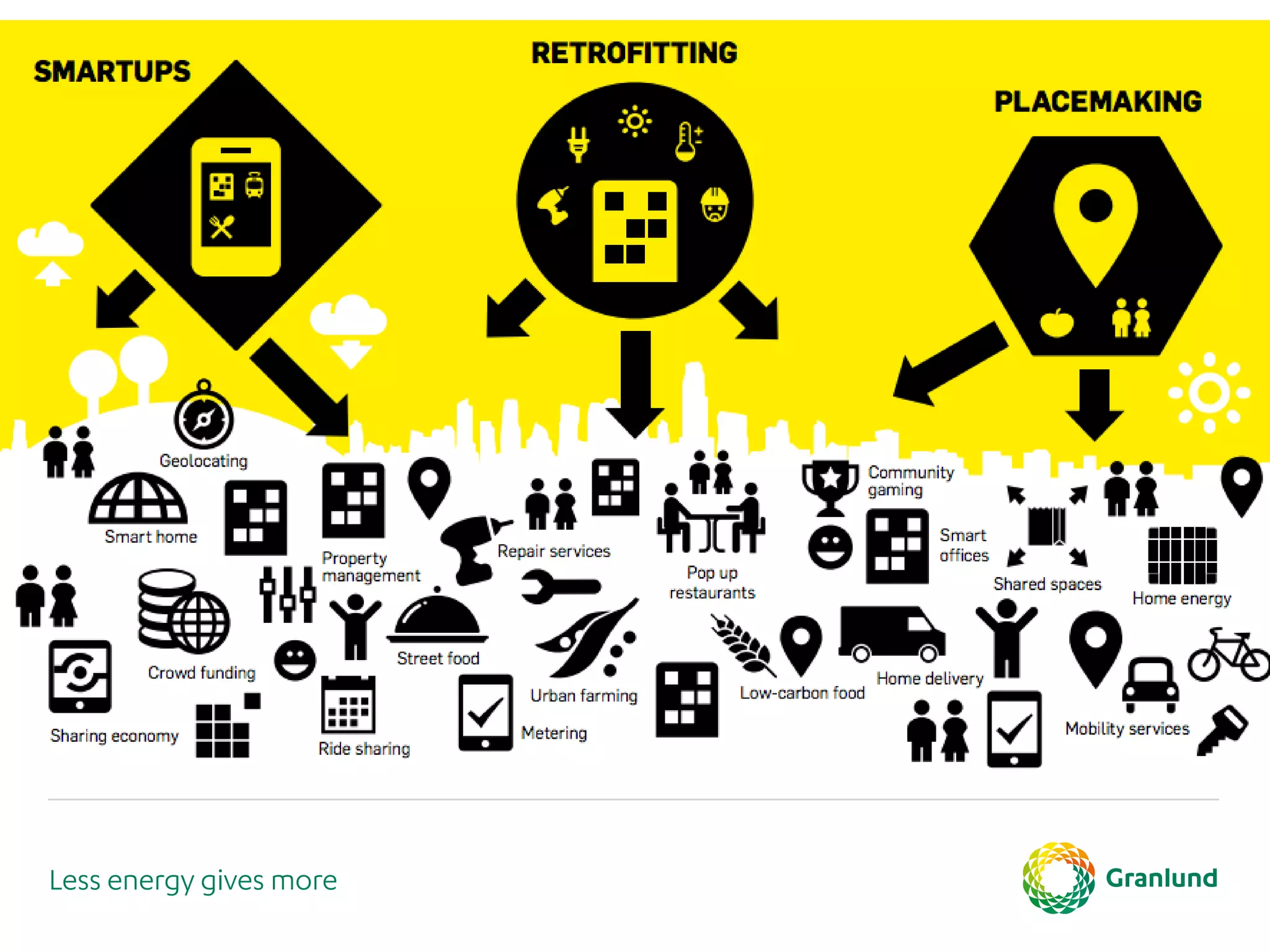
Service Innovations…….Smartups…………
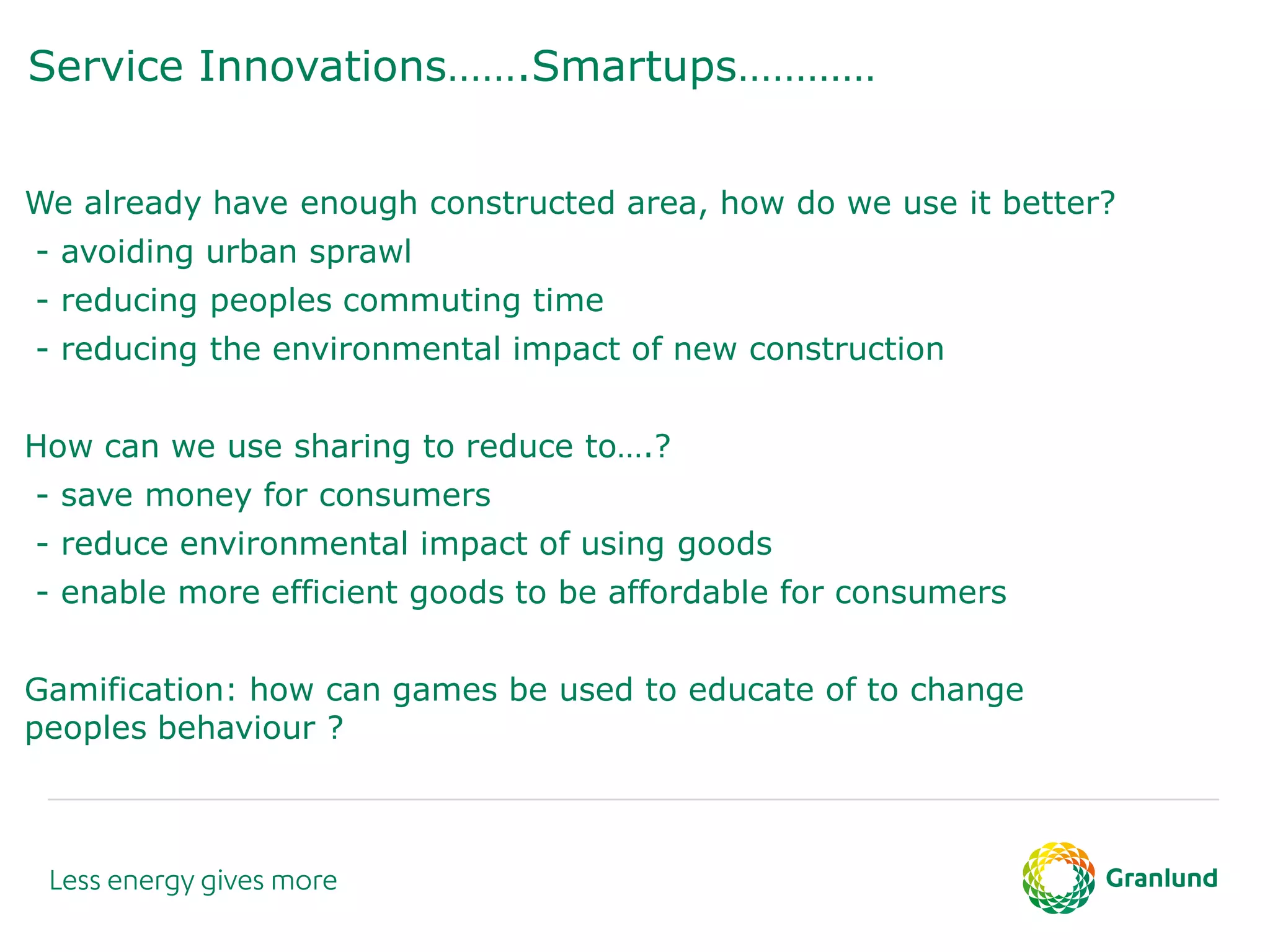
We already have enough constructed area, how do we use it better?
- avoiding urban sprawl
- reducing peoples commuting time
- reducing the environmental impact of new construction
How can we use sharing to reduce to….?
- save money for consumers
- reduce environmental impact of using goods
- enable more efficient goods to be affordable for consumers
Gamification: how can games be used to educate of to change
peoples behaviour ?
Service Innovations…….Smartups…………
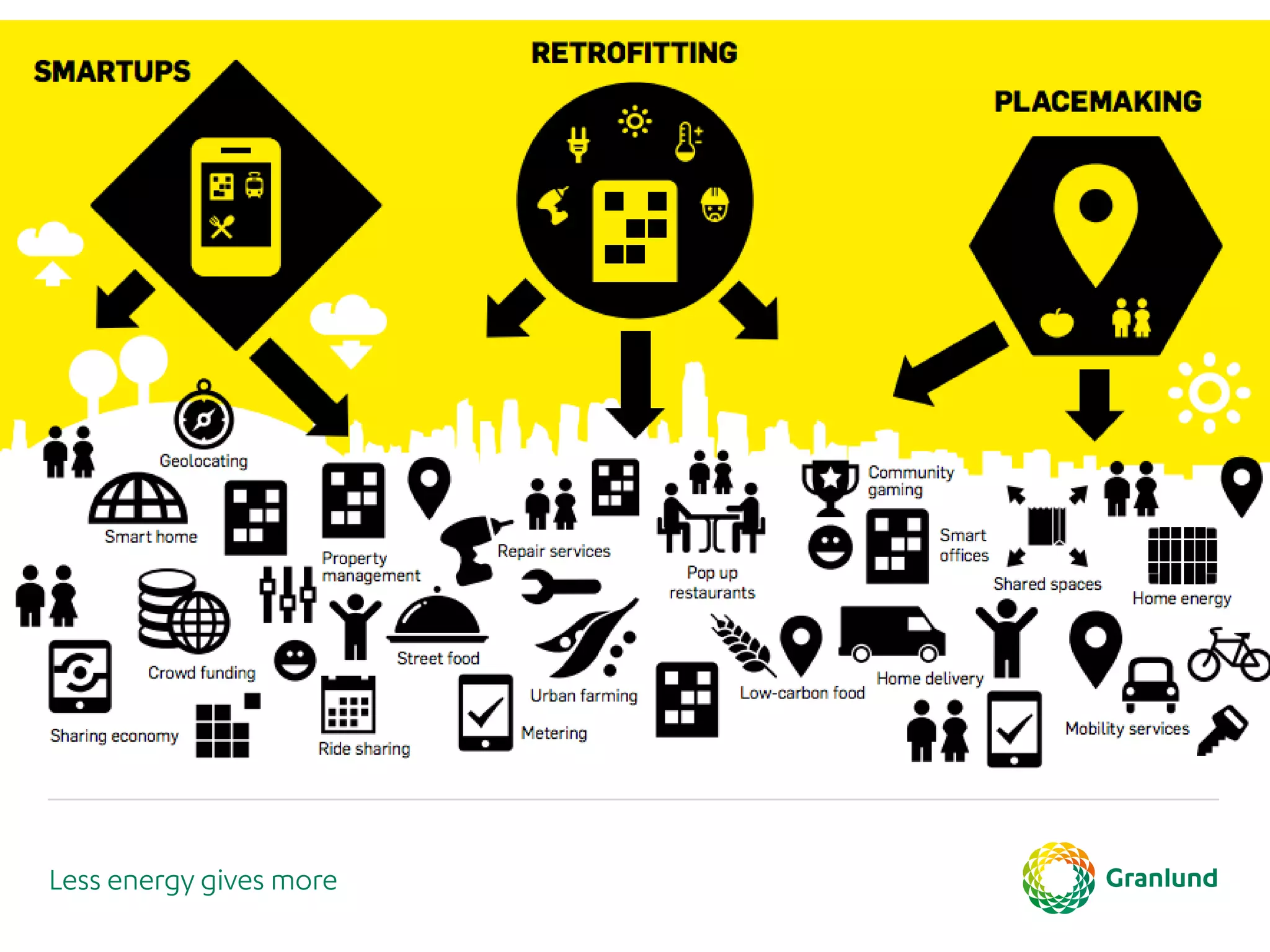
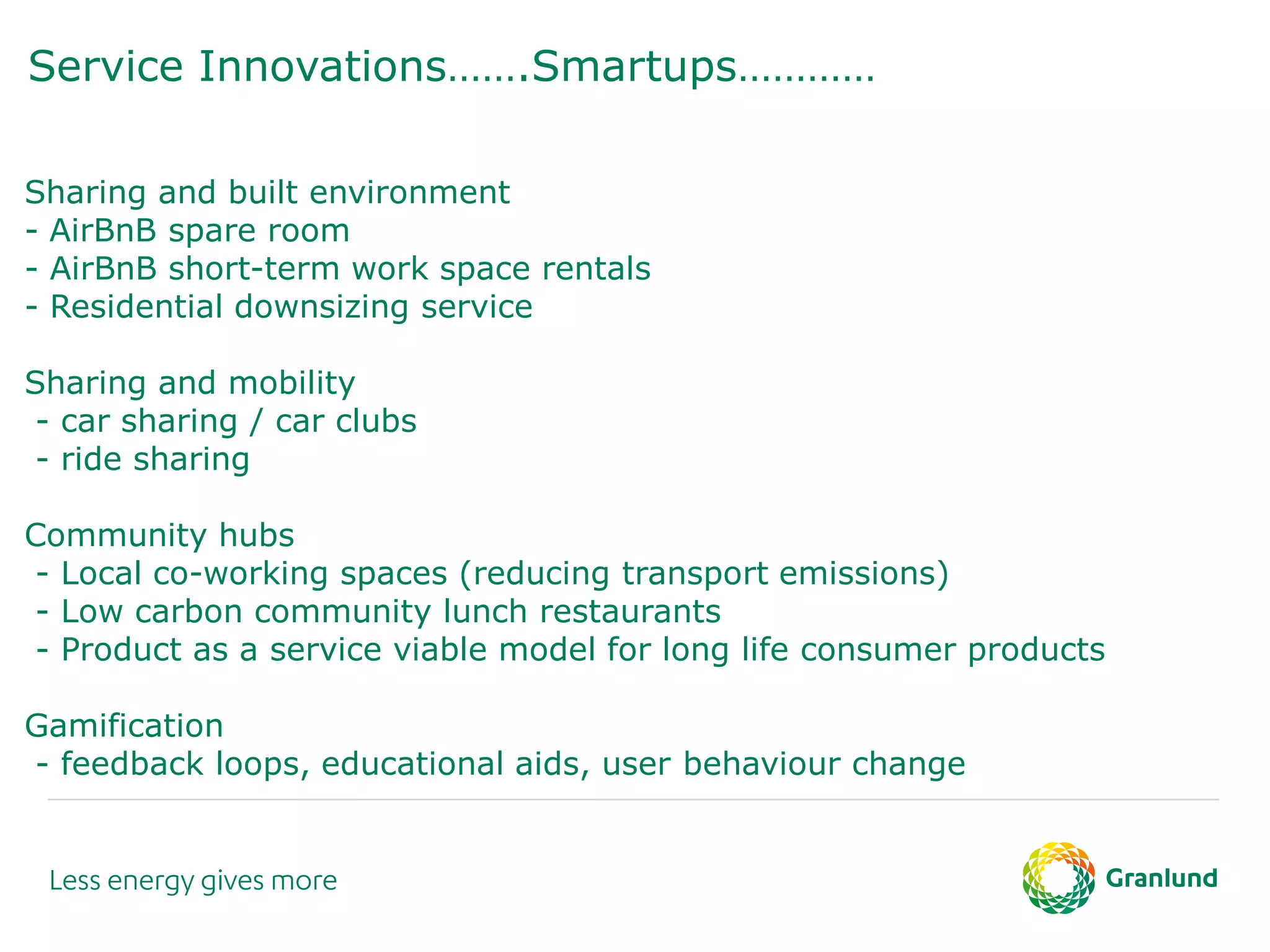
Sharing and built environment
- AirBnB spare room
- AirBnB short-term work space rentals
- Residential downsizing service
Sharing and mobility
- car sharing / car clubs
- ride sharing
Community hubs
- Local co-working spaces (reducing transport emissions)
- Low carbon community lunch restaurants
- Product as a service viable model for long life consumer products
Gamification
- feedback loops, educational aids, user behaviour change
x
x
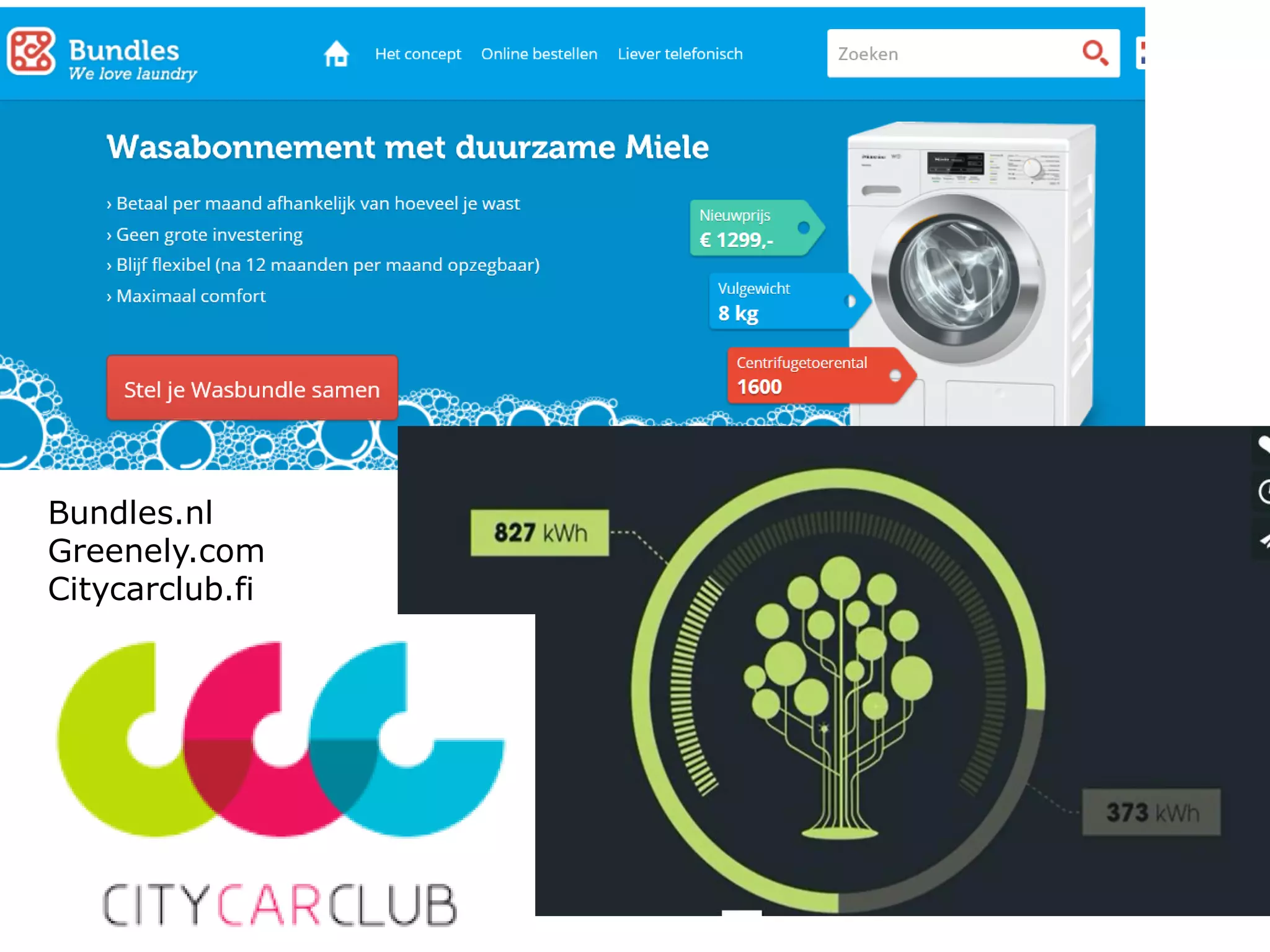
Bundles.nl
Greenely.com
Citycarclub.fi
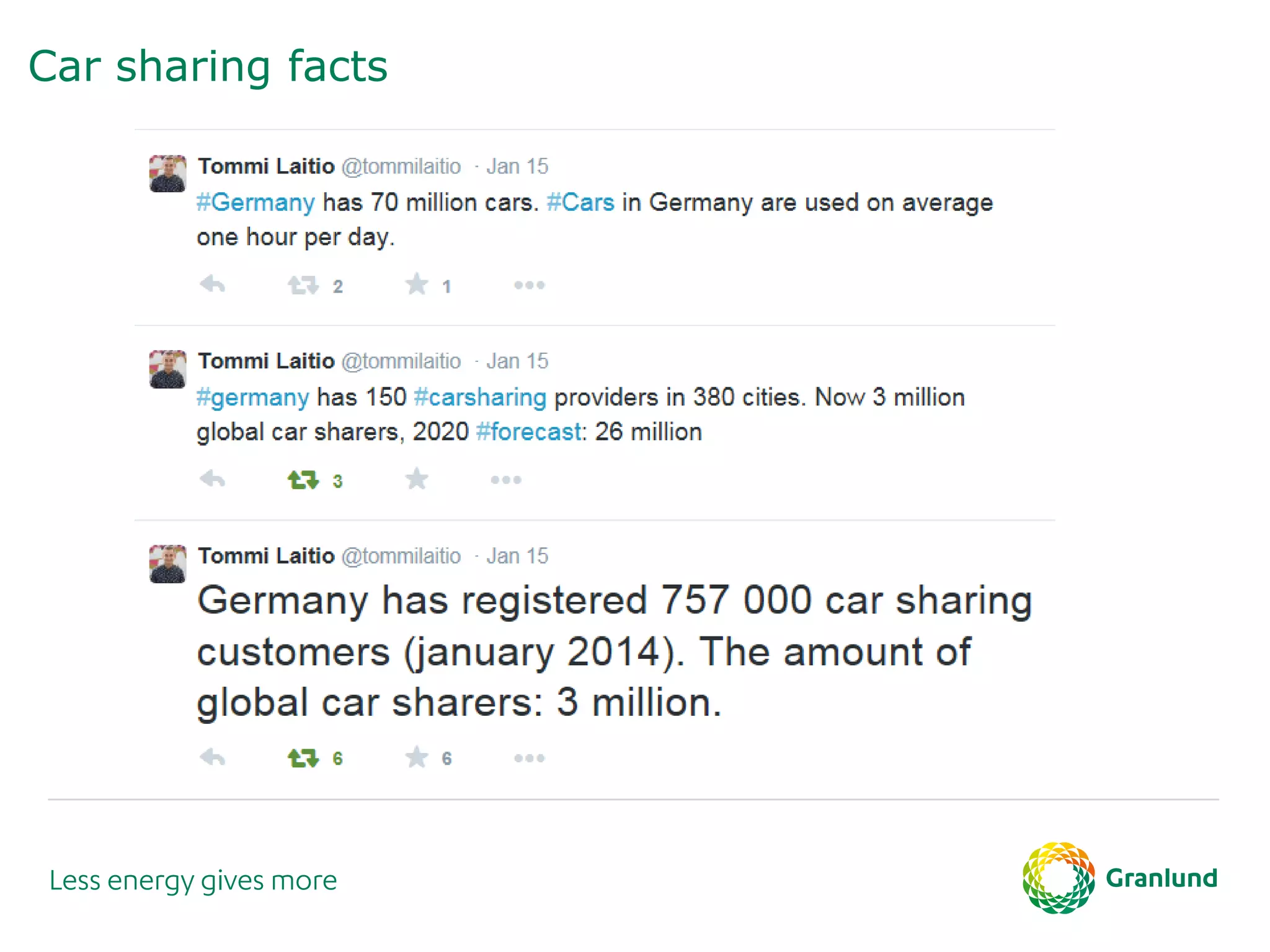
Car sharing facts
x
x
Innovations:
Built Environment
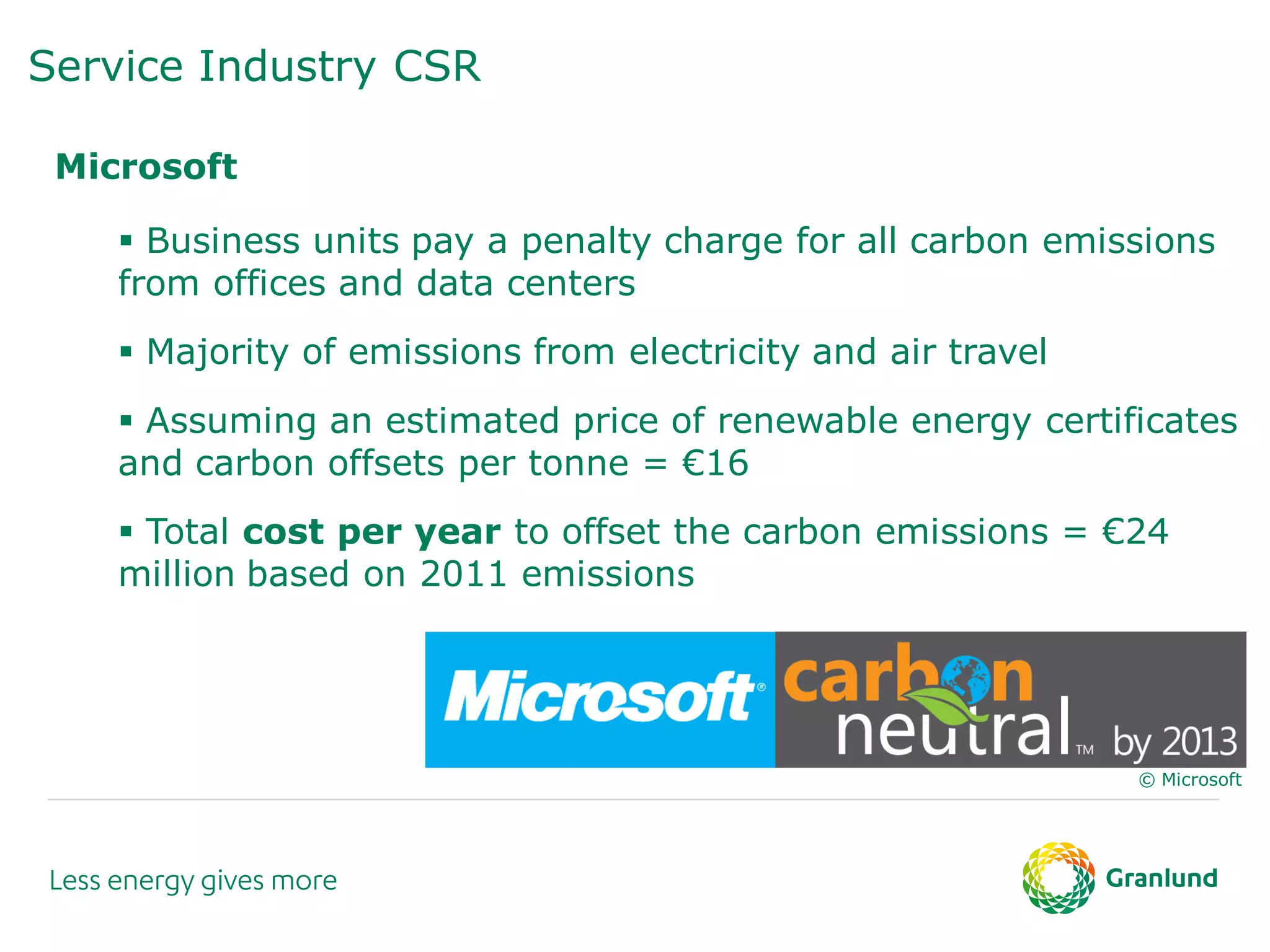
Service Industry CSR
Microsoft
 Business units pay a penalty charge for all carbon emissions
from offices and data centers
 Majority of emissions from electricity and air travel
 Assuming an estimated price of renewable energy certificates
and carbon offsets per tonne = €16
 Total cost per year to offset the carbon emissions = €24
million based on 2011 emissions
© Microsoft
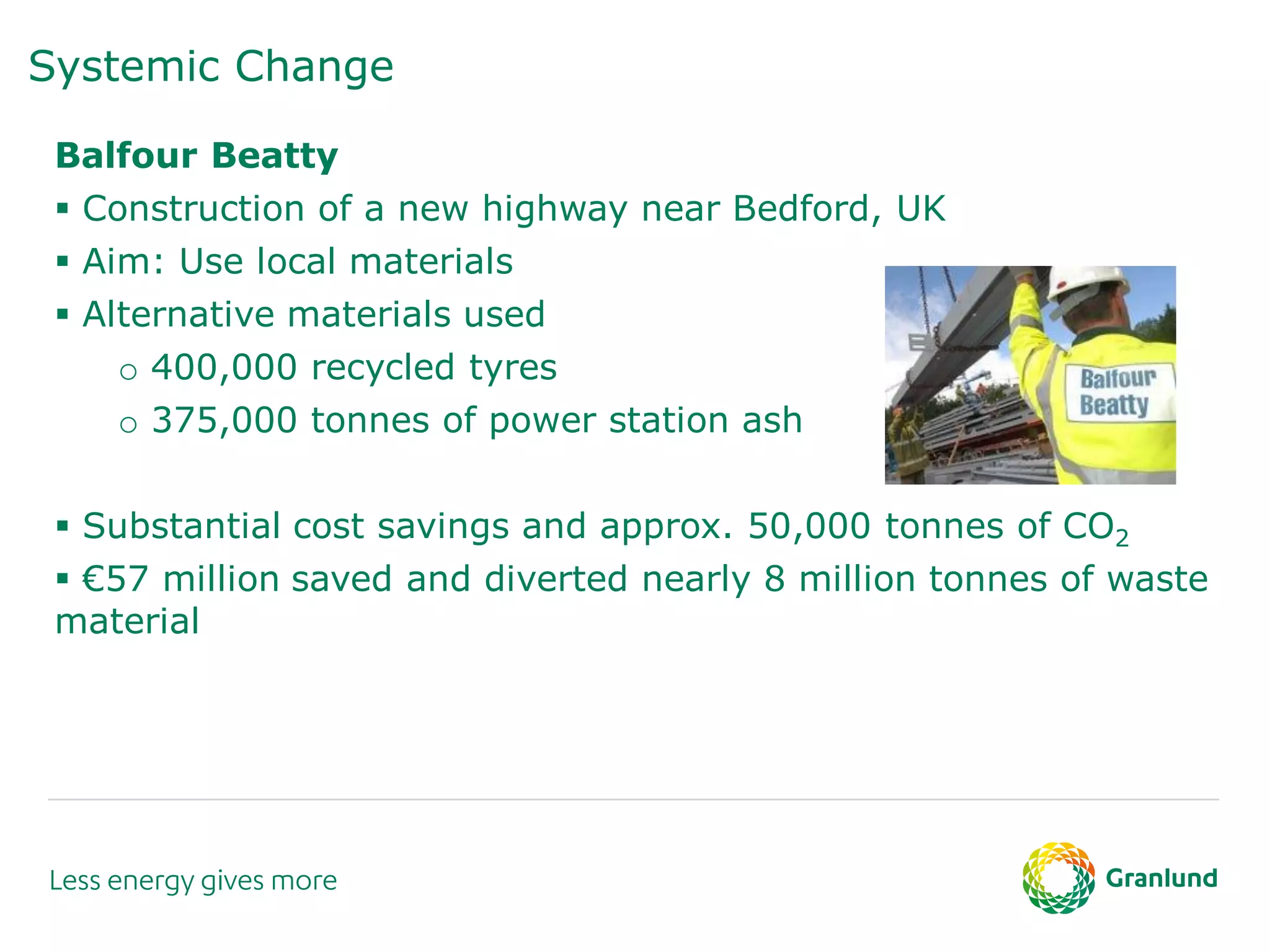
Systemic Change
Balfour Beatty
 Construction of a new highway near Bedford, UK
 Aim: Use local materials
 Alternative materials used
o 400,000 recycled tyres
o 375,000 tonnes of power station ash
 Substantial cost savings and approx. 50,000 tonnes of CO2
 €57 million saved and diverted nearly 8 million tonnes of waste
material
Technical Aspects:
For Energy Reduction
Energy Reduction
nZEB: nearly Zero Energy Buildings
 European Performance of Buildings Directive (EBPD)
 European Union member States shall ensure that by 31
December 2020 all new buildings are nearly zero-energy
buildings
 In Finland this is expected to be fully defined in 2015 but an
educated guess is that it will be approximately 30 – 50% of the
average consumption of today’s new buildings.
 It is also expected that renewable energy generation will not
strictly need to be on the site of the nZEB. It can be a
community / municipal energy generation system.
Energy Reduction
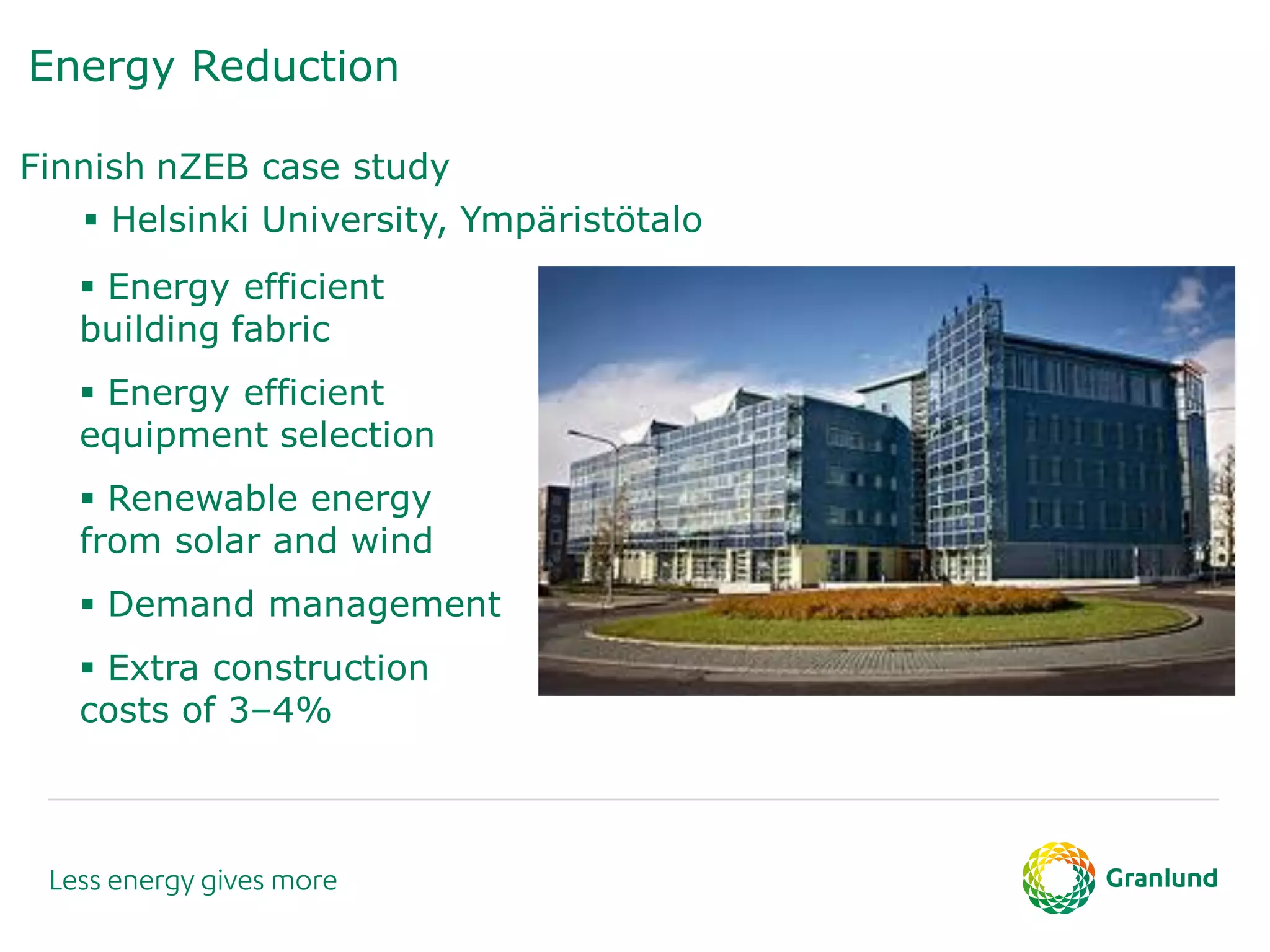
Finnish nZEB case study
 Helsinki University, Ympäristötalo
 Energy efficient
building fabric
 Energy efficient
equipment selection
 Renewable energy
from solar and wind
 Demand management
 Extra construction
costs of 3–4%
Electricity Generation
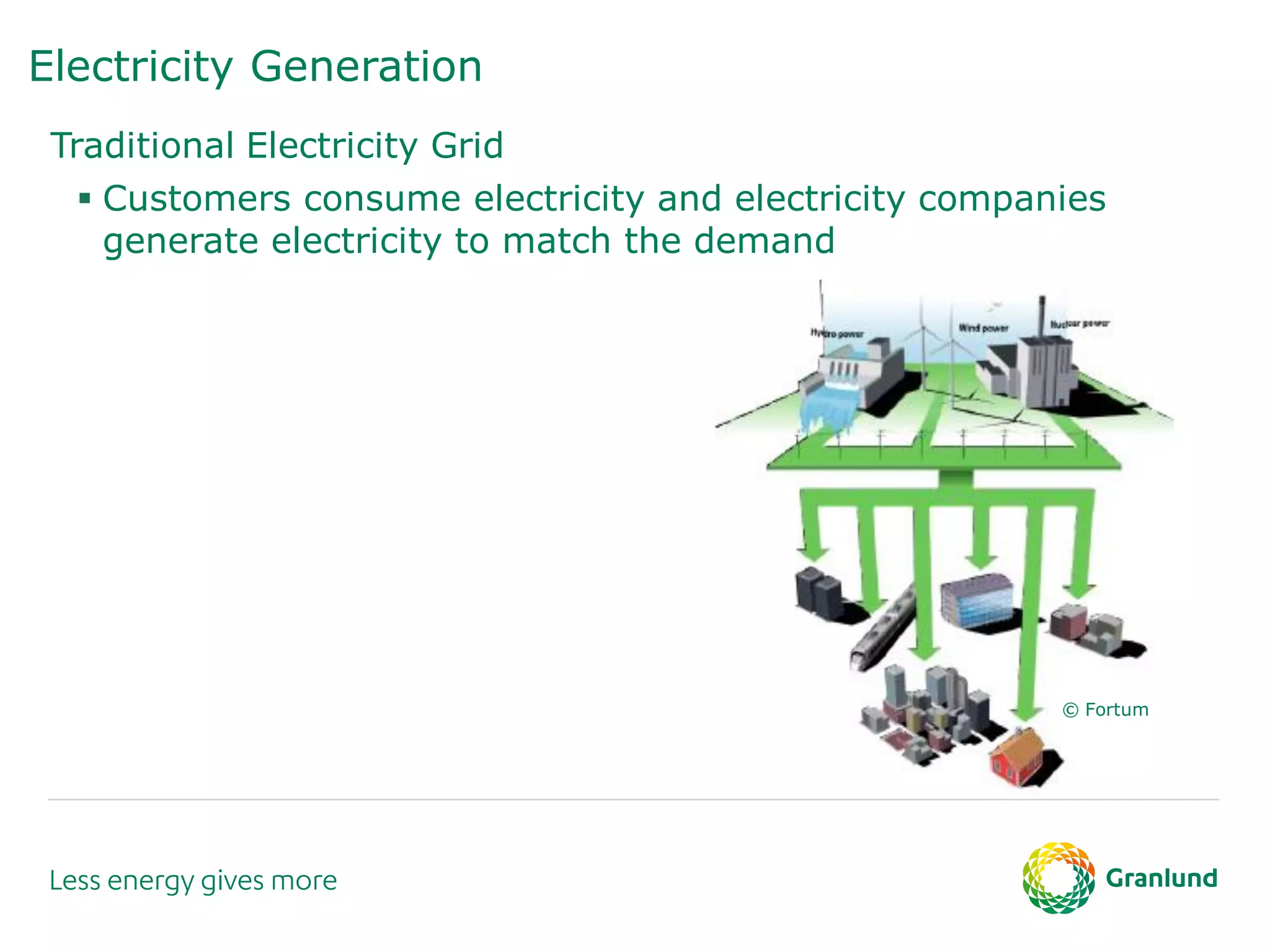
Traditional Electricity Grid
 Customers consume electricity and electricity companies
generate electricity to match the demand
© Fortum
Electricity Generation
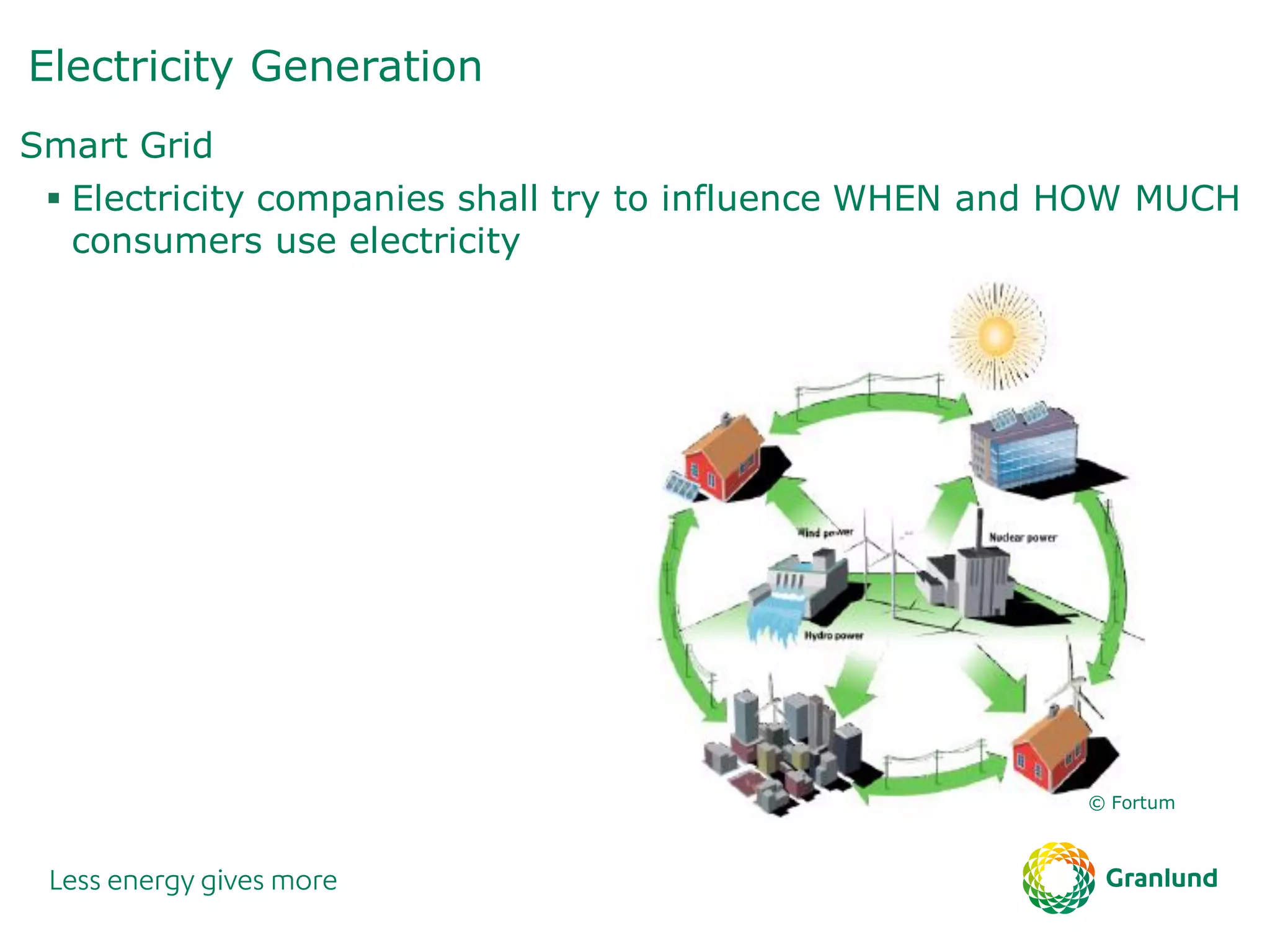
Smart Grid
 Electricity companies shall try to influence WHEN and HOW MUCH
consumers use electricity
© Fortum
Electricity Generation
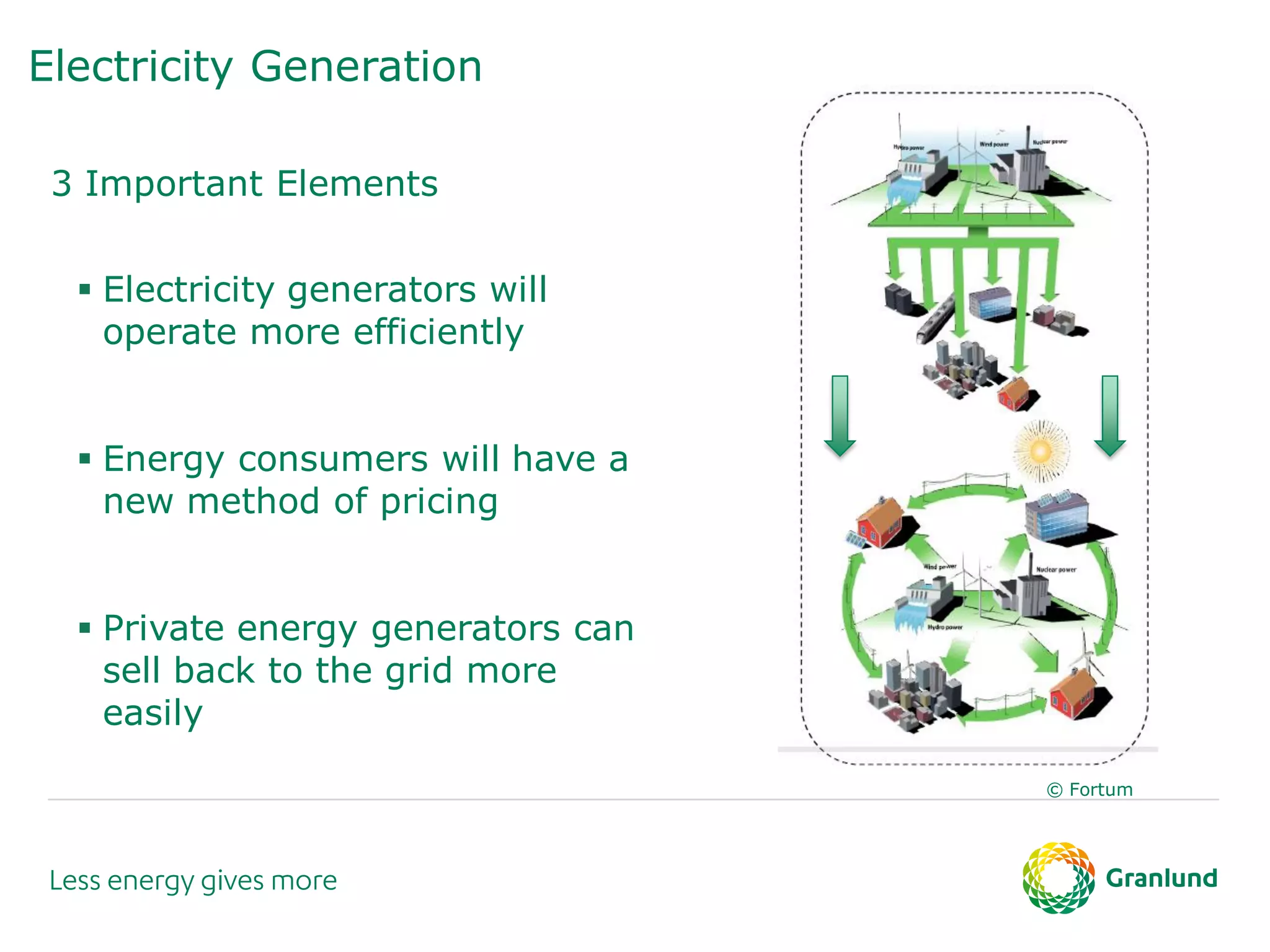
3 Important Elements
 Electricity generators will
operate more efficiently
 Energy consumers will have a
new method of pricing
 Private energy generators can
sell back to the grid more
easily
© Fortum
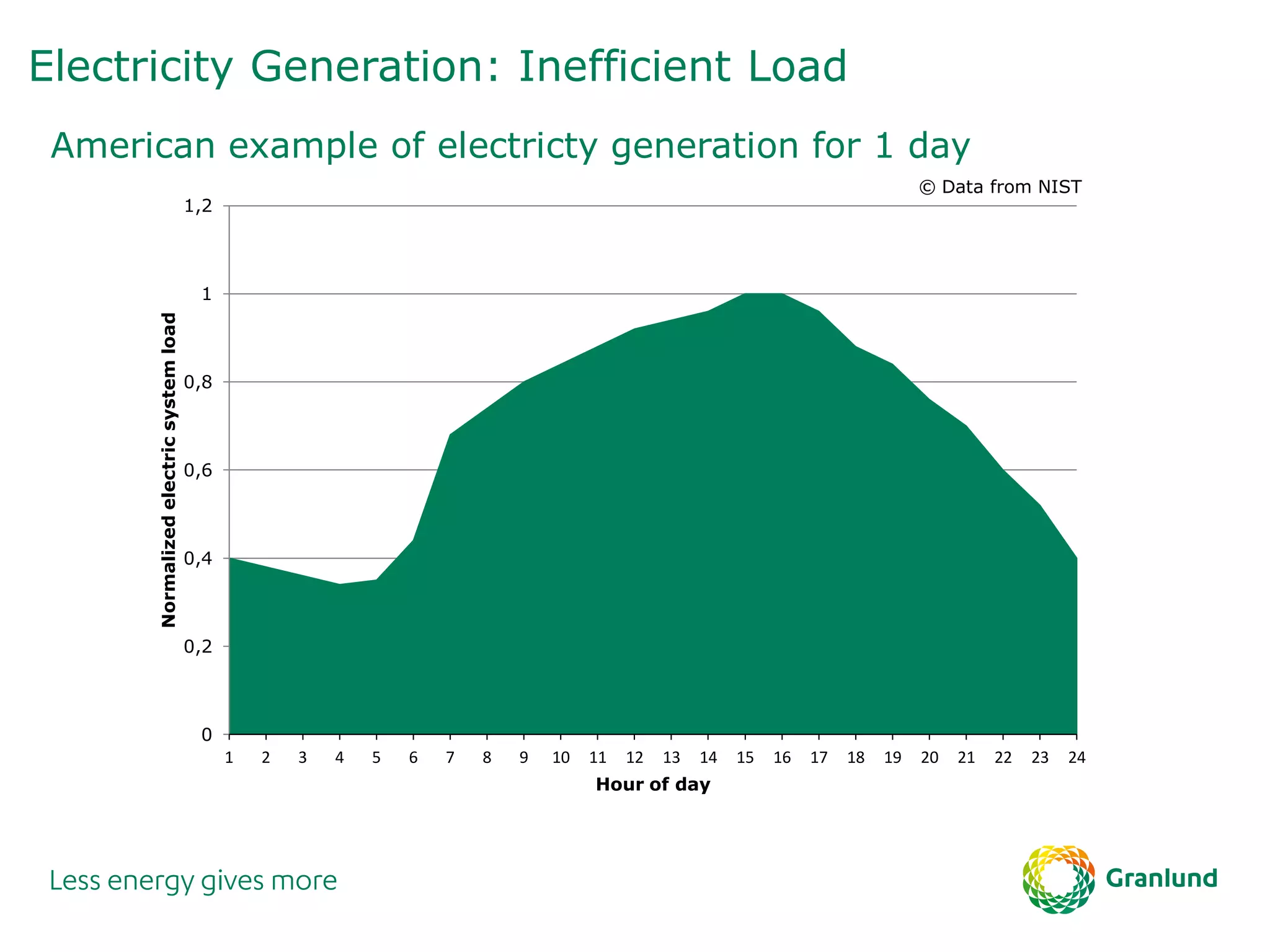
Electricity Generation: Inefficient Load
American example of electricty generation for 1 day
© Data from NIST
0
0,2
0,4
0,6
0,8
1
1,2
1 2 3 4 5 6 7 8 9 10 11 12 13 14 15 16 17 18 19 20 21 22 23 24
Normalizedelectricsystemload
Hour of day
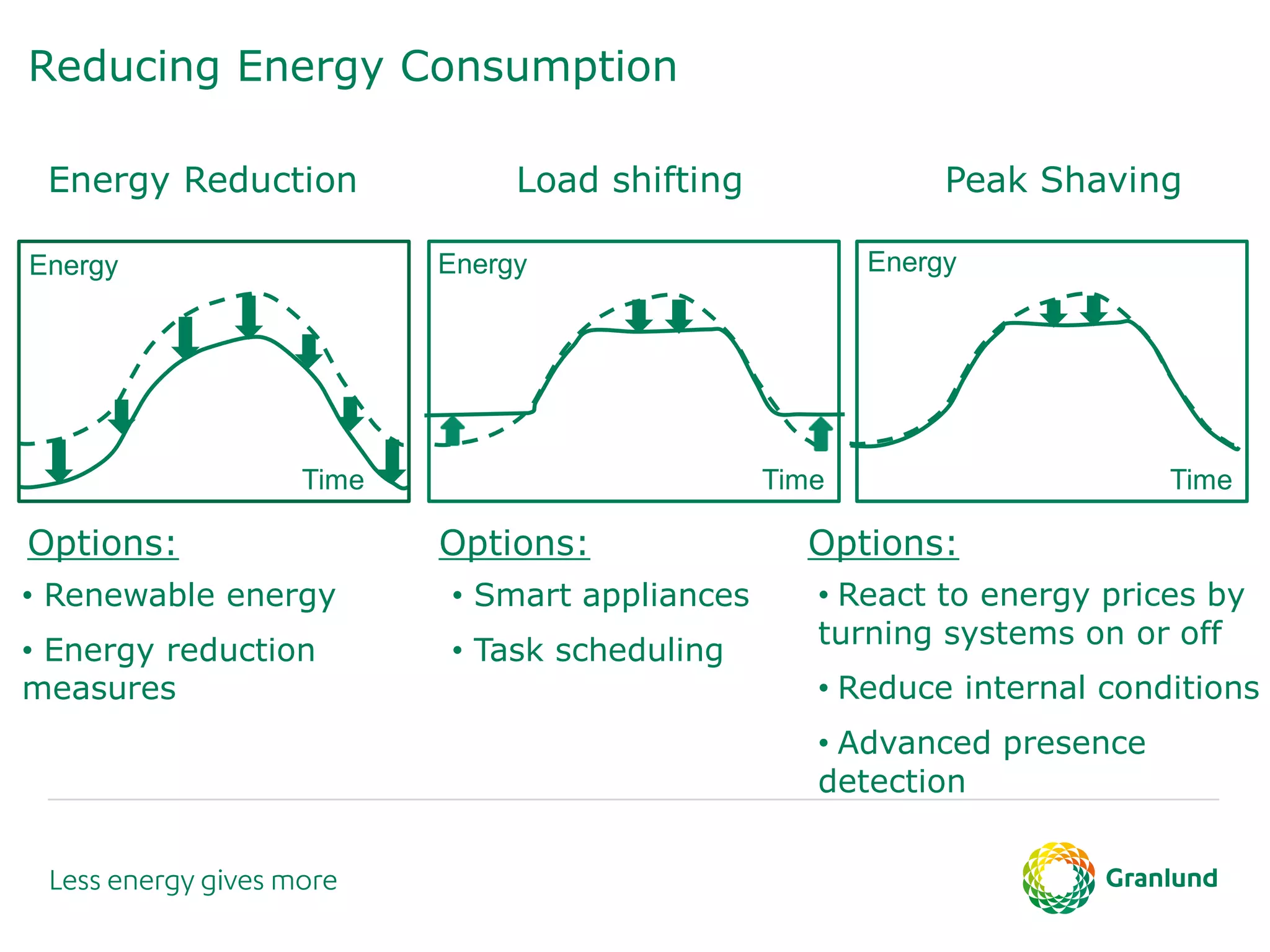
Energy Energy Energy
Time Time Time
Energy Reduction Load shifting Peak Shaving
• Renewable energy
• Energy reduction
measures
• Smart appliances
• Task scheduling
• React to energy prices by
turning systems on or off
• Reduce internal conditions
• Advanced presence
detection
Options: Options: Options:
Reducing Energy Consumption
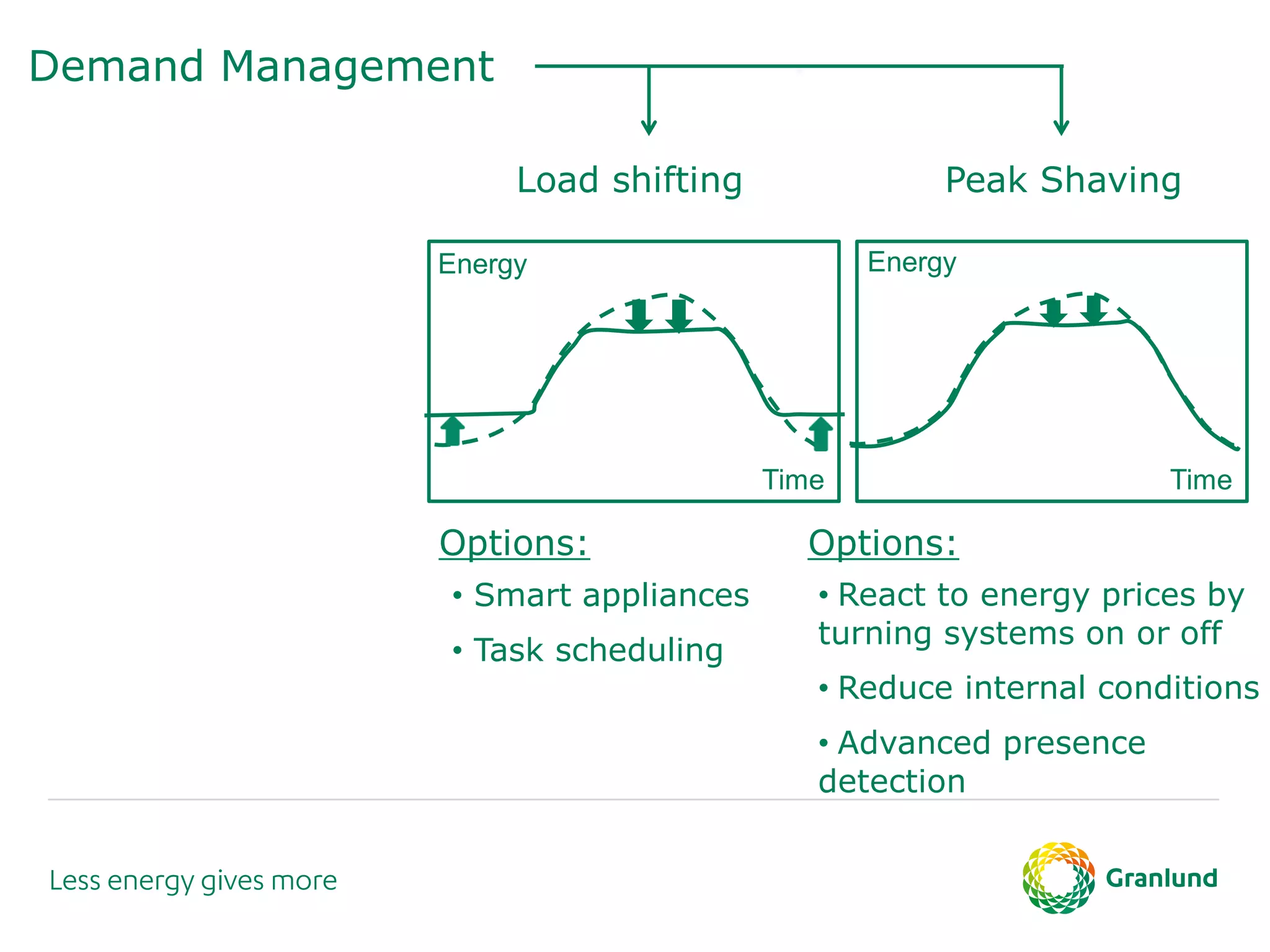
Energy Energy
Time Time
Load shifting Peak Shaving
• Smart appliances
• Task scheduling
• React to energy prices by
turning systems on or off
• Reduce internal conditions
• Advanced presence
detection
Options: Options:
Demand Management
Smart Buildings for a Smart Grid
Load shifting
 Electric car charging at night
 Smart appliances: dishwashing machine, clothes washing machine
Peak shaving
 Winter peak: turn off night-time lighting or to dim advertisement
lighting when prices are particularly high
 Summer peak: less cooling, target temperature rises from 21oC to
24oC
High supply
 Plenty of wind, take advantage of low energy prices:
 industrial processes that require large amounts of electricity may
be automatically performed
 cheaper to use expensive home systems such as sauna
©Zumawire
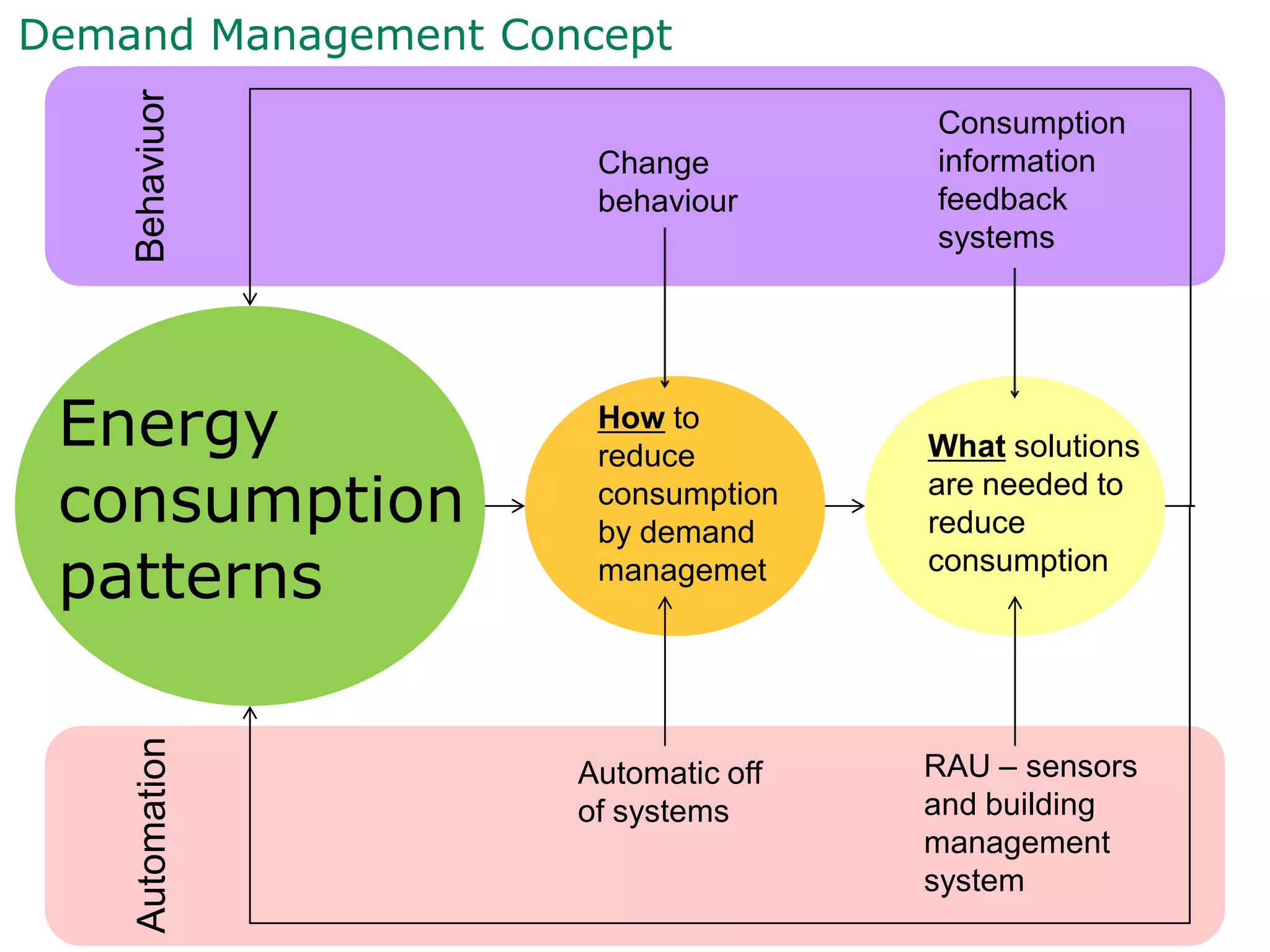
Energy
consumption
patterns
How to
reduce
consumption
by demand
managemet
What solutions
are needed to
reduce
consumption
Automatic off
of systems
RAU – sensors
and building
management
system
Automation
Consumption
information
feedback
systems
Behaviuor Change
behaviour
Demand Management Concept
“the wind is blowing in Denmark so maybe we will have a sauna”
Smart Buildings
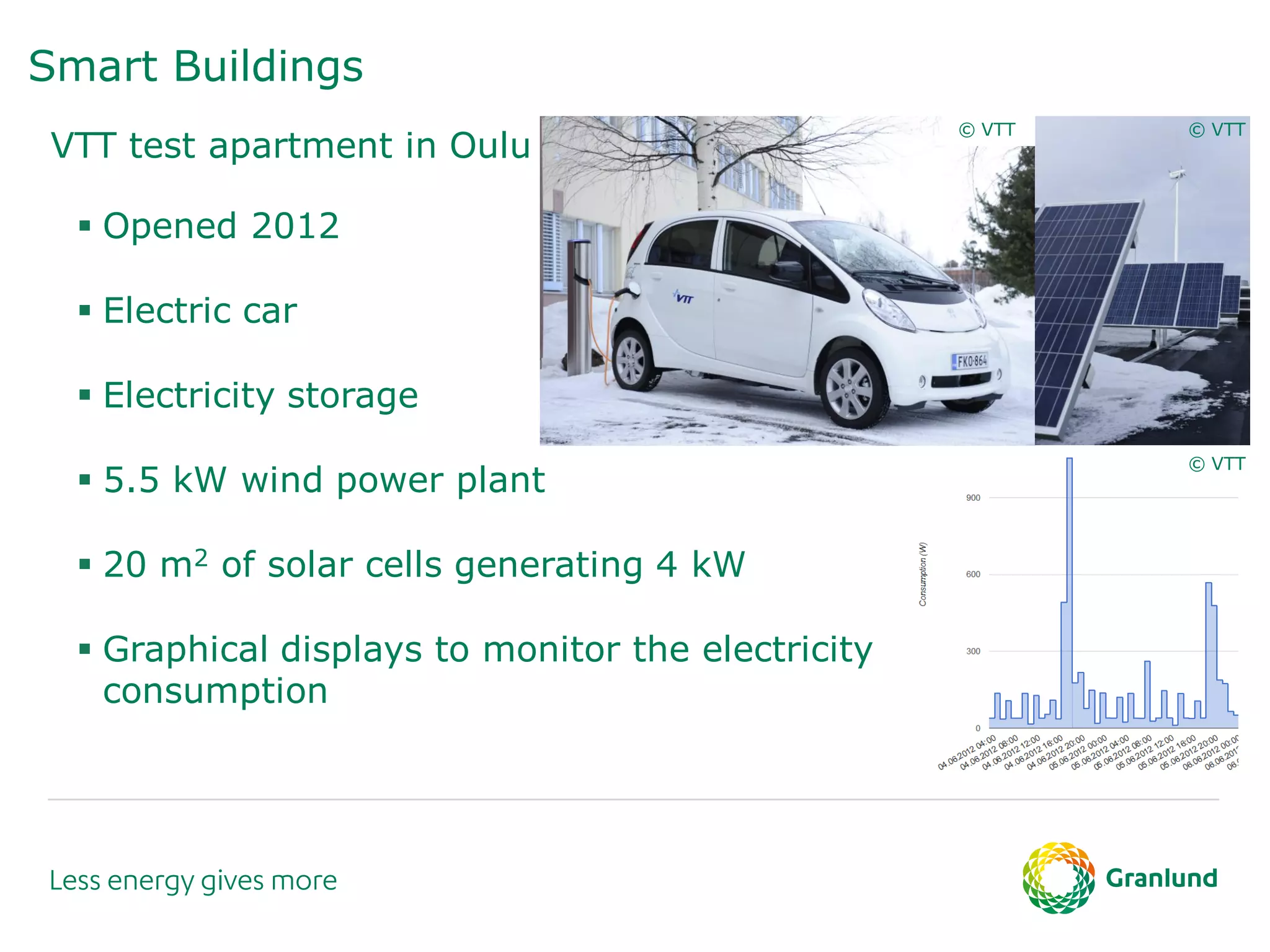
VTT test apartment in Oulu
 Opened 2012
 Electric car
 Electricity storage
 5.5 kW wind power plant
 20 m2 of solar cells generating 4 kW
 Graphical displays to monitor the electricity
consumption
© VTT
© VTT© VTT
Smart Buildings
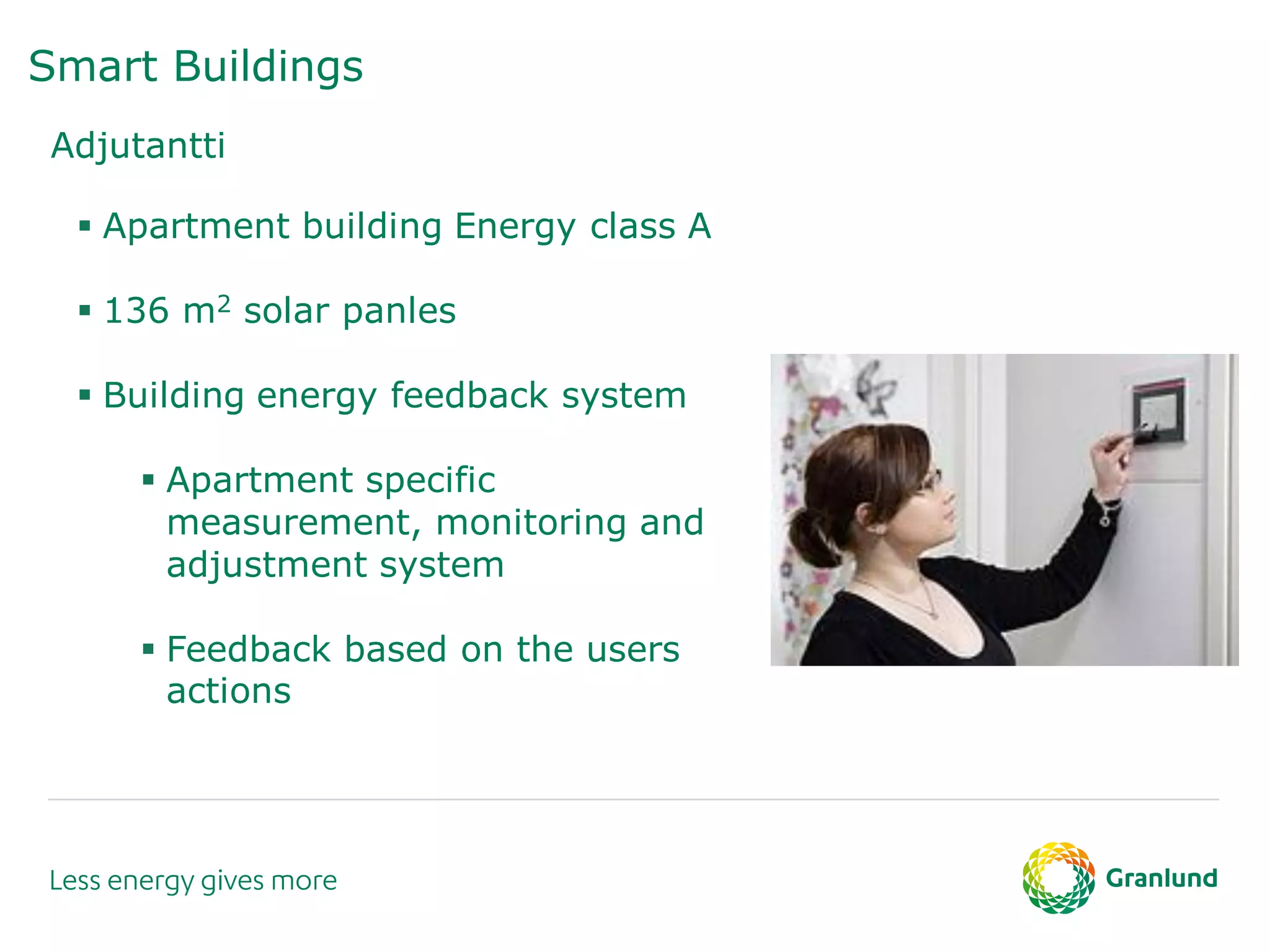
Adjutantti
 Apartment building Energy class A
 136 m2 solar panles
 Building energy feedback system
 Apartment specific
measurement, monitoring and
adjustment system
 Feedback based on the users
actions
Smart Buildings
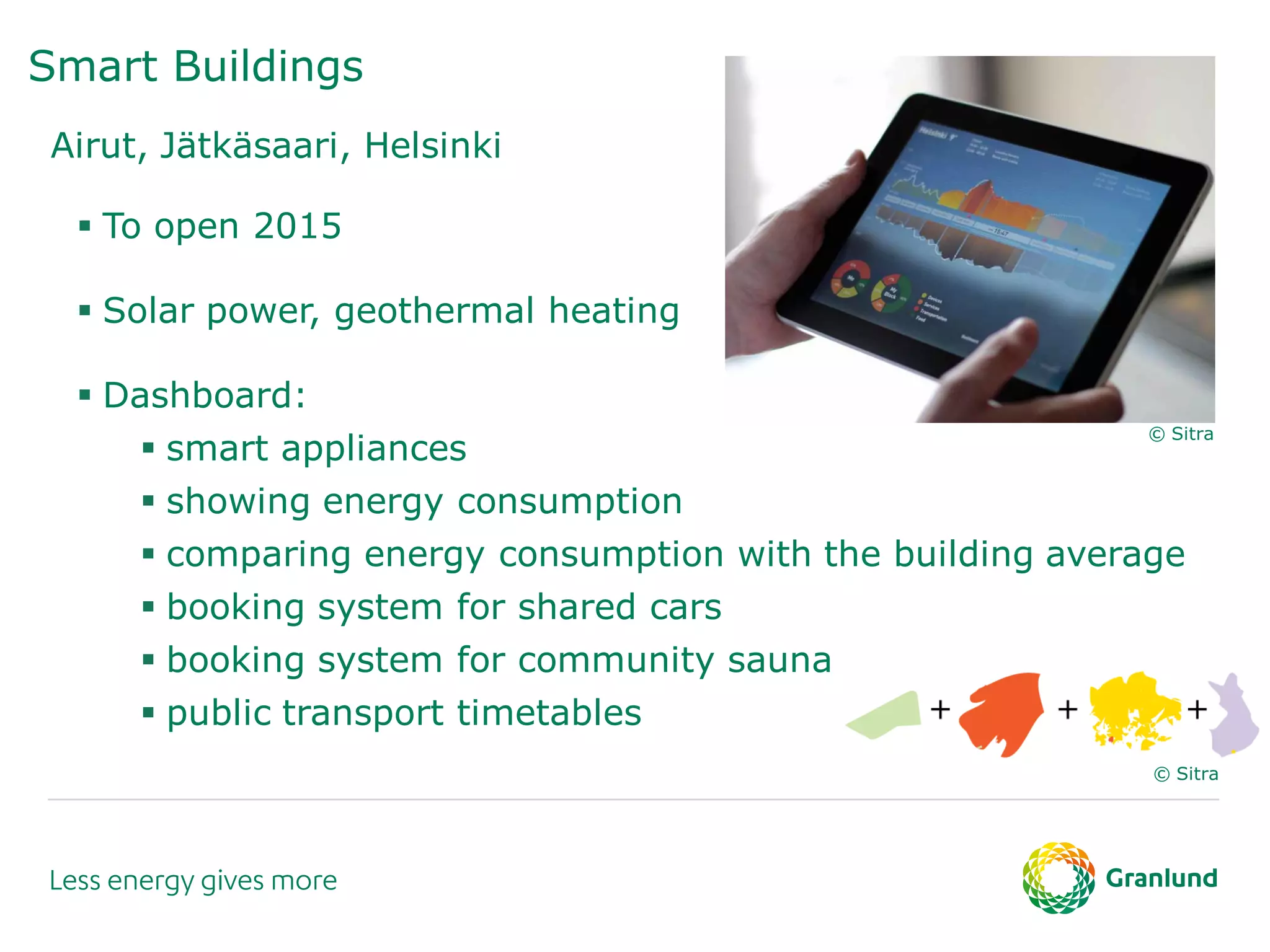
Airut, Jätkäsaari, Helsinki
 To open 2015
 Solar power, geothermal heating
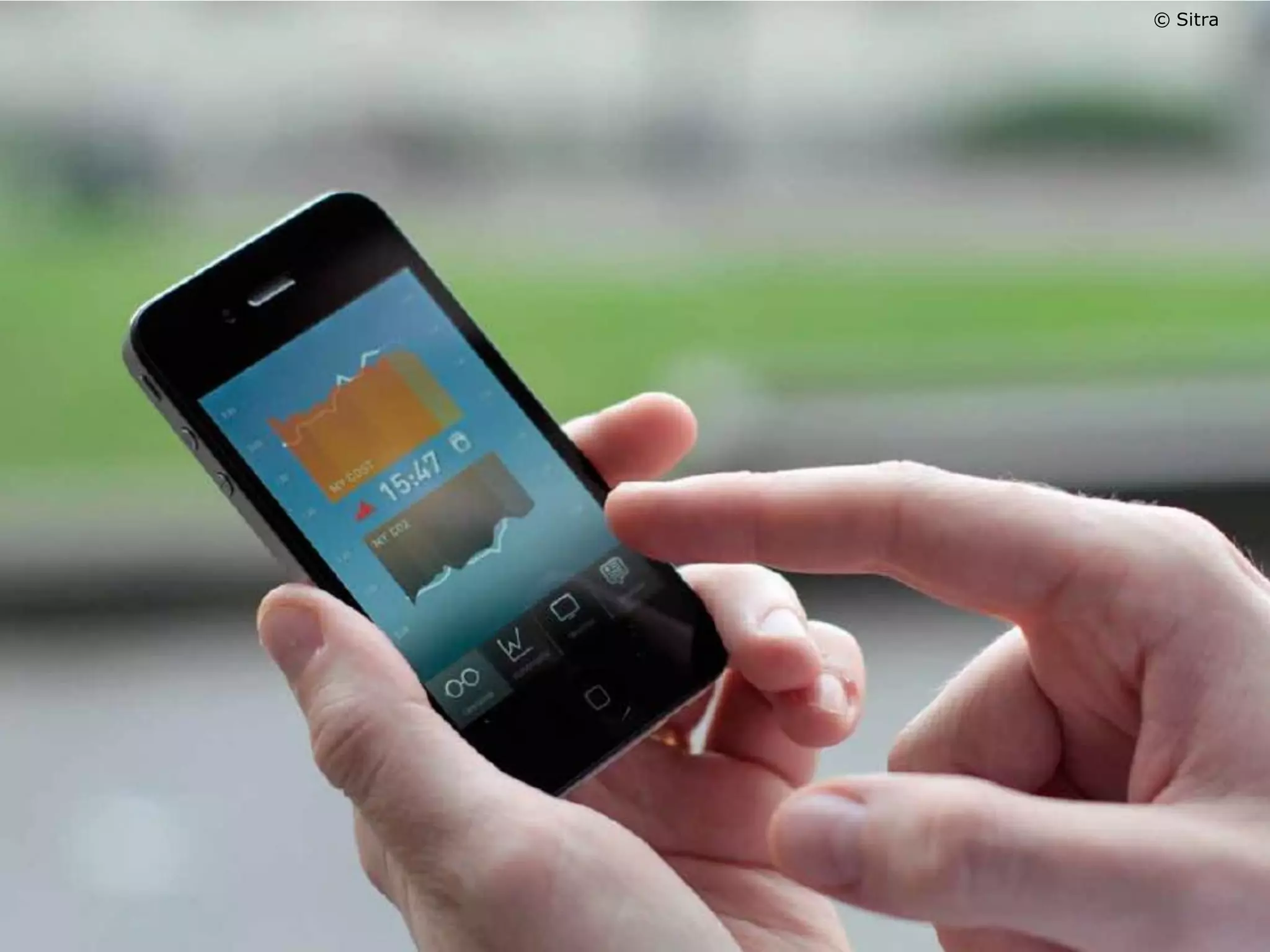
 Dashboard:
 smart appliances
 showing energy consumption
 comparing energy consumption with the building average
 booking system for shared cars
 booking system for community sauna
 public transport timetables
© Sitra
© Sitra
© Sitra
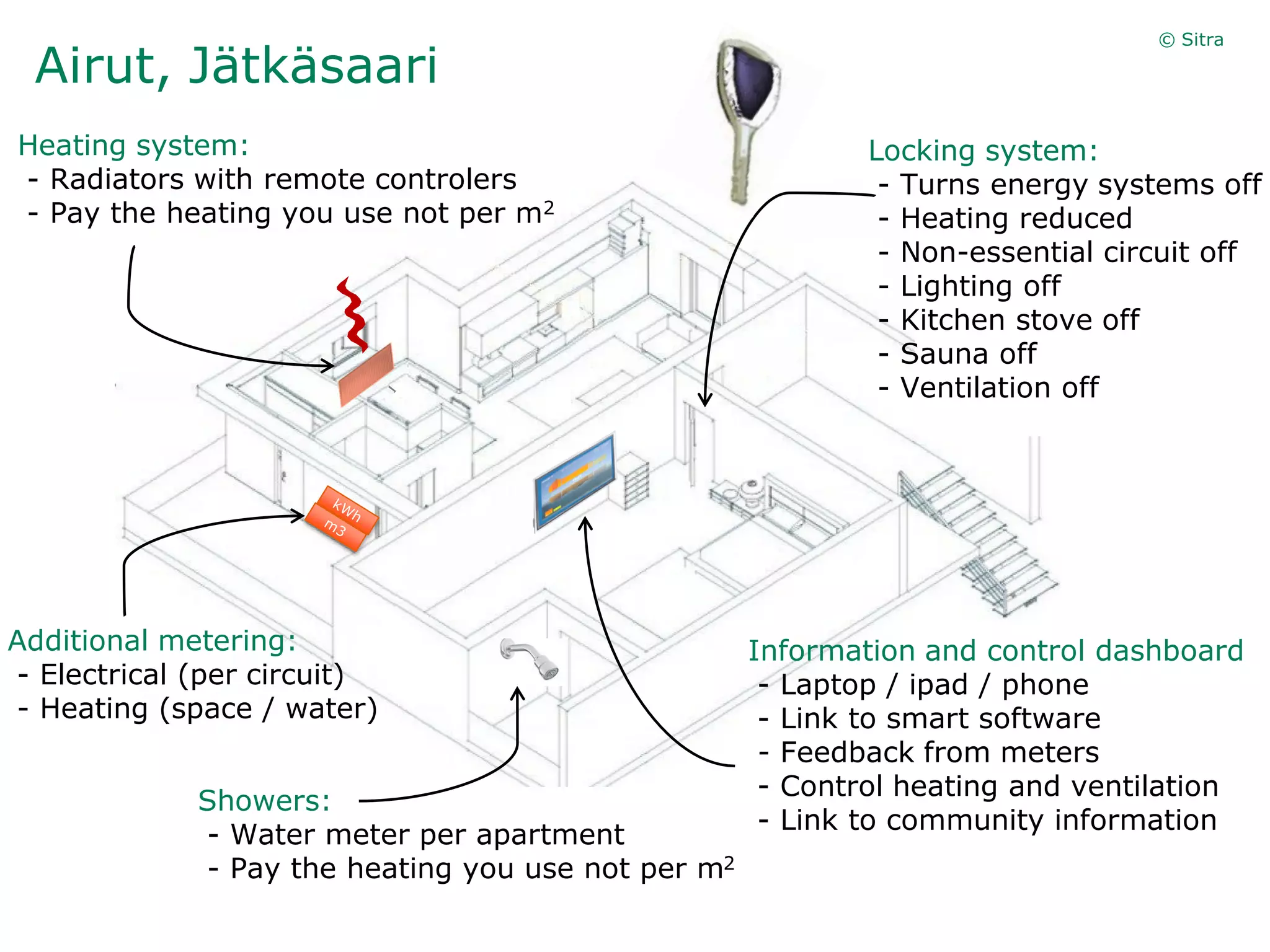
Airut, Jätkäsaari
Locking system:
- Turns energy systems off
- Heating reduced
- Non-essential circuit off
- Lighting off
- Kitchen stove off
- Sauna off
- Ventilation off
Heating system:
- Radiators with remote controlers
- Pay the heating you use not per m2
© Sitra
Low2No Smart Systems Selections
Showers:
- Water meter per apartment
- Pay the heating you use not per m2
Information and control dashboard
- Laptop / ipad / phone
- Link to smart software
- Feedback from meters
- Control heating and ventilation
- Link to community information
Additional metering:
- Electrical (per circuit)
- Heating (space / water)
Smart Buildings
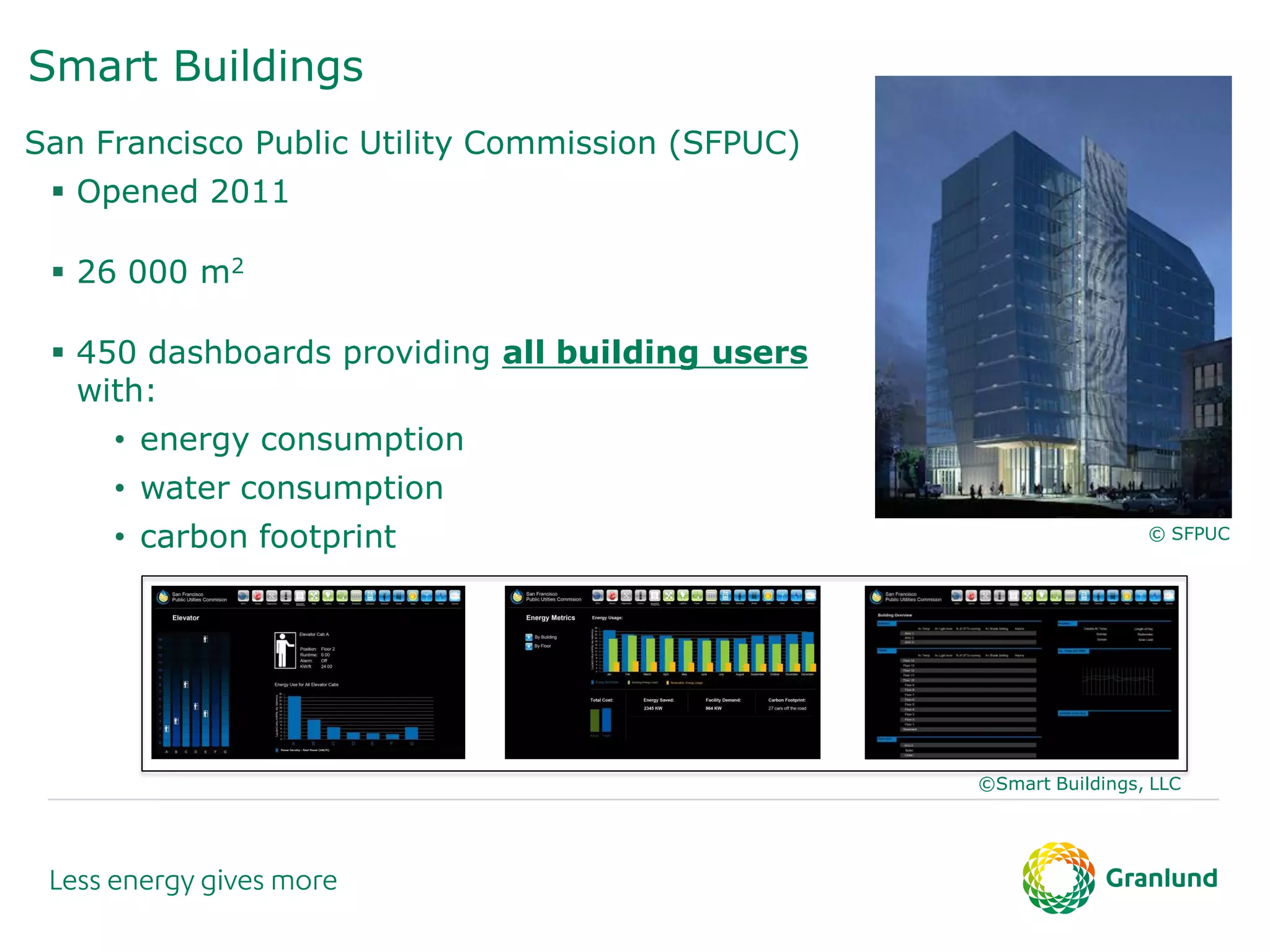
San Francisco Public Utility Commission (SFPUC)
 Opened 2011
 26 000 m2
 450 dashboards providing all building users
with:
• energy consumption
• water consumption
• carbon footprint © SFPUC
©Smart Buildings, LLC
Smart Buildings
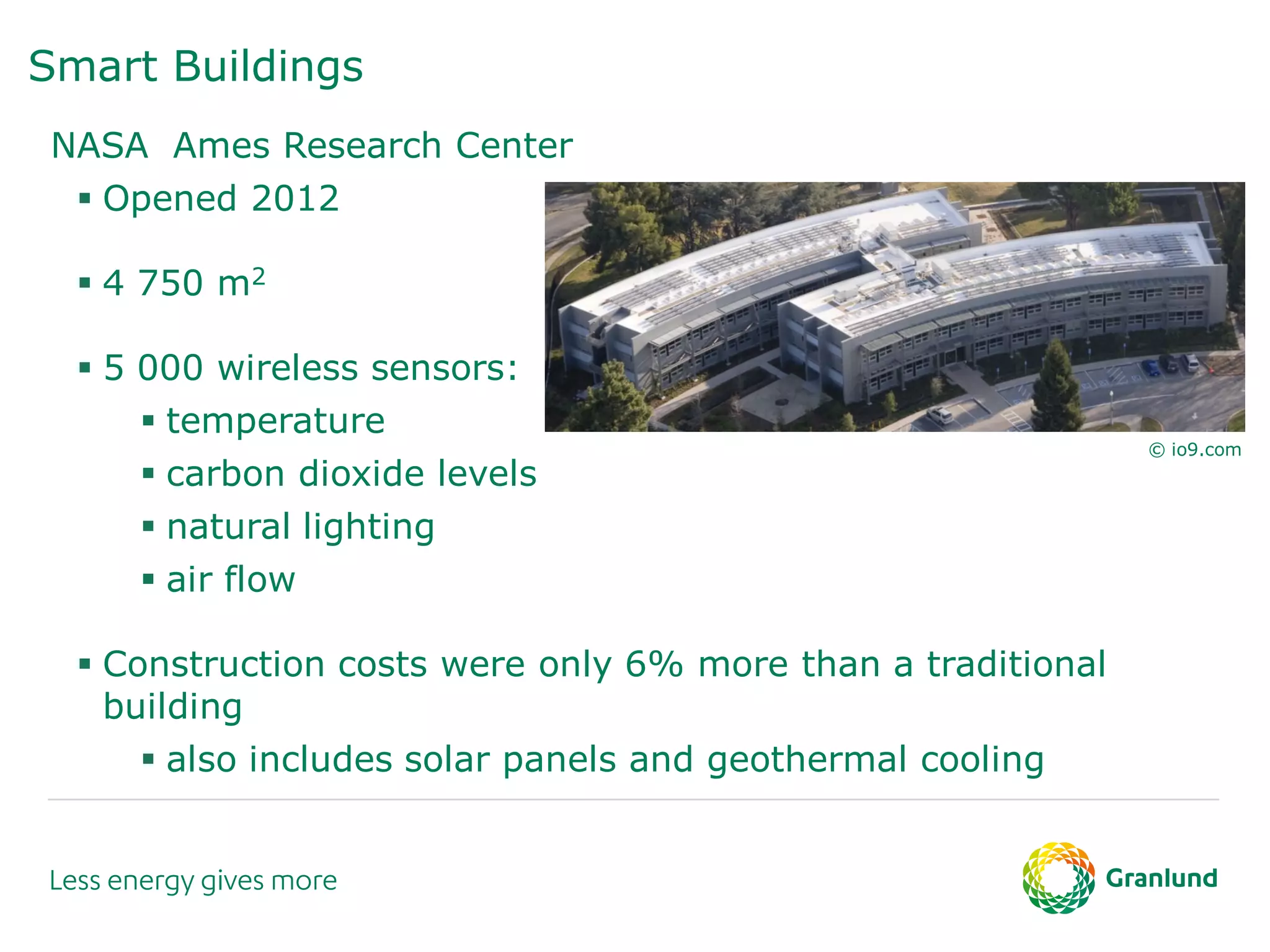
NASA Ames Research Center
 Opened 2012
 4 750 m2
 5 000 wireless sensors:
 temperature
 carbon dioxide levels
 natural lighting
 air flow
 Construction costs were only 6% more than a traditional
building
 also includes solar panels and geothermal cooling
© io9.com
Smart Buildings
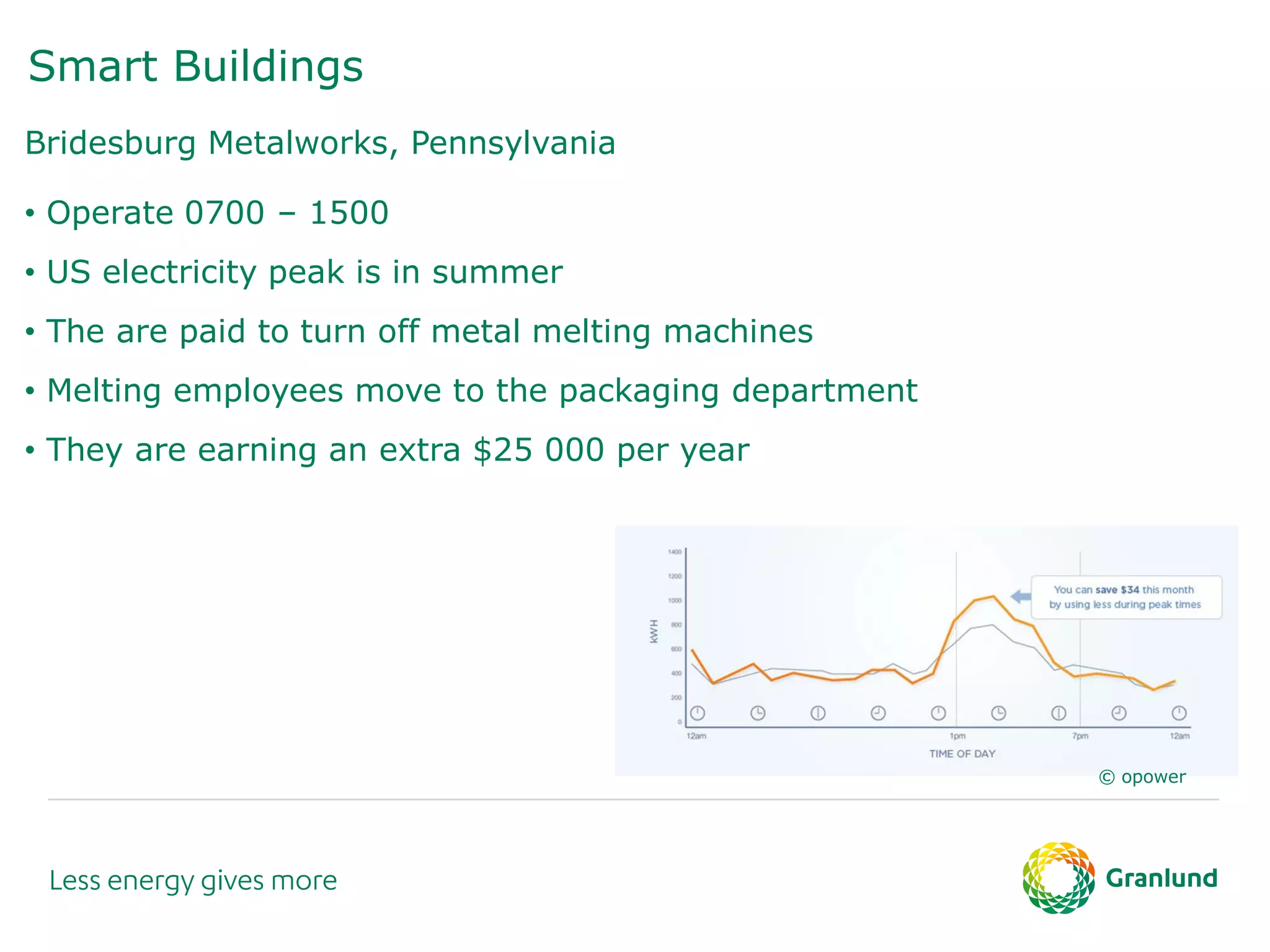
Bridesburg Metalworks, Pennsylvania
• Operate 0700 – 1500
• US electricity peak is in summer
• The are paid to turn off metal melting machines
• Melting employees move to the packaging department
• They are earning an extra $25 000 per year
© opower
Life Cycle:
Analysis and Cost Analysis
Sustainable Design
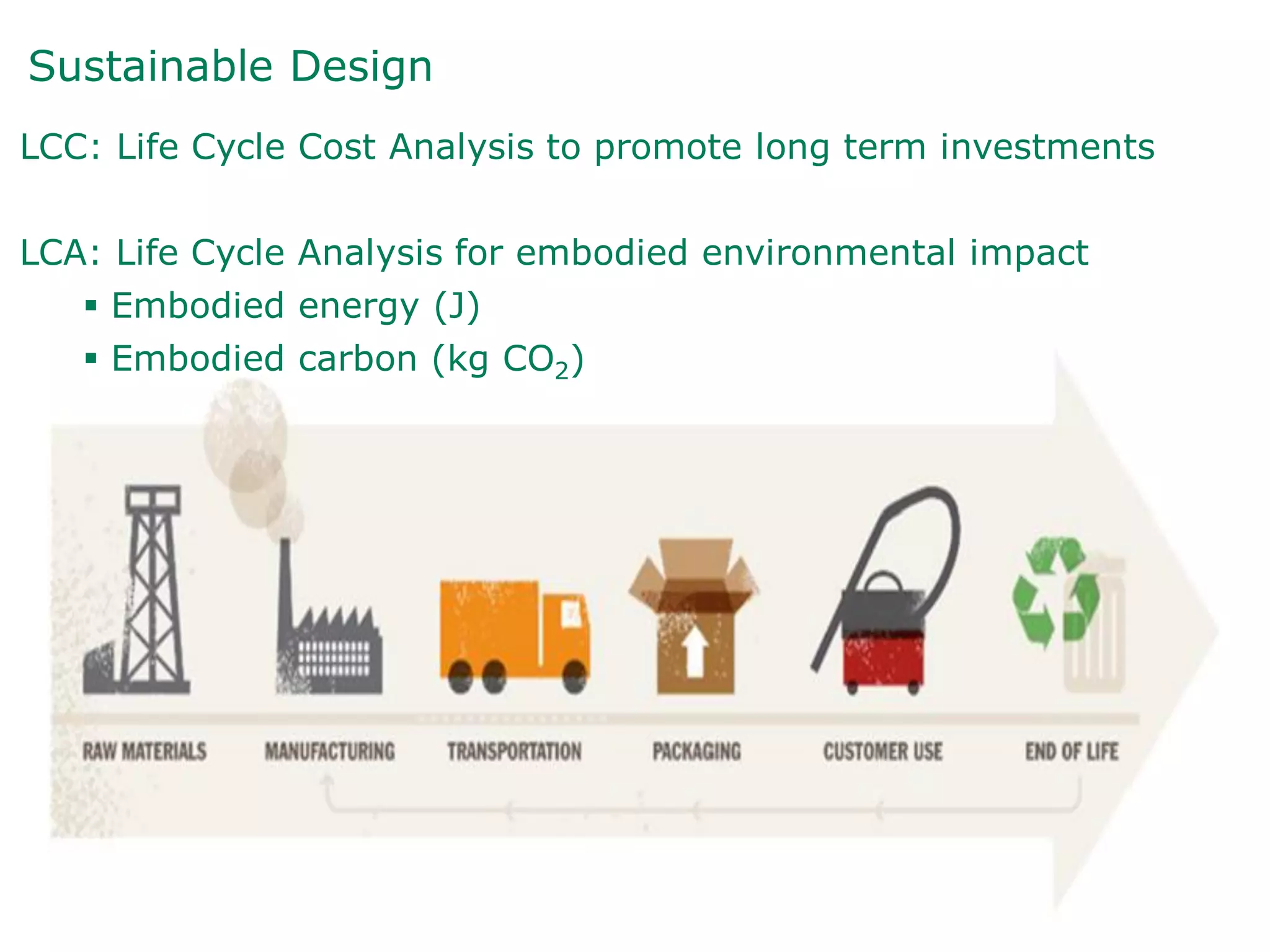
LCC: Life Cycle Cost Analysis to promote long term investments
LCA: Life Cycle Analysis for embodied environmental impact
 Embodied energy (J)
 Embodied carbon (kg CO2)
Sustainable Design
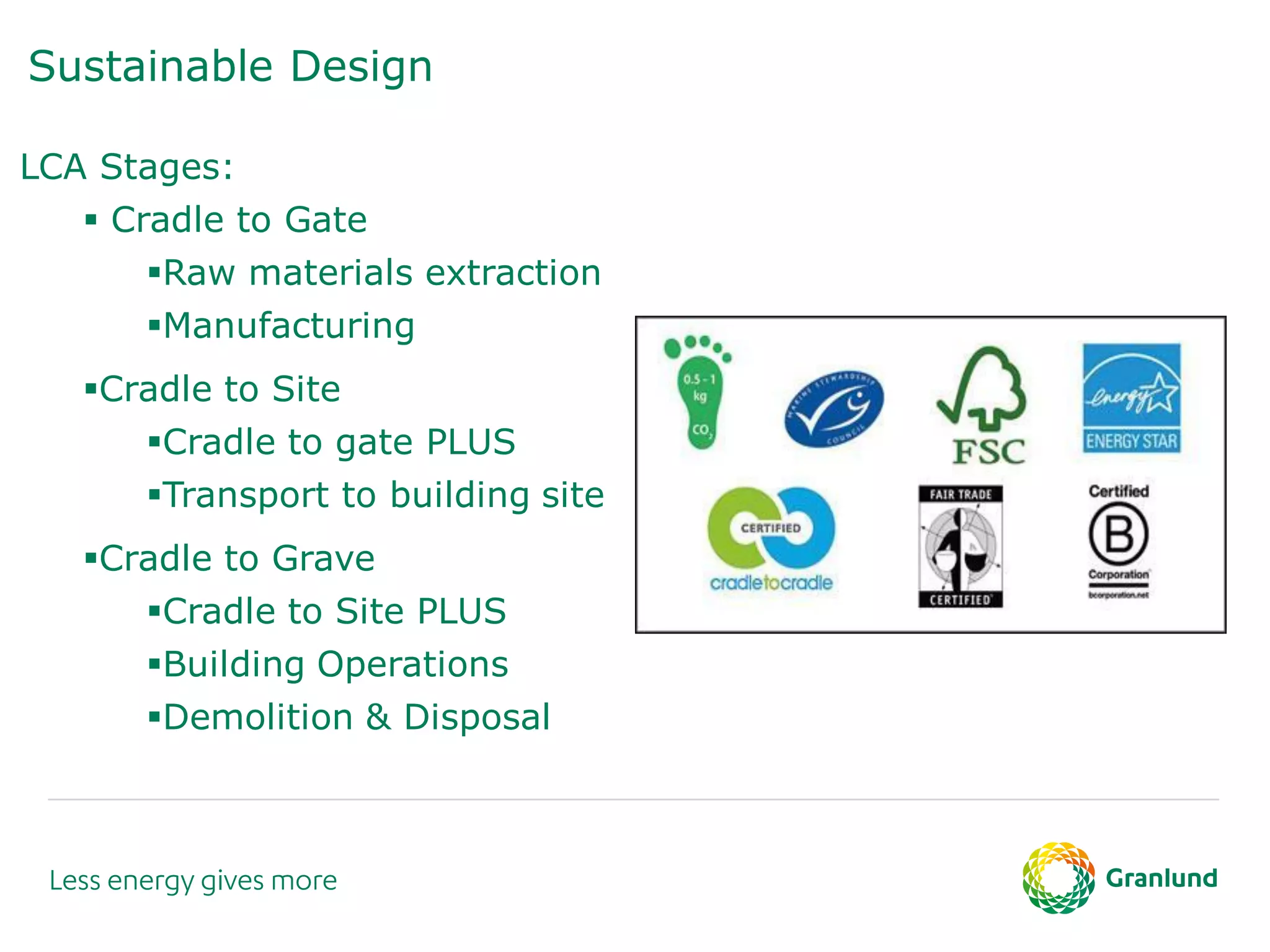
LCA Stages:
 Cradle to Gate
Raw materials extraction
Manufacturing
Cradle to Site
Cradle to gate PLUS
Transport to building site
Cradle to Grave
Cradle to Site PLUS
Building Operations
Demolition & Disposal
xx
 xx
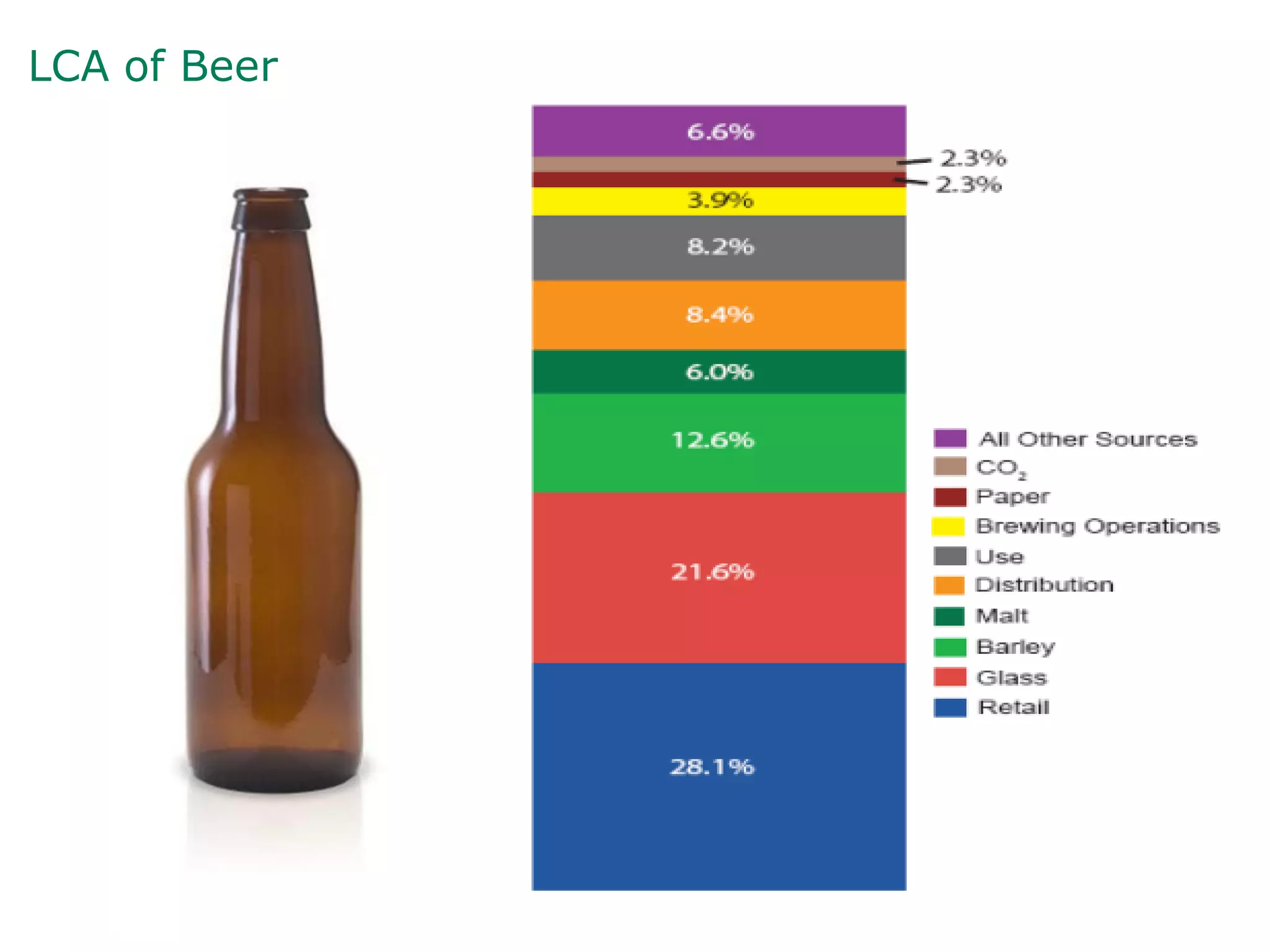
LCA of Beer
LCA Comparison
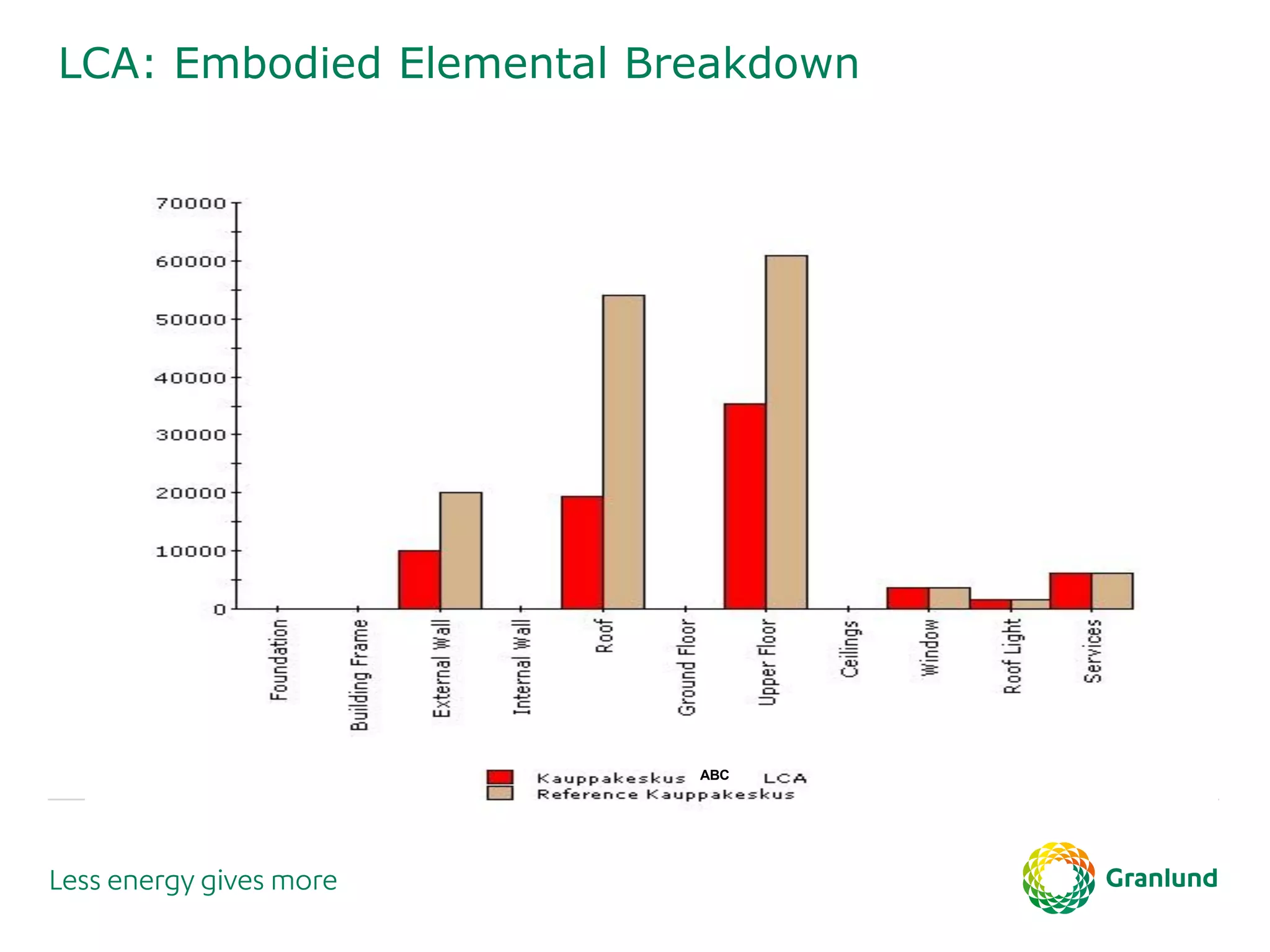
The following shows the comparison of two similar buildings
 Kauppakeskus ABC
 Steel structure building
 Reference Kauppakeskus
 Concrete structure
The steel structure allowed for more environmentally friendly
materials selections to be made in this case compared to
standard concrete construction
LCA: Embodied Elemental Breakdown
ABC
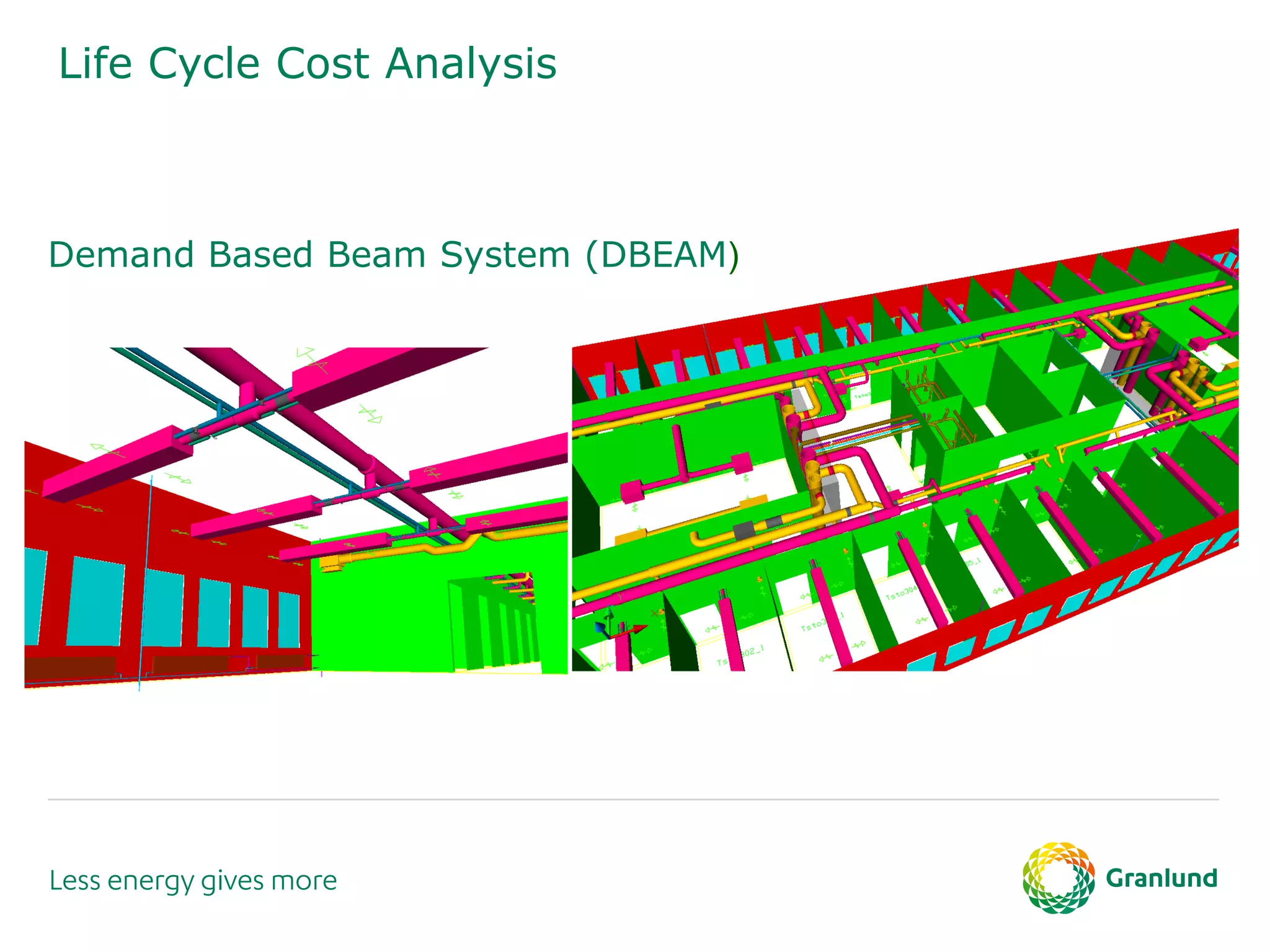
Life Cycle Cost Analysis
Demand Based Beam System (DBEAM)
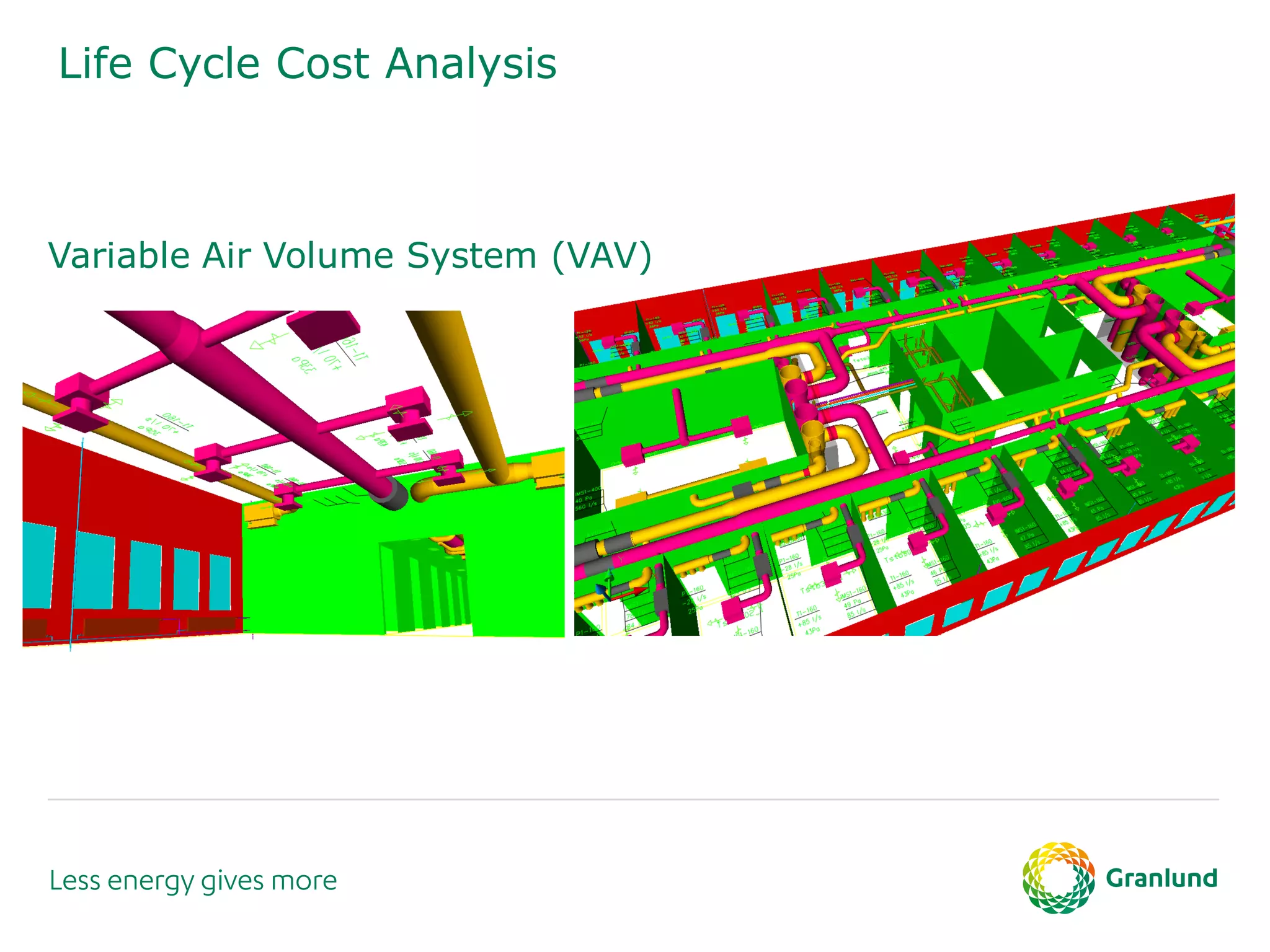
Life Cycle Cost Analysis
Variable Air Volume System (VAV)
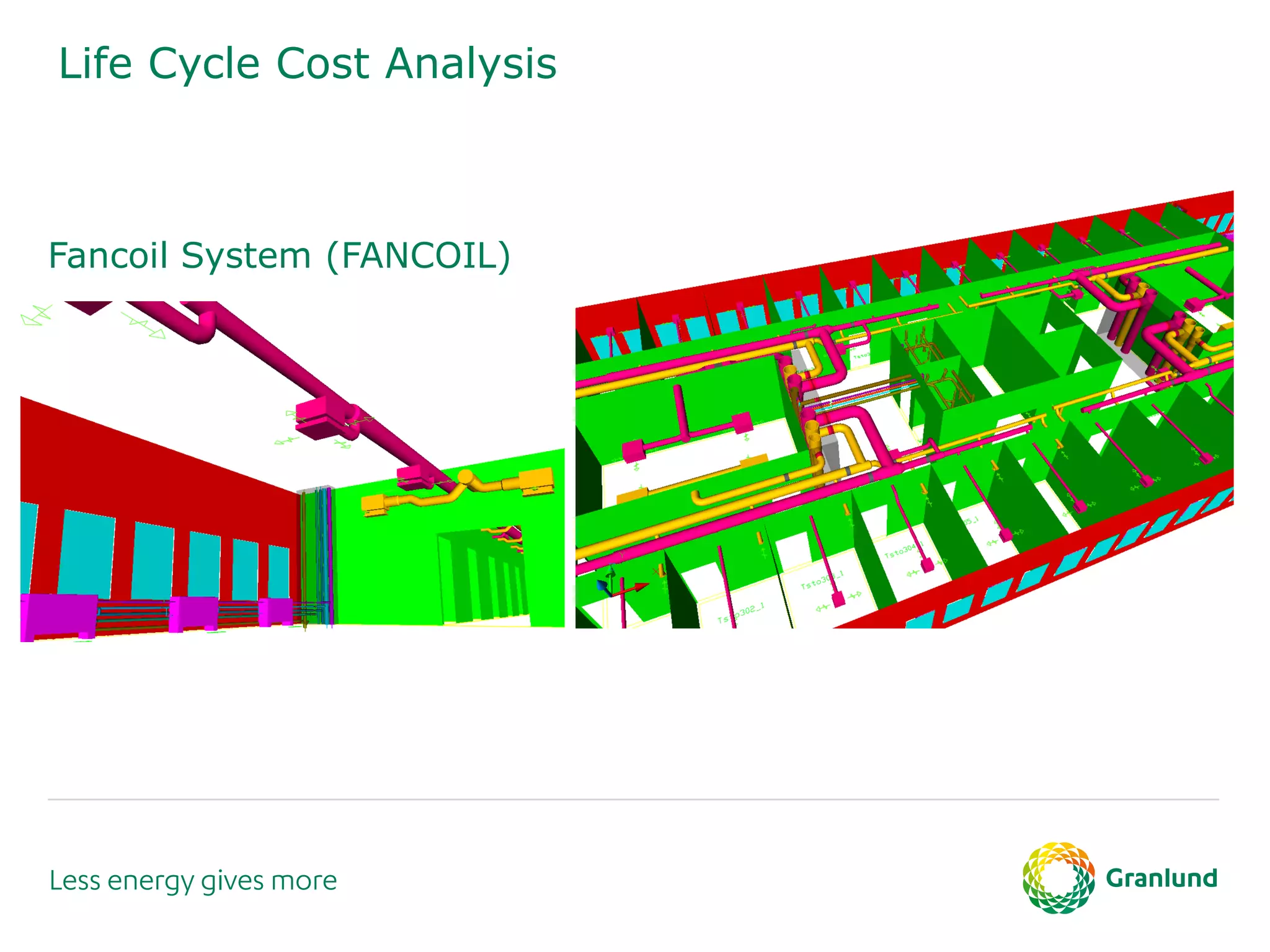
Life Cycle Cost Analysis
Fancoil System (FANCOIL)
Life Cycle Cost Analysis
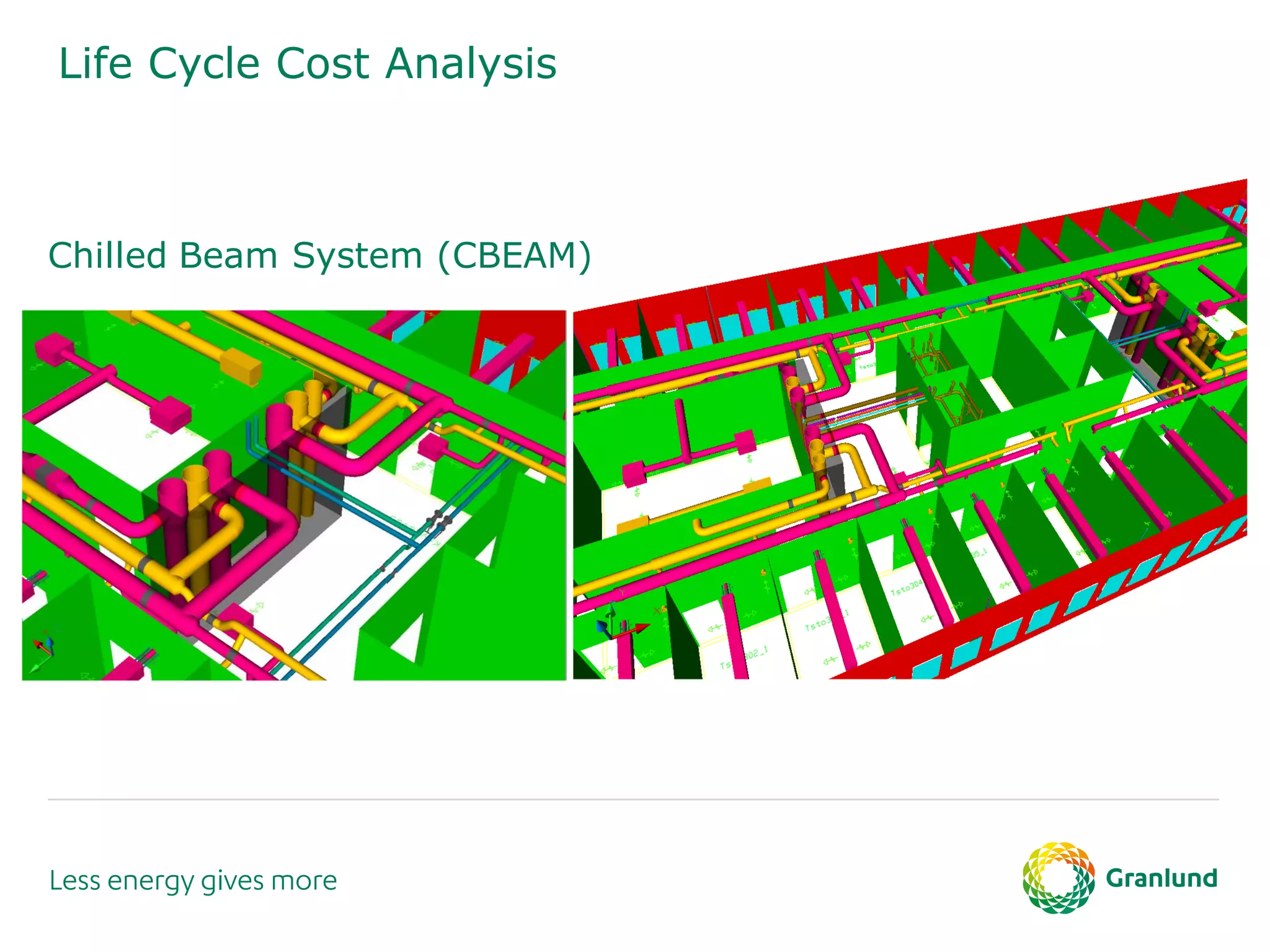
Chilled Beam System (CBEAM)
Life Cycle Cost Analysis
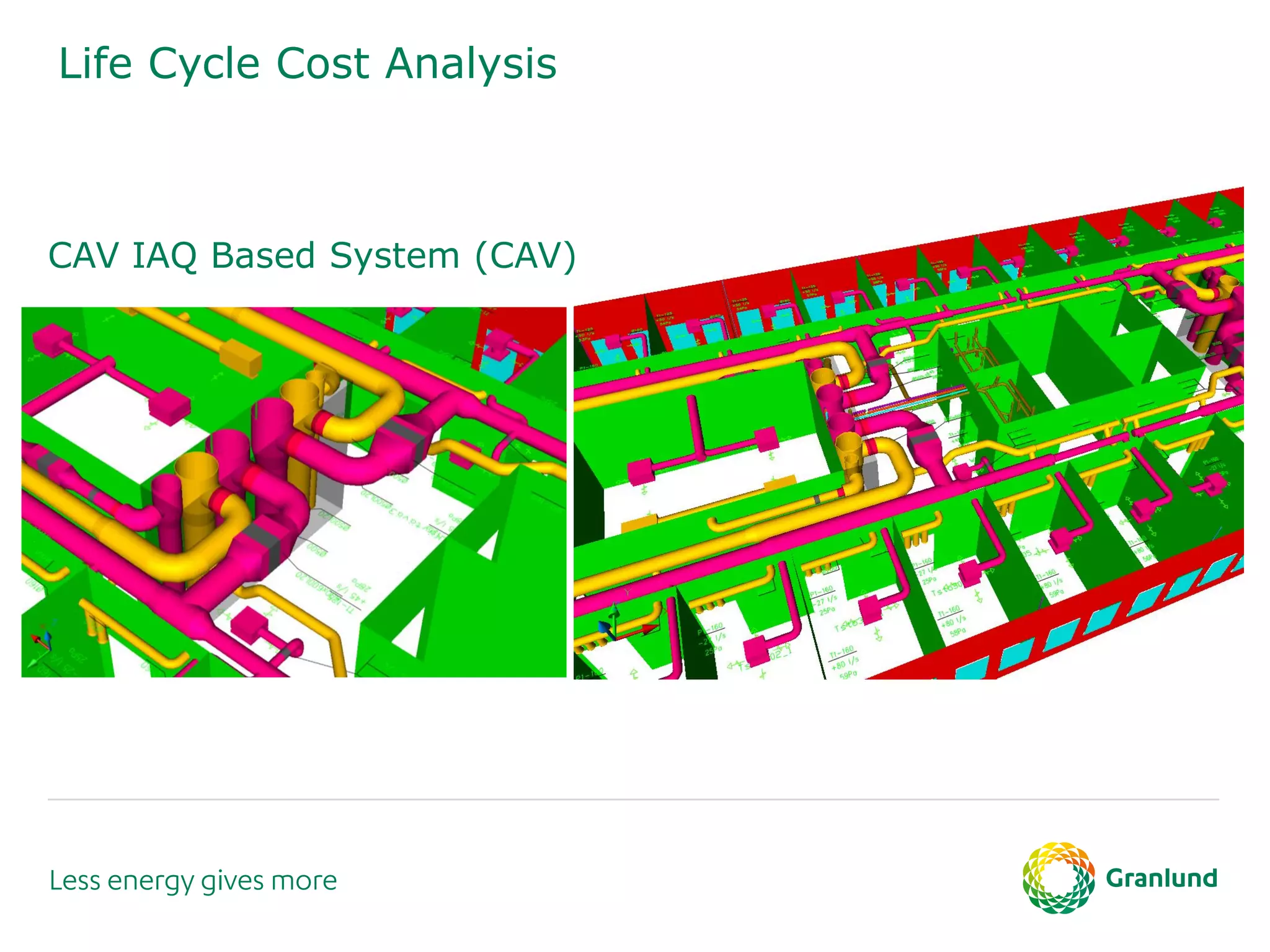
CAV IAQ Based System (CAV)
Life Cycle Cost Analysis
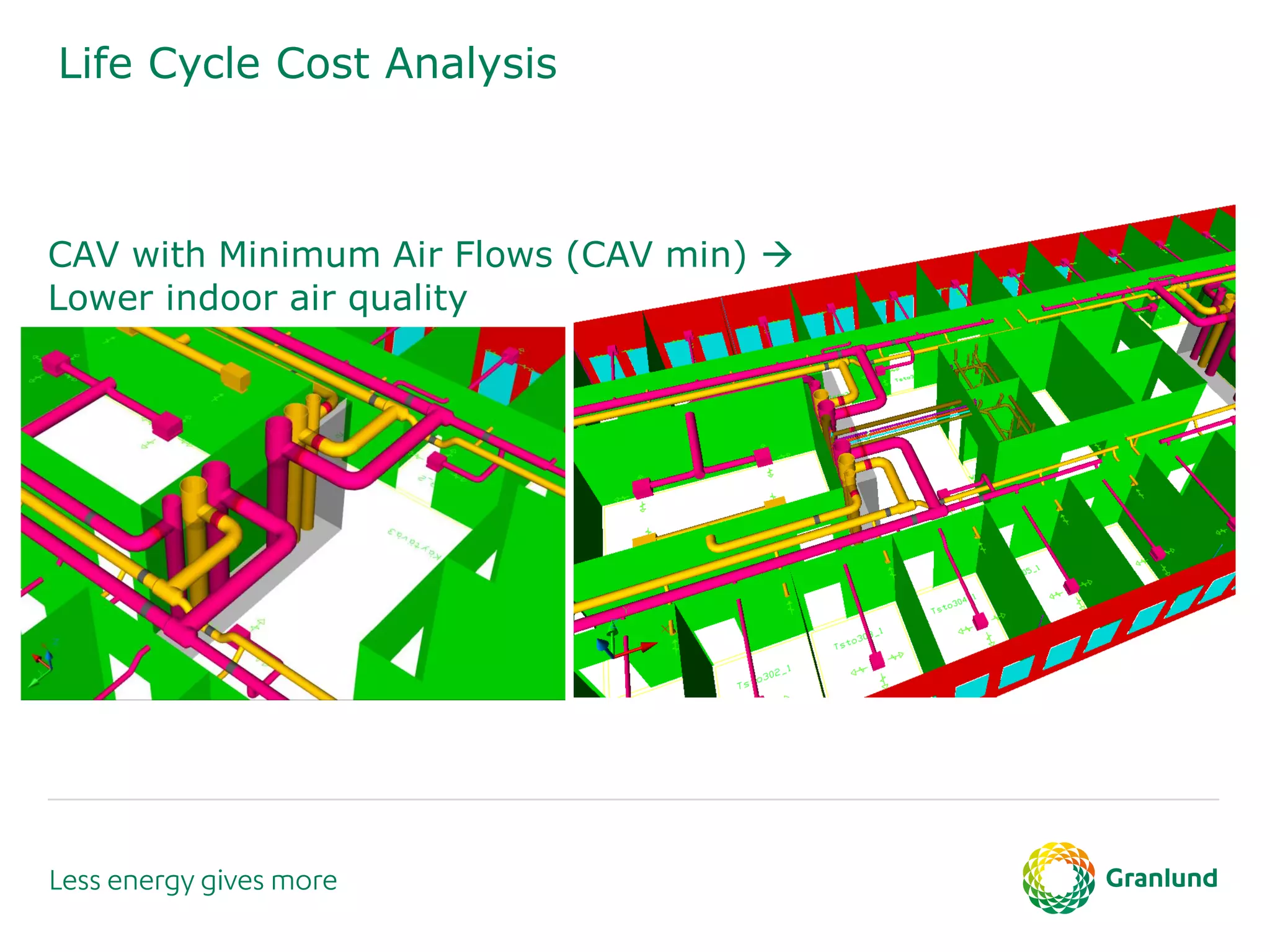
CAV with Minimum Air Flows (CAV min) 
Lower indoor air quality
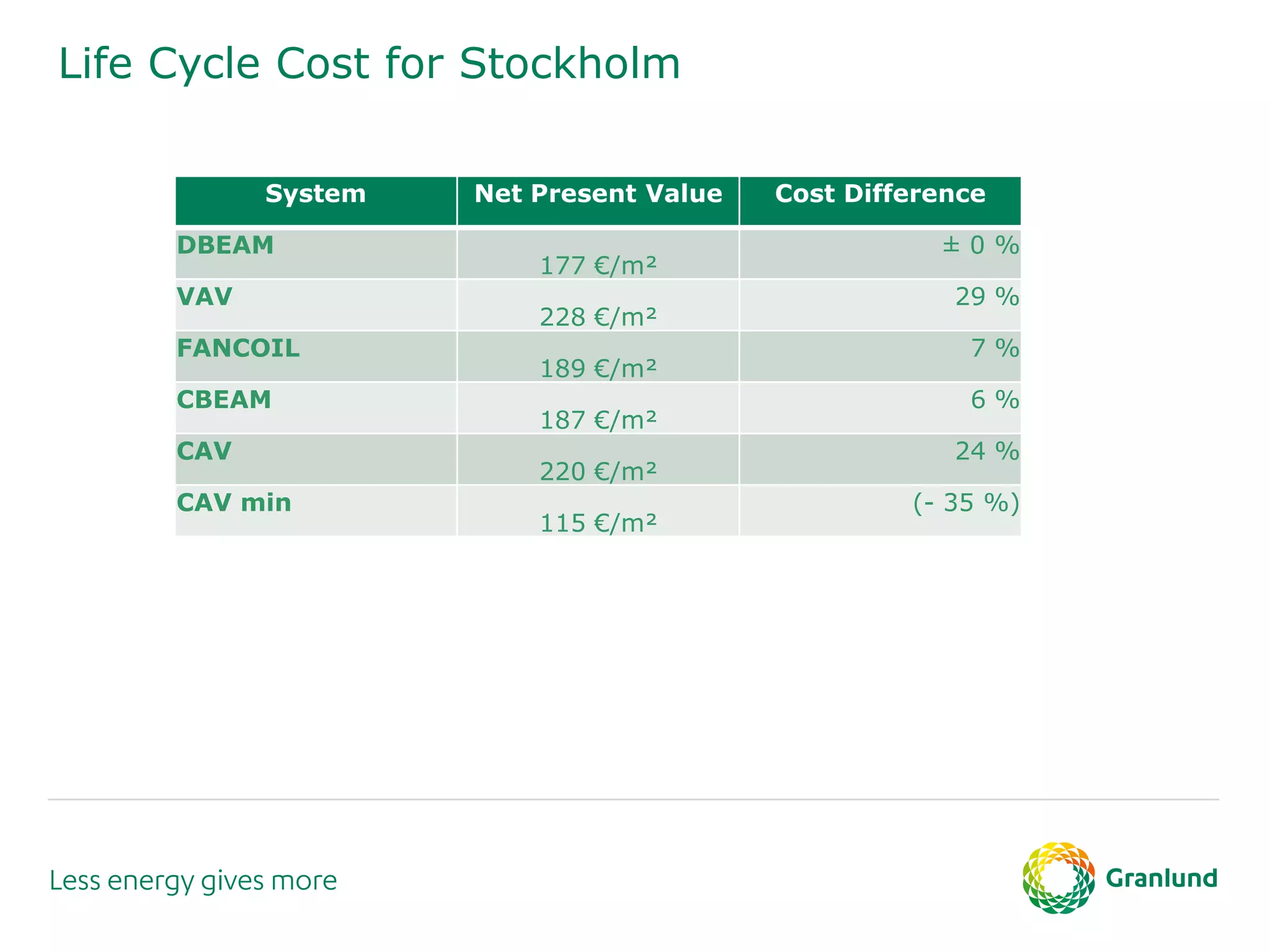
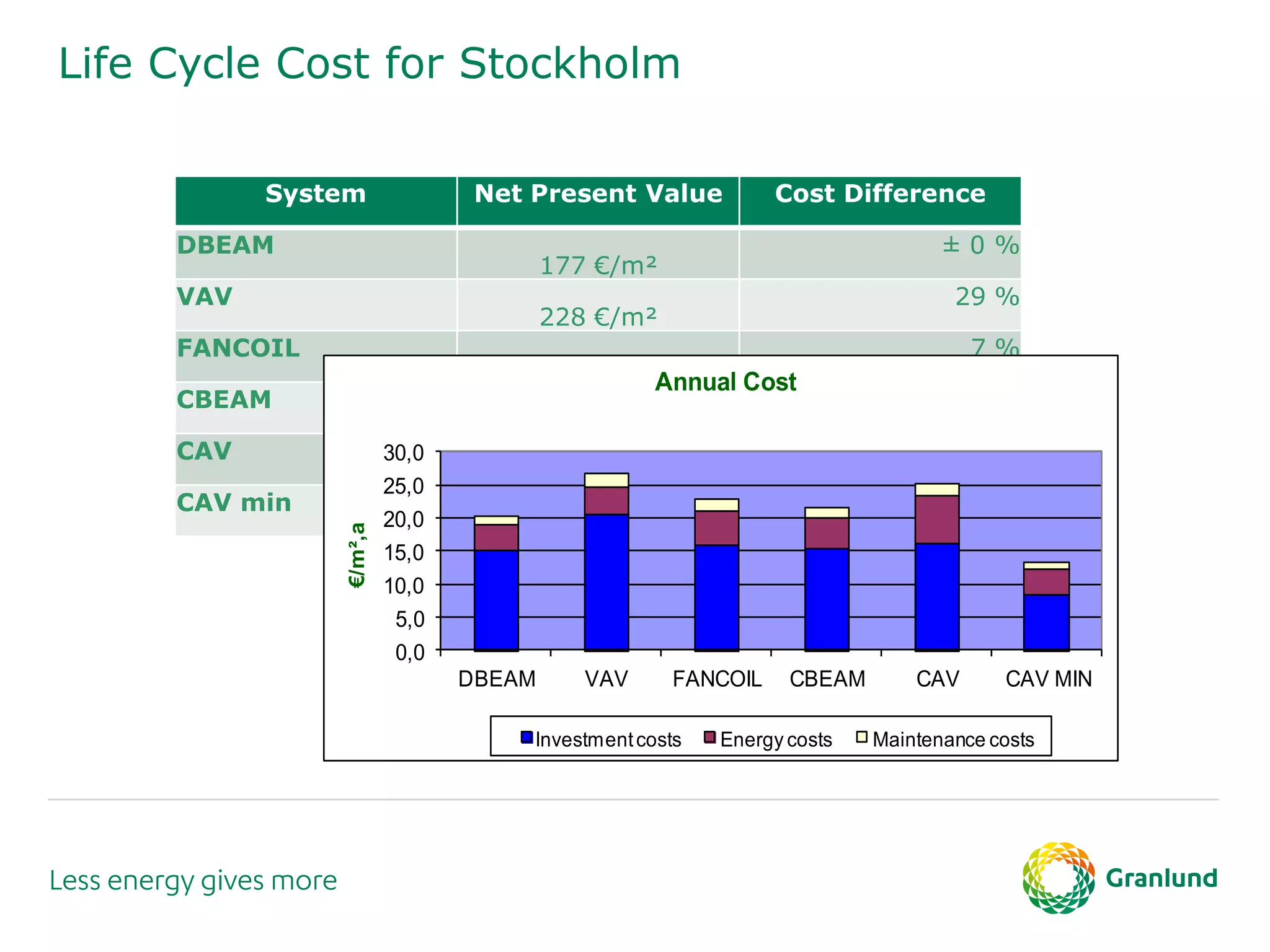
Life Cycle Cost for Stockholm
System Net Present Value Cost Difference
DBEAM
177 €/m²
± 0 %
VAV
228 €/m²
29 %
FANCOIL
189 €/m²
7 %
CBEAM
187 €/m²
6 %
CAV
220 €/m²
24 %
CAV min
115 €/m²
(- 35 %)
Life Cycle Cost for Stockholm
System Net Present Value Cost Difference
DBEAM
177 €/m²
± 0 %
VAV
228 €/m²
29 %
FANCOIL
189 €/m²
7 %
CBEAM
187 €/m²
6 %
CAV
220 €/m²
24 %
CAV min
115 €/m²
(- 35 %)
0,0
5,0
10,0
15,0
20,0
25,0
30,0
DBEAM VAV FANCOIL CBEAM CAV CAV MIN
€/m²,a
Annual Cost
Investmentcosts Energy costs Maintenance costs
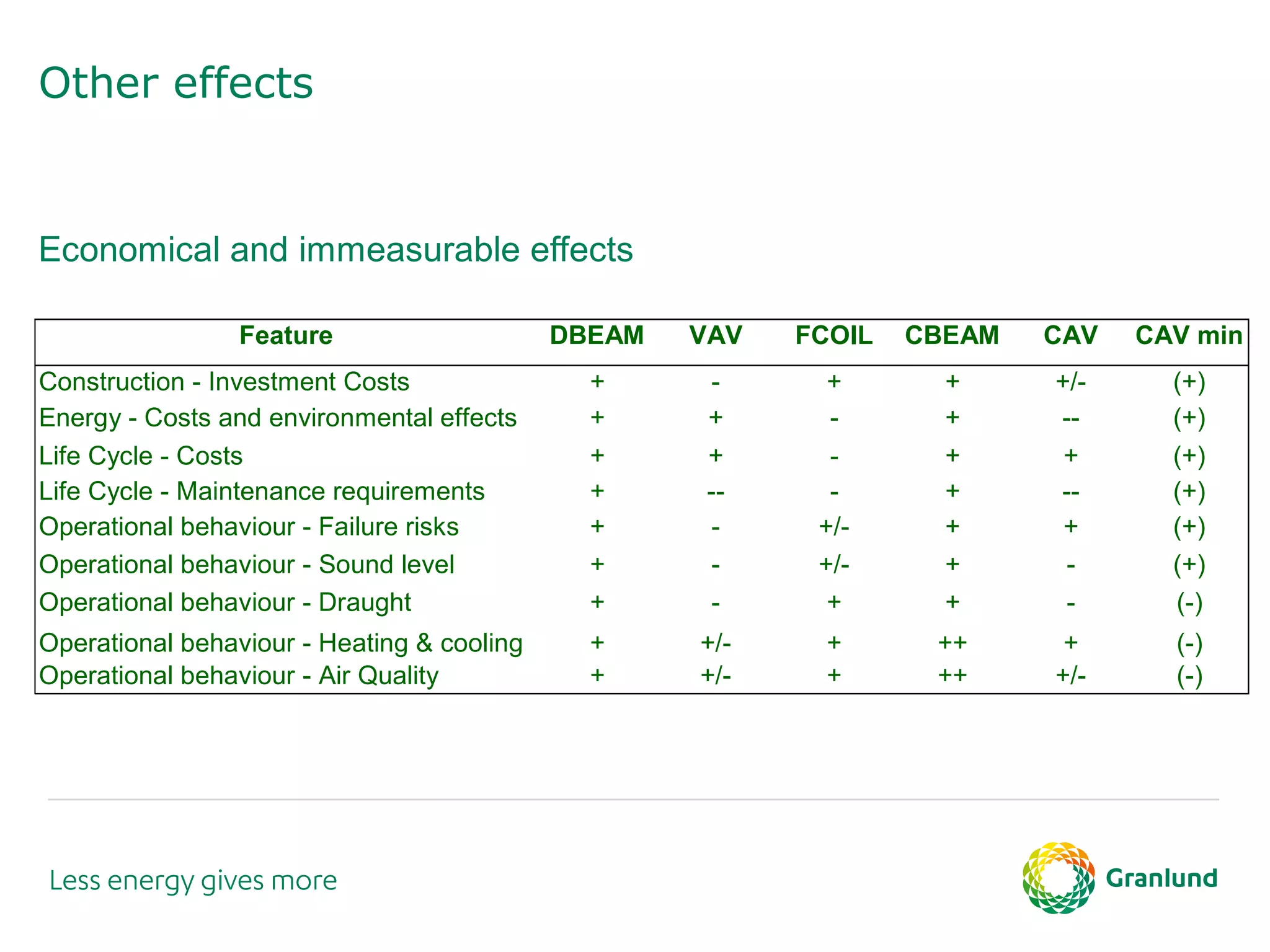
Economical and immeasurable effects
Feature DBEAM VAV FCOIL CBEAM CAV CAV min
Construction - Investment Costs + - + + +/- (+)
Energy - Costs and environmental effects + + - + -- (+)
Life Cycle - Costs + + - + + (+)
Life Cycle - Maintenance requirements + -- - + -- (+)
Operational behaviour - Failure risks + - +/- + + (+)
Operational behaviour - Sound level + - +/- + - (+)
Operational behaviour - Draught + - + + - (-)
Operational behaviour - Heating & cooling + +/- + ++ + (-)
Operational behaviour - Air Quality + +/- + ++ +/- (-)
Other effects
Sustainable Building Design Lecture: Technical Aspects 2015, Aalto University Architecture School

Sustainable Building Design Lecture: Technical Aspects 2015, Aalto University Architecture School

  • 1.
  • 3.
    • Real EstateConsulting • Energy and Environment • HVAC & Plumbing • Building Controls • Electrical Granlund 500+ people Leading building services expert in Finland
  • 4.
    Offices • Helsinki • Riihimäki •Lahti • Tampere • Vaasa • Seinäjoki • Kuopio • Joensuu • St Petersburg • Espoo • Lappeenranta
  • 7.
    Macroview Sustainability When wethink of the technicalities of sustainability we should focus on more than just energy…………….. Social Economic Environmental Inspiring architecture Company image / Brand Transport emissions Natural light Attracting employees Embodied energy of materials Outdoor connection Reduced maintenance Waste generation Increased fresh air Building value Water Acoustics Vacancy rates Light pollution Safety Energy savings Noise pollution Art Material cost Energy use
  • 8.
    One thought toconsider…. Who / what is driving innovation in the sustainable built environment today?  Cities or municipalities who own land or who give planning permissions and want to reduce environmental impact  Corporate clients / developers who want to create a green image  Corporate clients / developers who want to save money  Corporate clients who want a long lasting durable product  Consumers who demand green products  Others
  • 9.
  • 10.
    Inspirational Architecture Guggenheim Museum,in Bilbao  First 3 years, almost 4 million tourists visited, estimated they generated approximately €500 million in economic activity
  • 11.
    Community Interaction Commonwealth BankPlace (1)  Mixed-use complex in downtown Sydney, Australia  Aimed to maximise use by the local community  Children's Theatre:  Picnic park  Retail Terrace: bars, restaurants, cafes and stores  Artistic lighting with nighttime playground with low energy lighting
  • 12.
    Community Interaction Commonwealth BankPlace (2)  Western façade is a interactive digital canvas with low energy lights and solar power  Visitors can turn on lights from the park  Large number of return visitors  Retail terrace is now open at night  Link: http://tinyurl.com/cgoj23r
  • 13.
    Maximise Use Make useof the built environment outside of conventional hours  Community enterprises  Car parks that become sports facilities  Office spaces that become teaching spaces  Office restaurants that become study halls
  • 14.
    Inspirational Architecture Green Roofs High efficiency roof u-value  Increases site green area and biodiversity  Absorbs rainwater  Reduce roof heat gain in warm countries
  • 15.
  • 16.
    Passive & SocialSustainable Design Should daylighting be promoted in Finland?  Standard depth of a wing in Finnish offices is 18m 18m 18m 15m In Germany a depth of 12m is maximum by law  Daylight reduces electricity but increases heat loss  Daylit buildings also provide a strong connection to the outside
  • 17.
    Passive & SocialSustainable Design Daylighting  Pie chart: Rehva estimation of primary energy consumption in European buildings in 2020  Does this mean that in the long term reducing electricity is more important than heating?
  • 18.
    Social Sustainable Design Benefitsof daylit buildings © World GBC: The business case for green buildings
  • 19.
    Social Sustainable Design Daylighting Daylight factor for Helsinki, south facing, variable window widths, room depth = 6m
  • 20.
    Passive & SocialSustainable Design Natural Ventilation  Should we use natural ventilation to cool our buildings in summer?  This is done in many countries such as Germany which does not have a hotter summer than Finland  The building would be heated as normal in winter but instead of adding cooling in summer we would provide openings  Problem occurs due to cold air leakage into the building in winter
  • 21.
    Passive & SocialSustainable Design Natural ventilation  Temperature analysis for an external temperature of 22oC
  • 22.
    Passive & SocialSustainable Design Natural ventilation  Age of air analysis for an external temperature of 22oC
  • 23.
    GSW, Berlin: Daylighting& Natural Ventilation
  • 24.
    Design software CFD  Amountof air suplied can be reduced to a minimum BIM  Dramatically reducing waste and errors during the construction process
  • 25.
    CFD – Validationagainst measurements
  • 34.
  • 35.
    Water Efficiency Reducing waterconsumption  Not a Finnish priority (187, 888 lakes)  Low water using fittings Difficult with building regulations D1  Water recycling  Rainwater harvesting  Greywater recycling  Blackwater recycling  1 Bligh Street, Sydney  Approx. 100,000 litres of water will be saved per day
  • 36.
    Water Efficiency Water recycling For every 1 litre of rainwater / greywater used:  Mains water reduced by 1 litre  Waste water reduced by 1 litre
  • 37.
  • 38.
  • 39.
    Service Innovations…….Smartups………… We alreadyhave enough constructed area, how do we use it better? - avoiding urban sprawl - reducing peoples commuting time - reducing the environmental impact of new construction How can we use sharing to reduce to….? - save money for consumers - reduce environmental impact of using goods - enable more efficient goods to be affordable for consumers Gamification: how can games be used to educate of to change peoples behaviour ?
  • 40.
    Service Innovations…….Smartups………… Sharing andbuilt environment - AirBnB spare room - AirBnB short-term work space rentals - Residential downsizing service Sharing and mobility - car sharing / car clubs - ride sharing Community hubs - Local co-working spaces (reducing transport emissions) - Low carbon community lunch restaurants - Product as a service viable model for long life consumer products Gamification - feedback loops, educational aids, user behaviour change
  • 41.
  • 42.
  • 43.
  • 44.
  • 45.
    Service Industry CSR Microsoft Business units pay a penalty charge for all carbon emissions from offices and data centers  Majority of emissions from electricity and air travel  Assuming an estimated price of renewable energy certificates and carbon offsets per tonne = €16  Total cost per year to offset the carbon emissions = €24 million based on 2011 emissions © Microsoft
  • 46.
    Systemic Change Balfour Beatty Construction of a new highway near Bedford, UK  Aim: Use local materials  Alternative materials used o 400,000 recycled tyres o 375,000 tonnes of power station ash  Substantial cost savings and approx. 50,000 tonnes of CO2  €57 million saved and diverted nearly 8 million tonnes of waste material
  • 47.
  • 48.
    Energy Reduction nZEB: nearlyZero Energy Buildings  European Performance of Buildings Directive (EBPD)  European Union member States shall ensure that by 31 December 2020 all new buildings are nearly zero-energy buildings  In Finland this is expected to be fully defined in 2015 but an educated guess is that it will be approximately 30 – 50% of the average consumption of today’s new buildings.  It is also expected that renewable energy generation will not strictly need to be on the site of the nZEB. It can be a community / municipal energy generation system.
  • 49.
    Energy Reduction Finnish nZEBcase study  Helsinki University, Ympäristötalo  Energy efficient building fabric  Energy efficient equipment selection  Renewable energy from solar and wind  Demand management  Extra construction costs of 3–4%
  • 50.
    Electricity Generation Traditional ElectricityGrid  Customers consume electricity and electricity companies generate electricity to match the demand © Fortum
  • 51.
    Electricity Generation Smart Grid Electricity companies shall try to influence WHEN and HOW MUCH consumers use electricity © Fortum
  • 52.
    Electricity Generation 3 ImportantElements  Electricity generators will operate more efficiently  Energy consumers will have a new method of pricing  Private energy generators can sell back to the grid more easily © Fortum
  • 53.
    Electricity Generation: InefficientLoad American example of electricty generation for 1 day © Data from NIST 0 0,2 0,4 0,6 0,8 1 1,2 1 2 3 4 5 6 7 8 9 10 11 12 13 14 15 16 17 18 19 20 21 22 23 24 Normalizedelectricsystemload Hour of day
  • 54.
    Energy Energy Energy TimeTime Time Energy Reduction Load shifting Peak Shaving • Renewable energy • Energy reduction measures • Smart appliances • Task scheduling • React to energy prices by turning systems on or off • Reduce internal conditions • Advanced presence detection Options: Options: Options: Reducing Energy Consumption
  • 55.
    Energy Energy Time Time Loadshifting Peak Shaving • Smart appliances • Task scheduling • React to energy prices by turning systems on or off • Reduce internal conditions • Advanced presence detection Options: Options: Demand Management
  • 56.
    Smart Buildings fora Smart Grid Load shifting  Electric car charging at night  Smart appliances: dishwashing machine, clothes washing machine Peak shaving  Winter peak: turn off night-time lighting or to dim advertisement lighting when prices are particularly high  Summer peak: less cooling, target temperature rises from 21oC to 24oC High supply  Plenty of wind, take advantage of low energy prices:  industrial processes that require large amounts of electricity may be automatically performed  cheaper to use expensive home systems such as sauna ©Zumawire
  • 57.
    Energy consumption patterns How to reduce consumption by demand managemet Whatsolutions are needed to reduce consumption Automatic off of systems RAU – sensors and building management system Automation Consumption information feedback systems Behaviuor Change behaviour Demand Management Concept
  • 58.
    “the wind isblowing in Denmark so maybe we will have a sauna”
  • 59.
    Smart Buildings VTT testapartment in Oulu  Opened 2012  Electric car  Electricity storage  5.5 kW wind power plant  20 m2 of solar cells generating 4 kW  Graphical displays to monitor the electricity consumption © VTT © VTT© VTT
  • 60.
    Smart Buildings Adjutantti  Apartmentbuilding Energy class A  136 m2 solar panles  Building energy feedback system  Apartment specific measurement, monitoring and adjustment system  Feedback based on the users actions
  • 61.
    Smart Buildings Airut, Jätkäsaari,Helsinki  To open 2015  Solar power, geothermal heating  Dashboard:  smart appliances  showing energy consumption  comparing energy consumption with the building average  booking system for shared cars  booking system for community sauna  public transport timetables © Sitra © Sitra
  • 62.
  • 63.
    Airut, Jätkäsaari Locking system: -Turns energy systems off - Heating reduced - Non-essential circuit off - Lighting off - Kitchen stove off - Sauna off - Ventilation off Heating system: - Radiators with remote controlers - Pay the heating you use not per m2 © Sitra Low2No Smart Systems Selections Showers: - Water meter per apartment - Pay the heating you use not per m2 Information and control dashboard - Laptop / ipad / phone - Link to smart software - Feedback from meters - Control heating and ventilation - Link to community information Additional metering: - Electrical (per circuit) - Heating (space / water)
  • 64.
    Smart Buildings San FranciscoPublic Utility Commission (SFPUC)  Opened 2011  26 000 m2  450 dashboards providing all building users with: • energy consumption • water consumption • carbon footprint © SFPUC ©Smart Buildings, LLC
  • 65.
    Smart Buildings NASA AmesResearch Center  Opened 2012  4 750 m2  5 000 wireless sensors:  temperature  carbon dioxide levels  natural lighting  air flow  Construction costs were only 6% more than a traditional building  also includes solar panels and geothermal cooling © io9.com
  • 66.
    Smart Buildings Bridesburg Metalworks,Pennsylvania • Operate 0700 – 1500 • US electricity peak is in summer • The are paid to turn off metal melting machines • Melting employees move to the packaging department • They are earning an extra $25 000 per year © opower
  • 67.
  • 68.
    Sustainable Design LCC: LifeCycle Cost Analysis to promote long term investments LCA: Life Cycle Analysis for embodied environmental impact  Embodied energy (J)  Embodied carbon (kg CO2)
  • 69.
    Sustainable Design LCA Stages: Cradle to Gate Raw materials extraction Manufacturing Cradle to Site Cradle to gate PLUS Transport to building site Cradle to Grave Cradle to Site PLUS Building Operations Demolition & Disposal
  • 70.
  • 71.
    LCA Comparison The followingshows the comparison of two similar buildings  Kauppakeskus ABC  Steel structure building  Reference Kauppakeskus  Concrete structure The steel structure allowed for more environmentally friendly materials selections to be made in this case compared to standard concrete construction
  • 72.
  • 73.
    Life Cycle CostAnalysis Demand Based Beam System (DBEAM)
  • 74.
    Life Cycle CostAnalysis Variable Air Volume System (VAV)
  • 75.
    Life Cycle CostAnalysis Fancoil System (FANCOIL)
  • 76.
    Life Cycle CostAnalysis Chilled Beam System (CBEAM)
  • 77.
    Life Cycle CostAnalysis CAV IAQ Based System (CAV)
  • 78.
    Life Cycle CostAnalysis CAV with Minimum Air Flows (CAV min)  Lower indoor air quality
  • 79.
    Life Cycle Costfor Stockholm System Net Present Value Cost Difference DBEAM 177 €/m² ± 0 % VAV 228 €/m² 29 % FANCOIL 189 €/m² 7 % CBEAM 187 €/m² 6 % CAV 220 €/m² 24 % CAV min 115 €/m² (- 35 %)
  • 80.
    Life Cycle Costfor Stockholm System Net Present Value Cost Difference DBEAM 177 €/m² ± 0 % VAV 228 €/m² 29 % FANCOIL 189 €/m² 7 % CBEAM 187 €/m² 6 % CAV 220 €/m² 24 % CAV min 115 €/m² (- 35 %) 0,0 5,0 10,0 15,0 20,0 25,0 30,0 DBEAM VAV FANCOIL CBEAM CAV CAV MIN €/m²,a Annual Cost Investmentcosts Energy costs Maintenance costs
  • 81.
    Economical and immeasurableeffects Feature DBEAM VAV FCOIL CBEAM CAV CAV min Construction - Investment Costs + - + + +/- (+) Energy - Costs and environmental effects + + - + -- (+) Life Cycle - Costs + + - + + (+) Life Cycle - Maintenance requirements + -- - + -- (+) Operational behaviour - Failure risks + - +/- + + (+) Operational behaviour - Sound level + - +/- + - (+) Operational behaviour - Draught + - + + - (-) Operational behaviour - Heating & cooling + +/- + ++ + (-) Operational behaviour - Air Quality + +/- + ++ +/- (-) Other effects