Shekhar Shinde et al Int. Journal of Engineering Research and Applications www.ijera.com
ISSN : 2248-9622, Vol. 4, Issue 4( Version 9), April 2014, pp.114-117
www.ijera.com 114 | P a g e
Design of E-City Bus Tracking System
Shekhar Shinde*, Vijaykumar Nagalwar**
, Nikhil Shinde***
, B.V.Pawar
(GUIDE)****
*(Electronics and Telecommunication Department, PVPIT, PUNE University, Maharashtra)
** (Electronics and Telecommunication Department, PVPIT, PUNE University, Maharashtra)
***
(Electronics and Telecommunication Department, PVPIT, PUNE University, Maharashtra)
**** (Associate Professor, Electronics and Telecommunication Department, PVPIT, PUNE University,
Maharashtra)
ABSTRACT
E-city bus tracking system will serve as a viable notification system that will effectively assist passengers in
making the decision of whether to wait for the bus or not. This system is a standalone system designed to
display the real-time location(s) of the buses with the use of GSM module technology. The system will consist
of an IR transmitter module installed on the buses, receiver boards installed on the bus stops and GSM receiver
connected with PC monitoring the whole arrangement. It will also have passenger information system software
installed at the bus stops and which will provide user the relevant information regarding all the bus numbers
going for his source to destination along with the route details. It will also transmit its bus numbers and route
names, with the help of LED transmitter, continuously as soon as the bus comes within the range of the receiver
at the bus stop.
Keywords - GSM, LED, IR, PC, standalone
I. INTRODUCTION
Government has facilitated us with enormous
facilities. One of them is the public transport facility
more over bus transport facility. A huge number of
crowds take the benefit of public buses. But there are
few of the major problems each individual deals on
daily basis. A passenger often faces the problem in
deciding if it would be quicker for him to wait for the
bus or to hire a cab/auto to reach to the destination.
Many of them are often late for their work; students
arrive late for classes, as a consequence of their
dependency on the arrival and departure of buses
they take. The time when they realize that they
should have been looked for other options, it’s
already too late. All this could not take place if we
provide passengers with an easy access to see which
bus is near to their location and approximate time the
bus would take to reach their stop, in real-time. With
this little help, they can make appropriate decisions,
that if or if not to wait at that stop. E-City Bus
Tracking System will provide passengers with such
facility. Transportation has a very a vital role to play
in day to-day life. Most of the people are being
carried by the public transportation system. Because
of the ever increasing development the requirement
of this system is increasing, that too in time effective
manner.
1.1 Irregularities in bus timings:
A proper time table is provided by the bus
authorities, but due to number of reasons that
schedule is not been followed. This has a very bad
impact on individuals about the bus transport system.
And irregularities lead to wastage of priceless time of
the passenger.
1.2 Problem related to new passengers:
Craze of city life has led to migration of
huge crowd in the urban areas each day. When these
people wait for city bus, they find it confusing which
bus to board on and which not to. Also, people sitting
inside the bus find it difficult, where to get out from
the bus. A shout from the bus conductor is hardly
heard by passengers away from him.
1.3 Lack of control:
As the number of buses that run on roads is
much big, it is difficult to keep eye on each of them.
Sometimes, it happens that, a bus doesn’t wait for
one of the stops it should was supposed to stop.
These results in great disappointment and anger
within the passengers those were waiting at that stop.
These are some major problem, which can be
resolved to a greater extent after the implementation
of the bus.
RESEARCH ARTICLE OPEN ACCESS
Shekhar Shinde et al Int. Journal of Engineering Research and Applications www.ijera.com
ISSN : 2248-9622, Vol. 4, Issue 4( Version 9), April 2014, pp.114-117
www.ijera.com 115 | P a g e
II. Block Diagram of the Projected
system
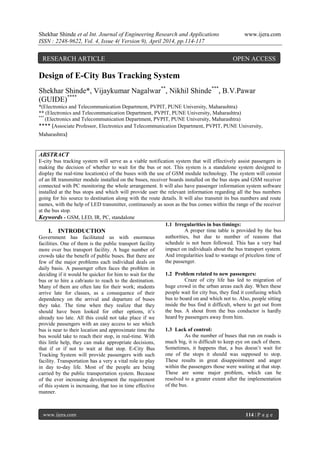
The overall working of the project is
summarized in Fig.1. It shows the
intercommunications between different protocols
used in this project.
Fig. 1 block diagram of the system
III. Block Diagram Description
2.1. Device Inside The Bus
Fig. 2 block diagram of bus unit
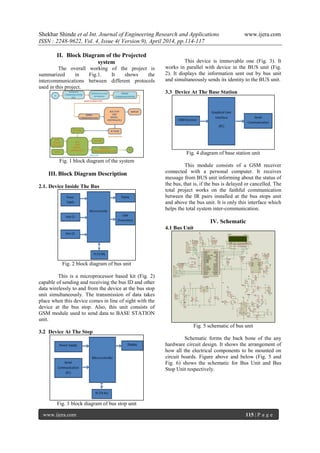
This is a microprocessor based kit (Fig. 2)
capable of sending and receiving the bus ID and other
data wirelessly to and from the device at the bus stop
unit simultaneously. The transmission of data takes
place when this device comes in line of sight with the
device at the bus stop. Also, this unit consists of
GSM module used to send data to BASE STATION
unit.
3.2 Device At The Stop
Fig. 3 block diagram of bus stop unit
This device is immovable one (Fig. 3). It
works in parallel with device in the BUS unit (Fig.
2). It displays the information sent out by bus unit
and simultaneously sends its identity to the BUS unit.
3.3 Device At The Base Station
Fig. 4 diagram of base station unit
This module consists of a GSM receiver
connected with a personal computer. It receives
message from BUS unit informing about the status of
the bus, that is, if the bus is delayed or cancelled. The
total project works on the faithful communication
between the IR pairs installed at the bus stops unit
and above the bus unit. It is only this interface which
helps the total system inter-communication.
IV. Schematic
4.1 Bus Unit
Fig. 5 schematic of bus unit
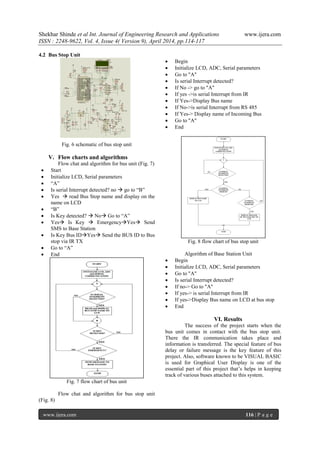
Schematic forms the back bone of the any
hardware circuit design. It shows the arrangement of
how all the electrical components to be mounted on
circuit boards. Figure above and below (Fig. 5 and
Fig. 6) shows the schematic for Bus Unit and Bus
Stop Unit respectively.
Shekhar Shinde et al Int. Journal of Engineering Research and Applications www.ijera.com
ISSN : 2248-9622, Vol. 4, Issue 4( Version 9), April 2014, pp.114-117
www.ijera.com 116 | P a g e
4.2 Bus Stop Unit
Fig. 6 schematic of bus stop unit
V. Flow charts and algorithms
Flow chat and algorithm for bus unit (Fig. 7)
 Start
 Initialize LCD, Serial parameters
 “A”
 Is serial Interrupt detected? no  go to “B”
 Yes  read Bus Stop name and display on the
name on LCD
 “B”
 Is Key detected?  No Go to “A”
 Yes Is Key  EmergencyYes Send
SMS to Base Station
 Is Key Bus IDYes Send the BUS ID to Bus
stop via IR TX
 Go to “A”
 End
Fig. 7 flow chart of bus unit
Flow chat and algorithm for bus stop unit
(Fig. 8)
 Begin
 Initialize LCD, ADC, Serial parameters
 Go to "A"
 Is serial Interrupt detected?
 If No -> go to "A"
 If yes ->is serial Interrupt from IR
 If Yes->Display Bus name
 If No->is serial Interrupt from RS 485
 If Yes-> Display name of Incoming Bus
 Go to "A"
 End
Fig. 8 flow chart of bus stop unit
Algorithm of Base Station Unit
 Begin
 Initialize LCD, ADC, Serial parameters
 Go to "A"
 Is serial Interrupt detected?
 If no-> Go to "A"
 If yes-> is serial Interrupt from IR
 If yes->Display Bus name on LCD at bus stop
 End
VI. Results
The success of the project starts when the
bus unit comes in contact with the bus stop unit.
There the IR communication takes place and
information is transferred. The special feature of bus
delay or failure message is the key feature of this
project. Also, software known to be VISUAL BASIC
is used for Graphical User Display is one of the
essential part of this project that’s helps in keeping
track of various buses attached to this system.
R1
10k
C7
10uf
X1
CRYSTAL
C533p
C633p
D7
14
D6
13
D5
12
D4
11
D3
10
D2
9
D1
8
D0
7
E
6
R
W
5
R
S
4
V
S
S
1
V
D
D
2
V
E
E
3
L
E
D
+
15
L
E
D-
16
LCD1LM016L-G
5V
5V
R2
330R
5V
5V
1
2
J1
SIL-100-02
D1
1N4007
D2
1N4007
D3
1N4007
D4
1N4007
C2
100n
C1
1000u
VI1 VO 3
G
N
D
2
U1 7805
C3
100n
C4
1000u
5V12V
RA0/AN02
RA1/AN13
RA2/AN2/VREF-/CVREF4
RA4/T0CKI/C1OUT6
RA5/AN4/SS/C2OUT7
RE0/AN5/RD8
RE1/AN6/WR9
RE2/AN7/CS10
OSC1/CLKIN
13
OSC2/CLKOUT14
RC1/T1OSI/CCP216
RC2/CCP117
RC3/SCK/SCL18
RD0/PSP019
RD1/PSP120
RB7/PGD40
RB6/PGC39
RB538
RB437
RB3/PGM36
RB235
RB134
RB0/INT33
RD7/PSP7
30
RD6/PSP629
RD5/PSP5
28
RD4/PSP427
RD3/PSP322
RD2/PSP221
RC7/RX/DT
26
RC6/TX/CK25
RC5/SDO24
RC4/SDI/SDA23
RA3/AN3/VREF+5
RC0/T1OSO/T1CKI
15
MCLR/Vpp/THV1
VDD1
11
VSS112
VSS31
VDD32
U2
PIC16F877A_S
5V 5V
RO1
RI2
DE3
DI4 GND5
DO/RI6
DO/RI
7
VCC
8
U3
75176
5V
1234
J5 RS485
R3
330R
R4
DC 7
Q 3
G
N
D
1
V
C
C
8
TR
2
TH
6
CV5
U4 NE555
R10
1k
R11
1k2
D5LED_S
5V
TXD
C8
10nF
D6
1N4148
R8
330R
R9
1k C9
10nF
5V
R7
10R
D7
LED_S
D8
LED_S
5V
12
3
RV1
2K
1
2
3
4
J6
RS485
R4
2k2
R5
10k
R6
10k
5V
5V
RXD
12
J3
SIL-100-02
12
J4
SIL-100-02
1
2
3
J7
TSOP1738
12345
J2SIL-100-05
Q1
TRANSISTOR
Q2
TRANSISTOR
Q3
TRANSISTOR
5V
R12
10k
Shekhar Shinde et al Int. Journal of Engineering Research and Applications www.ijera.com
ISSN : 2248-9622, Vol. 4, Issue 4( Version 9), April 2014, pp.114-117
www.ijera.com 117 | P a g e
VII. Conclusion
The project “E-City Bus Tracking System”
is successfully designed implemented and tested and
the following conclusions are made.
1) The display at bus stop saves time.
2) The present system reduces the work of bus
conductor.
3) The system involves the tracking of bus at the
every stop.
4) It also involves the sharing of information of the
bus on the bus stops, the bus is going to attain,
with the passengers.
5) The message through the GSM form Bus Unit
will convey the server about the current status of
the bus.
VIII. Future Scope
There is a vide scope for this project. This is
simple GSM based project which can be further
modified using GPS for live positing if the bus. GPS
gives exact location of the bus which in this project
the bus position is judged by the time parameter.
With the interface of GPS device and video camera to
this system would take this system to the next level in
the field of security. This would help in monitoring
the crimes that happen which is witnessed by
common people every day. This would prove a major
breakthrough in reducing the crime rates.
Also, with use of motion sensors the speed
of the bus can be calculated and same information
can be used to accurate the measurement of time
calculation which here is based on approximation.
Also, this project can be made completed automated
if speed sensors are used.
IX. ACKNOWLEDGEMENTS
We heartily thank Prof. B. V. Pawar of
Electronics and Telecommunication Department,
P.V.P.I.T Pune for his keen interest and complete
guidance in our paper.
REFERENCES
[1] Dr. Saylee Gharge, Manal Chhaya, Gaurav
Chheda, Jitesh Deshpande, Niket Gajra
``REAL TIME BUS MONITORING
SYSTEM USING GPS", (IRACST -
Engineering Science and Technology: An
International Journal $($ESTIJ$), ISSN:
2250-3498) Vol.2, No.3June 2012.
[2 ] Gaurav Chheda, Niket Gajra, Manal
Chhaya, Jitesh Deshpande, Saylee Gharge
``REAL TIME BUS MONITORING AND
PASSENGER INFORMATION SYSTEM"
International Journal of Soft Computing and
Engineering (IJSCE) ISSN: 2231-23207,
Vol.-1, Issue -6, January 2012.
[3] www.atti.gps-vehicle-tracking-systemsg.htm

U4409114117

  • 1.
    Shekhar Shinde etal Int. Journal of Engineering Research and Applications www.ijera.com ISSN : 2248-9622, Vol. 4, Issue 4( Version 9), April 2014, pp.114-117 www.ijera.com 114 | P a g e Design of E-City Bus Tracking System Shekhar Shinde*, Vijaykumar Nagalwar** , Nikhil Shinde*** , B.V.Pawar (GUIDE)**** *(Electronics and Telecommunication Department, PVPIT, PUNE University, Maharashtra) ** (Electronics and Telecommunication Department, PVPIT, PUNE University, Maharashtra) *** (Electronics and Telecommunication Department, PVPIT, PUNE University, Maharashtra) **** (Associate Professor, Electronics and Telecommunication Department, PVPIT, PUNE University, Maharashtra) ABSTRACT E-city bus tracking system will serve as a viable notification system that will effectively assist passengers in making the decision of whether to wait for the bus or not. This system is a standalone system designed to display the real-time location(s) of the buses with the use of GSM module technology. The system will consist of an IR transmitter module installed on the buses, receiver boards installed on the bus stops and GSM receiver connected with PC monitoring the whole arrangement. It will also have passenger information system software installed at the bus stops and which will provide user the relevant information regarding all the bus numbers going for his source to destination along with the route details. It will also transmit its bus numbers and route names, with the help of LED transmitter, continuously as soon as the bus comes within the range of the receiver at the bus stop. Keywords - GSM, LED, IR, PC, standalone I. INTRODUCTION Government has facilitated us with enormous facilities. One of them is the public transport facility more over bus transport facility. A huge number of crowds take the benefit of public buses. But there are few of the major problems each individual deals on daily basis. A passenger often faces the problem in deciding if it would be quicker for him to wait for the bus or to hire a cab/auto to reach to the destination. Many of them are often late for their work; students arrive late for classes, as a consequence of their dependency on the arrival and departure of buses they take. The time when they realize that they should have been looked for other options, it’s already too late. All this could not take place if we provide passengers with an easy access to see which bus is near to their location and approximate time the bus would take to reach their stop, in real-time. With this little help, they can make appropriate decisions, that if or if not to wait at that stop. E-City Bus Tracking System will provide passengers with such facility. Transportation has a very a vital role to play in day to-day life. Most of the people are being carried by the public transportation system. Because of the ever increasing development the requirement of this system is increasing, that too in time effective manner. 1.1 Irregularities in bus timings: A proper time table is provided by the bus authorities, but due to number of reasons that schedule is not been followed. This has a very bad impact on individuals about the bus transport system. And irregularities lead to wastage of priceless time of the passenger. 1.2 Problem related to new passengers: Craze of city life has led to migration of huge crowd in the urban areas each day. When these people wait for city bus, they find it confusing which bus to board on and which not to. Also, people sitting inside the bus find it difficult, where to get out from the bus. A shout from the bus conductor is hardly heard by passengers away from him. 1.3 Lack of control: As the number of buses that run on roads is much big, it is difficult to keep eye on each of them. Sometimes, it happens that, a bus doesn’t wait for one of the stops it should was supposed to stop. These results in great disappointment and anger within the passengers those were waiting at that stop. These are some major problem, which can be resolved to a greater extent after the implementation of the bus. RESEARCH ARTICLE OPEN ACCESS
  • 2.
    Shekhar Shinde etal Int. Journal of Engineering Research and Applications www.ijera.com ISSN : 2248-9622, Vol. 4, Issue 4( Version 9), April 2014, pp.114-117 www.ijera.com 115 | P a g e II. Block Diagram of the Projected system The overall working of the project is summarized in Fig.1. It shows the intercommunications between different protocols used in this project. Fig. 1 block diagram of the system III. Block Diagram Description 2.1. Device Inside The Bus Fig. 2 block diagram of bus unit This is a microprocessor based kit (Fig. 2) capable of sending and receiving the bus ID and other data wirelessly to and from the device at the bus stop unit simultaneously. The transmission of data takes place when this device comes in line of sight with the device at the bus stop. Also, this unit consists of GSM module used to send data to BASE STATION unit. 3.2 Device At The Stop Fig. 3 block diagram of bus stop unit This device is immovable one (Fig. 3). It works in parallel with device in the BUS unit (Fig. 2). It displays the information sent out by bus unit and simultaneously sends its identity to the BUS unit. 3.3 Device At The Base Station Fig. 4 diagram of base station unit This module consists of a GSM receiver connected with a personal computer. It receives message from BUS unit informing about the status of the bus, that is, if the bus is delayed or cancelled. The total project works on the faithful communication between the IR pairs installed at the bus stops unit and above the bus unit. It is only this interface which helps the total system inter-communication. IV. Schematic 4.1 Bus Unit Fig. 5 schematic of bus unit Schematic forms the back bone of the any hardware circuit design. It shows the arrangement of how all the electrical components to be mounted on circuit boards. Figure above and below (Fig. 5 and Fig. 6) shows the schematic for Bus Unit and Bus Stop Unit respectively.
  • 3.
    Shekhar Shinde etal Int. Journal of Engineering Research and Applications www.ijera.com ISSN : 2248-9622, Vol. 4, Issue 4( Version 9), April 2014, pp.114-117 www.ijera.com 116 | P a g e 4.2 Bus Stop Unit Fig. 6 schematic of bus stop unit V. Flow charts and algorithms Flow chat and algorithm for bus unit (Fig. 7)  Start  Initialize LCD, Serial parameters  “A”  Is serial Interrupt detected? no  go to “B”  Yes  read Bus Stop name and display on the name on LCD  “B”  Is Key detected?  No Go to “A”  Yes Is Key  EmergencyYes Send SMS to Base Station  Is Key Bus IDYes Send the BUS ID to Bus stop via IR TX  Go to “A”  End Fig. 7 flow chart of bus unit Flow chat and algorithm for bus stop unit (Fig. 8)  Begin  Initialize LCD, ADC, Serial parameters  Go to "A"  Is serial Interrupt detected?  If No -> go to "A"  If yes ->is serial Interrupt from IR  If Yes->Display Bus name  If No->is serial Interrupt from RS 485  If Yes-> Display name of Incoming Bus  Go to "A"  End Fig. 8 flow chart of bus stop unit Algorithm of Base Station Unit  Begin  Initialize LCD, ADC, Serial parameters  Go to "A"  Is serial Interrupt detected?  If no-> Go to "A"  If yes-> is serial Interrupt from IR  If yes->Display Bus name on LCD at bus stop  End VI. Results The success of the project starts when the bus unit comes in contact with the bus stop unit. There the IR communication takes place and information is transferred. The special feature of bus delay or failure message is the key feature of this project. Also, software known to be VISUAL BASIC is used for Graphical User Display is one of the essential part of this project that’s helps in keeping track of various buses attached to this system. R1 10k C7 10uf X1 CRYSTAL C533p C633p D7 14 D6 13 D5 12 D4 11 D3 10 D2 9 D1 8 D0 7 E 6 R W 5 R S 4 V S S 1 V D D 2 V E E 3 L E D + 15 L E D- 16 LCD1LM016L-G 5V 5V R2 330R 5V 5V 1 2 J1 SIL-100-02 D1 1N4007 D2 1N4007 D3 1N4007 D4 1N4007 C2 100n C1 1000u VI1 VO 3 G N D 2 U1 7805 C3 100n C4 1000u 5V12V RA0/AN02 RA1/AN13 RA2/AN2/VREF-/CVREF4 RA4/T0CKI/C1OUT6 RA5/AN4/SS/C2OUT7 RE0/AN5/RD8 RE1/AN6/WR9 RE2/AN7/CS10 OSC1/CLKIN 13 OSC2/CLKOUT14 RC1/T1OSI/CCP216 RC2/CCP117 RC3/SCK/SCL18 RD0/PSP019 RD1/PSP120 RB7/PGD40 RB6/PGC39 RB538 RB437 RB3/PGM36 RB235 RB134 RB0/INT33 RD7/PSP7 30 RD6/PSP629 RD5/PSP5 28 RD4/PSP427 RD3/PSP322 RD2/PSP221 RC7/RX/DT 26 RC6/TX/CK25 RC5/SDO24 RC4/SDI/SDA23 RA3/AN3/VREF+5 RC0/T1OSO/T1CKI 15 MCLR/Vpp/THV1 VDD1 11 VSS112 VSS31 VDD32 U2 PIC16F877A_S 5V 5V RO1 RI2 DE3 DI4 GND5 DO/RI6 DO/RI 7 VCC 8 U3 75176 5V 1234 J5 RS485 R3 330R R4 DC 7 Q 3 G N D 1 V C C 8 TR 2 TH 6 CV5 U4 NE555 R10 1k R11 1k2 D5LED_S 5V TXD C8 10nF D6 1N4148 R8 330R R9 1k C9 10nF 5V R7 10R D7 LED_S D8 LED_S 5V 12 3 RV1 2K 1 2 3 4 J6 RS485 R4 2k2 R5 10k R6 10k 5V 5V RXD 12 J3 SIL-100-02 12 J4 SIL-100-02 1 2 3 J7 TSOP1738 12345 J2SIL-100-05 Q1 TRANSISTOR Q2 TRANSISTOR Q3 TRANSISTOR 5V R12 10k
  • 4.
    Shekhar Shinde etal Int. Journal of Engineering Research and Applications www.ijera.com ISSN : 2248-9622, Vol. 4, Issue 4( Version 9), April 2014, pp.114-117 www.ijera.com 117 | P a g e VII. Conclusion The project “E-City Bus Tracking System” is successfully designed implemented and tested and the following conclusions are made. 1) The display at bus stop saves time. 2) The present system reduces the work of bus conductor. 3) The system involves the tracking of bus at the every stop. 4) It also involves the sharing of information of the bus on the bus stops, the bus is going to attain, with the passengers. 5) The message through the GSM form Bus Unit will convey the server about the current status of the bus. VIII. Future Scope There is a vide scope for this project. This is simple GSM based project which can be further modified using GPS for live positing if the bus. GPS gives exact location of the bus which in this project the bus position is judged by the time parameter. With the interface of GPS device and video camera to this system would take this system to the next level in the field of security. This would help in monitoring the crimes that happen which is witnessed by common people every day. This would prove a major breakthrough in reducing the crime rates. Also, with use of motion sensors the speed of the bus can be calculated and same information can be used to accurate the measurement of time calculation which here is based on approximation. Also, this project can be made completed automated if speed sensors are used. IX. ACKNOWLEDGEMENTS We heartily thank Prof. B. V. Pawar of Electronics and Telecommunication Department, P.V.P.I.T Pune for his keen interest and complete guidance in our paper. REFERENCES [1] Dr. Saylee Gharge, Manal Chhaya, Gaurav Chheda, Jitesh Deshpande, Niket Gajra ``REAL TIME BUS MONITORING SYSTEM USING GPS", (IRACST - Engineering Science and Technology: An International Journal $($ESTIJ$), ISSN: 2250-3498) Vol.2, No.3June 2012. [2 ] Gaurav Chheda, Niket Gajra, Manal Chhaya, Jitesh Deshpande, Saylee Gharge ``REAL TIME BUS MONITORING AND PASSENGER INFORMATION SYSTEM" International Journal of Soft Computing and Engineering (IJSCE) ISSN: 2231-23207, Vol.-1, Issue -6, January 2012. [3] www.atti.gps-vehicle-tracking-systemsg.htm