Happiest People Happiest Customers
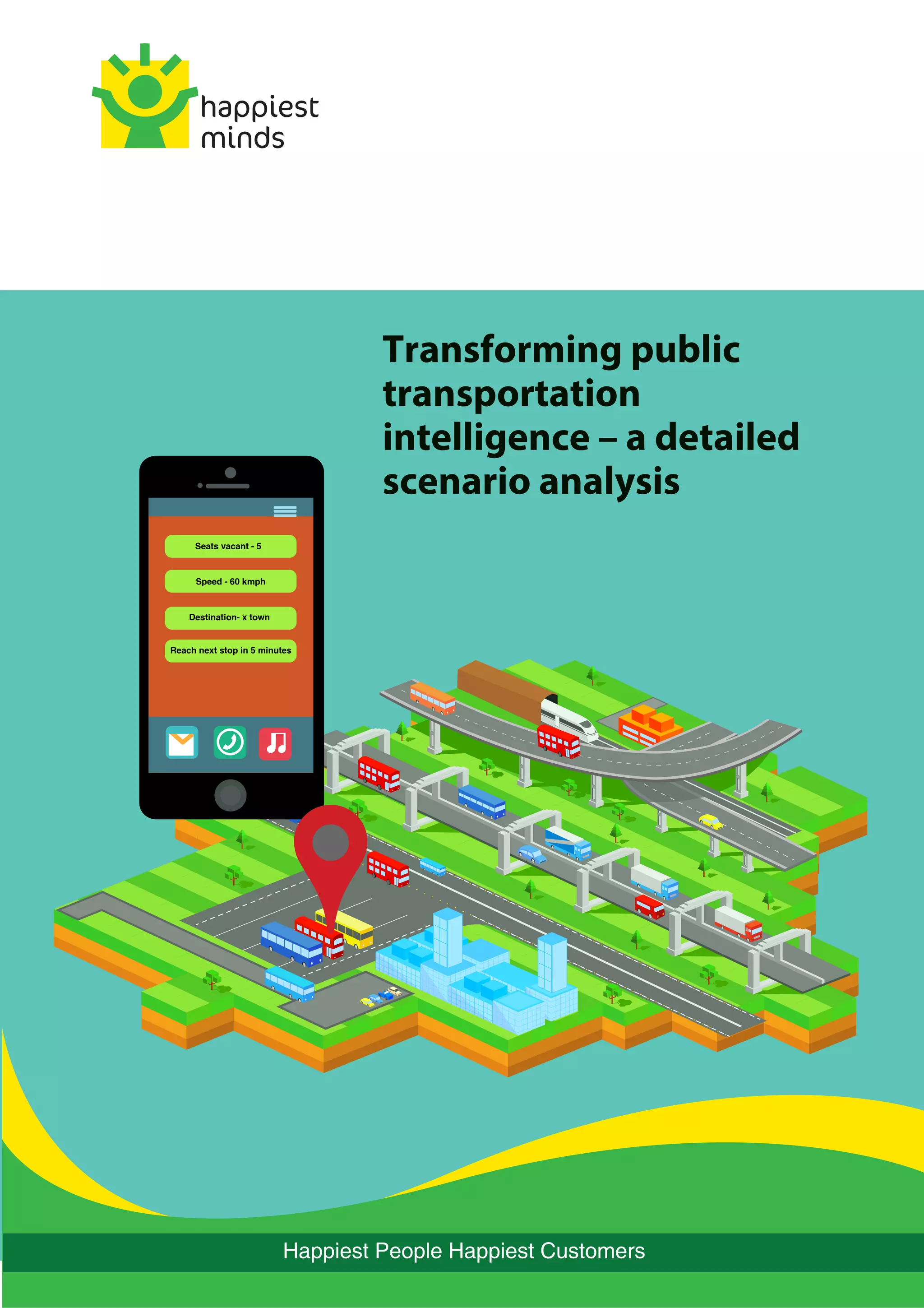
Transforming public
transportation
intelligence – a detailed
scenario analysis
Seats vacant - 5
Speed - 60 kmph
Destination- x town
Reach next stop in 5 minutes
© Happiest Minds Technologies Pvt. Ltd. All Rights Reserved2
Contents
Introduction.............................................................................................................................................3
Need and Benefit Analysis......................................................................................................................3
Broad Overview of ITS ...........................................................................................................................4
ITS – Real Life Use Cases Snapshot .....................................................................................................4
ITS Scenario – Detailed Analysis............................................................................................................4
Current Practice Analysis........................................................................................................................8
Happiest Minds IoT Approach................................................................................................................10
Conclusion..............................................................................................................................................11
© Happiest Minds Technologies Pvt. Ltd. All Rights Reserved
Transportation is the respiratory system of our economy as every day the world relies on a complex network of transportation system
responsible for facilitating full range of human activities sustaining the civilization. According to a recent study US road traffic congestion in
2007 wasted 2.8 billion gallons of fuel and 4.2 billion hours, costing a whopping $ 87.2 Billion. In India around 5 lakhs road accidents
happens, causing a loss of around $20 billion, getting 6 lakhs people injured and 1.5 lakhs getting killed. Every year, nearly 36,000 vehicles
are stolen. Traffic congestion costs the European Union over 1% of GDP i.e. 100 Billion Euros per year.
These concerns, seeds the need of transformative change for world’s Transportation System by enhancing road Safety to commuters and
driver, providing convenience and safety to use public transport, integrating Para transit and mass transit modes, optimizing the emergency
Services by reducing time to respond, regulate driving behavior reducing accidents , manage city traffic by optimizing route reducing
commutation time, Automate Toll collection reduce waiting time, control pollution caused by vehicles etc.
This is one of the most interesting times in Intelligent Transportation System ecosystem as Developing countries have an advantage over
the Developed countries, where they can optimize their existing model by leveraging the forces of Social, Mobile, Analytics and Cloud.
This would give a Bird-eye view on unleashing the IoT potential and exploring new vistas for the developing nations, encompassing the
major challenges and lessons learnt from the Real Life Use Cases implemented in developed nations like (Japan, South Korea, US, UK,
Australia). It provides a holistic point of view for developing nations to implement ITS and the benefit they have over the developed nations
on the following
3
Introduction
Need and benefits analysis
• Enhancing efficiency and convenience to use public transport, connecting para transit and mass transit modes.
• Optimize Emergency services saving lives and reducing road congestion contributing back to GDP.
• Provide Road Safety to commuters and drivers by regulating driving behavior and managing optimized routes
• Enable Parking assistance and Automated Road Tolling
• Create Vehicle to Vehicle and Vehicle to Infrastructure ecosystem and leveraging the Smart Phone Ecosystem
• Fleet Management, Vehicle Management and Track & trace Management
4 © Happiest Minds Technologies Pvt. Ltd. All Rights Reserved4
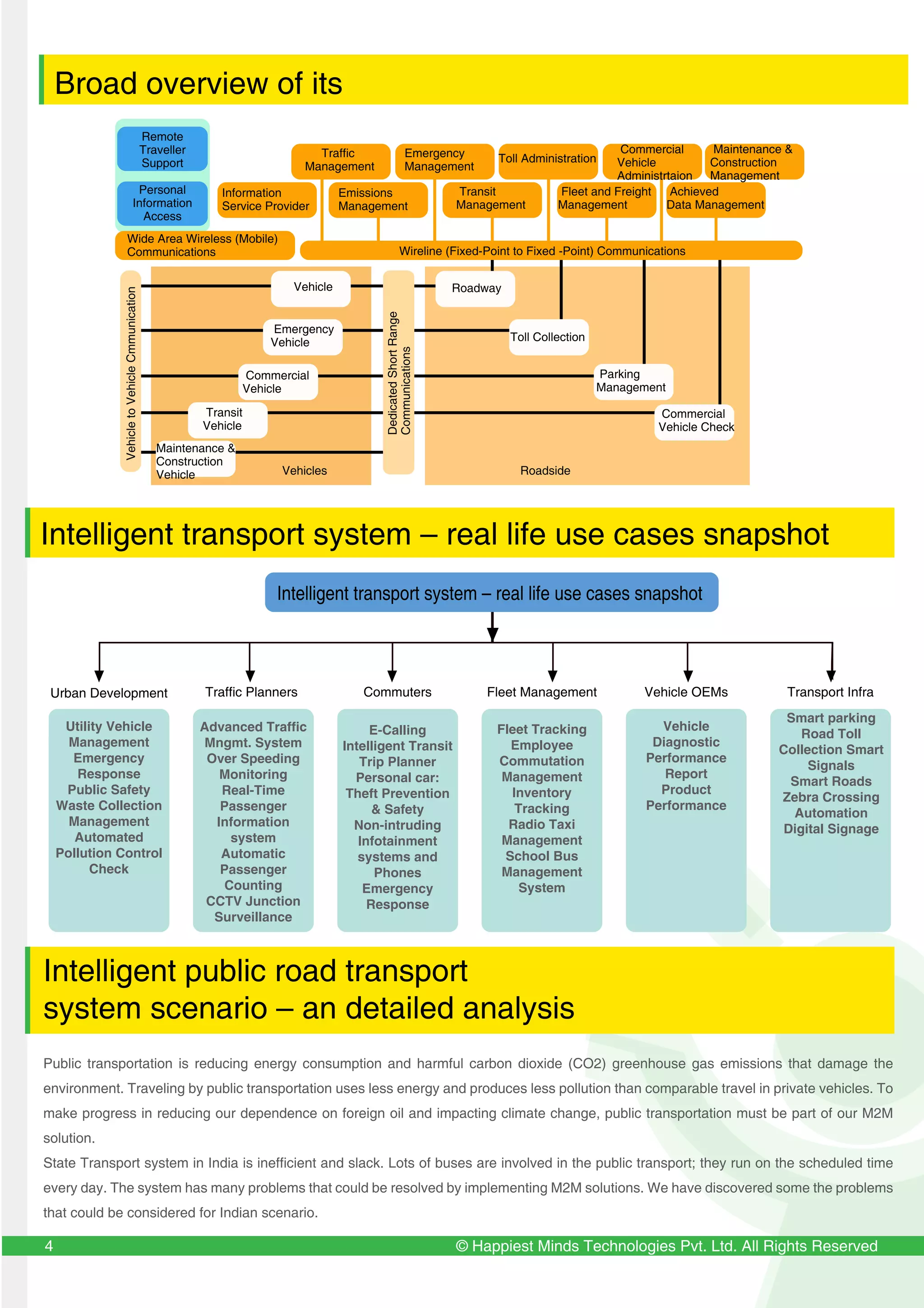
Intelligent transport system – real life use cases snapshot
Intelligent public road transport
system scenario – an detailed analysis
Public transportation is reducing energy consumption and harmful carbon dioxide (CO2) greenhouse gas emissions that damage the
environment. Traveling by public transportation uses less energy and produces less pollution than comparable travel in private vehicles. To
make progress in reducing our dependence on foreign oil and impacting climate change, public transportation must be part of our M2M
solution.
State Transport system in India is inefficient and slack. Lots of buses are involved in the public transport; they run on the scheduled time
every day. The system has many problems that could be resolved by implementing M2M solutions. We have discovered some the problems
that could be considered for Indian scenario.
RoadsideVehicles
Personal
Information
Access
Remote
Traveller
Support
Traffic
Management
Information
Service Provider
Emergency
Management
Emissions
Management
Toll Administration
Transit
Management
Commercial
Vehicle
Administrtaion
Fleet and Freight
Management
Maintenance &
Construction
Management
Achieved
Data Management
Vehicle
Emergency
Vehicle
Commercial
Vehicle
Transit
Vehicle
Maintenance &
Construction
Vehicle
Roadway
Toll Collection
Parking
Management
Commercial
Vehicle Check
VehicletoVehicleCmmunication
Wireline (Fixed-Point to Fixed -Point) Communications
Wide Area Wireless (Mobile)
Communications
DedicatedShortRange
Communications
Advanced Traffic
Mngmt. System
Over Speeding
Monitoring
Real-Time
Passenger
Information
system
Automatic
Passenger
Counting
CCTV Junction
Surveillance
E-Calling
Intelligent Transit
Trip Planner
Personal car:
Theft Prevention
& Safety
Non-intruding
Infotainment
systems and
Phones
Emergency
Response
Fleet Tracking
Employee
Commutation
Management
Inventory
Tracking
Radio Taxi
Management
School Bus
Management
System
Vehicle
Diagnostic
Performance
Report
Product
Performance
Smart parking
Road Toll
Collection Smart
Signals
Smart Roads
Zebra Crossing
Automation
Digital Signage
Utility Vehicle
Management
Emergency
Response
Public Safety
Waste Collection
Management
Automated
Pollution Control
Check
Urban Development Traffic Planners Commuters Fleet Management Vehicle OEMs Transport Infra
Intelligent transport system – real life use cases snapshot
Broad overview of its
5 © Happiest Minds Technologies Pvt. Ltd. All Rights Reserved5
Note: The Use Case is prepared by considering the Indian scenario rather than referring other countries’ systems. Some of the recommen-
dations would be for green field and some of them could be adopted by the existing system
Objectives:
• To develop a Smart system that could benefit RTC (Road Transport Corporation) as well as the passengers
• To develop a business model where operator can act as an Enterprise Service Provider
• To encourage the passenger to use public transport for commuting there by reducing traffic congestion, air pollution etc.
Problems:
• Overloaded buses
• Less frequency of buses
• Breakdown of buses (e.g. proper maintenance & BCP)
• Planning and priority on the basis of availability and urgency of the service provision
(e.g. traffic system and priority management system integration)
• Accidents by public transport vehicles due to rash driving
• Bus efficiency
Requirements:
• GPS devices
• Wheel speed sensors
• Torque sensors
• Sensors measuring the health of the vehicle
Basic Infrastructure Requirement:
• Wi-Fi at each bust stop and each bust depot
Planning and managing the buses:
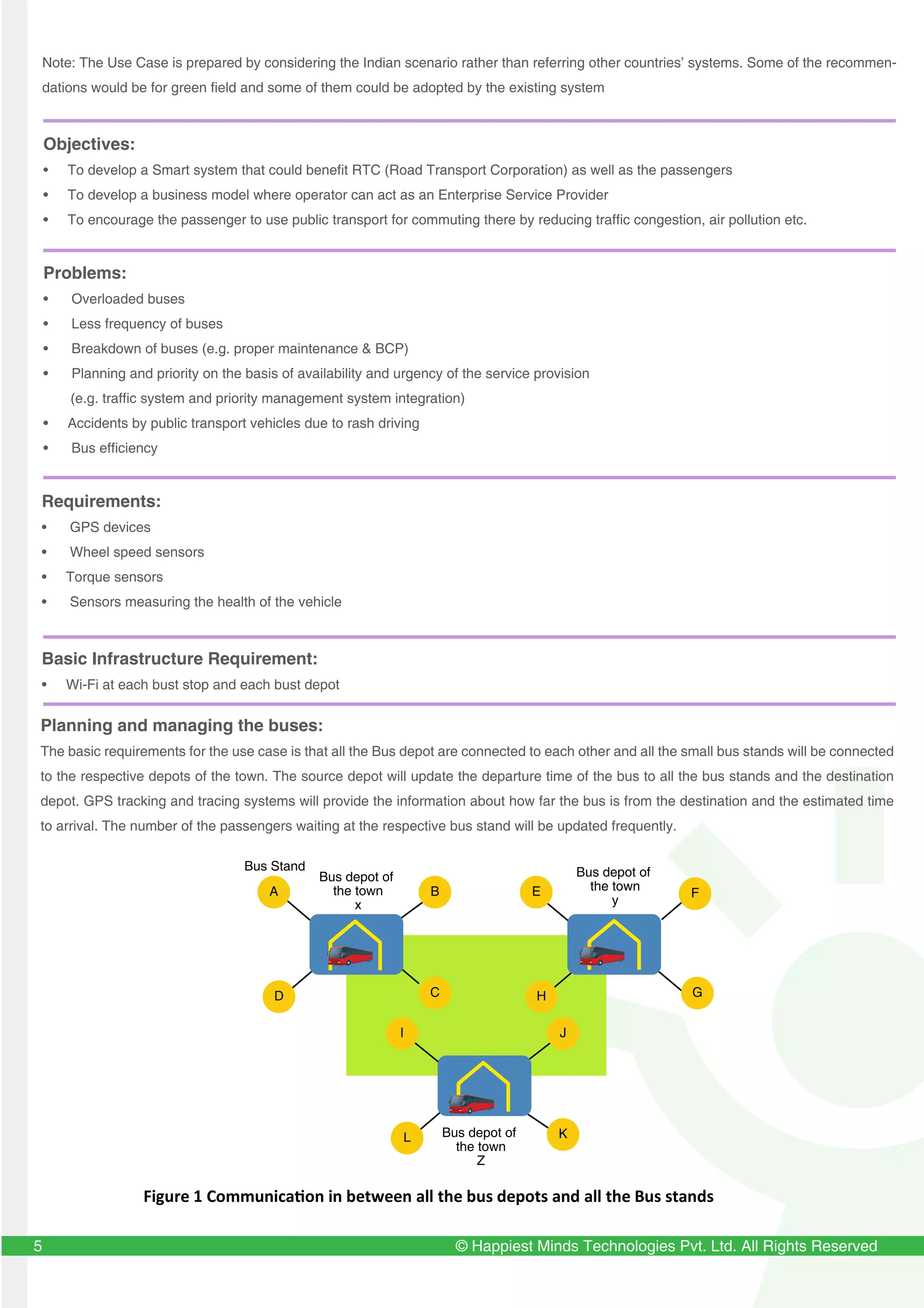
The basic requirements for the use case is that all the Bus depot are connected to each other and all the small bus stands will be connected
to the respective depots of the town. The source depot will update the departure time of the bus to all the bus stands and the destination
depot. GPS tracking and tracing systems will provide the information about how far the bus is from the destination and the estimated time
to arrival. The number of the passengers waiting at the respective bus stand will be updated frequently.
Figure 1 Communication in between all the bus depots and all the Bus stands
Bus depot of
the town
x
Bus depot of
the town
y
Bus depot of
the town
Z
Bus Stand
D C
BA
H G
FE
L K
JI
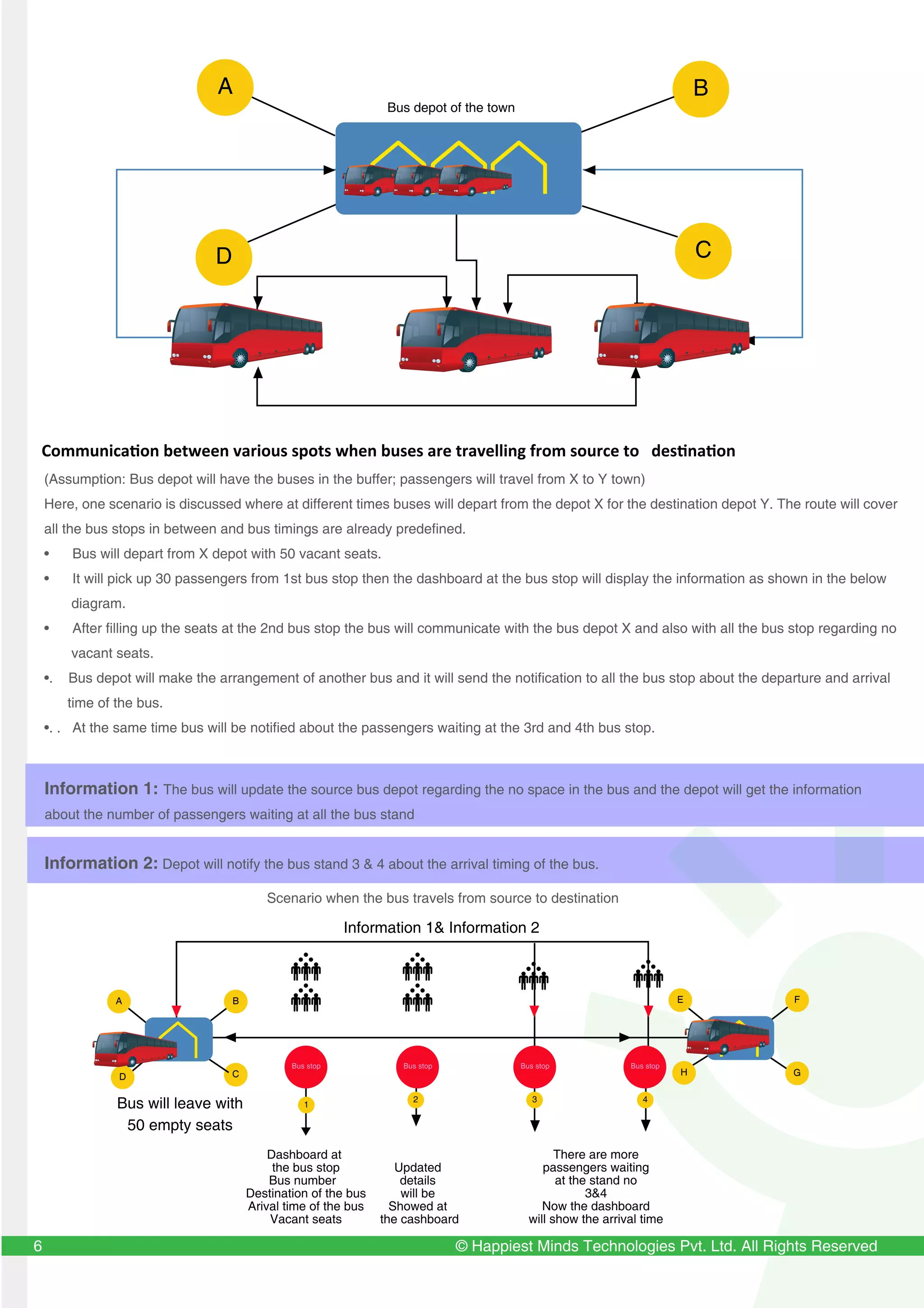
(Assumption: Bus depot will have the buses in the buffer; passengers will travel from X to Y town)
Here, one scenario is discussed where at different times buses will depart from the depot X for the destination depot Y. The route will cover
all the bus stops in between and bus timings are already predefined.
• Bus will depart from X depot with 50 vacant seats.
• It will pick up 30 passengers from 1st bus stop then the dashboard at the bus stop will display the information as shown in the below
diagram.
• After filling up the seats at the 2nd bus stop the bus will communicate with the bus depot X and also with all the bus stop regarding no
vacant seats.
•. Bus depot will make the arrangement of another bus and it will send the notification to all the bus stop about the departure and arrival
time of the bus.
•. . At the same time bus will be notified about the passengers waiting at the 3rd and 4th bus stop.
5 © Happiest Minds Technologies Pvt. Ltd. All Rights Reserved6
Communication between various spots when buses are travelling from source to destination
Information 1: The bus will update the source bus depot regarding the no space in the bus and the depot will get the information
about the number of passengers waiting at all the bus stand
Information 2: Depot will notify the bus stand 3 & 4 about the arrival timing of the bus.
Scenario when the bus travels from source to destination
Bus depot of the town
C
B
D
A
Information 1& Information 2
H G
FE
CD
BA
Bus stopBus stop
Bus will leave with
50 empty seats
There are more
passengers waiting
at the stand no
3&4
Now the dashboard
will show the arrival time
Dashboard at
the bus stop
Bus number
Destination of the bus
Arival time of the bus
Vacant seats
Bus stop
1
Bus stop
Updated
details
will be
Showed at
the cashboard
2 3 4
5 © Happiest Minds Technologies Pvt. Ltd. All Rights Reserved7
Fuel monitoring and efficiency measurement system, control of air pollution & tracking of the driver’s driving behavior: The fuel prices are
rising day by day. It’s been necessary to monitor the vehicle’s fuel consumption/usage and the efficiency, so that the frauds can be avoided
and the efficiency of the vehicle could be maintained
Sensors required
• Fuel level measurement sensors
• Fuel flow meters (measures the flow of the meter with the travelled distance)
• Torque Sensors
• Speed measurement sensors
• Air monitoring sensors
Whenever the fuel is filled or the level of the fuel changes the information regarding the same will be sent to the bus depot. The efficiency is
measured by the fuel flow meters as it will send the information about the distance travelled and the fuel consumption in the meantime.
Now, the driving behavior can be analyzed through the sensors (speed measurement and torque sensors) which would be fitted in the bus’
tires. The sensors will measure the torque of the tires and the data regarding the same will be sent to the hub where the data will be analyzed
and the driver should be punished for the same.
The air monitoring sensor will guide the hub about the content of the air pollution made by the bus.
Payment methodology:
• NFC: The passenger details would be recorded and the amount will be deducted from his account.
• Smart Card: Passenger need to recharge that card and payment will be made by swiping it.
• M-wallet, Google Wallet will be the other modes of payments
Bus Maintenance System:
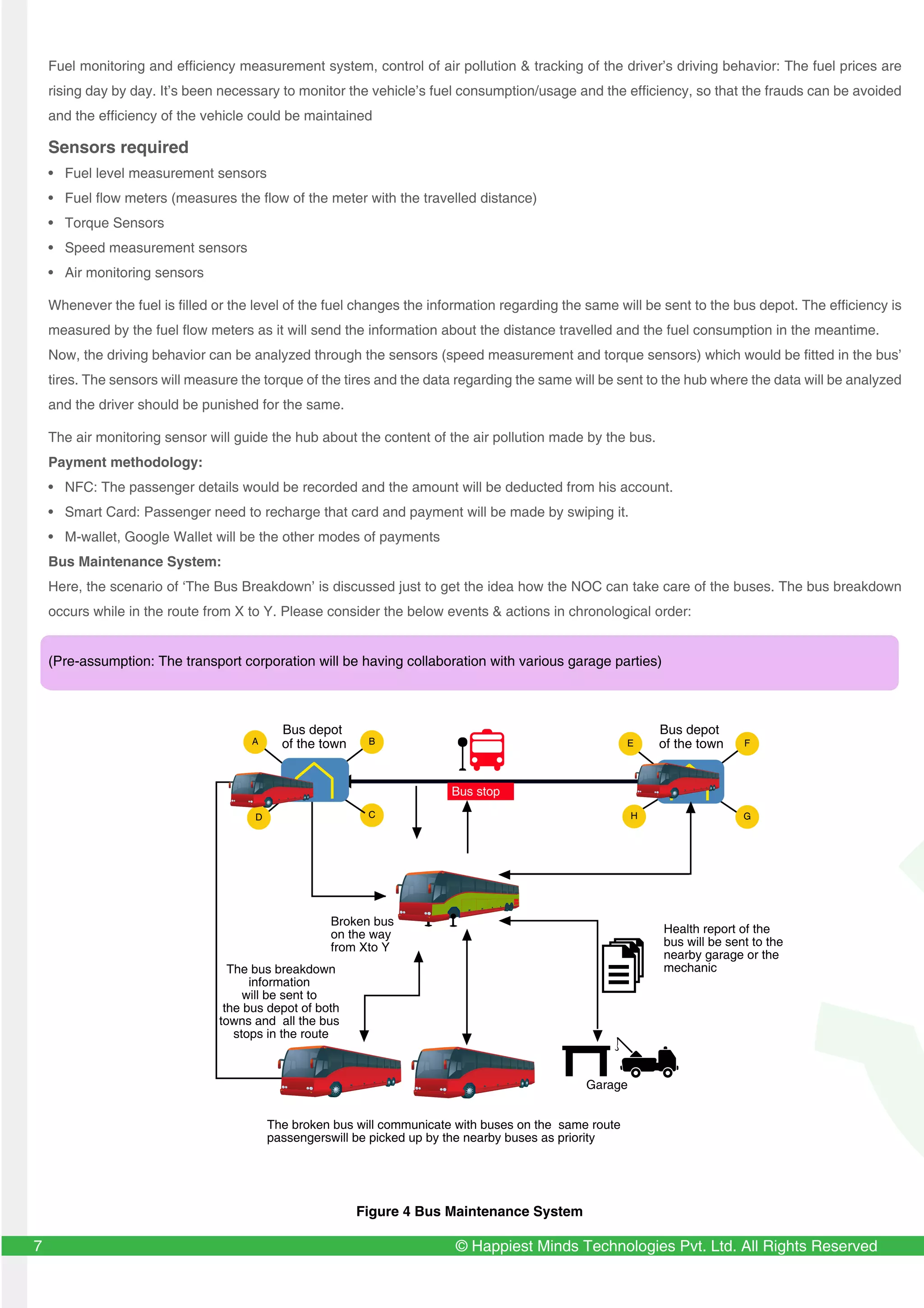
Here, the scenario of ‘The Bus Breakdown’ is discussed just to get the idea how the NOC can take care of the buses. The bus breakdown
occurs while in the route from X to Y. Please consider the below events & actions in chronological order:
(Pre-assumption: The transport corporation will be having collaboration with various garage parties)
Figure 4 Bus Maintenance System
H G
FE
Bus stop
CD
BA
Bus depot
of the town
Bus depot
of the town
The bus breakdown
information
will be sent to
the bus depot of both
towns and all the bus
stops in the route
The broken bus will communicate with buses on the same route
passengerswill be picked up by the nearby buses as priority
Garage
Health report of the
bus will be sent to the
nearby garage or the
mechanic
Broken bus
on the way
from Xto Y
Profiling of the customers using CRM:
State Road Transport System already has some limited Customer data that is taken during issue of a monthly pass. This customer data if
could be extended to all other customers in more detailed fashion could be of great use for the implementation of CRM. Assuming that
Telecom operator will act as a leader in the system, its customer data might be useful for profiling of the customers.
Once all the customer data is captured the mapping of users could be done using parent ID’s and Child ID’s. This mapping is useful to have
authentication for parents to track their child safety. Usage patterns of the passengers could be analyzed and accordingly loyalty points
could be added in the smart card provided to customer. Also CRM helps in getting proper timely feedback about the services offered to
passengers.
Tracing and tracking of special passengers like kids and woman for the safety purpose:
Once we have captured the customer details and mapping of profiles is done. Only people who have the authority predefined can track and
trace (using RFID tags or NFC) their kids and also for better women safety
Infotainment:
A personalized smart screen is provided to each passenger in green field buses. As these are value added services offered, Telecom opera-
tors can charge passengers according to their usage. Different infotainment facilities such as for Streaming. Videos, preloaded content, real
time Gaming and Information services could be provided. These screens can also be used for advertising based on Location of the bus;
content could be loaded through wifi at bus stops. And there by affordable infotainment services could be provided to passengers.
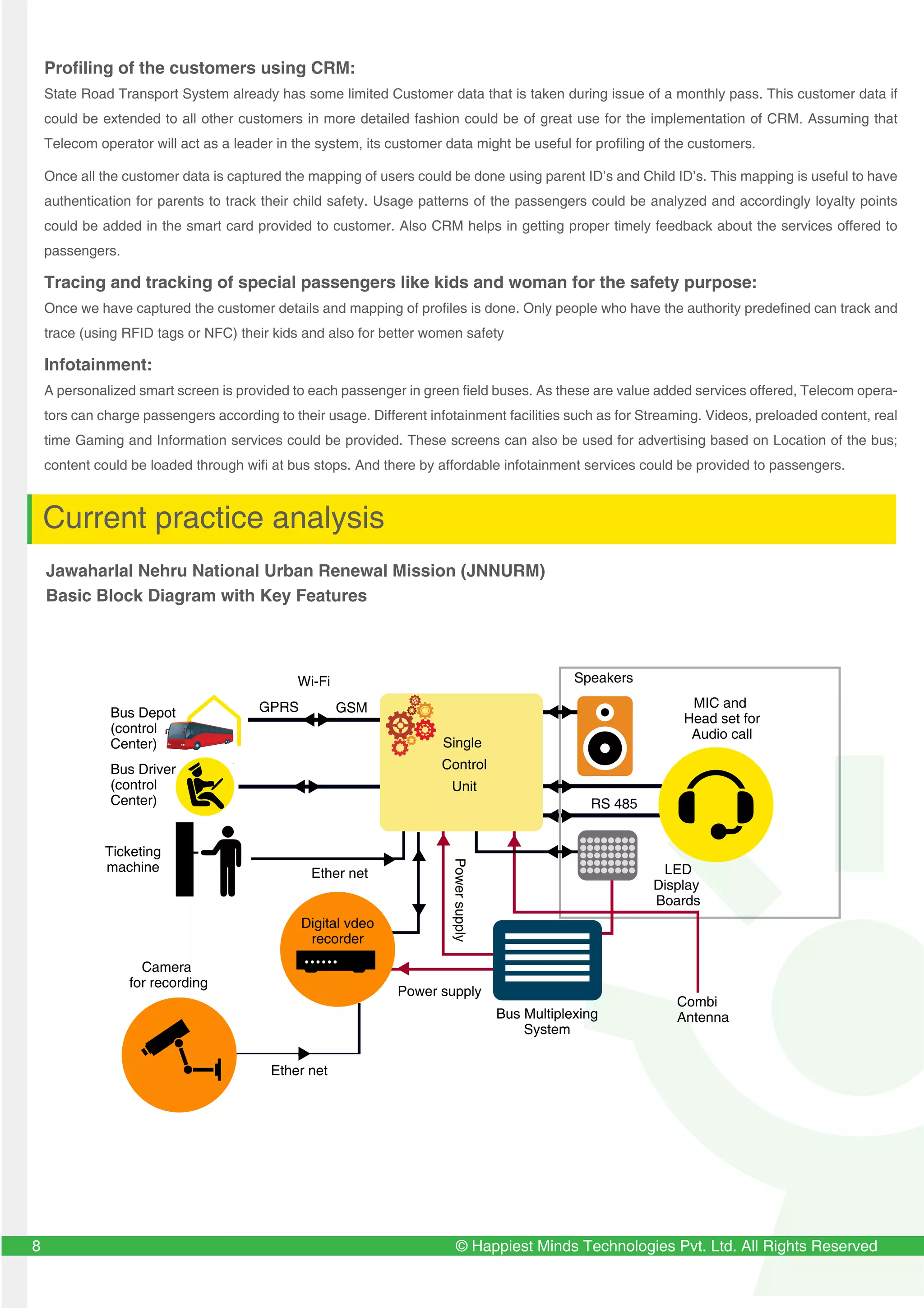
Jawaharlal Nehru National Urban Renewal Mission (JNNURM)
Basic Block Diagram with Key Features
5 © Happiest Minds Technologies Pvt. Ltd. All Rights Reserved8
Current practice analysis
Single
Control
Unit
Speakers
LED
Display
Boards
MIC and
Head set for
Audio call
Bus Multiplexing
System
Digital vdeo
recorder
Camera
for recording
Ticketing
machine
Bus Depot
(control
Center)
Bus Driver
(control
Center)
Ether net
Ether net
Power supply
Powersupply
GPRS
Wi-Fi
GSM
Combi
Antenna
RS 485
9
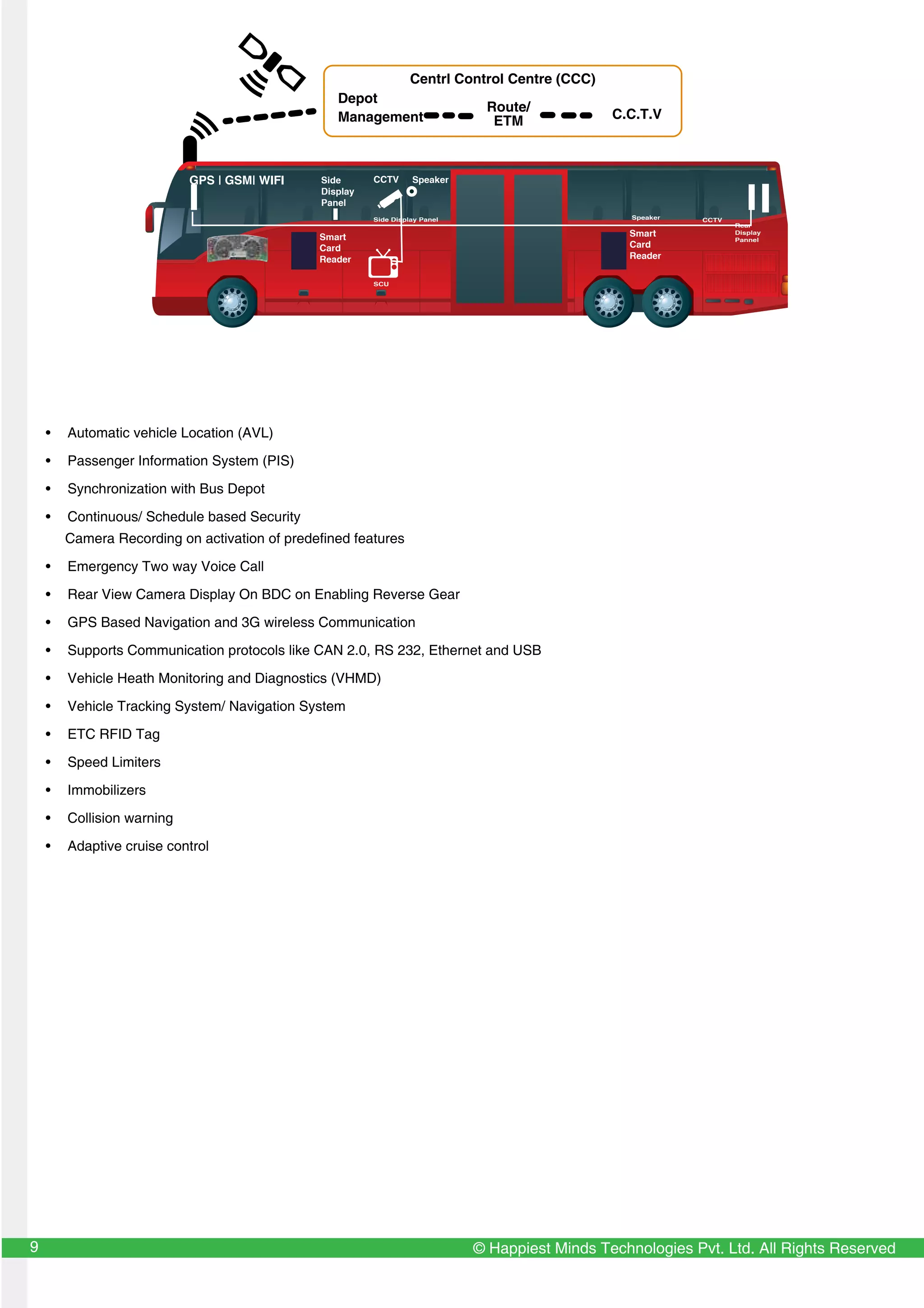
• Automatic vehicle Location (AVL)
• Passenger Information System (PIS)
• Synchronization with Bus Depot
• Continuous/ Schedule based Security
Camera Recording on activation of predefined features
• Emergency Two way Voice Call
• Rear View Camera Display On BDC on Enabling Reverse Gear
• GPS Based Navigation and 3G wireless Communication
• Supports Communication protocols like CAN 2.0, RS 232, Ethernet and USB
• Vehicle Heath Monitoring and Diagnostics (VHMD)
• Vehicle Tracking System/ Navigation System
• ETC RFID Tag
• Speed Limiters
• Immobilizers
• Collision warning
• Adaptive cruise control
CCTV
CCTV
SpeakerSide Display Panel
Side Display PanelSide
Display
Panel
Front
Display
Panel
Smart
Card
Reader
Smart
Card
Reader
GPS | GSM| WIFI
Rear
Display
Pannel
SCU
Speaker
© Happiest Minds Technologies Pvt. Ltd. All Rights Reserved9
C.C.T.V
Centrl Control Centre (CCC)
Depot
Management
Route/
ETM
9
© Happiest Minds Technologies Pvt. Ltd. All Rights Reserved
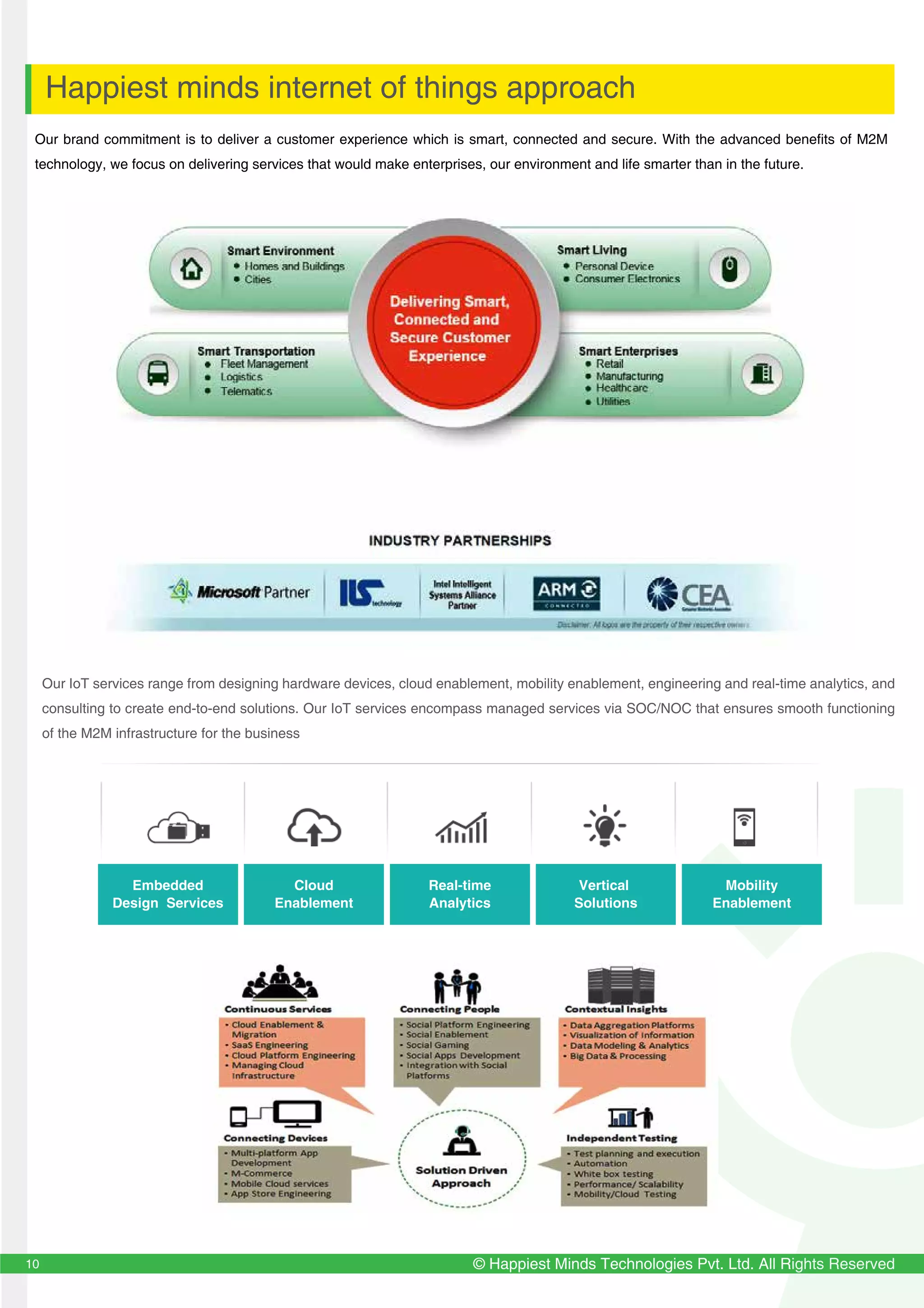
Our brand commitment is to deliver a customer experience which is smart, connected and secure. With the advanced benefits of M2M
technology, we focus on delivering services that would make enterprises, our environment and life smarter than in the future.
Our IoT services range from designing hardware devices, cloud enablement, mobility enablement, engineering and real-time analytics, and
consulting to create end-to-end solutions. Our IoT services encompass managed services via SOC/NOC that ensures smooth functioning
of the M2M infrastructure for the business
Happiest minds internet of things approach
Embedded
Design Services
Cloud
Enablement
Real-time
Analytics
Vertical
Solutions
Mobility
Enablement
10
Conclusion
© Happiest Minds Technologies Pvt. Ltd. All Rights Reserved11
The major enablers or drivers for Intelligent Transport system in India would be
• Exponential rise in the number of vehicles leading to traffic congestion, deterioration in air quality and increase in noise levels in
metropolitan city.
• €60bn of transport-related investment expected over the next five years and a massive €390bn anticipated over the next two
decades. (News Report, ITS International)
• Freight and logistics is a disorganized sector in india and demands huge potential for growth, development and investment.
Leveraging IoT for ITS implementation for proper vehicle tracking, vehicle emissions and fuel costs, can help reduce carbon
footprint 1and introduce1several degree of efficiency.
The ITS ecosystem in India is still in its nascent stage and there are some major challenges in implementing state-of-art technologies in
India. Some of the prominent ones are:-
• Integration of the ITS applications and introduction of standards or the framework for an international ITS architecture.
• Implementation and development of a nation-wide ITS data archive
• Due to basic socio – geographical differences, India’s ITS cannot replicate existing successful models implemented
in developed nations.
• High cost of implementation doesn’t allow high penetration.
Due to these Indian specific challenges you need an expert partner with specialized domain expertise. Happiest Minds IoT expertise would
help build better business model and implementation of ITS through integrating various ecosystem players.
129
12
© Happiest Minds Technologies Pvt. Ltd. All Rights Reserved
About the Author
Happiest Minds
Aditya Basu
Aditya is a certified Business Analyst, ITIL v3, Business Continuity Management and Business Process
Framework Professional. He has a rich experience in technology R&D, business development and Solu-
tion Offerings with special focus on Internet of Things domain. Aditya holds a MBA degree from Symbio-
sis International University with a Bachelors’ degree in Computer Science Engineering. You can reach
him at aditya.basu@happiestminds.com
Happiest Minds has a sharp focus on enabling Digital Transformation for customers by delivering a Smart,Secure and
Connected experience through disruptive technologies: mobility, big data analytics, security, cloud computing, social
computing, M2M/IoT, unified communications, etc. Enterprises are embracing these technologies to implement
Omni-channel strategies, manage structured & unstructured data and make real time decisions based on actionable insights,
while ensuring security for data and infrastructure. Happiest Minds also offers high degree of skills, IPs and domain expertise
across a set of focused areas that include IT Services, Product Engineering Services, Infrastructure Management, Security,
Testing and Consulting.
Headquartered in Bangalore, India, Happiest Minds has operations in the US, UK, Singapore and Australia.
It secured a $52.5 million Series-A funding led by Canaan Partners, Intel Capital and Ashok Soota..
Headquartered in Bangalore, India, Happiest Minds has operations in the US, UK, Singapore and Australia. It secured a $45
million Series-A funding led by Canaan Partners, Intel Capital and Ashok Soota.
12
© 2014 Happiest Minds. All Rights Reserved.
E-mail: Business@happiestminds.com
Visit us: www.happiestminds.com
Follow us on
This Document is an exclusive property of Happiest Minds Technologies Pvt. Ltd

TRANSFORMING PUBLIC TRANSPORTATION

  • 1.
    Happiest People HappiestCustomers Transforming public transportation intelligence – a detailed scenario analysis Seats vacant - 5 Speed - 60 kmph Destination- x town Reach next stop in 5 minutes
  • 2.
    © Happiest MindsTechnologies Pvt. Ltd. All Rights Reserved2 Contents Introduction.............................................................................................................................................3 Need and Benefit Analysis......................................................................................................................3 Broad Overview of ITS ...........................................................................................................................4 ITS – Real Life Use Cases Snapshot .....................................................................................................4 ITS Scenario – Detailed Analysis............................................................................................................4 Current Practice Analysis........................................................................................................................8 Happiest Minds IoT Approach................................................................................................................10 Conclusion..............................................................................................................................................11
  • 3.
    © Happiest MindsTechnologies Pvt. Ltd. All Rights Reserved Transportation is the respiratory system of our economy as every day the world relies on a complex network of transportation system responsible for facilitating full range of human activities sustaining the civilization. According to a recent study US road traffic congestion in 2007 wasted 2.8 billion gallons of fuel and 4.2 billion hours, costing a whopping $ 87.2 Billion. In India around 5 lakhs road accidents happens, causing a loss of around $20 billion, getting 6 lakhs people injured and 1.5 lakhs getting killed. Every year, nearly 36,000 vehicles are stolen. Traffic congestion costs the European Union over 1% of GDP i.e. 100 Billion Euros per year. These concerns, seeds the need of transformative change for world’s Transportation System by enhancing road Safety to commuters and driver, providing convenience and safety to use public transport, integrating Para transit and mass transit modes, optimizing the emergency Services by reducing time to respond, regulate driving behavior reducing accidents , manage city traffic by optimizing route reducing commutation time, Automate Toll collection reduce waiting time, control pollution caused by vehicles etc. This is one of the most interesting times in Intelligent Transportation System ecosystem as Developing countries have an advantage over the Developed countries, where they can optimize their existing model by leveraging the forces of Social, Mobile, Analytics and Cloud. This would give a Bird-eye view on unleashing the IoT potential and exploring new vistas for the developing nations, encompassing the major challenges and lessons learnt from the Real Life Use Cases implemented in developed nations like (Japan, South Korea, US, UK, Australia). It provides a holistic point of view for developing nations to implement ITS and the benefit they have over the developed nations on the following 3 Introduction Need and benefits analysis • Enhancing efficiency and convenience to use public transport, connecting para transit and mass transit modes. • Optimize Emergency services saving lives and reducing road congestion contributing back to GDP. • Provide Road Safety to commuters and drivers by regulating driving behavior and managing optimized routes • Enable Parking assistance and Automated Road Tolling • Create Vehicle to Vehicle and Vehicle to Infrastructure ecosystem and leveraging the Smart Phone Ecosystem • Fleet Management, Vehicle Management and Track & trace Management
  • 4.
    4 © HappiestMinds Technologies Pvt. Ltd. All Rights Reserved4 Intelligent transport system – real life use cases snapshot Intelligent public road transport system scenario – an detailed analysis Public transportation is reducing energy consumption and harmful carbon dioxide (CO2) greenhouse gas emissions that damage the environment. Traveling by public transportation uses less energy and produces less pollution than comparable travel in private vehicles. To make progress in reducing our dependence on foreign oil and impacting climate change, public transportation must be part of our M2M solution. State Transport system in India is inefficient and slack. Lots of buses are involved in the public transport; they run on the scheduled time every day. The system has many problems that could be resolved by implementing M2M solutions. We have discovered some the problems that could be considered for Indian scenario. RoadsideVehicles Personal Information Access Remote Traveller Support Traffic Management Information Service Provider Emergency Management Emissions Management Toll Administration Transit Management Commercial Vehicle Administrtaion Fleet and Freight Management Maintenance & Construction Management Achieved Data Management Vehicle Emergency Vehicle Commercial Vehicle Transit Vehicle Maintenance & Construction Vehicle Roadway Toll Collection Parking Management Commercial Vehicle Check VehicletoVehicleCmmunication Wireline (Fixed-Point to Fixed -Point) Communications Wide Area Wireless (Mobile) Communications DedicatedShortRange Communications Advanced Traffic Mngmt. System Over Speeding Monitoring Real-Time Passenger Information system Automatic Passenger Counting CCTV Junction Surveillance E-Calling Intelligent Transit Trip Planner Personal car: Theft Prevention & Safety Non-intruding Infotainment systems and Phones Emergency Response Fleet Tracking Employee Commutation Management Inventory Tracking Radio Taxi Management School Bus Management System Vehicle Diagnostic Performance Report Product Performance Smart parking Road Toll Collection Smart Signals Smart Roads Zebra Crossing Automation Digital Signage Utility Vehicle Management Emergency Response Public Safety Waste Collection Management Automated Pollution Control Check Urban Development Traffic Planners Commuters Fleet Management Vehicle OEMs Transport Infra Intelligent transport system – real life use cases snapshot Broad overview of its
  • 5.
    5 © HappiestMinds Technologies Pvt. Ltd. All Rights Reserved5 Note: The Use Case is prepared by considering the Indian scenario rather than referring other countries’ systems. Some of the recommen- dations would be for green field and some of them could be adopted by the existing system Objectives: • To develop a Smart system that could benefit RTC (Road Transport Corporation) as well as the passengers • To develop a business model where operator can act as an Enterprise Service Provider • To encourage the passenger to use public transport for commuting there by reducing traffic congestion, air pollution etc. Problems: • Overloaded buses • Less frequency of buses • Breakdown of buses (e.g. proper maintenance & BCP) • Planning and priority on the basis of availability and urgency of the service provision (e.g. traffic system and priority management system integration) • Accidents by public transport vehicles due to rash driving • Bus efficiency Requirements: • GPS devices • Wheel speed sensors • Torque sensors • Sensors measuring the health of the vehicle Basic Infrastructure Requirement: • Wi-Fi at each bust stop and each bust depot Planning and managing the buses: The basic requirements for the use case is that all the Bus depot are connected to each other and all the small bus stands will be connected to the respective depots of the town. The source depot will update the departure time of the bus to all the bus stands and the destination depot. GPS tracking and tracing systems will provide the information about how far the bus is from the destination and the estimated time to arrival. The number of the passengers waiting at the respective bus stand will be updated frequently. Figure 1 Communication in between all the bus depots and all the Bus stands Bus depot of the town x Bus depot of the town y Bus depot of the town Z Bus Stand D C BA H G FE L K JI
  • 6.
    (Assumption: Bus depotwill have the buses in the buffer; passengers will travel from X to Y town) Here, one scenario is discussed where at different times buses will depart from the depot X for the destination depot Y. The route will cover all the bus stops in between and bus timings are already predefined. • Bus will depart from X depot with 50 vacant seats. • It will pick up 30 passengers from 1st bus stop then the dashboard at the bus stop will display the information as shown in the below diagram. • After filling up the seats at the 2nd bus stop the bus will communicate with the bus depot X and also with all the bus stop regarding no vacant seats. •. Bus depot will make the arrangement of another bus and it will send the notification to all the bus stop about the departure and arrival time of the bus. •. . At the same time bus will be notified about the passengers waiting at the 3rd and 4th bus stop. 5 © Happiest Minds Technologies Pvt. Ltd. All Rights Reserved6 Communication between various spots when buses are travelling from source to destination Information 1: The bus will update the source bus depot regarding the no space in the bus and the depot will get the information about the number of passengers waiting at all the bus stand Information 2: Depot will notify the bus stand 3 & 4 about the arrival timing of the bus. Scenario when the bus travels from source to destination Bus depot of the town C B D A Information 1& Information 2 H G FE CD BA Bus stopBus stop Bus will leave with 50 empty seats There are more passengers waiting at the stand no 3&4 Now the dashboard will show the arrival time Dashboard at the bus stop Bus number Destination of the bus Arival time of the bus Vacant seats Bus stop 1 Bus stop Updated details will be Showed at the cashboard 2 3 4
  • 7.
    5 © HappiestMinds Technologies Pvt. Ltd. All Rights Reserved7 Fuel monitoring and efficiency measurement system, control of air pollution & tracking of the driver’s driving behavior: The fuel prices are rising day by day. It’s been necessary to monitor the vehicle’s fuel consumption/usage and the efficiency, so that the frauds can be avoided and the efficiency of the vehicle could be maintained Sensors required • Fuel level measurement sensors • Fuel flow meters (measures the flow of the meter with the travelled distance) • Torque Sensors • Speed measurement sensors • Air monitoring sensors Whenever the fuel is filled or the level of the fuel changes the information regarding the same will be sent to the bus depot. The efficiency is measured by the fuel flow meters as it will send the information about the distance travelled and the fuel consumption in the meantime. Now, the driving behavior can be analyzed through the sensors (speed measurement and torque sensors) which would be fitted in the bus’ tires. The sensors will measure the torque of the tires and the data regarding the same will be sent to the hub where the data will be analyzed and the driver should be punished for the same. The air monitoring sensor will guide the hub about the content of the air pollution made by the bus. Payment methodology: • NFC: The passenger details would be recorded and the amount will be deducted from his account. • Smart Card: Passenger need to recharge that card and payment will be made by swiping it. • M-wallet, Google Wallet will be the other modes of payments Bus Maintenance System: Here, the scenario of ‘The Bus Breakdown’ is discussed just to get the idea how the NOC can take care of the buses. The bus breakdown occurs while in the route from X to Y. Please consider the below events & actions in chronological order: (Pre-assumption: The transport corporation will be having collaboration with various garage parties) Figure 4 Bus Maintenance System H G FE Bus stop CD BA Bus depot of the town Bus depot of the town The bus breakdown information will be sent to the bus depot of both towns and all the bus stops in the route The broken bus will communicate with buses on the same route passengerswill be picked up by the nearby buses as priority Garage Health report of the bus will be sent to the nearby garage or the mechanic Broken bus on the way from Xto Y
  • 8.
    Profiling of thecustomers using CRM: State Road Transport System already has some limited Customer data that is taken during issue of a monthly pass. This customer data if could be extended to all other customers in more detailed fashion could be of great use for the implementation of CRM. Assuming that Telecom operator will act as a leader in the system, its customer data might be useful for profiling of the customers. Once all the customer data is captured the mapping of users could be done using parent ID’s and Child ID’s. This mapping is useful to have authentication for parents to track their child safety. Usage patterns of the passengers could be analyzed and accordingly loyalty points could be added in the smart card provided to customer. Also CRM helps in getting proper timely feedback about the services offered to passengers. Tracing and tracking of special passengers like kids and woman for the safety purpose: Once we have captured the customer details and mapping of profiles is done. Only people who have the authority predefined can track and trace (using RFID tags or NFC) their kids and also for better women safety Infotainment: A personalized smart screen is provided to each passenger in green field buses. As these are value added services offered, Telecom opera- tors can charge passengers according to their usage. Different infotainment facilities such as for Streaming. Videos, preloaded content, real time Gaming and Information services could be provided. These screens can also be used for advertising based on Location of the bus; content could be loaded through wifi at bus stops. And there by affordable infotainment services could be provided to passengers. Jawaharlal Nehru National Urban Renewal Mission (JNNURM) Basic Block Diagram with Key Features 5 © Happiest Minds Technologies Pvt. Ltd. All Rights Reserved8 Current practice analysis Single Control Unit Speakers LED Display Boards MIC and Head set for Audio call Bus Multiplexing System Digital vdeo recorder Camera for recording Ticketing machine Bus Depot (control Center) Bus Driver (control Center) Ether net Ether net Power supply Powersupply GPRS Wi-Fi GSM Combi Antenna RS 485
  • 9.
    9 • Automatic vehicleLocation (AVL) • Passenger Information System (PIS) • Synchronization with Bus Depot • Continuous/ Schedule based Security Camera Recording on activation of predefined features • Emergency Two way Voice Call • Rear View Camera Display On BDC on Enabling Reverse Gear • GPS Based Navigation and 3G wireless Communication • Supports Communication protocols like CAN 2.0, RS 232, Ethernet and USB • Vehicle Heath Monitoring and Diagnostics (VHMD) • Vehicle Tracking System/ Navigation System • ETC RFID Tag • Speed Limiters • Immobilizers • Collision warning • Adaptive cruise control CCTV CCTV SpeakerSide Display Panel Side Display PanelSide Display Panel Front Display Panel Smart Card Reader Smart Card Reader GPS | GSM| WIFI Rear Display Pannel SCU Speaker © Happiest Minds Technologies Pvt. Ltd. All Rights Reserved9 C.C.T.V Centrl Control Centre (CCC) Depot Management Route/ ETM
  • 10.
    9 © Happiest MindsTechnologies Pvt. Ltd. All Rights Reserved Our brand commitment is to deliver a customer experience which is smart, connected and secure. With the advanced benefits of M2M technology, we focus on delivering services that would make enterprises, our environment and life smarter than in the future. Our IoT services range from designing hardware devices, cloud enablement, mobility enablement, engineering and real-time analytics, and consulting to create end-to-end solutions. Our IoT services encompass managed services via SOC/NOC that ensures smooth functioning of the M2M infrastructure for the business Happiest minds internet of things approach Embedded Design Services Cloud Enablement Real-time Analytics Vertical Solutions Mobility Enablement 10
  • 11.
    Conclusion © Happiest MindsTechnologies Pvt. Ltd. All Rights Reserved11 The major enablers or drivers for Intelligent Transport system in India would be • Exponential rise in the number of vehicles leading to traffic congestion, deterioration in air quality and increase in noise levels in metropolitan city. • €60bn of transport-related investment expected over the next five years and a massive €390bn anticipated over the next two decades. (News Report, ITS International) • Freight and logistics is a disorganized sector in india and demands huge potential for growth, development and investment. Leveraging IoT for ITS implementation for proper vehicle tracking, vehicle emissions and fuel costs, can help reduce carbon footprint 1and introduce1several degree of efficiency. The ITS ecosystem in India is still in its nascent stage and there are some major challenges in implementing state-of-art technologies in India. Some of the prominent ones are:- • Integration of the ITS applications and introduction of standards or the framework for an international ITS architecture. • Implementation and development of a nation-wide ITS data archive • Due to basic socio – geographical differences, India’s ITS cannot replicate existing successful models implemented in developed nations. • High cost of implementation doesn’t allow high penetration. Due to these Indian specific challenges you need an expert partner with specialized domain expertise. Happiest Minds IoT expertise would help build better business model and implementation of ITS through integrating various ecosystem players.
  • 12.
    129 12 © Happiest MindsTechnologies Pvt. Ltd. All Rights Reserved About the Author Happiest Minds Aditya Basu Aditya is a certified Business Analyst, ITIL v3, Business Continuity Management and Business Process Framework Professional. He has a rich experience in technology R&D, business development and Solu- tion Offerings with special focus on Internet of Things domain. Aditya holds a MBA degree from Symbio- sis International University with a Bachelors’ degree in Computer Science Engineering. You can reach him at aditya.basu@happiestminds.com Happiest Minds has a sharp focus on enabling Digital Transformation for customers by delivering a Smart,Secure and Connected experience through disruptive technologies: mobility, big data analytics, security, cloud computing, social computing, M2M/IoT, unified communications, etc. Enterprises are embracing these technologies to implement Omni-channel strategies, manage structured & unstructured data and make real time decisions based on actionable insights, while ensuring security for data and infrastructure. Happiest Minds also offers high degree of skills, IPs and domain expertise across a set of focused areas that include IT Services, Product Engineering Services, Infrastructure Management, Security, Testing and Consulting. Headquartered in Bangalore, India, Happiest Minds has operations in the US, UK, Singapore and Australia. It secured a $52.5 million Series-A funding led by Canaan Partners, Intel Capital and Ashok Soota.. Headquartered in Bangalore, India, Happiest Minds has operations in the US, UK, Singapore and Australia. It secured a $45 million Series-A funding led by Canaan Partners, Intel Capital and Ashok Soota. 12 © 2014 Happiest Minds. All Rights Reserved. E-mail: Business@happiestminds.com Visit us: www.happiestminds.com Follow us on This Document is an exclusive property of Happiest Minds Technologies Pvt. Ltd