Sanjay Soni et al Int. Journal of Engineering Research and Applications www.ijera.com 
ISSN : 2248-9622, Vol. 4, Issue 8( Version 1), August 2014, pp.61-69 
www.ijera.com 61 | P a g e 
To Study Effect of Various Parameters for Quality Improvement in Technical Education Sanjay Soni, Dr. B. K. Chourasia, Abishek Soni Assistant Professor, Department of Industrial & Production Engineering Jabalpur Engineering College, Jabalpur Associate Professor, Department of Mechanical Engineering Jabalpur Engineering College, Jabalpur Assistant Professor, Department of Mechanical Engineering H.C.E.T, Jabalpur Indus. Abstract In the present Research Investigation an effort has been made to study the effect of various important parameters of technical education system on its quality. This is done by creating sub modules of important stakeholders of technical education system and studying their Interactions by constructing causal loop diagrams of various modules .The main objective of this Research study is to construct a system dynamic model based on the interactions among this sub-modules which can be taken as a base for optimal policy planning for achieving optimum level of quality in the technical education system. 
I. Introduction 
India has progressed with large number of technical institution imparting Engineering and Management courses. There is drastic growth in the number of technical institutions in almost all states except few and hopefully in coming years the remaining states will also be able to establish number of the technical Institutes. But it is accepted and unfortunate facts that accept few important organizations rest are not maintaining standard of technical education. Irony is that all premier Institutes get the creamy layer of intakes. Meritorious students getting admission in pioneer Institutes are natural professional. Unfortunately substandard Institutes get non creamy layer of intakes of are just producing Technical graduates having certificate but not required skills because of non quality practices. There is a need to find out the factors which affect the quality of the Technical education system. 
India has the world's second largest education system and provides one of largest pools of skilled manpower. In the recent years, the problem of quality among professional graduates is a cause of concern. Substandard Institutes are producing mere graduates instead of true professional, who cannot meet the expectations of Industries. There is immediate need to take few corrective measures otherwise India will face an explosion of unemployed technical graduates. Academia will have to understand the nerve of Industries and require producing true professional instead of mere graduate. Kapu and Mehta argue that higher education in India is being de facto privatized on a massive scale. But this privatization is not a result of changing ideological commitments but, a result from a breakdown of the state system and an exit of Indian elites from public institutions, to both private sector institutions within the country as well as abroad. Private philanthropy in higher education, which was supportive of public institutions in the past, is also increasingly withdrawing its support. Consequently the ideological and institutional underpinnings of this form of privatization remain exceedingly weak [10], (Kapu and Mehta, 2004). In this context of increase in the demand and supply of technical education and increasing role of private institutions as well as individuals quality assurance becomes more and more critical for the success of technical education in the country. External audit mechanisms including accreditation agencies such as All India Council for Technical Education [1], (AICTE), the National Board of Accreditation were established in 1994. Also, international quality certifications ISO have enhanced the status of many organizations including educational institutions as quality performers. At the same time, a more informal assessment of "good performance" results when prospective students arrive at their judgments with regard to the "quality" of the institution under consideration for purposes of admission. While the certification by the external agencies such as AICTE and NAAC (National Assessment and Accreditation Council) is an official endorsement, the perception of potential students with respect to the quality of the programmes offered by these technical institutions 
RESEARCH ARTICLE OPEN ACCESS
Sanjay Soni et al Int. Journal of Engineering Research and Applications www.ijera.com 
ISSN : 2248-9622, Vol. 4, Issue 8( Version 1), August 2014, pp.61-69 
www.ijera.com 62 | P a g e 
plays an important role in their success. Such perceptions are in a sense self perpetuating. As students start perceiving a particular institution to be better, high quality students will get attracted to the institution. Consequently, the academic performance of the student body as a whole will improve which will result in better placement for the students as well as improvement in the reputation of the institution. This will naturally attract still better students for the next set of admissions. The same self-perpetuating cycle could also work in the reverse direction in the sense that if there is a drop in the perceived quality of the institution, the slide could continue to push the reputation downwards. Thus, it is important to create a positive perception in the minds of the students as well as other stakeholders of the institution. There are many factors that contribute to the perceptions as well as the delivery of high quality education to the students. This paper attempts to identify the factors that promote high quality technical education and how they are affecting the technical education system. 
II. Specific Objectives of the Study 
The following are the specific objectives of the study; 1. To determine the impact of various factors contributing to quality of technical education system. 2. To establish close interactions among various factors by constructing causal loop for technical education system. 3. To construct a system dynamic model which can measure the effects of change in these factors on Quality of technical system. Quality in Education Defining quality in education is a massive challenge since it deals with the most sensitive creation on earth the human beings. [3] Suggests that education quality is a rather vague and controversial concept. At the broadest level, education quality is a rather vague and controversial concept. At the broadest level, education quality can be viewed as a set of elements that constitute the input, process and output of the education system, and provide services that completely satisfy both internal and external strategic constituencies by meeting their explicit and implicit expectations. If higher education is viewed as a system, then any quality management program must therefore asses inputs, process and outputs. 
III. Contextual Perspective 
[6], maintains that indeed, the notion of quality in technical education has no agreed technical meaning and its use usually involves a heavy contextual overlay of some political or educational position. For example, reference to the quality of research, student’s supervision, assessment, student intake, academic programs, teaching and learning, and program designs are not uncommon. Any attempt to define or attach meaning to the term is largely ignored and one is left to assume that it is high quality that is being referred to as opposed to good or poor quality [8]. 
IV. Stakeholders Perspective 
From the stakeholder’s perspective, [12], highlight the importance and value of considering quality from a variety of stakeholder perspectives. The different HE stakeholders, i.e., government, quality agencies, universities, individual academics, students, employer, parents and society, have the potential to think about quality in different ways. Similarly, five aspects of quality, including: exception, perfection, fitness for purpose, value for money, and transformation, are attributed to stakeholder’s perspective. [13], further elaborates on these aspects as follows: Exception: distinctive, embodied in excellence, passing a minimum set of standards. Perfection: zero defects, getting things right the first time. Fitness for purpose: relates quality to a purpose, defined by the provider. Quality is a function of competencies in terms of knowledge, skills and attitudes, capacity and competition vis-à-vis needs [15]. Resultant from the system that produced it, and is an attribute of that system as much as of the product itself of its processes, its people and the way they work together, [20]. Efficiency in meeting the set goals, relevance to human and environmental needs and conditions and something more in relation to the pursuit of excellence and human betterment, [19]. The US National Science Foundation has defines quality in technical education as the development of intellectual skills that will equip graduates to contribute to society through productive and satisfying engineering careers as innovators, decision-makers and leaders in the global economy of the twenty- first century,[12]. As in manufacturing and service industries quality is the hallmark of excellence and effectiveness in engineering education. Every engineering college and polytechnic should define their quality policy and articulate their commitment to achieve quality in all their activities and implement the policies energetically, [14].
Sanjay Soni et al Int. Journal of Engineering Research and Applications www.ijera.com 
ISSN : 2248-9622, Vol. 4, Issue 8( Version 1), August 2014, pp.61-69 
www.ijera.com 63 | P a g e 
Quality assurance is a process-driven approach with specific steps to help define and attain goals. This process considers design, development, production, and service. The most popular tool used to determine quality assurance is the she wart cycle, developed by Dr. W. Edwards Deming. This cycle for quality assurance consists of four steps: Plan, Do, check, and Act. These steps are commonly abbreviated as PDCA. An Internal Quality Assurance system under which students, staff and management satisfy themselves that control mechanisms are working to maintain and enhance the quality [16]. The quality assurance strategies that are appropriate for virtual education share common features with other forms of media, but there are also differences. The range and flexibility of information and communications technologies create new opportunities, but also give rise to complexities and challenges for governments, agencies, institutions and faculty, [8]. QA handbook,[7] provides 10 tips for quality assurance for digital library such as document your policies, ensure your technical infrastructure is capable of implementing your policies, and ensure your technical infrastructure is capable of implementing your policies, ensure that you have the resources necessary to implement your policies, implement systematic checking procedures to ensure your policies are being implemented, keep audit trails, learn from others, share your experiences, seek “fitness for purpose” not perfections, remember that QA is for you to implement, seek to deploy QA procedures more extensively,[6]. Education committee of Oxford University suggests major areas of quality assurances or quality enhancement such as admission, induction, and course design, student feedback, student complaints and appeals, statistical information, external input, quality enhancement in learning and teaching, monitoring of teaching, postgraduate research degrees, collaborative provision and placement. 
Educational institutions including the national Open University should be ethically and legally stopped from running courses and programmes in which they do not have core faculty. The use of teachers as academic managers and hiring of part time consultants has been helping many to generate resources, but quality is definitely being compromised. In open and distance learning system, the mechanism of quality assurance in India should include recognition and accreditation, institutional and programme assessment, process as well as product assessment ,[14]. [15], Has proposed technical education quality assurance and assessment (TEQ-AA) system that uses mobile agents to access the web pages of the technical institutions or colleges and collect relavant quality measurement information. The collected information is analyzed and deducted into the qualitative facts of the institution, standard measurement by using (RARM) Realistic Adductive Reasoning Model, [16]. Quality assurance can be achieved through accreditation of the institutes, periodically running faculty development program research and institutional development .But there are lots of challenges such as inequity in the number of diploma level institutions vs. degree, absence of vertical mobility for ITI to doctoral levels, Availability of quality and competent faculty, number of PhDs in technical education, outcomes based accreditation criteria, flexible learning, transitional education and distance learning etc. before the institution to go for quality assurance,[14]. 
V. System Dynamics Modeling 
System dynamics is a computer based modeling approach for analyzing and solving complex problems through policy design and analysis. The problems addressed by SD are based on the premise that the structure of a system, that is, the way essential system components are connected, generates its behavior,[20].If dynamic behavior arises from feedback within the system, finding effective policy interventions requires understanding system structure. Once a model is built, it can be used to simulate the effect of proposed actions on the problem and the system as a whole. As [11], notes, this kind of tool (System Dynamic model) is necessary because, while people are good at observing the local structure of a system, they are not good at predicting how complex, interdependent systems will behave. Sub-Systems of Technical education system: 
A system obviously comprises several sub- systems. The basic approach of system Dynamics is identifying the sub-systems and understanding their interrelationships and interdependence and to study their dynamic behavior. The various sub- systems of Technical education system are faculty module, student’s module, academic module, and administrative module, [12].
Sanjay Soni et al Int. Journal of Engineering Research and Applications www.ijera.com 
ISSN : 2248-9622, Vol. 4, Issue 8( Version 1), August 2014, pp.61-69 
www.ijera.com 64 | P a g e 
Figure: 1 Sub Modules of Technical Education System 
VI. Interactions in Subsystems of Technical Education System: 
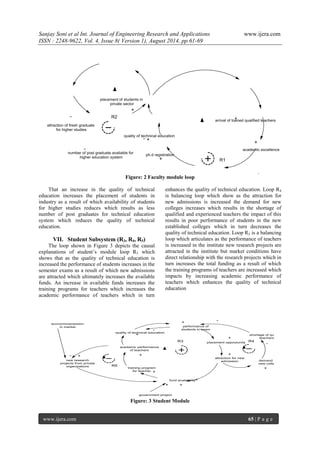
The interrelationship in the sub-systems can be studied with the help of causal loop diagrams of various modules and their impact on quality can be studied. The loop clearly depicts the causal explanations. Faculty Subsystem loop (R1, R2) The loop shown in figure 2 below is depicting the impact of faculty over Quality of technical education. Quality of technical education is enhanced by arrival of trained qualified teachers activity which in turn enhances the academic excellence (University teaching plan is fulfilled) as a result of which new admission are attracted which promotes the fund availability of institute and enhances the research and development activity in the institute as a result of which Ph. D. enrollment increases which enhances the quality of technical education. The balancing loop R2 is articulates 
Student sub system 
1. Mode of selection of students. 
2. Extracurricular activities of students. 
3. Performance of students. 
Quality of technical education 
Faculty sub system 
1. Arrival and departure of faculty. 
2. Training programs for faculty. 
3. Promotion policy for 
Faculty 
Academic subsystem 
1. Training programs for students. 
2. Training programs for faculty. 
3. National/International levels, seminars/conferences 
Administrative subsystem 
1. Mode of communications between faculty and management. 
2. Infrastructure facilities 
3. Students facilities. 
4. Faculty facilities
Sanjay Soni et al Int. Journal of Engineering Research and Applications www.ijera.com 
ISSN : 2248-9622, Vol. 4, Issue 8( Version 1), August 2014, pp.61-69 
www.ijera.com 65 | P a g e 
Figure: 2 Faculty module loop 
That an increase in the quality of technical 
education increases the placement of students in 
industry as a result of which availability of students 
for higher studies reduces which results as less 
number of post graduates for technical education 
system which reduces the quality of technical 
education. 
VII. Student Subsystem (R3, R4, R5) 
The loop shown in Figure 3 depicts the causal 
explanations of student’s module loop R3 which 
shows that as the quality of technical education is 
increased the performance of students increases in the 
semester exams as a result of which new admissions 
are attracted which ultimately increases the available 
funds. An increase in available funds increases the 
training programs for teachers which increases the 
academic performance of teachers which in turn 
enhances the quality of technical education. Loop R4 
is balancing loop which show as the attraction for 
new admissions is increased the demand for new 
colleges increases which results in the shortage of 
qualified and experienced teachers the impact of this 
results in poor performance of students in the new 
established colleges which in turn decreases the 
quality of technical education. Loop R5 is a balancing 
loop which articulates as the performance of teachers 
is increased in the institute new research projects are 
attracted in the institute but market conditions have 
direct relationship with the research projects which in 
turn increases the total funding as a result of which 
the training programs of teachers are increased which 
impacts by increasing academic performance of 
teachers which enhances the quality of technical 
education 
Figure: 3 Student Module
Sanjay Soni et al Int. Journal of Engineering Research and Applications www.ijera.com 
ISSN : 2248-9622, Vol. 4, Issue 8( Version 1), August 2014, pp.61-69 
www.ijera.com 66 | P a g e 
VIII. Administrative Subsystem (R6) 
The loop shown in figure 4 depicts the causal relationship of admistrative module which articulates as the quality of technical education increases the student teacher interactions increases as a result of which teaching enhances which promotes the performance of students in semester exams as a impact of which the placements are increased which attracts new admission which ultimately increases the available funds which in turn are utilized for the development of infrastructure of the institute (library,internet,etc.) which results in the increase in the quality of technical education system. Figure: 4 Administrative Module 
IX. The model 
Taking causal loop diagrams as a base a system dynamic model is constructed in which quality of technical education system is a level variable which is linked with teachers arrival rate and teacher quitting rate. Quality of technical system is also linked with number of pass out students and placements of students in industries.
Sanjay Soni et al Int. Journal of Engineering Research and Applications www.ijera.com 
ISSN : 2248-9622, Vol. 4, Issue 8( Version 1), August 2014, pp.61-69 
www.ijera.com 67 | P a g e 
IWPRPG 
IWFDOR 
IWSDR 
IWSS 
readmission_of _fail_students_mechanical 
students_drop_out_ratio 
placement_ratio_in_pg 
Auxiliary _167 
inf rastructure_growth_f actor 
reputation_of _institute 
f aculty_satisf action 
teacher_student_ra 
IWIGF 
regular_f aculty_arrival 
institute_growth_factor 
IWFS 
IWROI 
f aculty_departure 
delay_time 
drop_out 
migration_of_f aculty 
quality_gain 
quality 
students_satisf action 
quality_index 
sanctioned_posts 
guest_appointment 
appointment 
Regular_selection 
regular_f aculty_appointment 
total_regular_f aculty 
Figure: 5 Flow Model of Technical Education system. 
X. Results and Discussion: 
The table shown below gives the simulated 
values of quality by running the model for the period 
from 2004 to 2025.By assuming initial value for 
starting year as zero. The quality computation shown 
in the table is done from available data of Jabalpur 
Engineering College one of the premier Institute of 
Madhya Pradesh. The table shows the dynamic 
behavior of quality with time indicating that quality 
in not a function of one single thing but depends on 
various factors.Quality1, Quality2, Quality3, signifies 
the quality with presence of Assistant Professors, 
Associate Professors, and Professors
Sanjay Soni et al Int. Journal of Engineering Research and Applications www.ijera.com 
ISSN : 2248-9622, Vol. 4, Issue 8( Version 1), August 2014, pp.61-69 
www.ijera.com 68 | P a g e 
year 
2,004 
2,005 
2,006 
2,007 
2,008 
2,009 
2,010 
2,011 
2,012 
2,013 
2,014 
2,015 
2,016 
2,017 
2,018 
2,019 
2,020 
2,021 
2,022 
2,023 
2,024 
2,025 
quality(1) quality(2) quality(3) 
0.00 0.00 0.00 
6.06 3.57 6.18 
94.21 93.24 94.54 
132.60 132.27 132.68 
145.19 145.13 145.13 
111.41 111.56 111.33 
122.57 122.85 123.09 
123.45 123.57 123.74 
144.11 144.14 144.24 
154.80 154.78 154.96 
161.04 160.89 160.60 
135.18 135.13 134.81 
123.10 123.11 122.77 
117.91 117.95 117.59 
116.16 116.22 115.85 
116.14 116.21 115.84 
116.98 117.06 116.68 
118.25 118.33 117.94 
119.73 119.81 119.43 
121.33 121.41 121.02 
122.97 123.06 122.67 
124.65 124.73 124.34 
Figure: 6 Simulation result between teaching faculty and quality of Technical Education. 
year 
quality 
1 
1 
2 
2 
3 
3 
2,005 2,010 2,015 2,020 2,025 
0 
50 
100 
150 
1 
2 
3 
1 2 
3 
1 
2 3 1 2 3 1 
Figure: 7 Dynamic Behavior of Quality with Time 
XI. Conclusion 
The above investigation reveals that the quality 
of higher education is not independent but it has 
causal relationships with other parameters of 
technical education system .While discussing the 
quality issues of technical education the feedback of 
these parameters on quality of technical education 
cannot be ignored. The model constructed by taking 
the base of causal loop diagram of various sectors of 
technical education system helps in predicting the 
behavior of these parameters over long run, Thus
Sanjay Soni et al Int. Journal of Engineering Research and Applications www.ijera.com 
ISSN : 2248-9622, Vol. 4, Issue 8( Version 1), August 2014, pp.61-69 
www.ijera.com 69 | P a g e 
model can be used as the base for planning policy for quality in technical education. References 
[1] AICTE (2013),htt://www.aicte.ernet.in//. 
[2] Anderson, L. W. and Sosnaik, L.A. (eds) (1994). Bloom Taxonomy: A Forty-year Retrospective, Ninety-third Yearbook of the National Society for the Study of Education (NSSE), Distributed by The University of Chicago Press, Chicago, IL. 
[3] Arndt, H. (2007) Using System Dynamics- based Learning Environments to Enhance System Thinking, Conference Proceedings, The 2007 International Conference of the System Dynamics Society and 50th Anniversary Celebration, July 29 – August 2, 2007, Boston, Massachusetts, USA. 
[4] Conte C. (2003) Honey, I Shrunk the Defict, Governing Magazine/December 2003. 
[5] Dekkers, J. & Donatti, S. (1981). The integration of research studies on the use of simulation as an instructional strategy. Journal of Educational Research, 74,424- 427. 
[6] Friedman, S. with Cavaleri S. and Raphael, M. (2007) Individual Learning Style and Systems Tool Preferences, Conference Proceedings, The 2007 International Conference of the System Dynamics Society and 50th Anniversary Celebration, July 29 – August 2, 2007, Boston, Massachusetts, USA. 
[7] Hal bower, M. C (1993) The First Three Hours D-4230-3.In Forrester, J.W.(ed) (2004) MIT System Dynamics Group Literature Collection DVD, System Dynamics Society, Albany, NY, USA. 
[8] Hopper, M. and Stave, K. (2008) Assessing the Effectiveness of Systems Thinking Interventions in the Classroom, Conference Proceedings, The 2008 International Conference of the System Dynamics Society, July 20-24, 2008, Athens, Greece. 
[9] INEP National Institute of Educational Research. 12 April 2009. www.inep.gov.br/Superor/Censosuperior/Sinopse. 
[10] Kapu, and Mehta. (2004) Indian Higher Education Reform, CID Working paper No.108. 
[11] Kennedy, M. (2008). A Taxonomy of System Dynamics Pedagogic Techniques, Conference Proceedings, The 2008 International Conference of the System Dynamics Society, July 20 -24,2008, Athens, Greece. 
[12] Mckeachie W.J. (1990). Research on College Teaching: The Historical Background, Journal of Educational Psychology, Vol.82, No.2, 1990. 
[13] Morecroft, J.D. and Sterman, J.D. (eds) (1992). Modelling for Learning, European Journal of Operations Research, Vol.59 May, 1992. 
[14] McCowan, T. (2007). Expansion without equity: An analysis of current policy on access to higher education in Brazil. Higher Education, 53:579-598. 
[15] Niculescu, M. (2006). Strategic positioning in Romanian higher education. Journal of Organizational Change Management, V.19, No.6: 725-737. 
[16] Nuhoglu, M. with Nuhoglu, H.(2008).The Effects of System Dynamics Approach In Science Education in Middle School, Conference Proceedings, The 2008 International Conference of the System Dynamics Society, July 20-24, 2008, Athens, Greece. 
[17] Potash, P. with Heinbokel, J. (2005) Unleashing the Revolutionary Implications of a System Dynamics Education, The 23rd International Conference of the System Dynamics Society, July 17-21, 2005, Boston. 
[18] Senge, P.M. (2006). The Fifth Discipline: The Art and Practice of the Organization that Learn Revised Edition, Crown Business Edition, Random House, New York. 
[19] Sterman, J.D.(2008). Business Dynamics: Systems thinking and modeling for a complex world, McGraw-Hill, Boston.

To Study Effect of Various Parameters for Quality Improvement in Technical Education

  • 1.
    Sanjay Soni etal Int. Journal of Engineering Research and Applications www.ijera.com ISSN : 2248-9622, Vol. 4, Issue 8( Version 1), August 2014, pp.61-69 www.ijera.com 61 | P a g e To Study Effect of Various Parameters for Quality Improvement in Technical Education Sanjay Soni, Dr. B. K. Chourasia, Abishek Soni Assistant Professor, Department of Industrial & Production Engineering Jabalpur Engineering College, Jabalpur Associate Professor, Department of Mechanical Engineering Jabalpur Engineering College, Jabalpur Assistant Professor, Department of Mechanical Engineering H.C.E.T, Jabalpur Indus. Abstract In the present Research Investigation an effort has been made to study the effect of various important parameters of technical education system on its quality. This is done by creating sub modules of important stakeholders of technical education system and studying their Interactions by constructing causal loop diagrams of various modules .The main objective of this Research study is to construct a system dynamic model based on the interactions among this sub-modules which can be taken as a base for optimal policy planning for achieving optimum level of quality in the technical education system. I. Introduction India has progressed with large number of technical institution imparting Engineering and Management courses. There is drastic growth in the number of technical institutions in almost all states except few and hopefully in coming years the remaining states will also be able to establish number of the technical Institutes. But it is accepted and unfortunate facts that accept few important organizations rest are not maintaining standard of technical education. Irony is that all premier Institutes get the creamy layer of intakes. Meritorious students getting admission in pioneer Institutes are natural professional. Unfortunately substandard Institutes get non creamy layer of intakes of are just producing Technical graduates having certificate but not required skills because of non quality practices. There is a need to find out the factors which affect the quality of the Technical education system. India has the world's second largest education system and provides one of largest pools of skilled manpower. In the recent years, the problem of quality among professional graduates is a cause of concern. Substandard Institutes are producing mere graduates instead of true professional, who cannot meet the expectations of Industries. There is immediate need to take few corrective measures otherwise India will face an explosion of unemployed technical graduates. Academia will have to understand the nerve of Industries and require producing true professional instead of mere graduate. Kapu and Mehta argue that higher education in India is being de facto privatized on a massive scale. But this privatization is not a result of changing ideological commitments but, a result from a breakdown of the state system and an exit of Indian elites from public institutions, to both private sector institutions within the country as well as abroad. Private philanthropy in higher education, which was supportive of public institutions in the past, is also increasingly withdrawing its support. Consequently the ideological and institutional underpinnings of this form of privatization remain exceedingly weak [10], (Kapu and Mehta, 2004). In this context of increase in the demand and supply of technical education and increasing role of private institutions as well as individuals quality assurance becomes more and more critical for the success of technical education in the country. External audit mechanisms including accreditation agencies such as All India Council for Technical Education [1], (AICTE), the National Board of Accreditation were established in 1994. Also, international quality certifications ISO have enhanced the status of many organizations including educational institutions as quality performers. At the same time, a more informal assessment of "good performance" results when prospective students arrive at their judgments with regard to the "quality" of the institution under consideration for purposes of admission. While the certification by the external agencies such as AICTE and NAAC (National Assessment and Accreditation Council) is an official endorsement, the perception of potential students with respect to the quality of the programmes offered by these technical institutions RESEARCH ARTICLE OPEN ACCESS
  • 2.
    Sanjay Soni etal Int. Journal of Engineering Research and Applications www.ijera.com ISSN : 2248-9622, Vol. 4, Issue 8( Version 1), August 2014, pp.61-69 www.ijera.com 62 | P a g e plays an important role in their success. Such perceptions are in a sense self perpetuating. As students start perceiving a particular institution to be better, high quality students will get attracted to the institution. Consequently, the academic performance of the student body as a whole will improve which will result in better placement for the students as well as improvement in the reputation of the institution. This will naturally attract still better students for the next set of admissions. The same self-perpetuating cycle could also work in the reverse direction in the sense that if there is a drop in the perceived quality of the institution, the slide could continue to push the reputation downwards. Thus, it is important to create a positive perception in the minds of the students as well as other stakeholders of the institution. There are many factors that contribute to the perceptions as well as the delivery of high quality education to the students. This paper attempts to identify the factors that promote high quality technical education and how they are affecting the technical education system. II. Specific Objectives of the Study The following are the specific objectives of the study; 1. To determine the impact of various factors contributing to quality of technical education system. 2. To establish close interactions among various factors by constructing causal loop for technical education system. 3. To construct a system dynamic model which can measure the effects of change in these factors on Quality of technical system. Quality in Education Defining quality in education is a massive challenge since it deals with the most sensitive creation on earth the human beings. [3] Suggests that education quality is a rather vague and controversial concept. At the broadest level, education quality is a rather vague and controversial concept. At the broadest level, education quality can be viewed as a set of elements that constitute the input, process and output of the education system, and provide services that completely satisfy both internal and external strategic constituencies by meeting their explicit and implicit expectations. If higher education is viewed as a system, then any quality management program must therefore asses inputs, process and outputs. III. Contextual Perspective [6], maintains that indeed, the notion of quality in technical education has no agreed technical meaning and its use usually involves a heavy contextual overlay of some political or educational position. For example, reference to the quality of research, student’s supervision, assessment, student intake, academic programs, teaching and learning, and program designs are not uncommon. Any attempt to define or attach meaning to the term is largely ignored and one is left to assume that it is high quality that is being referred to as opposed to good or poor quality [8]. IV. Stakeholders Perspective From the stakeholder’s perspective, [12], highlight the importance and value of considering quality from a variety of stakeholder perspectives. The different HE stakeholders, i.e., government, quality agencies, universities, individual academics, students, employer, parents and society, have the potential to think about quality in different ways. Similarly, five aspects of quality, including: exception, perfection, fitness for purpose, value for money, and transformation, are attributed to stakeholder’s perspective. [13], further elaborates on these aspects as follows: Exception: distinctive, embodied in excellence, passing a minimum set of standards. Perfection: zero defects, getting things right the first time. Fitness for purpose: relates quality to a purpose, defined by the provider. Quality is a function of competencies in terms of knowledge, skills and attitudes, capacity and competition vis-à-vis needs [15]. Resultant from the system that produced it, and is an attribute of that system as much as of the product itself of its processes, its people and the way they work together, [20]. Efficiency in meeting the set goals, relevance to human and environmental needs and conditions and something more in relation to the pursuit of excellence and human betterment, [19]. The US National Science Foundation has defines quality in technical education as the development of intellectual skills that will equip graduates to contribute to society through productive and satisfying engineering careers as innovators, decision-makers and leaders in the global economy of the twenty- first century,[12]. As in manufacturing and service industries quality is the hallmark of excellence and effectiveness in engineering education. Every engineering college and polytechnic should define their quality policy and articulate their commitment to achieve quality in all their activities and implement the policies energetically, [14].
  • 3.
    Sanjay Soni etal Int. Journal of Engineering Research and Applications www.ijera.com ISSN : 2248-9622, Vol. 4, Issue 8( Version 1), August 2014, pp.61-69 www.ijera.com 63 | P a g e Quality assurance is a process-driven approach with specific steps to help define and attain goals. This process considers design, development, production, and service. The most popular tool used to determine quality assurance is the she wart cycle, developed by Dr. W. Edwards Deming. This cycle for quality assurance consists of four steps: Plan, Do, check, and Act. These steps are commonly abbreviated as PDCA. An Internal Quality Assurance system under which students, staff and management satisfy themselves that control mechanisms are working to maintain and enhance the quality [16]. The quality assurance strategies that are appropriate for virtual education share common features with other forms of media, but there are also differences. The range and flexibility of information and communications technologies create new opportunities, but also give rise to complexities and challenges for governments, agencies, institutions and faculty, [8]. QA handbook,[7] provides 10 tips for quality assurance for digital library such as document your policies, ensure your technical infrastructure is capable of implementing your policies, and ensure your technical infrastructure is capable of implementing your policies, ensure that you have the resources necessary to implement your policies, implement systematic checking procedures to ensure your policies are being implemented, keep audit trails, learn from others, share your experiences, seek “fitness for purpose” not perfections, remember that QA is for you to implement, seek to deploy QA procedures more extensively,[6]. Education committee of Oxford University suggests major areas of quality assurances or quality enhancement such as admission, induction, and course design, student feedback, student complaints and appeals, statistical information, external input, quality enhancement in learning and teaching, monitoring of teaching, postgraduate research degrees, collaborative provision and placement. Educational institutions including the national Open University should be ethically and legally stopped from running courses and programmes in which they do not have core faculty. The use of teachers as academic managers and hiring of part time consultants has been helping many to generate resources, but quality is definitely being compromised. In open and distance learning system, the mechanism of quality assurance in India should include recognition and accreditation, institutional and programme assessment, process as well as product assessment ,[14]. [15], Has proposed technical education quality assurance and assessment (TEQ-AA) system that uses mobile agents to access the web pages of the technical institutions or colleges and collect relavant quality measurement information. The collected information is analyzed and deducted into the qualitative facts of the institution, standard measurement by using (RARM) Realistic Adductive Reasoning Model, [16]. Quality assurance can be achieved through accreditation of the institutes, periodically running faculty development program research and institutional development .But there are lots of challenges such as inequity in the number of diploma level institutions vs. degree, absence of vertical mobility for ITI to doctoral levels, Availability of quality and competent faculty, number of PhDs in technical education, outcomes based accreditation criteria, flexible learning, transitional education and distance learning etc. before the institution to go for quality assurance,[14]. V. System Dynamics Modeling System dynamics is a computer based modeling approach for analyzing and solving complex problems through policy design and analysis. The problems addressed by SD are based on the premise that the structure of a system, that is, the way essential system components are connected, generates its behavior,[20].If dynamic behavior arises from feedback within the system, finding effective policy interventions requires understanding system structure. Once a model is built, it can be used to simulate the effect of proposed actions on the problem and the system as a whole. As [11], notes, this kind of tool (System Dynamic model) is necessary because, while people are good at observing the local structure of a system, they are not good at predicting how complex, interdependent systems will behave. Sub-Systems of Technical education system: A system obviously comprises several sub- systems. The basic approach of system Dynamics is identifying the sub-systems and understanding their interrelationships and interdependence and to study their dynamic behavior. The various sub- systems of Technical education system are faculty module, student’s module, academic module, and administrative module, [12].
  • 4.
    Sanjay Soni etal Int. Journal of Engineering Research and Applications www.ijera.com ISSN : 2248-9622, Vol. 4, Issue 8( Version 1), August 2014, pp.61-69 www.ijera.com 64 | P a g e Figure: 1 Sub Modules of Technical Education System VI. Interactions in Subsystems of Technical Education System: The interrelationship in the sub-systems can be studied with the help of causal loop diagrams of various modules and their impact on quality can be studied. The loop clearly depicts the causal explanations. Faculty Subsystem loop (R1, R2) The loop shown in figure 2 below is depicting the impact of faculty over Quality of technical education. Quality of technical education is enhanced by arrival of trained qualified teachers activity which in turn enhances the academic excellence (University teaching plan is fulfilled) as a result of which new admission are attracted which promotes the fund availability of institute and enhances the research and development activity in the institute as a result of which Ph. D. enrollment increases which enhances the quality of technical education. The balancing loop R2 is articulates Student sub system 1. Mode of selection of students. 2. Extracurricular activities of students. 3. Performance of students. Quality of technical education Faculty sub system 1. Arrival and departure of faculty. 2. Training programs for faculty. 3. Promotion policy for Faculty Academic subsystem 1. Training programs for students. 2. Training programs for faculty. 3. National/International levels, seminars/conferences Administrative subsystem 1. Mode of communications between faculty and management. 2. Infrastructure facilities 3. Students facilities. 4. Faculty facilities
  • 5.
    Sanjay Soni etal Int. Journal of Engineering Research and Applications www.ijera.com ISSN : 2248-9622, Vol. 4, Issue 8( Version 1), August 2014, pp.61-69 www.ijera.com 65 | P a g e Figure: 2 Faculty module loop That an increase in the quality of technical education increases the placement of students in industry as a result of which availability of students for higher studies reduces which results as less number of post graduates for technical education system which reduces the quality of technical education. VII. Student Subsystem (R3, R4, R5) The loop shown in Figure 3 depicts the causal explanations of student’s module loop R3 which shows that as the quality of technical education is increased the performance of students increases in the semester exams as a result of which new admissions are attracted which ultimately increases the available funds. An increase in available funds increases the training programs for teachers which increases the academic performance of teachers which in turn enhances the quality of technical education. Loop R4 is balancing loop which show as the attraction for new admissions is increased the demand for new colleges increases which results in the shortage of qualified and experienced teachers the impact of this results in poor performance of students in the new established colleges which in turn decreases the quality of technical education. Loop R5 is a balancing loop which articulates as the performance of teachers is increased in the institute new research projects are attracted in the institute but market conditions have direct relationship with the research projects which in turn increases the total funding as a result of which the training programs of teachers are increased which impacts by increasing academic performance of teachers which enhances the quality of technical education Figure: 3 Student Module
  • 6.
    Sanjay Soni etal Int. Journal of Engineering Research and Applications www.ijera.com ISSN : 2248-9622, Vol. 4, Issue 8( Version 1), August 2014, pp.61-69 www.ijera.com 66 | P a g e VIII. Administrative Subsystem (R6) The loop shown in figure 4 depicts the causal relationship of admistrative module which articulates as the quality of technical education increases the student teacher interactions increases as a result of which teaching enhances which promotes the performance of students in semester exams as a impact of which the placements are increased which attracts new admission which ultimately increases the available funds which in turn are utilized for the development of infrastructure of the institute (library,internet,etc.) which results in the increase in the quality of technical education system. Figure: 4 Administrative Module IX. The model Taking causal loop diagrams as a base a system dynamic model is constructed in which quality of technical education system is a level variable which is linked with teachers arrival rate and teacher quitting rate. Quality of technical system is also linked with number of pass out students and placements of students in industries.
  • 7.
    Sanjay Soni etal Int. Journal of Engineering Research and Applications www.ijera.com ISSN : 2248-9622, Vol. 4, Issue 8( Version 1), August 2014, pp.61-69 www.ijera.com 67 | P a g e IWPRPG IWFDOR IWSDR IWSS readmission_of _fail_students_mechanical students_drop_out_ratio placement_ratio_in_pg Auxiliary _167 inf rastructure_growth_f actor reputation_of _institute f aculty_satisf action teacher_student_ra IWIGF regular_f aculty_arrival institute_growth_factor IWFS IWROI f aculty_departure delay_time drop_out migration_of_f aculty quality_gain quality students_satisf action quality_index sanctioned_posts guest_appointment appointment Regular_selection regular_f aculty_appointment total_regular_f aculty Figure: 5 Flow Model of Technical Education system. X. Results and Discussion: The table shown below gives the simulated values of quality by running the model for the period from 2004 to 2025.By assuming initial value for starting year as zero. The quality computation shown in the table is done from available data of Jabalpur Engineering College one of the premier Institute of Madhya Pradesh. The table shows the dynamic behavior of quality with time indicating that quality in not a function of one single thing but depends on various factors.Quality1, Quality2, Quality3, signifies the quality with presence of Assistant Professors, Associate Professors, and Professors
  • 8.
    Sanjay Soni etal Int. Journal of Engineering Research and Applications www.ijera.com ISSN : 2248-9622, Vol. 4, Issue 8( Version 1), August 2014, pp.61-69 www.ijera.com 68 | P a g e year 2,004 2,005 2,006 2,007 2,008 2,009 2,010 2,011 2,012 2,013 2,014 2,015 2,016 2,017 2,018 2,019 2,020 2,021 2,022 2,023 2,024 2,025 quality(1) quality(2) quality(3) 0.00 0.00 0.00 6.06 3.57 6.18 94.21 93.24 94.54 132.60 132.27 132.68 145.19 145.13 145.13 111.41 111.56 111.33 122.57 122.85 123.09 123.45 123.57 123.74 144.11 144.14 144.24 154.80 154.78 154.96 161.04 160.89 160.60 135.18 135.13 134.81 123.10 123.11 122.77 117.91 117.95 117.59 116.16 116.22 115.85 116.14 116.21 115.84 116.98 117.06 116.68 118.25 118.33 117.94 119.73 119.81 119.43 121.33 121.41 121.02 122.97 123.06 122.67 124.65 124.73 124.34 Figure: 6 Simulation result between teaching faculty and quality of Technical Education. year quality 1 1 2 2 3 3 2,005 2,010 2,015 2,020 2,025 0 50 100 150 1 2 3 1 2 3 1 2 3 1 2 3 1 Figure: 7 Dynamic Behavior of Quality with Time XI. Conclusion The above investigation reveals that the quality of higher education is not independent but it has causal relationships with other parameters of technical education system .While discussing the quality issues of technical education the feedback of these parameters on quality of technical education cannot be ignored. The model constructed by taking the base of causal loop diagram of various sectors of technical education system helps in predicting the behavior of these parameters over long run, Thus
  • 9.
    Sanjay Soni etal Int. Journal of Engineering Research and Applications www.ijera.com ISSN : 2248-9622, Vol. 4, Issue 8( Version 1), August 2014, pp.61-69 www.ijera.com 69 | P a g e model can be used as the base for planning policy for quality in technical education. References [1] AICTE (2013),htt://www.aicte.ernet.in//. [2] Anderson, L. W. and Sosnaik, L.A. (eds) (1994). Bloom Taxonomy: A Forty-year Retrospective, Ninety-third Yearbook of the National Society for the Study of Education (NSSE), Distributed by The University of Chicago Press, Chicago, IL. [3] Arndt, H. (2007) Using System Dynamics- based Learning Environments to Enhance System Thinking, Conference Proceedings, The 2007 International Conference of the System Dynamics Society and 50th Anniversary Celebration, July 29 – August 2, 2007, Boston, Massachusetts, USA. [4] Conte C. (2003) Honey, I Shrunk the Defict, Governing Magazine/December 2003. [5] Dekkers, J. & Donatti, S. (1981). The integration of research studies on the use of simulation as an instructional strategy. Journal of Educational Research, 74,424- 427. [6] Friedman, S. with Cavaleri S. and Raphael, M. (2007) Individual Learning Style and Systems Tool Preferences, Conference Proceedings, The 2007 International Conference of the System Dynamics Society and 50th Anniversary Celebration, July 29 – August 2, 2007, Boston, Massachusetts, USA. [7] Hal bower, M. C (1993) The First Three Hours D-4230-3.In Forrester, J.W.(ed) (2004) MIT System Dynamics Group Literature Collection DVD, System Dynamics Society, Albany, NY, USA. [8] Hopper, M. and Stave, K. (2008) Assessing the Effectiveness of Systems Thinking Interventions in the Classroom, Conference Proceedings, The 2008 International Conference of the System Dynamics Society, July 20-24, 2008, Athens, Greece. [9] INEP National Institute of Educational Research. 12 April 2009. www.inep.gov.br/Superor/Censosuperior/Sinopse. [10] Kapu, and Mehta. (2004) Indian Higher Education Reform, CID Working paper No.108. [11] Kennedy, M. (2008). A Taxonomy of System Dynamics Pedagogic Techniques, Conference Proceedings, The 2008 International Conference of the System Dynamics Society, July 20 -24,2008, Athens, Greece. [12] Mckeachie W.J. (1990). Research on College Teaching: The Historical Background, Journal of Educational Psychology, Vol.82, No.2, 1990. [13] Morecroft, J.D. and Sterman, J.D. (eds) (1992). Modelling for Learning, European Journal of Operations Research, Vol.59 May, 1992. [14] McCowan, T. (2007). Expansion without equity: An analysis of current policy on access to higher education in Brazil. Higher Education, 53:579-598. [15] Niculescu, M. (2006). Strategic positioning in Romanian higher education. Journal of Organizational Change Management, V.19, No.6: 725-737. [16] Nuhoglu, M. with Nuhoglu, H.(2008).The Effects of System Dynamics Approach In Science Education in Middle School, Conference Proceedings, The 2008 International Conference of the System Dynamics Society, July 20-24, 2008, Athens, Greece. [17] Potash, P. with Heinbokel, J. (2005) Unleashing the Revolutionary Implications of a System Dynamics Education, The 23rd International Conference of the System Dynamics Society, July 17-21, 2005, Boston. [18] Senge, P.M. (2006). The Fifth Discipline: The Art and Practice of the Organization that Learn Revised Edition, Crown Business Edition, Random House, New York. [19] Sterman, J.D.(2008). Business Dynamics: Systems thinking and modeling for a complex world, McGraw-Hill, Boston.