Unit
3
The
Integumentary
System
Chapter 5 in Textbook
3.3 Accessory Structures of the Skin
Accessory Structures
Hair, hair follicles, sebaceous (oil) glands, sweat glands,
and nails
–Are integumentary accessory structures
–Are located in dermis
–Project through the skin surface
Hair
• The human body is covered with hair, except
– palms
– soles
– lips
– portions of external genitalia
• Functions of Hair
– protects and insulates (injury, sunrays, heat loss)
– guards openings against particles and insects (eyelashes and
nostril hairs)
– is sensitive to very light touch
Hair
• Hair is composed of dead, hard keratinized cells.
• Hair consists of 2 parts:
– Root – portion of hair embedded in skin
– Shaft – superficial portion of hair that projects from the skin’s
surface
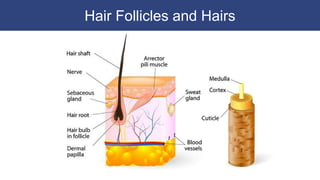
• Each hair shaft consists of three concentric layers:
– Medulla (core)
– Cortex (surrounds medulla; major part of shaft)
– Cuticle (single overlapping outer layer)
Hair
• Hair is produced in organs called hair
follicles. Hair follicles surround the hair.
• Hair follicles consist of:
– Sheath (encloses the hair)
– Bulb (base of hair follicle)
– Dermal papilla (contains blood vessels)
– Arrector pili (hair extends at an angle.
This smooth muscle pulls the hair into
a vertical position; causes goose
bumps in us and makes furry animals
look larger when threatened).
Hair Follicles and Hairs
Hair
• Hair Color
– Produced by melanocytes at the hair papilla
– Determined by genes but influenced by hormonal and environmental
factors
– Pigment production decreases with age, resulting in lighter color hair
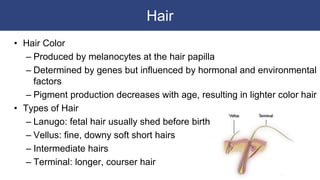
• Types of Hair
– Lanugo: fetal hair usually shed before birth
– Vellus: fine, downy soft short hairs
– Intermediate hairs
– Terminal: longer, courser hair
Hair
• Hair Loss
– Normal hair loss is 70-100 hairs per day
– Hair loss can be increased by illness, diet, high fever, surgery,
blood loss, stress, rapid weight loss, childbirth, drugs, and
radiation therapy
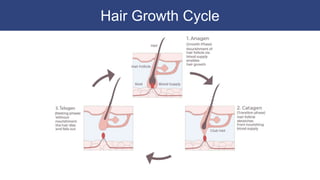
• Hair Growth
– Growth cycle is 2-5 years
– Average growth is 2 mm/week
– growth phase  transition phase  resting phase
Hair Growth Cycle
Exocrine Glands in Skin
• Sebaceous Glands (Oil Glands)
–Holocrine glands
–Secrete sebum
• Sweat Glands
–Two types: apocrine glands and merocrine glands
–Watery secretions
• Other Integumentary Glands
– mammary glands and ceruminous glands
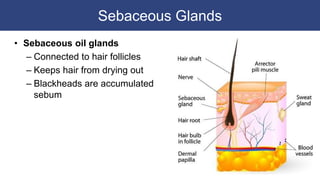
Sebaceous Glands
• Sebaceous oil glands
– Connected to hair follicles
– Keeps hair from drying out
– Blackheads are accumulated
sebum
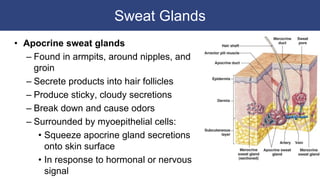
Sweat Glands
• Apocrine sweat glands
– Found in armpits, around nipples, and
groin
– Secrete products into hair follicles
– Produce sticky, cloudy secretions
– Break down and cause odors
– Surrounded by myoepithelial cells:
• Squeeze apocrine gland secretions
onto skin surface
• In response to hormonal or nervous
signal
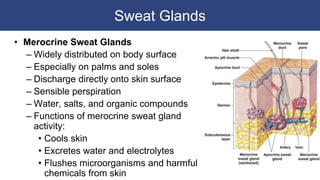
Sweat Glands
• Merocrine Sweat Glands
– Widely distributed on body surface
– Especially on palms and soles
– Discharge directly onto skin surface
– Sensible perspiration
– Water, salts, and organic compounds
– Functions of merocrine sweat gland
activity:
• Cools skin
• Excretes water and electrolytes
• Flushes microorganisms and harmful
chemicals from skin
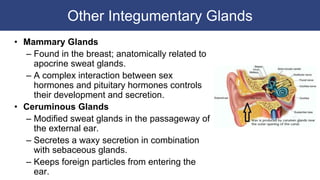
Other Integumentary Glands
• Mammary Glands
– Found in the breast; anatomically related to
apocrine sweat glands.
– A complex interaction between sex
hormones and pituitary hormones controls
their development and secretion.
• Ceruminous Glands
– Modified sweat glands in the passageway of
the external ear.
– Secretes a waxy secretion in combination
with sebaceous glands.
– Keeps foreign particles from entering the
ear.
Nails
• Nails protect fingers and toes
–Made of dead cells packed with keratin
–Metabolic disorders can change nail structure
–Used as tools for digging, scratching and manipulation of
objects
• Corresponds to hooves and claws
• Nail production
–Occurs in a deep epidermal fold near the bone called the
nail root
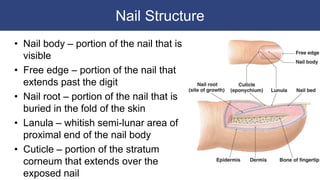
Nail Structure
• Nail body – portion of the nail that is
visible
• Free edge – portion of the nail that
extends past the digit
• Nail root – portion of the nail that is
buried in the fold of the skin
• Lanula – whitish semi-lunar area of
proximal end of the nail body
• Cuticle – portion of the stratum
corneum that extends over the
exposed nail

U3.3 Integumentary System

  • 1.
    Unit 3 The Integumentary System Chapter 5 inTextbook 3.3 Accessory Structures of the Skin
  • 2.
    Accessory Structures Hair, hairfollicles, sebaceous (oil) glands, sweat glands, and nails –Are integumentary accessory structures –Are located in dermis –Project through the skin surface
  • 3.
    Hair • The humanbody is covered with hair, except – palms – soles – lips – portions of external genitalia • Functions of Hair – protects and insulates (injury, sunrays, heat loss) – guards openings against particles and insects (eyelashes and nostril hairs) – is sensitive to very light touch
  • 4.
    Hair • Hair iscomposed of dead, hard keratinized cells. • Hair consists of 2 parts: – Root – portion of hair embedded in skin – Shaft – superficial portion of hair that projects from the skin’s surface • Each hair shaft consists of three concentric layers: – Medulla (core) – Cortex (surrounds medulla; major part of shaft) – Cuticle (single overlapping outer layer)
  • 5.
    Hair • Hair isproduced in organs called hair follicles. Hair follicles surround the hair. • Hair follicles consist of: – Sheath (encloses the hair) – Bulb (base of hair follicle) – Dermal papilla (contains blood vessels) – Arrector pili (hair extends at an angle. This smooth muscle pulls the hair into a vertical position; causes goose bumps in us and makes furry animals look larger when threatened).
  • 6.
  • 7.
    Hair • Hair Color –Produced by melanocytes at the hair papilla – Determined by genes but influenced by hormonal and environmental factors – Pigment production decreases with age, resulting in lighter color hair • Types of Hair – Lanugo: fetal hair usually shed before birth – Vellus: fine, downy soft short hairs – Intermediate hairs – Terminal: longer, courser hair
  • 8.
    Hair • Hair Loss –Normal hair loss is 70-100 hairs per day – Hair loss can be increased by illness, diet, high fever, surgery, blood loss, stress, rapid weight loss, childbirth, drugs, and radiation therapy • Hair Growth – Growth cycle is 2-5 years – Average growth is 2 mm/week – growth phase  transition phase  resting phase
  • 9.
  • 10.
    Exocrine Glands inSkin • Sebaceous Glands (Oil Glands) –Holocrine glands –Secrete sebum • Sweat Glands –Two types: apocrine glands and merocrine glands –Watery secretions • Other Integumentary Glands – mammary glands and ceruminous glands
  • 11.
    Sebaceous Glands • Sebaceousoil glands – Connected to hair follicles – Keeps hair from drying out – Blackheads are accumulated sebum
  • 12.
    Sweat Glands • Apocrinesweat glands – Found in armpits, around nipples, and groin – Secrete products into hair follicles – Produce sticky, cloudy secretions – Break down and cause odors – Surrounded by myoepithelial cells: • Squeeze apocrine gland secretions onto skin surface • In response to hormonal or nervous signal
  • 13.
    Sweat Glands • MerocrineSweat Glands – Widely distributed on body surface – Especially on palms and soles – Discharge directly onto skin surface – Sensible perspiration – Water, salts, and organic compounds – Functions of merocrine sweat gland activity: • Cools skin • Excretes water and electrolytes • Flushes microorganisms and harmful chemicals from skin
  • 14.
    Other Integumentary Glands •Mammary Glands – Found in the breast; anatomically related to apocrine sweat glands. – A complex interaction between sex hormones and pituitary hormones controls their development and secretion. • Ceruminous Glands – Modified sweat glands in the passageway of the external ear. – Secretes a waxy secretion in combination with sebaceous glands. – Keeps foreign particles from entering the ear.
  • 15.
    Nails • Nails protectfingers and toes –Made of dead cells packed with keratin –Metabolic disorders can change nail structure –Used as tools for digging, scratching and manipulation of objects • Corresponds to hooves and claws • Nail production –Occurs in a deep epidermal fold near the bone called the nail root
  • 16.
    Nail Structure • Nailbody – portion of the nail that is visible • Free edge – portion of the nail that extends past the digit • Nail root – portion of the nail that is buried in the fold of the skin • Lanula – whitish semi-lunar area of proximal end of the nail body • Cuticle – portion of the stratum corneum that extends over the exposed nail