 Skin=Integument
 Skin + accessory organs (hair, nails, and
cutaneous glands)= Integumentary
system
 Lgst. organ
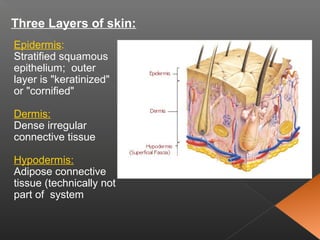
Epidermis:
Stratified squamous
epithelium; outer
layer is "keratinized"
or "cornified"
Dermis:
Dense irregular
connective tissue
Hypodermis:
Adipose connective
tissue (technically not
part of system
Three Layers of skin:
Stratum Corneum = Many layers of flat, dead, scale-like
cells full of keratin
Stratum Lucidum = One or two layers of dying cells
Stratum Granulosum = Three or four layers of cells;
Actively synthesizing protein
keratin
Stratum Spinosum (malphigian layer) = Three or four
layers of cells with Some cell division
Stratum Basale (st germinatum) = Single row of dividing
cells (columnar cells )
(Epidermis)
Primary cell type in epidermis = keratinocytes
which produce large amounts of protein keratin
Other cell types:
Melanocytes produce
pigment melanin &
transfer it to keratinocytes
Langerhans cells
(immune cells) protect
against pathogens and
toxins
Merkel cells detect touch
and pressure; transfer this
information to sensory
receptors in the dermis
Dermis:
Dense irregular connective tissue
Separated from epidermis (stratified squamous epithelium)
by basement membrane
Highly vascular
Highly innervated
Two Layers:
Papillary layer just
below epidermis
Reticular layer
forms deep 80%
Dermis:
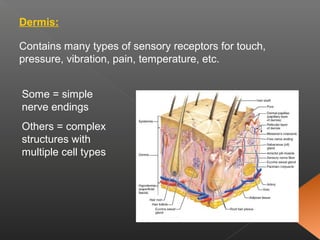
Contains many types of sensory receptors for touch,
pressure, vibration, pain, temperature, etc.
Some = simple
nerve endings
Others = complex
structures with
multiple cell types
Appendages of the skin
Hair follicles and hair
Sweat glands
Sebaceous (oil) glands
Nails on fingers and toes
All begin as epidermis of embryo; grow down into dermis
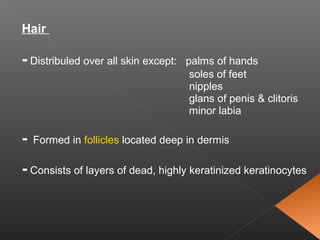
Hair
- Distribuled over all skin except: palms of hands
soles of feet
nipples
glans of penis & clitoris
minor labia
- Formed in follicles located deep in dermis
- Consists of layers of dead, highly keratinized keratinocytes
 Trunk and limb hair considered vestigial
 Scalp only place where it is thick enough
to retain heat
 Eyebrows enhance facial features
 Vibrassae (guard hair) are used to filter
particulates from the ear and nose
Shaft
Bulb
Root
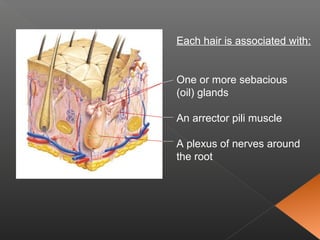
Each hair is associated with:
One or more sebacious
(oil) glands
An arrector pili muscle
A plexus of nerves around
the root
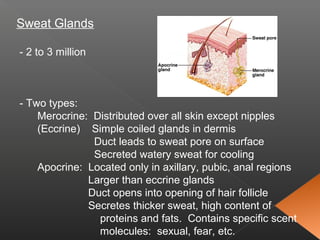
Sweat Glands
- 2 to 3 million
- Two types:
Merocrine: Distributed over all skin except nipples
(Eccrine) Simple coiled glands in dermis
Duct leads to sweat pore on surface
Secreted watery sweat for cooling
Apocrine: Located only in axillary, pubic, anal regions
Larger than eccrine glands
Duct opens into opening of hair follicle
Secretes thicker sweat, high content of
proteins and fats. Contains specific scent
molecules: sexual, fear, etc.
Sweat is usually 99% water with a pH between 4
and 6
Sweat glands produce 500ml of insensible
perspiration (no noticable wetness)daily
Diaphoresis—sweating with wetness (up to 1 l
per hr when exercising or in heat)
Two specially modified sweat glands:
Ceruminous—found in the external ear
canal. Secretion combines with sebum and dead
epidermal cells to form earwax (keeps eardrum pliable,
canal waterproof and has a bactericidal effect)
Mammary --milk producing glands found
in the female breast (modified apocrine glands)
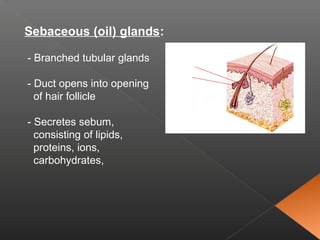
Sebaceous (oil) glands:
- Branched tubular glands
- Duct opens into opening
of hair follicle
- Secretes sebum,
consisting of lipids,
proteins, ions,
carbohydrates,
Functions of Integumentary System (skin & its products)
Barrier to keep water and solutes in
Barrier to keep bacterial, dirt, etc. out
Protection against abrasion
Contains sensory receptors for touch, temperature,
pressure, pain, etc.
Temperature regulation via hair, sweat, & amount of
blood flow
Blood reservoir
Synthesis of vitamin D
Excretion
Skin physiology

Skin physiology

  • 2.
     Skin=Integument  Skin+ accessory organs (hair, nails, and cutaneous glands)= Integumentary system  Lgst. organ
  • 3.
    Epidermis: Stratified squamous epithelium; outer layeris "keratinized" or "cornified" Dermis: Dense irregular connective tissue Hypodermis: Adipose connective tissue (technically not part of system Three Layers of skin:
  • 4.
    Stratum Corneum =Many layers of flat, dead, scale-like cells full of keratin Stratum Lucidum = One or two layers of dying cells Stratum Granulosum = Three or four layers of cells; Actively synthesizing protein keratin Stratum Spinosum (malphigian layer) = Three or four layers of cells with Some cell division Stratum Basale (st germinatum) = Single row of dividing cells (columnar cells ) (Epidermis)
  • 5.
    Primary cell typein epidermis = keratinocytes which produce large amounts of protein keratin Other cell types: Melanocytes produce pigment melanin & transfer it to keratinocytes Langerhans cells (immune cells) protect against pathogens and toxins Merkel cells detect touch and pressure; transfer this information to sensory receptors in the dermis
  • 6.
    Dermis: Dense irregular connectivetissue Separated from epidermis (stratified squamous epithelium) by basement membrane Highly vascular Highly innervated Two Layers: Papillary layer just below epidermis Reticular layer forms deep 80%
  • 7.
    Dermis: Contains many typesof sensory receptors for touch, pressure, vibration, pain, temperature, etc. Some = simple nerve endings Others = complex structures with multiple cell types
  • 8.
    Appendages of theskin Hair follicles and hair Sweat glands Sebaceous (oil) glands Nails on fingers and toes All begin as epidermis of embryo; grow down into dermis
  • 9.
    Hair - Distribuled overall skin except: palms of hands soles of feet nipples glans of penis & clitoris minor labia - Formed in follicles located deep in dermis - Consists of layers of dead, highly keratinized keratinocytes
  • 10.
     Trunk andlimb hair considered vestigial  Scalp only place where it is thick enough to retain heat  Eyebrows enhance facial features  Vibrassae (guard hair) are used to filter particulates from the ear and nose
  • 11.
  • 12.
    Each hair isassociated with: One or more sebacious (oil) glands An arrector pili muscle A plexus of nerves around the root
  • 13.
    Sweat Glands - 2to 3 million - Two types: Merocrine: Distributed over all skin except nipples (Eccrine) Simple coiled glands in dermis Duct leads to sweat pore on surface Secreted watery sweat for cooling Apocrine: Located only in axillary, pubic, anal regions Larger than eccrine glands Duct opens into opening of hair follicle Secretes thicker sweat, high content of proteins and fats. Contains specific scent molecules: sexual, fear, etc.
  • 14.
    Sweat is usually99% water with a pH between 4 and 6 Sweat glands produce 500ml of insensible perspiration (no noticable wetness)daily Diaphoresis—sweating with wetness (up to 1 l per hr when exercising or in heat) Two specially modified sweat glands: Ceruminous—found in the external ear canal. Secretion combines with sebum and dead epidermal cells to form earwax (keeps eardrum pliable, canal waterproof and has a bactericidal effect) Mammary --milk producing glands found in the female breast (modified apocrine glands)
  • 15.
    Sebaceous (oil) glands: -Branched tubular glands - Duct opens into opening of hair follicle - Secretes sebum, consisting of lipids, proteins, ions, carbohydrates,
  • 16.
    Functions of IntegumentarySystem (skin & its products) Barrier to keep water and solutes in Barrier to keep bacterial, dirt, etc. out Protection against abrasion Contains sensory receptors for touch, temperature, pressure, pain, etc. Temperature regulation via hair, sweat, & amount of blood flow Blood reservoir Synthesis of vitamin D Excretion