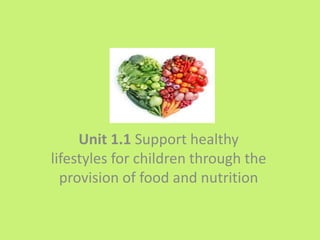
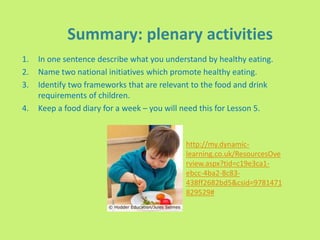
This document provides an overview of a training module that aims to teach participants about promoting healthy lifestyles for children through proper nutrition. It identifies learning outcomes around defining healthy eating, evaluating national nutrition initiatives, and describing requirements under relevant frameworks. Participants engage in activities like discussing healthy diets, researching UK programs, and analyzing evaluations of the School Fruit and Vegetable Scheme. The goal is for participants to understand how nutrition impacts children's health and development.

![LO1. Understand the impact of food and nutrition on children’s
health and development [AC 1.1]
Time: 5 mins
Using your show me boards, write
a list of everything you had to eat
and drink yesterday:
In pairs, share your lists and discuss what you understand by the
term ‘healthy eating’.
Be prepared to share your thoughts with the rest of the group.
• Breakfast
• Snacks
• Lunch
• Snacks
• Dinner
• Snacks
• Other](https://image.slidesharecdn.com/u1-151028183338-lva1-app6891/85/U1-1-lesson1-lo1-3-320.jpg)


![Food is a basic requirement of life. However, we need to eat a variety of food
in order to achieve a balanced diet. This is important in order to gain all the
vitamins and proteins etc. that we need.
What does a balanced diet consist of:
• Plenty of fruit and vegetables. As we know, we should eat five portions of fruit
and vegetables a day, because they are a good source of vitamins and minerals.
• Some starchy foods. These provide fibre and are foods such as rice, pasta,
potatoes and bread.
• Some milk and dairy foods. These provide protein and calcium and include milk,
cheese and yoghurt.
• Non-dairy sources of protein. These include meat, fish, eggs and pulses which
provide vitamins and minerals as well as protein.
• A small amount of sugar and fat.
LO1. Understand the impact of food and nutrition on children’s
health and development [AC 1.1]
What do we mean by healthy eating?](https://image.slidesharecdn.com/u1-151028183338-lva1-app6891/85/U1-1-lesson1-lo1-6-320.jpg)
![Time: 30 mins
Research national and local initiatives, for example:
• The School Fruit and Vegetable Scheme (SFVS)
• Food4Life/Change4Life
• The Government’s plans for free school meals for all Key
Stage 1 children
• Free milk in primary schools.
What local initiatives can you find out about?
Which initiatives would you suggest should be implemented and
why?
LO1. Understand the impact of food and nutrition on children’s
health and development [AC 1.2]](https://image.slidesharecdn.com/u1-151028183338-lva1-app6891/85/U1-1-lesson1-lo1-7-320.jpg)
![The School Fruit and Vegetable Scheme (SFVS)
• This was introduced in 2004, as part of the 5 A Day programme,
when all children in Key Stage 1 were given a free piece of fruit or
vegetable every day.
Food4Life
• This is part of the Change4Life programme begun in 2009 by the
Department of Health. Its aim is to tackle the issue of obesity.
Free school meals
• Many children have been entitled to free school meals if their
parents have been on benefits; recently the Government has
announced that there will be free school meals for all children in
Key Stage 1 from September 2014.
LO1. Understand the impact of food and nutrition on children’s
health and development [AC 1.2]
Evaluate national and local initiatives that promote healthy
eating](https://image.slidesharecdn.com/u1-151028183338-lva1-app6891/85/U1-1-lesson1-lo1-8-320.jpg)
![Time: 15 mins
• List any evidence that you have observed of the School Fruit
and Vegetable Scheme (SFVS) in action in your placements.
• Discuss what you think the aims of this scheme are and
whether it is successful.
• What do you know about Change4Life? Discuss this and
share your knowledge.
• Do you think that the Government should be offering free
school meals to all Key Stage 1 children? Why/why not?
LO1. Understand the impact of food and nutrition on children’s
health and development [AC 1.2]](https://image.slidesharecdn.com/u1-151028183338-lva1-app6891/85/U1-1-lesson1-lo1-9-320.jpg)
![Time: 15 mins
Work with a partner.
• Share the research you have found out about the School
Fruit and Vegetable Scheme (SFVS), Food4Life, the
Government’s plans for free school meals, free milk in
primary schools and any local initiatives that you have found
out about.
• Draw a poster to display the positive points and the negative
points of each scheme.
LO1. Understand the impact of food and nutrition on children’s
health and development [AC 1.2]](https://image.slidesharecdn.com/u1-151028183338-lva1-app6891/85/U1-1-lesson1-lo1-10-320.jpg)
![UN Convention on the Rights of the Child 1989
• Children were seen as a special case, as it was felt that they
could not stand up for themselves. So the Convention gives
children and young people under the age of 18 their own
special rights. Article 24 states that ‘Children have the right
to nutritious food.’
LO1. Understand the impact of food and nutrition on children’s
health and development [AC 1.3]
Describe food and drink requirements in relation to current
frameworks](https://image.slidesharecdn.com/u1-151028183338-lva1-app6891/85/U1-1-lesson1-lo1-11-320.jpg)
![The Early Years Foundation Stage (EYFS) 2012
• Under the Early Learning Goals, one of the prime areas is
physical development and this includes health and self-care
and states that ‘Children should know the importance of a
healthy diet.’
LO1. Understand the impact of food and nutrition on children’s
health and development [AC 1.3]
Describe food and drink requirements in relation to current
frameworks (cont’d)](https://image.slidesharecdn.com/u1-151028183338-lva1-app6891/85/U1-1-lesson1-lo1-12-320.jpg)
![Time: 15 mins
In small groups recap on what we mean by healthy eating.
Consider the following question:
Does healthy eating mean the same for everyone?
• Think of examples to support your arguments.
• Be prepared to share your thoughts with the rest of the class.
• Use the accompanying worksheet to discuss what constitutes
a healthy meal for a young child.
LO1. Understand the impact of food and nutrition on children’s
health and development [AC 1.1, 1.3]](https://image.slidesharecdn.com/u1-151028183338-lva1-app6891/85/U1-1-lesson1-lo1-13-320.jpg)
![Time: 15 mins
• List as many activities that are related to eating.
• Consider the evidence you discussed in the Classroom
discussion activity.
• Identify which initiatives these activities support. One
example has been provided for you.
LO1. Understand the impact of food and nutrition on children’s
health and development [AC 1.2, 1.3]
Healthy eating activities in placement National and local initiatives they
support
Snack time, providing fruit or vegetables SFVS](https://image.slidesharecdn.com/u1-151028183338-lva1-app6891/85/U1-1-lesson1-lo1-14-320.jpg)
![Time: 15 mins
Does the SFVS improve children’s diet?
• Find and read through the various evaluations of the SFVS.
• List arguments in support of the SFVS and those which are critical.
• What do you think about the SFVS? Support your answer with evidence.
LO1. Understand the impact of food and nutrition on children’s
health and development [AC 1.2]](https://image.slidesharecdn.com/u1-151028183338-lva1-app6891/85/U1-1-lesson1-lo1-15-320.jpg)
![U1.1 lesson2[lo2]](https://cdn.slidesharecdn.com/ss_thumbnails/u1-151028190936-lva1-app6891-thumbnail.jpg?width=640&height=640&fit=bounds)
![U1.1 lesson3[lo4,lo5]](https://cdn.slidesharecdn.com/ss_thumbnails/u1-151028195148-lva1-app6892-thumbnail.jpg?width=640&height=640&fit=bounds)
![U1.5 lesson3[lo4,lo8]](https://cdn.slidesharecdn.com/ss_thumbnails/u1-150917095042-lva1-app6891-thumbnail.jpg?width=640&height=640&fit=bounds)
![U1.1 lesson3[lo3]](https://cdn.slidesharecdn.com/ss_thumbnails/u1-151028192313-lva1-app6891-thumbnail.jpg?width=640&height=640&fit=bounds)
![U1.3 lesson1[lo1]](https://cdn.slidesharecdn.com/ss_thumbnails/u1-150904124606-lva1-app6891-thumbnail.jpg?width=640&height=640&fit=bounds)

![U1.4 lesson1[lo1] copy](https://cdn.slidesharecdn.com/ss_thumbnails/u1-151115200808-lva1-app6891-thumbnail.jpg?width=640&height=640&fit=bounds)
![U2.2 lesson3[lo2]](https://cdn.slidesharecdn.com/ss_thumbnails/u2-160107133108-thumbnail.jpg?width=640&height=640&fit=bounds)
![U1.1 lesson1[lo1]](https://cdn.slidesharecdn.com/ss_thumbnails/u1-160714122614-thumbnail.jpg?width=640&height=640&fit=bounds)

![U1.1 lesson5[lo6]](https://cdn.slidesharecdn.com/ss_thumbnails/u1-151028201916-lva1-app6892-thumbnail.jpg?width=640&height=640&fit=bounds)
![U1.3 lesson4[lo6]](https://cdn.slidesharecdn.com/ss_thumbnails/u1-150904125355-lva1-app6892-thumbnail.jpg?width=640&height=640&fit=bounds)
![U1.5 lesson1[lo1]](https://cdn.slidesharecdn.com/ss_thumbnails/u1-150917093400-lva1-app6892-thumbnail.jpg?width=640&height=640&fit=bounds)
![U3.1 lesson1[lo1,lo2,lo3]](https://cdn.slidesharecdn.com/ss_thumbnails/u3-160429093724-thumbnail.jpg?width=640&height=640&fit=bounds)
![U2.2 lesson1[lo1]](https://cdn.slidesharecdn.com/ss_thumbnails/u2-160107132930-thumbnail.jpg?width=640&height=640&fit=bounds)


![U1.4 lesson4[lo4]](https://cdn.slidesharecdn.com/ss_thumbnails/u1-151115201506-lva1-app6891-thumbnail.jpg?width=640&height=640&fit=bounds)
![U1.4 lesson3[lo3] copy](https://cdn.slidesharecdn.com/ss_thumbnails/u1-151115201251-lva1-app6892-thumbnail.jpg?width=640&height=640&fit=bounds)
![U1 lesson1[lo1]](https://cdn.slidesharecdn.com/ss_thumbnails/u1lesson1lo1-160902095602-thumbnail.jpg?width=640&height=640&fit=bounds)

![U1.3 lesson2[lo2,lo3,lo4]](https://cdn.slidesharecdn.com/ss_thumbnails/u1-150904124808-lva1-app6891-thumbnail.jpg?width=640&height=640&fit=bounds)
![U1.5 lesson5[lo6]](https://cdn.slidesharecdn.com/ss_thumbnails/u1-150924185608-lva1-app6891-thumbnail.jpg?width=640&height=640&fit=bounds)


![U1.5 lesson2[lo2,lo3]](https://cdn.slidesharecdn.com/ss_thumbnails/u1-150917093644-lva1-app6891-thumbnail.jpg?width=640&height=640&fit=bounds)


