U-Learning: Education for a
Mobile Generation
Steve Wheeler
Faculty of Education
University of Plymouth
Digital Shift
‘Our students have changed
radically. Today’s students are no
longer the people our educational
system was designed to teach
(Marc Prensky, 2001)
Digital Shift
By the time they reach 21 most young
people in the UK will have:
• Sent over 200,000 text messages
• Played 10,000 hours of videogames
• Watched over 20,000 hours of TV
• Talked 10,000 hours on mobile phones
• Seen over 500,000 TV adverts
• Spent less than 5,000 hours reading
Source: Prensky, 2001: The above figures are already out of date!
Household Devices (UK)
Source: National Statistics Office: http://www.statistics.gov.uk/
Mobile Phone Ownership
(UK)
Source: National Statistics Office: http://www.statistics.gov.uk/
0
20
40
60
80
100
15-24 25-34 35-44 45-54 55-64 65-74 75 and
over
All adults
aged 15
and over
2001
2003
Paradigm Shift
Should we translate traditional
learning environments into digital
format, or should there be a
complete reworking of our ideas
about education and training?
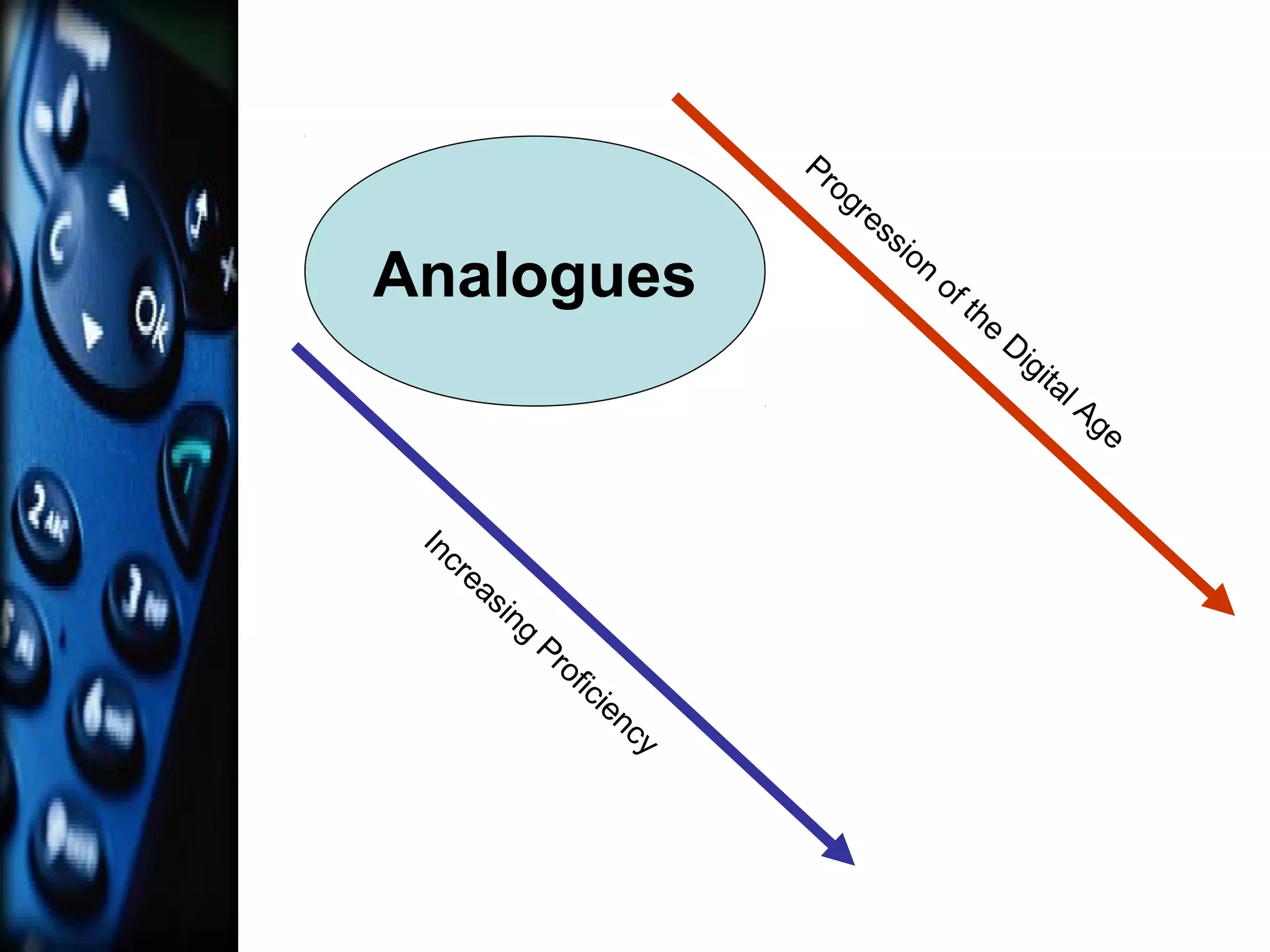
Analogues
Progression
of the
Digital Age
Increasing
Proficiency
Analogues
Digital
Immigrants
Progression
of the
Digital Age
Increasing
Proficiency
Analogues
Digital
Immigrants
Digital
Natives
Progression
of the
Digital Age
Increasing
Proficiency
Source: Prensky, (2001)
Which are you?
Digital Natives …
• Video games
• MTV
• Hypertext and hypermedia
• Music downloads
• Laptop library access
• Mobile phone connectivity
• Instant messaging
• ‘Twitch speed’
A Digital Divide
• Digital Immigrants find it hard to
believe their students can learn
successfully while watching TV or
listening to music, because they
(the Immigrants) can’t.
• Digital Natives think randomly,
are able to multi-task, and
concentrate in shorter and more
intensive bursts.
• Natives are always ‘on the move’
Natives Immigrants Analogues
Look for
information on
the internet first
They look for
information in
traditional media,
then
the internet
‘Next thing you’re
going to tell me is
that all the
computers in the
world are
connected by
some sort of ‘super
highway’!’
Natives Immigrants Analogues
Start using all
software without
reading the
manual.
They assume the
software will
intuitively teach
them.
Have to ‘educate
themselves’
before attempting
to use new
software.
And they find the
whole thing rather
annoying.
‘Yeah I like soft
wear. All my
clothes are made of
cotton.’
Natives
Click once on a
web hyperlink.
Read email from
screen.
‘Hi.. Check out this
cool site:
www.coolsite.com’
Natives Immigrants
Click once on a
web hyperlink.
Double-click web
hyper links.
Read email from
screen.
Print out emails and
read them on paper.
‘Hi.. Check out
this cool site:
www.coolsite.co
m’
‘Hello? Bill here. Do
you have a minute?
Come to my office
right now. You’ve
got to see this web
site!’
Natives Immigrants Analogues
Click once on a
web hyperlink.
Double-click web
hyper links.
‘Hyper-kids can be
so annoying!’
Read email from
screen.
Print out emails and
read them on paper.
‘My secretary
handles this email
thing’
‘Hi.. Check out
this cool site:
www.coolsite.co
m’
‘Hello? Bill here. Do
you have a minute?
Come to my office
right now. You’ve
got to see this web
site!’
‘Can you send
someone to clean
those spider webs
from the ceiling of
my office?’
Mobile Devices
for U-Learning
• Personal Digital Assistants, or PDAs,
are probably the most common type of
mobile technology in education.
• Tablet PCs are currently the most
versatile form of mobile technology
because they combine the functionality of
a laptop and a PDA.
• With technological advances and steadily
decreasing cost, mobile phones are
emerging as a viable option for mobile
learning.
A Prediction
The mobile
phone will
become the
dominant
handheld
device for
mobile learning
in the next 5
years.
Convergence
Video
Radio/Alarm
Internet
e-Mail
Music Composer
Camera
Desk Dairy
SMS/Text
MP3 Audio
Television
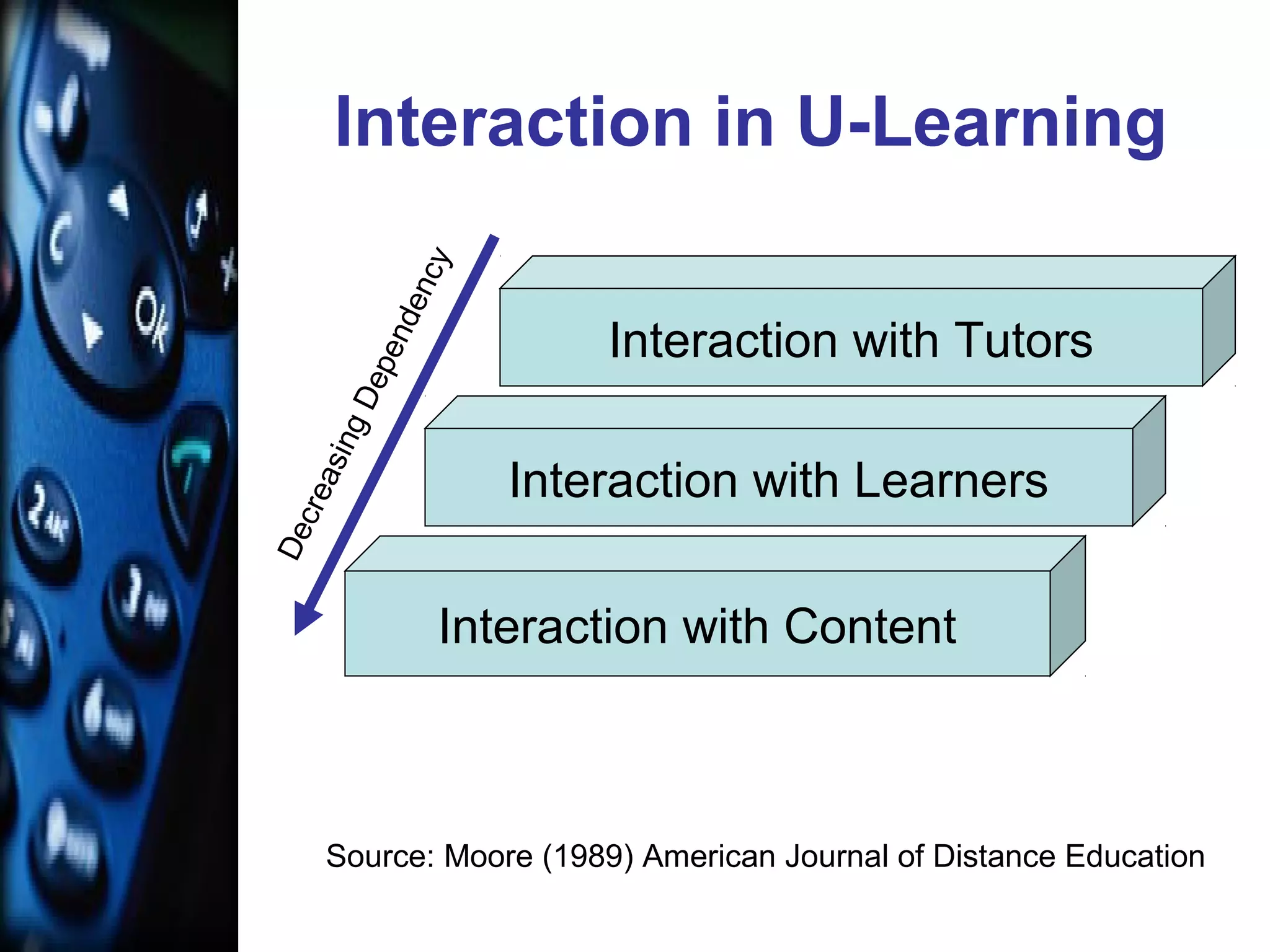
Interaction in U-Learning
Source: Moore (1989) American Journal of Distance Education
Interaction with Content
Interaction with Learners
Interaction with Tutors
DecreasingDependency
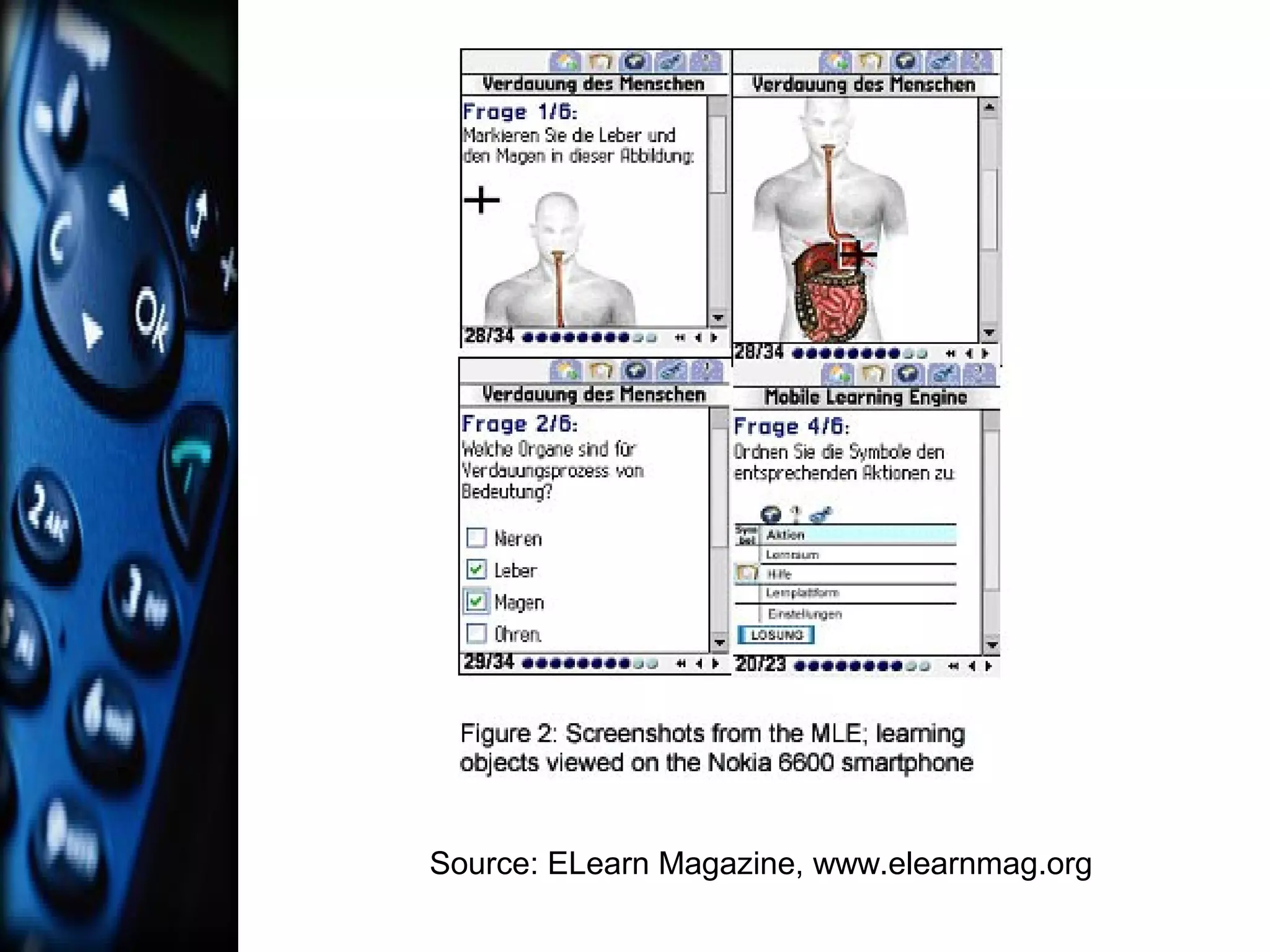
Wireless Application
Protocol (WAP)
Tutors can store learning
objects and menus in XHTML
so that students can access
them through WAP on mobile
devices
Source: ELearn Magazine, www.elearnmag.org
Moblogging
Moblogging is the
practice of being
able to update an
online journal (or
“web log” - “blog”)
using a mobile
device.
Source: http://mlearning.edublogs.org/tag/mobile-phone/moblogging/
Discussion
• Are there areas of your own
teaching in which mobile (u)learning
could play a part?
• If yes, what would you need to know
in order to implement it?
• If not, why not? (Identify reasons
mobile learning might be
inappropriate or unusable)
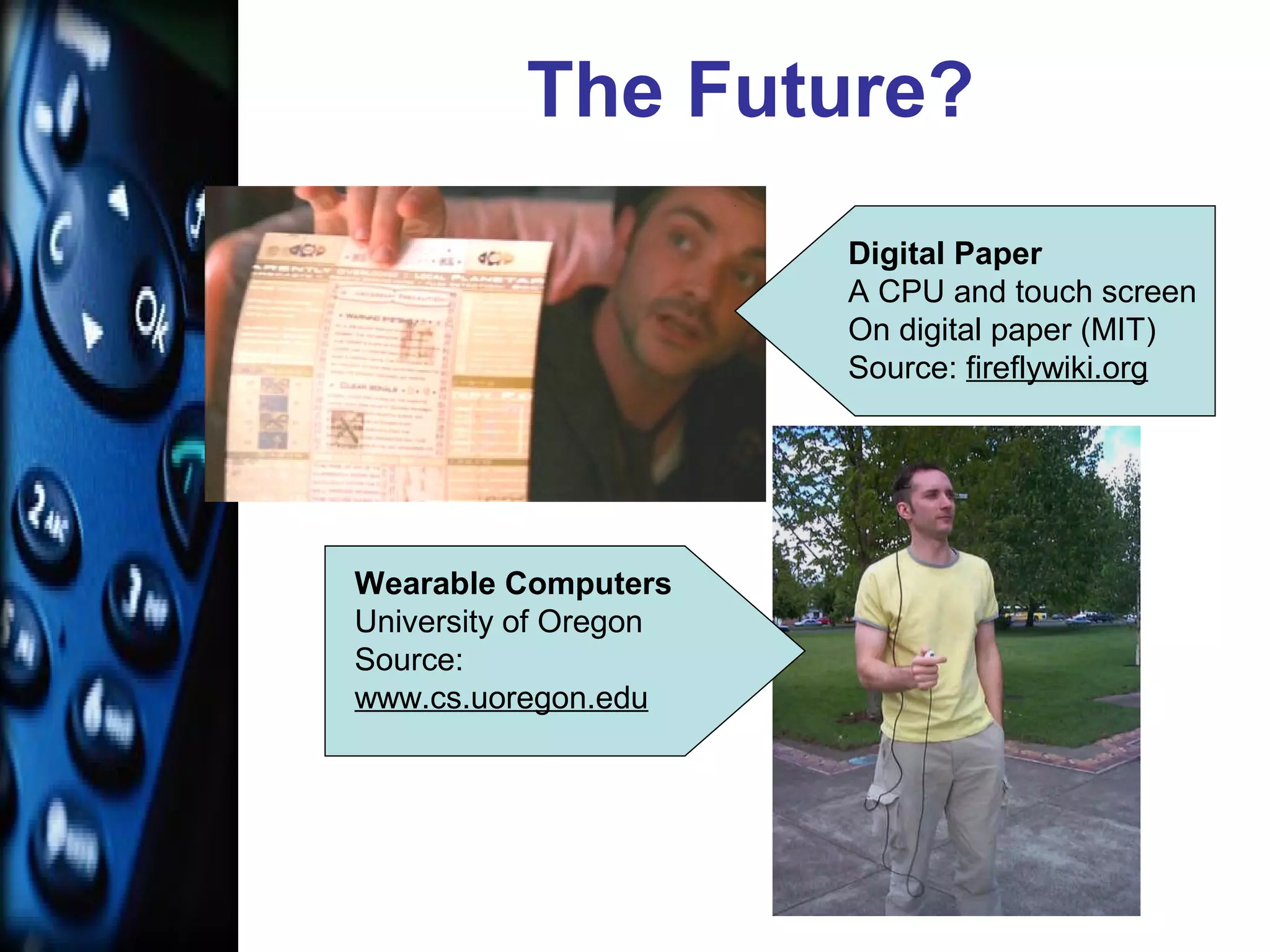
The Future?
Wearable Computers
University of Oregon
Source:
www.cs.uoregon.edu
Digital Paper
A CPU and touch screen
On digital paper (MIT)
Source: fireflywiki.org
Useful Resources
Learning Light e-Learning Centre (Mobile & Wireless Learning Projects)
http://www.e-learningcentre.co.uk/eclipse/Resources/mlearning.htm
Educause Review Going Nomadic: Mobile Learning in Higher Education
http://www.educause.edu/pub/er/erm04/erm0451.asp?bhcp=1
Glasgow Caledonian University: Mobile Learning Examples
http://www.educause.edu/pub/er/erm04/erm0451.asp?bhcp=1
Futurelab Report 11: Literature Review in Mobile Technologies and Learning
http://www.futurelab.org.uk/research/reviews/reviews_11_and12/11_02.htm
Learning with Mobile Devices: Conference Proceedings
http://www.lsda.org.uk/files/pdf/1440.pdf
Thanks for Listening
E: swheeler@plymouth.ac.uk
W: www2.plymouth.ac.uk/distancelearning
V: 01752 232332

U learning

  • 1.
    U-Learning: Education fora Mobile Generation Steve Wheeler Faculty of Education University of Plymouth
  • 2.
    Digital Shift ‘Our studentshave changed radically. Today’s students are no longer the people our educational system was designed to teach (Marc Prensky, 2001)
  • 3.
    Digital Shift By thetime they reach 21 most young people in the UK will have: • Sent over 200,000 text messages • Played 10,000 hours of videogames • Watched over 20,000 hours of TV • Talked 10,000 hours on mobile phones • Seen over 500,000 TV adverts • Spent less than 5,000 hours reading Source: Prensky, 2001: The above figures are already out of date!
  • 4.
    Household Devices (UK) Source:National Statistics Office: http://www.statistics.gov.uk/
  • 5.
    Mobile Phone Ownership (UK) Source:National Statistics Office: http://www.statistics.gov.uk/ 0 20 40 60 80 100 15-24 25-34 35-44 45-54 55-64 65-74 75 and over All adults aged 15 and over 2001 2003
  • 6.
    Paradigm Shift Should wetranslate traditional learning environments into digital format, or should there be a complete reworking of our ideas about education and training?
  • 7.
  • 8.
  • 9.
  • 10.
  • 11.
    Digital Natives … •Video games • MTV • Hypertext and hypermedia • Music downloads • Laptop library access • Mobile phone connectivity • Instant messaging • ‘Twitch speed’
  • 12.
    A Digital Divide •Digital Immigrants find it hard to believe their students can learn successfully while watching TV or listening to music, because they (the Immigrants) can’t. • Digital Natives think randomly, are able to multi-task, and concentrate in shorter and more intensive bursts. • Natives are always ‘on the move’
  • 13.
    Natives Immigrants Analogues Lookfor information on the internet first They look for information in traditional media, then the internet ‘Next thing you’re going to tell me is that all the computers in the world are connected by some sort of ‘super highway’!’
  • 14.
    Natives Immigrants Analogues Startusing all software without reading the manual. They assume the software will intuitively teach them. Have to ‘educate themselves’ before attempting to use new software. And they find the whole thing rather annoying. ‘Yeah I like soft wear. All my clothes are made of cotton.’
  • 15.
    Natives Click once ona web hyperlink. Read email from screen. ‘Hi.. Check out this cool site: www.coolsite.com’
  • 16.
    Natives Immigrants Click onceon a web hyperlink. Double-click web hyper links. Read email from screen. Print out emails and read them on paper. ‘Hi.. Check out this cool site: www.coolsite.co m’ ‘Hello? Bill here. Do you have a minute? Come to my office right now. You’ve got to see this web site!’
  • 17.
    Natives Immigrants Analogues Clickonce on a web hyperlink. Double-click web hyper links. ‘Hyper-kids can be so annoying!’ Read email from screen. Print out emails and read them on paper. ‘My secretary handles this email thing’ ‘Hi.. Check out this cool site: www.coolsite.co m’ ‘Hello? Bill here. Do you have a minute? Come to my office right now. You’ve got to see this web site!’ ‘Can you send someone to clean those spider webs from the ceiling of my office?’
  • 18.
    Mobile Devices for U-Learning •Personal Digital Assistants, or PDAs, are probably the most common type of mobile technology in education. • Tablet PCs are currently the most versatile form of mobile technology because they combine the functionality of a laptop and a PDA. • With technological advances and steadily decreasing cost, mobile phones are emerging as a viable option for mobile learning.
  • 19.
    A Prediction The mobile phonewill become the dominant handheld device for mobile learning in the next 5 years.
  • 20.
  • 21.
    Interaction in U-Learning Source:Moore (1989) American Journal of Distance Education Interaction with Content Interaction with Learners Interaction with Tutors DecreasingDependency
  • 22.
    Wireless Application Protocol (WAP) Tutorscan store learning objects and menus in XHTML so that students can access them through WAP on mobile devices
  • 23.
    Source: ELearn Magazine,www.elearnmag.org
  • 24.
    Moblogging Moblogging is the practiceof being able to update an online journal (or “web log” - “blog”) using a mobile device. Source: http://mlearning.edublogs.org/tag/mobile-phone/moblogging/
  • 25.
    Discussion • Are thereareas of your own teaching in which mobile (u)learning could play a part? • If yes, what would you need to know in order to implement it? • If not, why not? (Identify reasons mobile learning might be inappropriate or unusable)
  • 26.
    The Future? Wearable Computers Universityof Oregon Source: www.cs.uoregon.edu Digital Paper A CPU and touch screen On digital paper (MIT) Source: fireflywiki.org
  • 27.
    Useful Resources Learning Lighte-Learning Centre (Mobile & Wireless Learning Projects) http://www.e-learningcentre.co.uk/eclipse/Resources/mlearning.htm Educause Review Going Nomadic: Mobile Learning in Higher Education http://www.educause.edu/pub/er/erm04/erm0451.asp?bhcp=1 Glasgow Caledonian University: Mobile Learning Examples http://www.educause.edu/pub/er/erm04/erm0451.asp?bhcp=1 Futurelab Report 11: Literature Review in Mobile Technologies and Learning http://www.futurelab.org.uk/research/reviews/reviews_11_and12/11_02.htm Learning with Mobile Devices: Conference Proceedings http://www.lsda.org.uk/files/pdf/1440.pdf
  • 28.
    Thanks for Listening E:swheeler@plymouth.ac.uk W: www2.plymouth.ac.uk/distancelearning V: 01752 232332