









Changing Technology Judy Brown WTCS Boards Association July 19, 1996
Students today can’t prepare bark to calculate their problems.  They depend on their slates which are more expensive.  What will they do when the slate is dropped and it breaks?  They will be unable to write! Teacher’s Conference, 1703
Students today depend on paper too much.  They don’t know how to write on a slate without getting chalk dust all over themselves.  They can’t clean a slate properly.  What will they do when they run out of paper? Principal’s Association, 1815
Students today depend too much upon ink.  They don’t know how to use a pen knife to sharpen a pencil.  Pen and ink will never replace the pencil. National Association of Teachers, 1907
Students today depend upon store bought ink.  They don’t know how to make their own.  When they run out of ink they will be unable to write words or ciphers until their next trip to the settlement.  This is a sad commentary on modern education. The Rural American Teacher, 1928
Students today depend on these expensive fountain pens.  They can no longer write with a straight pen and nib.  We parents must not allow them to wallow in such luxury to the detriment of learning how to cope in the real business world which is not so extravagant. PTA Gazette, 1941
Ballpoint pens will be the ruin of education in our country.  Students use these devices and then throw them away.  The American values of thrift and frugality are being discarded.  Business and banks will never allow such expensive luxuries. Federal Teachers, 1950
Agenda New Technologies The Pace of Change  Educational Challenges
New Technologies Chips Connections Software
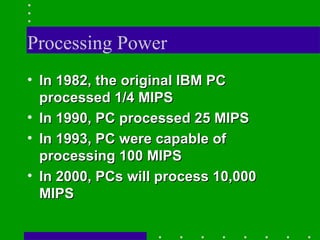
Processing Power In 1982, the original IBM PC processed 1/4 MIPS In 1990, PC processed 25 MIPS In 1993, PC were capable of processing 100 MIPS In 2000, PCs will process 10,000 MIPS
New Technologies Chips Connections Software
Connected World “ We're just a step away from the point when every computer is connected to every other computer...." Andy Grove, CEO Intel
New Technologies Chips Connections Software
Software “ Any piece of software is inadequate two years later.”   Bill Gates, CEO Microsoft
What's Happening Today? Faster / Cheaper / Better Improved Functionality Mergers / Takeovers / Acquisitions Convergence / Positioning
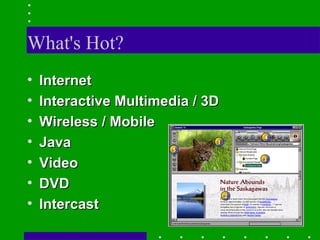
What's Hot? Internet Interactive Multimedia / 3D Wireless / Mobile Java Video DVD Intercast
What's Hot (Continued) Electronic Commerce Wallet PC Speech / Voice Recognition Mobile Communications Video Conferencing / Video Phone
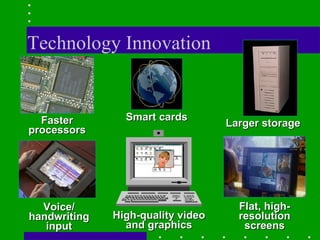
Technology Innovation  Faster processors Smart cards Larger storage Voice/ handwriting input High-quality video and graphics Flat, high- resolution screens
Technological Reality For four years, US. Industry has been spending more on computers and communications equipment than on all other capital equipment combined – all machinery for services, manufacturing, mining, agriculture, construction, whatever.
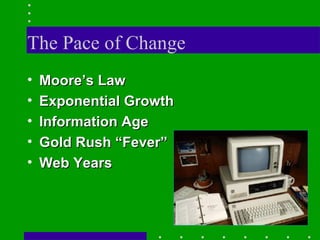
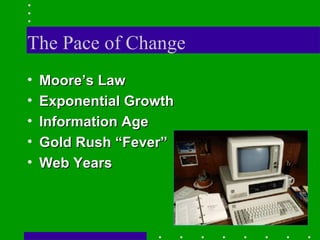
The Pace of Change Moore’s Law Exponential Growth Information Age Gold Rush “Fever” Web Years
Moore’s Law Each new chip contains roughly twice as much capacity as its predecessor, and each chip was released within 18-24 months of the previous chip. Gordon E. Moore, 1965
The Pace of Change Moore’s Law Exponential Growth Information Age Gold Rush “Fever” Web Years
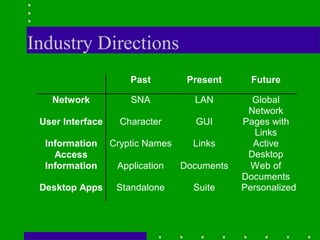
Industry Directions
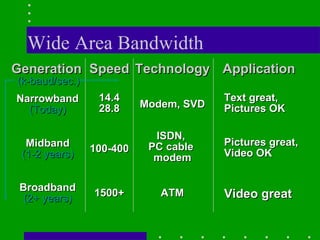
Wide Area Bandwidth Generation Speed Technology Application 14.4 28.8 Modem, SVD Text great, Pictures OK Narrowband (Today) 100-400 ISDN,  PC cable  modem Pictures great, Video OK Midband (1-2 years) Broadband (2+ years) 1500+ ATM Video great (k-baud/sec.)
Business Changes Home-based Workers Worldwide Market Electronic Funds Communications Collaboration New Tools
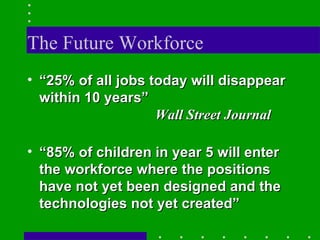
The Future Workforce “ 25% of all jobs today will disappear within 10 years” Wall Street Journal “ 85% of children in year 5 will enter the workforce where the positions have not yet been designed and the technologies not yet created”
Job Opportunities 101110010010001 Software distribution Finance and accounting Information delivery Customer support Human Resources
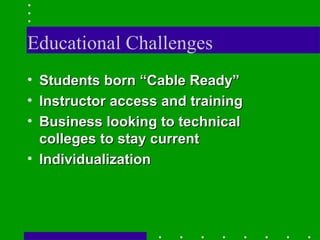
Educational Challenges Students born “Cable Ready” Instructor access and training Business looking to technical colleges to stay current  Individualization
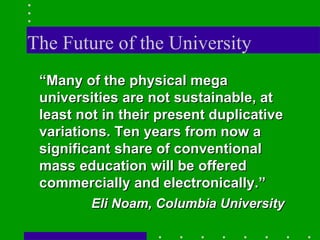
The Future of the University “ Many of the physical mega universities are not sustainable, at least not in their present duplicative variations. Ten years from now a significant share of conventional mass education will be offered commercially and electronically.” Eli Noam, Columbia University
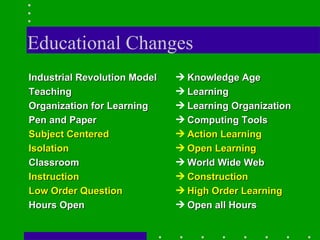
Educational Changes Industrial Revolution Model Teaching Organization for Learning Pen and Paper Subject Centered Isolation Classroom Instruction Low Order Question  Hours Open Knowledge Age Learning Learning Organization Computing Tools Action Learning Open Learning World Wide Web Construction High Order Learning Open all Hours
Where to Go for Information Online (Edupage) Training Sessions Books, Articles, Electronic Sources Professional Associations
Questions ?

Changing Technology from 1996

  • 1.
    Changing Technology JudyBrown WTCS Boards Association July 19, 1996
  • 2.
    Students today can’tprepare bark to calculate their problems. They depend on their slates which are more expensive. What will they do when the slate is dropped and it breaks? They will be unable to write! Teacher’s Conference, 1703
  • 3.
    Students today dependon paper too much. They don’t know how to write on a slate without getting chalk dust all over themselves. They can’t clean a slate properly. What will they do when they run out of paper? Principal’s Association, 1815
  • 4.
    Students today dependtoo much upon ink. They don’t know how to use a pen knife to sharpen a pencil. Pen and ink will never replace the pencil. National Association of Teachers, 1907
  • 5.
    Students today dependupon store bought ink. They don’t know how to make their own. When they run out of ink they will be unable to write words or ciphers until their next trip to the settlement. This is a sad commentary on modern education. The Rural American Teacher, 1928
  • 6.
    Students today dependon these expensive fountain pens. They can no longer write with a straight pen and nib. We parents must not allow them to wallow in such luxury to the detriment of learning how to cope in the real business world which is not so extravagant. PTA Gazette, 1941
  • 7.
    Ballpoint pens willbe the ruin of education in our country. Students use these devices and then throw them away. The American values of thrift and frugality are being discarded. Business and banks will never allow such expensive luxuries. Federal Teachers, 1950
  • 8.
    Agenda New TechnologiesThe Pace of Change Educational Challenges
  • 9.
    New Technologies ChipsConnections Software
  • 10.
    Processing Power In1982, the original IBM PC processed 1/4 MIPS In 1990, PC processed 25 MIPS In 1993, PC were capable of processing 100 MIPS In 2000, PCs will process 10,000 MIPS
  • 11.
    New Technologies ChipsConnections Software
  • 12.
    Connected World “We're just a step away from the point when every computer is connected to every other computer...." Andy Grove, CEO Intel
  • 13.
    New Technologies ChipsConnections Software
  • 14.
    Software “ Anypiece of software is inadequate two years later.” Bill Gates, CEO Microsoft
  • 15.
    What's Happening Today?Faster / Cheaper / Better Improved Functionality Mergers / Takeovers / Acquisitions Convergence / Positioning
  • 16.
    What's Hot? InternetInteractive Multimedia / 3D Wireless / Mobile Java Video DVD Intercast
  • 17.
    What's Hot (Continued)Electronic Commerce Wallet PC Speech / Voice Recognition Mobile Communications Video Conferencing / Video Phone
  • 18.
    Technology Innovation Faster processors Smart cards Larger storage Voice/ handwriting input High-quality video and graphics Flat, high- resolution screens
  • 19.
    Technological Reality Forfour years, US. Industry has been spending more on computers and communications equipment than on all other capital equipment combined – all machinery for services, manufacturing, mining, agriculture, construction, whatever.
  • 20.
    The Pace ofChange Moore’s Law Exponential Growth Information Age Gold Rush “Fever” Web Years
  • 21.
    Moore’s Law Eachnew chip contains roughly twice as much capacity as its predecessor, and each chip was released within 18-24 months of the previous chip. Gordon E. Moore, 1965
  • 22.
    The Pace ofChange Moore’s Law Exponential Growth Information Age Gold Rush “Fever” Web Years
  • 23.
  • 24.
    Wide Area BandwidthGeneration Speed Technology Application 14.4 28.8 Modem, SVD Text great, Pictures OK Narrowband (Today) 100-400 ISDN, PC cable modem Pictures great, Video OK Midband (1-2 years) Broadband (2+ years) 1500+ ATM Video great (k-baud/sec.)
  • 25.
    Business Changes Home-basedWorkers Worldwide Market Electronic Funds Communications Collaboration New Tools
  • 26.
    The Future Workforce“ 25% of all jobs today will disappear within 10 years” Wall Street Journal “ 85% of children in year 5 will enter the workforce where the positions have not yet been designed and the technologies not yet created”
  • 27.
    Job Opportunities 101110010010001Software distribution Finance and accounting Information delivery Customer support Human Resources
  • 28.
    Educational Challenges Studentsborn “Cable Ready” Instructor access and training Business looking to technical colleges to stay current Individualization
  • 29.
    The Future ofthe University “ Many of the physical mega universities are not sustainable, at least not in their present duplicative variations. Ten years from now a significant share of conventional mass education will be offered commercially and electronically.” Eli Noam, Columbia University
  • 30.
    Educational Changes IndustrialRevolution Model Teaching Organization for Learning Pen and Paper Subject Centered Isolation Classroom Instruction Low Order Question Hours Open Knowledge Age Learning Learning Organization Computing Tools Action Learning Open Learning World Wide Web Construction High Order Learning Open all Hours
  • 31.
    Where to Gofor Information Online (Edupage) Training Sessions Books, Articles, Electronic Sources Professional Associations
  • 32.

Editor's Notes

  • #2 Thank you Work, home, leisure