EPIDEMIOLOGY, PREVENTION
AND CONTROL OF TYPHOID
FEVER
PRESENTED BY :
TARANNUM NAZ
ROLL NO. 137
PARA H2
Introduction
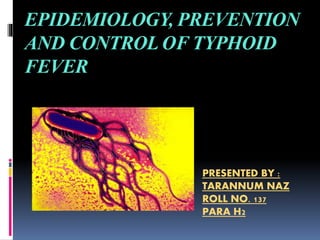
Typhoid fever is a result of systemic
infection mainly by Salmonella typhi. The
disease is clinically characterized by a typical
continuous fever for 3 to 4 weeks.
PROBLEM STATEMENT
 WORLD:
In 2004, WHO estimated the global typhoid
fever disease burden at 21 million cases
annually resulting in an estimated 2,16,000 to
6,00,000 death per year.
 INDIA:
Reported data for 2011 shows 1.06 million
cases and 346 death.
 Prevalence rate - 88 cases per lac population
death rate is 0.029 per lac population
Epidemiological
determinants
 Agent Factors:
 Agent: Salmonella typhi
Reservoir of infection: Man
Persons who excrete the bacilli for more than a
year after a clinically attack are called chronic
carrier. In most chronic carriers, the organisms
persist in the gall bladder and in the billary tract.
(A famous case of ‘Typhoid Mary’’who gave rise to
1300 cases in her lifetime.)
 Host Factors:
Age: 5 to 19 yrs
Sex: more in males.
 Environmental and Social
Factors:
 Peak incidence: July to September
Incubation Period: 10 to 14 days
Mode of transmission :
The disease is transmitted by faeco-oral route or
urine-oral route
CLINICAL FEATURES
 Chills and high fever.
 Prodromal Stage: Malaise , Headache,
Abdominal Pain and Constipation
 Later Stage: Splenomegaly, Abdominal
tenderness, Relative bradycardia
 Intestinal perforation and hemorrhage
occurs as complication
LABORATORY DIAGNOSIS
 Microbiological Procedure: By Isolation of
S.typhi from blood, bone marrow and stools.
 Serological Procedure: By Felix Widal Test
which measures agglutinating antibody level
against O and H antigen
 New Diagnostic Test:
 IDL Tubex test: This can detect IgM09
antibody from patients within a few minutes.
CONTROL
 CONTROL OF RESERVOIR:
Cases:
 Diagnosis- By culture of blood and stools.
Notification
Isolation- till 3 bacteriologically negative
stool and urine reports are obtained.
Treatment- Fluoroquinolones are drug of
choice.
Carriers:
 Identification
 Treatment- intensive course of ampicillin or
amoxicillin for 6 weeks
 Surgery – Cholecystectomy with ampicillin
therapy is very successful.
o CONTROL OF SANITATION:
Purification of drinking water supply, improvement
of basic sanitation and promotion of food hygiene
are essential measures.
IMMUNIZATION
o Vi Polysaccharide vaccine – 25µg of antigen is
subcutaneously administered. Vaccine is stable
for 6 months at 37ºC and for 2 years at 22ºC.
Schedule- Vaccine is licensed for individuals
greater than 2 yrs. Only 1 dose is required and
vaccine confers protection 7 days after infection.
To maintain protection, revaccination is
recommended every 3yrs
Type 21a vaccines – Orally administered, live
attenuated, Ty2 strain of S.typhi in which the genes
responsible for the production of Vi, have been
mutated chemically.
Schedule- Capsules are licensed for individuals
greater than 5yrs.
Vaccine is administered every other day, on 1, 3
and 5th day, a three dose regimen is recommended
with this.
Immunity is achieved 7 days after the last dose.
REFERENCES :
PARK’S TEXTBOOK OF
PREVENTIVE AND SOCIAL
MEDICINE
WIKIPEDIA
Typhoid

Typhoid

  • 1.
    EPIDEMIOLOGY, PREVENTION AND CONTROLOF TYPHOID FEVER PRESENTED BY : TARANNUM NAZ ROLL NO. 137 PARA H2
  • 2.
    Introduction Typhoid fever isa result of systemic infection mainly by Salmonella typhi. The disease is clinically characterized by a typical continuous fever for 3 to 4 weeks.
  • 3.
    PROBLEM STATEMENT  WORLD: In2004, WHO estimated the global typhoid fever disease burden at 21 million cases annually resulting in an estimated 2,16,000 to 6,00,000 death per year.  INDIA: Reported data for 2011 shows 1.06 million cases and 346 death.  Prevalence rate - 88 cases per lac population death rate is 0.029 per lac population
  • 4.
    Epidemiological determinants  Agent Factors: Agent: Salmonella typhi Reservoir of infection: Man Persons who excrete the bacilli for more than a year after a clinically attack are called chronic carrier. In most chronic carriers, the organisms persist in the gall bladder and in the billary tract. (A famous case of ‘Typhoid Mary’’who gave rise to 1300 cases in her lifetime.)
  • 5.
     Host Factors: Age:5 to 19 yrs Sex: more in males.  Environmental and Social Factors:  Peak incidence: July to September Incubation Period: 10 to 14 days
  • 6.
    Mode of transmission: The disease is transmitted by faeco-oral route or urine-oral route
  • 7.
    CLINICAL FEATURES  Chillsand high fever.  Prodromal Stage: Malaise , Headache, Abdominal Pain and Constipation  Later Stage: Splenomegaly, Abdominal tenderness, Relative bradycardia  Intestinal perforation and hemorrhage occurs as complication
  • 9.
    LABORATORY DIAGNOSIS  MicrobiologicalProcedure: By Isolation of S.typhi from blood, bone marrow and stools.  Serological Procedure: By Felix Widal Test which measures agglutinating antibody level against O and H antigen  New Diagnostic Test:  IDL Tubex test: This can detect IgM09 antibody from patients within a few minutes.
  • 10.
    CONTROL  CONTROL OFRESERVOIR: Cases:  Diagnosis- By culture of blood and stools. Notification Isolation- till 3 bacteriologically negative stool and urine reports are obtained. Treatment- Fluoroquinolones are drug of choice.
  • 11.
    Carriers:  Identification  Treatment-intensive course of ampicillin or amoxicillin for 6 weeks  Surgery – Cholecystectomy with ampicillin therapy is very successful. o CONTROL OF SANITATION: Purification of drinking water supply, improvement of basic sanitation and promotion of food hygiene are essential measures.
  • 12.
    IMMUNIZATION o Vi Polysaccharidevaccine – 25µg of antigen is subcutaneously administered. Vaccine is stable for 6 months at 37ºC and for 2 years at 22ºC. Schedule- Vaccine is licensed for individuals greater than 2 yrs. Only 1 dose is required and vaccine confers protection 7 days after infection. To maintain protection, revaccination is recommended every 3yrs
  • 13.
    Type 21a vaccines– Orally administered, live attenuated, Ty2 strain of S.typhi in which the genes responsible for the production of Vi, have been mutated chemically. Schedule- Capsules are licensed for individuals greater than 5yrs. Vaccine is administered every other day, on 1, 3 and 5th day, a three dose regimen is recommended with this. Immunity is achieved 7 days after the last dose.
  • 15.
    REFERENCES : PARK’S TEXTBOOKOF PREVENTIVE AND SOCIAL MEDICINE WIKIPEDIA