Software
Requirements
(OOAD Tutorial Series)
By: UPSOL ACADEMY
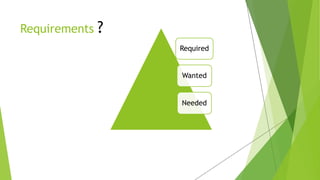
Requirements ?
Required
Wanted
Needed
 requirements must be complete and unambiguous.
 Incomplete and ambiguous requirements are open to
multiple interpretations and assumptions
 This can lead to the development of poor quality, or
faulty, software products
Tips for Requirements
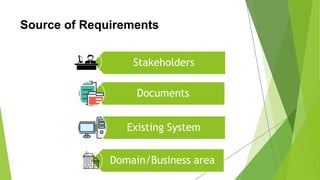
Source of Requirements
Stakeholders
Documents
Existing System
Domain/Business area
 Functional Requirements
 Non-Functional requirements
 Domain Requirements
 Inverse Requirements
 Design and Implementation Constraints
Requirements Types
 Statements describing what the system does.
 Functionality of system
 Statements of services the system should provide
 Reaction to particular inputs
 Behavior in particular situations
 Customers and developers usually focus on functional
requirements.
 Example: Login, Browse, Add to cart etc.
Functional Requirements
 Most non-functional requirements (NFRs) relate to the
system as a whole. They include constraints on:
 Performance
 Reliability
 Security
 Maintainability
 Usability
 Standards
More critical and may make system unusable if failed to apply..
Non-functional Requirements
 Example:
 If a real-time control system fails to meet its
performance requirements, the control functions will
not operate correctly e.g. ATM in banking system.
 NFRs come up/depends through:
 User needs, budget & interoperability,
 Organizational policies(s/w developing),
 External factors such as safety regulations, privacy
legislation, etc.
Non-Functional Requirements
• Architecture: where non-functional decisions are cast, and functional
requirements are partitioned.
• Design: where functional requirements are accomplished
Non-Functional Requirements
Architecture vs design
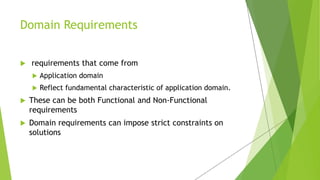
 requirements that come from
 Application domain
 Reflect fundamental characteristic of application domain.
 These can be both Functional and Non-Functional
requirements
 Domain requirements can impose strict constraints on
solutions
Domain Requirements
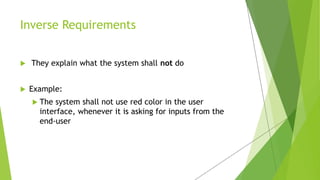
 They explain what the system shall not do.
 Example:
 The system shall not use red color in the user
interface, whenever it is asking for inputs from the
end-user
Inverse Requirements
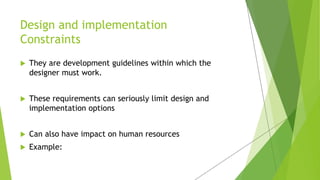
 They are development guidelines within which the
designer must work.
 These requirements can seriously limit design and
implementation options
 Can also have impact on human resources
 Example:
Design and implementation
Constraints
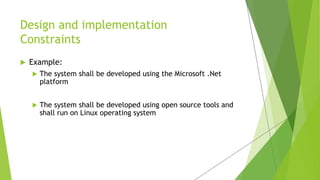
 Example:
 The system shall be developed using the Microsoft .Net
platform
 The system shall be developed using open source tools and
shall run on Linux operating system
Design and implementation
Constraints

Types of Software Requirements | software engineering.pptx

  • 1.
  • 2.
  • 3.
     requirements mustbe complete and unambiguous.  Incomplete and ambiguous requirements are open to multiple interpretations and assumptions  This can lead to the development of poor quality, or faulty, software products Tips for Requirements
  • 4.
  • 5.
     Functional Requirements Non-Functional requirements  Domain Requirements  Inverse Requirements  Design and Implementation Constraints Requirements Types
  • 6.
     Statements describingwhat the system does.  Functionality of system  Statements of services the system should provide  Reaction to particular inputs  Behavior in particular situations  Customers and developers usually focus on functional requirements.  Example: Login, Browse, Add to cart etc. Functional Requirements
  • 7.
     Most non-functionalrequirements (NFRs) relate to the system as a whole. They include constraints on:  Performance  Reliability  Security  Maintainability  Usability  Standards More critical and may make system unusable if failed to apply.. Non-functional Requirements
  • 8.
     Example:  Ifa real-time control system fails to meet its performance requirements, the control functions will not operate correctly e.g. ATM in banking system.  NFRs come up/depends through:  User needs, budget & interoperability,  Organizational policies(s/w developing),  External factors such as safety regulations, privacy legislation, etc. Non-Functional Requirements
  • 9.
    • Architecture: wherenon-functional decisions are cast, and functional requirements are partitioned. • Design: where functional requirements are accomplished Non-Functional Requirements Architecture vs design
  • 10.
     requirements thatcome from  Application domain  Reflect fundamental characteristic of application domain.  These can be both Functional and Non-Functional requirements  Domain requirements can impose strict constraints on solutions Domain Requirements
  • 11.
     They explainwhat the system shall not do.  Example:  The system shall not use red color in the user interface, whenever it is asking for inputs from the end-user Inverse Requirements
  • 12.
     They aredevelopment guidelines within which the designer must work.  These requirements can seriously limit design and implementation options  Can also have impact on human resources  Example: Design and implementation Constraints
  • 13.
     Example:  Thesystem shall be developed using the Microsoft .Net platform  The system shall be developed using open source tools and shall run on Linux operating system Design and implementation Constraints