MIM THIRD Year (2015 -18)
Robotic Process Automation
(RPA)
NAME ROLL NO
MUFADDAL NULLWALA 15-I-131
JBIMS-MIM
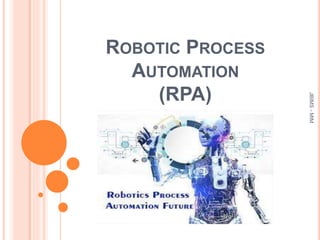
ROBOTIC PROCESS
AUTOMATION
(RPA)
JBIMS-MIM
INDEX
 What is Robotic Process Automation (RPA)
 Evolution of RPA
 Benefits of RPA
 Application of RPA
 6 Step RPA
 Robotic Spectrum
 Differences between RPA and regular automation
 Top RPA vendors
 What to look for in RPA software
 C-level decision-making around RPA
 Where the robotic process automation market is
heading
JBIMS-MIM
WHAT IS ROBOTIC PROCESS AUTOMATION (RPA)
 Robotic process automation (RPA) is the use of software
with artificial intelligence (AI) and machine
learning capabilities to handle high-volume, repeatable
tasks that previously required humans to perform. These
tasks can include queries, calculations and maintenance
of records and transactions.
 RPA technology, sometimes called a software robot
or bot, mimics a human worker, logging into
applications, entering data, calculating and completing
tasks and logging out.
 RPA software is not part of an organization's IT
infrastructure. Instead, it sits on top of it, enabling a
company to implement the technology quickly and
efficiently -- all without changing the existing
infrastructure and systems.
EVOLUTION OF RPA
 Although the term "robotic process automation" can
be traced to the early 2000s, it had been
developing for a number of years previously.
 RPA evolved from three key technologies: screen
scraping, workflow automation and artificial
intelligence.
 Screen scraping is the process of collecting screen
display data from a legacy application so that the
data can be displayed by a more modern user
interface.
JBIMS-MIM
 The advantages of workflow automation software,
which eliminates the need for manual data entry
and increases order fulfillment rates, include
increased speed, efficiency and accuracy.
 Lastly, artificial intelligence involves the ability of
computer systems to perform tasks that normally
require human intervention and intelligence.
JBIMS-MIM
BENEFITS OF RPA
 Robotic process automation technology can help
organizations on their digital transformation
journeys by:
 1) Enabling better customer service.
 2) Ensuring business operations and processes
comply with regulations and standards.
 3) Allowing processes to be completed much more
rapidly.
 4) Providing improved efficiency by digitizing and
auditing process data.
 5) Creating cost savings for manual and repetitive
tasks.
 6) Enabling employees to be more productive.
JBIMS-MIM
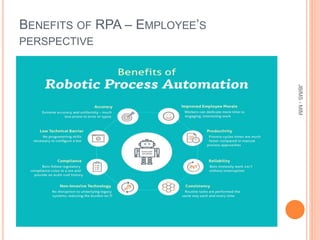
BENEFITS OF RPA – EMPLOYEE’S
PERSPECTIVE
JBIMS-MIM
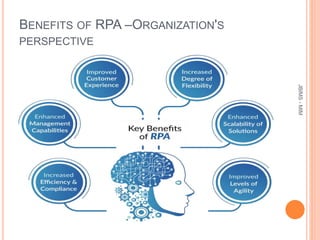
BENEFITS OF RPA –ORGANIZATION'S
PERSPECTIVE
JBIMS-MIM
APPLICATION OF RPA
Some of the top applications of RPA include:
 Customer service: RPA can help companies offer better
customer service by automating contact center tasks,
including verifying e-signatures, uploading scanned
documents and verifying information for automatic
approvals or rejections.
 Accounting: Organizations can use RPA for general
accounting, operational accounting, transactional
reporting and budgeting.
 Financial services: Companies in the financial services
industry can use RPA for foreign exchange payments,
automating account openings and closings, managing
audit requests and processing insurance claims.
JBIMS-MIM
 Healthcare: Medical organizations can use RPA for
handling patient records, claims, customer support,
account management, billing,
reporting and analytics.
 Human resources: RPA can automate HR tasks,
including onboarding and offboarding, updating
employee information and timesheet submission
processes.
 Supply chain management: RPA can be used for
procurement, automating order processing and
payments, monitoring inventory levels and tracking
shipments.
JBIMS-MIM
JBIMS-MIM
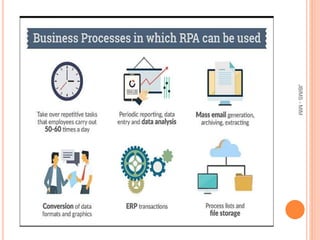
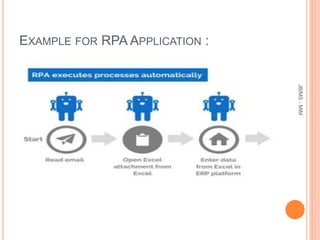
EXAMPLE FOR RPA APPLICATION :
JBIMS-MIM
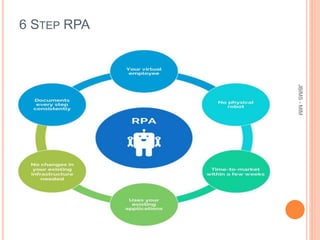
6 STEP RPA
JBIMS-MIM
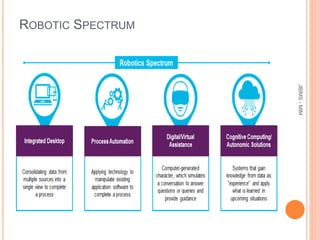
ROBOTIC SPECTRUM
JBIMS-MIM
DIFFERENCES BETWEEN RPA AND REGULAR
AUTOMATION
 What distinguishes RPA from traditional IT
Automation is the ability of the RPA software to be
aware and adapt to changing circumstances,
exceptions and new situations.
 Once RPA software has been trained to capture
and interpret the actions of specific processes in
existing software applications, it can then
manipulate data, trigger responses, initiate new
actions and communicate with other systems
autonomously.
JBIMS-MIM
 RPA software is particularly useful for organizations
that have many different and complicated systems
that need to interact together fluidly.
 For instance, if an electronic form from a human
resource system is missing a zip code, traditional
automation software would flag the form as having
an exception and an employee would handle the
exception by looking up the correct zip code and
entering it on the form. Once the form is complete,
the employee might send it on to payroll so the
information can be entered into the organization's
payroll system.
 With RPA technology, however, software that has
the ability to adapt, self-learn and self-correct would
handle the exception and interact with the payroll
system without human assistance.
JBIMS-MIM
TOP RPA VENDORS
 Automation Anywhere Inc. provides an enterprise
digital workforce platform geared toward procure-to-
pay, quote-to-cash, HR, claims processing and
other back-office processes.
 Blue Prism focuses on providing organizations in
regulated industries with more agile virtual
workforces, offering desktop-aligned robots that are
defined and managed centrally.
 EdgeVerve Limited, an Infosys company, helps
enterprises modernize customer service, improve
business processes and enhance operational
productivity.
JBIMS-MIM
 HelpSystems enables companies to streamline IT
and business operations by automating tasks and
workflows without the need to write code.
 UiPath offers an open platform to help
organizations efficiently automate business
processes.
 Workfusion combines robotics, AI-powered
cognitive automation and workforce orchestration to
automate enterprise business processes.
JBIMS-MIM
WHAT TO LOOK FOR IN RPA SOFTWARE
When enterprise leaders look for RPA technologies, they
should consider a number of things, including:
 Scalability: Organizations shouldn't select RPA software
that requires them to deploy software robots to desktops
or virtualized environments. They should look for RPA
platforms that can be centrally managed and scale
massively.
 Speed: Enterprises should be able to design and test
new robotic processes in a few hours or less, as well as
optimize the bots to work quickly.
 Reliability: As companies launch robots to automate
hundreds or even thousands of tasks, they should look
for tools with built-in monitoring and analytics that
enable them to monitor the health of their systems.
JBIMS-MIM
 Simplicity: Organizations should look for products
that are simple enough that any employee in the
business can build and use them to handle various
kinds of work, including collecting data and turning
content into information that enables leaders to
make the best business decisions.
 Intelligence: The best RPA tools can support simple
task-based activities, read and write to any data
source, and take advantage of more advanced
learning to further improve automation.
 Enterprise-class: Companies should look for tools
that are built from the ground up for enterprise-
grade scalability, reliability and manageability.
JBIMS-MIM
C-LEVEL DECISION-MAKING AROUND RPA
 Though automation software is expected to replace up
to 140 million full-time employees worldwide by 2025,
many high-quality jobs will be created for those who
maintain and improve RPA software.
 When software robots do replace people in the
enterprise, C-level executives need to be responsible for
ensuring that business outcomes are achieved and new
governance policies are met.
 Robotic process automation technology also requires
that the CTO/CIO take more of a leadership role and
assume accountability for the business outcomes and
the risks of deploying RPA tools.
JBIMS-MIM
 Additionally, the COO, CIO and chief human
resources officer, as well as the relevant C-level
executive who owns the process being automated,
should all work toward ensuring the availability of
an enterprise-grade, secure platform for controlling
and operating bots across systems.
JBIMS-MIM
WHERE THE ROBOTIC PROCESS AUTOMATION
MARKET IS HEADING
 A Global Market Insights Inc. report expects the
RPA market to reach $5 billion by 2024.
 The increased adoption of RPA technologies by
organizations to enhance their capabilities and
performance and boost cost savings will reportedly
drive the growth of the robotic process automation
market most during that time.
JBIMS-MIM
THANK YOU
JBIMS-MIM

Robotic Process Automation (RPA)

  • 1.
    MIM THIRD Year(2015 -18) Robotic Process Automation (RPA) NAME ROLL NO MUFADDAL NULLWALA 15-I-131 JBIMS-MIM
  • 2.
  • 3.
    INDEX  What isRobotic Process Automation (RPA)  Evolution of RPA  Benefits of RPA  Application of RPA  6 Step RPA  Robotic Spectrum  Differences between RPA and regular automation  Top RPA vendors  What to look for in RPA software  C-level decision-making around RPA  Where the robotic process automation market is heading JBIMS-MIM
  • 4.
    WHAT IS ROBOTICPROCESS AUTOMATION (RPA)  Robotic process automation (RPA) is the use of software with artificial intelligence (AI) and machine learning capabilities to handle high-volume, repeatable tasks that previously required humans to perform. These tasks can include queries, calculations and maintenance of records and transactions.  RPA technology, sometimes called a software robot or bot, mimics a human worker, logging into applications, entering data, calculating and completing tasks and logging out.  RPA software is not part of an organization's IT infrastructure. Instead, it sits on top of it, enabling a company to implement the technology quickly and efficiently -- all without changing the existing infrastructure and systems.
  • 5.
    EVOLUTION OF RPA Although the term "robotic process automation" can be traced to the early 2000s, it had been developing for a number of years previously.  RPA evolved from three key technologies: screen scraping, workflow automation and artificial intelligence.  Screen scraping is the process of collecting screen display data from a legacy application so that the data can be displayed by a more modern user interface. JBIMS-MIM
  • 6.
     The advantagesof workflow automation software, which eliminates the need for manual data entry and increases order fulfillment rates, include increased speed, efficiency and accuracy.  Lastly, artificial intelligence involves the ability of computer systems to perform tasks that normally require human intervention and intelligence. JBIMS-MIM
  • 7.
    BENEFITS OF RPA Robotic process automation technology can help organizations on their digital transformation journeys by:  1) Enabling better customer service.  2) Ensuring business operations and processes comply with regulations and standards.  3) Allowing processes to be completed much more rapidly.  4) Providing improved efficiency by digitizing and auditing process data.  5) Creating cost savings for manual and repetitive tasks.  6) Enabling employees to be more productive. JBIMS-MIM
  • 8.
    BENEFITS OF RPA– EMPLOYEE’S PERSPECTIVE JBIMS-MIM
  • 9.
    BENEFITS OF RPA–ORGANIZATION'S PERSPECTIVE JBIMS-MIM
  • 10.
    APPLICATION OF RPA Someof the top applications of RPA include:  Customer service: RPA can help companies offer better customer service by automating contact center tasks, including verifying e-signatures, uploading scanned documents and verifying information for automatic approvals or rejections.  Accounting: Organizations can use RPA for general accounting, operational accounting, transactional reporting and budgeting.  Financial services: Companies in the financial services industry can use RPA for foreign exchange payments, automating account openings and closings, managing audit requests and processing insurance claims. JBIMS-MIM
  • 11.
     Healthcare: Medicalorganizations can use RPA for handling patient records, claims, customer support, account management, billing, reporting and analytics.  Human resources: RPA can automate HR tasks, including onboarding and offboarding, updating employee information and timesheet submission processes.  Supply chain management: RPA can be used for procurement, automating order processing and payments, monitoring inventory levels and tracking shipments. JBIMS-MIM
  • 12.
  • 13.
    EXAMPLE FOR RPAAPPLICATION : JBIMS-MIM
  • 14.
  • 15.
  • 16.
    DIFFERENCES BETWEEN RPAAND REGULAR AUTOMATION  What distinguishes RPA from traditional IT Automation is the ability of the RPA software to be aware and adapt to changing circumstances, exceptions and new situations.  Once RPA software has been trained to capture and interpret the actions of specific processes in existing software applications, it can then manipulate data, trigger responses, initiate new actions and communicate with other systems autonomously. JBIMS-MIM
  • 17.
     RPA softwareis particularly useful for organizations that have many different and complicated systems that need to interact together fluidly.  For instance, if an electronic form from a human resource system is missing a zip code, traditional automation software would flag the form as having an exception and an employee would handle the exception by looking up the correct zip code and entering it on the form. Once the form is complete, the employee might send it on to payroll so the information can be entered into the organization's payroll system.  With RPA technology, however, software that has the ability to adapt, self-learn and self-correct would handle the exception and interact with the payroll system without human assistance. JBIMS-MIM
  • 18.
    TOP RPA VENDORS Automation Anywhere Inc. provides an enterprise digital workforce platform geared toward procure-to- pay, quote-to-cash, HR, claims processing and other back-office processes.  Blue Prism focuses on providing organizations in regulated industries with more agile virtual workforces, offering desktop-aligned robots that are defined and managed centrally.  EdgeVerve Limited, an Infosys company, helps enterprises modernize customer service, improve business processes and enhance operational productivity. JBIMS-MIM
  • 19.
     HelpSystems enablescompanies to streamline IT and business operations by automating tasks and workflows without the need to write code.  UiPath offers an open platform to help organizations efficiently automate business processes.  Workfusion combines robotics, AI-powered cognitive automation and workforce orchestration to automate enterprise business processes. JBIMS-MIM
  • 20.
    WHAT TO LOOKFOR IN RPA SOFTWARE When enterprise leaders look for RPA technologies, they should consider a number of things, including:  Scalability: Organizations shouldn't select RPA software that requires them to deploy software robots to desktops or virtualized environments. They should look for RPA platforms that can be centrally managed and scale massively.  Speed: Enterprises should be able to design and test new robotic processes in a few hours or less, as well as optimize the bots to work quickly.  Reliability: As companies launch robots to automate hundreds or even thousands of tasks, they should look for tools with built-in monitoring and analytics that enable them to monitor the health of their systems. JBIMS-MIM
  • 21.
     Simplicity: Organizationsshould look for products that are simple enough that any employee in the business can build and use them to handle various kinds of work, including collecting data and turning content into information that enables leaders to make the best business decisions.  Intelligence: The best RPA tools can support simple task-based activities, read and write to any data source, and take advantage of more advanced learning to further improve automation.  Enterprise-class: Companies should look for tools that are built from the ground up for enterprise- grade scalability, reliability and manageability. JBIMS-MIM
  • 22.
    C-LEVEL DECISION-MAKING AROUNDRPA  Though automation software is expected to replace up to 140 million full-time employees worldwide by 2025, many high-quality jobs will be created for those who maintain and improve RPA software.  When software robots do replace people in the enterprise, C-level executives need to be responsible for ensuring that business outcomes are achieved and new governance policies are met.  Robotic process automation technology also requires that the CTO/CIO take more of a leadership role and assume accountability for the business outcomes and the risks of deploying RPA tools. JBIMS-MIM
  • 23.
     Additionally, theCOO, CIO and chief human resources officer, as well as the relevant C-level executive who owns the process being automated, should all work toward ensuring the availability of an enterprise-grade, secure platform for controlling and operating bots across systems. JBIMS-MIM
  • 24.
    WHERE THE ROBOTICPROCESS AUTOMATION MARKET IS HEADING  A Global Market Insights Inc. report expects the RPA market to reach $5 billion by 2024.  The increased adoption of RPA technologies by organizations to enhance their capabilities and performance and boost cost savings will reportedly drive the growth of the robotic process automation market most during that time. JBIMS-MIM
  • 25.