ANALYSIS IN WRITING
A quick guide to the analytical essay
WHAT DOES ANALYSIS MEAN?
• The Oxford English Dictionary describes analysis as a detailed
examination or study of something so as to determine its nature,
structure, or essential features

• I like to think of analysis as original observations that provide
insight into a text or occurrence
• Analysis goes beyond simply summarizing a text or occurrence
and attempts to understand the material in a new and original
way
GETTING STARTED
• Remember that analysis is meant to go beyond summarizing a text or
occurrence
• This means that in order to create a strong analysis you should be
very familiar with the text or occurrence that you are writing about
• After you have become familiar with your material, decide which of the
text’s essential features will be the focus of your analysis
• If you are having difficulty choosing a direction for your analysis, refer
back to the assignment description. Your instructor will oftentimes tell
you what she wants you to pay attention to in your analysis
WRITING THE ESSAY
• Once you have identified the essential features that will be the
focus of your analysis, you should begin to create a thesis
statement
• The thesis statement should be in the form of an argument and
include your original observations about the essential
features of the text or occurrence
• In the first paragraph of the essay first introduce the text or
occurrence you are analyzing then be sure to include your
thesis statement
WRITING THE ESSAY
• For the body of your paper, use examples from the text or occurrence
that help illustrate your original observations
• Here is an easy way to organize a body paragraph for an analytical
essay
1) In the first sentence write a statement that sums up the direction
of the entire paragraph
2) Introduce the example you will be using from the text
3) Give the example
4) Summarize the example and explain why it is important to your
original observations about the text
WRITING THE ESSAY
• Keep in mind that the more examples you use to support your
original observations about the text the stronger your essay
will be
• When writing the conclusion of an analytical essay be sure to
include the essential features that are at the core of your
analysis
• BE SPECIFIC: Detail the way in which the examples you chose
from the material support your original observations about the
text or occurrence.
FINISHING UP
• Reread your essay in order to make sure that your original
observations are supported by the examples you chose from
the text.
• Also be sure that your essay has covered the essential
features of the text (which may have been identified by your
instructor in the assignment description)
• Reread your thesis statement to be sure that it conveys a clear
description of the position you have taken in regard to the
material up for analysis
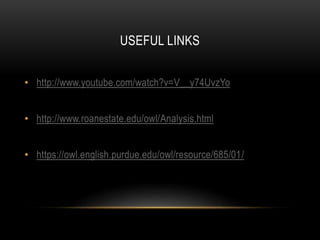
USEFUL LINKS
• http://www.youtube.com/watch?v=V__y74UvzYo
• http://www.roanestate.edu/owl/Analysis.html
• https://owl.english.purdue.edu/owl/resource/685/01/

Jordan - Analytical Essays

  • 1.
    ANALYSIS IN WRITING Aquick guide to the analytical essay
  • 2.
    WHAT DOES ANALYSISMEAN? • The Oxford English Dictionary describes analysis as a detailed examination or study of something so as to determine its nature, structure, or essential features • I like to think of analysis as original observations that provide insight into a text or occurrence • Analysis goes beyond simply summarizing a text or occurrence and attempts to understand the material in a new and original way
  • 3.
    GETTING STARTED • Rememberthat analysis is meant to go beyond summarizing a text or occurrence • This means that in order to create a strong analysis you should be very familiar with the text or occurrence that you are writing about • After you have become familiar with your material, decide which of the text’s essential features will be the focus of your analysis • If you are having difficulty choosing a direction for your analysis, refer back to the assignment description. Your instructor will oftentimes tell you what she wants you to pay attention to in your analysis
  • 4.
    WRITING THE ESSAY •Once you have identified the essential features that will be the focus of your analysis, you should begin to create a thesis statement • The thesis statement should be in the form of an argument and include your original observations about the essential features of the text or occurrence • In the first paragraph of the essay first introduce the text or occurrence you are analyzing then be sure to include your thesis statement
  • 5.
    WRITING THE ESSAY •For the body of your paper, use examples from the text or occurrence that help illustrate your original observations • Here is an easy way to organize a body paragraph for an analytical essay 1) In the first sentence write a statement that sums up the direction of the entire paragraph 2) Introduce the example you will be using from the text 3) Give the example 4) Summarize the example and explain why it is important to your original observations about the text
  • 6.
    WRITING THE ESSAY •Keep in mind that the more examples you use to support your original observations about the text the stronger your essay will be • When writing the conclusion of an analytical essay be sure to include the essential features that are at the core of your analysis • BE SPECIFIC: Detail the way in which the examples you chose from the material support your original observations about the text or occurrence.
  • 7.
    FINISHING UP • Rereadyour essay in order to make sure that your original observations are supported by the examples you chose from the text. • Also be sure that your essay has covered the essential features of the text (which may have been identified by your instructor in the assignment description) • Reread your thesis statement to be sure that it conveys a clear description of the position you have taken in regard to the material up for analysis
  • 8.
    USEFUL LINKS • http://www.youtube.com/watch?v=V__y74UvzYo •http://www.roanestate.edu/owl/Analysis.html • https://owl.english.purdue.edu/owl/resource/685/01/