Types of
Questionnaire
Smriti Adhikari
Research
Open end Questionnaires
– Open format questions
– Opportunities to response freely
– Able to collect truthful understanding answers
– Respondent can express their views freely
– Example: state your opinion on the new policy implemented by ABC ?
Closed end Questionnaires
– Unable to express their own judgements
– Asked selective questions
– Surveyor can easily perform preliminary analysis
– Deals with calculation od percentage and statistical data
7 type of close end Questionnaires
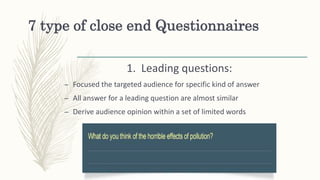
1. Leading questions:
– Focused the targeted audience for specific kind of answer
– All answer for a leading question are almost similar
– Derive audience opinion within a set of limited words
2.Importance questions :
– Rate the importance
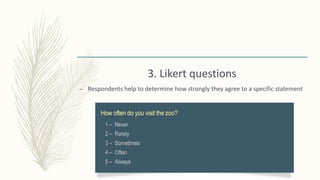
3. Likert questions
– Respondents help to determine how strongly they agree to a specific statement
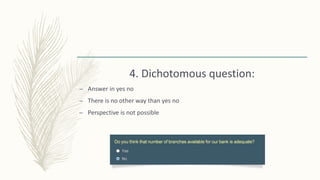
4. Dichotomous question:
– Answer in yes no
– There is no other way than yes no
– Perspective is not possible
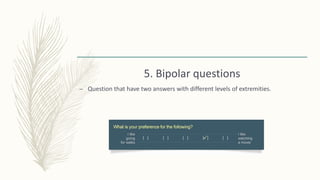
5. Bipolar questions
– Question that have two answers with different levels of extremities.
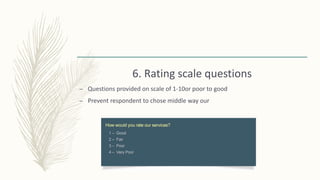
6. Rating scale questions
– Questions provided on scale of 1-10or poor to good
– Prevent respondent to chose middle way our
7. Buying propensity questions
– Assesses preference or inclination of a costumer to buy the products in the
future

Types of Questionnaire

  • 1.
  • 2.
    Open end Questionnaires –Open format questions – Opportunities to response freely – Able to collect truthful understanding answers – Respondent can express their views freely – Example: state your opinion on the new policy implemented by ABC ?
  • 3.
    Closed end Questionnaires –Unable to express their own judgements – Asked selective questions – Surveyor can easily perform preliminary analysis – Deals with calculation od percentage and statistical data
  • 4.
    7 type ofclose end Questionnaires 1. Leading questions: – Focused the targeted audience for specific kind of answer – All answer for a leading question are almost similar – Derive audience opinion within a set of limited words
  • 5.
    2.Importance questions : –Rate the importance
  • 6.
    3. Likert questions –Respondents help to determine how strongly they agree to a specific statement
  • 7.
    4. Dichotomous question: –Answer in yes no – There is no other way than yes no – Perspective is not possible
  • 8.
    5. Bipolar questions –Question that have two answers with different levels of extremities.
  • 9.
    6. Rating scalequestions – Questions provided on scale of 1-10or poor to good – Prevent respondent to chose middle way our
  • 10.
    7. Buying propensityquestions – Assesses preference or inclination of a costumer to buy the products in the future