Market Structure
henry.pahilanga
facebook.com/hp.Pahilanga
2
Market Structure
Understanding market structure
Types of market structure
The perfect competition
Forms of imperfect market
The monopoly
The oligopoly
Monopolistic competition
Monopsony and oligopsony
3
Understanding Market Structure
▪ Economics has its own special way in describing types
of market, that is, to determine on what extent
business firms in each type of market competes with
one another in terms of the quality of final produced
products.
▪ Economists usually prefer to have competitive markets.
▪ Price is determined whether high or low unless there is
competition.
▪ Presence of alternative products, services, and
viewpoints are also considered.
▪ That is why economists study markets with an eye to
how much competition exists.
4
Understanding Market Structure
▪ What is a market
▪ A place where buyers and sellers are
exchanging goods and services with the
following conditions such as:
o Types of goods and services being traded.
o The number and size of buyers and sellers in
the market.
o The degree to which information can flow
freely.
5
Understanding Market Structure
▪ What is a market structure
▪ Market structure, in economics, refers to how
different industries are classified and differentiated
based on their degree and nature of competition
for goods and services.
▪ It is based on the characteristics that influence the
behavior and outcomes of companies working in a
specific market.
6
Understanding Market Structure
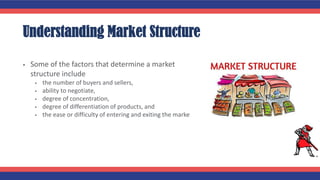
▪ Some of the factors that determine a market
structure include
▪ the number of buyers and sellers,
▪ ability to negotiate,
▪ degree of concentration,
▪ degree of differentiation of products, and
▪ the ease or difficulty of entering and exiting the market.
7
Understanding Market Structure
▪ In economics, market structures can be understood
well by closely examining an array of factors or
features exhibited by different players. It is common
to differentiate these markets across the following
seven distinct features.
▪ The industry’s buyer structure
▪ The turnover of customers
▪ The extent of product differentiation
▪ The nature of costs of inputs
▪ The number of players in the market
▪ Vertical integration extent in the same industry
▪ The largest player’s market share
8
Types of Market Structures
Perfect or pure market
▪ Market situation which consists of a
very large number of buyers and
sellers offering a homogeneous
product.
▪ No firm can affect the price.
▪ Price is determined through the
market demand and supply of the
particular product, since no single
buyer or seller has any real control
over price.
Imperfect or pure market
▪ Market situation wherein the conditions
necessary for perfect competitions are
not satisfied.
▪ Few sellers which is enough to affect the
market price.
▪ Happens when the firm becomes
relatively larger in connection with
market size.
▪ The power the individual firm has to
determine prices by adjusting its sales,
without having a complete power of a
monopolist.
9
Types of Market Structures
Perfect Competition
▪ Perfect competition occurs when there is a large number of small companies
competing against each other.
▪ They sell similar products (homogeneous), lack price influence over the commodities,
and are free to enter or exit the market.
▪ This market is unrealistic as it faces some significant criticisms described below.
• No incentive for innovation: In the real world, if competition exists and a company holds a
dominant market share, there is a tendency to increase innovation to beat the competitors
and maintain the status quo. However, in a perfectly competitive market, the profit margin
is fixed, and sellers cannot increase prices, or they will lose their customers.
• There are very few barriers to entry: Any company can enter the market and start selling
the product. Therefore, incumbents must stay proactive to maintain market share.
10
Types of Market Structures
Perfect Competition
▪ Cannot be found in real world.
▪ The following conditions must be required:
• Large number of sellers.
• Selling a homogenous product.
• No artificial restrictions placed upon price or quantity.
• Easy entry and exit.
• All buyers and sellers have perfect knowledge of market conditions and of any changes that
occur in the market.
• Firms are “price takers”.
11
Types of Market Structures
Monopolistic Competition
▪ Refers to an imperfectly competitive
market with the traits of both the
monopoly and competitive market.
▪ Sellers compete among themselves and
can differentiate their goods in terms of
quality and branding to look different.
▪ In this type of competition, sellers consider
the price charged by their competitors and
ignore the impact of their own prices on
their competition.
▪ The company initially produces many
products as the demand is high.
▪ Therefore, its Marginal Revenue
(MR) corresponds to its Marginal
Cost (MC). However, MR diminishes
over time as new companies enter
the market with differentiated
products affecting demand, leading
to less profit.
12
Types of Market Structures
Monopoly
▪ In a monopoly market, a single company
represents the whole industry. It has no
competitor, and it is the sole seller of
products in the entire market.
▪ This type of market is characterized by
factors such as the
▪ sole claim to ownership of resources,
▪ patent and copyright,
▪ licenses issued by the government, or
▪ high initial setup costs.
▪ All the above characteristics
associated with monopoly restrict
other companies from entering the
market.
▪ The company, therefore, remains a
single seller because it has the power
to control the market and set prices
for its goods.
13
Types of Market Structures
Classifications of Monopoly
1. Natural monopoly
▪ Market situation where a single firm
can supply the entire market due to
the fundamental cost structure of the
industry.
▪ Arises whenever capital cost is large
enough as compared to variable cost,
and they have cost advantage over
competitors.
▪ Common to the providers of gas, steel,
electricity, and water.
2. Legal monopoly
▪ Form of monopoly which the
government grants to a private
individual or firm over the product or
service, which is also known as de jure
monopoly.
▪ Most of the utilities granted with an
exclusive franchise by the government
such as water and electricity services
enjoy legal monopolies.
14
Types of Market Structures
Classifications of Monopoly
3. Coercive monopoly
▪ Form of monopoly whose existence as the sole producer and distributor
of goods and services is by means of coercion (legal or illegal), so that
most of the time it violates the principle of free market just to avoid
competition.
15
Types of Market Structures
Oligopoly
▪ An oligopoly market consists of a small number of
large companies that sell differentiated or identical
products. Since there are few players in the market,
their competitive strategies are dependent on each
other.
▪ For example, if one of the actors decides to reduce
the price of its products, the action will trigger
other actors to lower their prices, too.
▪ On the other hand, a price increase may influence
others not to take any action in the anticipation
consumers will opt for their products.
▪ Therefore, strategic planning by these types of
players is a must.
▪ In a situation where companies mutually
compete, they may create agreements to
share the market by restricting production,
leading to supernormal profits.
16
Types of Market Structures
Types of Oligopoly
1. Pure oligopoly
▪ Few sellers that produce identical products
or products sold are fairly homogeneous.
▪ Products sold include cement, sugar and
other raw materials.
2. Differentiated oligopoly
▪ Few sellers of differentiated products or
value characteristics or a quality of
goods varies.
▪ Example of this type is the automobile
industry because of the numerous
characteristics of cars.
17
Types of Market Structures
Types of Oligoposy
3. Duopoly
▪ Two producers exist in a given market.
▪ This type of oligopoly market is seen in the television and radio industry in
which both operates in the same locality although technically they are one
company.
18
Types of Market Structures
Types of Organization of Oligopoly
1. Cartel
▪ Formal agreement among oligopolists
to set-up a monopoly price, allocate
output, and share profit among
members. Ex. OPEC.
2. Collusion
▪ Formal or an informal agreements
among oligopolists to adopt policies
that will restrict or reduce the level
of competition in the market.
19
Types of Market Structures
Monopsony
▪ There is only one buyer of goods and services in the market.
▪ Sometimes considered analogous to monopoly in which there is only one
seller of goods and services in the market.
▪ Market has the control of supply and it can reduce the number of input
demanded in order to decrease the price of that particular input.
▪ Monopsony power gives them the ability to control their unit cost for an
input which is similar to the way the monopoly controls their price.
20
Types of Market Structures
Oligopsony
▪ There are a small number of buyers which are usually the small number
firms competing to obtain the factors of production.
▪ Under this market situation, firms are buyers and not sellers.
21
Market Structure
Market Characteristics Perfect Competition Monopolistic Competition Oligopoly Monopoly
Product Differentiation NO YES YES, but less so if oligopoly
supply raw materials
YES
Price Competition Intense; must meet price
of other firms
Intense Occasional but cooperative
behavior often present
Occasional with producers
of substitute and services.
Price of natural
monopolies is subject to
regulation.
Non-price Competition
(Advertising)
NO HIGH HIGH Often, to promote pubic
good will
Barrier to Entry NO LOW HIGH HIGH
Information Cost NO LOW HIGH HIGH
22
Market Structure
Market Characteristics Perfect Competition Monopolistic Competition Oligopoly Monopoly
Opportunities to Earn and
Keep Economic Profits
NO FEW MANY Many, though often
regulated
Number of Sellers Large number of seller Numerous buyer and
seller
Small number of firm Only one seller
Degree of Control Over
Price
Price taker Limited control Has control over price Price maker
Type of Product Homogenous product Differentiated products or
similar but not identical
Differentiated or identical
products
Highly standardized

Market Structure_Scribd.pdf

  • 1.
  • 2.
    2 Market Structure Understanding marketstructure Types of market structure The perfect competition Forms of imperfect market The monopoly The oligopoly Monopolistic competition Monopsony and oligopsony
  • 3.
    3 Understanding Market Structure ▪Economics has its own special way in describing types of market, that is, to determine on what extent business firms in each type of market competes with one another in terms of the quality of final produced products. ▪ Economists usually prefer to have competitive markets. ▪ Price is determined whether high or low unless there is competition. ▪ Presence of alternative products, services, and viewpoints are also considered. ▪ That is why economists study markets with an eye to how much competition exists.
  • 4.
    4 Understanding Market Structure ▪What is a market ▪ A place where buyers and sellers are exchanging goods and services with the following conditions such as: o Types of goods and services being traded. o The number and size of buyers and sellers in the market. o The degree to which information can flow freely.
  • 5.
    5 Understanding Market Structure ▪What is a market structure ▪ Market structure, in economics, refers to how different industries are classified and differentiated based on their degree and nature of competition for goods and services. ▪ It is based on the characteristics that influence the behavior and outcomes of companies working in a specific market.
  • 6.
    6 Understanding Market Structure ▪Some of the factors that determine a market structure include ▪ the number of buyers and sellers, ▪ ability to negotiate, ▪ degree of concentration, ▪ degree of differentiation of products, and ▪ the ease or difficulty of entering and exiting the market.
  • 7.
    7 Understanding Market Structure ▪In economics, market structures can be understood well by closely examining an array of factors or features exhibited by different players. It is common to differentiate these markets across the following seven distinct features. ▪ The industry’s buyer structure ▪ The turnover of customers ▪ The extent of product differentiation ▪ The nature of costs of inputs ▪ The number of players in the market ▪ Vertical integration extent in the same industry ▪ The largest player’s market share
  • 8.
    8 Types of MarketStructures Perfect or pure market ▪ Market situation which consists of a very large number of buyers and sellers offering a homogeneous product. ▪ No firm can affect the price. ▪ Price is determined through the market demand and supply of the particular product, since no single buyer or seller has any real control over price. Imperfect or pure market ▪ Market situation wherein the conditions necessary for perfect competitions are not satisfied. ▪ Few sellers which is enough to affect the market price. ▪ Happens when the firm becomes relatively larger in connection with market size. ▪ The power the individual firm has to determine prices by adjusting its sales, without having a complete power of a monopolist.
  • 9.
    9 Types of MarketStructures Perfect Competition ▪ Perfect competition occurs when there is a large number of small companies competing against each other. ▪ They sell similar products (homogeneous), lack price influence over the commodities, and are free to enter or exit the market. ▪ This market is unrealistic as it faces some significant criticisms described below. • No incentive for innovation: In the real world, if competition exists and a company holds a dominant market share, there is a tendency to increase innovation to beat the competitors and maintain the status quo. However, in a perfectly competitive market, the profit margin is fixed, and sellers cannot increase prices, or they will lose their customers. • There are very few barriers to entry: Any company can enter the market and start selling the product. Therefore, incumbents must stay proactive to maintain market share.
  • 10.
    10 Types of MarketStructures Perfect Competition ▪ Cannot be found in real world. ▪ The following conditions must be required: • Large number of sellers. • Selling a homogenous product. • No artificial restrictions placed upon price or quantity. • Easy entry and exit. • All buyers and sellers have perfect knowledge of market conditions and of any changes that occur in the market. • Firms are “price takers”.
  • 11.
    11 Types of MarketStructures Monopolistic Competition ▪ Refers to an imperfectly competitive market with the traits of both the monopoly and competitive market. ▪ Sellers compete among themselves and can differentiate their goods in terms of quality and branding to look different. ▪ In this type of competition, sellers consider the price charged by their competitors and ignore the impact of their own prices on their competition. ▪ The company initially produces many products as the demand is high. ▪ Therefore, its Marginal Revenue (MR) corresponds to its Marginal Cost (MC). However, MR diminishes over time as new companies enter the market with differentiated products affecting demand, leading to less profit.
  • 12.
    12 Types of MarketStructures Monopoly ▪ In a monopoly market, a single company represents the whole industry. It has no competitor, and it is the sole seller of products in the entire market. ▪ This type of market is characterized by factors such as the ▪ sole claim to ownership of resources, ▪ patent and copyright, ▪ licenses issued by the government, or ▪ high initial setup costs. ▪ All the above characteristics associated with monopoly restrict other companies from entering the market. ▪ The company, therefore, remains a single seller because it has the power to control the market and set prices for its goods.
  • 13.
    13 Types of MarketStructures Classifications of Monopoly 1. Natural monopoly ▪ Market situation where a single firm can supply the entire market due to the fundamental cost structure of the industry. ▪ Arises whenever capital cost is large enough as compared to variable cost, and they have cost advantage over competitors. ▪ Common to the providers of gas, steel, electricity, and water. 2. Legal monopoly ▪ Form of monopoly which the government grants to a private individual or firm over the product or service, which is also known as de jure monopoly. ▪ Most of the utilities granted with an exclusive franchise by the government such as water and electricity services enjoy legal monopolies.
  • 14.
    14 Types of MarketStructures Classifications of Monopoly 3. Coercive monopoly ▪ Form of monopoly whose existence as the sole producer and distributor of goods and services is by means of coercion (legal or illegal), so that most of the time it violates the principle of free market just to avoid competition.
  • 15.
    15 Types of MarketStructures Oligopoly ▪ An oligopoly market consists of a small number of large companies that sell differentiated or identical products. Since there are few players in the market, their competitive strategies are dependent on each other. ▪ For example, if one of the actors decides to reduce the price of its products, the action will trigger other actors to lower their prices, too. ▪ On the other hand, a price increase may influence others not to take any action in the anticipation consumers will opt for their products. ▪ Therefore, strategic planning by these types of players is a must. ▪ In a situation where companies mutually compete, they may create agreements to share the market by restricting production, leading to supernormal profits.
  • 16.
    16 Types of MarketStructures Types of Oligopoly 1. Pure oligopoly ▪ Few sellers that produce identical products or products sold are fairly homogeneous. ▪ Products sold include cement, sugar and other raw materials. 2. Differentiated oligopoly ▪ Few sellers of differentiated products or value characteristics or a quality of goods varies. ▪ Example of this type is the automobile industry because of the numerous characteristics of cars.
  • 17.
    17 Types of MarketStructures Types of Oligoposy 3. Duopoly ▪ Two producers exist in a given market. ▪ This type of oligopoly market is seen in the television and radio industry in which both operates in the same locality although technically they are one company.
  • 18.
    18 Types of MarketStructures Types of Organization of Oligopoly 1. Cartel ▪ Formal agreement among oligopolists to set-up a monopoly price, allocate output, and share profit among members. Ex. OPEC. 2. Collusion ▪ Formal or an informal agreements among oligopolists to adopt policies that will restrict or reduce the level of competition in the market.
  • 19.
    19 Types of MarketStructures Monopsony ▪ There is only one buyer of goods and services in the market. ▪ Sometimes considered analogous to monopoly in which there is only one seller of goods and services in the market. ▪ Market has the control of supply and it can reduce the number of input demanded in order to decrease the price of that particular input. ▪ Monopsony power gives them the ability to control their unit cost for an input which is similar to the way the monopoly controls their price.
  • 20.
    20 Types of MarketStructures Oligopsony ▪ There are a small number of buyers which are usually the small number firms competing to obtain the factors of production. ▪ Under this market situation, firms are buyers and not sellers.
  • 21.
    21 Market Structure Market CharacteristicsPerfect Competition Monopolistic Competition Oligopoly Monopoly Product Differentiation NO YES YES, but less so if oligopoly supply raw materials YES Price Competition Intense; must meet price of other firms Intense Occasional but cooperative behavior often present Occasional with producers of substitute and services. Price of natural monopolies is subject to regulation. Non-price Competition (Advertising) NO HIGH HIGH Often, to promote pubic good will Barrier to Entry NO LOW HIGH HIGH Information Cost NO LOW HIGH HIGH
  • 22.
    22 Market Structure Market CharacteristicsPerfect Competition Monopolistic Competition Oligopoly Monopoly Opportunities to Earn and Keep Economic Profits NO FEW MANY Many, though often regulated Number of Sellers Large number of seller Numerous buyer and seller Small number of firm Only one seller Degree of Control Over Price Price taker Limited control Has control over price Price maker Type of Product Homogenous product Differentiated products or similar but not identical Differentiated or identical products Highly standardized