Core Marketing Concepts
Prepared by
Akash B
Presentation on
 Need, want and demand
 Market
 Business
 Marketing
 Concept
Terminologies
To understand the marketing function.
First we need to understand the following core set of
concepts.
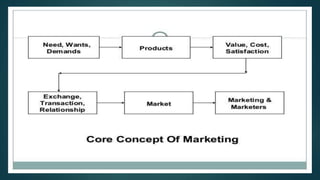
 Needs
 Wants
 Demands
 Need: Is the state of felt deprivation.The state at which our
inner self demand something.
For example: Basic needs = Foods, Shelter & Clothes etc.
 Want: It is something that human get from different culture
and personality. This can be said “Human wants is to
satisfy their needs”.
For example: Fast foods in western countries.
Demand
 Is from the human wants that are backed by the buying power. Have
in mind that, "buying power" is a disposal income.
 Example: A person want to purchase a motor car then he will have the
option of Suzuki, Toyota and Honda then he will decide according to
his paying capacity.
Market
 A place where buyers and sellers are meet for the purpose of
exchanging or doing transactions for their own satisfaction.
 The set of all actual and potential buyers of a product or service.
 Example: like Asian market & European market.
Business
 Any legal activity that is done for the sake of profit at any level and at
any cost.
 An economic system in which goods and services are exchanged for
one another or money on the basis of their perceived worth.
 Example: cotton ginning miles, sugar miles.
Marketing
 Satisfying customers with profitability.
 Delivery of satisfaction to the customers.
 Satisfying needs and wants through an exchange process.
 The management process responsible for identifying , anticipating and
satisfying customer requirements profitably.
 Example: marketing of Pepsi, nestle etc.
Concept
 It is an idea or technique that can be implemented for achievements of
specific objectives and goals.
 Example: core concept of marketing.
Five Core Concepts of Marketing
 Production concept
 Product concept
 Selling concept
 Marketing concept
 Societal marketing concept
Production concept
 The idea that consumers will favour products that are available and
highly affordable.
 The organization should focus on improving production and
distribution efficiency.
 Example of production concept
History: Honda has been the world's largest motorcycle manufacturer
since 1959 as well as the world's largest
manufacturer of internal combustion engines.
Honda usually follows the production concept to satisfy
their customers & to achieve the company’s goals. (More
you produce more you earn)
Product concept
 The idea that consumers will favour products offers the most quality,
performance and advance features therefore organization should devote its
energy to making continues product improvements.
 Example: TATA MOTORS
Selling concept
 The idea that consumers will not buy enough of the firm’s product
unless it undertakes a large scale selling and promotion effort.
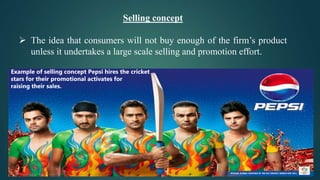
Example of selling concept Pepsi hires the cricket
stars for their promotional activates for
raising their sales.
Marketing concept
 The marketing management philosophy that achieving organizational goals
depends on knowing the needs and wants of target markets and delivering the
desired satisfactions to buyers better then competitors.
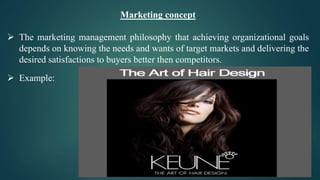
 Example:
Societal marketing concept
 A principle of enlightened marketing that holds a company should make
good marketing decisions by considering consumers wants, the company’s
requirement costumer’s long term interests and society’s long run interests.
Why strategies to be developed?
 To create goodwill.
 To make maximum profit.
 To make profitable relationship with costumers.
 Satisfying costumers as per companies objectives.
 To promote sales.
Core marketing concept ppt

Core marketing concept ppt

  • 1.
    Core Marketing Concepts Preparedby Akash B Presentation on
  • 2.
     Need, wantand demand  Market  Business  Marketing  Concept Terminologies
  • 4.
    To understand themarketing function. First we need to understand the following core set of concepts.  Needs  Wants  Demands
  • 5.
     Need: Isthe state of felt deprivation.The state at which our inner self demand something. For example: Basic needs = Foods, Shelter & Clothes etc.  Want: It is something that human get from different culture and personality. This can be said “Human wants is to satisfy their needs”. For example: Fast foods in western countries.
  • 6.
    Demand  Is fromthe human wants that are backed by the buying power. Have in mind that, "buying power" is a disposal income.  Example: A person want to purchase a motor car then he will have the option of Suzuki, Toyota and Honda then he will decide according to his paying capacity.
  • 7.
    Market  A placewhere buyers and sellers are meet for the purpose of exchanging or doing transactions for their own satisfaction.  The set of all actual and potential buyers of a product or service.  Example: like Asian market & European market.
  • 8.
    Business  Any legalactivity that is done for the sake of profit at any level and at any cost.  An economic system in which goods and services are exchanged for one another or money on the basis of their perceived worth.  Example: cotton ginning miles, sugar miles.
  • 9.
    Marketing  Satisfying customerswith profitability.  Delivery of satisfaction to the customers.  Satisfying needs and wants through an exchange process.  The management process responsible for identifying , anticipating and satisfying customer requirements profitably.  Example: marketing of Pepsi, nestle etc.
  • 10.
    Concept  It isan idea or technique that can be implemented for achievements of specific objectives and goals.  Example: core concept of marketing.
  • 11.
    Five Core Conceptsof Marketing  Production concept  Product concept  Selling concept  Marketing concept  Societal marketing concept
  • 12.
    Production concept  Theidea that consumers will favour products that are available and highly affordable.  The organization should focus on improving production and distribution efficiency.  Example of production concept History: Honda has been the world's largest motorcycle manufacturer since 1959 as well as the world's largest manufacturer of internal combustion engines.
  • 13.
    Honda usually followsthe production concept to satisfy their customers & to achieve the company’s goals. (More you produce more you earn)
  • 14.
    Product concept  Theidea that consumers will favour products offers the most quality, performance and advance features therefore organization should devote its energy to making continues product improvements.  Example: TATA MOTORS
  • 15.
    Selling concept  Theidea that consumers will not buy enough of the firm’s product unless it undertakes a large scale selling and promotion effort. Example of selling concept Pepsi hires the cricket stars for their promotional activates for raising their sales.
  • 16.
    Marketing concept  Themarketing management philosophy that achieving organizational goals depends on knowing the needs and wants of target markets and delivering the desired satisfactions to buyers better then competitors.  Example:
  • 17.
    Societal marketing concept A principle of enlightened marketing that holds a company should make good marketing decisions by considering consumers wants, the company’s requirement costumer’s long term interests and society’s long run interests.
  • 18.
    Why strategies tobe developed?  To create goodwill.  To make maximum profit.  To make profitable relationship with costumers.  Satisfying costumers as per companies objectives.  To promote sales.