
Subject : Human Resources management
Topic: Types Of Interviews
By
A. Raja
Introduction
 The word interview comes from Latin and middle
French words meaning to “see between” or “see
each other”.
 Generally, interview means a private meeting
between people when questions are asked and
answered.
 The person who answers the questions of an
interview is called in interviewee. The person who
asks the questions of our interview is called an
interviewer.
 It suggests a meeting between two persons for the
purpose of getting a view of each other or for
knowing each other.
INTERVIEW
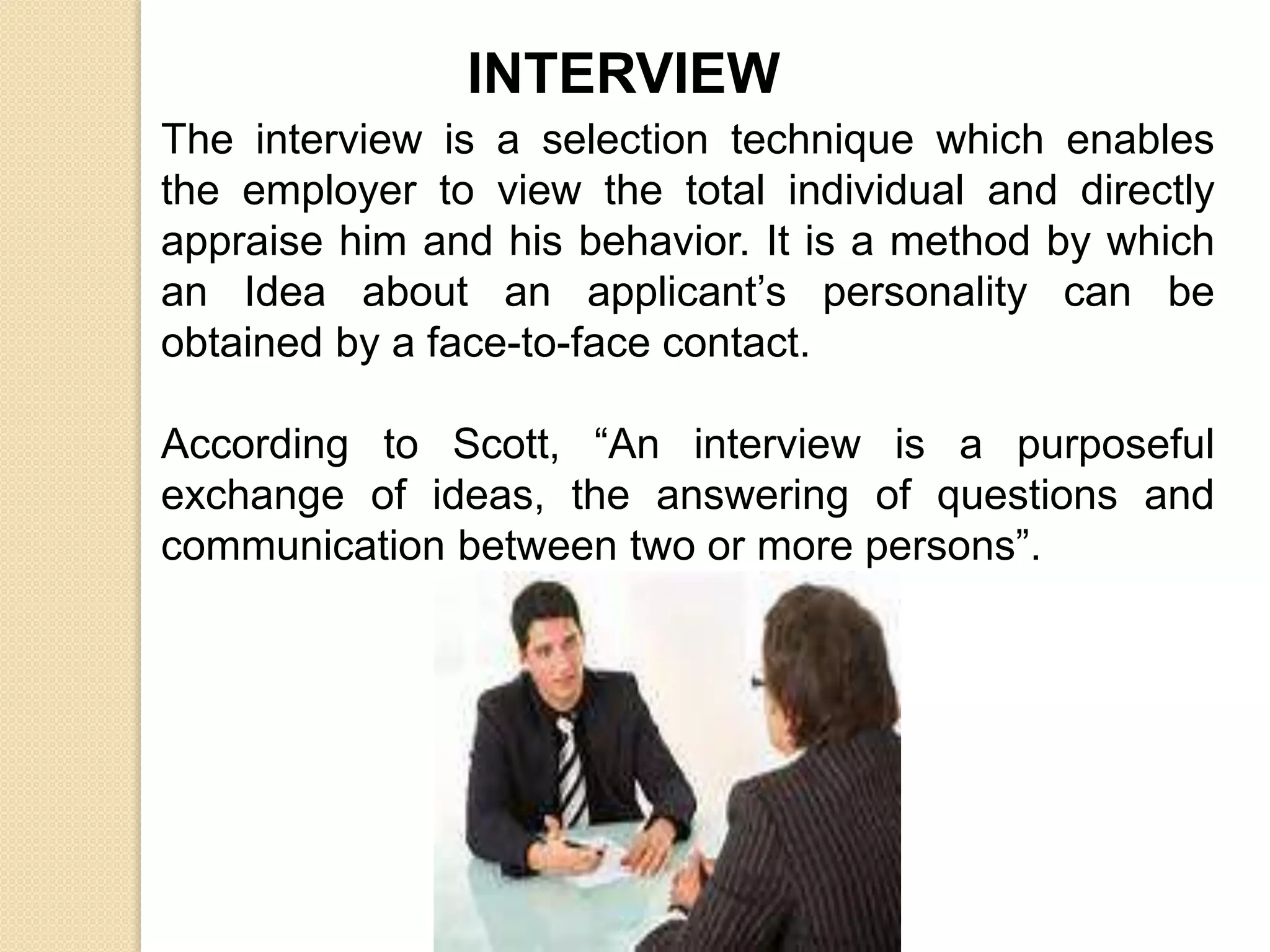
The interview is a selection technique which enables
the employer to view the total individual and directly
appraise him and his behavior. It is a method by which
an Idea about an applicant’s personality can be
obtained by a face-to-face contact.
According to Scott, “An interview is a purposeful
exchange of ideas, the answering of questions and
communication between two or more persons”.
Interview techniques
Various techniques of employment interviews are
adopted to solicit different kinds of information
and to measure the candidate’s skills,
knowledge, etc., at different planes.
Employment interviews can be divided into
following Categories:
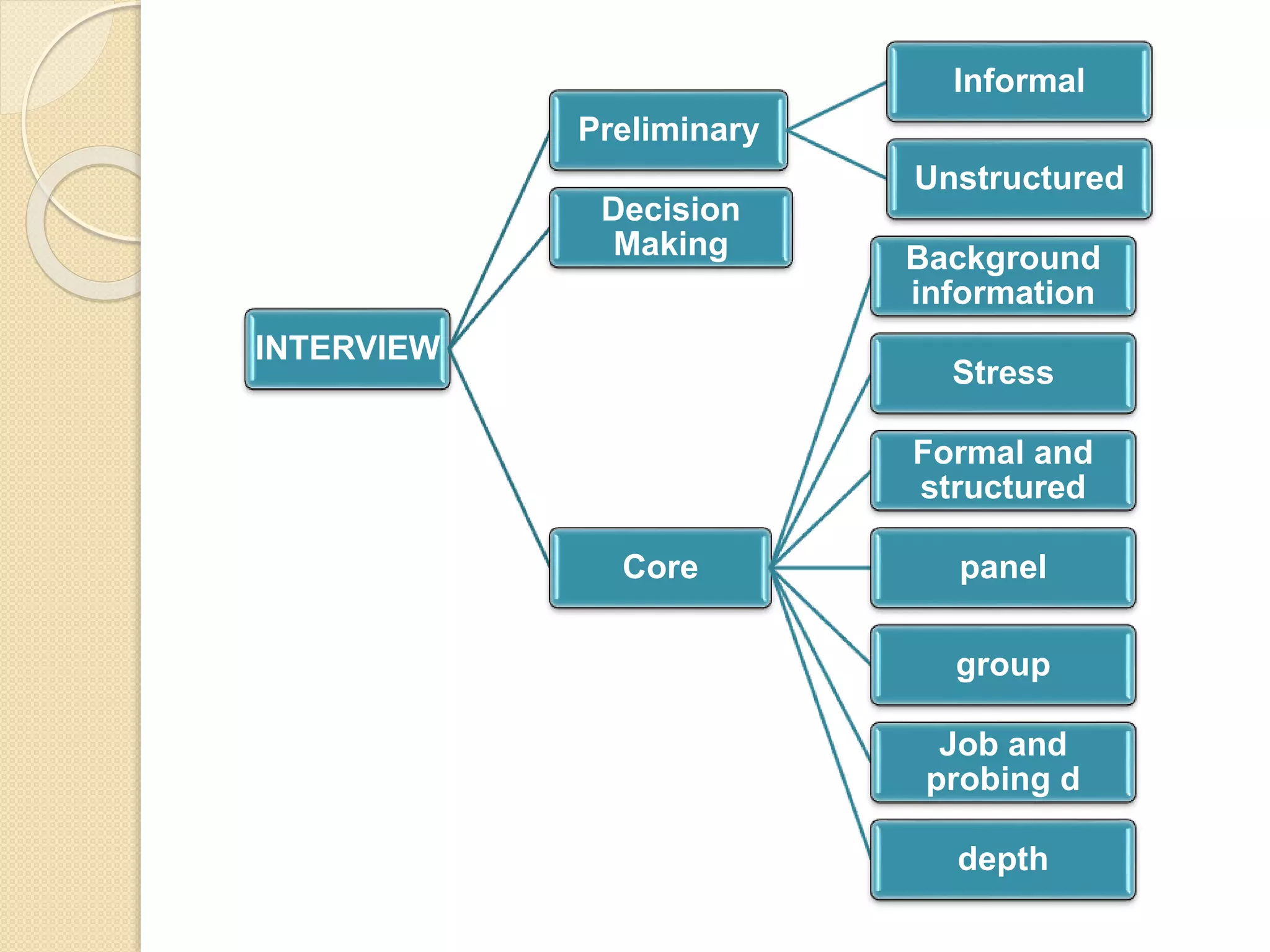
INTERVIEW
Preliminary
Informal
Unstructured
Decision
Making
Core
Background
information
Stress
Formal and
structured
panel
group
Job and
probing d
depth
•Preliminary interview:
It is generally regarded as
exchange of basic information between the
candidate and the personal manager about
the job and organization, like job
nature,salary,working conditions,benefits etc.,
this interview is mainly divided into following
types:
•Informal interview
• unstructured interview
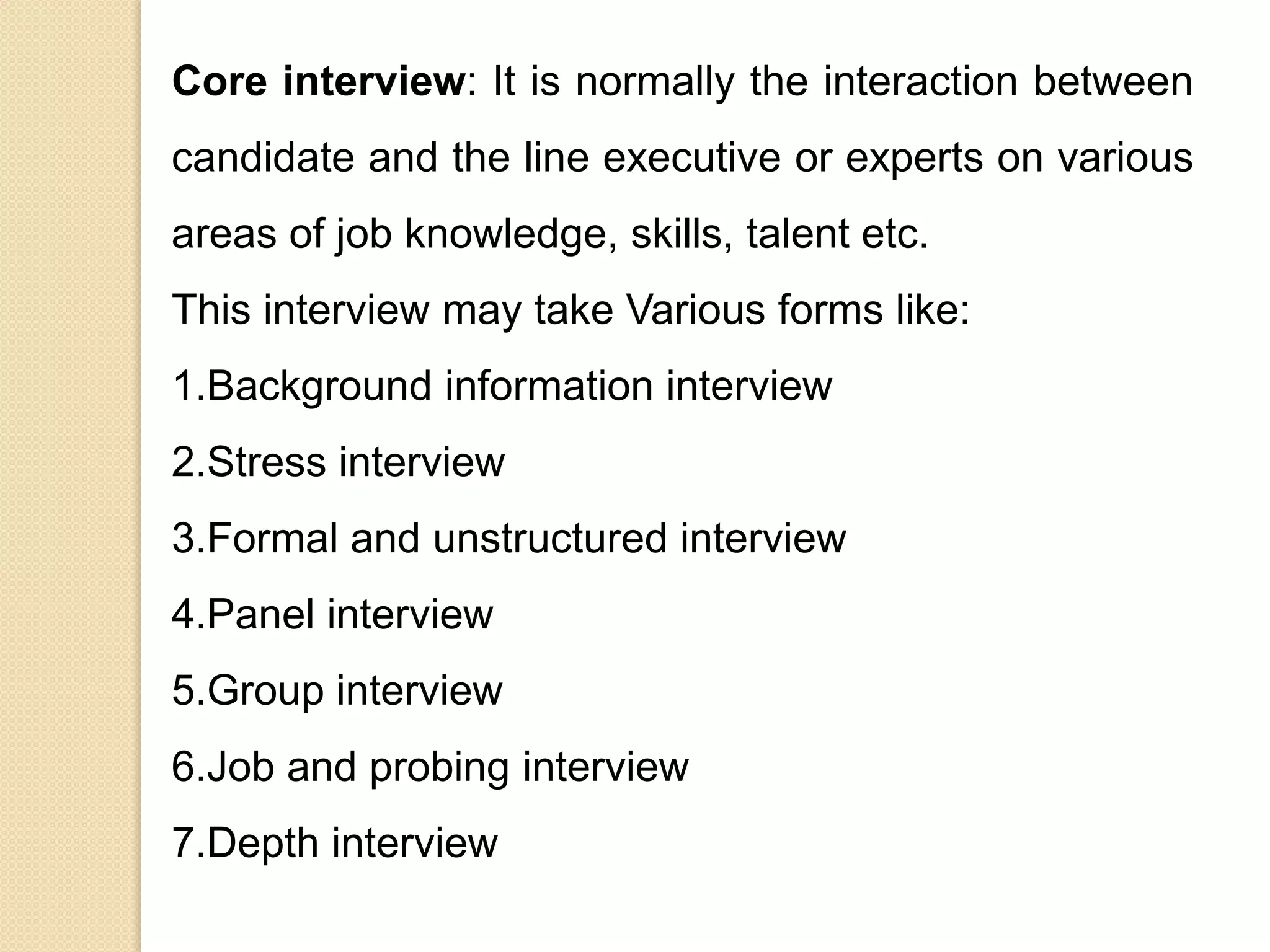
• Unstructured interview:
In this interview the
candidate is given the freedom to
tell himself by revealing his
knowledge on various
items/areas, his background,
expectations Interests etc.
similarly, the interviewer also
provides information on various
items required by the candidate.
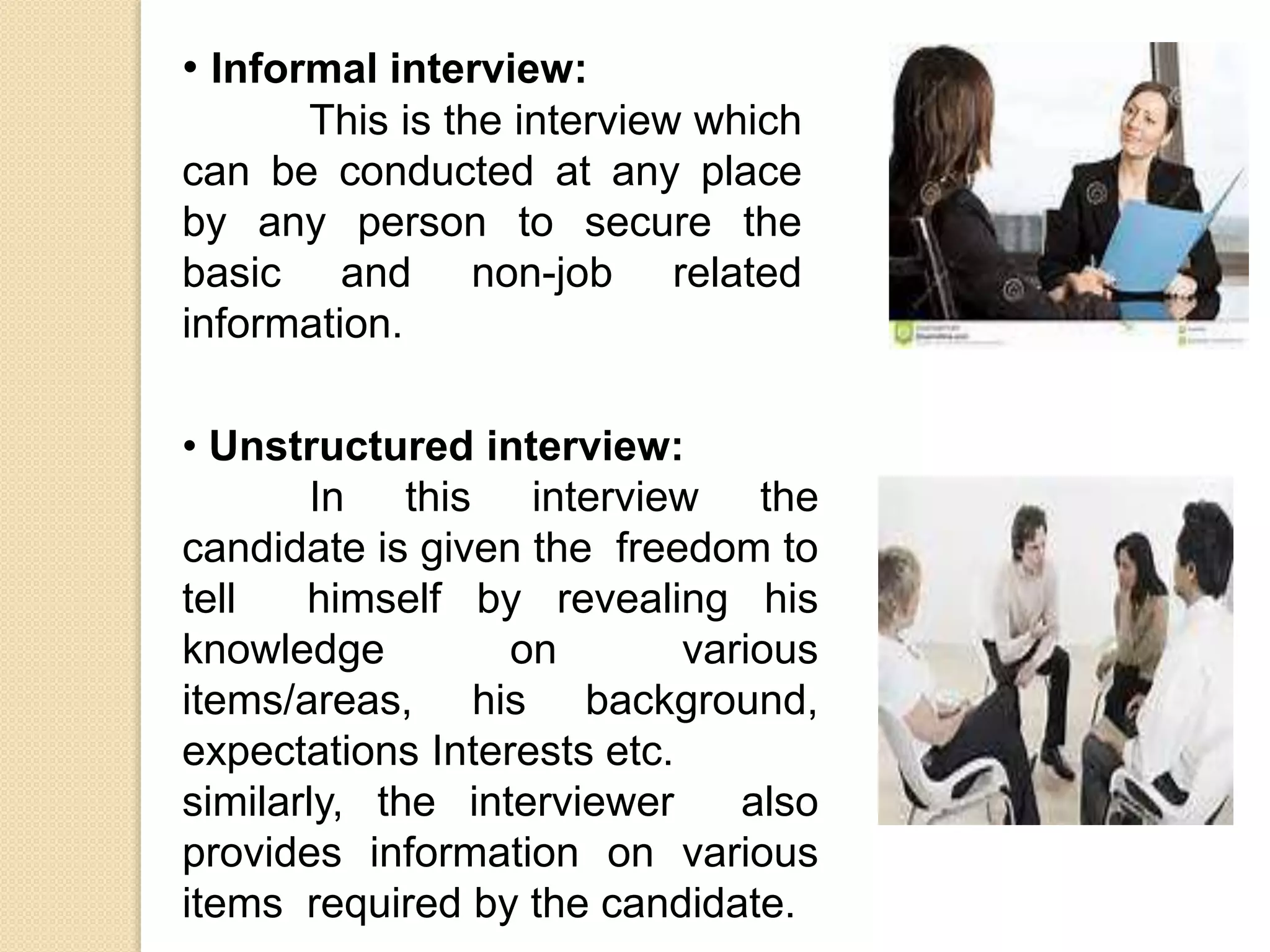
• Informal interview:
This is the interview which
can be conducted at any place
by any person to secure the
basic and non-job related
information.
Core interview: It is normally the interaction between
candidate and the line executive or experts on various
areas of job knowledge, skills, talent etc.
This interview may take Various forms like:
1.Background information interview
2.Stress interview
3.Formal and unstructured interview
4.Panel interview
5.Group interview
6.Job and probing interview
7.Depth interview
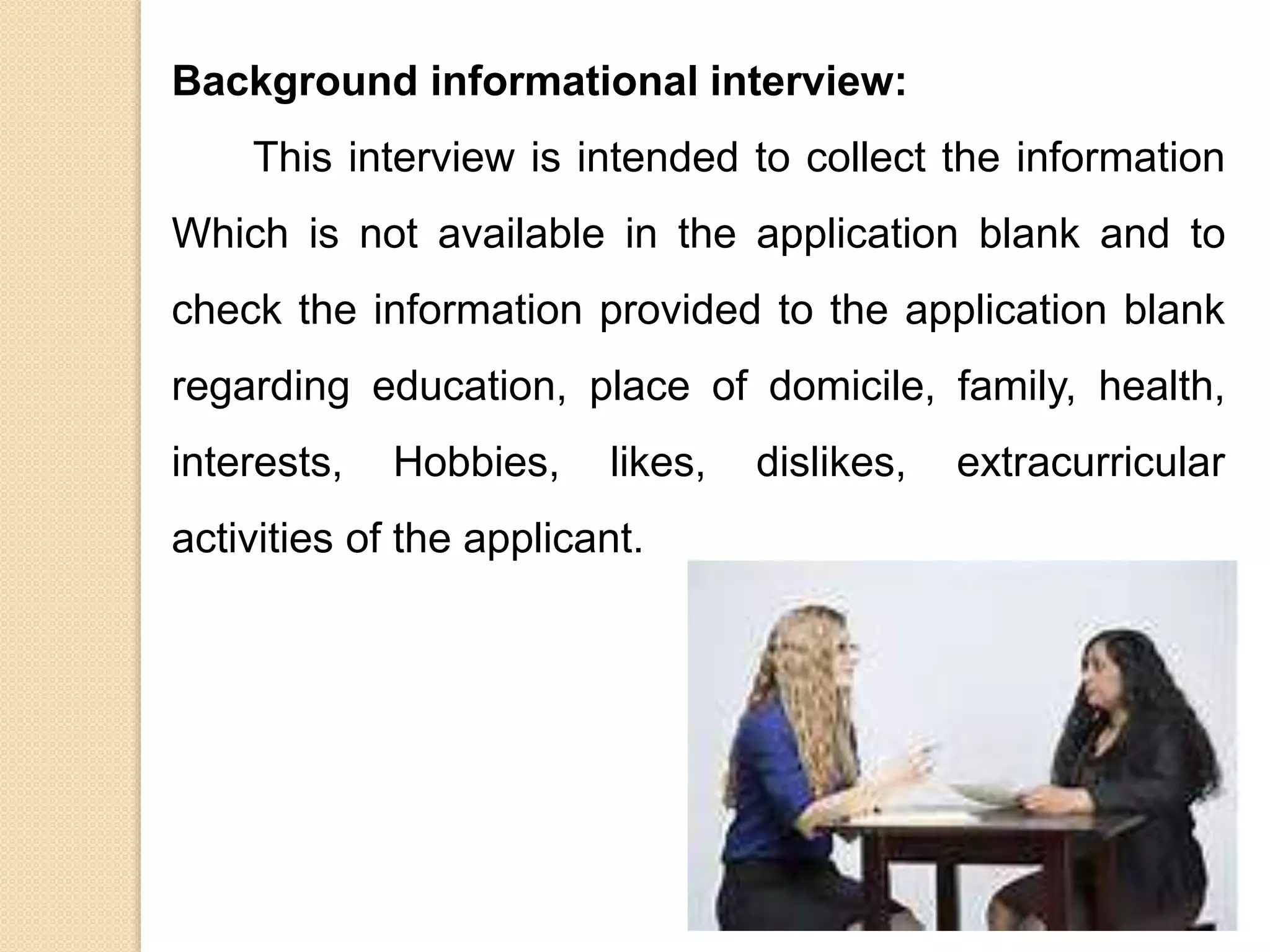
Background informational interview:
This interview is intended to collect the information
Which is not available in the application blank and to
check the information provided to the application blank
regarding education, place of domicile, family, health,
interests, Hobbies, likes, dislikes, extracurricular
activities of the applicant.
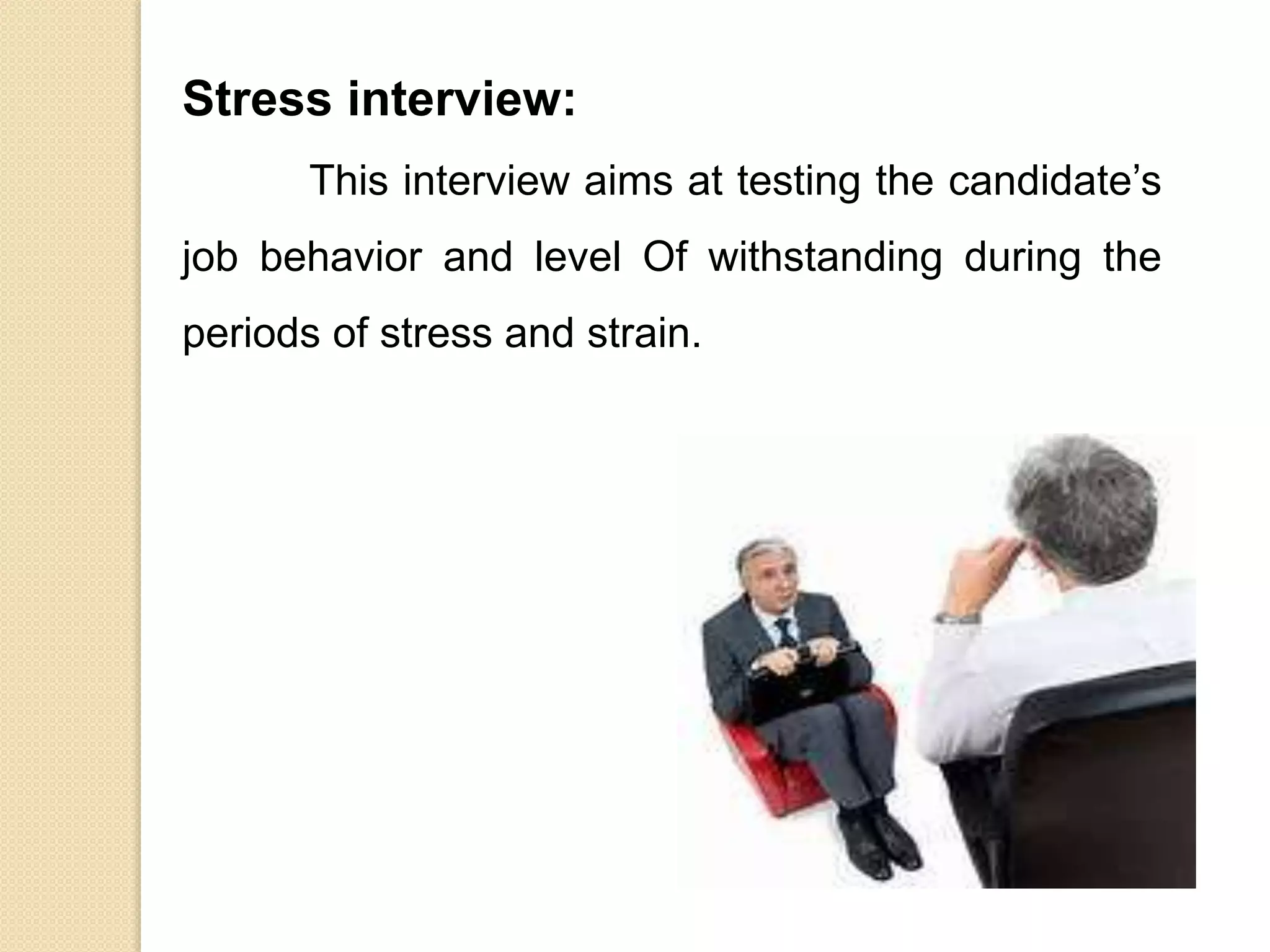
Stress interview:
This interview aims at testing the candidate’s
job behavior and level Of withstanding during the
periods of stress and strain.
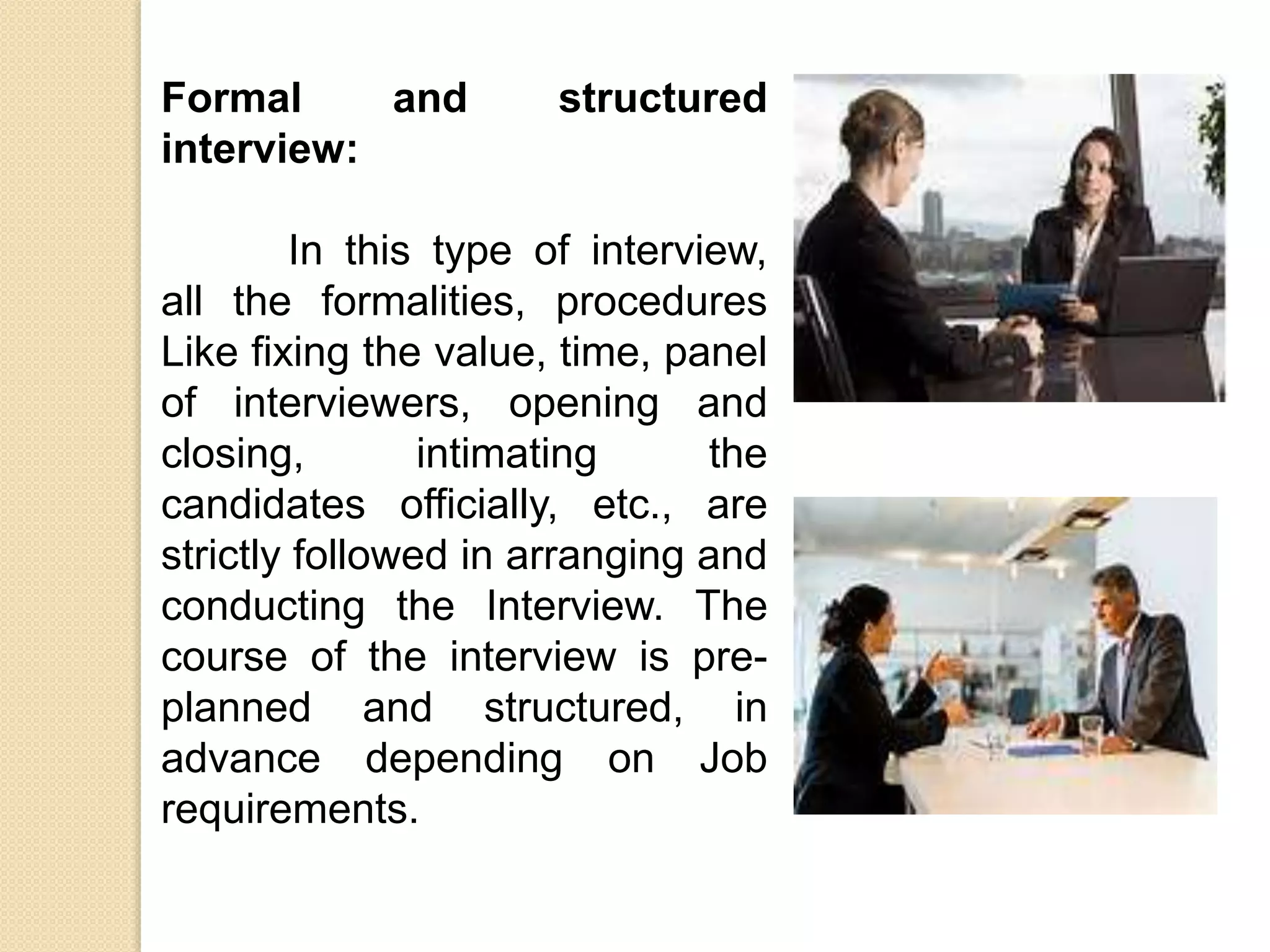
Formal and structured
interview:
In this type of interview,
all the formalities, procedures
Like fixing the value, time, panel
of interviewers, opening and
closing, intimating the
candidates officially, etc., are
strictly followed in arranging and
conducting the Interview. The
course of the interview is pre-
planned and structured, in
advance depending on Job
requirements.
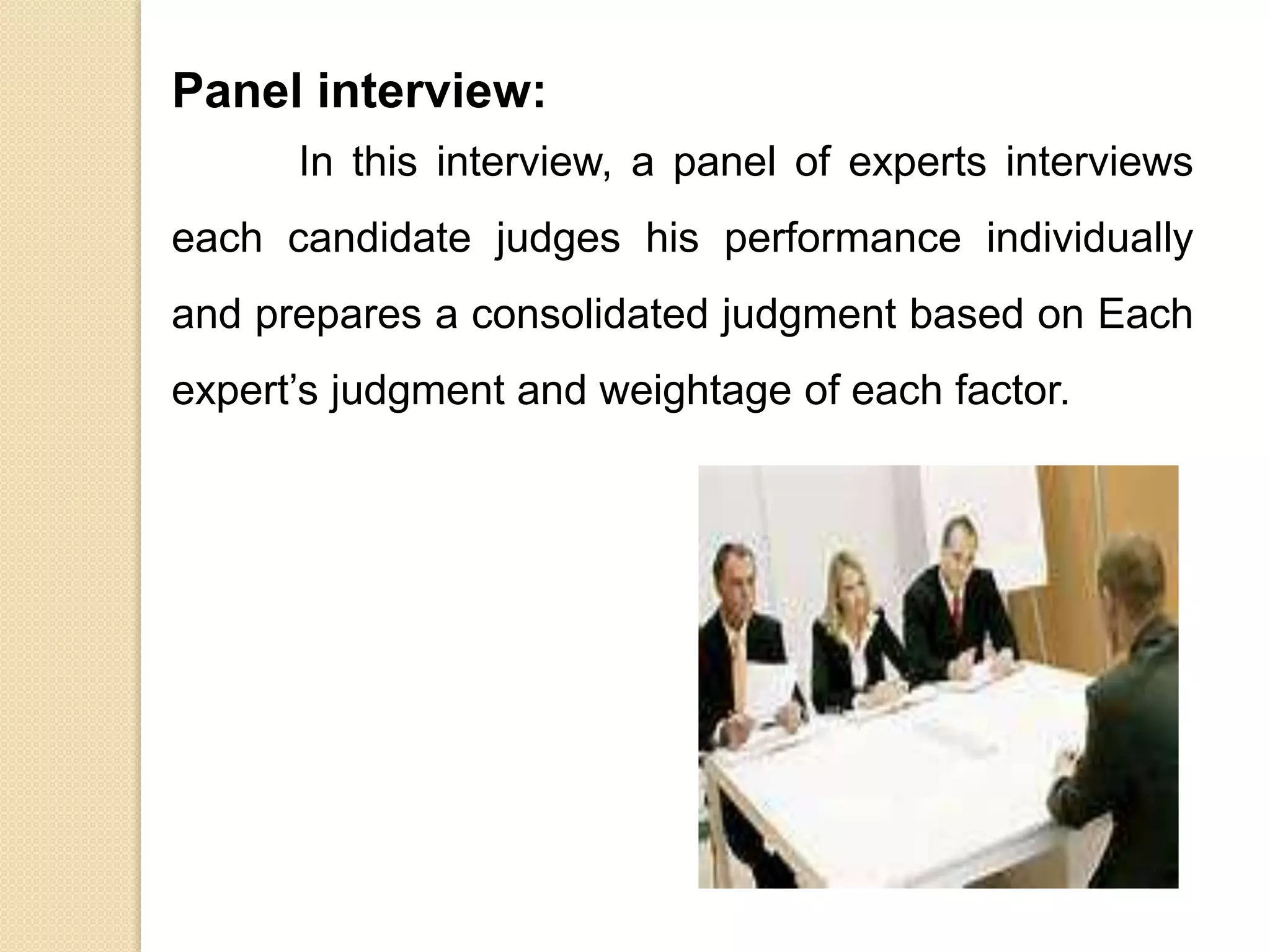
Panel interview:
In this interview, a panel of experts interviews
each candidate judges his performance individually
and prepares a consolidated judgment based on Each
expert’s judgment and weightage of each factor.
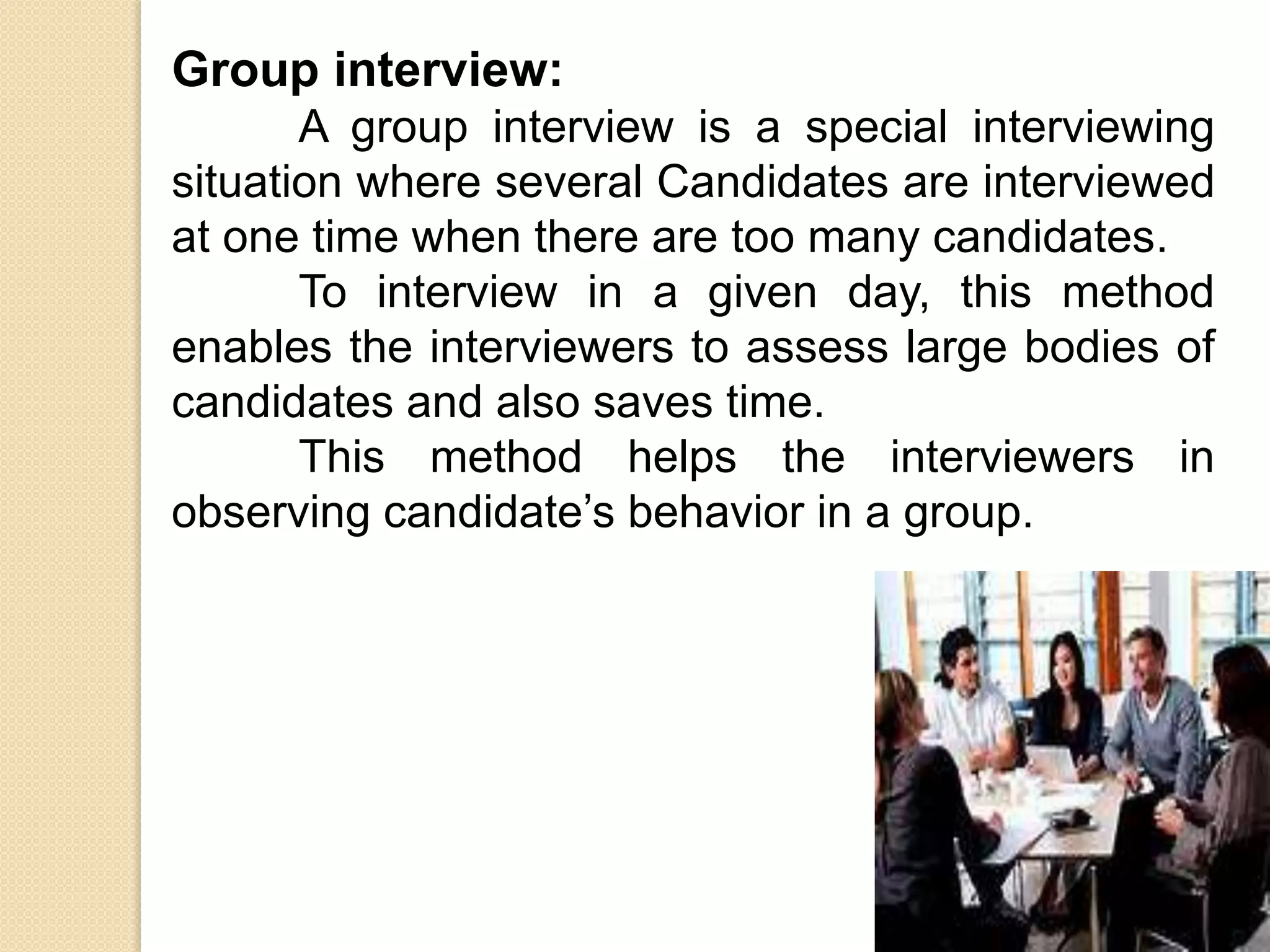
Group interview:
A group interview is a special interviewing
situation where several Candidates are interviewed
at one time when there are too many candidates.
To interview in a given day, this method
enables the interviewers to assess large bodies of
candidates and also saves time.
This method helps the interviewers in
observing candidate’s behavior in a group.
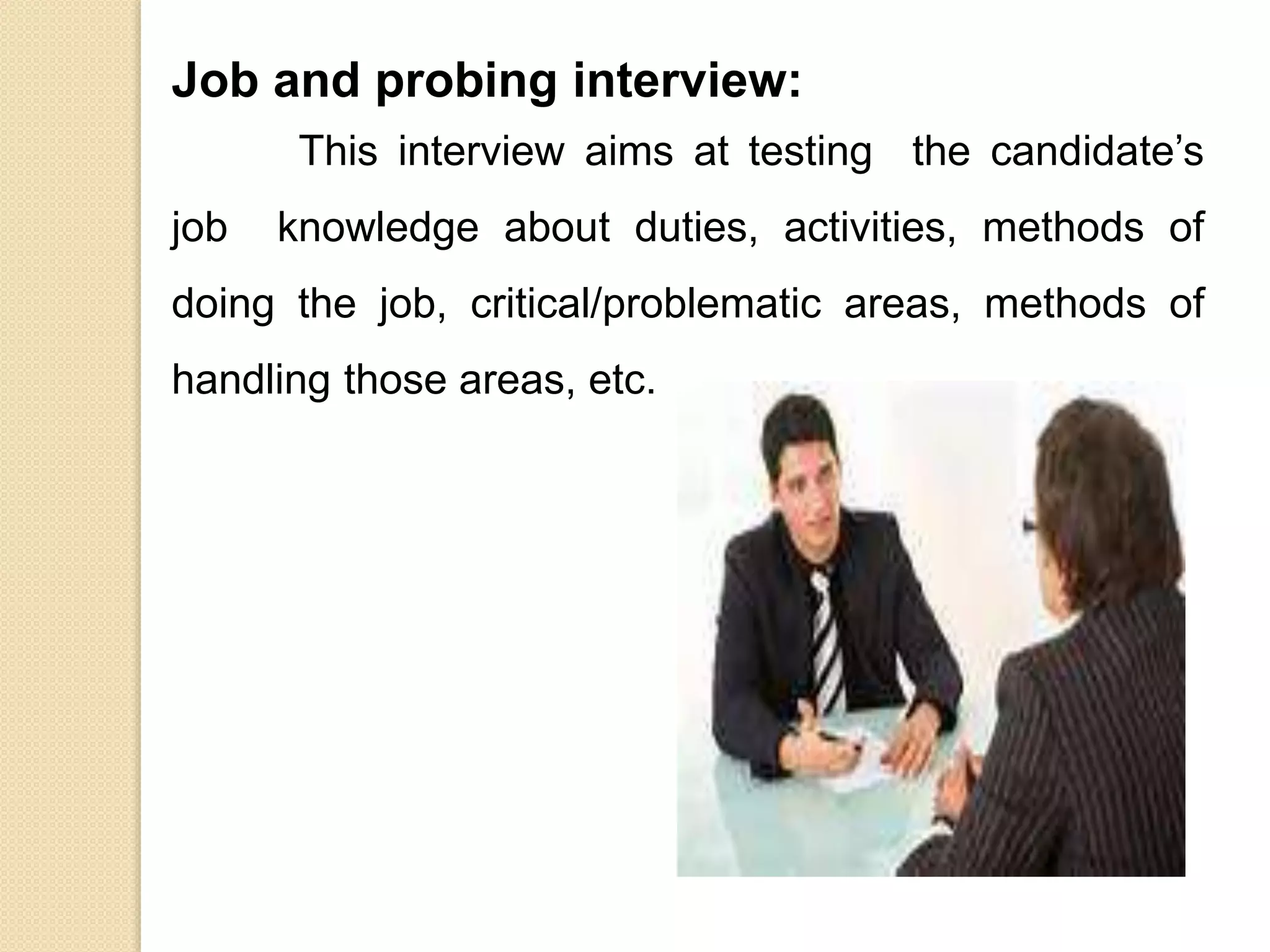
Job and probing interview:
This interview aims at testing the candidate’s
job knowledge about duties, activities, methods of
doing the job, critical/problematic areas, methods of
handling those areas, etc.
Decision making interview:
In this interview, the head of the
department/ section concerned interviews the
candidate once again, mostly through informal
discussion. The personnel manager also
interviews the candidates with a view to find
out his reaction/acceptance regarding salary,
allowances, promotional opportunities.
Depth interview:
In this type of interview, the candidates
would be examined extensively in core areas
of knowledge and skills of the job.
Advantages of interviews
 Selection of suitable candidate:
Suitable candidates can be selected
through interview because the
interview can know a lot about the
candidate by this process.
 Collection of primary information:
Interview can help to collect the fresh,
new and primary information as
needed
Advantages of interviews
 Increasing knowledge: Any
interview increases the
knowledge of both the interviewer
and the interviewee. They can
interchange their views and ideas.
Advantages of interviews
 Solving labour problems: Labour
unrest and other disputes are very
common in the industries.
Sometimes human resource
managers use the interview as a
means of revealing actual causes
behind the labour deputes.
disAdvantages of interviews
 Disappointment: Interviewee may be
disappointed while she or he faces the
interviewer’s questions which are not
related to the field. That is why suitable
candidate may be neglected.
 Biases of interviewer: Always there is a
possibility that the interview process can
be influenced by the biases of the
interviewer
disAdvantages of interviews
 Time consuming: Time constrain is one of
the major limitations of the interview
process. Preparation for the interview,
taking interviews and interpretation of the
responses required much time which
makes the interview method time
consuming.
THANK YOU

Types of Interviews

  • 1.
    Subject : HumanResources management Topic: Types Of Interviews By A. Raja
  • 2.
    Introduction  The wordinterview comes from Latin and middle French words meaning to “see between” or “see each other”.  Generally, interview means a private meeting between people when questions are asked and answered.  The person who answers the questions of an interview is called in interviewee. The person who asks the questions of our interview is called an interviewer.  It suggests a meeting between two persons for the purpose of getting a view of each other or for knowing each other.
  • 3.
    INTERVIEW The interview isa selection technique which enables the employer to view the total individual and directly appraise him and his behavior. It is a method by which an Idea about an applicant’s personality can be obtained by a face-to-face contact. According to Scott, “An interview is a purposeful exchange of ideas, the answering of questions and communication between two or more persons”.
  • 4.
    Interview techniques Various techniquesof employment interviews are adopted to solicit different kinds of information and to measure the candidate’s skills, knowledge, etc., at different planes. Employment interviews can be divided into following Categories:
  • 5.
  • 6.
    •Preliminary interview: It isgenerally regarded as exchange of basic information between the candidate and the personal manager about the job and organization, like job nature,salary,working conditions,benefits etc., this interview is mainly divided into following types: •Informal interview • unstructured interview
  • 7.
    • Unstructured interview: Inthis interview the candidate is given the freedom to tell himself by revealing his knowledge on various items/areas, his background, expectations Interests etc. similarly, the interviewer also provides information on various items required by the candidate. • Informal interview: This is the interview which can be conducted at any place by any person to secure the basic and non-job related information.
  • 8.
    Core interview: Itis normally the interaction between candidate and the line executive or experts on various areas of job knowledge, skills, talent etc. This interview may take Various forms like: 1.Background information interview 2.Stress interview 3.Formal and unstructured interview 4.Panel interview 5.Group interview 6.Job and probing interview 7.Depth interview
  • 9.
    Background informational interview: Thisinterview is intended to collect the information Which is not available in the application blank and to check the information provided to the application blank regarding education, place of domicile, family, health, interests, Hobbies, likes, dislikes, extracurricular activities of the applicant.
  • 10.
    Stress interview: This interviewaims at testing the candidate’s job behavior and level Of withstanding during the periods of stress and strain.
  • 11.
    Formal and structured interview: Inthis type of interview, all the formalities, procedures Like fixing the value, time, panel of interviewers, opening and closing, intimating the candidates officially, etc., are strictly followed in arranging and conducting the Interview. The course of the interview is pre- planned and structured, in advance depending on Job requirements.
  • 12.
    Panel interview: In thisinterview, a panel of experts interviews each candidate judges his performance individually and prepares a consolidated judgment based on Each expert’s judgment and weightage of each factor.
  • 13.
    Group interview: A groupinterview is a special interviewing situation where several Candidates are interviewed at one time when there are too many candidates. To interview in a given day, this method enables the interviewers to assess large bodies of candidates and also saves time. This method helps the interviewers in observing candidate’s behavior in a group.
  • 14.
    Job and probinginterview: This interview aims at testing the candidate’s job knowledge about duties, activities, methods of doing the job, critical/problematic areas, methods of handling those areas, etc.
  • 15.
    Decision making interview: Inthis interview, the head of the department/ section concerned interviews the candidate once again, mostly through informal discussion. The personnel manager also interviews the candidates with a view to find out his reaction/acceptance regarding salary, allowances, promotional opportunities. Depth interview: In this type of interview, the candidates would be examined extensively in core areas of knowledge and skills of the job.
  • 16.
    Advantages of interviews Selection of suitable candidate: Suitable candidates can be selected through interview because the interview can know a lot about the candidate by this process.  Collection of primary information: Interview can help to collect the fresh, new and primary information as needed
  • 17.
    Advantages of interviews Increasing knowledge: Any interview increases the knowledge of both the interviewer and the interviewee. They can interchange their views and ideas.
  • 18.
    Advantages of interviews Solving labour problems: Labour unrest and other disputes are very common in the industries. Sometimes human resource managers use the interview as a means of revealing actual causes behind the labour deputes.
  • 19.
    disAdvantages of interviews Disappointment: Interviewee may be disappointed while she or he faces the interviewer’s questions which are not related to the field. That is why suitable candidate may be neglected.  Biases of interviewer: Always there is a possibility that the interview process can be influenced by the biases of the interviewer
  • 20.
    disAdvantages of interviews Time consuming: Time constrain is one of the major limitations of the interview process. Preparation for the interview, taking interviews and interpretation of the responses required much time which makes the interview method time consuming.
  • 21.