INTERVIEW AND ITS
VARIOUS TYPES
SUBMITTED BY : KOMAL SAHI
MBA-HR Semester 1
What is an interview?
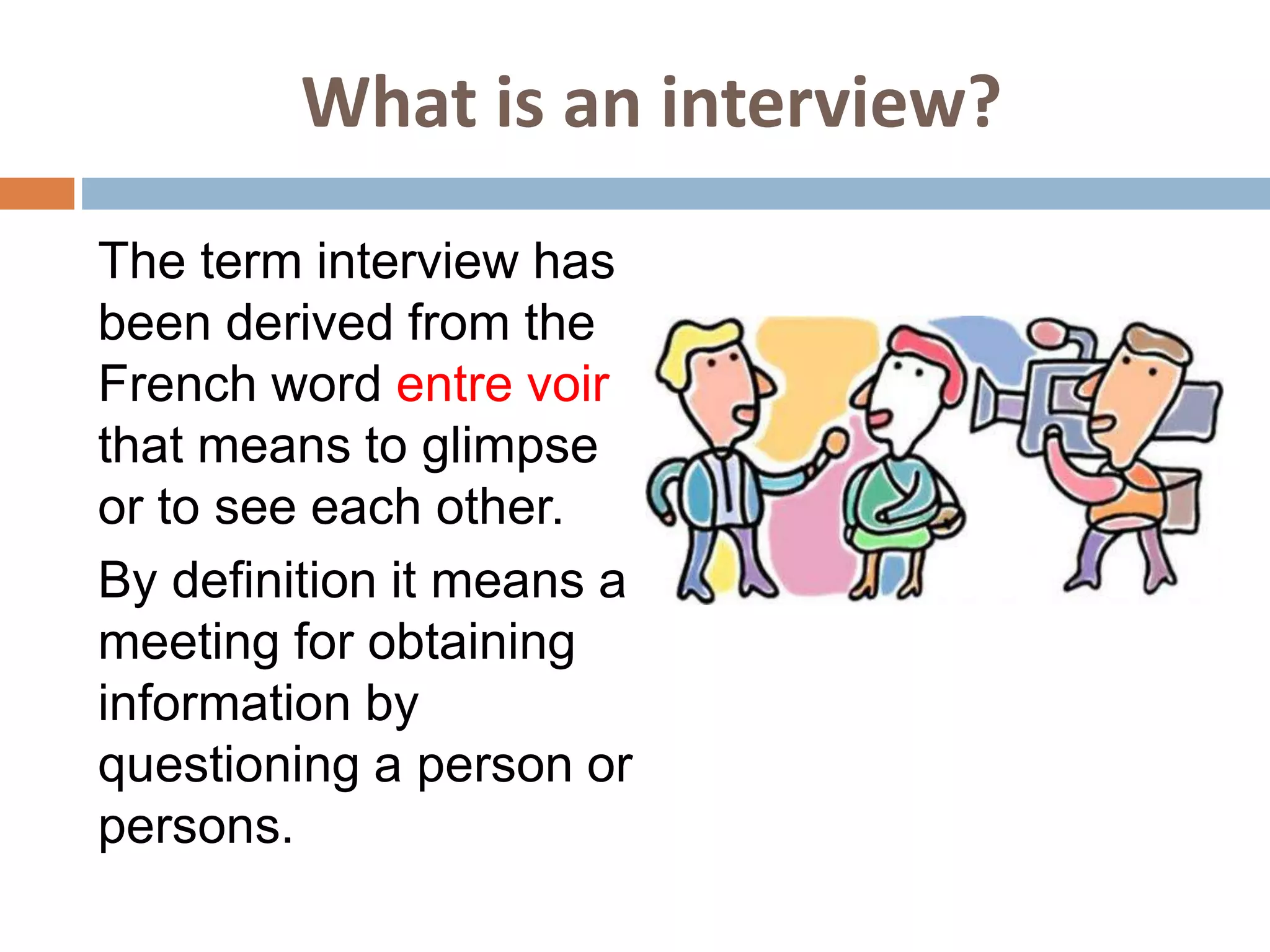
The term interview has
been derived from the
French word entre voir
that means to glimpse
or to see each other.
By definition it means a
meeting for obtaining
information by
questioning a person or
persons.
 A formal meeting at which somebody is asked
questions to see if they are suitable for a
particular job or course of study of a
college/university.
 Private meeting between people where
questions are asked and answered.
 To ask somebody about their life, opinions
especially on radio or television or for the
newspaper or magazine.
 To give an interview is to agree to answer
questions.
Interview as defined by The
Oxford Advanced Learner’s
dictionary
Meaning of the term
‘Interview’
 Basically ,an interview is a conversation between two
people (the interviewer and the interviewee) where
questions are asked by the interviewer to obtain
information from the interviewee.
 The word interview can have different meanings. For
example a reporter interviews a celebrity for television.
This kind of interviews can be one-on-one but usually
when it comes to television there are many reporters from
different channels.
 There are also job interviews which a person has to go
through in order to get a job he wants. Job interviews are
usually face-to-face interviews and include paperwork.
 During an interview you can expect to be asked questions
about your educational background, previous work
experiences and questions relating to your personal
characteristics and goals. But what happens after that? It
depends on what interview style your interviewer prefers.
Below are some of the more common interview styles
used.
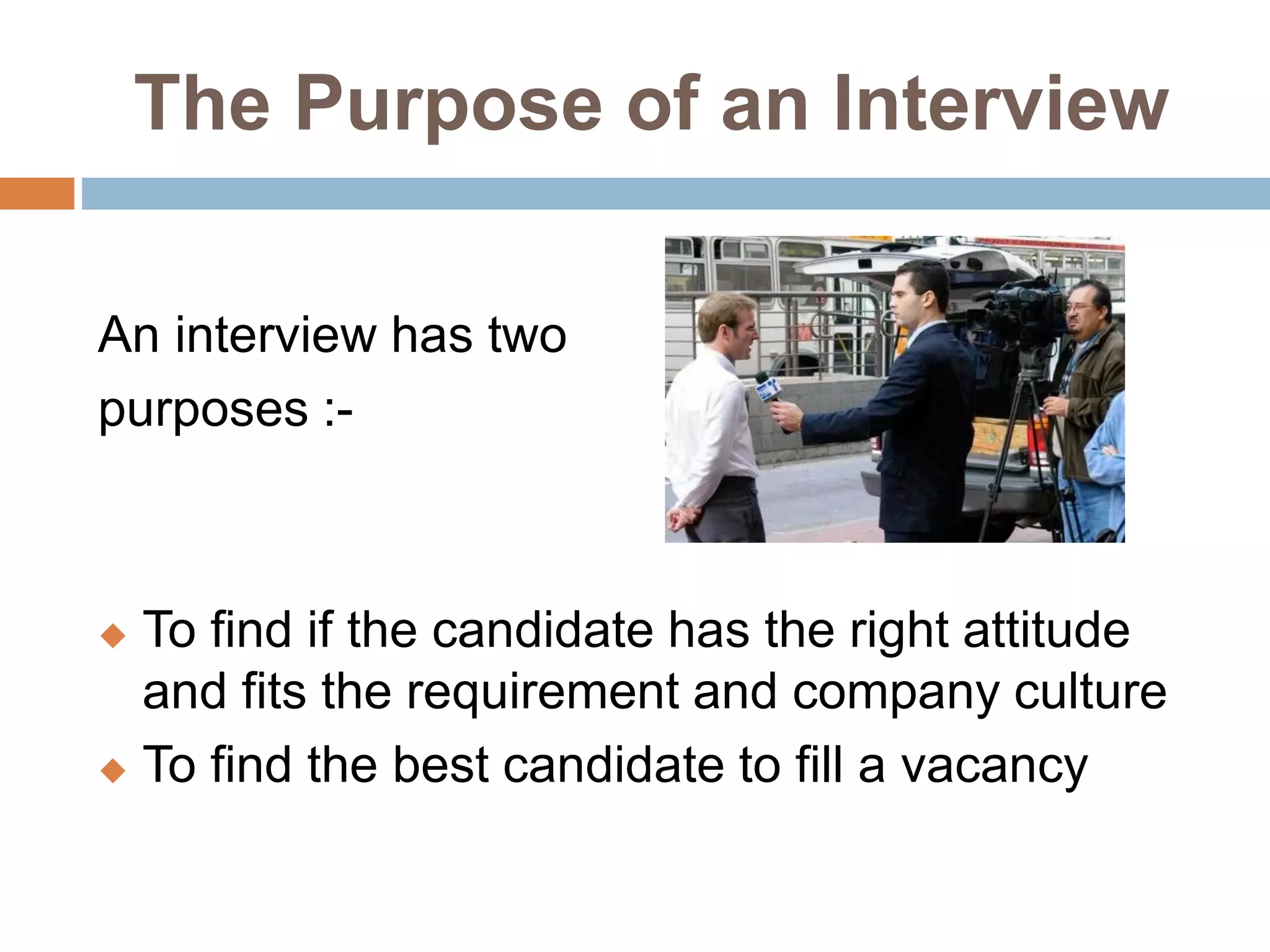
The Purpose of an Interview
An interview has two
purposes :-
 To find if the candidate has the right attitude
and fits the requirement and company culture
 To find the best candidate to fill a vacancy
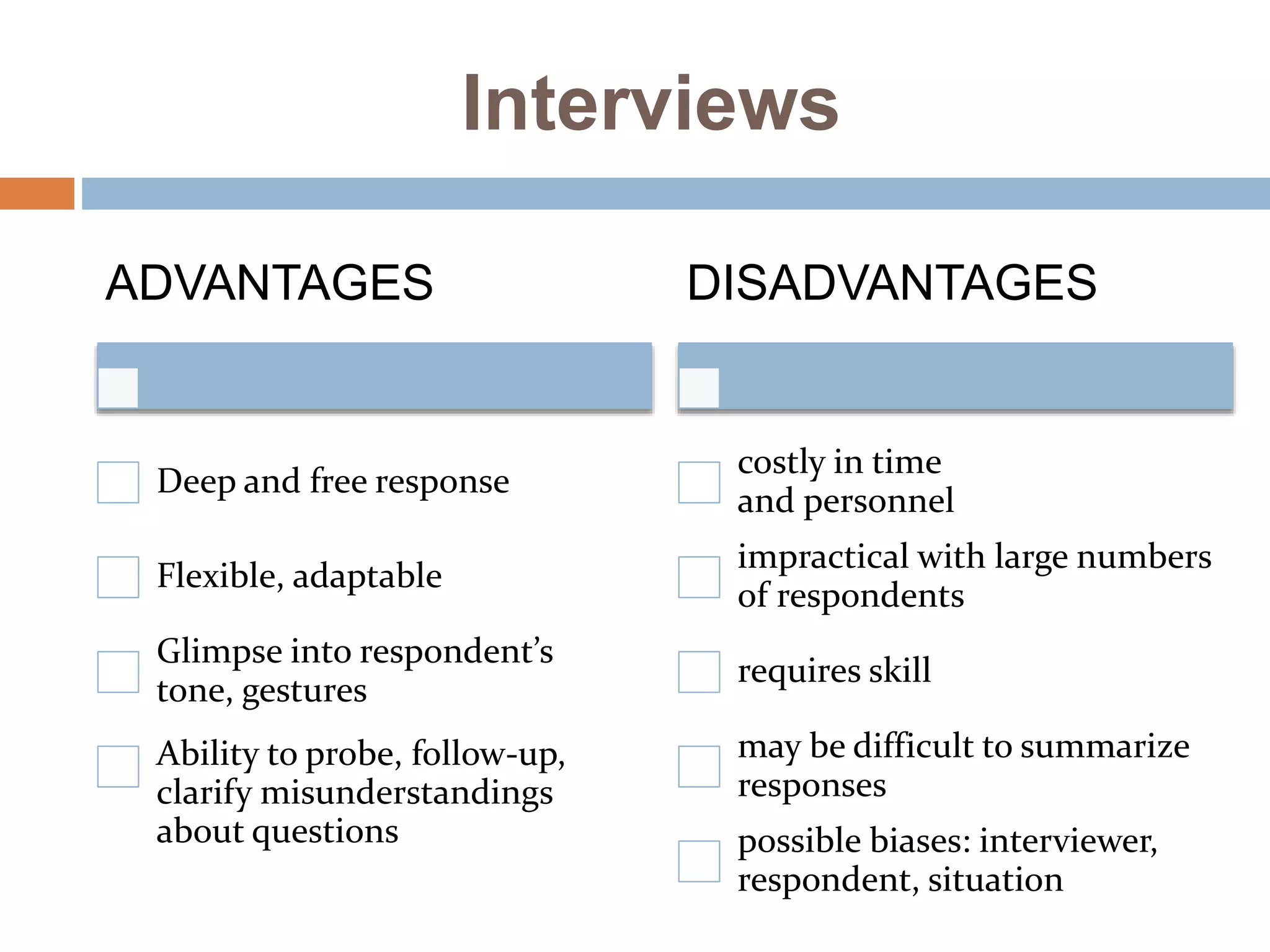
Interviews
ADVANTAGES
Deep and free response
Flexible, adaptable
Glimpse into respondent’s
tone, gestures
Ability to probe, follow-up,
clarify misunderstandings
about questions
DISADVANTAGES
costly in time
and personnel
impractical with large numbers
of respondents
requires skill
may be difficult to summarize
responses
possible biases: interviewer,
respondent, situation
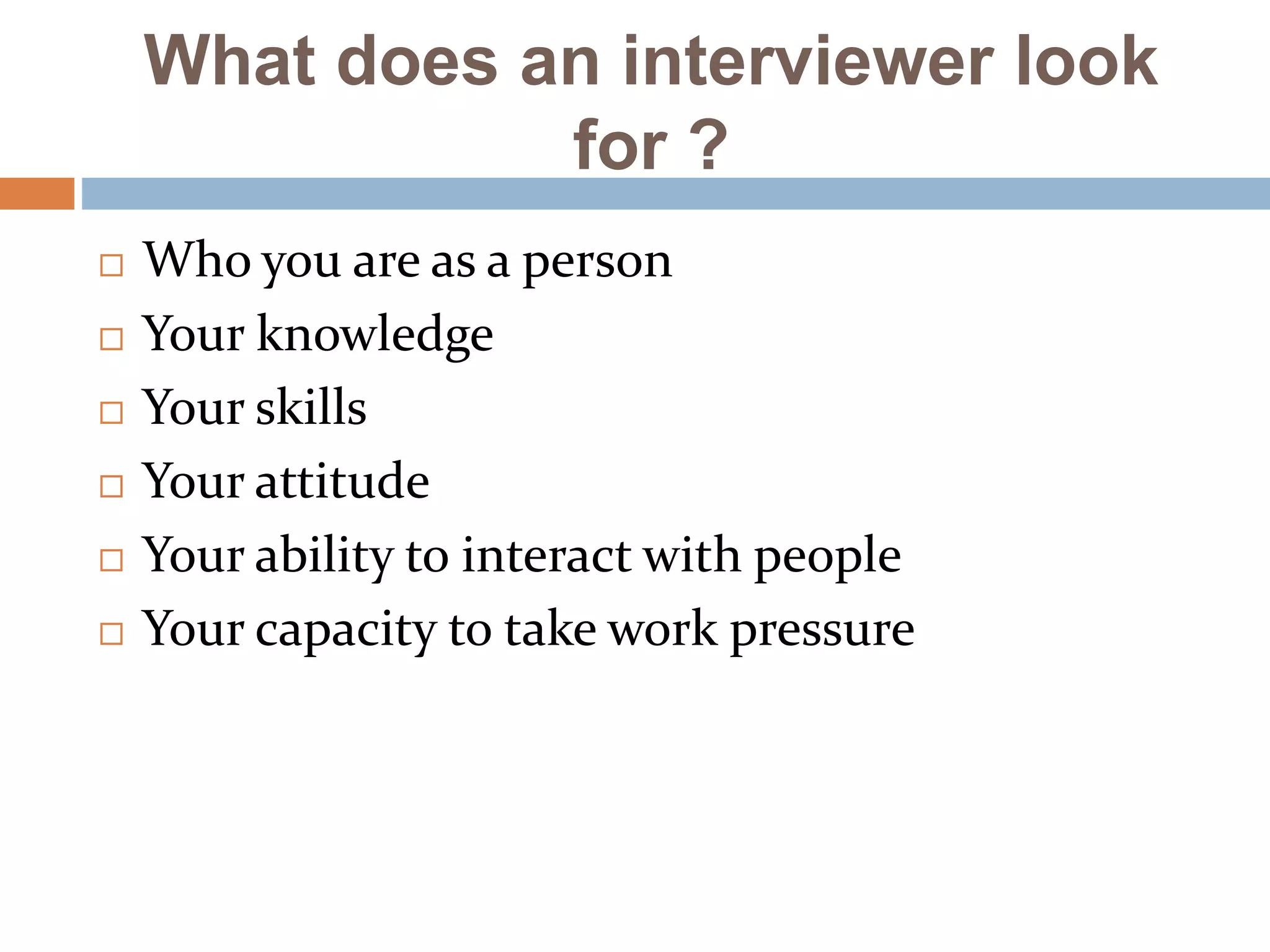
What does an interviewer look
for ?
 Who you are as a person
 Your knowledge
 Your skills
 Your attitude
 Your ability to interact with people
 Your capacity to take work pressure
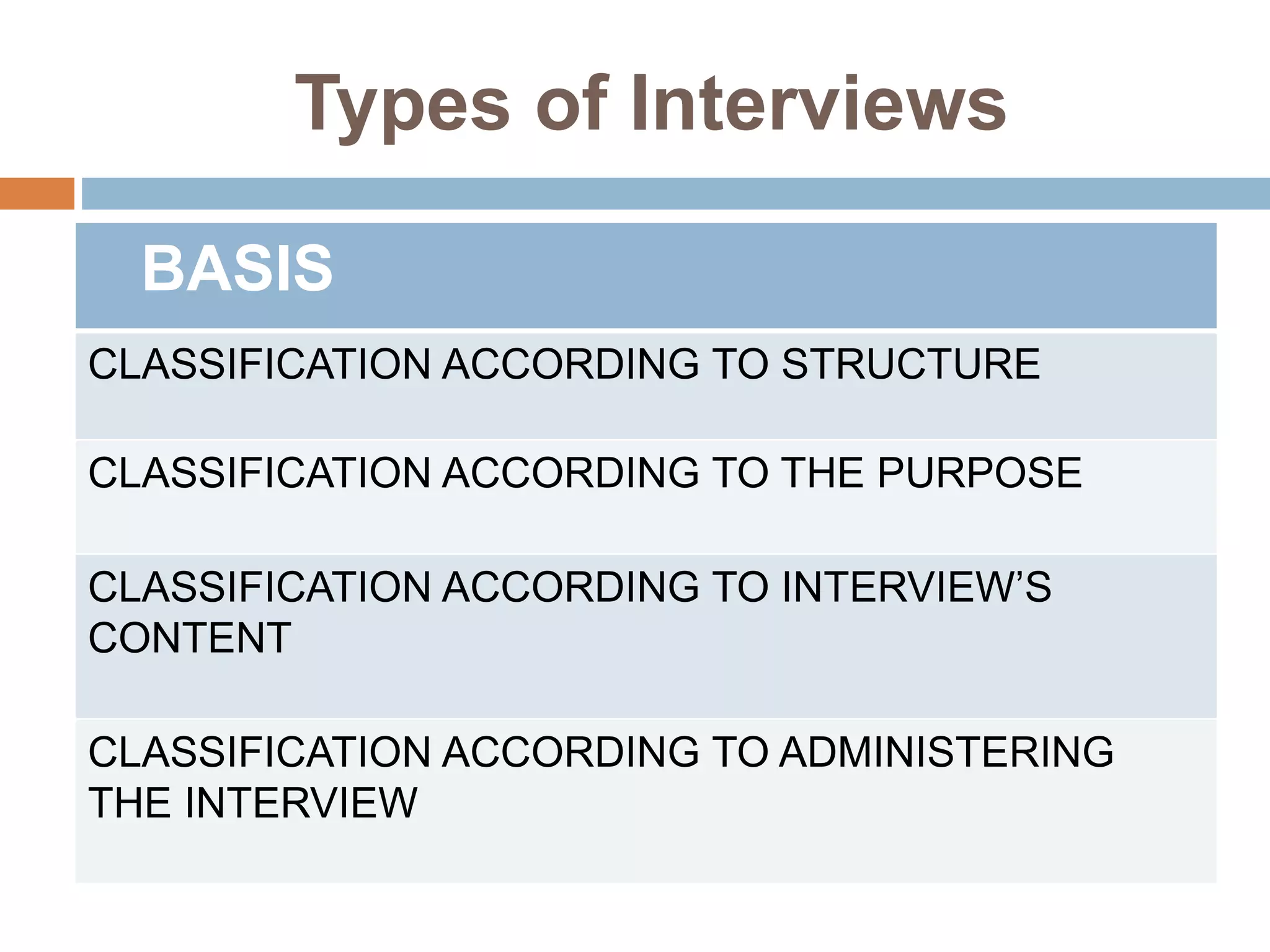
Types of Interviews
BASIS
CLASSIFICATION ACCORDING TO STRUCTURE
CLASSIFICATION ACCORDING TO THE PURPOSE
CLASSIFICATION ACCORDING TO INTERVIEW’S
CONTENT
CLASSIFICATION ACCORDING TO ADMINISTERING
THE INTERVIEW
I. CLASSIFICATION ACCORDING TO
STRUCTURE
 1. STRUCTURED OR DIRECT INTERVIEW
 The questions and acceptable responses are
specified in advance
 Responses are rated for appropriateness of
content
 Also called standardized interviews as they are
pre planned to a high degree of accuracy and
precision
 2. UNSTRUCTURED OR INDIRECT
INTERVIEW OR OPEN-ENDED INTERVIEW
 Not directed by questions or comments as to
what the candidate should be asked
 No set format is followed
 Candidate is encouraged to express himself on
any topic of his interest, his expectations,
background etc.
 Interviewers look for traits of character and
nature of his aspirations, strengths,
weaknesses, potential etc.
 3. SEMI-STRUCTURED INTERVIEW
 specific topic areas
 a general set of questions
 but the interview flows like a conversation and
topics are covered as they come up.
Pros and Cons of Structured &
Unstructured Interview
 STRUCTURED INTERVIEWS
 More reliable and valid as all candidates are
asked the same set of questions
 Enhance consistency across candidates
 UNSTRUCTURED INTERVIEWS
 Flexibility to pursue points of interest as they
develop
 Help in assessing the clarity of thoughts of the
candidate
II. CLASSIFICATION ACCORDING TO
PURPOSE
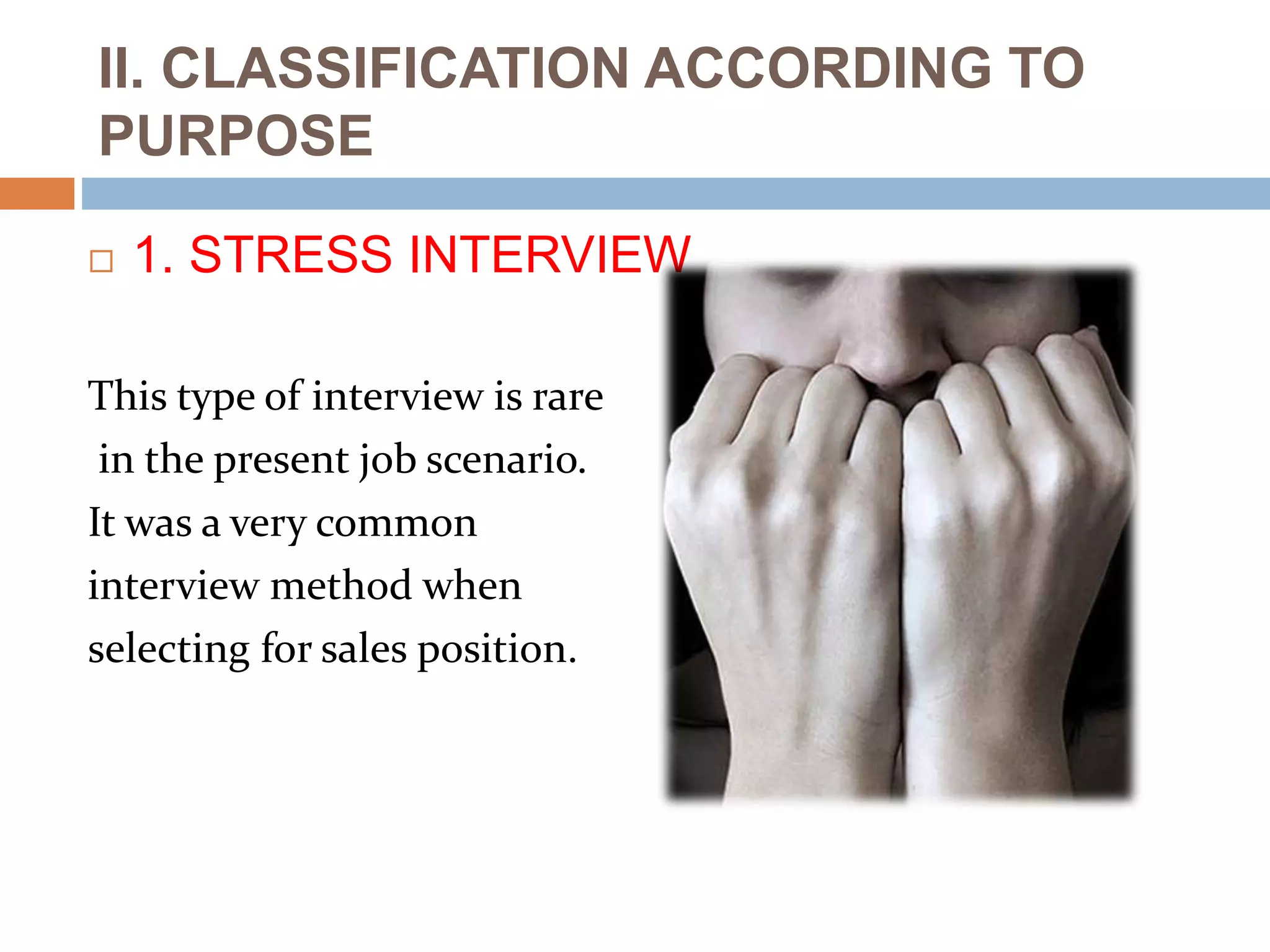
 1. STRESS INTERVIEW
This type of interview is rare
in the present job scenario.
It was a very common
interview method when
selecting for sales position.
Stress interview means-
 Being asked more than one question at a time;
 Being asked further questions without being allowed
adequate time to respond;
 The interviewer adopts a hostile behavior and deliberately
puts the candidate on defensive by trying to annoy,
embarrass or frustrate him;
 He asks questions rapidly, criticizes his/her answers,
interrupts him/her frequently, makes derogatory remarks
etc.
 Having his/her feelings provoked.
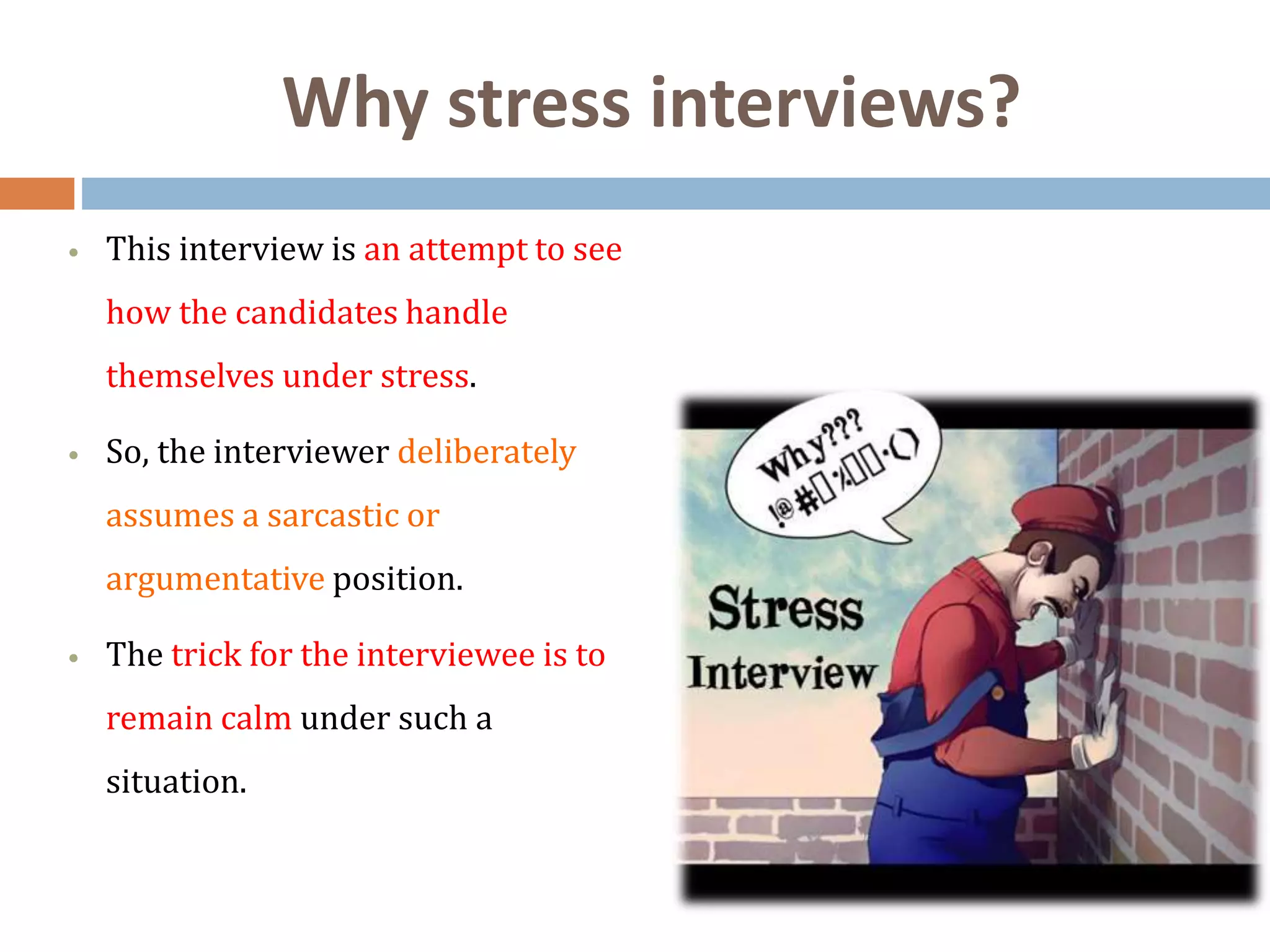
Why stress interviews?
 This interview is an attempt to see
how the candidates handle
themselves under stress.
 So, the interviewer deliberately
assumes a sarcastic or
argumentative position.
 The trick for the interviewee is to
remain calm under such a
situation.
 2. APPRAISAL/ ASSESSMENT INTERVIEW
 A discussion following a performance appraisal
 In which the supervisor and employee discuss
the employee’s rating and
 Possible remedial actions to be taken.
 3. EXIT INTERVIEW
 When an employee leaves the company for
any reason, an exit interview is conducted
 Aims at eliciting information about the job or
related matters
 Help the employer in having a better insight
into what is right or wrong about the company
 Highlights the work of an HR Manager
III. CLASSIFICATION ACCORDING TO
ADMINISTERING INTERVIEW
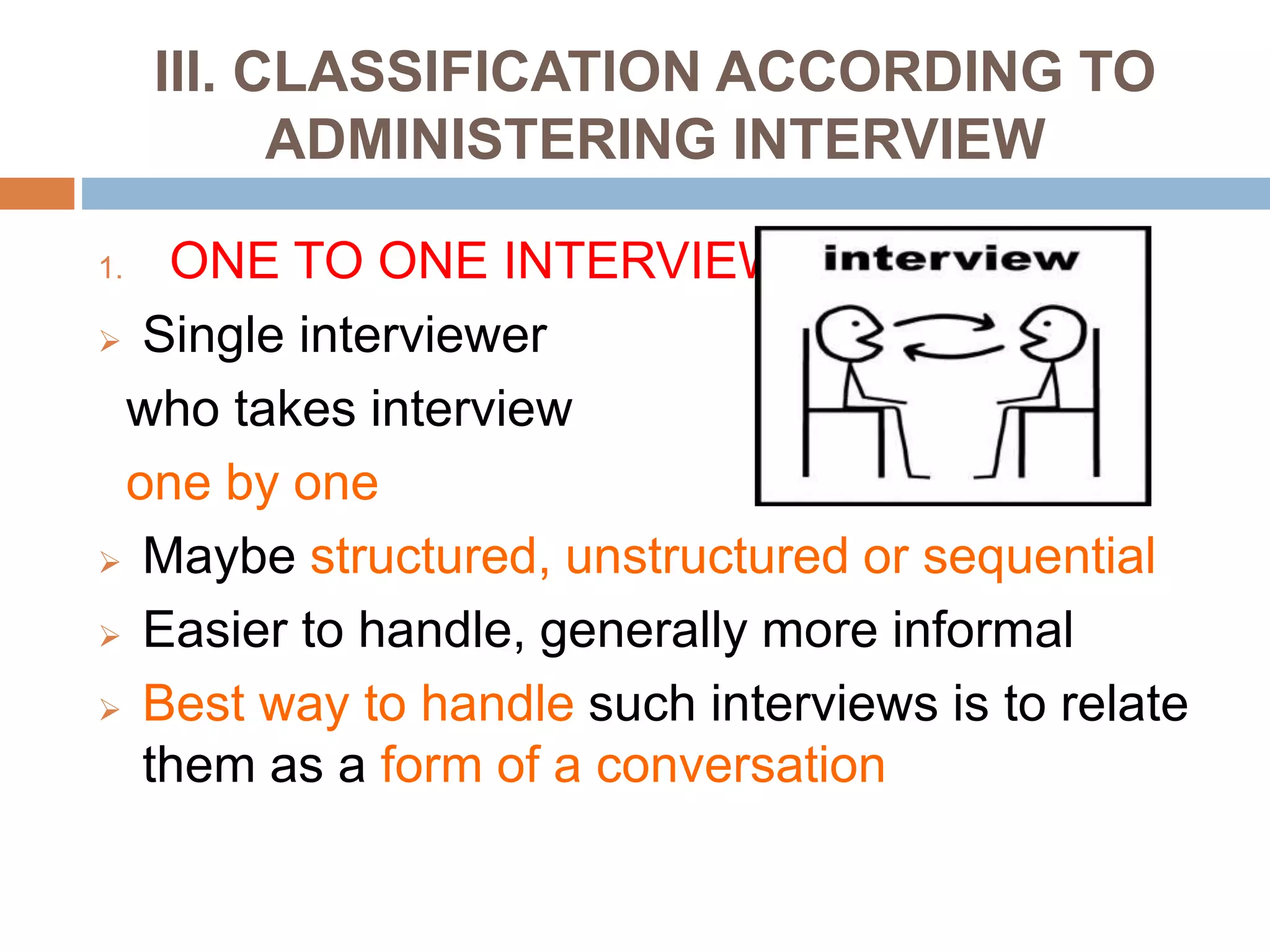
1. ONE TO ONE INTERVIEW
 Single interviewer
who takes interview
one by one
 Maybe structured, unstructured or sequential
 Easier to handle, generally more informal
 Best way to handle such interviews is to relate
them as a form of a conversation
 2. SEQUENTIAL/SERIAL INTERVIEW
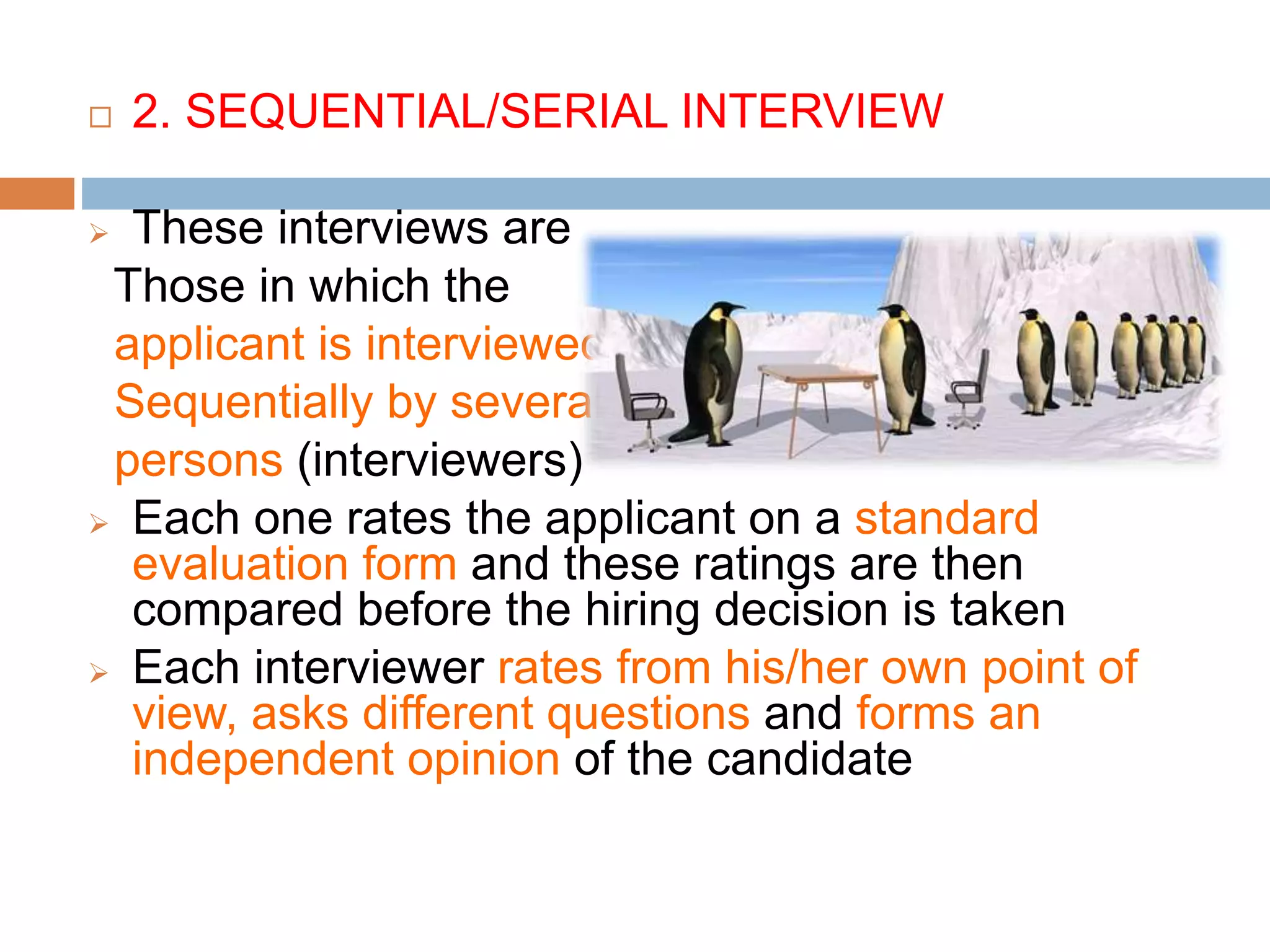
 These interviews are
Those in which the
applicant is interviewed
Sequentially by several
persons (interviewers)
 Each one rates the applicant on a standard
evaluation form and these ratings are then
compared before the hiring decision is taken
 Each interviewer rates from his/her own point of
view, asks different questions and forms an
independent opinion of the candidate
 3. GROUP INTERVIEW/ GROUP
DISCUSSION
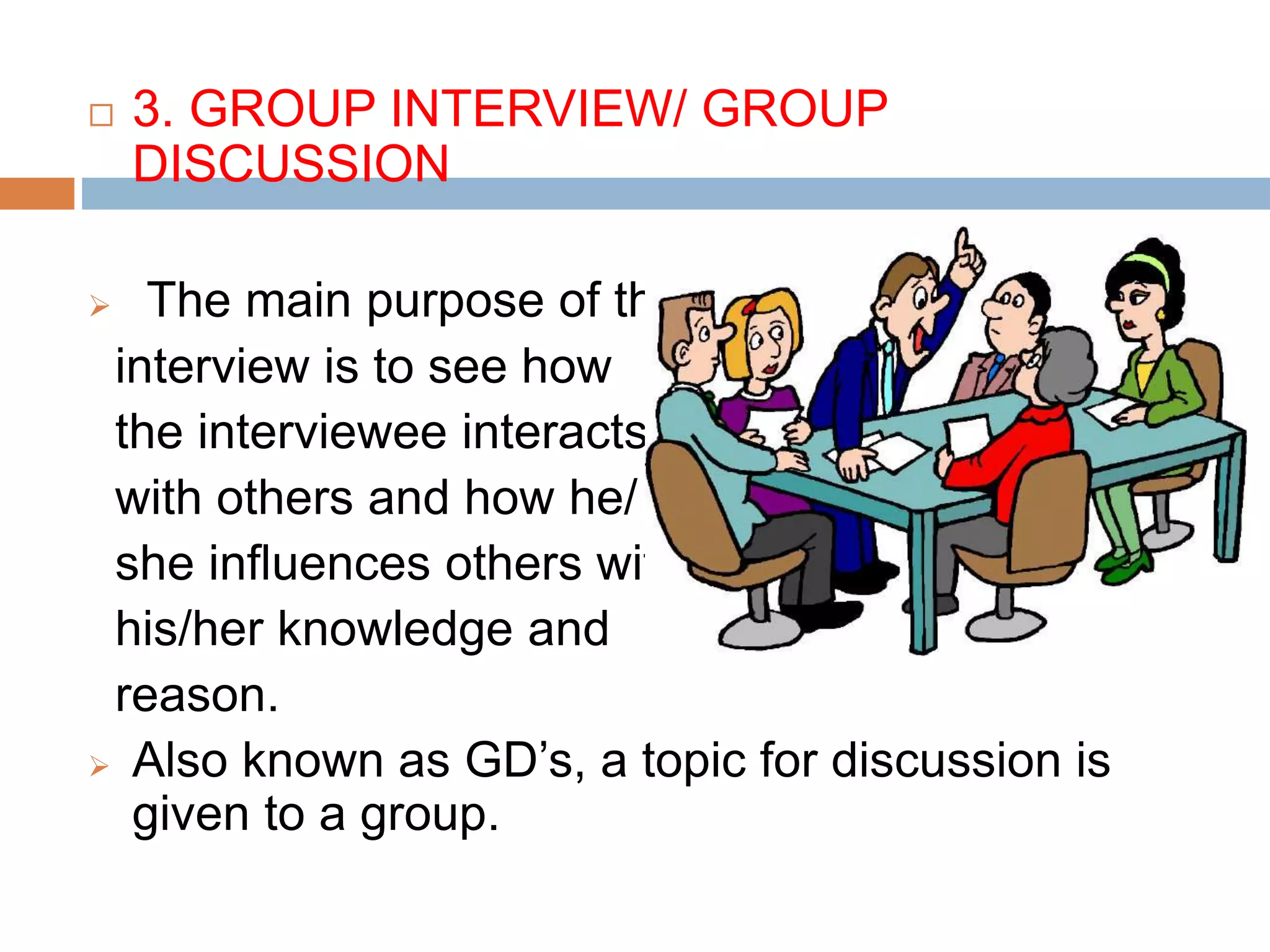
 The main purpose of this
interview is to see how
the interviewee interacts
with others and how he/
she influences others with
his/her knowledge and
reason.
 Also known as GD’s, a topic for discussion is
given to a group.
Why group interviews?
 Group interview is also the best
way to discover any leadership
potential, group participation, team
playing skills and communication
skills among the candidates.
 The selected candidates from the group interview are then
taken for an informal one to one interview.
 4. PANEL INTERVIEW/ COMMITTEE
INTERVIEW
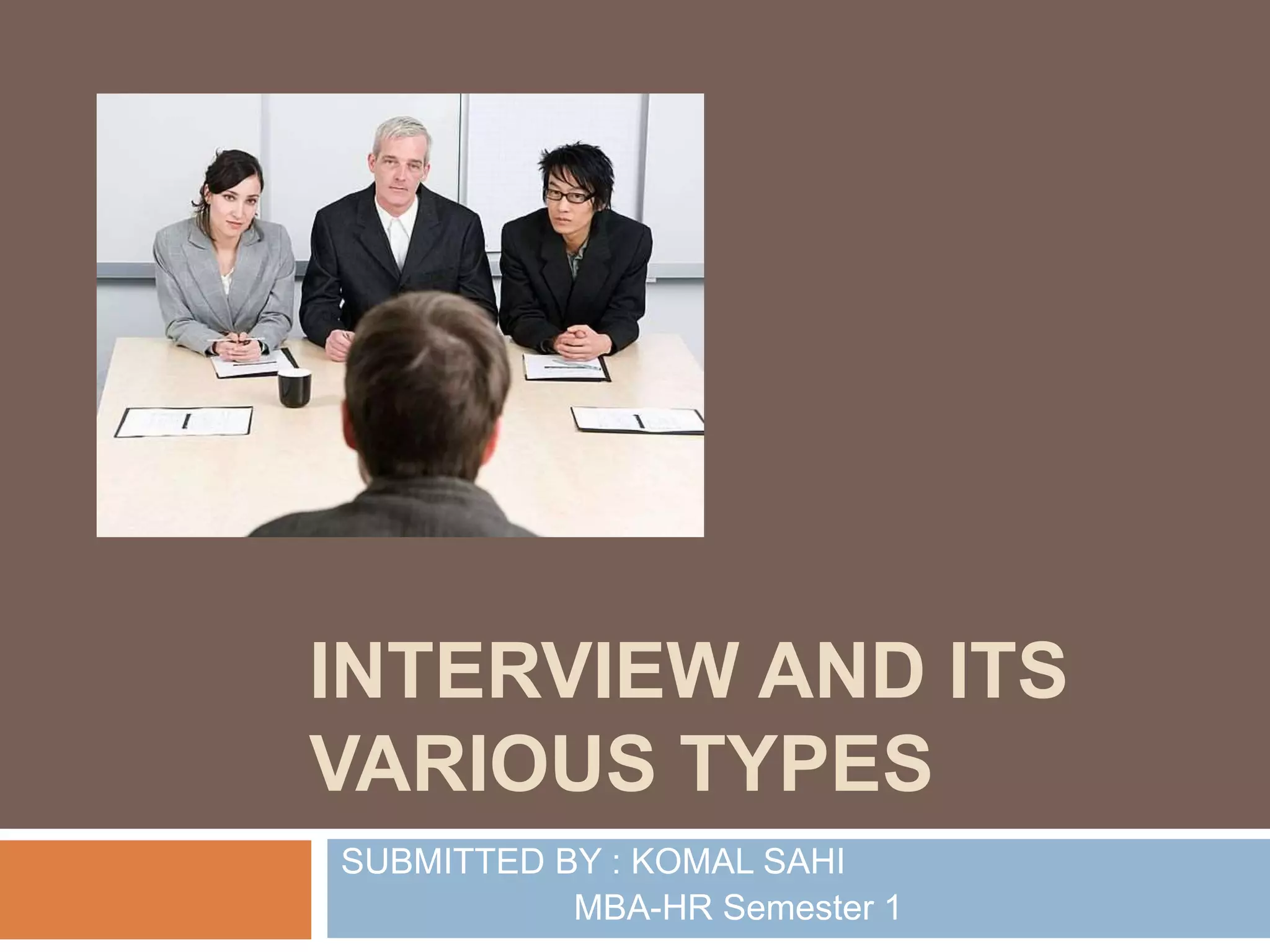
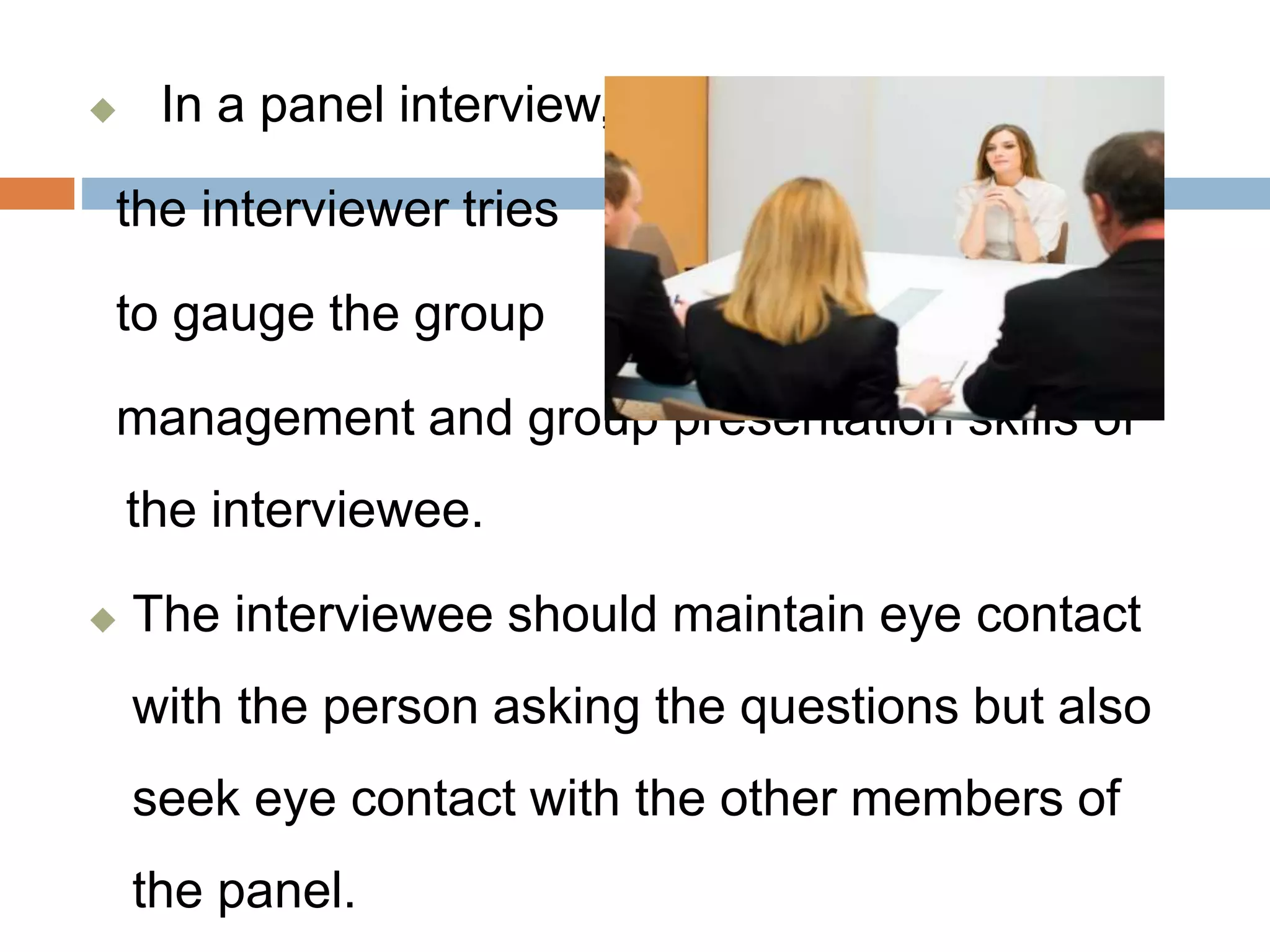
 A panel interview comprises more than two members
interviewing a person for the hiring.
 It is most common mode of interview when hiring at the
senior level.
 The interviewee should try to connect with each
interviewer and the best way to do this is to read the
personality of each interviewer.
 In a panel interview,
the interviewer tries
to gauge the group
management and group presentation skills of
the interviewee.
 The interviewee should maintain eye contact
with the person asking the questions but also
seek eye contact with the other members of
the panel.
IV. CLASSIFICATION ACCORDING TO
INTERVIEW’S CONTENT
1. SITUATIONAL INTERVIEW
 Here the interview will focus on the
individual’s ability to project what his behavior
will be in a given situation.
 The interview can be both structured and
situational with predetermined questions
requiring the candidate to project what his
behavior will be.
2. JOB RELATED INTERVIEW
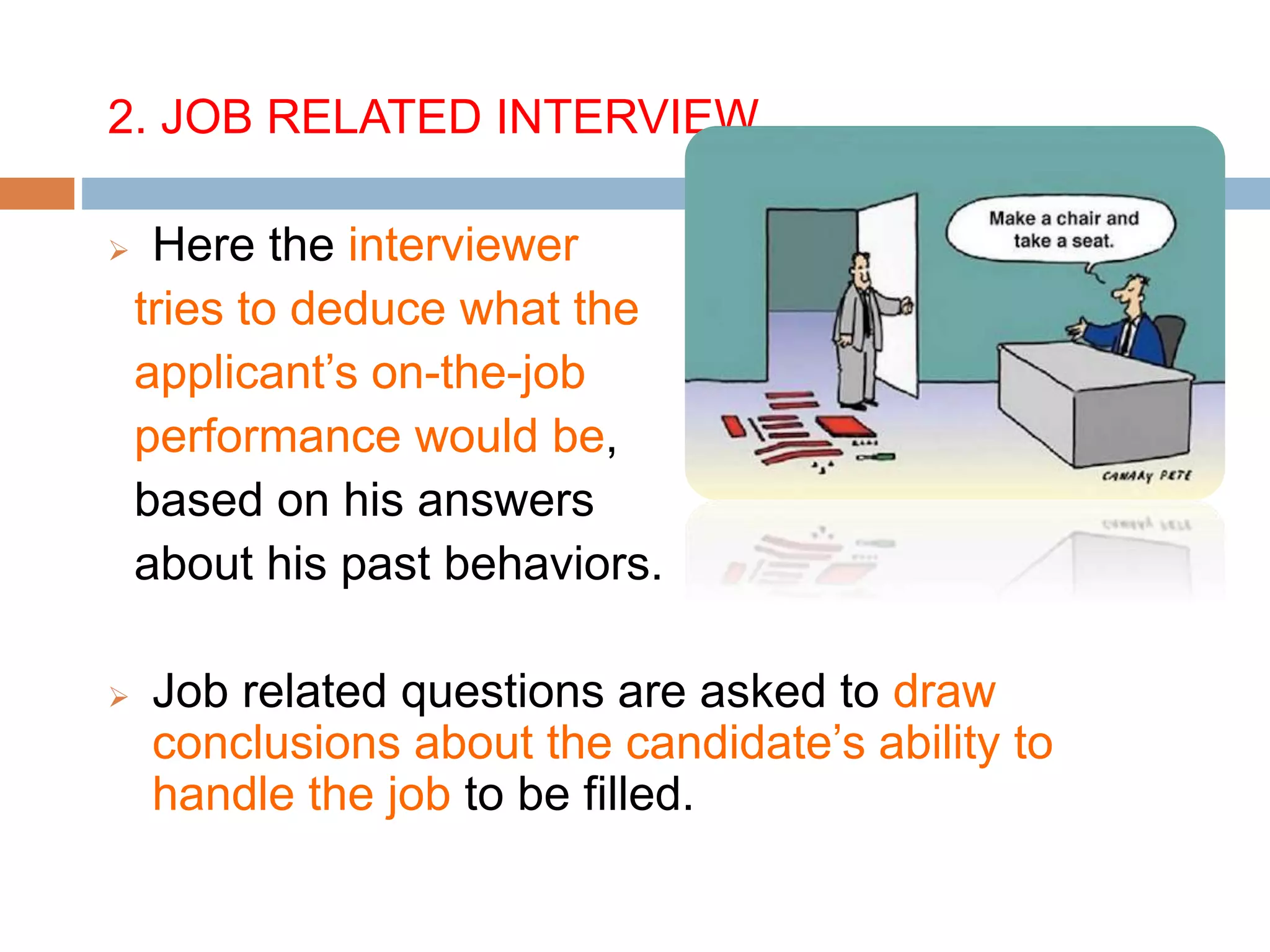
 Here the interviewer
tries to deduce what the
applicant’s on-the-job
performance would be,
based on his answers
about his past behaviors.
 Job related questions are asked to draw
conclusions about the candidate’s ability to
handle the job to be filled.
3. BEHAVIOURAL INTERVIEW
 Here a situation is described and candidates
are asked how they have behaved in the past
in such a situation.
 While situational interviews ask candidates to
describe how they would react to a situation in
future,
 The behavioral interviews seek candidates to
describe how did they react to situations in the
past.
4. PSYCHOLOGICAL INTERVIEWS
 Psychological interviews are interviews
conducted by a psychologist,
 In which questions are intended to assess
personal traits such as reliability or
dependability etc.
SOME MORE TYPES :-
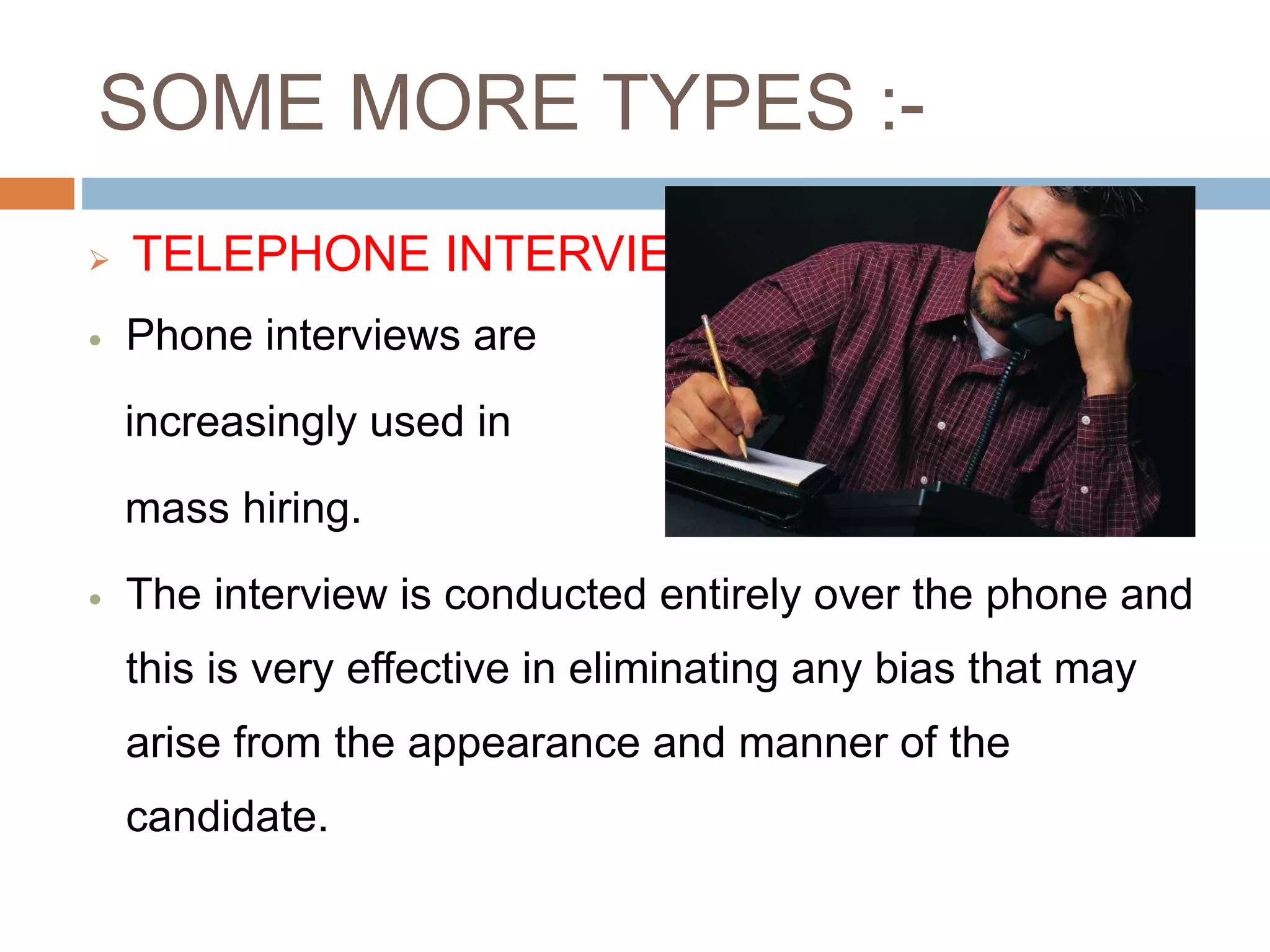
 TELEPHONE INTERVIEW
 Phone interviews are
increasingly used in
mass hiring.
 The interview is conducted entirely over the phone and
this is very effective in eliminating any bias that may
arise from the appearance and manner of the
candidate.
 PROMOTION INTERVIEW (of the employees who are due
for promotion)
 ANNUAL INTERVIEW (before writing annual reports,
reporting officer interacts with employees subordination)
 PERIODICAL INTERVIEW (with the existing employees)
 PROBLEM INTERVIEW (of an employee whose
performance is unsatisfactory-to find out reasons and find
solutions)
 COMPUTERIZED INTERVIEW (questions are presented
in MCQs)
 WALK-IN INTERVIEW (no specific candidates are called,
but those who are eligible can come with their valid
documents)
 VIDEO CONFERENCING (using video technology;
clothing, body language and dialogue are important here
as well)
FACTS YOU SHOULD KNOW ABOUT
THE COMPANY
 About the company, history, employment and
position in the industry
 Competitors
 Products and services
 Global presence
 Publications, blogs, presence in social media,
analysts’ review
 Finances of the company
 The position you have applied for
 Requirements of the specific position
Continued-
 Job profile
 Growth opportunities
 Salary offered for the role
 Requirement of travel
 Working hours to be put in
 Qualifications and any technical skills required
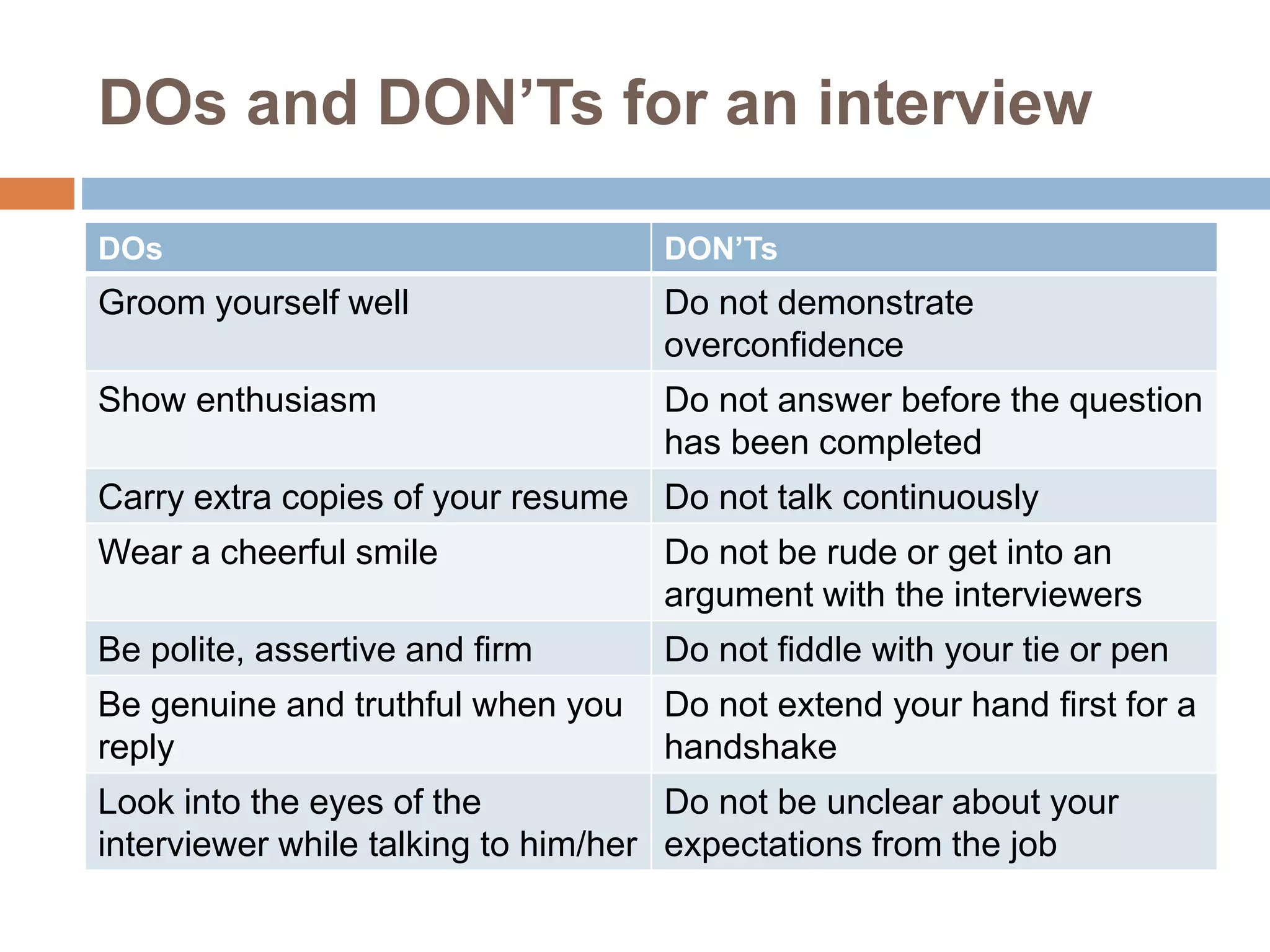
DOs and DON’Ts for an interview
DOs DON’Ts
Groom yourself well Do not demonstrate
overconfidence
Show enthusiasm Do not answer before the question
has been completed
Carry extra copies of your resume Do not talk continuously
Wear a cheerful smile Do not be rude or get into an
argument with the interviewers
Be polite, assertive and firm Do not fiddle with your tie or pen
Be genuine and truthful when you
reply
Do not extend your hand first for a
handshake
Look into the eyes of the
interviewer while talking to him/her
Do not be unclear about your
expectations from the job
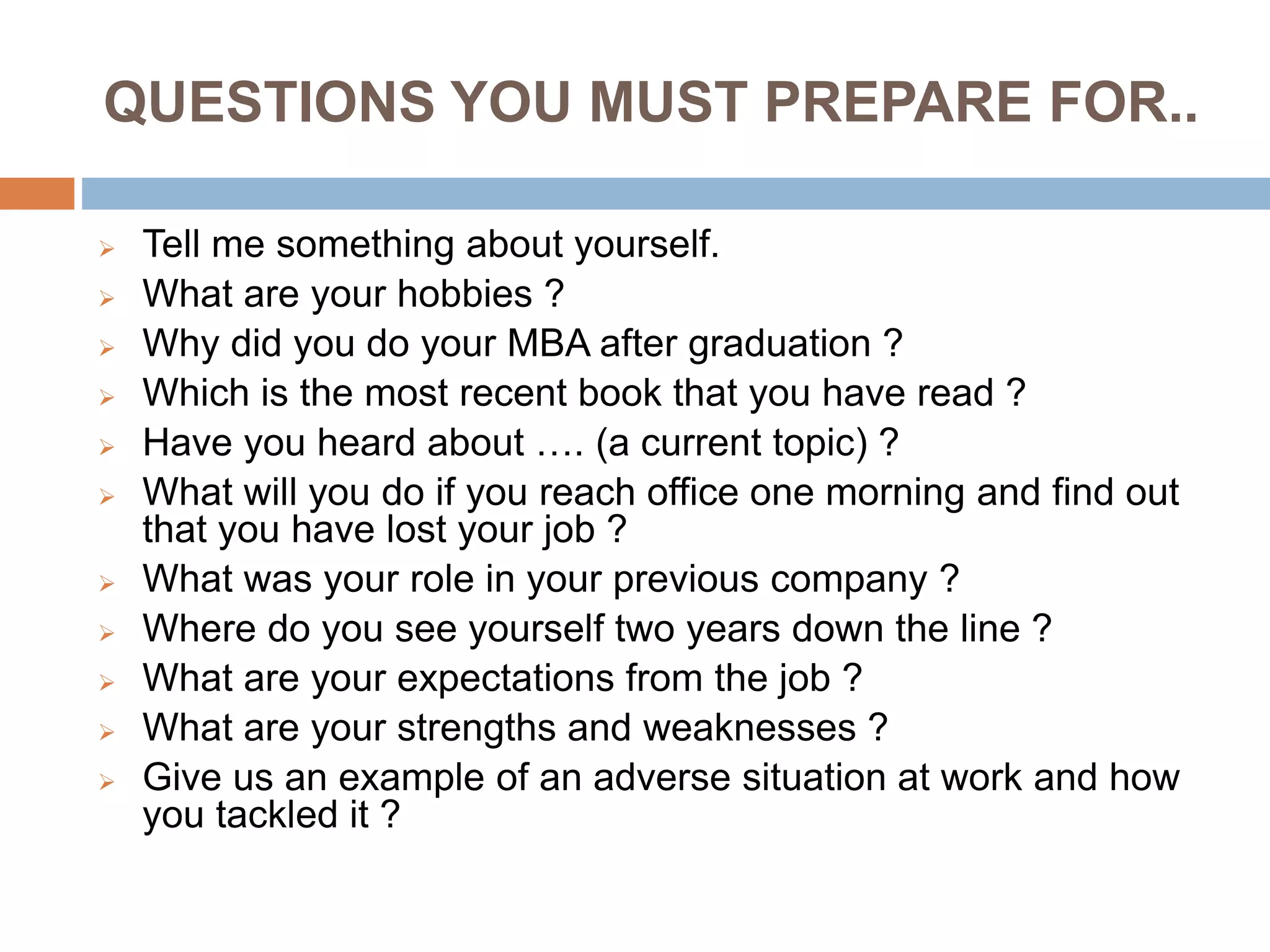
QUESTIONS YOU MUST PREPARE FOR..
 Tell me something about yourself.
 What are your hobbies ?
 Why did you do your MBA after graduation ?
 Which is the most recent book that you have read ?
 Have you heard about …. (a current topic) ?
 What will you do if you reach office one morning and find out
that you have lost your job ?
 What was your role in your previous company ?
 Where do you see yourself two years down the line ?
 What are your expectations from the job ?
 What are your strengths and weaknesses ?
 Give us an example of an adverse situation at work and how
you tackled it ?
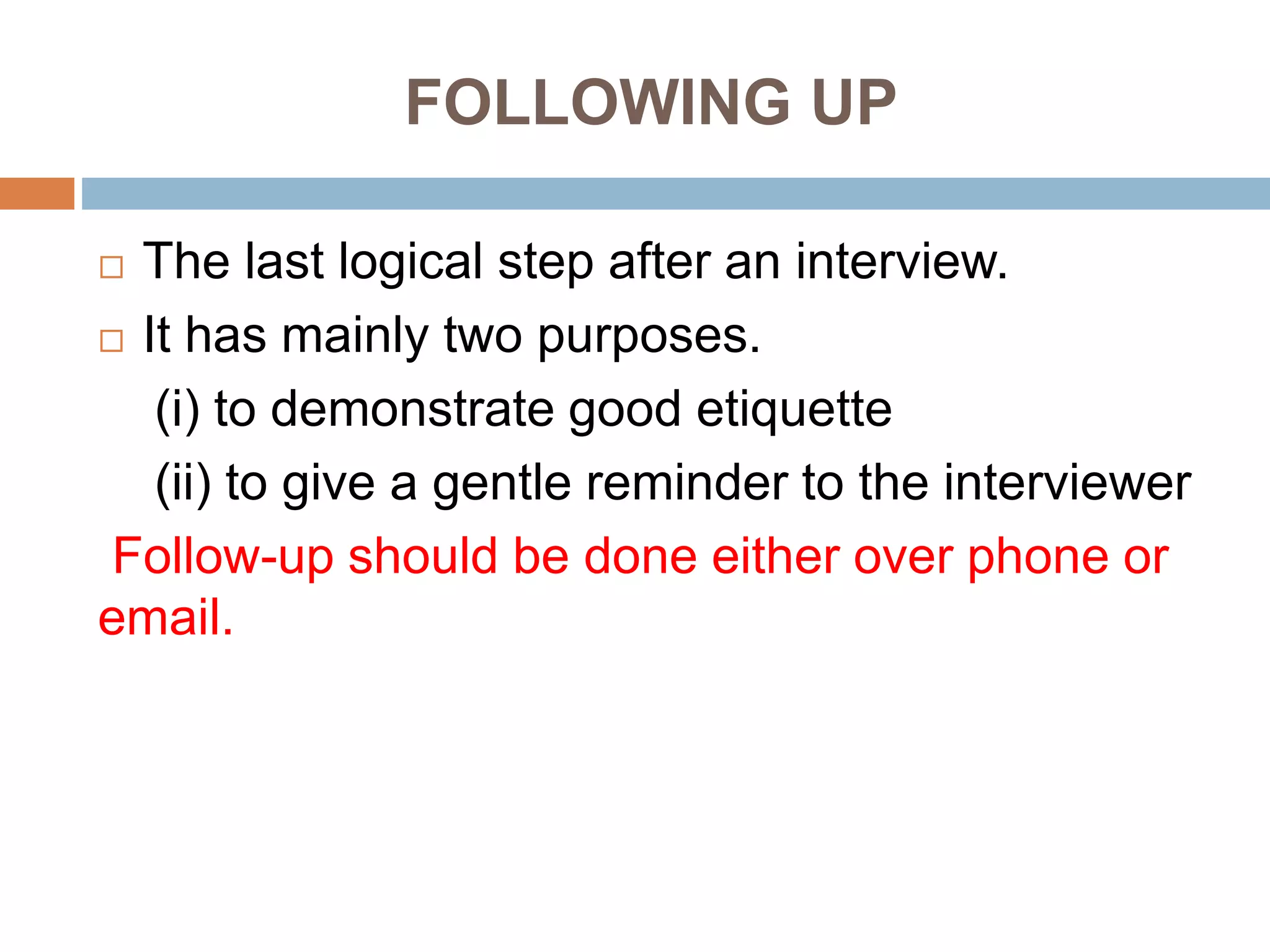
FOLLOWING UP
 The last logical step after an interview.
 It has mainly two purposes.
(i) to demonstrate good etiquette
(ii) to give a gentle reminder to the interviewer
Follow-up should be done either over phone or
email.
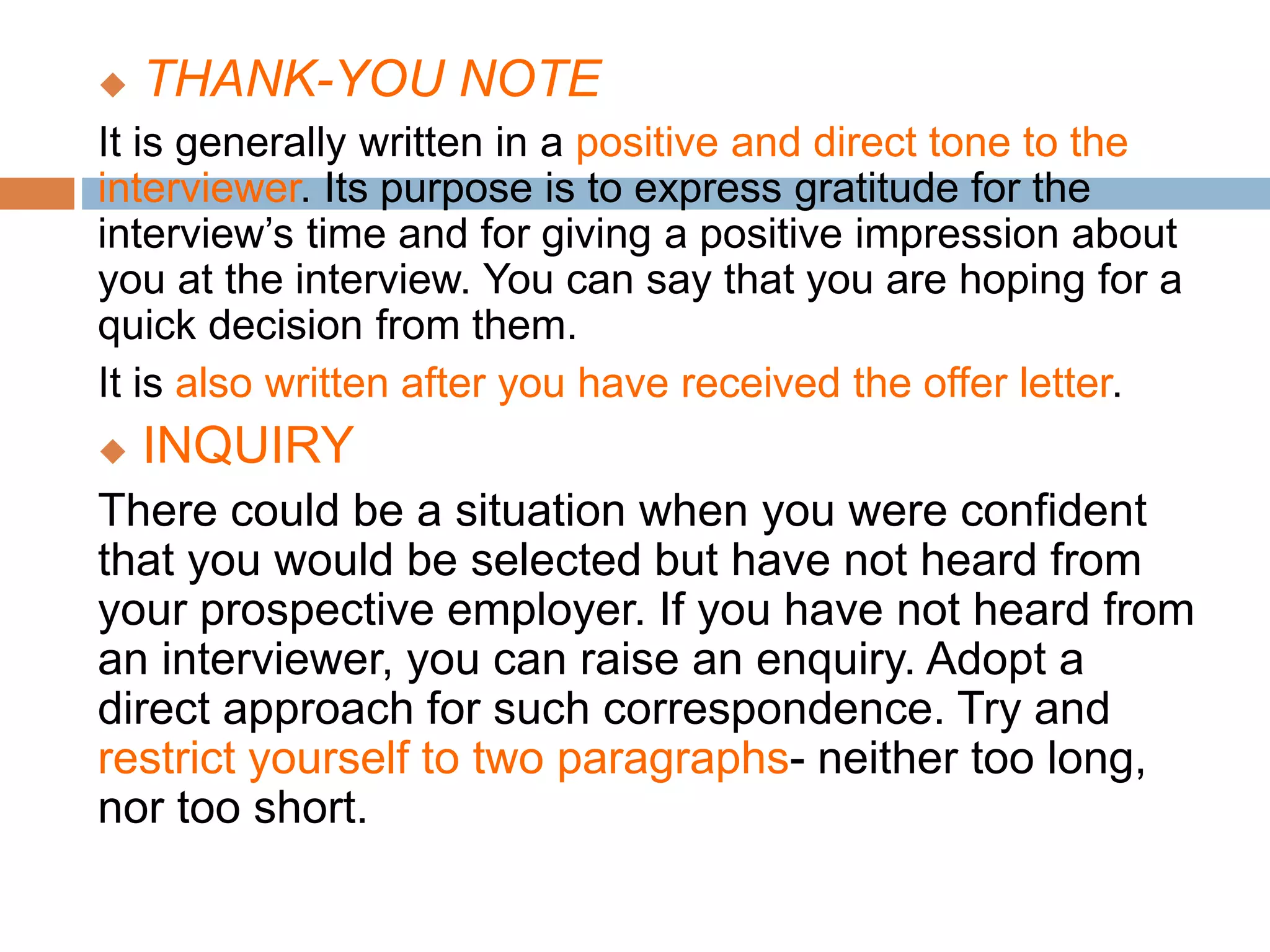
 THANK-YOU NOTE
It is generally written in a positive and direct tone to the
interviewer. Its purpose is to express gratitude for the
interview’s time and for giving a positive impression about
you at the interview. You can say that you are hoping for a
quick decision from them.
It is also written after you have received the offer letter.
 INQUIRY
There could be a situation when you were confident
that you would be selected but have not heard from
your prospective employer. If you have not heard from
an interviewer, you can raise an enquiry. Adopt a
direct approach for such correspondence. Try and
restrict yourself to two paragraphs- neither too long,
nor too short.
LIMITATIONS OF INTERVIEWS
 Personal Bias
 The Halo Effect
 Constant error
 Leniency
 Projection
 Stereotyping
 Snap judgement
 Lack of Integration
 Pressure to Hire
 Too much/ Too Little Talking
CONCLUSION
 The candidate has to physically and
emotionally be prepared apart from being
knowledgeable in the domain area.
 Many of the recruiters believe in recruit for
attitude, train for skills.
 Apart from a pleasing personality, grooming
and effective communication play a vital role in
succeeding at interviews.
Thank you!

bba s6 interview.pdf

  • 1.
    INTERVIEW AND ITS VARIOUSTYPES SUBMITTED BY : KOMAL SAHI MBA-HR Semester 1
  • 2.
    What is aninterview? The term interview has been derived from the French word entre voir that means to glimpse or to see each other. By definition it means a meeting for obtaining information by questioning a person or persons.
  • 3.
     A formalmeeting at which somebody is asked questions to see if they are suitable for a particular job or course of study of a college/university.  Private meeting between people where questions are asked and answered.  To ask somebody about their life, opinions especially on radio or television or for the newspaper or magazine.  To give an interview is to agree to answer questions. Interview as defined by The Oxford Advanced Learner’s dictionary
  • 4.
    Meaning of theterm ‘Interview’  Basically ,an interview is a conversation between two people (the interviewer and the interviewee) where questions are asked by the interviewer to obtain information from the interviewee.  The word interview can have different meanings. For example a reporter interviews a celebrity for television. This kind of interviews can be one-on-one but usually when it comes to television there are many reporters from different channels.
  • 5.
     There arealso job interviews which a person has to go through in order to get a job he wants. Job interviews are usually face-to-face interviews and include paperwork.  During an interview you can expect to be asked questions about your educational background, previous work experiences and questions relating to your personal characteristics and goals. But what happens after that? It depends on what interview style your interviewer prefers. Below are some of the more common interview styles used.
  • 6.
    The Purpose ofan Interview An interview has two purposes :-  To find if the candidate has the right attitude and fits the requirement and company culture  To find the best candidate to fill a vacancy
  • 7.
    Interviews ADVANTAGES Deep and freeresponse Flexible, adaptable Glimpse into respondent’s tone, gestures Ability to probe, follow-up, clarify misunderstandings about questions DISADVANTAGES costly in time and personnel impractical with large numbers of respondents requires skill may be difficult to summarize responses possible biases: interviewer, respondent, situation
  • 8.
    What does aninterviewer look for ?  Who you are as a person  Your knowledge  Your skills  Your attitude  Your ability to interact with people  Your capacity to take work pressure
  • 9.
    Types of Interviews BASIS CLASSIFICATIONACCORDING TO STRUCTURE CLASSIFICATION ACCORDING TO THE PURPOSE CLASSIFICATION ACCORDING TO INTERVIEW’S CONTENT CLASSIFICATION ACCORDING TO ADMINISTERING THE INTERVIEW
  • 10.
    I. CLASSIFICATION ACCORDINGTO STRUCTURE  1. STRUCTURED OR DIRECT INTERVIEW  The questions and acceptable responses are specified in advance  Responses are rated for appropriateness of content  Also called standardized interviews as they are pre planned to a high degree of accuracy and precision
  • 11.
     2. UNSTRUCTUREDOR INDIRECT INTERVIEW OR OPEN-ENDED INTERVIEW  Not directed by questions or comments as to what the candidate should be asked  No set format is followed  Candidate is encouraged to express himself on any topic of his interest, his expectations, background etc.  Interviewers look for traits of character and nature of his aspirations, strengths, weaknesses, potential etc.
  • 12.
     3. SEMI-STRUCTUREDINTERVIEW  specific topic areas  a general set of questions  but the interview flows like a conversation and topics are covered as they come up.
  • 13.
    Pros and Consof Structured & Unstructured Interview  STRUCTURED INTERVIEWS  More reliable and valid as all candidates are asked the same set of questions  Enhance consistency across candidates  UNSTRUCTURED INTERVIEWS  Flexibility to pursue points of interest as they develop  Help in assessing the clarity of thoughts of the candidate
  • 14.
    II. CLASSIFICATION ACCORDINGTO PURPOSE  1. STRESS INTERVIEW This type of interview is rare in the present job scenario. It was a very common interview method when selecting for sales position.
  • 15.
    Stress interview means- Being asked more than one question at a time;  Being asked further questions without being allowed adequate time to respond;  The interviewer adopts a hostile behavior and deliberately puts the candidate on defensive by trying to annoy, embarrass or frustrate him;  He asks questions rapidly, criticizes his/her answers, interrupts him/her frequently, makes derogatory remarks etc.  Having his/her feelings provoked.
  • 16.
    Why stress interviews? This interview is an attempt to see how the candidates handle themselves under stress.  So, the interviewer deliberately assumes a sarcastic or argumentative position.  The trick for the interviewee is to remain calm under such a situation.
  • 17.
     2. APPRAISAL/ASSESSMENT INTERVIEW  A discussion following a performance appraisal  In which the supervisor and employee discuss the employee’s rating and  Possible remedial actions to be taken.
  • 18.
     3. EXITINTERVIEW  When an employee leaves the company for any reason, an exit interview is conducted  Aims at eliciting information about the job or related matters  Help the employer in having a better insight into what is right or wrong about the company  Highlights the work of an HR Manager
  • 19.
    III. CLASSIFICATION ACCORDINGTO ADMINISTERING INTERVIEW 1. ONE TO ONE INTERVIEW  Single interviewer who takes interview one by one  Maybe structured, unstructured or sequential  Easier to handle, generally more informal  Best way to handle such interviews is to relate them as a form of a conversation
  • 20.
     2. SEQUENTIAL/SERIALINTERVIEW  These interviews are Those in which the applicant is interviewed Sequentially by several persons (interviewers)  Each one rates the applicant on a standard evaluation form and these ratings are then compared before the hiring decision is taken  Each interviewer rates from his/her own point of view, asks different questions and forms an independent opinion of the candidate
  • 21.
     3. GROUPINTERVIEW/ GROUP DISCUSSION  The main purpose of this interview is to see how the interviewee interacts with others and how he/ she influences others with his/her knowledge and reason.  Also known as GD’s, a topic for discussion is given to a group.
  • 22.
    Why group interviews? Group interview is also the best way to discover any leadership potential, group participation, team playing skills and communication skills among the candidates.  The selected candidates from the group interview are then taken for an informal one to one interview.
  • 23.
     4. PANELINTERVIEW/ COMMITTEE INTERVIEW  A panel interview comprises more than two members interviewing a person for the hiring.  It is most common mode of interview when hiring at the senior level.  The interviewee should try to connect with each interviewer and the best way to do this is to read the personality of each interviewer.
  • 24.
     In apanel interview, the interviewer tries to gauge the group management and group presentation skills of the interviewee.  The interviewee should maintain eye contact with the person asking the questions but also seek eye contact with the other members of the panel.
  • 25.
    IV. CLASSIFICATION ACCORDINGTO INTERVIEW’S CONTENT 1. SITUATIONAL INTERVIEW  Here the interview will focus on the individual’s ability to project what his behavior will be in a given situation.  The interview can be both structured and situational with predetermined questions requiring the candidate to project what his behavior will be.
  • 26.
    2. JOB RELATEDINTERVIEW  Here the interviewer tries to deduce what the applicant’s on-the-job performance would be, based on his answers about his past behaviors.  Job related questions are asked to draw conclusions about the candidate’s ability to handle the job to be filled.
  • 27.
    3. BEHAVIOURAL INTERVIEW Here a situation is described and candidates are asked how they have behaved in the past in such a situation.  While situational interviews ask candidates to describe how they would react to a situation in future,  The behavioral interviews seek candidates to describe how did they react to situations in the past.
  • 28.
    4. PSYCHOLOGICAL INTERVIEWS Psychological interviews are interviews conducted by a psychologist,  In which questions are intended to assess personal traits such as reliability or dependability etc.
  • 29.
    SOME MORE TYPES:-  TELEPHONE INTERVIEW  Phone interviews are increasingly used in mass hiring.  The interview is conducted entirely over the phone and this is very effective in eliminating any bias that may arise from the appearance and manner of the candidate.
  • 30.
     PROMOTION INTERVIEW(of the employees who are due for promotion)  ANNUAL INTERVIEW (before writing annual reports, reporting officer interacts with employees subordination)  PERIODICAL INTERVIEW (with the existing employees)  PROBLEM INTERVIEW (of an employee whose performance is unsatisfactory-to find out reasons and find solutions)  COMPUTERIZED INTERVIEW (questions are presented in MCQs)  WALK-IN INTERVIEW (no specific candidates are called, but those who are eligible can come with their valid documents)  VIDEO CONFERENCING (using video technology; clothing, body language and dialogue are important here as well)
  • 31.
    FACTS YOU SHOULDKNOW ABOUT THE COMPANY  About the company, history, employment and position in the industry  Competitors  Products and services  Global presence  Publications, blogs, presence in social media, analysts’ review  Finances of the company  The position you have applied for  Requirements of the specific position
  • 32.
    Continued-  Job profile Growth opportunities  Salary offered for the role  Requirement of travel  Working hours to be put in  Qualifications and any technical skills required
  • 33.
    DOs and DON’Tsfor an interview DOs DON’Ts Groom yourself well Do not demonstrate overconfidence Show enthusiasm Do not answer before the question has been completed Carry extra copies of your resume Do not talk continuously Wear a cheerful smile Do not be rude or get into an argument with the interviewers Be polite, assertive and firm Do not fiddle with your tie or pen Be genuine and truthful when you reply Do not extend your hand first for a handshake Look into the eyes of the interviewer while talking to him/her Do not be unclear about your expectations from the job
  • 34.
    QUESTIONS YOU MUSTPREPARE FOR..  Tell me something about yourself.  What are your hobbies ?  Why did you do your MBA after graduation ?  Which is the most recent book that you have read ?  Have you heard about …. (a current topic) ?  What will you do if you reach office one morning and find out that you have lost your job ?  What was your role in your previous company ?  Where do you see yourself two years down the line ?  What are your expectations from the job ?  What are your strengths and weaknesses ?  Give us an example of an adverse situation at work and how you tackled it ?
  • 35.
    FOLLOWING UP  Thelast logical step after an interview.  It has mainly two purposes. (i) to demonstrate good etiquette (ii) to give a gentle reminder to the interviewer Follow-up should be done either over phone or email.
  • 36.
     THANK-YOU NOTE Itis generally written in a positive and direct tone to the interviewer. Its purpose is to express gratitude for the interview’s time and for giving a positive impression about you at the interview. You can say that you are hoping for a quick decision from them. It is also written after you have received the offer letter.  INQUIRY There could be a situation when you were confident that you would be selected but have not heard from your prospective employer. If you have not heard from an interviewer, you can raise an enquiry. Adopt a direct approach for such correspondence. Try and restrict yourself to two paragraphs- neither too long, nor too short.
  • 37.
    LIMITATIONS OF INTERVIEWS Personal Bias  The Halo Effect  Constant error  Leniency  Projection  Stereotyping  Snap judgement  Lack of Integration  Pressure to Hire  Too much/ Too Little Talking
  • 38.
    CONCLUSION  The candidatehas to physically and emotionally be prepared apart from being knowledgeable in the domain area.  Many of the recruiters believe in recruit for attitude, train for skills.  Apart from a pleasing personality, grooming and effective communication play a vital role in succeeding at interviews.
  • 39.