
Dr. Yumna Shaheen Ali
Lecturer
Dental Hygiene and Technology

 Animals having one set of teeth of which none are
replaced at a later stage of growth
 Examples:
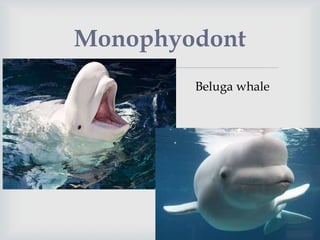
 Beluga whale
 Aquatic mammals (Cetacea) include a group of
toothed whales(Odontoceti) that are mostly homodont
and monophyodont
Monophyodont

Monophyodont
Beluga whale

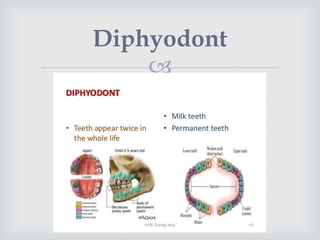
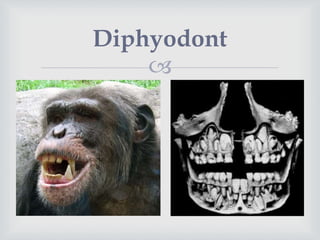
 Any animal with two successive sets of teeth,
initially the "deciduous" set and consecutively the
"permanent" set.
 Most mammals are diphyodonts as to chew their
food they need a strong, durable and complete set of
teeth.
 Examples:
 Human
 Most mammals are diphyodont, except kangaroos,
elephants and manatees.
Diphyodont

Diphyodont

Diphyodont

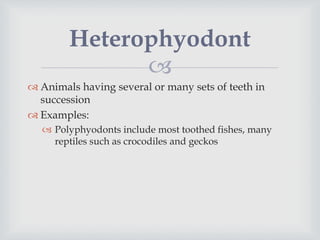
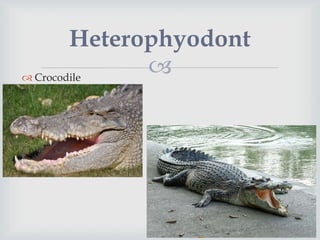
 Animals having several or many sets of teeth in
succession
 Examples:
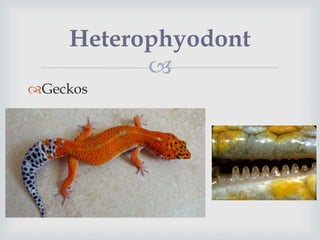
 Polyphyodonts include most toothed fishes, many
reptiles such as crocodiles and geckos
Heterophyodont

Geckos
Heterophyodont
 Crocodile
Heterophyodont

 Teeth that are all of similar form
 Homo means same, dont means dentition
 Homodont refers to same set of teeth
 Examples:
 Most reptiles
 Dolphins
Homodont

Homodont

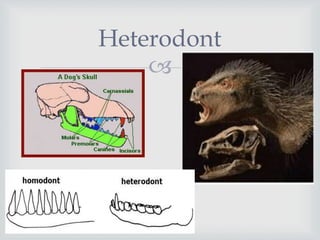
 Animal which possesses more than a single tooth
morphology
 Examples:
 Most mammals
Heterodont

Heterodont

 Having tubercles on the crown of the molar teeth
 Example:
 Posterior teeth in pig
 Human teeth
Bunodont

Bunodont

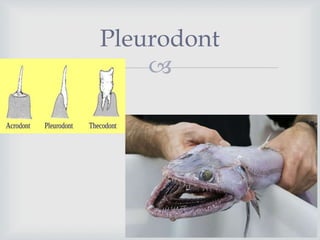
 Pleurodont is a formation of the teeth that are fused
(ankylosed) by their sides to the inner surface of the
jaw bones
 Examples:
 Lizards
Pleurodont

Pleurodont

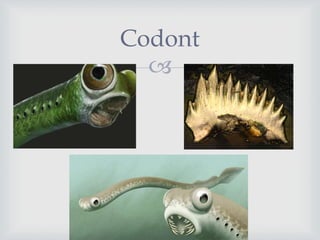
 Conodonts (kōnos, "cone", + odont, "tooth") are
extinct agnathan chordates resembling eels, classified
in the class Conodonta.
 For many years, they were known only from tooth-
like microfossils found in isolation and now
called conodont elements.
 Their teeth are called codont.
 They are pointed cone shaped
Codont

Codont
Types of Teeth

Types of Teeth

  • 1.
    Dr. Yumna ShaheenAli Lecturer Dental Hygiene and Technology
  • 2.
      Animals havingone set of teeth of which none are replaced at a later stage of growth  Examples:  Beluga whale  Aquatic mammals (Cetacea) include a group of toothed whales(Odontoceti) that are mostly homodont and monophyodont Monophyodont
  • 3.
  • 4.
      Any animalwith two successive sets of teeth, initially the "deciduous" set and consecutively the "permanent" set.  Most mammals are diphyodonts as to chew their food they need a strong, durable and complete set of teeth.  Examples:  Human  Most mammals are diphyodont, except kangaroos, elephants and manatees. Diphyodont
  • 5.
  • 6.
  • 7.
      Animals havingseveral or many sets of teeth in succession  Examples:  Polyphyodonts include most toothed fishes, many reptiles such as crocodiles and geckos Heterophyodont
  • 8.
  • 9.
  • 10.
      Teeth thatare all of similar form  Homo means same, dont means dentition  Homodont refers to same set of teeth  Examples:  Most reptiles  Dolphins Homodont
  • 11.
  • 12.
      Animal whichpossesses more than a single tooth morphology  Examples:  Most mammals Heterodont
  • 13.
  • 14.
      Having tubercleson the crown of the molar teeth  Example:  Posterior teeth in pig  Human teeth Bunodont
  • 15.
  • 16.
      Pleurodont isa formation of the teeth that are fused (ankylosed) by their sides to the inner surface of the jaw bones  Examples:  Lizards Pleurodont
  • 17.
  • 18.
      Conodonts (kōnos,"cone", + odont, "tooth") are extinct agnathan chordates resembling eels, classified in the class Conodonta.  For many years, they were known only from tooth- like microfossils found in isolation and now called conodont elements.  Their teeth are called codont.  They are pointed cone shaped Codont
  • 19.