PRINCIPLES OF
SPEECH WRITING
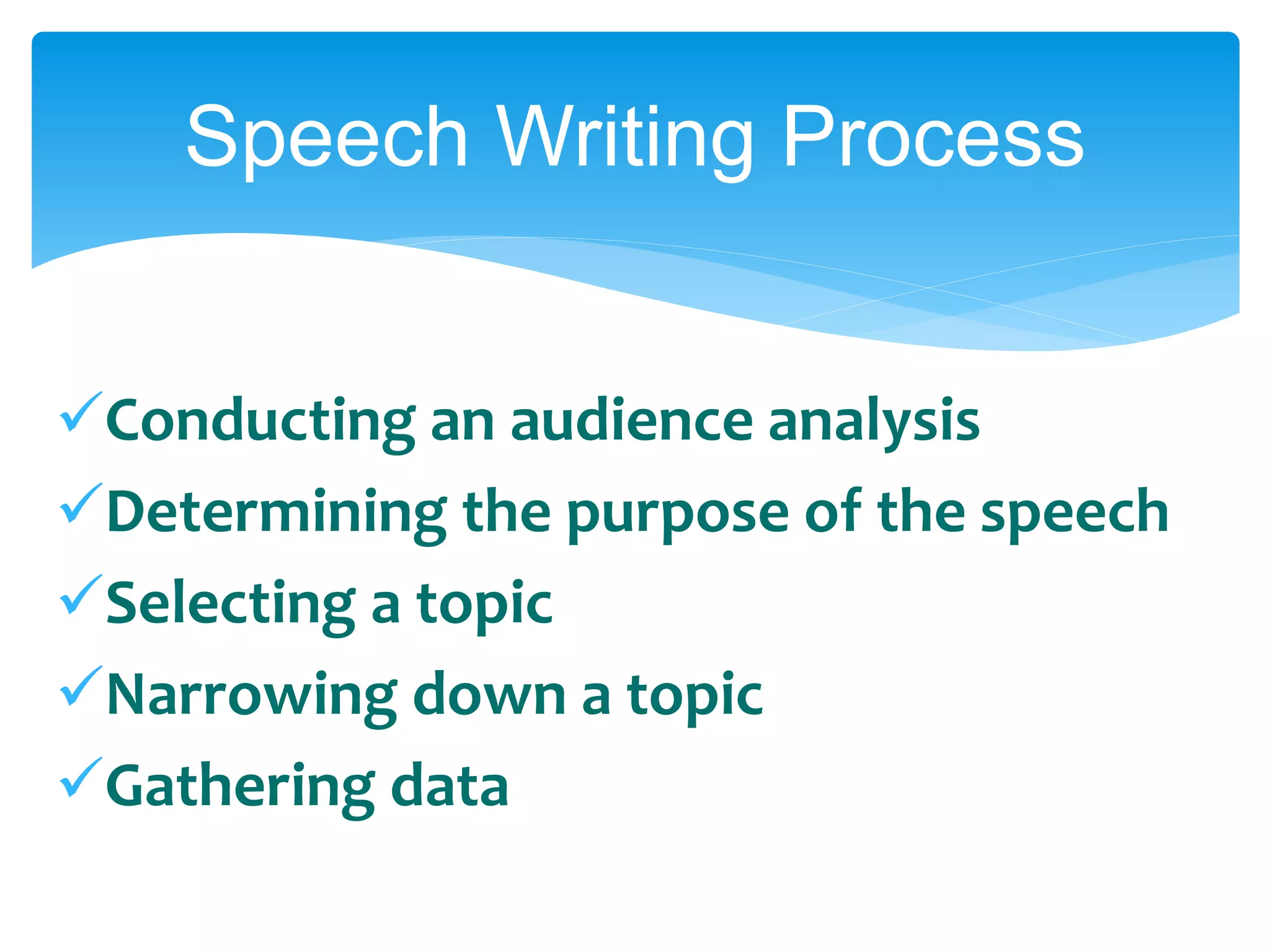
Conducting an audience analysis
Determining the purpose of the speech
Selecting a topic
Narrowing down a topic
Gathering data
Speech Writing Process
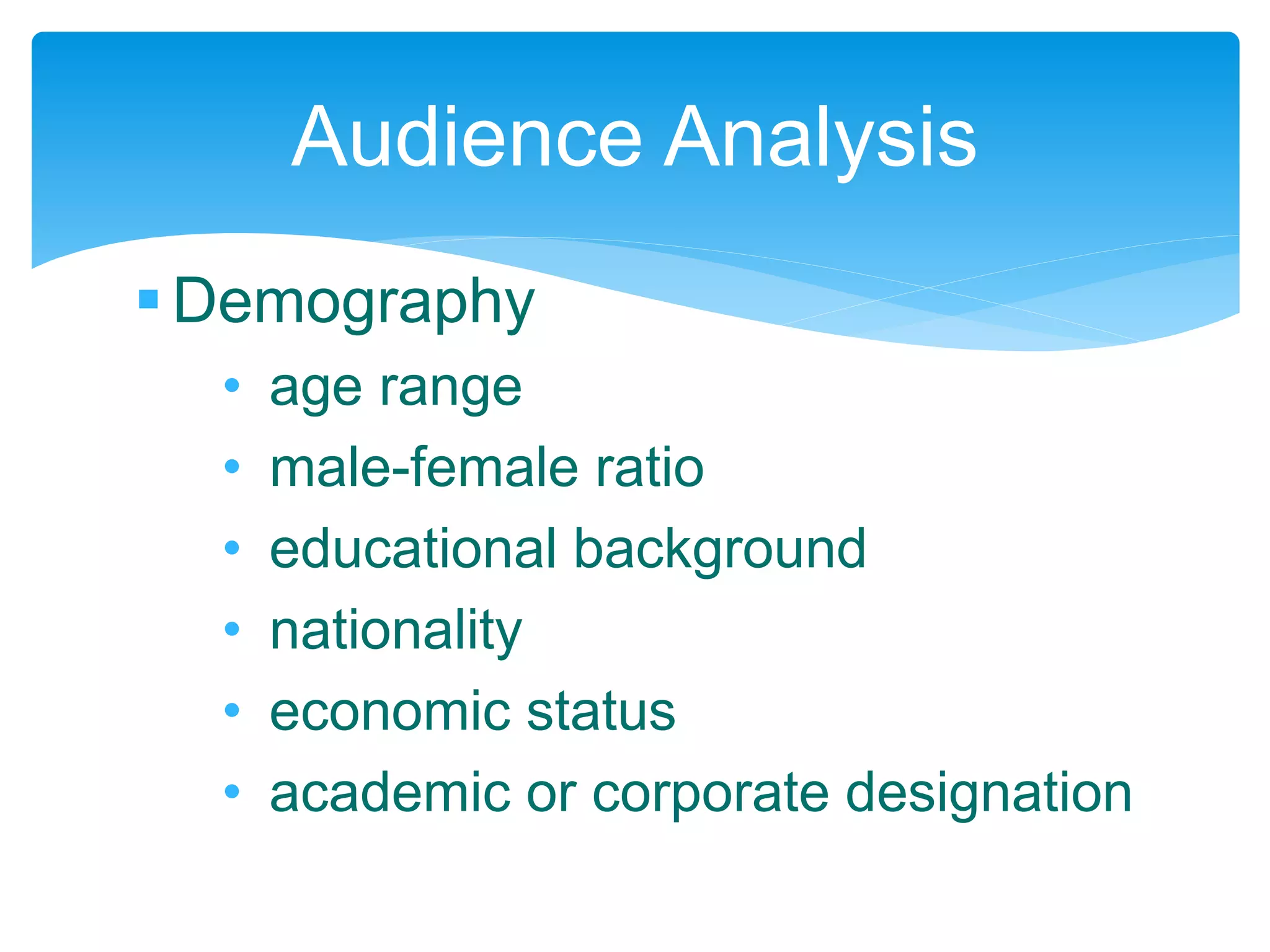
Demography
• age range
• male-female ratio
• educational background
• nationality
• economic status
• academic or corporate designation
Audience Analysis
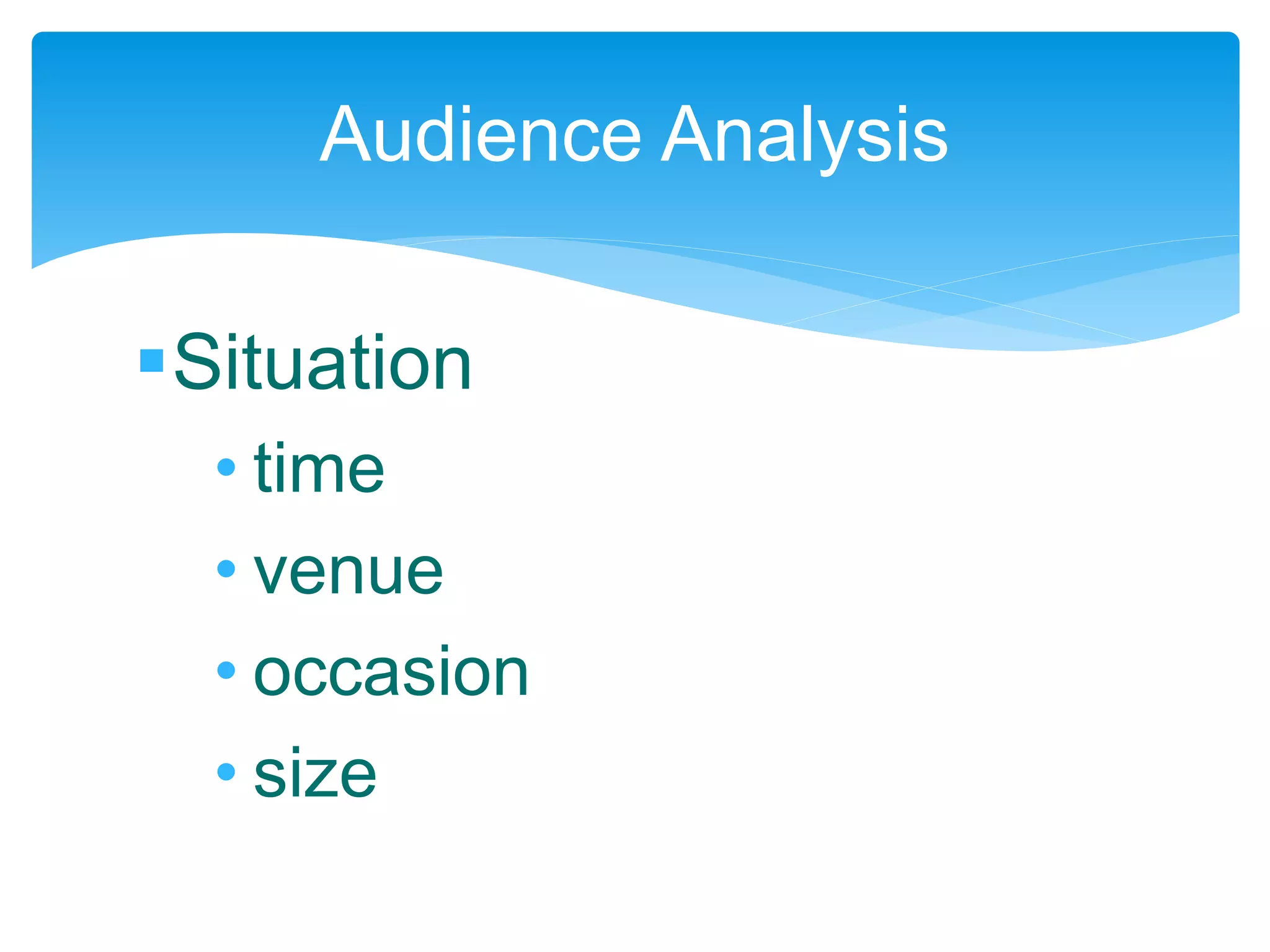
Situation
• time
• venue
• occasion
• size
Audience Analysis
Psychology
• values
• beliefs
• attitude
• preferences
• cultural and racial ideologies
• needs
Audience Analysis
Informative Speech
Entertainment Speech
Persuasive Speech
Purpose
Provides the audience with a
clear understanding of the
concept or idea presented by
the speaker.
Informative Speech
provides the audience with
amusement.
Entertainment Speech
Provides the audience with
well-argued ideas that can
influence their own beliefs and
decisions.
Persuasive Speech
 Selecting a Topic
•Choose a topic which you’re interested to.
 Narrowing down a topic
• Making your main idea more specific
 Data gathering
• Collecting ideas, information, sources, and
references relevant and related to the topic.
Selecting a Topic
 Biographical
•presents descriptions of the life of a
person
 Categorical/ Topical
•presents related categories supporting
the topic
 Casual
•Presents cause-effect relationship
Writing Patterns
 Chronological
•Presents the idea in time order
 Comparison/ Contrast
•Presents comparison/contrast of two or
three points
 Problem-solution
•Presents an identified problem, its
causes, and recommended solutions
Writing Patterns
Outline – an hierarchical list that
shows the relationship of your
ideas.
•Introduction
•Body
•Conclusion
Preparing an Outline
Provides explanations,
examples, or any details that
can help you deliver your
purpose and explain the main
idea of your speech
Body of Speech
Foundation of the speech
Here, the goal is to get the
attention of the audience and
present the subject or main
idea of your speech.
Introduction
Restates the main idea of the
speech.
Provides a summary, emphasizes
the message, and calls for action.
Aims to leave the audience with a
memorable statement.
Conclusion
Involves correcting errors in
mechanics, such as grammar,
punctuation, capitalization, unity,
coherence, and others.
Editing/Revising
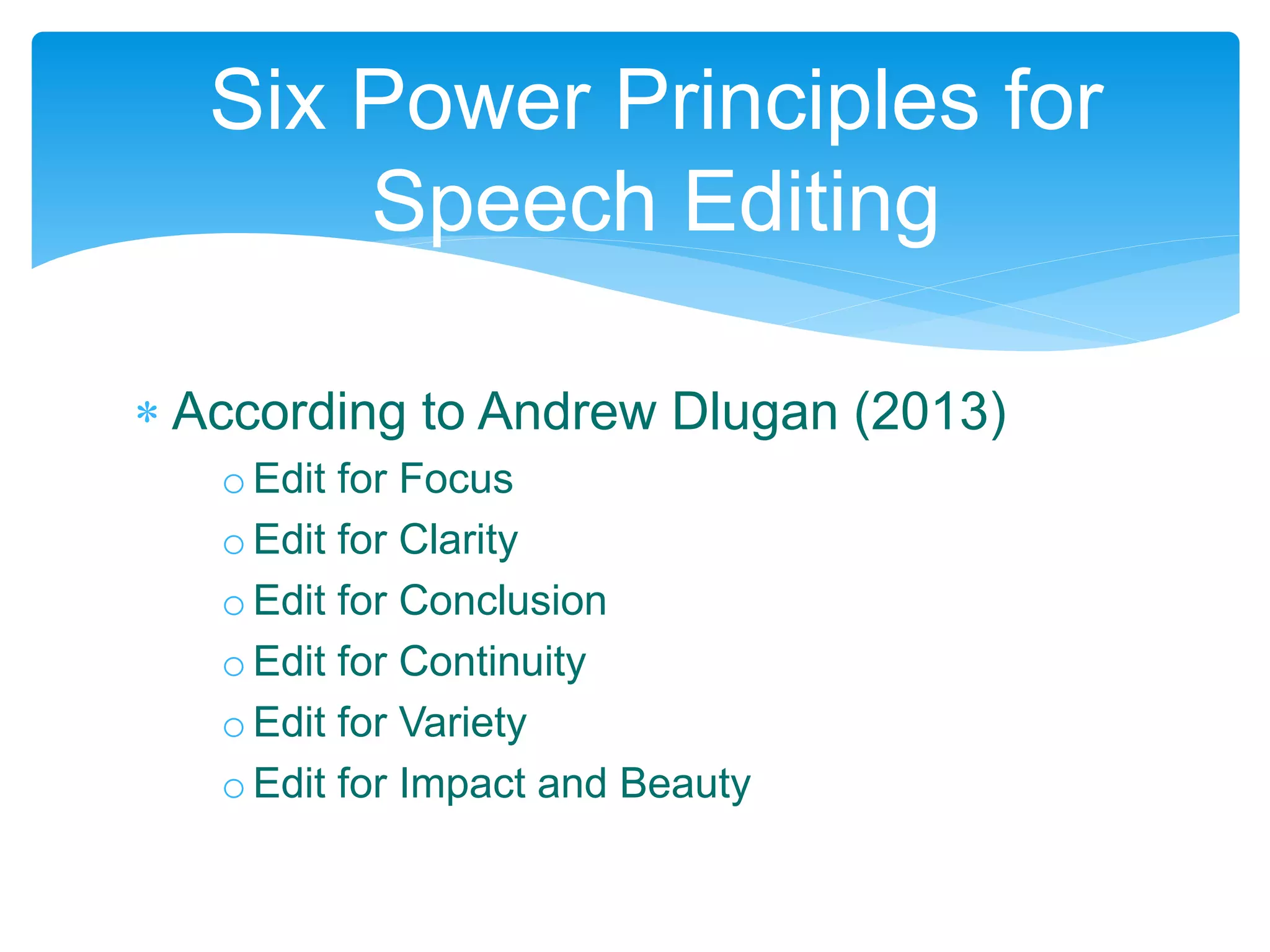
 According to Andrew Dlugan (2013)
o Edit for Focus
oEdit for Clarity
o Edit for Conclusion
o Edit for Continuity
o Edit for Variety
o Edit for Impact and Beauty
Six Power Principles for
Speech Editing
Ensure that everything you have written,
from introduction to conclusion, is related to
your central message.
“So, what’s the point? What’s the message of
the speech?”
Edit for Focus
Make all ideas in your speech clear by arranging
them in logical order (e.g., main idea first then
supporting detail, or supporting details first then
main idea).
“I don’t understand the message because the
examples or supporting details were confusing.”
Edit for Clarity
Keep your speech short, simple, and clear by
eliminating unrelated stories and sentences and by
using simple words.
“ The speech was all over the place; the speaker kept
talking endlessly as if no one was listening to
him/her.”
Edit for Conclusion
Keep the flow of your presentation smooth by
adding transition words and phrases.
“ The speech was too difficult to follow; I was lost in
the middle.”
Edit for Continuity
Add spice to your speech by shifting tone and style
from formal to conversational and vice-versa,
moving around the stage, or adding humor.
“ I didn’t enjoy the speech because it was boring.”
Edit for Variety
Make your speech memorable by using these
strategies :
 Surprise of the audience
 Use vivid descriptive images
 Write well-crafted and memorable lines
 Use Figures of Speech
“ There’s nothing really special about the speech.”
Edit for Impact and Beauty
It gives you an opportunity to identify what works
and what does not work for you and for your target
audience.
Rehearsing
Reading your speech aloud
Recording for your own analysis or for your peers
or coaches to give feed back on your delivery.
Some Strategies
“ Constant practice makes perfect.”
The Best thing to Remember at
this Stage:
Some Guidelines
in speech writing
1. Keep your words short and simple.
Your speech is meant to be heard by
your audience, not read.
2. Avoid jargon, acronyms, or technical
words because they can confuse your
audience.
3. Make your speech more personal. Use
the personal pronoun “I,” but take care not
to overuse it. When you need to
emphasize collectiveness with your
audience, use the personal pronoun “We.”
4. Use active verbs and contractions
because they add to the personal
conversational tone of your speech.
5. Be sensitive of your audience. Be
very careful with your language, jokes
and nonverbal cues.
6. Use metaphors and other figures of
speech to effectively convey your point.
7. Manage your time well; make sure
that the speech falls under the time
limit.
The Speech Writing Process
Quick Review
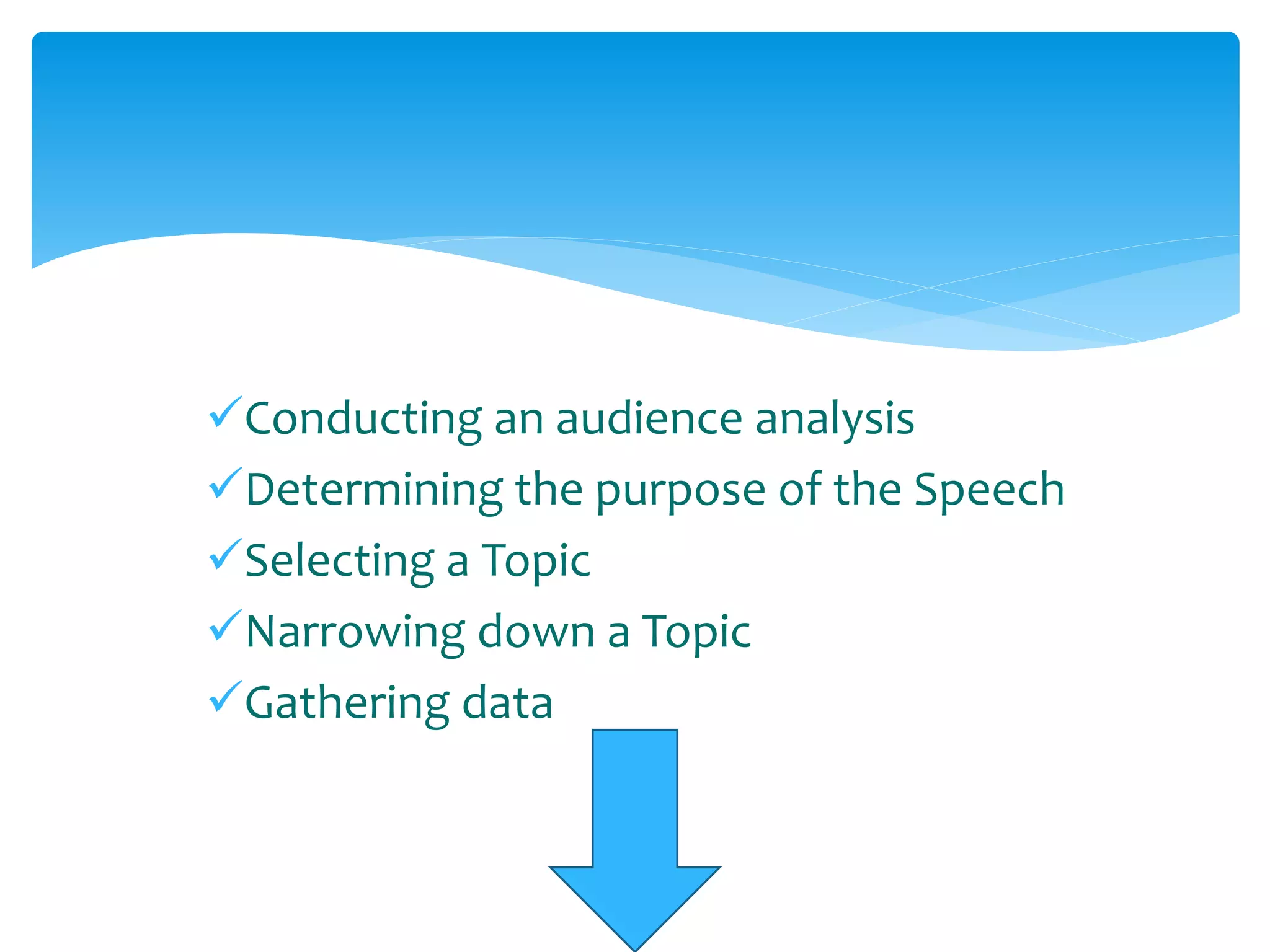
Conducting an audience analysis
Determining the purpose of the Speech
Selecting a Topic
Narrowing down a Topic
Gathering data
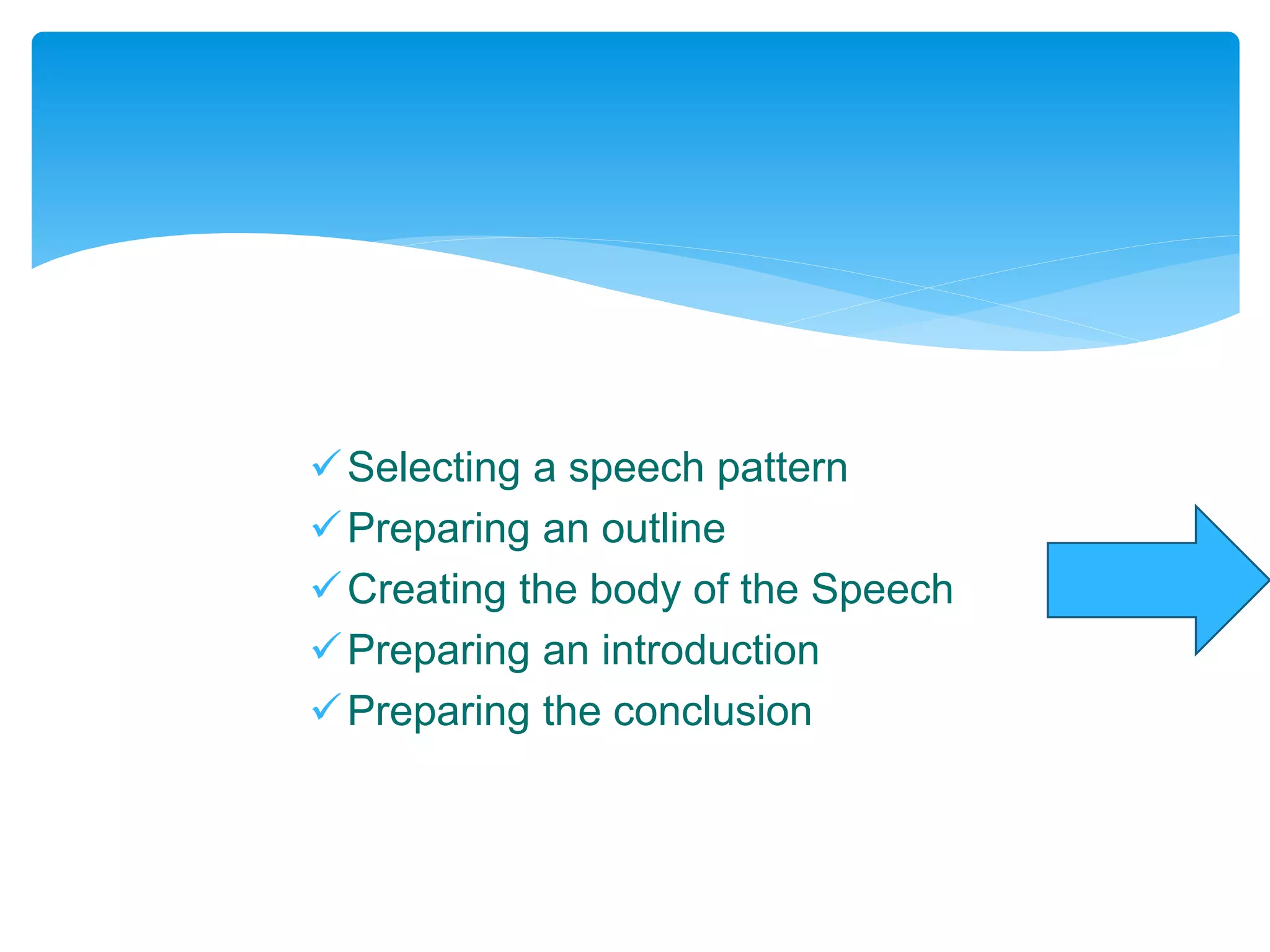
Selecting a speech pattern
Preparing an outline
Creating the body of the Speech
Preparing an introduction
Preparing the conclusion
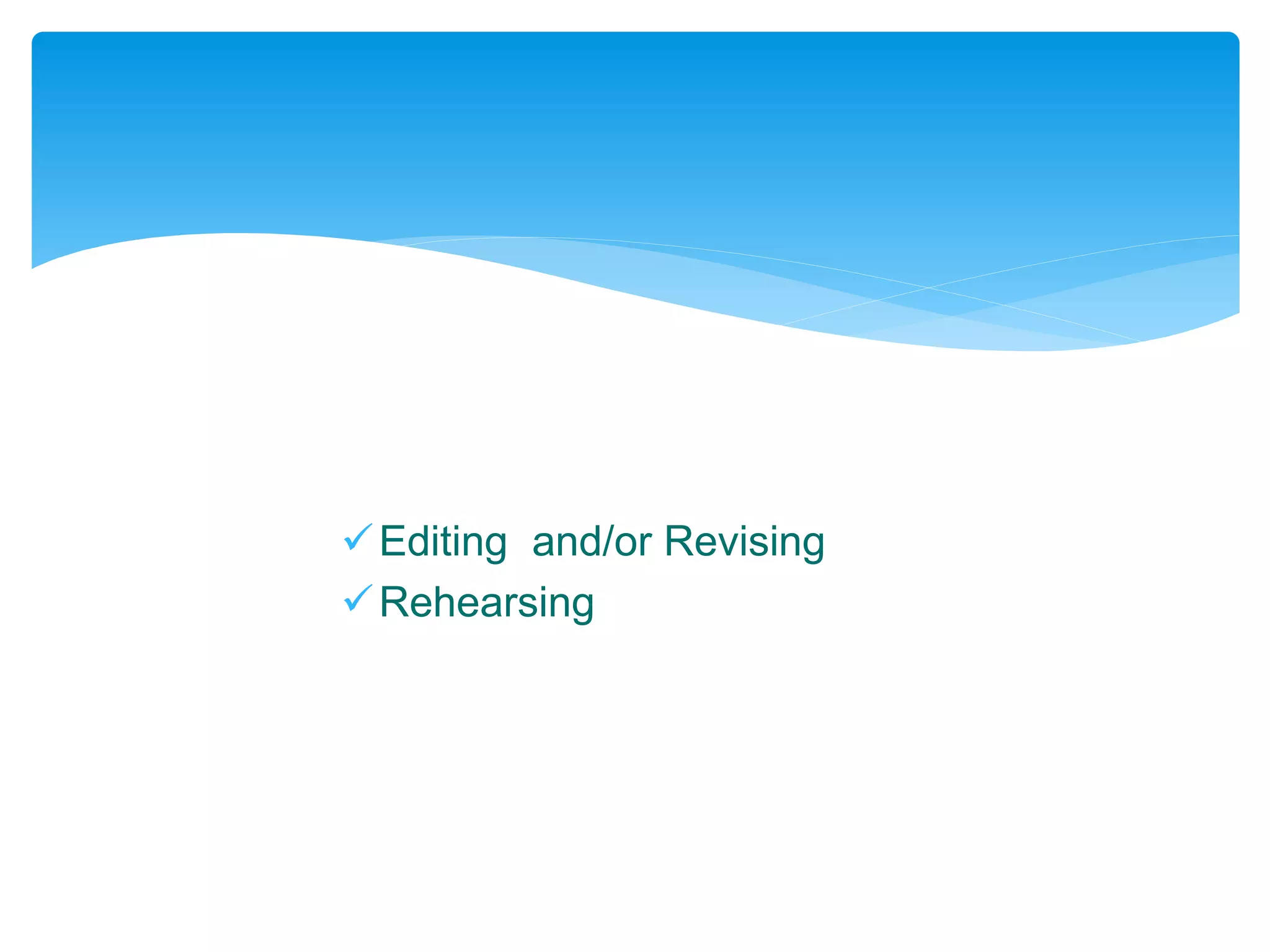
Editing and/or Revising
Rehearsing
IMO MAMA
THANK YOU
THAT’S ALL THANK YOU!!!

Principle of Speech Writing

  • 1.
  • 2.
    Conducting an audienceanalysis Determining the purpose of the speech Selecting a topic Narrowing down a topic Gathering data Speech Writing Process
  • 3.
    Demography • age range •male-female ratio • educational background • nationality • economic status • academic or corporate designation Audience Analysis
  • 4.
    Situation • time • venue •occasion • size Audience Analysis
  • 5.
    Psychology • values • beliefs •attitude • preferences • cultural and racial ideologies • needs Audience Analysis
  • 6.
  • 7.
    Provides the audiencewith a clear understanding of the concept or idea presented by the speaker. Informative Speech
  • 8.
    provides the audiencewith amusement. Entertainment Speech
  • 9.
    Provides the audiencewith well-argued ideas that can influence their own beliefs and decisions. Persuasive Speech
  • 10.
     Selecting aTopic •Choose a topic which you’re interested to.  Narrowing down a topic • Making your main idea more specific  Data gathering • Collecting ideas, information, sources, and references relevant and related to the topic. Selecting a Topic
  • 11.
     Biographical •presents descriptionsof the life of a person  Categorical/ Topical •presents related categories supporting the topic  Casual •Presents cause-effect relationship Writing Patterns
  • 12.
     Chronological •Presents theidea in time order  Comparison/ Contrast •Presents comparison/contrast of two or three points  Problem-solution •Presents an identified problem, its causes, and recommended solutions Writing Patterns
  • 13.
    Outline – anhierarchical list that shows the relationship of your ideas. •Introduction •Body •Conclusion Preparing an Outline
  • 14.
    Provides explanations, examples, orany details that can help you deliver your purpose and explain the main idea of your speech Body of Speech
  • 15.
    Foundation of thespeech Here, the goal is to get the attention of the audience and present the subject or main idea of your speech. Introduction
  • 16.
    Restates the mainidea of the speech. Provides a summary, emphasizes the message, and calls for action. Aims to leave the audience with a memorable statement. Conclusion
  • 17.
    Involves correcting errorsin mechanics, such as grammar, punctuation, capitalization, unity, coherence, and others. Editing/Revising
  • 18.
     According toAndrew Dlugan (2013) o Edit for Focus oEdit for Clarity o Edit for Conclusion o Edit for Continuity o Edit for Variety o Edit for Impact and Beauty Six Power Principles for Speech Editing
  • 19.
    Ensure that everythingyou have written, from introduction to conclusion, is related to your central message. “So, what’s the point? What’s the message of the speech?” Edit for Focus
  • 20.
    Make all ideasin your speech clear by arranging them in logical order (e.g., main idea first then supporting detail, or supporting details first then main idea). “I don’t understand the message because the examples or supporting details were confusing.” Edit for Clarity
  • 21.
    Keep your speechshort, simple, and clear by eliminating unrelated stories and sentences and by using simple words. “ The speech was all over the place; the speaker kept talking endlessly as if no one was listening to him/her.” Edit for Conclusion
  • 22.
    Keep the flowof your presentation smooth by adding transition words and phrases. “ The speech was too difficult to follow; I was lost in the middle.” Edit for Continuity
  • 23.
    Add spice toyour speech by shifting tone and style from formal to conversational and vice-versa, moving around the stage, or adding humor. “ I didn’t enjoy the speech because it was boring.” Edit for Variety
  • 24.
    Make your speechmemorable by using these strategies :  Surprise of the audience  Use vivid descriptive images  Write well-crafted and memorable lines  Use Figures of Speech “ There’s nothing really special about the speech.” Edit for Impact and Beauty
  • 25.
    It gives youan opportunity to identify what works and what does not work for you and for your target audience. Rehearsing
  • 26.
    Reading your speechaloud Recording for your own analysis or for your peers or coaches to give feed back on your delivery. Some Strategies
  • 27.
    “ Constant practicemakes perfect.” The Best thing to Remember at this Stage:
  • 28.
  • 29.
    1. Keep yourwords short and simple. Your speech is meant to be heard by your audience, not read.
  • 30.
    2. Avoid jargon,acronyms, or technical words because they can confuse your audience.
  • 31.
    3. Make yourspeech more personal. Use the personal pronoun “I,” but take care not to overuse it. When you need to emphasize collectiveness with your audience, use the personal pronoun “We.”
  • 32.
    4. Use activeverbs and contractions because they add to the personal conversational tone of your speech.
  • 33.
    5. Be sensitiveof your audience. Be very careful with your language, jokes and nonverbal cues.
  • 34.
    6. Use metaphorsand other figures of speech to effectively convey your point.
  • 35.
    7. Manage yourtime well; make sure that the speech falls under the time limit.
  • 36.
    The Speech WritingProcess Quick Review
  • 37.
    Conducting an audienceanalysis Determining the purpose of the Speech Selecting a Topic Narrowing down a Topic Gathering data
  • 38.
    Selecting a speechpattern Preparing an outline Creating the body of the Speech Preparing an introduction Preparing the conclusion
  • 39.
  • 40.