
Avoiding Communication Breakdown
•Use time-gaining expressions to have time
to think.
•Give positive remarks or comments.
•Be specific.
•Ask for repetition or clarification.
•Check for understanding.
•Do not jump to conclusions.
Developing Effective Communication Skills
•Effective communication is more
than just the transmission of
information from one person to
another. It takes place only when
the information is shared and
mutually understood.
The following are some ways on how you can
achieve effective communication.
•Keep focused.
•Speak intelligibly.
•Listen with your ears and eyes
•Minimize distractions.
SEATWORK
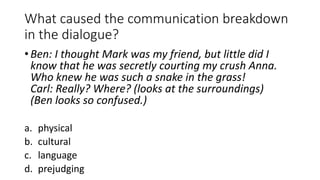
What caused the communication breakdown
in the dialogue?
• Ben: I thought Mark was my friend, but little did I
know that he was secretly courting my crush Anna.
Who knew he was such a snake in the grass!
Carl: Really? Where? (looks at the surroundings)
(Ben looks so confused.)
a. physical
b. cultural
c. language
d. prejudging
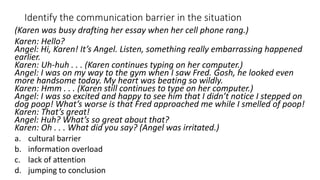
Identify the communication barrier in the situation
(Karen was busy drafting her essay when her cell phone rang.)
Karen: Hello?
Angel: Hi, Karen! It’s Angel. Listen, something really embarrassing happened
earlier.
Karen: Uh-huh . . . (Karen continues typing on her computer.)
Angel: I was on my way to the gym when I saw Fred. Gosh, he looked even
more handsome today. My heart was beating so wildly.
Karen: Hmm . . . (Karen still continues to type on her computer.)
Angel: I was so excited and happy to see him that I didn’t notice I stepped on
dog poop! What’s worse is that Fred approached me while I smelled of poop!
Karen: That’s great!
Angel: Huh? What’s so great about that?
Karen: Oh . . . What did you say? (Angel was irritated.)
a. cultural barrier
b. information overload
c. lack of attention
d. jumping to conclusion
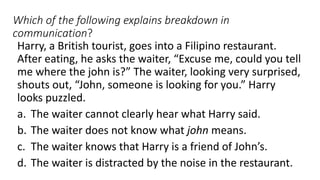
Which of the following explains breakdown in
communication?
Harry, a British tourist, goes into a Filipino restaurant.
After eating, he asks the waiter, “Excuse me, could you tell
me where the john is?” The waiter, looking very surprised,
shouts out, “John, someone is looking for you.” Harry
looks puzzled.
a. The waiter cannot clearly hear what Harry said.
b. The waiter does not know what john means.
c. The waiter knows that Harry is a friend of John’s.
d. The waiter is distracted by the noise in the restaurant.
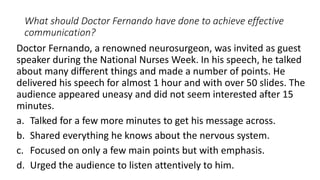
What should Doctor Fernando have done to achieve effective
communication?
Doctor Fernando, a renowned neurosurgeon, was invited as guest
speaker during the National Nurses Week. In his speech, he talked
about many different things and made a number of points. He
delivered his speech for almost 1 hour and with over 50 slides. The
audience appeared uneasy and did not seem interested after 15
minutes.
a. Talked for a few more minutes to get his message across.
b. Shared everything he knows about the nervous system.
c. Focused on only a few main points but with emphasis.
d. Urged the audience to listen attentively to him.
Which of the following is not a physical barrier
in communication?
a.noise
b.distance
c. jargon
d.poor lighting
INTERCULTURAL COMMUNICATION
• Refers to communication between or among members of different
cultural, social, or linguistic groups. When engaging in intercultural
communication, it is essential that participants have an
understanding of the following:
• Self-awareness, or an understanding of one's self and place in
society, is essential to communicate better with others, especially
those who are different from you.
• The way you communicate with others is largely influenced by
your view of them.
• Culture, gender, age, social status, and religion are some
sociocultural factors that influence and affect communication.
Culture
• Through communication with others, culture is
created, learned and shared.
• our culture influences the way we communicate with
others.
• The term culture is a complex concept, it has been
described in many different ways. In general, culture
refers to the learned set of knowledge, norms,
behaviors, values, beliefs, attitudes, customs, and
practices that people in a particular group share at a
specific point in time.
Take a look at this dialogue between a Filipino
and an American.
Situation: Raul meets with his new friend Peter at a restaurant. Raul
arrives late.
• Raul: Hi, Peter! I'm sorry I'm late. I was stuck in traffic.
• Peter: (looking irritated) Well, you should have called ahead of time.
So, how are you?
• Raul: I'm actually not feeling well. I went to the park yesterday and . .
. (continuously telling Peter the activities he did yesterday)
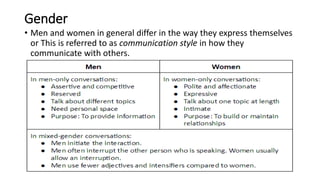
Gender
• Men and women in general differ in the way they express themselves
or This is referred to as communication style in how they
communicate with others.
Age
•People from different ages or generations
may have difficulty communicating with one
another.
•A person's age or the generation to which he
or she belongs influences the way he or she
communicates with others.
Social Status
•Differences in social status may affect
the way we communicate with others,
especially in intercultural
communication.
•Status differences are also evident
across cultures.
Religion
•Communication between or among
persons belonging to different religions is
a common source of intercultural conflict.
•Differences in religious views may also
lead to prejudices.
•Religion also deeply influences culture.

Avoiding communication breakdown

  • 1.
    Avoiding Communication Breakdown •Usetime-gaining expressions to have time to think. •Give positive remarks or comments. •Be specific. •Ask for repetition or clarification. •Check for understanding. •Do not jump to conclusions.
  • 2.
    Developing Effective CommunicationSkills •Effective communication is more than just the transmission of information from one person to another. It takes place only when the information is shared and mutually understood.
  • 3.
    The following aresome ways on how you can achieve effective communication. •Keep focused. •Speak intelligibly. •Listen with your ears and eyes •Minimize distractions.
  • 4.
  • 5.
    What caused thecommunication breakdown in the dialogue? • Ben: I thought Mark was my friend, but little did I know that he was secretly courting my crush Anna. Who knew he was such a snake in the grass! Carl: Really? Where? (looks at the surroundings) (Ben looks so confused.) a. physical b. cultural c. language d. prejudging
  • 6.
    Identify the communicationbarrier in the situation (Karen was busy drafting her essay when her cell phone rang.) Karen: Hello? Angel: Hi, Karen! It’s Angel. Listen, something really embarrassing happened earlier. Karen: Uh-huh . . . (Karen continues typing on her computer.) Angel: I was on my way to the gym when I saw Fred. Gosh, he looked even more handsome today. My heart was beating so wildly. Karen: Hmm . . . (Karen still continues to type on her computer.) Angel: I was so excited and happy to see him that I didn’t notice I stepped on dog poop! What’s worse is that Fred approached me while I smelled of poop! Karen: That’s great! Angel: Huh? What’s so great about that? Karen: Oh . . . What did you say? (Angel was irritated.) a. cultural barrier b. information overload c. lack of attention d. jumping to conclusion
  • 7.
    Which of thefollowing explains breakdown in communication? Harry, a British tourist, goes into a Filipino restaurant. After eating, he asks the waiter, “Excuse me, could you tell me where the john is?” The waiter, looking very surprised, shouts out, “John, someone is looking for you.” Harry looks puzzled. a. The waiter cannot clearly hear what Harry said. b. The waiter does not know what john means. c. The waiter knows that Harry is a friend of John’s. d. The waiter is distracted by the noise in the restaurant.
  • 8.
    What should DoctorFernando have done to achieve effective communication? Doctor Fernando, a renowned neurosurgeon, was invited as guest speaker during the National Nurses Week. In his speech, he talked about many different things and made a number of points. He delivered his speech for almost 1 hour and with over 50 slides. The audience appeared uneasy and did not seem interested after 15 minutes. a. Talked for a few more minutes to get his message across. b. Shared everything he knows about the nervous system. c. Focused on only a few main points but with emphasis. d. Urged the audience to listen attentively to him.
  • 9.
    Which of thefollowing is not a physical barrier in communication? a.noise b.distance c. jargon d.poor lighting
  • 10.
    INTERCULTURAL COMMUNICATION • Refersto communication between or among members of different cultural, social, or linguistic groups. When engaging in intercultural communication, it is essential that participants have an understanding of the following: • Self-awareness, or an understanding of one's self and place in society, is essential to communicate better with others, especially those who are different from you. • The way you communicate with others is largely influenced by your view of them. • Culture, gender, age, social status, and religion are some sociocultural factors that influence and affect communication.
  • 11.
    Culture • Through communicationwith others, culture is created, learned and shared. • our culture influences the way we communicate with others. • The term culture is a complex concept, it has been described in many different ways. In general, culture refers to the learned set of knowledge, norms, behaviors, values, beliefs, attitudes, customs, and practices that people in a particular group share at a specific point in time.
  • 12.
    Take a lookat this dialogue between a Filipino and an American. Situation: Raul meets with his new friend Peter at a restaurant. Raul arrives late. • Raul: Hi, Peter! I'm sorry I'm late. I was stuck in traffic. • Peter: (looking irritated) Well, you should have called ahead of time. So, how are you? • Raul: I'm actually not feeling well. I went to the park yesterday and . . . (continuously telling Peter the activities he did yesterday)
  • 13.
    Gender • Men andwomen in general differ in the way they express themselves or This is referred to as communication style in how they communicate with others.
  • 14.
    Age •People from differentages or generations may have difficulty communicating with one another. •A person's age or the generation to which he or she belongs influences the way he or she communicates with others.
  • 15.
    Social Status •Differences insocial status may affect the way we communicate with others, especially in intercultural communication. •Status differences are also evident across cultures.
  • 16.
    Religion •Communication between oramong persons belonging to different religions is a common source of intercultural conflict. •Differences in religious views may also lead to prejudices. •Religion also deeply influences culture.