



INTERCULTURAL
COMMUNICATION
REIMUEL M. BISNAR
Teacher I
Certified Microsoft Innovative Educator
Educator Community Contributor & Influencer
DEFINITION &
NATURE OF
INTERCUTURAL
COMMUNICATION
Ting-Toomey, 1999
Intercultural communication
happens when individuals
interact, negotiate, and create
meanings while bringing in
their varied cultural
backgrounds.
2
Gudykunst, 2003
Intercultural communication
pertains to communication
among people from different
nationalities.
DEFINITION &
NATURE OF
INTERCUTURAL
COMMUNICATION
3
Gudykunst & Kim, 2003
Intercultural communication
takes place when people
draw from their cultural
identity to understand values,
prejudices, language,
attitudes, and relationships
INTERCULTURAL
COMMUNICATION
is the sending
and receiving of
messages
across
languages and
cultures. 4
5
When you speak, your speech is
continuously accompanied by gestures,
facial expressions, and other body
movements that add to what you are
saying in different ways.
6
Nodding indicates
“DISAGREEMENT”
• Greece
• Lebanon
• Syria
• Palestine
• Turkey
• Macedonia
• Bulgaria
• Albania
7
Nodding means
“YES”
• Indian subcontinent
• Iran
• most of Europe
• Latin America
• North America
The Developmental Model
of Intercultural Sensitivity
Bennett and Bennett (2004)
8
Stage 1: DENIAL
The individual does not recognize cultural differences.
An individual in the denial stage might be heard saying:
“All cities are the same; they all
have tall buildings, fast food chains,
and coffee shops.” 9
Stage 2: DEFENSE
The individual starts to recognize cultural differences and is
intimidated by them, resulting in either a superior view on own
culture or an unjustified high regard for the new one.
An individual in the defense stage might be heard saying:
“This culture does not view life the way we do; our
culture is certainly better.”
10
“Their ways are better than my own; I wish I were one
of them.”
Stage 3: MINIMIZATION
Although individuals see cultural differences, they bank more
on the university of ideas rather than on cultural differences.
An individual in the minimization stage might be heard saying:
“Once we see through the
cultural differences, we really
are just the same!.” 11
Stage 4: ACCEPTANCE
The individual begins to appreciate important cultural
differences in behaviors and eventually in values.
An individual in the acceptance stage might be heard saying:
“These people and I have different
values and experiences, and I think
we can learn from one another.” 12
Stage 5: ADAPTATION
The individual is very open to world views when accepting new
perspectives.
An individual in the adaptation stage might be heard saying:
“To address our issue, I have to adjust
my approach to consider both my own
and my counterpart’s background.”
13
Stage 6: INTEGRATION
Individuals start to go beyond their own cultures and see
themselves and their actions based on multifarious cultural
viewpoints.
An individual in the integration stage might be heard saying:
“I can look at things from the
perspective of various cultures.”
14
Characteristics of Competent
Intercultural Communicators
Flexibility and the ability to tolerate high levels
of uncertainty
15
Reflectiveness or mindfulness
Open-mindedness
Sensitivity
Adaptability
Ability to engage in divergent thinking creatively
and systems-level thinking
Politeness
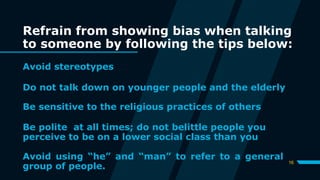
Refrain from showing bias when talking
to someone by following the tips below:
Avoid stereotypes
16
Do not talk down on younger people and the elderly
Be sensitive to the religious practices of others
Be polite at all times; do not belittle people you
perceive to be on a lower social class than you
Avoid using “he” and “man” to refer to a general
group of people.
www.facebook.com/reimuel.bisnar.71
www.instagram.com/reimuelb24
www.youtube.com/channel/UCakHxn3NGR2IYr360Sx-
A4Q
reimuelb@gmail.com or reimuel.bisnar@deped.gov.ph
FOLLOW ME IN
www.linkedin.com/in/reimuel-bisnar-23995b167/

Intercultural Communication

  • 1.
    INTERCULTURAL COMMUNICATION REIMUEL M. BISNAR TeacherI Certified Microsoft Innovative Educator Educator Community Contributor & Influencer
  • 2.
    DEFINITION & NATURE OF INTERCUTURAL COMMUNICATION Ting-Toomey,1999 Intercultural communication happens when individuals interact, negotiate, and create meanings while bringing in their varied cultural backgrounds. 2 Gudykunst, 2003 Intercultural communication pertains to communication among people from different nationalities.
  • 3.
    DEFINITION & NATURE OF INTERCUTURAL COMMUNICATION 3 Gudykunst& Kim, 2003 Intercultural communication takes place when people draw from their cultural identity to understand values, prejudices, language, attitudes, and relationships
  • 4.
    INTERCULTURAL COMMUNICATION is the sending andreceiving of messages across languages and cultures. 4
  • 5.
    5 When you speak,your speech is continuously accompanied by gestures, facial expressions, and other body movements that add to what you are saying in different ways.
  • 6.
    6 Nodding indicates “DISAGREEMENT” • Greece •Lebanon • Syria • Palestine • Turkey • Macedonia • Bulgaria • Albania
  • 7.
    7 Nodding means “YES” • Indiansubcontinent • Iran • most of Europe • Latin America • North America
  • 8.
    The Developmental Model ofIntercultural Sensitivity Bennett and Bennett (2004) 8
  • 9.
    Stage 1: DENIAL Theindividual does not recognize cultural differences. An individual in the denial stage might be heard saying: “All cities are the same; they all have tall buildings, fast food chains, and coffee shops.” 9
  • 10.
    Stage 2: DEFENSE Theindividual starts to recognize cultural differences and is intimidated by them, resulting in either a superior view on own culture or an unjustified high regard for the new one. An individual in the defense stage might be heard saying: “This culture does not view life the way we do; our culture is certainly better.” 10 “Their ways are better than my own; I wish I were one of them.”
  • 11.
    Stage 3: MINIMIZATION Althoughindividuals see cultural differences, they bank more on the university of ideas rather than on cultural differences. An individual in the minimization stage might be heard saying: “Once we see through the cultural differences, we really are just the same!.” 11
  • 12.
    Stage 4: ACCEPTANCE Theindividual begins to appreciate important cultural differences in behaviors and eventually in values. An individual in the acceptance stage might be heard saying: “These people and I have different values and experiences, and I think we can learn from one another.” 12
  • 13.
    Stage 5: ADAPTATION Theindividual is very open to world views when accepting new perspectives. An individual in the adaptation stage might be heard saying: “To address our issue, I have to adjust my approach to consider both my own and my counterpart’s background.” 13
  • 14.
    Stage 6: INTEGRATION Individualsstart to go beyond their own cultures and see themselves and their actions based on multifarious cultural viewpoints. An individual in the integration stage might be heard saying: “I can look at things from the perspective of various cultures.” 14
  • 15.
    Characteristics of Competent InterculturalCommunicators Flexibility and the ability to tolerate high levels of uncertainty 15 Reflectiveness or mindfulness Open-mindedness Sensitivity Adaptability Ability to engage in divergent thinking creatively and systems-level thinking Politeness
  • 16.
    Refrain from showingbias when talking to someone by following the tips below: Avoid stereotypes 16 Do not talk down on younger people and the elderly Be sensitive to the religious practices of others Be polite at all times; do not belittle people you perceive to be on a lower social class than you Avoid using “he” and “man” to refer to a general group of people.
  • 17.