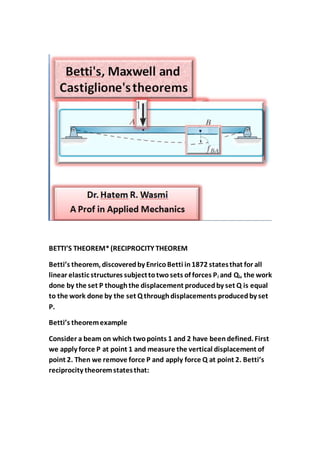
BETTI’S THEOREM*(RECIPROCITY THEOREM
Betti’s theorem, discoveredby EnricoBetti in1872 statesthat for all
, the workiand Qilinear elastic structures subjecttotwosets of forces P
done by the set P thoughthe displacement producedby set Q is equal
to the work done by the set Q throughdisplacements producedby set
P.
Betti’s theoremexample
Consider a beam on which twopoints 1 and 2 have beendefined. First
we apply force P at point 1 and measure the vertical displacement of
point 2. Then we remove force P and apply force Q at point 2. Betti’s
reciprocity theoremstatesthat:
Maxwell–Betti Reciprocal theorem
L as shown in Fig. LetConsider a simply supportedbeamof span
2P1Pforcescan be loaded by twosystems of forces
separately as shownin the figure.
whenonly load P1 is2be the deflectionbelow the loadpoint P21Let u
, when only load1be the deflectionbelow loadP12acting. Similarly let u
is acting on the beam.2P
B & M reciprocal TheoremContinued
Reciprocal theorem
The reciprocal theoremstates that the work done by forces acting
throughdisplacement of the secondsystemis the same as the work
done by the secondsystemof forces acting throughthe displacements
of the first system. Hence, according toreciprocal theorem,
Reciprocal theoremfor Systemof forces
Summary
1. The Castiglione's first theoremhas beenstatedandproved. For
statically determinate structure, the partial derivative of strainenergy
withrespect toexternal force is equal tothe displacement inthe
directionof that load at the point of applicationof the load. This
theoremwhenappliedto the statically indeterminate structureresults
in the theoremof Least work. the theoremof Least Work has been
statedand proved.
2. The celebratedtheoremof Maxwell-Betti’s reciprocal theoremhas
beensated and proved.

Betti

  • 1.
    BETTI’S THEOREM*(RECIPROCITY THEOREM Betti’stheorem, discoveredby EnricoBetti in1872 statesthat for all , the workiand Qilinear elastic structures subjecttotwosets of forces P done by the set P thoughthe displacement producedby set Q is equal to the work done by the set Q throughdisplacements producedby set P. Betti’s theoremexample Consider a beam on which twopoints 1 and 2 have beendefined. First we apply force P at point 1 and measure the vertical displacement of point 2. Then we remove force P and apply force Q at point 2. Betti’s reciprocity theoremstatesthat:
  • 2.
    Maxwell–Betti Reciprocal theorem Las shown in Fig. LetConsider a simply supportedbeamof span 2P1Pforcescan be loaded by twosystems of forces separately as shownin the figure. whenonly load P1 is2be the deflectionbelow the loadpoint P21Let u , when only load1be the deflectionbelow loadP12acting. Similarly let u is acting on the beam.2P B & M reciprocal TheoremContinued
  • 3.
    Reciprocal theorem The reciprocaltheoremstates that the work done by forces acting throughdisplacement of the secondsystemis the same as the work done by the secondsystemof forces acting throughthe displacements of the first system. Hence, according toreciprocal theorem, Reciprocal theoremfor Systemof forces
  • 5.
    Summary 1. The Castiglione'sfirst theoremhas beenstatedandproved. For statically determinate structure, the partial derivative of strainenergy withrespect toexternal force is equal tothe displacement inthe directionof that load at the point of applicationof the load. This theoremwhenappliedto the statically indeterminate structureresults in the theoremof Least work. the theoremof Least Work has been statedand proved. 2. The celebratedtheoremof Maxwell-Betti’s reciprocal theoremhas beensated and proved.