TYPES OF ANALYSES FORTYPES OF ANALYSES FOR
ASSOCIATIONASSOCIATION
MR. EDELSON P. BOHOL
RH 630 Research Seminar 1
Correlation AnalysisCorrelation Analysis
Is a statistical measure
used to determine the
strength or degree of
relationship between
two or more variables.
RH 630 Research Seminar 1
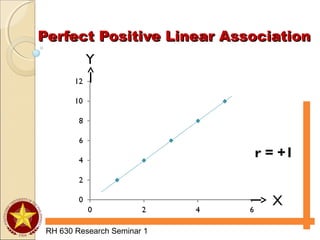
Perfect Positive Linear AssociationPerfect Positive Linear Association
RH 630 Research Seminar 1
r = +1
Y
X
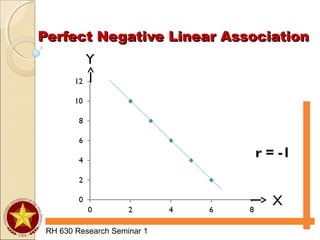
Perfect Negative Linear AssociationPerfect Negative Linear Association
RH 630 Research Seminar 1
r = -1
Y
X
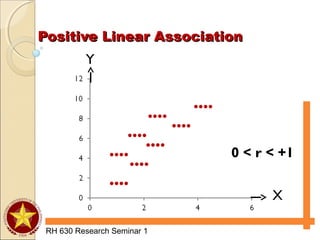
Positive Linear AssociationPositive Linear Association
RH 630 Research Seminar 1
0 < r < +1
Y
X
●●●●
●●●●
●●●●
●●●●
●●●●
●●●●
●●●●
●●●●
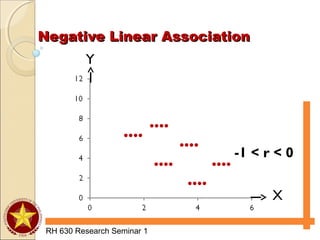
Negative Linear AssociationNegative Linear Association
RH 630 Research Seminar 1
-1 < r < 0
Y
X
●●●●
●●●●
●●●●
●●●● ●●●●
●●●●
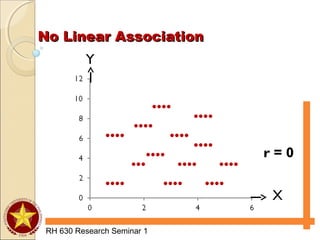
No Linear AssociationNo Linear Association
RH 630 Research Seminar 1
r = 0
Y
X
●●●●
●●●●
●●●●
●●●● ●●●●
●●●●
●●●●
●●● ●●●● ●●●●
●●●● ●●●● ●●●●
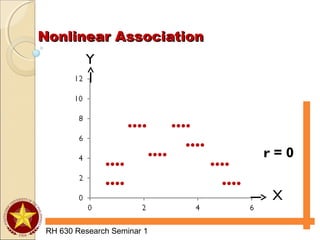
Nonlinear AssociationNonlinear Association
RH 630 Research Seminar 1
r = 0
Y
X
●●●● ●●●●
●●●●
●●●●
●●●● ●●●●
●●●● ●●●●
Pearson Product MomentPearson Product Moment
Correlation CoefficientCorrelation Coefficient
RH 630 Research Seminar 1
Pearson Product MomentPearson Product Moment
Correlation CoefficientCorrelation Coefficient
The most commonly
used measure is the
Pearson Product
Moment Correlation
Coefficient denoted by
p and estimated by
r.
RH 630 Research Seminar 1
Pearson Product MomentPearson Product Moment
Correlation CoefficientCorrelation Coefficient
RH 630 Research Seminar 1
n∑xy-(∑x)(∑y)
√[n(∑x²) - (∑x)²] [n(∑y²) - (∑y)²]
R =
Pearson Product Moment Correlation CoefficientPearson Product Moment Correlation Coefficient
RH 630 Research Seminar 1
R =
X Y X² Y² XY
3 9 9 81 27
4 13 16 168 52
5 15 25 225 75
6 16 36 256 96
7 17 49 289 119
∑X = 25 ∑ Y = 70 ∑ X² =
135
∑Y²=
1020
∑XY=369
n∑xy - (∑x)(∑y)
√[n(∑x²) - (∑x)²][n(∑y²) – (∑y)²]
√[ 5(135) – (25)² ] [5(1020) – (70)² ]
5 ( 369 ) – 25 ( 70 )
=
1845 - 1750
=
√ ( 50 ) ( 200 )
=
95
100
= .95
Simple Linear RegressionSimple Linear Regression
AnalysisAnalysis
RH 630 Research Seminar 1
REGRESSION ANALYSIS- is a
statistical used to determine the
functional relationship between
two or more variables.
Simple Linear regression AnalysisSimple Linear regression Analysis
RH 630 Research Seminar 1
 To establish the posible causation of
changes in one variable by changes
in other variables
To predict or estimate the value of a
variable given the values of other
variables.
To explain some of the variation of
one variable by the other variables.
The Objectives of Finding a Statistical FunctionalThe Objectives of Finding a Statistical Functional
Relationship Between Variables are:Relationship Between Variables are:
Data and ScatterData and Scatter
DiagramDiagram
RH 630 Research Seminar 1
Scatter Diagram- a plotted
points of the basic data on the X-
Y plane.
–It gives us an idea on the
posible relationship between X
andY.
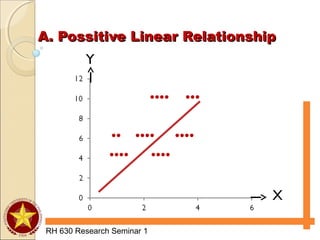
A. Possitive Linear RelationshipA. Possitive Linear Relationship
RH 630 Research Seminar 1
Y
X
●●●● ●●●
●● ●●●● ●●●●
●●●● ●●●●
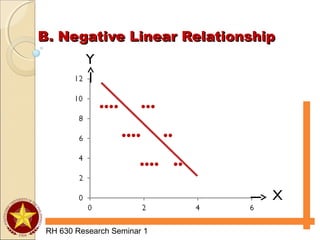
B. Negative Linear RelationshipB. Negative Linear Relationship
RH 630 Research Seminar 1
Y
X
●●●● ●●●
●●●● ●●
●●●● ●●
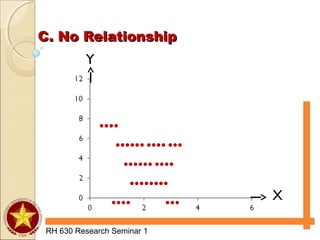
C. No RelationshipC. No Relationship
RH 630 Research Seminar 1
Y
X
●●●●
●●●●●● ●●●● ●●●
●●●●●● ●●●●
●●●●●●●●
●●●● ●●●
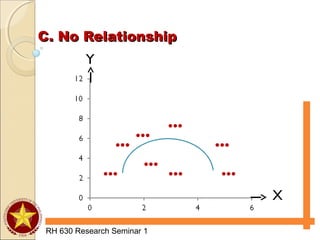
C. No RelationshipC. No Relationship
RH 630 Research Seminar 1
Y
X
●●●
●●●
●●● ●●●
●●●
●●● ●●● ●●●
The Data and theThe Data and the
Regression EquationRegression Equation
RH 630 Research Seminar 1
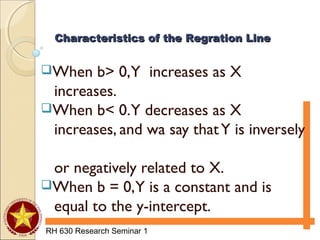
When b> 0,Y increases as X
increases.
When b< 0.Y decreases as X
increases, and wa say thatY is inversely
or negatively related to X.
When b = 0,Y is a constant and is
equal to the y-intercept.
Characteristics of the Regration LineCharacteristics of the Regration Line
The Data and the Regression EquationThe Data and the Regression Equation
RH 630 Research Seminar 1
Given : Equation of the lineY = a + bX
Computing for a and b:
Calculation of Simple RegressionCalculation of Simple Regression
byx =
∑XY – [∑X∑Y/N]
[∑X²– [(∑X)²/N]
Ayx = Y – byxX
Correlation from RanksCorrelation from Ranks
RH 630 Research Seminar 1
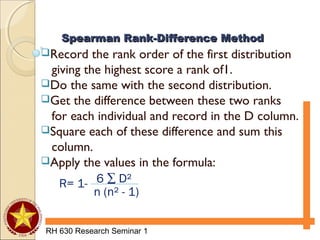
Record the rank order of the first distribution
giving the highest score a rank of1.
Do the same with the second distribution.
Get the difference between these two ranks
for each individual and record in the D column.
Square each of these difference and sum this
column.
Apply the values in the formula:
Spearman Rank-Difference MethodSpearman Rank-Difference Method
R= 1-
n (n² - 1)
6 ∑ D²
RH 630 Research Seminar 1
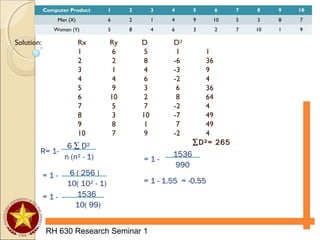
Solution: Rx Ry D D²
1 6 5 1 1
2 2 8 -6 36
3 1 4 -3 9
4 4 6 -2 4
5 9 3 6 36
6 10 2 8 64
7 5 7 -2 4
8 3 10 -7 49
9 8 1 7 49
10 7 9 -2 4
∑D²= 265
R= 1-
6 ∑ D²
n (n² - 1)
6 ( 256 )= 1 -
10( 10² - 1)
1536
10( 99)
= 1 -
1536
= 1 -
990
= 1 - 1.55 = -0.55
Computer Product 1 2 3 4 5 6 7 8 9 10
Men (X) 6 2 1 4 9 10 5 3 8 7
Woman (Y) 5 8 4 6 3 2 7 10 1 9
Chi-Square (2)Chi-Square (2)²²
RH 630 Research Seminar 1
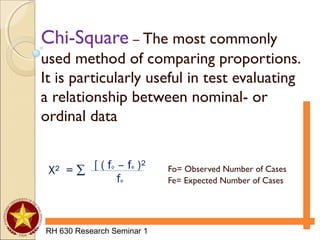
Chi-Square – The most commonly
used method of comparing proportions.
It is particularly useful in test evaluating
a relationship between nominal- or
ordinal data
Fo= Observed Number of Cases
Fe= Expected Number of Cases
X² = ∑ [ ( fo – fe )²
fe
Chi-Square (XChi-Square (X²)²)
RH 630 Research Seminar 1
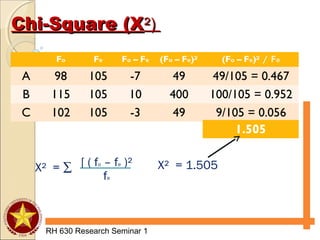
Fo Fe Fo – Fe (Fo – Fe)² (Fo – Fe)² / Fe
A 98 105 -7 49 49/105 = 0.467
B 115 105 10 400 100/105 = 0.952
C 102 105 -3 49 9/105 = 0.056
1.505
X² = ∑ [ ( fo – fe )²
fe
X² = 1.505
Chi-Square as a Test of Independence:Chi-Square as a Test of Independence:
Two Variable ProblemsTwo Variable Problems
RH 630 Research Seminar 1
Chi-Square can also be used to test
the significance of the relationship
between two variables when data are
expressed in terms of frequencies of
joint occurence.
Fe = [ ]
(rowtotal) (columntotal)
N
Chi-Square as a Test of Independence:Chi-Square as a Test of Independence:
Two Variable ProblemsTwo Variable Problems
RH 630 Research Seminar 1
Fe = [ ](rowtotal) (columntotal)
N
School Choice
Gender
Female Male Total
Public 42 65 107
Private 58 35 93
Total 100 100 200
C 1
C2
C 3
C4
Computational Procedure:
1. Compute the expected frequency of each cell.
C1 =
100x107 = 53.5
200
200
100x93 = 46.5C1 =
100x107 = 53.5
100x93 = 46.5
C4 = 200
C3 = 200
Chi-Square as a Test of Independence:Chi-Square as a Test of Independence:
Two Variable ProblemsTwo Variable Problems
RH 630 Research Seminar 1
School Choice
Gender
Female Male Total
Public 42 65 107
Private 58 35 93
Total 100 100 200
C 1
C2
C 3
C4
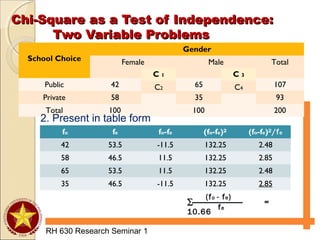
2. Present in table form
fo fe fo-fe (fo-fe)² (fo-fe)²/fe
42 53.5 -11.5 132.25 2.48
58 46.5 11.5 132.25 2.85
65 53.5 11.5 132.25 2.48
35 46.5 -11.5 132.25 2.85
∑ =
10.66
(fo - fe)
fe
Chi-Square as a Test of Independence:Chi-Square as a Test of Independence:
Two Variable ProblemsTwo Variable Problems
RH 630 Research Seminar 1
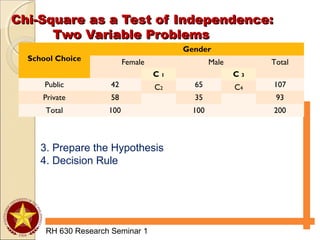
School Choice
Gender
Female Male Total
Public 42 65 107
Private 58 35 93
Total 100 100 200
C 1
C2
C 3
C4
3. Prepare the Hypothesis
4. Decision Rule
***********THE END********************THE END*********
THANKYOU!

Types of Analysis for Association

  • 2.
    TYPES OF ANALYSESFORTYPES OF ANALYSES FOR ASSOCIATIONASSOCIATION MR. EDELSON P. BOHOL RH 630 Research Seminar 1
  • 3.
    Correlation AnalysisCorrelation Analysis Isa statistical measure used to determine the strength or degree of relationship between two or more variables. RH 630 Research Seminar 1
  • 4.
    Perfect Positive LinearAssociationPerfect Positive Linear Association RH 630 Research Seminar 1 r = +1 Y X
  • 5.
    Perfect Negative LinearAssociationPerfect Negative Linear Association RH 630 Research Seminar 1 r = -1 Y X
  • 6.
    Positive Linear AssociationPositiveLinear Association RH 630 Research Seminar 1 0 < r < +1 Y X ●●●● ●●●● ●●●● ●●●● ●●●● ●●●● ●●●● ●●●●
  • 7.
    Negative Linear AssociationNegativeLinear Association RH 630 Research Seminar 1 -1 < r < 0 Y X ●●●● ●●●● ●●●● ●●●● ●●●● ●●●●
  • 8.
    No Linear AssociationNoLinear Association RH 630 Research Seminar 1 r = 0 Y X ●●●● ●●●● ●●●● ●●●● ●●●● ●●●● ●●●● ●●● ●●●● ●●●● ●●●● ●●●● ●●●●
  • 9.
    Nonlinear AssociationNonlinear Association RH630 Research Seminar 1 r = 0 Y X ●●●● ●●●● ●●●● ●●●● ●●●● ●●●● ●●●● ●●●●
  • 10.
    Pearson Product MomentPearsonProduct Moment Correlation CoefficientCorrelation Coefficient RH 630 Research Seminar 1
  • 11.
    Pearson Product MomentPearsonProduct Moment Correlation CoefficientCorrelation Coefficient The most commonly used measure is the Pearson Product Moment Correlation Coefficient denoted by p and estimated by r. RH 630 Research Seminar 1
  • 12.
    Pearson Product MomentPearsonProduct Moment Correlation CoefficientCorrelation Coefficient RH 630 Research Seminar 1 n∑xy-(∑x)(∑y) √[n(∑x²) - (∑x)²] [n(∑y²) - (∑y)²] R =
  • 13.
    Pearson Product MomentCorrelation CoefficientPearson Product Moment Correlation Coefficient RH 630 Research Seminar 1 R = X Y X² Y² XY 3 9 9 81 27 4 13 16 168 52 5 15 25 225 75 6 16 36 256 96 7 17 49 289 119 ∑X = 25 ∑ Y = 70 ∑ X² = 135 ∑Y²= 1020 ∑XY=369 n∑xy - (∑x)(∑y) √[n(∑x²) - (∑x)²][n(∑y²) – (∑y)²] √[ 5(135) – (25)² ] [5(1020) – (70)² ] 5 ( 369 ) – 25 ( 70 ) = 1845 - 1750 = √ ( 50 ) ( 200 ) = 95 100 = .95
  • 14.
    Simple Linear RegressionSimpleLinear Regression AnalysisAnalysis RH 630 Research Seminar 1
  • 15.
    RH 630 ResearchSeminar 1 REGRESSION ANALYSIS- is a statistical used to determine the functional relationship between two or more variables.
  • 16.
    Simple Linear regressionAnalysisSimple Linear regression Analysis RH 630 Research Seminar 1  To establish the posible causation of changes in one variable by changes in other variables To predict or estimate the value of a variable given the values of other variables. To explain some of the variation of one variable by the other variables. The Objectives of Finding a Statistical FunctionalThe Objectives of Finding a Statistical Functional Relationship Between Variables are:Relationship Between Variables are:
  • 17.
    Data and ScatterDataand Scatter DiagramDiagram RH 630 Research Seminar 1
  • 18.
    RH 630 ResearchSeminar 1 Scatter Diagram- a plotted points of the basic data on the X- Y plane. –It gives us an idea on the posible relationship between X andY.
  • 19.
    A. Possitive LinearRelationshipA. Possitive Linear Relationship RH 630 Research Seminar 1 Y X ●●●● ●●● ●● ●●●● ●●●● ●●●● ●●●●
  • 20.
    B. Negative LinearRelationshipB. Negative Linear Relationship RH 630 Research Seminar 1 Y X ●●●● ●●● ●●●● ●● ●●●● ●●
  • 21.
    C. No RelationshipC.No Relationship RH 630 Research Seminar 1 Y X ●●●● ●●●●●● ●●●● ●●● ●●●●●● ●●●● ●●●●●●●● ●●●● ●●●
  • 22.
    C. No RelationshipC.No Relationship RH 630 Research Seminar 1 Y X ●●● ●●● ●●● ●●● ●●● ●●● ●●● ●●●
  • 23.
    The Data andtheThe Data and the Regression EquationRegression Equation RH 630 Research Seminar 1
  • 24.
    RH 630 ResearchSeminar 1 When b> 0,Y increases as X increases. When b< 0.Y decreases as X increases, and wa say thatY is inversely or negatively related to X. When b = 0,Y is a constant and is equal to the y-intercept. Characteristics of the Regration LineCharacteristics of the Regration Line
  • 25.
    The Data andthe Regression EquationThe Data and the Regression Equation RH 630 Research Seminar 1 Given : Equation of the lineY = a + bX Computing for a and b: Calculation of Simple RegressionCalculation of Simple Regression byx = ∑XY – [∑X∑Y/N] [∑X²– [(∑X)²/N] Ayx = Y – byxX
  • 26.
    Correlation from RanksCorrelationfrom Ranks RH 630 Research Seminar 1
  • 27.
    RH 630 ResearchSeminar 1 Record the rank order of the first distribution giving the highest score a rank of1. Do the same with the second distribution. Get the difference between these two ranks for each individual and record in the D column. Square each of these difference and sum this column. Apply the values in the formula: Spearman Rank-Difference MethodSpearman Rank-Difference Method R= 1- n (n² - 1) 6 ∑ D²
  • 28.
    RH 630 ResearchSeminar 1 Solution: Rx Ry D D² 1 6 5 1 1 2 2 8 -6 36 3 1 4 -3 9 4 4 6 -2 4 5 9 3 6 36 6 10 2 8 64 7 5 7 -2 4 8 3 10 -7 49 9 8 1 7 49 10 7 9 -2 4 ∑D²= 265 R= 1- 6 ∑ D² n (n² - 1) 6 ( 256 )= 1 - 10( 10² - 1) 1536 10( 99) = 1 - 1536 = 1 - 990 = 1 - 1.55 = -0.55 Computer Product 1 2 3 4 5 6 7 8 9 10 Men (X) 6 2 1 4 9 10 5 3 8 7 Woman (Y) 5 8 4 6 3 2 7 10 1 9
  • 29.
  • 30.
    RH 630 ResearchSeminar 1 Chi-Square – The most commonly used method of comparing proportions. It is particularly useful in test evaluating a relationship between nominal- or ordinal data Fo= Observed Number of Cases Fe= Expected Number of Cases X² = ∑ [ ( fo – fe )² fe
  • 31.
    Chi-Square (XChi-Square (X²)²) RH630 Research Seminar 1 Fo Fe Fo – Fe (Fo – Fe)² (Fo – Fe)² / Fe A 98 105 -7 49 49/105 = 0.467 B 115 105 10 400 100/105 = 0.952 C 102 105 -3 49 9/105 = 0.056 1.505 X² = ∑ [ ( fo – fe )² fe X² = 1.505
  • 32.
    Chi-Square as aTest of Independence:Chi-Square as a Test of Independence: Two Variable ProblemsTwo Variable Problems RH 630 Research Seminar 1 Chi-Square can also be used to test the significance of the relationship between two variables when data are expressed in terms of frequencies of joint occurence. Fe = [ ] (rowtotal) (columntotal) N
  • 33.
    Chi-Square as aTest of Independence:Chi-Square as a Test of Independence: Two Variable ProblemsTwo Variable Problems RH 630 Research Seminar 1 Fe = [ ](rowtotal) (columntotal) N School Choice Gender Female Male Total Public 42 65 107 Private 58 35 93 Total 100 100 200 C 1 C2 C 3 C4 Computational Procedure: 1. Compute the expected frequency of each cell. C1 = 100x107 = 53.5 200 200 100x93 = 46.5C1 = 100x107 = 53.5 100x93 = 46.5 C4 = 200 C3 = 200
  • 34.
    Chi-Square as aTest of Independence:Chi-Square as a Test of Independence: Two Variable ProblemsTwo Variable Problems RH 630 Research Seminar 1 School Choice Gender Female Male Total Public 42 65 107 Private 58 35 93 Total 100 100 200 C 1 C2 C 3 C4 2. Present in table form fo fe fo-fe (fo-fe)² (fo-fe)²/fe 42 53.5 -11.5 132.25 2.48 58 46.5 11.5 132.25 2.85 65 53.5 11.5 132.25 2.48 35 46.5 -11.5 132.25 2.85 ∑ = 10.66 (fo - fe) fe
  • 35.
    Chi-Square as aTest of Independence:Chi-Square as a Test of Independence: Two Variable ProblemsTwo Variable Problems RH 630 Research Seminar 1 School Choice Gender Female Male Total Public 42 65 107 Private 58 35 93 Total 100 100 200 C 1 C2 C 3 C4 3. Prepare the Hypothesis 4. Decision Rule
  • 36.