Basic Biostatistics
Haramaya University
Collageof Health and Medicine Sciences
School of Public Health
Continuous Data Analysis
By Adisu Birhanu (Assistant prof. of Biostatistics)
Feb 2025
2.
Session Objectives
Describe Continuousvariable and method of analyses
Describe relationship between continuous variables
Interpret the outputs from linear regression models
3.
Analysis of ContinuousData
A continuous variable is one which can take on infinity many,
uncountable possible values in the range of real numbers.
Data analysis methods such as scatter plot, line graphs and
histogram are applicable for describing numerical data.
More advanced methods for inferential analysis of continuous data
include correlation, t-test, ANOVA and linear regression.
4.
Comparison of themeans
t-test is appropriate to compare two means from two population
There are three different t-tests
One sample t-test
Two independent sample t-test
Paired sample t-test
ANOVA is used for IV with more than two groups
BY ADISU B.
5.
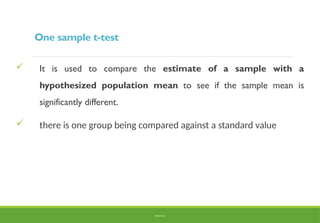
One sample t-test
It is used to compare the estimate of a sample with a
hypothesized population mean to see if the sample mean is
significantly different.
there is one group being compared against a standard value
BY ADISU B.
6.
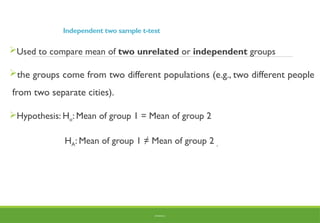
Independent two samplet-test
Used to compare mean of two unrelated or independent groups
the groups come from two different populations (e.g., two different people
from two separate cities).
Hypothesis: Ho: Mean of group 1 = Mean of group 2
HA: Mean of group 1 ≠ Mean of group 2 ,
BY ADISU B.
7.
Example
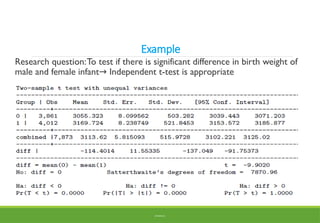
Research question:To testif there is significant difference in birth weight of
male and female infant Independent t-test is appropriate
→
BY ADISU B.
8.
Interpretation
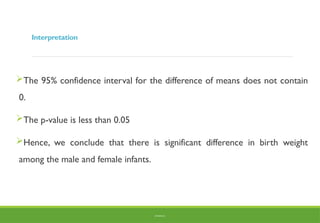
The 95% confidenceinterval for the difference of means does not contain
0.
The p-value is less than 0.05
Hence, we conclude that there is significant difference in birth weight
among the male and female infants.
BY ADISU B.
9.
Paired t- test
Compare means if each observation in one sample has one and only
one pair in the other sample dependent to each other.
In this case the groups come from a single population (e.g.,
measuring before and after an experimental treatment), perform
a paired t test.
Hypothesis: Ho: Mean difference = 0 Vs HA: Mean difference ≠ 0
BY ADISU B.
10.
One wayANOVA (AnalysisofVariance)
For two normal distributions the two sample means are compared by
t-test.
The means of more than two distributions need to be compared.
BY ADISU B.
11.
One way ANOVA…
Thet-test methodology generalizes to the one-way analysis of variance
(ANOVA) for categorical variables with more than two categories.
ANOVA do not tell you which group is different, but only whether a
difference exists.
To know which group is different, we used post hoc tests (bonferroni,
Tuckey, scheffe).
BY ADISU B.
12.
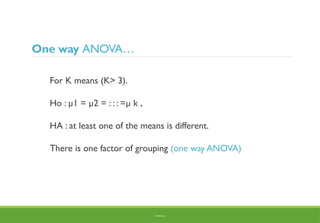
One way ANOVA…
ForK means (K> 3).
Ho : µ1 = µ2 = : : : =µ k ,
HA : at least one of the means is different.
There is one factor of grouping (one way ANOVA)
BY ADISU B.
13.
One wayANOVA…
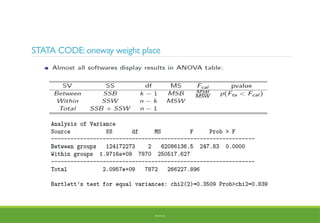
Consider infantdata: Outcome variable: birth weight
Factor variable: residence (urban= 1, semi-urban= 2, rural=3)
Objective: compare weight among the three place categories
BY ADISU B.
One way ANOVA…
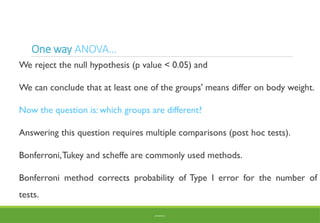
Wereject the null hypothesis (p value < 0.05) and
We can conclude that at least one of the groups' means differ on body weight.
Now the question is: which groups are different?
Answering this question requires multiple comparisons (post hoc tests).
Bonferroni,Tukey and scheffe are commonly used methods.
Bonferroni method corrects probability of Type I error for the number of
tests.
BY ADISU B.
16.
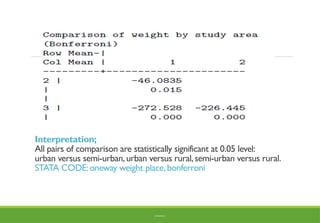
Interpretation;
All pairs ofcomparison are statistically significant at 0.05 level:
urban versus semi-urban,urban versus rural,semi-urban versus rural.
STATA CODE:oneway weight place,bonferroni
BY ADISU B.
17.
Correlation
Correlation is usedto quantify the degree to which two
continuous random variables are related,
Common correlation measure
Pearson Correlation Coefficient: for linear relationship
between two variables
18.
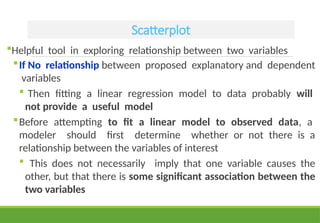
Scatterplot
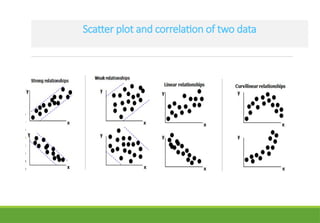
Helpful tool inexploring relationship between two variables
If No relationship between proposed explanatory and dependent
variables
Then fitting a linear regression model to data probably will
not provide a useful model
Before attempting to fit a linear model to observed data, a
modeler should first determine whether or not there is a
relationship between the variables of interest
This does not necessarily imply that one variable causes the
other, but that there is some significant association between the
two variables
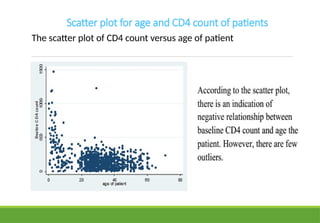
Scatter plot forage and CD4 count of patients
The scatter plot of CD4 count versus age of patient
21.
Correlation coefficient
A valuablenumerical measure of relationship between
two variables
A value between -1 and 1 indicating the strength of the
linear relationship for two variables
Population correlation coefficient ρ (rho) measures the
strength of linear relationship between two variables
Sample correlation coefficient, r, is an estimate of ρ and is used
to measure the strength of the linear relationship in the
sample observations.
22.
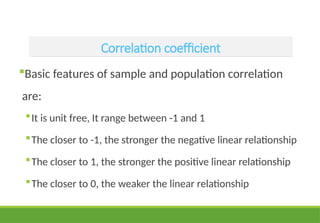
Correlation coefficient
Basic featuresof sample and population correlation
are:
It is unit free, It range between -1 and 1
The closer to -1, the stronger the negative linear relationship
The closer to 1, the stronger the positive linear relationship
The closer to 0, the weaker the linear relationship
23.
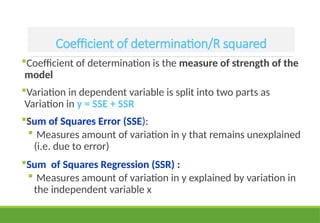
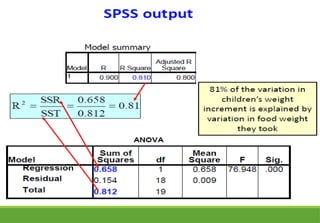
Coefficient of determination/Rsquared
Coefficient of determination is the measure of strength of the
model
Variation in dependent variable is split into two parts as
Variation in y = SSE + SSR
Sum of Squares Error (SSE):
Measures amount of variation in y that remains unexplained
(i.e. due to error)
Sum of Squares Regression (SSR) :
Measures amount of variation in y explained by variation in
the independent variable x
24.
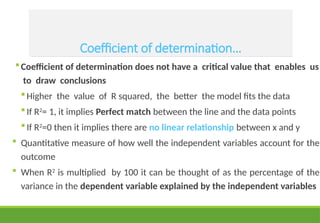
Coefficient of determinationdoes not have a critical value that enables us
to draw conclusions
Higher the value of R squared, the better the model fits the data
If R2
= 1, it implies Perfect match between the line and the data points
If R2
=0 then it implies there are no linear relationship between x and y
Quantitative measure of how well the independent variables account for the
outcome
When R2
is multiplied by 100 it can be thought of as the percentage of the
variance in the dependent variable explained by the independent variables
Coefficient of determination…
25.
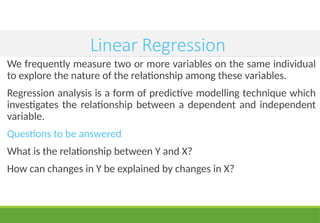
Linear Regression
We frequentlymeasure two or more variables on the same individual
to explore the nature of the relationship among these variables.
Regression analysis is a form of predictive modelling technique which
investigates the relationship between a dependent and independent
variable.
Questions to be answered
What is the relationship between Y and X?
How can changes in Y be explained by changes in X?
26.
Linear regression (#2)
Linearregression attempts to model the relationship
between two variables by fitting a linear equation to
observed data
Explanatory variable (X): can be any types of variables
Dependent variable: Y
Dependent variable for linear regression should be
numeric (continuous)
27.
Linear regression (#3)
Goalof linear regression is to find the line that best
predicts dependent variable from independent variables
Linear regression does this by finding the line that
minimizes the sum of the squares of the vertical distances
of the points from the line
28.
How linear regressionworks?
Least-squares methods (OLS)
Calculates the best-fitting line for the observed data by
minimizing the sum of the squares of the vertical deviations from
each data point to the line
If a point lies on the fitted line exactly, then its vertical deviation is 0
Goal of regression is to minimize the sum of the squares of the
vertical distances of the points from the line
29.
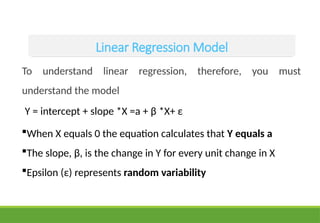
Linear Regression Model
Tounderstand linear regression, therefore, you must
understand the model
Y = intercept + slope *X =a + β *X+ ε
When X equals 0 the equation calculates that Y equals a
The slope, β, is the change in Y for every unit change in X
Epsilon (ε) represents random variability
30.
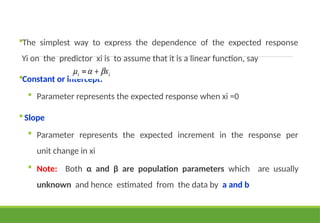
The simplest wayto express the dependence of the expected response
Yi on the predictor xi is to assume that it is a linear function, say
Constant or intercept:
Parameter represents the expected response when xi =0
Slope
Parameter represents the expected increment in the response per
unit change in xi
Note: Both α and β are population parameters which are usually
unknown and hence estimated from the data by a and b
33.
Assumptions of linearregression
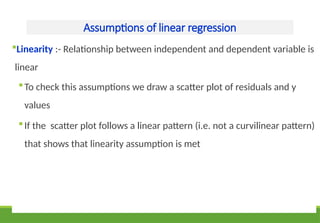
Linearity :- Relationship between independent and dependent variable is
linear
To check this assumptions we draw a scatter plot of residuals and y
values
If the scatter plot follows a linear pattern (i.e. not a curvilinear pattern)
that shows that linearity assumption is met
34.
Linear Regression Assumptions
Normality(Normally Distributed Error Terms): - Error terms follow
the normal distribution. We can use `qnorm' and `pnorm' to check
the normality of the residuals.
Shapirowilk test can also be used
35.
Homoscedasticity of Residuals
Homoscedasticity:- Variance of the error terms is constant.
Is about homogeneity of variance of the residuals.
If the model is well-fitted, there should be no pattern to the
residuals plotted against the fitted values.
If the variance of the residuals is non-constant. it is heteroscedastic.
Multicollinearity
When there isa perfect linear relationship among the
predictors, the estimates cannot be uniquely computed.
The term collinearity implies that two variables are near perfect
linear combinations of one another.
The regression model estimates of the coefficients become
unstable.
The standard errors for the coefficients can get wildly inflated.
We can use the vif or tolerance to check for multicollinearity.
38.
Multicollinearity…
As a ruleof thumb, a variable whose VIF are greater than 5
may need further investigation.
Tolerance, defined as 1/VIF, is used by many researchers to
check on the degree of collinearity.
39.
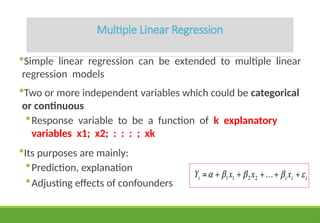
Multiple Linear Regression
Simplelinear regression can be extended to multiple linear
regression models
Two or more independent variables which could be categorical
or continuous
Response variable to be a function of k explanatory
variables x1; x2; : : : ; xk
Its purposes are mainly:
Prediction, explanation
Adjusting effects of confounders
40.
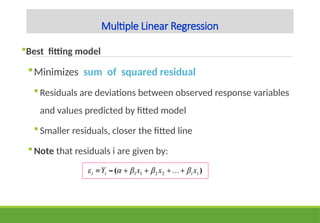
Multiple Linear Regression
Bestfitting model
Minimizes sum of squared residual
Residuals are deviations between observed response variables
and values predicted by fitted model
Smaller residuals, closer the fitted line
Note that residuals i are given by:
42.
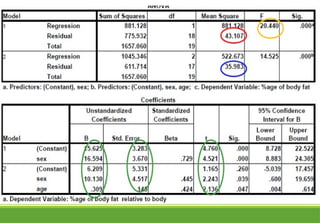
Coefficient in multiplelinear regressions
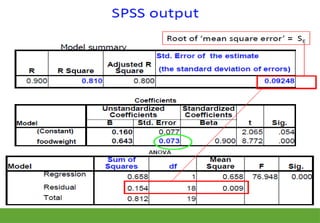
beta coefficient measures amount of increase or decrease in
dependent variable for a one-unit difference in continuous
independent variable
If an independent variable has a nominal scale with more
than two categories
Dummy variables are needed
Each dummy should be considered as an independent
variable
43.
Assumptions: Specification ofmodel (model building)
Strategies to identify a subset of variables:
Option 1: Variable selection based on significance in
univariable models (simple linear regression):
All variables that show a significant effect in uni-variable
models are included
Variable with a p-value of less than 0.25 is taken to MLR model
44.
Option 2: Variableselection based on significance in
multivariable model:
Backward
stepwise
forward selection
45.
Backward/stepwise/forward selection
Backward selection:
Allvariables will be entered in the model
Then remove step by step until significantly contributing
variables are left in model
Least contributing variable will be removed first
Then second least contributor will be removed and so on
Forward selection:
Model starts with empty (null model)
Then most significantly contributing variable will enter first
This continuous step by step until only significantly
contributing variables enter in the model
46.
Stepwise selection
Same asforward selection
Even if a variable is included in the model its contribution
will be tested after inclusion of other variable/s
Variables are added but can subsequently be removed if
they no longer contribute to the prediction
47.
Option 3: Variableselection based on subject matter
knowledge:
Best way to select variables, as it is not data-driven and it is
therefore considered as yielding unbiased results






![제 23회 보아즈(BOAZ) 빅데이터 컨퍼런스 - [MBOAX] : ABSA를 활용한 소비자 반응 분석 기반 운영 효율화 대시보드 설계](https://cdn.slidesharecdn.com/ss_thumbnails/3-1boaz23rdconferencemboax-260203102709-9d519923-thumbnail.jpg?width=640&height=640&fit=bounds)


