TYMPANOMETRY
Presented by Rao Abdul Rehman
Tympanometry
Presented by
Rao Abdul Rehman
Audiologist NHM ENT ward no. 2
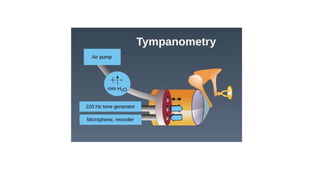
• Tympanometry is an electronic and acoustic measurement technique
to assess middle ear function
• It is an objective and fast and highly accurate way to rule out outer
and middle ear function pathology.
• When the pressure of EAC and middle ear becomes equal , maximum
mobility of TM happens & therefore max. flow of acoustic energy
(sound) occurs to middle ear.
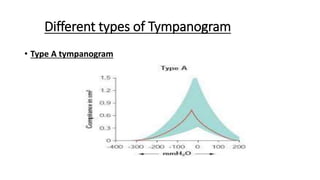
Different types of Tympanogram
• Type A tympanogram
INTERPRETATION
• Normal tympanogram
• Normal ET function
• Mobilty of TM is normal
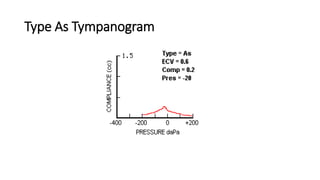
Type As Tympanogram
INTERPRETATION
• Middle ear pressure is normal
• Compliance is decrease
Example
Otosclerosis or any ossicular
fixation, tumors of middle ear
like glomus jugulare
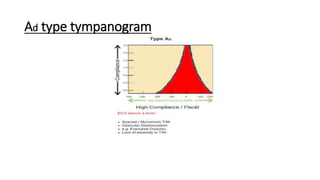
Ad type tympanogram
INTERPRETATION
• Middle ear pressure is normal
• Compliance is high
• TM moves excessively
Example
• Ossicular discontinuity, thin & lax TM, loss of elasticity
• Also in post stapedectomy ear.
Type C tympanogram
INTERPRETATION
• Middle ear pressure is Negative (ET closure
• Compliance is normal
Example
Early stage of ET obstruction
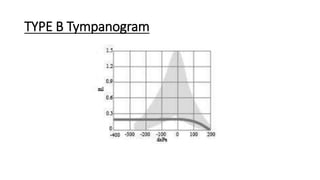
TYPE B Tympanogram
INTERPRETATION
• Decreased( collection of secretions/fluid in middle ear). So dome
shaped curve
Example
Serous otitis media & adhesive otitis media (sequelae of SOM)
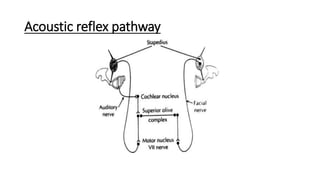
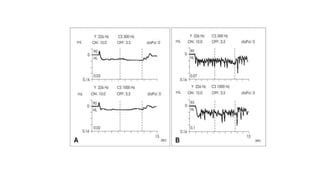
Acoustic reflex
• When an acoustic stimulus is delivered to ear canal at an intensity
between 70 to 90dBHL,one small muscle in middle ear ,the stapedius
, contract and creates the phenomena referred to as acoustic reflex.
Acoustic reflex pathway
Middle ear Disorder
• Middle ear disorder in which acoustic reflex is absent
• Otosclerosis will cause th stapes footplate adhere to bone
surrounding to oval window increase the stiffness of ossicular chain.
• Middle ear fluid will lose all compliance and stapedius contraction will
not inflence the imobilty of middle ear system
• Disarticulation will loss energy transfer across to ossicular chain
Tympanometry

Tympanometry