The Spanish InfluenceErrors from native Spanish speakers learning ESLTom TyleeLING 4661
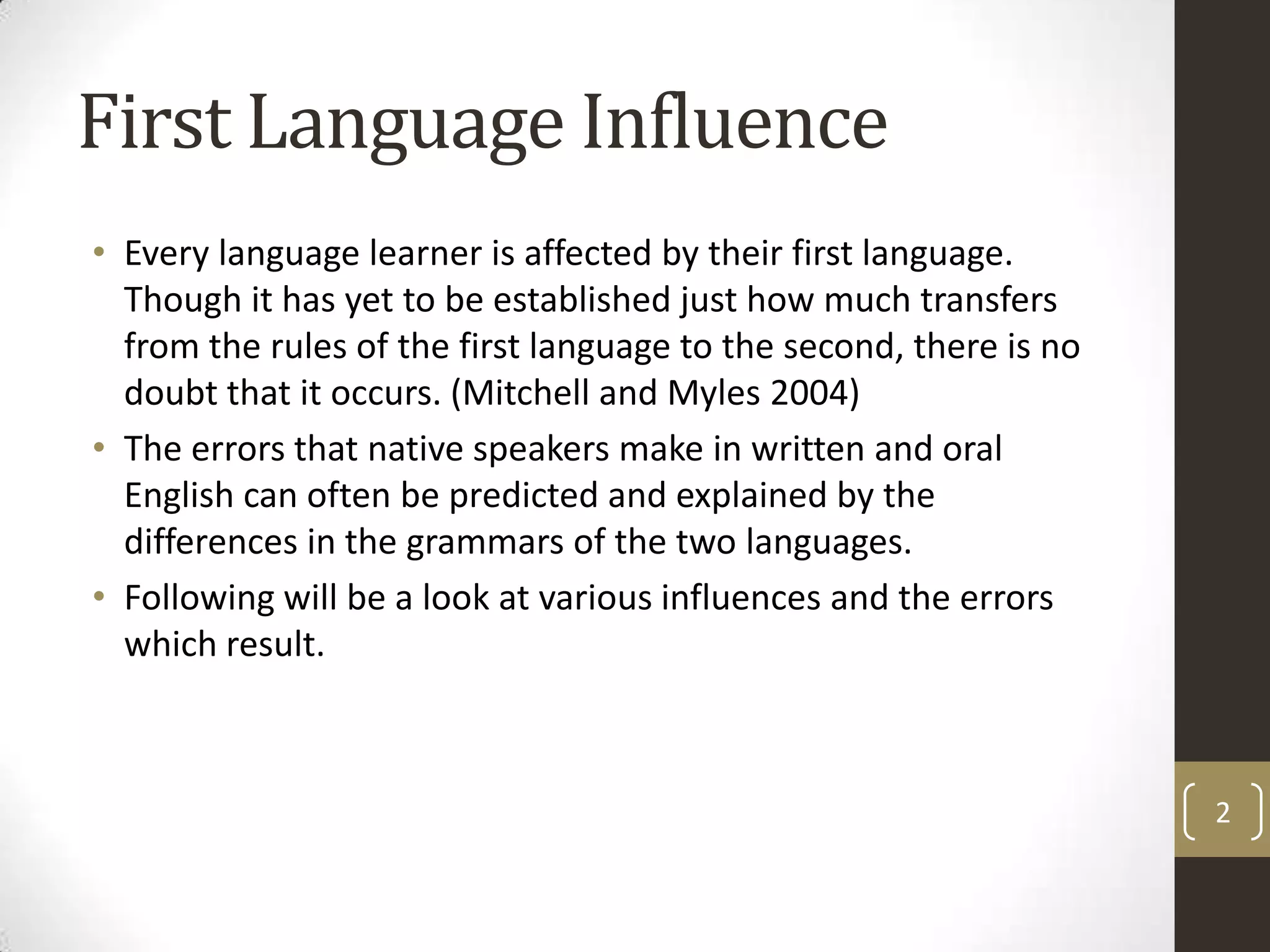
First Language InfluenceEvery language learner is affected by their first language.  Though it has yet to be established just how much transfers from the rules of the first language to the second, there is no doubt that it occurs. (Mitchell and Myles 2004)The errors that native speakers make in written and oral English can often be predicted and explained by the differences in the grammars of the two languages.Following will be a look at various influences and the errors which result.2
OverviewWhile certainly not comprehensive, we will be taking a look at some of the most commonly found mistakes and offer some possible explanations for why the errors occur.We will be looking at errors related to the following.Word choiceWord orderPronounsArticlesPresent Tense3
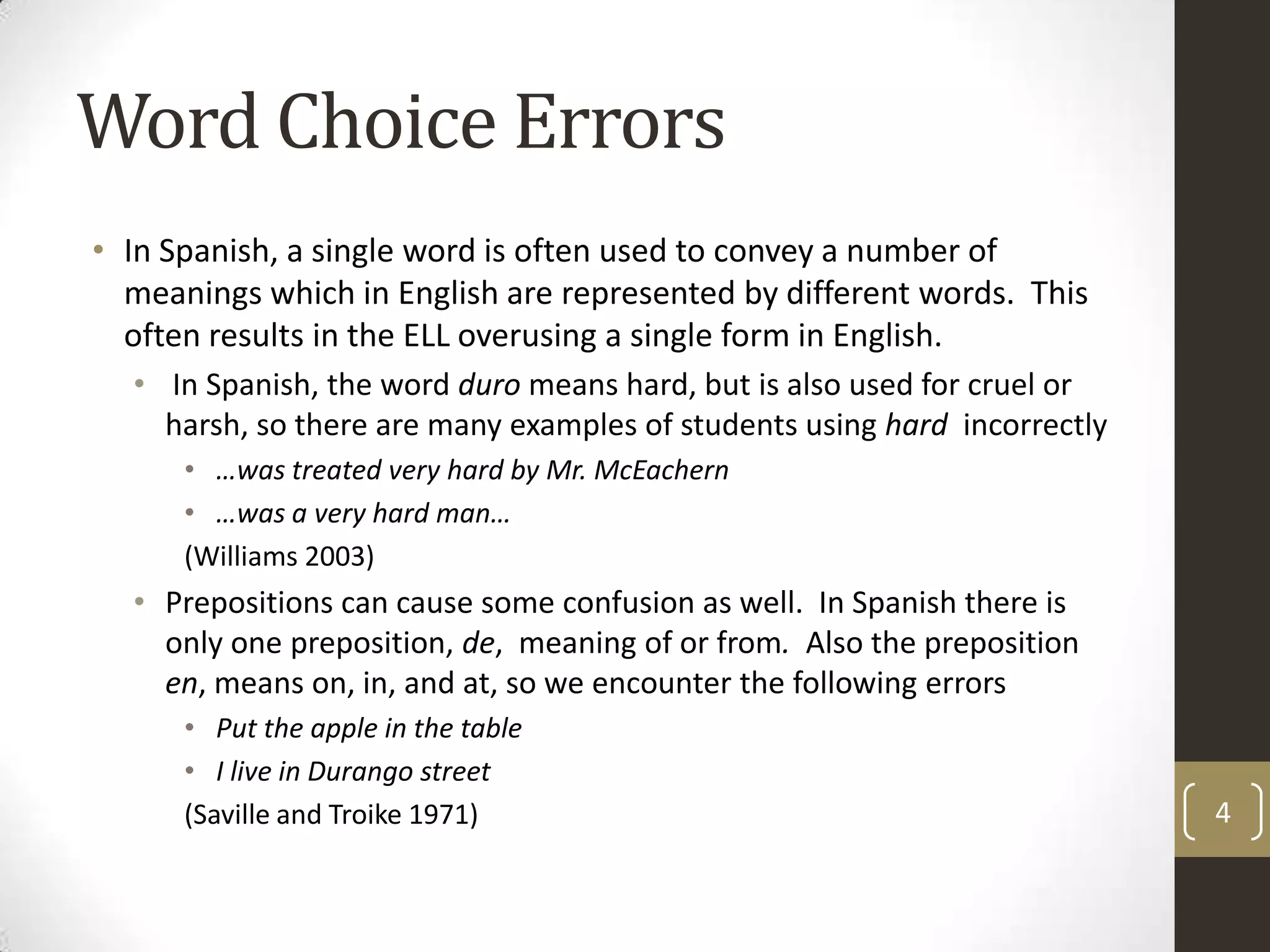
Word Choice ErrorsIn Spanish, a single word is often used to convey a number of meanings which in English are represented by different words.  This often results in the ELL overusing a single form in English. In Spanish, the word duro means hard, but is also used for cruel or harsh, so there are many examples of students using hard  incorrectly…was treated very hard by Mr. McEachern…was a very hard man…(Williams 2003)Prepositions can cause some confusion as well.  In Spanish there is only one preposition, de,  meaning of or from.  Also the preposition en, means on, in, and at, so we encounter the following errors Put the apple in the table I live in Durango street(Saville and Troike 1971)4
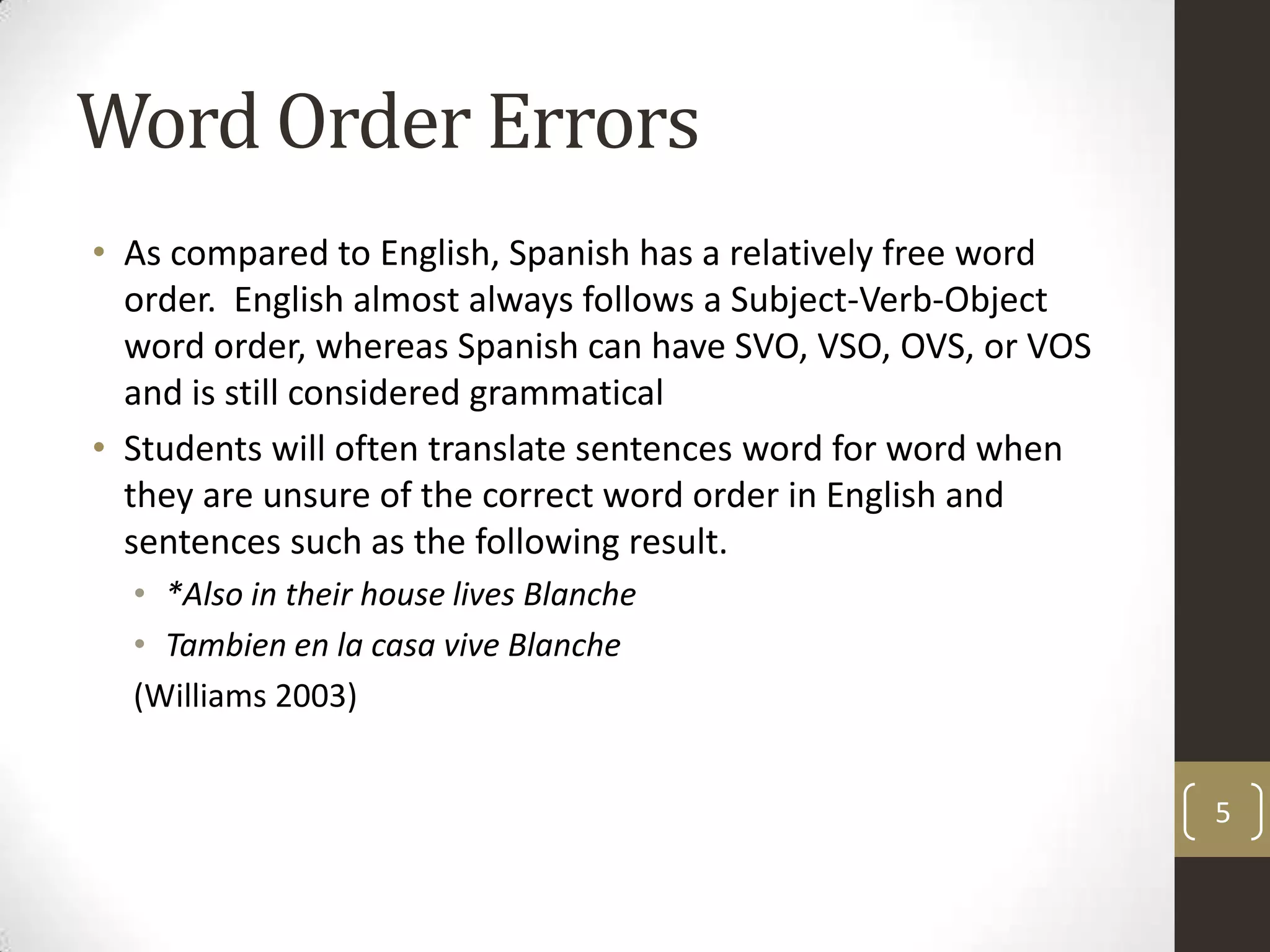
Word Order ErrorsAs compared to English, Spanish has a relatively free word order.  English almost always follows a Subject-Verb-Object word order, whereas Spanish can have SVO, VSO, OVS, or VOS and is still considered grammaticalStudents will often translate sentences word for word when they are unsure of the correct word order in English and sentences such as the following result.*Also in their house lives BlancheTambien en la casa vive Blanche(Williams 2003)5
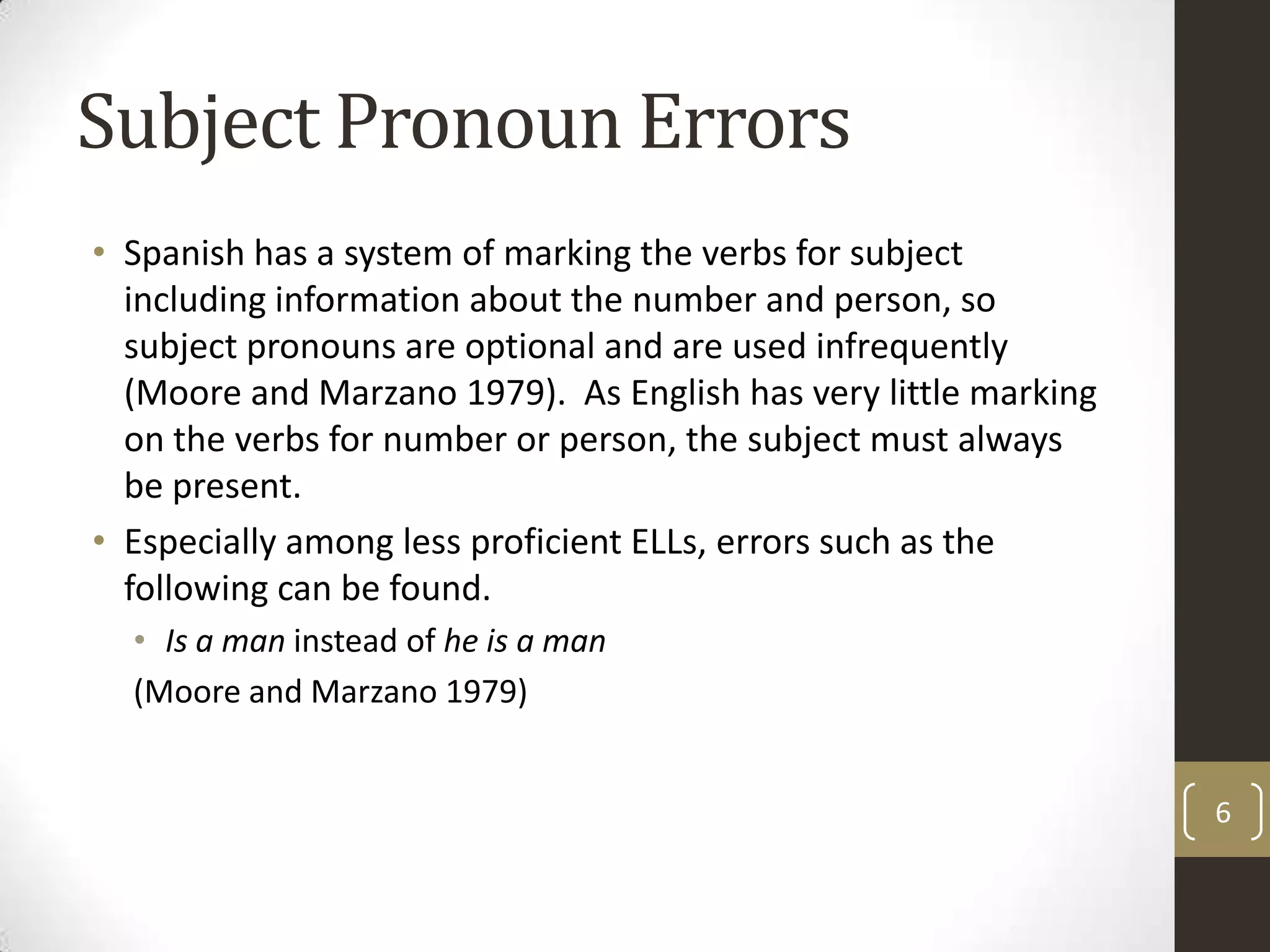
Subject Pronoun ErrorsSpanish has a system of marking the verbs for subject including information about the number and person, so subject pronouns are optional and are used infrequently (Moore and Marzano 1979).  As English has very little marking on the verbs for number or person, the subject must always be present.Especially among less proficient ELLs, errors such as the following can be found.Is a maninstead of he is a man(Moore and Marzano 1979)6
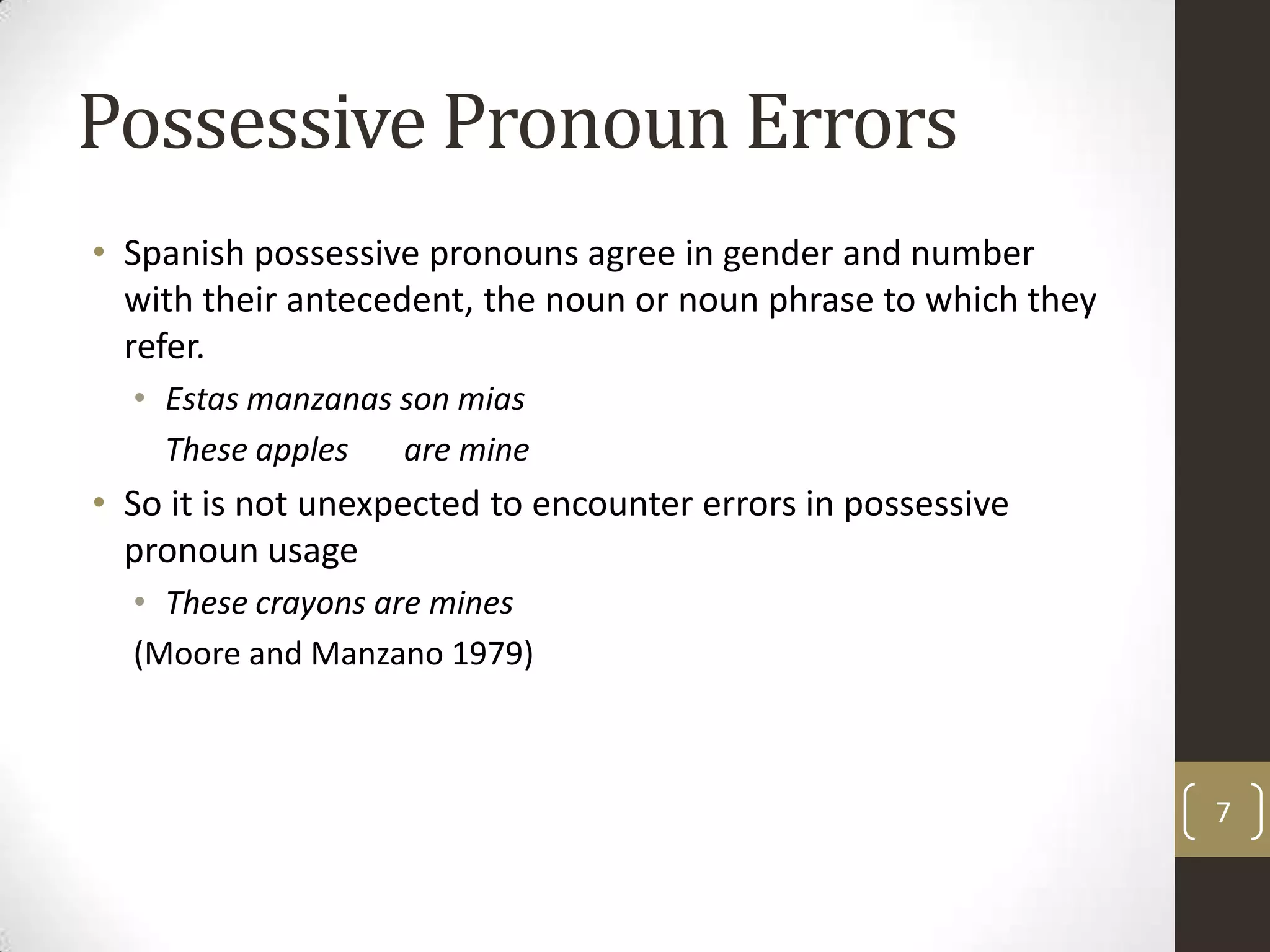
Possessive Pronoun ErrorsSpanish possessive pronouns agree in gender and number with their antecedent, the noun or noun phrase to which they refer.Estas manzanas son mias   These apples       are mineSo it is not unexpected to encounter errors in possessive pronoun usageThese crayons are mines(Moore and Manzano 1979)7
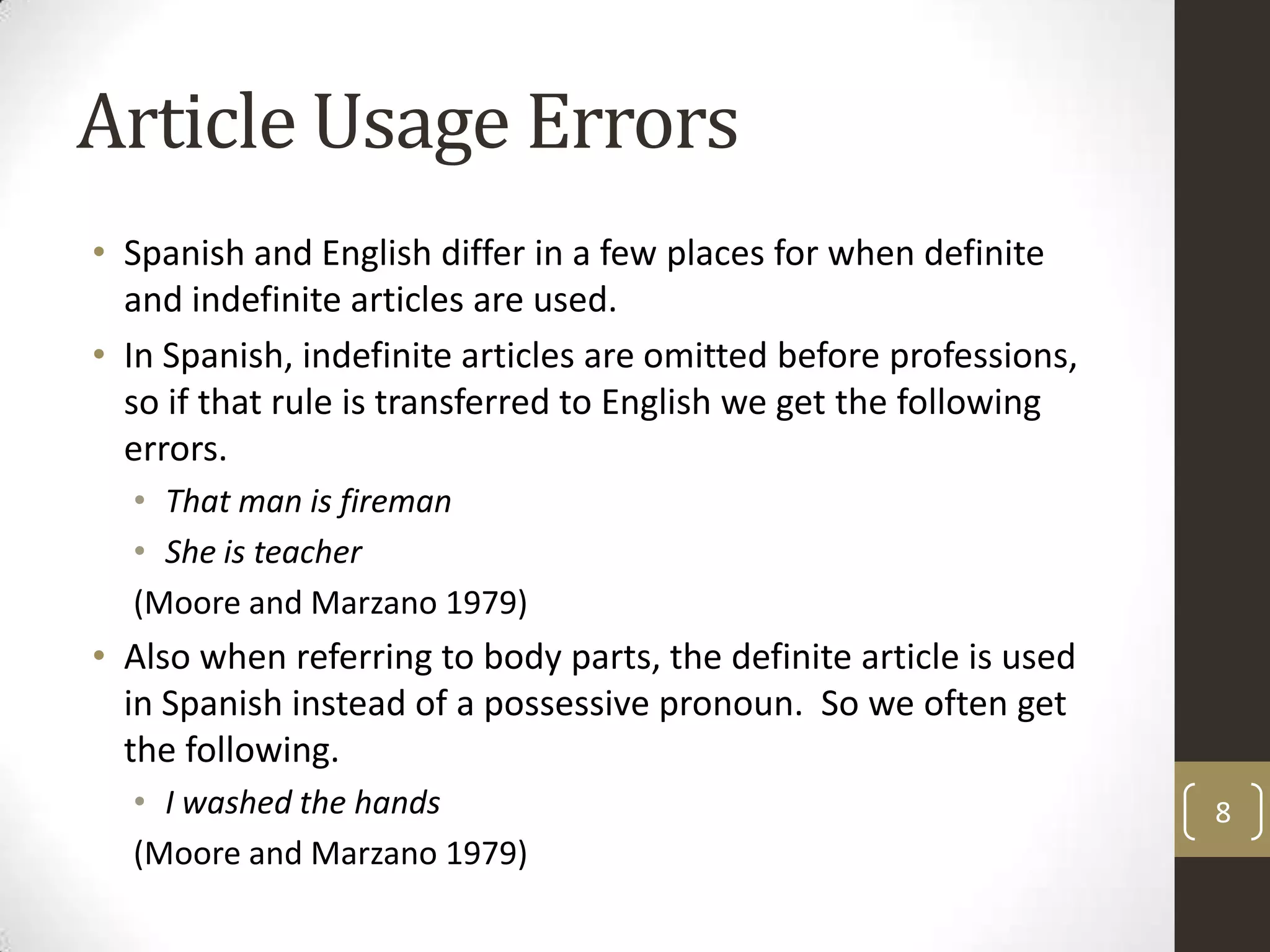
Article Usage ErrorsSpanish and English differ in a few places for when definite and indefinite articles are used.In Spanish, indefinite articles are omitted before professions, so if that rule is transferred to English we get the following errors.That man is firemanShe is teacher(Moore and Marzano 1979)Also when referring to body parts, the definite article is used in Spanish instead of a possessive pronoun.  So we often get the following.I washed the hands(Moore and Marzano 1979)8
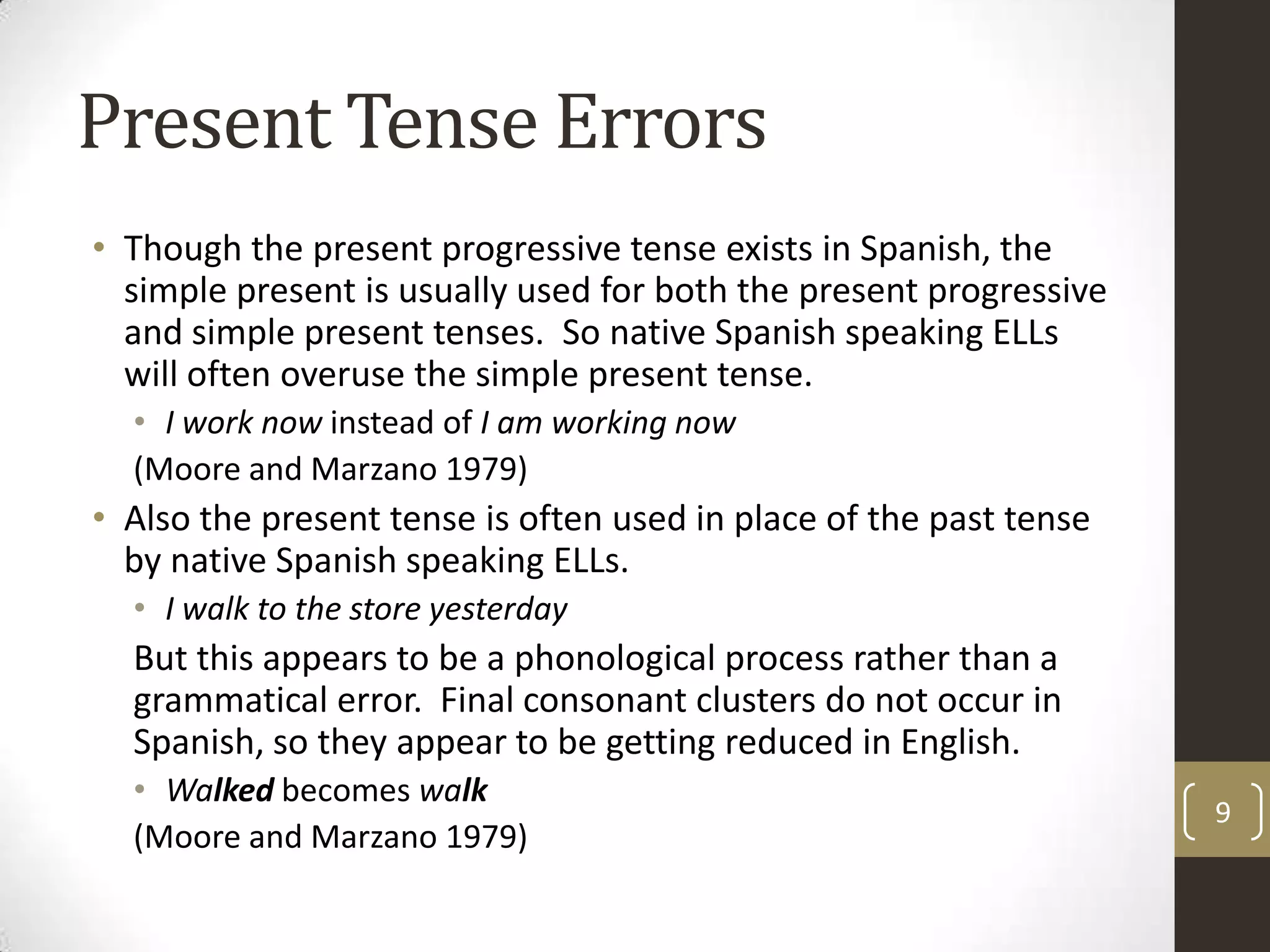
Present Tense ErrorsThough the present progressive tense exists in Spanish, the simple present is usually used for both the present progressive and simple present tenses.  So native Spanish speaking ELLs will often overuse the simple present tense.I work now instead of I am working now(Moore and Marzano 1979)Also the present tense is often used in place of the past tense by native Spanish speaking ELLs.I walk to the store yesterdayBut this appears to be a phonological process rather than a grammatical error.  Final consonant clusters do not occur in Spanish, so they appear to be getting reduced in English.Walkedbecomes walk(Moore and Marzano 1979)9
SummaryFrom just these few examinations of errors found in the English sentences produced by native Spanish-speaking ELLs, it is obvious that some of the rules from the speakers’ native Spanish are being transferred to English as they progress through the learning process.As teachers, it is important to be aware of these grammatical differences so that they can be highlighted and addressed.10
ReferencesMitchell, Rosamond and Florence Myles.  2004.  Second Language Learning Theories.  London: Hodder Education.Moore, Fernie Baca and Robert J. Marzano.  1979.  Errors of Spanish speakers learning English.  Research in the Teaching of English13.2, 161-67.Saville, M. R., and R. C. Troike.  1971.  A Handbook of Bilingual Education.  Washington, D.C.: TESOL.Williams, Todd O.  2003.  A study of native Spanish speakers’ writing in English for Teachers.  Inquiry 8.1.11

Tylee ppt

  • 1.
    The Spanish InfluenceErrorsfrom native Spanish speakers learning ESLTom TyleeLING 4661
  • 2.
    First Language InfluenceEverylanguage learner is affected by their first language. Though it has yet to be established just how much transfers from the rules of the first language to the second, there is no doubt that it occurs. (Mitchell and Myles 2004)The errors that native speakers make in written and oral English can often be predicted and explained by the differences in the grammars of the two languages.Following will be a look at various influences and the errors which result.2
  • 3.
    OverviewWhile certainly notcomprehensive, we will be taking a look at some of the most commonly found mistakes and offer some possible explanations for why the errors occur.We will be looking at errors related to the following.Word choiceWord orderPronounsArticlesPresent Tense3
  • 4.
    Word Choice ErrorsInSpanish, a single word is often used to convey a number of meanings which in English are represented by different words. This often results in the ELL overusing a single form in English. In Spanish, the word duro means hard, but is also used for cruel or harsh, so there are many examples of students using hard incorrectly…was treated very hard by Mr. McEachern…was a very hard man…(Williams 2003)Prepositions can cause some confusion as well. In Spanish there is only one preposition, de, meaning of or from. Also the preposition en, means on, in, and at, so we encounter the following errors Put the apple in the table I live in Durango street(Saville and Troike 1971)4
  • 5.
    Word Order ErrorsAscompared to English, Spanish has a relatively free word order. English almost always follows a Subject-Verb-Object word order, whereas Spanish can have SVO, VSO, OVS, or VOS and is still considered grammaticalStudents will often translate sentences word for word when they are unsure of the correct word order in English and sentences such as the following result.*Also in their house lives BlancheTambien en la casa vive Blanche(Williams 2003)5
  • 6.
    Subject Pronoun ErrorsSpanishhas a system of marking the verbs for subject including information about the number and person, so subject pronouns are optional and are used infrequently (Moore and Marzano 1979). As English has very little marking on the verbs for number or person, the subject must always be present.Especially among less proficient ELLs, errors such as the following can be found.Is a maninstead of he is a man(Moore and Marzano 1979)6
  • 7.
    Possessive Pronoun ErrorsSpanishpossessive pronouns agree in gender and number with their antecedent, the noun or noun phrase to which they refer.Estas manzanas son mias These apples are mineSo it is not unexpected to encounter errors in possessive pronoun usageThese crayons are mines(Moore and Manzano 1979)7
  • 8.
    Article Usage ErrorsSpanishand English differ in a few places for when definite and indefinite articles are used.In Spanish, indefinite articles are omitted before professions, so if that rule is transferred to English we get the following errors.That man is firemanShe is teacher(Moore and Marzano 1979)Also when referring to body parts, the definite article is used in Spanish instead of a possessive pronoun. So we often get the following.I washed the hands(Moore and Marzano 1979)8
  • 9.
    Present Tense ErrorsThoughthe present progressive tense exists in Spanish, the simple present is usually used for both the present progressive and simple present tenses. So native Spanish speaking ELLs will often overuse the simple present tense.I work now instead of I am working now(Moore and Marzano 1979)Also the present tense is often used in place of the past tense by native Spanish speaking ELLs.I walk to the store yesterdayBut this appears to be a phonological process rather than a grammatical error. Final consonant clusters do not occur in Spanish, so they appear to be getting reduced in English.Walkedbecomes walk(Moore and Marzano 1979)9
  • 10.
    SummaryFrom just thesefew examinations of errors found in the English sentences produced by native Spanish-speaking ELLs, it is obvious that some of the rules from the speakers’ native Spanish are being transferred to English as they progress through the learning process.As teachers, it is important to be aware of these grammatical differences so that they can be highlighted and addressed.10
  • 11.
    ReferencesMitchell, Rosamond andFlorence Myles. 2004. Second Language Learning Theories. London: Hodder Education.Moore, Fernie Baca and Robert J. Marzano. 1979. Errors of Spanish speakers learning English. Research in the Teaching of English13.2, 161-67.Saville, M. R., and R. C. Troike. 1971. A Handbook of Bilingual Education. Washington, D.C.: TESOL.Williams, Todd O. 2003. A study of native Spanish speakers’ writing in English for Teachers. Inquiry 8.1.11