Vietnamese and
English Language
  Comparison
      Amy Souder
         ESL 502
     Wilkes University
History and Key Features of
                      Vietnamese


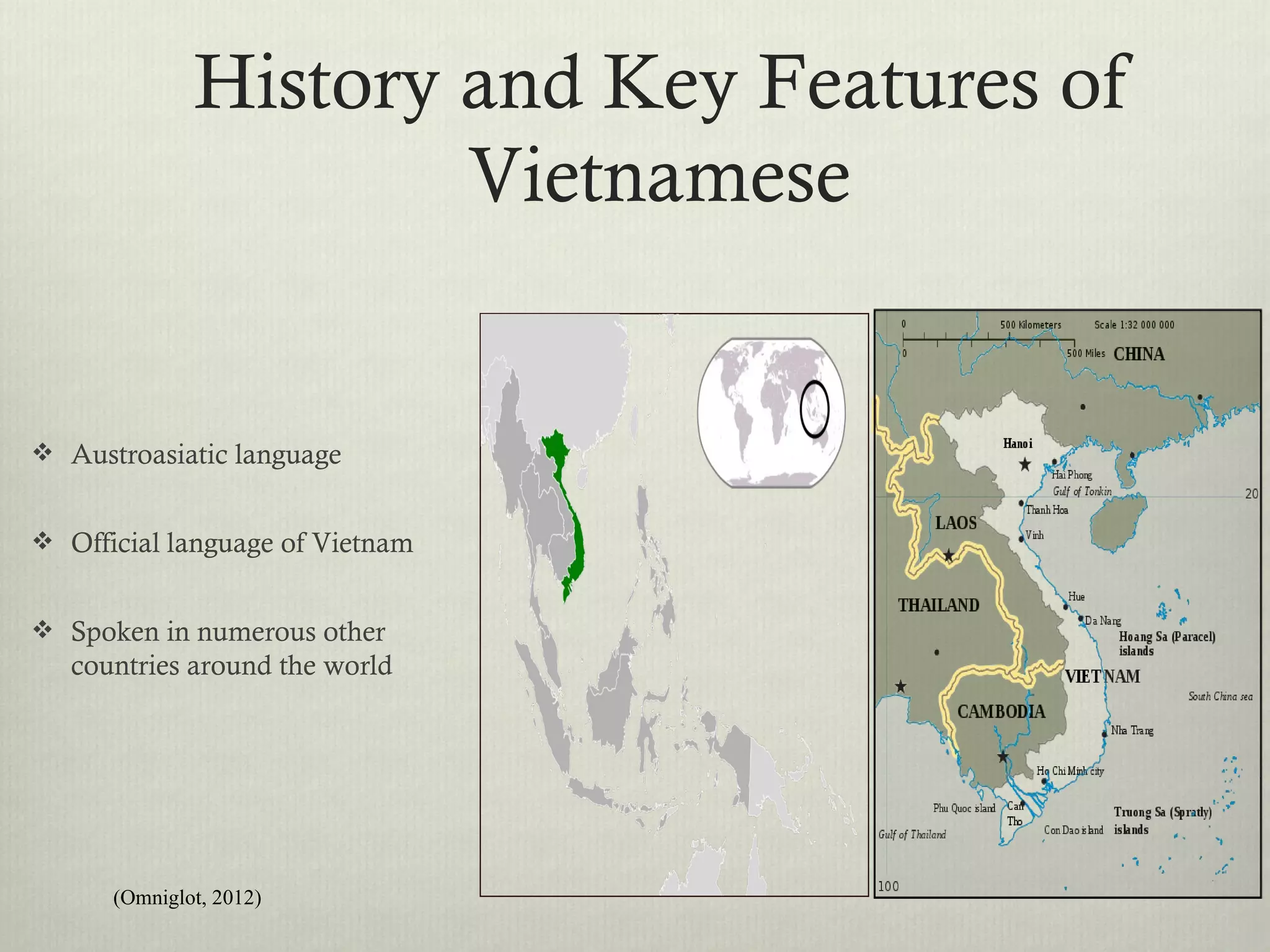
 Austroasiatic language


 Official language of Vietnam


 Spoken in numerous other
   countries around the world


      (Omniglot, 2012)
Tonal Language
              Vietnamese consists of six tones:
2.Midlevel

3.Low-falling

4.High-rising

5.Low-falling-rising

6.High-rising broken

7.Low-falling broken


(Ngo, 2011)
Vietnamese Alphabet
                Regular writing system

                Most of the letters
                 (grapheme) represent one
                 phoneme


           (Ngo, 2011)


           Vietnamese Alphabet Video
           (YouTube, 2009)
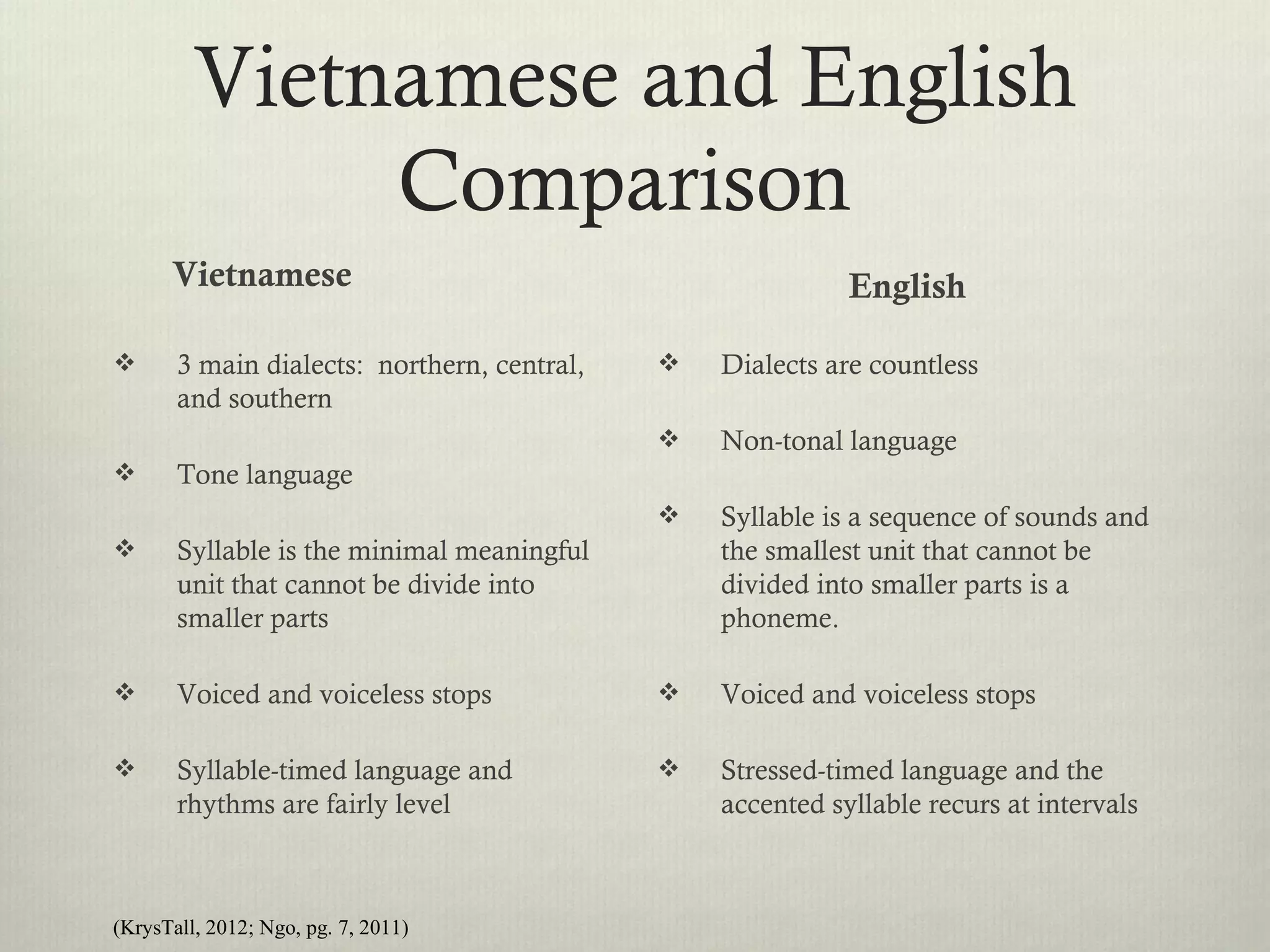
Vietnamese and English
              Comparison
      Vietnamese                                            English

      3 main dialects: northern, central,      Dialects are countless
       and southern
                                                Non-tonal language
      Tone language
                                                Syllable is a sequence of sounds and
      Syllable is the minimal meaningful        the smallest unit that cannot be
       unit that cannot be divide into           divided into smaller parts is a
       smaller parts                             phoneme.

      Voiced and voiceless stops               Voiced and voiceless stops

      Syllable-timed language and              Stressed-timed language and the
       rhythms are fairly level                  accented syllable recurs at intervals


(KrysTall, 2012; Ngo, pg. 7, 2011)
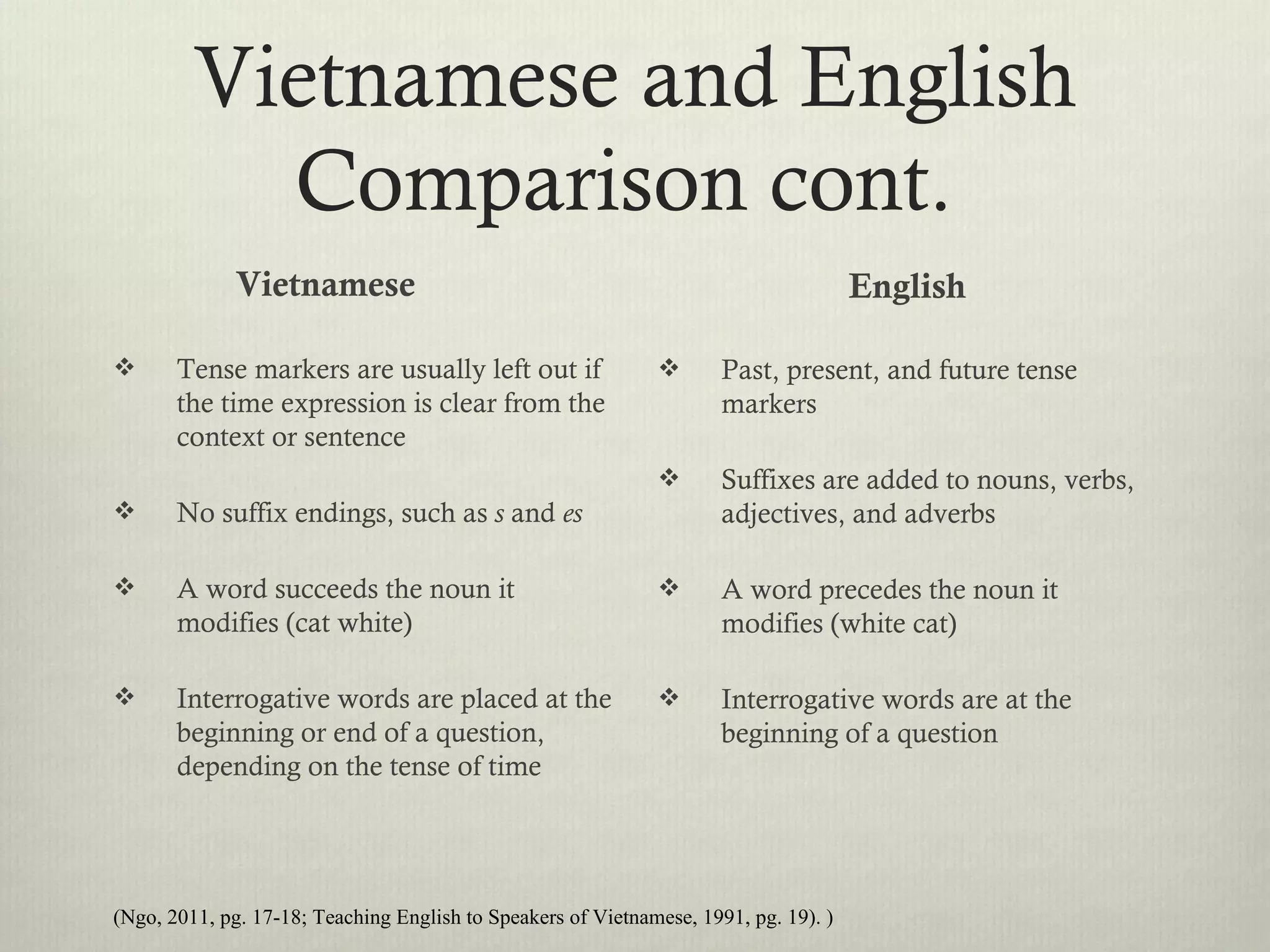
Vietnamese and English
           Comparison cont.
              Vietnamese                                                              English

      Tense markers are usually left out if                         Past, present, and future tense
       the time expression is clear from the                          markers
       context or sentence
                                                                     Suffixes are added to nouns, verbs,
      No suffix endings, such as s and es                            adjectives, and adverbs

      A word succeeds the noun it                                   A word precedes the noun it
       modifies (cat white)                                           modifies (white cat)

      Interrogative words are placed at the                         Interrogative words are at the
       beginning or end of a question,                                beginning of a question
       depending on the tense of time


(Ngo, 2011, pg. 17-18; Teaching English to Speakers of Vietnamese, 1991, pg. 19). )
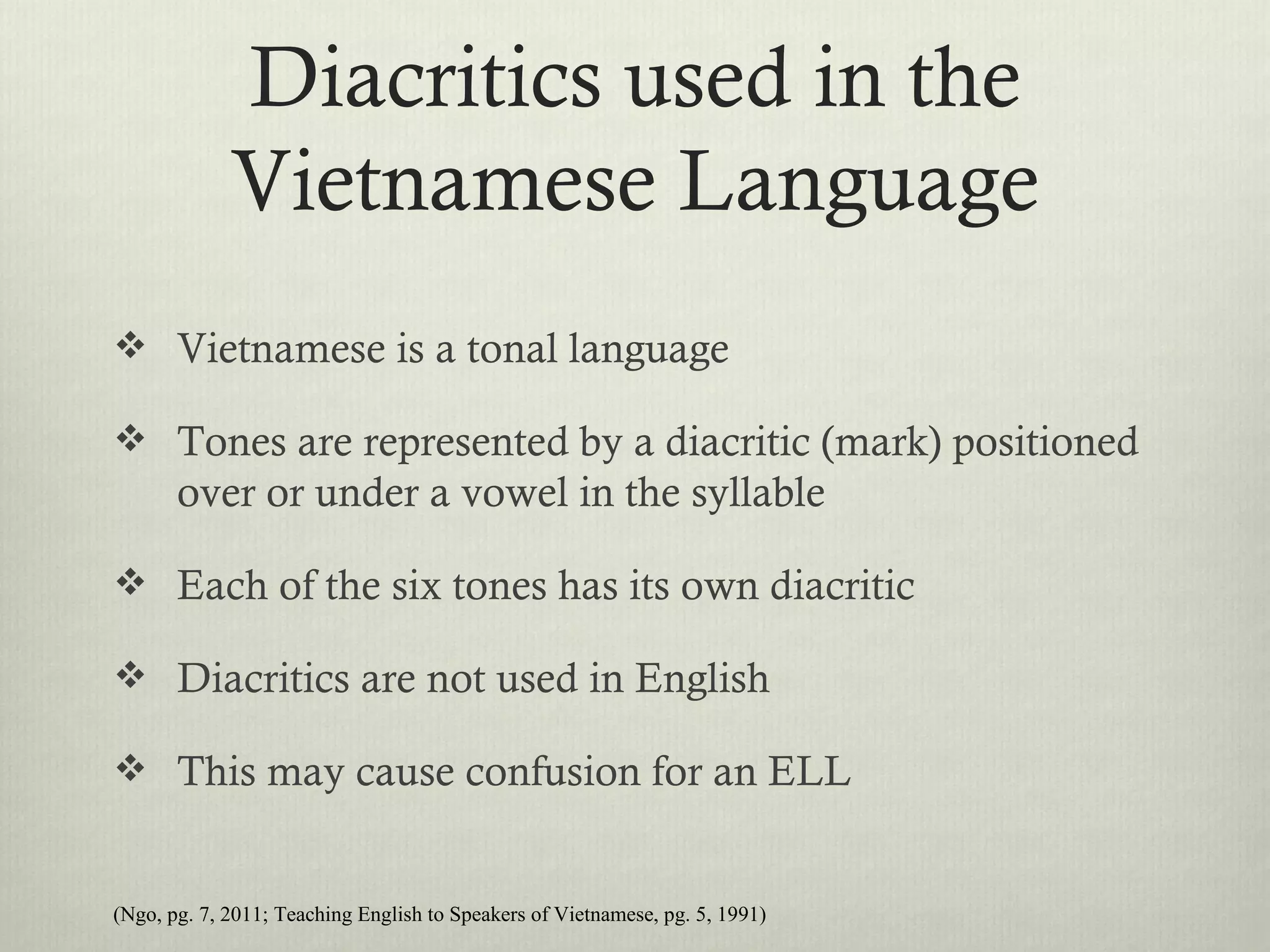
Diacritics used in the
             Vietnamese Language
 Vietnamese is a tonal language

 Tones are represented by a diacritic (mark) positioned
       over or under a vowel in the syllable

 Each of the six tones has its own diacritic

 Diacritics are not used in English

 This may cause confusion for an ELL


(Ngo, pg. 7, 2011; Teaching English to Speakers of Vietnamese, pg. 5, 1991)
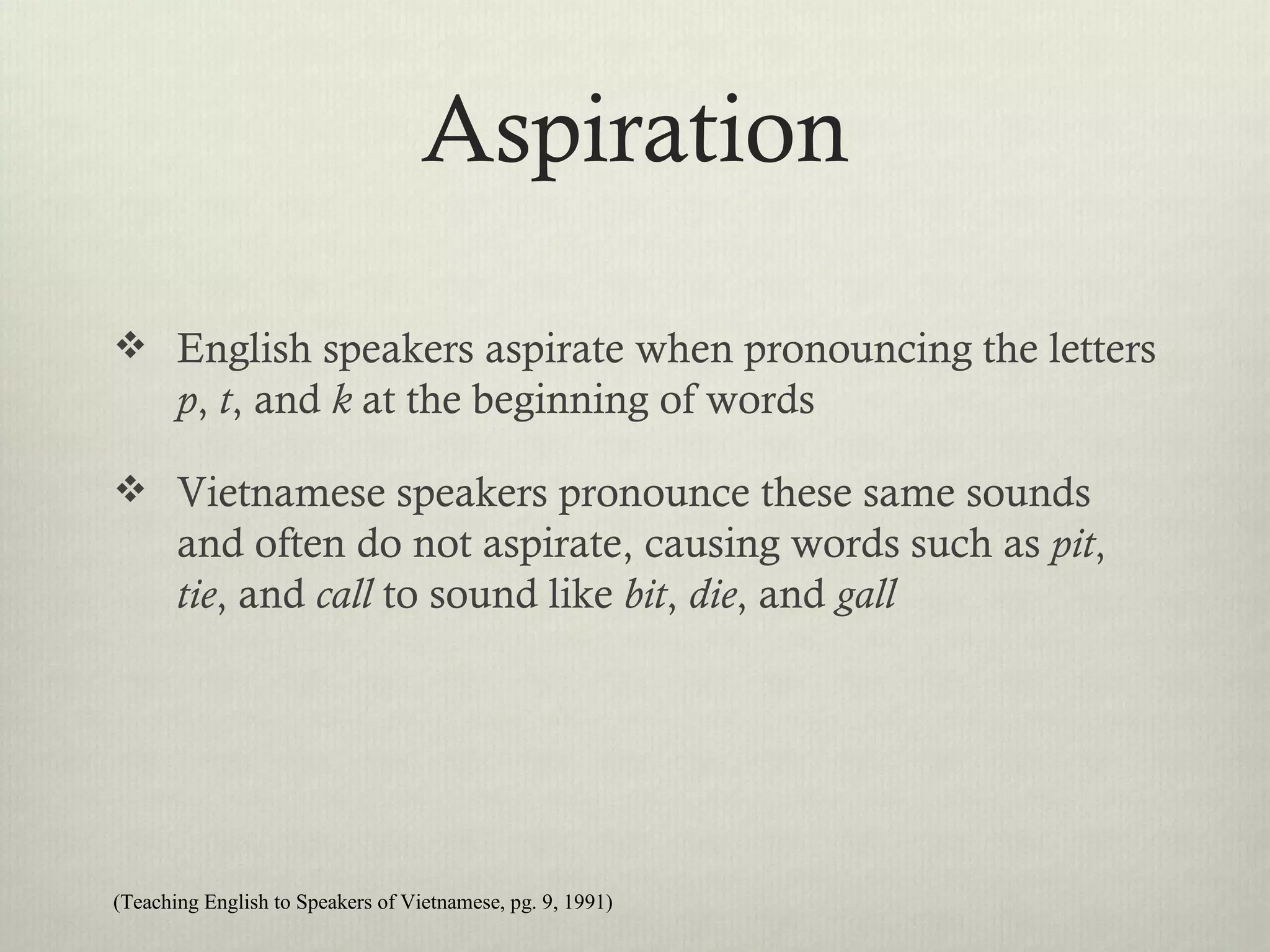
Aspiration

 English speakers aspirate when pronouncing the letters
       p, t, and k at the beginning of words

 Vietnamese speakers pronounce these same sounds
       and often do not aspirate, causing words such as pit,
       tie, and call to sound like bit, die, and gall


(Teaching English to Speakers of Vietnamese, pg. 9, 1991)
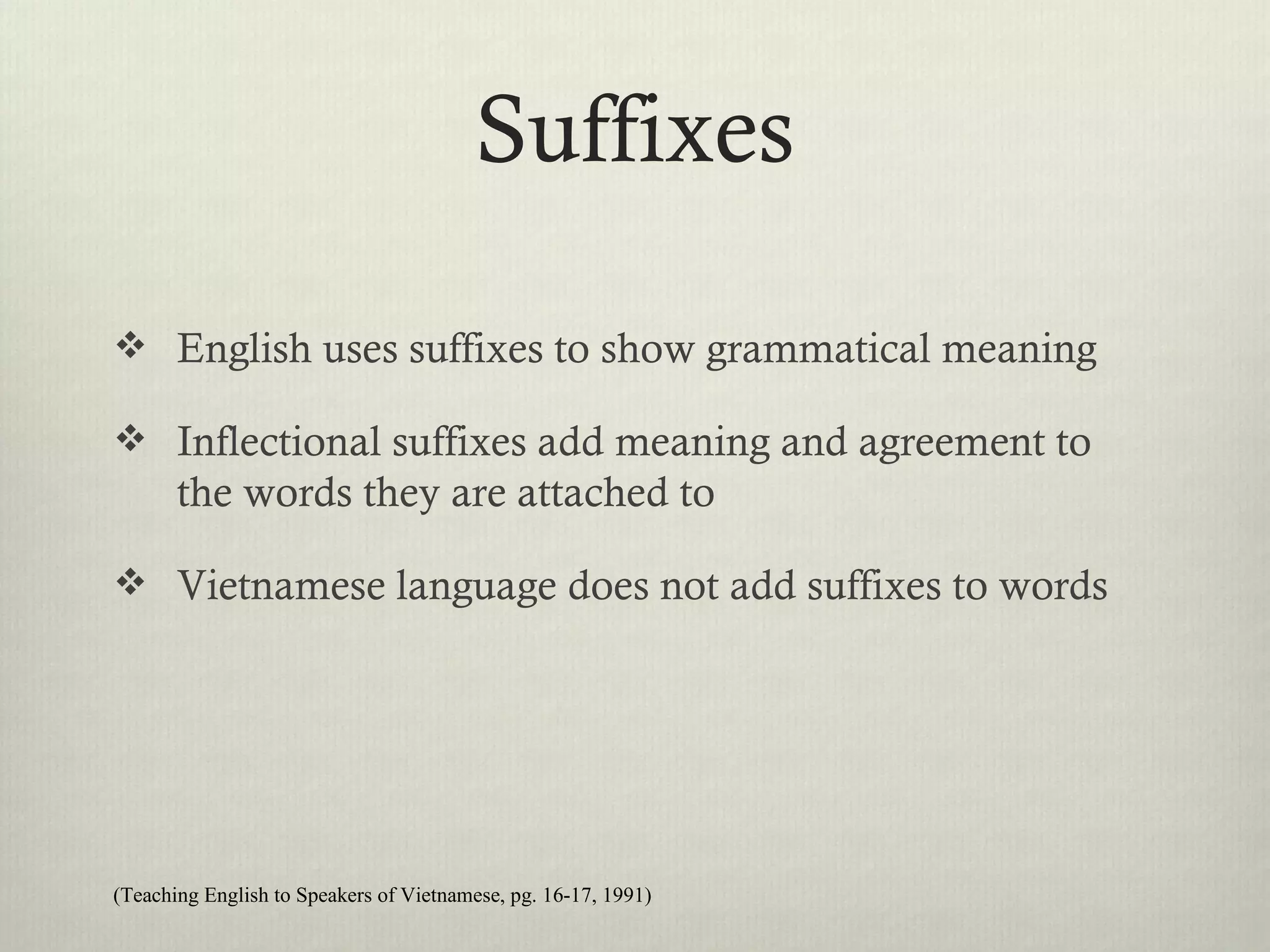
Suffixes

 English uses suffixes to show grammatical meaning

 Inflectional suffixes add meaning and agreement to
       the words they are attached to

 Vietnamese language does not add suffixes to words


(Teaching English to Speakers of Vietnamese, pg. 16-17, 1991)
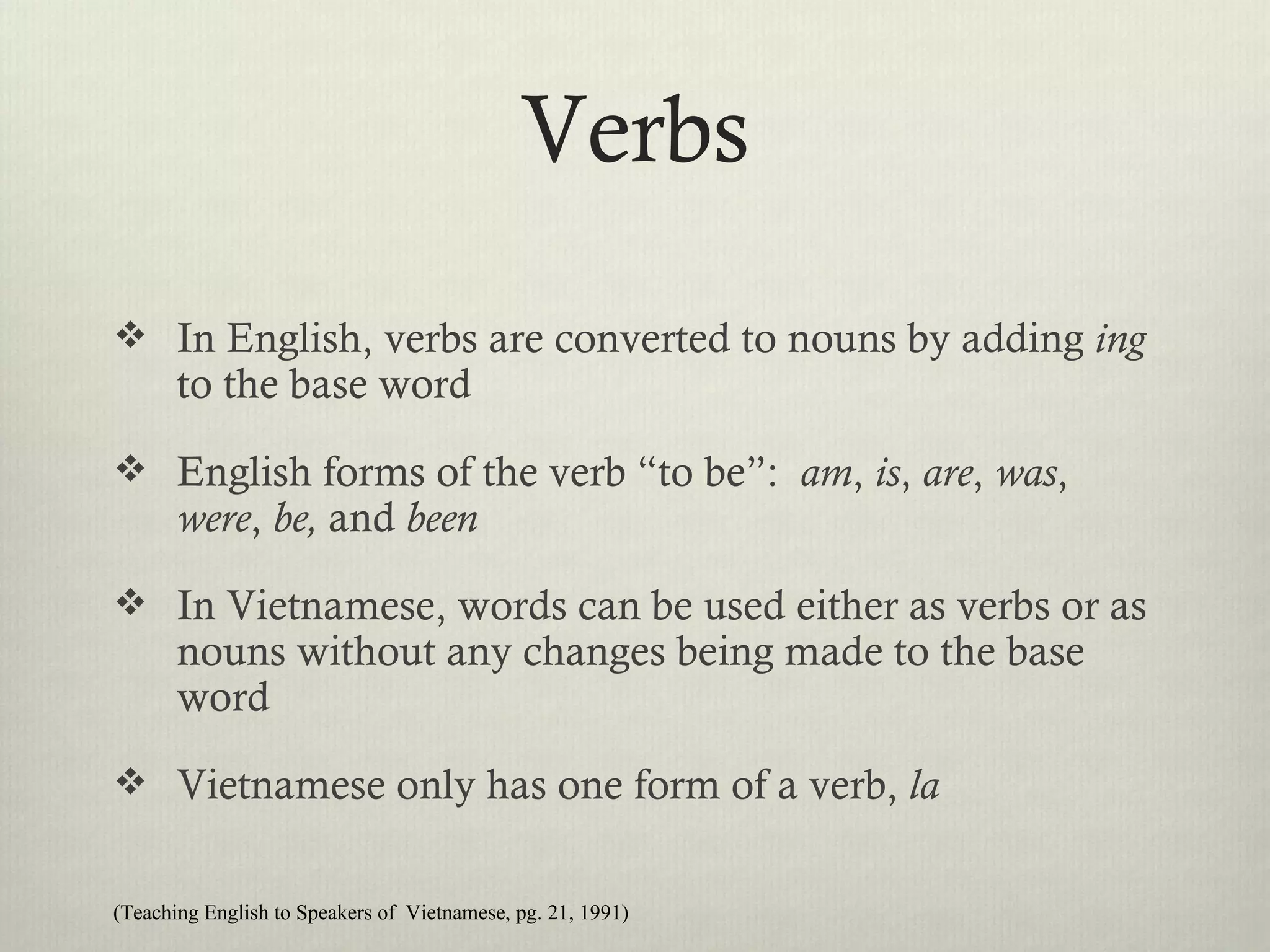
Verbs
 In English, verbs are converted to nouns by adding ing
       to the base word
 English forms of the verb “to be”: am, is, are, was,
       were, be, and been
 In Vietnamese, words can be used either as verbs or as
       nouns without any changes being made to the base
       word
 Vietnamese only has one form of a verb, la


(Teaching English to Speakers of Vietnamese, pg. 21, 1991)
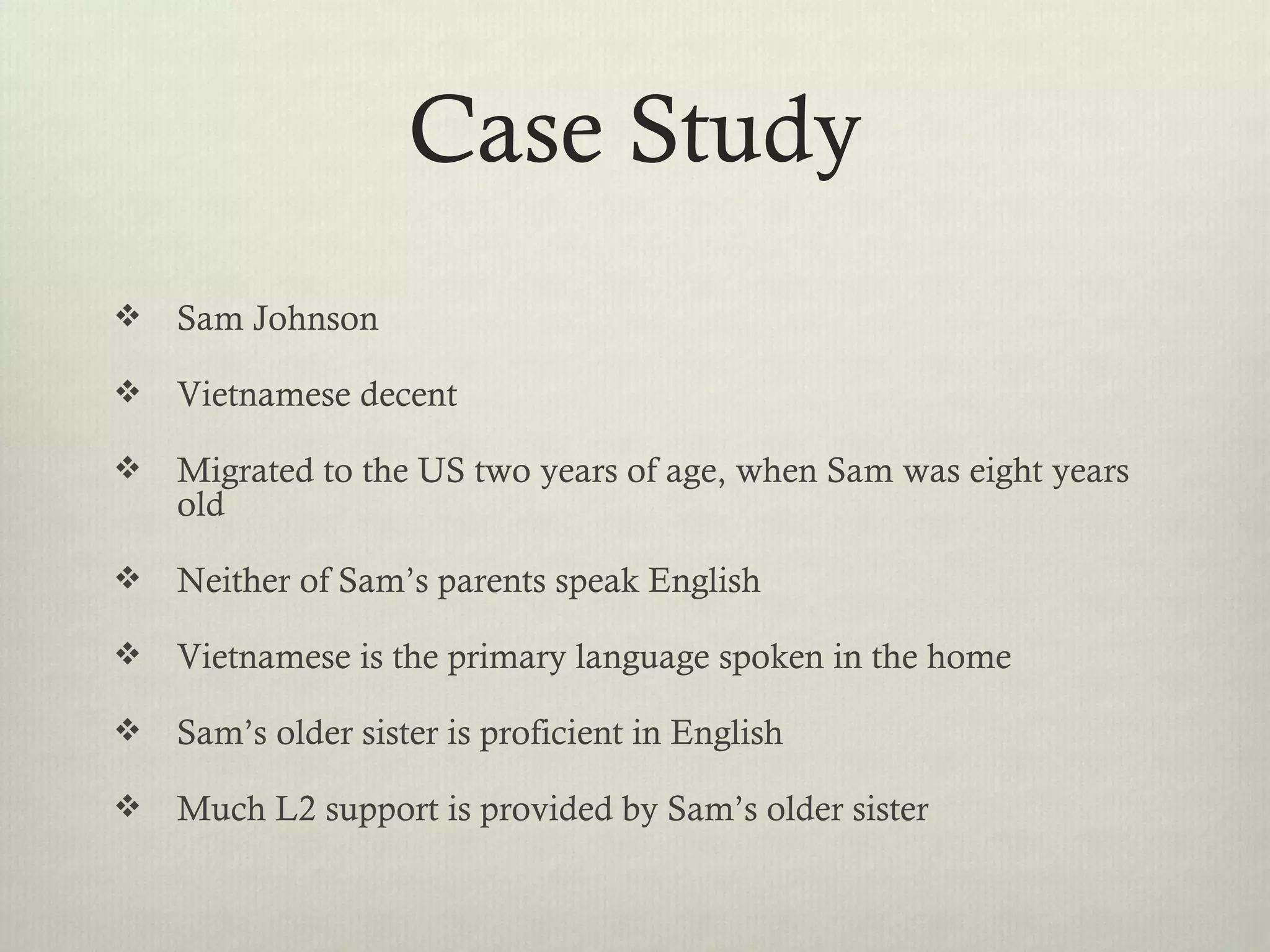
Case Study
   Sam Johnson

   Vietnamese decent

   Migrated to the US two years of age, when Sam was eight years
    old

   Neither of Sam’s parents speak English

   Vietnamese is the primary language spoken in the home

   Sam’s older sister is proficient in English

   Much L2 support is provided by Sam’s older sister
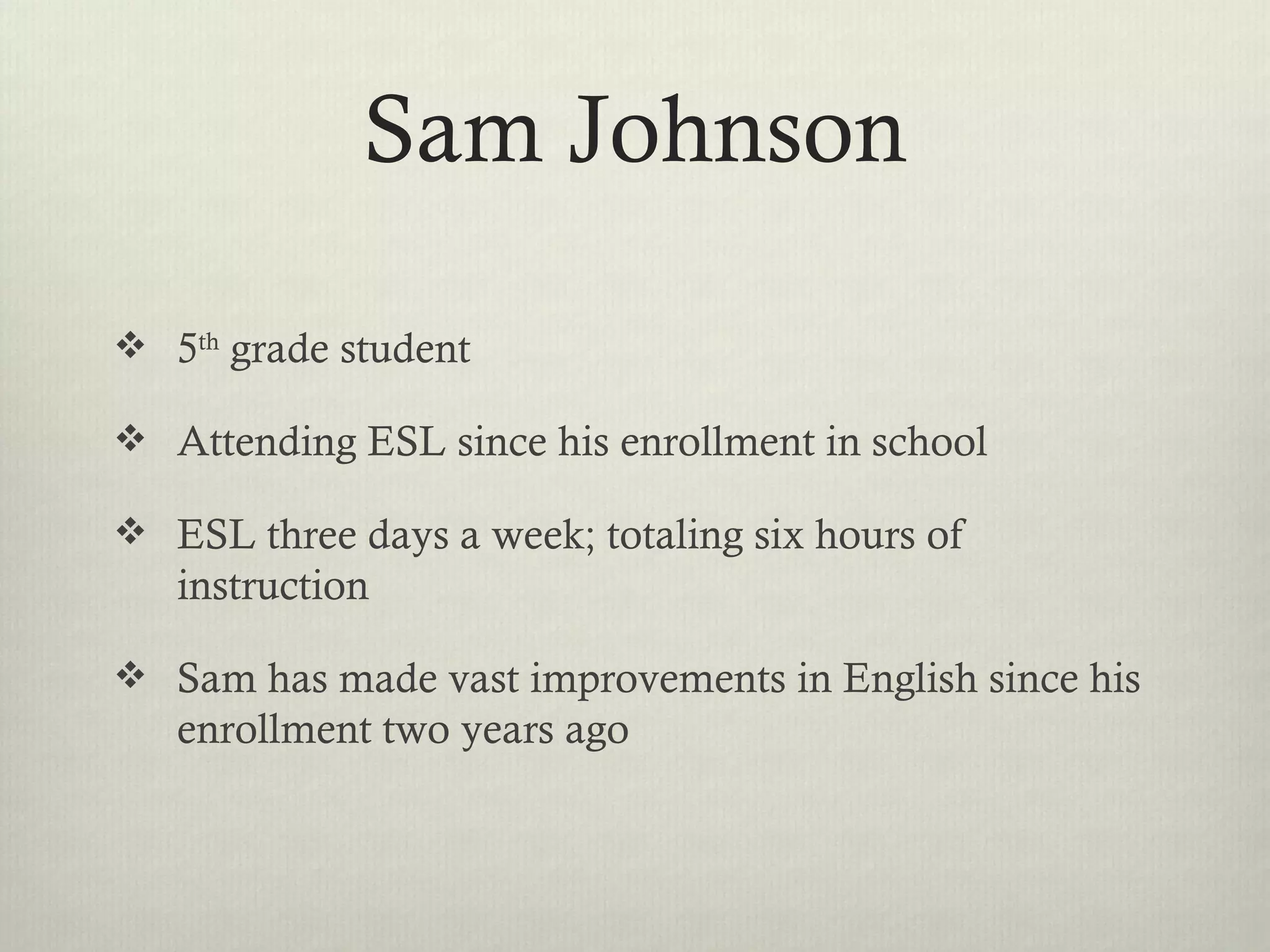
Sam Johnson

 5th grade student

 Attending ESL since his enrollment in school

 ESL three days a week; totaling six hours of
   instruction

 Sam has made vast improvements in English since his
   enrollment two years ago
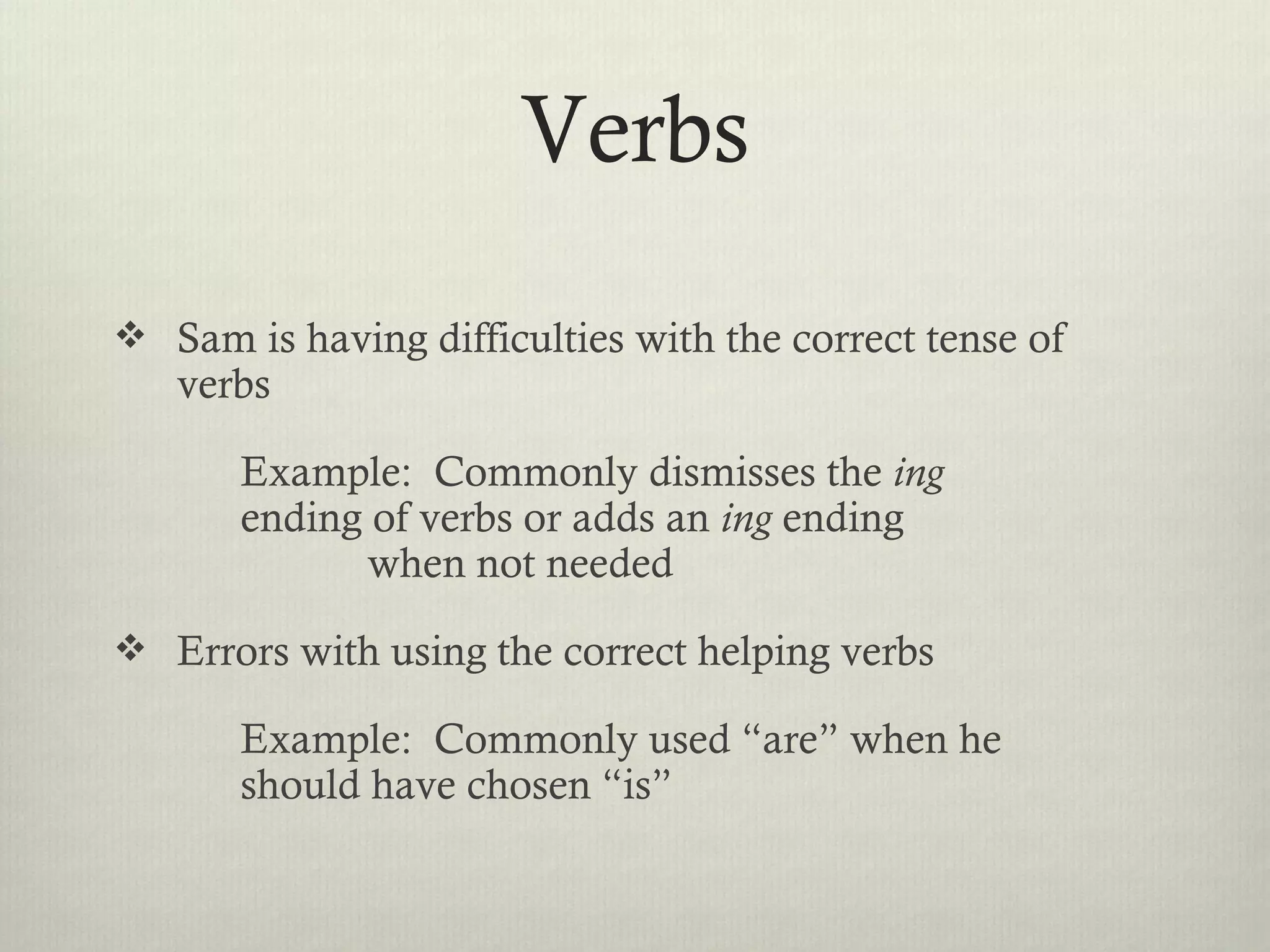
Verbs
 Sam is having difficulties with the correct tense of
   verbs

       Example: Commonly dismisses the ing
       ending of verbs or adds an ing ending
              when not needed
 Errors with using the correct helping verbs

       Example: Commonly used “are” when he
       should have chosen “is”
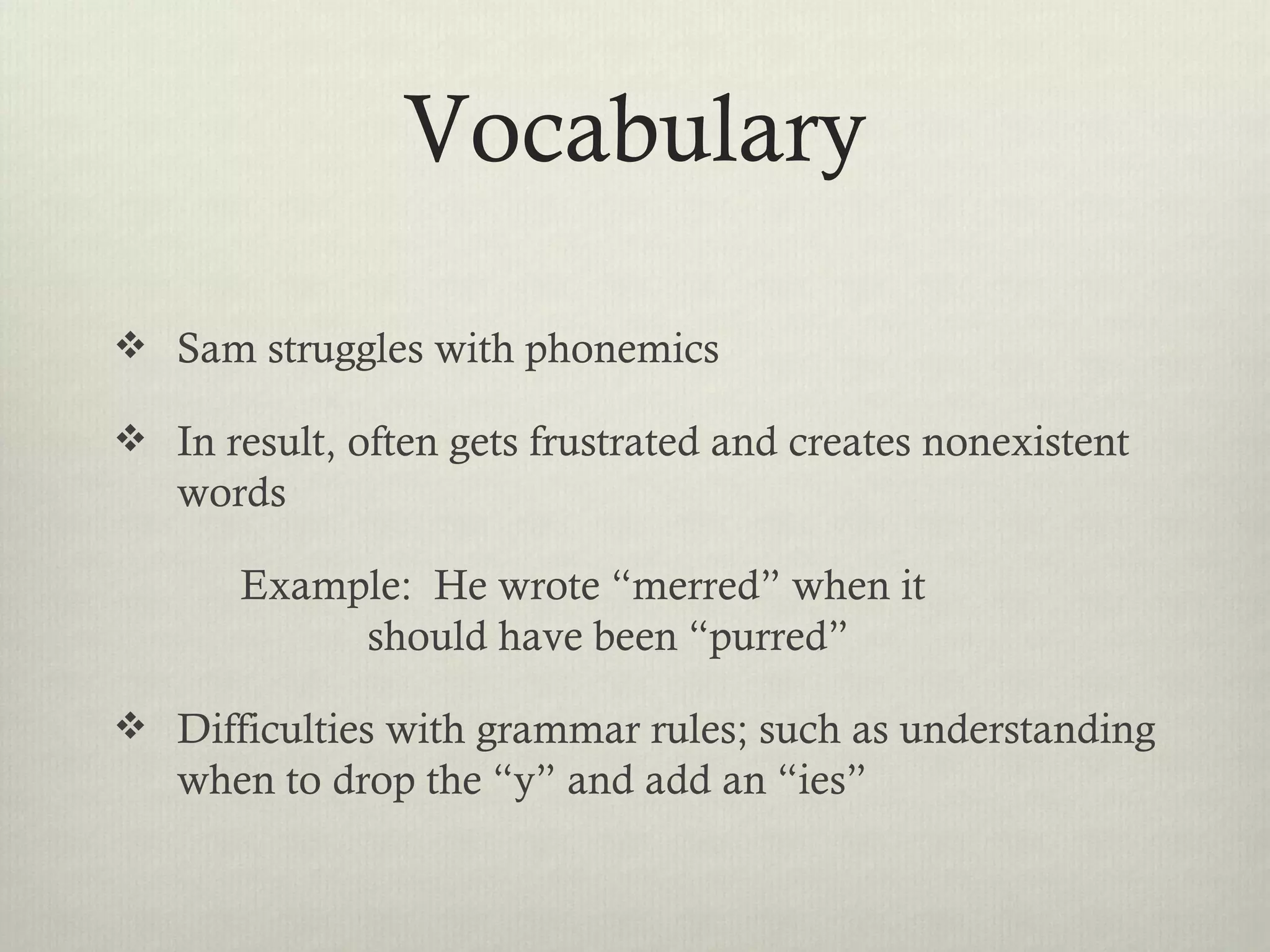
Vocabulary

 Sam struggles with phonemics

 In result, often gets frustrated and creates nonexistent
   words

       Example: He wrote “merred” when it
            should have been “purred”

 Difficulties with grammar rules; such as understanding
   when to drop the “y” and add an “ies”
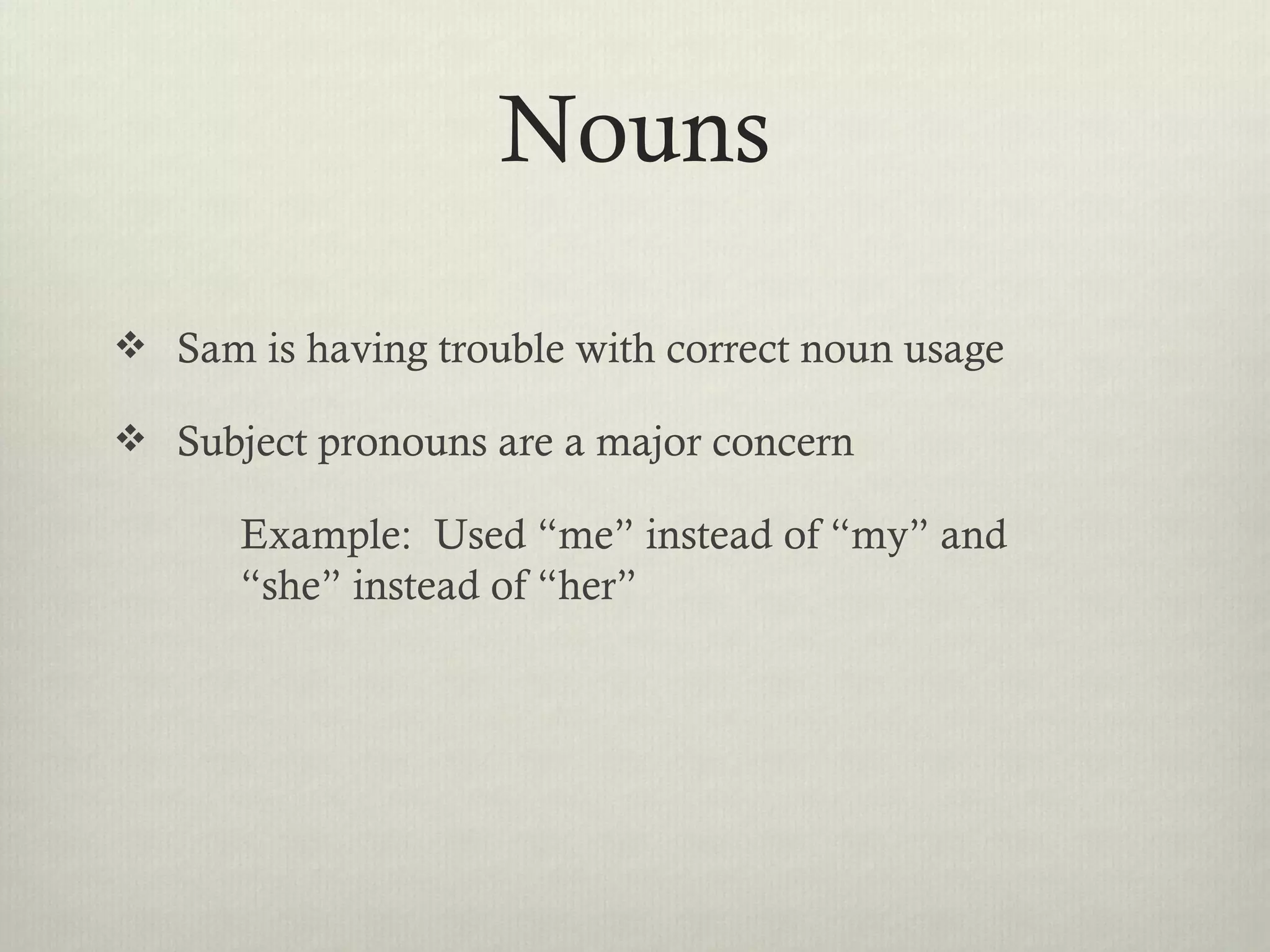
Nouns

 Sam is having trouble with correct noun usage

 Subject pronouns are a major concern

      Example: Used “me” instead of “my” and
      “she” instead of “her”
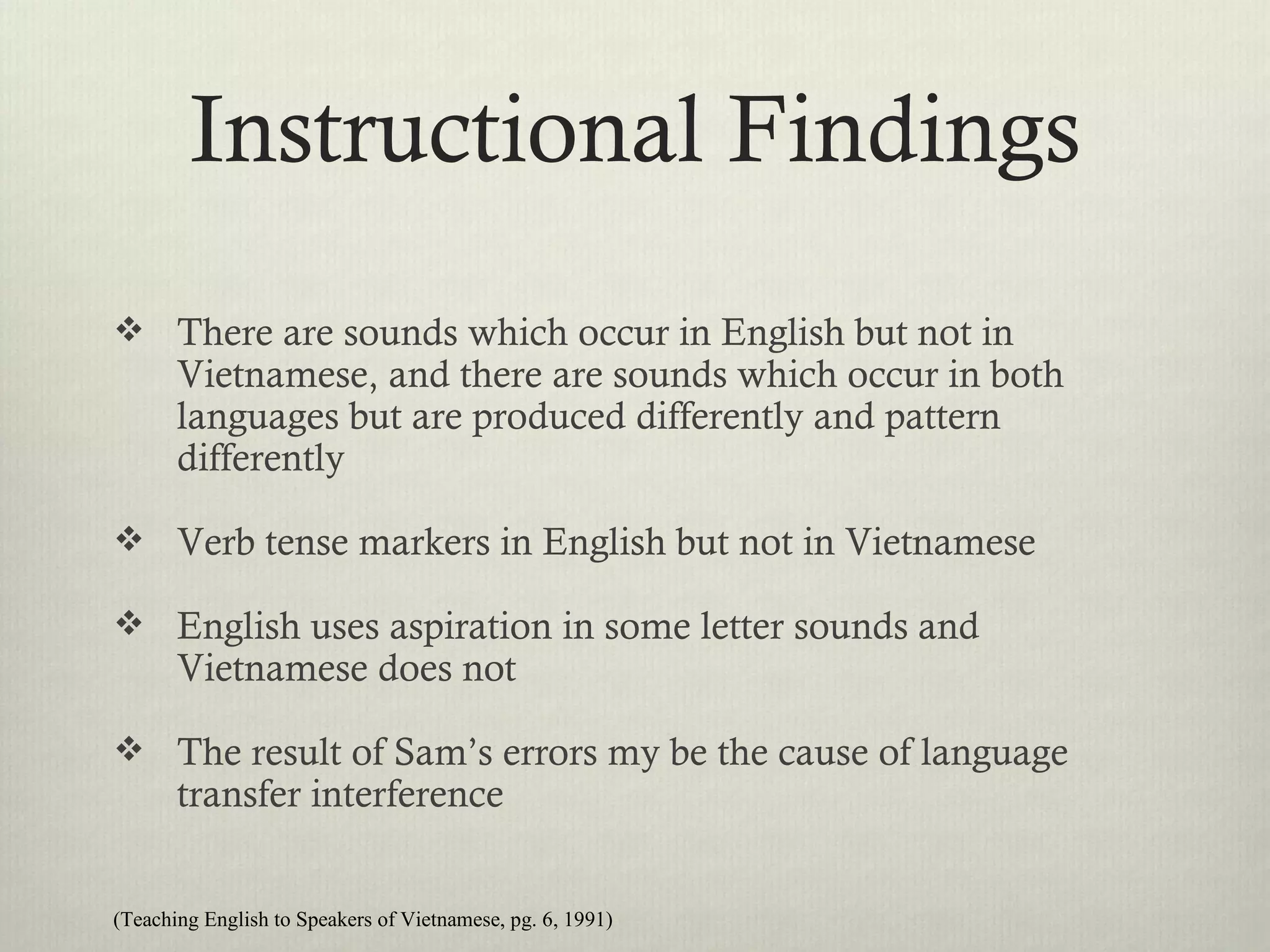
Instructional Findings
 There are sounds which occur in English but not in
       Vietnamese, and there are sounds which occur in both
       languages but are produced differently and pattern
       differently

 Verb tense markers in English but not in Vietnamese

 English uses aspiration in some letter sounds and
       Vietnamese does not

 The result of Sam’s errors my be the cause of language
       transfer interference


(Teaching English to Speakers of Vietnamese, pg. 6, 1991)
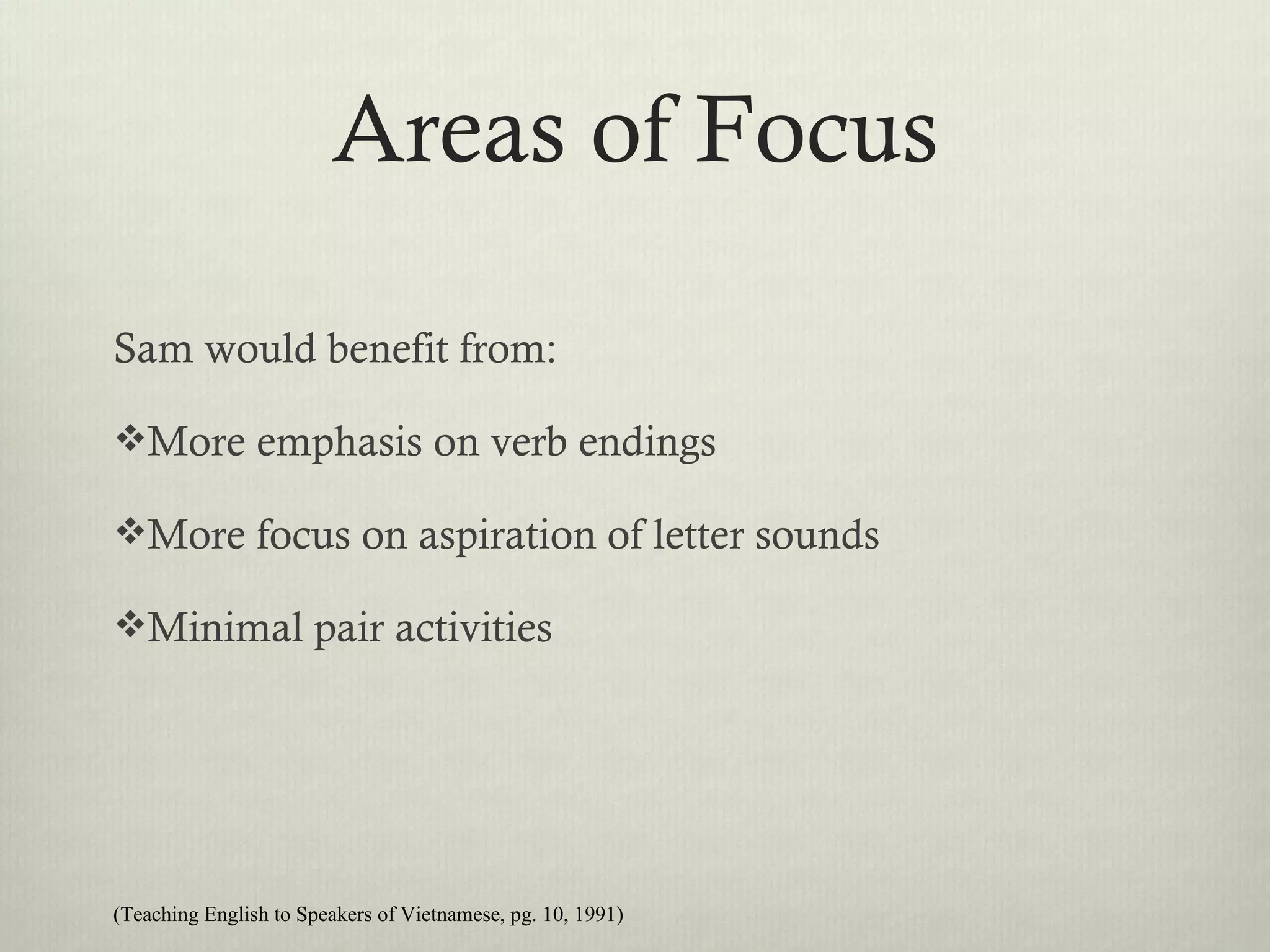
Areas of Focus

Sam would benefit from:

More emphasis on verb endings

More focus on aspiration of letter sounds

Minimal pair activities


(Teaching English to Speakers of Vietnamese, pg. 10, 1991)
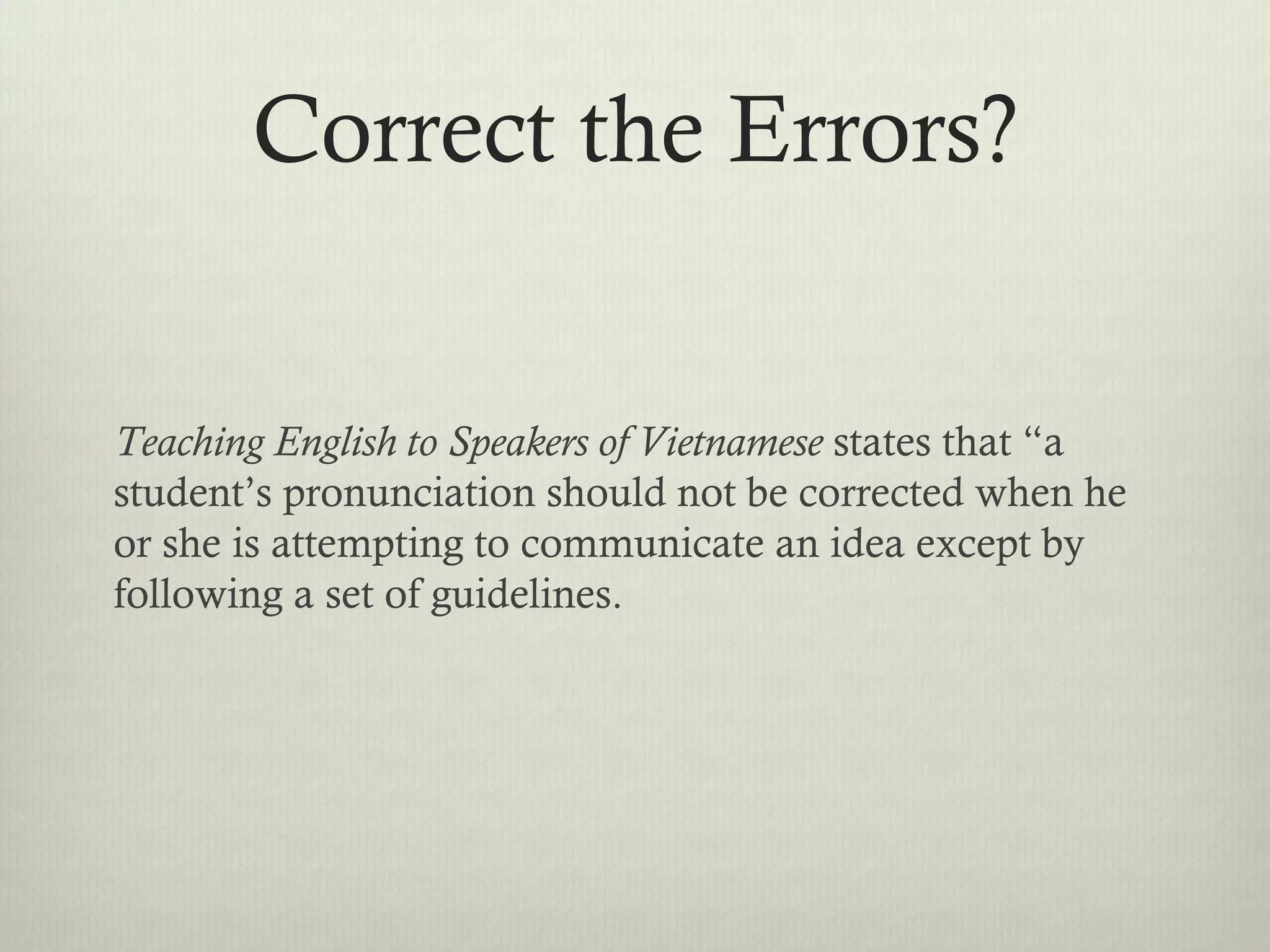
Correct the Errors?


Teaching English to Speakers of Vietnamese states that “a
student’s pronunciation should not be corrected when he
or she is attempting to communicate an idea except by
following a set of guidelines.
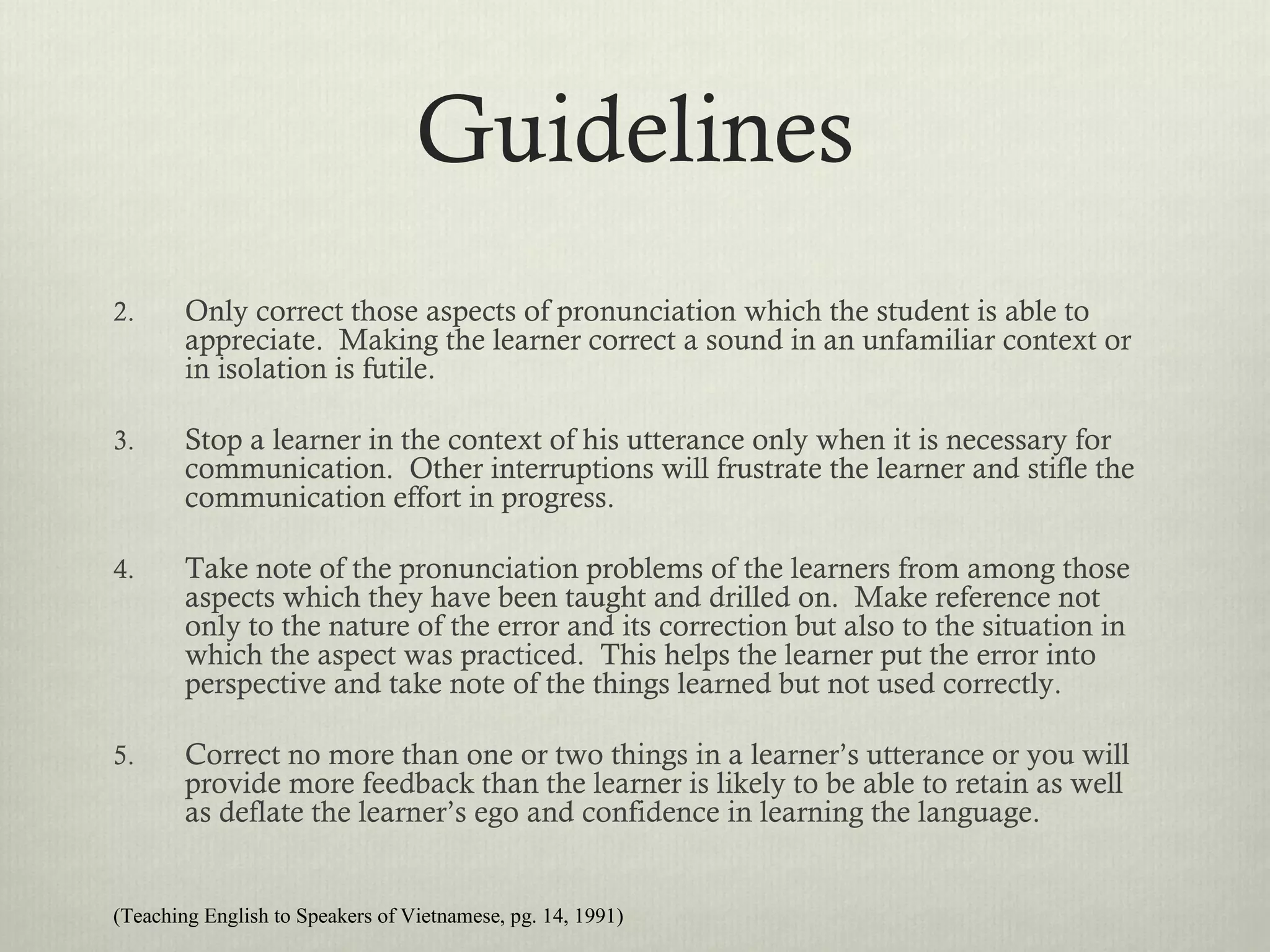
Guidelines
2.      Only correct those aspects of pronunciation which the student is able to
        appreciate. Making the learner correct a sound in an unfamiliar context or
        in isolation is futile.

3.      Stop a learner in the context of his utterance only when it is necessary for
        communication. Other interruptions will frustrate the learner and stifle the
        communication effort in progress.

4.      Take note of the pronunciation problems of the learners from among those
        aspects which they have been taught and drilled on. Make reference not
        only to the nature of the error and its correction but also to the situation in
        which the aspect was practiced. This helps the learner put the error into
        perspective and take note of the things learned but not used correctly.

5.      Correct no more than one or two things in a learner’s utterance or you will
        provide more feedback than the learner is likely to be able to retain as well
        as deflate the learner’s ego and confidence in learning the language.


(Teaching English to Speakers of Vietnamese, pg. 14, 1991)
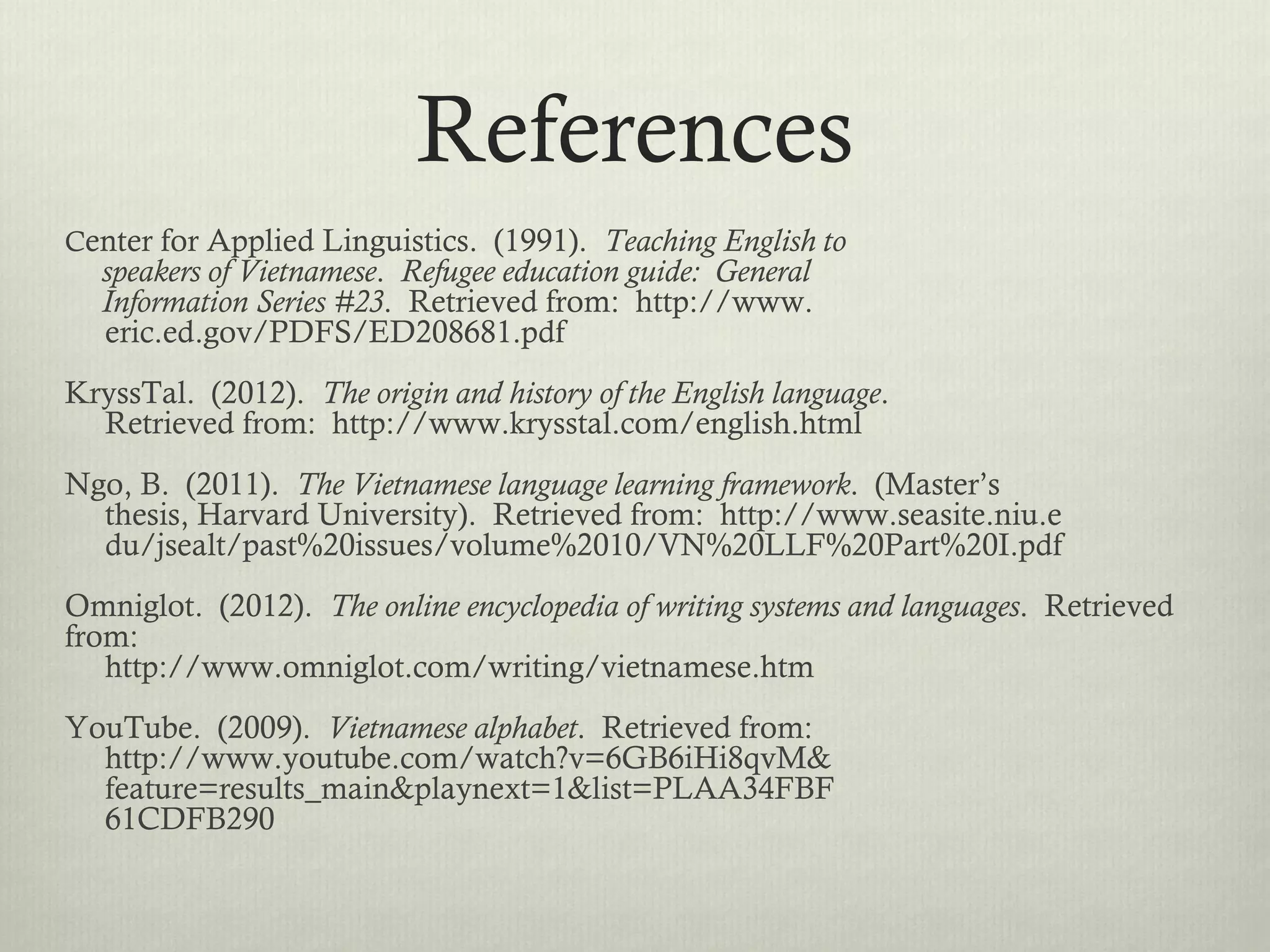
References
Center for Applied Linguistics. (1991). Teaching English to
  speakers of Vietnamese. Refugee education guide: General
  Information Series #23. Retrieved from: http://www.
  eric.ed.gov/PDFS/ED208681.pdf
KryssTal. (2012). The origin and history of the English language.
  Retrieved from: http://www.krysstal.com/english.html
Ngo, B. (2011). The Vietnamese language learning framework. (Master’s
  thesis, Harvard University). Retrieved from: http://www.seasite.niu.e
  du/jsealt/past%20issues/volume%2010/VN%20LLF%20Part%20I.pdf
Omniglot. (2012). The online encyclopedia of writing systems and languages. Retrieved
from:
   http://www.omniglot.com/writing/vietnamese.htm
YouTube. (2009). Vietnamese alphabet. Retrieved from:
  http://www.youtube.com/watch?v=6GB6iHi8qvM&
  feature=results_main&playnext=1&list=PLAA34FBF
  61CDFB290

Souder u11a1

  • 1.
    Vietnamese and English Language Comparison Amy Souder ESL 502 Wilkes University
  • 2.
    History and KeyFeatures of Vietnamese  Austroasiatic language  Official language of Vietnam  Spoken in numerous other countries around the world (Omniglot, 2012)
  • 3.
    Tonal Language Vietnamese consists of six tones: 2.Midlevel 3.Low-falling 4.High-rising 5.Low-falling-rising 6.High-rising broken 7.Low-falling broken (Ngo, 2011)
  • 4.
    Vietnamese Alphabet  Regular writing system  Most of the letters (grapheme) represent one phoneme (Ngo, 2011) Vietnamese Alphabet Video (YouTube, 2009)
  • 5.
    Vietnamese and English Comparison Vietnamese English  3 main dialects: northern, central,  Dialects are countless and southern  Non-tonal language  Tone language  Syllable is a sequence of sounds and  Syllable is the minimal meaningful the smallest unit that cannot be unit that cannot be divide into divided into smaller parts is a smaller parts phoneme.  Voiced and voiceless stops  Voiced and voiceless stops  Syllable-timed language and  Stressed-timed language and the rhythms are fairly level accented syllable recurs at intervals (KrysTall, 2012; Ngo, pg. 7, 2011)
  • 6.
    Vietnamese and English Comparison cont. Vietnamese English  Tense markers are usually left out if  Past, present, and future tense the time expression is clear from the markers context or sentence  Suffixes are added to nouns, verbs,  No suffix endings, such as s and es adjectives, and adverbs  A word succeeds the noun it  A word precedes the noun it modifies (cat white) modifies (white cat)  Interrogative words are placed at the  Interrogative words are at the beginning or end of a question, beginning of a question depending on the tense of time (Ngo, 2011, pg. 17-18; Teaching English to Speakers of Vietnamese, 1991, pg. 19). )
  • 7.
    Diacritics used inthe Vietnamese Language  Vietnamese is a tonal language  Tones are represented by a diacritic (mark) positioned over or under a vowel in the syllable  Each of the six tones has its own diacritic  Diacritics are not used in English  This may cause confusion for an ELL (Ngo, pg. 7, 2011; Teaching English to Speakers of Vietnamese, pg. 5, 1991)
  • 8.
    Aspiration  English speakersaspirate when pronouncing the letters p, t, and k at the beginning of words  Vietnamese speakers pronounce these same sounds and often do not aspirate, causing words such as pit, tie, and call to sound like bit, die, and gall (Teaching English to Speakers of Vietnamese, pg. 9, 1991)
  • 9.
    Suffixes  English usessuffixes to show grammatical meaning  Inflectional suffixes add meaning and agreement to the words they are attached to  Vietnamese language does not add suffixes to words (Teaching English to Speakers of Vietnamese, pg. 16-17, 1991)
  • 10.
    Verbs  In English,verbs are converted to nouns by adding ing to the base word  English forms of the verb “to be”: am, is, are, was, were, be, and been  In Vietnamese, words can be used either as verbs or as nouns without any changes being made to the base word  Vietnamese only has one form of a verb, la (Teaching English to Speakers of Vietnamese, pg. 21, 1991)
  • 11.
    Case Study  Sam Johnson  Vietnamese decent  Migrated to the US two years of age, when Sam was eight years old  Neither of Sam’s parents speak English  Vietnamese is the primary language spoken in the home  Sam’s older sister is proficient in English  Much L2 support is provided by Sam’s older sister
  • 12.
    Sam Johnson  5thgrade student  Attending ESL since his enrollment in school  ESL three days a week; totaling six hours of instruction  Sam has made vast improvements in English since his enrollment two years ago
  • 13.
    Verbs  Sam ishaving difficulties with the correct tense of verbs Example: Commonly dismisses the ing ending of verbs or adds an ing ending when not needed  Errors with using the correct helping verbs Example: Commonly used “are” when he should have chosen “is”
  • 14.
    Vocabulary  Sam struggleswith phonemics  In result, often gets frustrated and creates nonexistent words Example: He wrote “merred” when it should have been “purred”  Difficulties with grammar rules; such as understanding when to drop the “y” and add an “ies”
  • 15.
    Nouns  Sam ishaving trouble with correct noun usage  Subject pronouns are a major concern Example: Used “me” instead of “my” and “she” instead of “her”
  • 16.
    Instructional Findings  Thereare sounds which occur in English but not in Vietnamese, and there are sounds which occur in both languages but are produced differently and pattern differently  Verb tense markers in English but not in Vietnamese  English uses aspiration in some letter sounds and Vietnamese does not  The result of Sam’s errors my be the cause of language transfer interference (Teaching English to Speakers of Vietnamese, pg. 6, 1991)
  • 17.
    Areas of Focus Samwould benefit from: More emphasis on verb endings More focus on aspiration of letter sounds Minimal pair activities (Teaching English to Speakers of Vietnamese, pg. 10, 1991)
  • 18.
    Correct the Errors? TeachingEnglish to Speakers of Vietnamese states that “a student’s pronunciation should not be corrected when he or she is attempting to communicate an idea except by following a set of guidelines.
  • 19.
    Guidelines 2. Only correct those aspects of pronunciation which the student is able to appreciate. Making the learner correct a sound in an unfamiliar context or in isolation is futile. 3. Stop a learner in the context of his utterance only when it is necessary for communication. Other interruptions will frustrate the learner and stifle the communication effort in progress. 4. Take note of the pronunciation problems of the learners from among those aspects which they have been taught and drilled on. Make reference not only to the nature of the error and its correction but also to the situation in which the aspect was practiced. This helps the learner put the error into perspective and take note of the things learned but not used correctly. 5. Correct no more than one or two things in a learner’s utterance or you will provide more feedback than the learner is likely to be able to retain as well as deflate the learner’s ego and confidence in learning the language. (Teaching English to Speakers of Vietnamese, pg. 14, 1991)
  • 20.
    References Center for AppliedLinguistics. (1991). Teaching English to speakers of Vietnamese. Refugee education guide: General Information Series #23. Retrieved from: http://www. eric.ed.gov/PDFS/ED208681.pdf KryssTal. (2012). The origin and history of the English language. Retrieved from: http://www.krysstal.com/english.html Ngo, B. (2011). The Vietnamese language learning framework. (Master’s thesis, Harvard University). Retrieved from: http://www.seasite.niu.e du/jsealt/past%20issues/volume%2010/VN%20LLF%20Part%20I.pdf Omniglot. (2012). The online encyclopedia of writing systems and languages. Retrieved from: http://www.omniglot.com/writing/vietnamese.htm YouTube. (2009). Vietnamese alphabet. Retrieved from: http://www.youtube.com/watch?v=6GB6iHi8qvM& feature=results_main&playnext=1&list=PLAA34FBF 61CDFB290