Language ComparisonKathryn Gaugler ESL 502
Spanish vs. EnglishLanguage Origins and FeaturesVariancesCase Study
Language OriginsSpanish is a Romance language but English is a Germanic languageSpanish migrated across the Atlantic with the exploration and conquering of the “New World”Spanish is currently 2nd most spoken language in US
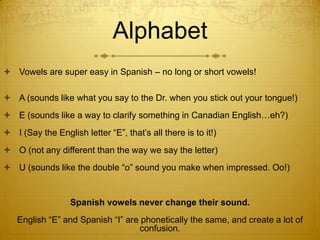
AlphabetVowels are super easy in Spanish – no long or short vowels!A (sounds like what you say to the Dr. when you stick out your tongue!)E (sounds like a way to clarify something in Canadian English…eh?) I (Say the English letter “E”, that’s all there is to it!)O (not any different than the way we say the letter)U (sounds like the double “o” sound you make when impressed. Oo!) Spanish vowels never change their sound.  English “E” and Spanish “I” are phonetically the same, and create a lot of confusion.
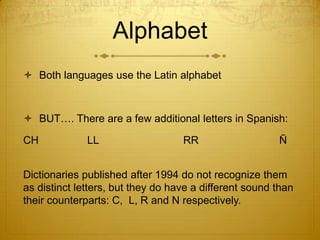
AlphabetBoth languages use the Latin alphabetBUT…. There are a few additional letters in Spanish:CH		LL			RR			ÑDictionaries published after 1994 do not recognize them as distinct letters, but they do have a different sound than their counterparts: C,  L, R and N respectively.
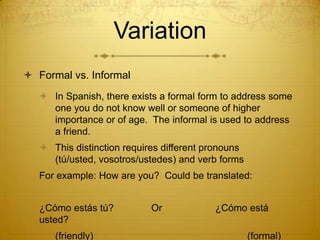
VariationFormal vs. InformalIn Spanish, there exists a formal form to address some one you do not know well or someone of higher importance or of age.  The informal is used to address a friend. This distinction requires different pronouns (tú/usted, vosotros/ustedes) and verb formsFor example: How are you?  Could be translated:¿Cómoestástú?          	Or		¿Cómoestáusted?(friendly)					(formal)
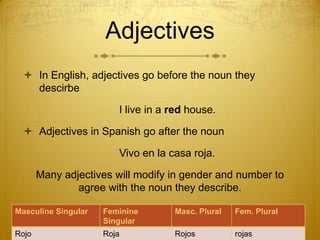
AdjectivesIn English, adjectives go before the noun they descirbeI live in a redhouse.Adjectives in Spanish go after the noun			Vivo en la casa roja. Many adjectives will modify in gender and number to agree with the noun they describe.
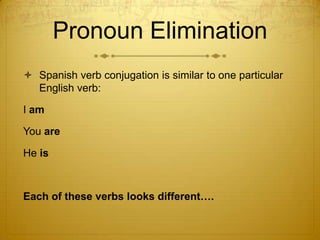
Pronoun EliminationSpanish verb conjugation is similar to one particular English verb:I amYou areHe isEach of these verbs looks different….
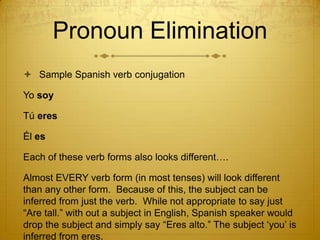
Pronoun EliminationSample Spanish verb conjugationYo soyTúeresÉlesEach of these verb forms also looks different….Almost EVERY verb form (in most tenses) will look different than any other form.  Because of this, the subject can be inferred from just the verb.  While not appropriate to say just “Are tall.” with out a subject in English, Spanish speaker would drop the subject and simply say “Eres alto.” The subject ‘you’ is inferred from eres.
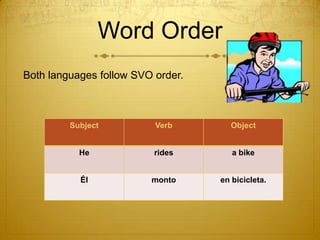
Word OrderBoth languages follow SVO order.
Case Study				Lola1st year ELLGoing into 2nd gradeSpeaks Spanish fluently for age, does not have home English exposureAnalysis done through written work
Case Studyerrors are a combination of developmental (like the omission of verbs) interference of L1 like putting adjectives after nouns.  (Some of her errors made sense knowing Spanish and the word arrangement and acceptable writing policies of that language.)Spelling is developmentalmastery of L1 and knowledge base to apply rules and strategies to her English acquisition is not there.
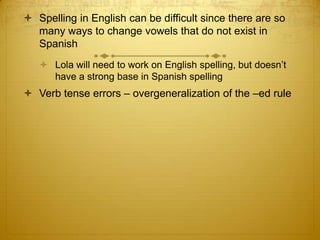
Spelling in English can be difficult since there are so many ways to change vowels that do not exist in SpanishLola will need to work on English spelling, but doesn’t have a strong base in Spanish spellingVerb tense errors – overgeneralization of the –ed rule

Languagecomp

  • 1.
  • 2.
    Spanish vs. EnglishLanguageOrigins and FeaturesVariancesCase Study
  • 3.
    Language OriginsSpanish isa Romance language but English is a Germanic languageSpanish migrated across the Atlantic with the exploration and conquering of the “New World”Spanish is currently 2nd most spoken language in US
  • 4.
    AlphabetVowels are supereasy in Spanish – no long or short vowels!A (sounds like what you say to the Dr. when you stick out your tongue!)E (sounds like a way to clarify something in Canadian English…eh?) I (Say the English letter “E”, that’s all there is to it!)O (not any different than the way we say the letter)U (sounds like the double “o” sound you make when impressed. Oo!) Spanish vowels never change their sound. English “E” and Spanish “I” are phonetically the same, and create a lot of confusion.
  • 5.
    AlphabetBoth languages usethe Latin alphabetBUT…. There are a few additional letters in Spanish:CH LL RR ÑDictionaries published after 1994 do not recognize them as distinct letters, but they do have a different sound than their counterparts: C, L, R and N respectively.
  • 6.
    VariationFormal vs. InformalInSpanish, there exists a formal form to address some one you do not know well or someone of higher importance or of age. The informal is used to address a friend. This distinction requires different pronouns (tú/usted, vosotros/ustedes) and verb formsFor example: How are you? Could be translated:¿Cómoestástú? Or ¿Cómoestáusted?(friendly) (formal)
  • 7.
    AdjectivesIn English, adjectivesgo before the noun they descirbeI live in a redhouse.Adjectives in Spanish go after the noun Vivo en la casa roja. Many adjectives will modify in gender and number to agree with the noun they describe.
  • 8.
    Pronoun EliminationSpanish verbconjugation is similar to one particular English verb:I amYou areHe isEach of these verbs looks different….
  • 9.
    Pronoun EliminationSample Spanishverb conjugationYo soyTúeresÉlesEach of these verb forms also looks different….Almost EVERY verb form (in most tenses) will look different than any other form. Because of this, the subject can be inferred from just the verb. While not appropriate to say just “Are tall.” with out a subject in English, Spanish speaker would drop the subject and simply say “Eres alto.” The subject ‘you’ is inferred from eres.
  • 10.
    Word OrderBoth languagesfollow SVO order.
  • 11.
    Case Study Lola1st yearELLGoing into 2nd gradeSpeaks Spanish fluently for age, does not have home English exposureAnalysis done through written work
  • 13.
    Case Studyerrors area combination of developmental (like the omission of verbs) interference of L1 like putting adjectives after nouns. (Some of her errors made sense knowing Spanish and the word arrangement and acceptable writing policies of that language.)Spelling is developmentalmastery of L1 and knowledge base to apply rules and strategies to her English acquisition is not there.
  • 14.
    Spelling in Englishcan be difficult since there are so many ways to change vowels that do not exist in SpanishLola will need to work on English spelling, but doesn’t have a strong base in Spanish spellingVerb tense errors – overgeneralization of the –ed rule