INTRODUCTION
“TYER CORD”
MANUFACTURING
By
Mahesh Pratap Dubey
+91-9453374288
anmpdubey@gmail.com
CONTENTS
 Introduction
 Parts & Function of Tyre Cord
 Raw Material in Tyre Cord
 Manufacturing Process
 Properties of Tyre Cord
 Uses & Application of Tyre Cord
 References
INTRODUCTION
 Tyres are the only point of contact of the vehicle with the road. The
intentions of the driver are finally executed by the tyres only, hence the
quality and design of the tyres is important. Tyres must perform a
certain number of functions for the smooth functioning of the vehicle
namely- steering, carrying a load, cushioning, rolling, transmitting drive
and long lasting life.
 Tyre yarns of polyester, rayon, nylon, aramid, glass, or steel are twisted
to 5 to 12 turns per inch.
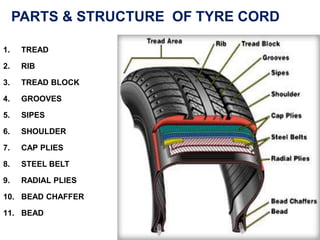
PARTS & STRUCTURE OF TYRE CORD
1. TREAD
2. RIB
3. TREAD BLOCK
4. GROOVES
5. SIPES
6. SHOULDER
7. CAP PLIES
8. STEEL BELT
9. RADIAL PLIES
10. BEAD CHAFFER
11. BEAD
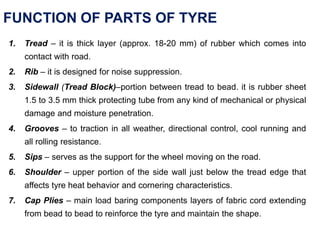
FUNCTION OF PARTS OF TYRE
1. Tread – it is thick layer (approx. 18-20 mm) of rubber which comes into
contact with road.
2. Rib – it is designed for noise suppression.
3. Sidewall (Tread Block)–portion between tread to bead. it is rubber sheet
1.5 to 3.5 mm thick protecting tube from any kind of mechanical or physical
damage and moisture penetration.
4. Grooves – to traction in all weather, directional control, cool running and
all rolling resistance.
5. Sips – serves as the support for the wheel moving on the road.
6. Shoulder – upper portion of the side wall just below the tread edge that
affects tyre heat behavior and cornering characteristics.
7. Cap Plies – main load baring components layers of fabric cord extending
from bead to bead to reinforce the tyre and maintain the shape.
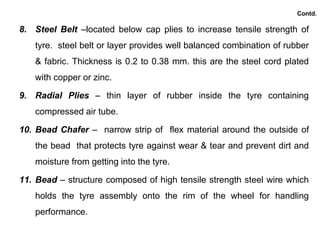
Contd.
8. Steel Belt –located below cap plies to increase tensile strength of
tyre. steel belt or layer provides well balanced combination of rubber
& fabric. Thickness is 0.2 to 0.38 mm. this are the steel cord plated
with copper or zinc.
9. Radial Plies – thin layer of rubber inside the tyre containing
compressed air tube.
10. Bead Chafer – narrow strip of flex material around the outside of
the bead that protects tyre against wear & tear and prevent dirt and
moisture from getting into the tyre.
11. Bead – structure composed of high tensile strength steel wire which
holds the tyre assembly onto the rim of the wheel for handling
performance.
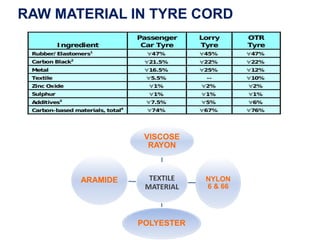
RAW MATERIAL IN TYRE CORD
TEXTILE
MATERIAL
VISCOSE
RAYON
NYLON
6 & 66
POLYESTER
ARAMIDE
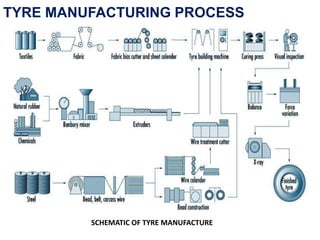
TYRE MANUFACTURING PROCESS
SCHEMATIC OF TYRE MANUFACTURE
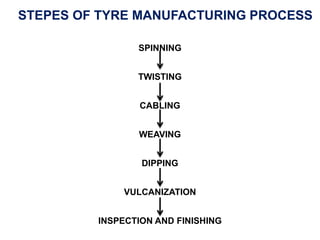
STEPES OF TYRE MANUFACTURING PROCESS
SPINNING
TWISTING
CABLING
WEAVING
DIPPING
VULCANIZATION
INSPECTION AND FINISHING
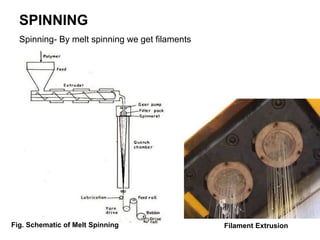
SPINNING
Spinning- By melt spinning we get filaments
Fig. Schematic of Melt Spinning Filament Extrusion
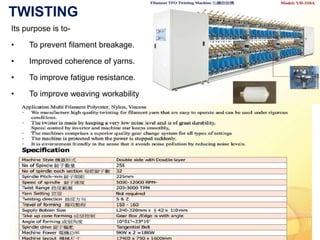
TWISTING
Its purpose is to-
• To prevent filament breakage.
• Improved coherence of yarns.
• To improve fatigue resistance.
• To improve weaving workability
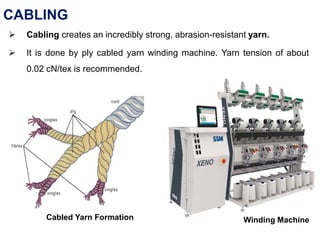
CABLING
 Cabling creates an incredibly strong, abrasion-resistant yarn.
 It is done by ply cabled yarn winding machine. Yarn tension of about
0.02 cN/tex is recommended.
Cabled Yarn Formation Winding Machine
WEAVING
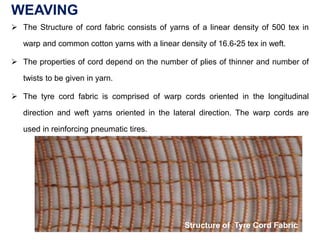
 The Structure of cord fabric consists of yarns of a linear density of 500 tex in
warp and common cotton yarns with a linear density of 16.6-25 tex in weft.
 The properties of cord depend on the number of plies of thinner and number of
twists to be given in yarn.
 The tyre cord fabric is comprised of warp cords oriented in the longitudinal
direction and weft yarns oriented in the lateral direction. The warp cords are
used in reinforcing pneumatic tires.
Structure of Tyre Cord Fabric
SPECIFICATIONS OF LOOM
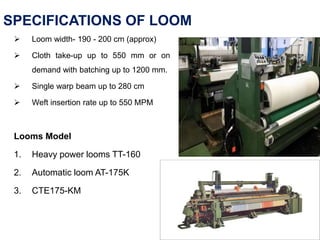
 Loom width- 190 - 200 cm (approx)
 Cloth take-up up to 550 mm or on
demand with batching up to 1200 mm.
 Single warp beam up to 280 cm
 Weft insertion rate up to 550 MPM
Looms Model
1. Heavy power looms TT-160
2. Automatic loom AT-175K
3. CTE175-KM
DIPPING
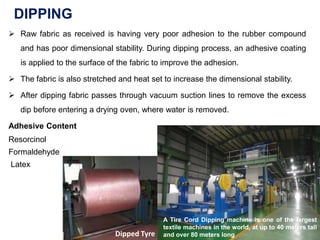
 Raw fabric as received is having very poor adhesion to the rubber compound
and has poor dimensional stability. During dipping process, an adhesive coating
is applied to the surface of the fabric to improve the adhesion.
 The fabric is also stretched and heat set to increase the dimensional stability.
 After dipping fabric passes through vacuum suction lines to remove the excess
dip before entering a drying oven, where water is removed.
Adhesive Content
Resorcinol
Formaldehyde
Latex
A Tire Cord Dipping machine is one of the largest
textile machines in the world, at up to 40 meters tall
and over 80 meters longDipped Tyre
VULCANIZATION
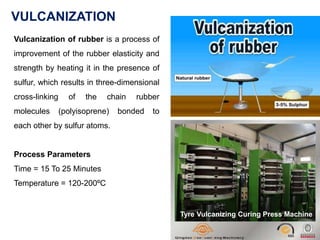
Vulcanization of rubber is a process of
improvement of the rubber elasticity and
strength by heating it in the presence of
sulfur, which results in three-dimensional
cross-linking of the chain rubber
molecules (polyisoprene) bonded to
each other by sulfur atoms.
Process Parameters
Time = 15 To 25 Minutes
Temperature = 120-200ºC
Tyre Vulcanizing Curing Press Machine
INSPECTION AND FINISHING
Following curing, finishing operations and inspection remain to be
performed before the tyre is stored or shipped. The finishing
operation trims flash or excess rubber from the tyre. This excess
rubber remains on the tyre from vents in the curing mould
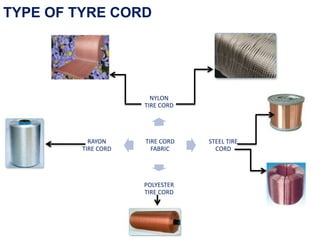
TYPE OF TYRE CORD
TIRE CORD
FABRIC
NYLON
TIRE CORD
STEEL TIRE
CORD
POLYESTER
TIRE CORD
RAYON
TIRE CORD
PROPERTIES OF TYRE CORD
1. High tenacity
2. High toughness
3. Superior fatigue resistance
4. Good adhesion to rubber
5. Low shrinkage
6. Increase extensibility
USES OF TYRE CORD FABRIC
 Polyester - Mainly used for passenger car and light truck radial tyres.
 Nylon- Are Used In Tyres In Truck, Bus & Off Road Vehicles.
 Steel- It is used inside tyres.
Applications of Tyre Cord
Automotive
Exterior
Passenger car tires
Bus and truck tires
Earth mover, off the road
Industrial tires
Agricultural & excavator tracks
Snowmobile tracks
Motor cycle tires
REFERENCES
•
1) http://www.michelin.re/zma/front/affich.jsp?codeRubrique=200609221
31123&lang=EN
2) http://www.bridgestone.co.in/tyre/tyrecare/safedriving.asp
3) www.hankooktyre.com.au/Tech/Functions.aspx?pageNum=3&subNu
m=4&ChildNum=2
4) http://en.wikipedia.org/wiki/Tire_manufacturing
5) http://www.jktyre.com/Customer_Service/Tyre_Components.aspx
6) http://www.indiacar.com/infobank/how_tyres_work.htm
7) Wikipedia articles Natural rubber, Synthetic rubber, Carbon black
Fumed silica Vulcanization, anti oxidants and anti ozonants
8) www.emt-india.net/process/tyre/pdf/TyreManufactureProcess001.pdf
THANKS

Tyer cord

  • 1.
    INTRODUCTION “TYER CORD” MANUFACTURING By Mahesh PratapDubey +91-9453374288 anmpdubey@gmail.com
  • 2.
    CONTENTS  Introduction  Parts& Function of Tyre Cord  Raw Material in Tyre Cord  Manufacturing Process  Properties of Tyre Cord  Uses & Application of Tyre Cord  References
  • 3.
    INTRODUCTION  Tyres arethe only point of contact of the vehicle with the road. The intentions of the driver are finally executed by the tyres only, hence the quality and design of the tyres is important. Tyres must perform a certain number of functions for the smooth functioning of the vehicle namely- steering, carrying a load, cushioning, rolling, transmitting drive and long lasting life.  Tyre yarns of polyester, rayon, nylon, aramid, glass, or steel are twisted to 5 to 12 turns per inch.
  • 4.
    PARTS & STRUCTUREOF TYRE CORD 1. TREAD 2. RIB 3. TREAD BLOCK 4. GROOVES 5. SIPES 6. SHOULDER 7. CAP PLIES 8. STEEL BELT 9. RADIAL PLIES 10. BEAD CHAFFER 11. BEAD
  • 5.
    FUNCTION OF PARTSOF TYRE 1. Tread – it is thick layer (approx. 18-20 mm) of rubber which comes into contact with road. 2. Rib – it is designed for noise suppression. 3. Sidewall (Tread Block)–portion between tread to bead. it is rubber sheet 1.5 to 3.5 mm thick protecting tube from any kind of mechanical or physical damage and moisture penetration. 4. Grooves – to traction in all weather, directional control, cool running and all rolling resistance. 5. Sips – serves as the support for the wheel moving on the road. 6. Shoulder – upper portion of the side wall just below the tread edge that affects tyre heat behavior and cornering characteristics. 7. Cap Plies – main load baring components layers of fabric cord extending from bead to bead to reinforce the tyre and maintain the shape.
  • 6.
    Contd. 8. Steel Belt–located below cap plies to increase tensile strength of tyre. steel belt or layer provides well balanced combination of rubber & fabric. Thickness is 0.2 to 0.38 mm. this are the steel cord plated with copper or zinc. 9. Radial Plies – thin layer of rubber inside the tyre containing compressed air tube. 10. Bead Chafer – narrow strip of flex material around the outside of the bead that protects tyre against wear & tear and prevent dirt and moisture from getting into the tyre. 11. Bead – structure composed of high tensile strength steel wire which holds the tyre assembly onto the rim of the wheel for handling performance.
  • 7.
    RAW MATERIAL INTYRE CORD TEXTILE MATERIAL VISCOSE RAYON NYLON 6 & 66 POLYESTER ARAMIDE
  • 8.
  • 9.
    STEPES OF TYREMANUFACTURING PROCESS SPINNING TWISTING CABLING WEAVING DIPPING VULCANIZATION INSPECTION AND FINISHING
  • 10.
    SPINNING Spinning- By meltspinning we get filaments Fig. Schematic of Melt Spinning Filament Extrusion
  • 11.
    TWISTING Its purpose isto- • To prevent filament breakage. • Improved coherence of yarns. • To improve fatigue resistance. • To improve weaving workability
  • 12.
    CABLING  Cabling createsan incredibly strong, abrasion-resistant yarn.  It is done by ply cabled yarn winding machine. Yarn tension of about 0.02 cN/tex is recommended. Cabled Yarn Formation Winding Machine
  • 13.
    WEAVING  The Structureof cord fabric consists of yarns of a linear density of 500 tex in warp and common cotton yarns with a linear density of 16.6-25 tex in weft.  The properties of cord depend on the number of plies of thinner and number of twists to be given in yarn.  The tyre cord fabric is comprised of warp cords oriented in the longitudinal direction and weft yarns oriented in the lateral direction. The warp cords are used in reinforcing pneumatic tires. Structure of Tyre Cord Fabric
  • 14.
    SPECIFICATIONS OF LOOM Loom width- 190 - 200 cm (approx)  Cloth take-up up to 550 mm or on demand with batching up to 1200 mm.  Single warp beam up to 280 cm  Weft insertion rate up to 550 MPM Looms Model 1. Heavy power looms TT-160 2. Automatic loom AT-175K 3. CTE175-KM
  • 15.
    DIPPING  Raw fabricas received is having very poor adhesion to the rubber compound and has poor dimensional stability. During dipping process, an adhesive coating is applied to the surface of the fabric to improve the adhesion.  The fabric is also stretched and heat set to increase the dimensional stability.  After dipping fabric passes through vacuum suction lines to remove the excess dip before entering a drying oven, where water is removed. Adhesive Content Resorcinol Formaldehyde Latex A Tire Cord Dipping machine is one of the largest textile machines in the world, at up to 40 meters tall and over 80 meters longDipped Tyre
  • 16.
    VULCANIZATION Vulcanization of rubberis a process of improvement of the rubber elasticity and strength by heating it in the presence of sulfur, which results in three-dimensional cross-linking of the chain rubber molecules (polyisoprene) bonded to each other by sulfur atoms. Process Parameters Time = 15 To 25 Minutes Temperature = 120-200ºC Tyre Vulcanizing Curing Press Machine
  • 17.
    INSPECTION AND FINISHING Followingcuring, finishing operations and inspection remain to be performed before the tyre is stored or shipped. The finishing operation trims flash or excess rubber from the tyre. This excess rubber remains on the tyre from vents in the curing mould
  • 18.
    TYPE OF TYRECORD TIRE CORD FABRIC NYLON TIRE CORD STEEL TIRE CORD POLYESTER TIRE CORD RAYON TIRE CORD
  • 19.
    PROPERTIES OF TYRECORD 1. High tenacity 2. High toughness 3. Superior fatigue resistance 4. Good adhesion to rubber 5. Low shrinkage 6. Increase extensibility
  • 20.
    USES OF TYRECORD FABRIC  Polyester - Mainly used for passenger car and light truck radial tyres.  Nylon- Are Used In Tyres In Truck, Bus & Off Road Vehicles.  Steel- It is used inside tyres. Applications of Tyre Cord Automotive Exterior Passenger car tires Bus and truck tires Earth mover, off the road Industrial tires Agricultural & excavator tracks Snowmobile tracks Motor cycle tires
  • 21.
    REFERENCES • 1) http://www.michelin.re/zma/front/affich.jsp?codeRubrique=200609221 31123&lang=EN 2) http://www.bridgestone.co.in/tyre/tyrecare/safedriving.asp 3)www.hankooktyre.com.au/Tech/Functions.aspx?pageNum=3&subNu m=4&ChildNum=2 4) http://en.wikipedia.org/wiki/Tire_manufacturing 5) http://www.jktyre.com/Customer_Service/Tyre_Components.aspx 6) http://www.indiacar.com/infobank/how_tyres_work.htm 7) Wikipedia articles Natural rubber, Synthetic rubber, Carbon black Fumed silica Vulcanization, anti oxidants and anti ozonants 8) www.emt-india.net/process/tyre/pdf/TyreManufactureProcess001.pdf
  • 22.