Lab report
Fabric manufacturing Sessional
Submitted by
Mahbubay Rabbani Mim
Id no. :-175035
Year and semester:-2/2
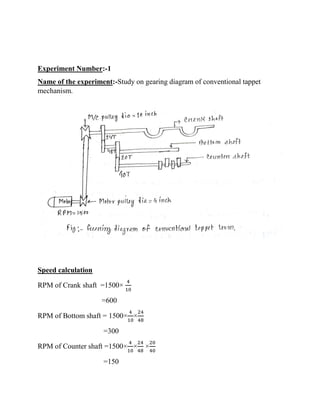
Experiment Number:-1
Name of the experiment:-Study on gearing diagram of conventional tappet
mechanism.
Speed calculation
RPM of Crank shaft =1500×
4
10
=600
RPM of Bottom shaft = 1500×
4
10
×
24
48
=300
RPM of Counter shaft =1500×
4
10
×
24
48
×
20
40
=150
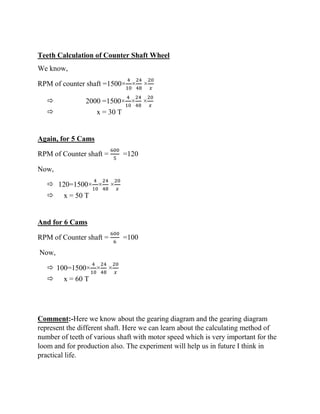
Teeth Calculation of Counter Shaft Wheel
We know,
RPM of counter shaft =1500×
4
10
×
24
48
×
20
𝑥
 2000 =1500×
4
10
×
24
48
×
20
𝑥
 x = 30 T
Again, for 5 Cams
RPM of Counter shaft =
600
5
=120
Now,
 120=1500×
4
10
×
24
48
×
20
𝑥
 x = 50 T
And for 6 Cams
RPM of Counter shaft =
600
6
=100
Now,
 100=1500×
4
10
×
24
48
×
20
𝑥
 x = 60 T
Comment:-Here we know about the gearing diagram and the gearing diagram
represent the different shaft. Here we can learn about the calculating method of
number of teeth of various shaft with motor speed which is very important for the
loom and for production also. The experiment will help us in future I think in
practical life.
Experiment Number:-2
Name of the experiment:-Study on Tappet shedding mechanism (Positive
shedding and Negative shedding).
Introduction:- Tappets are generally used for heald shedding. It converts the
rotary motion to a reciprocating motion. Tappet is a type of cam to which a rotary
motion is given for the purpose of producing reciprocating motion in rods and
levers by sliding contact. When the rod is to receive a series of lifts, with intervals
of rest and thus forms a shed called tappet.
Objectives:-
1. To learn about shedding mechanism of tappet loom.
2. To learn about different parts related to this mechanism.
Types of tappet
2 types
1. Negative shedding tappet.
2. Positive shedding tappet.
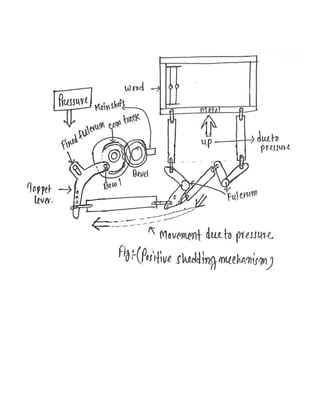
Positive Tappet Shedding:-
In a tappet shedding mechanism, if the tappet controls both upward and downward
movements of the heald shafts, then the shedding is known as positive tappet
shedding.
M/C parts:-
1.Motor.
2. Motor pulley.
3. M/C pulley.
4. Crank shaft.
5. Crank shaft gear.
6. Bottom shaft gear.
7. Bottom shaft.
8. Tappet.
9. Connecting rod.
10. Heald shaft.
11. Top arm
Working principle:-
In this type of shedding positive tappet (cam) is used for shedding. The positive
shedding cam (tappet) give both upward and downwards movements to healds
without the aid of any additional mechanism. Here motor gives motion to the
bottom shaft. Tappets are connected with bottom shaft; tappets provide shedding
action. Tappets depress the threads bowl, ultimately depresses the treadle lever.
Heald frame is connected with treadle lever and upper portion of healds is
connected by belt. Treadle lever ultimately responsible for the downward
movement of heald frame and upward movement of healds frame is mechanically
generated by belts or ropes.
Uses:-Tappet is generally used for heald shedding.
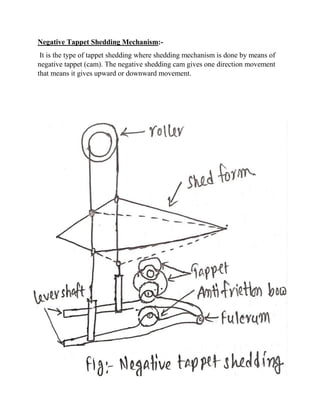
Negative Tappet Shedding Mechanism:-
It is the type of tappet shedding where shedding mechanism is done by means of
negative tappet (cam). The negative shedding cam gives one direction movement
that means it gives upward or downward movement.
M/C Parts:-
1. Roller.
2. Tappet.
3. Fulcrum.
4. Anti-friction bowl.
5. Lever shaft.
Working principle:-
When the bottom shaft is rotated in the clockwise direction the tappets are also
rotated. The tappet will depress the anti-friction bowl & the treadle. Being fulcrum
at one end, the front portion of the treadle moves down. This action is transferred to
the lamb rod, the heald shaft & the leather strap. So one heald shaft is lowered & the
threads connected to this heald shaft are lowered and form the bottom layer of the
shed. This leather straps attached to the reversing rollers are connected in opposite
directions like when leather strap is pull down, it is unwound from the roller. The
shaft therefore rotates in the clockwise direction and the other leather strap is wound
on to its roller. The heald shaft is raised and therefore the lamb rod & treadle lever
are also raised. The threads connected to the heald shaft are also raised & form the
top layer of the shed. For the next shed, the other tappets works with the other set of
bowl, treadle, lamb rod, heald shaft, strap and roller and the other heald shaft is
lowered. The first heald shaft is raised by the top reversing rollers, and the positions
of the heald shafts are thus interchanged. Thus, for one rotation of the bottom shaft,
two sheds are formed.
Comment:-In that experiment i know about the tappet shedding mechanism. We
also have known about the parts associated with the tappet shedding mechanism and
how can it converts the rotary motion to reciprocating motion. I think it will
contribute my future life at any woven industry.
Experiment Number:-3
Name of the experiment:-Study on conventional picking mechanism (over
picking and under picking mechanism).
Introduction:-
Picking is the second primary motion in weaving. It consists in passing a pick of
weft between the upper and lower lines of a divided warp. It builds up half of the
cloth. The shuttle is the vehicle of weft for picking in the conventional automatic
looms.
Objectives:-
1. To know the over and under picking mechanism.
2. To identify the different parts of these mechanism.
Over picking mechanism:-
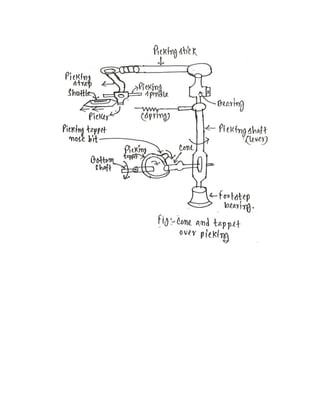
Over picking mechanism is used on cotton and jute loom. It is robust and easy to
adjust and maintain. In this motion the picking shaft is mounted over the shuttle
box. Picking is done over the loom that is why it is called as over pick motion. A
picking cam attached to bottom shaft displaces the picking cone (picking cone)
which is attached with the picking shaft. This causes rotation of the picking shaft.
As a result, the picking stick attached to the picking shaft swing in a horizontal
plane over the loom. This motion is further transferred to the picker by the picking
strap. The picker is constrained by the spindle to move in a straight line which
otherwise would have followed a path of arc. Finally, picker hits the shuttle and
passed through the warp shed.
M/C Parts:-
1. Picking arm.
2. Picking strap.
3. Picker.
4. Bottom shaft.
5. Picking spindle.
6. Shuttle.
7. Picking cam.
8. Vertical shaft.
9. Cone.
10.Bowl.
11.Angular.
12.Crank shaft.
Working principle:-The spindle is situated over the shuttle box and is essential to
guide the shuttle along the correct path. It is normally set slightly up and slightly
towards the front of the loom and its inner end. The back end of the shuttle will
thus receive a similar lift at the end of the stroke, so that its leading end will
receive correct delivery down and into the shed. A flexible leather-picking strap is
used to control the picker, which has tendency to stretched slowly in use, and vary
with regard to its elastic property. The cone over pick motion consist a vertical
shaft placed either inside or outside the loom framing. The shaft serves as fulcrum
of the picking arm, it is held against the loom frame. There is a spiral spring at the
picking shaft, which causes the picking arm and picker to move back after the
delivery of the pick. At the two end of the bottom shaft, two picking cams are
fixed. In revolving its nose the tappet strikes the cone shaped ant frictional roller
strut, positively rotates the shaft and causes the pick to move inward with sufficient
velocity to drive the shuttle across the loom. The timing of the picker begins to
move can be attend by turning the picking tappet on its boss.
Uses:-This is used for narrow and fast running looms, weaving light and medium
weight fabrics and for many narrow and wide looms for weaving heavy fabrics.
Under pick mechanism:-
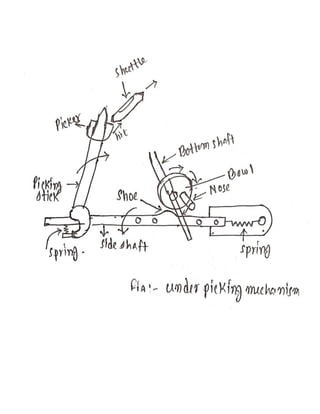
In under picking mechanism a race board is situated over picking arm. Under
picking is controlled by picking cam which is fixed on the bottom shaft. At first the
motion comes from motor and m/c pulley.
M/C Parts:-
1. Treadle lever.
2. Bowl.
3. Fulcrum.
4. Arm Curve.
5. metal plate.
6. Picking arm.
7. Shuttle box.
8. Coiled spring.
9. Bottom shaft wheel.
10.Leather band.
11.Loom framing.
Working principle:-
The motor supplies the power, when the motor pulley rotates the m/c pulley is also
rotate and the crankshaft wheel gets power for rotating. Thus crank shaft wheel
teeth are half the bottom shaft wheel. So, the crankshaft wheel rotates two times
that time the bottom shaft wheel rotates one time. Then picking wheel also rotates
due to fixed. In the parallel pick method, a curved shoal fixed to the bottom of
picking sticks rides on a horizontal plate fixed to the sley sword. When the bowl
rotates and to give pressure on the side shoe and l- level moves to forward
direction and weft is occurred.
Uses:-This mechanism is used in all non-automatic cotton looms. It is also used in
jute looms
Comment:-Picking mechanism is very important for loom. In the loom under
picking is directly done by picker and picking arm. Again under picking is
necessary for weft yarn insertion. The over picking motion is negative one. The
exact amount of power is required to drive a shuttle. By this experiment we learned
about the over picking mechanism and how it works. So, we should learn about
this mechanism very carefully, this experience will help us in our future practical
life.

175035 fabric lab report

  • 1.
    Lab report Fabric manufacturingSessional Submitted by Mahbubay Rabbani Mim Id no. :-175035 Year and semester:-2/2
  • 2.
    Experiment Number:-1 Name ofthe experiment:-Study on gearing diagram of conventional tappet mechanism. Speed calculation RPM of Crank shaft =1500× 4 10 =600 RPM of Bottom shaft = 1500× 4 10 × 24 48 =300 RPM of Counter shaft =1500× 4 10 × 24 48 × 20 40 =150
  • 3.
    Teeth Calculation ofCounter Shaft Wheel We know, RPM of counter shaft =1500× 4 10 × 24 48 × 20 𝑥  2000 =1500× 4 10 × 24 48 × 20 𝑥  x = 30 T Again, for 5 Cams RPM of Counter shaft = 600 5 =120 Now,  120=1500× 4 10 × 24 48 × 20 𝑥  x = 50 T And for 6 Cams RPM of Counter shaft = 600 6 =100 Now,  100=1500× 4 10 × 24 48 × 20 𝑥  x = 60 T Comment:-Here we know about the gearing diagram and the gearing diagram represent the different shaft. Here we can learn about the calculating method of number of teeth of various shaft with motor speed which is very important for the loom and for production also. The experiment will help us in future I think in practical life.
  • 4.
    Experiment Number:-2 Name ofthe experiment:-Study on Tappet shedding mechanism (Positive shedding and Negative shedding). Introduction:- Tappets are generally used for heald shedding. It converts the rotary motion to a reciprocating motion. Tappet is a type of cam to which a rotary motion is given for the purpose of producing reciprocating motion in rods and levers by sliding contact. When the rod is to receive a series of lifts, with intervals of rest and thus forms a shed called tappet. Objectives:- 1. To learn about shedding mechanism of tappet loom. 2. To learn about different parts related to this mechanism. Types of tappet 2 types 1. Negative shedding tappet. 2. Positive shedding tappet. Positive Tappet Shedding:- In a tappet shedding mechanism, if the tappet controls both upward and downward movements of the heald shafts, then the shedding is known as positive tappet shedding.
  • 6.
    M/C parts:- 1.Motor. 2. Motorpulley. 3. M/C pulley. 4. Crank shaft. 5. Crank shaft gear. 6. Bottom shaft gear. 7. Bottom shaft. 8. Tappet. 9. Connecting rod. 10. Heald shaft. 11. Top arm Working principle:- In this type of shedding positive tappet (cam) is used for shedding. The positive shedding cam (tappet) give both upward and downwards movements to healds without the aid of any additional mechanism. Here motor gives motion to the bottom shaft. Tappets are connected with bottom shaft; tappets provide shedding action. Tappets depress the threads bowl, ultimately depresses the treadle lever. Heald frame is connected with treadle lever and upper portion of healds is connected by belt. Treadle lever ultimately responsible for the downward movement of heald frame and upward movement of healds frame is mechanically generated by belts or ropes. Uses:-Tappet is generally used for heald shedding.
  • 7.
    Negative Tappet SheddingMechanism:- It is the type of tappet shedding where shedding mechanism is done by means of negative tappet (cam). The negative shedding cam gives one direction movement that means it gives upward or downward movement.
  • 8.
    M/C Parts:- 1. Roller. 2.Tappet. 3. Fulcrum. 4. Anti-friction bowl. 5. Lever shaft. Working principle:- When the bottom shaft is rotated in the clockwise direction the tappets are also rotated. The tappet will depress the anti-friction bowl & the treadle. Being fulcrum at one end, the front portion of the treadle moves down. This action is transferred to the lamb rod, the heald shaft & the leather strap. So one heald shaft is lowered & the threads connected to this heald shaft are lowered and form the bottom layer of the shed. This leather straps attached to the reversing rollers are connected in opposite directions like when leather strap is pull down, it is unwound from the roller. The shaft therefore rotates in the clockwise direction and the other leather strap is wound on to its roller. The heald shaft is raised and therefore the lamb rod & treadle lever are also raised. The threads connected to the heald shaft are also raised & form the top layer of the shed. For the next shed, the other tappets works with the other set of bowl, treadle, lamb rod, heald shaft, strap and roller and the other heald shaft is lowered. The first heald shaft is raised by the top reversing rollers, and the positions of the heald shafts are thus interchanged. Thus, for one rotation of the bottom shaft, two sheds are formed. Comment:-In that experiment i know about the tappet shedding mechanism. We also have known about the parts associated with the tappet shedding mechanism and how can it converts the rotary motion to reciprocating motion. I think it will contribute my future life at any woven industry.
  • 9.
    Experiment Number:-3 Name ofthe experiment:-Study on conventional picking mechanism (over picking and under picking mechanism). Introduction:- Picking is the second primary motion in weaving. It consists in passing a pick of weft between the upper and lower lines of a divided warp. It builds up half of the cloth. The shuttle is the vehicle of weft for picking in the conventional automatic looms. Objectives:- 1. To know the over and under picking mechanism. 2. To identify the different parts of these mechanism. Over picking mechanism:- Over picking mechanism is used on cotton and jute loom. It is robust and easy to adjust and maintain. In this motion the picking shaft is mounted over the shuttle box. Picking is done over the loom that is why it is called as over pick motion. A picking cam attached to bottom shaft displaces the picking cone (picking cone) which is attached with the picking shaft. This causes rotation of the picking shaft. As a result, the picking stick attached to the picking shaft swing in a horizontal plane over the loom. This motion is further transferred to the picker by the picking strap. The picker is constrained by the spindle to move in a straight line which otherwise would have followed a path of arc. Finally, picker hits the shuttle and passed through the warp shed.
  • 10.
    M/C Parts:- 1. Pickingarm. 2. Picking strap. 3. Picker. 4. Bottom shaft. 5. Picking spindle. 6. Shuttle. 7. Picking cam. 8. Vertical shaft. 9. Cone. 10.Bowl. 11.Angular. 12.Crank shaft.
  • 12.
    Working principle:-The spindleis situated over the shuttle box and is essential to guide the shuttle along the correct path. It is normally set slightly up and slightly towards the front of the loom and its inner end. The back end of the shuttle will thus receive a similar lift at the end of the stroke, so that its leading end will receive correct delivery down and into the shed. A flexible leather-picking strap is used to control the picker, which has tendency to stretched slowly in use, and vary with regard to its elastic property. The cone over pick motion consist a vertical shaft placed either inside or outside the loom framing. The shaft serves as fulcrum of the picking arm, it is held against the loom frame. There is a spiral spring at the picking shaft, which causes the picking arm and picker to move back after the delivery of the pick. At the two end of the bottom shaft, two picking cams are fixed. In revolving its nose the tappet strikes the cone shaped ant frictional roller strut, positively rotates the shaft and causes the pick to move inward with sufficient velocity to drive the shuttle across the loom. The timing of the picker begins to move can be attend by turning the picking tappet on its boss. Uses:-This is used for narrow and fast running looms, weaving light and medium weight fabrics and for many narrow and wide looms for weaving heavy fabrics.
  • 13.
    Under pick mechanism:- Inunder picking mechanism a race board is situated over picking arm. Under picking is controlled by picking cam which is fixed on the bottom shaft. At first the motion comes from motor and m/c pulley. M/C Parts:- 1. Treadle lever. 2. Bowl. 3. Fulcrum. 4. Arm Curve. 5. metal plate. 6. Picking arm. 7. Shuttle box. 8. Coiled spring. 9. Bottom shaft wheel. 10.Leather band. 11.Loom framing.
  • 15.
    Working principle:- The motorsupplies the power, when the motor pulley rotates the m/c pulley is also rotate and the crankshaft wheel gets power for rotating. Thus crank shaft wheel teeth are half the bottom shaft wheel. So, the crankshaft wheel rotates two times that time the bottom shaft wheel rotates one time. Then picking wheel also rotates due to fixed. In the parallel pick method, a curved shoal fixed to the bottom of picking sticks rides on a horizontal plate fixed to the sley sword. When the bowl rotates and to give pressure on the side shoe and l- level moves to forward direction and weft is occurred. Uses:-This mechanism is used in all non-automatic cotton looms. It is also used in jute looms Comment:-Picking mechanism is very important for loom. In the loom under picking is directly done by picker and picking arm. Again under picking is necessary for weft yarn insertion. The over picking motion is negative one. The exact amount of power is required to drive a shuttle. By this experiment we learned about the over picking mechanism and how it works. So, we should learn about this mechanism very carefully, this experience will help us in our future practical life.