SATURDAY, MARCH 17, 2018
Two Factor
Authentication
Will Adams
Software Architect
Fiserv, Inc.
• What is it?
• Authentication Factors
• Not to be confused with…
• Software token apps
• Why do we need it?
• Recent headlines
• The problem with passwords
• How do we implement it?
• A word about standards
• Adding a second factor
Agenda
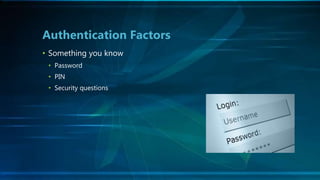
• Something you know
• Password
• PIN
• Security questions
Authentication Factors
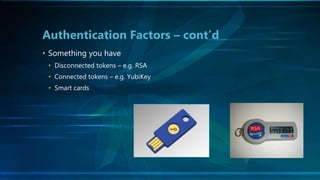
• Something you have
• Disconnected tokens – e.g. RSA
• Connected tokens – e.g. YubiKey
• Smart cards
Authentication Factors – cont’d
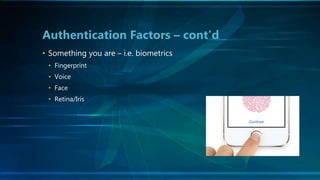
• Something you are – i.e. biometrics
• Fingerprint
• Voice
• Face
• Retina/Iris
Authentication Factors – cont’d
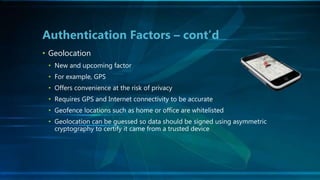
• Geolocation
• New and upcoming factor
• For example, GPS
• Offers convenience at the risk of privacy
• Requires GPS and Internet connectivity to be accurate
• Geofence locations such as home or office are whitelisted
• Geolocation can be guessed so data should be signed using asymmetric
cryptography to certify it came from a trusted device
Authentication Factors – cont’d
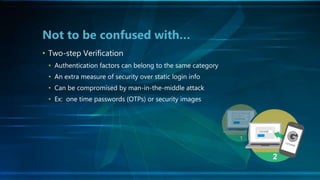
• Two-step Verification
• Authentication factors can belong to the same category
• An extra measure of security over static login info
• Can be compromised by man-in-the-middle attack
• Ex: one time passwords (OTPs) or security images
Not to be confused with…
• Google Authenticator
• Generates 2-step verification codes using Time-Based One Time
Passwords (TOTP) and HMAC-based OTPs
• A shared secret key is exchanged during setup between server and
app usually via QR code scan
• Available for iOS or Android
• Authy
• Provides 6-digit TOTPs for 2SV but also has multi-device support
• Available as a browser extension
• Encrypted backups in the Cloud
Software Token Apps
• February 2014 – Target stores
• Credit card data compromised
• Resulted from stolen network credentials
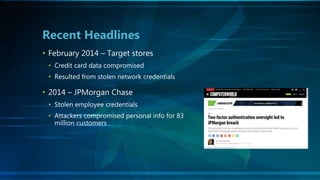
• 2014 – JPMorgan Chase
• Stolen employee credentials
• Attackers compromised personal info for 83
million customers
Recent Headlines
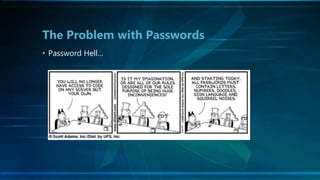
• Password Hell…
The Problem with Passwords
• Ease of sharing and reuse
• Prone to attacks – phishing, malware, brute force
• Complex passwords are often written down
• Creates a single point of failure without 2FA or MFA
• According to Verizon 2017 Data Breach Investigations Report,
81% of hacking-related breaches leveraged either stolen and/or
weak passwords
The (Real) Problem with Passwords
• FIDO (Fast IDentity Online) Alliance
• Group of leading companies like Google and Microsoft that develop
standards to enable a simpler and more secure authentication experience
across websites and mobile services
• UAF (Universal Authentication Framework)
• Designed as a replacement for basic authentication
• Typically involves biometrics where security info never leaves the device
• U2F (Universal Second Factor)
• Strengthens and simplifies 2FA using USB, NFC or Bluetooth devices
• Has strong security that protects against phishing, session hijacking, man-in-the-
middle and malware attacks
• Native support offered by major vendors and browsers
A Word About Standards…
• Two-step verification
• Two-factor authentication
Demos
• Two Factor Authentication book by Mark Stanislav
• https://www.amazon.com/Two-Factor-Authentication-Governance-
Publishing/dp/1849287325
• Pro ASP.NET Web API Security book by Badrinarayanan Lakshmiraghavan
• https://www.apress.com/us/book/9781430257820
• Articles:
• Authy vs. Google: https://authy.com/blog/authy-vs-google-authenticator/
• MFA Best Practices: https://www.pingidentity.com/content/dam/ping-6-2-
assets/Assets/white-papers/en/mfa-best-practices-securing-modern-digital-
enterprise-3001.pdf?id=b6322a80-f285-11e3-ac10-0800200c9a66
Resources
• Websites
• developers.yubico.com
• twofactorauth.org
• authy.com
Resources, cont’d
Questions?
• @RemoteArchitect
• Slides and source to be made available after Code Camp
Thank You!

Two factor authentication 2018

  • 1.
    SATURDAY, MARCH 17,2018 Two Factor Authentication Will Adams Software Architect Fiserv, Inc.
  • 2.
    • What isit? • Authentication Factors • Not to be confused with… • Software token apps • Why do we need it? • Recent headlines • The problem with passwords • How do we implement it? • A word about standards • Adding a second factor Agenda
  • 3.
    • Something youknow • Password • PIN • Security questions Authentication Factors
  • 4.
    • Something youhave • Disconnected tokens – e.g. RSA • Connected tokens – e.g. YubiKey • Smart cards Authentication Factors – cont’d
  • 5.
    • Something youare – i.e. biometrics • Fingerprint • Voice • Face • Retina/Iris Authentication Factors – cont’d
  • 6.
    • Geolocation • Newand upcoming factor • For example, GPS • Offers convenience at the risk of privacy • Requires GPS and Internet connectivity to be accurate • Geofence locations such as home or office are whitelisted • Geolocation can be guessed so data should be signed using asymmetric cryptography to certify it came from a trusted device Authentication Factors – cont’d
  • 7.
    • Two-step Verification •Authentication factors can belong to the same category • An extra measure of security over static login info • Can be compromised by man-in-the-middle attack • Ex: one time passwords (OTPs) or security images Not to be confused with…
  • 8.
    • Google Authenticator •Generates 2-step verification codes using Time-Based One Time Passwords (TOTP) and HMAC-based OTPs • A shared secret key is exchanged during setup between server and app usually via QR code scan • Available for iOS or Android • Authy • Provides 6-digit TOTPs for 2SV but also has multi-device support • Available as a browser extension • Encrypted backups in the Cloud Software Token Apps
  • 9.
    • February 2014– Target stores • Credit card data compromised • Resulted from stolen network credentials • 2014 – JPMorgan Chase • Stolen employee credentials • Attackers compromised personal info for 83 million customers Recent Headlines
  • 10.
    • Password Hell… TheProblem with Passwords
  • 11.
    • Ease ofsharing and reuse • Prone to attacks – phishing, malware, brute force • Complex passwords are often written down • Creates a single point of failure without 2FA or MFA • According to Verizon 2017 Data Breach Investigations Report, 81% of hacking-related breaches leveraged either stolen and/or weak passwords The (Real) Problem with Passwords
  • 12.
    • FIDO (FastIDentity Online) Alliance • Group of leading companies like Google and Microsoft that develop standards to enable a simpler and more secure authentication experience across websites and mobile services • UAF (Universal Authentication Framework) • Designed as a replacement for basic authentication • Typically involves biometrics where security info never leaves the device • U2F (Universal Second Factor) • Strengthens and simplifies 2FA using USB, NFC or Bluetooth devices • Has strong security that protects against phishing, session hijacking, man-in-the- middle and malware attacks • Native support offered by major vendors and browsers A Word About Standards…
  • 13.
    • Two-step verification •Two-factor authentication Demos
  • 14.
    • Two FactorAuthentication book by Mark Stanislav • https://www.amazon.com/Two-Factor-Authentication-Governance- Publishing/dp/1849287325 • Pro ASP.NET Web API Security book by Badrinarayanan Lakshmiraghavan • https://www.apress.com/us/book/9781430257820 • Articles: • Authy vs. Google: https://authy.com/blog/authy-vs-google-authenticator/ • MFA Best Practices: https://www.pingidentity.com/content/dam/ping-6-2- assets/Assets/white-papers/en/mfa-best-practices-securing-modern-digital- enterprise-3001.pdf?id=b6322a80-f285-11e3-ac10-0800200c9a66 Resources
  • 15.
    • Websites • developers.yubico.com •twofactorauth.org • authy.com Resources, cont’d
  • 16.
  • 17.
    • @RemoteArchitect • Slidesand source to be made available after Code Camp Thank You!

Editor's Notes

  • #6 Typically a factor substitution and not a second factor of authentication Can have false positives and false negatives – i.e.: A false positive is when the system incorrectly accepts a biometric sample as being a match. (Same as false accept) A false negative is when a valid biometric sample is provided but the system falsely rejects it as not a match. (Same as false reject)
  • #8 Have server store OTPs and establish a validity period to offset risk from MITM attack. OTPs as part of 2SV are in-band and phone calls used to verify identity are out-of-band. Goal is to have out-of-band process.
  • #10 Also Tesla and Slack were compromised.
  • #12 Password complexity rules and length do nothing to stop a phishing attack.
  • #13 Specs emphasize a device-centric model. Authentication over the wire happens using public-key crytography. User’s device registers the user to a server by registering a public key. To authenticate the user, the device signs a challenge from the server using its private key. Keys on the device are unlocked by a local user gesture such as a biometric or pressing a button.