Two Curves Upfront
            Normal convexity corrections and two curve pricing


                             Gary J. Kennedy

                          Clarus Financial Technology


                            February 21, 2013


Built with ShareLaTeX
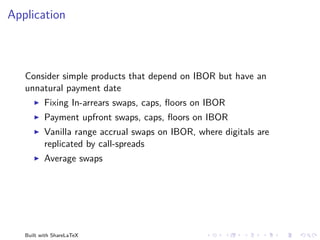
Application


   Consider simple products that depend on IBOR but have an
   unnatural payment date
          Fixing In-arrears swaps, caps, floors on IBOR
          Payment upfront swaps, caps, floors on IBOR
          Vanilla range accrual swaps on IBOR, where digitals are
          replicated by call-spreads
          Average swaps


   Built with ShareLaTeX
Notation
   Follow notation of Hagan [Hag03, Hag04] as much as possible.
   Consider an IBOR rate R(τ ), fixing at τ , with start date ts and
   end date te . Let Z (t, T ) denote the value of a zero coupon bond
   with maturity T at time t. For emphasis, D(T ) = Z (0, T ).
   A caplet with payment date tp is then valued as

                                                             Z (τ, tp )
                 Vcaplet = D(te )E max(R(τ ) − K , 0)                   |F0
                                                             Z (τ, te )
   Similarly,
                                                      Z (τ, tp )
                           Vswaplet = D(te )E R(τ )              |F0
                                                      Z (τ, te )
                                                             Z (τ, tp )
                Vfloorlet = D(te )E max(K − R(τ ), 0)                    |F0
                                                             Z (τ, te )
   We ignore the notional and accrual period length of the cashflow
   for convenience. The accrual period length of the IBOR rate is α.
   Built with ShareLaTeX
Two curves within the payoff


                           Z (τ,tp )
   How to relate           Z (τ,te )   and R(τ ) in a two curve world?
                                   Z R (t,u)                 Z (t,u)
   Recall from [Hen10],            Z R (t,v )
                                                = βt (u, v ) Z (t,v ) , and assume
                                    D R (u)
                                  D(u)
   βt (u, v ) = β0 (u, v )        = D R (v )
                                  D(v ) .
   In the special case that tp = ts (typical of in-arrears),

                              Z (τ, tp )        1
                                         =               (1 + αR(τ ))
                              Z (τ, te )   βτ (ts , te )


   Built with ShareLaTeX
Linear Cash Rate Model

   In the more general case of tp = ts we may use the linear cash rate
   model considered in [HK00, Hag04]

                                    Z R (τ, u)
                                                 ≈ a + bu R(τ )
                                    Z R (τ, te )
            Z R (τ,te )
   Since    Z R (τ,te )
                        =1      for any R(τ ), bte must be zero, whence a = 1.
                     Z (τ,u)
   Then     since Z (τ,te )     is a martingale,


   D(u)      Z (τ, u)          1       Z R (τ, u)   1
          =E            =E               R (τ, t )
                                                   ≈ (1 + bu R(0))
   D(te )    Z (τ, te )    βt (τ, te ) Z        e   β0

                     D R (u)
                               −1
                     D R (te )
   Thus bu = R(0) . Notice that the boundary cases are captured
   conveniently, for if u = ts , bu = α, whilst if u = te , bu = 0.

   Built with ShareLaTeX
Valuation


   The payoffs are now expectations of quadratic functions of the
   underlying IBOR rate, which can be fully replicated across the
   smile, see for example, [HK00, Ope11, Hag03].

                            D(te )
             Vcaplet =                   E [max(R(τ ) − K , 0)(1 + bu R(τ ))]
                           β0 (tp , te )
                                    D(te )
                      Vswaplet =                 E [R(τ )(1 + bu R(τ ))]
                                   β0 (tp , te )
                            D(te )
            Vfloorlet =                   E [max(K − R(τ ), 0)(1 + bu R(τ ))]
                           β0 (tp , te )


   Built with ShareLaTeX
Basis point volatility valuation

   For completeness we consider an analytic approximation using
   normal model1 .
                                               √
                               R(τ ) = R(0) + σ τ X
   where X is a normal variable with mean zero and unit variance.
   The volatility parameter, σ is referred to as basis point volatility, or
   simply BpVol [Zho03].
                                                           D(tp )
   Then since E[R 2 (τ )] = R(0)2 + σ 2 τ , and D(te ) = 1+bu R(0)
                                                 β0

                                                     bu σ 2 τ
                     Vswaplet = D(tp ) R(0) +
                                                   1 + bu R(0)
   Should the volatility surface be parameterised by strike, choose the
   σ = σ(R(0)).

      1
          Use of model which permitted negative rates became quite important in
   Europe during the   summer of 2011 when CHF became negative [Car12]
   Built with ShareLaTeX
Basis point volatility valuation


   For caplet,


                  D(te )
                               E [max(R(τ ) − K , 0)(1 + bu R(τ ))]
                 β0 (tp , te )
                                      bu σ 2 τ                   √
          = D(tp )         R(0) +               −K       N(d) + σ τ n(d)
                                    1 + bu R(0)

   Where d = R(0)−K . Should the volatility surface be parameterised
                    √
                  σ τ
   by strike, choose σ = σ(K ) when K > R(0). For K < R(0) use
   put-call parity.


   Built with ShareLaTeX
Basis point volatility valuation


   For floorlet,


               D(te )
                            E [max(K − R(τ ), 0)(1 + bu R(τ ))]
              β0 (tp , te )
                                          bu σ 2 τ           √
       = D(tp )            K − R(0) −               N(−d) + σ τ n(−d)
                                        1 + bu R(0)

   Should the volatility surface be parameterised by strike, choose
   σ = σ(K ) when K < R(0). For K > R(0) use put-call parity.


   Built with ShareLaTeX
Bibliography I

         L. Carver, Negative rates: Dealers struggle to price 0% floors,
         Risk Magazine Nov. (2012).
         P. Caspers, Normal libor in arrears, Available at SSRN
         2188619 (2012).
         P.S. Hagan, Convexity conundrums: pricing CMS swaps, caps
         and floors, Wilmott magazine 1 (2003), 38.
         P. Hagan, Accrual swaps and range notes, Working paper
         (2004).
         Marc Henrard, The irony in derivatives discounting part II: The
         crisis, Wilmott Journal 2 (2010), no. 6, 301–316.
         Phil Hunt and Joanne Kennedy, Financial derivatives in theory
         and practice, Wiley, 2000.

   Built with ShareLaTeX
Bibliography II


         A. Li and V. Raghavan, Libor-in-arrears swaps, Journal of
         Derivatives, Spring (1996).
         OpenGamma, Swap and cap/floors with fixing in arrears or
         payment delay, www.opengamma.com (2011).
         A. Pelsser, Mathematical foundation of convexity correction,
         Quantitative Finance 3 (2003), no. 1.
         Fei Zhou, Volatility skews, Lehman Brothers: Fixed Income
         Research Sep (2003).


   Built with ShareLaTeX

Two Curves Upfront

  • 1.
    Two Curves Upfront Normal convexity corrections and two curve pricing Gary J. Kennedy Clarus Financial Technology February 21, 2013 Built with ShareLaTeX
  • 2.
    Application Consider simple products that depend on IBOR but have an unnatural payment date Fixing In-arrears swaps, caps, floors on IBOR Payment upfront swaps, caps, floors on IBOR Vanilla range accrual swaps on IBOR, where digitals are replicated by call-spreads Average swaps Built with ShareLaTeX
  • 3.
    Notation Follow notation of Hagan [Hag03, Hag04] as much as possible. Consider an IBOR rate R(τ ), fixing at τ , with start date ts and end date te . Let Z (t, T ) denote the value of a zero coupon bond with maturity T at time t. For emphasis, D(T ) = Z (0, T ). A caplet with payment date tp is then valued as Z (τ, tp ) Vcaplet = D(te )E max(R(τ ) − K , 0) |F0 Z (τ, te ) Similarly, Z (τ, tp ) Vswaplet = D(te )E R(τ ) |F0 Z (τ, te ) Z (τ, tp ) Vfloorlet = D(te )E max(K − R(τ ), 0) |F0 Z (τ, te ) We ignore the notional and accrual period length of the cashflow for convenience. The accrual period length of the IBOR rate is α. Built with ShareLaTeX
  • 4.
    Two curves withinthe payoff Z (τ,tp ) How to relate Z (τ,te ) and R(τ ) in a two curve world? Z R (t,u) Z (t,u) Recall from [Hen10], Z R (t,v ) = βt (u, v ) Z (t,v ) , and assume D R (u) D(u) βt (u, v ) = β0 (u, v ) = D R (v ) D(v ) . In the special case that tp = ts (typical of in-arrears), Z (τ, tp ) 1 = (1 + αR(τ )) Z (τ, te ) βτ (ts , te ) Built with ShareLaTeX
  • 5.
    Linear Cash RateModel In the more general case of tp = ts we may use the linear cash rate model considered in [HK00, Hag04] Z R (τ, u) ≈ a + bu R(τ ) Z R (τ, te ) Z R (τ,te ) Since Z R (τ,te ) =1 for any R(τ ), bte must be zero, whence a = 1. Z (τ,u) Then since Z (τ,te ) is a martingale, D(u) Z (τ, u) 1 Z R (τ, u) 1 =E =E R (τ, t ) ≈ (1 + bu R(0)) D(te ) Z (τ, te ) βt (τ, te ) Z e β0 D R (u) −1 D R (te ) Thus bu = R(0) . Notice that the boundary cases are captured conveniently, for if u = ts , bu = α, whilst if u = te , bu = 0. Built with ShareLaTeX
  • 6.
    Valuation The payoffs are now expectations of quadratic functions of the underlying IBOR rate, which can be fully replicated across the smile, see for example, [HK00, Ope11, Hag03]. D(te ) Vcaplet = E [max(R(τ ) − K , 0)(1 + bu R(τ ))] β0 (tp , te ) D(te ) Vswaplet = E [R(τ )(1 + bu R(τ ))] β0 (tp , te ) D(te ) Vfloorlet = E [max(K − R(τ ), 0)(1 + bu R(τ ))] β0 (tp , te ) Built with ShareLaTeX
  • 7.
    Basis point volatilityvaluation For completeness we consider an analytic approximation using normal model1 . √ R(τ ) = R(0) + σ τ X where X is a normal variable with mean zero and unit variance. The volatility parameter, σ is referred to as basis point volatility, or simply BpVol [Zho03]. D(tp ) Then since E[R 2 (τ )] = R(0)2 + σ 2 τ , and D(te ) = 1+bu R(0) β0 bu σ 2 τ Vswaplet = D(tp ) R(0) + 1 + bu R(0) Should the volatility surface be parameterised by strike, choose the σ = σ(R(0)). 1 Use of model which permitted negative rates became quite important in Europe during the summer of 2011 when CHF became negative [Car12] Built with ShareLaTeX
  • 8.
    Basis point volatilityvaluation For caplet, D(te ) E [max(R(τ ) − K , 0)(1 + bu R(τ ))] β0 (tp , te ) bu σ 2 τ √ = D(tp ) R(0) + −K N(d) + σ τ n(d) 1 + bu R(0) Where d = R(0)−K . Should the volatility surface be parameterised √ σ τ by strike, choose σ = σ(K ) when K > R(0). For K < R(0) use put-call parity. Built with ShareLaTeX
  • 9.
    Basis point volatilityvaluation For floorlet, D(te ) E [max(K − R(τ ), 0)(1 + bu R(τ ))] β0 (tp , te ) bu σ 2 τ √ = D(tp ) K − R(0) − N(−d) + σ τ n(−d) 1 + bu R(0) Should the volatility surface be parameterised by strike, choose σ = σ(K ) when K < R(0). For K > R(0) use put-call parity. Built with ShareLaTeX
  • 10.
    Bibliography I L. Carver, Negative rates: Dealers struggle to price 0% floors, Risk Magazine Nov. (2012). P. Caspers, Normal libor in arrears, Available at SSRN 2188619 (2012). P.S. Hagan, Convexity conundrums: pricing CMS swaps, caps and floors, Wilmott magazine 1 (2003), 38. P. Hagan, Accrual swaps and range notes, Working paper (2004). Marc Henrard, The irony in derivatives discounting part II: The crisis, Wilmott Journal 2 (2010), no. 6, 301–316. Phil Hunt and Joanne Kennedy, Financial derivatives in theory and practice, Wiley, 2000. Built with ShareLaTeX
  • 11.
    Bibliography II A. Li and V. Raghavan, Libor-in-arrears swaps, Journal of Derivatives, Spring (1996). OpenGamma, Swap and cap/floors with fixing in arrears or payment delay, www.opengamma.com (2011). A. Pelsser, Mathematical foundation of convexity correction, Quantitative Finance 3 (2003), no. 1. Fei Zhou, Volatility skews, Lehman Brothers: Fixed Income Research Sep (2003). Built with ShareLaTeX