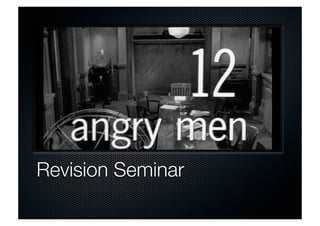
Revision Seminar
Twelve Angry Men is not a play about finding a boy 
innocent of a crime he didn’t commit. Rather, it’s a vivid 
depiction/portrayal/representation of...
Past essay questions 
‘In reaching a verdict, the jurors reconsider both their understanding of the 
case and their 
understanding of themselves.’ Discuss. 
i. “It’s not easy for me to raise my hand and send a boy off to die without talking 
about it first.” ‘The 8th Juror is the only member of the jury who values the 
life of the boy who is on trial.’ Do you agree? 
ii.‘Twelve Angry Men highlights the importance of seeing things from more than 
one perspective.’ 
Discuss. 
iii.‘Twelve Angry Men is a play about how power can be misused.’ 
Discuss. 
iv.‘Twelve Angry Men is less about guilt or innocence than about reasonable 
doubt.’ 
Discuss. 
v.Why is it so difficult for the jury in Twelve Angry Men to reach its final 
verdict?
Essay response task 
i.‘In reaching a verdict, the jurors 
reconsider both their understanding of 
the case and their 
understanding of themselves.’ Discuss. 
Write the numbers 1-12 
Group them
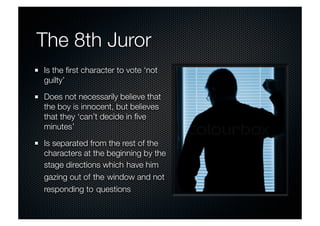
The 8th Juror 
Is the first character to vote ‘not 
guilty’ 
Does not necessarily believe that 
the boy is innocent, but believes 
that they ‘can’t decide in five 
minutes’ 
Is separated from the rest of the 
characters at the beginning by the 
stage directions which have him 
gazing out of the window and not 
responding to questions
Of all the characters, we learn the least about the 8th 
jurors background, although there is the rather curious 
story about him wandering the neighbourhood of the 
murder and buying a switchblade similar to the murder 
weapon, which may suggest that he is familiar with the 
area 
He only ever asserts that he is trying to do what is 
‘supposed to be happening in a jury room’, and even 
suggests that he will change his vote if all of the other 
jurors maintain their ‘guilty’ vote during the second 
count
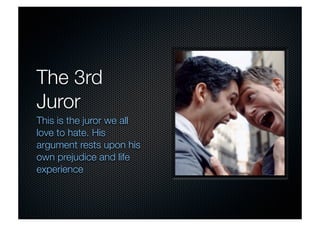
The 3rd 
Juror 
This is the juror we all 
love to hate. His 
argument rests upon his 
own prejudice and life 
experience
The 3rd juror is a self-made man, who believes in rough 
justice 
He is the last juror to change his mind 
His relationship with his estranged son determines his 
prejudice and attitude to the case, although he is the 
first to declare ‘I have no personal feelings about this’ 
Unlike many of the other jurors, he uses definite words 
like ‘I know’, ‘You can’t refute facts’ and ‘You’re 
absolutely right’
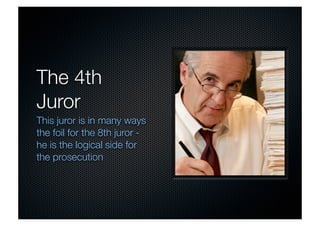
The 4th 
Juror 
This juror is in many ways 
the foil for the 8th juror - 
he is the logical side for 
the prosecution
The 4th juror describes himself as a broker, and his 
arguments are punctuated by numbers, that lend him 
more logic and reason than the observations the other 
jurors offer 
He lacks the imagination to put himself in the position 
of the accused, distancing himself from the ‘filthy 
neighbourhood’ that is a ‘breeding ground for criminals’
In many ways, the 4th juror is blinded by his own logic - 
he cannot imagine that his careful ordering of the world 
is wrong 
When the 8th juror demonstrates that he doesn’t know 
all the pertinent details about the films he has recently 
seen, it doesn’t change his mind 
Only by comparing himself to the spectacle-wearing 
witness, does the 4th juror finally (2nd to last) change 
his vote
The 10th 
Juror 
This juror is one of 
the loudest 
opponents of the 
innocence of the boy
The 10th juror is loudest in his opposition to ‘those’ 
people 
Unlike many of the other jurors he is not interested in 
seeing justice done - he thinks the boy is guilty, but 
when opinion swings the other way, tries to convince 
the 4th and 3rd jurors to ‘just quit’ because he doesn’t 
want to ‘break [his] brains over scum like that’ 
He is prejudiced against the boy he describes as a 
‘common ignorant slob’ but derides the logic and 
intelligence of others - ‘everyone’s a lawyer’
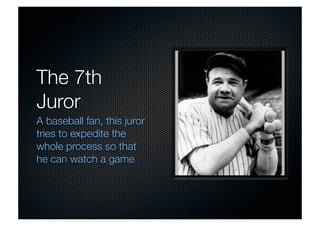
The 7th 
Juror 
A baseball fan, this juror 
tries to expedite the 
whole process so that 
he can watch a game
The 7th juror represents Rose’s understanding that not 
all citizens will give justice its due consideration 
He tries to play cards, noughts and crosses (tic, tac, 
toe) 
Finally votes not guilty because ‘all this yakkin’s getting 
us nowhere’
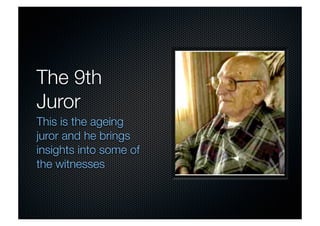
The 9th 
Juror 
This is the ageing 
juror and he brings 
insights into some of 
the witnesses
The 9th juror is first introduced as the juror in the 
lavatory, the Foreman has to ask him to hurry up, which 
gives us an insight into others’ perception of ageing 
This juror most strongly identifies with the witness who 
‘saw’ the boy fleeing the scene 
He is the first juror to change his vote, recognising the 
importance of the boy’s life and the relative 
unimportance of spending more time in the jury room - 
‘it’s only one night. A boy may die’ 
He is disgusted by the 10th juror
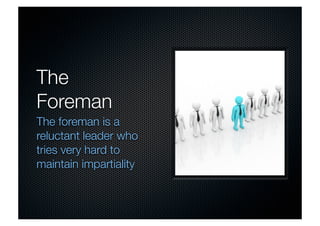
The 
Foreman 
The foreman is a 
reluctant leader who 
tries very hard to 
maintain impartiality
The foreman tries to make the dialogue within the jury 
room proceed in an orderly fashion, asking the jurors to 
‘go in order here’ and to ‘keep it peaceful’ 
He is challenged by both the 10th and the 12th juror, 
but tries to be fair to all jurors, even though he thinks 
the boy is ‘guilty’ 
He facilitates all enquiries by asking the guard to 
retrieve various pieces of evidence 
He changes his vote after the switchblade discussion in 
an ‘almost embarrassed’ manner
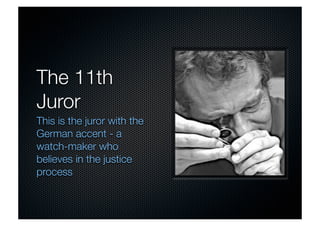
The 11th 
Juror 
This is the juror with the 
German accent - a 
watch-maker who 
believes in the justice 
process
In Act 1, the 11th juror has little to say, raising small points of 
evidence - such as the witness, the time and the knife 
Towards the end of this act (a short time after he tells us of his 
profession) he corrects the grammar of the 10th juror and 
begins to ask some serious questions about the case, saying 
‘I don’t believe I have to be loyal to one side or the other’, 
finally concluding he has ‘reasonable doubt’ 
He defends the 8th juror even when he believes the boy is 
guilty, upholding the principles of democracy
The 12th 
Juror 
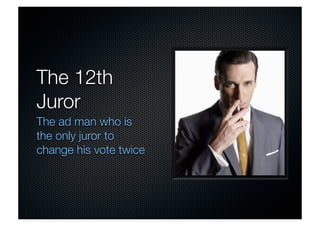
The ad man who is 
the only juror to 
change his vote twice
Like the 7th juror, the 12th is seemingly disengaged 
from the case at the beginning, doodling on his paper, 
although he claims it helps him ‘think more clearly’ 
He is the juror that asks them each to take a turn, but 
seems uncertain, ‘it’s just a quick thought’, ‘I...No! I 
don’t think so.’ 
He says, ‘This is a pretty complicated business’ and 
seems to epitomise the difficulty facing the 12 men
The 6th 
Juror 
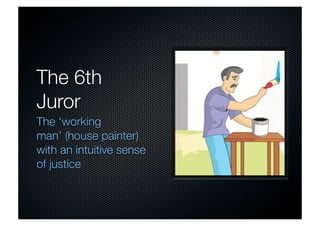
The ‘working 
man’ (house painter) 
with an intuitive sense 
of justice
Begins by thinking that the case is ‘pretty obvious. I 
mean, I was convinced from the first day’ 
Articulates the concern that the jurors release the boy 
and ‘the kid really did knife his father’, highlighting 
again the difficulty of the situation 
Raises the question of motive 
Has only two lines (apart from voting) in Act 2
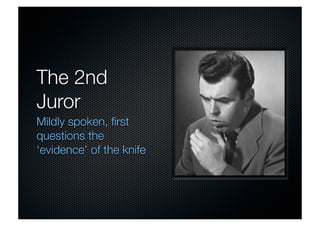
The 2nd 
Juror 
Mildly spoken, first 
questions the 
‘evidence’ of the knife
The 2nd juror has little specific to say about the case 
other than ‘I don’t know, it was pretty interesting’ 
He does not even defend his guilty response when the 
foreman goes around the table, saying, ‘It’s hard to put 
into words’ 
He offers cough drops all round, but in Act 2 when the 
10th juror asks for a cough drop responds, ‘They’re all 
gone, my friend’ 
Changes his vote in the beginning of Act 2
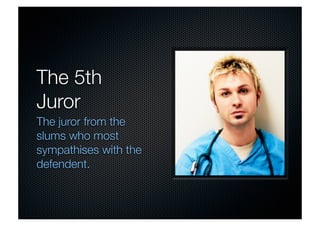
The 5th 
Juror 
The juror from the 
slums who most 
sympathises with the 
defendent.
Although we know from early on that the 5th juror has 
‘lived in a slum all [his] life’ and has nursed ‘that trash in 
Harlem Hospital’, he starts by thinking the boy is guilty. 
When asked to defend his position he says he will 
‘pass on it’ 
Is accused by the 3rd juror of changing his vote 
(because of the revelations of his background); later 
changes his vote in Act 1 
Gives crucial evidence about knife fighting
Introduction 
In Twelve Angry Men Reginald Rose has created a set 
of characters who...
Topic sentence 
Many of the characters... 
Some of the characters... 
Two of the characters... 
One character in particular, the ...th juror,....
In a body paragraph 
There are no names in Twelve Angry Men. Thus the 
characters come to symbolise...
No Names 
Words are used to label not who characters are but 
what they are perceived to be.
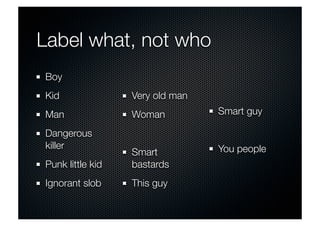
Label what, not who 
Boy 
Kid 
Man 
Dangerous 
killer 
Punk little kid 
Ignorant slob 
Very old man 
Woman 
Smart 
bastards 
This guy 
Smart guy 
You people
3rd Juror 
Now listen to me, you people. I’ve seen all kinds of 
dishonesty in my day - but this little display takes the 
cake. You come in here with your sanctimonious 
talk...you start getting through to some of these old 
ladies here. We’ll you’re not getting through to me. p. 
47
11th Juror 
This is not why we are here, to fight. We have a 
responsibility. This, I have always thought, is a 
remarkable thing about democracy. That we are 
notified by mail to come down to this place and 
decide...We have nothing to gain or lose by our verdict. 
p. 50
Character conflict 
The jury room is both a personal and impersonal 
space. On one hand, without names, that characters 
are...On the other hand, characters connect to and are 
confronted by the case and each other in highly 
personal ways. For example...
Themes 
In 12 Angry Men, justice can be fragile and tenuous 
because... 
Prejudice can exist inside every person, even those 
who... 
Innocence and justice are two different notions, 
because... 
Everyone can have an agenda when judging the justice 
that causes them to...
Setting 
The scarring of the table and the stark image of the 
knife still stuck in the middle of it at the end of the play 
reveal that... 
The heat, locked door, confined space and lack of 
cooling all emphasize...
Narrative 
As each point of evidence is debated, the 
preconceptions of the jurors is challenged. Some of 
these points of evidence symbolically represent the 
feelings of the jurors. For example, the scene in which 
the third juror acts out the stabbing of the 
boy...Moreover, the last evidence debated is that of the 
woman who claimed to witness the killing. The 
revelation that she wears glasses and may not have 
been able to see anything clearly at all, also 
represents...
Violence 
As the process of justice challenges the character’s 
personal values, the jury room becomes violently 
charged. Threatening others with violence becomes a 
way for jurors to protect...

Twelve Angry Men Updated

  • 1.
  • 2.
    Twelve Angry Menis not a play about finding a boy innocent of a crime he didn’t commit. Rather, it’s a vivid depiction/portrayal/representation of...
  • 3.
    Past essay questions ‘In reaching a verdict, the jurors reconsider both their understanding of the case and their understanding of themselves.’ Discuss. i. “It’s not easy for me to raise my hand and send a boy off to die without talking about it first.” ‘The 8th Juror is the only member of the jury who values the life of the boy who is on trial.’ Do you agree? ii.‘Twelve Angry Men highlights the importance of seeing things from more than one perspective.’ Discuss. iii.‘Twelve Angry Men is a play about how power can be misused.’ Discuss. iv.‘Twelve Angry Men is less about guilt or innocence than about reasonable doubt.’ Discuss. v.Why is it so difficult for the jury in Twelve Angry Men to reach its final verdict?
  • 4.
    Essay response task i.‘In reaching a verdict, the jurors reconsider both their understanding of the case and their understanding of themselves.’ Discuss. Write the numbers 1-12 Group them
  • 5.
    The 8th Juror Is the first character to vote ‘not guilty’ Does not necessarily believe that the boy is innocent, but believes that they ‘can’t decide in five minutes’ Is separated from the rest of the characters at the beginning by the stage directions which have him gazing out of the window and not responding to questions
  • 6.
    Of all thecharacters, we learn the least about the 8th jurors background, although there is the rather curious story about him wandering the neighbourhood of the murder and buying a switchblade similar to the murder weapon, which may suggest that he is familiar with the area He only ever asserts that he is trying to do what is ‘supposed to be happening in a jury room’, and even suggests that he will change his vote if all of the other jurors maintain their ‘guilty’ vote during the second count
  • 7.
    The 3rd Juror This is the juror we all love to hate. His argument rests upon his own prejudice and life experience
  • 8.
    The 3rd juroris a self-made man, who believes in rough justice He is the last juror to change his mind His relationship with his estranged son determines his prejudice and attitude to the case, although he is the first to declare ‘I have no personal feelings about this’ Unlike many of the other jurors, he uses definite words like ‘I know’, ‘You can’t refute facts’ and ‘You’re absolutely right’
  • 9.
    The 4th Juror This juror is in many ways the foil for the 8th juror - he is the logical side for the prosecution
  • 10.
    The 4th jurordescribes himself as a broker, and his arguments are punctuated by numbers, that lend him more logic and reason than the observations the other jurors offer He lacks the imagination to put himself in the position of the accused, distancing himself from the ‘filthy neighbourhood’ that is a ‘breeding ground for criminals’
  • 11.
    In many ways,the 4th juror is blinded by his own logic - he cannot imagine that his careful ordering of the world is wrong When the 8th juror demonstrates that he doesn’t know all the pertinent details about the films he has recently seen, it doesn’t change his mind Only by comparing himself to the spectacle-wearing witness, does the 4th juror finally (2nd to last) change his vote
  • 12.
    The 10th Juror This juror is one of the loudest opponents of the innocence of the boy
  • 13.
    The 10th juroris loudest in his opposition to ‘those’ people Unlike many of the other jurors he is not interested in seeing justice done - he thinks the boy is guilty, but when opinion swings the other way, tries to convince the 4th and 3rd jurors to ‘just quit’ because he doesn’t want to ‘break [his] brains over scum like that’ He is prejudiced against the boy he describes as a ‘common ignorant slob’ but derides the logic and intelligence of others - ‘everyone’s a lawyer’
  • 14.
    The 7th Juror A baseball fan, this juror tries to expedite the whole process so that he can watch a game
  • 15.
    The 7th jurorrepresents Rose’s understanding that not all citizens will give justice its due consideration He tries to play cards, noughts and crosses (tic, tac, toe) Finally votes not guilty because ‘all this yakkin’s getting us nowhere’
  • 16.
    The 9th Juror This is the ageing juror and he brings insights into some of the witnesses
  • 17.
    The 9th juroris first introduced as the juror in the lavatory, the Foreman has to ask him to hurry up, which gives us an insight into others’ perception of ageing This juror most strongly identifies with the witness who ‘saw’ the boy fleeing the scene He is the first juror to change his vote, recognising the importance of the boy’s life and the relative unimportance of spending more time in the jury room - ‘it’s only one night. A boy may die’ He is disgusted by the 10th juror
  • 18.
    The Foreman Theforeman is a reluctant leader who tries very hard to maintain impartiality
  • 19.
    The foreman triesto make the dialogue within the jury room proceed in an orderly fashion, asking the jurors to ‘go in order here’ and to ‘keep it peaceful’ He is challenged by both the 10th and the 12th juror, but tries to be fair to all jurors, even though he thinks the boy is ‘guilty’ He facilitates all enquiries by asking the guard to retrieve various pieces of evidence He changes his vote after the switchblade discussion in an ‘almost embarrassed’ manner
  • 20.
    The 11th Juror This is the juror with the German accent - a watch-maker who believes in the justice process
  • 21.
    In Act 1,the 11th juror has little to say, raising small points of evidence - such as the witness, the time and the knife Towards the end of this act (a short time after he tells us of his profession) he corrects the grammar of the 10th juror and begins to ask some serious questions about the case, saying ‘I don’t believe I have to be loyal to one side or the other’, finally concluding he has ‘reasonable doubt’ He defends the 8th juror even when he believes the boy is guilty, upholding the principles of democracy
  • 22.
    The 12th Juror The ad man who is the only juror to change his vote twice
  • 23.
    Like the 7thjuror, the 12th is seemingly disengaged from the case at the beginning, doodling on his paper, although he claims it helps him ‘think more clearly’ He is the juror that asks them each to take a turn, but seems uncertain, ‘it’s just a quick thought’, ‘I...No! I don’t think so.’ He says, ‘This is a pretty complicated business’ and seems to epitomise the difficulty facing the 12 men
  • 24.
    The 6th Juror The ‘working man’ (house painter) with an intuitive sense of justice
  • 25.
    Begins by thinkingthat the case is ‘pretty obvious. I mean, I was convinced from the first day’ Articulates the concern that the jurors release the boy and ‘the kid really did knife his father’, highlighting again the difficulty of the situation Raises the question of motive Has only two lines (apart from voting) in Act 2
  • 26.
    The 2nd Juror Mildly spoken, first questions the ‘evidence’ of the knife
  • 27.
    The 2nd jurorhas little specific to say about the case other than ‘I don’t know, it was pretty interesting’ He does not even defend his guilty response when the foreman goes around the table, saying, ‘It’s hard to put into words’ He offers cough drops all round, but in Act 2 when the 10th juror asks for a cough drop responds, ‘They’re all gone, my friend’ Changes his vote in the beginning of Act 2
  • 28.
    The 5th Juror The juror from the slums who most sympathises with the defendent.
  • 29.
    Although we knowfrom early on that the 5th juror has ‘lived in a slum all [his] life’ and has nursed ‘that trash in Harlem Hospital’, he starts by thinking the boy is guilty. When asked to defend his position he says he will ‘pass on it’ Is accused by the 3rd juror of changing his vote (because of the revelations of his background); later changes his vote in Act 1 Gives crucial evidence about knife fighting
  • 30.
    Introduction In TwelveAngry Men Reginald Rose has created a set of characters who...
  • 31.
    Topic sentence Manyof the characters... Some of the characters... Two of the characters... One character in particular, the ...th juror,....
  • 32.
    In a bodyparagraph There are no names in Twelve Angry Men. Thus the characters come to symbolise...
  • 33.
    No Names Wordsare used to label not who characters are but what they are perceived to be.
  • 34.
    Label what, notwho Boy Kid Man Dangerous killer Punk little kid Ignorant slob Very old man Woman Smart bastards This guy Smart guy You people
  • 35.
    3rd Juror Nowlisten to me, you people. I’ve seen all kinds of dishonesty in my day - but this little display takes the cake. You come in here with your sanctimonious talk...you start getting through to some of these old ladies here. We’ll you’re not getting through to me. p. 47
  • 36.
    11th Juror Thisis not why we are here, to fight. We have a responsibility. This, I have always thought, is a remarkable thing about democracy. That we are notified by mail to come down to this place and decide...We have nothing to gain or lose by our verdict. p. 50
  • 37.
    Character conflict Thejury room is both a personal and impersonal space. On one hand, without names, that characters are...On the other hand, characters connect to and are confronted by the case and each other in highly personal ways. For example...
  • 38.
    Themes In 12Angry Men, justice can be fragile and tenuous because... Prejudice can exist inside every person, even those who... Innocence and justice are two different notions, because... Everyone can have an agenda when judging the justice that causes them to...
  • 39.
    Setting The scarringof the table and the stark image of the knife still stuck in the middle of it at the end of the play reveal that... The heat, locked door, confined space and lack of cooling all emphasize...
  • 40.
    Narrative As eachpoint of evidence is debated, the preconceptions of the jurors is challenged. Some of these points of evidence symbolically represent the feelings of the jurors. For example, the scene in which the third juror acts out the stabbing of the boy...Moreover, the last evidence debated is that of the woman who claimed to witness the killing. The revelation that she wears glasses and may not have been able to see anything clearly at all, also represents...
  • 41.
    Violence As theprocess of justice challenges the character’s personal values, the jury room becomes violently charged. Threatening others with violence becomes a way for jurors to protect...