Mary Oliver Poetry
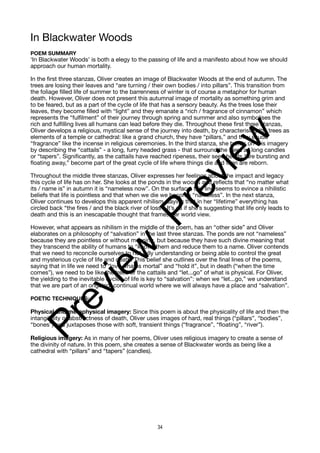
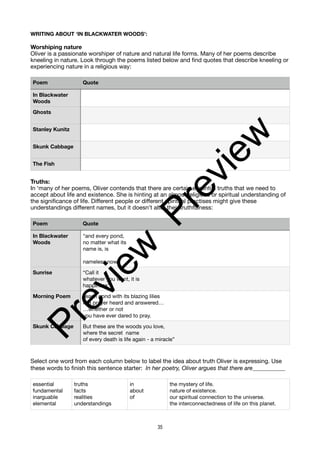
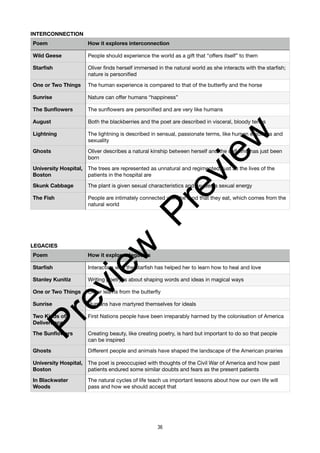
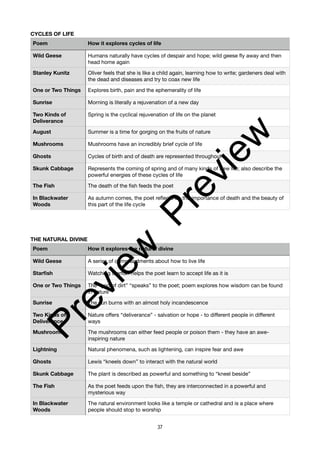
The
Student Activity Book
P
r
e
v
i
e
w
P
r
e
v
i
e
w
© This work is copyright 2024. Apart from any use permitted under the Copyright Act 1968, no part may be reproduced by any
process, nor may any other exclusive right be exercised, without the permission of Ticking Mind, 21 Miller St, Thornbury, 3071.
P
r
e
v
i
e
w
P
r
e
v
i
e
w
Table of Contents
Key ideas in Oliver’s poetry....................................................................................2
Wild Geese.............................................................................................................4
Starfish...................................................................................................................6
Stanley Kunitz........................................................................................................8
One or Two Things................................................................................................10
Sunrise..................................................................................................................12
Two Kinds of Deliverance......................................................................................14
The Sunflowers......................................................................................................16
August...................................................................................................................18
Mushrooms...........................................................................................................20
Lightning................................................................................................................22
Ghosts...................................................................................................................24
University Hospital, Boston....................................................................................26
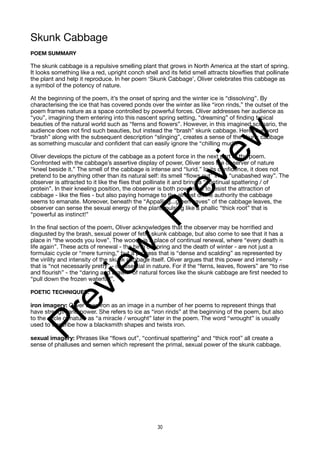
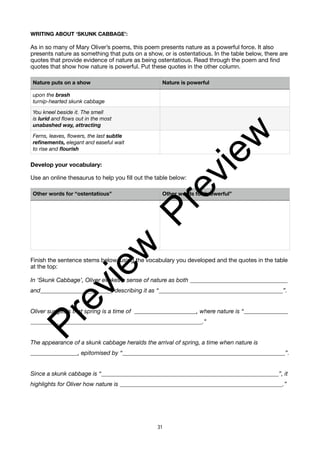
Skunk Cabbage.....................................................................................................28
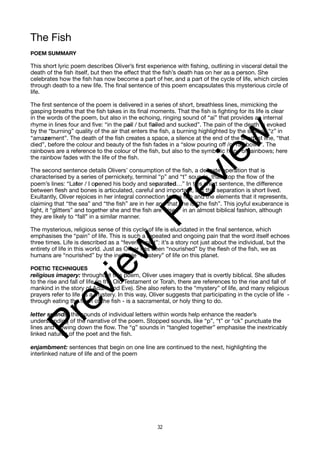
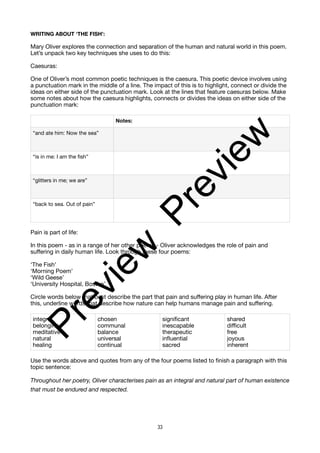
The Fish..................................................................................................................30
In Blackwater Woods..............................................................................................32
The poems grouped by key ideas..........................................................................34
Writing about interconnection................................................................................36
Writing about the natural divine..............................................................................38
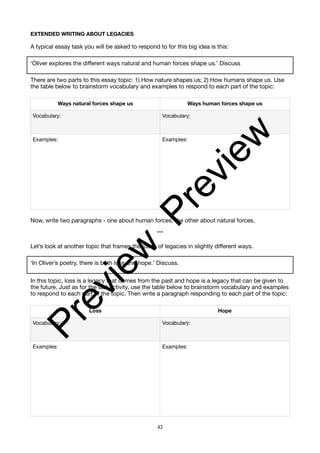
Writing about legacies............................................................................................40
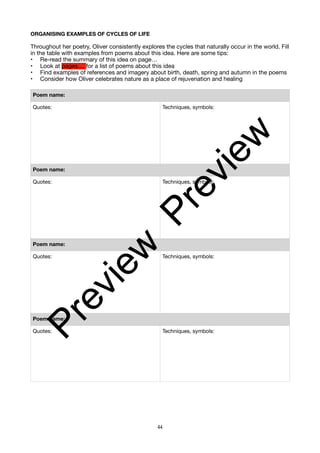
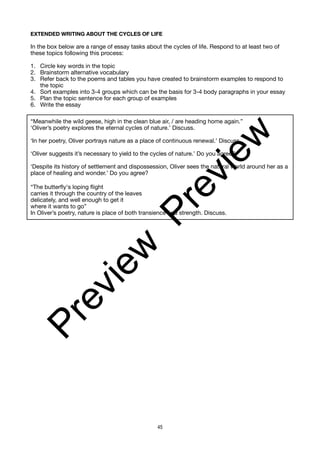
Writing about the cycles of life...............................................................................42
P
r
e
v
i
e
w
P
r
e
v
i
e
w
Key ideas in Oliver’s poems
Oliver’s poems show her preoccupation with central ideas or themes that she returns to again and
again. While some of her poems focus more upon one of these ideas than another, there is a great
deal of overlap. What this means is that you will see these ideas explored in some form in almost
all of the poems that you study.
INTERCONNECTION
Oliver shows us how humans are intrinsically linked to the natural world, how we are a part of the
ecosystem of life, but also how we separate ourselves and create divisions. Most of her poetry is
an exhortation for humans to tune in to the natural world, learn from it and find peace and joy by
giving in to this connection. She writes about the primal nature and emotions of human
experience, and how pain, suffering and joy are feelings that should be embraced and accepted.
In her poetry, pain is not necessarily a negative experience, but is a fundamental part of living life
and accepting its fullness. Oliver also writes about how the natural world can be a reflection of
human experience. She personifies natural elements, giving them human qualities to demonstrate
how humans are inextricably linked to the world that they live in.
LEGACIES
Throughout her work, Oliver explores what both people and the natural world can teach us and
how they can leave us with a legacy that represents their lives. In other words, she is interested in
the marks that people and nature leave upon the world and on the ways that the world is changed
by those who inhabit it. Some of these legacies can be problematic - like the legacies of European
settlers on First Nations Americans and on the landscape that they have settled. But there is
another, greater type of legacy - that of creativity. In her poems, Oliver represents nature as an
endless and abundant creative force. She also believes that people can access this creativity in
their own lives and that pioneers, poets and others have been inspired by the natural world to
create new ideas (and poems) and leave the world a more beautiful place. In this way, creativity is
an incredibly important legacy.
interconnection primal emotional
mirror
mimic
intrinsic
inextricable
fundamental
share
basic
elemental
primitive
ancient
ardent
ecstatic
passionate
impetuous
responsive
joyous
leaving a legacy the ephemerality of life
heritage
footprint
aftermath
consequence
history
the past
fleeting
transitory
transient
impermanence
brevity
loss
grief
2
P
r
e
v
i
e
w
P
r
e
v
i
e
w
CYCLICAL NATURE OF LIFE
Any poetry that is concerned with nature inevitably represents the cyclical nature of life, birth and
death. Oliver’s poems are fundamentally interested in this cycle and also in the interconnected
nature of the life cycle. What this means is that she writes about the way certain deaths are
necessary for life: animals (including human animals) eat other animals; dead bodies nourish the
earth and the plants that grow upon it. Her poems also represent the cycles of time: of seasons
days and the endless, repetitive and rejuvenating cycles that punctuate our lives on this planet. By
writing about these patterns, she embodies an acceptance of the highs and lows of life, that there
are naturally times of rejuvenation (such as spring and morning) and that there are natural declines
(such as winter, nighttime). Each of these is necessary to sustain life and each must be
appreciated, accepted and learned from.
THE NATURAL DIVINE
Although sceptical of traditional religion and religious practices, Oliver continually expresses a
sense of wonder and awe in the natural world. Her poems evoke a sense of the divinity of life and
of the biosphere of earth, finding the endless cycles of renewed life a hopeful and wondrous
experience. By observing and respecting the natural world, Oliver suggests that humans can learn
about themselves and their life experience. In this manner, she suggests that nature has much to
teach us about having more fulfilled and happier lives, learning to accept pain and suffering as an
integral part of life. However, in many of her poems she explicitly refers to kneeling in the
presence of some fabulous part of nature, and exhorts her readers to worship in the natural world.
This doesn’t mean that the natural world provides only positive experiences: like all divinities,
nature has both benevolent and dangerous qualities. Like a god it can bestow life and take it
away. It is therefore a force to be treated with awe and respect.
cycles death rejuvenation
diurnal phases
seasons
rhythms
rises and falls
end
night
decline
decay
degeneration
dissolution
birth
renewal
revival
reawakening
revitalisation
restoration
worship benevolent dangerous learn teach
awe
adore
exalt
respect
reverence
benign
generous
beneficent
bountiful
deadly
fatal
precarious
perilous
threatening
recognise
accept
realise
understand
absorb
show
illustrate
provide guidance
model
enlighten
3
P
r
e
v
i
e
w
P
r
e
v
i
e
w
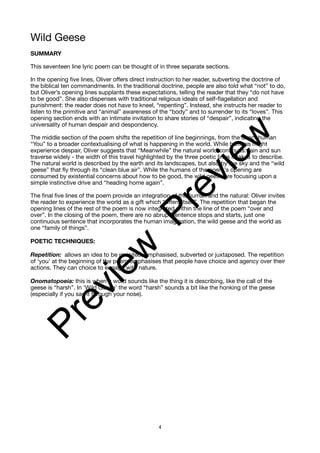
Wild Geese
SUMMARY
This seventeen line lyric poem can be thought of in three separate sections.
In the opening five lines, Oliver offers direct instruction to her reader, subverting the doctrine of
the biblical ten commandments. In the traditional doctrine, people are also told what “not” to do,
but Oliver’s opening lines supplants these expectations, telling the reader that they “do not have
to be good”. She also dispenses with traditional religious ideals of self-flagellation and
punishment: the reader does not have to kneel, “repenting”. Instead, she instructs her reader to
listen to the primitive and “animal” awareness of the “body” and to surrender to its “loves”. This
opening section ends with an intimate invitation to share stories of “despair”, indicating the
universality of human despair and despondency.
The middle section of the poem shifts the repetition of line beginnings, from the direct human
“You” to a broader contextualising of what is happening in the world. While humans might
experience despair, Oliver suggests that “Meanwhile” the natural world continues: rain and sun
traverse widely - the width of this travel highlighted by the three poetic lines it takes to describe.
The natural world is described by the earth and its landscapes, but also by the sky and the “wild
geese” that fly through its “clean blue air”. While the humans of the poem's opening are
consumed by existential concerns about how to be good, the wild geese are focusing upon a
simple instinctive drive and “heading home again”.
The final five lines of the poem provide an integration of the human and the natural: Oliver invites
the reader to experience the world as a gift which “offers itself”. The repetition that began the
opening lines of the rest of the poem is now integrated within the line of the poem “over and
over”. In the closing of the poem, there are no abrupt sentence stops and starts, just one
continuous sentence that incorporates the human imagination, the wild geese and the world as
one “family of things”.
POETIC TECHNIQUES:
Repetition: allows an idea to be revisited, emphasised, subverted or juxtaposed. The repetition
of ‘you’ at the beginning of the poem emphasises that people have choice and agency over their
actions. They can choice to engage with nature.
Onomatopoeia: this is when a word sounds like the thing it is describing, like the call of the
geese is “harsh”. In ‘Wild Geese’ the word “harsh” sounds a bit like the honking of the geese
(especially if you say it through your nose).
4
P
r
e
v
i
e
w
P
r
e
v
i
e
w
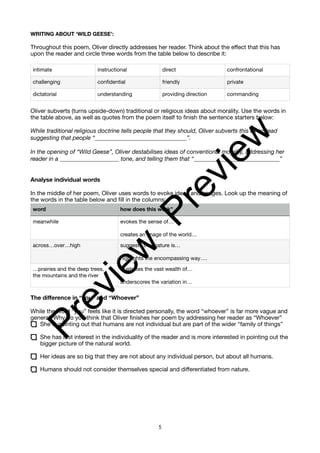
WRITING ABOUT ‘WILD GEESE’:
Throughout this poem, Oliver directly addresses her reader. Think about the effect that this has
upon the reader and circle three words from the table below to describe it:
Oliver subverts (turns upside-down) traditional or religious ideas about morality. Use the words in
the table above, as well as quotes from the poem itself to finish the sentence starters below:
While traditional religious doctrine tells people that they should, Oliver subverts this by instead
suggesting that people “_______________________________”.
In the opening of “Wild Geese”, Oliver destabilises ideas of conventional morality, addressing her
reader in a ____________________ tone, and telling them that “_____________________________”
Analyse individual words
In the middle of her poem, Oliver uses words to evoke ideas and images. Look up the meaning of
the words in the table below and fill in the columns:
The difference in “you” and “Whoever”
While the word “you” feels like it is directed personally, the word “whoever” is far more vague and
general. Why do you think that Oliver finishes her poem by addressing her reader as “Whoever”
She is pointing out that humans are not individual but are part of the wider “family of things”
She has lost interest in the individuality of the reader and is more interested in pointing out the
bigger picture of the natural world.
Her ideas are so big that they are not about any individual person, but about all humans.
Humans should not consider themselves special and differentiated from nature.
intimate instructional direct confrontational
challenging confidential friendly private
dictatorial understanding providing direction commanding
word how does this work”
meanwhile evokes the sense of…
creates an image of the world…
across…over…high suggests that nature is…
highlights the encompassing way….
…prairies and the deep trees,
the mountains and the river
illustrates the vast wealth of…
underscores the variation in…
5
P
r
e
v
i
e
w
P
r
e
v
i
e
w
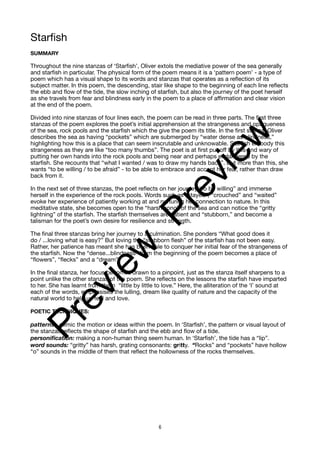
Starfish
SUMMARY
Throughout the nine stanzas of ‘Starfish’, Oliver extols the mediative power of the sea generally
and starfish in particular. The physical form of the poem means it is a ‘pattern poem’ - a type of
poem which has a visual shape to its words and stanzas that operates as a reflection of its
subject matter. In this poem, the descending, stair like shape to the beginning of each line reflects
the ebb and flow of the tide, the slow inching of starfish, but also the journey of the poet herself
as she travels from fear and blindness early in the poem to a place of affirmation and clear vision
at the end of the poem.
Divided into nine stanzas of four lines each, the poem can be read in three parts. The first three
stanzas of the poem explores the poet’s initial apprehension at the strangeness and opaqueness
of the sea, rock pools and the starfish which the give the poem its title. In the first stanza, Oliver
describes the sea as having “pockets” which are submerged by “water dense as blindness,”
highlighting how this is a place that can seem inscrutable and unknowable. Starfish embody this
strangeness as they are like “too many thumbs”. The poet is at first put off by this and wary of
putting her own hands into the rock pools and being near and perhaps endangered by the
starfish. She recounts that “what I wanted / was to draw my hands back”. But more than this, she
wants “to be willing / to be afraid” - to be able to embrace and accept her fear, rather than draw
back from it.
In the next set of three stanzas, the poet reflects on her journey “to be willing” and immerse
herself in the experience of the rock pools. Words such as “stayed”, “crouched” and “waited”
evoke her experience of patiently working at and nurturing her connection to nature. In this
meditative state, she becomes open to the “harsh song” of the sea and can notice the “gritty
lightning” of the starfish. The starfish themselves are patient and “stubborn,” and become a
talisman for the poet’s own desire for resilience and strength.
The final three stanzas bring her journey to a culmination. She ponders “What good does it
do / ...loving what is easy?” But loving the “stubborn flesh” of the starfish has not been easy.
Rather, her patience has meant she has been able to conquer her initial fear of the strangeness of
the starfish. Now the “dense...blindness” from the beginning of the poem becomes a place of
“flowers”, “flecks” and a “dream”.
In the final stanza, her focus becomes drawn to a pinpoint, just as the stanza itself sharpens to a
point unlike the other stanzas of the poem. She reflects on the lessons the starfish have imparted
to her. She has learnt from them “little by little to love.” Here, the alliteration of the ‘l’ sound at
each of the words, emphasises the lulling, dream like quality of nature and the capacity of the
natural world to help us feel and love.
POETIC TECHNIQUES:
patterns: mimic the motion or ideas within the poem. In ‘Starfish’, the pattern or visual layout of
the stanzas reflects the shape of starfish and the ebb and flow of a tide.
personification: making a non-human thing seem human. In ‘Starfish’, the tide has a “lip”.
word sounds: “gritty” has harsh, grating consonants: gritty. “Rocks” and “pockets” have hollow
“o” sounds in the middle of them that reflect the hollowness of the rocks themselves.
6
P
r
e
v
i
e
w
P
r
e
v
i
e
w
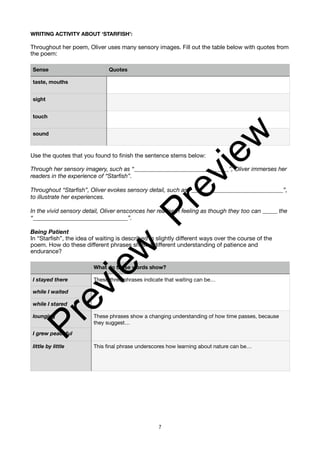
WRITING ACTIVITY ABOUT ‘STARFISH’:
Throughout her poem, Oliver uses many sensory images. Fill out the table below with quotes from
the poem:
Use the quotes that you found to finish the sentence stems below:
Through her sensory imagery, such as “________________________________”, Oliver immerses her
readers in the experience of “Starfish”.
Throughout “Starfish”, Oliver evokes sensory detail, such as “_______________________________”,
to illustrate her experiences.
In the vivid sensory detail, Oliver ensconces her reader in feeling as though they too can _____ the
“________________________________”.
Being Patient
In “Starfish”, the idea of waiting is described in slightly different ways over the course of the
poem. How do these different phrases show a different understanding of patience and
endurance?
Sense Quotes
taste, mouths
sight
touch
sound
What do these words show?
I stayed there These three phrases indicate that waiting can be…
while I waited
while I stared
lounging These phrases show a changing understanding of how time passes, because
they suggest…
I grew peaceful
little by little This final phrase underscores how learning about nature can be…
7
P
r
e
v
i
e
w
P
r
e
v
i
e
w
Stanley Kunitz
SUMMARY
‘Stanley Kunitz’ is a paean to American poet Stanley Kunitz, who influenced and shaped the way
Oliver wrote and thought about poetry. In this poem, the act of creating and tending to a garden is
a metaphor for the process of creating poetry.
In the first stanza, Oliver recounts how she once viewed crafting poetry as something akin to
sorcery where poems are summoned magically from thin are. When she held this view, Oliver saw
Kunitz as a wizard like “Merlin,” who with “important gestures” would wave a wand and make
“everything” in the garden grow “thickly”. Here, the idyllic descriptions of birds that “sing” and
snakes that “like / on boughs” is in fact an allusion to the impressive and rich poems Oliver
believed Kunitz to have created as if by magic. In this vision of things, the magic of Kunitz is
manifested in the dynamic forcefulness of his poetry with their “exploding.../ pages of thunder.”
The second stanza demonstrates Oliver’s realisation as a mature poet that poetry is not an act of
magic but something that requires work and effort. She “now” knows that writing poetry is like the
“great wheel of growth” in a garden. Just as there is “decay, and rebirth” amongst plants, so too
does the writing of poetry require creation and deconstruction. In a garden, “diseased” and
“superflous” plants need to be cut and new plants need “coaxing”. Similarly, in the act of writing
ideas that aren’t working need to be discarded and new ideas developed. This work is difficult
and arduous. Oliver now sees that in creating his poetry, Kunitz wasn’t the “strolling” Merlin of the
first stanza, but in fact someone who worked hard “on his knees” with “patience”. In this new
understanding, Oliver characterises the creation of poetry as like a “labor...on the mortal wheel”: a
process that is difficult and cyclical.
Throughout the last stanza, Oliver reflects on how her mature understanding of poetry has given
her joy in experiencing something that is not “magic” but intensely human and passionate. She
proclaims “what good it does the heart” to have an insight into the truth about how poetry is
created. With this knowledge, she is now like a “human child” trying to copy the way Kunitz
shaped his poetry with “raking and trimming.” Her final description of Kunitz imagines him not as
a sorcerer, but a type of blacksmith or engineer of words “stirring up / those sheets of fire”. Here,
the phrase “sheets of fire” is a vivid image of the blazing sheets of poetry that Oliver hopes to
create and forge like Kunitz from words and feelings that are “wild and shapeless”.
POETIC DEVICES
Mythical imagery: reference to Merlin
Sounds: ‘p’ sound in “pages”, “happened” evoke a sense of words and ideas popping or firing
magically on a page; the‘g’ sounds of “great wheel of growth” evoke an organic feeling
8
P
r
e
v
i
e
w
P
r
e
v
i
e
w
WRITING ACTIVITIES ABOUT ‘STANLEY KUNITZ’:
The poet as magician
In the first stanza, Oliver describes Kunitz as a wizard, like Merlin, or Gandalf (or Harry Potter),
wandering through his awesome poetry garden, making everything happen with “important
gestures”. She highlights the magical sounds of these gestures with a series of plosive “p”
sounds:
where petals float upward,
their colours exploding,
and trees open their moist
pages of thunder
it has happened every summer for years.
Write about the magical effect of these p sounds, using the vocabulary table and sentence
starters below:
In a series of plosive “p” sounds, that echo ________________________________________, Oliver
underscores the ____________________________ nature of Kunitz’s writing.
The repeated “p” sounds in the first stanza underscore the __________________________ nature of
Kunitz’s writing, mimicking the noise of _________________________________________________.
Epitomising the____________________________ nature of Kunitz’s poems, Oliver scatters her first
stanza with a series of “p” sounds that __________________________________________________.
The wheel of life
The second stanza of the poem evokes the idea of cycles of life, of “growth,/ and decay, and
rebirth”.
How does writing “grow”?
Writing is a process of growth because____________________________________________________.
What should writers do when writing shows signs of “decay”?
When writing “decay[s]”, good writers “_________________________” and “___________________”,
because ______________________________________________________________________________.
How does writing undergo “rebirth”?
Writing is reborn when __________________________________________________________________.
seemingly mystical phenomenal effortlessly magical apparently enchanted
9
P
r
e
v
i
e
w
P
r
e
v
i
e
w
One or Two Things
POEM SUMMARY
This lyric poem has seven vignettes, or word pictures, each encapsulating a small image of life.
Throughout the poem, Oliver emphasises the need for both enjoying the sensory pleasures of the
moment, and also a need for the imagination: for time spent in solitude and thought.
1.
This, the smallest vignette is a mere three lines. The opening line is the longest and is a request
for isolation, for withdrawing into the self. In the other four syllables that comprise this opening, it
is clear that the poet is adopting the voice of one who has “just/ been born.”. Whether this is an
actual birth, or a metaphorical, spiritual birth is not clear. What is clear is the need for solitude, for
time to consider.
2.
This vignette lifts the reader’s attention above the uncertain, terse voice of the recently birthed, to
an image of a butterfly coasting through the air, its drifting flight is echoed by the variable line
lengths and the lilting “l” sounds that repeat throughout. Within the lines are caesura breaks, the
commas representing the unpredictability of the butterfly’s flight, an uncertainty that culminates in
the missed line. This extended space encapsulates the poet’s idea of “long delicious moments” of
stillness in the flight of a butterfly as it floats. This vignette is about the sensory pleasures of living
in the moment.
3.
The third vignette returns the readers attention to the earth, quite literally to the “god of dirt”. Like
many of Oliver’s poems, she represents nature as having a sense of divine beneficence. Here, the
earth god “speaks” to the poet, in the voices of animals: a “dog”, a “crow”, a “frog”. The poet is
showing how these ordinary, familiar animals are capable of showing a divine wisdom. Again,
there is a missed line, this time representing a silence between the voices of the animals and the
idea that this wisdom can sometimes be heard in the moment, in the “now” but then never
experienced again.
4.
This short vignette brings us back to the voice of the poet and the discomfort of the human
experience, which is both in the moment, and preoccupied with memories that are painful and
cutting, “like a sharp iron hoof”. It is as though the poet feels memories and past experiences as
painfully present. These memories are both of the animalistic (the “hoof”) and of unnatural, human
creation (as represented by the “iron”). Here, the poet is emphasising the difficult and painful
nature of thinking and of the imagination, which is in stark contrast to the pleasures of living in the
moment.
5.
This short stanza briefly encapsulates the entire experience of life: the one or two things that life
needs is the “memory of pleasure” and “some cutting / knowledge of pain”. Life is about
embracing both of these if a being is to have the full range of experience.
6.
The brevity of this vignette echoes the opening of the poem and of the recently birthed creature.
However, here movement is required, bringing a sense of urgency and demand that is symbolised
by the word “need”. This stanza suggests that perhaps the poet is imagining herself as a recently
born foal, who needs to lift it “hoof” in order to walk. However, as we have learned from stanza
four, the hoof is a sharp and heavy idea, representing pain and effort. In order to proceed through
life, one must expect pain but also have imagination: “an idea”.
7.
Finally, the poet returns to her own struggle with existence, the difficulty of loving her her life. The
struggle of her existence is contrasted with the effortless flight of the butterfly, a symbol of
ephemerality that is “weightless”, totally unlike a create with iron hooves. But it is so weightless
and transient that, in a moment, it has “vanished”, just like life.
10
P
r
e
v
i
e
w
P
r
e
v
i
e
w
WRITING ABOUT ‘ONE OR TWO THINGS’:
The butterfly - a beautiful insect that emerges from a cocoon and lives only briefly - is an image
used by Oliver to symbolise the cyclical, transitory and ephemeral nature of the natural and
human world. In ‘One or two things’, the butterfly is an emblem of how we should live in the
moment, floating along on the winds of life, rather than worrying about what might come next.
The symbol of the butterfly:
Look at the table below, what feelings or ideas do you associate with a butterfly:
Writing practise:
Now, practise writing about the symbol of the butterfly by putting the words, phrases and quotes
in the table below into sentences. Follow these steps to create your sentences:
1. You must combine the words in the grid below into sentences
2. You must use the words in each cell at least once
3. You must combine two or more cells in a row, column or diagonal to write a sentence
4. You can use the words in any order - except the words in bold which must go at the start of a
sentence
5. You can add your own, extra words to create a sentence that make sense
6. Every time you write a sentence, cross out the cell you have used. You can use these words
again in different combinations, but crossing out the ones you’ve already used will allow you
to keep track of which words remain
work
transience
dedication
death
beauty
rebirth
suffering
harmony
eternity
freedom
single mindedness
endurance
grace
brief
passion
hope
Through the
description of...
“loping flight” evokes the natural
world’s
The words...
instinct suggests the way humans
can
an unburdened
life
create a picture
of
the possibility of emphemerality of
life
“it swings,
frenzied and
aimless”
recognising that
life is transitory
and
the capacity of
nature to
the fleeting
nature of the
butterfly
“for long
delicious
moments it is
perfectly /
lazy”
of liberating
ourselves from
represent’s her
belief that
the transitory
butterly
In ‘One or two
things’,
free of yielding to “weightless, in
the wind”
Oliver’s image
of...
11
P
r
e
v
i
e
w
P
r
e
v
i
e
w
Sunrise
POEM SUMMARY
In this poem, Oliver explores the rejuvenating and revitalising effect of a new day; delighting in the
shared experience that all humans have of a sunrise. She compares this unified experience to the
divisive ideas and ideologies of humans, which may seem brilliant, but often lead to people dying
or suffering for their principles. Each line of the poem is short and so its message creeps in
gradually and incrementally, like the rising of the sun it describes.
In the first three stanzas, Oliver describes the process of humans martyring themselves (dying for
their religious or political beliefs) throughout history. The first sentence literally spells this out in
stark detail: “You can /die for it”. She goes on to contrast the tiny and ephemeral nature of a
human life - “small bodies” - with the intangible brilliance of the ideas they have died for -“an
unforgettable / fury of light”. The sense that people have been martyred is evoked by the phrase
“bound / to the stake”. A stake is a symbol of witches, political dissidents or people of different
religious beliefs being burned or executed for their ideas.
At the end of the third stanza, Oliver presents a different way of thinking, using the single word
“But” to link to the next few stanzas. The fourth stanza describes the poet “climbing the familiar
hills”, much like the sun rises in the sky, in a familiar and recognisable way. The cyclical and
repeated nature of the sun’s passage is evoked by the repetition of the word “familiar”. She
moves from the personal and individual, to a brief mention of some of the world’s most populous
places to unite herself and all of humanity in a shared experience of the sunrise, describing how
the sun “blazes / for everyone”. Rather than the burning, destructiveness of human ideals, here
we are presented with the inclusiveness of the sun “joyfully” burning.
In the seventh stanza, the poet dissolves her sense of self, looking from the very immediate and
personal view of her “lashes” to the greater view that sees her as one of “so many!” different
humans. Here, towards the end of the poem, she struggles to name this universality of
experience, asking “What is my name?” and then “What is the name?”, shifting from the personal
to the global. Once again, she repeats phrases and words, invoking the cyclical nature of the
sunrise, which repeats itself every dawn. She also describes the most basic shared cyclical
movement of humanity, the “deep breath” that people take “over and over”.
The conclusion of her poem is that sunrise and nature can offer the “fire” of “happiness”,
something that is far more brilliant and incandescent than the human ideals that people might
burn for.
POETIC TECHNIQUES:
repetition: repeating words and phrases such as “familiar”, can create a sense of the cyclical
nature of things, because cycles repeat themselves; however, repetition can also force the reader
to re-examine words and phrases and note small differences, such as the difference between
What is my name?
AND
What is the name?
In this case, the repetition allows the reader to see a phrase anew and think more deeply about it,
just like contemplating a new day allows you to see new possibilities.
words at the end of the line: placing words at the end of a line of poetry gives them extra
emphasis. Throughout this poem, Oliver places words such as “bound”, “stake” and “lashes” at
the end of lines, creating a sense of punishment (since the word “lashes” could also mean whip-
lashes, rather than eye-lashes); these words highlight the ways humans create suffering for each
other with their ideas.
12
P
r
e
v
i
e
w
P
r
e
v
i
e
w
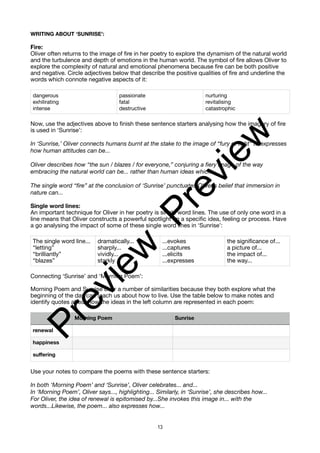
WRITING ABOUT ‘SUNRISE’:
Fire:
Oliver often returns to the image of fire in her poetry to explore the dynamism of the natural world
and the turbulence and depth of emotions in the human world. The symbol of fire allows Oliver to
explore the complexity of natural and emotional phenomena because fire can be both positive
and negative. Circle adjectives below that describe the positive qualities of fire and underline the
words which connote negative aspects of it:
Now, use the adjectives above to finish these sentence starters analysing how the imagery of fire
is used in ‘Sunrise’:
In ‘Sunrise,’ Oliver connects humans burnt at the stake to the image of “fury of light” to expresses
how human attitudes can be...
Oliver describes how “the sun / blazes / for everyone,” conjuring a fiery image of the way
embracing the natural world can be... rather than human ideas which...
The single word “fire” at the conclusion of ‘Sunrise’ punctuates Oliver’s belief that immersion in
nature can...
Single word lines:
An important technique for Oliver in her poetry is single word lines. The use of only one word in a
line means that Oliver constructs a powerful spotlight on a specific idea, feeling or process. Have
a go analysing the impact of some of these single word lines in ‘Sunrise’:
Connecting ‘Sunrise’ and ‘Morning Poem’:
Morning Poem and Sunrise bear a number of similarities because they both explore what the
beginning of the day can teach us about how to live. Use the table below to make notes and
identify quotes about how the ideas in the left column are represented in each poem:
Use your notes to compare the poems with these sentence starters:
In both ‘Morning Poem’ and ‘Sunrise’, Oliver celebrates... and...
In ‘Morning Poem’, Oliver says..., highlighting... Similarly, in ‘Sunrise’, she describes how...
For Oliver, the idea of renewal is epitomised by...She invokes this image in... with the
words...Likewise, the poem... also expresses how...
dangerous
exhilirating
intense
passionate
fatal
destructive
nurturing
revitalising
catastrophic
The single word line...
“letting”
“brilliantly”
“blazes”
dramatically...
sharply...
vividly...
starkly
...evokes
...captures
...elicits
...expresses
the significance of...
a picture of...
the impact of...
the way...
Morning Poem Sunrise
renewal
happiness
suffering
13
P
r
e
v
i
e
w
P
r
e
v
i
e
w
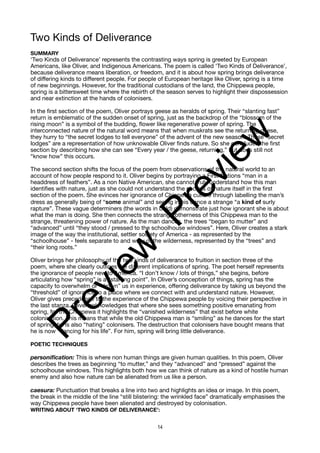
Two Kinds of Deliverance
SUMMARY
‘Two Kinds of Deliverance’ represents the contrasting ways spring is greeted by European
Americans, like Oliver, and Indigenous Americans. The poem is called ‘Two Kinds of Deliverance’,
because deliverance means liberation, or freedom, and it is about how spring brings deliverance
of differing kinds to different people. For people of European heritage like Oliver, spring is a time
of new beginnings. However, for the traditional custodians of the land, the Chippewa people,
spring is a bittersweet time where the rebirth of the season serves to highlight their dispossession
and near extinction at the hands of colonisers.
In the first section of the poem, Oliver portrays geese as heralds of spring. Their “slanting fast”
return is emblematic of the sudden onset of spring, just as the backdrop of the “blossom of the
rising moon” is a symbol of the budding, flower like regenerative power of spring. The
interconnected nature of the natural word means that when muskrats see the returning geese,
they hurry to “the secret lodges to tell everyone” of the advent of the new season. These “secret
lodges” are a representation of how unknowable Oliver finds nature. So she concludes the first
section by describing how she can see “Every year / the geese, returning,” but does still not
“know how” this occurs.
The second section shifts the focus of the poem from observations of the natural world to an
account of how people respond to it. Oliver begins by portraying a First Nations “man in a
headdress of feathers”. As a non Native American, she cannot truly understand how this man
identifies with nature, just as she could not understand the secrets of nature itself in the first
section of the poem. She evinces her ignorance of Chippewa culture through labelling the man’s
dress as generally being of “some animal” and seeing in his dance a strange “a kind of surly
rapture”. These vague determiners (the words in bold) demonstrate just how ignorant she is about
what the man is doing. She then connects the strange otherness of this Chippewa man to the
strange, threatening power of nature. As the man dances, the trees “began to mutter” and
“advanced” until “they stood / pressed to the schoolhouse windows”. Here, Oliver creates a stark
image of the way the institutional, settler society of America - as represented by the
“schoolhouse” - feels separate to and wary of the wilderness, represented by the “trees” and
“their long roots.”
Oliver brings her philosophy of the two kinds of deliverance to fruition in section three of the
poem, where she clearly outlines the different implications of spring. The poet herself represents
the ignorance of people new to America. “I don’t know / lots of things,” she begins, before
articulating how “spring” is a “starting point”. In Oliver’s conception of things, spring has the
capacity to overwhelm or “drown” us in experience, offering deliverance by taking us beyond the
“threshold” of ignorance to a place where we connect with and understand nature. However,
Oliver gives precedence to the experience of the Chippewa people by voicing their perspective in
the last stanza. Oliver acknowledges that where she sees something positive emanating from
spring, for the Chippewa it highlights the “vanished wilderness” that exist before white
colonisation. This means that while the old Chippewa man is “smiling” as he dances for the start
of spring, he is also “hating” colonisers. The destruction that colonisers have bought means that
he is now “dancing for his life”. For him, spring will bring little deliverance.
POETIC TECHNIQUES
personification: This is where non human things are given human qualities. In this poem, Oliver
describes the trees as beginning “to mutter,” and they “advanced” and “pressed” against the
schoolhouse windows. This highlights both how we can think of nature as a kind of hostile human
enemy and also how nature can be alienated from us like a person.
caesura: Punctuation that breaks a line into two and highlights an idea or image. In this poem,
the break in the middle of the line “still blistering: the wrinkled face” dramatically emphasises the
way Chippewa people have been alienated and destroyed by colonisation.
WRITING ABOUT ‘TWO KINDS OF DELIVERANCE’:
14
P
r
e
v
i
e
w
P
r
e
v
i
e
w
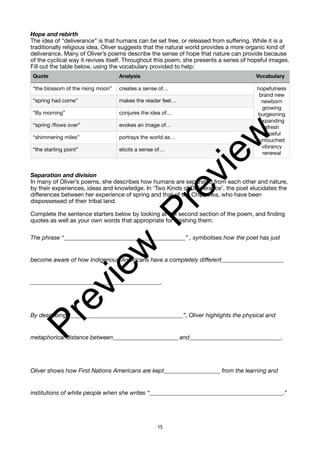
Hope and rebirth
The idea of “deliverance” is that humans can be set free, or released from suffering. While it is a
traditionally religious idea, Oliver suggests that the natural world provides a more organic kind of
deliverance. Many of Oliver’s poems describe the sense of hope that nature can provide because
of the cyclical way it revives itself. Throughout this poem, she presents a series of hopeful images.
Fill out the table below, using the vocabulary provided to help:
Separation and division
In many of Oliver’s poems, she describes how humans are separated from each other and nature,
by their experiences, ideas and knowledge. In ‘Two Kinds of Deliverance’, the poet elucidates the
differences between her experience of spring and that of the Chippewa, who have been
dispossessed of their tribal land.
Complete the sentence starters below by looking at the second section of the poem, and finding
quotes as well as your own words that appropriate for finishing them:
The phrase “_________________________________________” , symbolises how the poet has just
become aware of how Indigenous Americans have a completely different_____________________
____________________________________________.
By describing “______________________________________”, Oliver highlights the physical and
metaphorical distance between______________________ and_______________________________.
Oliver shows how First Nations Americans are kept___________________ from the learning and
institutions of white people when she writes “_____________________________________________.”
Quote Analysis Vocabulary
“the blossom of the rising moon” creates a sense of… hopefulness
brand new
newborn
growing
burgeoning
expanding
afresh
hopeful
untouched
vibrancy
renewal
“spring had come” makes the reader feel…
“By morning” conjures the idea of…
“spring /flows over” evokes an image of…
“shimmering miles” portrays the world as…
“the starting point” elicits a sense of…
15
P
r
e
v
i
e
w
P
r
e
v
i
e
w
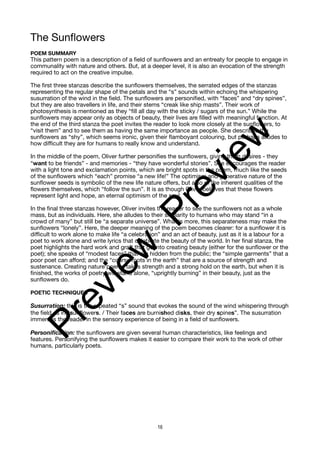
The Sunflowers
POEM SUMMARY
This pattern poem is a description of a field of sunflowers and an entreaty for people to engage in
communality with nature and others. But, at a deeper level, it is also an evocation of the strength
required to act on the creative impulse.
The first three stanzas describe the sunflowers themselves, the serrated edges of the stanzas
representing the regular shape of the petals and the “s” sounds within echoing the whispering
susurration of the wind in the field. The sunflowers are personified, with “faces” and “dry spines”,
but they are also travellers in life, and their stems “creak like ship masts”. Their work of
photosynthesis is mentioned as they “fill all day with the sticky / sugars of the sun.” While the
sunflowers may appear only as objects of beauty, their lives are filled with meaningful function. At
the end of the third stanza the poet invites the reader to look more closely at the sunflowers, to
“visit them” and to see them as having the same importance as people. She describes the
sunflowers as “shy”, which seems ironic, given their flamboyant colouring, but perhaps alludes to
how difficult they are for humans to really know and understand.
In the middle of the poem, Oliver further personifies the sunflowers, giving them desires - they
“want to be friends” - and memories - “they have wonderful stories”. She encourages the reader
with a light tone and exclamation points, which are bright spots in the poem, much like the seeds
of the sunflowers which “each” promise “a new life!” The optimism and generative nature of the
sunflower seeds is symbolic of the new life nature offers, but also of the inherent qualities of the
flowers themselves, which “follow the sun”. It is as though Oliver believes that these flowers
represent light and hope, an eternal optimism of the soul.
In the final three stanzas however, Oliver invites the reader to see the sunflowers not as a whole
mass, but as individuals. Here, she alludes to their similarity to humans who may stand “in a
crowd of many” but still be “a separate universe”. What is more, this separateness may make the
sunflowers “lonely”. Here, the deeper meaning of the poem becomes clearer: for a sunflower it is
difficult to work alone to make life “a celebration” and an act of beauty, just as it is a labour for a
poet to work alone and write lyrics that celebrate the beauty of the world. In her final stanza, the
poet highlights the hard work and graft that go into creating beauty (either for the sunflower or the
poet); she speaks of “modest faces” that are hidden from the public; the “simple garments” that a
poor poet can afford; and the “coarse roots in the earth” that are a source of strength and
sustenance. Creating nature poems takes strength and a strong hold on the earth, but when it is
finished, the works of poetry will stand alone, “uprightly burning” in their beauty, just as the
sunflowers do.
POETIC TECHNIQUES
Susurration: this is the repeated “s” sound that evokes the sound of the wind whispering through
the field as in “sunflowers. / Their faces are burnished disks, their dry spines”. The susurration
immerses the reader in the sensory experience of being in a field of sunflowers.
Personification: the sunflowers are given several human characteristics, like feelings and
features. Personifying the sunflowers makes it easier to compare their work to the work of other
humans, particularly poets.
16
P
r
e
v
i
e
w
P
r
e
v
i
e
w
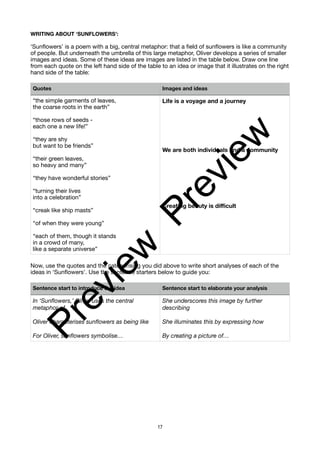
WRITING ABOUT ‘SUNFLOWERS’:
‘Sunflowers’ is a poem with a big, central metaphor: that a field of sunflowers is like a community
of people. But underneath the umbrella of this large metaphor, Oliver develops a series of smaller
images and ideas. Some of these ideas are images are listed in the table below. Draw one line
from each quote on the left hand side of the table to an idea or image that it illustrates on the right
hand side of the table:
Now, use the quotes and the categorising you did above to write short analyses of each of the
ideas in ‘Sunflowers’. Use the sentence starters below to guide you:
Quotes Images and ideas
“the simple garments of leaves,
the coarse roots in the earth”
“those rows of seeds -
each one a new life!”
“they are shy
but want to be friends”
“their green leaves,
so heavy and many”
“they have wonderful stories”
“turning their lives
into a celebration”
“creak like ship masts”
“of when they were young”
“each of them, though it stands
in a crowd of many,
like a separate universe”
Life is a voyage and a journey
We are both individuals and a community
Creating beauty is difficult
Sentence start to introduce the idea Sentence start to elaborate your analysis
In ‘Sunflowers,’ Oliver uses the central
metaphor of
Oliver characterises sunflowers as being like
For Oliver, sunflowers symbolise…
She underscores this image by further
describing
She illuminates this by expressing how
By creating a picture of…
17
P
r
e
v
i
e
w
P
r
e
v
i
e
w
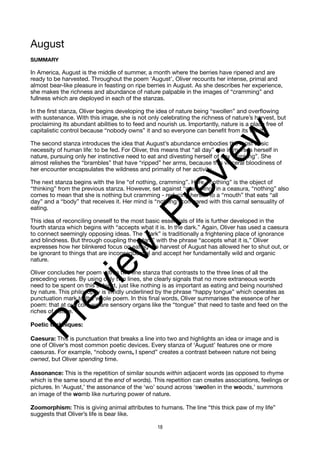
August
SUMMARY
In America, August is the middle of summer, a month where the berries have ripened and are
ready to be harvested. Throughout the poem ‘August’, Oliver recounts her intense, primal and
almost bear-like pleasure in feasting on ripe berries in August. As she describes her experience,
she makes the richness and abundance of nature palpable in the images of “cramming” and
fullness which are deployed in each of the stanzas.
In the first stanza, Oliver begins developing the idea of nature being “swollen” and overflowing
with sustenance. With this image, she is not only celebrating the richness of nature’s harvest, but
proclaiming its abundant abilities to to feed and nourish us. Importantly, nature is a place free of
capitalistic control because “nobody owns” it and so everyone can benefit from its wealth.
The second stanza introduces the idea that August’s abundance embodies the most basic
necessity of human life: to be fed. For Oliver, this means that “all day” she immerses herself in
nature, pursuing only her instinctive need to eat and divesting herself of any “thinking”. She
almost relishes the “brambles” that have “ripped” her arms, because this visceral bloodiness of
her encounter encapsulates the wildness and primality of her activity.
The next stanza begins with the line “of nothing, cramming”. Here, “nothing” is the object of
“thinking” from the previous stanza. However, set against “cramming” in a ceasura, “nothing” also
comes to mean that she is nothing but cramming - reducing herself to a “mouth” that eats “all
day” and a “body” that receives it. Her mind is “nothing” compared with this carnal sensuality of
eating.
This idea of reconciling oneself to the most basic essentials of life is further developed in the
fourth stanza which begins with “accepts what it is. In the dark.” Again, Oliver has used a caesura
to connect seemingly opposing ideas. The “dark” is traditionally a frightening place of ignorance
and blindness. But through coupling the “dark” with the phrase “accepts what it is,” Oliver
expresses how her blinkered focus on eating the harvest of August has allowed her to shut out, or
be ignorant to things that are inconsequential and accept her fundamentally wild and organic
nature.
Oliver concludes her poem with a two line stanza that contrasts to the three lines of all the
preceding verses. By using only two lines, she clearly signals that no more extraneous words
need to be spent on this subject, just like nothing is as important as eating and being nourished
by nature. This philosophy is vividly underlined by the phrase “happy tongue” which operates as
punctuation mark to the whole poem. In this final words, Oliver summarises the essence of her
poem: that at our core we are sensory organs like the “tongue” that need to taste and feed on the
riches of nature.
Poetic techniques:
Caesura: This is punctuation that breaks a line into two and highlights an idea or image and is
one of Oliver’s most common poetic devices. Every stanza of ‘August’ features one or more
caesuras. For example, “nobody owns, I spend” creates a contrast between nature not being
owned, but Oliver spending time.
Assonance: This is the repetition of similar sounds within adjacent words (as opposed to rhyme
which is the same sound at the end of words). This repetition can creates associations, feelings or
pictures. In ‘August,’ the assonance of the ‘wo’ sound across ‘swollen in the woods,’ summons
an image of the womb like nurturing power of nature.
Zoomorphism: This is giving animal attributes to humans. The line “this thick paw of my life”
suggests that Oliver’s life is bear like.
18
P
r
e
v
i
e
w
P
r
e
v
i
e
w
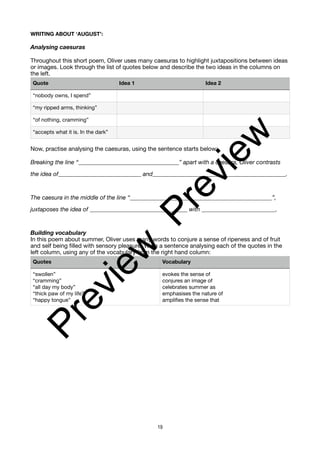
WRITING ABOUT ‘AUGUST’:
Analysing caesuras
Throughout this short poem, Oliver uses many caesuras to highlight juxtapositions between ideas
or images. Look through the list of quotes below and describe the two ideas in the columns on
the left.
Now, practise analysing the caesuras, using the sentence starts below:
Breaking the line “__________________________________” apart with a caesura, Oliver contrasts
the idea of____________________________ and_____________________________________________.
The caesura in the middle of the line “________________________________________________”,
juxtaposes the idea of _________________________________ with _________________________.
Building vocabulary
In this poem about summer, Oliver uses many words to conjure a sense of ripeness and of fruit
and self being filled with sensory pleasure. Write a sentence analysing each of the quotes in the
left column, using any of the vocabulary from the right hand column:
Quote Idea 1 Idea 2
“nobody owns, I spend”
“my ripped arms, thinking”
“of nothing, cramming”
“accepts what it is. In the dark”
Quotes Vocabulary
“swollen”
“cramming”
“all day my body”
“thick paw of my life”
“happy tongue”
evokes the sense of
conjures an image of
celebrates summer as
emphasises the nature of
amplifies the sense that
19
P
r
e
v
i
e
w
P
r
e
v
i
e
w
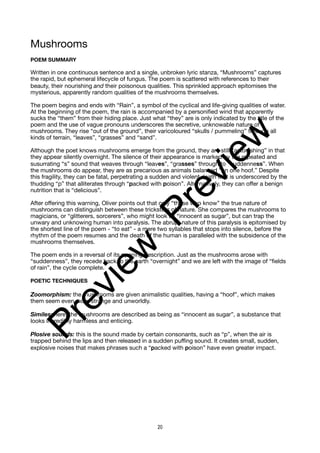
Mushrooms
POEM SUMMARY
Written in one continuous sentence and a single, unbroken lyric stanza, “Mushrooms” captures
the rapid, but ephemeral lifecycle of fungus. The poem is scattered with references to their
beauty, their nourishing and their poisonous qualities. This sprinkled approach epitomises the
mysterious, apparently random qualities of the mushrooms themselves.
The poem begins and ends with “Rain”, a symbol of the cyclical and life-giving qualities of water.
At the beginning of the poem, the rain is accompanied by a personified wind that apparently
sucks the “them” from their hiding place. Just what “they” are is only indicated by the title of the
poem and the use of vague pronouns underscores the secretive, unknowable nature of
mushrooms. They rise “out of the ground”, their varicoloured “skulls / pummeling” through all
kinds of terrain, “leaves”, “grasses” and “sand”.
Although the poet knows mushrooms emerge from the ground, they are still “astonishing” in that
they appear silently overnight. The silence of their appearance is marked by the repeated and
susurrating “s” sound that weaves through “leaves”, “grasses” through to “suddenness”. When
the mushrooms do appear, they are as precarious as animals balanced “on one hoof.” Despite
this fragility, they can be fatal, perpetrating a sudden and violent death that is underscored by the
thudding “p” that alliterates through “packed with poison”. Alternatively, they can offer a benign
nutrition that is “delicious”.
After offering this warning, Oliver points out that only “those who know” the true nature of
mushrooms can distinguish between these tricksters of nature. She compares the mushrooms to
magicians, or “glitterers, sorcerers”, who might look as “innocent as sugar”, but can trap the
unwary and unknowing human into paralysis. The abrupt nature of this paralysis is epitomised by
the shortest line of the poem - “to eat” - a mere two syllables that stops into silence, before the
rhythm of the poem resumes and the death of the human is paralleled with the subsidence of the
mushrooms themselves.
The poem ends in a reversal of its opening description. Just as the mushrooms arose with
“suddenness”, they recede back to the earth “overnight” and we are left with the image of “fields
of rain”, the cycle complete.
POETIC TECHNIQUES
Zoomorphism: the mushrooms are given animalistic qualities, having a “hoof”, which makes
them seem even more strange and unworldly.
Similes: here, the mushrooms are described as being as “innocent as sugar”, a substance that
looks incredibly harmless and enticing.
Plosive sounds: this is the sound made by certain consonants, such as “p”, when the air is
trapped behind the lips and then released in a sudden puffing sound. It creates small, sudden,
explosive noises that makes phrases such a “packed with poison” have even greater impact.
20
P
r
e
v
i
e
w
P
r
e
v
i
e
w
WRITING ABOUT ‘MUSHROOMS’:
Lips:
Oliver personifies nature as having a ‘lip’ in a number of her poems:
‘Mushrooms’: “the cool pursed / lips of the wind / draw them / out of the ground”
‘Lightning’: “The oaks shone / gaunt gold / on the lip / of the storm”
‘Starfish’: “under the tide’s lip, / in water dense as blindness / they slid / like sponges”
Select one of these ideas that you think this personification expresses:
Nature is a powerful force that can speak to us
Nature and natural events are like a mouth or opening into another world
There is an edge or lip that separates the human and natural world
Sensory descriptions:
Oliver describes mushrooms in very sensory terms in this poem. Fill out the table with quotes that
demonstrate the different senses and brainstorm the impact these descriptions create.
Use your quotes and brainstorming to write a few sentences analysing the sensory descriptions in
the poem:
The shape of the poem:
As with many of her poems, Oliver has constructed ‘Mushrooms’ to somehow physically resemble
the central topic and idea in the poem. In this case, the poem consists of only one sentence.
Circle four words from the table below that you think best describe this aspect of the poem and
the growth of mushrooms themselves:
Use the words you circled to complete this sentence:
The structure of ‘Mushrooms’, consisting of one______________ and __________________
sentence, mirrors the ______________ and __________________ nature of mushrooms and their
growth.
Quotes Creates an image of mushrooms as..
looks like
sounds like
feels like
tastes like
Oliver...
describes the mushrooms as...
depicts the mushrooms as...
characterises the mushrooms as
creating a picture of...
evoking a sense of...
highlighting how...
capturing the...
continuous
surging
unbroken
deathless
regular
breathless
persistent
incessant
cyclical
ceaseless
eternal
indestructible
21
P
r
e
v
i
e
w
P
r
e
v
i
e
w
Lightning
SUMMARY
Oliver’s ‘Lightning’ lyrically evokes the power of a lightening storm on a dark night. As in many of
her poems, Oliver’s portrait of a natural phenomenon is not just a romantic description of the thing
itself, but a metaphor for the human experience. Here, the excitement and danger of lightning is a
symbol for the emotionally turbulent and conflicted lives we can lead as humans.
The first part of the poem reveals the landscape that will be overwhelmed by the lightning storm.
It is a place where oaks shine like “gaunt gold” - the alliteration of the “g” combining with the
melancholic connotation of “gaunt” to create a sense that human sadness makes us feel hollow,
but it can also be a valuable, golden experience. This scene of sadness will experience a
catharsis - a release of emotion - as the wind opens the “shapeless mouth” of the storm and
begins a “five-hour howl”. Through this series of images, Oliver alludes to how the dynamism of
nature is both a tool for humans to process and navigate their complex, sometimes dark,
emotions - but also an emblem of the frightening, profound character of the emotions themselves.
Over the middle of the poem, Oliver describes the storm and the lightning itself. Her characteristic
short lines - often single words or phrases - allows her to capture the speed and tempo of the
storm. The single phrases “the lights” and “that grew black” vividly portray the rapid black and
white flashing of being in a lightning storm. Under these circumstances, the lights “went out fast”,
and the landscape is “bulging”, “quick” and “thudding,” as the storm seems to completely fill and
immerse the whole environment. This natural process is a “lesson in creating” and an emblem of
the natural world’s inherent capacity to renew itself in fast, and often dramatic ways.
As in many of her other poems, Oliver concludes by reflecting on and linking the human
experience to the image of nature she has so dramatically evoked in the rest of the poem. In
‘Lightning’, she brings her poem to a culmination by describing how lightning can instil both “fear”
and “excitement” within the observer. Indeed, just like a storm is a “lesson in creating” from the
middle of the poem, in this last section she expresses how a lighting can in fact be
“sensual”, and like a “poured stroke” and something to which our body “wants to flow towards”.
This deeply sexual imagery articulates how storms and lighting in particular can be
representations of our inner primal, turbulent selves. In the same way that we want to “hide” and
“flow toward” lightning, so to do we want to hide and embrace our intense, secret emotions. The
emotionally symbolic nature of lightning is underscored at the very end of the poem, where Oliver
imagines each “bolt” as “a burning river” that tears through the “dark” night and the dark of
ourselves.
POETIC TECHNIQUES:
Caesura: Punctuation that breaks a line into two and highlights an idea or image. In this poem,
the break in the middle of the line “poured stroke! and still” dramatically emphasises the way
lightning is both slippery and hard and breaks things in two (as it does to the poetic line).
22
P
r
e
v
i
e
w
P
r
e
v
i
e
w
WRITING ABOUT ‘LIGHTNING’:
Onomatopoeia
To evoke the sounds of the wind and lightning, Oliver uses onomatopoeia throughout this poem.
The repeated “o” sounds, for example, mirror the hollow howling of wind in a storm, while the
fizzing “s” sounds are like the electric sizzle and zap of lightning. When you are analysing poetry, it
is useful to be able to analyse how sounds enhance the effectiveness of the poet’s message. Use
the words and phrases in the table below to write analytic sentences about the poem’s
onomatopoeia.
Parallels between nature and human experience
In many of Oliver’s poems, she uses nature as an extended metaphor for the human experience.
In ‘Lightning’, she draws a parallel between the urgency and immediacy of lightning with the
human experience of excitement and fear. Use the quotes and phrases from the table below to
connect Oliver’s description of nature with the human experience.
Sentence start nature sound analysis effect on reader
The evocative…
Creating the…
Oliver epitomises
the…
Evoking the…
..sound of the wind…
.. sizzle of lightening…
…the crack of thunder…
through repetition of “o”
sounds, which…
the recurring “s” sounds
that...
in her sharp, cracking
consonants, which…
with fizzing “s” sounds
that…
with crackling “s” sounds
immerse…
absorb…
creates an immersive
experience…
give the reader a
sense of immediacy
in..
Quote Connection to human experience
The “five-hour howl” of the wind
The “balance” between the extreme emotions of
the storm
In ‘Lightning’, Oliver writes of the difficulty of telling
“fear from excitement”…
When Oliver describes the “river” of lightning
“tearing like escape,” she...
parallels the human experience of…
evokes the human desire to…
illustrating the human struggle with…
creates a vivid picture of...
epitomising the human need for…
personifies the common human experience of…
23
P
r
e
v
i
e
w
P
r
e
v
i
e
w
Ghosts
POEM SUMMARY
In seven sections, this poem explores the interactions that different groups of humans and
animals have had on the American prairies, highlighting all of the ways in which they have left an
impact.
1.
This first section, written in italics, introduces a refrain that will echo later, directly asking the
reader if they have “noticed”. The italics provide a breathless urgency, like the whisper of a ghost
but, at this stage of the poem, the reader has no idea what they should have noticed.
2.
The first stanza of this section starts with the ghosts of ancient beasts, in a long and noisy line
that underscores the highly populated bygone world of these prairies, which were teeming with
“bawling” buffalos. Here, the onomatopoeia of “bawling”, conjures the bellowing sound of these
herds. In this stanza, the beasts merely “lay down on the earth and died”, presumably of natural
causes, rather than because they were hunted by humans. However, Oliver contests this
assumption, pointing out that “it’s hard to tell” whether ancient remains are of animal bones or
other, amorphous indications of different kinds of life that “was once”. In the second stanza, this
ambiguity becomes a bit clearer because she points out that the “golden eagle” seems almost too
heavy to be natural, while the human-made “huge barns” look so much a natural part of the
landscape that they “seem ready” to “ramble off” on their own. Overall, Oliver is suggesting that
human habitation has always been a natural and embedded part of this landscape, challenging
the old-fashioned, European view of history that asserts that landscape is either a wilderness or
settled. In this first section, Oliver is pointing out that human habitation has always been an
integral part of the landscape.
3.
Section three is a brief vignette that evokes the ghost of the American explorer, Meriwether Lewis,
who was part of an expedition that claimed parts of the western continent for the US. Although
acting for the US government, Lewis was an advocate for the First Nations tribes and was
extremely interested in the medicinal qualities of plants that he found. In Oliver’s poem, Lewis has
an almost prayerful interaction with the wilderness, as he “kneels down” and watches the
ecosystem in front of him. He observes how the sparrow relies upon “buffalo hair” to build its
nest, a nest that is built in the herb hyssop (which has long been used in herbal remedies). As
Lewis watches the new chicks, Oliver imagines the birds “content” to be in this wild and
dangerous world. In this quasi-religious imagery, the sparrow chicks, like Adam and Eve, have
“fallen” into the corporeal world, having left a presumably “perfect world” that exists pre-birth.
The sparrows and Lewis are in this perilous world that is made beautiful by the “flowered fields” of
the prairies. Both birds and man are new in this dangerous and beautiful world, discovering it
together.
4.
This vignette is mostly written in the words of the Sioux people, voicing their ancient beliefs in the
regenerative nature of the world and in people’s capacity to bring forth the dead, and rebuild the
past by “dancing”, rejoicing in the landscape. The italics of the passage echo the ghostly sense of
a people who have been largely decimated, but were also once an integral part of the landscape
that this poem explores. Rather than presuming to tell us how the Sioux people interacted with
the land, Oliver uses their own words, evoking the ghosts of Sioux elders and their wisdom.
5.
Switching to another set of ghosts, Oliver imagines the “old-timers” of the American wild west,
who would traverse the landscape in trains. They would shoot buffalo from their carriage
windows, not interacting with the landscape at all, but preying upon it in wasteful ways. These
old-timers would shoot animals only for their “tongue”, literally robbing the natural world of its
voice. The wastefulness of this predation is highlighted in the stanza that describes the rotting
meat that “stank unbelievably”. Here, rather than describing the eden-like paradise of section
24
P
r
e
v
i
e
w
P
r
e
v
i
e
w
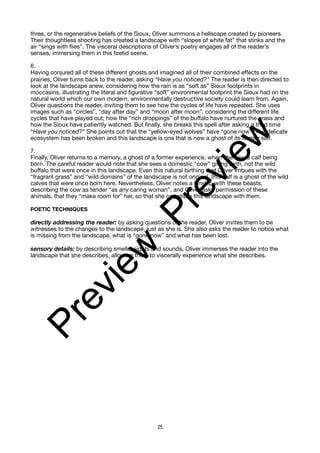
three, or the regenerative beliefs of the Sioux, Oliver summons a hellscape created by pioneers.
Their thoughtless shooting has created a landscape with “slopes of white fat” that stinks and the
air “sings with flies”. The visceral descriptions of Oliver’s poetry engages all of the reader’s
senses, immersing them in this foetid scene.
6.
Having conjured all of these different ghosts and imagined all of their combined effects on the
prairies, Oliver turns back to the reader, asking “Have you noticed?” The reader is then directed to
look at the landscape anew, considering how the rain is as “soft as” Sioux footprints in
moccasins, illustrating the literal and figurative “soft” environmental footprint the Sioux had on the
natural world which our own modern, environmentally destructive society could learn from. Again,
Oliver questions the reader, inviting them to see how the cycles of life have repeated. She uses
images such as “circles”, “day after day” and “moon after moon”, considering the different life
cycles that have played out; how the “rich droppings” of the buffalo have nurtured the grass and
how the Sioux have patiently watched. But finally, she breaks this spell after asking a third time
“Have you noticed?” She points out that the “yellow-eyed wolves” have “gone now”. The delicate
ecosystem has been broken and this landscape is one that is now a ghost of its former self.
7.
Finally, Oliver returns to a memory, a ghost of a former experience, when she saw a calf being
born. The careful reader would note that she sees a domestic “cow” giving birth, not the wild
buffalo that were once in this landscape. Even this natural birthing that Oliver imbues with the
“fragrant grass” and “wild domains” of the landscape is not original, this calf is a ghost of the wild
calves that were once born here. Nevertheless, Oliver notes a kinship with these beasts,
describing the cow as tender “as any caring woman”, and Oliver asks permission of these
animals, that they “make room for” her, so that she can share this landscape with them.
POETIC TECHNIQUES
directly addressing the reader: by asking questions of the reader, Oliver invites them to be
witnesses to the changes to the landscape, just as she is. She also asks the reader to notice what
is missing from the landscape, what is “gone now” and what has been lost.
sensory details: by describing smells, sights and sounds, Oliver immerses the reader into the
landscape that she describes, allowing them to viscerally experience what she describes.
25
P
r
e
v
i
e
w
P
r
e
v
i
e
w
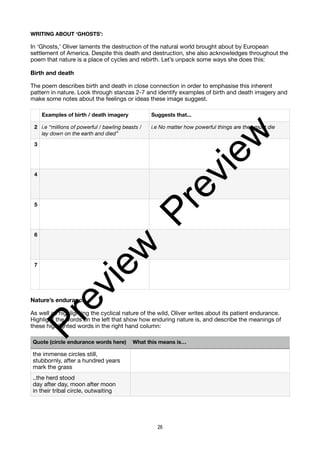
WRITING ABOUT ‘GHOSTS’:
In ‘Ghosts,’ Oliver laments the destruction of the natural world brought about by European
settlement of America. Despite this death and destruction, she also acknowledges throughout the
poem that nature is a place of cycles and rebirth. Let’s unpack some ways she does this:
Birth and death
The poem describes birth and death in close connection in order to emphasise this inherent
pattern in nature. Look through stanzas 2-7 and identify examples of birth and death imagery and
make some notes about the feelings or ideas these image suggest.
Nature’s endurance
As well as highlighting the cyclical nature of the wild, Oliver writes about its patient endurance.
Highlight the words on the left that show how enduring nature is, and describe the meanings of
these highlighted words in the right hand column:
Examples of birth / death imagery Suggests that...
2 i.e “millions of powerful / bawling beasts /
lay down on the earth and died”
i.e No matter how powerful things are they must die
3
4
5
6
7
Quote (circle endurance words here) What this means is…
the immense circles still,
stubbornly, after a hundred years
mark the grass
..the herd stood
day after day, moon after moon
in their tribal circle, outwaiting
26
P
r
e
v
i
e
w
P
r
e
v
i
e
w
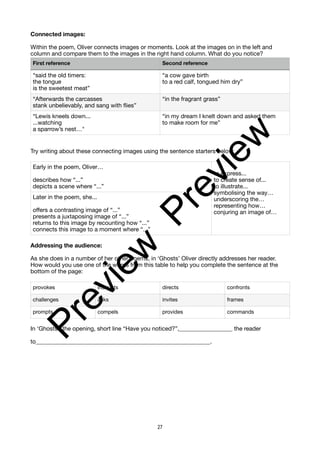
Connected images:
Within the poem, Oliver connects images or moments. Look at the images on in the left and
column and compare them to the images in the right hand column. What do you notice?
Try writing about these connecting images using the sentence starters below:
Addressing the audience:
As she does in a number of her other poems, in ‘Ghosts’ Oliver directly addresses her reader.
How would you use one of the words from this table to help you complete the sentence at the
bottom of the page:
In ‘Ghosts’, the opening, short line “Have you noticed?”,__________________ the reader
to___________________________________________________________.
First reference Second reference
“said the old timers:
the tongue
is the sweetest meat”
“a cow gave birth
to a red calf, tongued him dry”
“Afterwards the carcasses
stank unbelievably, and sang with flies”
“in the fragrant grass”
“Lewis kneels down...
...watching
a sparrow’s nest…"
“in my dream I knelt down and asked them
to make room for me”
Early in the poem, Oliver…
describes how “...”
depicts a scene where “...”
to express...
to create sense of...
to illustrate...
symbolising the way…
underscoring the…
representing how…
conjuring an image of…
Later in the poem, she...
offers a contrasting image of “...”
presents a juxtaposing image of “...”
returns to this image by recounting how “...”
connects this image to a moment where “...”
provokes instructs directs confronts
challenges asks invites frames
prompts compels provides commands
27
P
r
e
v
i
e
w
P
r
e
v
i
e
w
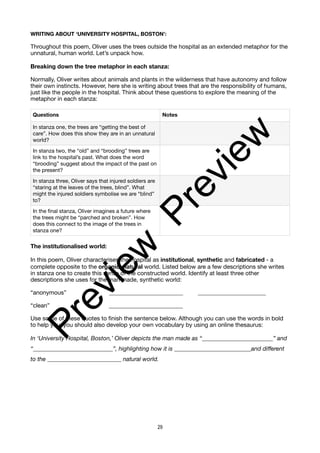
University Hospital, Boston
POEM SUMMARY
The four stanzas of this poem describe the experience of visiting a significant loved one in
hospital. The poem itself is addressed to the patient, in an intimate exploration of the experience
of visiting, but also as a love letter to the “you” of the poem.
The first stanza presents a regimented image of “trees on the hospital lawn”, separated from their
natural environment and planted in a manicured landscape. Here in this unnatural setting, they are
“lush and thriving” and Oliver draws a parallel between the trees of the lawn and the patients in
the hospital: they are out of their natural ecosystem but “are getting the best of care”. The rest of
the stanza underscores the sterility of the environment, describing the “clean rooms high above
this city”, people who work “day and night” and the “intricate machines”. Here, blood doesn’t
pump in a hot-blooded way, but “murmur[s]” in a quiet and modest manner. The last two lines hint
at the two things that might be affecting the reader of this poem - physical ailments, or “despair of
the mind.”
The second stanza creates a sense of connection, between people and with the landscape.
Together the poet and the reader “walk out/ into the light” and commune with nature. Rather than
the trees being the amorphous and unnamed group they were in the first stanza, they are given
names: “buckeyes, a sycamore and one/black walnut brooding/high over a hedge of lilacs”. Just
as the poet connects with the reader, she connects with the individual personalities of the tree.
She also suggests that these trees have a history, just as she and the reader do, they are “as old
as the red-brick building” that was built in the time of the American Civil War. While she
contemplates the history of the trees and the present, the poet hears of the present concerns of
her reader - “you tell me: you are better.”
Having thought about the history of this place, in the third stanza Oliver contemplates the “many
young men” who would have convalesced here during the Civil War, coming into this sterile
environment after the “red and hideous battlefields” and being forced to recover in “small and
stuffy chambers”. Unlike the current patient, who can walk out and commune with the trees, these
historic soldiers were entirely cut off from the natural world and were left “longing” for cures that
were not yet invented and who may have died while “staring at the leaves of the trees” that they
could not sit under. In describing “tools still unimagined, medicines still unfound”, Oliver suggests
that the subject of the poem might be also suffering from an illness for which there is not yet a
cure. She suggests that the soldiers of history might have been “blind / to the terrible effort
around them to keep them alive” and as she does so, she looks into the eyes of the subject of the
poem. Here, there is a clear parallel about the effort to keep different patients alive, while the
patient does not know how much “terrible effort” is being expended by the doctors and perhaps
the poet herself.
Finally, the poet describes the subject of the poem, as a person of changeable appearance and
mood - their eyes are “sometimes green and sometimes gray” and their moods are “sometimes
full of humour, but often not”. It seems clearer and clearer that the reader of this poem is suffering
from a “despair of the mind”, a depression that requires hospitalisation, but for which there is no
known cure. Then the poet describes how barren her life would be without this person - “a place
of parched and broken trees”. This barren landscape is further expanded upon as she walks out
of the hospital, past “an empty room” from where a patient has gone. Unlike in the natural world,
where there may be quiet, here there is a silence that is “deep and neutral” uncaring and
unconcerned with the suffering that happens, but also unconcerned with the emotions of “loving”
that the poet feels for her reader.
POETIC DEVICES
descriptions of a built world: unlike most of her other poems, which describe nature, this poem
describes the manufactured world, which is “neutral” and filled with “intricate machines”. In this
world, there is none of the exuberance, exhilaration and terror of the natural world, it is a beige
and emotionally barren place. In this way, “University Hospital, Boston” is a contrast to many
other Oliver poems.
28
P
r
e
v
i
e
w
P
r
e
v
i
e
w
WRITING ABOUT ‘UNIVERSITY HOSPITAL, BOSTON’:
Throughout this poem, Oliver uses the trees outside the hospital as an extended metaphor for the
unnatural, human world. Let’s unpack how.
Breaking down the tree metaphor in each stanza:
Normally, Oliver writes about animals and plants in the wilderness that have autonomy and follow
their own instincts. However, here she is writing about trees that are the responsibility of humans,
just like the people in the hospital. Think about these questions to explore the meaning of the
metaphor in each stanza:
The institutionalised world:
In this poem, Oliver characterises the hospital as institutional, synthetic and fabricated - a
complete opposite to the organic, natural world. Listed below are a few descriptions she writes
in stanza one to create this sense of the constructed world. Identify at least three other
descriptions she uses for the man made, synthetic world:
“anonymous” _________________________ _______________________
“clean” _________________________
Use some of these quotes to finish the sentence below. Although you can use the words in bold
to help you, you should also develop your own vocabulary by using an online thesaurus:
In ‘University Hospital, Boston,’ Oliver depicts the man made as “________________________” and
“___________________________”, highlighting how it is __________________________and different
to the _________________________ natural world.
Questions Notes
In stanza one, the trees are “getting the best of
care”. How does this show they are in an unnatural
world?
In stanza two, the “old” and “brooding” trees are
link to the hospital’s past. What does the word
“brooding” suggest about the impact of the past on
the present?
In stanza three, Oliver says that injured soldiers are
“staring at the leaves of the trees, blind”. What
might the injured soldiers symbolise we are “blind”
to?
In the final stanza, Oliver imagines a future where
the trees might be “parched and broken”. How
does this connect to the image of the trees in
stanza one?
29
P
r
e
v
i
e
w
P
r
e
v
i
e
w
Skunk Cabbage
POEM SUMMARY
The skunk cabbage is a repulsive smelling plant that grows in North America at the start of spring.
It looks something like a red, upright conch shell and its fetid smell attracts blowflies that pollinate
the plant and help it reproduce. In her poem ‘Skunk Cabbage’, Oliver celebrates this cabbage as
a symbol of the potency of nature.
At the beginning of the poem, it’s the onset of spring and the winter ice is “dissolving”. By
characterising the ice that has covered ponds over the winter as like “iron rinds,” the outset of the
poem frames nature as a space controlled by powerful forces. Oliver addresses her audience as
“you”, imagining them entering into this nascent spring setting, “dreaming” of finding typical
beauties of the natural world such as “ferns and flowers”. However, in this imagined scenario, the
audience does not find such beauties, but instead the “brash” skunk cabbage. Here, the word
“brash” along with the subsequent description “slinging”, creates a sense of the skunk cabbage
as something muscular and confident that can easily ignore the “chilling mud”.
Oliver develops the picture of the cabbage as a potent force in the next part of the poem.
Confronted with the cabbage’s assertive display of power, Oliver sees the observer of nature
“kneel beside it.” The smell of the cabbage is intense and “lurid.” In its confidence, it does not
pretend to be anything other than its natural self: its smell “flows out” in an “unabashed way”. The
observer is attracted to it like the flies that pollinate it and bring a “continual spattering / of
protein”. In their kneeling position, the observer is both powerless to resist the attraction of
cabbage - like the flies - but also paying homage to the almost divine authority the cabbage
seems to emanate. Moreover, beneath the “Appalling...green caves” of the cabbage leaves, the
observer can sense the sexual energy of the plant, pulsing like a phallic “thick root” that is
“powerful as instinct!”
In the final section of the poem, Oliver acknowledges that the observer may be horrified and
disgusted by the brash, sexual power of fetid skunk cabbage, but also come to see that it has a
place in “the woods you love”. The woods is a place of continual renewal, where “every death is
life again”. These acts of renewal - the birth of spring and the death of winter - are not just a
formulaic cycle or “mere turning,” but a process that is “dense and scalding” as represented by
the virility and intensity of the skunk cabbage itself. Oliver argues that this power and intensity -
that is “not necessarily pretty” - is essential in nature. For if the “ferns, leaves, flowers” are “to rise
and flourish” - the “daring and brawn” of natural forces like the skunk cabbage are first needed to
“pull down the frozen waterfall”.
POETIC TECHNIQUES:
iron imagery: Oliver uses iron as an image in a number of her poems to represent things that
have strength and power. She refers to ice as “iron rinds” at the beginning of the poem, but also
to the cycle of nature as “a miracle / wrought” later in the poem. The word “wrought” is usually
used to describe how a blacksmith shapes and twists iron.
sexual imagery: Phrases like “flows out”, “continual spattering” and “thick root” all create a
sense of phalluses and semen which represent the primal, sexual power of the skunk cabbage.
30
P
r
e
v
i
e
w
P
r
e
v
i
e
w
WRITING ABOUT ‘SKUNK CABBAGE’:
As in so many of Mary Oliver’s poems, this poem presents nature as a powerful force. It also
presents nature as something that puts on a show, or is ostentatious. In the table below, there are
quotes that provide evidence of nature as being ostentatious. Read through the poem and find
quotes that show how nature is powerful. Put these quotes in the other column.
Develop your vocabulary:
Use an online thesaurus to help you fill out the table below:
Finish the sentence stems below, using the vocabulary you developed and the quotes in the table
at the top:
In ‘Skunk Cabbage’, Oliver evokes a sense of nature as both _________________________________
and________________________, describing it as “__________________________________________”.
Oliver suggests that spring is a time of _____________________, where nature is “_______________
__________________________________________________________.”
The appearance of a skunk cabbage heralds the arrival of spring, a time when nature is
________________, epitomised by “_______________________________________________________”.
Since a skunk cabbage is “____________________________________________________________”, it
highlights for Oliver how nature is _______________________________________________________.”
Nature puts on a show Nature is powerful
upon the brash
turnip-hearted skunk cabbage
You kneel beside it. The smell
is lurid and flows out in the most
unabashed way, attracting
Ferns, leaves, flowers, the last subtle
refinements, elegant and easeful wait
to rise and flourish
Other words for “ostentatious” Other words for “powerful”
31
P
r
e
v
i
e
w
P
r
e
v
i
e
w
The Fish
POEM SUMMARY
This short lyric poem describes Oliver’s first experience with fishing, outlining in visceral detail the
death of the fish itself, but then the effect that the fish’s death has on her as a person. She
celebrates how the fish has now become a part of her, and a part of the cycle of life, which circles
through death to a new life. The final sentence of this poem encapsulates this mysterious circle of
life.
The first sentence of the poem is delivered in a series of short, breathless lines, mimicking the
gasping breaths that the fish takes in its final moments. That the fish is fighting for its life is clear
in the words of the poem, but also in the echoing, ringing sound of “ai” that provides an internal
rhyme in lines four and five: “in the pail / but failed and sucked”. The pain of the death is evoked
by the “burning” quality of the air that enters the fish, a burning highlighted by the sizzling “z” in
“amazement”. The death of the fish creates a space, a silence at the end of the shortest line, “that
died”, before the colour and beauty of the fish fades in a “slow pouring off /of rainbows”. The
rainbows are a reference to the colour of the fish, but also to the symbolic hope of rainbows; here
the rainbow fades with the life of the fish.
The second sentence details Olivers’ consumption of the fish, a delicate operation that is
characterised by a series of pernickety, terminal “p” and “t” sounds, that stop the flow of the
poem’s lines: “Later / I opened his body and separated…” In this short sentence, the difference
between flesh and bones is articulated, careful and important, but this separation is short lived.
Exultantly, Oliver rejoices in her integral connection to the fish and the elements that it represents,
claiming that “the sea” and “the fish” are in her and that she is “the fish”. This joyful exuberance is
light, it “glitters” and together she and the fish are “risen” in an almost biblical fashion, although
they are likely to “fall” in a similar manner.
The mysterious, religious sense of this cycle of life is elucidated in the final sentence, which
emphasises the “pain” of life. This is such a repeated and ongoing pain that the word itself echoes
three times. Life is described as a “feverish plot”: it’s a story not just about the individual, but the
entirety of life in this world. Just as Oliver has been “nourished” by the flesh of the fish, we as
humans are “nourished” by the ineffable “mystery” of life on this planet.
POETIC TECHNIQUES
religious imagery: throughout this poem, Oliver uses imagery that is overtly biblical. She alludes
to the rise and fall of life (in the Old Testament or Torah, there are references to the rise and fall of
mankind in the story of Adam and Eve). She also refers to the “mystery” of life, and many religious
prayers refer to life as a mystery. In this way, Oliver suggests that participating in the cycle of life -
through eating the flesh of the fish - is a sacramental, or holy thing to do.
letter sounds: the sounds of individual letters within words help enhance the reader’s
understanding of the narrative of the poem. Stopped sounds, like “p”, “t” or “ck” punctuate the
lines and slowing down the flow. The “g” sounds in “tangled together” emphasise the inextricably
linked natures of the poet and the fish.
enjambment: sentences that begin on one line are continued to the next, highlighting the
interlinked nature of life and of the poem
32
P
r
e
v
i
e
w
P
r
e
v
i
e
w
WRITING ABOUT ‘THE FISH’:
Mary Oliver explores the connection and separation of the human and natural world in this poem.
Let’s unpack two key techniques she uses to do this:
Caesuras:
One of Oliver’s most common poetic techniques is the caesura. This poetic device involves using
a punctuation mark in the middle of a line. The impact of this is to highlight, connect or divide the
ideas on either side of the punctuation mark. Look at the lines that feature caesuras below. Make
some notes about how the caesura highlights, connects or divides the ideas on either side of the
punctuation mark:
Pain is part of life:
In this poem - as in a range of her other poems - Oliver acknowledges the role of pain and
suffering in daily human life. Look through these four poems:
‘The Fish’
‘Morning Poem’
‘Wild Geese’
‘University Hospital, Boston’
Circle words below that best describe the part that pain and suffering play in human life. After
this, underline words that describe how nature can help humans manage pain and suffering.
Use the words above and quotes from any of the four poems listed to finish a paragraph with this
topic sentence:
Throughout her poetry, Oliver characterises pain as an integral and natural part of human existence
that must be endured and respected.
Notes:
“and ate him: Now the sea”
“is in me: I am the fish”
“glitters in me; we are”
“back to sea. Out of pain”
integral
belonging
meditative
natural
healing
chosen
communal
balance
universal
continual
significant
inescapable
therapeutic
influential
sacred
shared
difficult
free
joyous
inherent
33
P
r
e
v
i
e
w
P
r
e
v
i
e
w
In Blackwater Woods
POEM SUMMARY
‘In Blackwater Woods’ is both a elegy to the passing of life and a manifesto about how we should
approach our human mortality.
In the first three stanzas, Oliver creates an image of Blackwater Woods at the end of autumn. The
trees are losing their leaves and “are turning / their own bodies / into pillars”. This transition from
the foliage filled life of summer to the barrenness of winter is of course a metaphor for human
death. However, Oliver does not present this autumnal image of mortality as something grim and
to be feared, but as a part of the cycle of life that has a sensory beauty. As the trees lose their
leaves, they become filled with “light” and they emanate a “rich / fragrance of cinnamon” which
represents the “fulfilment” of their journey through spring and summer and also symbolises the
rich and fulfilling lives all humans can lead before they die. Throughout these first three stanzas,
Oliver develops a religious, mystical sense of the journey into death, by characterising the trees as
elements of a temple or cathedral: like a grand church, they have “pillars,” and they exude
“fragrance” like the incense in religious ceremonies. In the third stanza, she builds on this imagery
by describing the “cattails” - a long, furry headed grass - that surround the trees as long candles
or “tapers”. Significantly, as the cattails have reached ripeness, their seed heads “are bursting and
floating away,” become part of the great cycle of life where things die and then are reborn.
Throughout the middle three stanzas, Oliver expresses her feelings about the impact and legacy
this cycle of life has on her. She looks at the ponds in the woods and reflects that “no matter what
its / name is” in autumn it is “nameless now”. On the surface, this line seems to evince a nihilistic
beliefs that life is pointless and that when we die we become “nameless”. In the next stanza,
Oliver continues to develops this apparent nihilism, saying that in her “lifetime” everything has
circled back “the fires / and the black river of loss”. It’s as if she’s suggesting that life only leads to
death and this is an inescapable thought that frames her world view.
However, what appears as nihilism in the middle of the poem, has an “other side” and Oliver
elaborates on a philosophy of “salvation” in the last three stanzas. The ponds are not “nameless”
because they are pointless or without meaning, but because they have such divine meaning that
they transcend the ability of humans to “know” them and reduce them to a name. Oliver contends
that we need to reconcile ourselves to not fully understanding or being able to control the great
and mysterious cycle of life and death. This belief she outlines over the final lines of the poems,
saying that in life we need to “love what is mortal” and “hold it”, but in death (“when the time
comes”), we need to be like the trees or the cattails and “let...go” of what is physical. For Oliver,
the yielding to the inevitable cycles of life is key to “salvation”: when we “let...go,” we understand
that we are part of an ongoing, continual world where we will always have a place and “salvation”.
POETIC TECHNIQUES:
Physical and metaphysical imagery: Since this poem is about the physicality of life and then the
intangibility or abstractness of death, Oliver uses images of hard, real things (“pillars”, “bodies”,
“bones”) and juxtaposes those with soft, transient things (“fragrance”, “floating”, “river”).
Religious imagery: As in many of her poems, Oliver uses religious imagery to create a sense of
the divinity of nature. In this poem, she creates a sense of Blackwater words as being like a
cathedral with “pillars” and “tapers” (candles).
34
P
r
e
v
i
e
w
P
r
e
v
i
e
w
WRITING ABOUT ‘IN BLACKWATER WOODS’:
Worshiping nature
Oliver is a passionate worshiper of nature and natural life forms. Many of her poems describe
kneeling in nature. Look through the poems listed below and find quotes that describe kneeling or
experiencing nature in a religious way:
Truths:
In ‘many of her poems, Oliver contends that there are certain essential truths that we need to
accept about life and existence. She is hinting at an almost religious or spiritual understanding of
the significance of life. Different people or different spiritual practises might give these
understandings different names, but it doesn’t alter their truthfulness:
Select one word from each column below to label the idea about truth Oliver is expressing. Use
these words to finish this sentence starter: In her poetry, Oliver argues that there are___________
Poem Quote
In Blackwater
Woods
Ghosts
Stanley Kunitz
Skunk Cabbage
The Fish
Poem Quote
In Blackwater
Woods
“and every pond,
no matter what its
name is, is
nameless now.”
Sunrise “Call it
whatever you want, it is
happiness”
Morning Poem “each pond with its blazing lilies
is a prayer heard and answered…
…whether or not
you have ever dared to pray.
Skunk Cabbage But these are the woods you love,
where the secret name
of every death is life again - a miracle”
essential
fundamental
inarguable
elemental
truths
facts
realities
understandings
in
about
of
the mystery of life.
nature of existence.
our spiritual connection to the universe.
the interconnectedness of life on this planet.
35
P
r
e
v
i
e
w
P
r
e
v
i
e
w
INTERCONNECTION
LEGACIES
Poem How it explores interconnection
Wild Geese People should experience the world as a gift that “offers itself” to them
Starfish Oliver finds herself immersed in the natural world as she interacts with the starfish;
nature is personified
One or Two Things The human experience is compared to that of the butterfly and the horse
Sunrise Nature can offer humans “happiness”
The Sunflowers The sunflowers are personified and are very like humans
August Both the blackberries and the poet are described in visceral, bloody terms
Lightning The lightning is described in sensual, passionate terms, like human emotions and
sexuality
Ghosts Oliver describes a natural kinship between herself and the calf who has just been
born
University Hospital,
Boston
The trees are represented as unnatural and regimented, just as the lives of the
patients in the hospital are
Skunk Cabbage The plant is given sexual characteristics and exudes a sexual energy
The Fish People are intimately connected with the food that they eat, which comes from the
natural world
Poem How it explores legacies
Starfish Interacting with the starfish has helped her to learn how to heal and love
Stanley Kunitiz Writing poetry is about shaping words and ideas in magical ways
One or Two Things Oliver learns from the butterfly
Sunrise Humans have martyred themselves for ideals
Two Kinds of
Deliverance
First Nations people have been irreparably harmed by the colonisation of America
The Sunflowers Creating beauty, like creating poetry, is hard but important to do so that people
can be inspired
Ghosts Different people and animals have shaped the landscape of the American prairies
University Hospital,
Boston
The poet is preoccupied with thoughts of the Civil War of America and how past
patients endured some similar doubts and fears as the present patients
In Blackwater
Woods
The natural cycles of life teach us important lessons about how our own life will
pass and how we should accept that
36
P
r
e
v
i
e
w
P
r
e
v
i
e
w
CYCLES OF LIFE
THE NATURAL DIVINE
Poem How it explores cycles of life
Wild Geese Humans naturally have cycles of despair and hope; wild geese fly away and then
head home again
Stanley Kunitz Oliver feels that she is like a child again, learning how to write; gardeners deal with
the dead and diseases and try to coax new life
One or Two Things Explores birth, pain and the ephemerality of life
Sunrise Morning is literally a rejuvenation of a new day
Two Kinds of
Deliverance
Spring is the cyclical rejuvenation of life on the planet
August Summer is a time for gorging on the fruits of nature
Mushrooms Mushrooms have an incredibly brief cycle of life
Ghosts Cycles of birth and of death are represented throughout
Skunk Cabbage Represents the coming of spring and of many kinds of new life; also describe the
powerful energies of these cycles of life
The Fish The death of the fish feeds the poet
In Blackwater
Woods
As autumn comes, the poet reflects on the importance of death and the beauty of
this part of the life cycle
Poem How it explores the natural divine
Wild Geese A series of commandments about how to live life
Starfish Watching starfish helps the poet learn to accept life as it is
One or Two Things The “god of dirt” “speaks” to the poet; poem explores how wisdom can be found
in nature
Sunrise The sun burns with an almost holy incandescence
Two Kinds of
Deliverance
Nature offers “deliverance” - salvation or hope - to different people in different
ways
Mushrooms The mushrooms can either feed people or poison them - they have an awe-
inspiring nature
Lightning Natural phenomena, such as lightening, can inspire fear and awe
Ghosts Lewis “kneels down” to interact with the natural world
Skunk Cabbage The plant is described as powerful and something to “kneel beside”
The Fish As the poet feeds upon the fish, they are interconnected in a powerful and
mysterious way
In Blackwater
Woods
The natural environment looks like a temple or cathedral and is a place where
people should stop to worship
37
P
r
e
v
i
e
w
P
r
e
v
i
e
w
ORGANISING EXAMPLES OF INTERCONNECTION
In many of her poems, Oliver expresses the way humans and the natural world are connected. Fill
in the table with examples from poems about this idea. Here are some tips:
• Re-read the summary of this idea on page…
• Look at pages.... for a list of poems about this idea
• Find examples of zoomorphism and personification that show how nature and humans have
shared qualities
• Think about how in many of her poems Oliver speaks directly to the reader and invites them to
interact with the natural world
Poem name:
Quotes: Techniques, symbols:
Poem name:
Quotes: Techniques, symbols:
Poem name:
Quotes: Techniques, symbols:
Poem name:
Quotes: Techniques, symbols:
38
P
r
e
v
i
e
w
P
r
e
v
i
e
w
EXTENDED WRITING ABOUT INTERCONNECTION
A typical essay task you will be asked to respond to for this big idea is this:
How does Oliver explore the connection between humans and nature in her poetry?
Use the notes you have created in the table on the previous page to practise writing a paragraph
in response to this topic. The paragraph outline below gives you a structure and sentence starters
to follow:
Now, try writing another paragraph. This time, use the table below to make notes about examples
you can use to write about the topic sentence provided. Find an example of a quote and a symbol
or technique to go in each of the rows where you need to provide evidence.
Topic sentence Throughout many of her poems, Oliver explores how the primal nature of humans
connects them to the natural world.
Initial examples
from one poem
In [poem name], she..., highlighting....
The description of..., creates...
This image is underlined by...
Link Oliver further reflects on the idea of humans as primal and natural in...
Further
examples from
another poem
This poem expresses...and...
Through the symbol of..., Oliver...
Synthesising
sentence
At the core of these poems is Oliver’s profound belief that... and...
Topic sentence As beings who are part of nature, Oliver also contends in her poetry that humans need
to yield to the natural world and their natural selves.
Initial examples
from one poem
Link
Further
examples from
another poem
Synthesising
sentence
39
P
r
e
v
i
e
w
P
r
e
v
i
e
w
ORGANISING EXAMPLES OF THE NATURAL DIVINE
Throughout her poetry, Oliver uses religious and spiritual imagery to evoke the sense that nature is
a divine force that we should worship and respect. She also writes about how nature can teach
us, or make us better people. Use the table below to identify examples of how four poems explore
this key idea. To help you do this:
• Re-read the summary of this idea on page…
• Look at pages.... for a list of poems about this idea
• Look again through the summary of each poem and the writing activities for ideas about
quotes and techniques to put in your table
Poem name:
Quotes: Techniques, symbols:
Poem name:
Quotes: Techniques, symbols:
Poem name:
Quotes: Techniques, symbols:
Poem name:
Quotes: Techniques, symbols:
40
P
r
e
v
i
e
w
P
r
e
v
i
e
w
EXTENDED WRITING ABOUT THE NATURAL DIVINE
The two tasks below ask you to unpack an essay topic about this key idea and write a paragraph
in response to the topic.
‘In her poetry, Oliver depicts nature as a powerful and divine force.’ Discuss.
An important skill you’ll need in your essays is to respond to the key words in a topic with a range
of vocabulary. Brainstorm as many words as you can that you can use to address each part of the
topic. Use the vocabulary lists on page... to help you.
When you organise your examples for an essay, you will want to think about sub-ideas that are
connected to the essay topic. Look at the list below and choose one sub-idea that will help you to
write a paragraph responding to the topic:
☐ Nature is powerful and often frightening or destructive
☐ The beauty of nature is something that we should worship
☐ Nature is awe inspiring
☐ The natural world is a benevolent force that shows us how to be better people
☐ The wonder of nature is something we should respect
☐ Life is both a terrible and a wonderful gift
☐ Although the natural world can be destructive, it also regenerates in ways that mimic religious
teachings
☐ We should be grateful to nature because ultimately it controls everything on earth.
Although the essay topic below doesn’t explicitly reference divinity or spirituality, it does ask you
to consider what nature can teach or show us (and therefore, why we should respect nature):
“learning
little by little to love
our only world.”
What does Oliver show that nature can teach us?
Circle key words and brainstorm an alternative vocabulary for these words. After this, choose one
sub idea from below. Using your brainstormed vocabulary and examples you have collected on
page... write a whole paragraph to support this idea.
☐ Nature can teach us patience.
☐ Nature teaches us about the inevitable cycles of life and death.
☐ Nature can teach us to let go off the heavy and difficult things that weigh us down in life.
☐ Nature can teach us to embrace our primal selves.
☐ The wonder of nature can teach us to be open to be beauty and joy of the human world.
depicts nature powerful divine force
41
P
r
e
v
i
e
w
P
r
e
v
i
e
w
ORGANISING EXAMPLES OF LEGACIES
Throughout her poetry, Oliver provides different examples of how people, art and nature can
change the world and influence future generations. She shows us how things that happen in the
past can continue to have ongoing effects for many years. Use the table below to identify
examples of how four poems explore this key idea. To help you do this:
• Re-read the summary of this idea on page…
• Look at pages.... for a list of poems about this idea
• When you read through the poems, look for references to famous people, events, or ideas that
are lasting
Poem name:
Quotes: Techniques, symbols:
Poem name:
Quotes: Techniques, symbols:
Poem name:
Quotes: Techniques, symbols:
Poem name:
Quotes: Techniques, symbols:
42
P
r
e
v
i
e
w
P
r
e
v
i
e
w
EXTENDED WRITING ABOUT LEGACIES
A typical essay task you will be asked to respond to for this big idea is this:
‘Oliver explores the different ways natural and human forces shape us.’ Discuss
There are two parts to this essay topic: 1) How nature shapes us; 2) How humans shape us. Use
the table below to brainstorm vocabulary and examples to respond to each part of the topic:
Now, write two paragraphs - one about human forces, the other about natural forces.
***
Let’s look at another topic that frames the ideas of legacies in slightly different ways.
‘In Oliver’s poetry, there is both loss and hope.’ Discuss.
In this topic, loss is a legacy that comes from the past and hope is a legacy that can be given to
the future. Just as for the last activity, use the table below to brainstorm vocabulary and examples
to respond to each part of the topic. Then write a paragraph responding to each part of the topic:
Ways natural forces shape us Ways human forces shape us
Vocabulary: Vocabulary:
Examples: Examples:
Loss Hope
Vocabulary: Vocabulary:
Examples: Examples:
43
P
r
e
v
i
e
w
P
r
e
v
i
e
w
ORGANISING EXAMPLES OF CYCLES OF LIFE
Throughout her poetry, Oliver consistently explores the cycles that naturally occur in the world. Fill
in the table with examples from poems about this idea. Here are some tips:
• Re-read the summary of this idea on page…
• Look at pages.... for a list of poems about this idea
• Find examples of references and imagery about birth, death, spring and autumn in the poems
• Consider how Oliver celebrates nature as a place of rejuvenation and healing
Poem name:
Quotes: Techniques, symbols:
Poem name:
Quotes: Techniques, symbols:
Poem name:
Quotes: Techniques, symbols:
Poem name:
Quotes: Techniques, symbols:
44
P
r
e
v
i
e
w
P
r
e
v
i
e
w
EXTENDED WRITING ABOUT THE CYCLES OF LIFE
In the box below are a range of essay tasks about the cycles of life. Respond to at least two of
these topics following this process:
1. Circle key words in the topic
2. Brainstorm alternative vocabulary
3. Refer back to the poems and tables you have created to brainstorm examples to respond to
the topic
4. Sort examples into 3-4 groups which can be the basis for 3-4 body paragraphs in your essay
5. Plan the topic sentence for each group of examples
6. Write the essay
“Meanwhile the wild geese, high in the clean blue air, / are heading home again.”
‘Oliver’s poetry explores the eternal cycles of nature.’ Discuss.
‘In her poetry, Oliver portrays nature as a place of continuous renewal.’ Discuss.
‘Oliver suggests it’s necessary to yield to the cycles of nature.’ Do you agree?
‘Despite its history of settlement and dispossession, Oliver sees the natural world around her as a
place of healing and wonder.’ Do you agree?
“The butterfly's loping flight
carries it through the country of the leaves
delicately, and well enough to get it
where it wants to go”
In Oliver’s poetry, nature is place of both transience and strength. Discuss.
45
P
r
e
v
i
e
w
P
r
e
v
i
e
w
FURTHER ESSAY TOPICS
‘Mary Oliver’s poetry is an invitation to explore our connection to nature.’ Do you agree?
"the world offers itself to your imagination, ...
over and over announcing your place
in the family of things.”
‘Humans and the natural world are intertwined in Oliver’s poetry.’ Discuss.
“somewhere deep within you
a beast shouting”
‘Humans have a deep connection to nature in Oliver’s poetry.’ To what extent do you agree?
“thinking
of nothing, cramming
the black honey of summer”
‘Oliver depicts nature as an idyllic sanctuary.’ Do you agree?
How does Oliver explore the way the natural world enriches people’s lives?
How does Oliver direct her readers to think about nature?
‘Throughout her poetry, Oliver depicts the power of nature.’ Discuss.
How does Oliver use vivid imagery to portray forces of nature?
‘In her poetry, Oliver suggests that humans need to immerse themselves in the natural world.’ Do
you agree?
How does Oliver suggest the reader responds to the past and the present in her poetry?
"Have you noticed?”
‘Oliver’s poetry challenges the reader to look beyond the surface.’ Discuss.
‘Throughout her poetry, Oliver testifies to the influences on her life and poetry.’ Do you agree?
“But now I know more
about the great wheel of growth”
How is Oliver’s poetry a response to her experiences of the human and natural world?
“One or two things are all you need
to travel over the blue pond, over the deep
roughage of the trees”
What does Oliver believe we can learn from nature?
46
P
r
e
v
i
e
w
P
r
e
v
i
e
w

Mary Oliver Student Activity Book_V2.pdf

  • 1.
    Mary Oliver Poetry The StudentActivity Book P r e v i e w P r e v i e w
  • 2.
    © This workis copyright 2024. Apart from any use permitted under the Copyright Act 1968, no part may be reproduced by any process, nor may any other exclusive right be exercised, without the permission of Ticking Mind, 21 Miller St, Thornbury, 3071. P r e v i e w P r e v i e w
  • 3.
    Table of Contents Keyideas in Oliver’s poetry....................................................................................2 Wild Geese.............................................................................................................4 Starfish...................................................................................................................6 Stanley Kunitz........................................................................................................8 One or Two Things................................................................................................10 Sunrise..................................................................................................................12 Two Kinds of Deliverance......................................................................................14 The Sunflowers......................................................................................................16 August...................................................................................................................18 Mushrooms...........................................................................................................20 Lightning................................................................................................................22 Ghosts...................................................................................................................24 University Hospital, Boston....................................................................................26 Skunk Cabbage.....................................................................................................28 The Fish..................................................................................................................30 In Blackwater Woods..............................................................................................32 The poems grouped by key ideas..........................................................................34 Writing about interconnection................................................................................36 Writing about the natural divine..............................................................................38 Writing about legacies............................................................................................40 Writing about the cycles of life...............................................................................42 P r e v i e w P r e v i e w
  • 4.
    Key ideas inOliver’s poems Oliver’s poems show her preoccupation with central ideas or themes that she returns to again and again. While some of her poems focus more upon one of these ideas than another, there is a great deal of overlap. What this means is that you will see these ideas explored in some form in almost all of the poems that you study. INTERCONNECTION Oliver shows us how humans are intrinsically linked to the natural world, how we are a part of the ecosystem of life, but also how we separate ourselves and create divisions. Most of her poetry is an exhortation for humans to tune in to the natural world, learn from it and find peace and joy by giving in to this connection. She writes about the primal nature and emotions of human experience, and how pain, suffering and joy are feelings that should be embraced and accepted. In her poetry, pain is not necessarily a negative experience, but is a fundamental part of living life and accepting its fullness. Oliver also writes about how the natural world can be a reflection of human experience. She personifies natural elements, giving them human qualities to demonstrate how humans are inextricably linked to the world that they live in. LEGACIES Throughout her work, Oliver explores what both people and the natural world can teach us and how they can leave us with a legacy that represents their lives. In other words, she is interested in the marks that people and nature leave upon the world and on the ways that the world is changed by those who inhabit it. Some of these legacies can be problematic - like the legacies of European settlers on First Nations Americans and on the landscape that they have settled. But there is another, greater type of legacy - that of creativity. In her poems, Oliver represents nature as an endless and abundant creative force. She also believes that people can access this creativity in their own lives and that pioneers, poets and others have been inspired by the natural world to create new ideas (and poems) and leave the world a more beautiful place. In this way, creativity is an incredibly important legacy. interconnection primal emotional mirror mimic intrinsic inextricable fundamental share basic elemental primitive ancient ardent ecstatic passionate impetuous responsive joyous leaving a legacy the ephemerality of life heritage footprint aftermath consequence history the past fleeting transitory transient impermanence brevity loss grief 2 P r e v i e w P r e v i e w
  • 5.
    CYCLICAL NATURE OFLIFE Any poetry that is concerned with nature inevitably represents the cyclical nature of life, birth and death. Oliver’s poems are fundamentally interested in this cycle and also in the interconnected nature of the life cycle. What this means is that she writes about the way certain deaths are necessary for life: animals (including human animals) eat other animals; dead bodies nourish the earth and the plants that grow upon it. Her poems also represent the cycles of time: of seasons days and the endless, repetitive and rejuvenating cycles that punctuate our lives on this planet. By writing about these patterns, she embodies an acceptance of the highs and lows of life, that there are naturally times of rejuvenation (such as spring and morning) and that there are natural declines (such as winter, nighttime). Each of these is necessary to sustain life and each must be appreciated, accepted and learned from. THE NATURAL DIVINE Although sceptical of traditional religion and religious practices, Oliver continually expresses a sense of wonder and awe in the natural world. Her poems evoke a sense of the divinity of life and of the biosphere of earth, finding the endless cycles of renewed life a hopeful and wondrous experience. By observing and respecting the natural world, Oliver suggests that humans can learn about themselves and their life experience. In this manner, she suggests that nature has much to teach us about having more fulfilled and happier lives, learning to accept pain and suffering as an integral part of life. However, in many of her poems she explicitly refers to kneeling in the presence of some fabulous part of nature, and exhorts her readers to worship in the natural world. This doesn’t mean that the natural world provides only positive experiences: like all divinities, nature has both benevolent and dangerous qualities. Like a god it can bestow life and take it away. It is therefore a force to be treated with awe and respect. cycles death rejuvenation diurnal phases seasons rhythms rises and falls end night decline decay degeneration dissolution birth renewal revival reawakening revitalisation restoration worship benevolent dangerous learn teach awe adore exalt respect reverence benign generous beneficent bountiful deadly fatal precarious perilous threatening recognise accept realise understand absorb show illustrate provide guidance model enlighten 3 P r e v i e w P r e v i e w
  • 6.
    Wild Geese SUMMARY This seventeenline lyric poem can be thought of in three separate sections. In the opening five lines, Oliver offers direct instruction to her reader, subverting the doctrine of the biblical ten commandments. In the traditional doctrine, people are also told what “not” to do, but Oliver’s opening lines supplants these expectations, telling the reader that they “do not have to be good”. She also dispenses with traditional religious ideals of self-flagellation and punishment: the reader does not have to kneel, “repenting”. Instead, she instructs her reader to listen to the primitive and “animal” awareness of the “body” and to surrender to its “loves”. This opening section ends with an intimate invitation to share stories of “despair”, indicating the universality of human despair and despondency. The middle section of the poem shifts the repetition of line beginnings, from the direct human “You” to a broader contextualising of what is happening in the world. While humans might experience despair, Oliver suggests that “Meanwhile” the natural world continues: rain and sun traverse widely - the width of this travel highlighted by the three poetic lines it takes to describe. The natural world is described by the earth and its landscapes, but also by the sky and the “wild geese” that fly through its “clean blue air”. While the humans of the poem's opening are consumed by existential concerns about how to be good, the wild geese are focusing upon a simple instinctive drive and “heading home again”. The final five lines of the poem provide an integration of the human and the natural: Oliver invites the reader to experience the world as a gift which “offers itself”. The repetition that began the opening lines of the rest of the poem is now integrated within the line of the poem “over and over”. In the closing of the poem, there are no abrupt sentence stops and starts, just one continuous sentence that incorporates the human imagination, the wild geese and the world as one “family of things”. POETIC TECHNIQUES: Repetition: allows an idea to be revisited, emphasised, subverted or juxtaposed. The repetition of ‘you’ at the beginning of the poem emphasises that people have choice and agency over their actions. They can choice to engage with nature. Onomatopoeia: this is when a word sounds like the thing it is describing, like the call of the geese is “harsh”. In ‘Wild Geese’ the word “harsh” sounds a bit like the honking of the geese (especially if you say it through your nose). 4 P r e v i e w P r e v i e w
  • 7.
    WRITING ABOUT ‘WILDGEESE’: Throughout this poem, Oliver directly addresses her reader. Think about the effect that this has upon the reader and circle three words from the table below to describe it: Oliver subverts (turns upside-down) traditional or religious ideas about morality. Use the words in the table above, as well as quotes from the poem itself to finish the sentence starters below: While traditional religious doctrine tells people that they should, Oliver subverts this by instead suggesting that people “_______________________________”. In the opening of “Wild Geese”, Oliver destabilises ideas of conventional morality, addressing her reader in a ____________________ tone, and telling them that “_____________________________” Analyse individual words In the middle of her poem, Oliver uses words to evoke ideas and images. Look up the meaning of the words in the table below and fill in the columns: The difference in “you” and “Whoever” While the word “you” feels like it is directed personally, the word “whoever” is far more vague and general. Why do you think that Oliver finishes her poem by addressing her reader as “Whoever” She is pointing out that humans are not individual but are part of the wider “family of things” She has lost interest in the individuality of the reader and is more interested in pointing out the bigger picture of the natural world. Her ideas are so big that they are not about any individual person, but about all humans. Humans should not consider themselves special and differentiated from nature. intimate instructional direct confrontational challenging confidential friendly private dictatorial understanding providing direction commanding word how does this work” meanwhile evokes the sense of… creates an image of the world… across…over…high suggests that nature is… highlights the encompassing way…. …prairies and the deep trees, the mountains and the river illustrates the vast wealth of… underscores the variation in… 5 P r e v i e w P r e v i e w
  • 8.
    Starfish SUMMARY Throughout the ninestanzas of ‘Starfish’, Oliver extols the mediative power of the sea generally and starfish in particular. The physical form of the poem means it is a ‘pattern poem’ - a type of poem which has a visual shape to its words and stanzas that operates as a reflection of its subject matter. In this poem, the descending, stair like shape to the beginning of each line reflects the ebb and flow of the tide, the slow inching of starfish, but also the journey of the poet herself as she travels from fear and blindness early in the poem to a place of affirmation and clear vision at the end of the poem. Divided into nine stanzas of four lines each, the poem can be read in three parts. The first three stanzas of the poem explores the poet’s initial apprehension at the strangeness and opaqueness of the sea, rock pools and the starfish which the give the poem its title. In the first stanza, Oliver describes the sea as having “pockets” which are submerged by “water dense as blindness,” highlighting how this is a place that can seem inscrutable and unknowable. Starfish embody this strangeness as they are like “too many thumbs”. The poet is at first put off by this and wary of putting her own hands into the rock pools and being near and perhaps endangered by the starfish. She recounts that “what I wanted / was to draw my hands back”. But more than this, she wants “to be willing / to be afraid” - to be able to embrace and accept her fear, rather than draw back from it. In the next set of three stanzas, the poet reflects on her journey “to be willing” and immerse herself in the experience of the rock pools. Words such as “stayed”, “crouched” and “waited” evoke her experience of patiently working at and nurturing her connection to nature. In this meditative state, she becomes open to the “harsh song” of the sea and can notice the “gritty lightning” of the starfish. The starfish themselves are patient and “stubborn,” and become a talisman for the poet’s own desire for resilience and strength. The final three stanzas bring her journey to a culmination. She ponders “What good does it do / ...loving what is easy?” But loving the “stubborn flesh” of the starfish has not been easy. Rather, her patience has meant she has been able to conquer her initial fear of the strangeness of the starfish. Now the “dense...blindness” from the beginning of the poem becomes a place of “flowers”, “flecks” and a “dream”. In the final stanza, her focus becomes drawn to a pinpoint, just as the stanza itself sharpens to a point unlike the other stanzas of the poem. She reflects on the lessons the starfish have imparted to her. She has learnt from them “little by little to love.” Here, the alliteration of the ‘l’ sound at each of the words, emphasises the lulling, dream like quality of nature and the capacity of the natural world to help us feel and love. POETIC TECHNIQUES: patterns: mimic the motion or ideas within the poem. In ‘Starfish’, the pattern or visual layout of the stanzas reflects the shape of starfish and the ebb and flow of a tide. personification: making a non-human thing seem human. In ‘Starfish’, the tide has a “lip”. word sounds: “gritty” has harsh, grating consonants: gritty. “Rocks” and “pockets” have hollow “o” sounds in the middle of them that reflect the hollowness of the rocks themselves. 6 P r e v i e w P r e v i e w
  • 9.
    WRITING ACTIVITY ABOUT‘STARFISH’: Throughout her poem, Oliver uses many sensory images. Fill out the table below with quotes from the poem: Use the quotes that you found to finish the sentence stems below: Through her sensory imagery, such as “________________________________”, Oliver immerses her readers in the experience of “Starfish”. Throughout “Starfish”, Oliver evokes sensory detail, such as “_______________________________”, to illustrate her experiences. In the vivid sensory detail, Oliver ensconces her reader in feeling as though they too can _____ the “________________________________”. Being Patient In “Starfish”, the idea of waiting is described in slightly different ways over the course of the poem. How do these different phrases show a different understanding of patience and endurance? Sense Quotes taste, mouths sight touch sound What do these words show? I stayed there These three phrases indicate that waiting can be… while I waited while I stared lounging These phrases show a changing understanding of how time passes, because they suggest… I grew peaceful little by little This final phrase underscores how learning about nature can be… 7 P r e v i e w P r e v i e w
  • 10.
    Stanley Kunitz SUMMARY ‘Stanley Kunitz’is a paean to American poet Stanley Kunitz, who influenced and shaped the way Oliver wrote and thought about poetry. In this poem, the act of creating and tending to a garden is a metaphor for the process of creating poetry. In the first stanza, Oliver recounts how she once viewed crafting poetry as something akin to sorcery where poems are summoned magically from thin are. When she held this view, Oliver saw Kunitz as a wizard like “Merlin,” who with “important gestures” would wave a wand and make “everything” in the garden grow “thickly”. Here, the idyllic descriptions of birds that “sing” and snakes that “like / on boughs” is in fact an allusion to the impressive and rich poems Oliver believed Kunitz to have created as if by magic. In this vision of things, the magic of Kunitz is manifested in the dynamic forcefulness of his poetry with their “exploding.../ pages of thunder.” The second stanza demonstrates Oliver’s realisation as a mature poet that poetry is not an act of magic but something that requires work and effort. She “now” knows that writing poetry is like the “great wheel of growth” in a garden. Just as there is “decay, and rebirth” amongst plants, so too does the writing of poetry require creation and deconstruction. In a garden, “diseased” and “superflous” plants need to be cut and new plants need “coaxing”. Similarly, in the act of writing ideas that aren’t working need to be discarded and new ideas developed. This work is difficult and arduous. Oliver now sees that in creating his poetry, Kunitz wasn’t the “strolling” Merlin of the first stanza, but in fact someone who worked hard “on his knees” with “patience”. In this new understanding, Oliver characterises the creation of poetry as like a “labor...on the mortal wheel”: a process that is difficult and cyclical. Throughout the last stanza, Oliver reflects on how her mature understanding of poetry has given her joy in experiencing something that is not “magic” but intensely human and passionate. She proclaims “what good it does the heart” to have an insight into the truth about how poetry is created. With this knowledge, she is now like a “human child” trying to copy the way Kunitz shaped his poetry with “raking and trimming.” Her final description of Kunitz imagines him not as a sorcerer, but a type of blacksmith or engineer of words “stirring up / those sheets of fire”. Here, the phrase “sheets of fire” is a vivid image of the blazing sheets of poetry that Oliver hopes to create and forge like Kunitz from words and feelings that are “wild and shapeless”. POETIC DEVICES Mythical imagery: reference to Merlin Sounds: ‘p’ sound in “pages”, “happened” evoke a sense of words and ideas popping or firing magically on a page; the‘g’ sounds of “great wheel of growth” evoke an organic feeling 8 P r e v i e w P r e v i e w
  • 11.
    WRITING ACTIVITIES ABOUT‘STANLEY KUNITZ’: The poet as magician In the first stanza, Oliver describes Kunitz as a wizard, like Merlin, or Gandalf (or Harry Potter), wandering through his awesome poetry garden, making everything happen with “important gestures”. She highlights the magical sounds of these gestures with a series of plosive “p” sounds: where petals float upward, their colours exploding, and trees open their moist pages of thunder it has happened every summer for years. Write about the magical effect of these p sounds, using the vocabulary table and sentence starters below: In a series of plosive “p” sounds, that echo ________________________________________, Oliver underscores the ____________________________ nature of Kunitz’s writing. The repeated “p” sounds in the first stanza underscore the __________________________ nature of Kunitz’s writing, mimicking the noise of _________________________________________________. Epitomising the____________________________ nature of Kunitz’s poems, Oliver scatters her first stanza with a series of “p” sounds that __________________________________________________. The wheel of life The second stanza of the poem evokes the idea of cycles of life, of “growth,/ and decay, and rebirth”. How does writing “grow”? Writing is a process of growth because____________________________________________________. What should writers do when writing shows signs of “decay”? When writing “decay[s]”, good writers “_________________________” and “___________________”, because ______________________________________________________________________________. How does writing undergo “rebirth”? Writing is reborn when __________________________________________________________________. seemingly mystical phenomenal effortlessly magical apparently enchanted 9 P r e v i e w P r e v i e w
  • 12.
    One or TwoThings POEM SUMMARY This lyric poem has seven vignettes, or word pictures, each encapsulating a small image of life. Throughout the poem, Oliver emphasises the need for both enjoying the sensory pleasures of the moment, and also a need for the imagination: for time spent in solitude and thought. 1. This, the smallest vignette is a mere three lines. The opening line is the longest and is a request for isolation, for withdrawing into the self. In the other four syllables that comprise this opening, it is clear that the poet is adopting the voice of one who has “just/ been born.”. Whether this is an actual birth, or a metaphorical, spiritual birth is not clear. What is clear is the need for solitude, for time to consider. 2. This vignette lifts the reader’s attention above the uncertain, terse voice of the recently birthed, to an image of a butterfly coasting through the air, its drifting flight is echoed by the variable line lengths and the lilting “l” sounds that repeat throughout. Within the lines are caesura breaks, the commas representing the unpredictability of the butterfly’s flight, an uncertainty that culminates in the missed line. This extended space encapsulates the poet’s idea of “long delicious moments” of stillness in the flight of a butterfly as it floats. This vignette is about the sensory pleasures of living in the moment. 3. The third vignette returns the readers attention to the earth, quite literally to the “god of dirt”. Like many of Oliver’s poems, she represents nature as having a sense of divine beneficence. Here, the earth god “speaks” to the poet, in the voices of animals: a “dog”, a “crow”, a “frog”. The poet is showing how these ordinary, familiar animals are capable of showing a divine wisdom. Again, there is a missed line, this time representing a silence between the voices of the animals and the idea that this wisdom can sometimes be heard in the moment, in the “now” but then never experienced again. 4. This short vignette brings us back to the voice of the poet and the discomfort of the human experience, which is both in the moment, and preoccupied with memories that are painful and cutting, “like a sharp iron hoof”. It is as though the poet feels memories and past experiences as painfully present. These memories are both of the animalistic (the “hoof”) and of unnatural, human creation (as represented by the “iron”). Here, the poet is emphasising the difficult and painful nature of thinking and of the imagination, which is in stark contrast to the pleasures of living in the moment. 5. This short stanza briefly encapsulates the entire experience of life: the one or two things that life needs is the “memory of pleasure” and “some cutting / knowledge of pain”. Life is about embracing both of these if a being is to have the full range of experience. 6. The brevity of this vignette echoes the opening of the poem and of the recently birthed creature. However, here movement is required, bringing a sense of urgency and demand that is symbolised by the word “need”. This stanza suggests that perhaps the poet is imagining herself as a recently born foal, who needs to lift it “hoof” in order to walk. However, as we have learned from stanza four, the hoof is a sharp and heavy idea, representing pain and effort. In order to proceed through life, one must expect pain but also have imagination: “an idea”. 7. Finally, the poet returns to her own struggle with existence, the difficulty of loving her her life. The struggle of her existence is contrasted with the effortless flight of the butterfly, a symbol of ephemerality that is “weightless”, totally unlike a create with iron hooves. But it is so weightless and transient that, in a moment, it has “vanished”, just like life. 10 P r e v i e w P r e v i e w
  • 13.
    WRITING ABOUT ‘ONEOR TWO THINGS’: The butterfly - a beautiful insect that emerges from a cocoon and lives only briefly - is an image used by Oliver to symbolise the cyclical, transitory and ephemeral nature of the natural and human world. In ‘One or two things’, the butterfly is an emblem of how we should live in the moment, floating along on the winds of life, rather than worrying about what might come next. The symbol of the butterfly: Look at the table below, what feelings or ideas do you associate with a butterfly: Writing practise: Now, practise writing about the symbol of the butterfly by putting the words, phrases and quotes in the table below into sentences. Follow these steps to create your sentences: 1. You must combine the words in the grid below into sentences 2. You must use the words in each cell at least once 3. You must combine two or more cells in a row, column or diagonal to write a sentence 4. You can use the words in any order - except the words in bold which must go at the start of a sentence 5. You can add your own, extra words to create a sentence that make sense 6. Every time you write a sentence, cross out the cell you have used. You can use these words again in different combinations, but crossing out the ones you’ve already used will allow you to keep track of which words remain work transience dedication death beauty rebirth suffering harmony eternity freedom single mindedness endurance grace brief passion hope Through the description of... “loping flight” evokes the natural world’s The words... instinct suggests the way humans can an unburdened life create a picture of the possibility of emphemerality of life “it swings, frenzied and aimless” recognising that life is transitory and the capacity of nature to the fleeting nature of the butterfly “for long delicious moments it is perfectly / lazy” of liberating ourselves from represent’s her belief that the transitory butterly In ‘One or two things’, free of yielding to “weightless, in the wind” Oliver’s image of... 11 P r e v i e w P r e v i e w
  • 14.
    Sunrise POEM SUMMARY In thispoem, Oliver explores the rejuvenating and revitalising effect of a new day; delighting in the shared experience that all humans have of a sunrise. She compares this unified experience to the divisive ideas and ideologies of humans, which may seem brilliant, but often lead to people dying or suffering for their principles. Each line of the poem is short and so its message creeps in gradually and incrementally, like the rising of the sun it describes. In the first three stanzas, Oliver describes the process of humans martyring themselves (dying for their religious or political beliefs) throughout history. The first sentence literally spells this out in stark detail: “You can /die for it”. She goes on to contrast the tiny and ephemeral nature of a human life - “small bodies” - with the intangible brilliance of the ideas they have died for -“an unforgettable / fury of light”. The sense that people have been martyred is evoked by the phrase “bound / to the stake”. A stake is a symbol of witches, political dissidents or people of different religious beliefs being burned or executed for their ideas. At the end of the third stanza, Oliver presents a different way of thinking, using the single word “But” to link to the next few stanzas. The fourth stanza describes the poet “climbing the familiar hills”, much like the sun rises in the sky, in a familiar and recognisable way. The cyclical and repeated nature of the sun’s passage is evoked by the repetition of the word “familiar”. She moves from the personal and individual, to a brief mention of some of the world’s most populous places to unite herself and all of humanity in a shared experience of the sunrise, describing how the sun “blazes / for everyone”. Rather than the burning, destructiveness of human ideals, here we are presented with the inclusiveness of the sun “joyfully” burning. In the seventh stanza, the poet dissolves her sense of self, looking from the very immediate and personal view of her “lashes” to the greater view that sees her as one of “so many!” different humans. Here, towards the end of the poem, she struggles to name this universality of experience, asking “What is my name?” and then “What is the name?”, shifting from the personal to the global. Once again, she repeats phrases and words, invoking the cyclical nature of the sunrise, which repeats itself every dawn. She also describes the most basic shared cyclical movement of humanity, the “deep breath” that people take “over and over”. The conclusion of her poem is that sunrise and nature can offer the “fire” of “happiness”, something that is far more brilliant and incandescent than the human ideals that people might burn for. POETIC TECHNIQUES: repetition: repeating words and phrases such as “familiar”, can create a sense of the cyclical nature of things, because cycles repeat themselves; however, repetition can also force the reader to re-examine words and phrases and note small differences, such as the difference between What is my name? AND What is the name? In this case, the repetition allows the reader to see a phrase anew and think more deeply about it, just like contemplating a new day allows you to see new possibilities. words at the end of the line: placing words at the end of a line of poetry gives them extra emphasis. Throughout this poem, Oliver places words such as “bound”, “stake” and “lashes” at the end of lines, creating a sense of punishment (since the word “lashes” could also mean whip- lashes, rather than eye-lashes); these words highlight the ways humans create suffering for each other with their ideas. 12 P r e v i e w P r e v i e w
  • 15.
    WRITING ABOUT ‘SUNRISE’: Fire: Oliveroften returns to the image of fire in her poetry to explore the dynamism of the natural world and the turbulence and depth of emotions in the human world. The symbol of fire allows Oliver to explore the complexity of natural and emotional phenomena because fire can be both positive and negative. Circle adjectives below that describe the positive qualities of fire and underline the words which connote negative aspects of it: Now, use the adjectives above to finish these sentence starters analysing how the imagery of fire is used in ‘Sunrise’: In ‘Sunrise,’ Oliver connects humans burnt at the stake to the image of “fury of light” to expresses how human attitudes can be... Oliver describes how “the sun / blazes / for everyone,” conjuring a fiery image of the way embracing the natural world can be... rather than human ideas which... The single word “fire” at the conclusion of ‘Sunrise’ punctuates Oliver’s belief that immersion in nature can... Single word lines: An important technique for Oliver in her poetry is single word lines. The use of only one word in a line means that Oliver constructs a powerful spotlight on a specific idea, feeling or process. Have a go analysing the impact of some of these single word lines in ‘Sunrise’: Connecting ‘Sunrise’ and ‘Morning Poem’: Morning Poem and Sunrise bear a number of similarities because they both explore what the beginning of the day can teach us about how to live. Use the table below to make notes and identify quotes about how the ideas in the left column are represented in each poem: Use your notes to compare the poems with these sentence starters: In both ‘Morning Poem’ and ‘Sunrise’, Oliver celebrates... and... In ‘Morning Poem’, Oliver says..., highlighting... Similarly, in ‘Sunrise’, she describes how... For Oliver, the idea of renewal is epitomised by...She invokes this image in... with the words...Likewise, the poem... also expresses how... dangerous exhilirating intense passionate fatal destructive nurturing revitalising catastrophic The single word line... “letting” “brilliantly” “blazes” dramatically... sharply... vividly... starkly ...evokes ...captures ...elicits ...expresses the significance of... a picture of... the impact of... the way... Morning Poem Sunrise renewal happiness suffering 13 P r e v i e w P r e v i e w
  • 16.
    Two Kinds ofDeliverance SUMMARY ‘Two Kinds of Deliverance’ represents the contrasting ways spring is greeted by European Americans, like Oliver, and Indigenous Americans. The poem is called ‘Two Kinds of Deliverance’, because deliverance means liberation, or freedom, and it is about how spring brings deliverance of differing kinds to different people. For people of European heritage like Oliver, spring is a time of new beginnings. However, for the traditional custodians of the land, the Chippewa people, spring is a bittersweet time where the rebirth of the season serves to highlight their dispossession and near extinction at the hands of colonisers. In the first section of the poem, Oliver portrays geese as heralds of spring. Their “slanting fast” return is emblematic of the sudden onset of spring, just as the backdrop of the “blossom of the rising moon” is a symbol of the budding, flower like regenerative power of spring. The interconnected nature of the natural word means that when muskrats see the returning geese, they hurry to “the secret lodges to tell everyone” of the advent of the new season. These “secret lodges” are a representation of how unknowable Oliver finds nature. So she concludes the first section by describing how she can see “Every year / the geese, returning,” but does still not “know how” this occurs. The second section shifts the focus of the poem from observations of the natural world to an account of how people respond to it. Oliver begins by portraying a First Nations “man in a headdress of feathers”. As a non Native American, she cannot truly understand how this man identifies with nature, just as she could not understand the secrets of nature itself in the first section of the poem. She evinces her ignorance of Chippewa culture through labelling the man’s dress as generally being of “some animal” and seeing in his dance a strange “a kind of surly rapture”. These vague determiners (the words in bold) demonstrate just how ignorant she is about what the man is doing. She then connects the strange otherness of this Chippewa man to the strange, threatening power of nature. As the man dances, the trees “began to mutter” and “advanced” until “they stood / pressed to the schoolhouse windows”. Here, Oliver creates a stark image of the way the institutional, settler society of America - as represented by the “schoolhouse” - feels separate to and wary of the wilderness, represented by the “trees” and “their long roots.” Oliver brings her philosophy of the two kinds of deliverance to fruition in section three of the poem, where she clearly outlines the different implications of spring. The poet herself represents the ignorance of people new to America. “I don’t know / lots of things,” she begins, before articulating how “spring” is a “starting point”. In Oliver’s conception of things, spring has the capacity to overwhelm or “drown” us in experience, offering deliverance by taking us beyond the “threshold” of ignorance to a place where we connect with and understand nature. However, Oliver gives precedence to the experience of the Chippewa people by voicing their perspective in the last stanza. Oliver acknowledges that where she sees something positive emanating from spring, for the Chippewa it highlights the “vanished wilderness” that exist before white colonisation. This means that while the old Chippewa man is “smiling” as he dances for the start of spring, he is also “hating” colonisers. The destruction that colonisers have bought means that he is now “dancing for his life”. For him, spring will bring little deliverance. POETIC TECHNIQUES personification: This is where non human things are given human qualities. In this poem, Oliver describes the trees as beginning “to mutter,” and they “advanced” and “pressed” against the schoolhouse windows. This highlights both how we can think of nature as a kind of hostile human enemy and also how nature can be alienated from us like a person. caesura: Punctuation that breaks a line into two and highlights an idea or image. In this poem, the break in the middle of the line “still blistering: the wrinkled face” dramatically emphasises the way Chippewa people have been alienated and destroyed by colonisation. WRITING ABOUT ‘TWO KINDS OF DELIVERANCE’: 14 P r e v i e w P r e v i e w
  • 17.
    Hope and rebirth Theidea of “deliverance” is that humans can be set free, or released from suffering. While it is a traditionally religious idea, Oliver suggests that the natural world provides a more organic kind of deliverance. Many of Oliver’s poems describe the sense of hope that nature can provide because of the cyclical way it revives itself. Throughout this poem, she presents a series of hopeful images. Fill out the table below, using the vocabulary provided to help: Separation and division In many of Oliver’s poems, she describes how humans are separated from each other and nature, by their experiences, ideas and knowledge. In ‘Two Kinds of Deliverance’, the poet elucidates the differences between her experience of spring and that of the Chippewa, who have been dispossessed of their tribal land. Complete the sentence starters below by looking at the second section of the poem, and finding quotes as well as your own words that appropriate for finishing them: The phrase “_________________________________________” , symbolises how the poet has just become aware of how Indigenous Americans have a completely different_____________________ ____________________________________________. By describing “______________________________________”, Oliver highlights the physical and metaphorical distance between______________________ and_______________________________. Oliver shows how First Nations Americans are kept___________________ from the learning and institutions of white people when she writes “_____________________________________________.” Quote Analysis Vocabulary “the blossom of the rising moon” creates a sense of… hopefulness brand new newborn growing burgeoning expanding afresh hopeful untouched vibrancy renewal “spring had come” makes the reader feel… “By morning” conjures the idea of… “spring /flows over” evokes an image of… “shimmering miles” portrays the world as… “the starting point” elicits a sense of… 15 P r e v i e w P r e v i e w
  • 18.
    The Sunflowers POEM SUMMARY Thispattern poem is a description of a field of sunflowers and an entreaty for people to engage in communality with nature and others. But, at a deeper level, it is also an evocation of the strength required to act on the creative impulse. The first three stanzas describe the sunflowers themselves, the serrated edges of the stanzas representing the regular shape of the petals and the “s” sounds within echoing the whispering susurration of the wind in the field. The sunflowers are personified, with “faces” and “dry spines”, but they are also travellers in life, and their stems “creak like ship masts”. Their work of photosynthesis is mentioned as they “fill all day with the sticky / sugars of the sun.” While the sunflowers may appear only as objects of beauty, their lives are filled with meaningful function. At the end of the third stanza the poet invites the reader to look more closely at the sunflowers, to “visit them” and to see them as having the same importance as people. She describes the sunflowers as “shy”, which seems ironic, given their flamboyant colouring, but perhaps alludes to how difficult they are for humans to really know and understand. In the middle of the poem, Oliver further personifies the sunflowers, giving them desires - they “want to be friends” - and memories - “they have wonderful stories”. She encourages the reader with a light tone and exclamation points, which are bright spots in the poem, much like the seeds of the sunflowers which “each” promise “a new life!” The optimism and generative nature of the sunflower seeds is symbolic of the new life nature offers, but also of the inherent qualities of the flowers themselves, which “follow the sun”. It is as though Oliver believes that these flowers represent light and hope, an eternal optimism of the soul. In the final three stanzas however, Oliver invites the reader to see the sunflowers not as a whole mass, but as individuals. Here, she alludes to their similarity to humans who may stand “in a crowd of many” but still be “a separate universe”. What is more, this separateness may make the sunflowers “lonely”. Here, the deeper meaning of the poem becomes clearer: for a sunflower it is difficult to work alone to make life “a celebration” and an act of beauty, just as it is a labour for a poet to work alone and write lyrics that celebrate the beauty of the world. In her final stanza, the poet highlights the hard work and graft that go into creating beauty (either for the sunflower or the poet); she speaks of “modest faces” that are hidden from the public; the “simple garments” that a poor poet can afford; and the “coarse roots in the earth” that are a source of strength and sustenance. Creating nature poems takes strength and a strong hold on the earth, but when it is finished, the works of poetry will stand alone, “uprightly burning” in their beauty, just as the sunflowers do. POETIC TECHNIQUES Susurration: this is the repeated “s” sound that evokes the sound of the wind whispering through the field as in “sunflowers. / Their faces are burnished disks, their dry spines”. The susurration immerses the reader in the sensory experience of being in a field of sunflowers. Personification: the sunflowers are given several human characteristics, like feelings and features. Personifying the sunflowers makes it easier to compare their work to the work of other humans, particularly poets. 16 P r e v i e w P r e v i e w
  • 19.
    WRITING ABOUT ‘SUNFLOWERS’: ‘Sunflowers’is a poem with a big, central metaphor: that a field of sunflowers is like a community of people. But underneath the umbrella of this large metaphor, Oliver develops a series of smaller images and ideas. Some of these ideas are images are listed in the table below. Draw one line from each quote on the left hand side of the table to an idea or image that it illustrates on the right hand side of the table: Now, use the quotes and the categorising you did above to write short analyses of each of the ideas in ‘Sunflowers’. Use the sentence starters below to guide you: Quotes Images and ideas “the simple garments of leaves, the coarse roots in the earth” “those rows of seeds - each one a new life!” “they are shy but want to be friends” “their green leaves, so heavy and many” “they have wonderful stories” “turning their lives into a celebration” “creak like ship masts” “of when they were young” “each of them, though it stands in a crowd of many, like a separate universe” Life is a voyage and a journey We are both individuals and a community Creating beauty is difficult Sentence start to introduce the idea Sentence start to elaborate your analysis In ‘Sunflowers,’ Oliver uses the central metaphor of Oliver characterises sunflowers as being like For Oliver, sunflowers symbolise… She underscores this image by further describing She illuminates this by expressing how By creating a picture of… 17 P r e v i e w P r e v i e w
  • 20.
    August SUMMARY In America, Augustis the middle of summer, a month where the berries have ripened and are ready to be harvested. Throughout the poem ‘August’, Oliver recounts her intense, primal and almost bear-like pleasure in feasting on ripe berries in August. As she describes her experience, she makes the richness and abundance of nature palpable in the images of “cramming” and fullness which are deployed in each of the stanzas. In the first stanza, Oliver begins developing the idea of nature being “swollen” and overflowing with sustenance. With this image, she is not only celebrating the richness of nature’s harvest, but proclaiming its abundant abilities to to feed and nourish us. Importantly, nature is a place free of capitalistic control because “nobody owns” it and so everyone can benefit from its wealth. The second stanza introduces the idea that August’s abundance embodies the most basic necessity of human life: to be fed. For Oliver, this means that “all day” she immerses herself in nature, pursuing only her instinctive need to eat and divesting herself of any “thinking”. She almost relishes the “brambles” that have “ripped” her arms, because this visceral bloodiness of her encounter encapsulates the wildness and primality of her activity. The next stanza begins with the line “of nothing, cramming”. Here, “nothing” is the object of “thinking” from the previous stanza. However, set against “cramming” in a ceasura, “nothing” also comes to mean that she is nothing but cramming - reducing herself to a “mouth” that eats “all day” and a “body” that receives it. Her mind is “nothing” compared with this carnal sensuality of eating. This idea of reconciling oneself to the most basic essentials of life is further developed in the fourth stanza which begins with “accepts what it is. In the dark.” Again, Oliver has used a caesura to connect seemingly opposing ideas. The “dark” is traditionally a frightening place of ignorance and blindness. But through coupling the “dark” with the phrase “accepts what it is,” Oliver expresses how her blinkered focus on eating the harvest of August has allowed her to shut out, or be ignorant to things that are inconsequential and accept her fundamentally wild and organic nature. Oliver concludes her poem with a two line stanza that contrasts to the three lines of all the preceding verses. By using only two lines, she clearly signals that no more extraneous words need to be spent on this subject, just like nothing is as important as eating and being nourished by nature. This philosophy is vividly underlined by the phrase “happy tongue” which operates as punctuation mark to the whole poem. In this final words, Oliver summarises the essence of her poem: that at our core we are sensory organs like the “tongue” that need to taste and feed on the riches of nature. Poetic techniques: Caesura: This is punctuation that breaks a line into two and highlights an idea or image and is one of Oliver’s most common poetic devices. Every stanza of ‘August’ features one or more caesuras. For example, “nobody owns, I spend” creates a contrast between nature not being owned, but Oliver spending time. Assonance: This is the repetition of similar sounds within adjacent words (as opposed to rhyme which is the same sound at the end of words). This repetition can creates associations, feelings or pictures. In ‘August,’ the assonance of the ‘wo’ sound across ‘swollen in the woods,’ summons an image of the womb like nurturing power of nature. Zoomorphism: This is giving animal attributes to humans. The line “this thick paw of my life” suggests that Oliver’s life is bear like. 18 P r e v i e w P r e v i e w
  • 21.
    WRITING ABOUT ‘AUGUST’: Analysingcaesuras Throughout this short poem, Oliver uses many caesuras to highlight juxtapositions between ideas or images. Look through the list of quotes below and describe the two ideas in the columns on the left. Now, practise analysing the caesuras, using the sentence starts below: Breaking the line “__________________________________” apart with a caesura, Oliver contrasts the idea of____________________________ and_____________________________________________. The caesura in the middle of the line “________________________________________________”, juxtaposes the idea of _________________________________ with _________________________. Building vocabulary In this poem about summer, Oliver uses many words to conjure a sense of ripeness and of fruit and self being filled with sensory pleasure. Write a sentence analysing each of the quotes in the left column, using any of the vocabulary from the right hand column: Quote Idea 1 Idea 2 “nobody owns, I spend” “my ripped arms, thinking” “of nothing, cramming” “accepts what it is. In the dark” Quotes Vocabulary “swollen” “cramming” “all day my body” “thick paw of my life” “happy tongue” evokes the sense of conjures an image of celebrates summer as emphasises the nature of amplifies the sense that 19 P r e v i e w P r e v i e w
  • 22.
    Mushrooms POEM SUMMARY Written inone continuous sentence and a single, unbroken lyric stanza, “Mushrooms” captures the rapid, but ephemeral lifecycle of fungus. The poem is scattered with references to their beauty, their nourishing and their poisonous qualities. This sprinkled approach epitomises the mysterious, apparently random qualities of the mushrooms themselves. The poem begins and ends with “Rain”, a symbol of the cyclical and life-giving qualities of water. At the beginning of the poem, the rain is accompanied by a personified wind that apparently sucks the “them” from their hiding place. Just what “they” are is only indicated by the title of the poem and the use of vague pronouns underscores the secretive, unknowable nature of mushrooms. They rise “out of the ground”, their varicoloured “skulls / pummeling” through all kinds of terrain, “leaves”, “grasses” and “sand”. Although the poet knows mushrooms emerge from the ground, they are still “astonishing” in that they appear silently overnight. The silence of their appearance is marked by the repeated and susurrating “s” sound that weaves through “leaves”, “grasses” through to “suddenness”. When the mushrooms do appear, they are as precarious as animals balanced “on one hoof.” Despite this fragility, they can be fatal, perpetrating a sudden and violent death that is underscored by the thudding “p” that alliterates through “packed with poison”. Alternatively, they can offer a benign nutrition that is “delicious”. After offering this warning, Oliver points out that only “those who know” the true nature of mushrooms can distinguish between these tricksters of nature. She compares the mushrooms to magicians, or “glitterers, sorcerers”, who might look as “innocent as sugar”, but can trap the unwary and unknowing human into paralysis. The abrupt nature of this paralysis is epitomised by the shortest line of the poem - “to eat” - a mere two syllables that stops into silence, before the rhythm of the poem resumes and the death of the human is paralleled with the subsidence of the mushrooms themselves. The poem ends in a reversal of its opening description. Just as the mushrooms arose with “suddenness”, they recede back to the earth “overnight” and we are left with the image of “fields of rain”, the cycle complete. POETIC TECHNIQUES Zoomorphism: the mushrooms are given animalistic qualities, having a “hoof”, which makes them seem even more strange and unworldly. Similes: here, the mushrooms are described as being as “innocent as sugar”, a substance that looks incredibly harmless and enticing. Plosive sounds: this is the sound made by certain consonants, such as “p”, when the air is trapped behind the lips and then released in a sudden puffing sound. It creates small, sudden, explosive noises that makes phrases such a “packed with poison” have even greater impact. 20 P r e v i e w P r e v i e w
  • 23.
    WRITING ABOUT ‘MUSHROOMS’: Lips: Oliverpersonifies nature as having a ‘lip’ in a number of her poems: ‘Mushrooms’: “the cool pursed / lips of the wind / draw them / out of the ground” ‘Lightning’: “The oaks shone / gaunt gold / on the lip / of the storm” ‘Starfish’: “under the tide’s lip, / in water dense as blindness / they slid / like sponges” Select one of these ideas that you think this personification expresses: Nature is a powerful force that can speak to us Nature and natural events are like a mouth or opening into another world There is an edge or lip that separates the human and natural world Sensory descriptions: Oliver describes mushrooms in very sensory terms in this poem. Fill out the table with quotes that demonstrate the different senses and brainstorm the impact these descriptions create. Use your quotes and brainstorming to write a few sentences analysing the sensory descriptions in the poem: The shape of the poem: As with many of her poems, Oliver has constructed ‘Mushrooms’ to somehow physically resemble the central topic and idea in the poem. In this case, the poem consists of only one sentence. Circle four words from the table below that you think best describe this aspect of the poem and the growth of mushrooms themselves: Use the words you circled to complete this sentence: The structure of ‘Mushrooms’, consisting of one______________ and __________________ sentence, mirrors the ______________ and __________________ nature of mushrooms and their growth. Quotes Creates an image of mushrooms as.. looks like sounds like feels like tastes like Oliver... describes the mushrooms as... depicts the mushrooms as... characterises the mushrooms as creating a picture of... evoking a sense of... highlighting how... capturing the... continuous surging unbroken deathless regular breathless persistent incessant cyclical ceaseless eternal indestructible 21 P r e v i e w P r e v i e w
  • 24.
    Lightning SUMMARY Oliver’s ‘Lightning’ lyricallyevokes the power of a lightening storm on a dark night. As in many of her poems, Oliver’s portrait of a natural phenomenon is not just a romantic description of the thing itself, but a metaphor for the human experience. Here, the excitement and danger of lightning is a symbol for the emotionally turbulent and conflicted lives we can lead as humans. The first part of the poem reveals the landscape that will be overwhelmed by the lightning storm. It is a place where oaks shine like “gaunt gold” - the alliteration of the “g” combining with the melancholic connotation of “gaunt” to create a sense that human sadness makes us feel hollow, but it can also be a valuable, golden experience. This scene of sadness will experience a catharsis - a release of emotion - as the wind opens the “shapeless mouth” of the storm and begins a “five-hour howl”. Through this series of images, Oliver alludes to how the dynamism of nature is both a tool for humans to process and navigate their complex, sometimes dark, emotions - but also an emblem of the frightening, profound character of the emotions themselves. Over the middle of the poem, Oliver describes the storm and the lightning itself. Her characteristic short lines - often single words or phrases - allows her to capture the speed and tempo of the storm. The single phrases “the lights” and “that grew black” vividly portray the rapid black and white flashing of being in a lightning storm. Under these circumstances, the lights “went out fast”, and the landscape is “bulging”, “quick” and “thudding,” as the storm seems to completely fill and immerse the whole environment. This natural process is a “lesson in creating” and an emblem of the natural world’s inherent capacity to renew itself in fast, and often dramatic ways. As in many of her other poems, Oliver concludes by reflecting on and linking the human experience to the image of nature she has so dramatically evoked in the rest of the poem. In ‘Lightning’, she brings her poem to a culmination by describing how lightning can instil both “fear” and “excitement” within the observer. Indeed, just like a storm is a “lesson in creating” from the middle of the poem, in this last section she expresses how a lighting can in fact be “sensual”, and like a “poured stroke” and something to which our body “wants to flow towards”. This deeply sexual imagery articulates how storms and lighting in particular can be representations of our inner primal, turbulent selves. In the same way that we want to “hide” and “flow toward” lightning, so to do we want to hide and embrace our intense, secret emotions. The emotionally symbolic nature of lightning is underscored at the very end of the poem, where Oliver imagines each “bolt” as “a burning river” that tears through the “dark” night and the dark of ourselves. POETIC TECHNIQUES: Caesura: Punctuation that breaks a line into two and highlights an idea or image. In this poem, the break in the middle of the line “poured stroke! and still” dramatically emphasises the way lightning is both slippery and hard and breaks things in two (as it does to the poetic line). 22 P r e v i e w P r e v i e w
  • 25.
    WRITING ABOUT ‘LIGHTNING’: Onomatopoeia Toevoke the sounds of the wind and lightning, Oliver uses onomatopoeia throughout this poem. The repeated “o” sounds, for example, mirror the hollow howling of wind in a storm, while the fizzing “s” sounds are like the electric sizzle and zap of lightning. When you are analysing poetry, it is useful to be able to analyse how sounds enhance the effectiveness of the poet’s message. Use the words and phrases in the table below to write analytic sentences about the poem’s onomatopoeia. Parallels between nature and human experience In many of Oliver’s poems, she uses nature as an extended metaphor for the human experience. In ‘Lightning’, she draws a parallel between the urgency and immediacy of lightning with the human experience of excitement and fear. Use the quotes and phrases from the table below to connect Oliver’s description of nature with the human experience. Sentence start nature sound analysis effect on reader The evocative… Creating the… Oliver epitomises the… Evoking the… ..sound of the wind… .. sizzle of lightening… …the crack of thunder… through repetition of “o” sounds, which… the recurring “s” sounds that... in her sharp, cracking consonants, which… with fizzing “s” sounds that… with crackling “s” sounds immerse… absorb… creates an immersive experience… give the reader a sense of immediacy in.. Quote Connection to human experience The “five-hour howl” of the wind The “balance” between the extreme emotions of the storm In ‘Lightning’, Oliver writes of the difficulty of telling “fear from excitement”… When Oliver describes the “river” of lightning “tearing like escape,” she... parallels the human experience of… evokes the human desire to… illustrating the human struggle with… creates a vivid picture of... epitomising the human need for… personifies the common human experience of… 23 P r e v i e w P r e v i e w
  • 26.
    Ghosts POEM SUMMARY In sevensections, this poem explores the interactions that different groups of humans and animals have had on the American prairies, highlighting all of the ways in which they have left an impact. 1. This first section, written in italics, introduces a refrain that will echo later, directly asking the reader if they have “noticed”. The italics provide a breathless urgency, like the whisper of a ghost but, at this stage of the poem, the reader has no idea what they should have noticed. 2. The first stanza of this section starts with the ghosts of ancient beasts, in a long and noisy line that underscores the highly populated bygone world of these prairies, which were teeming with “bawling” buffalos. Here, the onomatopoeia of “bawling”, conjures the bellowing sound of these herds. In this stanza, the beasts merely “lay down on the earth and died”, presumably of natural causes, rather than because they were hunted by humans. However, Oliver contests this assumption, pointing out that “it’s hard to tell” whether ancient remains are of animal bones or other, amorphous indications of different kinds of life that “was once”. In the second stanza, this ambiguity becomes a bit clearer because she points out that the “golden eagle” seems almost too heavy to be natural, while the human-made “huge barns” look so much a natural part of the landscape that they “seem ready” to “ramble off” on their own. Overall, Oliver is suggesting that human habitation has always been a natural and embedded part of this landscape, challenging the old-fashioned, European view of history that asserts that landscape is either a wilderness or settled. In this first section, Oliver is pointing out that human habitation has always been an integral part of the landscape. 3. Section three is a brief vignette that evokes the ghost of the American explorer, Meriwether Lewis, who was part of an expedition that claimed parts of the western continent for the US. Although acting for the US government, Lewis was an advocate for the First Nations tribes and was extremely interested in the medicinal qualities of plants that he found. In Oliver’s poem, Lewis has an almost prayerful interaction with the wilderness, as he “kneels down” and watches the ecosystem in front of him. He observes how the sparrow relies upon “buffalo hair” to build its nest, a nest that is built in the herb hyssop (which has long been used in herbal remedies). As Lewis watches the new chicks, Oliver imagines the birds “content” to be in this wild and dangerous world. In this quasi-religious imagery, the sparrow chicks, like Adam and Eve, have “fallen” into the corporeal world, having left a presumably “perfect world” that exists pre-birth. The sparrows and Lewis are in this perilous world that is made beautiful by the “flowered fields” of the prairies. Both birds and man are new in this dangerous and beautiful world, discovering it together. 4. This vignette is mostly written in the words of the Sioux people, voicing their ancient beliefs in the regenerative nature of the world and in people’s capacity to bring forth the dead, and rebuild the past by “dancing”, rejoicing in the landscape. The italics of the passage echo the ghostly sense of a people who have been largely decimated, but were also once an integral part of the landscape that this poem explores. Rather than presuming to tell us how the Sioux people interacted with the land, Oliver uses their own words, evoking the ghosts of Sioux elders and their wisdom. 5. Switching to another set of ghosts, Oliver imagines the “old-timers” of the American wild west, who would traverse the landscape in trains. They would shoot buffalo from their carriage windows, not interacting with the landscape at all, but preying upon it in wasteful ways. These old-timers would shoot animals only for their “tongue”, literally robbing the natural world of its voice. The wastefulness of this predation is highlighted in the stanza that describes the rotting meat that “stank unbelievably”. Here, rather than describing the eden-like paradise of section 24 P r e v i e w P r e v i e w
  • 27.
    three, or theregenerative beliefs of the Sioux, Oliver summons a hellscape created by pioneers. Their thoughtless shooting has created a landscape with “slopes of white fat” that stinks and the air “sings with flies”. The visceral descriptions of Oliver’s poetry engages all of the reader’s senses, immersing them in this foetid scene. 6. Having conjured all of these different ghosts and imagined all of their combined effects on the prairies, Oliver turns back to the reader, asking “Have you noticed?” The reader is then directed to look at the landscape anew, considering how the rain is as “soft as” Sioux footprints in moccasins, illustrating the literal and figurative “soft” environmental footprint the Sioux had on the natural world which our own modern, environmentally destructive society could learn from. Again, Oliver questions the reader, inviting them to see how the cycles of life have repeated. She uses images such as “circles”, “day after day” and “moon after moon”, considering the different life cycles that have played out; how the “rich droppings” of the buffalo have nurtured the grass and how the Sioux have patiently watched. But finally, she breaks this spell after asking a third time “Have you noticed?” She points out that the “yellow-eyed wolves” have “gone now”. The delicate ecosystem has been broken and this landscape is one that is now a ghost of its former self. 7. Finally, Oliver returns to a memory, a ghost of a former experience, when she saw a calf being born. The careful reader would note that she sees a domestic “cow” giving birth, not the wild buffalo that were once in this landscape. Even this natural birthing that Oliver imbues with the “fragrant grass” and “wild domains” of the landscape is not original, this calf is a ghost of the wild calves that were once born here. Nevertheless, Oliver notes a kinship with these beasts, describing the cow as tender “as any caring woman”, and Oliver asks permission of these animals, that they “make room for” her, so that she can share this landscape with them. POETIC TECHNIQUES directly addressing the reader: by asking questions of the reader, Oliver invites them to be witnesses to the changes to the landscape, just as she is. She also asks the reader to notice what is missing from the landscape, what is “gone now” and what has been lost. sensory details: by describing smells, sights and sounds, Oliver immerses the reader into the landscape that she describes, allowing them to viscerally experience what she describes. 25 P r e v i e w P r e v i e w
  • 28.
    WRITING ABOUT ‘GHOSTS’: In‘Ghosts,’ Oliver laments the destruction of the natural world brought about by European settlement of America. Despite this death and destruction, she also acknowledges throughout the poem that nature is a place of cycles and rebirth. Let’s unpack some ways she does this: Birth and death The poem describes birth and death in close connection in order to emphasise this inherent pattern in nature. Look through stanzas 2-7 and identify examples of birth and death imagery and make some notes about the feelings or ideas these image suggest. Nature’s endurance As well as highlighting the cyclical nature of the wild, Oliver writes about its patient endurance. Highlight the words on the left that show how enduring nature is, and describe the meanings of these highlighted words in the right hand column: Examples of birth / death imagery Suggests that... 2 i.e “millions of powerful / bawling beasts / lay down on the earth and died” i.e No matter how powerful things are they must die 3 4 5 6 7 Quote (circle endurance words here) What this means is… the immense circles still, stubbornly, after a hundred years mark the grass ..the herd stood day after day, moon after moon in their tribal circle, outwaiting 26 P r e v i e w P r e v i e w
  • 29.
    Connected images: Within thepoem, Oliver connects images or moments. Look at the images on in the left and column and compare them to the images in the right hand column. What do you notice? Try writing about these connecting images using the sentence starters below: Addressing the audience: As she does in a number of her other poems, in ‘Ghosts’ Oliver directly addresses her reader. How would you use one of the words from this table to help you complete the sentence at the bottom of the page: In ‘Ghosts’, the opening, short line “Have you noticed?”,__________________ the reader to___________________________________________________________. First reference Second reference “said the old timers: the tongue is the sweetest meat” “a cow gave birth to a red calf, tongued him dry” “Afterwards the carcasses stank unbelievably, and sang with flies” “in the fragrant grass” “Lewis kneels down... ...watching a sparrow’s nest…" “in my dream I knelt down and asked them to make room for me” Early in the poem, Oliver… describes how “...” depicts a scene where “...” to express... to create sense of... to illustrate... symbolising the way… underscoring the… representing how… conjuring an image of… Later in the poem, she... offers a contrasting image of “...” presents a juxtaposing image of “...” returns to this image by recounting how “...” connects this image to a moment where “...” provokes instructs directs confronts challenges asks invites frames prompts compels provides commands 27 P r e v i e w P r e v i e w
  • 30.
    University Hospital, Boston POEMSUMMARY The four stanzas of this poem describe the experience of visiting a significant loved one in hospital. The poem itself is addressed to the patient, in an intimate exploration of the experience of visiting, but also as a love letter to the “you” of the poem. The first stanza presents a regimented image of “trees on the hospital lawn”, separated from their natural environment and planted in a manicured landscape. Here in this unnatural setting, they are “lush and thriving” and Oliver draws a parallel between the trees of the lawn and the patients in the hospital: they are out of their natural ecosystem but “are getting the best of care”. The rest of the stanza underscores the sterility of the environment, describing the “clean rooms high above this city”, people who work “day and night” and the “intricate machines”. Here, blood doesn’t pump in a hot-blooded way, but “murmur[s]” in a quiet and modest manner. The last two lines hint at the two things that might be affecting the reader of this poem - physical ailments, or “despair of the mind.” The second stanza creates a sense of connection, between people and with the landscape. Together the poet and the reader “walk out/ into the light” and commune with nature. Rather than the trees being the amorphous and unnamed group they were in the first stanza, they are given names: “buckeyes, a sycamore and one/black walnut brooding/high over a hedge of lilacs”. Just as the poet connects with the reader, she connects with the individual personalities of the tree. She also suggests that these trees have a history, just as she and the reader do, they are “as old as the red-brick building” that was built in the time of the American Civil War. While she contemplates the history of the trees and the present, the poet hears of the present concerns of her reader - “you tell me: you are better.” Having thought about the history of this place, in the third stanza Oliver contemplates the “many young men” who would have convalesced here during the Civil War, coming into this sterile environment after the “red and hideous battlefields” and being forced to recover in “small and stuffy chambers”. Unlike the current patient, who can walk out and commune with the trees, these historic soldiers were entirely cut off from the natural world and were left “longing” for cures that were not yet invented and who may have died while “staring at the leaves of the trees” that they could not sit under. In describing “tools still unimagined, medicines still unfound”, Oliver suggests that the subject of the poem might be also suffering from an illness for which there is not yet a cure. She suggests that the soldiers of history might have been “blind / to the terrible effort around them to keep them alive” and as she does so, she looks into the eyes of the subject of the poem. Here, there is a clear parallel about the effort to keep different patients alive, while the patient does not know how much “terrible effort” is being expended by the doctors and perhaps the poet herself. Finally, the poet describes the subject of the poem, as a person of changeable appearance and mood - their eyes are “sometimes green and sometimes gray” and their moods are “sometimes full of humour, but often not”. It seems clearer and clearer that the reader of this poem is suffering from a “despair of the mind”, a depression that requires hospitalisation, but for which there is no known cure. Then the poet describes how barren her life would be without this person - “a place of parched and broken trees”. This barren landscape is further expanded upon as she walks out of the hospital, past “an empty room” from where a patient has gone. Unlike in the natural world, where there may be quiet, here there is a silence that is “deep and neutral” uncaring and unconcerned with the suffering that happens, but also unconcerned with the emotions of “loving” that the poet feels for her reader. POETIC DEVICES descriptions of a built world: unlike most of her other poems, which describe nature, this poem describes the manufactured world, which is “neutral” and filled with “intricate machines”. In this world, there is none of the exuberance, exhilaration and terror of the natural world, it is a beige and emotionally barren place. In this way, “University Hospital, Boston” is a contrast to many other Oliver poems. 28 P r e v i e w P r e v i e w
  • 31.
    WRITING ABOUT ‘UNIVERSITYHOSPITAL, BOSTON’: Throughout this poem, Oliver uses the trees outside the hospital as an extended metaphor for the unnatural, human world. Let’s unpack how. Breaking down the tree metaphor in each stanza: Normally, Oliver writes about animals and plants in the wilderness that have autonomy and follow their own instincts. However, here she is writing about trees that are the responsibility of humans, just like the people in the hospital. Think about these questions to explore the meaning of the metaphor in each stanza: The institutionalised world: In this poem, Oliver characterises the hospital as institutional, synthetic and fabricated - a complete opposite to the organic, natural world. Listed below are a few descriptions she writes in stanza one to create this sense of the constructed world. Identify at least three other descriptions she uses for the man made, synthetic world: “anonymous” _________________________ _______________________ “clean” _________________________ Use some of these quotes to finish the sentence below. Although you can use the words in bold to help you, you should also develop your own vocabulary by using an online thesaurus: In ‘University Hospital, Boston,’ Oliver depicts the man made as “________________________” and “___________________________”, highlighting how it is __________________________and different to the _________________________ natural world. Questions Notes In stanza one, the trees are “getting the best of care”. How does this show they are in an unnatural world? In stanza two, the “old” and “brooding” trees are link to the hospital’s past. What does the word “brooding” suggest about the impact of the past on the present? In stanza three, Oliver says that injured soldiers are “staring at the leaves of the trees, blind”. What might the injured soldiers symbolise we are “blind” to? In the final stanza, Oliver imagines a future where the trees might be “parched and broken”. How does this connect to the image of the trees in stanza one? 29 P r e v i e w P r e v i e w
  • 32.
    Skunk Cabbage POEM SUMMARY Theskunk cabbage is a repulsive smelling plant that grows in North America at the start of spring. It looks something like a red, upright conch shell and its fetid smell attracts blowflies that pollinate the plant and help it reproduce. In her poem ‘Skunk Cabbage’, Oliver celebrates this cabbage as a symbol of the potency of nature. At the beginning of the poem, it’s the onset of spring and the winter ice is “dissolving”. By characterising the ice that has covered ponds over the winter as like “iron rinds,” the outset of the poem frames nature as a space controlled by powerful forces. Oliver addresses her audience as “you”, imagining them entering into this nascent spring setting, “dreaming” of finding typical beauties of the natural world such as “ferns and flowers”. However, in this imagined scenario, the audience does not find such beauties, but instead the “brash” skunk cabbage. Here, the word “brash” along with the subsequent description “slinging”, creates a sense of the skunk cabbage as something muscular and confident that can easily ignore the “chilling mud”. Oliver develops the picture of the cabbage as a potent force in the next part of the poem. Confronted with the cabbage’s assertive display of power, Oliver sees the observer of nature “kneel beside it.” The smell of the cabbage is intense and “lurid.” In its confidence, it does not pretend to be anything other than its natural self: its smell “flows out” in an “unabashed way”. The observer is attracted to it like the flies that pollinate it and bring a “continual spattering / of protein”. In their kneeling position, the observer is both powerless to resist the attraction of cabbage - like the flies - but also paying homage to the almost divine authority the cabbage seems to emanate. Moreover, beneath the “Appalling...green caves” of the cabbage leaves, the observer can sense the sexual energy of the plant, pulsing like a phallic “thick root” that is “powerful as instinct!” In the final section of the poem, Oliver acknowledges that the observer may be horrified and disgusted by the brash, sexual power of fetid skunk cabbage, but also come to see that it has a place in “the woods you love”. The woods is a place of continual renewal, where “every death is life again”. These acts of renewal - the birth of spring and the death of winter - are not just a formulaic cycle or “mere turning,” but a process that is “dense and scalding” as represented by the virility and intensity of the skunk cabbage itself. Oliver argues that this power and intensity - that is “not necessarily pretty” - is essential in nature. For if the “ferns, leaves, flowers” are “to rise and flourish” - the “daring and brawn” of natural forces like the skunk cabbage are first needed to “pull down the frozen waterfall”. POETIC TECHNIQUES: iron imagery: Oliver uses iron as an image in a number of her poems to represent things that have strength and power. She refers to ice as “iron rinds” at the beginning of the poem, but also to the cycle of nature as “a miracle / wrought” later in the poem. The word “wrought” is usually used to describe how a blacksmith shapes and twists iron. sexual imagery: Phrases like “flows out”, “continual spattering” and “thick root” all create a sense of phalluses and semen which represent the primal, sexual power of the skunk cabbage. 30 P r e v i e w P r e v i e w
  • 33.
    WRITING ABOUT ‘SKUNKCABBAGE’: As in so many of Mary Oliver’s poems, this poem presents nature as a powerful force. It also presents nature as something that puts on a show, or is ostentatious. In the table below, there are quotes that provide evidence of nature as being ostentatious. Read through the poem and find quotes that show how nature is powerful. Put these quotes in the other column. Develop your vocabulary: Use an online thesaurus to help you fill out the table below: Finish the sentence stems below, using the vocabulary you developed and the quotes in the table at the top: In ‘Skunk Cabbage’, Oliver evokes a sense of nature as both _________________________________ and________________________, describing it as “__________________________________________”. Oliver suggests that spring is a time of _____________________, where nature is “_______________ __________________________________________________________.” The appearance of a skunk cabbage heralds the arrival of spring, a time when nature is ________________, epitomised by “_______________________________________________________”. Since a skunk cabbage is “____________________________________________________________”, it highlights for Oliver how nature is _______________________________________________________.” Nature puts on a show Nature is powerful upon the brash turnip-hearted skunk cabbage You kneel beside it. The smell is lurid and flows out in the most unabashed way, attracting Ferns, leaves, flowers, the last subtle refinements, elegant and easeful wait to rise and flourish Other words for “ostentatious” Other words for “powerful” 31 P r e v i e w P r e v i e w
  • 34.
    The Fish POEM SUMMARY Thisshort lyric poem describes Oliver’s first experience with fishing, outlining in visceral detail the death of the fish itself, but then the effect that the fish’s death has on her as a person. She celebrates how the fish has now become a part of her, and a part of the cycle of life, which circles through death to a new life. The final sentence of this poem encapsulates this mysterious circle of life. The first sentence of the poem is delivered in a series of short, breathless lines, mimicking the gasping breaths that the fish takes in its final moments. That the fish is fighting for its life is clear in the words of the poem, but also in the echoing, ringing sound of “ai” that provides an internal rhyme in lines four and five: “in the pail / but failed and sucked”. The pain of the death is evoked by the “burning” quality of the air that enters the fish, a burning highlighted by the sizzling “z” in “amazement”. The death of the fish creates a space, a silence at the end of the shortest line, “that died”, before the colour and beauty of the fish fades in a “slow pouring off /of rainbows”. The rainbows are a reference to the colour of the fish, but also to the symbolic hope of rainbows; here the rainbow fades with the life of the fish. The second sentence details Olivers’ consumption of the fish, a delicate operation that is characterised by a series of pernickety, terminal “p” and “t” sounds, that stop the flow of the poem’s lines: “Later / I opened his body and separated…” In this short sentence, the difference between flesh and bones is articulated, careful and important, but this separation is short lived. Exultantly, Oliver rejoices in her integral connection to the fish and the elements that it represents, claiming that “the sea” and “the fish” are in her and that she is “the fish”. This joyful exuberance is light, it “glitters” and together she and the fish are “risen” in an almost biblical fashion, although they are likely to “fall” in a similar manner. The mysterious, religious sense of this cycle of life is elucidated in the final sentence, which emphasises the “pain” of life. This is such a repeated and ongoing pain that the word itself echoes three times. Life is described as a “feverish plot”: it’s a story not just about the individual, but the entirety of life in this world. Just as Oliver has been “nourished” by the flesh of the fish, we as humans are “nourished” by the ineffable “mystery” of life on this planet. POETIC TECHNIQUES religious imagery: throughout this poem, Oliver uses imagery that is overtly biblical. She alludes to the rise and fall of life (in the Old Testament or Torah, there are references to the rise and fall of mankind in the story of Adam and Eve). She also refers to the “mystery” of life, and many religious prayers refer to life as a mystery. In this way, Oliver suggests that participating in the cycle of life - through eating the flesh of the fish - is a sacramental, or holy thing to do. letter sounds: the sounds of individual letters within words help enhance the reader’s understanding of the narrative of the poem. Stopped sounds, like “p”, “t” or “ck” punctuate the lines and slowing down the flow. The “g” sounds in “tangled together” emphasise the inextricably linked natures of the poet and the fish. enjambment: sentences that begin on one line are continued to the next, highlighting the interlinked nature of life and of the poem 32 P r e v i e w P r e v i e w
  • 35.
    WRITING ABOUT ‘THEFISH’: Mary Oliver explores the connection and separation of the human and natural world in this poem. Let’s unpack two key techniques she uses to do this: Caesuras: One of Oliver’s most common poetic techniques is the caesura. This poetic device involves using a punctuation mark in the middle of a line. The impact of this is to highlight, connect or divide the ideas on either side of the punctuation mark. Look at the lines that feature caesuras below. Make some notes about how the caesura highlights, connects or divides the ideas on either side of the punctuation mark: Pain is part of life: In this poem - as in a range of her other poems - Oliver acknowledges the role of pain and suffering in daily human life. Look through these four poems: ‘The Fish’ ‘Morning Poem’ ‘Wild Geese’ ‘University Hospital, Boston’ Circle words below that best describe the part that pain and suffering play in human life. After this, underline words that describe how nature can help humans manage pain and suffering. Use the words above and quotes from any of the four poems listed to finish a paragraph with this topic sentence: Throughout her poetry, Oliver characterises pain as an integral and natural part of human existence that must be endured and respected. Notes: “and ate him: Now the sea” “is in me: I am the fish” “glitters in me; we are” “back to sea. Out of pain” integral belonging meditative natural healing chosen communal balance universal continual significant inescapable therapeutic influential sacred shared difficult free joyous inherent 33 P r e v i e w P r e v i e w
  • 36.
    In Blackwater Woods POEMSUMMARY ‘In Blackwater Woods’ is both a elegy to the passing of life and a manifesto about how we should approach our human mortality. In the first three stanzas, Oliver creates an image of Blackwater Woods at the end of autumn. The trees are losing their leaves and “are turning / their own bodies / into pillars”. This transition from the foliage filled life of summer to the barrenness of winter is of course a metaphor for human death. However, Oliver does not present this autumnal image of mortality as something grim and to be feared, but as a part of the cycle of life that has a sensory beauty. As the trees lose their leaves, they become filled with “light” and they emanate a “rich / fragrance of cinnamon” which represents the “fulfilment” of their journey through spring and summer and also symbolises the rich and fulfilling lives all humans can lead before they die. Throughout these first three stanzas, Oliver develops a religious, mystical sense of the journey into death, by characterising the trees as elements of a temple or cathedral: like a grand church, they have “pillars,” and they exude “fragrance” like the incense in religious ceremonies. In the third stanza, she builds on this imagery by describing the “cattails” - a long, furry headed grass - that surround the trees as long candles or “tapers”. Significantly, as the cattails have reached ripeness, their seed heads “are bursting and floating away,” become part of the great cycle of life where things die and then are reborn. Throughout the middle three stanzas, Oliver expresses her feelings about the impact and legacy this cycle of life has on her. She looks at the ponds in the woods and reflects that “no matter what its / name is” in autumn it is “nameless now”. On the surface, this line seems to evince a nihilistic beliefs that life is pointless and that when we die we become “nameless”. In the next stanza, Oliver continues to develops this apparent nihilism, saying that in her “lifetime” everything has circled back “the fires / and the black river of loss”. It’s as if she’s suggesting that life only leads to death and this is an inescapable thought that frames her world view. However, what appears as nihilism in the middle of the poem, has an “other side” and Oliver elaborates on a philosophy of “salvation” in the last three stanzas. The ponds are not “nameless” because they are pointless or without meaning, but because they have such divine meaning that they transcend the ability of humans to “know” them and reduce them to a name. Oliver contends that we need to reconcile ourselves to not fully understanding or being able to control the great and mysterious cycle of life and death. This belief she outlines over the final lines of the poems, saying that in life we need to “love what is mortal” and “hold it”, but in death (“when the time comes”), we need to be like the trees or the cattails and “let...go” of what is physical. For Oliver, the yielding to the inevitable cycles of life is key to “salvation”: when we “let...go,” we understand that we are part of an ongoing, continual world where we will always have a place and “salvation”. POETIC TECHNIQUES: Physical and metaphysical imagery: Since this poem is about the physicality of life and then the intangibility or abstractness of death, Oliver uses images of hard, real things (“pillars”, “bodies”, “bones”) and juxtaposes those with soft, transient things (“fragrance”, “floating”, “river”). Religious imagery: As in many of her poems, Oliver uses religious imagery to create a sense of the divinity of nature. In this poem, she creates a sense of Blackwater words as being like a cathedral with “pillars” and “tapers” (candles). 34 P r e v i e w P r e v i e w
  • 37.
    WRITING ABOUT ‘INBLACKWATER WOODS’: Worshiping nature Oliver is a passionate worshiper of nature and natural life forms. Many of her poems describe kneeling in nature. Look through the poems listed below and find quotes that describe kneeling or experiencing nature in a religious way: Truths: In ‘many of her poems, Oliver contends that there are certain essential truths that we need to accept about life and existence. She is hinting at an almost religious or spiritual understanding of the significance of life. Different people or different spiritual practises might give these understandings different names, but it doesn’t alter their truthfulness: Select one word from each column below to label the idea about truth Oliver is expressing. Use these words to finish this sentence starter: In her poetry, Oliver argues that there are___________ Poem Quote In Blackwater Woods Ghosts Stanley Kunitz Skunk Cabbage The Fish Poem Quote In Blackwater Woods “and every pond, no matter what its name is, is nameless now.” Sunrise “Call it whatever you want, it is happiness” Morning Poem “each pond with its blazing lilies is a prayer heard and answered… …whether or not you have ever dared to pray. Skunk Cabbage But these are the woods you love, where the secret name of every death is life again - a miracle” essential fundamental inarguable elemental truths facts realities understandings in about of the mystery of life. nature of existence. our spiritual connection to the universe. the interconnectedness of life on this planet. 35 P r e v i e w P r e v i e w
  • 38.
    INTERCONNECTION LEGACIES Poem How itexplores interconnection Wild Geese People should experience the world as a gift that “offers itself” to them Starfish Oliver finds herself immersed in the natural world as she interacts with the starfish; nature is personified One or Two Things The human experience is compared to that of the butterfly and the horse Sunrise Nature can offer humans “happiness” The Sunflowers The sunflowers are personified and are very like humans August Both the blackberries and the poet are described in visceral, bloody terms Lightning The lightning is described in sensual, passionate terms, like human emotions and sexuality Ghosts Oliver describes a natural kinship between herself and the calf who has just been born University Hospital, Boston The trees are represented as unnatural and regimented, just as the lives of the patients in the hospital are Skunk Cabbage The plant is given sexual characteristics and exudes a sexual energy The Fish People are intimately connected with the food that they eat, which comes from the natural world Poem How it explores legacies Starfish Interacting with the starfish has helped her to learn how to heal and love Stanley Kunitiz Writing poetry is about shaping words and ideas in magical ways One or Two Things Oliver learns from the butterfly Sunrise Humans have martyred themselves for ideals Two Kinds of Deliverance First Nations people have been irreparably harmed by the colonisation of America The Sunflowers Creating beauty, like creating poetry, is hard but important to do so that people can be inspired Ghosts Different people and animals have shaped the landscape of the American prairies University Hospital, Boston The poet is preoccupied with thoughts of the Civil War of America and how past patients endured some similar doubts and fears as the present patients In Blackwater Woods The natural cycles of life teach us important lessons about how our own life will pass and how we should accept that 36 P r e v i e w P r e v i e w
  • 39.
    CYCLES OF LIFE THENATURAL DIVINE Poem How it explores cycles of life Wild Geese Humans naturally have cycles of despair and hope; wild geese fly away and then head home again Stanley Kunitz Oliver feels that she is like a child again, learning how to write; gardeners deal with the dead and diseases and try to coax new life One or Two Things Explores birth, pain and the ephemerality of life Sunrise Morning is literally a rejuvenation of a new day Two Kinds of Deliverance Spring is the cyclical rejuvenation of life on the planet August Summer is a time for gorging on the fruits of nature Mushrooms Mushrooms have an incredibly brief cycle of life Ghosts Cycles of birth and of death are represented throughout Skunk Cabbage Represents the coming of spring and of many kinds of new life; also describe the powerful energies of these cycles of life The Fish The death of the fish feeds the poet In Blackwater Woods As autumn comes, the poet reflects on the importance of death and the beauty of this part of the life cycle Poem How it explores the natural divine Wild Geese A series of commandments about how to live life Starfish Watching starfish helps the poet learn to accept life as it is One or Two Things The “god of dirt” “speaks” to the poet; poem explores how wisdom can be found in nature Sunrise The sun burns with an almost holy incandescence Two Kinds of Deliverance Nature offers “deliverance” - salvation or hope - to different people in different ways Mushrooms The mushrooms can either feed people or poison them - they have an awe- inspiring nature Lightning Natural phenomena, such as lightening, can inspire fear and awe Ghosts Lewis “kneels down” to interact with the natural world Skunk Cabbage The plant is described as powerful and something to “kneel beside” The Fish As the poet feeds upon the fish, they are interconnected in a powerful and mysterious way In Blackwater Woods The natural environment looks like a temple or cathedral and is a place where people should stop to worship 37 P r e v i e w P r e v i e w
  • 40.
    ORGANISING EXAMPLES OFINTERCONNECTION In many of her poems, Oliver expresses the way humans and the natural world are connected. Fill in the table with examples from poems about this idea. Here are some tips: • Re-read the summary of this idea on page… • Look at pages.... for a list of poems about this idea • Find examples of zoomorphism and personification that show how nature and humans have shared qualities • Think about how in many of her poems Oliver speaks directly to the reader and invites them to interact with the natural world Poem name: Quotes: Techniques, symbols: Poem name: Quotes: Techniques, symbols: Poem name: Quotes: Techniques, symbols: Poem name: Quotes: Techniques, symbols: 38 P r e v i e w P r e v i e w
  • 41.
    EXTENDED WRITING ABOUTINTERCONNECTION A typical essay task you will be asked to respond to for this big idea is this: How does Oliver explore the connection between humans and nature in her poetry? Use the notes you have created in the table on the previous page to practise writing a paragraph in response to this topic. The paragraph outline below gives you a structure and sentence starters to follow: Now, try writing another paragraph. This time, use the table below to make notes about examples you can use to write about the topic sentence provided. Find an example of a quote and a symbol or technique to go in each of the rows where you need to provide evidence. Topic sentence Throughout many of her poems, Oliver explores how the primal nature of humans connects them to the natural world. Initial examples from one poem In [poem name], she..., highlighting.... The description of..., creates... This image is underlined by... Link Oliver further reflects on the idea of humans as primal and natural in... Further examples from another poem This poem expresses...and... Through the symbol of..., Oliver... Synthesising sentence At the core of these poems is Oliver’s profound belief that... and... Topic sentence As beings who are part of nature, Oliver also contends in her poetry that humans need to yield to the natural world and their natural selves. Initial examples from one poem Link Further examples from another poem Synthesising sentence 39 P r e v i e w P r e v i e w
  • 42.
    ORGANISING EXAMPLES OFTHE NATURAL DIVINE Throughout her poetry, Oliver uses religious and spiritual imagery to evoke the sense that nature is a divine force that we should worship and respect. She also writes about how nature can teach us, or make us better people. Use the table below to identify examples of how four poems explore this key idea. To help you do this: • Re-read the summary of this idea on page… • Look at pages.... for a list of poems about this idea • Look again through the summary of each poem and the writing activities for ideas about quotes and techniques to put in your table Poem name: Quotes: Techniques, symbols: Poem name: Quotes: Techniques, symbols: Poem name: Quotes: Techniques, symbols: Poem name: Quotes: Techniques, symbols: 40 P r e v i e w P r e v i e w
  • 43.
    EXTENDED WRITING ABOUTTHE NATURAL DIVINE The two tasks below ask you to unpack an essay topic about this key idea and write a paragraph in response to the topic. ‘In her poetry, Oliver depicts nature as a powerful and divine force.’ Discuss. An important skill you’ll need in your essays is to respond to the key words in a topic with a range of vocabulary. Brainstorm as many words as you can that you can use to address each part of the topic. Use the vocabulary lists on page... to help you. When you organise your examples for an essay, you will want to think about sub-ideas that are connected to the essay topic. Look at the list below and choose one sub-idea that will help you to write a paragraph responding to the topic: ☐ Nature is powerful and often frightening or destructive ☐ The beauty of nature is something that we should worship ☐ Nature is awe inspiring ☐ The natural world is a benevolent force that shows us how to be better people ☐ The wonder of nature is something we should respect ☐ Life is both a terrible and a wonderful gift ☐ Although the natural world can be destructive, it also regenerates in ways that mimic religious teachings ☐ We should be grateful to nature because ultimately it controls everything on earth. Although the essay topic below doesn’t explicitly reference divinity or spirituality, it does ask you to consider what nature can teach or show us (and therefore, why we should respect nature): “learning little by little to love our only world.” What does Oliver show that nature can teach us? Circle key words and brainstorm an alternative vocabulary for these words. After this, choose one sub idea from below. Using your brainstormed vocabulary and examples you have collected on page... write a whole paragraph to support this idea. ☐ Nature can teach us patience. ☐ Nature teaches us about the inevitable cycles of life and death. ☐ Nature can teach us to let go off the heavy and difficult things that weigh us down in life. ☐ Nature can teach us to embrace our primal selves. ☐ The wonder of nature can teach us to be open to be beauty and joy of the human world. depicts nature powerful divine force 41 P r e v i e w P r e v i e w
  • 44.
    ORGANISING EXAMPLES OFLEGACIES Throughout her poetry, Oliver provides different examples of how people, art and nature can change the world and influence future generations. She shows us how things that happen in the past can continue to have ongoing effects for many years. Use the table below to identify examples of how four poems explore this key idea. To help you do this: • Re-read the summary of this idea on page… • Look at pages.... for a list of poems about this idea • When you read through the poems, look for references to famous people, events, or ideas that are lasting Poem name: Quotes: Techniques, symbols: Poem name: Quotes: Techniques, symbols: Poem name: Quotes: Techniques, symbols: Poem name: Quotes: Techniques, symbols: 42 P r e v i e w P r e v i e w
  • 45.
    EXTENDED WRITING ABOUTLEGACIES A typical essay task you will be asked to respond to for this big idea is this: ‘Oliver explores the different ways natural and human forces shape us.’ Discuss There are two parts to this essay topic: 1) How nature shapes us; 2) How humans shape us. Use the table below to brainstorm vocabulary and examples to respond to each part of the topic: Now, write two paragraphs - one about human forces, the other about natural forces. *** Let’s look at another topic that frames the ideas of legacies in slightly different ways. ‘In Oliver’s poetry, there is both loss and hope.’ Discuss. In this topic, loss is a legacy that comes from the past and hope is a legacy that can be given to the future. Just as for the last activity, use the table below to brainstorm vocabulary and examples to respond to each part of the topic. Then write a paragraph responding to each part of the topic: Ways natural forces shape us Ways human forces shape us Vocabulary: Vocabulary: Examples: Examples: Loss Hope Vocabulary: Vocabulary: Examples: Examples: 43 P r e v i e w P r e v i e w
  • 46.
    ORGANISING EXAMPLES OFCYCLES OF LIFE Throughout her poetry, Oliver consistently explores the cycles that naturally occur in the world. Fill in the table with examples from poems about this idea. Here are some tips: • Re-read the summary of this idea on page… • Look at pages.... for a list of poems about this idea • Find examples of references and imagery about birth, death, spring and autumn in the poems • Consider how Oliver celebrates nature as a place of rejuvenation and healing Poem name: Quotes: Techniques, symbols: Poem name: Quotes: Techniques, symbols: Poem name: Quotes: Techniques, symbols: Poem name: Quotes: Techniques, symbols: 44 P r e v i e w P r e v i e w
  • 47.
    EXTENDED WRITING ABOUTTHE CYCLES OF LIFE In the box below are a range of essay tasks about the cycles of life. Respond to at least two of these topics following this process: 1. Circle key words in the topic 2. Brainstorm alternative vocabulary 3. Refer back to the poems and tables you have created to brainstorm examples to respond to the topic 4. Sort examples into 3-4 groups which can be the basis for 3-4 body paragraphs in your essay 5. Plan the topic sentence for each group of examples 6. Write the essay “Meanwhile the wild geese, high in the clean blue air, / are heading home again.” ‘Oliver’s poetry explores the eternal cycles of nature.’ Discuss. ‘In her poetry, Oliver portrays nature as a place of continuous renewal.’ Discuss. ‘Oliver suggests it’s necessary to yield to the cycles of nature.’ Do you agree? ‘Despite its history of settlement and dispossession, Oliver sees the natural world around her as a place of healing and wonder.’ Do you agree? “The butterfly's loping flight carries it through the country of the leaves delicately, and well enough to get it where it wants to go” In Oliver’s poetry, nature is place of both transience and strength. Discuss. 45 P r e v i e w P r e v i e w
  • 48.
    FURTHER ESSAY TOPICS ‘MaryOliver’s poetry is an invitation to explore our connection to nature.’ Do you agree? "the world offers itself to your imagination, ... over and over announcing your place in the family of things.” ‘Humans and the natural world are intertwined in Oliver’s poetry.’ Discuss. “somewhere deep within you a beast shouting” ‘Humans have a deep connection to nature in Oliver’s poetry.’ To what extent do you agree? “thinking of nothing, cramming the black honey of summer” ‘Oliver depicts nature as an idyllic sanctuary.’ Do you agree? How does Oliver explore the way the natural world enriches people’s lives? How does Oliver direct her readers to think about nature? ‘Throughout her poetry, Oliver depicts the power of nature.’ Discuss. How does Oliver use vivid imagery to portray forces of nature? ‘In her poetry, Oliver suggests that humans need to immerse themselves in the natural world.’ Do you agree? How does Oliver suggest the reader responds to the past and the present in her poetry? "Have you noticed?” ‘Oliver’s poetry challenges the reader to look beyond the surface.’ Discuss. ‘Throughout her poetry, Oliver testifies to the influences on her life and poetry.’ Do you agree? “But now I know more about the great wheel of growth” How is Oliver’s poetry a response to her experiences of the human and natural world? “One or two things are all you need to travel over the blue pond, over the deep roughage of the trees” What does Oliver believe we can learn from nature? 46 P r e v i e w P r e v i e w