An Inspector Calls - Key Quotations

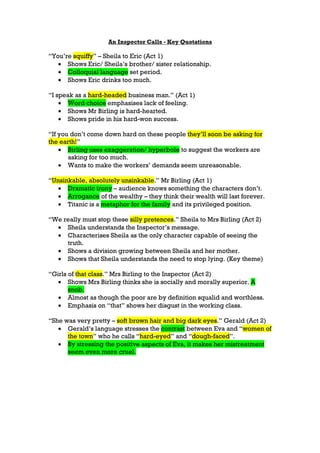
“You’re squiffy” – Sheila to Eric (Act 1)
   • Shows Eric/ Sheila’s brother/ sister relationship.
   • Colloquial language set period.
   • Shows Eric drinks too much.

“I speak as a hard-headed business man.” (Act 1)
    • Word choice emphasises lack of feeling.
    • Shows Mr Birling is hard-hearted.
    • Shows pride in his hard-won success.

“If you don’t come down hard on these people they’ll soon be asking for
the earth!”
    • Birling uses exaggeration/ hyperbole to suggest the workers are
       asking for too much.
    • Wants to make the workers’ demands seem unreasonable.

“Unsinkable, absolutely unsinkable.” Mr Birling (Act 1)
   • Dramatic irony – audience knows something the characters don’t.
   • Arrogance of the wealthy – they think their wealth will last forever.
   • Titanic is a metaphor for the family and its privileged position.

“We really must stop these silly pretences.” Sheila to Mrs Birling (Act 2)
  • Sheila understands the Inspector’s message.
  • Characterises Sheila as the only character capable of seeing the
     truth.
  • Shows a division growing between Sheila and her mother.
  • Shows that Sheila understands the need to stop lying. (Key theme)

“Girls of that class.” Mrs Birling to the Inspector (Act 2)
   • Shows Mrs Birling thinks she is socially and morally superior. A
       snob.
   • Almost as though the poor are by definition squalid and worthless.
   • Emphasis on “that” shows her disgust in the working class.

“She was very pretty – soft brown hair and big dark eyes.” Gerald (Act 2)
   • Gerald’s language stresses the contrast between Eva and “women of
      the town” who he calls “hard-eyed” and “dough-faced”.
   • By stressing the positive aspects of Eva, it makes her mistreatment
      seem even more cruel.
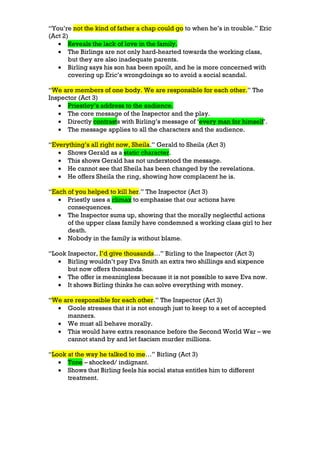
“You’re not the kind of father a chap could go to when he’s in trouble.” Eric
(Act 2)
   • Reveals the lack of love in the family.
   • The Birlings are not only hard-hearted towards the working class,
       but they are also inadequate parents.
   • Birling says his son has been spoilt, and he is more concerned with
       covering up Eric’s wrongdoings so to avoid a social scandal.

“We are members of one body. We are responsible for each other.” The
Inspector (Act 3)
   • Priestley’s address to the audience.
   • The core message of the Inspector and the play.
   • Directly contrasts with Birling’s message of ‘every man for himself’.
   • The message applies to all the characters and the audience.

“Everything’s all right now, Sheila.” Gerald to Sheila (Act 3)
   • Shows Gerald as a static character.
   • This shows Gerald has not understood the message.
   • He cannot see that Sheila has been changed by the revelations.
   • He offers Sheila the ring, showing how complacent he is.

“Each of you helped to kill her.” The Inspector (Act 3)
   • Priestly uses a climax to emphasise that our actions have
      consequences.
   • The Inspector sums up, showing that the morally neglectful actions
      of the upper class family have condemned a working class girl to her
      death.
   • Nobody in the family is without blame.

“Look Inspector, I’d give thousands…” Birling to the Inspector (Act 3)
   • Birling wouldn’t pay Eva Smith an extra two shillings and sixpence
      but now offers thousands.
   • The offer is meaningless because it is not possible to save Eva now.
   • It shows Birling thinks he can solve everything with money.

“We are responsible for each other.” The Inspector (Act 3)
  • Goole stresses that it is not enough just to keep to a set of accepted
     manners.
  • We must all behave morally.
  • This would have extra resonance before the Second World War – we
     cannot stand by and let fascism murder millions.

“Look at the way he talked to me…” Birling (Act 3)
   • Tone – shocked/ indignant.
   • Shows that Birling feels his social status entitles him to different
      treatment.
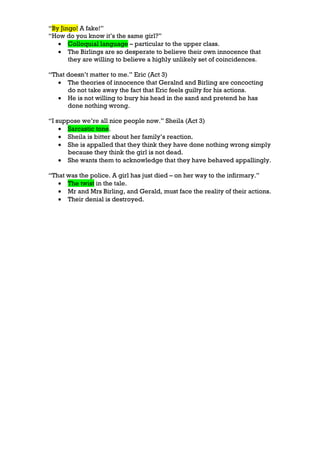
“By Jingo! A fake!”
“How do you know it’s the same girl?”
   • Colloquial language – particular to the upper class.
   • The Birlings are so desperate to believe their own innocence that
       they are willing to believe a highly unlikely set of coincidences.

“That doesn’t matter to me.” Eric (Act 3)
   • The theories of innocence that Geralnd and Birling are concocting
      do not take away the fact that Eric feels guilty for his actions.
   • He is not willing to bury his head in the sand and pretend he has
      done nothing wrong.

“I suppose we’re all nice people now.” Sheila (Act 3)
    • Sarcastic tone.
    • Sheila is bitter about her family’s reaction.
    • She is appalled that they think they have done nothing wrong simply
      because they think the girl is not dead.
    • She wants them to acknowledge that they have behaved appallingly.

“That was the police. A girl has just died – on her way to the infirmary.”
   • The twist in the tale.
   • Mr and Mrs Birling, and Gerald, must face the reality of their actions.
   • Their denial is destroyed.

An Inspector Calls - Quotations

  • 1.
    An Inspector Calls- Key Quotations “You’re squiffy” – Sheila to Eric (Act 1) • Shows Eric/ Sheila’s brother/ sister relationship. • Colloquial language set period. • Shows Eric drinks too much. “I speak as a hard-headed business man.” (Act 1) • Word choice emphasises lack of feeling. • Shows Mr Birling is hard-hearted. • Shows pride in his hard-won success. “If you don’t come down hard on these people they’ll soon be asking for the earth!” • Birling uses exaggeration/ hyperbole to suggest the workers are asking for too much. • Wants to make the workers’ demands seem unreasonable. “Unsinkable, absolutely unsinkable.” Mr Birling (Act 1) • Dramatic irony – audience knows something the characters don’t. • Arrogance of the wealthy – they think their wealth will last forever. • Titanic is a metaphor for the family and its privileged position. “We really must stop these silly pretences.” Sheila to Mrs Birling (Act 2) • Sheila understands the Inspector’s message. • Characterises Sheila as the only character capable of seeing the truth. • Shows a division growing between Sheila and her mother. • Shows that Sheila understands the need to stop lying. (Key theme) “Girls of that class.” Mrs Birling to the Inspector (Act 2) • Shows Mrs Birling thinks she is socially and morally superior. A snob. • Almost as though the poor are by definition squalid and worthless. • Emphasis on “that” shows her disgust in the working class. “She was very pretty – soft brown hair and big dark eyes.” Gerald (Act 2) • Gerald’s language stresses the contrast between Eva and “women of the town” who he calls “hard-eyed” and “dough-faced”. • By stressing the positive aspects of Eva, it makes her mistreatment seem even more cruel.
  • 2.
    “You’re not thekind of father a chap could go to when he’s in trouble.” Eric (Act 2) • Reveals the lack of love in the family. • The Birlings are not only hard-hearted towards the working class, but they are also inadequate parents. • Birling says his son has been spoilt, and he is more concerned with covering up Eric’s wrongdoings so to avoid a social scandal. “We are members of one body. We are responsible for each other.” The Inspector (Act 3) • Priestley’s address to the audience. • The core message of the Inspector and the play. • Directly contrasts with Birling’s message of ‘every man for himself’. • The message applies to all the characters and the audience. “Everything’s all right now, Sheila.” Gerald to Sheila (Act 3) • Shows Gerald as a static character. • This shows Gerald has not understood the message. • He cannot see that Sheila has been changed by the revelations. • He offers Sheila the ring, showing how complacent he is. “Each of you helped to kill her.” The Inspector (Act 3) • Priestly uses a climax to emphasise that our actions have consequences. • The Inspector sums up, showing that the morally neglectful actions of the upper class family have condemned a working class girl to her death. • Nobody in the family is without blame. “Look Inspector, I’d give thousands…” Birling to the Inspector (Act 3) • Birling wouldn’t pay Eva Smith an extra two shillings and sixpence but now offers thousands. • The offer is meaningless because it is not possible to save Eva now. • It shows Birling thinks he can solve everything with money. “We are responsible for each other.” The Inspector (Act 3) • Goole stresses that it is not enough just to keep to a set of accepted manners. • We must all behave morally. • This would have extra resonance before the Second World War – we cannot stand by and let fascism murder millions. “Look at the way he talked to me…” Birling (Act 3) • Tone – shocked/ indignant. • Shows that Birling feels his social status entitles him to different treatment.
  • 3.
    “By Jingo! Afake!” “How do you know it’s the same girl?” • Colloquial language – particular to the upper class. • The Birlings are so desperate to believe their own innocence that they are willing to believe a highly unlikely set of coincidences. “That doesn’t matter to me.” Eric (Act 3) • The theories of innocence that Geralnd and Birling are concocting do not take away the fact that Eric feels guilty for his actions. • He is not willing to bury his head in the sand and pretend he has done nothing wrong. “I suppose we’re all nice people now.” Sheila (Act 3) • Sarcastic tone. • Sheila is bitter about her family’s reaction. • She is appalled that they think they have done nothing wrong simply because they think the girl is not dead. • She wants them to acknowledge that they have behaved appallingly. “That was the police. A girl has just died – on her way to the infirmary.” • The twist in the tale. • Mr and Mrs Birling, and Gerald, must face the reality of their actions. • Their denial is destroyed.