Presented By:
 Mitali
 Faridul
 Aditya
 Abhik
 Ashish
 Saikat
 Prakhar
 Avishek
12 Angry Men can be classified as a
courtroom drama. The defense and the
prosecution have rested and the jury is
filing into the jury room to decide if a
young man is guilty or innocent of
murdering his father. What begins as an
open-and-shut case of murder soon
becomes a detective story that presents a
succession of clues creating doubt, and a
mini-drama of each of the jurors'
prejudices and preconceptions about the
trial, the accused, and each other. Based
on the play, all of the action takes place
on the stage of the jury room.
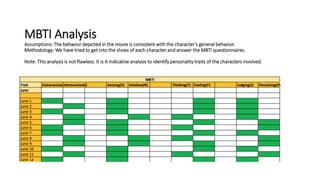
MBTI Analysis
Assumptions: The behavior depicted in the movie is consistent with the character’s general behavior.
Methodology: We have tried to get into the shoes of each character and answer the MBTI questionnaires.
Note: This analysis is not flawless. It is A Indicative analysis to identify personality traits of the characters involved.
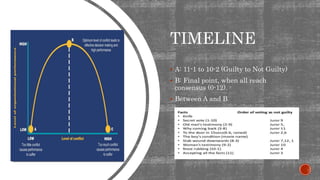
TIMELINE
 A: 11-1 to 10-2 (Guilty to Not Guilty)
 B: Final point, when all reach
consensus (0-12).
 Between A and B
When Vote Stood at 11-1
Setting the direction
• “ Lets talk for an hour. Ball Games doesn’t
start until 8:00
- Juror 8 Bargained with Juror 9 and persuaded
everyone to participate and work towards a goal
• Juror 10- “I have a story to tell”
• “ Juror 8 -” That’s not what we are sitting here
for “ – Clearly took the corrective action to
avoid any deviation
• “ Juror 8 -” Acted as a transformational
leader, providing rationality, direction and
sense of mission to solve the problem
• He then situationally only got involved when
he was needed or there were any deviations.
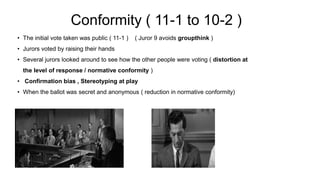
Conformity ( 11-1 to 10-2 )
• The initial vote taken was public ( 11-1 ) ( Juror 9 avoids groupthink )
• Jurors voted by raising their hands
• Several jurors looked around to see how the other people were voting ( distortion at
the level of response / normative conformity )
• Confirmation bias , Stereotyping at play
• When the ballot was secret and anonymous ( reduction in normative conformity)
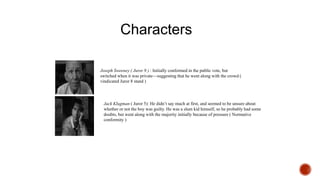
Joseph Sweeney ( Juror 9 ) : Initially conformed in the public vote, but
switched when it was private—suggesting that he went along with the crowd (
vindicated Juror 8 stand )
Jack Klugman ( Juror 5): He didn’t say much at first, and seemed to be unsure about
whether or not the boy was guilty. He was a slum kid himself, so he probably had some
doubts, but went along with the majority initially because of pressure ( Normative
conformity )
Characters
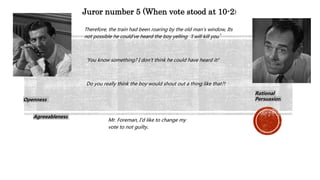
Juror number 5 (When vote stood at 10-2)
’You know something? I don’t think he could have heard it!’
Rational
PersuasionOpenness
Agreeableness
Therefore, the train had been roaring by the old man’s window, Its
not possible he could’ve heard the boy yelling ‘I will kill you’
Do you really think the boy would shout out a thing like that?!
Mr. Foreman, I’d like to change my
vote to not guilty.
He is a German immigrant to the US. A very self conscious and polite person. He notes down
points during discussion and then points those out to all other members, trying to persuade
them rationally. At the starting he showed signs of group thinking when he was not sure about
his vote but to confirm with the group he voted “Guilty”
Self conscious
Rational
Polite
Group think
At the end of this scene, vote stood at 8– 4 in favour of
punishment
Juror 11 changed his vote to
“Not guilty”
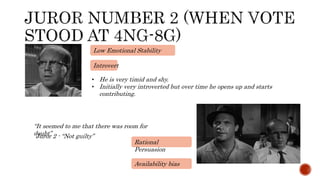
• He is very timid and shy.
• Initially very introverted but over time he opens up and starts
contributing.
Low Emotional Stability
Juror 2 - “Not guilty”
Rational
Persuasion
Introvert
Availability bias
“It seemed to me that there was room for
doubt”
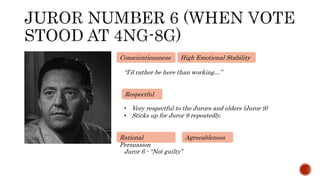
“I’d rather be here than working…”
Respectful
Juror 6 - “Not guilty”
Rational
Persuasion
Conscientiousness High Emotional Stability
• Very respectful to the Jurors and elders (Juror 9)
• Sticks up for Juror 9 repeatedly.
Agreeableness
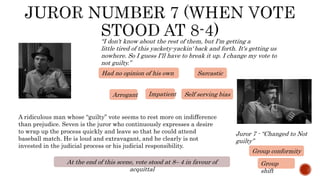
“I don't know about the rest of them, but I'm getting a
little tired of this yackety-yackin' back and forth. It's getting us
nowhere. So I guess I'll have to break it up. I change my vote to
not guilty.”
A ridiculous man whose “guilty” vote seems to rest more on indifference
than prejudice. Seven is the juror who continuously expresses a desire
to wrap up the process quickly and leave so that he could attend
baseball match. He is loud and extravagant, and he clearly is not
invested in the judicial process or his judicial responsibility.
Had no opinion of his own
Juror 7 - “Changed to Not
guilty”
Group
shift
Arrogant
Sarcastic
Self serving bias
Group conformity
Impatient
At the end of this scene, vote stood at 8– 4 in favour of
acquittal
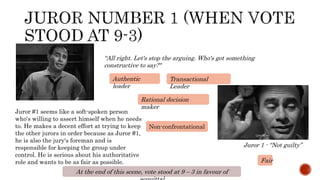
“All right. Let's stop the arguing. Who's got something
constructive to say?"
Juror #1 seems like a soft-spoken person
who's willing to assert himself when he needs
to. He makes a decent effort at trying to keep
the other jurors in order because as Juror #1,
he is also the jury's foreman and is
responsible for keeping the group under
control. He is serious about his authoritative
role and wants to be as fair as possible.
Authentic
leader
Juror 1 - “Not guilty”
Rational decision
maker
Transactional
Leader
Non-confrontational
Fair
At the end of this scene, vote stood at 9 – 3 in favour of
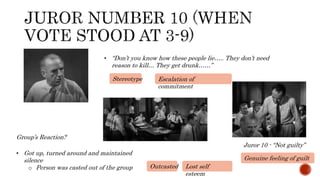
• “Don’t you know how these people lie….. They don’t need
reason to kill… They get drunk……”
• Got up, turned around and maintained
silence
o Person was casted out of the group
Stereotype
Group’s Reaction?
Juror 10 - “Not guilty”
Genuine feeling of guilt
Outcasted
Escalation of
commitment
Lost self
esteem
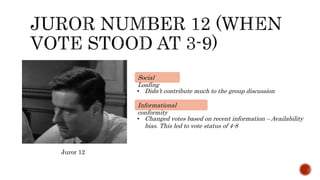
• Didn’t contribute much to the group discussion
Social
Loafing
Juror 12
• Changed votes based on recent information – Availability
bias. This led to vote status of 4-8
Informational
conformity
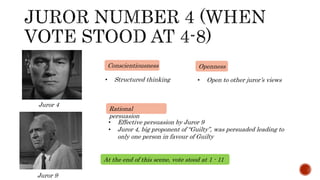
• Effective persuasion by Juror 9
• Juror 4, big proponent of “Guilty”, was persuaded leading to
only one person in favour of Guilty
Rational
persuasion
Juror 4
Juror 9
At the end of this scene, vote stood at 1 - 11
Conscientiousness Openness
• Structured thinking • Open to other juror’s views
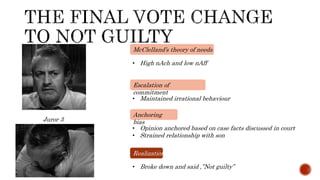
• Maintained irrational behaviour
Escalation of
commitment
Juror 3
Anchoring
bias
• Opinion anchored based on case facts discussed in court
• Strained relationship with son
Realization
• Broke down and said ,”Not guilty”
• High nAch and low nAff
McClelland’s theory of needs
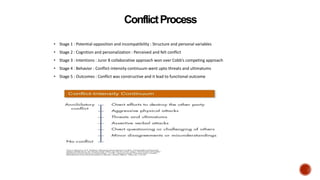
• Stage 1 : Potential opposition and incompatibility : Structure and personal variables
• Stage 2 : Cognition and personalization : Perceived and felt conflict
• Stage 3 : Intentions : Juror 8 collaborative approach won over Cobb’s competing approach
• Stage 4 : Behavior : Conflict-intensity continuum went upto threats and ultimatums
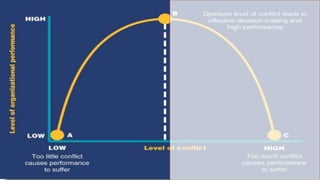
• Stage 5 : Outcomes : Conflict was constructive and it lead to functional outcome
ConflictProcess
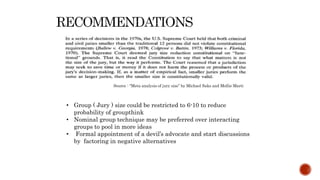
Source : “Meta analysis of jury size” by Michael Saks and Mollie Marti
• Group ( Jury ) size could be restricted to 6-10 to reduce
probability of groupthink
• Nominal group technique may be preferred over interacting
groups to pool in more ideas
• Formal appointment of a devil’s advocate and start discussions
by factoring in negative alternatives

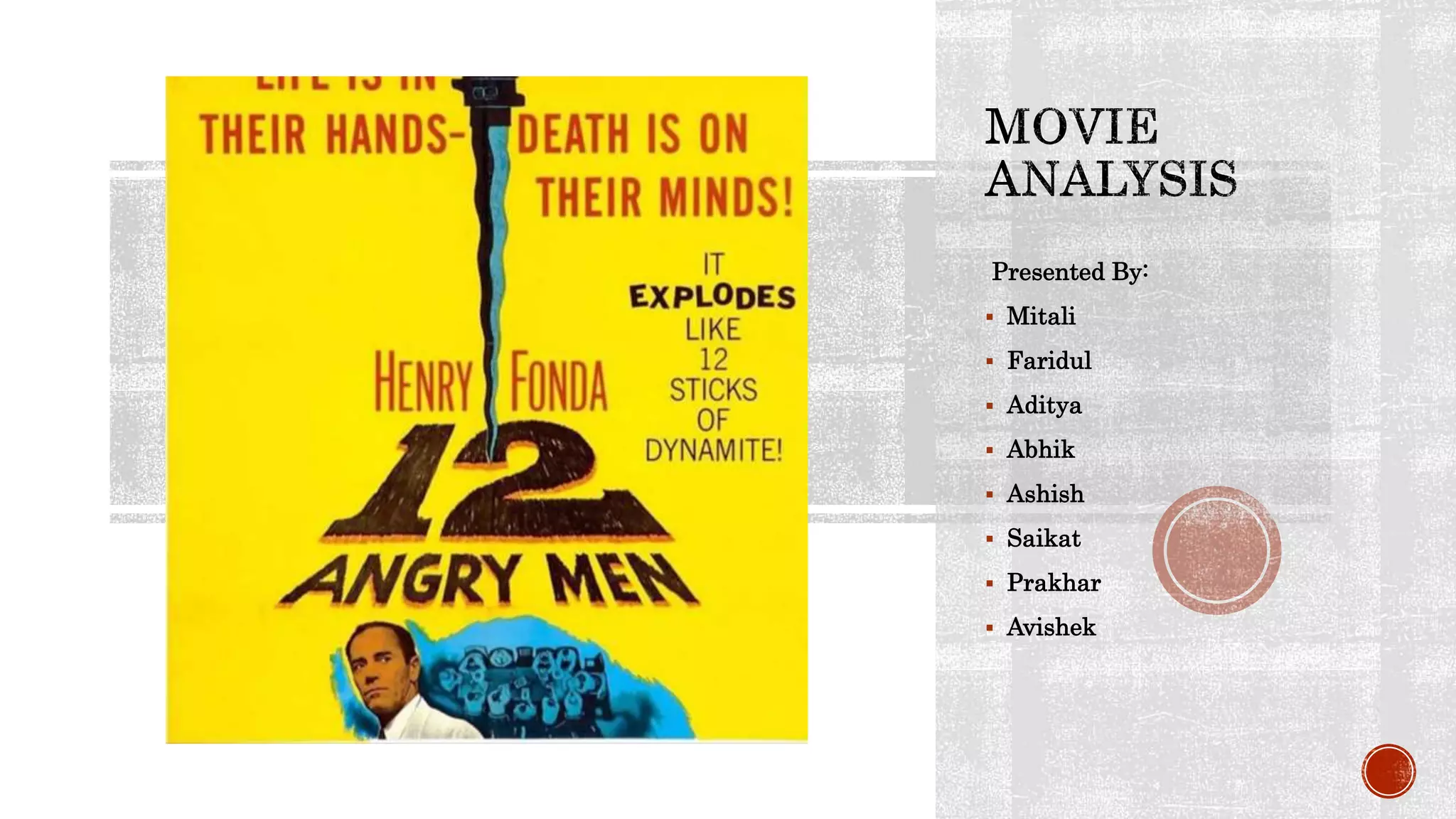
12 Angry Men

  • 1.
    Presented By:  Mitali Faridul  Aditya  Abhik  Ashish  Saikat  Prakhar  Avishek
  • 2.
    12 Angry Mencan be classified as a courtroom drama. The defense and the prosecution have rested and the jury is filing into the jury room to decide if a young man is guilty or innocent of murdering his father. What begins as an open-and-shut case of murder soon becomes a detective story that presents a succession of clues creating doubt, and a mini-drama of each of the jurors' prejudices and preconceptions about the trial, the accused, and each other. Based on the play, all of the action takes place on the stage of the jury room.
  • 5.
    MBTI Analysis Assumptions: Thebehavior depicted in the movie is consistent with the character’s general behavior. Methodology: We have tried to get into the shoes of each character and answer the MBTI questionnaires. Note: This analysis is not flawless. It is A Indicative analysis to identify personality traits of the characters involved.
  • 6.
    TIMELINE  A: 11-1to 10-2 (Guilty to Not Guilty)  B: Final point, when all reach consensus (0-12).  Between A and B
  • 7.
    When Vote Stoodat 11-1 Setting the direction • “ Lets talk for an hour. Ball Games doesn’t start until 8:00 - Juror 8 Bargained with Juror 9 and persuaded everyone to participate and work towards a goal • Juror 10- “I have a story to tell” • “ Juror 8 -” That’s not what we are sitting here for “ – Clearly took the corrective action to avoid any deviation • “ Juror 8 -” Acted as a transformational leader, providing rationality, direction and sense of mission to solve the problem • He then situationally only got involved when he was needed or there were any deviations.
  • 8.
    Conformity ( 11-1to 10-2 ) • The initial vote taken was public ( 11-1 ) ( Juror 9 avoids groupthink ) • Jurors voted by raising their hands • Several jurors looked around to see how the other people were voting ( distortion at the level of response / normative conformity ) • Confirmation bias , Stereotyping at play • When the ballot was secret and anonymous ( reduction in normative conformity)
  • 9.
    Joseph Sweeney (Juror 9 ) : Initially conformed in the public vote, but switched when it was private—suggesting that he went along with the crowd ( vindicated Juror 8 stand ) Jack Klugman ( Juror 5): He didn’t say much at first, and seemed to be unsure about whether or not the boy was guilty. He was a slum kid himself, so he probably had some doubts, but went along with the majority initially because of pressure ( Normative conformity ) Characters
  • 10.
    Juror number 5(When vote stood at 10-2) ’You know something? I don’t think he could have heard it!’ Rational PersuasionOpenness Agreeableness Therefore, the train had been roaring by the old man’s window, Its not possible he could’ve heard the boy yelling ‘I will kill you’ Do you really think the boy would shout out a thing like that?! Mr. Foreman, I’d like to change my vote to not guilty.
  • 11.
    He is aGerman immigrant to the US. A very self conscious and polite person. He notes down points during discussion and then points those out to all other members, trying to persuade them rationally. At the starting he showed signs of group thinking when he was not sure about his vote but to confirm with the group he voted “Guilty” Self conscious Rational Polite Group think At the end of this scene, vote stood at 8– 4 in favour of punishment Juror 11 changed his vote to “Not guilty”
  • 12.
    • He isvery timid and shy. • Initially very introverted but over time he opens up and starts contributing. Low Emotional Stability Juror 2 - “Not guilty” Rational Persuasion Introvert Availability bias “It seemed to me that there was room for doubt”
  • 13.
    “I’d rather behere than working…” Respectful Juror 6 - “Not guilty” Rational Persuasion Conscientiousness High Emotional Stability • Very respectful to the Jurors and elders (Juror 9) • Sticks up for Juror 9 repeatedly. Agreeableness
  • 14.
    “I don't knowabout the rest of them, but I'm getting a little tired of this yackety-yackin' back and forth. It's getting us nowhere. So I guess I'll have to break it up. I change my vote to not guilty.” A ridiculous man whose “guilty” vote seems to rest more on indifference than prejudice. Seven is the juror who continuously expresses a desire to wrap up the process quickly and leave so that he could attend baseball match. He is loud and extravagant, and he clearly is not invested in the judicial process or his judicial responsibility. Had no opinion of his own Juror 7 - “Changed to Not guilty” Group shift Arrogant Sarcastic Self serving bias Group conformity Impatient At the end of this scene, vote stood at 8– 4 in favour of acquittal
  • 15.
    “All right. Let'sstop the arguing. Who's got something constructive to say?" Juror #1 seems like a soft-spoken person who's willing to assert himself when he needs to. He makes a decent effort at trying to keep the other jurors in order because as Juror #1, he is also the jury's foreman and is responsible for keeping the group under control. He is serious about his authoritative role and wants to be as fair as possible. Authentic leader Juror 1 - “Not guilty” Rational decision maker Transactional Leader Non-confrontational Fair At the end of this scene, vote stood at 9 – 3 in favour of
  • 16.
    • “Don’t youknow how these people lie….. They don’t need reason to kill… They get drunk……” • Got up, turned around and maintained silence o Person was casted out of the group Stereotype Group’s Reaction? Juror 10 - “Not guilty” Genuine feeling of guilt Outcasted Escalation of commitment Lost self esteem
  • 17.
    • Didn’t contributemuch to the group discussion Social Loafing Juror 12 • Changed votes based on recent information – Availability bias. This led to vote status of 4-8 Informational conformity
  • 18.
    • Effective persuasionby Juror 9 • Juror 4, big proponent of “Guilty”, was persuaded leading to only one person in favour of Guilty Rational persuasion Juror 4 Juror 9 At the end of this scene, vote stood at 1 - 11 Conscientiousness Openness • Structured thinking • Open to other juror’s views
  • 19.
    • Maintained irrationalbehaviour Escalation of commitment Juror 3 Anchoring bias • Opinion anchored based on case facts discussed in court • Strained relationship with son Realization • Broke down and said ,”Not guilty” • High nAch and low nAff McClelland’s theory of needs
  • 21.
    • Stage 1: Potential opposition and incompatibility : Structure and personal variables • Stage 2 : Cognition and personalization : Perceived and felt conflict • Stage 3 : Intentions : Juror 8 collaborative approach won over Cobb’s competing approach • Stage 4 : Behavior : Conflict-intensity continuum went upto threats and ultimatums • Stage 5 : Outcomes : Conflict was constructive and it lead to functional outcome ConflictProcess
  • 22.
    Source : “Metaanalysis of jury size” by Michael Saks and Mollie Marti • Group ( Jury ) size could be restricted to 6-10 to reduce probability of groupthink • Nominal group technique may be preferred over interacting groups to pool in more ideas • Formal appointment of a devil’s advocate and start discussions by factoring in negative alternatives

Editor's Notes