Shakespeare’s play
Twelfth Night
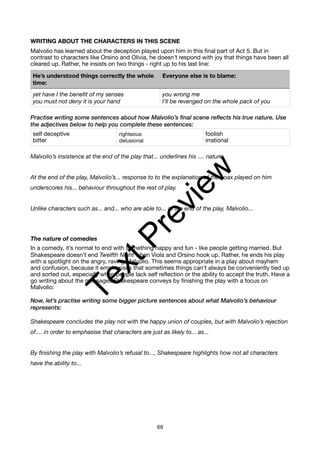
a tale of Disorder and Disguise
The
Student Activity Book
T
e
x
t
P
r
e
v
i
e
w
© This work is copyright 2024. Apart from any use permitted under the Copyright Act 1968, no part may be reproduced by any
process, nor may any other exclusive right be exercised, without the permission of Ticking Mind, 21 Miller St, Thornbury, 3071.
2
T
e
x
t
P
r
e
v
i
e
w
Table of Contents
THEMES……………………………… 4 ACT 4
ACT 1 Sc 1………………………………… 52
Sc 1………………………………… 6 Sc 2 ………………………………… 54
Sc 2 ………………………………… 8 Sc 3 ………………………………… 56
Sc 3 ………………………………… 10 Imagery writing activities………… 58
Sc 4 ………………………………… 12 Extended writing activities………… 59
Sc 5 (lines 1-80)…………………… 14 ACT 5
Sc 5 (lines 81-138)………………… 16 Sc 1 (lines 1-90)…………………… 60
Sc 5 (lines 139-265)………………… 18 Sc 1 (lines 91-160)…………………. 62
Imagery writing activities………… 20 Sc 1 (lines161-192)………………… 64
Extended writing activities………… 21 Sc 1 (lines 193-305)……………… 66
ACT 2 Sc 1 (lines 265-385)……………… 68
Sc 1………………………………… 22 Imagery writing activities………… 70
Sc 2 ………………………………… 24 Extended writing activities………… 71
Sc 3 ………………………………… 26
Sc 4 ………………………………… 28
Sc 5 ………………………………… 30
Imagery writing activities………… 32
Extended writing activities………… 33
ACT 3
Sc 1 (lines 1-71)……………………. 34
Sc 1 (lines 72-189)…………………. 36
Sc 2 ………………………………… 38
Sc 3 ………………………………… 40
Sc 4 (lines 1-119)………………… 42
Sc 4 (lines 120-184)……………… 44
Sc 4 (lines 185-264)……………… 46
Sc 4 (lines 265-344)……………… 48
Imagery writing activities………… 50
Extended writing activities………… 51
3
T
e
x
t
P
r
e
v
i
e
w
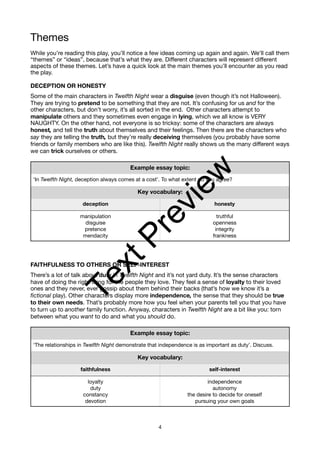
Themes
While you’re reading this play, you’ll notice a few ideas coming up again and again. We’ll call them
“themes” or “ideas”, because that’s what they are. Different characters will represent different
aspects of these themes. Let’s have a quick look at the main themes you’ll encounter as you read
the play.
DECEPTION OR HONESTY
Some of the main characters in Twelfth Night wear a disguise (even though it’s not Halloween).
They are trying to pretend to be something that they are not. It’s confusing for us and for the
other characters, but don’t worry, it’s all sorted in the end. Other characters attempt to
manipulate others and they sometimes even engage in lying, which we all know is VERY
NAUGHTY. On the other hand, not everyone is so tricksy: some of the characters are always
honest, and tell the truth about themselves and their feelings. Then there are the characters who
say they are telling the truth, but they’re really deceiving themselves (you probably have some
friends or family members who are like this). Twelfth Night really shows us the many different ways
we can trick ourselves or others.
FAITHFULNESS TO OTHERS OR SELF-INTEREST
There’s a lot of talk about duty in Twelfth Night and it’s not yard duty. It’s the sense characters
have of doing the right thing for the people they love. They feel a sense of loyalty to their loved
ones and they never, ever gossip about them behind their backs (that’s how we know it’s a
fictional play). Other characters display more independence, the sense that they should be true
to their own needs. That’s probably more how you feel when your parents tell you that you have
to turn up to another family function. Anyway, characters in Twelfth Night are a bit like you: torn
between what you want to do and what you should do.
Example essay topic:
‘In Twelfth Night, deception always comes at a cost’. To what extent do you agree?
Key vocabulary:
deception honesty
manipulation
disguise
pretence
mendacity
truthful
openness
integrity
frankness
Example essay topic:
‘The relationships in Twelfth Night demonstrate that independence is as important as duty’. Discuss.
Key vocabulary:
faithfulness self-interest
loyalty
duty
constancy
devotion
independence
autonomy
the desire to decide for oneself
pursuing your own goals
4
T
e
x
t
P
r
e
v
i
e
w
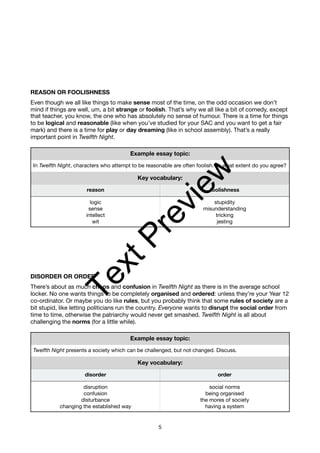
REASON OR FOOLISHNESS
Even though we all like things to make sense most of the time, on the odd occasion we don’t
mind if things are well, um, a bit strange or foolish. That’s why we all like a bit of comedy, except
that teacher, you know, the one who has absolutely no sense of humour. There is a time for things
to be logical and reasonable (like when you’ve studied for your SAC and you want to get a fair
mark) and there is a time for play or day dreaming (like in school assembly). That’s a really
important point in Twelfth Night.
DISORDER OR ORDER
There’s about as much chaos and confusion in Twelfth Night as there is in the average school
locker. No one wants things to be completely organised and ordered: unless they’re your Year 12
co-ordinator. Or maybe you do like rules, but you probably think that some rules of society are a
bit stupid, like letting politicians run the country. Everyone wants to disrupt the social order from
time to time, otherwise the patriarchy would never get smashed. Twelfth Night is all about
challenging the norms (for a little while).
Example essay topic:
In Twelfth Night, characters who attempt to be reasonable are often foolish. To what extent do you agree?
Key vocabulary:
reason foolishness
logic
sense
intellect
wit
stupidity
misunderstanding
tricking
jesting
Example essay topic:
Twelfth Night presents a society which can be challenged, but not changed. Discuss.
Key vocabulary:
disorder order
disruption
confusion
disturbance
changing the established way
social norms
being organised
the mores of society
having a system
5
T
e
x
t
P
r
e
v
i
e
w
Act 1: Scene 1
WHAT THE HECK IS HAPPENING?
In this opening scene of the play, Duke Orsino is sitting around in his palace, listening to some
tunes. The music playing must be classic Barry White, because Orsino comments on how music
puts him in the mood for love, and he wants these tunes to go on and on. And then, suddenly, he
doesn’t. Like a moody toddler, he shouts at the musicians to stop, because he’s sick of the
sounds they make. To distract the toddlerish Orsino, Curio asks if he wants to hunt deer and
because Curio has used the word “hart” (meaning male deer) to describe the deer, it makes the
Orsino think of love and how he totally ❤ Olivia. Luckily, at this point, Valentine walks in and
Orsino asks him about the latest gossip from Olivia. Valentine says that Olivia is still totally
bummed out because her brother has died and that Olivia doesn’t even want to think about dating
anyone for seven years. Being the sensitive kind of guy he is (not), Orsino says that this is a total
downer and a complete waste of hotness.
LET’S LOOK AT THE BIG PICTURE
In his plays, Shakespeare describes the world in terms of opposites, or extremes. What Orsino
talks about is a series of opposites, like this:
So, one of the key ideas is having too much of something, or just the right amount: such as
having lots of sensory delights (heaps of food, music, sweet smells and so on) compared with
depriving yourself (living like a nun, stopping the music).
As you analyse this play, you’re going to want to discuss how Shakespeare represents different
ideas, so let’s have a go practising now. Use the sentence stems below to write about how
Twelfth Night illustrates the clash of ideas:
From the very beginning of his play, Shakespeare presents his audience with contrasting ideas
of…and …
In the opening scene of Twelfth Night, Orsino is torn between…and …
From the outset of Twelfth Night, the audience is confronted with the character’s vacillation
between…and…
Then, use one of the sentence stems below and the quotes in the table above to help write a
follow-on sentence:
This [idea] is exemplified by Orsino saying….
When…says…., the audience is faced with the idea that…
On the one hand… But on the other…
give me excess of it Enough; no more:
’Tis not so sweet now as it was before
a bank of violets,
Stealing,
and giving odour!
and pitch soe’er
(i.e. the sea has high waves)
But falls into abatement and low price
(i.e. sometimes the sea is flat)
like a cloistress, she veiled will walk
(i.e. Olivia is like a nun because she’s grieving)
Away before me to sweet beds of flowers:
Love-thoughts lie rich
(i.e. I’d like to get into bed with Olivia and show her
how to be less nun-like)
6
T
e
x
t
P
r
e
v
i
e
w
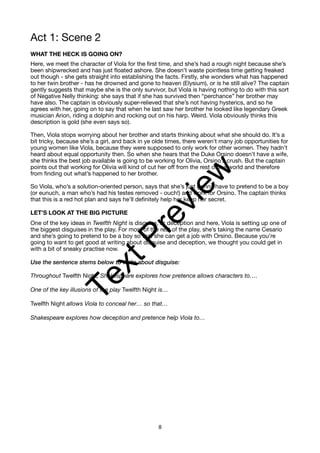
WRITING ABOUT THIS SCENE
The opening scene of the play is all about showing us what type of person Orsino is: his nature,
his beliefs, his values. Let’s look at some of the opinions Orsino has in this scene. Read each
quote carefully and then use the sentence starters to explain what he’s saying.
surfeiting = having too much
fell = fierce
E’er = ever
BUILDING VOCABULARY
An important skill in analysis is to use specific words to describe and discuss the characters and
ideas you are writing about. Circle three of the words below you could use to describe Orsino
based upon what he says in Scene 1.
Explain why these words are appropriate by putting each of them into a sentence:
Orsino is... because...
If music be the food of love, play on Music is like...
Give me excess of it, that surfeiting,
The appetite may sicken and so die.
Too much music and love will help Orsino...
O spirit of love, how quick and fresh art
thou...
Love is something that is...
O when my eyes did see Olivia first...
That instant was I turned into a hart,
And my desires like fell and cruel hounds
E’er since pursue me.
When Orsino first say Olivia, he became like a...
and was...
How will she love, when the rich golden shaft
Hath killed the flock of all affections else
That live in her
How will Olivia ever love, when her love for her dead
brother has...
passionate
emotional
idealistic
lovelorn
melancholic
lonely
desperate
overwhelmed by
consumed by
7
T
e
x
t
P
r
e
v
i
e
w
Act 1: Scene 2
WHAT THE HECK IS GOING ON?
Here, we meet the character of Viola for the first time, and she’s had a rough night because she’s
been shipwrecked and has just floated ashore. She doesn’t waste pointless time getting freaked
out though - she gets straight into establishing the facts. Firstly, she wonders what has happened
to her twin brother - has he drowned and gone to heaven (Elysium), or is he still alive? The captain
gently suggests that maybe she is the only survivor, but Viola is having nothing to do with this sort
of Negative Nelly thinking: she says that if she has survived then “perchance” her brother may
have also. The captain is obviously super-relieved that she’s not having hysterics, and so he
agrees with her, going on to say that when he last saw her brother he looked like legendary Greek
musician Arion, riding a dolphin and rocking out on his harp. Weird. Viola obviously thinks this
description is gold (she even says so).
Then, Viola stops worrying about her brother and starts thinking about what she should do. It’s a
bit tricky, because she’s a girl, and back in ye olde times, there weren’t many job opportunities for
young women like Viola, because they were supposed to only work for other women. They hadn’t
heard about equal opportunity then. So when she hears that the Duke Orsino doesn’t have a wife,
she thinks the best job available is going to be working for Olivia, Orsino’s crush. But the captain
points out that working for Olivia will kind of cut her off from the rest of the world and therefore
from finding out what’s happened to her brother.
So Viola, who’s a solution-oriented person, says that she’s just gonna have to pretend to be a boy
(or eunuch, a man who’s had his testes removed - ouch!) and work for Orsino. The captain thinks
that this is a red hot plan and says he’ll definitely help her keep her secret.
LET’S LOOK AT THE BIG PICTURE
One of the key ideas in Twelfth Night is disguise, or deception and here, Viola is setting up one of
the biggest disguises in the play. For most of the rest of the play, she’s taking the name Cesario
and she’s going to pretend to be a boy so that she can get a job with Orsino. Because you’re
going to want to get good at writing about disguise and deception, we thought you could get in
with a bit of sneaky practise now.
Use the sentence stems below to write about disguise:
Throughout Twelfth Night, Shakespeare explores how pretence allows characters to….
One of the key illusions of the play Twelfth Night is…
Twelfth Night allows Viola to conceal her… so that…
Shakespeare explores how deception and pretence help Viola to…
8
T
e
x
t
P
r
e
v
i
e
w
WRITING ABOUT CHARACTERS IN THIS SCENE
Having introduced Orsino, Shakespeare now shows us Viola. What do some of these key quotes
show us about Viola’s character?
abjured = given something up
Now, practise putting these quotes into some basic sentences:
Viola asks “...”, revealing her...
When Viola says “...”, she illustrates her...
BUILDING VOCABULARY:
Let’s begin to build your vocabulary to discuss Viola. Look through this list of actions and
descriptions and decide which you’d use to discuss how Viola is presented in this scene:
Try putting some of these words into these sentences:
On her arrival in Illyria, Viola ..., demonstrating...
When she initially comes to Illyria, Viola..., illustrating...
At the opening of the play, Viola’s rapid actions in... characterise her as... and...
Viola’s initial response to being in Illyria, when she... illustrates how...
What should I do in Illyria?
Who governs here?
What’s she?
The series of questions Viola asks shows that she
is...
Captain: [Olivia is grieving so she] hath abjured the
company / And sight of men.
Viola: O that I served that lady.
Viola’s admiration for Olivia’s actions shows she
values...
Verbs to describe Viola’s actions Ways to label Viola
reacts quickly to...
identifies immediately that...
rapidly develops a...
immediately engages in...
demonstrates the ability to...
prioritises the need to
wary / wariness
quick witted / quick wittedness
independent / independence
perceptive / perceptiveness
creative / creativity
decisive / decisiveness
9
T
e
x
t
P
r
e
v
i
e
w
Act 1: Scene 3
WHAT THE HECK IS GOING ON?
Another scene, another group of new characters. This time, we’re introduced to Sir Toby Belch
(Olivia’s uncle), Maria or Mary (Olivia’s housekeeper) and Sir Andrew Aguecheek (a complete
moron). These three will be responsible for the main comic subplot in the play.
In this scene, Maria is giving Sir Toby a warning that he’s been partying too hard. Given that he’s a
fat old man, this is supposed to be hilarious (he’s fat! he’s old!! he’s drinking a lot!!! I’m literally
ROTFL). The other thing that Maria is warning Sir Toby about is that his friend, Sir Andrew, is a
complete idiot and shouldn’t be trying to come on to Olivia (“woo” is just an old-fashioned term
for “putting the riz on”). Sir Toby says that Sir Andrew would be an awesome husband because
he’s super-rich, but Maria says that money doesn’t make up for being a total fool. Then Sir
Andrew himself walks in and Sir T asks him to put the smooth moves onto Maria. Maria is
completely unimpressed and walks off.
Then Sir Toby admires Sir Andrew’s hair (weird), Sir Andrew says that he’s thinking of leaving,
because Olivia is definitely not interested in him but Sir Toby convinces him to stay for another
month because neither of them have anything else to do. At the end of this scene, Sir Toby goes
on about how important it is to have a good time in life - that you should even dance a jig on the
way to and from church. Finally they both talk about how fantastic Sir Andrew’s legs look when
he’s dancing. Hilarious. Comedy gold.
LET’S LOOK AT THE BIG PICTURE
This whole subplot is a bit confusing in the play. It has almost nothing to do with the main action
and was supposed to get an Elizabethan audience roaring with laughter. I mean, one of the
characters is named Sir Toby Belch - it’s like a five-year-old got to name a character “Poo-bum-
head”.
But there are some important ideas in this subplot. Because the characters of Sir Toby and
Aguecheek are so over-the-top, we need to think about the idea of moderation.
Let’s look at some of the things that Maria says:
Ay, but you must confine yourself within the modest limits of order.
That quaffing and drinking will undo you. (Quaffing is an old-fashioned term for skulling.)
[Arguecheek is] a very fool and a prodigal. (A prodigal is someone who wastes money.)
Now let’s think about some of the things that Sir Toby says:
When talking about Olivia’s approach to grieving :I am sure care’s an enemy to life.
When talking about drinking: Confine! I’ll confine myself no finer than I am.
With drinking healths to my niece: I’ll drink to her as long as there is a passage in my throat and drink in
Illyria.
When talking about moving around: My very walk should be a jig…Is it a world to hid virtues in?
So what do you think?
Is Maria right that we should approach life with moderation, or is Sir Toby right that we should
enjoy ourselves as much as possible while we can?
10
T
e
x
t
P
r
e
v
i
e
w
WRITING ABOUT CHARACTERS IN THIS SCENE
This scene introduces three new characters. Maria is feisty, but also sensible and intelligent.
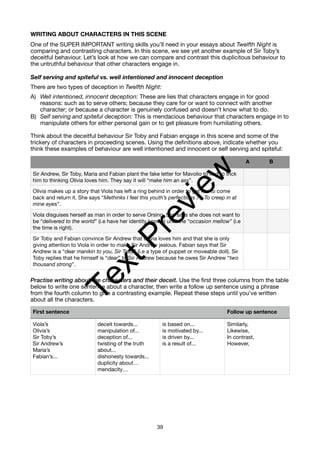
However, Sir Toby and Sir Andrew are much less sensible. How are we shown these elements of
each of the characters?
Names
To begin with, let’s think about the meaning of the characters’ names:
• Sir Toby Belch (belch = burp)
• Sir Andrew Aguecheek (ague = a fever)
• Maria (a traditional name - i.e Mary, the mother of Jesus)
Have a go finishing this sentence starter to analyse what the names reveal about the characters:
While the maternal overtones of Maria’s name show that she’s intelligent and sensible, Sir Toby
Belch and Andrew Arguecheek’s names indicate that they are ... and..
Quotes
Of course, the things the characters say also demonstrate their personalities. Unpack what these
quotes show us about each of the characters:
Sir Toby:
care = worrying about things
galliard = a lively dance
coranto = a running dance
Maria:
Sir Andrew:
wit = intelligence
caper = jump and leap
revels = drink and joke about
I am sure care’s* an enemy to life. Sir Toby’s attitude to life is that...
Why dost thou not go to church in a
galliard* and come home in coranto*?
Sir Toby's advice to Sir Andrew that he should...
shows that Sir Toby believes normal rules about how to behave
in society are...
You must confine yourself within the
modest limits of order.
Although Maria is friendly towards Sir Toby, she also believes...
I have no more wit* than a Christian or
ordinary man has.
I can cut a caper*
Shall we set about some revels*?
Throughout this scene, Sir Andrew’s comments show he has
a .... nature and is mostly interested in...
11
T
e
x
t
P
r
e
v
i
e
w
Act 1: Scene 4
WHAT THE HECK IS GOING ON?
For the first time, the audience is introduced to Viola disguised as Cesario. She’s chatting with
Valentine, who conveniently provides a bit of exposition to the the audience. He tells her:
• the Duke already thinks Cesario is a pretty handy character to have around
• Cesario has been working for the Duke for three days
• the Duke might even give Cesario a promotion.
Then the Duke comes in and starts behaving like he’s in Year 8, reminding Cesario that he has the
hots for Olivia and he wants Cesario to be his wingman and like, totally ask Olivia out. He thinks
that Olivia will listen to Year 8 stuff coming from Cesario, because Cesario does look pretty young.
LET’S LOOK AT THE BIG PICTURE
Even though this is a very little scene, it brings up a lot of the big ideas that you’ll want to discuss
when writing about this play.
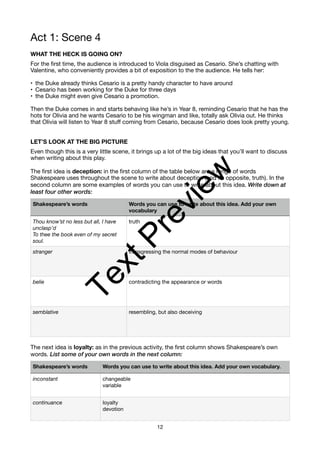
The first idea is deception: in the first column of the table below are a range of words
Shakespeare uses throughout the scene to write about deception (and its opposite, truth). In the
second column are some examples of words you can use to write about this idea. Write down at
least four other words:
The next idea is loyalty: as in the previous activity, the first column shows Shakespeare’s own
words. List some of your own words in the next column:
Shakespeare’s words Words you can use to write about this idea. Add your own
vocabulary
Thou know’st no less but all, I have
unclasp’d
To thee the book even of my secret
soul.
truth
stranger transgressing the normal modes of behaviour
belie contradicting the appearance or words
semblative resembling, but also deceiving
Shakespeare’s words Words you can use to write about this idea. Add your own vocabulary.
inconstant changeable
variable
continuance loyalty
devotion
12
T
e
x
t
P
r
e
v
i
e
w
WRITING ABOUT CHARACTERS IN THIS SCENE
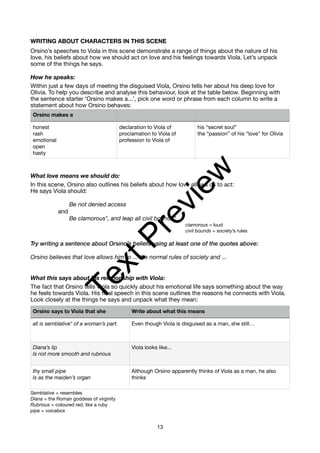
Orsino’s speeches to Viola in this scene demonstrate a range of things about the nature of his
love, his beliefs about how we should act on love and his feelings towards Viola. Let’s unpack
some of the things he says.
How he speaks:
Within just a few days of meeting the disguised Viola, Orsino tells her about his deep love for
Olivia. To help you describe and analyse this behaviour, look at the table below. Beginning with
the sentence starter ‘Orsino makes a...’, pick one word or phrase from each column to write a
statement about how Orsino behaves:
What love means we should do:
In this scene, Orsino also outlines his beliefs about how love allows us to act:
He says Viola should:
Be not denied access
and
Be clamorous*, and leap all civil bounds*
clamorous = loud
civil bounds = society’s rules
Try writing a sentence about Orsino’s beliefs using at least one of the quotes above:
Orsino believes that love allows him to ... the normal rules of society and ...
What this says about his relationship with Viola:
The fact that Orsino tells Viola so quickly about his emotional life says something about the way
he feels towards Viola. His final speech in this scene outlines the reasons he connects with Viola.
Look closely at the things he says and unpack what they mean:
Semblative = resembles
Diana = the Roman goddess of virginity
Rubrious = coloured red, like a ruby
pipe = voicebox
Orsino makes a
honest
rash
emotional
open
hasty
declaration to Viola of
proclamation to Viola of
profession to Viola of
his “secret soul”
the “passion” of his “love” for Olivia
Orsino says to Viola that she Write about what this means
all is semblative* of a woman’s part. Even though Viola is disguised as a man, she still…
Diana’s lip
Is not more smooth and rubrious
Viola looks like...
thy small pipe
Is as the maiden’s organ
Although Orsino apparently thinks of Viola as a man, he also
thinks
13
T
e
x
t
P
r
e
v
i
e
w
Act 1: Scene 5 (lines 1-80)
WHAT THE HECK IS HAPPENING?
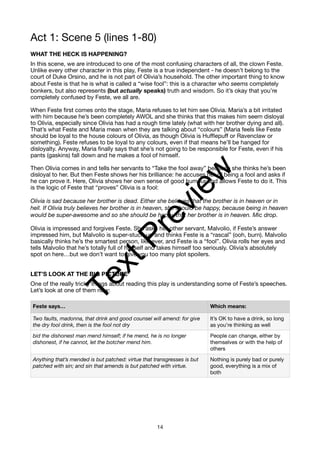
In this scene, we are introduced to one of the most confusing characters of all, the clown Feste.
Unlike every other character in this play, Feste is a true independent - he doesn’t belong to the
court of Duke Orsino, and he is not part of Olivia’s household. The other important thing to know
about Feste is that he is what is called a “wise fool”: this is a character who seems completely
bonkers, but also represents (but actually speaks) truth and wisdom. So it’s okay that you’re
completely confused by Feste, we all are.
When Feste first comes onto the stage, Maria refuses to let him see Olivia. Maria’s a bit irritated
with him because he’s been completely AWOL and she thinks that this makes him seem disloyal
to Olivia, especially since Olivia has had a rough time lately (what with her brother dying and all).
That’s what Feste and Maria mean when they are talking about “colours” (Maria feels like Feste
should be loyal to the house colours of Olivia, as though Olivia is Hufflepuff or Ravenclaw or
something). Feste refuses to be loyal to any colours, even if that means he’ll be hanged for
disloyalty. Anyway, Maria finally says that she’s not going to be responsible for Feste, even if his
pants (gaskins) fall down and he makes a fool of himself.
Then Olivia comes in and tells her servants to “Take the fool away” because she thinks he’s been
disloyal to her. But then Feste shows her his brilliance: he accuses her of being a fool and asks if
he can prove it. Here, Olivia shows her own sense of good humour and allows Feste to do it. This
is the logic of Feste that “proves” Olivia is a fool:
Olivia is sad because her brother is dead. Either she believes that the brother is in heaven or in
hell. If Olivia truly believes her brother is in heaven, she should be happy, because being in heaven
would be super-awesome and so she should be happy that her brother is in heaven. Mic drop.
Olivia is impressed and forgives Feste. She asks her other servant, Malvolio, if Feste’s answer
impressed him, but Malvolio is super-stuck-up and thinks Feste is a “rascal” (ooh, burn). Malvolio
basically thinks he’s the smartest person, like ever, and Feste is a “fool”. Olivia rolls her eyes and
tells Malvolio that he’s totally full of himself and takes himself too seriously. Olivia’s absolutely
spot on here…but we don’t want to give you too many plot spoilers.
LET’S LOOK AT THE BIG PICTURE
One of the really tricky things about reading this play is understanding some of Feste’s speeches.
Let’s look at one of them now:
Feste says… Which means:
Two faults, madonna, that drink and good counsel will amend: for give
the dry fool drink, then is the fool not dry
It’s OK to have a drink, so long
as you’re thinking as well
bid the dishonest man mend himself; if he mend, he is no longer
dishonest, if he cannot, let the botcher mend him.
People can change, either by
themselves or with the help of
others
Anything that’s mended is but patched: virtue that transgresses is but
patched with sin; and sin that amends is but patched with virtue.
Nothing is purely bad or purely
good, everything is a mix of
both
14
T
e
x
t
P
r
e
v
i
e
w
WRITING ABOUT CHARACTERS IN THIS SCENE
Being a fool is no joke in Twelfth Night. Feste, Malvolio and Olivia all discuss different aspects of
foolery and its consequences.
Feste:
In this quote, he is speaking directly to the spirit of Wit (intelligence). Unpack what it means:
wits = supposedly intelligent people
In this next set of quotes, Feste uses his foolery to prove to Olivia that she is also a fool:
Malvolio:
Not everyone likes Feste. In fact, Malvolio downright hates him. Look at the things Malvolio says
about Feste in the left column and brainstorm some words to describe what these attitudes show
about the type of person Malvolio is himself:
Olivia:
Olivia thinks Malvolio’s objection to Feste and foolery makes him a bit of a kill-joy. Unpack more
closely the things she says on this topic:
of = because of;
distempered = grumpy
bird bolts = harmless arrows
Those wits* that think they have thee do
very oft prove fools.
According to Feste, those people who see themselves as
intelligent can be…
Give me leave to prove you a fool.
The more fool, madonna, to mourn for your
brother’s soul being in heaven.
Feste is able to “prove” that Oliva is a fool because…
Malvolio says... Words to describe how Malvolio thinks of Feste:
barren rascal
no more brain than a stone
unless you laugh [at him]… he is gagged
O you are sick of* self-love, Malvolio, and
taste with a distempered appetite.
Malvolio is “sick” because he is…and this means that he
approaches life in a…way.
To be generous, guiltless, and of free
disposition is to take those things for bird-
bolts* that you deem cannon bullets.
Olivia believes that having a “free disposition” like Feste
helps a person to...
15
T
e
x
t
P
r
e
v
i
e
w
Act 1: Scene 5 (lines 81-138)
WHAT THE HECK IS HAPPENING?
Maria comes back onto the stage to tell Olivia that she has a visitor. Olivia wants to know what
kind of a person is visiting her and Maria tells her that he’s pretty good looking, wearing cool
threads (“a fair young man, and well attended”). Olivia thinks that this sounds like the kind of
visitor she’d like to see, but Maria points out that Sir Toby is getting in the way. So Olivia sends
Malvolio off to get rid of Sir Toby and find out if the hottie who’s visiting has been sent by Duke
Orsino.
Then Sir Toby staggers on stage, clearly wasted, and tells Olivia that her visitor is nothing special,
just your average “pickle-herring” (kinda like a Shakespearean version of “there’s plenty more fish
in the sea”). Clearly Sir Toby is annoyed that a younger (and way more sober, good-looking) man
than Arguecheek has turned up. Olivia tells Feste to take Sir Toby away and get him sobered up.
Finally, Malvolio comes back and tells Olivia that her visitor is pretty persistent and will not go
away. In fact, the visitor is going to stay until Olivia agrees to see him. Malvolio also describes the
visitor as one of “very ill manner” and half-way between being a boy and a man. So kind of like
your average high-school student.
Olivia finally gives up on all of these different descriptions and calls him in so that she can make
up her own mind.
LET’S LOOK AT THE BIG PICTURE
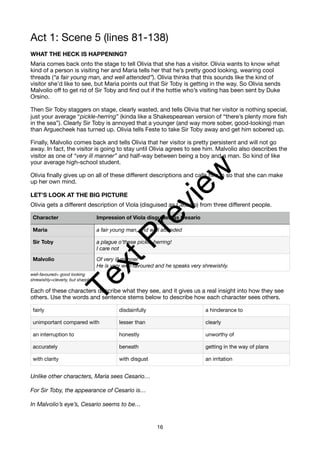
Olivia gets a different description of Viola (disguised as Cesario) from three different people.
well-favoured= good looking
shrewishly=cleverly, but sharply
Each of these characters describe what they see, and it gives us a real insight into how they see
others. Use the words and sentence stems below to describe how each character sees others.
Unlike other characters, Maria sees Cesario…
For Sir Toby, the appearance of Cesario is…
In Malvolio’s eye’s, Cesario seems to be…
Character Impression of Viola disguised as Cesario
Maria a fair young man, and well attended
Sir Toby a plague o’these pickle-herring!
I care not
Malvolio Of very ill manner
He is very well-favoured and he speaks very shrewishly.
fairly disdainfully a hinderance to
unimportant compared with lesser than clearly
an interruption to honestly unworthy of
accurately beneath getting in the way of plans
with clarity with disgust an irritation
16
T
e
x
t
P
r
e
v
i
e
w
WRITING ABOUT CHARACTERS IN THIS SCENE
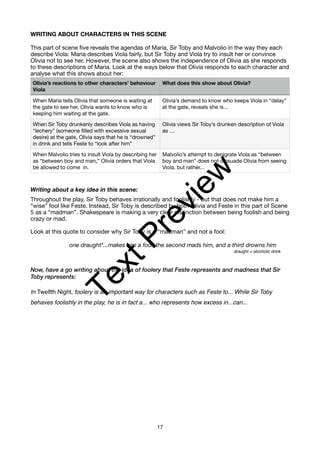
This part of scene five reveals the agendas of Maria, Sir Toby and Malvolio in the way they each
describe Viola: Maria describes Viola fairly, but Sir Toby and Viola try to insult her or convince
Olivia not to see her. However, the scene also shows the independence of Olivia as she responds
to these descriptions of Maria. Look at the ways below that Olivia responds to each character and
analyse what this shows about her:
Writing about a key idea in this scene:
Throughout the play, Sir Toby behaves irrationally and foolishly - but that does not make him a
“wise” fool like Feste. Instead, Sir Toby is described by both Olivia and Feste in this part of Scene
5 as a “madman”. Shakespeare is making a very clear distinction between being foolish and being
crazy or mad.
Look at this quote to consider why Sir Toby is a “madman” and not a fool:
one draught*...makes him a fool, the second mads him, and a third drowns him
draught = alcoholic drink
Now, have a go writing about the idea of foolery that Feste represents and madness that Sir
Toby represents:
In Twelfth Night, foolery is an important way for characters such as Feste to... While Sir Toby
behaves foolishly in the play, he is in fact a... who represents how excess in...can...
Olivia’s reactions to other characters’ behaviour
Viola
What does this show about Olivia?
When Maria tells Olivia that someone is waiting at
the gate to see her, Olivia wants to know who is
keeping him waiting at the gate.
Olivia’s demand to know who keeps Viola in “delay”
at the gate, reveals she is...
When Sir Toby drunkenly describes Viola as having
“lechery” (someone filled with excessive sexual
desire) at the gate, Olivia says that he is “drowned”
in drink and tells Feste to “look after him”
Olivia views Sir Toby’s drunken description of Viola
as …
When Malvolio tries to insult Viola by describing her
as “between boy and man,” Olivia orders that Viola
be allowed to come in.
Malvolio’s attempt to denigrate Viola as “between
boy and man” does not dissuade Olivia from seeing
Viola, but rather...
17
T
e
x
t
P
r
e
v
i
e
w
Act 1: Scene 5 (lines 139-265)
WHAT THE HECK IS GOING ON?
Here, at the end of Act One, the complicated love triangle of this play is complete: Olivia meets
Viola (disguised as Cesario) and falls in love.
When Viola first arrives onstage, she starts to talk to Olivia in stereotypical lovey-dovey ways:
“Most radiant, exquisite and unmatchable beauty…”. But it’s soon clear that Viola has way too
much of a sense of humour to go on and so she stops herself and makes a joke about how this is
way too good of a speech to waste on someone who is not Olivia. But then Olivia asks her to cut
to the chase and “forgive” (ie forget about) “the praise.” Viola must have practised it like a Year 12
oral presentation, because she doesn’t want to skip the speech. Maria steps in at this point and
offers to show Viola the door if she doesn’t get on with having a normal discussion.
Then Viola says she doesn’t want to talk about love in front of an audience: she thinks it should be
“secret as maidenhood.” So Olivia agrees to talk in private, but when Viola starts the speech
again, Olivia shows her sense of humour, asking “what chapter of his bosom” has Orsino’s speech
been written. Of course it’s idiotic to suggest that love is written on someone’s heart - even in
Shakespearean times everyone knew that the heart is just a lump of blood and muscle.
Viola asks Olivia to take her veil off, so they can see each other properly, and when Olivia does
take off her veil, Viola tries flattering her and telling her how super-hot she is. Olivia thinks this is
as boring and predictable as an episode of Emily in Paris and interrupts again. So Viola changes
strategies and talks about how Orsino is even better than Timothee Charlamet, but by now Olivia
is way more interested in Viola than boring old Orsino and so she starts asking Viola questions
about herself.
At the very end of the scene, Olivia is so interested in Viola that she sends her own messenger
(Malvolio) after her, pretending that Viola has left a ring behind (but it’s secretly Olivia’s own ring -
plot twist!). Just like Orsino, Olivia is using someone else as a love messenger! They’re all Year 8s!
It’s awesome.
LET’S LOOK AT THE BIG PICTURE
This scene contains two important symbols, and even though students often think that symbols
are hard, these two are pretty straightforward.
• There are a lot of similarities between Viola and Olivia - they’re both intelligent, witty and
independent. And also, their names are basically inversions of each other’s, using the same
letters: I-L-O-V-A (and an extra i for Olivia). Mind blown.
• Another really important symbol that’s used in this scene is the veil. Olivia starts the scene by
wearing a veil, but as they get to know each other and talk truthfully about love, Olivia removes
her veil, taking away a barrier between them, but also revealing herself, unveiling the truth about
her feelings.
Try writing about these symbols using the sentence starters below:
The similarities between Viola and Olivia are highlighted by…
Shakespeare underscores the complementary natures of Olivia and Viola by giving them names
which…
Removing her veil in front of Viola illustrates how Olivia….
By removing her veil, Olivia symbolically gestures that she is…
18
T
e
x
t
P
r
e
v
i
e
w
WRITING ABOUT CHARACTERS IN THIS SCENE
In this last part of scene 5, both Olivia and Viola engage in a playfulness that allows them to reveal
deep truths. Of course, Viola is playing at being Cesario, but more than that, both Olivia and Viola
are participating in a kind of play argument with each other which allows them to speak honestly.
One thing they both reveal is the attributes they love in a person. Look at the quotes below in the
left column and then in the right column, list words from the vocabulary table that describe what
Viola and Olivia value in a person they love:
cantons = songs; contemned = condemned (unrequited)
blazon= coat of arms (means a stamp of approval)
While Viola’s relationship with Olivia allows her space to speak honestly, it also creates a conflict
for her.
*burden of praise
Try discussing this struggle of Viola’s in a sentence. Finish the sentence starters below using a
quote in each of your sentences:
On the one hand, Viola empathises with Olivia as a woman and doesn’t want...
But on the other hand...
Viola believes a person should show their love
like this:
For Viola, the person she loves should be...
With groans that thunder love, with sighs of fire
With adorations, with fertile tears
Write loyal cantons* of contemned* love,
And sing them loud even in the dead of night
Olivia is attracted to Viola because: For Olivia, the person she loves should be...
Thy tongue, thy face, thy limbs, actions, and spirit
Do give thee five-fold blazon*
emotionally-charged profound passionate intelligent
vivacious confident attractive lively
well-spoken intense vocal full of life
active humorous witty consumed by love
As a woman, Viola does not want to make life
harder for another woman. She doesn’t want
Orsino’s declaration of love to be like…
But, Viola also loves Orsino. So when Olivia says
she doesn’t love him, Viola says:
an…overture of war
a…taxation of homage*
In your denial I...find no sense
19
T
e
x
t
P
r
e
v
i
e
w
WRITING ABOUT IMAGERY IN ACT 1
Act 1 introduces some of the key imagery that recurs throughout the play. Let’s have a close look
at three of them.
The changeable sea:
There are a lot of references to the sea in Twelfth Night and one of the key ideas associated with
the sea is that it changes: it has ups and downs (waves) and it changes with the tides. Some of
the characters have a more mutable or changeable attitude to love in the play, whereas other
characters are not like the sea and are steadfast. Shakespeare symbolises the changeability of
character’s emotions by using sea imagery:
Orsino: O spirit of Love, ... receiveth as the sea.
Maria: Will you hoist sail, sir?...Viola: No, good swagger, I am to hull here a little longer.
Sensory beauty and delights:
Shakespeare also uses sensory images of eating, music, smell and natural beauty to highlight
how physical pleasures are essential to nourish human emotional life. However, sometimes these
pleasures, like the drunkenness of Sir Toby and Andrew, can be taken to excess:
Orsino: If music be the food of love, play on.
Orsino: Love thoughts lie rich when caponised with bowers.
Viola: [I will] speak to him in many sorts of music.
Olivia: [about Sir Toby] he’s drowned [in drunkenness]
Sir Andrew: I am a great eater of beef and I believe that does harm to my wit.
When the time is right:
An important idea throughout the play is that sometimes we need to wait for the right time to do
things (like it’s appropriate to disguise yourself during the festival of Twelfth Night). We should also
let things develop naturally without trying to force or control them. Shakespeare emphasises this
idea through imagery of time developing naturally:
Viola: [I hope] might not be delivered to the world / Till I had mad mine own occasion mellow
Viola: What else may hap, to time I will commit.
Orsino: I know thy constellation is right apt.
Feste: let summer bear it out.
Olivia: fate, show they force...what is decreed must be.
Writing practise:
Using the notes and evidence from above as a guide, complete these sentence starters to
practise wring about the imagery used in this Act:
• Shakespeare foreshadows the changeability of Orsino’s love through the imagery of... which
represents...
• Despite the sea-like changeability of events, Viola demonstrates.... when she says “...”.
• When Viola says “...”, the imagery of... highlights how...
• Shakespeare uses the imagery of... through Olivia’s belief that “...” in order to underline that...
• Although sensory imagery such as Orsino’s delight in “...” represents the importance of...,
through Sir Toby’s... , Shakespeare demonstrates that...
20
T
e
x
t
P
r
e
v
i
e
w
EXTENDED WRITING PRACTICE ON ACT 1
As you reach the end of each Act, you should practise doing some extended writing by
responding to essay topics. Since you’ve only just started unpacking the play, this writing activity
will give you lots of sentence starters to guide you. Write a body paragraph in response to each of
the topics below using the sentence starters to help you.
‘In Twelfth Night, deception always comes at a cost’. Discuss.
Over the course of Twelfth Night, Viola’s disguise as... harms both... and...
Although she believes her disguise as... will help her to..., from the outset of the play she must...
her true feelings for…
So, her deceptive behaviour has a repressive impact on her ability to...
Moreover, when Viola, disguised as...meets Olivia, her pretence affects Olivia by...
Olivia is fooled by Viola’s appearance and feels…
Through the depth of Olivia’s ... and the way Viola herself is forced to..., Shakespeare
demonstrates that...
*Hint: Look again at pages 10-11 and 18-19 to find quotes and examples to help you complete this body paragraph.
“I’ll do my best / To woo your lady.”
‘Characters put duty ahead of their own interests’. To what extent do you agree?
Throughout Twelfth Night, some characters are able to sacrifice their own...in order to be faithful
to...
In her disguise as..., Viola chooses to serve... in order to…
Though she desires to be..., Viola dutifully...
In this way, Shakespeare portrays her as an inherently... character who...
In contrast, Sir Toby is a character who is motivated by...
In Act 1, Shakespeare presents Sir Toby as someone who would rather... than...
By doing this, Shakespeare underlines the.... portrait of Sir Toby through the imagery of…
Olivia describes Sir Toby as..., highlighting that...
By juxtaposing the actions of Viola and Sir Toby, Shakespeare emphasises that...
*Hint: Look again at pages 10-11, 12-13, 16-17 to find quotes and examples to help you complete this body paragraph.
21
T
e
x
t
P
r
e
v
i
e
w
Act 2: Scene 1
WHAT THE HECK IS HAPPENING?
For the first time, we meet Viola’s twin brother, Sebastian (and he’s just walking along, not riding a
dolphin, which is disappointing). He’s chatting with his new BFF Antonio, a man who “recovered”
him from the sea. Most of what they’re talking about is just to fill the audience in on who
Sebastian is and how he thinks his sister has drowned, which is really handy. Also, Sebastian tells
Antonio that he’s about to head off to Orsino’s court (and the audience can gasp and whisper to
each other, “I bet he’s going to find his sister! Ooh, it’s so exciting!”). Sebastian doesn’t think that
Antonio should be obliged to come, so he heads off on his own. Antonio then tells himself (and
the audience) that he “has many enemies in Orsino’s court,” so it would be dangerous for him to
go with Sebastian, but gosh, he likes Sebastian so much, and he’s got a bad case of FOMO, so
he decides to follow Sebastian.
LET’S LOOK AT THE BIG PICTURE
In many ways, this relationship is a parallel relationship to Viola and Orsino’s: there is a sense that
one person is serving the other and there are bonds of loyalty and love that Antonio and
Sebastian feel toward each other, just as Viola and Orsino do. In this scene, we can see that
Antonio is willing to risk his personal safety, to go with his friend, just as Viola is willing to risk her
love for Orsino to help him. Let’s look at these two risks side by side:
Use these sentence starters to write about how love is associated with risk:
The characters of Antonio and Viola are both willing to risk…..in order to prove their love.
For Viola and Antonio, love means that they will…
Both Antonio and Viola are prepared to endanger their own…in order to…
Viola and Antonio gamble with their own…so that they can…
Antonio: 2.1 Viola: 1.4
But, come what may, I do adore thee so,
That danger shall seem sport, and I will go.
I’ll do my best
To woo your lady: yet, a barful strife!
Whoe’er I woo, myself would be his wife.
22
T
e
x
t
P
r
e
v
i
e
w
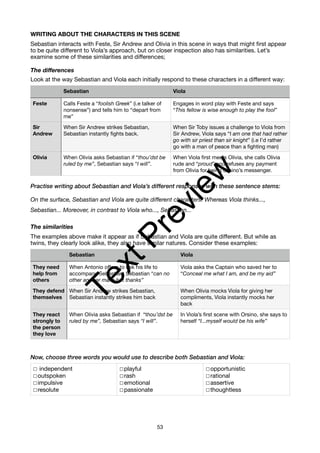
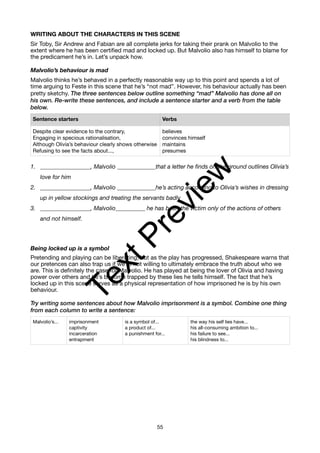
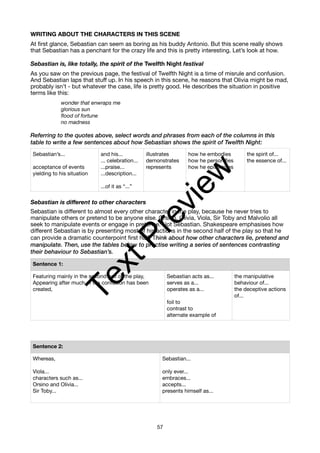
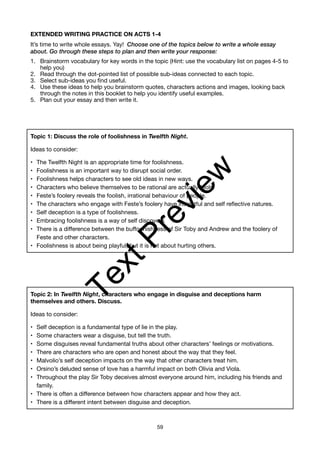
WRITING ABOUT IDEAS IN THIS SCENE
One important idea about love in Twelfth Night is that it creates a bond of fairness and equality
between two people. Both Viola and her brother Sebastian discuss the importance of this bond
being respected. Let’s look at how.
Viola:
In the previous scene, when Olivia offers to pay Viola a fee for being a messenger, Viola says:
Keep your purse; My master, not myself, lacks recompense*.
*recompense = payment for something
What do you think?
In what way does Viola think Olivia has disrespected or not given due “recompense” to Orsino?
Sebastian:
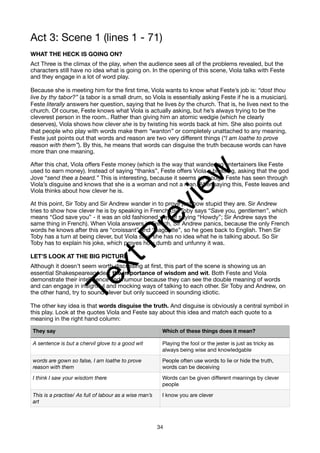
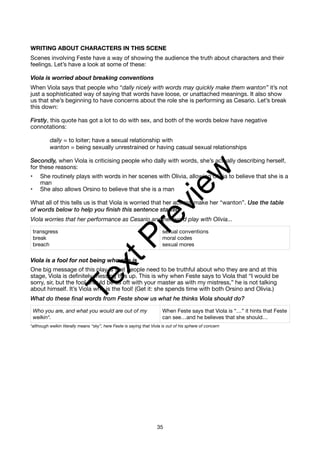
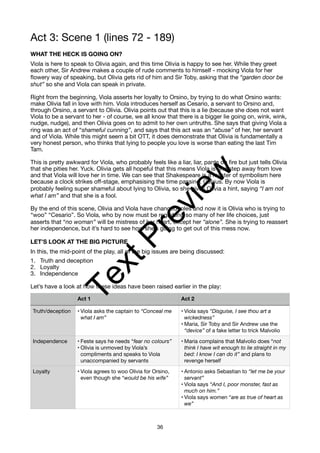
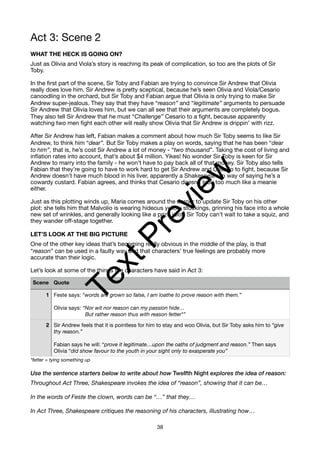
In 1.2, which immediately follows Olivia’s attempt to pay Viola at the end of Act 1, Sebastian also
uses the word “recompense” to talk about fairness in a relationship. Let’s look at his speech:
Now, have a go writing about Viola and Sebastian’s notion of “recompense” in love, using
these sentence starters:
In Twelfth Night, both Viola and Sebastian act according their belief that love...
Viola believes that Olivia has not given Orsino.... when she...
Arguing in a similar manner, Sebastian says that endangering Antonio would be...
Antonio:
While Sebastian feels strongly that his fate might endanger Antonio and therefore not be a fair
payment for Antonio’s love, Antonio himself believes the opposite. This is his argument about why
he should be allowed to accompany Sebastian on his adventure:
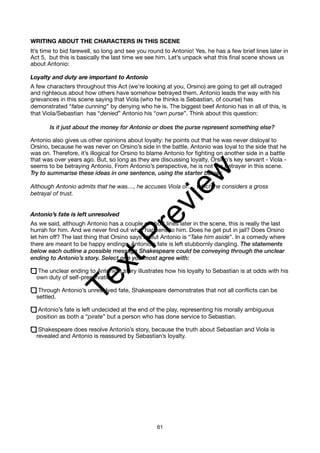
If you will not murder me* for my love, let me be your servant.”
murder me = cause me to die of love
What do you think?
Why does Antonio think Antonio’s actions might not respect their relationship?
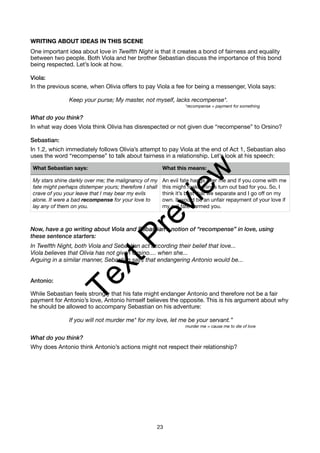
What Sebastian says: What this means:
My stars shine darkly over me; the malignancy of my
fate might perhaps distemper yours; therefore I shall
crave of you your leave that I may bear my evils
alone. It were a bad recompense for your love to
lay any of them on you.
An evil fate hangs over me and if you come with me
this might make things turn out bad for you. So, I
think it’s best that we separate and I go off on my
own. It would be an unfair repayment of your love if
my evil fate harmed you.
23
T
e
x
t
P
r
e
v
i
e
w
Act 2: Scene 2
WHAT THE HECK IS HAPPENING?
Back to Viola’s plot, where Malvolio is giving her a ring. Malvolio thinks that he is returning Viola’s
ring, and even accuses her of “peevishly” throwing it at Olivia. Malvolio also complains that it was
a LOT of effort to follow Viola and give her back the ring, as though carrying a ring is so hard and
heavy that you basically need to be Wolverine to do it. Just to prove what a great guy he is,
Malvolio throws the ring at Viola, telling her that “if it be worth stooping for, there it lies in your
eye.” Basically, he thinks that it’s probably a worthless piece of junk, but if she can be bothered
picking it up, she can find it for herself. What a prince.
Viola waits until he’s gone before she picks up the ring and then she starts to wonder why Olivia
sent it. Viola knows that it’s not hers, so realises there must be a reason Olivia has sent it.
Gradually, Viola starts to comprehend that Olivia thinks she’s a MAN (probably because she’s
been disguised as a man the whole time)!! And Viola starts to feel sorry for Olivia, because Olivia
has been tricked. Now she feels even more like she and Olivia are in the same position: Viola’s
disguise has prevented anyone understanding who they are truly in love with.
LET’S LOOK AT THE BIG PICTURE
Increasingly, Shakespeare is using ideas of fate or fortune in the play. It’s been there from the
beginning, but now we start to see how good luck or bad luck determines what will happen to
people. Let’s have a look at some places where the idea of luck has already occurred:
At the end of each of the last three scenes, a character sees that they are in a tricky situation, and
rather than worrying too much about the bad stuff that might happen, they decide to leave things
to fate:
Olivia: What is decreed must be, and be this so.
Antonio: come what may…I will go.
Viola: O time, though must untangle this, not I
Why do you think these characters accept fate rather than worrying about it?
they’re thoughtless characters
they demonstrating the idea that living life is about accepting its positives and negatives
it’s a comedy, so it’s about having fun
they’re hopeful, optimistic characters
acceptance means being open to possibilities.
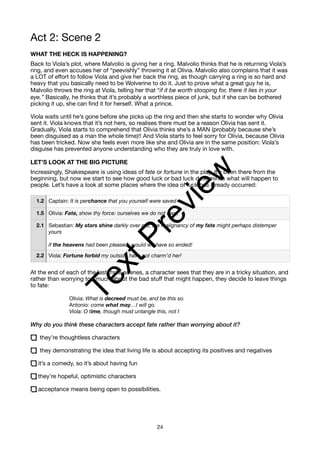
1.2 Captain: It is perchance that you yourself were saved
1.5 Olivia: Fate, show thy force: ourselves we do not owe;
2.1 Sebastian: My stars shine darkly over me; the malignancy of my fate might perhaps distemper
yours
if the heavens had been pleased, would we have so ended!
2.2 Viola: Fortune forbid my outside have not charm’d her!
24
T
e
x
t
P
r
e
v
i
e
w
WRITING ABOUT IDEAS IN THIS SCENE
Central to the whole of Twelfth Night, is the idea that disguises can provide freedom, opportunities
and the change to reveal emotional truths - such as the opportunity for Viola to work closely with
Orsino, and therefore find out that she loves him. The opposite is also true throughout the play:
disguises create confusion and disorder. In this scene, Viola is beginning to grapple with this
second, negative aspect of disguise. She is confronted by the idea that her disguise is so good,
that Olivia has now fallen in love with her. Here is an example of a typical analytic sentence you
might write in an essay discussing the two sides to the idea of disguise for the character of Viola:
Viola’s disguise as Cesario both allows her the freedom to speak truthfully, but also leads to the
“wickedness” of Olivia loving her as a man.
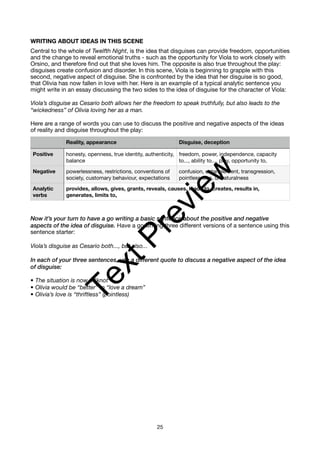
Here are a range of words you can use to discuss the positive and negative aspects of the ideas
of reality and disguise throughout the play:
Now it’s your turn to have a go writing a basic sentence about the positive and negative
aspects of the idea of disguise. Have a go writing three different versions of a sentence using this
sentence starter:
Viola’s disguise as Cesario both..., but also...
In each of your three sentences, use a different quote to discuss a negative aspect of the idea
of disguise:
• The situation is now a “knot”
• Olivia would be “better” to “love a dream”
• Olivia’s love is “thriftless” (pointless)
Reality, appearance Disguise, deception
Positive honesty, openness, true identity, authenticity,
balance
freedom, power, independence, capacity
to..., ability to..., play, opportunity to,
Negative powerlessness, restrictions, conventions of
society, customary behaviour, expectations
confusion, entanglement, transgression,
pointlessness, unnaturalness
Analytic
verbs
provides, allows, gives, grants, reveals, causes, leads to, creates, results in,
generates, limits to,
25
T
e
x
t
P
r
e
v
i
e
w
Act 2: Scene 3
WHAT THE HECK IS HAPPENING?
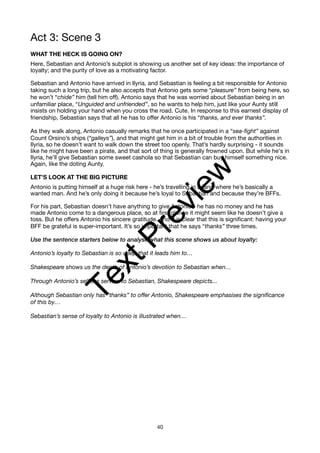
It’s the middle of the night and surprise, surprise, Sir Andrew and Sir Toby are drunk. Again. It’s so
late that they’ve decided that there’s no point going to bed and they may as well go on drinking.
Then Feste walks in and they ask him to sing a song (“a catch”). Sir Andrew tries to be impressive
by talking about made-up philosophers and Feste instantly outwits him by talking in made-up
Latin. Gosh, it’s hilarious - Shakespeare’s fans must have been choking with laughter. Feste starts
to sing a song and the two Sirs are so impressed that they ask him to sing another.
That’s when Maria comes in and tells them to be careful of making too much noise. But Sir
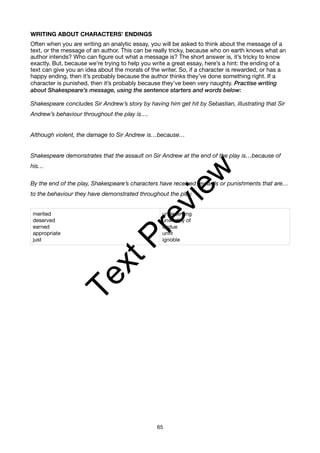
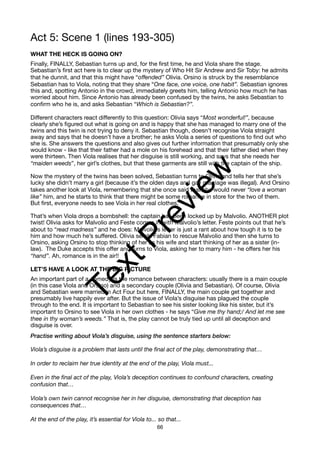
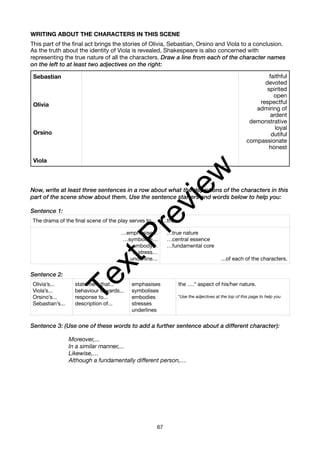
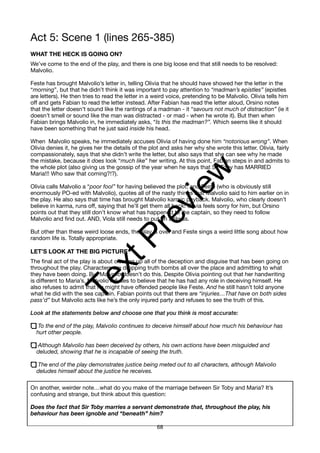
Andrew and Toby think they’re too hilarious to stop and so Malvolio comes in and makes a couple
of speeches about how badly they’re behaving and how they should listen to him because he’s
such an important man. And he tells Sir Toby to leave the house (and it’s pretty rude for a servant
to tell a Sir that he should leave, let me tell you!). When Sir Toby refuses to listen to him, Malvolio
turns on Maria and tells her off for letting them make so much noise. Having generally irritated
everyone in the room, Malvolio flounces out.
Maria wants the two Sirs to stop making so much noise, because Olivia is having trouble sleeping
and she also tells them not to worry too much about Malvolio, because she has a plan for making
him feel as stupid as he deserves to. She says that she’s going to write Malvolio a letter in Olivia’s
handwriting. In this letter, she’s going to describe Malvolio as a hottie, to make it seem like Olivia
has a major crush on Malvolio. The two Sirs think that this plan is red-hot and that Maria is a
genius for thinking of it. Then they need a drink to celebrate how brilliant this plan is. Another
drink, that is.
LET’S LOOK AT THE BIG PICTURE:
When Feste is singing, he’s actually pointing out a few important and wise things to the audience.
The first is this:
Journeys end in lovers meeting,
Every wise man’s son doth know.
That is, falling in love is a wise and important thing to do. Love is really important in this play.
The second thing is this:
Present mirth hath present laughter:…
Youth’s a stuff will not endure.
That is, being laughing and being silly is lovely and romantic when you are young, but maybe not
quite so charming when you’re as old as Sir Toby. In fact, Feste has a few truth-bombs for Sir
Toby in this scene:
In this scene, Feste is pointing out three things:
1. Sir Toby does not value love: he is trying to get Olivia to marry Sir Andrew only because it’s
convenient to him to have his niece marry his friend
2. Sir Toby lives as though he will never die: he drinks and parties as though there are no
consequences for his actions, even though he’s inconveniencing everyone around him
3. Sir Toby is a coward: he won’t face up to reality and he won’t even confront Malvolio.
Sir Toby says: Feste responds:
But I will never die Sir Toby, there you lie.
Shall I bid [Malvolio] go, and spare not? O no, no, no, no, you dare not
26
T
e
x
t
P
r
e
v
i
e
w
WRITING ABOUT CHARACTERS AND IDEAS IN THIS SCENE
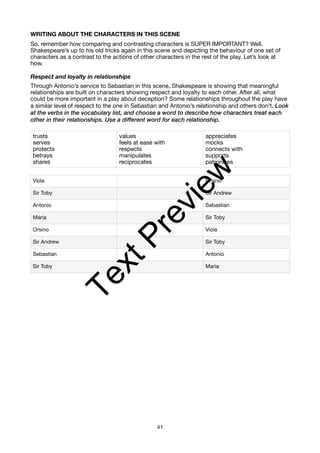
This scene really shows Malvolio at his rude and grumpy best. One of the reasons that we all think
Malvolio is a complete pain is that Shakespeare is deliberately creating a character who is awful.
That’s because Malvolio represents some important ideas. Let’s look more closely at some of
these ideas:
The truth
Speaking and seeing the truth is an important idea in the play. However, Malvolio is often blind to
the truth around him or wilfully misrepresents it. Think about some of these things that have
happened so far:
• He doesn’t know the ring he gives to Viola is Olivia’s, even though he must have had many
opportunities to see her wearing it.
• He says to Viola that she “threw” the ring at Olivia, even though Olivia said it was simply
“left...behind”.
• Maria is trying to make Sir Toby and Sir Andrew quieten down (“For the love o’God, peace!”),
but Malvolio doesn’t recognise this and says Olivia “shall know of it, by this hand” (i.e from
himself) that Maria is enabling all the partying.
Try writing about how Malvolio is blind to the truth. Give an example of his actions in the second
sentence:
Shakespeare characterises Malvolio as someone who… .
This is apparent when…
Self deception and self importance
More than any of the other characters in the play, Malvolio doesn’t seem to understand himself
and he thinks that he’s the ant’s pants. Already, Olivia has noted that he is full with “self love”.
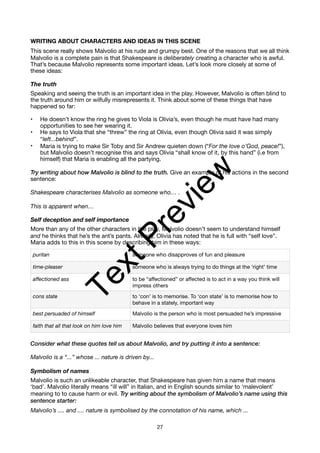
Maria adds to this in this scene by describing him in these ways:
Consider what these quotes tell us about Malvolio, and try putting it into a sentence:
Malvolio is a “...” whose ... nature is driven by...
Symbolism of names
Malvolio is such an unlikeable character, that Shakespeare has given him a name that means
‘bad’. Malvolio literally means “ill will” in Italian, and in English sounds similar to ‘malevolent’
meaning to to cause harm or evil. Try writing about the symbolism of Malvolio’s name using this
sentence starter:
Malvolio’s .... and .... nature is symbolised by the connotation of his name, which ...
puritan someone who disapproves of fun and pleasure
time-pleaser someone who is always trying to do things at the ‘right’ time
affectioned ass to be “affectioned” or affected is to act in a way you think will
impress others
cons state to ‘con’ is to memorise. To ‘con state’ is to memorise how to
behave in a stately, important way
best persuaded of himself Malvolio is the person who is most persuaded he’s impressive
faith that all that look on him love him Malvolio believes that everyone loves him
27
T
e
x
t
P
r
e
v
i
e
w
Act 2: Scene 4
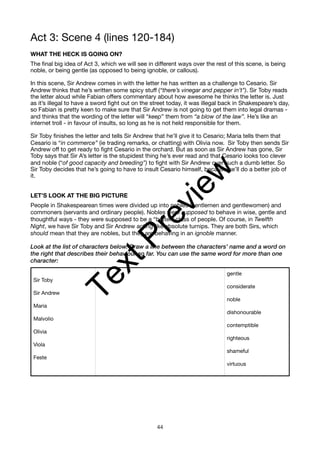
WHAT THE HECK IS HAPPENING?
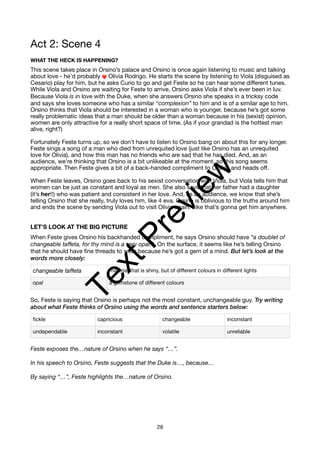
This scene takes place in Orsino’s palace and Orsino is once again listening to music and talking
about love - he’d probably ❤ Olivia Rodrigo. He starts the scene by listening to Viola (disguised as
Cesario) play for him, but he asks Curio to go and get Feste so he can hear some different tunes.
While Viola and Orsino are waiting for Feste to arrive, Orsino asks Viola if she’s ever been in luv.
Because Viola is in love with the Duke, when she answers Orsino she speaks in a tricksy code
and says she loves someone who has a similar “complexion” to him and is of a similar age to him.
Orsino thinks that Viola should be interested in a woman who is younger, because he’s got some
really problematic ideas that a man should be older than a woman because in his (sexist) opinion,
women are only attractive for a really short space of time. (As if your grandad is the hottest man
alive, right?)
Fortunately Feste turns up, so we don’t have to listen to Orsino bang on about this for any longer.
Feste sings a song of a man who died from unrequited love (just like Orsino has an unrequited
love for Olivia), and how this man has no friends who are sad that he has died. And, as an
audience, we’re thinking that Orsino is a bit unlikeable at the moment, so this song seems
appropriate. Then Feste gives a bit of a back-handed compliment to Orsino and heads off.
When Feste leaves, Orsino goes back to his sexist conversation with Viola, but Viola tells him that
women can be just as constant and loyal as men. She also says that her father had a daughter
(it’s her!!) who was patient and consistent in her love. And, as an audience, we know that she’s
telling Orsino that she really, truly loves him, like 4 eva. Orsino is oblivious to the truths around him
and ends the scene by sending Viola out to visit Olivia again. Like that’s gonna get him anywhere.
LET’S LOOK AT THE BIG PICTURE
When Feste gives Orsino his backhanded compliment, he says Orsino should have “a doublet of
changeable taffeta, for thy mind is a very opal.” On the surface, it seems like he’s telling Orsino
that he should have fine threads to wear because he’s got a gem of a mind. But let’s look at the
words more closely:
So, Feste is saying that Orsino is perhaps not the most constant, unchangeable guy. Try writing
about what Feste thinks of Orsino using the words and sentence starters below:
Feste exposes the…nature of Orsino when he says “…”.
In his speech to Orsino, Feste suggests that the Duke is…, because…
By saying “…”, Feste highlights the…nature of Orsino.
changeable taffeta material that is shiny, but of different colours in different lights
opal a gemstone of different colours
fickle capricious changeable inconstant
undependable inconstant volatile unreliable
28
T
e
x
t
P
r
e
v
i
e
w
WRITING ABOUT IDEAS IN THIS SCENE
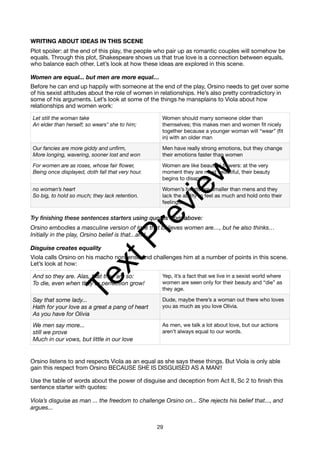
Plot spoiler: at the end of this play, the people who pair up as romantic couples will somehow be
equals. Through this plot, Shakespeare shows us that true love is a connection between equals,
who balance each other. Let’s look at how these ideas are explored in this scene.
Women are equal... but men are more equal…
Before he can end up happily with someone at the end of the play, Orsino needs to get over some
of his sexist attitudes about the role of women in relationships. He’s also pretty contradictory in
some of his arguments. Let’s look at some of the things he mansplains to Viola about how
relationships and women work:
Try finishing these sentences starters using quotes from above:
Orsino embodies a masculine version of love that believes women are…, but he also thinks…
Initially in the play, Orsino belief is that...and...
Disguise creates equality
Viola calls Orsino on his macho nonsense and challenges him at a number of points in this scene.
Let’s look at how:
Orsino listens to and respects Viola as an equal as she says these things. But Viola is only able
gain this respect from Orsino BECAUSE SHE IS DISGUISED AS A MAN!!
Use the table of words about the power of disguise and deception from Act II, Sc 2 to finish this
sentence starter with quotes:
Viola’s disguise as man ... the freedom to challenge Orsino on... She rejects his belief that..., and
argues...
Let still the woman take
An elder than herself; so wears* she to him;
Women should marry someone older than
themselves; this makes men and women fit nicely
together because a younger woman will “wear” (fit
in) with an older man
Our fancies are more giddy and unfirm,
More longing, wavering, sooner lost and won
Men have really strong emotions, but they change
their emotions faster than women
For women are as roses, whose fair flower,
Being once displayed, doth fall that very hour.
Women are like beautiful flowers: at the very
moment they are most beautiful, their beauty
begins to disappear.
no woman’s heart
So big, to hold so much; they lack retention.
Women’s hearts are smaller than mens and they
lack the ability to feel as much and hold onto their
feelings.
And so they are. Alas, that they are so:
To die, even when they to perfection grow!
Yep, it’s a fact that we live in a sexist world where
women are seen only for their beauty and “die” as
they age.
Say that some lady...
Hath for your love as a great a pang of heart
As you have for Olivia
Dude, maybe there’s a woman out there who loves
you as much as you love Olivia.
We men say more...
still we prove
Much in our vows, but little in our love
As men, we talk a lot about love, but our actions
aren’t always equal to our words.
29
T
e
x
t
P
r
e
v
i
e
w
Act 2: Scene 5
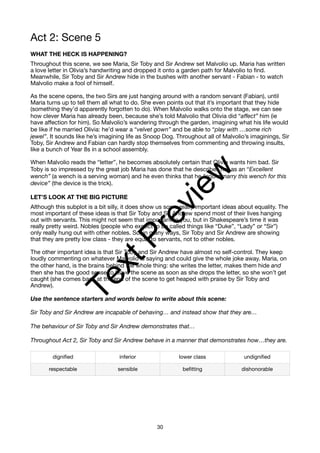
WHAT THE HECK IS HAPPENING?
Throughout this scene, we see Maria, Sir Toby and Sir Andrew set Malvolio up. Maria has written
a love letter in Olivia’s handwriting and dropped it onto a garden path for Malvolio to find.
Meanwhile, Sir Toby and Sir Andrew hide in the bushes with another servant - Fabian - to watch
Malvolio make a fool of himself.
As the scene opens, the two Sirs are just hanging around with a random servant (Fabian), until
Maria turns up to tell them all what to do. She even points out that it’s important that they hide
(something they’d apparently forgotten to do). When Malvolio walks onto the stage, we can see
how clever Maria has already been, because she’s told Malvolio that Olivia did “affect” him (ie
have affection for him). So Malvolio’s wandering through the garden, imagining what his life would
be like if he married Olivia: he’d wear a “velvet gown” and be able to “play with …some rich
jewel”. It sounds like he’s imagining life as Snoop Dog. Throughout all of Malvolio’s imaginings, Sir
Toby, Sir Andrew and Fabian can hardly stop themselves from commenting and throwing insults,
like a bunch of Year 8s in a school assembly.
When Malvolio reads the “letter”, he becomes absolutely certain that Olivia wants him bad. Sir
Toby is so impressed by the great job Maria has done that he describes her as an “Excellent
wench” (a wench is a serving woman) and he even thinks that he “could marry this wench for this
device” (the device is the trick).
LET’S LOOK AT THE BIG PICTURE
Although this subplot is a bit silly, it does show us some really important ideas about equality. The
most important of these ideas is that Sir Toby and Sir Andrew spend most of their lives hanging
out with servants. This might not seem that important to you, but in Shakespeare’s time it was
really pretty weird. Nobles (people who expect to be called things like “Duke”, “Lady” or “Sir”)
only really hung out with other nobles. So, in many ways, Sir Toby and Sir Andrew are showing
that they are pretty low class - they are equal to servants, not to other nobles.
The other important idea is that Sir Toby and Sir Andrew have almost no self-control. They keep
loudly commenting on whatever Malvolio is saying and could give the whole joke away. Maria, on
the other hand, is the brains behind the whole thing: she writes the letter, makes them hide and
then she has the good sense to leave the scene as soon as she drops the letter, so she won’t get
caught (she comes back at the end of the scene to get heaped with praise by Sir Toby and
Andrew).
Use the sentence starters and words below to write about this scene:
Sir Toby and Sir Andrew are incapable of behaving… and instead show that they are…
The behaviour of Sir Toby and Sir Andrew demonstrates that…
Throughout Act 2, Sir Toby and Sir Andrew behave in a manner that demonstrates how…they are.
dignified inferior lower class undignified
respectable sensible befitting dishonorable
30
T
e
x
t
P
r
e
v
i
e
w
WRITING ABOUT THE IDEAS IN THIS SCENE
Yep, Malvolio is at it again, being an egotistic, pompous old snob. Let’s look at the ideas
Shakespeare explores through Malvolio’s behaviour.
It’s wrong to seek power over others
In his first part of this scene, Malvolio engages in a very specific fantasy about what he would do
if he were married to Olivia and had power. He doesn’t dream of having a good time and spending
a lot of money. Rather, this is what he thinks up:
[I would call] my officers about me, in my branched velvet gown, having come from a day bed,
where I have left Olivia sleeping - to ask for my kinsman* Toby. Seven of my people, with an
obedient start*, make out for him. I frown the while, and perchance wind up my watch, or play with
my - some rich jewel. Toby approaches; curtsies there to me - I extend my hand to him thus,
quenching* my familiar smile with an austere regard of control* - Saying, ‘You must amend your
drunkenness’
kinsman = relation (through marriage)
obedient start = jump at my command
quenching = stopping
austere regard of control = put on a cold glare
What’s so interesting about this speech, is the amount of detail Malvolio has in his fantasy about
what having power. He thinks about what he would look like with power and how he would show
his power over others.
Try using the sentence starters below to write about how this fantasy shows Malvolio is a SICK
PUPPY. In the first sentence, use words from the table.
Malvolio’s revenge fantasy towards Sir Toby, reveals a…
Now write a second sentence, using one or more quotes from his speech:
His dream of power includes the desire to... and..., illustrating his egotistic need for...
Self importance makes us blind
In the next part of the scene, when Malvolio picks up the fake letter from the ground, he is quick
to believe that it has been written by Olivia and is about him. This requires a fairly wilful blindness.
Rather than thinking about what Olivia really thinks or how she would actually behave, Malvolio
mistakenly believes that Olivia:
• has just left a letter lying on the ground about her true love when she has publicly said she
would not be courted by any man.
• would say something like be “surly (rude) with servants,” when she herself asks servants to do
things using phrases like “I pray you”.
• commended him for his “yellow stockings”, when (as Maria later points out), she hates yellow.
Try writing about Malvolio’s desires and actions with these sentence starters:
disturbing
vainglorious
conceited
desire
urge
wish
to demonstrate
to act out
to display
power over...
authority over...
control over...
Malvolio’s “self love”...
Malvolio’s blindness to the true nature of Olivia...
Malvolio’s desire for power...
drives him to...
fuels his...
makes him oblivious to...
31
T
e
x
t
P
r
e
v
i
e
w
WRITING ABOUT IMAGERY IN ACT 2
Act 2 continues the use of sea imagery and also introduces symbols of sickness and constancy.
Let’s look at the evidence and practise writing about these images:
Sickness:
Throughout Twelfth Night, Shakespeare uses imagery of sickness to show how characters are
overdoing things, or behaving in unbalanced ways. He uses lots of old-fashioned terms for
sickness, like pestilence or distemper.
Orsino: [thinks Olivia purges] the air of pestilence.
Olivia: O you are sick of [with] self-love, Malvolio, and taste with a distempered appetite.
Sebastian [to Antonio]: the malignancy of my fate might perhaps distemper yours.
Sir Toby [about the catchiness of Feste’s singing]: A contagious breath.
Malvolio [describes Sir Andrew and Sir Toby’s drunken parties as]: disorders
Sea and constancy imagery:
In Act 2, Shakespeare continues to use some imagery of the sea to highlight how changeable
people feel, but in addition to this, he further emphasises the motif of constancy by using the
word itself. Not only does he explicitly refer to constancy, but he uses words like giddy and infirm
to show the changeability of emotions:
Orsino: mine [love] is all as hungry as the sea.
Feste: I would have men of such constancy put to sea.
Orsino: I am as all true lovers are, / Unstaid and skittish...Save in the constant image of the
creature / That is beloved.
Orsino: Our [i.e men] fancies are more giddy and unfirm...Than women’s are.
Orsino: these brisk and giddy-paced times.
Writing practice:
Using the notes and evidence from above, complete these sentence starters to write about the
images and motifs in the play:
• To highlight the …nature of Sir Toby’s behaviour, Shakespeare uses…imagery.
• Malvolio is described as “…” to emphasise how…he is…
• The interaction between Feste and Orsino uses images of…to highlight how…
• Although Orsino claims to love Olivia, he admits…which demonstrates…
• When Orsino speaks to Viola, he describes men as “…” which indicates…
32
T
e
x
t
P
r
e
v
i
e
w
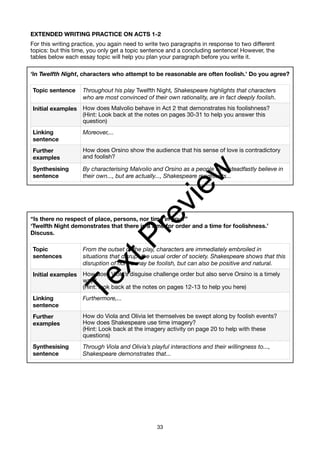
EXTENDED WRITING PRACTICE ON ACTS 1-2
For this writing practice, you again need to write two paragraphs in response to two different
topics: but this time, you only get a topic sentence and a concluding sentence! However, the
tables below each essay topic will help you plan your paragraph before you write it.
‘In Twelfth Night, characters who attempt to be reasonable are often foolish.’ Do you agree?
“Is there no respect of place, persons, nor time in you?”
‘Twelfth Night demonstrates that there is a time for order and a time for foolishness.’
Discuss.
Topic sentence Throughout his play Twelfth Night, Shakespeare highlights that characters
who are most convinced of their own rationality, are in fact deeply foolish.
Initial examples How does Malvolio behave in Act 2 that demonstrates his foolishness?
(Hint: Look back at the notes on pages 30-31 to help you answer this
question)
Linking
sentence
Moreover,...
Further
examples
How does Orsino show the audience that his sense of love is contradictory
and foolish?
Synthesising
sentence
By characterising Malvolio and Orsino as a people who steadfastly believe in
their own..., but are actually..., Shakespeare represents...
Topic
sentences
From the outset of the play, characters are immediately embroiled in
situations that disrupt the usual order of society. Shakespeare shows that this
disruption of norms may be foolish, but can also be positive and natural.
Initial examples How does Viola’s disguise challenge order but also serve Orsino is a timely
way?
(Hint: look back at the notes on pages 12-13 to help you here)
Linking
sentence
Furthermore,...
Further
examples
How do Viola and Olivia let themselves be swept along by foolish events?
How does Shakespeare use time imagery?
(Hint: Look back at the imagery activity on page 20 to help with these
questions)
Synthesising
sentence
Through Viola and Olivia’s playful interactions and their willingness to...,
Shakespeare demonstrates that...
33
T
e
x
t
P
r
e
v
i
e
w
Act 3: Scene 1 (lines 1 - 71)
WHAT THE HECK IS GOING ON?
Act Three is the climax of the play, when the audience sees all of the problems revealed, but the
characters still have no idea what is going on. In the opening of this scene, Viola talks with Feste
and they engage in a lot of word play.
Because she is meeting him for the first time, Viola wants to know what Feste’s job is: “dost thou
live by thy tabor?” (a tabor is a small drum, so Viola is essentially asking Feste if he is a musician).
Feste literally answers her question, saying that he lives by the church. That is, he lives next to the
church. Of course, Feste knows what Viola is actually asking, but he’s always trying to be the
cleverest person in the room.. Rather than giving him an atomic wedgie (which he clearly
deserves), Viola shows how clever she is by twisting his words back at him. She also points out
that people who play with words make them “wanton” or completely unattached to any meaning.
Feste just points out that words and reason are two very different things (“I am loathe to prove
reason with them”). By this, he means that words can disguise the truth because words can have
more than one meaning.
After this chat, Viola offers Feste money (which is the way that wandering entertainers like Feste
used to earn money). Instead of saying “thanks”, Feste offers Viola a blessing, asking that the god
Jove “send thee a beard.” This is interesting, because it seems as though Feste has seen through
Viola’s disguise and knows that she is a woman and not a man. After saying this, Feste leaves and
Viola thinks about how clever he is.
At this point, Sir Toby and Sir Andrew wander in to prove just how stupid they are. Sir Andrew
tries to show how clever he is by speaking in French (Sir Toby says “Save you, gentlemen”, which
means “God save you” - it was an old fashioned way of saying “Howdy”; Sir Andrew says the
same thing in French). When Viola answers in French, Sir Andrew panics, because the only French
words he knows after this are “croissant” and “baguette”, so he goes back to English. Then Sir
Toby has a turn at being clever, but Viola says she has no idea what he is talking about. So Sir
Toby has to explain his joke, which proves how dumb and unfunny it was.
LET’S LOOK AT THE BIG PICTURE
Although it doesn’t seem worth discussing at first, this part of the scene is showing us an
essential Shakespearean idea: the importance of wisdom and wit. Both Feste and Viola
demonstrate their intelligence and humour because they can see the double meaning of words
and can engage in insightful and mocking ways of talking to each other. Sir Toby and Andrew, on
the other hand, try to sound clever but only succeed in sounding idiotic.
The other key idea is that words disguise the truth. And disguise is obviously a central symbol in
this play. Look at the quotes Viola and Feste say about this idea and match each quote to a
meaning in the right hand column:
They say Which of these things does it mean?
A sentence is but a chervil glove to a good wit Playing the fool or the jester is just as tricky as
always being wise and knowledgable
words are gown so false, I am loathe to prove
reason with them
People often use words to lie or hide the truth,
words can be deceiving
I think I saw your wisdom there Words can be given different meanings by clever
people
This is a practise/ As full of labour as a wise man’s
art
I know you are clever
34
T
e
x
t
P
r
e
v
i
e
w
WRITING ABOUT CHARACTERS IN THIS SCENE
Scenes involving Feste have a way of showing the audience the truth about characters and their
feelings. Let’s have a look at some of these:
Viola is worried about breaking conventions
When Viola says that people who “dally nicely with words may quickly make them wanton” it’s not
just a sophisticated way of saying that words have loose, or unattached meanings. It also show
us that she’s beginning to have concerns about the role she is performing as Cesario. Let’s break
this down:
Firstly, this quote has got a lot to do with sex, and both of the words below have negative
connotations:
dally = to loiter; have a sexual relationship with
wanton = being sexually unrestrained or having casual sexual relationships
Secondly, when Viola is criticising people who dally with words, she’s actually describing herself,
for these reasons:
• She routinely plays with words in her scenes with Olivia, allowing Olivia to believe that she is a
man
• She also allows Orsino to believe that she is a man
What all of this tells us is that Viola is worried that her actions make her “wanton”. Use the table
of words below to help you finish this sentence starter:
Viola worries that her performance as Cesario and her word play with Olivia...
Viola is a fool for not being who she is
One big message of this play is that people need to be truthful about who they are and at this
stage, Viola is definitely messing this up. This is why when Feste says to Viola that “I would be
sorry, sir, but the fool should be as oft with your master as with my mistress,” he is not talking
about himself. It’s Viola who is the fool! (Get it: she spends time with both Orsino and Olivia.)
What do these final words from Feste show us what he thinks Viola should do?
*although welkin literally means “sky”, here Feste is saying that Viola is out of his sphere of concern
transgress
break
breach
sexual conventions
moral codes
sexual mores
Who you are, and what you would are out of my
welkin*.
When Feste says that Viola is “…” it hints that Feste
can see…and he believes that she should…
35
T
e
x
t
P
r
e
v
i
e
w
Act 3: Scene 1 (lines 72 - 189)
WHAT THE HECK IS GOING ON?
Viola is here to speak to Olivia again, and this time Olivia is happy to see her. While they greet
each other, Sir Andrew makes a couple of rude comments to himself - mocking Viola for her
flowery way of speaking, but Olivia gets rid of him and Sir Toby, asking that the “garden door be
shut” so she and Viola can speak in private.
Right from the beginning, Viola asserts her loyalty to Orsino, by trying to do what Orsino wants:
make Olivia fall in love with him. Viola introduces herself as Cesario, a servant to Orsino and,
through Orsino, a servant to Olivia. Olivia points out that this is a lie (because she does not want
Viola to be a servant to her - of course, we all know that there is a bigger lie going on, wink, wink,
nudge, nudge), and then Olivia goes on to admit to her own untruths. She says that giving Viola a
ring was an act of “shameful cunning”, and says that this act was an “abuse” of her, her servant
and of Viola. While this might seem a bit OTT, it does demonstrate that Olivia is fundamentally a
very honest person, who thinks that lying to people you love is worse than eating the last Tim
Tam.
This is pretty awkward for Viola, who probably feels like a liar, liar, pants on fire but just tells Olivia
that she pities her. Yuck. Olivia gets all hopeful that this means Viola is one step away from love
and that Viola will love her in time. We can see that Shakespeare is a master of symbolism here
because a clock strikes off-stage, emphasising the time passing. Genius. By now Viola is
probably feeling super shameful about lying to Olivia, so she gives Olivia a hint, saying “I am not
what I am” and that she is a fool.
By the end of this scene, Olivia and Viola have changed roles and now it is Olivia who is trying to
“woo” “Cesario”. So Viola, who by now must be regretting so many of her life choices, just
asserts that “no woman” will be mistress of her heart, except her “alone”. She is trying to reassert
her independence, but it’s hard to see how she’s going to get out of this mess now.
LET’S LOOK AT THE BIG PICTURE
In this, the mid-point of the play, all of the big issues are being discussed:
1. Truth and deception
2. Loyalty
3. Independence
Let’s have a look at how these ideas have been raised earlier in the play:
Act 1 Act 2
Truth/deception • Viola asks the captain to “Conceal me
what I am”
• Viola says “Disguise, I see thou art a
wickedness”
• Maria, Sir Toby and Sir Andrew use the
“device” of a fake letter to trick Malvolio
Independence • Feste says he needs “fear no colours”
• Olivia is unmoved by Viola’s
compliments and speaks to Viola
unaccompanied by servants
• Maria complains that Malvolio does “not
think I have wit enough to lie straight in my
bed: I know I can do it” and plans to
revenge herself
Loyalty • Viola agrees to woo Olivia for Orsino,
even though she “would be his wife”
• Antonio asks Sebastian to “let me be your
servant”
• Viola says “And I, poor monster, fast as
much on him.”
• Viola says women “are as true of heart as
we”
36
T
e
x
t
P
r
e
v
i
e
w
WRITING ABOUT CHARACTERS ARE CONFLICTS IN THIS SCENE
It’s the middle of the play and things are getting dramatic!!! This means characters are
experiencing conflicts - both with other characters and within themselves. Let’s have a look at two
key conflicts that are on show in the second half of this scene:
Autonomy and independence are in conflict with loyalty and emotional bonds
Viola is feisty and independent: she’s her own boss. She says to Olivia at the end of this scene:
I have one heart, one bosom, and one truth,
And that no woman has; nor never none
Shall mistress be of it, save I alone.
What she means by this is that she has one love and she’s the person in charge of this emotion.
However, it’s difficult for Viola to feel fully in control of her emotional self, when she also feels that
she needs to be loyal to Orsino. These are the words she uses to describe her relationship with
Orsino at the start of her conversation with Olivia: “duty”, “humble service,” “servant,” “on his
behalf”.
Try writing about Viola’s conflict by using the sentence starter below. Use quotes from the
explanation above to finish your sentence:
Viola is conflicted by “...”, and her desire to “...” to Orsino.
Openness and honesty are in conflict with disguise and deception
Olivia believes in telling the truth. She has feelings and she wants them to be in the open. Look at
these quotes which show how she speaks frankly and plainly about her trick with the ring and her
love for Cesario:
✦ I did send / ... A ring in chase of you.
✦ So did I abuse / Myself, my servant, and...you.
✦ love thee so [much] that / ...wit nor reason can my passion hide.
Use the quotes above to practise writing about the openness of Olivia:
Olivia openly admits that “...”, revealing that she is unafraid to...
Olivia tells Viola candidly that “...”, demonstrating how she is able to...
In contrast to Olivia, Viola lies throughout this scene. She lies to Olivia when she says “Cesario is
your servant’s name.” But the bigger way she lies is by misrepresenting her feelings about Orsino
and her actions in general. Consider these quotes and question:
• When Olivia states that Viola is Orsino’s servant, Viola responds by saying: “he is yours, and he
must needs be yours.” Is it the truth that Viola feels Orsino “must” be the servant of Olivia?
• When Viola makes her big speech about being the boss of her own heart, she swears “By
innocence” that it’s the truth. Do you think Viola’s actions and behaviour have always been
innocent?
Write two continuous sentences about the contrast between Olivia and Viola. Use these
sentences starters:
In contrast to Olivia who seeks to..., Viola is unable to…
Whereas Olivia..., Viola...
37
T
e
x
t
P
r
e
v
i
e
w
Act 3: Scene 2
WHAT THE HECK IS GOING ON?
Just as Olivia and Viola’s story is reaching its peak of complication, so too are the plots of Sir
Toby.
In the first part of the scene, Sir Toby and Fabian are trying to convince Sir Andrew that Olivia
really does love him. Sir Andrew is pretty sceptical, because he’s seen Olivia and Viola/Cesario
canoodling in the orchard, but Sir Toby and Fabian argue that Olivia is only trying to make Sir
Andrew super-jealous. They say that they have “reason” and “legitimate” arguments to persuade
Sir Andrew that Olivia loves him, but we can all see that their arguments are completely bogus.
They also tell Sir Andrew that he must “Challenge” Cesario to a fight, because apparently
watching two men fight each other will really show Olivia that Sir Andrew is drippin’ with rizz.
After Sir Andrew has left, Fabian makes a comment about how much Sir Toby seems to like Sir
Andrew, to think him “dear”. But Sir Toby makes a play on words, saying that he has been “dear
to him”, that is, he’s cost Sir Andrew a lot of money - “two thousand”. Taking the cost of living and
inflation rates into account, that’s about $4 million. Yikes! No wonder Sir Toby is keen for Sir
Andrew to marry into the family - he won’t have to pay back all of that money. Sir Toby also tells
Fabian that they’re going to have to work hard to get Sir Andrew and Cesario to fight, because Sir
Andrew doesn’t have much blood in his liver, apparently a Shakespearean way of saying he’s a
cowardy custard. Fabian agrees, and thinks that Cesario doesn’t look too much like a meanie
either.
Just as this plotting winds up, Maria comes around the corner to update Sir Toby on his other
plot: she tells him that Malvolio is wearing hideous yellow stockings, grinning his face into a whole
new set of wrinkles, and generally looking like a prize idiot. Sir Toby can’t wait to take a squiz, and
they wander off-stage together.
LET’S LOOK AT THE BIG PICTURE
One of the other key ideas that’s becoming really obvious in the middle of the play, is that
“reason” can be used in a faulty way and that characters’ true feelings are probably more
accurate than their logic.
Let’s look at some of the things the characters have said in Act 3:
*fetter = tying something up
Use the sentence starters below to write about how Twelfth Night explores the idea of reason:
Throughout Act Three, Shakespeare invokes the idea of “reason”, showing that it can be…
In the words of Feste the clown, words can be “…” that they…
In Act Three, Shakespeare critiques the reasoning of his characters, illustrating how…
Scene Quote
1 Feste says: “words are grown so false, I am loathe to prove reason with them.”
Olivia says: “Nor wit nor reason can my passion hide…
But rather reason thus with reason fetter*”
2 Sir Andrew feels that it is pointless for him to stay and woo Olivia, but Sir Toby asks him to “give
thy reason.”
Fabian says he will: “prove it legitimate…upon the oaths of judgment and reason.” Then says
Olivia “did show favour to the youth in your sight only to exasperate you”
38
T
e
x
t
P
r
e
v
i
e
w
WRITING ABOUT CHARACTERS IN THIS SCENE
One of the SUPER IMPORTANT writing skills you’ll need in your essays about Twelfth Night is
comparing and contrasting characters. In this scene, we see yet another example of Sir Toby’s
deceitful behaviour. Let’s look at how we can compare and contrast this duplicitous behaviour to
the untruthful behaviour that other characters engage in.
Self serving and spiteful vs. well intentioned and innocent deception
There are two types of deception in Twelfth Night:
A) Well intentioned, innocent deception: These are lies that characters engage in for good
reasons: such as to serve others; because they care for or want to connect with another
character; or because a character is genuinely confused and doesn’t know what to do.
B) Self serving and spiteful deception: This is mendacious behaviour that characters engage in to
manipulate others for either personal gain or to get pleasure from humiliating others.
Think about the deceitful behaviour Sir Toby and Fabian engage in this scene and some of the
trickery of characters in proceeding scenes. Using the definitions above, indicate whether you
think these examples of behaviour are well intentioned and innocent or self serving and spiteful:
Practise writing about the characters and their deceit. Use the first three columns from the table
below to write one sentence about a character, then write a follow up sentence using a phrase
from the fourth column to give a contrasting example. Repeat these steps until you’ve written
about all the characters.
A B
Sir Andrew, Sir Toby, Maria and Fabian plant the fake letter for Mavolio to find to trick
him to thinking Olivia loves him. They say it will “make him an ass”.
Olivia makes up a story that Viola has left a ring behind in order to get her to come
back and return it. She says “Methinks I feel this youth’s perfections / ...To creep in at
mine eyes”.
Viola disguises herself as man in order to serve Orsino. She says she does not want to
be “delivered to the world” (i.e have her identity known) until the “occasion mellow” (i.e
the time is right).
Sir Toby and Fabian convince Sir Andrew that Olivia loves him and that she is only
giving attention to Viola in order to make Sir Andrew jealous. Fabian says that Sir
Andrew is a “dear manikin to you, Sir Toby” (i.e a type of puppet or moveable doll). Sir
Toby replies that he himself is “dear” to Sir Andrew because he owes Sir Andrew “two
thousand strong”.
First sentence Follow up sentence
Viola’s
Olivia’s
Sir Toby’s
Sir Andrew’s
Maria’s
Fabian’s...
deceit towards...
manipulation of...
deception of...
twisting of the truth
about...
dishonesty towards...
duplicity about…
mendacity…
is based on...
is motivated by...
is driven by...
is a result of...
Similarly,
Likewise,
In contrast,
However,
39
T
e
x
t
P
r
e
v
i
e
w
Act 3: Scene 3
WHAT THE HECK IS GOING ON?
Here, Sebastian and Antonio’s subplot is showing us another set of key ideas: the importance of
loyalty; and the purity of love as a motivating factor.
Sebastian and Antonio have arrived in Ilyria, and Sebastian is feeling a bit responsible for Antonio
taking such a long trip, but he also accepts that Antonio gets some “pleasure” from being here, so
he won’t “chide” him (tell him off). Antonio says that he was worried about Sebastian being in an
unfamiliar place, “Unguided and unfriended”, so he wants to help him, just like your Aunty still
insists on holding your hand when you cross the road. Cute. In response to this earnest display of
friendship, Sebastian says that all he has to offer Antonio is his “thanks, and ever thanks”.
As they walk along, Antonio casually remarks that he once participated in a “sea-fight” against
Count Orsino’s ships (“galleys”), and that might get him in a bit of trouble from the authorities in
Ilyria, so he doesn’t want to walk down the street too openly. That’s hardly surprising - it sounds
like he might have been a pirate, and that sort of thing is generally frowned upon. But while he's in
Ilyria, he’ll give Sebastian some sweet cashola so that Sebastian can buy himself something nice.
Again, like the doting Aunty.
LET’S LOOK AT THE BIG PICTURE
Antonio is putting himself at a huge risk here - he’s travelling in a land where he’s basically a
wanted man. And he’s only doing it because he’s loyal to Sebastian and because they’re BFFs.
For his part, Sebastian doesn’t have anything to give Antonio - he has no money and he has
made Antonio come to a dangerous place, so at first glance it might seem like he doesn’t give a
toss. But he offers Antonio his sincere gratitude. And it is clear that this is significant: having your
BFF be grateful is super-important. It’s so important that he says “thanks” three times.
Use the sentence starters below to analyse what this scene shows us about loyalty:
Antonio’s loyalty to Sebastian is so deep that it leads him to…
Shakespeare shows us the depth of Antonio’s devotion to Sebastian when…
Through Antonio’s selfless service to Sebastian, Shakespeare depicts...
Although Sebastian only has “thanks” to offer Antonio, Shakespeare emphasises the significance
of this by…
Sebastian’s sense of loyalty to Antonio is illustrated when…
40
T
e
x
t
P
r
e
v
i
e
w
WRITING ABOUT THE CHARACTERS IN THIS SCENE
So, remember how comparing and contrasting characters is SUPER IMPORTANT? Well,
Shakespeare’s up to his old tricks again in this scene and depicting the behaviour of one set of
characters as a contrast to the actions of other characters in the rest of the play. Let’s look at
how.
Respect and loyalty in relationships
Through Antonio’s service to Sebastian in this scene, Shakespeare is showing that meaningful
relationships are built on characters showing respect and loyalty to each other. After all, what
could be more important in a play about deception? Some relationships throughout the play have
a similar level of respect to the one in Sebastian and Antonio’s relationship and others don’t. Look
at the verbs in the vocabulary list, and choose a word to describe how characters treat each
other in their relationships. Use a different word for each relationship.
trusts
serves
protects
betrays
shares
values
feels at ease with
respects
manipulates
reciprocates
appreciates
mocks
connects with
supports
patronises
Viola Orsino
Sir Toby Sir Andrew
Antonio Sebastian
Maria Sir Toby
Orsino Viola
Sir Andrew Sir Toby
Sebastian Antonio
Sir Toby Maria
41
T
e
x
t
P
r
e
v
i
e
w
Act 3: Scene 4 (lines 1-119)
WHAT THE HECK IS GOING ON?
In this final scene of Act 3, all of the different sub-plots start to come together and the audience
can start to see how the play will resolve. It’s quite a long scene, so we’ll unpack it one sub-plot at
a time.
When the scene opens, Olivia is planning to meet up with Cesario (Viola) again. She asks Maria to
get Malvolio to help her and Maria says she will, but that Malvolio is acting like a weirdo (of course
he is, Maria has set him up!). When Malvolio enters the room, he is grinning like a hyena and Olivia
asks “what is the matter with” him. He takes this opportunity to point out that he’s in a good
mood (not “black in [his] mind”) and that he’s wearing yellow socks to prove it. Olivia suggests
that he needs a good lie down, but Malvolio thinks that she’s asking him to sleep with her (gross!).
Because it has never in a million years occurred to Olivia that she might sleep with Malvolio, she
just thinks he’s bonkers and is kissing his own hand (he thinks this is sexy!) and grinning because
he’s developed some rare psychological disorder. Malvolio keeps quoting parts of the letter that
he thinks Olivia wrote to him, but because she DIDN’T write him a letter, she has no idea what he
is talking about.
Eventually, she has had enough of Malvolio’s nutty behaviour and asks Maria to get Sir Toby so
that Sir T can look after Malvolio. She also stresses that Sir Toby should look after Malvolio with
“special care”, because she doesn’t want any harm to come to him. After she walks out, Malvolio
gets all excited because he thinks he’s about to have a conversation with Sir Toby about getting
married to her (because it’s the olden days and men have to ask each other permission to marry
their female relatives). What an idiot.
Then Sir Toby comes in with Fabian and Maria; Malvolio tells Fabian to nick off, because he’s
irrelevant. Since Maria and Sir Toby are living in Shakespearean times, they believe that madness
is caused by people being possessed by the devil (of course, they know that he’s just been
tricked by the letter, but they don’t want Malvolio to know that they know about the letter - golly
that’s confusing). Fabian and Maria keep emphasising that they should be gentle with Malvolio,
but in the end Sir Toby (having first suggested they “hang him” - extreme) takes him off to a dark
room where he’s going to tie Malvolio up. Nice.
LET’S LOOK AT THE BIG PICTURE:
Twelfth Night is a comedy (that’s why you keep LOLing) and, by the end of a comedy, characters
are supposed to get what they deserve. So Malvolio is about to be punished for being an uppity
snob. BUT, here’s the thing that you should do as an audience…do you think that the punishment
is an appropriate punishment? Think about all of the characters so far, and what they have
done and decide whether they deserve a happy ending or a punishment:
Character What they have done Extenuating circumstances Do they deserve
punishment or reward?
Malvolio Been a stuck-up pain in the
backside, thought that he
deserved to marry Olivia
He was tricked
Sir Toby Leeches off Olivia and is
constantly drunk
Tricked Sir Andrew
About to harshly punish Malvolio
Erm, not really any
Maria Has tricked Malvolio Malvolio was rude to her
Thinks Malvolio should be
treated gently
42
T
e
x
t
P
r
e
v
i
e
w
WRITING ABOUT CHARACTERS IN THIS SCENE
You might not have noticed this, but Shakespeare compares characters throughout Twelfth Night.
In this part of 3.4, Shakespeare does this by contrasting how Malvolio pretends to be something
he’s not (i.e fun) to the way Viola disguises herself. Let’s break this contrast down.
Malvolio’s performance vs. Viola’s performance
Both Malvolio and Viola dress up as people they’re not. Malvolio puts on yellow stockings, garters
(straps around the legs) and grins cheesily. Viola dresses as a man, but otherwise behaves in a
normal way. Compare some of the things they say below and how people react to them:
From the list below, identify at least three words to describe how Malvolio’s and Viola’s
performances are characterised by Shakespeare. Circle words to describe Malvolio and put an
asterisk next to words to describe Viola.
Why do Viola and Malvolio’s performances get such different reactions? Which of the
statements below do you think best explains the reason? Choose up to two:
Viola is a better actor than Malvolio
Viola disguises her physical appearance, but is true to her innate personality
Malvolio’s performance is motivated by selfish desires
Malvolio’s performance doesn’t alter his repellant character
Now, put all your thinking together about the performances of Viola and Malvolio to finish this
series of continuous sentence starters:
When Malvolio performs as Olivia’s love, Shakespeare characterises him as... and...,
demonstrating that his pretence is .... and not... In contrast, Viola’s disguise as man comes across
as... and... [Character name]... says describes her as “...”, illustrating that though Viola is
disguised, they way she acts is...
Malvolio Viola
Malvolio: This does make some obstruction in the
blood. (i.e: the garter belts I’m wearing are pretty
uncomfortable)
Olivia: …What is the matter with thee?
Malvolio: To bed! Ay, sweetheart.
Olivia: …Why dost thou smile so and kiss thy hand
so oft?
In 1.4
Viola: I think not so, my lord.
Orsino: …I know thy constellation is right apt / For
this affair
End of 3.1
Olivia: Your wife is like to reap a proper man.
natural
unnatural
authentic
unauthentic
for self-preservation
contrived
appropriate
elaborate
unsettling
outlandish
strange
presumptuous
for personal gain
instinctive
representative
43
T
e
x
t
P
r
e
v
i
e
w
Act 3: Scene 4 (lines 120-184)
WHAT THE HECK IS GOING ON?
The final big idea of Act 3, which we will see in different ways over the rest of this scene, is being
noble, or being gentle (as opposed to being ignoble, or callous).
In this scene, Sir Andrew comes in with the letter he has written as a challenge to Cesario. Sir
Andrew thinks that he’s written some spicy stuff (“there’s vinegar and pepper in’t”). Sir Toby reads
the letter aloud while Fabian offers commentary about how awesome he thinks the letter is. Just
as it’s illegal to have a sword fight out on the street today, it was illegal back in Shakespeare’s day,
so Fabian is pretty keen to make sure that Sir Andrew is not going to get them into legal dramas -
and thinks that the wording of the letter will “keep” them from “a blow of the law”. He’s like an
internet troll - in favour of insults, so long as he is not held responsible for them.
Sir Toby finishes the letter and tells Sir Andrew that he’ll give it to Cesario; Maria tells them that
Cesario is “in commerce” (ie trading remarks, or chatting) with Olivia now. Sir Toby then sends Sir
Andrew off to get ready to fight Cesario in the orchard. But as soon as Sir Andrew has gone, Sir
Toby says that Sir A’s letter is the stupidest thing he’s ever read and that Cesario looks too clever
and noble (“of good capacity and breeding”) to fight with Sir Andrew over such a dumb letter. So
Sir Toby decides that he’s going to have to insult Cesario himself, because he’ll do a better job of
it.
LET’S LOOK AT THE BIG PICTURE
People in Shakespearean times were divided up into nobles (gentlemen and gentlewomen) and
commoners (servants and ordinary people). Nobles were supposed to behave in wise, gentle and
thoughtful ways - they were supposed to be a “better” class of people. Of course, in Twelfth
Night, we have Sir Toby and Sir Andrew acting like absolute turnips. They are both Sirs, which
should mean that they are nobles, but they are behaving in an ignoble manner.
Look at the list of characters below. Draw a line between the characters’ name and a word on
the right that describes their behaviour so far. You can use the same word for more than one
character:
Sir Toby
Sir Andrew
Maria
Malvolio
Olivia
Viola
Feste
gentle
considerate
noble
dishonourable
contemptible
righteous
shameful
virtuous
44
T
e
x
t
P
r
e
v
i
e
w
WRITING ABOUT THE CHARACTERS IN THIS SCENE
This part of the scene provides further evidence of things we already know about a range of the
characters. So let’s do some practise in analysing how character attributes are reinforced.
Viola’s disguise is accepted
In the last activity, we looked at how Viola’s disguise is accepted by people like Orsino and Olivia
because she’s only changed her appearance, not her personality and nature. This scene provides
further evidence of how Viola’s pretence as Cesario is believable. Consider this description from
Sir Toby about Cesario:
...the behaviour of the young gentleman gives him out to be of good capacity and breeding
Now, practise writing some sentences about the way Viola’s role as Cesario is taken as true by
other characters. You must use one example from early in the play and one example from this
scene in your sentences:
Throughout the play, Shakespeare illustrates how Viola’s disguise is believed by others because...
Initially in the play,... This acceptance of her pretence is further underlined by…
Sir Andrew is an idiot
Through the character of Sir Andrew, Shakespeare promotes the idea that a brain with nothing
going on is not a good thing. In this part of the scene, Sir Andrew further exemplifies how
mindless he by writing a challenge to Viola for a fight. In this challenge, he calls Viola “a scurvy
fool” and then explains:
...why do I call thee so...I will show thee no reason for’t
In other words, ‘I’m calling you a poo poo pants and I’m not telling you why.’ Of course, the
reason he’s not explaining himself is that he doesn’t really know why he’s writing a challenge: he’s
just mindlessly doing it because Sir Toby told him to. Now, practise writing some sentences
about Sir Andrew. As in the activity above, you must use one example from early in the play
and one example from this scene in your sentences:
The foolishness of Sir Andrew’s character is illustrated from the outset of play by...Later in the play,
Shakespeare further illustrates Sir Andrew’s.. through...
Sir Toby is a nasty pasty
Sir Toby is manipulative, unkind and a little bit violent. He’s borrowed a chunk of money from Sir
Andrew (whom he has complete contempt for); thinks Malvolio should not just be humiliated but
put in a “dark room and bound”; and now is setting up Sir Andrew and Viola to fight in the hope
that one of them dies.
Have a go writing some sentences about Sir Toby. Like in the other two writing activities, you
must use one example from early in the play and one example from this scene in your
sentences:
Sir Toby’s actions are motivated by... and... In the first few Acts of the play, he... His callous and
ignoble attitude is further illustrated by...
45
T
e
x
t
P
r
e
v
i
e
w
Act 3: Scene 4 (lines 185-264)
WHAT THE HECK IS GOING ON?
A conversation between Olivia and Viola reminds us of what’s going on between them, just in case
you’ve forgotten. Olivia speaks of the strength of her love, and the fact that she should feel
embarrassed for being so open about her feelings, but is also honest enough to admit that she
doesn’t even care what she should feel (her love “mocks reproof”). Viola tells her that the strength of
Olivia’s love is matched by her “master’s grief”. So, it’s really just a quick summary of the situation:
Olivia is in love with Cesario, Viola wants to make Orsino happy. You’re all caught up.
For the rest of this part of the scene, Sir Toby goes between Viola and Sir Andrew, trying to get them
all riled up to fight each other. To Viola, he says these things:
While Sir Toby is telling all of these lies, Viola is trying to say that she can’t understand why anyone
would want to fight her and then she says that she doesn’t like to fight, but he ignores her. He also
tells Fabian to stay with Viola (because he knows Viola might sneak off) and he goes to speak with
Sir Andrew. This is what he says to Sir A:
Sir Andrew, just like Viola, has no interest in fighting. But before he can run off, Fabian brings Viola
back into the scene and Sir Toby encourages them both to fight.
LET’S LOOK AT THE BIG PICTURE
Throughout this scene, Sir Toby has been running a whole lot of different schemes. Here, he’s
actually trying to get two people to fight, in the hope that one of them will kill the other one. To do
this, he has told so many lies that his pants must be totally on fire. Have a look at the statements
below and choose one that best describes how you feel about Sir T’s actions:
Sir Toby’s duplicity is at its worst when he puts his friend, Sir Andrew, in danger, telling him he
must defend himself from “mortal motion[s]”.
Through the character of Sir Toby, Shakespeare highlights the deadly consequences of deceit
While Sir Toby’s lies are apparently laughable, because it’s ridiculous to think of Sir Andrew as
“quick, skilful and deadly’, they are also dangerous.
Although Twelfth Night explores the comedic value of deception, the actions of Sir Toby also
highlight its dangers.
Sir Toby says… Which means…
That defence thou hast, betake thee to’t: of what
nature the wrongs are thou hast done him, I know
not; but thy intercepter, full of despite, bloody as the
hunter, attends thee at the orchard end…thy
assailant is quick, skilful and deadly
Get ready, because someone’s about to attack you.
I dunno why he’s gonna attack you, but he’s
basically Batman.
He is a knight, dubbed with unhatched rapier…he is
a devil in private brawl: souls and bodies hath he
divorced three
No one has ever even touched his sword in a
fight..he fights like a demon and he’s already killed
three peeps.
his indignation derives itself out of a very competent
injury
He’s upset with you for a super-good reason.
Sir Toby says… Which means…
Why man, he’s a very devil; I have not seen such a
firago. I had a pass with him, rapier, scabbard and
all, and he gives me the stuck in with such a mortal
motion
By golly, he’s an absolute demon! I had a quick
sword-fight with him and I thought he might kill me!
Ay, but he will not now be pacified Nothing we can do will calm him down
46
T
e
x
t
P
r
e
v
i
e
w
WRITING ABOUT CHARACTERS IN THIS SCENE
Pretending to be someone else can have some positives. In the initial part of the play, Viola’s
disguise as Cesario allows her the security and freedom of a man. However, this has it’s
downside: it makes her appear as a male rival to Sir Andrew’s attempted courtship of Olivia. This
means, of course, that Sir Toby sets up a potentially fatal sword fight between Viola and Sir
Andrew. Let’s practise writing about this downside of pretence.
Disguises have unintended consequences
When Sir Toby confronts Viola in this scene, he tells Viola that Sir Andrew is furious. Viola can’t
think what she’s done, and replies: “It is something of my negligence, nothing of my purpose.” Of
course, on one hand she’s just saying she hasn’t meant to upset Sir Andrew. But on the other
hand, her words also reveal that while she hasn’t meant it, her disguise has created some issues.
The table below includes some words to describe her (lack of) thinking in taking the disguise of
Cesario and the problems it creates:
Try using the words from the table above to complete these sentence starters:
When Viola describes her unintentional insult to Sir Andrew as “negligence” rather than “purpose”,
it reveals she is... because she has failed to…
Her actions have created...which can only be solved through...
Let’s now practise writing about two characters, not just one. Complete these series of
sentence starter to do this:
In Act 3, the deceptions of characters begin to have consequences that are... and... .
Viola, who has pretended to be... finds herself...while Malvolio, playing at being...is on the brink
of…
Through these complications, Shakespeare demonstrates that…leads to…
Words for disguise When Viola takes the disguise
her behaviour is:
Viola’s disguise creates:
deception
manipulation
deceit
trickery
misrepresentation
fraudulent
mendacity
dishonesty
impulsive
reckless
thoughtless
rash
foolhardy
heedless
confusion
problems
threats
uncertainty
bewilderment
47
T
e
x
t
P
r
e
v
i
e
w
Act 3: Scene 4 (lines 264-344)
WHAT THE HECK IS HAPPENING?
Throughout Act 3, the various sub-plots have been coming together and now, at the end of Act 3,
more worlds are colliding: Antonio finds Viola duelling with Sir Andrew, but makes the mistake of
thinking that Viola is Sebastian (because they’re twins, they presumably look alike). Antonio offers
to fight Sir Andrew for Viola, but Sir Toby barges in and wants to fight Antonio instead. It’s getting
as action-packed as a James Bond film, and makes about as much sense.
Just as things are getting out of control, the cops turn up and arrest Antonio. One of the officers
says that he knows Antonio’s “favour” well (that is, he knows Antonio’s face). Antonio looks to
Viola for some help (because he thinks Viola is Sebastian) and asks Viola to give him back his
“purse”, because he needs the money. Viola has absolutely no idea who Antonio is and she
doesn’t have very much money, but offers “half [her] coffer”. This response totally burns Antonio,
because he thinks it is Sebastian pretending not to know him and Sebastian who won’t give him
back his money. He accuses Viola of being “vile” but the officers just think that Antonio is “mad”
and take him off.
After he has gone, Viola registers that Antonio called her Sebastian, and she starts to think that
maybe her brother survived the storm. She says that “Tempests are kind and salt waves fresh in
love” because she’s so excited her brother might be still alive. Sir Toby, Sir Andrew and Fabian
have absolutely no idea what’s going on but they think it’s all pretty exciting and they want to see
what’s going to happen next.
LET’S LOOK AT THE BIG PICTURE
Although they don’t know each other, Viola and Antonio share a truck-load of values. They even
say the same sorts of things. Look through the final lines of this scene and find quotes that
represent the values of Viola and Antonio:
Value What this looks like Quote
Peace-
loving
They ask people to stop
fighting
Viola:
Antonio:
Generosity They offer money or feel bad
about taking money from others
Viola:
Antonio:
Passionate
loyalty
They have angry language for
people who are ungrateful or
undeserving of loyalty
Viola:
Antonio:
48
T
e
x
t
P
r
e
v
i
e
w
WRITING ABOUT THE CHARACTERS IN THIS SCENE
Antonio and Viola both believe strongly in duty and service to others. For Viola, it’s her sense of
loyalty to Orsino, and of course Antonio wants to serve Sebastian. So it’s really interesting that
these two characters who believe most strongly in duty and service find themselves in conflict
with each other. Let’s unpack events and practise writing about them.
Both characters believe in duty and service
In a play where so many characters are pretending and manipulating others, being faithful and
true is kind of important. Antonio and Viola both say and do a range of things to show how
important they think duty is:
Now, use some of the examples from the table above to write about Viola and Antonio these
with these sentence starters:
While Antonio and Viola both value .., Antonio labels service and loyalty as “...” and “...”
For Viola, the importance she places on duty is demonstrated through...
For Antonio, disloyalty is the worse thing you can do
Antonio has sacrificed his safety to accompany Sebastian to Illyria. He believes strongly that
service and loyalty are sacred and should be reciprocal. So when Viola doesn’t hand back the
purse that Antonio gave Sebastian earlier in the Act 3, he thinks she is being disloyal and that this
is a complete and utter betrayal. These are words he uses to describe what he believes is
Sebastian’s disloyalty:
“blemish”, “corruption”, “shame”, “deformed”
Use some of these quotes to write about Antonio’s reaction to ‘Sebastian’s’ disloyalty:
When Antonio believes that Viola is Sebastian and has refused to return his purse, he describes
this action as “... “ and “...”, highlighting the importance to him of...
Viola’s disguise is a kind of betrayal
One of the really important messages Shakespeare is imparting throughout the play is that
disguises can give us freedom and power, but they can also be a misrepresentation of who we
are. Viola says something similar to this when she says “I hate...lying, vainness, babbling
drunkenness”. When she says this, she demonstrates poor self-awareness because she’s been
“lying” throughout the play. So her disguised self isn’t just betraying Antonio, she’s also betraying
herself. Try writing about this idea with the sentence starter below:
Viola claims to despise..., but as long as she is performing her role of Cesario she is...
The names Antonio gives to duty and service in
this part of Sc. 4
The ways Viola shows that duty is important to
her in previous scenes:
sanctity of love
venerable worth
promises
devotion
She trusts and believes in Orsino because he is not
“inconstant”
She continually describes herself to Olivia as
Orsino’s “servant”
She urges Olivia to direct her love to Orsino, even
though Viola herself loves him
49
T
e
x
t
P
r
e
v
i
e
w
WRITING ABOUT IMAGERY IN ACT 3
In Act 3, there continues to be references to being sick or overdoing things to excess, but there is
also a return to the idea of doing things in the right time. And, although Malvolio received his letter
in Act 2, here there is more imagery about letters and the tricksy nature of words.
Sickness and excess:
Once again, Shakespeare uses imagery of being sick or doing things to excess to show his
audience how being sick is a symbol of a moral failing in the world of Twelfth Night.
Viola: I am almost sick for one [beard: i.e. she is almost sick for Orsino’s beard]
Maria: For there is no Christian…can ever believe such impossible passages of grossness.
Sir Toby: His very genius have taken the infection of the device
When the time is right:
More than any other character in the play, Olivia seems to be preoccupied with the idea of the
time being right. This is especially true of Act 3, when she describes some things that need to
happen at the right time, and other emotions, like love or madness, as happening at inappropriate
times.
Olivia: The clock upbraids me with the waste of time.
Olivia:…when wit and youth is come to harvest, /Your wife is like to reap a proper man.
Olivia: …love’s night is noon
Olivia: Why, this is very midsummer madness.
Letters and words:
In this play, words are not to be trusted. Even words that are written down, as in letters, can’t be
trusted. Throughout Act 3, Shakespeare becomes more explicit about this.
Viola: they that dally nicely with words may quickly make them wanton.
Feste: Indeed words are very rascals
Sir Toby [telling Sir Andrew to write a letter challenging Viola]: as many lies as will like in thy sheet
of paper…set ‘em down.
Sir Toby: Now will I not deliver his letter [because it will] breed no terror in the youth: he will find it
comes from a clodpole.
Writing practice:
Using the notes and evidence above, complete the sentence starters below:
• When Viola says “…”, it reveals how…she feels about…
• Both Maria and Sir Toby hint that Malvolio’s behaviour is…, using imagery of…and…to describe
him.
• Throughout Act 3, Olivia is preoccupied with doing things in…
• There are times in Act 3, when Olivia indicates that people’s actions are inappropriate for the
time, such as when she describes… as…
• Viola and Feste discuss the confusion that words can cause, describing them as…
• Feste believes that words are “…” and that they can…
• The letter that Sir Andrew writes shows him to be “…”, which is not his intention.
• The second letter of the play adds further evidence that the written word is…
50
T
e
x
t
P
r
e
v
i
e
w
EXTENDED WRITING PRACTISE ABOUT ACTS 1-3
In this extended writing task, you don’t get topic sentences or suggested examples. You have to
come up with your own ideas to write two paragraphs in response to two different essay topics.
To help you, each essay question has a series of steps you should follow:
‘Loyalty often comes at the cost of self-interest.’ Discuss.
1. Brainstorm key vocabulary:
(Hint: look at the vocabulary list on page 4 to help you with this)
2. Brainstorm examples
3. Choose examples you can write about in one body paragraph. Develop a topic sentence that
uses key words from your vocabulary planning, plan the paragraph and then write it. (Hint: create
a table like the one on page 33 to help you plan your paragraph.)
‘When characters engage in deception in Twelfth Night, they lose control of their lives’. To
what extent do you agree?
1. Brainstorm key vocabulary:
(Hint: look at the vocabulary lists on page 4 to help you with this)
2. Brainstorm examples
3. Choose examples you can write about in one body paragraph. Develop a topic sentence that
uses key words from your vocabulary planning, plan the paragraph and then write it. (Hint: create
a table like the one on page 33 to help you plan your paragraph)
Loyalty Self interest
Who has this character been loyal or
disloyal to?
What cost to self interest has this had?
Viola
Antonio
Sir Toby
Feste
Deception Lose control
In what ways do these characters
deceive themselves?
How does this self deception result in loss of
control?
Viola
Olivia
Malvolio
Orsino
51
T
e
x
t
P
r
e
v
i
e
w
Act 4: Scene 1
WHAT THE HECK IS GOING ON?
Sebastian turns up to Olivia’s house and Feste thinks that Sebastian is Cesario. Sebastian thinks
that Feste is nuts and tries to get rid of him by giving him money. Then the two Sirs turn up with
Fabian and Sir Andrew tries to continue the fight. Unsurprisingly, Sebastian asks “Are all the
people mad?”, because he missed the first half of the play and has no idea what is going on.
Feste goes off to get Olivia and, while he’s gone, Sir Toby tries to fight Sebastian. Sebastian tells
Sir Toby to “draw [his] sword”, and just as Sir Toby and Sebastian are about to fight, Olivia comes
in and tells them to “Hold!”, or stop. She tells them all off and says they have no manners at all
and that they should all go away. When Sir Toby, Sir Andrew and Fabian have gone, she
apologises to Sebastian, telling him that Sir Toby is always pranking other people.
At the end of her speech, Olivia also hints at her love (“one poor heart”) for Viola/Cesario/
Sebastian (it’s REALLY confusing, right?). It’s interesting that this is the third time Sebastian has
been misidentified in this scene and, rather than thinking that Olivia is bonkers, he starts to
wonder if he himself is “mad, or else this is a dream”. Rather than telling Olivia to go away (like he
did with Feste), or offering to fight her (like he did with Sir Toby), Sebastian is happy to go along
with Olivia’s misidentification of him, saying that he wants to keep sleeping if this is really a dream.
Olivia tells him to be “ruled by” her and he agrees. Obviously, he thinks Olivia is pretty hot stuff.
LET’S LOOK AT THE BIG PICTURE
All of the disguise and deception in the play have led us to this moment, when everyone is
confused and no one has any idea what is going on. Feste’s speech epitomises this confusion,
when he says:
No, I do not know you; nor am I not sent to you by my lady, to bid you come speak with her;
nor your name is not Master Cesario; nor this is not my nose neither.
In this speech, Feste uses a LOT of negatives: when he says “nor this is not my nose neither”,
he’s actually saying that it IS his nose, but the way he says it is so confusing that we no longer
know what the truth is.
He also uses three different words that sound the same, but have completely different meanings
(they’re homophones): No, know and nose. These homophones confuse us further because now
no-one knows anything about noses. Are you confused? Good, that means Feste’s wordplay is
doing its job.
Try writing about Feste’s word play using the words and sentence starters below:
At the beginning of Act Four, Feste’s word play emphasises the…created by Viola’s disguise.
In Feste’s first encounter with Sebastian, the …he feels is symbolised by the word play in his
speech, when he says “…”
confusion bafflement bewilderment mystification disorder
52
T
e
x
t
P
r
e
v
i
e
w
WRITING ABOUT THE CHARACTERS IN THIS SCENE
Sebastian interacts with Feste, Sir Andrew and Olivia in this scene in ways that might first appear
to be quite different to Viola’s approach, but on closer inspection also has similarities. Let’s
examine some of these similarities and differences;
The differences
Look at the way Sebastian and Viola each initially respond to these characters in a different way:
Practise writing about Sebastian and Viola’s different responses with these sentence stems:
On the surface, Sebastian and Viola are quite different characters. Whereas Viola thinks...,
Sebastian... Moreover, in contrast to Viola who..., Sebastian...
The similarities
The examples above make it appear as if Sebastian and Viola are quite different. But while as
twins, they clearly look alike, they also have similar natures. Consider these examples:
Now, choose three words you would use to describe both Sebastian and Viola:
Sebastian Viola
Feste Calls Feste a “foolish Greek” (i.e talker of
nonsense”) and tells him to “depart from
me”
Engages in word play with Feste and says
“This fellow is wise enough to play the fool”
Sir
Andrew
When Sir Andrew strikes Sebastian,
Sebastian instantly fights back.
When Sir Toby issues a challenge to Viola from
Sir Andrew, Viola says “I am one that had rather
go with sir priest than sir knight” (i.e I’d rather
go with a man of peace than a fighting man)
Olivia When Olivia asks Sebastian if “thou’dst be
ruled by me”, Sebastian says “I will”.
When Viola first meets Olivia, she calls Olivia
rude and “proud” and refuses any payment
from Olivia for being Orsino’s messenger.
Sebastian Viola
They need
help from
others
When Antonio offers to risk his life to
accompany Sebastian, Sebastian “can no
other answer make but thanks”
Viola asks the Captain who saved her to
“Conceal me what I am, and be my aid”
They defend
themselves
When Sir Andrew strikes Sebastian,
Sebastian instantly strikes him back
When Olivia mocks Viola for giving her
compliments, Viola instantly mocks her
back
They react
strongly to
the person
they love
When Olivia asks Sebastian if “thou’dst be
ruled by me”, Sebastian says “I will”.
In Viola’s first scene with Orsino, she says to
herself “I...myself would be his wife”
☐ independent
☐outspoken
☐impulsive
☐resolute
☐playful
☐rash
☐emotional
☐passionate
☐opportunistic
☐rational
☐assertive
☐thoughtless
53
T
e
x
t
P
r
e
v
i
e
w
Act 4: Scene 2
WHAT THE HECK IS GOING ON?
Feste makes two different appearances to Malvolio in this scene. This is what happens during the
first appearance:
Malvolio has been locked up in a dark room by Sir Toby (even though Olivia told him to treat the
servant “with special care”). Now, Maria and Sir Toby have asked Feste to dress up as a “curate”
or priest to keep the joke going that Malvolio is crazy and needs help from people like priests.
When Feste first greets Malvolio, Malvolio asks him to go and speak to Olivia. Straight away,
Feste challenges Malvolio for needing help from Olivia (rather than being independent enough to
help himself). Then Malvolio goes on to say that he is suffering worse than anyone has ever
suffered. Like, worse even than having to study Shakespeare in Year 12. And it’s all everyone
else’s fault - he has been “wronged” by others and he’s completely innocent. And he’s totally in
the dark (this is an important symbol: yes, Malvolio is ACTUALLY in a dark room, but he’s also
claiming to be in the dark, to not understand why this is happening to him). Feste challenges Sir
Toby on this idea, suggesting that there are different kinds of darkness - the darkness of
“barricadoes” and the darkness “as lustrous as ebony”. What Feste is saying is that darkness can
have different qualities and it’s important to understand these differences. Just like ignorance, or
being mentally in the dark has different qualities. After this, Feste and Malvolio have a brief and
confusing conversation about philosophy and Pythagoras. You don’t need to understand
Pythagoras’ ideas about reincarnation, but you do need to pay attention to the fact that Malvolio
prefers his own reasoning and “in no way approve[s]” Pythagoras’ opinion. Malvolio actually
thinks he is smarter than Pythagoras! Of course, we all wish Pythagoras was wrong, because that
would have made Year 9 maths much easier but, sadly, Pythagoras was one smart cookie. Feste
also thinks that Pythagoras was pretty clever and tells Malvolio that he cannot “allow of thy wits”
(ie, you can’t be very smart) if you think you are more intelligent than Pythagoras.
After this conversation, Sir Toby confides that he’s a bit worried about this latest prank, and if
Feste could help him to free Malvolio without getting Sir T in trouble with Olivia, that would be
awesome.
So Feste now has his second conversation with Malvolio, this time as himself: Malvolio calls him
“Fool” thirteen times in this passage, but Feste suggests that it is Malvolio who is the fool.
Malvolio persists in saying that “there was never man so notoriously abused”, and Feste suggests
that this is one of the stupidest things he’s ever heard - he calls it “bibble-babble”. Malvolio
continues to assert that he is entirely innocent and is telling the truth about what happened to
him. Eventually, Feste agrees to take a note to Olivia and heads off, singing.
LET’S LOOK AT THE BIG PICTURE
Throughout the play, Feste’s role is to reveal the truth to different characters. He does this through
word play and jokes, but also by challenging the things that other characters say, trying to get
them to see the difference between their words and actions. When dressed up as the curate,
Feste attempts to get Malvolio to reflect on how his actions might be t5he product of “ignorance”
and lack of self knowledge. Think about these other things Feste does in this scene:
• reveals who he truly is in the second half of the scene
• asks Malvolio: “are you not mad indeed or do you but counterfeit?” (i.e you’re either mad or
pretending to be mad)
• agrees to help Malvolio by getting him paper and pen
Based on his actions, which words would you use to describe Feste:
provocative
honest
reflective
insightful
challenging
truthful
unaffected
questioning
natural
reflective
compassionate
sincere
54
T
e
x
t
P
r
e
v
i
e
w
WRITING ABOUT THE CHARACTERS IN THIS SCENE
Sir Toby, Sir Andrew and Fabian are all complete jerks for taking their prank on Malvolio to the
extent where he has been certified mad and locked up. But Malvolio also has himself to blame for
the predicament he’s in. Let’s unpack how.
Malvolio’s behaviour is mad
Malvolio thinks he’s behaved in a perfectly reasonable way up to this point and spends a lot of
time arguing to Feste in this scene that he’s “not mad”. However, his behaviour actually has been
pretty sketchy. The three sentences below outline something “mad” Malvolio has done all on
his own. Re-write these sentences, and include a sentence starter and a verb from the table
below.
1. _________________, Malvolio _____________that a letter he finds on the ground outlines Olivia’s
love for him
2. _________________, Malvolio _____________he’s acting according to Olivia’s wishes in dressing
up in yellow stockings and treating the servants badly
3. _________________, Malvolio__________ he has been the victim only of the actions of others
and not himself.
Being locked up is a symbol
Pretending and playing can be liberating, but as the play has progressed, Shakespeare warns that
our pretences can also trap us if we’re not willing to ultimately embrace the truth about who we
are. This is definitely the case for Malvolio. He has played at being the lover of Olivia and having
power over others and he’s become trapped by these lies he tells himself. The fact that he’s
locked up in this scene serves as a physical representation of how imprisoned he is by his own
behaviour.
Try writing some sentences about how Malvolio imprisonment is a symbol. Combine one thing
from each column to write a sentence:
Sentence starters Verbs
Despite clear evidence to the contrary,
Engaging in specious rationalisation,
Although Olivia’s behaviour clearly shows otherwise
Refusing to see the facts about...,
believes
convinces himself
maintains
presumes
Malvolio’s... imprisonment
captivity
incarceration
entrapment
is a symbol of...
a product of...
a punishment for...
the way his self lies have...
his all-consuming ambition to...
his failure to see...
his blindness to...
55
T
e
x
t
P
r
e
v
i
e
w
Act 4: Scene 3
WHAT THE HECK IS GOING ON?
This short scene has Sebastian delighting in the world around him: he loves the feel of the air and
the sun and the beauty of the jewel that Olivia gave him. Basically, everything is awesome.
Except, and this is a bit of a worry: Olivia might just possibly be completely bonkers. He’d like to
talk to Antonio about Olivia’s mental stability, but he can’t find him. What’s really interesting about
this speech is that Sebastian points out how “his soul disputes well with [his] sense”. That is, his
feelings for Olivia are not rational thoughts. This is a struggle that many of the other characters
have had throughout the play but, at the end of his speech, Sebastian shows the audience a
different way of thinking.
At the conclusion of his monologue, Sebastian focuses on what Olivia’s actions are, not on what
she says. Although she has claimed to be in love with Sebastian, which he cannot understand, he
also observes that she runs her house and organises her servants smoothly and well. He also
thinks that she could not “sway her house” (ie influence her servants and friends) if she were mad.
So, even though the things she has said to him seem a bit hasty (to say the least!), he thinks that
her actions are more important.
That’s just as well, because then Olivia turns up with a priest and says that they’re going to get
married right now. She asks him what he thinks about this (because consent is important) and he
declares that he’s ready to “ever be true” to her. So they head off to get married, almost at first
sight, just as though they’re on a reality TV show.
LET’S LOOK AT THE BIG PICTURE
Although getting married at first sight might seem like it’s a stupid idea, we should remember that
this is a play, and Shakespeare is trying to make an important point: that emotion and reason are
quite different things. Sebastian is one of the only characters (apart from Olivia) who seems to
understand this. But Shakespeare’s play, Twelfth Night is all about being impetuous and
unreasonable in the appropriate time.
Historically speaking, the twelfth night after Christmas was a celebration, a time for silliness and
the breaking of the rules. People celebrated with parties, dress-ups and behaving in ways that
they wouldn’t ordinarily. So Shakespeare’s play employs these devices: characters dress up
(Viola, Feste), they behave in ways that are inappropriate (Sir Toby, Malvolio, Sir Andrew) and they
are emotionally charged (basically everyone will get married by the end of the play). The twelfth
night was not a time to apply reason and logic, and every time the characters follow their reason,
they muck up their lives. Finish the following sentence starters to demonstrate how logic leads
to confusion in Twelfth Night:
Viola disguises herself as a man, reasoning that his will allow her to be independent, but once she
has decided to live as a man, she finds that…
Malvolio uses logic to convince himself that Olivia is in love with him, but…
From the very beginning of the play, Orsino notes that love “falls into abatement and low price,/
Even in a minute” but he tries to convince himself that his feelings for Olivia are…
56
T
e
x
t
P
r
e
v
i
e
w
WRITING ABOUT THE CHARACTERS IN THIS SCENE
At first glance, Sebastian can seem as boring as his buddy Antonio. But this scene really shows
that Sebastian has a penchant for the crazy life and this is pretty interesting. Let’s look at how.
Sebastian is, like totally, the spirit of the Twelfth Night festival
As you saw on the previous page, the festival of Twelfth Night is a time of misrule and confusion.
And Sebastian laps that stuff up. In his speech in this scene, he reasons that Olivia might be mad,
probably isn’t - but whatever the case, life is pretty good. He describes the situation in positive
terms like this:
wonder that enwraps me
glorious sun
flood of fortune
no madness
Referring to the quotes above, select words and phrases from each of the columns in this
table to write a few sentences about how Sebastian shows the spirit of Twelfth Night:
Sebastian is different to other characters
Sebastian is different to almost every other character in the play, because he never tries to
manipulate others or pretend to be anyone else. Orsino, Olivia, Viola, Sir Toby and Malvolio all
seek to manipulate events or engage in pretence. Not Sebastian. Shakespeare emphasises how
different Sebastian is by presenting most of his actions in the second half of the play so that he
can provide a dramatic counterpoint first half. Think about how other characters lie, pretend and
manipulate. Then, use the tables below to practise writing a series of sentences contrasting
their behaviour to Sebastian’s.
Sebastian’s...
acceptance of events
yielding to his situation
and his...
... celebration...
...praise...
...description...
...of it as “...”
illustrates
demonstrates
represents
how he embodies
how he personifies
how he epitomises
the spirit of...
the essence of...
Sentence 1:
Featuring mainly in the second half of the play,
Appearing after much of the confusion has been
created,
Sebastian acts as...
serves as a...
operates as a...
foil to
contrast to
alternate example of
the manipulative
behaviour of...
the deceptive actions
of...
Sentence 2:
Whereas,
Viola...
characters such as...
Orsino and Olivia...
Sir Toby...
Sebastian...
only ever...
embraces...
accepts...
presents himself as...
57
T
e
x
t
P
r
e
v
i
e
w
WRITING ABOUT IMAGERY IN ACT 4
This is a pretty short act, and has more action than symbols or imagery, but Sebastian uses quite
a lot of sensory imagery. He also suggests that his senses can’t be fully trusted - that his senses
are not sensible. This act also shows us that there is about to be ANOTHER letter written which
doesn’t tell the whole truth.
Sensory pleasures and sense:
Sebastian is overjoyed with how things are turning out for him and it makes him see the world as
beautiful. He is delighting in the sensory pleasure around him, but he also distrusts his senses,
thinking that he must be dreaming or mad.
Sebastian:..I am mad, or else this is a dream: / Let fancy still my sense in Lethe* steep. [I’d like to
stay asleep if this is really a dream]
Sebastian:…This is the air; that is the glorious sun; / This pearl she gave me, I do feel’t, and see ’t.
Sebastian: …I am ready to distrust mine eyes
*In ancient Greek mythology, Lethe was the river of sleep
Letters and words:
Now Malvolio has decided to write a letter (the next act will show what is in the letter) but when
Malvolio asks for Feste to help him, it is clear that Malvolio is not telling the whole truth about his
attitude towards Feste. He says he wants to tell the truth, but it’s clear that he isn’t.
Malvolio: Good fool, as ever thou wilt deserve well at my hand, help me to a candle, and pen, ink
and paper.
Malvolio:…some ink, paper and light…it shall advantage thee more than ever the bearing of letter
did.
Writing practice:
Using the notes and evidence above, complete the sentence starters below:
• Although Sebastian delights in his sensory pleasure, saying “…”, he also thinks that senses
could be…
• Sebastian’s contradictory ecstasy and distrust in sensory delights highlights how love is…
• Malvolio’s insistence upon “…” to write a letter to Olivia shows that he thinks…, but he is really...
• Although Malvolio says to Feste that “…”, Malvolio’s earlier words^ towards Feste indicate…
• Even as Malvolio sets out to write about his version of events, he…Feste, highlighting how
letters and words do not…
^ Look at the activities from 1.5 to help you with this sentence.
58
T
e
x
t
P
r
e
v
i
e
w
EXTENDED WRITING PRACTICE ON ACTS 1-4
It’s time to write whole essays. Yay! Choose one of the topics below to write a whole essay
about. Go through these steps to plan and then write your response:
1. Brainstorm vocabulary for key words in the topic (Hint: use the vocabulary list on pages 4-5 to
help you)
2. Read through the dot-pointed list of possible sub-ideas connected to each topic.
3. Select sub-ideas you find useful.
4. Use these ideas to help you brainstorm quotes, characters actions and images, looking back
through the notes in this booklet to help you identify useful examples.
5. Plan out your essay and then write it.
Topic 1: Discuss the role of foolishness in Twelfth Night.
Ideas to consider:
• The Twelfth Night is an appropriate time for foolishness.
• Foolishness is an important way to disrupt social order.
• Foolishness helps characters to see old ideas in new ways.
• Characters who believe themselves to be rational are actually fools.
• Feste’s foolery reveals the foolish, irrational behaviour of people.
• The characters who engage with Feste’s foolery have insightful and self reflective natures.
• Self deception is a type of foolishness.
• Embracing foolishness is a way of self discovery.
• There is a difference between the buffoonishness of Sir Toby and Andrew and the foolery of
Feste and other characters.
• Foolishness is about being playful, but it is not about hurting others.
Topic 2: In Twelfth Night, characters who engage in disguise and deceptions harm
themselves and others. Discuss.
Ideas to consider:
• Self deception is a fundamental type of lie in the play.
• Some characters wear a disguise, but tell the truth.
• Some disguises reveal fundamental truths about other characters’ feelings or motivations.
• There are characters who are open and honest about the way that they feel.
• Malvolio’s self deception impacts on the way that other characters treat him.
• Orsino’s deluded sense of love has a harmful impact on both Olivia and Viola.
• Throughout the play Sir Toby deceives almost everyone around him, including his friends and
family.
• There is often a difference between how characters appear and how they act.
• There is a different intent between disguise and deception.
59
T
e
x
t
P
r
e
v
i
e
w
Act 5: Scene 1 (lines 1-90)
WHAT THE HECK IS GOING ON?
We’re now at the end of the play, and all of the subplots need to be tied up in some way.
The scene starts with a small, unimportant interaction between Feste and Fabian, then Orsino
comes in with Viola and his other servants. Orsino and Feste begin a conversation about friends
and enemies. Feste tells the Duke that he is “the better for [his] foes and the worse for [his]
friends.” Orsino thinks that sounds wrong, because surely anyone is better off with their friends
than their enemies, right? But Feste points out that it is our enemies who tell us the truth about
our faults (they “tell [you] plainly” when you are “an ass”), whereas our friends tell us lies, like how
our bum doesn’t look too saggy in our new jeans, but then let you go out looking like your
grandma. Essentially he’s saying that friends who suck up to us without telling us the truth are
problematic.
Orsino is impressed by this reasoning, which is handy, because in a little while he’s about to
receive some truth bombs about who his friends and enemies are.
Straightaway, the officers bring Antonio in and Orsino recognises him instantly as an enemy he
fought at sea. The First Officer backs up this memory, adding that it was during this battle that
Orsino’s nephew “lost his leg” (this is a great spot for a tasteless joke about how careless losing a
leg is … losing your wallet is one thing, but losing a leg? That’s just sloppy.) Viola steps in to
mention how Antonio backed her up when she was fighting Sir Andrew, and then Orsino gives
Antonio the chance to tell his own side of the story. Here, Antonio admits that he was fighting
Orsino’s men, but that doesn’t make him a “pirate”, just an “enemy”. They were fighting at sea
(which no one owns) and they were on opposite sides of the battle; under these circumstances,
Antonio was just doing his job. He also launches an attack at Viola (because he thinks she’s
Sebastian), saying that this person, who he thought was his friend, is denying even knowing him.
And, as if that’s not bad enough, this so-called-friend has taken his money.
Olivia walks in and Orsino is distracted, but he’s puzzled by Antonio claiming to be Viola’s friend
for the past “three months”, when Viola has been his friend for the last three months. Luckily,
Olivia’s presence is so distracting that Orsino forgets all about Antonio for basically the rest of the
play.
LET’S LOOK AT THE BIG PICTURE
One of the key ideas that Feste and Antonio are concerned with is loyalty. Feste thinks that
friends can be disloyal because they don’t tell the whole truth. And when they don’t tell you the
whole truth, they deny you “self knowledge”. Have a go writing about this with this sentence
starter:
For Feste, “self knowledge” comes not from... but...
And it’s undeniable that Viola, who has claimed to be Orsino’s friend for basically the entire play, is
deceiving Orsino about two key things. Put these two deceptions into a sentence, using the
following sentence starter:
Although Viola claims to be Orsino’s loyal servant, she is actually misleading him about….and….
60
T
e
x
t
P
r
e
v
i
e
w
WRITING ABOUT THE CHARACTERS IN THIS SCENE
It’s time to bid farewell, so long and see you round to Antonio! Yes, he has a few brief lines later in
Act 5, but this is basically the last time we see him. Let’s unpack what this final scene shows us
about Antonio:
Loyalty and duty are important to Antonio
A few characters throughout this Act (we’re looking at you, Orsino) are going to get all outraged
and righteous about how others have somehow betrayed them. Antonio leads the way with his
grievances in this scene saying that Viola (who he thinks is Sebastian, of course) has
demonstrated “false cunning” by denying who he is. The biggest beef Antonio has in all of this, is
that Viola/Sebastian has “denied” Antonio his “own purse”. Think about this question:
Is it just about the money for Antonio or does the purse represent something else?
Antonio also gives us other opinions about loyalty: he points out that he was never disloyal to
Orsino, because he was never on Orsino’s side in the battle. Antonio was loyal to the side that he
was on. Therefore, it’s illogical for Orsino to blame Antonio for fighting on another side in a battle
that was over years ago. But, so long as they are discussing loyalty, Orsino’s key servant - Viola -
seems to be betraying Antonio. From Antonio’s perspective, he is not the betrayer in this scene.
Try to summarise these ideas in one sentence, using the starter below:
Although Antonio admits that he was…, he accuses Viola of…, which he considers a gross
betrayal of trust.
Antonio’s fate is left unresolved
As we said, although Antonio has a couple of short lines later in the scene, this is really the last
hurrah for him. And we never find out what happens to him. Does he get put in jail? Does Orsino
let him off? The last thing that Orsino says about Antonio is “Take him aside”. In a comedy where
there are meant to be happy endings, Antonio’s fate is left stubbornly dangling. The statements
below each outline a possible message Shakespeare could be conveying through the unclear
ending to Antonio’s story. Select one you most agree with:
The unclear ending to Antonio’s story illustrates how his loyalty to Sebastian is at odds with his
own duty of self-preservation.
Through Antonio’s unresolved fate, Shakespeare demonstrates that not all conflicts can be
settled.
Antonio’s fate is left undecided at the end of the play, representing his morally ambiguous
position as both a “pirate” but a person who has done service to Sebastian.
Shakespeare does resolve Antonio’s story, because the truth about Sebastian and Viola is
revealed and Antonio is reassured by Sebastian’s loyalty.
61
T
e
x
t
P
r
e
v
i
e
w
Act 5: Scene 1 (lines 91-160)
WHAT THE HECK IS GOING ON?
Olivia and Orsino meet for the first time in this play, and Olivia confronts him, asking him what he
wants from her, apart from herself, which “he may not have”. Olivia then wants to have a
conversation with Viola, but Orsino keeps interrupting and Viola lets him speak, because she
thinks it is her “duty”. Olivia basically rolls her eyes and asks if Orsino wants to keep telling her
how much he loves her, because that is an “old tune” and he’s starting to bore her with that.
Orsino accuses her of being “so cruel”, but she points out that she is just being true to herself.
She has never said that she loves Orsino and it’s not cruel to tell someone that you don’t love
them. Orsino then asks Olivia what he’s supposed to do now and she tells him that he can do
whatever he wants, because she’s not the boss of him.
Then Orsino goes off on a tangent, saying that if he were a character in a story, like the “Egyptian
thief”, he’d kill her because that’s sooooo romantic. He goes on about this for some time,
sounding more and more like a crazed stalker, but finally he pulls himself together and tells Viola
that they’re heading off. Viola starts to follow Orsino, and Olivia asks Viola why. So then there is a
bit of confusion about the whole Viola/Sebastian thing: Olivia thinks she’s just got married to Viola,
Viola has no idea what’s going on, blah, blah, blah. To back up her story, Olivia calls the priest in
and the priest says that he did just marry Olivia and “Cesario”.
So now Orsino loses his temper again, shouting at Viola for “dissembling” (ie lying). He says that
he’s never going to see Viola ever again. She protests, Olivia starts to speak, but then Sir Andrew
interrupts the whole scene and it seems like we’re never going to solve this whole Viola/Sebastian
dilemma.
LET’S LOOK AT THE BIG PICTURE
Although we all want the confusion of the play to be tidied up and everyone to finally figure out
that Viola and Sebastian are twins (plot spoiler!), Shakespeare is stringing us along for a while.
Partly that’s because it makes the play more dramatic, but it is partly about doing things at the
right time. And, as we all know by now, the twelfth night is an appropriate time for confusion and
mayhem.
Throughout the play, characters have talked a lot about waiting for the “right” time for things to
occur. They do this by using images of things being “ripe” or ready for “harvest”, or “mellow”*:
Viola: O that I... might not be delivered to the world / Till I had made mine own occasion
mellow (1.2)
Viola: O time, thou must untangle this, not I (2.2)
Feste: In delay there lies no plenty (2.3)
Olivia: ...when wit and youth is come to harvest / Your wife is like to reap a proper man (3.1)
Olivia: ...we intended / To keep in darkness what occasion now / Reveals before ’tis ripe (5.1)
Orsino: My thoughts are ripe in mischief. (5.1)
In this final scene, Shakespeare compels the characters to face truths they have been putting off.
Try using the quotes above to write about this idea with the sentence starters and words
below:
*which is just another poetic way of saying “ripe”
Throughout the play, characters have sought
to...
However, in the final scene of the play, the time
is finally “ripe” and characters are forced to...
put off
delay
avoid
evade
confront...
face...
acknowledge
accept...
62
T
e
x
t
P
r
e
v
i
e
w
WRITING ABOUT THE CHARACTERS IN THIS SCENE
Emotions are running high! Let’s look at what this part of the scene shows us about a range of
feelings.
Constancy, duty and loyalty
As the play reaches its dramatic culmination, all the characters are becoming intensely worried
about how faithful and dutiful the people they care about it are being. Here’s a range of things
characters say in this part of the scene about the ideas of constancy, duty and loyalty:
Your task is to write a series of sentences about how important constancy, duty and loyalty are
to the characters and how their concerns about the absence of these qualities. Use quotes
from the table above and words from the table below to help you construct your sentences.
Orsino is a pretender
Lots of the scenes throughout this play have demonstrated the pretences and manipulations of
various characters. But so far, Shakespeare hasn’t really put Orsino’s deceptiveness under the
blowtorch. So here’s where we begin to see that Orsino is just as much a big old fake as anyone
else in the play. When Olivia tells Orsino that he should do whatever “it please my lord”. He
immediately responds by saying that, if he was a character in a story, he would react violently and
vengefully. That is, he can’t really think of how he should respond, he can only think about how a
fictional character might respond. Write about this using the sentence starter below:
Shakespeare reveals the depth of Orsino’s self deception when…
Orsino’s pretence at loving Olivia is highlighted by….
However, when Orsino thinks that Viola has betrayed him, he says:
O thou dissembling cub! ...direct they feet / Where thou and I henceforth may never meet.
What’s different about Orsino’s reaction to the apparent betrayal from Viola compared to
Olivia’s apparent betrayal? Which reaction is more honest?
Olivia: Cesario, do you do not keep promise
with me.
Viola: ...my duty hushes me.
Olivia: Still so constant. Orsino: ..the faithfull’st offerings
Orsino: ...my soul...devotion tendered. Orsino: ...my true place in your favour.
Priest: A contract of eternal bond of love. Olivia: Hold little faith
character actions constancy inconstancy
focus on
dwell on
agonise about
seek reassurance of
feel aggrieved that
feel betrayed by
accuse others of
deplore
faithfulness
duty
service
loyalty
devotion
faithlessness
disloyalty
betrayal
dishonesty
deception
63
T
e
x
t
P
r
e
v
i
e
w
Act 5: Scene 1 (lines 161-192)
WHAT THE HECK IS GOING ON?
Just as we’re all about to scream with frustration at the muddle in front of us, Sir Andrew rolls
onstage, shouting for a surgeon because he and Sir Toby have been hit in the head by Cesario
(except that, OF COURSE, Sir Andrew thinks that Viola/Cesario is Sebastian). We all might
privately think that it’s a good thing someone has hit Sir Andrew and Sir Toby, but violence is not a
solution. So Viola is quick to explain that she and Sir Andrew drew swords, but she never hit
actually anyone. Then Sir Toby wanders onstage, also asking for a doctor. Feste says that the
doctor is drunk and can’t come and Sir Toby (the hypocrite) says that he hates “a drunken rogue”.
It seems like karma has finally come to get Sir Toby. Olivia has had enough of him and sends him
away and Sir Andrew, his ever-loyal friend, says that he’ll help Sir Toby. Having made enemies of
basically everyone else, Sir Toby now calls Sir Andrew “an ass-head” and a bunch of other names,
which may be true, but seem a bit unkind. And then Olivia sends them all to bed.
LET’S HAVE A LOOK AT THE BIG PICTURE
This is almost the end of the story for Sir Toby and it’s absolutely the end of Sir Andrew. Because
Sir Andrew has been a foolish boof-head, he is punished by being beaten up by Sebastian. Sir
Toby has received a similar punishment (although his story is not quite finished yet) and, as an
audience, we feel like justice has been served.
This little subplot also prolongs the big reveal at the end of the play and creates more suspense.
As an audience, we know that Sebastian is doing all of the things Viola has been accused of, but
the characters still don’t know and this creates a dramatic tension that lasts through most of the
scene.
Using the table below, write about the construction of Act Five, using a phrase from each of
the columns:
The interruption of Sir Andrew
When Sir Andrew comes
onstage in Act Five, he
Sir Andrew’s appearance in
Act Five
enhances the anticipation,
highlights the emotional
tension of the final act,
creates a dramatic tension,
leading the audience to understand that
events will be revealed when the time is
“ripe”.
highlighting how Shakespeare believes that
there is an appropriate time for everything.
underscoring the sense that events will
unfold in the appropriate time.
64
T
e
x
t
P
r
e
v
i
e
w
WRITING ABOUT CHARACTERS’ ENDINGS
Often when you are writing an analytic essay, you will be asked to think about the message of a
text, or the message of an author. This can be really tricky, because who on earth knows what an
author intends? Who can figure out what a message is? The short answer is, it’s tricky to know
exactly. But, because we’re trying to help you write a great essay, here’s a hint: the ending of a
text can give you an idea about the morals of the writer. So, if a character is rewarded, or has a
happy ending, then it’s probably because the author thinks they’ve done something right. If a
character is punished, then it’s probably because they’ve been very naughty. Practise writing
about Shakespeare’s message, using the sentence starters and words below:
Shakespeare concludes Sir Andrew’s story by having him get hit by Sebastian, illustrating that Sir
Andrew’s behaviour throughout the play is….
Although violent, the damage to Sir Andrew is…because…
Shakespeare demonstrates that the assault on Sir Andrew at the end of the play is…because of
his…
By the end of the play, Shakespeare’s characters have received rewards or punishments that are…
to the behaviour they have demonstrated throughout the play.
merited
deserved
earned
appropriate
just
undeserving
unworthy of
undue
unfit
ignoble
65
T
e
x
t
P
r
e
v
i
e
w
Act 5: Scene 1 (lines 193-305)
WHAT THE HECK IS GOING ON?
Finally, FINALLY, Sebastian turns up and, for the first time, he and Viola share the stage.
Sebastian’s first act here is to clear up the mystery of Who Hit Sir Andrew and Sir Toby: he admits
that he dunnit, and that this might have “offended” Olivia. Orsino is struck by the resemblance
Sebastian has to Viola, noting that they share “One face, one voice, one habit”. Sebastian ignores
this and, spotting Antonio in the crowd, immediately greets him, telling Antonio how much he has
worried about him. Since Antonio has already been confused by the twins, he asks Sebastian to
confirm who he is, and asks Sebastian “Which is Sebastian?”.
Different characters react differently to this question: Olivia says “Most wonderful!”, because
clearly she’s figured out what is going on and is happy that she has managed to marry one of the
twins and this twin is not trying to deny it. Sebastian though, doesn’t recognise Viola straight
away and says that he doesn’t have a brother; he asks Viola a series of questions to find out who
she is. She answers the questions and also gives out further information that presumably only she
would know - like that their father had a mole on his forehead and that their father died when they
were thirteen. Then Viola realises that her disguise is still working, and says that she needs her
“maiden weeds”, her girl’s clothes, but that these garments are still with the captain of the ship.
Now the mystery of the twins has been solved, Sebastian turns to Olivia and tells her that she’s
lucky she didn’t marry a girl (because it’s the olden days and gay marriage was illegal). And Orsino
takes another look at Viola, remembering that she once said that she would never “love a woman
like” him, and he starts to think that there might be some romance in store for the two of them.
But first, everyone needs to see Viola in her real clothes.
That’s when Viola drops a bombshell: the captain has been locked up by Malvolio. ANOTHER plot
twist! Olivia asks for Malvolio and Feste comes in with Malvolio’s letter. Feste points out that he’s
about to “read madness” and he does: Malvolio’s letter is just a rant about how tough it is to be
him and how much he’s suffered. Olivia sends Fabian to rescue Malvolio and then she turns to
Orsino, asking Orsino to stop thinking of her as his wife and start thinking of her as a sister (in-
law). The Duke accepts this offer and turns to Viola, asking her to marry him - he offers her his
“hand”. Ah, romance is in the air!!
LET’S HAVE A LOOK AT THE BIG PICTURE
An important part of a comedy is the romance between characters: usually there is a main couple
(in this case Viola and Orsino) and a secondary couple (Olivia and Sebastian). Of course, Olivia
and Sebastian were married in Act Four but here, FINALLY, the main couple get together and
presumably live happily ever after. But the issue of Viola’s disguise has plagued the couple
through to the end. It is important to Sebastian to see his sister looking like his sister, but it’s
important to Orsino to see Viola in her own clothes - he says “Give me thy hand;/ And let me see
thee in thy woman’s weeds.” That is, the play cannot be truly tied up until all deception and
disguise is over.
Practise writing about Viola’s disguise, using the sentence starters below:
Viola’s disguise is a problem that lasts until the final act of the play, demonstrating that…
In order to reclaim her true identity at the end of the play, Viola must...
Even in the final act of the play, Viola’s deception continues to confound characters, creating
confusion that…
Viola’s own twin cannot recognise her in her disguise, demonstrating that deception has
consequences that…
At the end of the play, it’s essential for Viola to... so that...
66
T
e
x
t
P
r
e
v
i
e
w
WRITING ABOUT THE CHARACTERS IN THIS SCENE
This part of the final act brings the stories of Olivia, Sebastian, Orsino and Viola to a conclusion.
As the truth about the identity of Viola is revealed, Shakespeare is also concerned with
representing the true nature of all the characters. Draw a line from each of the character names
on the left to at least two adjectives on the right:
Now, write at least three sentences in a row about what the depictions of the characters in this
part of the scene show about them. Use the sentence starters and words below to help you:
Sentence 1:
Sentence 2:
Sentence 3: (Use one of these words to add a further sentence about a different character):
Moreover,...
In a similar manner,...
Likewise,…
Although a fundamentally different person,…
Sebastian
Olivia
Orsino
Viola
faithful
devoted
spirited
open
respectful
admiring of
ardent
demonstrative
loyal
dutiful
compassionate
honest
The drama of the final scene of the play serves to... ...the...
…emphasise…
…symbolise…
…embody…
…stress…
…underline…
…true nature
…central essence
…fundamental core
...of each of the characters.
Olivia’s...
Viola’s...
Orsino’s...
Sebastian’s...
statement that...
behaviour towards...
response to...
description of...
emphasises
symbolises
embodies
stresses
underlines
the ….* aspect of his/her nature.
*Use the adjectives at the top of this page to help you
67
T
e
x
t
P
r
e
v
i
e
w
Act 5: Scene 1 (lines 265-385)
WHAT THE HECK IS GOING ON?
We’ve come to the end of the play, and there is one big loose end that still needs to be resolved:
Malvolio.
Feste has brought Malvolio’s letter in, telling Olivia that he should have showed her the letter in the
“morning”, but that he didn’t think it was important to pay attention to “madman’s epistles” (epistles
are letters). He then tries to read the letter in a weird voice, pretending to be Malvolio. Olivia tells him
off and gets Fabian to read the letter instead. After Fabian has read the letter aloud, Orsino notes
that the letter doesn’t sound like the rantings of a madman - it “savours not much of distraction” (ie it
doesn’t smell or sound like the man was distracted - or mad - when he wrote it). But then when
Fabian brings Malvolio in, he immediately asks, “Is this the madman?”. Which seems like it should
have been something that he just said inside his head.
When Malvolio speaks, he immediately accuses Olivia of having done him “notorious wrong”. When
Olivia denies it, he gives her the details of the plot and asks her why she wrote this letter. Olivia, fairly
compassionately, says that she didn’t write the letter, but also says that she can see why he made
the mistake, because it does look “much like” her writing. At this point, Fabian steps in and admits to
the whole plot (also giving us the gossip of the year when he says that Sir Toby has MARRIED
Maria!!! Who saw that coming?!?).
Olivia calls Malvolio a “poor fool” for having believed the plot, and Feste (who is obviously still
enormously PO-ed with Malvolio), quotes all of the nasty things that Malvolio said to him earlier on in
the play. He also says that time has brought Malvolio karmic payback. Malvolio, who clearly doesn’t
believe in karma, runs off, saying that he’ll get them all back! Olivia feels sorry for him, but Orsino
points out that they still don’t know what has happened to the captain, so they need to follow
Malvolio and find out. AND, Viola still needs to put on a dress.
But other than these weird loose ends, the play is over and Feste sings a weird little song about how
random life is. Totally appropriate.
LET’S LOOK AT THE BIG PICTURE
The final act of the play is about clearing up all of the deception and disguise that has been going on
throughout the play. Characters are dropping truth bombs all over the place and admitting to what
they have been doing. But Malvolio doesn’t do this. Despite Olivia pointing out that her handwriting
is different to Maria’s, Malvolio refuses to believe that he has had any role in deceiving himself. He
also refuses to admit that he might have offended people like Feste. And he still hasn’t told anyone
what he did with the sea captain. Fabian points out that there are “injuries…That have on both sides
pass’d” but Malvolio acts like he’s the only injured party and refuses to see the truth of this.
Look at the statements below and choose one that you think is most accurate:
To the end of the play, Malvolio continues to deceive himself about how much his behaviour has
hurt other people.
Although Malvolio has been deceived by others, his own actions have been misguided and
deluded, showing that he is incapable of seeing the truth.
The end of the play demonstrates justice being meted out to all characters, although Malvolio
deludes himself about the justice he receives.
On another, weirder note…what do you make of the marriage between Sir Toby and Maria? It’s
confusing and strange, but think about this question:
Does the fact that Sir Toby marries a servant demonstrate that, throughout the play, his
behaviour has been ignoble and “beneath” him?
68
T
e
x
t
P
r
e
v
i
e
w
WRITING ABOUT THE CHARACTERS IN THIS SCENE
Malvolio has learned about the deception played upon him in this final part of Act 5. But in
contrast to characters like Orsino and Olivia, he doesn’t respond with joy that things have been all
cleared up. Rather, he insists on two things - right up to his last line:
Practise writing some sentences about how Malvolio’s final scene reflects his true nature. Use
the adjectives below to help you complete these sentences:
Malvolio’s insistence at the end of the play that... underlines his .... nature.
At the end of the play, Malvolio’s... response to to the explanation of the hoax played on him
underscores his... behaviour throughout the rest of play.
Unlike characters such as... and... who are able to... at the end of the play, Malvolio...
The nature of comedies
In a comedy, it’s normal to end with something happy and fun - like people getting married. But
Shakespeare doesn’t end Twelfth Night when Viola and Orsino hook up. Rather, he ends his play
with a spotlight on the angry, raving Malvolio. This seems appropriate in a play about mayhem
and confusion, because it emphasises that sometimes things can’t always be conveniently tied up
and sorted out, especially when people lack self reflection or the ability to accept the truth. Have a
go writing about the messages Shakespeare conveys by finishing the play with a focus on
Malvolio:
Now, let’s practise writing some bigger picture sentences about what Malvolio’s behaviour
represents:
Shakespeare concludes the play not with the happy union of couples, but with Malvolio’s rejection
of.... in order to emphasise that characters are just as likely to... as...
By finishing the play with Malvolio’s refusal to..., Shakespeare highlights how not all characters
have the ability to...
He’s understood things correctly the whole
time:
Everyone else is to blame:
yet have I the benefit of my senses
you must not deny it is your hand
you wrong me
I’ll be revenged on the whole pack of you
self deceptive
bitter
righteous
delusional
foolish
irrational
69
T
e
x
t
P
r
e
v
i
e
w
WRITING ABOUT IMAGERY IN ACT 5
The final act of the play is short and, unsurprisingly, because it’s time for the various plots and
subplots to be resolved (or not), there is a lot of imagery about doing things in the right time.
There is also a bit of sensory imagery. This act also contains a lot of imagery about transgression,
which has happened in other acts of the play, but only in a small way.
Transgression:
Because the Twelfth Night festival is a night to break all of the normal rules of society, during most
of the play, it was okay for characters to transgress their normal roles and to break some of the
rules of good manners (not all of them, but some). Malvolio has a different opinion: he thinks that
others should ALWAYS follow the rules. But he also thinks these rules don’t necessarily apply to
him - in his case, it’s not weird for a servant to marry a lady!
Orsino [from 1.]: Be clamorous and leap all civil bounds
Malvolio [from 2.3]: you [should] not give means for this uncivil rule.
Orsino: Well, I will be so much a sinner, to be a double-dealer.
Antonio: A witchcraft drew me hither
Orsino: your service done him / So much against the mettle of your sex, /So far beneath your soft
and tender breeding
*In ancient Greek mythology, Lethe was the river of sleep
Senses:
In this final act of the play, it is clear that people’s senses might sometimes delight them, but all-
too-often these senses have been misleading.
Olivia: If it be aught to the old tune, my lord /It is as fat and fulsome to mine ear /As howling after
music.
Malvolio [via letter]: yet have I the benefit of my senses
Orsino: This savours not much of distraction (i.e. this doesn’t smell like madness)
In the right time:
Because it’s the final act, it’s time for all of the happy couples to get together and clear up any
misunderstandings. It’s also time for the chaos, disorder and disruption to come to an end,
because, well Twelfth Night is over.
Olivia: To keep in darkness what occasion now / Reveals before ’t is ripe
Viola: Do not embrace me till each circumstance /Of place, time, fortune, do cohere
Fabian: let no quarrel nor no brawl to come / Taint the condition of this present hour
Feste: thus the whirligig of time brings in his revenges.
Orsino: When that is known and golden time convents
Writing practice:
Using the notes and evidence above, complete the sentence starters below:
• Although earlier on in the play Orsino thinks that “…” is appropriate, by the time the play is at an
end he believes…. . In this way, Shakespeare shows us that…
• Malvolio’s insistence that he has “…” highlights the discrepancy between,... and …
• In the final act of the play, different characters highlight the importance of…
70
T
e
x
t
P
r
e
v
i
e
w
EXTENDED WRITING PRACTICE ABOUT THE WHOLE PLAY
Now you know all about the play, you need to practise writing about it. To prepare for your SAC or
exam, ensure you practise responding to topics from each set of themes:
Deception / Honesty:
‘In Twelfth Night, Shakespeare presents disguise as an important tool for self discovery.’ Discuss.
Shakespeare presents self-acceptance as a foundation for relationships. Do you agree?
How does Shakespeare explore self deception in Twelfth Night?
‘In Twelfth Night, romantic relationships are more about appearances than about reality.’ Discuss.
'Characters achieve happiness through openness and honesty.’ Discuss.
Faithfulness to others / self interest:
‘In Twelfth Night, Shakespeare highlights the importance of characters being faithful during the
confusion of events.’ Discuss.
‘Twelfth Night is as much about loyalty as it is about foolery.’ Do you agree?
‘Loyalty often comes at the cost of self-interest in Twelfth Night.’ Discuss.
‘Some characters use their influence to manipulate the lives of those around them.’ Discuss.
“…how I am beguiled!”
To what extent do characters in the play hear only what suits their interests?
Reason / foolishness:
‘In Twelfth Night, characters who attempt to be reasonable are often foolish.’ Do you agree?
Discuss the role of foolishness in Twelfth Night.
How does Shakespeare demonstrate that there is wisdom in foolery in Twelfth Night?
‘Reason cannot be trusted in Twelfth Night.’ Discuss.
Disorder / Order:
'Even though some conventions are challenged, order is restored at the end of Twelfth Night.’
Discuss.
‘Twelfth Night presents a society which can be challenged, but not changed’. Discuss.
How does Shakespeare explore the consequences of disorder in Twelfth Night?
“Is there no respect of place, persons, nor time in you?”
‘Twelfth Night demonstrates that there is a time for convention and a time for disorder’. Discuss.
71
T
e
x
t
P
r
e
v
i
e
w

The Twelfth Night Student Activity Workbook

  • 1.
    Shakespeare’s play Twelfth Night atale of Disorder and Disguise The Student Activity Book T e x t P r e v i e w
  • 2.
    © This workis copyright 2024. Apart from any use permitted under the Copyright Act 1968, no part may be reproduced by any process, nor may any other exclusive right be exercised, without the permission of Ticking Mind, 21 Miller St, Thornbury, 3071. 2 T e x t P r e v i e w
  • 3.
    Table of Contents THEMES………………………………4 ACT 4 ACT 1 Sc 1………………………………… 52 Sc 1………………………………… 6 Sc 2 ………………………………… 54 Sc 2 ………………………………… 8 Sc 3 ………………………………… 56 Sc 3 ………………………………… 10 Imagery writing activities………… 58 Sc 4 ………………………………… 12 Extended writing activities………… 59 Sc 5 (lines 1-80)…………………… 14 ACT 5 Sc 5 (lines 81-138)………………… 16 Sc 1 (lines 1-90)…………………… 60 Sc 5 (lines 139-265)………………… 18 Sc 1 (lines 91-160)…………………. 62 Imagery writing activities………… 20 Sc 1 (lines161-192)………………… 64 Extended writing activities………… 21 Sc 1 (lines 193-305)……………… 66 ACT 2 Sc 1 (lines 265-385)……………… 68 Sc 1………………………………… 22 Imagery writing activities………… 70 Sc 2 ………………………………… 24 Extended writing activities………… 71 Sc 3 ………………………………… 26 Sc 4 ………………………………… 28 Sc 5 ………………………………… 30 Imagery writing activities………… 32 Extended writing activities………… 33 ACT 3 Sc 1 (lines 1-71)……………………. 34 Sc 1 (lines 72-189)…………………. 36 Sc 2 ………………………………… 38 Sc 3 ………………………………… 40 Sc 4 (lines 1-119)………………… 42 Sc 4 (lines 120-184)……………… 44 Sc 4 (lines 185-264)……………… 46 Sc 4 (lines 265-344)……………… 48 Imagery writing activities………… 50 Extended writing activities………… 51 3 T e x t P r e v i e w
  • 4.
    Themes While you’re readingthis play, you’ll notice a few ideas coming up again and again. We’ll call them “themes” or “ideas”, because that’s what they are. Different characters will represent different aspects of these themes. Let’s have a quick look at the main themes you’ll encounter as you read the play. DECEPTION OR HONESTY Some of the main characters in Twelfth Night wear a disguise (even though it’s not Halloween). They are trying to pretend to be something that they are not. It’s confusing for us and for the other characters, but don’t worry, it’s all sorted in the end. Other characters attempt to manipulate others and they sometimes even engage in lying, which we all know is VERY NAUGHTY. On the other hand, not everyone is so tricksy: some of the characters are always honest, and tell the truth about themselves and their feelings. Then there are the characters who say they are telling the truth, but they’re really deceiving themselves (you probably have some friends or family members who are like this). Twelfth Night really shows us the many different ways we can trick ourselves or others. FAITHFULNESS TO OTHERS OR SELF-INTEREST There’s a lot of talk about duty in Twelfth Night and it’s not yard duty. It’s the sense characters have of doing the right thing for the people they love. They feel a sense of loyalty to their loved ones and they never, ever gossip about them behind their backs (that’s how we know it’s a fictional play). Other characters display more independence, the sense that they should be true to their own needs. That’s probably more how you feel when your parents tell you that you have to turn up to another family function. Anyway, characters in Twelfth Night are a bit like you: torn between what you want to do and what you should do. Example essay topic: ‘In Twelfth Night, deception always comes at a cost’. To what extent do you agree? Key vocabulary: deception honesty manipulation disguise pretence mendacity truthful openness integrity frankness Example essay topic: ‘The relationships in Twelfth Night demonstrate that independence is as important as duty’. Discuss. Key vocabulary: faithfulness self-interest loyalty duty constancy devotion independence autonomy the desire to decide for oneself pursuing your own goals 4 T e x t P r e v i e w
  • 5.
    REASON OR FOOLISHNESS Eventhough we all like things to make sense most of the time, on the odd occasion we don’t mind if things are well, um, a bit strange or foolish. That’s why we all like a bit of comedy, except that teacher, you know, the one who has absolutely no sense of humour. There is a time for things to be logical and reasonable (like when you’ve studied for your SAC and you want to get a fair mark) and there is a time for play or day dreaming (like in school assembly). That’s a really important point in Twelfth Night. DISORDER OR ORDER There’s about as much chaos and confusion in Twelfth Night as there is in the average school locker. No one wants things to be completely organised and ordered: unless they’re your Year 12 co-ordinator. Or maybe you do like rules, but you probably think that some rules of society are a bit stupid, like letting politicians run the country. Everyone wants to disrupt the social order from time to time, otherwise the patriarchy would never get smashed. Twelfth Night is all about challenging the norms (for a little while). Example essay topic: In Twelfth Night, characters who attempt to be reasonable are often foolish. To what extent do you agree? Key vocabulary: reason foolishness logic sense intellect wit stupidity misunderstanding tricking jesting Example essay topic: Twelfth Night presents a society which can be challenged, but not changed. Discuss. Key vocabulary: disorder order disruption confusion disturbance changing the established way social norms being organised the mores of society having a system 5 T e x t P r e v i e w
  • 6.
    Act 1: Scene1 WHAT THE HECK IS HAPPENING? In this opening scene of the play, Duke Orsino is sitting around in his palace, listening to some tunes. The music playing must be classic Barry White, because Orsino comments on how music puts him in the mood for love, and he wants these tunes to go on and on. And then, suddenly, he doesn’t. Like a moody toddler, he shouts at the musicians to stop, because he’s sick of the sounds they make. To distract the toddlerish Orsino, Curio asks if he wants to hunt deer and because Curio has used the word “hart” (meaning male deer) to describe the deer, it makes the Orsino think of love and how he totally ❤ Olivia. Luckily, at this point, Valentine walks in and Orsino asks him about the latest gossip from Olivia. Valentine says that Olivia is still totally bummed out because her brother has died and that Olivia doesn’t even want to think about dating anyone for seven years. Being the sensitive kind of guy he is (not), Orsino says that this is a total downer and a complete waste of hotness. LET’S LOOK AT THE BIG PICTURE In his plays, Shakespeare describes the world in terms of opposites, or extremes. What Orsino talks about is a series of opposites, like this: So, one of the key ideas is having too much of something, or just the right amount: such as having lots of sensory delights (heaps of food, music, sweet smells and so on) compared with depriving yourself (living like a nun, stopping the music). As you analyse this play, you’re going to want to discuss how Shakespeare represents different ideas, so let’s have a go practising now. Use the sentence stems below to write about how Twelfth Night illustrates the clash of ideas: From the very beginning of his play, Shakespeare presents his audience with contrasting ideas of…and … In the opening scene of Twelfth Night, Orsino is torn between…and … From the outset of Twelfth Night, the audience is confronted with the character’s vacillation between…and… Then, use one of the sentence stems below and the quotes in the table above to help write a follow-on sentence: This [idea] is exemplified by Orsino saying…. When…says…., the audience is faced with the idea that… On the one hand… But on the other… give me excess of it Enough; no more: ’Tis not so sweet now as it was before a bank of violets, Stealing, and giving odour! and pitch soe’er (i.e. the sea has high waves) But falls into abatement and low price (i.e. sometimes the sea is flat) like a cloistress, she veiled will walk (i.e. Olivia is like a nun because she’s grieving) Away before me to sweet beds of flowers: Love-thoughts lie rich (i.e. I’d like to get into bed with Olivia and show her how to be less nun-like) 6 T e x t P r e v i e w
  • 7.
    WRITING ABOUT THISSCENE The opening scene of the play is all about showing us what type of person Orsino is: his nature, his beliefs, his values. Let’s look at some of the opinions Orsino has in this scene. Read each quote carefully and then use the sentence starters to explain what he’s saying. surfeiting = having too much fell = fierce E’er = ever BUILDING VOCABULARY An important skill in analysis is to use specific words to describe and discuss the characters and ideas you are writing about. Circle three of the words below you could use to describe Orsino based upon what he says in Scene 1. Explain why these words are appropriate by putting each of them into a sentence: Orsino is... because... Orsino is... because... Orsino is... because... If music be the food of love, play on Music is like... Give me excess of it, that surfeiting, The appetite may sicken and so die. Too much music and love will help Orsino... O spirit of love, how quick and fresh art thou... Love is something that is... O when my eyes did see Olivia first... That instant was I turned into a hart, And my desires like fell and cruel hounds E’er since pursue me. When Orsino first say Olivia, he became like a... and was... How will she love, when the rich golden shaft Hath killed the flock of all affections else That live in her How will Olivia ever love, when her love for her dead brother has... passionate emotional idealistic lovelorn melancholic lonely desperate overwhelmed by consumed by 7 T e x t P r e v i e w
  • 8.
    Act 1: Scene2 WHAT THE HECK IS GOING ON? Here, we meet the character of Viola for the first time, and she’s had a rough night because she’s been shipwrecked and has just floated ashore. She doesn’t waste pointless time getting freaked out though - she gets straight into establishing the facts. Firstly, she wonders what has happened to her twin brother - has he drowned and gone to heaven (Elysium), or is he still alive? The captain gently suggests that maybe she is the only survivor, but Viola is having nothing to do with this sort of Negative Nelly thinking: she says that if she has survived then “perchance” her brother may have also. The captain is obviously super-relieved that she’s not having hysterics, and so he agrees with her, going on to say that when he last saw her brother he looked like legendary Greek musician Arion, riding a dolphin and rocking out on his harp. Weird. Viola obviously thinks this description is gold (she even says so). Then, Viola stops worrying about her brother and starts thinking about what she should do. It’s a bit tricky, because she’s a girl, and back in ye olde times, there weren’t many job opportunities for young women like Viola, because they were supposed to only work for other women. They hadn’t heard about equal opportunity then. So when she hears that the Duke Orsino doesn’t have a wife, she thinks the best job available is going to be working for Olivia, Orsino’s crush. But the captain points out that working for Olivia will kind of cut her off from the rest of the world and therefore from finding out what’s happened to her brother. So Viola, who’s a solution-oriented person, says that she’s just gonna have to pretend to be a boy (or eunuch, a man who’s had his testes removed - ouch!) and work for Orsino. The captain thinks that this is a red hot plan and says he’ll definitely help her keep her secret. LET’S LOOK AT THE BIG PICTURE One of the key ideas in Twelfth Night is disguise, or deception and here, Viola is setting up one of the biggest disguises in the play. For most of the rest of the play, she’s taking the name Cesario and she’s going to pretend to be a boy so that she can get a job with Orsino. Because you’re going to want to get good at writing about disguise and deception, we thought you could get in with a bit of sneaky practise now. Use the sentence stems below to write about disguise: Throughout Twelfth Night, Shakespeare explores how pretence allows characters to…. One of the key illusions of the play Twelfth Night is… Twelfth Night allows Viola to conceal her… so that… Shakespeare explores how deception and pretence help Viola to… 8 T e x t P r e v i e w
  • 9.
    WRITING ABOUT CHARACTERSIN THIS SCENE Having introduced Orsino, Shakespeare now shows us Viola. What do some of these key quotes show us about Viola’s character? abjured = given something up Now, practise putting these quotes into some basic sentences: Viola asks “...”, revealing her... When Viola says “...”, she illustrates her... BUILDING VOCABULARY: Let’s begin to build your vocabulary to discuss Viola. Look through this list of actions and descriptions and decide which you’d use to discuss how Viola is presented in this scene: Try putting some of these words into these sentences: On her arrival in Illyria, Viola ..., demonstrating... When she initially comes to Illyria, Viola..., illustrating... At the opening of the play, Viola’s rapid actions in... characterise her as... and... Viola’s initial response to being in Illyria, when she... illustrates how... What should I do in Illyria? Who governs here? What’s she? The series of questions Viola asks shows that she is... Captain: [Olivia is grieving so she] hath abjured the company / And sight of men. Viola: O that I served that lady. Viola’s admiration for Olivia’s actions shows she values... Verbs to describe Viola’s actions Ways to label Viola reacts quickly to... identifies immediately that... rapidly develops a... immediately engages in... demonstrates the ability to... prioritises the need to wary / wariness quick witted / quick wittedness independent / independence perceptive / perceptiveness creative / creativity decisive / decisiveness 9 T e x t P r e v i e w
  • 10.
    Act 1: Scene3 WHAT THE HECK IS GOING ON? Another scene, another group of new characters. This time, we’re introduced to Sir Toby Belch (Olivia’s uncle), Maria or Mary (Olivia’s housekeeper) and Sir Andrew Aguecheek (a complete moron). These three will be responsible for the main comic subplot in the play. In this scene, Maria is giving Sir Toby a warning that he’s been partying too hard. Given that he’s a fat old man, this is supposed to be hilarious (he’s fat! he’s old!! he’s drinking a lot!!! I’m literally ROTFL). The other thing that Maria is warning Sir Toby about is that his friend, Sir Andrew, is a complete idiot and shouldn’t be trying to come on to Olivia (“woo” is just an old-fashioned term for “putting the riz on”). Sir Toby says that Sir Andrew would be an awesome husband because he’s super-rich, but Maria says that money doesn’t make up for being a total fool. Then Sir Andrew himself walks in and Sir T asks him to put the smooth moves onto Maria. Maria is completely unimpressed and walks off. Then Sir Toby admires Sir Andrew’s hair (weird), Sir Andrew says that he’s thinking of leaving, because Olivia is definitely not interested in him but Sir Toby convinces him to stay for another month because neither of them have anything else to do. At the end of this scene, Sir Toby goes on about how important it is to have a good time in life - that you should even dance a jig on the way to and from church. Finally they both talk about how fantastic Sir Andrew’s legs look when he’s dancing. Hilarious. Comedy gold. LET’S LOOK AT THE BIG PICTURE This whole subplot is a bit confusing in the play. It has almost nothing to do with the main action and was supposed to get an Elizabethan audience roaring with laughter. I mean, one of the characters is named Sir Toby Belch - it’s like a five-year-old got to name a character “Poo-bum- head”. But there are some important ideas in this subplot. Because the characters of Sir Toby and Aguecheek are so over-the-top, we need to think about the idea of moderation. Let’s look at some of the things that Maria says: Ay, but you must confine yourself within the modest limits of order. That quaffing and drinking will undo you. (Quaffing is an old-fashioned term for skulling.) [Arguecheek is] a very fool and a prodigal. (A prodigal is someone who wastes money.) Now let’s think about some of the things that Sir Toby says: When talking about Olivia’s approach to grieving :I am sure care’s an enemy to life. When talking about drinking: Confine! I’ll confine myself no finer than I am. With drinking healths to my niece: I’ll drink to her as long as there is a passage in my throat and drink in Illyria. When talking about moving around: My very walk should be a jig…Is it a world to hid virtues in? So what do you think? Is Maria right that we should approach life with moderation, or is Sir Toby right that we should enjoy ourselves as much as possible while we can? 10 T e x t P r e v i e w
  • 11.
    WRITING ABOUT CHARACTERSIN THIS SCENE This scene introduces three new characters. Maria is feisty, but also sensible and intelligent. However, Sir Toby and Sir Andrew are much less sensible. How are we shown these elements of each of the characters? Names To begin with, let’s think about the meaning of the characters’ names: • Sir Toby Belch (belch = burp) • Sir Andrew Aguecheek (ague = a fever) • Maria (a traditional name - i.e Mary, the mother of Jesus) Have a go finishing this sentence starter to analyse what the names reveal about the characters: While the maternal overtones of Maria’s name show that she’s intelligent and sensible, Sir Toby Belch and Andrew Arguecheek’s names indicate that they are ... and.. Quotes Of course, the things the characters say also demonstrate their personalities. Unpack what these quotes show us about each of the characters: Sir Toby: care = worrying about things galliard = a lively dance coranto = a running dance Maria: Sir Andrew: wit = intelligence caper = jump and leap revels = drink and joke about I am sure care’s* an enemy to life. Sir Toby’s attitude to life is that... Why dost thou not go to church in a galliard* and come home in coranto*? Sir Toby's advice to Sir Andrew that he should... shows that Sir Toby believes normal rules about how to behave in society are... You must confine yourself within the modest limits of order. Although Maria is friendly towards Sir Toby, she also believes... I have no more wit* than a Christian or ordinary man has. I can cut a caper* Shall we set about some revels*? Throughout this scene, Sir Andrew’s comments show he has a .... nature and is mostly interested in... 11 T e x t P r e v i e w
  • 12.
    Act 1: Scene4 WHAT THE HECK IS GOING ON? For the first time, the audience is introduced to Viola disguised as Cesario. She’s chatting with Valentine, who conveniently provides a bit of exposition to the the audience. He tells her: • the Duke already thinks Cesario is a pretty handy character to have around • Cesario has been working for the Duke for three days • the Duke might even give Cesario a promotion. Then the Duke comes in and starts behaving like he’s in Year 8, reminding Cesario that he has the hots for Olivia and he wants Cesario to be his wingman and like, totally ask Olivia out. He thinks that Olivia will listen to Year 8 stuff coming from Cesario, because Cesario does look pretty young. LET’S LOOK AT THE BIG PICTURE Even though this is a very little scene, it brings up a lot of the big ideas that you’ll want to discuss when writing about this play. The first idea is deception: in the first column of the table below are a range of words Shakespeare uses throughout the scene to write about deception (and its opposite, truth). In the second column are some examples of words you can use to write about this idea. Write down at least four other words: The next idea is loyalty: as in the previous activity, the first column shows Shakespeare’s own words. List some of your own words in the next column: Shakespeare’s words Words you can use to write about this idea. Add your own vocabulary Thou know’st no less but all, I have unclasp’d To thee the book even of my secret soul. truth stranger transgressing the normal modes of behaviour belie contradicting the appearance or words semblative resembling, but also deceiving Shakespeare’s words Words you can use to write about this idea. Add your own vocabulary. inconstant changeable variable continuance loyalty devotion 12 T e x t P r e v i e w
  • 13.
    WRITING ABOUT CHARACTERSIN THIS SCENE Orsino’s speeches to Viola in this scene demonstrate a range of things about the nature of his love, his beliefs about how we should act on love and his feelings towards Viola. Let’s unpack some of the things he says. How he speaks: Within just a few days of meeting the disguised Viola, Orsino tells her about his deep love for Olivia. To help you describe and analyse this behaviour, look at the table below. Beginning with the sentence starter ‘Orsino makes a...’, pick one word or phrase from each column to write a statement about how Orsino behaves: What love means we should do: In this scene, Orsino also outlines his beliefs about how love allows us to act: He says Viola should: Be not denied access and Be clamorous*, and leap all civil bounds* clamorous = loud civil bounds = society’s rules Try writing a sentence about Orsino’s beliefs using at least one of the quotes above: Orsino believes that love allows him to ... the normal rules of society and ... What this says about his relationship with Viola: The fact that Orsino tells Viola so quickly about his emotional life says something about the way he feels towards Viola. His final speech in this scene outlines the reasons he connects with Viola. Look closely at the things he says and unpack what they mean: Semblative = resembles Diana = the Roman goddess of virginity Rubrious = coloured red, like a ruby pipe = voicebox Orsino makes a honest rash emotional open hasty declaration to Viola of proclamation to Viola of profession to Viola of his “secret soul” the “passion” of his “love” for Olivia Orsino says to Viola that she Write about what this means all is semblative* of a woman’s part. Even though Viola is disguised as a man, she still… Diana’s lip Is not more smooth and rubrious Viola looks like... thy small pipe Is as the maiden’s organ Although Orsino apparently thinks of Viola as a man, he also thinks 13 T e x t P r e v i e w
  • 14.
    Act 1: Scene5 (lines 1-80) WHAT THE HECK IS HAPPENING? In this scene, we are introduced to one of the most confusing characters of all, the clown Feste. Unlike every other character in this play, Feste is a true independent - he doesn’t belong to the court of Duke Orsino, and he is not part of Olivia’s household. The other important thing to know about Feste is that he is what is called a “wise fool”: this is a character who seems completely bonkers, but also represents (but actually speaks) truth and wisdom. So it’s okay that you’re completely confused by Feste, we all are. When Feste first comes onto the stage, Maria refuses to let him see Olivia. Maria’s a bit irritated with him because he’s been completely AWOL and she thinks that this makes him seem disloyal to Olivia, especially since Olivia has had a rough time lately (what with her brother dying and all). That’s what Feste and Maria mean when they are talking about “colours” (Maria feels like Feste should be loyal to the house colours of Olivia, as though Olivia is Hufflepuff or Ravenclaw or something). Feste refuses to be loyal to any colours, even if that means he’ll be hanged for disloyalty. Anyway, Maria finally says that she’s not going to be responsible for Feste, even if his pants (gaskins) fall down and he makes a fool of himself. Then Olivia comes in and tells her servants to “Take the fool away” because she thinks he’s been disloyal to her. But then Feste shows her his brilliance: he accuses her of being a fool and asks if he can prove it. Here, Olivia shows her own sense of good humour and allows Feste to do it. This is the logic of Feste that “proves” Olivia is a fool: Olivia is sad because her brother is dead. Either she believes that the brother is in heaven or in hell. If Olivia truly believes her brother is in heaven, she should be happy, because being in heaven would be super-awesome and so she should be happy that her brother is in heaven. Mic drop. Olivia is impressed and forgives Feste. She asks her other servant, Malvolio, if Feste’s answer impressed him, but Malvolio is super-stuck-up and thinks Feste is a “rascal” (ooh, burn). Malvolio basically thinks he’s the smartest person, like ever, and Feste is a “fool”. Olivia rolls her eyes and tells Malvolio that he’s totally full of himself and takes himself too seriously. Olivia’s absolutely spot on here…but we don’t want to give you too many plot spoilers. LET’S LOOK AT THE BIG PICTURE One of the really tricky things about reading this play is understanding some of Feste’s speeches. Let’s look at one of them now: Feste says… Which means: Two faults, madonna, that drink and good counsel will amend: for give the dry fool drink, then is the fool not dry It’s OK to have a drink, so long as you’re thinking as well bid the dishonest man mend himself; if he mend, he is no longer dishonest, if he cannot, let the botcher mend him. People can change, either by themselves or with the help of others Anything that’s mended is but patched: virtue that transgresses is but patched with sin; and sin that amends is but patched with virtue. Nothing is purely bad or purely good, everything is a mix of both 14 T e x t P r e v i e w
  • 15.
    WRITING ABOUT CHARACTERSIN THIS SCENE Being a fool is no joke in Twelfth Night. Feste, Malvolio and Olivia all discuss different aspects of foolery and its consequences. Feste: In this quote, he is speaking directly to the spirit of Wit (intelligence). Unpack what it means: wits = supposedly intelligent people In this next set of quotes, Feste uses his foolery to prove to Olivia that she is also a fool: Malvolio: Not everyone likes Feste. In fact, Malvolio downright hates him. Look at the things Malvolio says about Feste in the left column and brainstorm some words to describe what these attitudes show about the type of person Malvolio is himself: Olivia: Olivia thinks Malvolio’s objection to Feste and foolery makes him a bit of a kill-joy. Unpack more closely the things she says on this topic: of = because of; distempered = grumpy bird bolts = harmless arrows Those wits* that think they have thee do very oft prove fools. According to Feste, those people who see themselves as intelligent can be… Give me leave to prove you a fool. The more fool, madonna, to mourn for your brother’s soul being in heaven. Feste is able to “prove” that Oliva is a fool because… Malvolio says... Words to describe how Malvolio thinks of Feste: barren rascal no more brain than a stone unless you laugh [at him]… he is gagged O you are sick of* self-love, Malvolio, and taste with a distempered appetite. Malvolio is “sick” because he is…and this means that he approaches life in a…way. To be generous, guiltless, and of free disposition is to take those things for bird- bolts* that you deem cannon bullets. Olivia believes that having a “free disposition” like Feste helps a person to... 15 T e x t P r e v i e w
  • 16.
    Act 1: Scene5 (lines 81-138) WHAT THE HECK IS HAPPENING? Maria comes back onto the stage to tell Olivia that she has a visitor. Olivia wants to know what kind of a person is visiting her and Maria tells her that he’s pretty good looking, wearing cool threads (“a fair young man, and well attended”). Olivia thinks that this sounds like the kind of visitor she’d like to see, but Maria points out that Sir Toby is getting in the way. So Olivia sends Malvolio off to get rid of Sir Toby and find out if the hottie who’s visiting has been sent by Duke Orsino. Then Sir Toby staggers on stage, clearly wasted, and tells Olivia that her visitor is nothing special, just your average “pickle-herring” (kinda like a Shakespearean version of “there’s plenty more fish in the sea”). Clearly Sir Toby is annoyed that a younger (and way more sober, good-looking) man than Arguecheek has turned up. Olivia tells Feste to take Sir Toby away and get him sobered up. Finally, Malvolio comes back and tells Olivia that her visitor is pretty persistent and will not go away. In fact, the visitor is going to stay until Olivia agrees to see him. Malvolio also describes the visitor as one of “very ill manner” and half-way between being a boy and a man. So kind of like your average high-school student. Olivia finally gives up on all of these different descriptions and calls him in so that she can make up her own mind. LET’S LOOK AT THE BIG PICTURE Olivia gets a different description of Viola (disguised as Cesario) from three different people. well-favoured= good looking shrewishly=cleverly, but sharply Each of these characters describe what they see, and it gives us a real insight into how they see others. Use the words and sentence stems below to describe how each character sees others. Unlike other characters, Maria sees Cesario… For Sir Toby, the appearance of Cesario is… In Malvolio’s eye’s, Cesario seems to be… Character Impression of Viola disguised as Cesario Maria a fair young man, and well attended Sir Toby a plague o’these pickle-herring! I care not Malvolio Of very ill manner He is very well-favoured and he speaks very shrewishly. fairly disdainfully a hinderance to unimportant compared with lesser than clearly an interruption to honestly unworthy of accurately beneath getting in the way of plans with clarity with disgust an irritation 16 T e x t P r e v i e w
  • 17.
    WRITING ABOUT CHARACTERSIN THIS SCENE This part of scene five reveals the agendas of Maria, Sir Toby and Malvolio in the way they each describe Viola: Maria describes Viola fairly, but Sir Toby and Viola try to insult her or convince Olivia not to see her. However, the scene also shows the independence of Olivia as she responds to these descriptions of Maria. Look at the ways below that Olivia responds to each character and analyse what this shows about her: Writing about a key idea in this scene: Throughout the play, Sir Toby behaves irrationally and foolishly - but that does not make him a “wise” fool like Feste. Instead, Sir Toby is described by both Olivia and Feste in this part of Scene 5 as a “madman”. Shakespeare is making a very clear distinction between being foolish and being crazy or mad. Look at this quote to consider why Sir Toby is a “madman” and not a fool: one draught*...makes him a fool, the second mads him, and a third drowns him draught = alcoholic drink Now, have a go writing about the idea of foolery that Feste represents and madness that Sir Toby represents: In Twelfth Night, foolery is an important way for characters such as Feste to... While Sir Toby behaves foolishly in the play, he is in fact a... who represents how excess in...can... Olivia’s reactions to other characters’ behaviour Viola What does this show about Olivia? When Maria tells Olivia that someone is waiting at the gate to see her, Olivia wants to know who is keeping him waiting at the gate. Olivia’s demand to know who keeps Viola in “delay” at the gate, reveals she is... When Sir Toby drunkenly describes Viola as having “lechery” (someone filled with excessive sexual desire) at the gate, Olivia says that he is “drowned” in drink and tells Feste to “look after him” Olivia views Sir Toby’s drunken description of Viola as … When Malvolio tries to insult Viola by describing her as “between boy and man,” Olivia orders that Viola be allowed to come in. Malvolio’s attempt to denigrate Viola as “between boy and man” does not dissuade Olivia from seeing Viola, but rather... 17 T e x t P r e v i e w
  • 18.
    Act 1: Scene5 (lines 139-265) WHAT THE HECK IS GOING ON? Here, at the end of Act One, the complicated love triangle of this play is complete: Olivia meets Viola (disguised as Cesario) and falls in love. When Viola first arrives onstage, she starts to talk to Olivia in stereotypical lovey-dovey ways: “Most radiant, exquisite and unmatchable beauty…”. But it’s soon clear that Viola has way too much of a sense of humour to go on and so she stops herself and makes a joke about how this is way too good of a speech to waste on someone who is not Olivia. But then Olivia asks her to cut to the chase and “forgive” (ie forget about) “the praise.” Viola must have practised it like a Year 12 oral presentation, because she doesn’t want to skip the speech. Maria steps in at this point and offers to show Viola the door if she doesn’t get on with having a normal discussion. Then Viola says she doesn’t want to talk about love in front of an audience: she thinks it should be “secret as maidenhood.” So Olivia agrees to talk in private, but when Viola starts the speech again, Olivia shows her sense of humour, asking “what chapter of his bosom” has Orsino’s speech been written. Of course it’s idiotic to suggest that love is written on someone’s heart - even in Shakespearean times everyone knew that the heart is just a lump of blood and muscle. Viola asks Olivia to take her veil off, so they can see each other properly, and when Olivia does take off her veil, Viola tries flattering her and telling her how super-hot she is. Olivia thinks this is as boring and predictable as an episode of Emily in Paris and interrupts again. So Viola changes strategies and talks about how Orsino is even better than Timothee Charlamet, but by now Olivia is way more interested in Viola than boring old Orsino and so she starts asking Viola questions about herself. At the very end of the scene, Olivia is so interested in Viola that she sends her own messenger (Malvolio) after her, pretending that Viola has left a ring behind (but it’s secretly Olivia’s own ring - plot twist!). Just like Orsino, Olivia is using someone else as a love messenger! They’re all Year 8s! It’s awesome. LET’S LOOK AT THE BIG PICTURE This scene contains two important symbols, and even though students often think that symbols are hard, these two are pretty straightforward. • There are a lot of similarities between Viola and Olivia - they’re both intelligent, witty and independent. And also, their names are basically inversions of each other’s, using the same letters: I-L-O-V-A (and an extra i for Olivia). Mind blown. • Another really important symbol that’s used in this scene is the veil. Olivia starts the scene by wearing a veil, but as they get to know each other and talk truthfully about love, Olivia removes her veil, taking away a barrier between them, but also revealing herself, unveiling the truth about her feelings. Try writing about these symbols using the sentence starters below: The similarities between Viola and Olivia are highlighted by… Shakespeare underscores the complementary natures of Olivia and Viola by giving them names which… Removing her veil in front of Viola illustrates how Olivia…. By removing her veil, Olivia symbolically gestures that she is… 18 T e x t P r e v i e w
  • 19.
    WRITING ABOUT CHARACTERSIN THIS SCENE In this last part of scene 5, both Olivia and Viola engage in a playfulness that allows them to reveal deep truths. Of course, Viola is playing at being Cesario, but more than that, both Olivia and Viola are participating in a kind of play argument with each other which allows them to speak honestly. One thing they both reveal is the attributes they love in a person. Look at the quotes below in the left column and then in the right column, list words from the vocabulary table that describe what Viola and Olivia value in a person they love: cantons = songs; contemned = condemned (unrequited) blazon= coat of arms (means a stamp of approval) While Viola’s relationship with Olivia allows her space to speak honestly, it also creates a conflict for her. *burden of praise Try discussing this struggle of Viola’s in a sentence. Finish the sentence starters below using a quote in each of your sentences: On the one hand, Viola empathises with Olivia as a woman and doesn’t want... But on the other hand... Viola believes a person should show their love like this: For Viola, the person she loves should be... With groans that thunder love, with sighs of fire With adorations, with fertile tears Write loyal cantons* of contemned* love, And sing them loud even in the dead of night Olivia is attracted to Viola because: For Olivia, the person she loves should be... Thy tongue, thy face, thy limbs, actions, and spirit Do give thee five-fold blazon* emotionally-charged profound passionate intelligent vivacious confident attractive lively well-spoken intense vocal full of life active humorous witty consumed by love As a woman, Viola does not want to make life harder for another woman. She doesn’t want Orsino’s declaration of love to be like… But, Viola also loves Orsino. So when Olivia says she doesn’t love him, Viola says: an…overture of war a…taxation of homage* In your denial I...find no sense 19 T e x t P r e v i e w
  • 20.
    WRITING ABOUT IMAGERYIN ACT 1 Act 1 introduces some of the key imagery that recurs throughout the play. Let’s have a close look at three of them. The changeable sea: There are a lot of references to the sea in Twelfth Night and one of the key ideas associated with the sea is that it changes: it has ups and downs (waves) and it changes with the tides. Some of the characters have a more mutable or changeable attitude to love in the play, whereas other characters are not like the sea and are steadfast. Shakespeare symbolises the changeability of character’s emotions by using sea imagery: Orsino: O spirit of Love, ... receiveth as the sea. Maria: Will you hoist sail, sir?...Viola: No, good swagger, I am to hull here a little longer. Sensory beauty and delights: Shakespeare also uses sensory images of eating, music, smell and natural beauty to highlight how physical pleasures are essential to nourish human emotional life. However, sometimes these pleasures, like the drunkenness of Sir Toby and Andrew, can be taken to excess: Orsino: If music be the food of love, play on. Orsino: Love thoughts lie rich when caponised with bowers. Viola: [I will] speak to him in many sorts of music. Olivia: [about Sir Toby] he’s drowned [in drunkenness] Sir Andrew: I am a great eater of beef and I believe that does harm to my wit. When the time is right: An important idea throughout the play is that sometimes we need to wait for the right time to do things (like it’s appropriate to disguise yourself during the festival of Twelfth Night). We should also let things develop naturally without trying to force or control them. Shakespeare emphasises this idea through imagery of time developing naturally: Viola: [I hope] might not be delivered to the world / Till I had mad mine own occasion mellow Viola: What else may hap, to time I will commit. Orsino: I know thy constellation is right apt. Feste: let summer bear it out. Olivia: fate, show they force...what is decreed must be. Writing practise: Using the notes and evidence from above as a guide, complete these sentence starters to practise wring about the imagery used in this Act: • Shakespeare foreshadows the changeability of Orsino’s love through the imagery of... which represents... • Despite the sea-like changeability of events, Viola demonstrates.... when she says “...”. • When Viola says “...”, the imagery of... highlights how... • Shakespeare uses the imagery of... through Olivia’s belief that “...” in order to underline that... • Although sensory imagery such as Orsino’s delight in “...” represents the importance of..., through Sir Toby’s... , Shakespeare demonstrates that... 20 T e x t P r e v i e w
  • 21.
    EXTENDED WRITING PRACTICEON ACT 1 As you reach the end of each Act, you should practise doing some extended writing by responding to essay topics. Since you’ve only just started unpacking the play, this writing activity will give you lots of sentence starters to guide you. Write a body paragraph in response to each of the topics below using the sentence starters to help you. ‘In Twelfth Night, deception always comes at a cost’. Discuss. Over the course of Twelfth Night, Viola’s disguise as... harms both... and... Although she believes her disguise as... will help her to..., from the outset of the play she must... her true feelings for… So, her deceptive behaviour has a repressive impact on her ability to... Moreover, when Viola, disguised as...meets Olivia, her pretence affects Olivia by... Olivia is fooled by Viola’s appearance and feels… Through the depth of Olivia’s ... and the way Viola herself is forced to..., Shakespeare demonstrates that... *Hint: Look again at pages 10-11 and 18-19 to find quotes and examples to help you complete this body paragraph. “I’ll do my best / To woo your lady.” ‘Characters put duty ahead of their own interests’. To what extent do you agree? Throughout Twelfth Night, some characters are able to sacrifice their own...in order to be faithful to... In her disguise as..., Viola chooses to serve... in order to… Though she desires to be..., Viola dutifully... In this way, Shakespeare portrays her as an inherently... character who... In contrast, Sir Toby is a character who is motivated by... In Act 1, Shakespeare presents Sir Toby as someone who would rather... than... By doing this, Shakespeare underlines the.... portrait of Sir Toby through the imagery of… Olivia describes Sir Toby as..., highlighting that... By juxtaposing the actions of Viola and Sir Toby, Shakespeare emphasises that... *Hint: Look again at pages 10-11, 12-13, 16-17 to find quotes and examples to help you complete this body paragraph. 21 T e x t P r e v i e w
  • 22.
    Act 2: Scene1 WHAT THE HECK IS HAPPENING? For the first time, we meet Viola’s twin brother, Sebastian (and he’s just walking along, not riding a dolphin, which is disappointing). He’s chatting with his new BFF Antonio, a man who “recovered” him from the sea. Most of what they’re talking about is just to fill the audience in on who Sebastian is and how he thinks his sister has drowned, which is really handy. Also, Sebastian tells Antonio that he’s about to head off to Orsino’s court (and the audience can gasp and whisper to each other, “I bet he’s going to find his sister! Ooh, it’s so exciting!”). Sebastian doesn’t think that Antonio should be obliged to come, so he heads off on his own. Antonio then tells himself (and the audience) that he “has many enemies in Orsino’s court,” so it would be dangerous for him to go with Sebastian, but gosh, he likes Sebastian so much, and he’s got a bad case of FOMO, so he decides to follow Sebastian. LET’S LOOK AT THE BIG PICTURE In many ways, this relationship is a parallel relationship to Viola and Orsino’s: there is a sense that one person is serving the other and there are bonds of loyalty and love that Antonio and Sebastian feel toward each other, just as Viola and Orsino do. In this scene, we can see that Antonio is willing to risk his personal safety, to go with his friend, just as Viola is willing to risk her love for Orsino to help him. Let’s look at these two risks side by side: Use these sentence starters to write about how love is associated with risk: The characters of Antonio and Viola are both willing to risk…..in order to prove their love. For Viola and Antonio, love means that they will… Both Antonio and Viola are prepared to endanger their own…in order to… Viola and Antonio gamble with their own…so that they can… Antonio: 2.1 Viola: 1.4 But, come what may, I do adore thee so, That danger shall seem sport, and I will go. I’ll do my best To woo your lady: yet, a barful strife! Whoe’er I woo, myself would be his wife. 22 T e x t P r e v i e w
  • 23.
    WRITING ABOUT IDEASIN THIS SCENE One important idea about love in Twelfth Night is that it creates a bond of fairness and equality between two people. Both Viola and her brother Sebastian discuss the importance of this bond being respected. Let’s look at how. Viola: In the previous scene, when Olivia offers to pay Viola a fee for being a messenger, Viola says: Keep your purse; My master, not myself, lacks recompense*. *recompense = payment for something What do you think? In what way does Viola think Olivia has disrespected or not given due “recompense” to Orsino? Sebastian: In 1.2, which immediately follows Olivia’s attempt to pay Viola at the end of Act 1, Sebastian also uses the word “recompense” to talk about fairness in a relationship. Let’s look at his speech: Now, have a go writing about Viola and Sebastian’s notion of “recompense” in love, using these sentence starters: In Twelfth Night, both Viola and Sebastian act according their belief that love... Viola believes that Olivia has not given Orsino.... when she... Arguing in a similar manner, Sebastian says that endangering Antonio would be... Antonio: While Sebastian feels strongly that his fate might endanger Antonio and therefore not be a fair payment for Antonio’s love, Antonio himself believes the opposite. This is his argument about why he should be allowed to accompany Sebastian on his adventure: If you will not murder me* for my love, let me be your servant.” murder me = cause me to die of love What do you think? Why does Antonio think Antonio’s actions might not respect their relationship? What Sebastian says: What this means: My stars shine darkly over me; the malignancy of my fate might perhaps distemper yours; therefore I shall crave of you your leave that I may bear my evils alone. It were a bad recompense for your love to lay any of them on you. An evil fate hangs over me and if you come with me this might make things turn out bad for you. So, I think it’s best that we separate and I go off on my own. It would be an unfair repayment of your love if my evil fate harmed you. 23 T e x t P r e v i e w
  • 24.
    Act 2: Scene2 WHAT THE HECK IS HAPPENING? Back to Viola’s plot, where Malvolio is giving her a ring. Malvolio thinks that he is returning Viola’s ring, and even accuses her of “peevishly” throwing it at Olivia. Malvolio also complains that it was a LOT of effort to follow Viola and give her back the ring, as though carrying a ring is so hard and heavy that you basically need to be Wolverine to do it. Just to prove what a great guy he is, Malvolio throws the ring at Viola, telling her that “if it be worth stooping for, there it lies in your eye.” Basically, he thinks that it’s probably a worthless piece of junk, but if she can be bothered picking it up, she can find it for herself. What a prince. Viola waits until he’s gone before she picks up the ring and then she starts to wonder why Olivia sent it. Viola knows that it’s not hers, so realises there must be a reason Olivia has sent it. Gradually, Viola starts to comprehend that Olivia thinks she’s a MAN (probably because she’s been disguised as a man the whole time)!! And Viola starts to feel sorry for Olivia, because Olivia has been tricked. Now she feels even more like she and Olivia are in the same position: Viola’s disguise has prevented anyone understanding who they are truly in love with. LET’S LOOK AT THE BIG PICTURE Increasingly, Shakespeare is using ideas of fate or fortune in the play. It’s been there from the beginning, but now we start to see how good luck or bad luck determines what will happen to people. Let’s have a look at some places where the idea of luck has already occurred: At the end of each of the last three scenes, a character sees that they are in a tricky situation, and rather than worrying too much about the bad stuff that might happen, they decide to leave things to fate: Olivia: What is decreed must be, and be this so. Antonio: come what may…I will go. Viola: O time, though must untangle this, not I Why do you think these characters accept fate rather than worrying about it? they’re thoughtless characters they demonstrating the idea that living life is about accepting its positives and negatives it’s a comedy, so it’s about having fun they’re hopeful, optimistic characters acceptance means being open to possibilities. 1.2 Captain: It is perchance that you yourself were saved 1.5 Olivia: Fate, show thy force: ourselves we do not owe; 2.1 Sebastian: My stars shine darkly over me; the malignancy of my fate might perhaps distemper yours if the heavens had been pleased, would we have so ended! 2.2 Viola: Fortune forbid my outside have not charm’d her! 24 T e x t P r e v i e w
  • 25.
    WRITING ABOUT IDEASIN THIS SCENE Central to the whole of Twelfth Night, is the idea that disguises can provide freedom, opportunities and the change to reveal emotional truths - such as the opportunity for Viola to work closely with Orsino, and therefore find out that she loves him. The opposite is also true throughout the play: disguises create confusion and disorder. In this scene, Viola is beginning to grapple with this second, negative aspect of disguise. She is confronted by the idea that her disguise is so good, that Olivia has now fallen in love with her. Here is an example of a typical analytic sentence you might write in an essay discussing the two sides to the idea of disguise for the character of Viola: Viola’s disguise as Cesario both allows her the freedom to speak truthfully, but also leads to the “wickedness” of Olivia loving her as a man. Here are a range of words you can use to discuss the positive and negative aspects of the ideas of reality and disguise throughout the play: Now it’s your turn to have a go writing a basic sentence about the positive and negative aspects of the idea of disguise. Have a go writing three different versions of a sentence using this sentence starter: Viola’s disguise as Cesario both..., but also... In each of your three sentences, use a different quote to discuss a negative aspect of the idea of disguise: • The situation is now a “knot” • Olivia would be “better” to “love a dream” • Olivia’s love is “thriftless” (pointless) Reality, appearance Disguise, deception Positive honesty, openness, true identity, authenticity, balance freedom, power, independence, capacity to..., ability to..., play, opportunity to, Negative powerlessness, restrictions, conventions of society, customary behaviour, expectations confusion, entanglement, transgression, pointlessness, unnaturalness Analytic verbs provides, allows, gives, grants, reveals, causes, leads to, creates, results in, generates, limits to, 25 T e x t P r e v i e w
  • 26.
    Act 2: Scene3 WHAT THE HECK IS HAPPENING? It’s the middle of the night and surprise, surprise, Sir Andrew and Sir Toby are drunk. Again. It’s so late that they’ve decided that there’s no point going to bed and they may as well go on drinking. Then Feste walks in and they ask him to sing a song (“a catch”). Sir Andrew tries to be impressive by talking about made-up philosophers and Feste instantly outwits him by talking in made-up Latin. Gosh, it’s hilarious - Shakespeare’s fans must have been choking with laughter. Feste starts to sing a song and the two Sirs are so impressed that they ask him to sing another. That’s when Maria comes in and tells them to be careful of making too much noise. But Sir Andrew and Toby think they’re too hilarious to stop and so Malvolio comes in and makes a couple of speeches about how badly they’re behaving and how they should listen to him because he’s such an important man. And he tells Sir Toby to leave the house (and it’s pretty rude for a servant to tell a Sir that he should leave, let me tell you!). When Sir Toby refuses to listen to him, Malvolio turns on Maria and tells her off for letting them make so much noise. Having generally irritated everyone in the room, Malvolio flounces out. Maria wants the two Sirs to stop making so much noise, because Olivia is having trouble sleeping and she also tells them not to worry too much about Malvolio, because she has a plan for making him feel as stupid as he deserves to. She says that she’s going to write Malvolio a letter in Olivia’s handwriting. In this letter, she’s going to describe Malvolio as a hottie, to make it seem like Olivia has a major crush on Malvolio. The two Sirs think that this plan is red-hot and that Maria is a genius for thinking of it. Then they need a drink to celebrate how brilliant this plan is. Another drink, that is. LET’S LOOK AT THE BIG PICTURE: When Feste is singing, he’s actually pointing out a few important and wise things to the audience. The first is this: Journeys end in lovers meeting, Every wise man’s son doth know. That is, falling in love is a wise and important thing to do. Love is really important in this play. The second thing is this: Present mirth hath present laughter:… Youth’s a stuff will not endure. That is, being laughing and being silly is lovely and romantic when you are young, but maybe not quite so charming when you’re as old as Sir Toby. In fact, Feste has a few truth-bombs for Sir Toby in this scene: In this scene, Feste is pointing out three things: 1. Sir Toby does not value love: he is trying to get Olivia to marry Sir Andrew only because it’s convenient to him to have his niece marry his friend 2. Sir Toby lives as though he will never die: he drinks and parties as though there are no consequences for his actions, even though he’s inconveniencing everyone around him 3. Sir Toby is a coward: he won’t face up to reality and he won’t even confront Malvolio. Sir Toby says: Feste responds: But I will never die Sir Toby, there you lie. Shall I bid [Malvolio] go, and spare not? O no, no, no, no, you dare not 26 T e x t P r e v i e w
  • 27.
    WRITING ABOUT CHARACTERSAND IDEAS IN THIS SCENE This scene really shows Malvolio at his rude and grumpy best. One of the reasons that we all think Malvolio is a complete pain is that Shakespeare is deliberately creating a character who is awful. That’s because Malvolio represents some important ideas. Let’s look more closely at some of these ideas: The truth Speaking and seeing the truth is an important idea in the play. However, Malvolio is often blind to the truth around him or wilfully misrepresents it. Think about some of these things that have happened so far: • He doesn’t know the ring he gives to Viola is Olivia’s, even though he must have had many opportunities to see her wearing it. • He says to Viola that she “threw” the ring at Olivia, even though Olivia said it was simply “left...behind”. • Maria is trying to make Sir Toby and Sir Andrew quieten down (“For the love o’God, peace!”), but Malvolio doesn’t recognise this and says Olivia “shall know of it, by this hand” (i.e from himself) that Maria is enabling all the partying. Try writing about how Malvolio is blind to the truth. Give an example of his actions in the second sentence: Shakespeare characterises Malvolio as someone who… . This is apparent when… Self deception and self importance More than any of the other characters in the play, Malvolio doesn’t seem to understand himself and he thinks that he’s the ant’s pants. Already, Olivia has noted that he is full with “self love”. Maria adds to this in this scene by describing him in these ways: Consider what these quotes tell us about Malvolio, and try putting it into a sentence: Malvolio is a “...” whose ... nature is driven by... Symbolism of names Malvolio is such an unlikeable character, that Shakespeare has given him a name that means ‘bad’. Malvolio literally means “ill will” in Italian, and in English sounds similar to ‘malevolent’ meaning to to cause harm or evil. Try writing about the symbolism of Malvolio’s name using this sentence starter: Malvolio’s .... and .... nature is symbolised by the connotation of his name, which ... puritan someone who disapproves of fun and pleasure time-pleaser someone who is always trying to do things at the ‘right’ time affectioned ass to be “affectioned” or affected is to act in a way you think will impress others cons state to ‘con’ is to memorise. To ‘con state’ is to memorise how to behave in a stately, important way best persuaded of himself Malvolio is the person who is most persuaded he’s impressive faith that all that look on him love him Malvolio believes that everyone loves him 27 T e x t P r e v i e w
  • 28.
    Act 2: Scene4 WHAT THE HECK IS HAPPENING? This scene takes place in Orsino’s palace and Orsino is once again listening to music and talking about love - he’d probably ❤ Olivia Rodrigo. He starts the scene by listening to Viola (disguised as Cesario) play for him, but he asks Curio to go and get Feste so he can hear some different tunes. While Viola and Orsino are waiting for Feste to arrive, Orsino asks Viola if she’s ever been in luv. Because Viola is in love with the Duke, when she answers Orsino she speaks in a tricksy code and says she loves someone who has a similar “complexion” to him and is of a similar age to him. Orsino thinks that Viola should be interested in a woman who is younger, because he’s got some really problematic ideas that a man should be older than a woman because in his (sexist) opinion, women are only attractive for a really short space of time. (As if your grandad is the hottest man alive, right?) Fortunately Feste turns up, so we don’t have to listen to Orsino bang on about this for any longer. Feste sings a song of a man who died from unrequited love (just like Orsino has an unrequited love for Olivia), and how this man has no friends who are sad that he has died. And, as an audience, we’re thinking that Orsino is a bit unlikeable at the moment, so this song seems appropriate. Then Feste gives a bit of a back-handed compliment to Orsino and heads off. When Feste leaves, Orsino goes back to his sexist conversation with Viola, but Viola tells him that women can be just as constant and loyal as men. She also says that her father had a daughter (it’s her!!) who was patient and consistent in her love. And, as an audience, we know that she’s telling Orsino that she really, truly loves him, like 4 eva. Orsino is oblivious to the truths around him and ends the scene by sending Viola out to visit Olivia again. Like that’s gonna get him anywhere. LET’S LOOK AT THE BIG PICTURE When Feste gives Orsino his backhanded compliment, he says Orsino should have “a doublet of changeable taffeta, for thy mind is a very opal.” On the surface, it seems like he’s telling Orsino that he should have fine threads to wear because he’s got a gem of a mind. But let’s look at the words more closely: So, Feste is saying that Orsino is perhaps not the most constant, unchangeable guy. Try writing about what Feste thinks of Orsino using the words and sentence starters below: Feste exposes the…nature of Orsino when he says “…”. In his speech to Orsino, Feste suggests that the Duke is…, because… By saying “…”, Feste highlights the…nature of Orsino. changeable taffeta material that is shiny, but of different colours in different lights opal a gemstone of different colours fickle capricious changeable inconstant undependable inconstant volatile unreliable 28 T e x t P r e v i e w
  • 29.
    WRITING ABOUT IDEASIN THIS SCENE Plot spoiler: at the end of this play, the people who pair up as romantic couples will somehow be equals. Through this plot, Shakespeare shows us that true love is a connection between equals, who balance each other. Let’s look at how these ideas are explored in this scene. Women are equal... but men are more equal… Before he can end up happily with someone at the end of the play, Orsino needs to get over some of his sexist attitudes about the role of women in relationships. He’s also pretty contradictory in some of his arguments. Let’s look at some of the things he mansplains to Viola about how relationships and women work: Try finishing these sentences starters using quotes from above: Orsino embodies a masculine version of love that believes women are…, but he also thinks… Initially in the play, Orsino belief is that...and... Disguise creates equality Viola calls Orsino on his macho nonsense and challenges him at a number of points in this scene. Let’s look at how: Orsino listens to and respects Viola as an equal as she says these things. But Viola is only able gain this respect from Orsino BECAUSE SHE IS DISGUISED AS A MAN!! Use the table of words about the power of disguise and deception from Act II, Sc 2 to finish this sentence starter with quotes: Viola’s disguise as man ... the freedom to challenge Orsino on... She rejects his belief that..., and argues... Let still the woman take An elder than herself; so wears* she to him; Women should marry someone older than themselves; this makes men and women fit nicely together because a younger woman will “wear” (fit in) with an older man Our fancies are more giddy and unfirm, More longing, wavering, sooner lost and won Men have really strong emotions, but they change their emotions faster than women For women are as roses, whose fair flower, Being once displayed, doth fall that very hour. Women are like beautiful flowers: at the very moment they are most beautiful, their beauty begins to disappear. no woman’s heart So big, to hold so much; they lack retention. Women’s hearts are smaller than mens and they lack the ability to feel as much and hold onto their feelings. And so they are. Alas, that they are so: To die, even when they to perfection grow! Yep, it’s a fact that we live in a sexist world where women are seen only for their beauty and “die” as they age. Say that some lady... Hath for your love as a great a pang of heart As you have for Olivia Dude, maybe there’s a woman out there who loves you as much as you love Olivia. We men say more... still we prove Much in our vows, but little in our love As men, we talk a lot about love, but our actions aren’t always equal to our words. 29 T e x t P r e v i e w
  • 30.
    Act 2: Scene5 WHAT THE HECK IS HAPPENING? Throughout this scene, we see Maria, Sir Toby and Sir Andrew set Malvolio up. Maria has written a love letter in Olivia’s handwriting and dropped it onto a garden path for Malvolio to find. Meanwhile, Sir Toby and Sir Andrew hide in the bushes with another servant - Fabian - to watch Malvolio make a fool of himself. As the scene opens, the two Sirs are just hanging around with a random servant (Fabian), until Maria turns up to tell them all what to do. She even points out that it’s important that they hide (something they’d apparently forgotten to do). When Malvolio walks onto the stage, we can see how clever Maria has already been, because she’s told Malvolio that Olivia did “affect” him (ie have affection for him). So Malvolio’s wandering through the garden, imagining what his life would be like if he married Olivia: he’d wear a “velvet gown” and be able to “play with …some rich jewel”. It sounds like he’s imagining life as Snoop Dog. Throughout all of Malvolio’s imaginings, Sir Toby, Sir Andrew and Fabian can hardly stop themselves from commenting and throwing insults, like a bunch of Year 8s in a school assembly. When Malvolio reads the “letter”, he becomes absolutely certain that Olivia wants him bad. Sir Toby is so impressed by the great job Maria has done that he describes her as an “Excellent wench” (a wench is a serving woman) and he even thinks that he “could marry this wench for this device” (the device is the trick). LET’S LOOK AT THE BIG PICTURE Although this subplot is a bit silly, it does show us some really important ideas about equality. The most important of these ideas is that Sir Toby and Sir Andrew spend most of their lives hanging out with servants. This might not seem that important to you, but in Shakespeare’s time it was really pretty weird. Nobles (people who expect to be called things like “Duke”, “Lady” or “Sir”) only really hung out with other nobles. So, in many ways, Sir Toby and Sir Andrew are showing that they are pretty low class - they are equal to servants, not to other nobles. The other important idea is that Sir Toby and Sir Andrew have almost no self-control. They keep loudly commenting on whatever Malvolio is saying and could give the whole joke away. Maria, on the other hand, is the brains behind the whole thing: she writes the letter, makes them hide and then she has the good sense to leave the scene as soon as she drops the letter, so she won’t get caught (she comes back at the end of the scene to get heaped with praise by Sir Toby and Andrew). Use the sentence starters and words below to write about this scene: Sir Toby and Sir Andrew are incapable of behaving… and instead show that they are… The behaviour of Sir Toby and Sir Andrew demonstrates that… Throughout Act 2, Sir Toby and Sir Andrew behave in a manner that demonstrates how…they are. dignified inferior lower class undignified respectable sensible befitting dishonorable 30 T e x t P r e v i e w
  • 31.
    WRITING ABOUT THEIDEAS IN THIS SCENE Yep, Malvolio is at it again, being an egotistic, pompous old snob. Let’s look at the ideas Shakespeare explores through Malvolio’s behaviour. It’s wrong to seek power over others In his first part of this scene, Malvolio engages in a very specific fantasy about what he would do if he were married to Olivia and had power. He doesn’t dream of having a good time and spending a lot of money. Rather, this is what he thinks up: [I would call] my officers about me, in my branched velvet gown, having come from a day bed, where I have left Olivia sleeping - to ask for my kinsman* Toby. Seven of my people, with an obedient start*, make out for him. I frown the while, and perchance wind up my watch, or play with my - some rich jewel. Toby approaches; curtsies there to me - I extend my hand to him thus, quenching* my familiar smile with an austere regard of control* - Saying, ‘You must amend your drunkenness’ kinsman = relation (through marriage) obedient start = jump at my command quenching = stopping austere regard of control = put on a cold glare What’s so interesting about this speech, is the amount of detail Malvolio has in his fantasy about what having power. He thinks about what he would look like with power and how he would show his power over others. Try using the sentence starters below to write about how this fantasy shows Malvolio is a SICK PUPPY. In the first sentence, use words from the table. Malvolio’s revenge fantasy towards Sir Toby, reveals a… Now write a second sentence, using one or more quotes from his speech: His dream of power includes the desire to... and..., illustrating his egotistic need for... Self importance makes us blind In the next part of the scene, when Malvolio picks up the fake letter from the ground, he is quick to believe that it has been written by Olivia and is about him. This requires a fairly wilful blindness. Rather than thinking about what Olivia really thinks or how she would actually behave, Malvolio mistakenly believes that Olivia: • has just left a letter lying on the ground about her true love when she has publicly said she would not be courted by any man. • would say something like be “surly (rude) with servants,” when she herself asks servants to do things using phrases like “I pray you”. • commended him for his “yellow stockings”, when (as Maria later points out), she hates yellow. Try writing about Malvolio’s desires and actions with these sentence starters: disturbing vainglorious conceited desire urge wish to demonstrate to act out to display power over... authority over... control over... Malvolio’s “self love”... Malvolio’s blindness to the true nature of Olivia... Malvolio’s desire for power... drives him to... fuels his... makes him oblivious to... 31 T e x t P r e v i e w
  • 32.
    WRITING ABOUT IMAGERYIN ACT 2 Act 2 continues the use of sea imagery and also introduces symbols of sickness and constancy. Let’s look at the evidence and practise writing about these images: Sickness: Throughout Twelfth Night, Shakespeare uses imagery of sickness to show how characters are overdoing things, or behaving in unbalanced ways. He uses lots of old-fashioned terms for sickness, like pestilence or distemper. Orsino: [thinks Olivia purges] the air of pestilence. Olivia: O you are sick of [with] self-love, Malvolio, and taste with a distempered appetite. Sebastian [to Antonio]: the malignancy of my fate might perhaps distemper yours. Sir Toby [about the catchiness of Feste’s singing]: A contagious breath. Malvolio [describes Sir Andrew and Sir Toby’s drunken parties as]: disorders Sea and constancy imagery: In Act 2, Shakespeare continues to use some imagery of the sea to highlight how changeable people feel, but in addition to this, he further emphasises the motif of constancy by using the word itself. Not only does he explicitly refer to constancy, but he uses words like giddy and infirm to show the changeability of emotions: Orsino: mine [love] is all as hungry as the sea. Feste: I would have men of such constancy put to sea. Orsino: I am as all true lovers are, / Unstaid and skittish...Save in the constant image of the creature / That is beloved. Orsino: Our [i.e men] fancies are more giddy and unfirm...Than women’s are. Orsino: these brisk and giddy-paced times. Writing practice: Using the notes and evidence from above, complete these sentence starters to write about the images and motifs in the play: • To highlight the …nature of Sir Toby’s behaviour, Shakespeare uses…imagery. • Malvolio is described as “…” to emphasise how…he is… • The interaction between Feste and Orsino uses images of…to highlight how… • Although Orsino claims to love Olivia, he admits…which demonstrates… • When Orsino speaks to Viola, he describes men as “…” which indicates… 32 T e x t P r e v i e w
  • 33.
    EXTENDED WRITING PRACTICEON ACTS 1-2 For this writing practice, you again need to write two paragraphs in response to two different topics: but this time, you only get a topic sentence and a concluding sentence! However, the tables below each essay topic will help you plan your paragraph before you write it. ‘In Twelfth Night, characters who attempt to be reasonable are often foolish.’ Do you agree? “Is there no respect of place, persons, nor time in you?” ‘Twelfth Night demonstrates that there is a time for order and a time for foolishness.’ Discuss. Topic sentence Throughout his play Twelfth Night, Shakespeare highlights that characters who are most convinced of their own rationality, are in fact deeply foolish. Initial examples How does Malvolio behave in Act 2 that demonstrates his foolishness? (Hint: Look back at the notes on pages 30-31 to help you answer this question) Linking sentence Moreover,... Further examples How does Orsino show the audience that his sense of love is contradictory and foolish? Synthesising sentence By characterising Malvolio and Orsino as a people who steadfastly believe in their own..., but are actually..., Shakespeare represents... Topic sentences From the outset of the play, characters are immediately embroiled in situations that disrupt the usual order of society. Shakespeare shows that this disruption of norms may be foolish, but can also be positive and natural. Initial examples How does Viola’s disguise challenge order but also serve Orsino is a timely way? (Hint: look back at the notes on pages 12-13 to help you here) Linking sentence Furthermore,... Further examples How do Viola and Olivia let themselves be swept along by foolish events? How does Shakespeare use time imagery? (Hint: Look back at the imagery activity on page 20 to help with these questions) Synthesising sentence Through Viola and Olivia’s playful interactions and their willingness to..., Shakespeare demonstrates that... 33 T e x t P r e v i e w
  • 34.
    Act 3: Scene1 (lines 1 - 71) WHAT THE HECK IS GOING ON? Act Three is the climax of the play, when the audience sees all of the problems revealed, but the characters still have no idea what is going on. In the opening of this scene, Viola talks with Feste and they engage in a lot of word play. Because she is meeting him for the first time, Viola wants to know what Feste’s job is: “dost thou live by thy tabor?” (a tabor is a small drum, so Viola is essentially asking Feste if he is a musician). Feste literally answers her question, saying that he lives by the church. That is, he lives next to the church. Of course, Feste knows what Viola is actually asking, but he’s always trying to be the cleverest person in the room.. Rather than giving him an atomic wedgie (which he clearly deserves), Viola shows how clever she is by twisting his words back at him. She also points out that people who play with words make them “wanton” or completely unattached to any meaning. Feste just points out that words and reason are two very different things (“I am loathe to prove reason with them”). By this, he means that words can disguise the truth because words can have more than one meaning. After this chat, Viola offers Feste money (which is the way that wandering entertainers like Feste used to earn money). Instead of saying “thanks”, Feste offers Viola a blessing, asking that the god Jove “send thee a beard.” This is interesting, because it seems as though Feste has seen through Viola’s disguise and knows that she is a woman and not a man. After saying this, Feste leaves and Viola thinks about how clever he is. At this point, Sir Toby and Sir Andrew wander in to prove just how stupid they are. Sir Andrew tries to show how clever he is by speaking in French (Sir Toby says “Save you, gentlemen”, which means “God save you” - it was an old fashioned way of saying “Howdy”; Sir Andrew says the same thing in French). When Viola answers in French, Sir Andrew panics, because the only French words he knows after this are “croissant” and “baguette”, so he goes back to English. Then Sir Toby has a turn at being clever, but Viola says she has no idea what he is talking about. So Sir Toby has to explain his joke, which proves how dumb and unfunny it was. LET’S LOOK AT THE BIG PICTURE Although it doesn’t seem worth discussing at first, this part of the scene is showing us an essential Shakespearean idea: the importance of wisdom and wit. Both Feste and Viola demonstrate their intelligence and humour because they can see the double meaning of words and can engage in insightful and mocking ways of talking to each other. Sir Toby and Andrew, on the other hand, try to sound clever but only succeed in sounding idiotic. The other key idea is that words disguise the truth. And disguise is obviously a central symbol in this play. Look at the quotes Viola and Feste say about this idea and match each quote to a meaning in the right hand column: They say Which of these things does it mean? A sentence is but a chervil glove to a good wit Playing the fool or the jester is just as tricky as always being wise and knowledgable words are gown so false, I am loathe to prove reason with them People often use words to lie or hide the truth, words can be deceiving I think I saw your wisdom there Words can be given different meanings by clever people This is a practise/ As full of labour as a wise man’s art I know you are clever 34 T e x t P r e v i e w
  • 35.
    WRITING ABOUT CHARACTERSIN THIS SCENE Scenes involving Feste have a way of showing the audience the truth about characters and their feelings. Let’s have a look at some of these: Viola is worried about breaking conventions When Viola says that people who “dally nicely with words may quickly make them wanton” it’s not just a sophisticated way of saying that words have loose, or unattached meanings. It also show us that she’s beginning to have concerns about the role she is performing as Cesario. Let’s break this down: Firstly, this quote has got a lot to do with sex, and both of the words below have negative connotations: dally = to loiter; have a sexual relationship with wanton = being sexually unrestrained or having casual sexual relationships Secondly, when Viola is criticising people who dally with words, she’s actually describing herself, for these reasons: • She routinely plays with words in her scenes with Olivia, allowing Olivia to believe that she is a man • She also allows Orsino to believe that she is a man What all of this tells us is that Viola is worried that her actions make her “wanton”. Use the table of words below to help you finish this sentence starter: Viola worries that her performance as Cesario and her word play with Olivia... Viola is a fool for not being who she is One big message of this play is that people need to be truthful about who they are and at this stage, Viola is definitely messing this up. This is why when Feste says to Viola that “I would be sorry, sir, but the fool should be as oft with your master as with my mistress,” he is not talking about himself. It’s Viola who is the fool! (Get it: she spends time with both Orsino and Olivia.) What do these final words from Feste show us what he thinks Viola should do? *although welkin literally means “sky”, here Feste is saying that Viola is out of his sphere of concern transgress break breach sexual conventions moral codes sexual mores Who you are, and what you would are out of my welkin*. When Feste says that Viola is “…” it hints that Feste can see…and he believes that she should… 35 T e x t P r e v i e w
  • 36.
    Act 3: Scene1 (lines 72 - 189) WHAT THE HECK IS GOING ON? Viola is here to speak to Olivia again, and this time Olivia is happy to see her. While they greet each other, Sir Andrew makes a couple of rude comments to himself - mocking Viola for her flowery way of speaking, but Olivia gets rid of him and Sir Toby, asking that the “garden door be shut” so she and Viola can speak in private. Right from the beginning, Viola asserts her loyalty to Orsino, by trying to do what Orsino wants: make Olivia fall in love with him. Viola introduces herself as Cesario, a servant to Orsino and, through Orsino, a servant to Olivia. Olivia points out that this is a lie (because she does not want Viola to be a servant to her - of course, we all know that there is a bigger lie going on, wink, wink, nudge, nudge), and then Olivia goes on to admit to her own untruths. She says that giving Viola a ring was an act of “shameful cunning”, and says that this act was an “abuse” of her, her servant and of Viola. While this might seem a bit OTT, it does demonstrate that Olivia is fundamentally a very honest person, who thinks that lying to people you love is worse than eating the last Tim Tam. This is pretty awkward for Viola, who probably feels like a liar, liar, pants on fire but just tells Olivia that she pities her. Yuck. Olivia gets all hopeful that this means Viola is one step away from love and that Viola will love her in time. We can see that Shakespeare is a master of symbolism here because a clock strikes off-stage, emphasising the time passing. Genius. By now Viola is probably feeling super shameful about lying to Olivia, so she gives Olivia a hint, saying “I am not what I am” and that she is a fool. By the end of this scene, Olivia and Viola have changed roles and now it is Olivia who is trying to “woo” “Cesario”. So Viola, who by now must be regretting so many of her life choices, just asserts that “no woman” will be mistress of her heart, except her “alone”. She is trying to reassert her independence, but it’s hard to see how she’s going to get out of this mess now. LET’S LOOK AT THE BIG PICTURE In this, the mid-point of the play, all of the big issues are being discussed: 1. Truth and deception 2. Loyalty 3. Independence Let’s have a look at how these ideas have been raised earlier in the play: Act 1 Act 2 Truth/deception • Viola asks the captain to “Conceal me what I am” • Viola says “Disguise, I see thou art a wickedness” • Maria, Sir Toby and Sir Andrew use the “device” of a fake letter to trick Malvolio Independence • Feste says he needs “fear no colours” • Olivia is unmoved by Viola’s compliments and speaks to Viola unaccompanied by servants • Maria complains that Malvolio does “not think I have wit enough to lie straight in my bed: I know I can do it” and plans to revenge herself Loyalty • Viola agrees to woo Olivia for Orsino, even though she “would be his wife” • Antonio asks Sebastian to “let me be your servant” • Viola says “And I, poor monster, fast as much on him.” • Viola says women “are as true of heart as we” 36 T e x t P r e v i e w
  • 37.
    WRITING ABOUT CHARACTERSARE CONFLICTS IN THIS SCENE It’s the middle of the play and things are getting dramatic!!! This means characters are experiencing conflicts - both with other characters and within themselves. Let’s have a look at two key conflicts that are on show in the second half of this scene: Autonomy and independence are in conflict with loyalty and emotional bonds Viola is feisty and independent: she’s her own boss. She says to Olivia at the end of this scene: I have one heart, one bosom, and one truth, And that no woman has; nor never none Shall mistress be of it, save I alone. What she means by this is that she has one love and she’s the person in charge of this emotion. However, it’s difficult for Viola to feel fully in control of her emotional self, when she also feels that she needs to be loyal to Orsino. These are the words she uses to describe her relationship with Orsino at the start of her conversation with Olivia: “duty”, “humble service,” “servant,” “on his behalf”. Try writing about Viola’s conflict by using the sentence starter below. Use quotes from the explanation above to finish your sentence: Viola is conflicted by “...”, and her desire to “...” to Orsino. Openness and honesty are in conflict with disguise and deception Olivia believes in telling the truth. She has feelings and she wants them to be in the open. Look at these quotes which show how she speaks frankly and plainly about her trick with the ring and her love for Cesario: ✦ I did send / ... A ring in chase of you. ✦ So did I abuse / Myself, my servant, and...you. ✦ love thee so [much] that / ...wit nor reason can my passion hide. Use the quotes above to practise writing about the openness of Olivia: Olivia openly admits that “...”, revealing that she is unafraid to... Olivia tells Viola candidly that “...”, demonstrating how she is able to... In contrast to Olivia, Viola lies throughout this scene. She lies to Olivia when she says “Cesario is your servant’s name.” But the bigger way she lies is by misrepresenting her feelings about Orsino and her actions in general. Consider these quotes and question: • When Olivia states that Viola is Orsino’s servant, Viola responds by saying: “he is yours, and he must needs be yours.” Is it the truth that Viola feels Orsino “must” be the servant of Olivia? • When Viola makes her big speech about being the boss of her own heart, she swears “By innocence” that it’s the truth. Do you think Viola’s actions and behaviour have always been innocent? Write two continuous sentences about the contrast between Olivia and Viola. Use these sentences starters: In contrast to Olivia who seeks to..., Viola is unable to… Whereas Olivia..., Viola... 37 T e x t P r e v i e w
  • 38.
    Act 3: Scene2 WHAT THE HECK IS GOING ON? Just as Olivia and Viola’s story is reaching its peak of complication, so too are the plots of Sir Toby. In the first part of the scene, Sir Toby and Fabian are trying to convince Sir Andrew that Olivia really does love him. Sir Andrew is pretty sceptical, because he’s seen Olivia and Viola/Cesario canoodling in the orchard, but Sir Toby and Fabian argue that Olivia is only trying to make Sir Andrew super-jealous. They say that they have “reason” and “legitimate” arguments to persuade Sir Andrew that Olivia loves him, but we can all see that their arguments are completely bogus. They also tell Sir Andrew that he must “Challenge” Cesario to a fight, because apparently watching two men fight each other will really show Olivia that Sir Andrew is drippin’ with rizz. After Sir Andrew has left, Fabian makes a comment about how much Sir Toby seems to like Sir Andrew, to think him “dear”. But Sir Toby makes a play on words, saying that he has been “dear to him”, that is, he’s cost Sir Andrew a lot of money - “two thousand”. Taking the cost of living and inflation rates into account, that’s about $4 million. Yikes! No wonder Sir Toby is keen for Sir Andrew to marry into the family - he won’t have to pay back all of that money. Sir Toby also tells Fabian that they’re going to have to work hard to get Sir Andrew and Cesario to fight, because Sir Andrew doesn’t have much blood in his liver, apparently a Shakespearean way of saying he’s a cowardy custard. Fabian agrees, and thinks that Cesario doesn’t look too much like a meanie either. Just as this plotting winds up, Maria comes around the corner to update Sir Toby on his other plot: she tells him that Malvolio is wearing hideous yellow stockings, grinning his face into a whole new set of wrinkles, and generally looking like a prize idiot. Sir Toby can’t wait to take a squiz, and they wander off-stage together. LET’S LOOK AT THE BIG PICTURE One of the other key ideas that’s becoming really obvious in the middle of the play, is that “reason” can be used in a faulty way and that characters’ true feelings are probably more accurate than their logic. Let’s look at some of the things the characters have said in Act 3: *fetter = tying something up Use the sentence starters below to write about how Twelfth Night explores the idea of reason: Throughout Act Three, Shakespeare invokes the idea of “reason”, showing that it can be… In the words of Feste the clown, words can be “…” that they… In Act Three, Shakespeare critiques the reasoning of his characters, illustrating how… Scene Quote 1 Feste says: “words are grown so false, I am loathe to prove reason with them.” Olivia says: “Nor wit nor reason can my passion hide… But rather reason thus with reason fetter*” 2 Sir Andrew feels that it is pointless for him to stay and woo Olivia, but Sir Toby asks him to “give thy reason.” Fabian says he will: “prove it legitimate…upon the oaths of judgment and reason.” Then says Olivia “did show favour to the youth in your sight only to exasperate you” 38 T e x t P r e v i e w
  • 39.
    WRITING ABOUT CHARACTERSIN THIS SCENE One of the SUPER IMPORTANT writing skills you’ll need in your essays about Twelfth Night is comparing and contrasting characters. In this scene, we see yet another example of Sir Toby’s deceitful behaviour. Let’s look at how we can compare and contrast this duplicitous behaviour to the untruthful behaviour that other characters engage in. Self serving and spiteful vs. well intentioned and innocent deception There are two types of deception in Twelfth Night: A) Well intentioned, innocent deception: These are lies that characters engage in for good reasons: such as to serve others; because they care for or want to connect with another character; or because a character is genuinely confused and doesn’t know what to do. B) Self serving and spiteful deception: This is mendacious behaviour that characters engage in to manipulate others for either personal gain or to get pleasure from humiliating others. Think about the deceitful behaviour Sir Toby and Fabian engage in this scene and some of the trickery of characters in proceeding scenes. Using the definitions above, indicate whether you think these examples of behaviour are well intentioned and innocent or self serving and spiteful: Practise writing about the characters and their deceit. Use the first three columns from the table below to write one sentence about a character, then write a follow up sentence using a phrase from the fourth column to give a contrasting example. Repeat these steps until you’ve written about all the characters. A B Sir Andrew, Sir Toby, Maria and Fabian plant the fake letter for Mavolio to find to trick him to thinking Olivia loves him. They say it will “make him an ass”. Olivia makes up a story that Viola has left a ring behind in order to get her to come back and return it. She says “Methinks I feel this youth’s perfections / ...To creep in at mine eyes”. Viola disguises herself as man in order to serve Orsino. She says she does not want to be “delivered to the world” (i.e have her identity known) until the “occasion mellow” (i.e the time is right). Sir Toby and Fabian convince Sir Andrew that Olivia loves him and that she is only giving attention to Viola in order to make Sir Andrew jealous. Fabian says that Sir Andrew is a “dear manikin to you, Sir Toby” (i.e a type of puppet or moveable doll). Sir Toby replies that he himself is “dear” to Sir Andrew because he owes Sir Andrew “two thousand strong”. First sentence Follow up sentence Viola’s Olivia’s Sir Toby’s Sir Andrew’s Maria’s Fabian’s... deceit towards... manipulation of... deception of... twisting of the truth about... dishonesty towards... duplicity about… mendacity… is based on... is motivated by... is driven by... is a result of... Similarly, Likewise, In contrast, However, 39 T e x t P r e v i e w
  • 40.
    Act 3: Scene3 WHAT THE HECK IS GOING ON? Here, Sebastian and Antonio’s subplot is showing us another set of key ideas: the importance of loyalty; and the purity of love as a motivating factor. Sebastian and Antonio have arrived in Ilyria, and Sebastian is feeling a bit responsible for Antonio taking such a long trip, but he also accepts that Antonio gets some “pleasure” from being here, so he won’t “chide” him (tell him off). Antonio says that he was worried about Sebastian being in an unfamiliar place, “Unguided and unfriended”, so he wants to help him, just like your Aunty still insists on holding your hand when you cross the road. Cute. In response to this earnest display of friendship, Sebastian says that all he has to offer Antonio is his “thanks, and ever thanks”. As they walk along, Antonio casually remarks that he once participated in a “sea-fight” against Count Orsino’s ships (“galleys”), and that might get him in a bit of trouble from the authorities in Ilyria, so he doesn’t want to walk down the street too openly. That’s hardly surprising - it sounds like he might have been a pirate, and that sort of thing is generally frowned upon. But while he's in Ilyria, he’ll give Sebastian some sweet cashola so that Sebastian can buy himself something nice. Again, like the doting Aunty. LET’S LOOK AT THE BIG PICTURE Antonio is putting himself at a huge risk here - he’s travelling in a land where he’s basically a wanted man. And he’s only doing it because he’s loyal to Sebastian and because they’re BFFs. For his part, Sebastian doesn’t have anything to give Antonio - he has no money and he has made Antonio come to a dangerous place, so at first glance it might seem like he doesn’t give a toss. But he offers Antonio his sincere gratitude. And it is clear that this is significant: having your BFF be grateful is super-important. It’s so important that he says “thanks” three times. Use the sentence starters below to analyse what this scene shows us about loyalty: Antonio’s loyalty to Sebastian is so deep that it leads him to… Shakespeare shows us the depth of Antonio’s devotion to Sebastian when… Through Antonio’s selfless service to Sebastian, Shakespeare depicts... Although Sebastian only has “thanks” to offer Antonio, Shakespeare emphasises the significance of this by… Sebastian’s sense of loyalty to Antonio is illustrated when… 40 T e x t P r e v i e w
  • 41.
    WRITING ABOUT THECHARACTERS IN THIS SCENE So, remember how comparing and contrasting characters is SUPER IMPORTANT? Well, Shakespeare’s up to his old tricks again in this scene and depicting the behaviour of one set of characters as a contrast to the actions of other characters in the rest of the play. Let’s look at how. Respect and loyalty in relationships Through Antonio’s service to Sebastian in this scene, Shakespeare is showing that meaningful relationships are built on characters showing respect and loyalty to each other. After all, what could be more important in a play about deception? Some relationships throughout the play have a similar level of respect to the one in Sebastian and Antonio’s relationship and others don’t. Look at the verbs in the vocabulary list, and choose a word to describe how characters treat each other in their relationships. Use a different word for each relationship. trusts serves protects betrays shares values feels at ease with respects manipulates reciprocates appreciates mocks connects with supports patronises Viola Orsino Sir Toby Sir Andrew Antonio Sebastian Maria Sir Toby Orsino Viola Sir Andrew Sir Toby Sebastian Antonio Sir Toby Maria 41 T e x t P r e v i e w
  • 42.
    Act 3: Scene4 (lines 1-119) WHAT THE HECK IS GOING ON? In this final scene of Act 3, all of the different sub-plots start to come together and the audience can start to see how the play will resolve. It’s quite a long scene, so we’ll unpack it one sub-plot at a time. When the scene opens, Olivia is planning to meet up with Cesario (Viola) again. She asks Maria to get Malvolio to help her and Maria says she will, but that Malvolio is acting like a weirdo (of course he is, Maria has set him up!). When Malvolio enters the room, he is grinning like a hyena and Olivia asks “what is the matter with” him. He takes this opportunity to point out that he’s in a good mood (not “black in [his] mind”) and that he’s wearing yellow socks to prove it. Olivia suggests that he needs a good lie down, but Malvolio thinks that she’s asking him to sleep with her (gross!). Because it has never in a million years occurred to Olivia that she might sleep with Malvolio, she just thinks he’s bonkers and is kissing his own hand (he thinks this is sexy!) and grinning because he’s developed some rare psychological disorder. Malvolio keeps quoting parts of the letter that he thinks Olivia wrote to him, but because she DIDN’T write him a letter, she has no idea what he is talking about. Eventually, she has had enough of Malvolio’s nutty behaviour and asks Maria to get Sir Toby so that Sir T can look after Malvolio. She also stresses that Sir Toby should look after Malvolio with “special care”, because she doesn’t want any harm to come to him. After she walks out, Malvolio gets all excited because he thinks he’s about to have a conversation with Sir Toby about getting married to her (because it’s the olden days and men have to ask each other permission to marry their female relatives). What an idiot. Then Sir Toby comes in with Fabian and Maria; Malvolio tells Fabian to nick off, because he’s irrelevant. Since Maria and Sir Toby are living in Shakespearean times, they believe that madness is caused by people being possessed by the devil (of course, they know that he’s just been tricked by the letter, but they don’t want Malvolio to know that they know about the letter - golly that’s confusing). Fabian and Maria keep emphasising that they should be gentle with Malvolio, but in the end Sir Toby (having first suggested they “hang him” - extreme) takes him off to a dark room where he’s going to tie Malvolio up. Nice. LET’S LOOK AT THE BIG PICTURE: Twelfth Night is a comedy (that’s why you keep LOLing) and, by the end of a comedy, characters are supposed to get what they deserve. So Malvolio is about to be punished for being an uppity snob. BUT, here’s the thing that you should do as an audience…do you think that the punishment is an appropriate punishment? Think about all of the characters so far, and what they have done and decide whether they deserve a happy ending or a punishment: Character What they have done Extenuating circumstances Do they deserve punishment or reward? Malvolio Been a stuck-up pain in the backside, thought that he deserved to marry Olivia He was tricked Sir Toby Leeches off Olivia and is constantly drunk Tricked Sir Andrew About to harshly punish Malvolio Erm, not really any Maria Has tricked Malvolio Malvolio was rude to her Thinks Malvolio should be treated gently 42 T e x t P r e v i e w
  • 43.
    WRITING ABOUT CHARACTERSIN THIS SCENE You might not have noticed this, but Shakespeare compares characters throughout Twelfth Night. In this part of 3.4, Shakespeare does this by contrasting how Malvolio pretends to be something he’s not (i.e fun) to the way Viola disguises herself. Let’s break this contrast down. Malvolio’s performance vs. Viola’s performance Both Malvolio and Viola dress up as people they’re not. Malvolio puts on yellow stockings, garters (straps around the legs) and grins cheesily. Viola dresses as a man, but otherwise behaves in a normal way. Compare some of the things they say below and how people react to them: From the list below, identify at least three words to describe how Malvolio’s and Viola’s performances are characterised by Shakespeare. Circle words to describe Malvolio and put an asterisk next to words to describe Viola. Why do Viola and Malvolio’s performances get such different reactions? Which of the statements below do you think best explains the reason? Choose up to two: Viola is a better actor than Malvolio Viola disguises her physical appearance, but is true to her innate personality Malvolio’s performance is motivated by selfish desires Malvolio’s performance doesn’t alter his repellant character Now, put all your thinking together about the performances of Viola and Malvolio to finish this series of continuous sentence starters: When Malvolio performs as Olivia’s love, Shakespeare characterises him as... and..., demonstrating that his pretence is .... and not... In contrast, Viola’s disguise as man comes across as... and... [Character name]... says describes her as “...”, illustrating that though Viola is disguised, they way she acts is... Malvolio Viola Malvolio: This does make some obstruction in the blood. (i.e: the garter belts I’m wearing are pretty uncomfortable) Olivia: …What is the matter with thee? Malvolio: To bed! Ay, sweetheart. Olivia: …Why dost thou smile so and kiss thy hand so oft? In 1.4 Viola: I think not so, my lord. Orsino: …I know thy constellation is right apt / For this affair End of 3.1 Olivia: Your wife is like to reap a proper man. natural unnatural authentic unauthentic for self-preservation contrived appropriate elaborate unsettling outlandish strange presumptuous for personal gain instinctive representative 43 T e x t P r e v i e w
  • 44.
    Act 3: Scene4 (lines 120-184) WHAT THE HECK IS GOING ON? The final big idea of Act 3, which we will see in different ways over the rest of this scene, is being noble, or being gentle (as opposed to being ignoble, or callous). In this scene, Sir Andrew comes in with the letter he has written as a challenge to Cesario. Sir Andrew thinks that he’s written some spicy stuff (“there’s vinegar and pepper in’t”). Sir Toby reads the letter aloud while Fabian offers commentary about how awesome he thinks the letter is. Just as it’s illegal to have a sword fight out on the street today, it was illegal back in Shakespeare’s day, so Fabian is pretty keen to make sure that Sir Andrew is not going to get them into legal dramas - and thinks that the wording of the letter will “keep” them from “a blow of the law”. He’s like an internet troll - in favour of insults, so long as he is not held responsible for them. Sir Toby finishes the letter and tells Sir Andrew that he’ll give it to Cesario; Maria tells them that Cesario is “in commerce” (ie trading remarks, or chatting) with Olivia now. Sir Toby then sends Sir Andrew off to get ready to fight Cesario in the orchard. But as soon as Sir Andrew has gone, Sir Toby says that Sir A’s letter is the stupidest thing he’s ever read and that Cesario looks too clever and noble (“of good capacity and breeding”) to fight with Sir Andrew over such a dumb letter. So Sir Toby decides that he’s going to have to insult Cesario himself, because he’ll do a better job of it. LET’S LOOK AT THE BIG PICTURE People in Shakespearean times were divided up into nobles (gentlemen and gentlewomen) and commoners (servants and ordinary people). Nobles were supposed to behave in wise, gentle and thoughtful ways - they were supposed to be a “better” class of people. Of course, in Twelfth Night, we have Sir Toby and Sir Andrew acting like absolute turnips. They are both Sirs, which should mean that they are nobles, but they are behaving in an ignoble manner. Look at the list of characters below. Draw a line between the characters’ name and a word on the right that describes their behaviour so far. You can use the same word for more than one character: Sir Toby Sir Andrew Maria Malvolio Olivia Viola Feste gentle considerate noble dishonourable contemptible righteous shameful virtuous 44 T e x t P r e v i e w
  • 45.
    WRITING ABOUT THECHARACTERS IN THIS SCENE This part of the scene provides further evidence of things we already know about a range of the characters. So let’s do some practise in analysing how character attributes are reinforced. Viola’s disguise is accepted In the last activity, we looked at how Viola’s disguise is accepted by people like Orsino and Olivia because she’s only changed her appearance, not her personality and nature. This scene provides further evidence of how Viola’s pretence as Cesario is believable. Consider this description from Sir Toby about Cesario: ...the behaviour of the young gentleman gives him out to be of good capacity and breeding Now, practise writing some sentences about the way Viola’s role as Cesario is taken as true by other characters. You must use one example from early in the play and one example from this scene in your sentences: Throughout the play, Shakespeare illustrates how Viola’s disguise is believed by others because... Initially in the play,... This acceptance of her pretence is further underlined by… Sir Andrew is an idiot Through the character of Sir Andrew, Shakespeare promotes the idea that a brain with nothing going on is not a good thing. In this part of the scene, Sir Andrew further exemplifies how mindless he by writing a challenge to Viola for a fight. In this challenge, he calls Viola “a scurvy fool” and then explains: ...why do I call thee so...I will show thee no reason for’t In other words, ‘I’m calling you a poo poo pants and I’m not telling you why.’ Of course, the reason he’s not explaining himself is that he doesn’t really know why he’s writing a challenge: he’s just mindlessly doing it because Sir Toby told him to. Now, practise writing some sentences about Sir Andrew. As in the activity above, you must use one example from early in the play and one example from this scene in your sentences: The foolishness of Sir Andrew’s character is illustrated from the outset of play by...Later in the play, Shakespeare further illustrates Sir Andrew’s.. through... Sir Toby is a nasty pasty Sir Toby is manipulative, unkind and a little bit violent. He’s borrowed a chunk of money from Sir Andrew (whom he has complete contempt for); thinks Malvolio should not just be humiliated but put in a “dark room and bound”; and now is setting up Sir Andrew and Viola to fight in the hope that one of them dies. Have a go writing some sentences about Sir Toby. Like in the other two writing activities, you must use one example from early in the play and one example from this scene in your sentences: Sir Toby’s actions are motivated by... and... In the first few Acts of the play, he... His callous and ignoble attitude is further illustrated by... 45 T e x t P r e v i e w
  • 46.
    Act 3: Scene4 (lines 185-264) WHAT THE HECK IS GOING ON? A conversation between Olivia and Viola reminds us of what’s going on between them, just in case you’ve forgotten. Olivia speaks of the strength of her love, and the fact that she should feel embarrassed for being so open about her feelings, but is also honest enough to admit that she doesn’t even care what she should feel (her love “mocks reproof”). Viola tells her that the strength of Olivia’s love is matched by her “master’s grief”. So, it’s really just a quick summary of the situation: Olivia is in love with Cesario, Viola wants to make Orsino happy. You’re all caught up. For the rest of this part of the scene, Sir Toby goes between Viola and Sir Andrew, trying to get them all riled up to fight each other. To Viola, he says these things: While Sir Toby is telling all of these lies, Viola is trying to say that she can’t understand why anyone would want to fight her and then she says that she doesn’t like to fight, but he ignores her. He also tells Fabian to stay with Viola (because he knows Viola might sneak off) and he goes to speak with Sir Andrew. This is what he says to Sir A: Sir Andrew, just like Viola, has no interest in fighting. But before he can run off, Fabian brings Viola back into the scene and Sir Toby encourages them both to fight. LET’S LOOK AT THE BIG PICTURE Throughout this scene, Sir Toby has been running a whole lot of different schemes. Here, he’s actually trying to get two people to fight, in the hope that one of them will kill the other one. To do this, he has told so many lies that his pants must be totally on fire. Have a look at the statements below and choose one that best describes how you feel about Sir T’s actions: Sir Toby’s duplicity is at its worst when he puts his friend, Sir Andrew, in danger, telling him he must defend himself from “mortal motion[s]”. Through the character of Sir Toby, Shakespeare highlights the deadly consequences of deceit While Sir Toby’s lies are apparently laughable, because it’s ridiculous to think of Sir Andrew as “quick, skilful and deadly’, they are also dangerous. Although Twelfth Night explores the comedic value of deception, the actions of Sir Toby also highlight its dangers. Sir Toby says… Which means… That defence thou hast, betake thee to’t: of what nature the wrongs are thou hast done him, I know not; but thy intercepter, full of despite, bloody as the hunter, attends thee at the orchard end…thy assailant is quick, skilful and deadly Get ready, because someone’s about to attack you. I dunno why he’s gonna attack you, but he’s basically Batman. He is a knight, dubbed with unhatched rapier…he is a devil in private brawl: souls and bodies hath he divorced three No one has ever even touched his sword in a fight..he fights like a demon and he’s already killed three peeps. his indignation derives itself out of a very competent injury He’s upset with you for a super-good reason. Sir Toby says… Which means… Why man, he’s a very devil; I have not seen such a firago. I had a pass with him, rapier, scabbard and all, and he gives me the stuck in with such a mortal motion By golly, he’s an absolute demon! I had a quick sword-fight with him and I thought he might kill me! Ay, but he will not now be pacified Nothing we can do will calm him down 46 T e x t P r e v i e w
  • 47.
    WRITING ABOUT CHARACTERSIN THIS SCENE Pretending to be someone else can have some positives. In the initial part of the play, Viola’s disguise as Cesario allows her the security and freedom of a man. However, this has it’s downside: it makes her appear as a male rival to Sir Andrew’s attempted courtship of Olivia. This means, of course, that Sir Toby sets up a potentially fatal sword fight between Viola and Sir Andrew. Let’s practise writing about this downside of pretence. Disguises have unintended consequences When Sir Toby confronts Viola in this scene, he tells Viola that Sir Andrew is furious. Viola can’t think what she’s done, and replies: “It is something of my negligence, nothing of my purpose.” Of course, on one hand she’s just saying she hasn’t meant to upset Sir Andrew. But on the other hand, her words also reveal that while she hasn’t meant it, her disguise has created some issues. The table below includes some words to describe her (lack of) thinking in taking the disguise of Cesario and the problems it creates: Try using the words from the table above to complete these sentence starters: When Viola describes her unintentional insult to Sir Andrew as “negligence” rather than “purpose”, it reveals she is... because she has failed to… Her actions have created...which can only be solved through... Let’s now practise writing about two characters, not just one. Complete these series of sentence starter to do this: In Act 3, the deceptions of characters begin to have consequences that are... and... . Viola, who has pretended to be... finds herself...while Malvolio, playing at being...is on the brink of… Through these complications, Shakespeare demonstrates that…leads to… Words for disguise When Viola takes the disguise her behaviour is: Viola’s disguise creates: deception manipulation deceit trickery misrepresentation fraudulent mendacity dishonesty impulsive reckless thoughtless rash foolhardy heedless confusion problems threats uncertainty bewilderment 47 T e x t P r e v i e w
  • 48.
    Act 3: Scene4 (lines 264-344) WHAT THE HECK IS HAPPENING? Throughout Act 3, the various sub-plots have been coming together and now, at the end of Act 3, more worlds are colliding: Antonio finds Viola duelling with Sir Andrew, but makes the mistake of thinking that Viola is Sebastian (because they’re twins, they presumably look alike). Antonio offers to fight Sir Andrew for Viola, but Sir Toby barges in and wants to fight Antonio instead. It’s getting as action-packed as a James Bond film, and makes about as much sense. Just as things are getting out of control, the cops turn up and arrest Antonio. One of the officers says that he knows Antonio’s “favour” well (that is, he knows Antonio’s face). Antonio looks to Viola for some help (because he thinks Viola is Sebastian) and asks Viola to give him back his “purse”, because he needs the money. Viola has absolutely no idea who Antonio is and she doesn’t have very much money, but offers “half [her] coffer”. This response totally burns Antonio, because he thinks it is Sebastian pretending not to know him and Sebastian who won’t give him back his money. He accuses Viola of being “vile” but the officers just think that Antonio is “mad” and take him off. After he has gone, Viola registers that Antonio called her Sebastian, and she starts to think that maybe her brother survived the storm. She says that “Tempests are kind and salt waves fresh in love” because she’s so excited her brother might be still alive. Sir Toby, Sir Andrew and Fabian have absolutely no idea what’s going on but they think it’s all pretty exciting and they want to see what’s going to happen next. LET’S LOOK AT THE BIG PICTURE Although they don’t know each other, Viola and Antonio share a truck-load of values. They even say the same sorts of things. Look through the final lines of this scene and find quotes that represent the values of Viola and Antonio: Value What this looks like Quote Peace- loving They ask people to stop fighting Viola: Antonio: Generosity They offer money or feel bad about taking money from others Viola: Antonio: Passionate loyalty They have angry language for people who are ungrateful or undeserving of loyalty Viola: Antonio: 48 T e x t P r e v i e w
  • 49.
    WRITING ABOUT THECHARACTERS IN THIS SCENE Antonio and Viola both believe strongly in duty and service to others. For Viola, it’s her sense of loyalty to Orsino, and of course Antonio wants to serve Sebastian. So it’s really interesting that these two characters who believe most strongly in duty and service find themselves in conflict with each other. Let’s unpack events and practise writing about them. Both characters believe in duty and service In a play where so many characters are pretending and manipulating others, being faithful and true is kind of important. Antonio and Viola both say and do a range of things to show how important they think duty is: Now, use some of the examples from the table above to write about Viola and Antonio these with these sentence starters: While Antonio and Viola both value .., Antonio labels service and loyalty as “...” and “...” For Viola, the importance she places on duty is demonstrated through... For Antonio, disloyalty is the worse thing you can do Antonio has sacrificed his safety to accompany Sebastian to Illyria. He believes strongly that service and loyalty are sacred and should be reciprocal. So when Viola doesn’t hand back the purse that Antonio gave Sebastian earlier in the Act 3, he thinks she is being disloyal and that this is a complete and utter betrayal. These are words he uses to describe what he believes is Sebastian’s disloyalty: “blemish”, “corruption”, “shame”, “deformed” Use some of these quotes to write about Antonio’s reaction to ‘Sebastian’s’ disloyalty: When Antonio believes that Viola is Sebastian and has refused to return his purse, he describes this action as “... “ and “...”, highlighting the importance to him of... Viola’s disguise is a kind of betrayal One of the really important messages Shakespeare is imparting throughout the play is that disguises can give us freedom and power, but they can also be a misrepresentation of who we are. Viola says something similar to this when she says “I hate...lying, vainness, babbling drunkenness”. When she says this, she demonstrates poor self-awareness because she’s been “lying” throughout the play. So her disguised self isn’t just betraying Antonio, she’s also betraying herself. Try writing about this idea with the sentence starter below: Viola claims to despise..., but as long as she is performing her role of Cesario she is... The names Antonio gives to duty and service in this part of Sc. 4 The ways Viola shows that duty is important to her in previous scenes: sanctity of love venerable worth promises devotion She trusts and believes in Orsino because he is not “inconstant” She continually describes herself to Olivia as Orsino’s “servant” She urges Olivia to direct her love to Orsino, even though Viola herself loves him 49 T e x t P r e v i e w
  • 50.
    WRITING ABOUT IMAGERYIN ACT 3 In Act 3, there continues to be references to being sick or overdoing things to excess, but there is also a return to the idea of doing things in the right time. And, although Malvolio received his letter in Act 2, here there is more imagery about letters and the tricksy nature of words. Sickness and excess: Once again, Shakespeare uses imagery of being sick or doing things to excess to show his audience how being sick is a symbol of a moral failing in the world of Twelfth Night. Viola: I am almost sick for one [beard: i.e. she is almost sick for Orsino’s beard] Maria: For there is no Christian…can ever believe such impossible passages of grossness. Sir Toby: His very genius have taken the infection of the device When the time is right: More than any other character in the play, Olivia seems to be preoccupied with the idea of the time being right. This is especially true of Act 3, when she describes some things that need to happen at the right time, and other emotions, like love or madness, as happening at inappropriate times. Olivia: The clock upbraids me with the waste of time. Olivia:…when wit and youth is come to harvest, /Your wife is like to reap a proper man. Olivia: …love’s night is noon Olivia: Why, this is very midsummer madness. Letters and words: In this play, words are not to be trusted. Even words that are written down, as in letters, can’t be trusted. Throughout Act 3, Shakespeare becomes more explicit about this. Viola: they that dally nicely with words may quickly make them wanton. Feste: Indeed words are very rascals Sir Toby [telling Sir Andrew to write a letter challenging Viola]: as many lies as will like in thy sheet of paper…set ‘em down. Sir Toby: Now will I not deliver his letter [because it will] breed no terror in the youth: he will find it comes from a clodpole. Writing practice: Using the notes and evidence above, complete the sentence starters below: • When Viola says “…”, it reveals how…she feels about… • Both Maria and Sir Toby hint that Malvolio’s behaviour is…, using imagery of…and…to describe him. • Throughout Act 3, Olivia is preoccupied with doing things in… • There are times in Act 3, when Olivia indicates that people’s actions are inappropriate for the time, such as when she describes… as… • Viola and Feste discuss the confusion that words can cause, describing them as… • Feste believes that words are “…” and that they can… • The letter that Sir Andrew writes shows him to be “…”, which is not his intention. • The second letter of the play adds further evidence that the written word is… 50 T e x t P r e v i e w
  • 51.
    EXTENDED WRITING PRACTISEABOUT ACTS 1-3 In this extended writing task, you don’t get topic sentences or suggested examples. You have to come up with your own ideas to write two paragraphs in response to two different essay topics. To help you, each essay question has a series of steps you should follow: ‘Loyalty often comes at the cost of self-interest.’ Discuss. 1. Brainstorm key vocabulary: (Hint: look at the vocabulary list on page 4 to help you with this) 2. Brainstorm examples 3. Choose examples you can write about in one body paragraph. Develop a topic sentence that uses key words from your vocabulary planning, plan the paragraph and then write it. (Hint: create a table like the one on page 33 to help you plan your paragraph.) ‘When characters engage in deception in Twelfth Night, they lose control of their lives’. To what extent do you agree? 1. Brainstorm key vocabulary: (Hint: look at the vocabulary lists on page 4 to help you with this) 2. Brainstorm examples 3. Choose examples you can write about in one body paragraph. Develop a topic sentence that uses key words from your vocabulary planning, plan the paragraph and then write it. (Hint: create a table like the one on page 33 to help you plan your paragraph) Loyalty Self interest Who has this character been loyal or disloyal to? What cost to self interest has this had? Viola Antonio Sir Toby Feste Deception Lose control In what ways do these characters deceive themselves? How does this self deception result in loss of control? Viola Olivia Malvolio Orsino 51 T e x t P r e v i e w
  • 52.
    Act 4: Scene1 WHAT THE HECK IS GOING ON? Sebastian turns up to Olivia’s house and Feste thinks that Sebastian is Cesario. Sebastian thinks that Feste is nuts and tries to get rid of him by giving him money. Then the two Sirs turn up with Fabian and Sir Andrew tries to continue the fight. Unsurprisingly, Sebastian asks “Are all the people mad?”, because he missed the first half of the play and has no idea what is going on. Feste goes off to get Olivia and, while he’s gone, Sir Toby tries to fight Sebastian. Sebastian tells Sir Toby to “draw [his] sword”, and just as Sir Toby and Sebastian are about to fight, Olivia comes in and tells them to “Hold!”, or stop. She tells them all off and says they have no manners at all and that they should all go away. When Sir Toby, Sir Andrew and Fabian have gone, she apologises to Sebastian, telling him that Sir Toby is always pranking other people. At the end of her speech, Olivia also hints at her love (“one poor heart”) for Viola/Cesario/ Sebastian (it’s REALLY confusing, right?). It’s interesting that this is the third time Sebastian has been misidentified in this scene and, rather than thinking that Olivia is bonkers, he starts to wonder if he himself is “mad, or else this is a dream”. Rather than telling Olivia to go away (like he did with Feste), or offering to fight her (like he did with Sir Toby), Sebastian is happy to go along with Olivia’s misidentification of him, saying that he wants to keep sleeping if this is really a dream. Olivia tells him to be “ruled by” her and he agrees. Obviously, he thinks Olivia is pretty hot stuff. LET’S LOOK AT THE BIG PICTURE All of the disguise and deception in the play have led us to this moment, when everyone is confused and no one has any idea what is going on. Feste’s speech epitomises this confusion, when he says: No, I do not know you; nor am I not sent to you by my lady, to bid you come speak with her; nor your name is not Master Cesario; nor this is not my nose neither. In this speech, Feste uses a LOT of negatives: when he says “nor this is not my nose neither”, he’s actually saying that it IS his nose, but the way he says it is so confusing that we no longer know what the truth is. He also uses three different words that sound the same, but have completely different meanings (they’re homophones): No, know and nose. These homophones confuse us further because now no-one knows anything about noses. Are you confused? Good, that means Feste’s wordplay is doing its job. Try writing about Feste’s word play using the words and sentence starters below: At the beginning of Act Four, Feste’s word play emphasises the…created by Viola’s disguise. In Feste’s first encounter with Sebastian, the …he feels is symbolised by the word play in his speech, when he says “…” confusion bafflement bewilderment mystification disorder 52 T e x t P r e v i e w
  • 53.
    WRITING ABOUT THECHARACTERS IN THIS SCENE Sebastian interacts with Feste, Sir Andrew and Olivia in this scene in ways that might first appear to be quite different to Viola’s approach, but on closer inspection also has similarities. Let’s examine some of these similarities and differences; The differences Look at the way Sebastian and Viola each initially respond to these characters in a different way: Practise writing about Sebastian and Viola’s different responses with these sentence stems: On the surface, Sebastian and Viola are quite different characters. Whereas Viola thinks..., Sebastian... Moreover, in contrast to Viola who..., Sebastian... The similarities The examples above make it appear as if Sebastian and Viola are quite different. But while as twins, they clearly look alike, they also have similar natures. Consider these examples: Now, choose three words you would use to describe both Sebastian and Viola: Sebastian Viola Feste Calls Feste a “foolish Greek” (i.e talker of nonsense”) and tells him to “depart from me” Engages in word play with Feste and says “This fellow is wise enough to play the fool” Sir Andrew When Sir Andrew strikes Sebastian, Sebastian instantly fights back. When Sir Toby issues a challenge to Viola from Sir Andrew, Viola says “I am one that had rather go with sir priest than sir knight” (i.e I’d rather go with a man of peace than a fighting man) Olivia When Olivia asks Sebastian if “thou’dst be ruled by me”, Sebastian says “I will”. When Viola first meets Olivia, she calls Olivia rude and “proud” and refuses any payment from Olivia for being Orsino’s messenger. Sebastian Viola They need help from others When Antonio offers to risk his life to accompany Sebastian, Sebastian “can no other answer make but thanks” Viola asks the Captain who saved her to “Conceal me what I am, and be my aid” They defend themselves When Sir Andrew strikes Sebastian, Sebastian instantly strikes him back When Olivia mocks Viola for giving her compliments, Viola instantly mocks her back They react strongly to the person they love When Olivia asks Sebastian if “thou’dst be ruled by me”, Sebastian says “I will”. In Viola’s first scene with Orsino, she says to herself “I...myself would be his wife” ☐ independent ☐outspoken ☐impulsive ☐resolute ☐playful ☐rash ☐emotional ☐passionate ☐opportunistic ☐rational ☐assertive ☐thoughtless 53 T e x t P r e v i e w
  • 54.
    Act 4: Scene2 WHAT THE HECK IS GOING ON? Feste makes two different appearances to Malvolio in this scene. This is what happens during the first appearance: Malvolio has been locked up in a dark room by Sir Toby (even though Olivia told him to treat the servant “with special care”). Now, Maria and Sir Toby have asked Feste to dress up as a “curate” or priest to keep the joke going that Malvolio is crazy and needs help from people like priests. When Feste first greets Malvolio, Malvolio asks him to go and speak to Olivia. Straight away, Feste challenges Malvolio for needing help from Olivia (rather than being independent enough to help himself). Then Malvolio goes on to say that he is suffering worse than anyone has ever suffered. Like, worse even than having to study Shakespeare in Year 12. And it’s all everyone else’s fault - he has been “wronged” by others and he’s completely innocent. And he’s totally in the dark (this is an important symbol: yes, Malvolio is ACTUALLY in a dark room, but he’s also claiming to be in the dark, to not understand why this is happening to him). Feste challenges Sir Toby on this idea, suggesting that there are different kinds of darkness - the darkness of “barricadoes” and the darkness “as lustrous as ebony”. What Feste is saying is that darkness can have different qualities and it’s important to understand these differences. Just like ignorance, or being mentally in the dark has different qualities. After this, Feste and Malvolio have a brief and confusing conversation about philosophy and Pythagoras. You don’t need to understand Pythagoras’ ideas about reincarnation, but you do need to pay attention to the fact that Malvolio prefers his own reasoning and “in no way approve[s]” Pythagoras’ opinion. Malvolio actually thinks he is smarter than Pythagoras! Of course, we all wish Pythagoras was wrong, because that would have made Year 9 maths much easier but, sadly, Pythagoras was one smart cookie. Feste also thinks that Pythagoras was pretty clever and tells Malvolio that he cannot “allow of thy wits” (ie, you can’t be very smart) if you think you are more intelligent than Pythagoras. After this conversation, Sir Toby confides that he’s a bit worried about this latest prank, and if Feste could help him to free Malvolio without getting Sir T in trouble with Olivia, that would be awesome. So Feste now has his second conversation with Malvolio, this time as himself: Malvolio calls him “Fool” thirteen times in this passage, but Feste suggests that it is Malvolio who is the fool. Malvolio persists in saying that “there was never man so notoriously abused”, and Feste suggests that this is one of the stupidest things he’s ever heard - he calls it “bibble-babble”. Malvolio continues to assert that he is entirely innocent and is telling the truth about what happened to him. Eventually, Feste agrees to take a note to Olivia and heads off, singing. LET’S LOOK AT THE BIG PICTURE Throughout the play, Feste’s role is to reveal the truth to different characters. He does this through word play and jokes, but also by challenging the things that other characters say, trying to get them to see the difference between their words and actions. When dressed up as the curate, Feste attempts to get Malvolio to reflect on how his actions might be t5he product of “ignorance” and lack of self knowledge. Think about these other things Feste does in this scene: • reveals who he truly is in the second half of the scene • asks Malvolio: “are you not mad indeed or do you but counterfeit?” (i.e you’re either mad or pretending to be mad) • agrees to help Malvolio by getting him paper and pen Based on his actions, which words would you use to describe Feste: provocative honest reflective insightful challenging truthful unaffected questioning natural reflective compassionate sincere 54 T e x t P r e v i e w
  • 55.
    WRITING ABOUT THECHARACTERS IN THIS SCENE Sir Toby, Sir Andrew and Fabian are all complete jerks for taking their prank on Malvolio to the extent where he has been certified mad and locked up. But Malvolio also has himself to blame for the predicament he’s in. Let’s unpack how. Malvolio’s behaviour is mad Malvolio thinks he’s behaved in a perfectly reasonable way up to this point and spends a lot of time arguing to Feste in this scene that he’s “not mad”. However, his behaviour actually has been pretty sketchy. The three sentences below outline something “mad” Malvolio has done all on his own. Re-write these sentences, and include a sentence starter and a verb from the table below. 1. _________________, Malvolio _____________that a letter he finds on the ground outlines Olivia’s love for him 2. _________________, Malvolio _____________he’s acting according to Olivia’s wishes in dressing up in yellow stockings and treating the servants badly 3. _________________, Malvolio__________ he has been the victim only of the actions of others and not himself. Being locked up is a symbol Pretending and playing can be liberating, but as the play has progressed, Shakespeare warns that our pretences can also trap us if we’re not willing to ultimately embrace the truth about who we are. This is definitely the case for Malvolio. He has played at being the lover of Olivia and having power over others and he’s become trapped by these lies he tells himself. The fact that he’s locked up in this scene serves as a physical representation of how imprisoned he is by his own behaviour. Try writing some sentences about how Malvolio imprisonment is a symbol. Combine one thing from each column to write a sentence: Sentence starters Verbs Despite clear evidence to the contrary, Engaging in specious rationalisation, Although Olivia’s behaviour clearly shows otherwise Refusing to see the facts about..., believes convinces himself maintains presumes Malvolio’s... imprisonment captivity incarceration entrapment is a symbol of... a product of... a punishment for... the way his self lies have... his all-consuming ambition to... his failure to see... his blindness to... 55 T e x t P r e v i e w
  • 56.
    Act 4: Scene3 WHAT THE HECK IS GOING ON? This short scene has Sebastian delighting in the world around him: he loves the feel of the air and the sun and the beauty of the jewel that Olivia gave him. Basically, everything is awesome. Except, and this is a bit of a worry: Olivia might just possibly be completely bonkers. He’d like to talk to Antonio about Olivia’s mental stability, but he can’t find him. What’s really interesting about this speech is that Sebastian points out how “his soul disputes well with [his] sense”. That is, his feelings for Olivia are not rational thoughts. This is a struggle that many of the other characters have had throughout the play but, at the end of his speech, Sebastian shows the audience a different way of thinking. At the conclusion of his monologue, Sebastian focuses on what Olivia’s actions are, not on what she says. Although she has claimed to be in love with Sebastian, which he cannot understand, he also observes that she runs her house and organises her servants smoothly and well. He also thinks that she could not “sway her house” (ie influence her servants and friends) if she were mad. So, even though the things she has said to him seem a bit hasty (to say the least!), he thinks that her actions are more important. That’s just as well, because then Olivia turns up with a priest and says that they’re going to get married right now. She asks him what he thinks about this (because consent is important) and he declares that he’s ready to “ever be true” to her. So they head off to get married, almost at first sight, just as though they’re on a reality TV show. LET’S LOOK AT THE BIG PICTURE Although getting married at first sight might seem like it’s a stupid idea, we should remember that this is a play, and Shakespeare is trying to make an important point: that emotion and reason are quite different things. Sebastian is one of the only characters (apart from Olivia) who seems to understand this. But Shakespeare’s play, Twelfth Night is all about being impetuous and unreasonable in the appropriate time. Historically speaking, the twelfth night after Christmas was a celebration, a time for silliness and the breaking of the rules. People celebrated with parties, dress-ups and behaving in ways that they wouldn’t ordinarily. So Shakespeare’s play employs these devices: characters dress up (Viola, Feste), they behave in ways that are inappropriate (Sir Toby, Malvolio, Sir Andrew) and they are emotionally charged (basically everyone will get married by the end of the play). The twelfth night was not a time to apply reason and logic, and every time the characters follow their reason, they muck up their lives. Finish the following sentence starters to demonstrate how logic leads to confusion in Twelfth Night: Viola disguises herself as a man, reasoning that his will allow her to be independent, but once she has decided to live as a man, she finds that… Malvolio uses logic to convince himself that Olivia is in love with him, but… From the very beginning of the play, Orsino notes that love “falls into abatement and low price,/ Even in a minute” but he tries to convince himself that his feelings for Olivia are… 56 T e x t P r e v i e w
  • 57.
    WRITING ABOUT THECHARACTERS IN THIS SCENE At first glance, Sebastian can seem as boring as his buddy Antonio. But this scene really shows that Sebastian has a penchant for the crazy life and this is pretty interesting. Let’s look at how. Sebastian is, like totally, the spirit of the Twelfth Night festival As you saw on the previous page, the festival of Twelfth Night is a time of misrule and confusion. And Sebastian laps that stuff up. In his speech in this scene, he reasons that Olivia might be mad, probably isn’t - but whatever the case, life is pretty good. He describes the situation in positive terms like this: wonder that enwraps me glorious sun flood of fortune no madness Referring to the quotes above, select words and phrases from each of the columns in this table to write a few sentences about how Sebastian shows the spirit of Twelfth Night: Sebastian is different to other characters Sebastian is different to almost every other character in the play, because he never tries to manipulate others or pretend to be anyone else. Orsino, Olivia, Viola, Sir Toby and Malvolio all seek to manipulate events or engage in pretence. Not Sebastian. Shakespeare emphasises how different Sebastian is by presenting most of his actions in the second half of the play so that he can provide a dramatic counterpoint first half. Think about how other characters lie, pretend and manipulate. Then, use the tables below to practise writing a series of sentences contrasting their behaviour to Sebastian’s. Sebastian’s... acceptance of events yielding to his situation and his... ... celebration... ...praise... ...description... ...of it as “...” illustrates demonstrates represents how he embodies how he personifies how he epitomises the spirit of... the essence of... Sentence 1: Featuring mainly in the second half of the play, Appearing after much of the confusion has been created, Sebastian acts as... serves as a... operates as a... foil to contrast to alternate example of the manipulative behaviour of... the deceptive actions of... Sentence 2: Whereas, Viola... characters such as... Orsino and Olivia... Sir Toby... Sebastian... only ever... embraces... accepts... presents himself as... 57 T e x t P r e v i e w
  • 58.
    WRITING ABOUT IMAGERYIN ACT 4 This is a pretty short act, and has more action than symbols or imagery, but Sebastian uses quite a lot of sensory imagery. He also suggests that his senses can’t be fully trusted - that his senses are not sensible. This act also shows us that there is about to be ANOTHER letter written which doesn’t tell the whole truth. Sensory pleasures and sense: Sebastian is overjoyed with how things are turning out for him and it makes him see the world as beautiful. He is delighting in the sensory pleasure around him, but he also distrusts his senses, thinking that he must be dreaming or mad. Sebastian:..I am mad, or else this is a dream: / Let fancy still my sense in Lethe* steep. [I’d like to stay asleep if this is really a dream] Sebastian:…This is the air; that is the glorious sun; / This pearl she gave me, I do feel’t, and see ’t. Sebastian: …I am ready to distrust mine eyes *In ancient Greek mythology, Lethe was the river of sleep Letters and words: Now Malvolio has decided to write a letter (the next act will show what is in the letter) but when Malvolio asks for Feste to help him, it is clear that Malvolio is not telling the whole truth about his attitude towards Feste. He says he wants to tell the truth, but it’s clear that he isn’t. Malvolio: Good fool, as ever thou wilt deserve well at my hand, help me to a candle, and pen, ink and paper. Malvolio:…some ink, paper and light…it shall advantage thee more than ever the bearing of letter did. Writing practice: Using the notes and evidence above, complete the sentence starters below: • Although Sebastian delights in his sensory pleasure, saying “…”, he also thinks that senses could be… • Sebastian’s contradictory ecstasy and distrust in sensory delights highlights how love is… • Malvolio’s insistence upon “…” to write a letter to Olivia shows that he thinks…, but he is really... • Although Malvolio says to Feste that “…”, Malvolio’s earlier words^ towards Feste indicate… • Even as Malvolio sets out to write about his version of events, he…Feste, highlighting how letters and words do not… ^ Look at the activities from 1.5 to help you with this sentence. 58 T e x t P r e v i e w
  • 59.
    EXTENDED WRITING PRACTICEON ACTS 1-4 It’s time to write whole essays. Yay! Choose one of the topics below to write a whole essay about. Go through these steps to plan and then write your response: 1. Brainstorm vocabulary for key words in the topic (Hint: use the vocabulary list on pages 4-5 to help you) 2. Read through the dot-pointed list of possible sub-ideas connected to each topic. 3. Select sub-ideas you find useful. 4. Use these ideas to help you brainstorm quotes, characters actions and images, looking back through the notes in this booklet to help you identify useful examples. 5. Plan out your essay and then write it. Topic 1: Discuss the role of foolishness in Twelfth Night. Ideas to consider: • The Twelfth Night is an appropriate time for foolishness. • Foolishness is an important way to disrupt social order. • Foolishness helps characters to see old ideas in new ways. • Characters who believe themselves to be rational are actually fools. • Feste’s foolery reveals the foolish, irrational behaviour of people. • The characters who engage with Feste’s foolery have insightful and self reflective natures. • Self deception is a type of foolishness. • Embracing foolishness is a way of self discovery. • There is a difference between the buffoonishness of Sir Toby and Andrew and the foolery of Feste and other characters. • Foolishness is about being playful, but it is not about hurting others. Topic 2: In Twelfth Night, characters who engage in disguise and deceptions harm themselves and others. Discuss. Ideas to consider: • Self deception is a fundamental type of lie in the play. • Some characters wear a disguise, but tell the truth. • Some disguises reveal fundamental truths about other characters’ feelings or motivations. • There are characters who are open and honest about the way that they feel. • Malvolio’s self deception impacts on the way that other characters treat him. • Orsino’s deluded sense of love has a harmful impact on both Olivia and Viola. • Throughout the play Sir Toby deceives almost everyone around him, including his friends and family. • There is often a difference between how characters appear and how they act. • There is a different intent between disguise and deception. 59 T e x t P r e v i e w
  • 60.
    Act 5: Scene1 (lines 1-90) WHAT THE HECK IS GOING ON? We’re now at the end of the play, and all of the subplots need to be tied up in some way. The scene starts with a small, unimportant interaction between Feste and Fabian, then Orsino comes in with Viola and his other servants. Orsino and Feste begin a conversation about friends and enemies. Feste tells the Duke that he is “the better for [his] foes and the worse for [his] friends.” Orsino thinks that sounds wrong, because surely anyone is better off with their friends than their enemies, right? But Feste points out that it is our enemies who tell us the truth about our faults (they “tell [you] plainly” when you are “an ass”), whereas our friends tell us lies, like how our bum doesn’t look too saggy in our new jeans, but then let you go out looking like your grandma. Essentially he’s saying that friends who suck up to us without telling us the truth are problematic. Orsino is impressed by this reasoning, which is handy, because in a little while he’s about to receive some truth bombs about who his friends and enemies are. Straightaway, the officers bring Antonio in and Orsino recognises him instantly as an enemy he fought at sea. The First Officer backs up this memory, adding that it was during this battle that Orsino’s nephew “lost his leg” (this is a great spot for a tasteless joke about how careless losing a leg is … losing your wallet is one thing, but losing a leg? That’s just sloppy.) Viola steps in to mention how Antonio backed her up when she was fighting Sir Andrew, and then Orsino gives Antonio the chance to tell his own side of the story. Here, Antonio admits that he was fighting Orsino’s men, but that doesn’t make him a “pirate”, just an “enemy”. They were fighting at sea (which no one owns) and they were on opposite sides of the battle; under these circumstances, Antonio was just doing his job. He also launches an attack at Viola (because he thinks she’s Sebastian), saying that this person, who he thought was his friend, is denying even knowing him. And, as if that’s not bad enough, this so-called-friend has taken his money. Olivia walks in and Orsino is distracted, but he’s puzzled by Antonio claiming to be Viola’s friend for the past “three months”, when Viola has been his friend for the last three months. Luckily, Olivia’s presence is so distracting that Orsino forgets all about Antonio for basically the rest of the play. LET’S LOOK AT THE BIG PICTURE One of the key ideas that Feste and Antonio are concerned with is loyalty. Feste thinks that friends can be disloyal because they don’t tell the whole truth. And when they don’t tell you the whole truth, they deny you “self knowledge”. Have a go writing about this with this sentence starter: For Feste, “self knowledge” comes not from... but... And it’s undeniable that Viola, who has claimed to be Orsino’s friend for basically the entire play, is deceiving Orsino about two key things. Put these two deceptions into a sentence, using the following sentence starter: Although Viola claims to be Orsino’s loyal servant, she is actually misleading him about….and…. 60 T e x t P r e v i e w
  • 61.
    WRITING ABOUT THECHARACTERS IN THIS SCENE It’s time to bid farewell, so long and see you round to Antonio! Yes, he has a few brief lines later in Act 5, but this is basically the last time we see him. Let’s unpack what this final scene shows us about Antonio: Loyalty and duty are important to Antonio A few characters throughout this Act (we’re looking at you, Orsino) are going to get all outraged and righteous about how others have somehow betrayed them. Antonio leads the way with his grievances in this scene saying that Viola (who he thinks is Sebastian, of course) has demonstrated “false cunning” by denying who he is. The biggest beef Antonio has in all of this, is that Viola/Sebastian has “denied” Antonio his “own purse”. Think about this question: Is it just about the money for Antonio or does the purse represent something else? Antonio also gives us other opinions about loyalty: he points out that he was never disloyal to Orsino, because he was never on Orsino’s side in the battle. Antonio was loyal to the side that he was on. Therefore, it’s illogical for Orsino to blame Antonio for fighting on another side in a battle that was over years ago. But, so long as they are discussing loyalty, Orsino’s key servant - Viola - seems to be betraying Antonio. From Antonio’s perspective, he is not the betrayer in this scene. Try to summarise these ideas in one sentence, using the starter below: Although Antonio admits that he was…, he accuses Viola of…, which he considers a gross betrayal of trust. Antonio’s fate is left unresolved As we said, although Antonio has a couple of short lines later in the scene, this is really the last hurrah for him. And we never find out what happens to him. Does he get put in jail? Does Orsino let him off? The last thing that Orsino says about Antonio is “Take him aside”. In a comedy where there are meant to be happy endings, Antonio’s fate is left stubbornly dangling. The statements below each outline a possible message Shakespeare could be conveying through the unclear ending to Antonio’s story. Select one you most agree with: The unclear ending to Antonio’s story illustrates how his loyalty to Sebastian is at odds with his own duty of self-preservation. Through Antonio’s unresolved fate, Shakespeare demonstrates that not all conflicts can be settled. Antonio’s fate is left undecided at the end of the play, representing his morally ambiguous position as both a “pirate” but a person who has done service to Sebastian. Shakespeare does resolve Antonio’s story, because the truth about Sebastian and Viola is revealed and Antonio is reassured by Sebastian’s loyalty. 61 T e x t P r e v i e w
  • 62.
    Act 5: Scene1 (lines 91-160) WHAT THE HECK IS GOING ON? Olivia and Orsino meet for the first time in this play, and Olivia confronts him, asking him what he wants from her, apart from herself, which “he may not have”. Olivia then wants to have a conversation with Viola, but Orsino keeps interrupting and Viola lets him speak, because she thinks it is her “duty”. Olivia basically rolls her eyes and asks if Orsino wants to keep telling her how much he loves her, because that is an “old tune” and he’s starting to bore her with that. Orsino accuses her of being “so cruel”, but she points out that she is just being true to herself. She has never said that she loves Orsino and it’s not cruel to tell someone that you don’t love them. Orsino then asks Olivia what he’s supposed to do now and she tells him that he can do whatever he wants, because she’s not the boss of him. Then Orsino goes off on a tangent, saying that if he were a character in a story, like the “Egyptian thief”, he’d kill her because that’s sooooo romantic. He goes on about this for some time, sounding more and more like a crazed stalker, but finally he pulls himself together and tells Viola that they’re heading off. Viola starts to follow Orsino, and Olivia asks Viola why. So then there is a bit of confusion about the whole Viola/Sebastian thing: Olivia thinks she’s just got married to Viola, Viola has no idea what’s going on, blah, blah, blah. To back up her story, Olivia calls the priest in and the priest says that he did just marry Olivia and “Cesario”. So now Orsino loses his temper again, shouting at Viola for “dissembling” (ie lying). He says that he’s never going to see Viola ever again. She protests, Olivia starts to speak, but then Sir Andrew interrupts the whole scene and it seems like we’re never going to solve this whole Viola/Sebastian dilemma. LET’S LOOK AT THE BIG PICTURE Although we all want the confusion of the play to be tidied up and everyone to finally figure out that Viola and Sebastian are twins (plot spoiler!), Shakespeare is stringing us along for a while. Partly that’s because it makes the play more dramatic, but it is partly about doing things at the right time. And, as we all know by now, the twelfth night is an appropriate time for confusion and mayhem. Throughout the play, characters have talked a lot about waiting for the “right” time for things to occur. They do this by using images of things being “ripe” or ready for “harvest”, or “mellow”*: Viola: O that I... might not be delivered to the world / Till I had made mine own occasion mellow (1.2) Viola: O time, thou must untangle this, not I (2.2) Feste: In delay there lies no plenty (2.3) Olivia: ...when wit and youth is come to harvest / Your wife is like to reap a proper man (3.1) Olivia: ...we intended / To keep in darkness what occasion now / Reveals before ’tis ripe (5.1) Orsino: My thoughts are ripe in mischief. (5.1) In this final scene, Shakespeare compels the characters to face truths they have been putting off. Try using the quotes above to write about this idea with the sentence starters and words below: *which is just another poetic way of saying “ripe” Throughout the play, characters have sought to... However, in the final scene of the play, the time is finally “ripe” and characters are forced to... put off delay avoid evade confront... face... acknowledge accept... 62 T e x t P r e v i e w
  • 63.
    WRITING ABOUT THECHARACTERS IN THIS SCENE Emotions are running high! Let’s look at what this part of the scene shows us about a range of feelings. Constancy, duty and loyalty As the play reaches its dramatic culmination, all the characters are becoming intensely worried about how faithful and dutiful the people they care about it are being. Here’s a range of things characters say in this part of the scene about the ideas of constancy, duty and loyalty: Your task is to write a series of sentences about how important constancy, duty and loyalty are to the characters and how their concerns about the absence of these qualities. Use quotes from the table above and words from the table below to help you construct your sentences. Orsino is a pretender Lots of the scenes throughout this play have demonstrated the pretences and manipulations of various characters. But so far, Shakespeare hasn’t really put Orsino’s deceptiveness under the blowtorch. So here’s where we begin to see that Orsino is just as much a big old fake as anyone else in the play. When Olivia tells Orsino that he should do whatever “it please my lord”. He immediately responds by saying that, if he was a character in a story, he would react violently and vengefully. That is, he can’t really think of how he should respond, he can only think about how a fictional character might respond. Write about this using the sentence starter below: Shakespeare reveals the depth of Orsino’s self deception when… Orsino’s pretence at loving Olivia is highlighted by…. However, when Orsino thinks that Viola has betrayed him, he says: O thou dissembling cub! ...direct they feet / Where thou and I henceforth may never meet. What’s different about Orsino’s reaction to the apparent betrayal from Viola compared to Olivia’s apparent betrayal? Which reaction is more honest? Olivia: Cesario, do you do not keep promise with me. Viola: ...my duty hushes me. Olivia: Still so constant. Orsino: ..the faithfull’st offerings Orsino: ...my soul...devotion tendered. Orsino: ...my true place in your favour. Priest: A contract of eternal bond of love. Olivia: Hold little faith character actions constancy inconstancy focus on dwell on agonise about seek reassurance of feel aggrieved that feel betrayed by accuse others of deplore faithfulness duty service loyalty devotion faithlessness disloyalty betrayal dishonesty deception 63 T e x t P r e v i e w
  • 64.
    Act 5: Scene1 (lines 161-192) WHAT THE HECK IS GOING ON? Just as we’re all about to scream with frustration at the muddle in front of us, Sir Andrew rolls onstage, shouting for a surgeon because he and Sir Toby have been hit in the head by Cesario (except that, OF COURSE, Sir Andrew thinks that Viola/Cesario is Sebastian). We all might privately think that it’s a good thing someone has hit Sir Andrew and Sir Toby, but violence is not a solution. So Viola is quick to explain that she and Sir Andrew drew swords, but she never hit actually anyone. Then Sir Toby wanders onstage, also asking for a doctor. Feste says that the doctor is drunk and can’t come and Sir Toby (the hypocrite) says that he hates “a drunken rogue”. It seems like karma has finally come to get Sir Toby. Olivia has had enough of him and sends him away and Sir Andrew, his ever-loyal friend, says that he’ll help Sir Toby. Having made enemies of basically everyone else, Sir Toby now calls Sir Andrew “an ass-head” and a bunch of other names, which may be true, but seem a bit unkind. And then Olivia sends them all to bed. LET’S HAVE A LOOK AT THE BIG PICTURE This is almost the end of the story for Sir Toby and it’s absolutely the end of Sir Andrew. Because Sir Andrew has been a foolish boof-head, he is punished by being beaten up by Sebastian. Sir Toby has received a similar punishment (although his story is not quite finished yet) and, as an audience, we feel like justice has been served. This little subplot also prolongs the big reveal at the end of the play and creates more suspense. As an audience, we know that Sebastian is doing all of the things Viola has been accused of, but the characters still don’t know and this creates a dramatic tension that lasts through most of the scene. Using the table below, write about the construction of Act Five, using a phrase from each of the columns: The interruption of Sir Andrew When Sir Andrew comes onstage in Act Five, he Sir Andrew’s appearance in Act Five enhances the anticipation, highlights the emotional tension of the final act, creates a dramatic tension, leading the audience to understand that events will be revealed when the time is “ripe”. highlighting how Shakespeare believes that there is an appropriate time for everything. underscoring the sense that events will unfold in the appropriate time. 64 T e x t P r e v i e w
  • 65.
    WRITING ABOUT CHARACTERS’ENDINGS Often when you are writing an analytic essay, you will be asked to think about the message of a text, or the message of an author. This can be really tricky, because who on earth knows what an author intends? Who can figure out what a message is? The short answer is, it’s tricky to know exactly. But, because we’re trying to help you write a great essay, here’s a hint: the ending of a text can give you an idea about the morals of the writer. So, if a character is rewarded, or has a happy ending, then it’s probably because the author thinks they’ve done something right. If a character is punished, then it’s probably because they’ve been very naughty. Practise writing about Shakespeare’s message, using the sentence starters and words below: Shakespeare concludes Sir Andrew’s story by having him get hit by Sebastian, illustrating that Sir Andrew’s behaviour throughout the play is…. Although violent, the damage to Sir Andrew is…because… Shakespeare demonstrates that the assault on Sir Andrew at the end of the play is…because of his… By the end of the play, Shakespeare’s characters have received rewards or punishments that are… to the behaviour they have demonstrated throughout the play. merited deserved earned appropriate just undeserving unworthy of undue unfit ignoble 65 T e x t P r e v i e w
  • 66.
    Act 5: Scene1 (lines 193-305) WHAT THE HECK IS GOING ON? Finally, FINALLY, Sebastian turns up and, for the first time, he and Viola share the stage. Sebastian’s first act here is to clear up the mystery of Who Hit Sir Andrew and Sir Toby: he admits that he dunnit, and that this might have “offended” Olivia. Orsino is struck by the resemblance Sebastian has to Viola, noting that they share “One face, one voice, one habit”. Sebastian ignores this and, spotting Antonio in the crowd, immediately greets him, telling Antonio how much he has worried about him. Since Antonio has already been confused by the twins, he asks Sebastian to confirm who he is, and asks Sebastian “Which is Sebastian?”. Different characters react differently to this question: Olivia says “Most wonderful!”, because clearly she’s figured out what is going on and is happy that she has managed to marry one of the twins and this twin is not trying to deny it. Sebastian though, doesn’t recognise Viola straight away and says that he doesn’t have a brother; he asks Viola a series of questions to find out who she is. She answers the questions and also gives out further information that presumably only she would know - like that their father had a mole on his forehead and that their father died when they were thirteen. Then Viola realises that her disguise is still working, and says that she needs her “maiden weeds”, her girl’s clothes, but that these garments are still with the captain of the ship. Now the mystery of the twins has been solved, Sebastian turns to Olivia and tells her that she’s lucky she didn’t marry a girl (because it’s the olden days and gay marriage was illegal). And Orsino takes another look at Viola, remembering that she once said that she would never “love a woman like” him, and he starts to think that there might be some romance in store for the two of them. But first, everyone needs to see Viola in her real clothes. That’s when Viola drops a bombshell: the captain has been locked up by Malvolio. ANOTHER plot twist! Olivia asks for Malvolio and Feste comes in with Malvolio’s letter. Feste points out that he’s about to “read madness” and he does: Malvolio’s letter is just a rant about how tough it is to be him and how much he’s suffered. Olivia sends Fabian to rescue Malvolio and then she turns to Orsino, asking Orsino to stop thinking of her as his wife and start thinking of her as a sister (in- law). The Duke accepts this offer and turns to Viola, asking her to marry him - he offers her his “hand”. Ah, romance is in the air!! LET’S HAVE A LOOK AT THE BIG PICTURE An important part of a comedy is the romance between characters: usually there is a main couple (in this case Viola and Orsino) and a secondary couple (Olivia and Sebastian). Of course, Olivia and Sebastian were married in Act Four but here, FINALLY, the main couple get together and presumably live happily ever after. But the issue of Viola’s disguise has plagued the couple through to the end. It is important to Sebastian to see his sister looking like his sister, but it’s important to Orsino to see Viola in her own clothes - he says “Give me thy hand;/ And let me see thee in thy woman’s weeds.” That is, the play cannot be truly tied up until all deception and disguise is over. Practise writing about Viola’s disguise, using the sentence starters below: Viola’s disguise is a problem that lasts until the final act of the play, demonstrating that… In order to reclaim her true identity at the end of the play, Viola must... Even in the final act of the play, Viola’s deception continues to confound characters, creating confusion that… Viola’s own twin cannot recognise her in her disguise, demonstrating that deception has consequences that… At the end of the play, it’s essential for Viola to... so that... 66 T e x t P r e v i e w
  • 67.
    WRITING ABOUT THECHARACTERS IN THIS SCENE This part of the final act brings the stories of Olivia, Sebastian, Orsino and Viola to a conclusion. As the truth about the identity of Viola is revealed, Shakespeare is also concerned with representing the true nature of all the characters. Draw a line from each of the character names on the left to at least two adjectives on the right: Now, write at least three sentences in a row about what the depictions of the characters in this part of the scene show about them. Use the sentence starters and words below to help you: Sentence 1: Sentence 2: Sentence 3: (Use one of these words to add a further sentence about a different character): Moreover,... In a similar manner,... Likewise,… Although a fundamentally different person,… Sebastian Olivia Orsino Viola faithful devoted spirited open respectful admiring of ardent demonstrative loyal dutiful compassionate honest The drama of the final scene of the play serves to... ...the... …emphasise… …symbolise… …embody… …stress… …underline… …true nature …central essence …fundamental core ...of each of the characters. Olivia’s... Viola’s... Orsino’s... Sebastian’s... statement that... behaviour towards... response to... description of... emphasises symbolises embodies stresses underlines the ….* aspect of his/her nature. *Use the adjectives at the top of this page to help you 67 T e x t P r e v i e w
  • 68.
    Act 5: Scene1 (lines 265-385) WHAT THE HECK IS GOING ON? We’ve come to the end of the play, and there is one big loose end that still needs to be resolved: Malvolio. Feste has brought Malvolio’s letter in, telling Olivia that he should have showed her the letter in the “morning”, but that he didn’t think it was important to pay attention to “madman’s epistles” (epistles are letters). He then tries to read the letter in a weird voice, pretending to be Malvolio. Olivia tells him off and gets Fabian to read the letter instead. After Fabian has read the letter aloud, Orsino notes that the letter doesn’t sound like the rantings of a madman - it “savours not much of distraction” (ie it doesn’t smell or sound like the man was distracted - or mad - when he wrote it). But then when Fabian brings Malvolio in, he immediately asks, “Is this the madman?”. Which seems like it should have been something that he just said inside his head. When Malvolio speaks, he immediately accuses Olivia of having done him “notorious wrong”. When Olivia denies it, he gives her the details of the plot and asks her why she wrote this letter. Olivia, fairly compassionately, says that she didn’t write the letter, but also says that she can see why he made the mistake, because it does look “much like” her writing. At this point, Fabian steps in and admits to the whole plot (also giving us the gossip of the year when he says that Sir Toby has MARRIED Maria!!! Who saw that coming?!?). Olivia calls Malvolio a “poor fool” for having believed the plot, and Feste (who is obviously still enormously PO-ed with Malvolio), quotes all of the nasty things that Malvolio said to him earlier on in the play. He also says that time has brought Malvolio karmic payback. Malvolio, who clearly doesn’t believe in karma, runs off, saying that he’ll get them all back! Olivia feels sorry for him, but Orsino points out that they still don’t know what has happened to the captain, so they need to follow Malvolio and find out. AND, Viola still needs to put on a dress. But other than these weird loose ends, the play is over and Feste sings a weird little song about how random life is. Totally appropriate. LET’S LOOK AT THE BIG PICTURE The final act of the play is about clearing up all of the deception and disguise that has been going on throughout the play. Characters are dropping truth bombs all over the place and admitting to what they have been doing. But Malvolio doesn’t do this. Despite Olivia pointing out that her handwriting is different to Maria’s, Malvolio refuses to believe that he has had any role in deceiving himself. He also refuses to admit that he might have offended people like Feste. And he still hasn’t told anyone what he did with the sea captain. Fabian points out that there are “injuries…That have on both sides pass’d” but Malvolio acts like he’s the only injured party and refuses to see the truth of this. Look at the statements below and choose one that you think is most accurate: To the end of the play, Malvolio continues to deceive himself about how much his behaviour has hurt other people. Although Malvolio has been deceived by others, his own actions have been misguided and deluded, showing that he is incapable of seeing the truth. The end of the play demonstrates justice being meted out to all characters, although Malvolio deludes himself about the justice he receives. On another, weirder note…what do you make of the marriage between Sir Toby and Maria? It’s confusing and strange, but think about this question: Does the fact that Sir Toby marries a servant demonstrate that, throughout the play, his behaviour has been ignoble and “beneath” him? 68 T e x t P r e v i e w
  • 69.
    WRITING ABOUT THECHARACTERS IN THIS SCENE Malvolio has learned about the deception played upon him in this final part of Act 5. But in contrast to characters like Orsino and Olivia, he doesn’t respond with joy that things have been all cleared up. Rather, he insists on two things - right up to his last line: Practise writing some sentences about how Malvolio’s final scene reflects his true nature. Use the adjectives below to help you complete these sentences: Malvolio’s insistence at the end of the play that... underlines his .... nature. At the end of the play, Malvolio’s... response to to the explanation of the hoax played on him underscores his... behaviour throughout the rest of play. Unlike characters such as... and... who are able to... at the end of the play, Malvolio... The nature of comedies In a comedy, it’s normal to end with something happy and fun - like people getting married. But Shakespeare doesn’t end Twelfth Night when Viola and Orsino hook up. Rather, he ends his play with a spotlight on the angry, raving Malvolio. This seems appropriate in a play about mayhem and confusion, because it emphasises that sometimes things can’t always be conveniently tied up and sorted out, especially when people lack self reflection or the ability to accept the truth. Have a go writing about the messages Shakespeare conveys by finishing the play with a focus on Malvolio: Now, let’s practise writing some bigger picture sentences about what Malvolio’s behaviour represents: Shakespeare concludes the play not with the happy union of couples, but with Malvolio’s rejection of.... in order to emphasise that characters are just as likely to... as... By finishing the play with Malvolio’s refusal to..., Shakespeare highlights how not all characters have the ability to... He’s understood things correctly the whole time: Everyone else is to blame: yet have I the benefit of my senses you must not deny it is your hand you wrong me I’ll be revenged on the whole pack of you self deceptive bitter righteous delusional foolish irrational 69 T e x t P r e v i e w
  • 70.
    WRITING ABOUT IMAGERYIN ACT 5 The final act of the play is short and, unsurprisingly, because it’s time for the various plots and subplots to be resolved (or not), there is a lot of imagery about doing things in the right time. There is also a bit of sensory imagery. This act also contains a lot of imagery about transgression, which has happened in other acts of the play, but only in a small way. Transgression: Because the Twelfth Night festival is a night to break all of the normal rules of society, during most of the play, it was okay for characters to transgress their normal roles and to break some of the rules of good manners (not all of them, but some). Malvolio has a different opinion: he thinks that others should ALWAYS follow the rules. But he also thinks these rules don’t necessarily apply to him - in his case, it’s not weird for a servant to marry a lady! Orsino [from 1.]: Be clamorous and leap all civil bounds Malvolio [from 2.3]: you [should] not give means for this uncivil rule. Orsino: Well, I will be so much a sinner, to be a double-dealer. Antonio: A witchcraft drew me hither Orsino: your service done him / So much against the mettle of your sex, /So far beneath your soft and tender breeding *In ancient Greek mythology, Lethe was the river of sleep Senses: In this final act of the play, it is clear that people’s senses might sometimes delight them, but all- too-often these senses have been misleading. Olivia: If it be aught to the old tune, my lord /It is as fat and fulsome to mine ear /As howling after music. Malvolio [via letter]: yet have I the benefit of my senses Orsino: This savours not much of distraction (i.e. this doesn’t smell like madness) In the right time: Because it’s the final act, it’s time for all of the happy couples to get together and clear up any misunderstandings. It’s also time for the chaos, disorder and disruption to come to an end, because, well Twelfth Night is over. Olivia: To keep in darkness what occasion now / Reveals before ’t is ripe Viola: Do not embrace me till each circumstance /Of place, time, fortune, do cohere Fabian: let no quarrel nor no brawl to come / Taint the condition of this present hour Feste: thus the whirligig of time brings in his revenges. Orsino: When that is known and golden time convents Writing practice: Using the notes and evidence above, complete the sentence starters below: • Although earlier on in the play Orsino thinks that “…” is appropriate, by the time the play is at an end he believes…. . In this way, Shakespeare shows us that… • Malvolio’s insistence that he has “…” highlights the discrepancy between,... and … • In the final act of the play, different characters highlight the importance of… 70 T e x t P r e v i e w
  • 71.
    EXTENDED WRITING PRACTICEABOUT THE WHOLE PLAY Now you know all about the play, you need to practise writing about it. To prepare for your SAC or exam, ensure you practise responding to topics from each set of themes: Deception / Honesty: ‘In Twelfth Night, Shakespeare presents disguise as an important tool for self discovery.’ Discuss. Shakespeare presents self-acceptance as a foundation for relationships. Do you agree? How does Shakespeare explore self deception in Twelfth Night? ‘In Twelfth Night, romantic relationships are more about appearances than about reality.’ Discuss. 'Characters achieve happiness through openness and honesty.’ Discuss. Faithfulness to others / self interest: ‘In Twelfth Night, Shakespeare highlights the importance of characters being faithful during the confusion of events.’ Discuss. ‘Twelfth Night is as much about loyalty as it is about foolery.’ Do you agree? ‘Loyalty often comes at the cost of self-interest in Twelfth Night.’ Discuss. ‘Some characters use their influence to manipulate the lives of those around them.’ Discuss. “…how I am beguiled!” To what extent do characters in the play hear only what suits their interests? Reason / foolishness: ‘In Twelfth Night, characters who attempt to be reasonable are often foolish.’ Do you agree? Discuss the role of foolishness in Twelfth Night. How does Shakespeare demonstrate that there is wisdom in foolery in Twelfth Night? ‘Reason cannot be trusted in Twelfth Night.’ Discuss. Disorder / Order: 'Even though some conventions are challenged, order is restored at the end of Twelfth Night.’ Discuss. ‘Twelfth Night presents a society which can be challenged, but not changed’. Discuss. How does Shakespeare explore the consequences of disorder in Twelfth Night? “Is there no respect of place, persons, nor time in you?” ‘Twelfth Night demonstrates that there is a time for convention and a time for disorder’. Discuss. 71 T e x t P r e v i e w