Volcano
Proximity
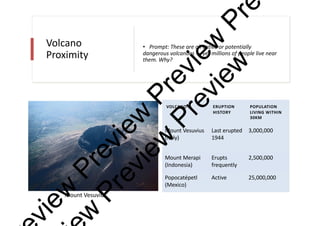
• Prompt: These are all active or potentially
dangerous volcanoes — yet millions of people live near
them. Why?
VOLCANO ERUPTION
HISTORY
POPULATION
LIVING WITHIN
30KM
Mount Vesuvius
(Italy)
Last erupted
1944
3,000,000
Mount Merapi
(Indonesia)
Erupts
frequently
2,500,000
Popocatépetl
(Mexico)
Active 25,000,000
Mount Vesuvius
v
i
e
w
P
r
e
v
i
e
w
P
r
e
v
i
e
w
P
r
e
w
P
r
e
v
i
e
w
P
r
e
v
i
e
w
Prompt: These are all active
or potentially dangerous
volcanoes — yet millions of
people live near them. Why?
• Despite the danger, many people live near
volcanoes due to the benefits the landscape
offers. Mount Vesuvius, for example, is near
Naples, an economically vital city with fertile
volcanic soil that supports agriculture. In
Indonesia, Mount Merapi is surrounded by dense
farming communities that depend on rich volcanic
soils for growing crops. In Mexico, Popocatépetl is
just 70km from Mexico City — one of the largest
urban areas in the world. Proximity to jobs,
transportation hubs, and fertile land outweighs
the risks for many. Additionally, infrequent
eruptions or early warning systems may give
residents a false sense of security. The economic
and cultural attachment to these regions often
means relocation isn’t feasible or desirable, even
when the risk of disaster is well known.
v
i
e
w
P
r
e
v
i
e
w
P
r
e
v
i
e
w
P
r
e
w
P
r
e
v
i
e
w
P
r
e
v
i
e
w
Coastal
Erosion Rates
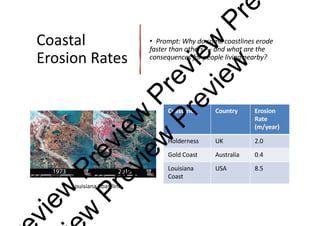
• Prompt: Why do some coastlines erode
faster than others — and what are the
consequences for people living nearby?
Coastline Country Erosion
Rate
(m/year)
Holderness UK 2.0
Gold Coast Australia 0.4
Louisiana
Coast
USA 8.5
Louisiana Coastline
v
i
e
w
P
r
e
v
i
e
w
P
r
e
v
i
e
w
P
r
e
w
P
r
e
v
i
e
w
P
r
e
v
i
e
w
Prompt: Why do some
coastlines erode faster than
others — and what are the
consequences for people
living nearby?
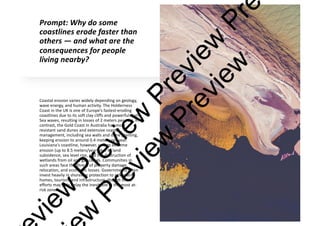
Coastal erosion varies widely depending on geology,
wave energy, and human activity. The Holderness
Coast in the UK is one of Europe’s fastest-eroding
coastlines due to its soft clay cliffs and powerful North
Sea waves, resulting in losses of 2 meters per year. In
contrast, the Gold Coast in Australia has more
resistant sand dunes and extensive coastal
management, including sea walls and dune planting,
keeping erosion to around 0.4 meters per year.
Louisiana's coastline, however, suffers extreme
erosion (up to 8.5 meters/year) due to land
subsidence, sea level rise, and the destruction of
wetlands from oil and gas canals. Communities in
such areas face the threat of property damage,
relocation, and economic losses. Governments often
invest heavily in shoreline protection to safeguard
homes, tourism, and infrastructure, though these
efforts may only delay the inevitable in the most at-
risk zones.
v
i
e
w
P
r
e
v
i
e
w
P
r
e
v
i
e
w
P
r
e
w
P
r
e
v
i
e
w
P
r
e
v
i
e
w
Mountain
Heights vs.
Population
• Prompt: Why do some of the world’s tallest or most
iconic mountains have people living nearby, while
others don’t?
Mountain Height
(m)
Population
Within 50km
Mount
Everest
8,848 20,000
Mount
Kosciuszko
2,228 5,000
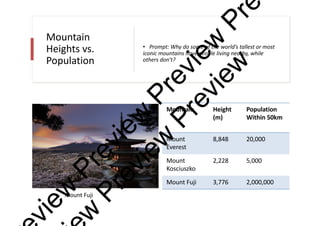
Mount Fuji 3,776 2,000,000
Mount Fuji
v
i
e
w
P
r
e
v
i
e
w
P
r
e
v
i
e
w
P
r
e
w
P
r
e
v
i
e
w
P
r
e
v
i
e
w
Prompt: Why do some of the
world’s tallest or most iconic
mountains have people living
nearby, while others don’t?
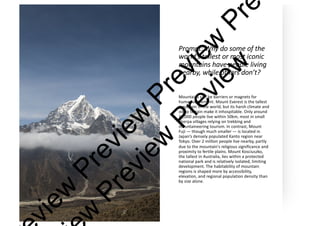
Mountains can be barriers or magnets for
human settlement. Mount Everest is the tallest
mountain in the world, but its harsh climate and
steep terrain make it inhospitable. Only around
20,000 people live within 50km, most in small
Sherpa villages relying on trekking and
mountaineering tourism. In contrast, Mount
Fuji — though much smaller — is located in
Japan’s densely populated Kanto region near
Tokyo. Over 2 million people live nearby, partly
due to the mountain's religious significance and
proximity to fertile plains. Mount Kosciuszko,
the tallest in Australia, lies within a protected
national park and is relatively isolated, limiting
development. The habitability of mountain
regions is shaped more by accessibility,
elevation, and regional population density than
by size alone.
v
i
e
w
P
r
e
v
i
e
w
P
r
e
v
i
e
w
P
r
e
w
P
r
e
v
i
e
w
P
r
e
v
i
e
w

Landforms and landscapes data surprise preview

  • 1.
    Volcano Proximity • Prompt: Theseare all active or potentially dangerous volcanoes — yet millions of people live near them. Why? VOLCANO ERUPTION HISTORY POPULATION LIVING WITHIN 30KM Mount Vesuvius (Italy) Last erupted 1944 3,000,000 Mount Merapi (Indonesia) Erupts frequently 2,500,000 Popocatépetl (Mexico) Active 25,000,000 Mount Vesuvius v i e w P r e v i e w P r e v i e w P r e w P r e v i e w P r e v i e w
  • 2.
    Prompt: These areall active or potentially dangerous volcanoes — yet millions of people live near them. Why? • Despite the danger, many people live near volcanoes due to the benefits the landscape offers. Mount Vesuvius, for example, is near Naples, an economically vital city with fertile volcanic soil that supports agriculture. In Indonesia, Mount Merapi is surrounded by dense farming communities that depend on rich volcanic soils for growing crops. In Mexico, Popocatépetl is just 70km from Mexico City — one of the largest urban areas in the world. Proximity to jobs, transportation hubs, and fertile land outweighs the risks for many. Additionally, infrequent eruptions or early warning systems may give residents a false sense of security. The economic and cultural attachment to these regions often means relocation isn’t feasible or desirable, even when the risk of disaster is well known. v i e w P r e v i e w P r e v i e w P r e w P r e v i e w P r e v i e w
  • 3.
    Coastal Erosion Rates • Prompt:Why do some coastlines erode faster than others — and what are the consequences for people living nearby? Coastline Country Erosion Rate (m/year) Holderness UK 2.0 Gold Coast Australia 0.4 Louisiana Coast USA 8.5 Louisiana Coastline v i e w P r e v i e w P r e v i e w P r e w P r e v i e w P r e v i e w
  • 4.
    Prompt: Why dosome coastlines erode faster than others — and what are the consequences for people living nearby? Coastal erosion varies widely depending on geology, wave energy, and human activity. The Holderness Coast in the UK is one of Europe’s fastest-eroding coastlines due to its soft clay cliffs and powerful North Sea waves, resulting in losses of 2 meters per year. In contrast, the Gold Coast in Australia has more resistant sand dunes and extensive coastal management, including sea walls and dune planting, keeping erosion to around 0.4 meters per year. Louisiana's coastline, however, suffers extreme erosion (up to 8.5 meters/year) due to land subsidence, sea level rise, and the destruction of wetlands from oil and gas canals. Communities in such areas face the threat of property damage, relocation, and economic losses. Governments often invest heavily in shoreline protection to safeguard homes, tourism, and infrastructure, though these efforts may only delay the inevitable in the most at- risk zones. v i e w P r e v i e w P r e v i e w P r e w P r e v i e w P r e v i e w
  • 5.
    Mountain Heights vs. Population • Prompt:Why do some of the world’s tallest or most iconic mountains have people living nearby, while others don’t? Mountain Height (m) Population Within 50km Mount Everest 8,848 20,000 Mount Kosciuszko 2,228 5,000 Mount Fuji 3,776 2,000,000 Mount Fuji v i e w P r e v i e w P r e v i e w P r e w P r e v i e w P r e v i e w
  • 6.
    Prompt: Why dosome of the world’s tallest or most iconic mountains have people living nearby, while others don’t? Mountains can be barriers or magnets for human settlement. Mount Everest is the tallest mountain in the world, but its harsh climate and steep terrain make it inhospitable. Only around 20,000 people live within 50km, most in small Sherpa villages relying on trekking and mountaineering tourism. In contrast, Mount Fuji — though much smaller — is located in Japan’s densely populated Kanto region near Tokyo. Over 2 million people live nearby, partly due to the mountain's religious significance and proximity to fertile plains. Mount Kosciuszko, the tallest in Australia, lies within a protected national park and is relatively isolated, limiting development. The habitability of mountain regions is shaped more by accessibility, elevation, and regional population density than by size alone. v i e w P r e v i e w P r e v i e w P r e w P r e v i e w P r e v i e w