THE
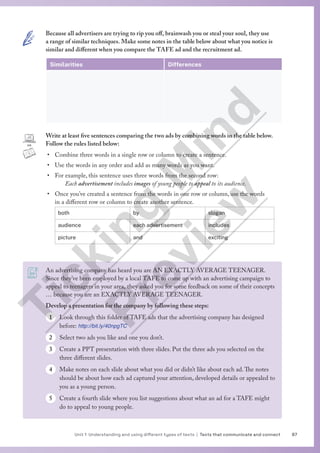
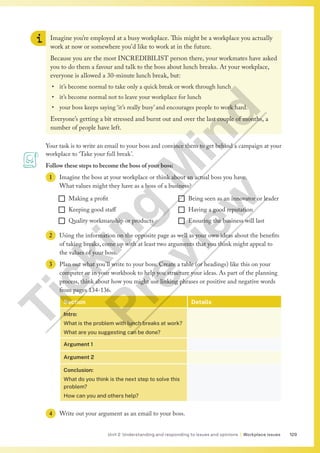
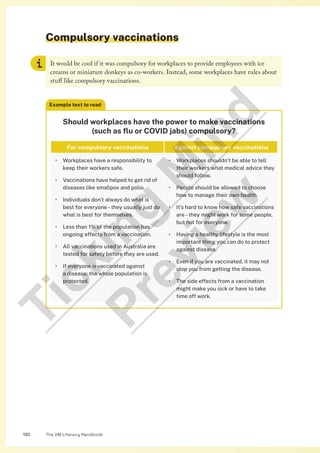
VM
LITERACY
HANDBOOK
T
i
c
k
i
n
g
M
i
n
d
P
r
e
v
i
e
w
THE VM LITERACY HANDBOOK
Copyright © Ticking Mind 2023
All rights reserved.
Except under the conditions described in the Copyright Act 1968
of Australia and subsequent amendments, no part of this publications
may be reproduced, stored in a retrieval system, or transmitted in any
form or by any means, electronic, mechanical, photocopying, recording
or otherwise, without the prior permission of the copyright owner.
First Published 2023 by: Ticking Mind Publications, Thornbury.
ISBN 978-0-6455181-1-5
Design by Tasha Hassapis
T
i
c
k
i
n
g
M
i
n
d
P
r
e
v
i
e
w
THE
VM
LITERACY
HANDBOOK
T
i
c
k
i
n
g
M
i
n
d
P
r
e
v
i
e
w
The VM Literacy Handbook
4
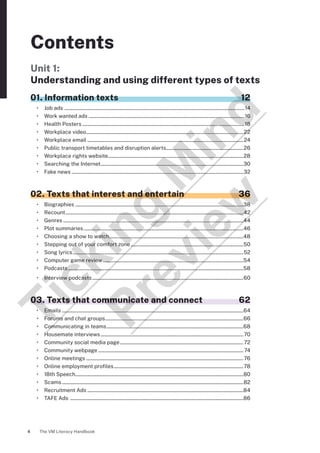
Contents
Unit 1:
Understanding and using different types of texts
01. Information texts 12
• Job ads ......................................................................................................................................................14
• Work wanted ads..................................................................................................................................16
• Health Posters.......................................................................................................................................18
• Workplace video...................................................................................................................................22
• Workplace email..................................................................................................................................24
• Public transport timetables and disruption alerts.................................................................26
• Workplace rights website................................................................................................................28
• Searching the Internet.......................................................................................................................30
• Fake news...............................................................................................................................................32
02. Texts that interest and entertain 36
• Biographies............................................................................................................................................38
• Recount....................................................................................................................................................42
• Genres......................................................................................................................................................44
• Plot summaries.....................................................................................................................................46
• Choosing a show to watch...............................................................................................................48
• Stepping out of your comfort zone..............................................................................................50
• Song lyrics..............................................................................................................................................52
• Computer game review.....................................................................................................................54
• Podcasts..................................................................................................................................................58
• Interview podcasts..............................................................................................................................60
03. Texts that communicate and connect 62
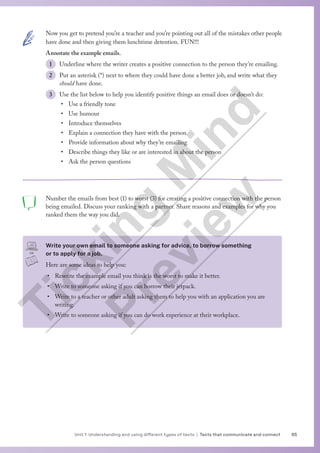
• Emails.......................................................................................................................................................64
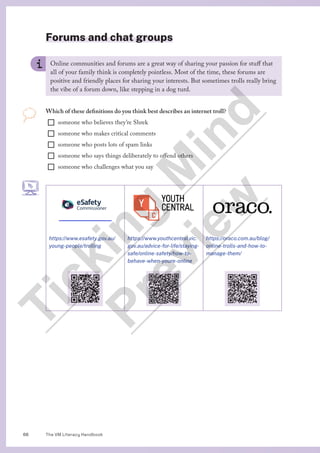
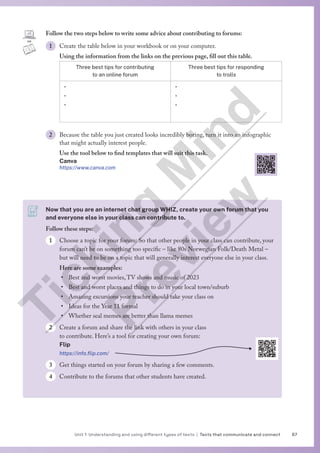
• Forums and chat groups...................................................................................................................66
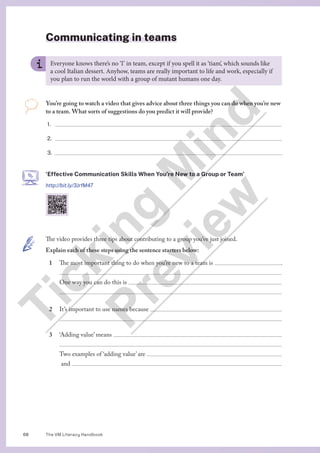
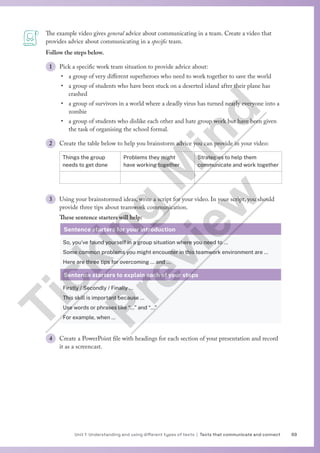
• Communicating in teams..................................................................................................................68
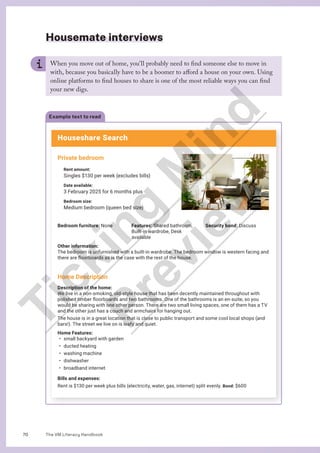
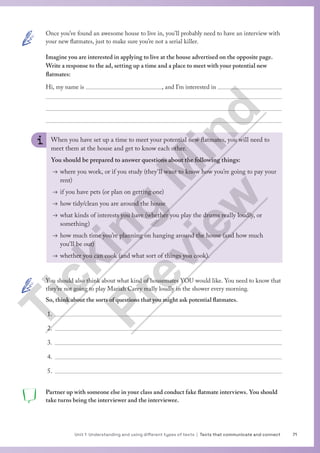
• Housemate interviews.......................................................................................................................70
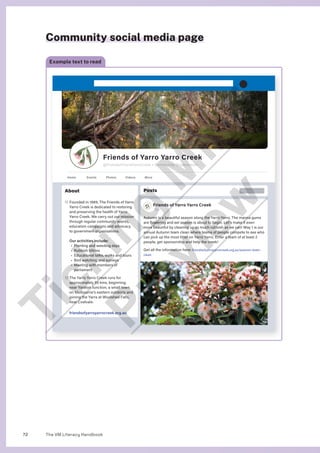
• Community social media page.......................................................................................................72
• Community webpage.........................................................................................................................74
• Online meetings...................................................................................................................................76
• Online employment profiles............................................................................................................78
• 18th Speech...........................................................................................................................................80
• Scams.......................................................................................................................................................82
• Recruitment Ads..................................................................................................................................84
• TAFE Ads ................................................................................................................................................86
T
i
c
k
i
n
g
M
i
n
d
P
r
e
v
i
e
w
5
Unit 2:
Understanding and responding to issues and opinions
04. Community Debates and Discussion 90
• Community protest poster...............................................................................................................92
• Community campaign poster.........................................................................................................94
• Posting rules for online communities..........................................................................................96
• Online reviews.......................................................................................................................................98
• Political advertising..........................................................................................................................100
05. Liveability issues 102
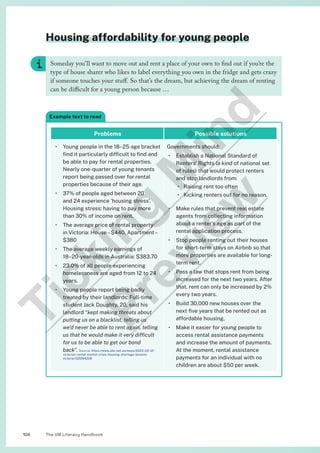
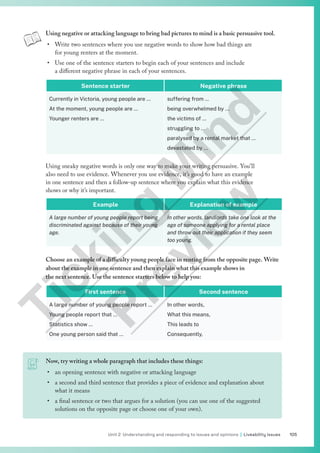
• Housing affordability for young people...................................................................................104
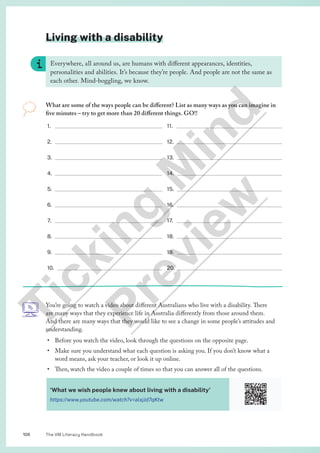
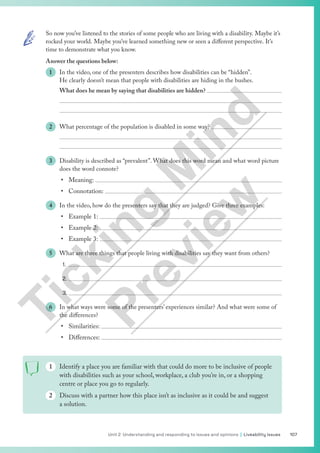
• Living with a disability.....................................................................................................................106
• Public health campaigns................................................................................................................108
• Transport issues..................................................................................................................................110
• Generational conflict........................................................................................................................ 112
• Classification rules.............................................................................................................................114
06. Workplace issues 116
• Minimum wage.....................................................................................................................................118
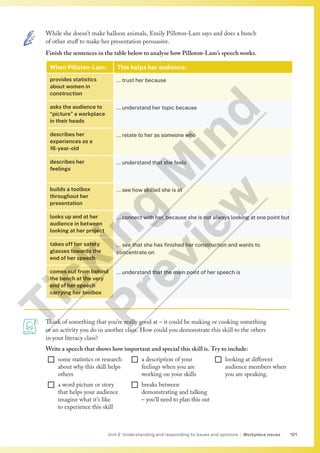
• Women in Construction...................................................................................................................120
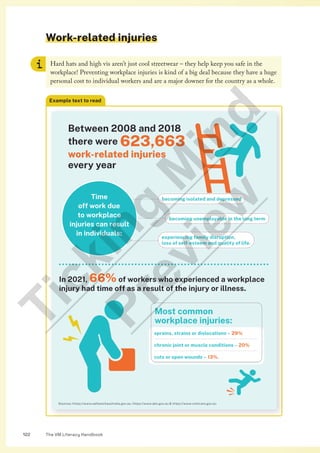
• Work related injuries........................................................................................................................ 122
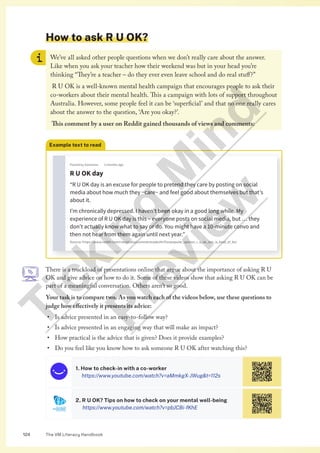
• How to ask R U OK?.......................................................................................................................... 124
• Mental health in the work place..................................................................................................126
• Break time.............................................................................................................................................128
• Compulsory vaccinations...............................................................................................................130
• The 4 day week...................................................................................................................................132
07. Persuasive words and phrases 134
• Positive and negative action words............................................................................................134
• Positive and negative describing words...................................................................................135
• Phrases to link arguments.............................................................................................................136
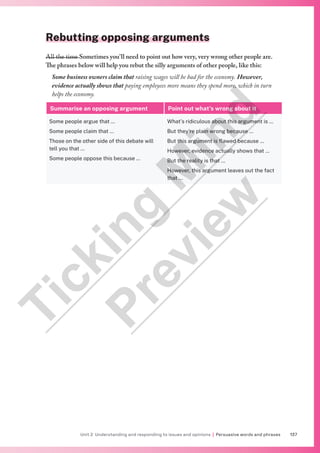
• Rebutting opposing arguments...................................................................................................137
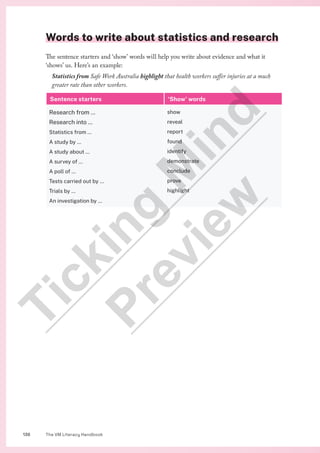
• Words to write about statistics and research........................................................................138
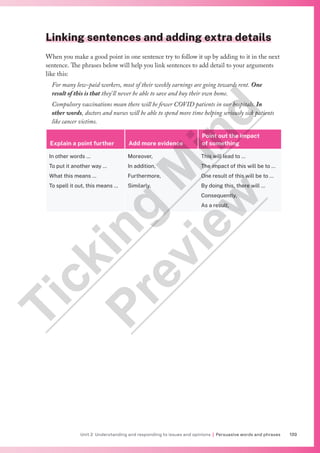
• Linking sentences and adding extra details..........................................................................139
T
i
c
k
i
n
g
M
i
n
d
P
r
e
v
i
e
w
The VM Literacy Handbook
6
Overview of Unit 1
The detailed version
In Unit 1, there are two different Areas of Study:
→ Area of Study 1: Literacy for personal use
→ Area of Study 2: Understanding and creating digital texts
But in this book, we’ve kinda collapsed them, because you’ll be using many of the same literacy
skills for ‘old-school’ texts on old-timey paper that you would for new-fangled digital texts that
pop up on the interweb.
Essentially, this Unit (which takes a whole semester of study to finish), helps you to think about
why literacy is important, and how we use literacy skills for a whole range of things, such as
for entertainment, to find out information and really just to communicate with other humans.
When you study this unit, you’ll be asked to do a whole range of things, like:
• watch and read texts that you find interesting
• watch and read texts that you find boring
• discuss different ideas and texts
• get information from texts
• compare texts and think about them
• evaluate the effectiveness of different texts
• write your own texts for funsies, to communicate or to provide information
• take notes, annotate, journal, draw doodles in the margin
• interview people
• research weird and wonderful stuff
• create infographics like mind maps, charts or stick-figure comic strips.
The 5-second version
So, during this semester you’ll be doing a whole range of reading, watching, listening, discussing
and critiquing – and hopefully you’ll be doing a fair bit of laughing, too. Because literacy shouldn’t
be all about serious, silent, shushing work in the library.
Stuff you need to hand in to pass
At the end of the unit, you will have to produce at least two assessment tasks.
They might be something like:
Area of Study 1
¨ Write a story, an explanation or an
informative piece of some kind.
¨ Produce a reflective journal.
¨ Create and produce some kind
of performance.
Area of Study 2
¨ Create a digital presentation.
¨ Write some kind of online report,
explanation or article.
¨ Produce a video or podcast.
T
i
c
k
i
n
g
M
i
n
d
P
r
e
v
i
e
w
7
Overview of Unit 2
The detailed version
In Unit 2, once again, there are two different Areas of Study:
→ Area of Study 1: Understanding issues and voices
→ Area of Study 2: Responding to opinions
But just as we did for Unit 1, we’ve smushed the units together, because it’s really difficult to think
about issues and voices without having some kind of opinion about them. Unless you’re a robot.
And if you’re a robot, this course is probably not for you.
Once again, this unit will take a whole semester, and it’s designed to help you to think about why
humans have different opinions from each other, and how debate and disagreement happen across
a whole range of areas – in the community, in workplaces and basically anywhere you have more
than one person. It’s also designed to help you engage in discussion and disagreement thoughtfully
and respectfully.
When you study this unit, you’ll be asked to do a whole range of things, like:
• watch and read texts that you agree with
• watch and read texts that you disagree with
• watch and read texts that you really struggle to have an opinion about
• discuss different ideas and how different people have different perspectives
• think about how people are influenced by bias and prior experiences
• compare arguments
• engage in respectful disagreements with your classmates and teacher
• write your own persuasive texts
• try to convince people that you are right
• take notes, annotate, journal, draw doodles in the margin
• think about your own biases and how your life experience impacts on your opinions
• explore how eye contact, tone and body language influence us.
The 5-second version
So, during this semester you’ll be discussing, thinking, disagreeing, agreeing and you’ll be unsure
about a lot of opinions and ideas – because that’s what it’s like to engage in issues. Confusing,
but interesting.
Stuff you need to hand in to pass
At the end of the unit, you will have to produce at least two assessment tasks.
They might be something like:
Area of Study 1
¨ Write a case study of some kind of issue
or disagreement.
¨ Respond to questions.
¨ Create and produce a digital presentation
of a point of view.
Area of Study 2
¨ Produce an oral report of an issue.
¨ Provide a recorded debate or discussion.
¨ Create a video or podcast of an issue.
T
i
c
k
i
n
g
M
i
n
d
P
r
e
v
i
e
w
The VM Literacy Handbook
8
Using this textbook
To make this textbook into an AMAZING learning experience that you’ll want to share with your
friends and parents and will make you say things like, “I’ve got the most amazing textbook ever”,
we’ve used … icons. Yep, throughout this textbook are icons that help you work out what you need
to do and where you should do it (hint, it’s not the back of your hand).
Here’s a cheeky guide to how they work.
Information to read
This is boring information that we spice up with some gags. You’ll need to read
this stuff BEFORE you do something else so you know why it’s important.
What do you already know
This icon shows that there is an opportunity to share how much of an expert
you already are on the topic.
Example text to read
Read this
Yes, you need to read stuff. Joy! This icon points out what you need to read.
View online
Sometimes you’ll need to view cat videos serious stuff online. This will be
accompanied by a link you need to visit.
Writing to do in this workbook
Throughout this textbook, this icon indicates that there is an activity and space
for you to share your AWESOME response in this actual book!
Activity to do somewhere else
Of course, you’ll also have to do stuff in other places apart from this textbook,
like in an old-school exercise book or on your computer. This icon tells you when
you need to do this.
Find your own example
Lots of activities throughout this textbook require you to show you’ve become
a BLACKBELT in the topic by finding your own examples.
Discuss
Regularly throughout this textbook, this icon will prompt you to turn to another
student and share your thoughts about how right you are and how wrong
they are.
Create your own text
Oooh … this icon is super serious. It tells you that you need to create your own
version of a text that you’ve been studying. Your teacher might even ask you
to submit what you do as an assessment.
Tip
This icon will be accompanied by some great advice about how to find buried
treasure or do the activity you’ve just been asked to do.
T
i
c
k
i
n
g
M
i
n
d
P
r
e
v
i
e
w
9
Writing Journal Entries
Like A Pro
One of the super fun activities you’ll often be asked to do throughout this course is to write in
a journal. In your journal, you’ll be asked to share your thoughts and feelings about a particular
text you’ve watched or read, compare two texts, or find your own example of something and
reflect on it.
For example, in Unit 1, you might be asked to write a journal entry in response to a task like this:
Reflect on a show, book, magazine or computer game that is your go-to ‘comfort viewing’.
Your journal entries could be one of the main things your teacher asks you to hand in as an
assessment task throughout the course. This means you might return to journal entries you did some
while ago and ‘polish’ them up to make them literally sparkle like diamonds better.
To help in this process, journal entries should always include:
• the date
• the title of the thing you’re writing about
• at least five sentences (could be more).
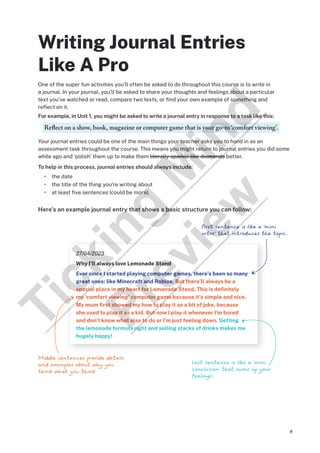
Here’s an example journal entry that shows a basic structure you can follow:
27/04/2023
Why I’ll always love Lemonade Stand
Ever since I started playing computer games, there’s been so many
great ones: like Minecraft and Roblox. But there’ll always be a
special place in my heart for Lemonade Stand. This is definitely
my ‘comfort viewing’ computer game because it’s simple and nice.
My mum first showed my how to play it as a bit of joke, because
she used to play it as a kid. But now I play it whenever I’m bored
and don’t know what else to do or I’m just feeling down. Getting
the lemonade formula right and selling stacks of drinks makes me
hugely happy!
First sentence is like a ‘mini
intro’ that introduces the topic.
Last sentence is like a ‘mini
conclusion’ that sums up your
feelings.
Middle sentences provide details
and examples about why you
think what you think.
T
i
c
k
i
n
g
M
i
n
d
P
r
e
v
i
e
w
The VM Literacy Handbook
10
Unit 1
Understanding and using
different types of texts
Boring list of stuff that’s in this chapter
Information texts 12
Texts that interest and entertain  36
Texts that communicate and connect  62
Over the course of your long and award-winning life, you are going to need to
engage with a whole lot of different texts: hilarious internet posts, TV shows,
songs, stupid tattoos your friends get, bus timetables, ads and spam from
scammers. Oh, and you might need to read some stuff at work. Understanding
texts will be an AMAZING LEARNING ADVENTURE and (guess what?) you
already do a lot of it. Fill out the survey on the opposite page to see how.
This chapter will look at ‘old-school’ texts, such as posters, pamphlets, song lyrics
and TV shows as well as digital texts like web pages, social media and videos.
T
i
c
k
i
n
g
M
i
n
d
P
r
e
v
i
e
w
Unit 1 Understanding and using different types of texts 11
Why you’re already acing this
(circle A, B or C)
1. Do you ever binge-watch a TV series and talk about it with other people?
A) all the time; B) sometimes; C) never.
2. Have you ever seen an ad that seems to be everywhere?
A) all the time; B) sometimes; C) never.
3. Have you ever got information from a poster?
A) all the time; B) sometimes; C) never.
4. Have you ever read something for work?
A) all the time; B) sometimes; C) never.
5. Have you ever created a Spotify playlist?
A) all the time; B) sometimes; C) never.
6. Do you ever wonder what a particular emoji means in a text message?
A) all the time; B) sometimes; C) never.
7. Do you ever read instructions to help you set up or assemble something?
A) all the time; B) sometimes; C) never.
8. Have you ever read handouts given to you by an expert (like a doctor or career adviser)?
A) all the time; B) sometimes; C) never.
9. Do you ever check tickets or invites so you know what date and time you’re supposed to
turn up? A) all the time; B) sometimes; C) never.
10. Do you ever learn things from a TikTok or YouTube video?
A) all the time; B) sometimes; C) never.
11. Do you ever forward hilarious pictures of something (like a seal wearing sunglasses)?
A) all the time; B) sometimes; C) never.
If you answered:
¨ Mostly As: You’re basically a text pro, and you’re going to love this course.
¨ A combination of As and Bs: You’re already pretty awesome at this, and you’re going to
love getting to pro-level.
¨ Mostly Bs: You know a lot about different text types and how to use them, but you’re going
to love learning more.
¨ A combination of Bs and Cs: You’re going to get so much out of this unit – what an
AMAZING LEARNING JOURNEY you have ahead of you! You’re going to love it.
¨ Mostly Cs: What have you been doing? Living under a rock? You really need this course.
¨ Mostly Ds: There were no Ds!! What, did you think this survey was a total invasion of your
privacy and beneath you? Come on, some of those lame jokes were hilarious.
T
i
c
k
i
n
g
M
i
n
d
P
r
e
v
i
e
w
The VM Literacy Handbook
12
Informative features
¨ Headings and subheadings signpost big ideas
¨ The most important information goes first
¨ Small, simple sections of writing break down long and detailed ideas
¨ Linking words and phrases show the connection between ideas and elements
(i.e. firstly, secondly, however, moreover)
¨ Explanations of technical terms
(i.e. with brackets in a sentence or glossaries at the end)
¨ Examples
¨ Pictures, diagrams or visuals
¨ Suggestions about places to find further information (i.e. links to websites, lists of other
information texts to read, contact information for people or organisations)
Information texts
Unit 1 Understanding and using different types of texts
Posters, pamphlets and job ads are all kinds of old-school information texts – they’re
the kind of thing that will help you understand how to get into a TAFE course,
check your moles or start your own cult. Throughout your life, you’ll need to engage
with a lot of information texts in order to achieve your dreams of ruling the world.
You’ll probably even need to create information texts of your own.
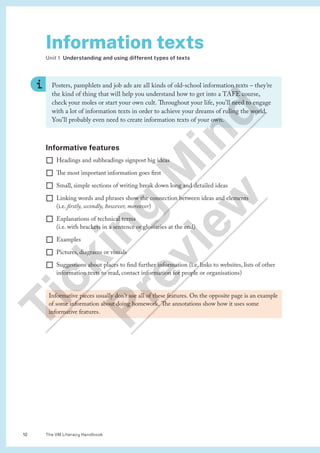
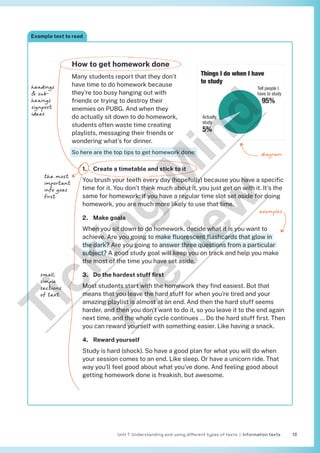
Informative pieces usually don’t use all of these features. On the opposite page is an example
of some information about doing homework. The annotations show how it uses some
informative features.
T
i
c
k
i
n
g
M
i
n
d
P
r
e
v
i
e
w
Unit 1 Understanding and using different types of texts | Information texts 13
Example text to read
How to get homework done
Many students report that they don’t
have time to do homework because
they’re too busy hanging out with
friends or trying to destroy their
enemies on PUBG. And when they
do actually sit down to do homework,
students often waste time creating
playlists, messaging their friends or
wondering what’s for dinner.
So here are the top tips to get homework done:
1. Create a timetable and stick to it
You brush your teeth every day (hopefully) because you have a specific
time for it. You don’t think much about it, you just get on with it. It’s the
same for homework: if you have a regular time slot set aside for doing
homework, you are much more likely to use that time.
2. Make goals
When you sit down to do homework, decide what it is you want to
achieve. Are you going to make fluorescent flashcards that glow in
the dark? Are you going to answer three questions from a particular
subject? A good study goal will keep you on track and help you make
the most of the time you have set aside.
3. Do the hardest stuff first
Most students start with the homework they find easiest. But that
means that you leave the hard stuff for when you’re tired and your
amazing playlist is almost at an end. And then the hard stuff seems
harder, and then you don’t want to do it, so you leave it to the end again
next time, and the whole cycle continues … Do the hard stuff first. Then
you can reward yourself with something easier. Like having a snack.
4. Reward yourself
Study is hard (shock). So have a good plan for what you will do when
your session comes to an end. Like sleep. Or have a unicorn ride. That
way you’ll feel good about what you’ve done. And feeling good about
getting homework done is freakish, but awesome.
diagram
examples
Tell people I
have to study
Actually
study
5%
95%
Things I do when I have
to study
headings
 sub-
heaings
signpost
ideas
the most
important
info goes
first
small,
simple
sections
of text
T
i
c
k
i
n
g
M
i
n
d
P
r
e
v
i
e
w
The VM Literacy Handbook
14
Job ads
List three businesses in your local area where you have seen job ads.
1.
2.
3.
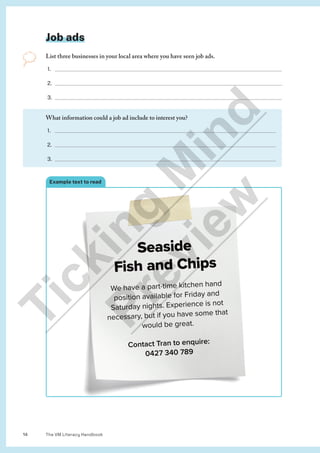
Seaside
Fish and Chips
We have a part-time kitchen hand
position available for Friday and
Saturday nights. Experience is not
necessary, but if you have some that
would be great.
Contact Tran to enquire:
0427 340 789
Example text to read
What information could a job ad include to interest you?
1.
2.
3.
T
i
c
k
i
n
g
M
i
n
d
P
r
e
v
i
e
w
Unit 1 Understanding and using different types of texts | Information texts 15
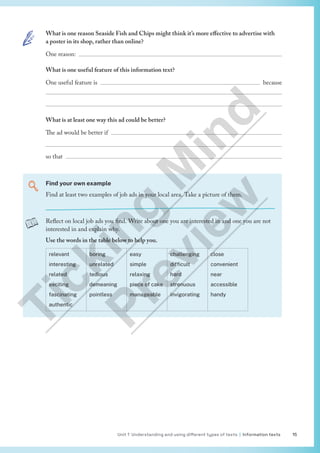
What is one reason Seaside Fish and Chips might think it’s more effective to advertise with
a poster in its shop, rather than online?
One reason: 
What is one useful feature of this information text?
One useful feature is  because


What is at least one way this ad could be better?
The ad would be better if 

so that 
Find your own example
Find at least two examples of job ads in your local area. Take a picture of them.
Reflect on local job ads you find. Write about one you are interested in and one you are not
interested in and explain why.
Use the words in the table below to help you.
relevant
interesting
related
exciting
fascinating
authentic
boring
unrelated
tedious
demeaning
pointless
easy
simple
relaxing
piece of cake
manageable
challenging
difficult
hard
strenuous
invigorating
close
convenient
near
accessible
handy
T
i
c
k
i
n
g
M
i
n
d
P
r
e
v
i
e
w
The VM Literacy Handbook
16
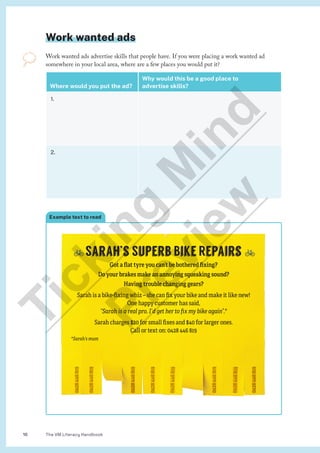
🚲Sarah’s Superb Bike Repairs 🚲
Got a flat tyre you can’t be bothered fixing?
Do your brakes make an annoying squeaking sound?
Having trouble changing gears?
Sarah is a bike-fixing whiz – she can fix your bike and make it like new!
One happy customer has said,
“Sarah is a real pro. I’d get her to fix my bike again”.*
Sarah charges $20 for small fixes and $40 for larger ones.
Call or text on: 0428 446 819
*Sarah’s mum
0428
446
819
0428
446
819
0428
446
819
0428
446
819
0428
446
819
0428
446
819
0428
446
819
0428
446
819
Example text to read
Work wanted ads
Work wanted ads advertise skills that people have. If you were placing a work wanted ad
somewhere in your local area, where are a few places you would put it?
Where would you put the ad?
Why would this be a good place to
advertise skills?
1.
2.
T
i
c
k
i
n
g
M
i
n
d
P
r
e
v
i
e
w
Unit 1 Understanding and using different types of texts | Information texts 17
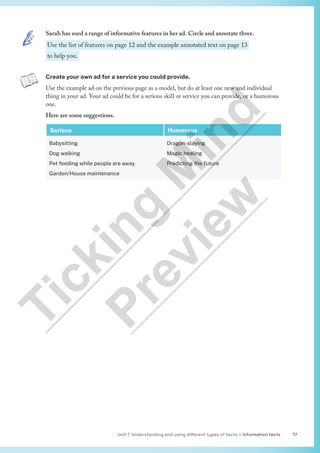
Create your own ad for a service you could provide.
Use the example ad on the previous page as a model, but do at least one new and individual
thing in your ad. Your ad could be for a serious skill or service you can provide, or a humorous
one.
Here are some suggestions.
Serious Humorous
Babysitting
Dog walking
Pet feeding while people are away
Garden/House maintenance
Dragon-slaying
Magic healing
Predicting the future
Sarah has used a range of informative features in her ad. Circle and annotate three.
Use the list of features on page 12 and the example annotated text on page 13
to help you.
T
i
c
k
i
n
g
M
i
n
d
P
r
e
v
i
e
w
The VM Literacy Handbook
18
Health posters
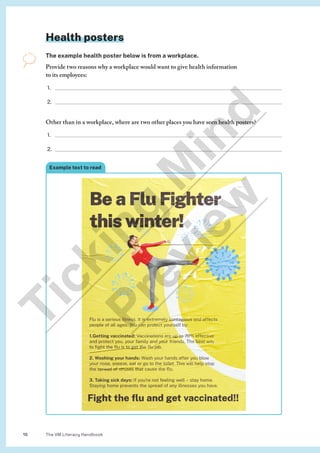
The example health poster below is from a workplace.
Provide two reasons why a workplace would want to give health information
to its employees:
1.
2.
Other than in a workplace, where are two other places you have seen health posters?
1.
2.
Example text to read
T
i
c
k
i
n
g
M
i
n
d
P
r
e
v
i
e
w
Unit 1 Understanding and using different types of texts | Information texts 19
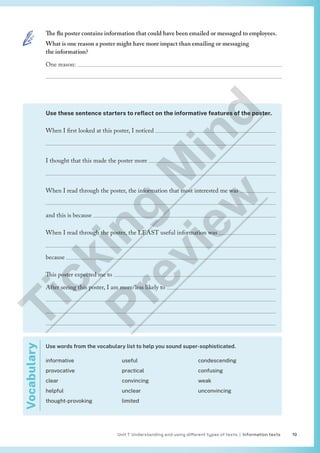
Use these sentence starters to reflect on the informative features of the poster.
When I first looked at this poster, I noticed 

I thought that this made the poster more 

When I read through the poster, the information that most interested me was 

and this is because 
When I read through the poster, the LEAST useful information was 

because 
This poster expected me to 
After seeing this poster, I am more/less likely to 


Use words from the vocabulary list to help you sound super-sophisticated.
informative
provocative
clear
helpful
thought-provoking
useful
practical
convincing
unclear
limited
condescending
confusing
weak
unconvincing
Vocabulary The flu poster contains information that could have been emailed or messaged to employees.
What is one reason a poster might have more impact than emailing or messaging
the information?
One reason: 

T
i
c
k
i
n
g
M
i
n
d
P
r
e
v
i
e
w
The VM Literacy Handbook
20
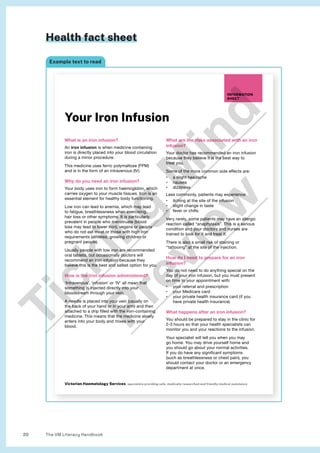
Health fact sheet
Example text to read
What is an iron infusion?
An iron infusion is when medicine containing
iron is directly placed into your blood circulation
during a minor procedure.
This medicine uses ferric polymaltose (FPM)
and is in the form of an intravenous (IV).
Why do you need an iron infusion?
Your body uses iron to form haemoglobin, which
carries oxygen to your muscle tissues. Iron is an
essential element for healthy body functioning.
Low iron can lead to anemia, which may lead
to fatigue, breathlessness when exercising,
hair loss or other symptoms. It is particularly
prevalent in people who menstruate (blood
loss may lead to lower iron); vegans or people
who do not eat meat or those with high iron
requirements (athletes, growing children or
pregnant people).
Usually people with low iron are recommended
oral tablets, but occasionally doctors will
recommend an iron infusion because they
believe this is the best and safest option for you.
How is the iron infusion administered?
‘Intravenous’, ‘infusion’ or ‘IV’ all mean that
something is injected directly into your
bloodstream through your vein.
A needle is placed into your vein (usually on
the back of your hand or in your arm) and then
attached to a drip filled with the iron-containing
medicine. This means that the medicine slowly
enters into your body and mixes with your
blood.
What are the risks associated with an iron
infusion?
Your doctor has recommended an iron infusion
because they believe it is the best way to
treat you.
Some of the more common side effects are:
• a slight headache
• nausea
• dizziness
Less commonly, patients may experience:
• itching at the site of the infusion
• slight change in taste
• fever or chills.
Very rarely, some patients may have an allergic
reaction called “anaphylaxis”. This is a serious
condition and your doctors and nurses are
trained to look for it and treat it.
There is also a small risk of staining or
“tattooing” at the site of the injection.
How do I need to prepare for an iron
infusion?
You do not need to do anything special on the
day of your iron infusion, but you must present
on time to your appointment with:
• your referral and prescription
• your Medicare card
• your private health insurance card (if you
have private health insurance).
What happens after an iron infusion?
You should be prepared to stay in the clinic for
2-3 hours so that your health specialists can
monitor you and your reactions to the infusion.
Your specialist will tell you when you may
go home. You may drive yourself home and
you should go about your normal activities.
If you do have any significant symptoms
(such as breathlessness or chest pain), you
should contact your doctor or an emergency
department at once.
INFORMATION
SHEET
Your Iron Infusion
Victorian Haematology Services specialists providing safe, medically researched and friendly medical assistance
T
i
c
k
i
n
g
M
i
n
d
P
r
e
v
i
e
w
Unit 1 Understanding and using different types of texts | Information texts 21
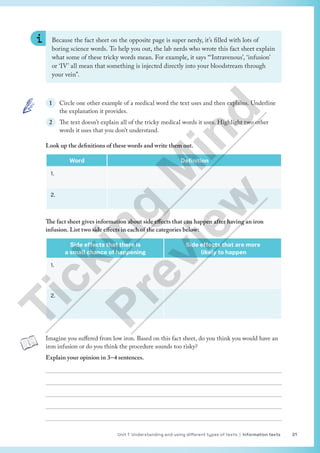
Because the fact sheet on the opposite page is super nerdy, it’s filled with lots of
boring science words. To help you out, the lab nerds who wrote this fact sheet explain
what some of these tricky words mean. For example, it says “‘Intravenous’, ‘infusion’
or ‘IV’ all mean that something is injected directly into your bloodstream through
your vein”.
1 Circle one other example of a medical word the text uses and then explains. Underline
the explanation it provides.
2 The text doesn’t explain all of the tricky medical words it uses. Highlight two other
words it uses that you don’t understand.
Look up the definitions of these words and write them out.
Word Definition
1.
2.
The fact sheet gives information about side effects that can happen after having an iron
infusion. List two side effects in each of the categories below:
Side effects that there is
a small chance of happening
Side effects that are more
likely to happen
1.
2.
Imagine you suffered from low iron. Based on this fact sheet, do you think you would have an
iron infusion or do you think the procedure sounds too risky?
Explain your opinion in 3–4 sentences.


T
i
c
k
i
n
g
M
i
n
d
P
r
e
v
i
e
w
The VM Literacy Handbook
22
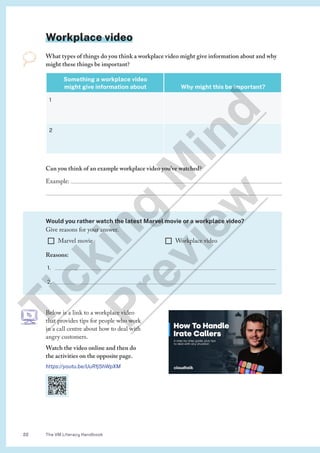
Below is a link to a workplace video
that provides tips for people who work
in a call centre about how to deal with
angry customers.
Watch the video online and then do
the activities on the opposite page.
https://youtu.be/UuRfj5hWpXM
Workplace video
What types of things do you think a workplace video might give information about and why
might these things be important?
Something a workplace video
might give information about Why might this be important?
1
2
Can you think of an example workplace video you’ve watched?
Example: 

Would you rather watch the latest Marvel movie or a workplace video?
Give reasons for your answer.
¨ Marvel movie ¨ Workplace video
Reasons:
1. 
2. 
T
i
c
k
i
n
g
M
i
n
d
P
r
e
v
i
e
w
Unit 1 Understanding and using different types of texts | Information texts 23
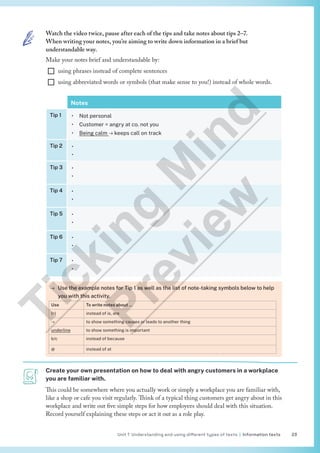
Watch the video twice, pause after each of the tips and take notes about tips 2–7.
When writing your notes, you’re aiming to write down information in a brief but
understandable way.
Make your notes brief and understandable by:
¨ using phrases instead of complete sentences
¨ using abbreviated words or symbols (that make sense to you!) instead of whole words.
Notes
Tip 1 • Not personal
• Customer = angry at co. not you
• Being calm → keeps call on track
Tip 2 •
•
Tip 3 •
•
Tip 4 •
•
Tip 5 •
•   
Tip 6 •
•   
Tip 7 •
•
→ Use the example notes for Tip 1 as well as the list of note-taking symbols below to help
you with this activity.
Use To write notes about …
(=) instead of is, are
→ to show something causes or leads to another thing
underline to show something is important
b/c instead of because
@ instead of at
Create your own presentation on how to deal with angry customers in a workplace
you are familiar with.
This could be somewhere where you actually work or simply a workplace you are familiar with,
like a shop or cafe you visit regularly. Think of a typical thing customers get angry about in this
workplace and write out five simple steps for how employees should deal with this situation.
Record yourself explaining these steps or act it out as a role play.
T
i
c
k
i
n
g
M
i
n
d
P
r
e
v
i
e
w
The VM Literacy Handbook
24
Workplace email
What might be one advantage of putting detailed workplace information into an email for
employees rather than a video?
Advantage: 


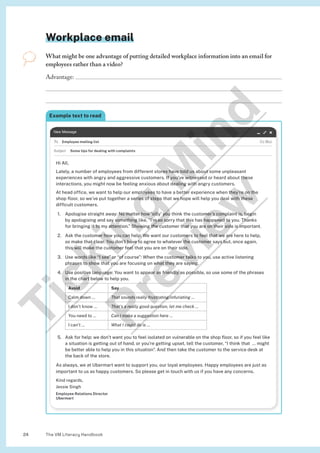
Example text to read
Employee mailing list
Some tips for dealing with complaints
Hi All,
Lately, a number of employees from different stores have told us about some unpleasant
experiences with angry and aggressive customers. If you’ve witnessed or heard about these
interactions, you might now be feeling anxious about dealing with angry customers.
At head office, we want to help our employees to have a better experience when they’re on the
shop floor, so we’ve put together a series of steps that we hope will help you deal with these
difficult customers.
1. Apologise straight away: No matter how ‘silly’ you think the customer’s complaint is, begin
by apologising and say something like, “I’m so sorry that this has happened to you. Thanks
for bringing it to my attention.” Showing the customer that you are on their side is important.
2. Ask the customer how you can help: We want our customers to feel that we are here to help,
so make that clear. You don’t have to agree to whatever the customer says but, once again,
this will make the customer feel that you are on their side.
3. Use words like “I see” or “of course”: When the customer talks to you, use active listening
phrases to show that you are focusing on what they are saying.
4. Use positive language: You want to appear as friendly as possible, so use some of the phrases
in the chart below to help you.
Avoid Say
Calm down … That sounds really frustrating/infuriating …
I don’t know … That’s a really good question, let me check …
You need to … Can I make a suggestion here …
I can’t … What I could do is …
5. Ask for help: we don’t want you to feel isolated on vulnerable on the shop floor, so if you feel like
a situation is getting out of hand, or you’re getting upset, tell the customer, “I think that … might
be better able to help you in this situation”. And then take the customer to the service desk at
the back of the store.
As always, we at Ubermart want to support you, our loyal employees. Happy employees are just as
important to us as happy customers. So please get in touch with us if you have any concerns.
Kind regards,
Jessie Singh
Employee Relations Director
Ubermart
T
i
c
k
i
n
g
M
i
n
d
P
r
e
v
i
e
w
Unit 1 Understanding and using different types of texts | Information texts 25
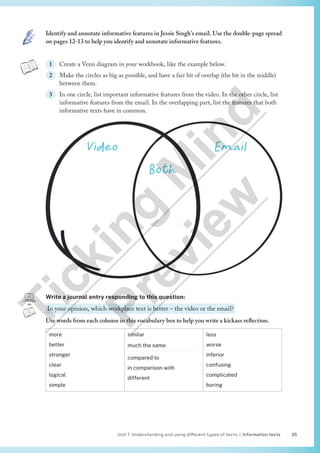
Identify and annotate informative features in Jessie Singh’s email. Use the double-page spread
on pages 12-13 to help you identify and annotate informative features.
1 Create a Venn diagram in your workbook, like the example below.
2 Make the circles as big as possible, and have a fair bit of overlap (the bit in the middle)
between them.
3 In one circle, list important informative features from the video. In the other circle, list
informative features from the email. In the overlapping part, list the features that both
informative texts have in common.
Video
Both
Email
Write a journal entry responding to this question:
In your opinion, which workplace text is better – the video or the email?
Use words from each column in this vocabulary box to help you write a kickass reflection.
more
better
stronger
clear
logical
simple
similar
much the same
compared to
in comparison with
different
less
worse
inferior
confusing
complicated
boring
T
i
c
k
i
n
g
M
i
n
d
P
r
e
v
i
e
w
The VM Literacy Handbook
26
Public transport timetables and
disruption alerts
Imagine you’re travelling via dragon public transport to a place some distance away.
What type of information might you need to find out?
1. 
2. 
Where specifically might you find this information?


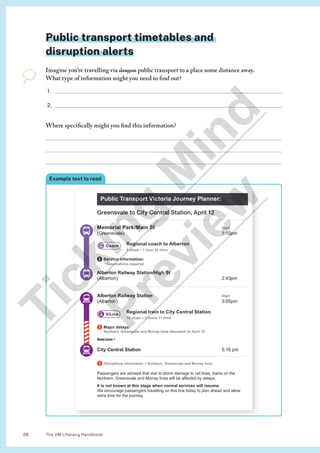
Example text to read
Public Transport Victoria Journey Planner:
Greensvale to City Central Station, April 12
Memorial Park/Main St Start
(Greensvale) 1:10pm
Regional coach to Alberton
6 stops – 1 hour 33 mins
Service information:
**Reservations required
Alberton Railway Station/High St
(Alberton) 2:43pm
Alberton Railway Station Start
(Alberton) 3:05pm
Regional train to City Central Station
10 stops – 2 hours 11 mins
Major delays:
Northern, Greensvale and Murray lines disrupted on April 12
Read more 
City Central Station 5:16 pm
Disruptions information  Northern, Greensvale and Murray lines
Passengers are advised that due to storm damage to rail lines, trains on the
Northern, Greensvale and Murray lines will be affected by delays.
It is not known at this stage when normal services will resume.
We encourage passengers travelling on this line today to plan ahead and allow
extra time for the journey.
Coach
V/Line
T
i
c
k
i
n
g
M
i
n
d
P
r
e
v
i
e
w
Unit 1 Understanding and using different types of texts | Information texts 27
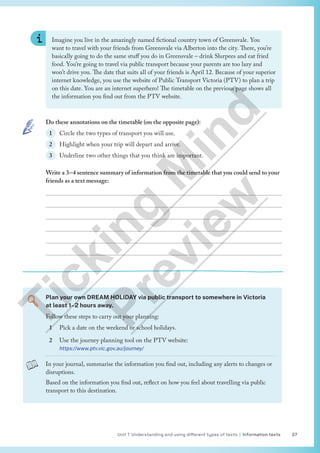
Imagine you live in the amazingly named fictional country town of Greensvale. You
want to travel with your friends from Greensvale via Alberton into the city. There, you’re
basically going to do the same stuff you do in Greensvale – drink Slurpees and eat fried
food. You’re going to travel via public transport because your parents are too lazy and
won’t drive you. The date that suits all of your friends is April 12. Because of your superior
internet knowledge, you use the website of Public Transport Victoria (PTV) to plan a trip
on this date. You are an internet superhero! The timetable on the previous page shows all
the information you find out from the PTV website.
Do these annotations on the timetable (on the opposite page):
1 Circle the two types of transport you will use.
2 Highlight when your trip will depart and arrive.
3 Underline two other things that you think are important.
Plan your own DREAM HOLIDAY via public transport to somewhere in Victoria
at least 1–2 hours away.
Follow these steps to carry out your planning:
1 Pick a date on the weekend or school holidays.
2 Use the journey planning tool on the PTV website:
https://www.ptv.vic.gov.au/journey/
In your journal, summarise the information you find out, including any alerts to changes or
disruptions.
Based on the information you find out, reflect on how you feel about travelling via public
transport to this destination.
Write a 3–4 sentence summary of information from the timetable that you could send to your
friends as a text message:


T
i
c
k
i
n
g
M
i
n
d
P
r
e
v
i
e
w
The VM Literacy Handbook
28
Workplace rights website
If you use the internet like a GENIUS, you’ll know that when you’re looking for
information on a website you can simply use the search function to type in what
you’re looking for. A slower way of finding the information you want is using menus
to click through different pages of a website until you find out what you want to know.
What might be one advantage of using menus to find the information you want rather than
using the search function?
1. 


Let’s say that you work at a cafe and, because you’re not a robot, you want to know what
breaks you are entitled to if you work a 6-hour shift. You’ve been told that a good source
of information is the government website Fair Work.
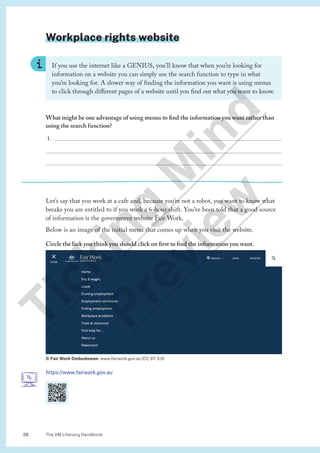
Below is an image of the initial menu that comes up when you visit the website.
Circle the link you think you should click on first to find the information you want.
© Fair Work Ombudsman www.fairwork.gov.au (CC BY 3.0)
https://www.fairwork.gov.au
T
i
c
k
i
n
g
M
i
n
d
P
r
e
v
i
e
w
Unit 1 Understanding and using different types of texts | Information texts 29
Click through the menu links on the Fair Work website until you find out what breaks you are
entitled to on a 6-hour shift at a cafe.
Use the simple flowchart below to keep a record of the links you click on:
What breaks are you entitled to on a 6-hour shift at a cafe?


Click on at least two other links you found interesting on the website.
Write down three things you found out about workplace rights apart from break entitlements.
1. 
2. 
3. 
T
i
c
k
i
n
g
M
i
n
d
P
r
e
v
i
e
w
The VM Literacy Handbook
30
Searching the internet
The internet is truly awesome. You can find almost anything there – like pictures of
guinea pigs dressed in unicorn costumes, or old Facebook pages of your teachers. But
sometimes you will want to find boring and useful stuff on the internet too. Like the
dates of open days. Or the nearest doctor’s clinic.
Here are a few tips to help you get the most out of your
internet searches:
1 Use specific keywords: make sure your search is as quick as possible by using words
that hone in on what you are really looking for – like if you’re looking for the World
Cup scores, don’t just type in “world cup”, because you might get a history lesson
from Wikipedia; instead, type in “world cup scores, 2023”. Adding in things like
dates and locations can be useful for finding exactly what you want.
2 Take out pointless words: search engines will often give you too many results if you
put in words like “and”, “but”, “the”, “a” “to”, “in”, “of” or “on”. So take these out.
Use only words that describe or name what you are looking for.
3 Use quotation marks: these weird, flying commas help the search engine to know
exactly the thing you’re looking for. This is especially the case if you’re looking
for song lyrics or a quote that someone said. In this case, you DO want to use the
pointless words from above.
It’s also really important to remember that because the internet is a popularity contest,
it’s easier to find information from the US, or popular culture. So sometimes finding
important, boring information from Australia is a bit trickier.
T
i
c
k
i
n
g
M
i
n
d
P
r
e
v
i
e
w
Unit 1 Understanding and using different types of texts | Information texts 31
Internet scavenger hunt
Use the tips from the previous page and your own INTERNET NINJA skills, to find
information with as few clicks as possible.
Follow these steps:
1 Create the table below on a device of your choice
2 Find the information listed in the table
3 Record the information in the correct cells
4 Write down how many links you had to click on (including within a website) to find the
information. Just a few clicks show you have a black belt in searching the web, while lots
of clicks indicate that the information was hard to find, or that you need
to work on using more specific search terms.
Find this: Answer/evidence Website
# of
clicks
The open days for the
TAFE nearest your school
The number of albums
David Bowie produced
How much it costs to get
a tattoo that says
“I love learning”
The cost of a consultation
at your local GP’s
The laws for marijuana
possession in Victoria
How to apply for your
P plates
The most popular movie
in 1997
What a cross between a
tiger and a lion is called
How to get to Adelaide
via public transport from
where you live
T
i
c
k
i
n
g
M
i
n
d
P
r
e
v
i
e
w
The VM Literacy Handbook
32
Fake news
Which of these statements do you think best explains what fake news is?
¨ Stuff your parents tell you
¨ Information or news stories you disagree with
¨ False news or information that is presented as real
¨ Unicorns are real
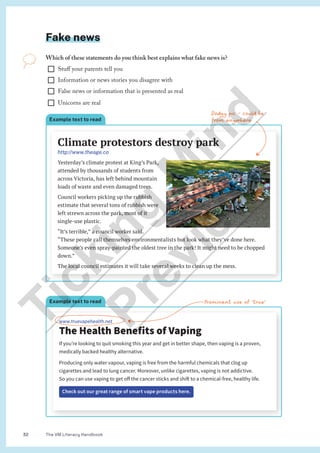
Dodgy pic - could be
from anywhere
Example text to read
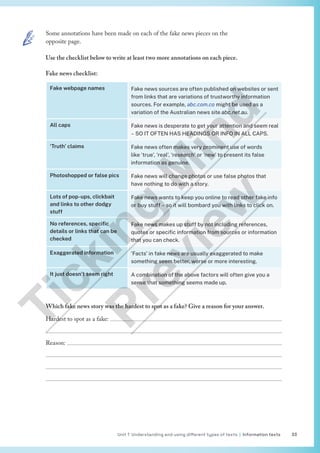
www.truevapehealth.net
The Health Benefits of Vaping
If you’re looking to quit smoking this year and get in better shape, then vaping is a proven,
medically backed healthy alternative.
Producing only water vapour, vaping is free from the harmful chemicals that clog up
cigarettes and lead to lung cancer. Moreover, unlike cigarettes, vaping is not addictive.
So you can use vaping to get off the cancer sticks and shift to a chemical-free, healthy life.
Check out our great range of smart vape products here.
Prominent use of ‘true’
Climate protestors destroy park
http://www.theage.co
Yesterday’s climate protest at King’s Park,
attended by thousands of students from
across Victoria, has left behind mountain
loads of waste and even damaged trees.
Council workers picking up the rubbish
estimate that several tons of rubbish were
left strewn across the park, most of it
single-use plastic.
“It’s terrible,” a council worker said.
“These people call themselves environmentalists but look what they’ve done here.
Someone’s even spray-painted the oldest tree in the park! It might need to be chopped
down.”
The local council estimates it will take several weeks to clean up the mess.
Example text to read
T
i
c
k
i
n
g
M
i
n
d
P
r
e
v
i
e
w
Unit 1 Understanding and using different types of texts | Information texts 33
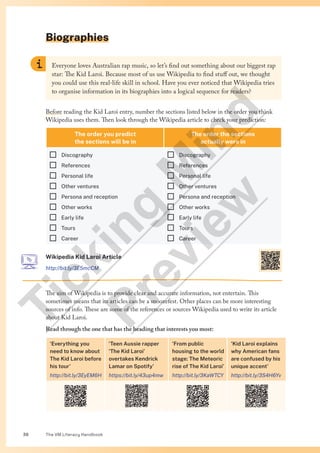
Some annotations have been made on each of the fake news pieces on the
opposite page.
Use the checklist below to write at least two more annotations on each piece.
Fake news checklist:
Fake webpage names Fake news sources are often published on websites or sent
from links that are variations of trustworthy information
sources. For example, abc.com.co might be used as a
variation of the Australian news site abc.net.au.
All caps Fake news is desperate to get your attention and seem real
– SO IT OFTEN HAS HEADINGS OR INFO IN ALL CAPS.
‘Truth’ claims Fake news often makes very prominent use of words
like ‘true’, ‘real’, ‘research’ or ‘new’ to present its false
information as genuine.
Photoshopped or false pics Fake news will change photos or use false photos that
have nothing to do with a story.
Lots of pop-ups, clickbait
and links to other dodgy
stuff
Fake news wants to keep you online to read other fake info
or buy stuff – so it will bombard you with links to click on.
No references, specific
details or links that can be
checked
Fake news makes up stuff by not including references,
quotes or specific information from sources or information
that you can check.
Exaggerated information ‘Facts’ in fake news are usually exaggerated to make
something seem better, worse or more interesting.
It just doesn’t seem right A combination of the above factors will often give you a
sense that something seems made up.
Which fake news story was the hardest to spot as a fake? Give a reason for your answer.
Hardest to spot as a fake: 

Reason: 


T
i
c
k
i
n
g
M
i
n
d
P
r
e
v
i
e
w
The VM Literacy Handbook
34
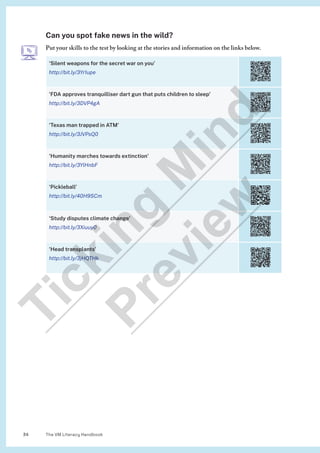
Can you spot fake news in the wild?
Put your skills to the test by looking at the stories and information on the links below.
‘Silent weapons for the secret war on you’
http://bit.ly/3Yr1upe
‘FDA approves tranquilliser dart gun that puts children to sleep’
http://bit.ly/3DVP4gA
‘Texas man trapped in ATM’
http://bit.ly/3JVPsQ0
‘Humanity marches towards extinction’
http://bit.ly/3YlHnbF
‘Pickleball’
http://bit.ly/40H9SCm
‘Study disputes climate change’
http://bit.ly/3Xiuuy0
‘Head transplants’
http://bit.ly/3jHQTHk
T
i
c
k
i
n
g
M
i
n
d
P
r
e
v
i
e
w
Unit 1 Understanding and using different types of texts | Information texts 35
Look through each of the web pages listed on the opposite page and make a judgement about
whether it contains true or fake information.
Make some notes in the table below about why you think the webpage is true or fake. Use the
tips at the bottom of the page to help you work out if a webpage has true or false information.
Tips for spotting fake news and false information
¨ Is your gut reaction telling you that this seems crazy or made up?
¨ Do any pictures look faked or changed?
¨ Does the web address look strange or a rip-off of a real one?
¨ Copy key words from the headline and do a Google search. Do other trustworthy
sites have information about this?
¨ Is there specific evidence that is used that can be checked or does the piece use
vague and uncheckable examples?
True or
fake?
What helped you work out
if it was true or false?
‘Silent weapons for the
secret war on you’
‘FDA approves
tranquilliser dart gun that
puts children to sleep’
‘Texas man trapped in
ATM’
‘Humanity marches
towards extinction’
‘Pickleball’
‘Study disputes climate
change’
‘Head transplants’
T
i
c
k
i
n
g
M
i
n
d
P
r
e
v
i
e
w
The VM Literacy Handbook
36
Texts that interest and
entertain
Unit 1 Understanding and using different types of texts
We all know that you are going to have to read, watch and listen to texts for work
and school. But this isn’t really the reason that most of us are interested in texts.
We love texts because they ENTERTAIN us – they’re FUN. We all love:
→ watching films and throwing popcorn at the screen
→ bingeing on TV shows
→ listening to music
→ some of us even love reading books, comics or playing computer games.
These are all texts. And throughout your life, you have loved a whole range of
different texts (sometimes really cringey and embarrassing ones).
Let’s pretend we’re all Boomers and take a trip down memory lane.
Create the table below on a device or in your workbook.
Try to put three examples in each box, but don’t worry if you can’t fill out every box – you’re
old now, and old people forget stuff.
Age
TV shows/
YouTube
channels Films
Books/
Comics
Music/
Songs Games
Preschool–
Prep
Grades 1–4
Grades 5–6
Years 7–8
Years 9–10
Now
T
i
c
k
i
n
g
M
i
n
d
P
r
e
v
i
e
w
Unit 1 Understanding and using different types of texts | Texts that interest and entertain 37
So you’ve come up with some examples of texts you liked.
Follow the steps below to develop what you’ve brainstormed into a nerdy presentation
or reflection on ‘Texts That Have Changed My Life!’
1 Share examples of all the weird stuff you liked with the rest of your class.This should
trigger an avalanche of responses like, “Oh yeah, I really liked [insert name of strange
kid’s TV show here]”.This should help you fill in any of the blank spaces you have left.
2 Once you’ve brainstormed your heart out and recalled that you too loved the Teletubbies,
pick one text from each phase of your life and take some notes about it:
• What was the text about?
• What do you remember loving about it?
• Did other people – friends, family – like it as well?
• Why do you think this text was important at this point in your life?
3 Write a reflection or use a digital tool of your choice to create a presentation about ‘Texts
That Have Changed My Life’.The sentence starters below will help write a reflection or
record a voiceover for your presentation.
Introducing a text
• The first … I can remember that really made a big impact on me was …
• I remember being crazy about …
• The thing I loved most when I was … was …
• When I turned …, my interest in … stopped … and I got into …
• As I got older, my taste changed again and …
• I remember when I was …, there was a big craze for …
• When I hit …, everyone was into …
• During my first few years at …, I was obsessed with …
• Now, I’m most interested in …
Reflecting on what you liked about the text
• In …, there was a character who …
• … was about …
• … was a game where …
• What I most remember about … is …
• The thing that most sticks in my mind about … is …
• I used to love … and …
• … really helped me …
• I closely identified with …
• … used to make me laugh because …
• I was fascinated by …
• I was obsessed by …
• I remember that other kids loved it too because …
• My friends and I used to argue about how …
• My friends and I used to act out …
• I think I liked it more than other people because …
• No one else seemed to like … because …
T
i
c
k
i
n
g
M
i
n
d
P
r
e
v
i
e
w
The VM Literacy Handbook
38
Biographies
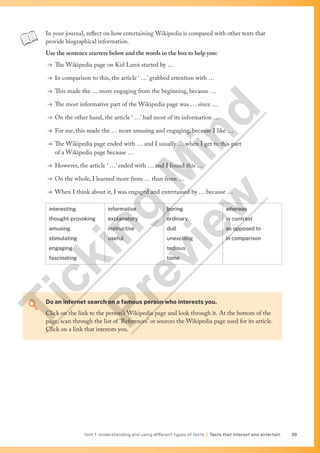
Everyone loves Australian rap music, so let’s find out something about our biggest rap
star: The Kid Laroi. Because most of us use Wikipedia to find stuff out, we thought
you could use this real-life skill in school. Have you ever noticed that Wikipedia tries
to organise information in its biographies into a logical sequence for readers?
Before reading the Kid Laroi entry, number the sections listed below in the order you think
Wikipedia uses them. Then look through the Wikipedia article to check your prediction:
The order you predict
the sections will be in
The order the sections
actually were in
¨ Discography
¨ References
¨ Personal life
¨ Other ventures
¨ Persona and reception
¨ Other works
¨ Early life
¨ Tours
¨ Career
¨ Discography
¨ References
¨ Personal life
¨ Other ventures
¨ Persona and reception
¨ Other works
¨ Early life
¨ Tours
¨ Career
Wikipedia Kid Laroi Article
http://bit.ly/3E5mcCM
The aim of Wikipedia is to provide clear and accurate information, not entertain. This
sometimes means that its articles can be a snoozefest. Other places can be more interesting
sources of info. These are some of the references or sources Wikipedia used to write its article
about Kid Laroi.
Read through the one that has the heading that interests you most:
‘Everything you
need to know about
The Kid Laroi before
his tour’
http://bit.ly/3EyEM6H
‘Teen Aussie rapper
‘The Kid Laroi’
overtakes Kendrick
Lamar on Spotify’
https://bit.ly/43up4mw
‘From public
housing to the world
stage: The Meteoric
rise of The Kid Laroi’
http://bit.ly/3KaWTCY
‘Kid Laroi explains
why American fans
are confused by his
unique accent’
http://bit.ly/3S4H6Yv
T
i
c
k
i
n
g
M
i
n
d
P
r
e
v
i
e
w
Unit 1 Understanding and using different types of texts | Texts that interest and entertain 39
In your journal, reflect on how entertaining Wikipedia is compared with other texts that
provide biographical information.
Use the sentence starters below and the words in the box to help you:
→ The Wikipedia page on Kid Laroi started by …
→ In comparison to this, the article ‘ …’ grabbed attention with …
→ This made the … more engaging from the beginning, because …
→ The most informative part of the Wikipedia page was … since …
→ On the other hand, the article ‘ …’ had most of its information …
→ For me, this made the … more amusing and engaging, because I like …
→ The Wikipedia page ended with … and I usually … when I get to this part
of a Wikipedia page because …
→ However, the article ‘ …’ ended with … and I found this …
→ On the whole, I learned more from … than from …
→ When I think about it, I was engaged and entertained by … because …
interesting
thought-provoking
amusing
stimulating
engaging
fascinating
informative
explanatory
instructive
useful
boring
ordinary
dull
unexciting
tedious
tame
whereas
in contrast
as opposed to
in comparison
Do an internet search on a famous person who interests you.
Click on the link to the person’s Wikipedia page and look through it. At the bottom of the
page, scan through the list of ‘References’ or sources the Wikipedia page used for its article.
Click on a link that interests you.
T
i
c
k
i
n
g
M
i
n
d
P
r
e
v
i
e
w
The VM Literacy Handbook
40
Interesting biographies or profiles don’t just list facts about a person, they often have
a ‘theme,’ like ‘how a love of knitting with dog hair’ saved one person’s life.
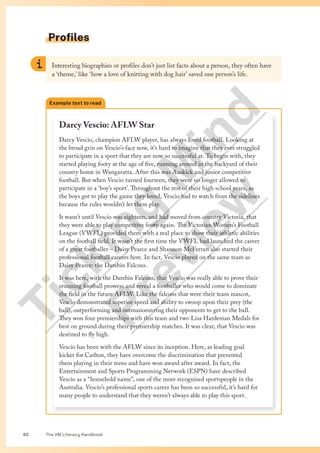
Darcy Vescio: AFLW Star
Darcy Vescio, champion AFLW player, has always loved football. Looking at
the broad grin on Vescio’s face now, it’s hard to imagine that they ever struggled
to participate in a sport that they are now so successful at. To begin with, they
started playing footy at the age of five, running around in the backyard of their
country home in Wangaratta. After this was Auskick and junior competitive
football. But when Vescio turned fourteen, they were no longer allowed to
participate in a ‘boy’s sport’. Throughout the rest of their high school years, as
the boys got to play the game they loved, Vescio had to watch from the sidelines
because the rules wouldn’t let them play.
It wasn’t until Vescio was eighteen, and had moved from country Victoria, that
they were able to play competitive footy again. The Victorian Women’s Football
League (VWFL) provided them with a real place to show their athletic abilities
on the football field. It wasn’t the first time the VWFL had launched the career
of a great footballer – Daisy Pearce and Shannon McFerran also started their
professional football careers here. In fact, Vescio played on the same team as
Daisy Pearce: the Darebin Falcons.
It was here, with the Darebin Falcons, that Vescio was really able to prove their
stunning football prowess and reveal a footballer who would come to dominate
the field in the future AFLW. Like the falcons that were their team mascot,
Vescio demonstrated superior speed and ability to swoop upon their prey (the
ball), outperforming and outmanoeuvring their opponents to get to the ball.
They won four premierships with this team and two Lisa Hardeman Medals for
best on ground during their premiership matches. It was clear, that Vescio was
destined to fly high.
Vescio has been with the AFLW since its inception. Here, as leading goal
kicker for Carlton, they have overcome the discrimination that prevented
them playing in their teens and have won award after award. In fact, the
Entertainment and Sports Programming Network (ESPN) have described
Vescio as a “household name”, one of the more recognised sportspeople in the
Australia. Vescio’s professional sports career has been so successful, it’s hard for
many people to understand that they weren’t always able to play this sport.
Example text to read
Profiles
T
i
c
k
i
n
g
M
i
n
d
P
r
e
v
i
e
w
Unit 1 Understanding and using different types of texts | Texts that interest and entertain 41
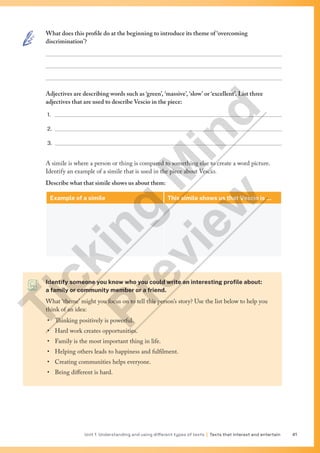
What does this profile do at the beginning to introduce its theme of ‘overcoming
discrimination’?


Adjectives are describing words such as ‘green’, ‘massive’, ‘slow’ or ‘excellent’. List three
adjectives that are used to describe Vescio in the piece:
1.
2.
3.
A simile is where a person or thing is compared to something else to create a word picture.
Identify an example of a simile that is used in the piece about Vescio.
Describe what that simile shows us about them:
Example of a simile This simile shows us that Vescio is …
Identify someone you know who you could write an interesting profile about:
a family or community member or a friend.
What ‘theme’ might you focus on to tell this person’s story? Use the list below to help you
think of an idea:
• Thinking positively is powerful.
• Hard work creates opportunities.
• Family is the most important thing in life.
• Helping others leads to happiness and fulfilment.
• Creating communities helps everyone.
• Being different is hard.
T
i
c
k
i
n
g
M
i
n
d
P
r
e
v
i
e
w
The VM Literacy Handbook
42
Recount
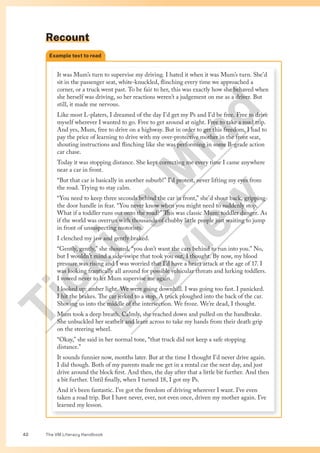
It was Mum’s turn to supervise my driving. I hated it when it was Mum’s turn. She’d
sit in the passenger seat, white-knuckled, flinching every time we approached a
corner, or a truck went past. To be fair to her, this was exactly how she behaved when
she herself was driving, so her reactions weren’t a judgement on me as a driver. But
still, it made me nervous.
Like most L-platers, I dreamed of the day I’d get my Ps and I’d be free. Free to drive
myself wherever I wanted to go. Free to get around at night. Free to take a road trip.
And yes, Mum, free to drive on a highway. But in order to get this freedom, I had to
pay the price of learning to drive with my over-protective mother in the front seat,
shouting instructions and flinching like she was performing in some B-grade action
car chase.
Today it was stopping distance. She kept correcting me every time I came anywhere
near a car in front.
“But that car is basically in another suburb!” I’d protest, never lifting my eyes from
the road. Trying to stay calm.
“You need to keep three seconds behind the car in front,” she’d shout back, gripping
the door handle in fear. “You never know when you might need to suddenly stop.
What if a toddler runs out onto the road?” This was classic Mum: toddler danger. As
if the world was overrun with thousands of chubby little people just waiting to jump
in front of unsuspecting motorists.
I clenched my jaw and gently braked.
“Gently, gently,” she shouted, “you don’t want the cars behind to run into you.” No,
but I wouldn’t mind a side-swipe that took you out, I thought. By now, my blood
pressure was rising and I was worried that I’d have a heart attack at the age of 17. I
was looking frantically all around for possible vehicular threats and lurking toddlers.
I vowed never to let Mum supervise me again.
I looked up: amber light. We were going downhill. I was going too fast. I panicked.
I hit the brakes. The car jerked to a stop. A truck ploughed into the back of the car.
Shoving us into the middle of the intersection. We froze. We’re dead, I thought.
Mum took a deep breath. Calmly, she reached down and pulled on the handbrake.
She unbuckled her seatbelt and leant across to take my hands from their death grip
on the steering wheel.
“Okay,” she said in her normal tone, “that truck did not keep a safe stopping
distance.”
It sounds funnier now, months later. But at the time I thought I’d never drive again.
I did though. Both of my parents made me get in a rental car the next day, and just
drive around the block first. And then, the day after that a little bit further. And then
a bit further. Until finally, when I turned 18, I got my Ps.
And it’s been fantastic. I’ve got the freedom of driving wherever I want. I’ve even
taken a road trip. But I have never, ever, not even once, driven my mother again. I’ve
learned my lesson.
Example text to read
T
i
c
k
i
n
g
M
i
n
d
P
r
e
v
i
e
w
Unit 1 Understanding and using different types of texts | Texts that interest and entertain 43
Telling a good story is not easy. Listening to a bad story is even worse. Especially if it’s at a
family gathering and your boring cousin keeps droning on and on about that one time when
they got an amazing run rate in cricket. Nobody wants to be that person. And you can avoid
this issue by having some structure to your story.
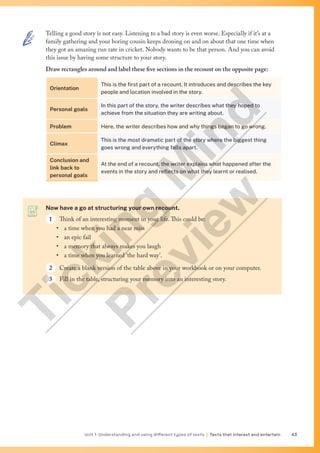
Draw rectangles around and label these five sections in the recount on the opposite page:
Orientation
This is the first part of a recount. It introduces and describes the key
people and location involved in the story.
Personal goals
In this part of the story, the writer describes what they hoped to
achieve from the situation they are writing about.
Problem Here, the writer describes how and why things began to go wrong.
Climax
This is the most dramatic part of the story where the biggest thing
goes wrong and everything falls apart.
Conclusion and
link back to
personal goals
At the end of a recount, the writer explains what happened after the
events in the story and reflects on what they learnt or realised.
Now have a go at structuring your own recount.
1 Think of an interesting moment in your life.This could be:
• a time when you had a near miss
• an epic fail
• a memory that always makes you laugh
• a time when you learned ‘the hard way’.
2 Create a blank version of the table above in your workbook or on your computer.
3 Fill in the table, structuring your memory into an interesting story.
T
i
c
k
i
n
g
M
i
n
d
P
r
e
v
i
e
w
The VM Literacy Handbook
44
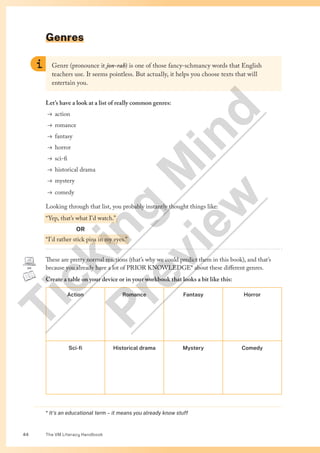
Genres
* It’s an educational term – it means you already know stuff
Genre (pronounce it jon-rah) is one of those fancy-schmancy words that English
teachers use. It seems pointless. But actually, it helps you choose texts that will
entertain you.
Let’s have a look at a list of really common genres:
→ action
→ romance
→ fantasy
→ horror
→ sci-fi
→ historical drama
→ mystery
→ comedy
Looking through that list, you probably instantly thought things like:
“Yep, that’s what I’d watch.”
OR
“I’d rather stick pins in my eyes.”
These are pretty normal reactions (that’s why we could predict them in this book), and that’s
because you already have a lot of PRIOR KNOWLEDGE* about these different genres.
Create a table on your device or in your workbook that looks a bit like this:
Action Romance Fantasy Horror
Sci-fi Historical drama Mystery Comedy
T
i
c
k
i
n
g
M
i
n
d
P
r
e
v
i
e
w
Unit 1 Understanding and using different types of texts | Texts that interest and entertain 45
Look at the tropes of your favourite genre.
Write a couple of sentences about what you like about these tropes. Then write a couple of
sentences about something you don’t like about this. Use at least one word from each of the
columns below in your writing.
enjoy
find familiar
escape into
am always
entertained by
irritated by
hate the way
don’t understand why
think there should be
less … and more …
and
because
but
also
so
although
while
despite
however
even though
in contrast
One of the predictable things about genres is that they have reliable tropes. Tropes
are kinda like cliches or stereotypes – they are things that happen or feature all the
time in stories. Like, action films regularly have the trope of a really buff guy who
speaks in a husky voice (this also happens in romances, and sometimes in mysteries,
and sometimes in basically any Hollywood movie …).
Look through the list of tropes below and sort them into the genre table that you created.
Some tropes can go into more than one category.
• detective explains everything
at the end
• nerdy girl gets a makeover
• time travel
• a wise old person
• the world is a dystopia
• guy with huge muscles
• the villain has an accent/scar/is albino
• someone walks into a room and doesn’t
turn the lights on
• skintight body suits
• the bully’s best friends are idiots
• evil robots
• an orphan is the secret heir
• dragons
• nerdy character helps heroic character
• opposites are attracted
• something needs to be resolved quickly
• girl needs to be rescued
• protagonist needs to go on a journey
• the person you don’t suspect did the
murder
• a car chase (or boat chase)
• an evil overlord/mastermind
• people fight
• people who hate each other are forced to
be close
• there is a ‘chosen’ one
• the hero’s best friend provides comic relief
• people fall over/stumble/are clumsy
• characters find themselves isolated or alone
• characters meet in a funny way
T
i
c
k
i
n
g
M
i
n
d
P
r
e
v
i
e
w
The VM Literacy Handbook
46
You can use your knowledge of tropes to create plots for your own TV show.
Let’s say we were creating a TV show called Detective High that had the premise:
Lina Nguyen is a tenacious detective whose rogue behaviour gets her sacked from City Police.
Unable to find a job in any detective or security agency, she reluctantly agrees to teach a ‘True
Crime Podcasts’ subject at her local school. Working with her students, she begins to solve a
range of crimes in the local area.
What are two tropes that could be used in this show to make it popular?
1.
2.
Detective High – Pilot episode summary
Episode 1:
The episode begins with Lina in the office of Police Chief Brody.
Brody lists all the ways Lina has broken the law in her last
case. After Lina insults Brody, he sacks her and ensures that
no detective or security agency in the city will hire her. Lina’s
bills begin to build up and she is desperate for a job. Her aunt,
the principal of a local high school, offers her a job and Lina
reluctantly agrees to teach a class on ‘True Crime Podcasts’.
Her first lesson is a disaster because she teaches only from
the textbook and the students complain it’s boring. After
ungraciously accepting advice from a helpful fellow teacher,
Mike Tanton, to ‘make things real’, her next class goes well as
she sets them the task of investigating the robbery of a local
store, owned by Mike’s parents. With the help of Mike, she
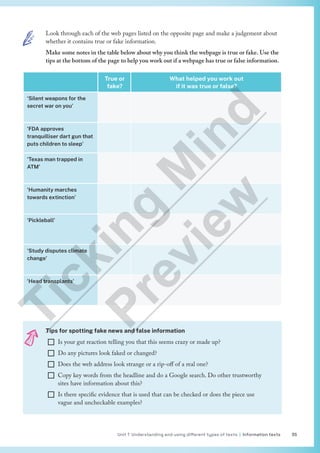
accesses CCTV footage to discover clues about who committed
the crime. At the end of the episode, she and her podcast
students summarise the case in their first podcast.
grumpy person
wise old person
happy person
(attracted to
grumpy person?)
people who hate
each other forced
to be close
everyone gets
together at end
and detective
explains it all
Example text to read
Plot summaries
T
i
c
k
i
n
g
M
i
n
d
P
r
e
v
i
e
w
Unit 1 Understanding and using different types of texts | Texts that interest and entertain 47
Think of a genre of TV you like and create your own TV series for a streaming service that
belongs to this genre.
To figure out an idea for your show:
1 Think of real TV series that you like. Consider how you can change aspects of this or
combine elements of different shows to come up with your idea.
2 Discuss your TV show with a partner. Listen to their advice on how to improve your
show. Use the advice you find useful.
Using the example premise and episode summary on the opposite page, write a summary of
your show that includes:
1 an interesting name for your show
2 a 1–2 sentence summary of the whole series
3 a 6–7 sentence summary of the pilot (first) episode
4 a list of at least two tropes that your show will use.
Now that you’ve created your own TV series, why not try to pass it off as real?
Use the tool below to create a fake Netflix cover page for your TV series.
Fake Netflix cover creator
http://bit.ly/3kampOc
T
i
c
k
i
n
g
M
i
n
d
P
r
e
v
i
e
w
The VM Literacy Handbook
48
Choosing a show to watch
Example text to read
Zombi e Hospita l
MA15+ HD
2023 1 Season
Top 10 - #3 in TV Shows Today
A team of young, smart and outrageously
attractive doctors at Gloomhaven General deal
with the everyday reality of a world where half the
population are zombies. Treating everything from
zombie diabetes to accidental dismemberment,
new challenges face the team at Gloomhaven
General every week.
Dramedy Ÿ Quirky Ÿ Notable Soundtrack
Sonja Flemming/CBS ©2016 CBS Broadcasting, Inc. All Rights Reserved.)
You make decisions every week about what to watch. Some things will be more
important to you than others in deciding what to watch – like a desperate need to watch
what everyone else is watching. Or your genuine love of nostalgic Pokémon viewing.
Look at the information about the TV show below. Decide if you would watch the show or
not. Circle two things in the information that were most important in your decision.
T
i
c
k
i
n
g
M
i
n
d
P
r
e
v
i
e
w
Unit 1 Understanding and using different types of texts | Texts that interest and entertain 49
There are actually lots of methods you can use to help you decide what to watch.
Fill out the table below to identify what method you use most:
M = Most of the time / S = Some of the time / N = Never
Method of choosing
what to watch
How often
do you
use this
method?
Example show you’ve decided to
watch using this method
Using ‘Recommended for you’
suggestions from a streaming
platform
Liking the name
Reading the plot summary
Looking at the trailer
Looking at what actors are in it
Listening to recommendations
from friends
Reading a review
Picking a show from ‘trending
or popular now’ lists
Looking at shows in genres or
categories you like
Every way of choosing a film or TV show to watch has an advantage and a disadvantage.
Choose one of your usual methods for choosing a show and think of one advantage and
disadvantage of that method:
Advantage: 
Disadvantage: 
Looking at reviews can sometimes be a helpful way of choosing a film or TV show to
watch. Identify a show that you are interested in watching. Do a search for it at the review
website below. Read through one critic review and at least one audience review.
https://www.rottentomatoes.com/
Reflect on whether the reviews have helped you decide to watch the show.
Give reasons for your response.
T
i
c
k
i
n
g
M
i
n
d
P
r
e
v
i
e
w
The VM Literacy Handbook
50
Stepping out of your comfort zone
Okay, so you know what you like to watch. You probably even collect figurines and
dress up in costumes from your favourite TV show. But here’s the thing: sometimes
you’ll meet new people (maybe even a potential partner) and they might like
something different from you . Instead of running away screaming and then curling
up in the foetal position, you could TRY SOMETHING NEW.
It’s a scary thought, but there are rewards – you might even end up watching a
hilarious sci-fi movie where one of the characters has hotdogs for fingers.
So, try this:
1 Go around the classroom and ask people about their favourite TV show.
2 Find the example that you think sounds THE ABSOLUTE WORST.
3 Watch it. One whole episode.
T
i
c
k
i
n
g
M
i
n
d
P
r
e
v
i
e
w
Unit 1 Understanding and using different types of texts | Texts that interest and entertain 51
Reflecting on what you just viewed
Write a thoughtful reflection on what you just watched.
One that doesn’t start with your gut reaction, but one that helps you to understand why your
classmate might love this show. It’s easy to think of things you hate (windy days, shouty people,
the kid in the corner who’s always picking their nose) – but that doesn’t help you understand
another person’s perspective. You need to dig a bit deeper for that.
1 Your first task is to think about why you normally hate something.
You can use some of the phrases below to help you get started:
I normally watch …
I tend to like …
My favourite TV shows are …
I’ve always thought …
I don’t want other people to think I like …
because
since
as
2 Then, you should try to think of something in the new TV show that was actually pretty
OK. Write a couple of things about it.
You can use some of the phrases below to help:
One of the things I didn’t mind was …
I thought the setting of … looked …
The costumes that … wore really made
me think …
My favourite scene was …
I was interested in …
… this is because …
… since it was …
… which reminded me of …
… and it made me think …
I liked the idea of …
I actually liked the character of …, who
I could kind of relate to …
Even though they were nothing like me …
… their dialogue …
… the way they related to others …
… they seemed …
3 Now you can really go to town on the things you didn’t like about the show. But you
can’t use four-letter words like s*^% or f#@ed or soup.
Try using some of the words below instead:
not my favourite
not something I
personally prefer
not my first choice
less entertaining than
dragged a bit when
felt slow when
seemed monotonous when
cliched
trite
overdone
predictable
shocking
offensive
distasteful
off-colour
4 Finally, have a conversation with the person who loved this TV show.
Try to use the words and phrases you practised here.
T
i
c
k
i
n
g
M
i
n
d
P
r
e
v
i
e
w
The VM Literacy Handbook
52
Song lyrics
From American shows and books, what do you know about ‘Homecoming’ and being a
‘Homecoming Queen’?


What is one reason why Australian singers often use references to American things even
though we don’t come from America?


A fascinating thing about song lyrics is that they can mean quite different things to
different people. For example, the famous lyric “let it go”, from the Disney song of
the same name, could mean to emotionally let something go or could be a directive to
release a trapped inner gas bubble. It depends on who you talk to.
Thelma Plum is a First Nations indie-folk artist whose song lyrics are often personal
in nature and reflect on her experiences growing up Aboriginal. In her song
‘Homecoming Queen’, she uses references to the American high school tradition of
electing Homecoming Queens to sing about her own teenage experiences here in
Australia.
Listen to ‘Homecoming Queen’ on YouTube
http://bit.ly/3I6IjtJ
Read through the lyrics to ‘Homecoming
Queen’ on AZ Lyrics
http://bit.ly/3lJurxQ
T
i
c
k
i
n
g
M
i
n
d
P
r
e
v
i
e
w
Unit 1 Understanding and using different types of texts | Texts that interest and entertain 53
Throughout the song, Plum sings about how she felt as a teenager growing up in her town.
What do you think some of her lyrics might mean?
Plum sings … This could mean that …
“hard for me to dream”
“I’ll be the voice of this town”
“it was hard, to get used to me”
“I’ll be my own homecoming queen”
Plum sings a lot about putting on a “crown” during her song.
Circle two words from the list below that the crown could symbolise: Being …
special
better than others
powerful
rich
important
empowered
royal
beautiful
unique
Many teenagers feel different or ‘other’. Which one of her lyrics do you most connect with
and why?
Lyric: 

Why do you connect with this? 

Pick a song you like that has lyrics that mean something to you personally.
In your journal, reflect on the song and what the lyrics mean to you.
Use some of the sentence starters below to help you:
→ The song that has my favourite lyrics is …
→ It’s about … and …
→ In the song, some of the lyrics that mean the most to me are …
→ These words mean a lot to me because …
→ I really connect with the description “ …” because …
→ I love the idea of “ …” because …
→ Since I’m …, I connect with the feeling that …
T
i
c
k
i
n
g
M
i
n
d
P
r
e
v
i
e
w
The VM Literacy Handbook
54
Computer game review
So, you’re interested in playing a game about a goose called Untitled Goose Game
because it’s about … well … a goose. But you also want to know if it’s actually any
good before you shell out sweet cashola for it. Wikipedia tells you that it “is a 2019
puzzle stealth game” where “players control a goose who bothers the inhabitants of
an English village”. This doesn’t really help you make your decision, so you decide to
look at a review.
What are two things you’d like a review to tell you about Untitled Goose Game to help you
decide whether to buy it or not?
1. 
2. 
Untiled Goose Game review by Good Game Spawn Point
(GGSP)
http://bit.ly/3Idq3yT
T
i
c
k
i
n
g
M
i
n
d
P
r
e
v
i
e
w
Unit 1 Understanding and using different types of texts | Texts that interest and entertain 55
The review is given by two presenters. Rad Yeo (the one with pink hair) and Will Yates (the
one without pink hair).
Take notes about what the presenters say about the game in each section of the review.
Use the advice about taking notes on page 23 to help you.
Angharad ‘Rad’ Yeo Will Yates
Introduction and
establishment
of connection to
audience and game
Outline of game
Review of game’s art
Review of game’s
controls/mechanism
Review of game’s
music
Review of game’s
missions
Overall rating
The review uses different techniques to be entertaining for its audience such as using footage
of Will playing the game and making jokes.
What are two other things it does to be entertaining?
1. 
2. 
T
i
c
k
i
n
g
M
i
n
d
P
r
e
v
i
e
w
The VM Literacy Handbook
56
Computer game review
Example text to read
Review: The Untitled Goose Game
Like basically everyone I know, I’ve always wondered what life would be like if I was a
goose instead of a person. Obviously, I’d have a lot more time on my hands to dream
up various FOWL DEEDS to annoy all of the people around me. And that’s basically
the entire premise of the game The Untitled Goose Game: you’re a goose, waddling
around a small village, playing pranks on all of the villagers and generally having a
honking good time.
In order to finish the game, you have to complete a to-do list of actions, manipulating
the people around you and generally fowling up their lives so that you can have
a laugh. One challenge, for example, will have you tying up the shoelaces of a
hapless kid and watching him fall flat on his face. Another challenge gets you to
throw a gardener’s rake into the lake and watch as he rages at the edge. This is your
opportunity to prank everyone at will and then hide under your own wing.
The really great thing about this game is that your actions are basically only limited
by your own imagination: you can honk, flap and hide wherever you want. And you
can even zoom out to get a better gander at the whole scene. All of this means that
you’ll spend as much time honking with laughter as actually playing the game.
I particularly loved the simple graphics of this game – it felt nostalgic and childlike,
but was also filled with surprising details, like the harmonica that changed your honk
when you hold it in your beak, or getting villagers to break their own belongings, just
for the fun of it. I loved the little thought bubbles that popped up above the villagers’
heads, showing you what they were thinking about. These thought bubbles also
gave the hilarious impression that the goose was doing a lot more thinking than the
people.
Unfortunately, the simplicity of the graphics also made some actions a little bit
clumsy – it was sometimes difficult to pick an object up with your beak if it was beside
something else. But maybe that’s how it really is with beaks. I’m used to having
opposable thumbs, so maybe I really would find having a beak as tricky as this.
The other great thing about this game was the sound. I loved hearing the light patter
of my feet waddling around and getting faster when I ran away. It made for the best
kind of wild goose chase. The classical music playing in the background was pretty
boring, but I was so focused on my own victorious honking that I barely noticed it. In
fact, all of the sound was pretty low-key. Like the rest of this game, the real hero is
the goose.
Apart from the music, my other big roast for this game is that it was just too short. It
felt like I’d just mastered the art of being a goose when the whole game was over. It
took me only two hours and then my goose (game) was cooked. And I wasn’t ready
for it to be over. I really wanted to live as a goose for a bit longer. It was so much fun.
Although there were moments that I was worried I’d be Christmas dinner.
T
i
c
k
i
n
g
M
i
n
d
P
r
e
v
i
e
w
Unit 1 Understanding and using different types of texts | Texts that interest and entertain 57
Create your own written or recorded review (you might do this option with a partner
as a podcast or video) of a computer game, board game, book, film or TV show.
• Brainstorm things you can write or speak about in your review under these headings:
introduction, game/text outline, review of different elements (game elements, character or
plot elements), overall rating.
• Think of phrases you can use in your review that are puns or ‘dad jokes’about the thing
you are reviewing. For example, in a shoot-em-up game, you might joke that “It will blast
you away”or in reviewing a detective show you might say “There’s no mystery about why
this is a great show!”
• If you’re creating a recorded review, practise presenting the review before you record it.
Compare how much you liked the two reviews by discussing them with a partner.
Use the sentence starters below to help you compare them.
Did you prefer the written or video review of the game?
Introduction and
establishment
of connection to
audience and game
I thought that the … had a better beginning, because …
In contrast, the … started by …, which I found …
I liked the way the … review started because …
The other review also started by … but …
Outline of game Of the two reviews, the one that I thought gave the best outline
was … because …
The way … helped me understand …
I was confused by …, which made me …
Neither review really helped me to understand …
Both reviews gave an effective …
Review of individual
elements of the
game
The … review gave the most helpful review of different parts of the
game by …
The other review wasn’t as … because …
I was more interested in … so I liked this about the … review.
I hadn’t thought about … so it interested me that …
Overall rating I trusted the rating of … because …
The rating of … made me think …
Even though the written review didn’t really have a rating, it gave
me the impression that …
The written review tries to entertain its audience by using goose-related words. For example,
in the introduction it says ‘Fowl deeds’ (‘fowl’ is another word for a farm bird like a chicken or
goose) instead of the common phrase ‘Foul deeds’ (evil deeds).
Circle two other examples of goose puns or related words in the review.
T
i
c
k
i
n
g
M
i
n
d
P
r
e
v
i
e
w
The VM Literacy Handbook
58
Podcasts
When you turn thirty, you’ll suddenly have a huge desire to listen to podcasts and
tell everyone you meet, “I’ve just listened to an interesting podcast about …”. So,
we’re preparing you for this future by making you listen to one of the all-time great
podcasts: Serial.
Serial is a podcast that investigates the 1999 murder of Mae Hin Lee – an 18-year-
old student at a US high school. Lee’s ex-boyfriend and fellow student Adnan Masud
Syed was found guilty of her murder. The podcast looks at whether or not he was
actually guilty.
The first episode is called ‘The Alibi’.
What things do you know about what an alibi is and why it’s important in investigating
a crime?


Casey Fiesler from Atlanta, CC BY 2.0, via Wikimedia Commons
https://serialpodcast.org/season-one/1/the-alibi
A GUIDE TO
PEOPLE IN SERIAL Rabia Chaudry
Attorney and family friend
who believes Adnan is
innocent
Saad Chaudry
Adnan’s best friend,
believes Adnan is innocent
Asia McLaine
Claims to have seen
Adnan in the library at
the time of murder
Derek
Asia’s boyfriend came to
pick her up at the library,
doesn’t remember if
Adnan was there
Stephanie
Adnan’s close friend, Jay’s
girlfriend, Jay says Adnan
threatened her
Kristina Gutierrez
Adnan’s troubled lawyer
Hae
Beloved honor student.
Murder victim.
Adnan
Hae’s ex boyfriend,
convicted of murder
Jay
Friend who implicated
Adnan in the crime
As you listen to the podcast, you might find the below reference useful to keep track of the
different people who are mentioned.
T
i
c
k
i
n
g
M
i
n
d
P
r
e
v
i
e
w
Unit 1 Understanding and using different types of texts | Texts that interest and entertain 59
Have you ever been in one of those one-way conversations where someone just talks at you
with a torrent of words and you don’t get a chance to say anything? Was it yesterday with one
of your friends?
Let’s practise NOT having that type of conversation.
As you listen to Serial, Episode 1, stop about every ten minutes and discuss your thoughts
with a partner or two other people. Use at least one of the sentence starters in each of the
columns below to take turns sharing and responding to the AWESOME ideas you and
others have:
Sentence starters to share your own thoughts
The thing that most interests me about … is …
When the podcast talked about …, I thought …
Something I don’t understand about … is …
I’d never really thought about … before.
I think it’s clear that …
I was really surprised by … because …
I’m not sure what I think about … On one hand … But on the other hand …
I bet … will happen, because …
Sentence starters to respond to someone else’s thoughts
Yeah, I agree because …
I’m not sure I agree … because …
So, what you’re saying is that …
I’m interested that you say … because …
Do you also think that …?
Why do you think that …?
What you said made me think of …
Really? I’m not sure I understand what you mean by … Can you explain that a bit more?
When you get to the end of the podcast, use at least one of these sentence starters
to discuss how you connected to the show:
→ I’m definitely interested to know … because …
→ Truthfully, I don’t really care about … because …
→ Even though this wasn’t the focus, I was most interested in … about the podcast because …
→ This podcast challenged me to think about how …
→ Honestly, this sort of story makes me feel a bit … since …
→ The kind of thing I thought this podcast could do better is … and I think …
→ It had never really occurred to me that … could happen and it made me …
T
i
c
k
i
n
g
M
i
n
d
P
r
e
v
i
e
w
The VM Literacy Handbook
60
Interview podcasts
One popular podcast format is the interview because it requires the podcast producer
to do ABSOLUTELY NO WORK other than come up with some questions for
famous people. In the best interview-based podcasts, podcasters ask people questions
that lead to interesting and entertaining answers.
Think of a famous actor or musician you’d like to interview.
What are two boring, obvious questions this person is probably usually asked?
1. 
2. 
What are at least two more interesting questions this person could be asked that would lead to
entertaining answers?
1. 
2. 
Let’s Be Real With Sammy Jaye is a classic example of the interview-
based podcast. Look through the list of episodes at the podcast site
and listen to one episode that interests you.
https://ihr.fm/3xSrMER
What was one example of an interesting question that Sammy Jaye asked? What was
interesting about the response to the question?
Interesting question: 


Interesting part of response: 


© 2023 iHeartMedia, Inc
T
i
c
k
i
n
g
M
i
n
d
P
r
e
v
i
e
w
Unit 1 Understanding and using different types of texts | Texts that interest and entertain 61
You won’t have the time or resources in your class to organise a podcast interview with an
AMAZEBALLS and FAMOUS person like your school principal or Rihanna. But you can
do the next best thing: interview someone else in your class like the kid who normally sits next
to you. Keep in mind that most kids in your class probably haven’t made a number one selling
album or won a gold medal at the Olympics. They probably don’t even have a secret superpower
like being able to fart the alphabet. But they’ve all got interesting stories to tell about their
lives. Your job as a podcaster is to help them tell their story in an interesting way.
Follow these steps to create your own interview podcast:
¨ Team up with someone in your class. You will interview them for a podcast and they
will interview you for a podcast.
¨ List some things you know about this person. Circle things that you think would be
good to ask questions about.
¨ Use the tips and website included below to help you come up with questions.
¨ Write out a list of about 20 questions to ask.
¨ Read through your questions and change any that you think are boring.
¨ Practise your part of the podcast. Don’t forget to practise introducing yourself and your
interviewee. It’s important to make them sound interesting when you introduce them.
Interview tips:
→ Use question words like how or why. Don’t ask questions that can be answered with yes, no
or a quick fact.
→ Begin a question with an interesting fact or observation. For example: “Something I’ve
noticed about you, is that you like to wear clothes that make you look like a grandpa.
Can you tell me about your fashion philosophy?” or “In 2021 you broke your leg. What
happened and how difficult was it to recover?”
→ Use follow-up questions like: “That’s really interesting. Can you tell me more about …?” or
“What do you mean by …?”
Some websites to help you write interview questions:
https://riverside.fm/blog/
podcast-interview-questions
https://www.resound.fm/blog/
podcast-interview-questions
https://amplify.matchmaker.
fm/podcast-interview-
questions/
T
i
c
k
i
n
g
M
i
n
d
P
r
e
v
i
e
w
The VM Literacy Handbook
62
Texts that communicate
and connect
Unit 1 Understanding and using different types of texts
Ways of communicating
It turns out that every communication method is a different text type. English teachers
actually do rule the world. To show how much of a SMARTY PANTS you already are
about communication methods, draw a line from each communication method on the left
to a definition that best describes it on the right:
Conversation
A social media page that is used to share links about conspiracy
theories, posts about what your dog is up to, and pics and videos.
Interview
People in the same space taking it in turns to say words to each other
out loud and with their mouths.
Speech
A social media page full of photoshopped pics and “inspirational”
quotes.
Phone call An uglier version of Instagram.
Facebook
A social media page that allows people to respond to complex ideas
with very short angry posts.
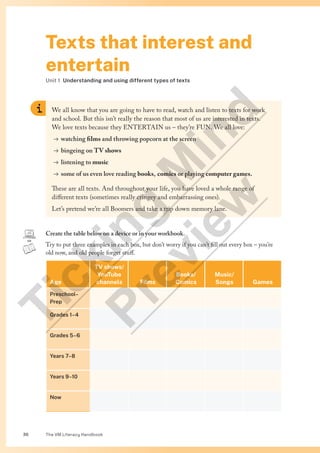
BeReal
One person asking lots of questions and another person answering
while trying to sound smarter and better than they really are.
Instagram
A messaging service that allows groups of people to send photos,
messages and panda GIFs to each other.
TikTok A more old-fashioned WhatsApp that you need a phone plan to use.
WhatsApp
For people who can be bothered writing long messages for other
people who actually have the time to read them.
Text message One person talking for a really long time … blah blah blah.
Email
A way to ask people to come to a party, but also showing them how
fancy you are because you used a pretty font on a fancy background.
Evites/digital
invitations
An online forum that allows people to share their own opinion
and tell people with different opinions how wrong they are.
Reddit
An online way of having a conversation with people while actually
doing something else on your computer.
Zoom/Microsoft
Teams
Using your phone in a really old-fashioned way to speak to a person
in a different room.
T
i
c
k
i
n
g
M
i
n
d
P
r
e
v
i
e
w
63
Unit 1 Understanding and using different types of texts | Texts that communicate and connect
There are pros and cons for every communication method.
For example, Twitter is really good if you’re 45, angry at everyone and want to fight online
with other VERY ANGRY PEOPLE. It’s not so good if you’re 18 and want to share a funny
video about a hamster riding a tiny e-scooter while wearing a cape. What communication
method would you use for each of these situations below?
Name the communication method and provide a brief explanation.
Show people your latest
Harry Styles fan video
TikTok because it’s easy to use and share videos.
Advertise a meeting of your
Harry Styles fan club
Organise a trip to a Harry
Styles movie with your friends
Ask one of your relatives if
there is any work you can do for
money so you can go to a Harry
Styles concert
Tell people a story about why
your best friend is even better
than Harry Styles
Tell people the truth about how
a lizard queen rules the world
Ask your parents for money to
go to a Harry Styles concert
Invite people to your Harry
Styles themed 18th
Share photos of you at a Harry
Styles concert
Share moody, black-and-white
pictures of you and your friends
at 7-Eleven
Ask your nan for money to go to
a Harry Styles concert
T
i
c
k
i
n
g
M
i
n
d
P
r
e
v
i
e
w
The VM Literacy Handbook
64
Unless you’re a psychopath with no feelings for anyone else, when you email someone,
you normally try to create a connection with the person you’re emailing. Let’s say
you’re emailing someone you don’t know to ask them if you can hire their beach house
for schoolies.
Example text to read
principal@ststephensprimary.edu.au
Hall
Hi,
Could I use your hall on the 18th of April for a party I’m having? There’ll be about 30-50 people there
and it will probably go for about 5 hours. I’d like to have it from 6.00. Let me know if it’s free.
Alex
info@joannespetshop.net
Job at Pet Shop
Hi Joanne,
I’m emailing you to apply for the sales assistant job at your pet store that you’ve got advertised in your
window. I’m a Year 11 student at Creekside High and I absolutely love animals. I’ve got three pets: a
Labrador, a tabby cat and a guinea pig. None of them has run away yet, so I must be doing something
right as a pet owner! I’ve got good animal handling skills and a fair bit of knowledge about pet care, so I
could offer a lot as an assistant. I also love your shop. I think you have interesting animals that you care
for and good quality products.
Thanks,
Ava Grigorio
gemma@luxuryhair.net.au
Advice about hairdressing award
Hi Gemma,
My neighbour Sandra Hawkins gave me your email address and said you’d be a good person to contact
about advice for hairdressing training because you started out in this town and now you run your own
business! I’d like to do hairdressing training, but really don’t know where to start. There’s only the one
hairdresser in town, and they’re not taking on any apprentices. I’ve done a bit of a Google search, but all
it comes up with is stuff about TAFE courses for TAFEs that are miles away. How did you start out? I’d
love some advice. Anything you could tell me would be much appreciated.
Regards,
Mustafa
Emails
T
i
c
k
i
n
g
M
i
n
d
P
r
e
v
i
e
w
65
Unit 1 Understanding and using different types of texts | Texts that communicate and connect
Now you get to pretend you’re a teacher and you’re pointing out all of the mistakes other people
have done and then giving them lunchtime detention. FUN!!!
Annotate the example emails.
1 Underline where the writer creates a positive connection to the person they’re emailing.
2 Put an asterisk (*) next to where they could have done a better job, and write what they
should have done.
3 Use the list below to help you identify positive things an email does or doesn’t do:
• Use a friendly tone
• Use humour
• Introduce themselves
• Explain a connection they have with the person
• Provide information about why they’re emailing
• Describe things they like or are interested in about the person
• Ask the person questions
Write your own email to someone asking for advice, to borrow something
or to apply for a job.
Here are some ideas to help you:
• Rewrite the example email you think is the worst to make it better.
• Write to someone asking if you can borrow their jetpack.
• Write to a teacher or other adult asking them to help you with an application you are
writing.
• Write to someone asking if you can do work experience at their workplace.
Number the emails from best (1) to worst (3) for creating a positive connection with the person
being emailed. Discuss your ranking with a partner. Share reasons and examples for why you
ranked them the way you did.
T
i
c
k
i
n
g
M
i
n
d
P
r
e
v
i
e
w
The VM Literacy Handbook
66
Forums and chat groups
Online communities and forums are a great way of sharing your passion for stuff that
all of your family think is completely pointless. Most of the time, these forums are
positive and friendly places for sharing your interests. But sometimes trolls really bring
the vibe of a forum down, like stepping in a dog turd.
Which of these definitions do you think best describes an internet troll?
¨ someone who believes they’re Shrek
¨ someone who makes critical comments
¨ someone who posts lots of spam links
¨ someone who says things deliberately to offend others
¨ someone who challenges what you say
https://www.esafety.gov.au/
young-people/trolling
https://www.youthcentral.vic.
gov.au/advice-for-life/staying-
safe/online-safety/how-to-
behave-when-youre-online
https://oraco.com.au/blog/
online-trolls-and-how-to-
manage-them/
T
i
c
k
i
n
g
M
i
n
d
P
r
e
v
i
e
w
67
Unit 1 Understanding and using different types of texts | Texts that communicate and connect
Follow the two steps below to write some advice about contributing to forums:
1 Create the table below in your workbook or on your computer.
Using the information from the links on the previous page, fill out this table.
Three best tips for contributing
to an online forum
Three best tips for responding
to trolls
•
•
•
•
•
•
2 Because the table you just created looks incredibly boring, turn it into an infographic
that might actually interest people.
Use the tool below to find templates that will suit this task.
Canva
https://www.canva.com
Now that you are an internet chat group WHIZ, create your own forum that you
and everyone else in your class can contribute to.
Follow these steps:
1 Choose a topic for your forum: So that other people in your class can contribute, your
forum can’t be on something too specific – like 80s Norwegian Folk/Death Metal –
but will need to be on a topic that will generally interest everyone else in your class.
Here are some examples:
• Best and worst movies,TV shows and music of 2023
• Best and worst places and things to do in your local town/suburb
• Amazing excursions your teacher should take your class on
• Ideas for the Year 11 formal
• Whether seal memes are better than llama memes
2 Create a forum and share the link with others in your class
to contribute. Here’s a tool for creating your own forum:
Flip
https://info.flip.com/
3 Get things started on your forum by sharing a few comments.
4 Contribute to the forums that other students have created.
T
i
c
k
i
n
g
M
i
n
d
P
r
e
v
i
e
w
The VM Literacy Handbook
68
Communicating in teams
The video provides three tips about contributing to a group you’ve just joined.
Explain each of these steps using the sentence starters below:
1 The most important thing to do when you’re new to a team is  .

One way you can do this is 

2 It’s important to use names because 

3 ‘Adding value’ means 

Two examples of ‘adding value’ are 
and 
Everyone knows there’s no ‘I’ in team, except if you spell it as ‘tiam’, which sounds like
a cool Italian dessert. Anyhow, teams are really important to life and work, especially if
you plan to run the world with a group of mutant humans one day.
You’re going to watch a video that gives advice about three things you can do when you’re new
to a team. What sorts of suggestions do you predict it will provide?
1.
2.
3.
‘Effective Communication Skills When You’re New to a Group or Team’
http://bit.ly/3JrfM47
T
i
c
k
i
n
g
M
i
n
d
P
r
e
v
i
e
w
69
Unit 1 Understanding and using different types of texts | Texts that communicate and connect
The example video gives general advice about communicating in a team. Create a video that
provides advice about communicating in a specific team.
Follow the steps below.
1 Pick a specific work team situation to provide advice about:
• a group of very different superheroes who need to work together to save the world
• a group of students who have been stuck on a deserted island after their plane has
crashed
• a group of survivors in a world where a deadly virus has turned nearly everyone into a
zombie
• a group of students who dislike each other and hate group work but have been given
the task of organising the school formal.
2 Create the table below to help you brainstorm advice you can provide in your video:
Things the group
needs to get done
Problems they might
have working together
Strategies to help them
communicate and work together
3 Using your brainstormed ideas, write a script for your video. In your script, you should
provide three tips about teamwork communication.
These sentence starters will help:
Sentence starters for your introduction
So, you’ve found yourself in a group situation where you need to …
Some common problems you might encounter in this teamwork environment are …
Here are three tips for overcoming … and …
Sentence starters to explain each of your steps
Firstly / Secondly / Finally …
This skill is important because …
Use words or phrases like “…” and “…”
For example, when …
4 Create a PowerPoint file with headings for each section of your presentation and record
it as a screencast.
T
i
c
k
i
n
g
M
i
n
d
P
r
e
v
i
e
w
The VM Literacy Handbook
70
Housemate interviews
When you move out of home, you’ll probably need to find someone else to move in
with, because you basically have to be a boomer to afford a house on your own. Using
online platforms to find houses to share is one of the most reliable ways you can find
your new digs.
Example text to read
Houseshare Search
Private bedroom
Rent amount:
Singles $130 per week (excludes bills)
Date available:
3 February 2025 for 6 months plus
Bedroom size:
Medium bedroom (queen bed size)
Bedroom furniture: None Features: Shared bathroom,
Built-in wardrobe, Desk
available
Security bond: Discuss
Other information:
The bedroom is unfurnished with a built-in wardrobe. The bedroom window is western facing and
there are floorboards as is the case with the rest of the house.
Home Description
Description of the home:
We live in a non-smoking, old-style house that has been decently maintained throughout with
polished timber floorboards and two bathrooms. One of the bathrooms is an en-suite, so you
would be sharing with one other person. There are two small living spaces, one of them has a TV
and the other just has a couch and armchairs for hanging out.
The house is in a great location that is close to public transport and some cool local shops (and
bars!). The street we live on is leafy and quiet.
Home Features:
• small backyard with garden
• ducted heating
• washing machine
• dishwasher
• broadband internet
Bills and expenses:
Rent is $130 per week plus bills (electricity, water, gas, internet) split evenly. Bond: $600
T
i
c
k
i
n
g
M
i
n
d
P
r
e
v
i
e
w
71
Unit 1 Understanding and using different types of texts | Texts that communicate and connect
Once you’ve found an awesome house to live in, you’ll probably need to have an interview with
your new flatmates, just to make sure you’re not a serial killer.
Imagine you are interested in applying to live at the house advertised on the opposite page.
Write a response to the ad, setting up a time and a place to meet with your potential new
flatmates:
Hi, my name is 				, and I’m interested in 


When you have set up a time to meet your potential new flatmates, you will need to
meet them at the house and get to know each other.
You should be prepared to answer questions about the following things:
→ where you work, or if you study (they’ll want to know how you’re going to pay your
rent)
→ if you have pets (or plan on getting one)
→ how tidy/clean you are around the house
→ what kinds of interests you have (whether you play the drums really loudly, or
something)
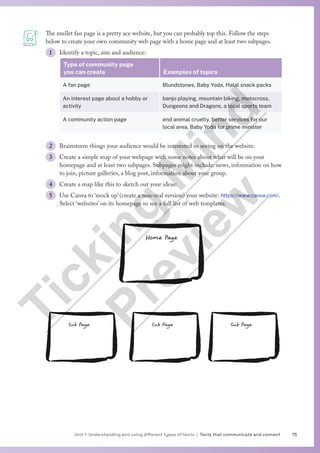
→ how much time you’re planning on hanging around the house (and how much
you’ll be out)
→ whether you can cook (and what sort of things you cook).
You should also think about what kind of housemates YOU would like. You need to know that
they’re not going to play Mariah Carey really loudly in the shower every morning.
So, think about the sorts of questions that you might ask potential flatmates.
1.
2.
3.
4.
5.
Partner up with someone else in your class and conduct fake flatmate interviews. You should
take turns being the interviewer and the interviewee.
T
i
c
k
i
n
g
M
i
n
d
P
r
e
v
i
e
w
The VM Literacy Handbook
72
Community social media page
Example text to read
Posts

Friends of Yarro Yarro Creek
15h
Autumn is a beautiful season along the Yarro Yarro. The manna gums
are flowering and eel season is about to begin. Let’s make it even
more beautiful by cleaning up as much rubbish as we can! May 1 is our
annual Autumn team clean where teams of people compete to see who
can pick up the most litter on Yarro Yarro. Enter a team of at least 2
people, get sponsorship and help the creek!
Get all the information here: friendsofyarroyarrocreek.org.au/autumn-team-
clean
About

Founded in 1989, The Friends of Yarro
Yarro Creek is dedicated to restoring
and preserving the health of Yarro
Yarro Creek. We carry out our mission
through regular community events,
education campaigns and advocacy
to government organisations.
Our activities include:
• Planting and weeding days
• Rubbish blitzes
• Educational talks, walks and tours
• Bird watching and surveys
• 
Meeting with members of
parliament

The Yarro Yarro Creek runs for
approximately 55 kms, beginning
near Yarston Junction, a small town
on Melbourne’s eastern outskirts and
joining the Yarra at Woolshed Falls,
near Coalvale.
friendsofyarroyarrocreek.org.au
Home Events Photos Videos More
Friends of Yarro Yarro Creek
@FriendsofYarroYarroCreek Ÿ Community Organisation
T
i
c
k
i
n
g
M
i
n
d
P
r
e
v
i
e
w
73
Unit 1 Understanding and using different types of texts | Texts that communicate and connect
The internet is not only a place where you can find pictures of vegetables that look like
hamsters – it’s also a place where you can find groups of people that like similar things
to you. Often, these websites are set up as ‘Community groups’.
Community websites or social media pages often contain these features:
→ a brief statement about the aim or focus of the community
→ positive language celebrating the aims of the community
→ group pictures showing people participating in the community
→ a logo that symbolises the community
→ links to further information including: becoming a member, donating,
volunteering/how to get involved, upcoming events, news, contact details and
social media.
Thinking about the audience.
Although this might not be the sort of group you would join, it’s surprising what interests
other people – you might even know some people who are interested in really freakish
things, like kayaking or exercising in public. What sort of people might be interested in
joining the Friends of Yarro Yarro group? List three different interests these people might
have in common:
1.
2.
3.
Circle and label features from the list above that appear on the Friends of Yarro Yarro
Facebook page.
There are different types of communities and community web pages and social media sites.
Based on the information from its social media page, tick the type of community that best
describes the Friends of Yarro Yarro creek:
¨ Fan community: a group of people who are fans of something like a sports team,
celebrity, band, movie or book
¨ Support community: a group of people who help each other to overcome problems
such as mental illness
¨ Community of action: a group of people who want to work together to change
or improve something
¨ Networking community: a community where people can meet new friends or partners
¨ Interest community: a group of people who share information and teach each other
about a particular topic such as beekeeping.
T
i
c
k
i
n
g
M
i
n
d
P
r
e
v
i
e
w
The VM Literacy Handbook
74
Community webpage
Of course, we all know the internet was invented so that we can look at weird and
hilarious things online and we don’t ever need to be bored again. But many webpages
are not just to entertain you – they’re to help you to connect with other people who
might like similar sorts of things to you. They help to build communities of like-
minded people.
What website (not YouTube) do you visit most regularly? Is there somewhere on this website
for people to share opinions or reviews?
Example text to read
Royalsocietyofmulletlovers
MENU
History of the mullet
Mullet gallery
Blog
Tips for mullet care
Campaign for World
Mullet Day
Forum
Recent Posts
Top Three Tips for Mullet Care
24 April
It’s all about the brushing and good application of hair product …
Town in Queensland Announces Plans for ‘Big Mullet’
30 March
We’ve got the big pineapple, so why not the big mullet? The town of …
Mullet of the Year
Fellow mulleteers, the entries are in and it’s time to vote for Mullet of the Year! Visit
our gallery to vote for Mullet of the Year and post comments about who should win.
Contact us
T
i
c
k
i
n
g
M
i
n
d
P
r
e
v
i
e
w
75
Unit 1 Understanding and using different types of texts | Texts that communicate and connect
The mullet fan page is a pretty ace website, but you can probably top this. Follow the steps
below to create your own community web page with a home page and at least two subpages.
1 Identify a topic, aim and audience:
Type of community page
you can create Examples of topics
A fan page Blundstones, Baby Yoda, Halal snack packs
An interest page about a hobby or
activity
banjo playing, mountain biking, motocross,
Dungeons and Dragons, a local sports team
A community action page end animal cruelty, better services for our
local area, Baby Yoda for prime minister
2 Brainstorm things your audience would be interested in seeing on the website.
3 Create a simple map of your webpage with some notes about what will be on your
homepage and at least two subpages. Subpages might include: news, information on how
to join, picture galleries, a blog post, information about your group.
4 Create a map like this to sketch out your ideas:
5 Use Canva to ‘mock up’ (create a non-real version) your website: https://www.canva.com/.
Select ‘websites’ on its homepage to see a full list of web templates.
Home Page
Sub Page Sub Page Sub Page
T
i
c
k
i
n
g
M
i
n
d
P
r
e
v
i
e
w
The VM Literacy Handbook
76
Online meetings
COVID lockdowns taught boomers how to use online meeting platforms and now
everyone has to suffer. At some point, you’ll need to set up an internet meeting for
a job or housemate interview or because you’ve finally been locked up for smuggling
dragons into the country and the internet is your only link to the outside world.
In your journal, write about the most memorable internet meeting you’ve been in (with a tool
like Zoom or Microsoft Teams) because it was either really, really good or really, really bad.
Explain what was good or bad about it.
’A Video Call in Real Life’ by Tripp and Tyler
http://bit.ly/3FpsH3V
T
i
c
k
i
n
g
M
i
n
d
P
r
e
v
i
e
w
77
Unit 1 Understanding and using different types of texts | Texts that communicate and connect
Throughout this meeting, a range of things go wrong. Some of these things are the result of
bad luck and some are the result of bad organisation or human behaviour.
Write down examples of things that belong in each category:
Things that go wrong because
of bad luck
Things that go wrong because
of bad organisation or behaviour
•
•
•
•
•
•
•
•
•
•
•
•
•
•
Now imagine you are going to set up an online meeting of your own.
You are the manager of a local hamburger outlet. The owner, Beth, wants to have a Zoom
meeting for all of the managers of the stores she owns. She is a bit of a control freak and refers
to all of the managers like you as “young folk”. She has sent you a draft set of rules she thinks
everyone should follow in the meeting. She wants your feedback.
1 Read through what Beth has written so far.
2 Cross out any expectations you think are unnecessary.
3 Add expectations that you think are missing.
4 Rewrite the expectations to add humour or details that will appeal to other “young” store
managers.
Beth’s draft expectations
• Be ready.
• No drinking or eating while on the call. It’s disgusting and noisy.
• Be somewhere quiet.
• Wear your uniform. We’re all part of a team and should be proud.
• Put your hand up to show you want to say something.
T
i
c
k
i
n
g
M
i
n
d
P
r
e
v
i
e
w
The VM Literacy Handbook
78
Online employment profiles
Do you have mad skills for something that you think people will pay you sweet
cashola for? Advertising online through websites like Airtasker or Oneflare can help
you to connect with people who are looking for skills you have. Your profile will be an
important element in someone deciding if you’re the type of person they’d hire or run
away from.
Paxton F.
About
I am an experienced and patient babysitter who loves looking after children of all ages.
I have lots of cousins and have been babysitting many children in my neighbourhood for
three years. I am punctual and reliable and can be trusted to look after your little darlings
and help clean up after them. I am currently studying to be a childcare worker, so this is a
real passion for me.
• current Working with Children Check
• up-to-date first aid training
• I have my Ps
• available for after-school pick-up Thursdays and Fridays
• available most evenings
“Friendly and patient babysitter”
Jordan W
About
Hi, I’m Jordan and I run a lawn-mowing service. I can mow, edge and trim your lawn so
that it looks as smooth and green as a golf course. I have lots of experience with both
large and small gardens. I am friendly and punctual and can bring my own tools so that
all you need to do is sit back and enjoy your great-looking grass. I am always careful to
avoid damaging the other plants in your garden and am respectful of your neighbours.
Ask me for a quote and you won’t be disappointed.
“Reliable and careful lawn mower”
Example text to read
T
i
c
k
i
n
g
M
i
n
d
P
r
e
v
i
e
w
79
Unit 1 Understanding and using different types of texts | Texts that communicate and connect
Now it’s time for you to have a go at turning your skills into money, money, money. If you are
successful, you could even throw your new wads of cash into the air and roll around in it, like
real millionaires do.
1 Brainstorm skills or services you have that other people might need.These could be
things like:
• cleaning
• babysitting
• lawn mowing or gardening
• bicycle repairs
• computer repairs
• cooking
• mural painting
• anything YOU are awesome at.
2 Write a list of your skills in this area. Remember that you need to make yourself sound
good, so choose words from the table below to help each of your skills sound even more
AWESOME:
careful punctual caring thoughtful
precise original thorough detailed
accurate friendly helpful practical
considerate cooperative excellent skilful
3 Write a profile of yourself that is about 4–5 sentences long. Use the list of skills you
came up with, as well as the words in the table above so that you sound like the ideal
person to hire. Also, using these basic sentence structures will help you keep your
profile brief:
• I am … who …
• I have … and have …
• I can …, … and …
• I will … so that …
T
i
c
k
i
n
g
M
i
n
d
P
r
e
v
i
e
w
The VM Literacy Handbook
80
18th Speech
Turning 18 isn’t just about getting together and sharing a slab of cider. Often, people
will make speeches about the 18-year-old. These speeches are usually a series of
anecdotes that allow everyone at the party to laugh at the person turning 18. But the
best 18th speeches also show the positive side of the person.
Example text to read
Good evening everyone and thanks for coming along to celebrate the day that most of us
thought would never happen: Norman Price has turned 18!
My name is Sarah, and I’ve been Norman’s friend for as long as I can remember and now,
of course, I am his girlfriend.
For those of you who have been residents of Pontypandy for years, Norman Price is a
familiar figure – he has tried to burn the town down on many occasions and is the cause of
most of the grey hairs on Fireman Sam’s head. It’s hard to understand how one boy could
have caused so much trouble in such a small town, but that’s Norman for you. When you’re
friends with Norman, life is never dull. There are a couple of stories I think really sum up
Norman’s nature – and almost all of them involve a fire.
One of the best stories about Norman was the time he thought he was a superhero called
Atomic Boy. For a couple of days, he genuinely believed he was invisible. He had this little
cloak that he wore, and Atomic Boy snuck around the streets of Pontypandy pretending no
one could see him. Of course, it couldn’t last. When Joe’s robot dog – remember that dog
everyone? – went crazy, Norman thought he could save the day. He announced that because
he was invisible, he’d confront the dog. Of course, it all went horribly wrong and ended in a
fireball. But the important thing to remember is that Norman genuinely believed he would
save the day. He really wanted to be brave. And that’s one of the things that makes him such
a great person.
Norman has not just believed that he could be a superhero. Once, when he was obsessed with
Harry Potter, he thought he could be a wizard AND a movie star. So, he got me, my twin
brother James and Mandy to help him create this amazing movie. Now, this time his magic
didn’t cause a fire – or much of one (laughs) – but he DID get stuck on the zip-line for his
final stunt. There he was, hanging on a zip line like a pair of undies, yelling and screaming.
It was hilarious. Once again, Fireman Sam and his crew had to come in and save the day.
But even though all of the adults were really annoyed, we kids had a fantastic day, all
because of Norman’s great imagination.
But I think my favourite Norman misadventure was the time he set fire to his own house.
His poor mother, Dilys, had to evacuate her shop and home, closing the business for the
day. All of this because Norman was worried that his pet lamb, Woolly, would get too cold.
Norman had found an old, faulty electric blanket and set it up on the floor for Woolly to
enjoy before – you guessed it – it caught fire. Woolly was lucky he didn’t end up as roast
lamb!! Once again, Norman had created a disaster, but, once again, it was because of a
great quality – his kindness and thoughtfulness.
And I think that’s what we’re all here to celebrate today – not all of the times that Norman
has nearly burned our town down, but his wonderful character. Norman is brave,
imaginative, thoughtful and kind. And that’s why I love him. But let’s all make sure he
doesn’t light his own birthday candles!
T
i
c
k
i
n
g
M
i
n
d
P
r
e
v
i
e
w
81
Unit 1 Understanding and using different types of texts | Texts that communicate and connect
Now it’s your turn to pretend you’re going to write an amazing 18th speech for your best mate
or a fictional character from a show.
Here are a few steps to follow:
1 Brainstorm three funny stories about your friend or character:
1.
2.
3.
2 Think of one or two positive qualities that each story demonstrates.
Use the table below to help you:
thoughtful kind imaginative creative
funny caring curious interested
fair responsible well-mannered courageous
inclusive sympathetic loyal open-minded
selfless determined ambitious hard-working
3 Write a draft of each of the stories you brainstormed.
Use the sentence starters below to help you out.
Introduce positive qualities of person with … Start a story with …
When you’re friends with …, life is never …
Anyone who knows … knows that they are …
For those of you who’ve known … for any time,
you’ll know that …
There are a few stories I’d like to tell that sum up …
One of my favourite stories …
I think that one event that sums
up …
I clearly remember …
Who could ever forget …
One of the best stories …
Provide details with … Reflect on positive qualities with …
… this was because …
… all due to the fact …
… since …
… which was caused by …
… which led to …
… even though this happened …
… while it was a disaster …
… still, it showed …
… but after all, we could see …
… in the end, it demonstrated …
All of these stories show that …
And that’s what we’re here to celebrate – that …
T
i
c
k
i
n
g
M
i
n
d
P
r
e
v
i
e
w
The VM Literacy Handbook
82
Scams
Like your cat, scammers want to connect with you but only care about what they can
get out of you.
Use two of these words to explain what a scam is: manipulate, fake, steal, false, financial.
A scam is 

Example text to read
Account deactivated due to suspicious activity
spotifyinfo@securityspotifyz.net
Dear User,
At the Spotify Anti-Fraud Department we take your security very seriously.
We have noticed some suspicious activity on your account recently and have de-activated it.
ANY attempt to login now will mean you are treated as a hacker. To reset your account and
begin using it again safely click on the link below within the next 24 hours.
CLICK HERE TO RESET YOUR ACCOUNT
Regards,
Spotify Anti-fraud Team
Pure Bred Poodle Puppy For Sale
SA, Australia
$575
Female. 7 Weeks old.
This beautiful girl is now ready for a new home of a poodle lover. Pure bred
puppies like this one usually sell for over $2000. We are selling this one
cheap because we have too many puppies at the moment.
We are a well know breeder from SA, Australia with %100 satisfaction rating.
After payment is made, we’ll organise a pet courier and insurance to your
location. Payment is via money transfer or crypto currency directly to me.
Sign in to message seller
Three unsuccessful attempts have now been made to deliver
your package from ParcelFreight. To have this package delivered
to your nearest post office, you will now need to pay a delivery
surcharge. Click here to pay the charge.
Today 3.36pm
T
i
c
k
i
n
g
M
i
n
d
P
r
e
v
i
e
w
83
Unit 1 Understanding and using different types of texts | Texts that communicate and connect
Unfortunately, the messages on the opposite page are all typical and boring examples of scams.
None of them involve something ridiculous like investing in a rocket-propelled jet pack.
Use the list of ‘Features of scams’ below to circle and annotate at least one thing each message
is doing to try to make you believe it’s true.
Features of scams How to spot them
Claim to
be from an
authority
Scam messages often
emphasise they are from
‘official’ people, accounts or
departments to make you think
it is a genuine message.
• Dodgy looking email address
• No legitimate contact details like a
phone number or webpage
• Spelling and grammar errors
• The formatting of a message
doesn’t seem quite right
Create a sense
of urgency
Scam messages will often
emphasise you have a limited
time to do something before an
offer ends or you incur negative
consequences to make you
respond immediately without
thinking.
• Uses words or phrases like
‘immediately’, ‘within the next 24
hours’
• Emphasises the need to click on
a link rather than take any other
type of action
Make you feel
panic, fear or
hope
Scam messages make you feel
panic by threatening you with
fines or legal action. They can
also make you feel hope by
promising something amazing.
• Emphasises how much of a big
deal something is
• Uses language like ‘court’, ‘fines’,
‘legal action’, ‘police’ to make you
feel threatened
Offers a ‘too
good to be true’
opportunity
Scam messages regularly
include offers of refunds,
discounts, freebies or money
that are unexpected.
• If your first reaction is ‘this is too
good to be true’, then it probably is.
• Unusual payment method is
required (like immediate upfront
payments or deposits, bank
transfers or money orders)
The average Australian who is duped by a scam loses $1370. So, being able to spot a scam and
make scammers eat poo is a good life skill.
The two government websites below provide advice about what to do if you think something
is a scam. Look through each website and identify one different tip from each that you find
the most useful about what to do if you think something is a scam.
Discuss with a partner the tip you found most useful and why.
http://bit.ly/3LKtUqG http://bit.ly/3JZV2k9
T
i
c
k
i
n
g
M
i
n
d
P
r
e
v
i
e
w
The VM Literacy Handbook
84
Recruitment Ads
Job and education ads aimed at young people often try to make them think of the future.
Circle the things from the list below that you think of when you think of the future:
owning a house
being in a relationship
staring at the horizon soulfully
having a great job
ice cream
living somewhere else
travelling
making money
flying cars
Example text to read
Future Planet Energy
Dream. Create. Power. Repeat.
Future Planet Energy is taking Australia into the
future of renewable power. And we’re looking to
recruit the next generation to power that future.
We’re offering careers and on-the-job training
for under-25s in renewable energy design,
programming, engineering and administration.
The only qualification you’ll need is the ability
to dream big.
See our website for more details and to
register your interest.
T
i
c
k
i
n
g
M
i
n
d
P
r
e
v
i
e
w
85
Unit 1 Understanding and using different types of texts | Texts that communicate and connect
You’ve taken the first step in defeating The Evil Advertising Empire.
Now use all of the sentence starters below to write a paragraph that analyses how
the ad works:
→ Future Planet Power’s recruitment ad is trying to …
→ Initially, it gains our attention by … This technique …
→ Another way it captures our interest is through …
→ Once it gains our attention, the ad then provides details that … These details are
presented in …
→ Finally, the ad prompts action by including a … that is designed to …
All ads are basically trying to brainwash you into doing or buying stuff. So you
don’t become a human-robot slave to advertising, you need to teach your brain to
think about the evil tricks advertising is playing on you. One easy way to analyse
advertisements is to identify and think about what it does to: 1) gain attention, 2) add
details and 3) prompt action.
Use the table below to identify, circle and annotate features of the recruitment advertisement
on the opposite page.
Gain attention by Add detail by Prompt action by
• Having a large,
interesting picture
• Using bright colours
• Having a large heading
• Using high-interest
words like ‘cheap’, ‘new’,
‘best’
• Placing smaller, detailed
text under a larger
heading
• Providing information in
easy-to-read dot points
• Using simple, short
sentences
• Using slogans
• Using a call to action
phrase like ‘Visit our
website …’, ‘Donate now’,
‘Ask your local provider
to …’
• Including a phone
number, web address
or QR code for further
information
This ad is trying to appeal to young people because it wants to recruit people aged under 25.
Tick one statement that definitely describes how the ad is trying to appeal to young people.
¨ The ad is trying to motivate young people to join Future Planet Power by showing it’s
easy to get a career in the company.
¨ The ad is trying to make a career with Future Planet Power seem exciting and
adventurous for younger people.
¨ The ad is appealing to young people’s desire to save the planet.
¨ The ad is trying to motivate young people to join Future Planet Power by showing them
that they can have a rewarding and well-paid career with the company.
T
i
c
k
i
n
g
M
i
n
d
P
r
e
v
i
e
w
The VM Literacy Handbook
86
Example text to read
TAFE Ads
If you were thinking of going to a TAFE, what are two important things you would want
from that TAFE?
1.
2.
Adventures departing from
BE TAFE now.
Destination
YOU.
Visit our webpage to find your adventure now.
BE
TAFE
T
i
c
k
i
n
g
M
i
n
d
P
r
e
v
i
e
w
87
Unit 1 Understanding and using different types of texts | Texts that communicate and connect
An advertising company has heard you are AN EXACTLY AVERAGE TEENAGER.
Since they’ve been employed by a local TAFE to come up with an advertising campaign to
appeal to teenagers in your area, they asked you for some feedback on some of their concepts
… because you are an EXACTLY AVERAGE TEENAGER.
Develop a presentation for the company by following these steps:
1 Look through this folder of TAFE ads that the advertising company has designed
before: http://bit.ly/40npgTC
2 Select two ads you like and one you don’t.
3 Create a PPT presentation with three slides. Put the three ads you selected on the
three different slides.
4 Make notes on each slide about what you did or didn’t like about each ad.The notes
should be about how each ad captured your attention, developed details or appealed to
you as a young person.
5 Create a fourth slide where you list suggestions about what an ad for a TAFE might
do to appeal to young people.
Because all advertisers are trying to rip you off, brainwash you or steal your soul, they use
a range of similar techniques. Make some notes in the table below about what you notice is
similar and different when you compare the TAFE ad and the recruitment ad.
Similarities Differences
Write at least five sentences comparing the two ads by combining words in the table below.
Follow the rules listed below:
• Combine three words in a single row or column to create a sentence.
• Use the words in any order and add as many words as you want.
• For example, this sentence uses three words from the second row:
Each advertisement includes images of young people to appeal to its audience.
• Once you’ve created a sentence from the words in one row or column, use the words
in a different row or column to create another sentence.
both by slogan
audience each advertisement includes
picture and exciting
T
i
c
k
i
n
g
M
i
n
d
P
r
e
v
i
e
w
The VM Literacy Handbook
88
Unit 2
Understanding and
responding to issues
and opinions
Exciting list of stuff that’s in this chapter
Community debate and discussion  90
Liveability issues  102
Workplace issues  116
Everyone has opinions about stuff. Like thinking that cheese should form most
of the food pyramid. But other people disagree because they think that cheese
makes them fart too much. Both groups of people are right: cheese is delicious
AND cheese is bad for some people. Sadly, people will always disagree about
cheese, and they’ll also always disagree about other things. Because different
people have different opinions.
A really important life skill is learning to LISTEN to other people’s opinions
respectfully – even to those people who think that the world is ruled by a giant
lizard king. We also need to UNDERSTAND why people have these opinions
(maybe they have a giant and tyrannical goanna living in their backyard). And
finally, we need to RESPOND to those opinions with our own viewpoints –
because everyone knows that the world is really ruled by a goblin queen. Tick
all of the statements that you agree with on the opposite page to see how
important issues are.
T
i
c
k
i
n
g
M
i
n
d
P
r
e
v
i
e
w
89
Unit 2 Understanding and responding to issues and opinions
Why you’ve already got an opinion …
about having opinions
Today, I’ve already:
¨ disagreed with someone
¨ heard different opinions about
something
¨ thought that something was unfair.
When a group of people are making a
decision, I think it’s most important that:
¨ everyone gets a say
¨ there’s a fair outcome
¨ a practical decision is made
¨ evidence and facts are used to make a
decision
¨ everyone does what I want.
In terms of people sharing their opinions, I
think:
¨ some people have ideas and attitudes
that are just wrong and shouldn’t be
listened to
¨ everyone has a right to be respected
and listened to even if what they say is
unpopular
¨ I only want to hear them if I agree with
them.
The best arguments are ones that:
¨ use statistics and facts
¨ have humour
¨ make me feel passionately about
something
¨ connect to people’s personal
experience
¨ insult the other side.
When I get into an argument I:
¨ get stubborn and don’t listen to the
other side properly
¨ shout loudly
¨ storm out of the room
¨ make up facts
¨ always have thoughtful and well-
reasoned points.
The persuasive voices that make the most
impact on me are:
¨ influencers I watch online
¨ my parents
¨ the friends I look upon as demi-gods
¨ political leaders
¨ ads where everyone is good-looking
and looks like they’re having fun.
If you ticked:
20–27 boxes: You’re a passionate person who is engaged in the world around you. You’ve got
lots of ideas to share and you’re going to be ace at this part of the course.
15–19 boxes: You’re a deep thinker, but you’re a bit worried about sharing your opinions or
listening to other people. You’re going to love learning more and having insightful discussions.
10–14 boxes: You’ve got high standards and you want everyone to be as awesome as you.
This part of the course is going to be a real eye-opener about how interesting OTHER PEOPLE
can be.
1–9 boxes: You’re at the start of a rollercoaster ride where you will learn that some people
do have opinions and ideas that are worth learning about.
T
i
c
k
i
n
g
M
i
n
d
P
r
e
v
i
e
w
The VM Literacy Handbook
90
Community debates
and discussion
Unit 2 Understanding and responding to issues and opinions
Part of being human is belonging to different communities. So, it’s important to
realise that communities can be physical OR experiential. A physical community is one
like your local area, school, street gang or busking group. Or your community might
be experiential because you share a characteristic like awesome moustaches, a love of
Pokémon or a passionate interest in playing the piano accordion.
You belong to loads of different communities, whether you want to or not. Have a look at the
sentence starters below and fill out any details that show all of the different communities you
are already a part of.
→ Physical communities: In terms of where I live, I feel I most belong to 

 .
→ Interest, value and action communities: I regularly see a group of people in real life so that
we can 
 .
→ Cultural communities: I’m part of a family or cultural group who celebrate 
						, speak  ,
sing  ,
eat 
and wear clothes like  .
→ Interest / online communities: I’m part of a group of people/I regularly visit websites for
people who are interested in 
 .
→ Gender and sexual communities: I’m part of a community of people who identify as 

 .
→ Body image and ability communities: An important part of my body identity is 		
							 and this connects me to other people
who share this characteristic.
T
i
c
k
i
n
g
M
i
n
d
P
r
e
v
i
e
w
91
Unit 2 Understanding and responding to issues and opinions | Community debates and discussion
Even though we’re all individuals and no one really understands how hard it is to be us, we also
like being in communities of people like us. Being in a community is a positive experience
where you feel a sense of belonging. Looking at the list of communities you’re part of, pick
one you really love being in and write a few sentences reflecting on what you love about it.
Here’s an example:
I love being in my local sports team. We’re not very good, but we have heaps of fun because we
don’t take it too seriously.
I love 

Because each of us belongs to many different communities, sometimes we can experience
issues where an important value or aspect of one community conflicts with a value or aspect of
another community. For example, you might be part of both a computer game community and
a feminist community. This might lead you to having a conflict like this:
I love playing computer games with friends, but as a feminist, I sometimes find the sexism in
computer games really difficult, especially when my friends don’t seem to care about it.
What are two different communities you belong to that sometimes create an issue for you
because they have different values or focuses?
I love 							, but 

Communities can also face issues when events, other groups or developments and attitudes in
society have some type of negative impact. Like when scientists in a laboratory near your local
community accidentally create killer robots that go on a rampage.
Here are some other examples:
I love being part of the LGBTQI+ community, but there is still so much prejudice in the world that
it gets me down.
I love living in rural Victoria, but floods have devastated our local community and made life really
hard.
What is a community you are part of and an issue it faces because of events, other groups
or developments in society?
Community you are
part of
Issue it faces
T
i
c
k
i
n
g
M
i
n
d
P
r
e
v
i
e
w
The VM Literacy Handbook
92
Community protest poster
Lambsden is a small town that has a lot of tourists visiting it. One of the pubs in
this town has been bought by the Australian Resort Company (ARC). The ARC is
going to turn the pub into an upmarket resort for people visiting the town. Lambsden
locals have formed a group to protest against this development. This group has put
up a range of posters around the town to get more people on their side and stop the
development from happening.
What values and concerns might local residents of a small town have?
Circle three from this list:
Things/activities to do
Jobs for locals
Access to education
Places to gather as a community
Protection for the environment
Protection of community history
Affordable housing
A town that looks nice
Example text to read
T
i
c
k
i
n
g
M
i
n
d
P
r
e
v
i
e
w
93
Unit 2 Understanding and responding to issues and opinions | Community debates and discussion
Many communities face issues of developments that locals oppose. This might include:
• beloved old buildings being knocked down
• unpopular, new buildings being built (like high-rise apartments or shopping centres)
• natural areas being overtaken or impacted by developments.
Can you think of any issue about a development in your local area?
1 What does the poster want people to do after they have finished reading it?


2 The heading of the poster uses the word “destroying”. What does the word destroying
mean?


3 What picture does the word ‘destroying’ create in your head?


4 The poster doesn’t say that the ARC is going to destroy the pub, it says the ARC is
“destroying the community”. Why is the thought of destroying the community more
persuasive than destroying a pub?


5 Apart from ‘destroying’, what are two other negative or attacking words that make the
ARC seem as evil as Lord Voldemort?
1. 
2. 
6 The poster uses a simple visual to be more persuasive. Use the sentence starters below to
describe the visual and the way it might persuade the audience:
The poster includes a simple image of a …
This picture makes the audience think the ARC is … and …


T
i
c
k
i
n
g
M
i
n
d
P
r
e
v
i
e
w
The VM Literacy Handbook
94
Community campaign poster
Example text to read
T
i
c
k
i
n
g
M
i
n
d
P
r
e
v
i
e
w
95
Unit 2 Understanding and responding to issues and opinions | Community debates and discussion
The ‘stop’ ARC development poster on page 92 and the ‘save’ The Farmers Arms poster on the
opposite page use some persuasive words that are the same and some that are different.
Circle all the persuasive words, such as ‘historic’ and ‘bulldozed’, in each poster. List the
words in the appropriate category in the Venn diagram below.
Words in
‘Stop’ poster Words
in both
posters
Words in
‘Save’ poster
1 What is different about the argument made by this poster compared with the poster on
page 92?


2 Match each of the words below to their connotation (what they make you think of):
protect something that is like an evil demon without real feelings
bulldoze look after and keep safe
heritage the important essence of something
soul to flatten something to the ground and completely get rid of it
soulless an important and special part of our history
3 One poster was trying to get people to ‘stop’ something from happening.The other
poster is trying to ‘save’ something. In your opinion:
¨ The idea of ‘stopping’ something is more convincing …
¨ The idea of ‘saving’ something is more convincing …
¨ They are equally convincing …
… and this is because …

T
i
c
k
i
n
g
M
i
n
d
P
r
e
v
i
e
w
The VM Literacy Handbook
96
Posting rules for online communities
If online communities said, “Post whatever you want on our website” – they’d probably
end up with lots of cat memes or scam ads for magic flying lawnmowers. That’s why
online communities often have rules about what can be posted on their community
sites. But sometimes there is fierce debate about what these rules should be or how
they are enforced.
The online debate below is about the ‘toxic positivity’ of a community – the idea that a
community page can be ‘too’ positive.
Do you think something can be ‘too’ positive? Explain your answer below:


Example text to read
About

Welcome to the Good Vibes network. In an internet world where there is so much hate, this is a sanctuary where Yerri
locals can celebrate our community and spread happiness by sharing stories that focus on the great things happening in
our neighbourhood. It’s also a place to share spare furniture, household goods and food to bring joy to others.
To create a positive, sharing space, we ask you to respect these rules:
• Be honest and truthful.
• Focus on sharing local experiences that are positive.
• Share unique stories: do not re-post stories from elsewhere.
• Be compassionate.
• Do not criticise.
Good Vibes Network
Real Good Vibes Group
About

The Real Good Vibes Group believes that Yerri is an amazing place to live … but it’s not perfect. We think that in order
to celebrate our local neighbourhood, we also need to be honest about its failings. If we don’t, we can become toxically
positive. So, our community page is a genuinely inclusive space where you can share your honest truths about what’s
great and not so great about Yerri.
Here are a few sensible rules about keeping our space inclusive and useful:
• Sharing means listening to others. If you post something, also respond to something.
• If you post regularly, keep a balance of positive and negative posts.
• Being critical is different to being hateful or bigoted. We think you can work out the difference.
realgoodvibesgroup.com.au
T
i
c
k
i
n
g
M
i
n
d
P
r
e
v
i
e
w
97
Unit 2 Understanding and responding to issues and opinions | Community debates and discussion
The Good Vibes Network believes it’s important to lay down some awesome funk beats focus
on positives. What are two reasons it provides for this:
1.
2.
The Real Good Vibes Group not only had trouble coming up with an original name, but also
disagrees with the point of view of The Good Vibes Network.
What is the main reason The Real Good Vibes Group disagrees:


Each community page tries to persuade its audience that it represents the community. What
are examples of some words or phrases that each page uses to do this:
Good Vibes Network Real Good Vibes Group
Discuss with a partner which group you would rather belong to. Before talking to them,
consider these things:
1 What was your first reaction when you read each post?
2 Which of these was important to your choice of which group you’d rather belong to?
• your personality
• your values
• past online experiences
• ideas about stories you could share
3 Would you be more likely to join one group or the other if they changed some of their
posting rules?
Imagine you are creating your own online community for fans of Wombats called
‘Wombatty’. What are three rules you would make for posting on Wombatty?
1.
2.
3.
T
i
c
k
i
n
g
M
i
n
d
P
r
e
v
i
e
w
The VM Literacy Handbook
98
Online reviews
The internet is full of online communities that get together to discuss how awesome
perfumes, games or llamas are. And in many of these communities, people disagree
on their favourite things. This is because people have different opinions. Because
they’re people.
Example text to read
KICKS-OUT
Casual shoe reviews by casual shoe lovers
JELLY BEANS MID 7s
I love colours, I really do. And I wanted to love these Jelly Beans Mid 7s – they look amazing.
But in order to get these colours, Jelly Beans have released some pretty toxic chemicals into the
environment, and it’s hard to feel good about that. I was looking to branch out from my Vejas
and add a bit more colour (and also, let’s face it, Vejas have great environmental credentials,
but they’re not exactly comfortable, with that weird, extra-long tongue). But I just couldn’t bring
myself to purchase a pair of Jelly Beans, even after I tried them on in-store and admired my
colourful self. It’s not just the toxic colour chemicals (I loved the colours so much I could nearly
overlook this problem), but the soles are produced from rubber that is only 1% recycled and
the uppers have only 3% organic cotton. That’s a huge environmental footprint (pun intended).
I just couldn’t justify a purchase that would have such an impact on the world and I’m kinda
disappointed that Jelly Beans haven’t woken up to the impact that the fashion industry is having
on our planet. I love the look of these shoes, but I’d hate the guilty feeling I’d have if I bought them.
-OneWorldBro
Oh man, I love these shoes – they’re like the HG of all shoes: cool, comfy, light and good-looking.
I’ve always been a fan (or should I say, ‘bean’ a fan – geddit?) of Jelly Beans sneakers – unlike
most sneaker brands they prioritise colour and personality, which makes you want to get them in
all colours. Previously, though, they’ve only released low-rise versions. And I love a bit of high-top
action, so I was super excited when I heard that they were releasing their new Mid 7s. In some
ways, they look a bit like a cross between a Converse Chuck Taylor Hightop and the more padded
Air Jordans. But the thing that separates Jelly Beans Mid 7s from the pack is that they have
coloured soles. And you can mix and match the combination of sole and upper to suit yourself,
which means that you can order shoes that fit your personality and your wardrobe. I ordered mine
with a purple upper and a yellow sole, and they were pretty eye-watering when they arrived, but
boy, did they attract some attention! They are really the show-stoppers of an outfit and everyone
notices them – even normals who don’t usually look at my sneakers. When I first wore my Mid
7s, I noticed that they were comfortable all over my foot, and I didn’t even get that weird new-
sneaker-blister on my heel. Even though I wore them all day. It was like I was floating on air. But
beautiful, colourful, head-turning air. I want to get them in every single colour combination – which
might mean that I end up with about 26 new pairs of kicks. Lucky me!!
-Awa
T
i
c
k
i
n
g
M
i
n
d
P
r
e
v
i
e
w
99
Unit 2 Understanding and responding to issues and opinions | Community debates and discussion
It’s pretty clear that both reviewers the look of the new Jelly Beans Mid 7s. But even
though they agree about this, they disagree about a lot of other things. And that’s probably
because they’re coming from completely different places. They have different priorities
and values.
1 Look at the list of priorities, values and biases below:
• comfort
• style
• personal identity
• environmental impact
• concern for workers’ welfare
• cost
• variety of options
• quality
• brand loyalty
• group affiliation
2 Sort these priorities, values and biases into the table below
Awa OneWorldBro Neither/Can’t tell
3 From the list above, identify the values that are most important to you when buying
something. You can also add values you have that aren’t on the list:
1.
2.
3.
4.
Turn to a partner and compare and discuss the values you have when buying something.
Provide explanations about why some values are more important to you than others.
T
i
c
k
i
n
g
M
i
n
d
P
r
e
v
i
e
w
The VM Literacy Handbook
100
Political advertising
Some people like to be in charge and boss everyone around. One of them is probably
your best friend … or possibly your cat. Another example is a member of state
parliament. Every few years, different candidates in your local area will compete with
each other to represent your community in the Victorian Parliament. These candidates
will try to convince you to vote for them by giving away free BBQ sausages and
creating ads about how they represent local values and issues.
What are three values or qualities you would want a member of parliament for your local area
to have?
1.
2.
3.
Campaign ad for Dr Kate Lardner
https://vimeo.com/751923972
T
i
c
k
i
n
g
M
i
n
d
P
r
e
v
i
e
w
101
Unit 2 Understanding and responding to issues and opinions | Community debates and discussion
Think about how a member of parliament in the area you live in is trying to appeal
to locals by following these steps:
1 Find out who the politician is who represents your local area and find their
website. An easy Google search you do to find this out is: [name of your area] +
mp + victoria + website
2 Look at the homepage of their website:
• What issues do they list as important?
• How might these issues be important to voters in your area?
3 What is similar or different about how your local politician tries to appeal to
voters compared to Dr Kate Lardner’s approach?
What are two things Dr Kate Lardner says or does at the start of her video to show she is the
type of person locals should vote for?
1.
2.
In order to convince people to vote for her, Dr Kate Lardner says she is a “doctor, not a
politician”. What are positive associations people might have with being a doctor, and
negative associations with being a politician?
Positive associations with
being a doctor
Negative associations with
being a politician
Soon you’ll be 18 and the most important thing about this will be:
being able to buy scratchies
getting your license
voting!!!
T
i
c
k
i
n
g
M
i
n
d
P
r
e
v
i
e
w
The VM Literacy Handbook
102
1)
The
state
of
the
environment;
2)
Equity
and
discrimination:
How
unequal
society
is
and
unfairly
some
people
can
be
treated;
3)
Mental
health;
4)
The
economy
and
financial
matters;
5)
Industrial
relations:
how
well
employees
and
their
companies
are
getting
along;
6)
Housing
and
homelessness;
7)
Crime,
safety
and
violence;
8)
The
quality
of
our
political
leaders;
9)
Access
to
education
Liveability issues
Unit 2 Understanding and responding to issues and opinions
If ‘liveability’ sounds like a made-up word, like ‘blamestorming’ or ‘soup’, then
that’s because you probably haven’t come across this idea before – or eaten soup. But
liveability issues are kind of a thing … and it’s what this next section is about. So let’s
start by thinking about what liveability means.
Which one of these definitions do you think might describe what liveability means?
¨ A type of country music that
is played in hilly areas
¨ How suitable a place is to live in
¨ How much you earn
¨ How long you expect to live
Every year, the people at Mission Australia ask young people around Australia what they
feel are the big issues that affect the liveability of their lives. Once they get past listing all the
things they think their parents could do better, these young people list a range of other big
issues they care about. The next few sections of this book will look at some of these issues.
Rank these issues from 1–9 according to how much you care or are worried about them:
¨ Mental health
¨ Crime, safety and violence
¨ The quality of our political leaders
¨ Access to education
¨ Equity and discrimination: How unequal society is and unfairly some people can
be treated
¨ The state of the environment
¨ The economy and financial matters
¨ Industrial relations: how well employees and their companies are getting along
¨ Housing and homelessness
Now, check your answers against how young people around Australia generally rank
them to see how weird and different you are to other teenagers, or to confirm that you’re
exactly normal:
T
i
c
k
i
n
g
M
i
n
d
P
r
e
v
i
e
w
103
Unit 2 Understanding and responding to issues and opinions | Liveability issues
So why do you care about some issues more than others?
Use the prompts below to discuss with a partner why you ranked the issues on the opposite
page the way you did. Also, talk about how similar or different your response was to other
teenagers around the country.
• My top concern was … because …
• In my life, this is a big issue because …
• I could have put a number of issues at the top because …
• In the middle of my list, I put … I think about this sometimes when …
• There were some issues that I didn’t care about like … and …
• I don’t feel like I’m really affected by … since …
• I was not surprised that most other teenagers put … at the top of their list.This makes
sense to me because …
• I was surprised that most other teenagers put … at the top of their list.This was surprising
to me because most teenagers I know …
• I wonder if …?
• Do you think teenagers give different responses when …?
You might have concerns that were not even on this list. What do you think is missing?
Write three concerns that you think SUPER DEFINITELY SHOULD have been on
the list:
1.
2.
3.
Turn to your partner again and discuss why these are important additions to the list.
Use the sentence starters below to help you get started.
• I think it’s important for us all to think about … because …
• I can’t believe that no one has added … It’s really important to me because …
• One of the issues no one ever seems to talk about is … and we definitely need to talk
about it since …
• It seems weird to have a list about young people’s concerns and not mention …,
which is really important since …
T
i
c
k
i
n
g
M
i
n
d
P
r
e
v
i
e
w
The VM Literacy Handbook
104
Housing affordability for young people
Someday you’ll want to move out and rent a place of your own to find out if you’re the
type of house sharer who likes to label everything you own in the fridge and gets crazy
if someone touches your stuff. So that’s the dream, but achieving the dream of renting
can be difficult for a young person because …
Example text to read
Problems Possible solutions
• Young people in the 18–25 age bracket
find it particularly difficult to find and
be able to pay for rental properties.
Nearly one-quarter of young tenants
report being passed over for rental
properties because of their age.
• 37% of people aged between 20
and 24 experience ‘housing stress’.
Housing stress: having to pay more
than 30% of income on rent.
• The average price of rental property
in Victoria: House–$440, Apartment–
$380
• The average weekly earnings of
18–20-year-olds in Australia: $383.70
• 23.0% of all people experiencing
homelessness are aged from 12 to 24
years.
• Young people report being badly
treated by their landlords: Full-time
student Jack Doughty, 20, said his
landlord “kept making threats about
putting us on a blacklist, telling us
we’d never be able to rent again, telling
us that he would make it very difficult
for us to be able to get our bond
back”. Source: https://www.abc.net.au/news/2023-03-12/
victorian-rental-market-crisis-housing-shortage-tenants-
victoria/102084206
Governments should:
• Establish a National Standard of
Renters’ Rights (a kind of national set
of rules) that would protect renters
and stop landlords from:
• Raising rent too often
• Kicking renters out for no reason.
• Make rules that prevent real estate
agents from collecting information
about a renter’s age as part of the
rental application process.
• Stop people renting out their houses
for short-term stays on Airbnb so that
more properties are available for long-
term rent.
• Pass a law that stops rent from being
increased for the next two years. After
that, rent can only be increased by 2%
every two years.
• Build 30,000 new houses over the
next five years that be rented out as
affordable housing.
• Make it easier for young people to
access rental assistance payments
and increase the amount of payments.
At the moment, rental assistance
payments for an individual with no
children are about $50 per week.
T
i
c
k
i
n
g
M
i
n
d
P
r
e
v
i
e
w
105
Unit 2 Understanding and responding to issues and opinions | Liveability issues
Now, try writing a whole paragraph that includes these things:
• an opening sentence with negative or attacking language
• a second and third sentence that provides a piece of evidence and explanation about
what it means
• a final sentence or two that argues for a solution (you can use one of the suggested
solutions on the opposite page or choose one of your own).
Using negative or attacking language to bring bad pictures to mind is a basic persuasive tool.
• Write two sentences where you use negative words to show how bad things are
for young renters at the moment.
• Use one of the sentence starters to begin each of your sentences and include
a different negative phrase in each of your sentences.
Sentence starter Negative phrase
Currently in Victoria, young people are …
At the moment, young people are …
Younger renters are …
suffering from …
being overwhelmed by …
the victims of …
struggling to …
paralysed by a rental market that …
devastated by …
Using sneaky negative words is only one way to make your writing persuasive. You’ll
also need to use evidence. Whenever you use evidence, it’s good to have an example
in one sentence and then a follow-up sentence where you explain what this evidence
shows or why it’s important.
Example Explanation of example
A large number of young people report being
discriminated against because of their young
age.
In other words, landlords take one look at the
age of someone applying for a rental place
and throw out their application if they seem
too young.
Choose an example of a difficulty young people face in renting from the opposite page. Write
about the example in one sentence and then explain what this example shows in
the next sentence. Use the sentence starters below to help you:
First sentence Second sentence
A large number of young people report …
Young people report that …
Statistics show …
One young person said that …
In other words,
What this means,
This leads to
Consequently,
T
i
c
k
i
n
g
M
i
n
d
P
r
e
v
i
e
w
The VM Literacy Handbook
106
Living with a disability
Everywhere, all around us, are humans with different appearances, identities,
personalities and abilities. It’s because they’re people. And people are not the same as
each other. Mind-boggling, we know.
What are some of the ways people can be different? List as many ways as you can imagine in
five minutes – try to get more than 20 different things. GO!!
1.
2.
3.
4.
5.
6.
7.
8.
9.
10.
11.
12.
13.
14.
15.
16.
17.
18.
19.
20.
You’re going to watch a video about different Australians who live with a disability. There
are many ways that they experience life in Australia differently from those around them.
And there are many ways that they would like to see a change in some people’s attitudes and
understanding.
• Before you watch the video, look through the questions on the opposite page.
• Make sure you understand what each question is asking you. If you don’t know what a
word means, ask your teacher, or look it up online.
• Then, watch the video a couple of times so that you can answer all of the questions.
‘What we wish people knew about living with a disability’
https://www.youtube.com/watch?v=alxjJd7qKtw
T
i
c
k
i
n
g
M
i
n
d
P
r
e
v
i
e
w
107
Unit 2 Understanding and responding to issues and opinions | Liveability issues
So now you’ve listened to the stories of some people who are living with a disability. Maybe it’s
rocked your world. Maybe you’ve learned something new or seen a different perspective. It’s
time to demonstrate what you know.
Answer the questions below:
1 In the video, one of the presenters describes how disabilities can be “hidden”.
He clearly doesn’t mean that people with disabilities are hiding in the bushes.
What does he mean by saying that disabilities are hidden? 


2 What percentage of the population is disabled in some way? 


3 Disability is described as “prevalent”. What does this word mean and what word picture
does the word connote?
• Meaning: 
• Connotation: 
4 In the video, how do the presenters say that they are judged? Give three examples:
• Example 1: 
• Example 2: 
• Example 3: 
5 What are three things that people living with disabilities say they want from others?
1.
2.
3.
6 In what ways were some of the presenters’ experiences similar? And what were some of
the differences?
• Similarities: 
• Differences: 
1 Identify a place you are familiar with that could do more to be inclusive of people
with disabilities such as your school, workplace, a club you’re in, or a shopping
centre or place you go to regularly.
2 Discuss with a partner how this place isn’t as inclusive as it could be and suggest
a solution.
T
i
c
k
i
n
g
M
i
n
d
P
r
e
v
i
e
w
The VM Literacy Handbook
108
No one looks cool with four cigarettes in their mouth.
No one looks cool vaping.
No one is healthy while they’re vaping.
Choose to say, “No”.
Brought to you by the Department of Health
Public health campaigns
Example text to read
T
i
c
k
i
n
g
M
i
n
d
P
r
e
v
i
e
w
109
Unit 2 Understanding and responding to issues and opinions | Liveability issues
The ads on the opposite page obviously have very different opinions about whether or not
vaping is good for you (Captain Obvious strikes again!).
Firstly, have a close look at who produced each of the ads.
Finish these two sentences:
The ad on the left was produced by 							 and
they’re interested in 


The ad on the right was produced by 							 and
they’re interested in 


Both of the ads use words to convince you that vaping is bad or good. What words do they use
to convince you of their arguments:
Words that suggest vaping is bad Words that suggest vaping is good
Create your own ad.
Your task is to convince teenagers to eat a piece of fruit every day. Follow these steps
to create this ad:
1 Think about what images of fruit or people eating fruit might appeal to teenagers.
2 Go online and choose an image that you think will be persuasive in your ad.
3 Write a short slogan of 5–10 words that says how awesome fruit is.
To help you come up with a slogan, look at some example famous slogans here:
http://bit.ly/3G48kJU
4 Give three details that tell your readers how utterly rad eating fruit is or how super
hip fruit eaters really are.
5 Now, for funsies, let’s think about the issue from the other side. Create an ad that
proves the evils of eating fruit. Go through the same steps as above, but this time,
make fruit seem like AN INSTRUMENT OF DEATH.
T
i
c
k
i
n
g
M
i
n
d
P
r
e
v
i
e
w
The VM Literacy Handbook
110
Transport issues
Because teleportation or flying brooms aren’t real, every day we have to get to the
places where we need to be via car, public transport, on a bike – or even by hoofing it
on our own two feet. Getting from A to B takes time, money and resources, so there’s
always lots of debate about why some forms of transport are better than others.
Read through the arguments below and:
• tick two or more arguments you agree with
• put a cross next to two or more arguments you don’t agree with
• don’t put anything next to the arguments that you don’t really care about.
Arguments for using and investing in public transport
¨ Public transport is an environmentally
friendly and efficient way to transport
hundreds of people each day.
¨ Having more trains, trams and buses
means we’ll reduce pollution.
¨ We should make public transport
accessible for everyone, including
people with a disability.
¨ We should ban cars in the middle of
cities to encourage people to take public
transport and walk.
¨ We should increase taxes on petrol
and cars to encourage people to take
public transport.
¨ We should make public transport free.
Arguments for the necessity of cars and investing in roads
¨ Cars will always be necessary for
people living in areas with little
or no public transport.
¨ Cars are important to many jobs and
hobbies that require shifting large things.
¨ We need to invest in improving our roads
to make sure they’re safe to travel on.
¨ Cars are the only way for people with
disabilities to get from A to B.
¨ Electric car technology will significantly
reduce the amount of pollution cars
make. We should make electric cars
affordable and invest in building electric
car charging stations.
Arguments urging people to walk, cycle or scoot and for investing in footpaths
and bike tracks
¨ The most environmentally friendly way
to get anywhere is to walk or ride.
¨ If we all walked or rode more, we’d be a
lot healthier. It would reduce the amount
of heart disease and obesity in Australia.
¨ Paths make walking more accessible
for people with wheelchairs, canes and
mobility scooters.
¨ Investing in walking and cycling tracks
will help people meet each other on
the street and encourage a sense of
community.
¨ Students should be banned from being
driven to school.They should have to
ride, walk or take public transport.
¨ Busy areas of cities and towns should
be made ‘vehicle-free zones’ – so walking
and cycling are prioritised.
T
i
c
k
i
n
g
M
i
n
d
P
r
e
v
i
e
w
111
Unit 2 Understanding and responding to issues and opinions | Liveability issues
The opinions and values we have are informed by the people around us and our experiences.
For example, Peppa Pig makes lots of fat jokes about Daddy Pig because she’s influenced by a
culture that thinks being thin is beautiful.
Use the checklist below to identify things that influence your opinions and values about
transport.
Circle at least two statements:
Are you mainly a car and
roads fan?
Are you mainly a public
transport fan?
Are you mainly a walking
and cycling fan?
• You have a strong
personal value that cars
provide freedom and
independence.
• You live somewhere
where there’s little or no
public transport and it’s
necessary to drive.
• Your parents, family
or friends like driving
and cars.
• Lots of people you know
drive cars.
• You’ve had bad
experiences with other
forms of transport.
• You have a strong
personal value that using
public transport is a
social responsibility.
• You live somewhere
where there’s lots
of access to public
transport.
• Your parents, family
or friends like public
transport.
• Lots of people you know
use public transport.
• You’ve had bad
experiences with other
forms of transport.
• You have a strong
personal value that
walking and cycling
is important for health
and the environment.
• You live somewhere
where there are lots
of walking and cycling
tracks or you can easily
walk or cycle around.
• Your parents, family or
friends like walking and
cycling.
• Lots of people you know
walk or cycle.
• You’ve had bad
experiences with other
forms of transport.
Looking at things from a different point of view
1 Now it’s time to write a paragraph in support of one of the arguments on the opposite
page. But first, rather than just writing about your own opinion on transport, you need
to try thinking from someone else’s perspective.
Write a paragraph in support of one of the arguments you put a cross next to.Try to
imagine what experiences a person might have to support that argument.Then write a
paragraph arguing that case.
2 OK, now you can argue what you actually think. Pick one of the arguments you put a
tick next to. Write a paragraph arguing that case.
As you do so, imagine you are trying to convince the person you pretended to be for Step
1. How can you argue your case in a way that will convince them?
T
i
c
k
i
n
g
M
i
n
d
P
r
e
v
i
e
w
The VM Literacy Handbook
112
Okay, by now we all know that Boomers are out-of-touch dinosaurs, Millennials are
over-attached to their skinny jeans and the pressures of ‘adulting’, and Gen Z are
‘snowflakes’ who don’t want to work full-time. Oh, and there’s Gen X: no one ever
remembers them and they whine about being irrelevant.
All of these stereotypes are a big part of what is called the “generational divide” – we
all feel like the other groups don’t know how hard it is to be us and we all think that
other generations have it easy. Let’s have a look at some of the stereotypes of these four
main generational groups:
Example text to read
Generation Negative stereotypes Generational trends
Boomers
• Old and out of touch
• Caused environmental
destruction
• Don’t know anything about
technology
• Own all the houses
• Racist
• Free tertiary education
• Most families had one car (if any)
• No internet
• Movements such as the ‘hippie’
movement
• One TV per household
Gen X
• Materialistic
• Helicopter parents
• Overshare on Facebook
• Can’t function without coffee
• Cynical about the whole world
• Had computers growing up
(but were teenagers when the
internet was developed)
• Houses became larger (and
prices went up)
• End of free education
• Two-car households
Millennials
• Lazy and overpraised
• More interested in social media
than face-to-face interactions
• Regularly eat out
• Need their phones all the time
• Go shopping as a hobby
• Grew up with smart phones and
the internet
• Starting families later in life
• Worried about the environment
• Housing incredibly expensive
• Having families is no longer the
norm
Gen Z
• Environmentally concerned
• Obsessed with identity and
labels
• Snowflakes
• Don’t know how to Google
properly
• Cancel culture
• Grew up with parents taking
photos of them all the time and
putting them online
• Sceptical of formal and
traditional education
• Live in houses that are relatively
large
• Fast fashion and consumerism
are a ‘normal’ part of life
Generational conflict
T
i
c
k
i
n
g
M
i
n
d
P
r
e
v
i
e
w
113
Unit 2 Understanding and responding to issues and opinions | Liveability issues
Maybe some of those stereotypes seemed ‘true’ to you. Maybe you thought that you actually
belong to a different generation. But now it’s time for you to argue that yours is THE
GREATEST GENERATION OF ALL TIME, all time, all time, all time …
Follow these steps to write a paragraph that explains why yours is the greatest generation.
1 Make an assertion using the table below to help you:
Sentence opener Adjective Time phrase Add detail
My generation is the
People born after
2000 are the
Our cohort is the
greatest
most significant
best
of all time
ever
since history began
because
since
in that they
2 Outline one of the big ideas that defines your generation, using the table
to help you:
Sentence opener Add detail
One of the things that makes our generation different is that
As a generation, we are more … than …
The most significant thing we do is
[use the table
opposite to help you]
3 Argue against what others might say about your generation:
Sentence opener Verb Add detail
While some people might
Sometimes older generations feel that
We’ve all heard older people
complain that
moan that
criticise us as
whine about how
attack us as
and
because
how much we
because our
4 Attack that generation using a stereotype about them:
Sentence opener Time phrase Add detail
This is hypocritical
This is completely unfair
because
This is ridiculous because
they grew up in a world
where
they have always
they had the advantage of
[use the table on the
opposite page to help
you]
T
i
c
k
i
n
g
M
i
n
d
P
r
e
v
i
e
w
The VM Literacy Handbook
114
Classification rules
We have tons of rules that stop us saying, doing or looking at whatever we want. Here are
some you’ll be used to.
Classification
symbol
What does this symbol tell us about who can
and can’t watch certain things?
Everyone can watch this … even your grandma. Its language and themes
are unlikely to offend or harm anyone.
Kids under the age of 15 might find some of the themes or activities in
this text confusing or upsetting and they might need to debrief with a
trusted adult.
This is generally only allowed for people over 15 years old and may
contain some violence or sex that confronts people. Texts in this
category might also have some themes that people consider more
appropriate for adults because we all know adults make the right
decisions all the time.
This is only legal for people over 15 years old and people may be
required to prove their age to watch it in a cinema. Potentially offensive
themes in this sort of rating category are often sexual, violent or drug-
related.
This material is only allowed for adults because it contains material that
might be really high impact and you might have to scrub your eyeballs
and give yourself a lobotomy to get it out of your brain. Usually, it’s
violent, horror or explicitly sexual content.
All images: JamesHenstridge, Public domain, CC BY 3.0, via Wikimedia Commons
At some point in your life, you’ll probably try to do something crazy like ride a pig
to work. Then, when someone stops you, you might get cross and feel the urge to
shout, “It’s a free country!” Being ‘a free country’ is the belief that since Australia
is a democracy, we are free to say and do whatever we want (like ride a pig to work).
But being in a democracy is different to being in a country where you can do whatever
you want.
Spotify Platform Rules
https://support.spotify.com/us/article/platform-rules/
T
i
c
k
i
n
g
M
i
n
d
P
r
e
v
i
e
w
115
Unit 2 Understanding and responding to issues and opinions | Liveability issues
Imagine that you work at the Australian Classification Board. A new TV show has come to
your office for classification. It’s called ‘Pinky’.
Look through the episode list below and provide a classification for each episode:
¨ Pinky has started a new school. Some of the ‘cool’ kids offer him a vape.
¨ Pinky finds an old recorder. He pretends it is a magic recorder and hypnotises his mum,
who plays along with him.
¨ Pinky decides to join an extremist group. He joins this group as they go on racist protests
through their town.
¨ Pinky is attracted to another kid in his class. He asks them on a date.They kiss him
without consent.
¨ A group of bullies attacks Pinky. He is punched and ends up with a black eye and a blood
nose.
¨ Pinky is visited by an axe murderer one night. He escapes, but the rest of his family is
killed. It’s the season finale.
Turn to a partner and go through each episode one by one:
• explaining why you gave the episode its particular rating
• asking one question or making one comment about each rating your partner provides.
Technology apps also usually have rules or policies that restrict or control what people can post
or publish within the app. You’re probably familiar with Spotify because you like to listen to
Irish Synth-Jazz to relax after a hard day at school. Did you also know it has many … many …
many rules about what you can’t put on it? To think about these rules:
1 Visit the link to Spotify’s rules included on the opposite page.
2 Scroll through and read at least 4–5 rules (you’ll turn 80 before you can read all of them).
3 Identify one rule that you think is sensible.
4 Identify another rule you think is sensible.
5 Now, identify a rule that you don’t agree with or you’re not sure about.
Write some sentences explaining how you feel about the rules you picked out. Use these
sentence starters below:
• Spotify has many rules about what can be published on its app that cover things from …
to …
• One of the rules that is really good is … because …
• Another rule I like is … The main reason I like this is that … /
• But a rule I don’t like/I’m not sure about is …The main reason I don’t like this/am not sure
about it is …
T
i
c
k
i
n
g
M
i
n
d
P
r
e
v
i
e
w
The VM Literacy Handbook
116
Workplace issues
Unit 2 Understanding and responding to issues and opinions
You might be looking forward to working. Perhaps you imagine your ideal
workplace as space where people work together – sharing jokes, eating chocolates
and whistling jaunty tunes. But surprisingly, this is not always the case. Sometimes
people are unhappy. They might even disagree with each other about how to do the
work, how much to get paid or what kind of instant coffee to buy. These are called
WORKPLACE ISSUES.
In the workplace, there are often issues because there are different
STAKEHOLDERS who want to achieve different things. Let’s look at the three
major stakeholders in a business:
• the boss
• workers
• customers/clients.
Each of these stakeholders wants to get something different from the workplace. (If
the workplace is a pub, the customers might actually want to get a real steak. Which
means that they are stakeholders who want a steak.) And these different needs and
desires sometimes clash with each other.
Workplace concerns and aims
• fast service
• low costs
• high wages
• safety in the workplace
• looking after their workers
• workers to work long hours
• free chocolate biscuits in the break room
• workers to work short hours
• paid leave
• quick turnaround
• quality work
• polite service
• efficient service
• unicorn rides at the Christmas party
• skill development and learning on
the job
• the possibility of a promotion
• respect from people around them
• punctuality
• a new playlist to listen to
• loyalty
• minimal staff turnover or resignations
• employees not being away or sick
• job satisfaction
• good balance of work and life
It’s really difficult for a workplace to achieve all of these different aims and desires.
And that’s when ISSUES arise.
T
i
c
k
i
n
g
M
i
n
d
P
r
e
v
i
e
w
117
Unit 2 Understanding and responding to issues and opinions | Workplace issues
Look at the table below. Organise the Workplace concerns and aims list into the different
columns of the table.
Keep in mind that the same item can be an aim for different stakeholders, so it would go into
more than one category.
Workers Bosses Customers/Clients
Have a look at the lists that you’ve created. What is one possible conflict of interest between
workers and their boss?
One possible conflict is that a boss might want 
because 
					, but workers might want 

since 

What is one possible conflict of interest between workers and their customers/clients?
One possible conflict is that workers might want 					 because 

								. However, customers might
want 
since 

It’s also important to remember that not all bosses are the same, or all workers,
or even all clients. People are individual weirdos. Let’s all remember that.
T
i
c
k
i
n
g
M
i
n
d
P
r
e
v
i
e
w
The VM Literacy Handbook
118
Minimum wage
Example text to read
“A minimum wage is an employee’s base rate of pay for ordinary hours
worked. From 1 July 2022, the national minimum wage for someone 21
or over is $21.38 per hour or $812.60 per 38-hour week (before tax).”
Source: Fair Work Australia
The minimum wage in Australia is pretty good. Think about it: Of the
$812 per week, maybe $150 goes to rent, $150 to groceries, and
another $100 to other bills. That leaves $412!!!
Source: Reddit comment by user Fresh71
“The general consensus is that today, it is very difficult to live on the
minimum wage in Australia. For an individual adult Australian on an
extremely limited and organised budget, it may be possible to live
on this amount. Some charities have stated that, to deliver a real living
wage, the minimum wage should be increased to $25 per hour.”
Source: Australian Unions
“The minimum wage should be called the ‘not even minimum’ wage. The
people who set the minimum wage should try living on it. Instead they get
paid hundreds of thousands of dollars, while the average worker gets paid
$800 a week.”
Source: Facebook page Australians Against Big Business
“Why would you bother paying workers? They work … or they’re crushed!!!”
Source: Ms Wicked Witch
“At AusCare, we’ve had a 57% rise this year in requests for grocery
vouchers from families where the parents earn the minimum wage.”
Source: AusCare
“Increasing the minimum wage by too much will result in ‘A wages
blowout … that … will heap even more pressure on small and family
businesses at a time when they can least afford it’.”
Source: Australian Chamber of Commerce and Industry
There are 180,000 workers on the minimum wage. One of them, Liam,
works part-time at Bunnings on top of his studies. But the rising cost
of living means he can’t afford to move out of home. “Especially with
the growing prices in housing, I won’t be able to get out of my parents’
basement for forever, basically.”
Source: SBS News
T
i
c
k
i
n
g
M
i
n
d
P
r
e
v
i
e
w
119
Unit 2 Understanding and responding to issues and opinions | Workplace issues
Because you don’t want to grow up to be like your Uncle Ravi, who gets all of his
facts from pamphlets he writes himself, you need to practise using reliable or credible
information. This will also help you to develop credible opinions. Let’s have a go
spotting what’s reliable or credible on the opposite page.
1 Circle at least two facts AND two opinions that are provided about the minimum wage
in the information on the opposite page.
2 Use the table below to annotate these facts and opinions as credible or non-credible.
Credible: Can be relied on,
trusted and believed
Non-credible: Can’t be relied on,
trusted or believed
Facts Facts or data from government
departments
Facts or data from trustworthy news
sources
Facts or evidence that have no official
source
Facts or evidence that seem to have
been made up to support a case
Opinions Opinions from experts in an area or
people with first-hand experience
Extreme opinions that are given
without any supporting evidence
Opinions that are unfair because they
are based on prejudice or bias
You’ve suddenly turned 35 and have been overcome with the desire to fight with people on
Twitter. Imagine you’re the owner of a small cafe who’s struggling to make a profit.
In a ‘tweet’ of 20–30 words, respond to the suggestion that we should raise the minimum
wage to $25 an hour.
Use this fake tweet generator to make your tweet look real: https://www.tweetgen.com/
create/tweet.html
Now, imagine you’re a worker being paid the minimum wage who’s finding it hard to
pay your bills. You’ve been asked to appear on a panel TV show where there will be other
workers and business owners debating the issue of raising the minimum wage.
Practise and record a one-minute spoken answer to the question: What do you think about
raising the minimum wage?
T
i
c
k
i
n
g
M
i
n
d
P
r
e
v
i
e
w
The VM Literacy Handbook
120
Women in construction
We’ve all seen ‘empowering’ speeches. Your school probably had one at the beginning
of the year. It was probably delivered by someone in their early 20s describing how they
overcame some kind of challenge, like being bitten by a dog, and then became a sports-
ball hero. You probably clapped and thought, “Holy bananas, I’m glad that’s over!”
But empowering speeches can also be kind of interesting. Especially if it’s not just
someone droning on about how awesome they are, but someone who can actually
demonstrate some kind of interesting skill. Like making balloon animals. Everyone
wants to watch a speech with balloon animals because the squeaky, farting sounds are
absolutely hilarious.
When you watch people talk about stuff online, what kinds of things are they doing?


How does watching someone demonstrate skills make their points more interesting?


1 Before watching the video below, read through the statements in the table on the
opposite page. You’ll notice that lots of the questions are about how Emily Pilloton-Lam
delivers her speech. You don’t have to agree with her to see that she is delivering a well-
rehearsed presentation.
2 Watch her presentation at least twice so that you can fill in the table as well
as you can.
What if Women Built the World They Want to See?
https://www.youtube.com/watch?v=PveLQRApahs
Image: TED inc.Vectorization: Totie, Public domain, via Wikimedia Commons
T
i
c
k
i
n
g
M
i
n
d
P
r
e
v
i
e
w
121
Unit 2 Understanding and responding to issues and opinions | Workplace issues
While she doesn’t make balloon animals, Emily Pilloton-Lam says and does a bunch
of other stuff to make her presentation persuasive.
Finish the sentences in the table below to analyse how Pilloton-Lam’s speech works.
When Pilloton-Lam: This helps her audience:
provides statistics
about women in
construction
… trust her because
asks the audience to
“picture” a workplace
in their heads
… understand her topic because
describes her
experiences as a
16-year-old
… relate to her as someone who
describes her
feelings
… understand that she feels
builds a toolbox
throughout her
presentation
… see how skilled she is at
looks up and at her
audience in between
looking at her project
… connect with her, because she is not always looking at one point but
takes off her safety
glasses towards the
end of her speech
… see that she has finished her construction and wants to
concentrate on
comes out from behind
the bench at the very
end of her speech
carrying her toolbox
… understand that the main point of her speech is
Think of something that you’re really good at – it could be making or cooking something
or an activity you do in another class. How could you demonstrate this skill to the others
in your literacy class?
Write a speech that shows how important and special this skill is. Try to include:
¨ some statistics or research
about why this skill helps
others
¨ a word picture or story
that helps your audience
imagine what it’s like
to experience this skill
¨ a description of your
feelings when you are
working on your skills
¨ breaks between
demonstrating and talking
– you’ll need to plan this out
¨ looking at different
audience members when
you are speaking.
T
i
c
k
i
n
g
M
i
n
d
P
r
e
v
i
e
w
The VM Literacy Handbook
122
Work-related injuries
Hard hats and high vis aren’t just cool streetwear – they help keep you safe in the
workplace! Preventing workplace injuries is kind of a big deal because they have a huge
personal cost to individual workers and are a major downer for the country as a whole.
Example text to read
Sources: https://www.safeworkaustralia.gov.au, https://www.abs.gov.au  https://www.comcare.gov.au
Between 2008 and 2018
there were 623,663
work-related injuries
every year
In 2021, 66% of workers who experienced a workplace
injury had time off as a result of the injury or illness.
becoming isolated and depressed
becoming unemployable in the long term
experiencing family disruption,
loss of self-esteem and quality of life.
Time
off work due
to workplace
injuries can result
in individuals:
sprains, strains or dislocations – 29%
chronic joint or muscle conditions – 20%
cuts or open wounds – 13%.
Most common
workplace injuries:
T
i
c
k
i
n
g
M
i
n
d
P
r
e
v
i
e
w
123
Unit 2 Understanding and responding to issues and opinions | Workplace issues
Your workplace has organised a staff training session on ‘How to lift things properly’. One
of your co-workers laughed about this and said it sounds like a complete load of donkey poo
and he’s going out for a BBQ chicken pizza instead.
Using the information on the previous page and any of your own ideas, write a brief
paragraph to convince your co-worker that this session isn’t actually a complete waste
of time. Use the words in the table below to help you.
This is important It will help prevent It will improve
it’s vital that we
it is essential to
this information is crucial for
training is a major part of
training will put a stop to
will help us to avoid
we need to minimise
it’s important to protect
this will help
everyone will feel better if
it will increase our ability to
this will be a step forward for
Show your understanding of the information on the previous page by ticking whether these
statements are true or false:
Construction workers experience the most injuries in the workplace.
¨ True ¨ False
Muscle strains are one of the most common workplace injuries.
¨ True ¨ False
Preventing workplace injuries would protect workers’ mental health.
¨ True ¨ False
Black magic causes the most fatalities every year.
¨ True ¨ False
Have you had any personal experience of a workplace injury or do you know anyone else who
has? In a few sentences, explain the cause and impact of the injury:


T
i
c
k
i
n
g
M
i
n
d
P
r
e
v
i
e
w
The VM Literacy Handbook
124
How to ask R U OK?
We’ve all asked other people questions when we don’t really care about the answer.
Like when you ask your teacher how their weekend was but in your head you’re
thinking “They’re a teacher – do they ever even leave school and do real stuff?”
R U OK is a well-known mental health campaign that encourages people to ask their
co-workers about their mental health. This a campaign with lots of support throughout
Australia. However, some people feel it can be ‘superficial’ and that no one really cares
about the answer to the question, ‘Are you okay?’.
This comment by a user on Reddit gained thousands of views and comments:
Example text to read
Posted by Someone 2 months ago
R U OK day
“R U OK day is an excuse for people to pretend they care by posting on social
media about how much they ~care~ and feel good about themselves but that’s
about it.
I’m chronically depressed. I haven’t been okay in a good long while. My
experience of R U OK day is this – everyone posts on social media, but … they
don’t actually know what to say or do. You might have a 10-minute convo and
then not hear from them again until next year.”
Source: https://www.reddit.com/r/australia/comments/pkofm7/unpopular_opinion_r_u_ok_day_is_kind_of_bs/
There is a truckload of presentations online that argue about the importance of asking R U
OK and give advice on how to do it. Some of these videos show that asking R U OK can be
part of a meaningful conversation. Others aren’t so good.
Your task is to compare two. As you watch each of the videos below, use these questions to
judge how effectively it presents its advice:
• Is advice presented in an easy-to-follow way?
• Is advice presented in an engaging way that will make an impact?
• How practical is the advice that is given? Does it provide examples?
• Do you feel like you know how to ask someone R U OK after watching this?
1. How to check-in with a co-worker
https://www.youtube.com/watch?v=aMmkgX-JWugt=112s
2. R U OK? Tips on how to check on your mental well-being
https://www.youtube.com/watch?v=pbJCBi-fKhE
T
i
c
k
i
n
g
M
i
n
d
P
r
e
v
i
e
w
125
Unit 2 Understanding and responding to issues and opinions | Workplace issues
Choose one of the statements below to support.
• R U OK day is an important campaign that all workplaces can easily support.
• Every day should be R U OK day in the workplace.
• R U OK day can be frustrating if workplaces don’t do it properly.
On your computer or in your workbook, write a five-sentence persuasive paragraph in
support of this statement. Use the tips below as a guide to writing your paragraph:
First sentence Re-write the statement you’re supporting.
Second sentence Use one or more of the positive or negative actions words on page
134 to write a sentence about the positive or negative impact of the
campaign.
Third sentence Use an example or give evidence to support your case.
Fourth sentence Use one of the phrases on pages 138-139 to write a sentence that
explains or provides more detail about the evidence in the previous
sentence.
Concluding
sentence
Write a persuasive sentence about what workplaces or people
should do from now on.
After you’ve watched each video, use the questions on the opposite page to make some notes
about what it does well or doesn’t do well.
What it does well What it doesn’t do well
Video 1
Video 2
Which video would be more effective to use in a workplace to show employees how to ask each
other ‘R U OK’? Give at least two reasons for your answer:


T
i
c
k
i
n
g
M
i
n
d
P
r
e
v
i
e
w
The VM Literacy Handbook
126
Mental health in the workplace
Just like they agree that ‘Let It Go’ from Frozen is the world’s greatest song, everyone
also knows that mental health in the workplace is a big issue. However, sometimes
people feel that mental health programs in the workplace are ‘superficial’ and not
‘authentic’.
A survey of young workers by mental health group Batyr has found that 70% feel their
workplace mental health initiatives are ‘superficial’ and not helpful. Young workers
said mental health policies that were advertised but not actually put in place and
mental health-related emails were among the most meaningless examples of mental
health initiatives.
What do you think ‘superficial’ means? 
What do you think ‘authentic’ means? 
The websites below contain information about why mental health in the workplace
is important along with suggestions about things that can be done to improve
mental health in the workplace.
Black Dog Institute
https://www.blackdoginstitute.org.au/
resources-support/wellbeing/workplace-
wellbeing/
Employment plus
https://www.employmentplus.com.au/
employer-mental-health-responsibilities
T
i
c
k
i
n
g
M
i
n
d
P
r
e
v
i
e
w
127
Unit 2 Understanding and responding to issues and opinions | Workplace issues
Plan, write and record a 1–2-minute presentation on ‘Why we need real, not pretend action on
mental health in the workplace’.
Follow these steps:
1 Make notes about what to say at each stage of your presentation.
Section Notes
Introduction – Use evidence to
argue why mental health in the
workplace matters.
Body – Give an example and
explanation of a mental health
initiative that isn’t helpful.
Body – Give an example and
explanation of a mental health
initiative that can be useful.
Explain why it’s more useful
than the previous example.
Conclusion – Provide one
sentence urging workplaces to
take action.
2 Using your notes, write out a script for your presentation.
3 Create a PowerPoint that includes one slide for each section of your presentation.
Each slide should only include very brief information – such as one important fact or
statement and a picture. Slides with less information are easier to focus on.
4 Take a break and use your latest treasure map to hunt for some buried treasure.
5 Resume work and record your presentation.
T
i
c
k
i
n
g
M
i
n
d
P
r
e
v
i
e
w
The VM Literacy Handbook
128
Break time
The middle-of-the-day lunch break is important to recharge your batteries and prevent
you from falling asleep at your desk in the afternoon or chopping off an arm.
Apart from hunting Pokémon, what are three other things that would happen in your
perfect school or work lunchtime?
1.
2.
3.
National news Workplace issues
Workers taking a break from … taking
a break
http://www.businesstimes.com.au
A record number of Australian workers are skipping lunch to keep working.
Although employers are required to provide a minimum 30-minute lunch break to all
employees who work for five hours or longer, a report by the Australia Institute has
found that 3.8 million workers are regularly not taking a lunch break.
Even if workers do take a break, 72% report that they usually have a shorter break than
allowed and often take it at their workspace.
The most common reason workers give for skipping or shortening their lunch is ‘too
much work’. However, research shows that breaking for lunch actually makes workers
more productive and improves their wellbeing.
Workers who regularly take breaks report that taking a full break reduces stress and
makes work more enjoyable. They also say a full break ’clears’ their head and makes
them more productive. Health experts agree that taking a full break away from your
normal workspace improves physical and mental health.
Source: https://australiainstitute.org.au/post/mr-australia-no-longer-a-nation-that-lunches/
Example text to read
T
i
c
k
i
n
g
M
i
n
d
P
r
e
v
i
e
w
129
Unit 2 Understanding and responding to issues and opinions | Workplace issues
Imagine you’re employed at a busy workplace. This might be a workplace you actually
work at now or somewhere you’d like to work at in the future.
Because you are the most INCREDIBILIST person there, your workmates have asked
you to do them a favour and talk to the boss about lunch breaks. At your workplace,
everyone is allowed a 30-minute lunch break, but:
• it’s become normal to take only a quick break or work through lunch
• it’s become normal not to leave your workplace for lunch
• your boss keeps saying ‘it’s really busy’ and encourages people to work hard.
Everyone’s getting a bit stressed and burnt out and over the last couple of months, a
number of people have left.
Your task is to write an email to your boss and convince them to get behind a campaign at your
workplace to ‘Take your full break’.
Follow these steps to become the boss of your boss:
1 Imagine the boss at your workplace or think about an actual boss you have.
What values might they have as a boss of a business?
¨ Making a profit
¨ Keeping good staff
¨ Quality workmanship or products
¨ Being seen as an innovator or leader
¨ Having a good reputation
¨ Ensuring the business will last
2 Using the information on the opposite page as well as your own ideas about the benefits
of taking breaks, come up with at least two arguments that you think might appeal to
the values of your boss.
3 Plan out what you’ll write to your boss. Create a table (or headings) like this on your
computer or in your workbook to help you structure your ideas. As part of the planning
process, think about how you might use linking phrases or positive and negative words
from pages 134-136.
Section Details
Intro:
What is the problem with lunch breaks at work?
What are you suggesting can be done?
Argument 1
Argument 2
Conclusion:
What do you think is the next step to solve this
problem?
How can you and others help?
4 Write out your argument as an email to your boss.
T
i
c
k
i
n
g
M
i
n
d
P
r
e
v
i
e
w
The VM Literacy Handbook
130
Compulsory vaccinations
It would be cool if it was compulsory for workplaces to provide employees with ice
creams or miniature donkeys as co-workers. Instead, some workplaces have rules about
stuff like compulsory vaccinations.
Example text to read
Should workplaces have the power to make vaccinations
(such as flu or COVID jabs) compulsory?
For compulsory vaccinations Against compulsory vaccinations
• Workplaces have a responsibility to
keep their workers safe.
• Vaccinations have helped to get rid of
diseases like smallpox and polio.
• Individuals don’t always do what is
best for everyone–they usually just do
what is best for themselves.
• Less than 1% of the population has
ongoing effects from a vaccination.
• All vaccinations used in Australia are
tested for safety before they are used.
• If everyone is vaccinated against
a disease, the whole population is
protected.
• Workplaces shouldn’t be able to tell
their workers what medical advice they
should follow.
• People should be allowed to choose
how to manage their own health.
• It’s hard to know how safe vaccinations
are–they might work for some people,
but not for everyone.
• Having a healthy lifestyle is the most
important thing you can do to protect
against disease.
• Even if you are vaccinated, it may not
stop you from getting the disease.
• The side effects from a vaccination
might make you sick or have to take
time off work.
T
i
c
k
i
n
g
M
i
n
d
P
r
e
v
i
e
w
131
Unit 2 Understanding and responding to issues and opinions | Workplace issues
Now, turn to another student and share your thoughts about which case you support. Also,
give them a high five just for funsies.
Write a short persuasive piece arguing your case. Follow the steps below:
Step A: Choose the three arguments you think are the strongest.
Step B: Think about the best order to put these arguments in.
Step C: Use the planning tables like the ones on pages 129 to help you plan your piece.
Step D: 
Write it!! Use the information on pages 134-139 to help you with linking and
persuasive phrases.
1 Think about which side of the compulsory vaccination debate you agree with most.
You might:
• agree completely with one side
• agree mostly with one side, but have some different thoughts about some of the
arguments.
2 Prepare some thoughts to share with another student about why you support one case
over another.
Think through some answers to these questions:
• What argument do you find strongest? Why?
• What other arguments can you think of to strengthen your case?
• What name would you give to a pet turtle?
T
i
c
k
i
n
g
M
i
n
d
P
r
e
v
i
e
w
The VM Literacy Handbook
132
Example text to read
4-day week
You probably know a lot of people who work five days a week. Some people call them
“adults”, other people call them “part of the rat race”. But a number of people have
suggested that a five-day work-week is terrible, because working is a lot of hard … um
… work. Nerds have even done some studies about changing to a four-day working
week. Because they are nerds they’ve put the information into graphs with pretty
colours. Even nerds like colours.
38
-67
-9
48
-92
-61
-31
0
31
61
Revenue Absenteeism
Results of 4-day week trial
Fatigue Employee
satisfaction
How people spend their “day off
Childcare
Appointments
Exercise and Health
Social activities
Second job
61%
3%
19%
12%
5%
Hours worked annually vs. Productivity per hour
Productivity: Dollars generated per hour of work
2200
1900
1600
1700
1400
2000
2100
1800
1500
1300
1200
Hours
worked
annually
Mexico
Chile
Portugal
Australia
Sweden
Norway
Denmark Luxembourg
Japan
UK
20 60
40 80 100
0 120
T
i
c
k
i
n
g
M
i
n
d
P
r
e
v
i
e
w
133
Unit 2 Understanding and responding to issues and opinions | Workplace issues
1 Look at the graph with the title ‘Results of 4-day week trial’. What two things increased
during the trial? What two things decreased?
Increase 1:
Increase 2:
Decrease 1:
Decrease 2:
Based on these results, what arguments could you make for having a four-day working
week?


2 Look at the graph with the title ‘How people spend their “day off ”’. Write two sentences
about how this graph shows that a four-day working week HELPS people have better
lives.


3 In the graph titled ‘The most productive countries have the shortest workweeks’, you
can see that many countries can get stuff done without spending too long at work. How
could you use the information in this graph to argue that a four-day working week is a
good idea?
By answering the three questions above, you now have three arguments for creating a
longer persuasive piece called ‘Why a four-day week is an awesome idea’.
Write a draft of a persuasive piece, using a different argument in each paragraph. Use the
linking words and persuasive writing ideas from pages 134-138 to help you.
T
i
c
k
i
n
g
M
i
n
d
P
r
e
v
i
e
w
The VM Literacy Handbook
134
Persuasive words
and phrases
Unit 2 Understanding and responding to issues and opinions
When you’re making the case for something, you should use positive language to make
it sound like the most AMAZEBALLS thing ever and even better than Cheezels.
And when you’re arguing against something, you should show how that thing is cruel
and disgusting … like homework. Here are some pro tips on how to do it.
Positive and negative action words
Use the words in the list below to make actions sound good or bad, as in these examples:
• Taking proper lunch breaks supports mental health and promotes fitness.
• Vaping ravages your health and destroys the quality of your life.
Positive action words Negative action words
benefit
start
improve
help
support
aid
advance
enhance
promote
create
develop
boost
expand
lift
build
produce
establish
uphold
accelerate
increase
abolish
harm
slow
destroy
devastate
take away
restrict
cut off
stop
injure
crush
lose
ruin
wreck
finish
damage
demean
ravage
prevent
decimate
T
i
c
k
i
n
g
M
i
n
d
P
r
e
v
i
e
w
135
Unit 2 Understanding and responding to issues and opinions | Persuasive words and phrases
9
Positive describing words
Use the words below to argue that something will have positive impacts.
Here’s an example:
Increasing the minimum wage will have an immediate benefit for thousands of families
around Australia.
Positive describing words Positive impacts
immediate
valuable
powerful
effective
instant
strong
successful
popular
trustworthy
essential
practical
long-term
efficient
important
enormous
historic
incredible
first-class
ideal
beneficial
advantage
asset
benefit
boost
breakthrough
future
gain
improvement
upgrade
leap forward
miracle
opportunity
progress
recovery
regeneration
right direction
service
solution
Negative describing words
Use the words below to emphasise the negative impacts something might have, like this:
A failure to implement meaningful mental health programs in the workplace will lead to a
devastating mental health emergency across the country.
Negative describing words Negative impacts
colossal
irreparable
costly
heavy
avoidable
difficult
dangerous
disastrous
devastating
catastrophic
large scale
serious
severe
total
unacceptable
expensive
burden
calamity
catastrophe
crisis
destruction
dilemma
disaster
embarrassment
emergency
failure
mess
mistake
nightmare
plight
problem
quandary
predicament
shambles
wrong direction
T
i
c
k
i
n
g
M
i
n
d
P
r
e
v
i
e
w
The VM Literacy Handbook
136
Phrases to link arguments
When making an argument that has several points, try to avoid using firstly, secondly and
thirdly to introduce each point … because that’s pretty boring. These phrases below can
introduce and link different arguments with a bit more punch.
Instead of … Use …
Firstly In the first place …
To begin with, …
Perhaps the most important thing to say to begin with is that …
I’ll start by saying that …
You can’t argue with the fact that …
Secondly, Thirdly On top of this, it’s also true that …
Beyond the fact that …,
Added to the fact that …, it’s also true that …
If it wasn’t enough that …, then …
Moreover, …
In addition to …,
Another significant point is …
Of equal importance is …
Of even more importance is …
Above all else …
T
i
c
k
i
n
g
M
i
n
d
P
r
e
v
i
e
w
137
Unit 2 Understanding and responding to issues and opinions | Persuasive words and phrases
Rebutting opposing arguments
All the time Sometimes you’ll need to point out how very, very wrong other people are.
The phrases below will help you rebut the silly arguments of other people, like this:
Some business owners claim that raising wages will be bad for the economy. However,
evidence actually shows that paying employees more means they spend more, which in turn
helps the economy.
Summarise an opposing argument Point out what’s wrong about it
Some people argue that …
Some people claim that …
Those on the other side of this debate will
tell you that …
Some people oppose this because …
What’s ridiculous about this argument is …
But they’re plain wrong because …
But this argument is flawed because …
However, evidence actually shows that …
But the reality is that …
However, this argument leaves out the fact
that …
T
i
c
k
i
n
g
M
i
n
d
P
r
e
v
i
e
w
The VM Literacy Handbook
138
Words to write about statistics and research
The sentence starters and ‘show’ words will help you write about evidence and what it
‘shows’ us. Here’s an example:
Statistics from Safe Work Australia highlight that health workers suffer injuries at a much
greater rate than other workers.
Sentence starters ‘Show’ words
Research from …
Research into …
Statistics from …
A study by …
A study about …
A survey of …
A poll of …
Tests carried out by …
Trials by …
An investigation by …
show
reveal
report
found
identify
demonstrate
conclude
prove
highlight
T
i
c
k
i
n
g
M
i
n
d
P
r
e
v
i
e
w
139
Unit 2 Understanding and responding to issues and opinions | Persuasive words and phrases
Linking sentences and adding extra details
When you make a good point in one sentence try to follow it up by adding to it in the next
sentence. The phrases below will help you link sentences to add detail to your arguments
like this:
For many low-paid workers, most of their weekly earnings are going towards rent. One
result of this is that they’ll never be able to save and buy their own home.
Compulsory vaccinations mean there will be fewer COVID patients in our hospitals. In
other words, doctors and nurses will be able to spend more time helping seriously sick patients
like cancer victims.
Explain a point further Add more evidence
Point out the impact
of something
In other words …
To put it another way …
What this means …
To spell it out, this means …
Moreover,
In addition,
Furthermore,
Similarly,
This will lead to …
The impact of this will be to …
One result of this will be to …
By doing this, there will …
Consequently,
As a result,
T
i
c
k
i
n
g
M
i
n
d
P
r
e
v
i
e
w

The VM Literacy Handbook 1

  • 1.
  • 2.
    THE VM LITERACYHANDBOOK Copyright © Ticking Mind 2023 All rights reserved. Except under the conditions described in the Copyright Act 1968 of Australia and subsequent amendments, no part of this publications may be reproduced, stored in a retrieval system, or transmitted in any form or by any means, electronic, mechanical, photocopying, recording or otherwise, without the prior permission of the copyright owner. First Published 2023 by: Ticking Mind Publications, Thornbury. ISBN 978-0-6455181-1-5 Design by Tasha Hassapis T i c k i n g M i n d P r e v i e w
  • 3.
  • 4.
    The VM LiteracyHandbook 4 Contents Unit 1: Understanding and using different types of texts 01. Information texts 12 • Job ads ......................................................................................................................................................14 • Work wanted ads..................................................................................................................................16 • Health Posters.......................................................................................................................................18 • Workplace video...................................................................................................................................22 • Workplace email..................................................................................................................................24 • Public transport timetables and disruption alerts.................................................................26 • Workplace rights website................................................................................................................28 • Searching the Internet.......................................................................................................................30 • Fake news...............................................................................................................................................32 02. Texts that interest and entertain 36 • Biographies............................................................................................................................................38 • Recount....................................................................................................................................................42 • Genres......................................................................................................................................................44 • Plot summaries.....................................................................................................................................46 • Choosing a show to watch...............................................................................................................48 • Stepping out of your comfort zone..............................................................................................50 • Song lyrics..............................................................................................................................................52 • Computer game review.....................................................................................................................54 • Podcasts..................................................................................................................................................58 • Interview podcasts..............................................................................................................................60 03. Texts that communicate and connect 62 • Emails.......................................................................................................................................................64 • Forums and chat groups...................................................................................................................66 • Communicating in teams..................................................................................................................68 • Housemate interviews.......................................................................................................................70 • Community social media page.......................................................................................................72 • Community webpage.........................................................................................................................74 • Online meetings...................................................................................................................................76 • Online employment profiles............................................................................................................78 • 18th Speech...........................................................................................................................................80 • Scams.......................................................................................................................................................82 • Recruitment Ads..................................................................................................................................84 • TAFE Ads ................................................................................................................................................86 T i c k i n g M i n d P r e v i e w
  • 5.
    5 Unit 2: Understanding andresponding to issues and opinions 04. Community Debates and Discussion 90 • Community protest poster...............................................................................................................92 • Community campaign poster.........................................................................................................94 • Posting rules for online communities..........................................................................................96 • Online reviews.......................................................................................................................................98 • Political advertising..........................................................................................................................100 05. Liveability issues 102 • Housing affordability for young people...................................................................................104 • Living with a disability.....................................................................................................................106 • Public health campaigns................................................................................................................108 • Transport issues..................................................................................................................................110 • Generational conflict........................................................................................................................ 112 • Classification rules.............................................................................................................................114 06. Workplace issues 116 • Minimum wage.....................................................................................................................................118 • Women in Construction...................................................................................................................120 • Work related injuries........................................................................................................................ 122 • How to ask R U OK?.......................................................................................................................... 124 • Mental health in the work place..................................................................................................126 • Break time.............................................................................................................................................128 • Compulsory vaccinations...............................................................................................................130 • The 4 day week...................................................................................................................................132 07. Persuasive words and phrases 134 • Positive and negative action words............................................................................................134 • Positive and negative describing words...................................................................................135 • Phrases to link arguments.............................................................................................................136 • Rebutting opposing arguments...................................................................................................137 • Words to write about statistics and research........................................................................138 • Linking sentences and adding extra details..........................................................................139 T i c k i n g M i n d P r e v i e w
  • 6.
    The VM LiteracyHandbook 6 Overview of Unit 1 The detailed version In Unit 1, there are two different Areas of Study: → Area of Study 1: Literacy for personal use → Area of Study 2: Understanding and creating digital texts But in this book, we’ve kinda collapsed them, because you’ll be using many of the same literacy skills for ‘old-school’ texts on old-timey paper that you would for new-fangled digital texts that pop up on the interweb. Essentially, this Unit (which takes a whole semester of study to finish), helps you to think about why literacy is important, and how we use literacy skills for a whole range of things, such as for entertainment, to find out information and really just to communicate with other humans. When you study this unit, you’ll be asked to do a whole range of things, like: • watch and read texts that you find interesting • watch and read texts that you find boring • discuss different ideas and texts • get information from texts • compare texts and think about them • evaluate the effectiveness of different texts • write your own texts for funsies, to communicate or to provide information • take notes, annotate, journal, draw doodles in the margin • interview people • research weird and wonderful stuff • create infographics like mind maps, charts or stick-figure comic strips. The 5-second version So, during this semester you’ll be doing a whole range of reading, watching, listening, discussing and critiquing – and hopefully you’ll be doing a fair bit of laughing, too. Because literacy shouldn’t be all about serious, silent, shushing work in the library. Stuff you need to hand in to pass At the end of the unit, you will have to produce at least two assessment tasks. They might be something like: Area of Study 1 ¨ Write a story, an explanation or an informative piece of some kind. ¨ Produce a reflective journal. ¨ Create and produce some kind of performance. Area of Study 2 ¨ Create a digital presentation. ¨ Write some kind of online report, explanation or article. ¨ Produce a video or podcast. T i c k i n g M i n d P r e v i e w
  • 7.
    7 Overview of Unit2 The detailed version In Unit 2, once again, there are two different Areas of Study: → Area of Study 1: Understanding issues and voices → Area of Study 2: Responding to opinions But just as we did for Unit 1, we’ve smushed the units together, because it’s really difficult to think about issues and voices without having some kind of opinion about them. Unless you’re a robot. And if you’re a robot, this course is probably not for you. Once again, this unit will take a whole semester, and it’s designed to help you to think about why humans have different opinions from each other, and how debate and disagreement happen across a whole range of areas – in the community, in workplaces and basically anywhere you have more than one person. It’s also designed to help you engage in discussion and disagreement thoughtfully and respectfully. When you study this unit, you’ll be asked to do a whole range of things, like: • watch and read texts that you agree with • watch and read texts that you disagree with • watch and read texts that you really struggle to have an opinion about • discuss different ideas and how different people have different perspectives • think about how people are influenced by bias and prior experiences • compare arguments • engage in respectful disagreements with your classmates and teacher • write your own persuasive texts • try to convince people that you are right • take notes, annotate, journal, draw doodles in the margin • think about your own biases and how your life experience impacts on your opinions • explore how eye contact, tone and body language influence us. The 5-second version So, during this semester you’ll be discussing, thinking, disagreeing, agreeing and you’ll be unsure about a lot of opinions and ideas – because that’s what it’s like to engage in issues. Confusing, but interesting. Stuff you need to hand in to pass At the end of the unit, you will have to produce at least two assessment tasks. They might be something like: Area of Study 1 ¨ Write a case study of some kind of issue or disagreement. ¨ Respond to questions. ¨ Create and produce a digital presentation of a point of view. Area of Study 2 ¨ Produce an oral report of an issue. ¨ Provide a recorded debate or discussion. ¨ Create a video or podcast of an issue. T i c k i n g M i n d P r e v i e w
  • 8.
    The VM LiteracyHandbook 8 Using this textbook To make this textbook into an AMAZING learning experience that you’ll want to share with your friends and parents and will make you say things like, “I’ve got the most amazing textbook ever”, we’ve used … icons. Yep, throughout this textbook are icons that help you work out what you need to do and where you should do it (hint, it’s not the back of your hand). Here’s a cheeky guide to how they work. Information to read This is boring information that we spice up with some gags. You’ll need to read this stuff BEFORE you do something else so you know why it’s important. What do you already know This icon shows that there is an opportunity to share how much of an expert you already are on the topic. Example text to read Read this Yes, you need to read stuff. Joy! This icon points out what you need to read. View online Sometimes you’ll need to view cat videos serious stuff online. This will be accompanied by a link you need to visit. Writing to do in this workbook Throughout this textbook, this icon indicates that there is an activity and space for you to share your AWESOME response in this actual book! Activity to do somewhere else Of course, you’ll also have to do stuff in other places apart from this textbook, like in an old-school exercise book or on your computer. This icon tells you when you need to do this. Find your own example Lots of activities throughout this textbook require you to show you’ve become a BLACKBELT in the topic by finding your own examples. Discuss Regularly throughout this textbook, this icon will prompt you to turn to another student and share your thoughts about how right you are and how wrong they are. Create your own text Oooh … this icon is super serious. It tells you that you need to create your own version of a text that you’ve been studying. Your teacher might even ask you to submit what you do as an assessment. Tip This icon will be accompanied by some great advice about how to find buried treasure or do the activity you’ve just been asked to do. T i c k i n g M i n d P r e v i e w
  • 9.
    9 Writing Journal Entries LikeA Pro One of the super fun activities you’ll often be asked to do throughout this course is to write in a journal. In your journal, you’ll be asked to share your thoughts and feelings about a particular text you’ve watched or read, compare two texts, or find your own example of something and reflect on it. For example, in Unit 1, you might be asked to write a journal entry in response to a task like this: Reflect on a show, book, magazine or computer game that is your go-to ‘comfort viewing’. Your journal entries could be one of the main things your teacher asks you to hand in as an assessment task throughout the course. This means you might return to journal entries you did some while ago and ‘polish’ them up to make them literally sparkle like diamonds better. To help in this process, journal entries should always include: • the date • the title of the thing you’re writing about • at least five sentences (could be more). Here’s an example journal entry that shows a basic structure you can follow: 27/04/2023 Why I’ll always love Lemonade Stand Ever since I started playing computer games, there’s been so many great ones: like Minecraft and Roblox. But there’ll always be a special place in my heart for Lemonade Stand. This is definitely my ‘comfort viewing’ computer game because it’s simple and nice. My mum first showed my how to play it as a bit of joke, because she used to play it as a kid. But now I play it whenever I’m bored and don’t know what else to do or I’m just feeling down. Getting the lemonade formula right and selling stacks of drinks makes me hugely happy! First sentence is like a ‘mini intro’ that introduces the topic. Last sentence is like a ‘mini conclusion’ that sums up your feelings. Middle sentences provide details and examples about why you think what you think. T i c k i n g M i n d P r e v i e w
  • 10.
    The VM LiteracyHandbook 10 Unit 1 Understanding and using different types of texts Boring list of stuff that’s in this chapter Information texts 12 Texts that interest and entertain 36 Texts that communicate and connect 62 Over the course of your long and award-winning life, you are going to need to engage with a whole lot of different texts: hilarious internet posts, TV shows, songs, stupid tattoos your friends get, bus timetables, ads and spam from scammers. Oh, and you might need to read some stuff at work. Understanding texts will be an AMAZING LEARNING ADVENTURE and (guess what?) you already do a lot of it. Fill out the survey on the opposite page to see how. This chapter will look at ‘old-school’ texts, such as posters, pamphlets, song lyrics and TV shows as well as digital texts like web pages, social media and videos. T i c k i n g M i n d P r e v i e w
  • 11.
    Unit 1 Understandingand using different types of texts 11 Why you’re already acing this (circle A, B or C) 1. Do you ever binge-watch a TV series and talk about it with other people? A) all the time; B) sometimes; C) never. 2. Have you ever seen an ad that seems to be everywhere? A) all the time; B) sometimes; C) never. 3. Have you ever got information from a poster? A) all the time; B) sometimes; C) never. 4. Have you ever read something for work? A) all the time; B) sometimes; C) never. 5. Have you ever created a Spotify playlist? A) all the time; B) sometimes; C) never. 6. Do you ever wonder what a particular emoji means in a text message? A) all the time; B) sometimes; C) never. 7. Do you ever read instructions to help you set up or assemble something? A) all the time; B) sometimes; C) never. 8. Have you ever read handouts given to you by an expert (like a doctor or career adviser)? A) all the time; B) sometimes; C) never. 9. Do you ever check tickets or invites so you know what date and time you’re supposed to turn up? A) all the time; B) sometimes; C) never. 10. Do you ever learn things from a TikTok or YouTube video? A) all the time; B) sometimes; C) never. 11. Do you ever forward hilarious pictures of something (like a seal wearing sunglasses)? A) all the time; B) sometimes; C) never. If you answered: ¨ Mostly As: You’re basically a text pro, and you’re going to love this course. ¨ A combination of As and Bs: You’re already pretty awesome at this, and you’re going to love getting to pro-level. ¨ Mostly Bs: You know a lot about different text types and how to use them, but you’re going to love learning more. ¨ A combination of Bs and Cs: You’re going to get so much out of this unit – what an AMAZING LEARNING JOURNEY you have ahead of you! You’re going to love it. ¨ Mostly Cs: What have you been doing? Living under a rock? You really need this course. ¨ Mostly Ds: There were no Ds!! What, did you think this survey was a total invasion of your privacy and beneath you? Come on, some of those lame jokes were hilarious. T i c k i n g M i n d P r e v i e w
  • 12.
    The VM LiteracyHandbook 12 Informative features ¨ Headings and subheadings signpost big ideas ¨ The most important information goes first ¨ Small, simple sections of writing break down long and detailed ideas ¨ Linking words and phrases show the connection between ideas and elements (i.e. firstly, secondly, however, moreover) ¨ Explanations of technical terms (i.e. with brackets in a sentence or glossaries at the end) ¨ Examples ¨ Pictures, diagrams or visuals ¨ Suggestions about places to find further information (i.e. links to websites, lists of other information texts to read, contact information for people or organisations) Information texts Unit 1 Understanding and using different types of texts Posters, pamphlets and job ads are all kinds of old-school information texts – they’re the kind of thing that will help you understand how to get into a TAFE course, check your moles or start your own cult. Throughout your life, you’ll need to engage with a lot of information texts in order to achieve your dreams of ruling the world. You’ll probably even need to create information texts of your own. Informative pieces usually don’t use all of these features. On the opposite page is an example of some information about doing homework. The annotations show how it uses some informative features. T i c k i n g M i n d P r e v i e w
  • 13.
    Unit 1 Understandingand using different types of texts | Information texts 13 Example text to read How to get homework done Many students report that they don’t have time to do homework because they’re too busy hanging out with friends or trying to destroy their enemies on PUBG. And when they do actually sit down to do homework, students often waste time creating playlists, messaging their friends or wondering what’s for dinner. So here are the top tips to get homework done: 1. Create a timetable and stick to it You brush your teeth every day (hopefully) because you have a specific time for it. You don’t think much about it, you just get on with it. It’s the same for homework: if you have a regular time slot set aside for doing homework, you are much more likely to use that time. 2. Make goals When you sit down to do homework, decide what it is you want to achieve. Are you going to make fluorescent flashcards that glow in the dark? Are you going to answer three questions from a particular subject? A good study goal will keep you on track and help you make the most of the time you have set aside. 3. Do the hardest stuff first Most students start with the homework they find easiest. But that means that you leave the hard stuff for when you’re tired and your amazing playlist is almost at an end. And then the hard stuff seems harder, and then you don’t want to do it, so you leave it to the end again next time, and the whole cycle continues … Do the hard stuff first. Then you can reward yourself with something easier. Like having a snack. 4. Reward yourself Study is hard (shock). So have a good plan for what you will do when your session comes to an end. Like sleep. Or have a unicorn ride. That way you’ll feel good about what you’ve done. And feeling good about getting homework done is freakish, but awesome. diagram examples Tell people I have to study Actually study 5% 95% Things I do when I have to study headings sub- heaings signpost ideas the most important info goes first small, simple sections of text T i c k i n g M i n d P r e v i e w
  • 14.
    The VM LiteracyHandbook 14 Job ads List three businesses in your local area where you have seen job ads. 1. 2. 3. Seaside Fish and Chips We have a part-time kitchen hand We have a part-time kitchen hand position available for Friday and Saturday nights. Experience is not necessary, but if you have some that would be great. Contact Tran to enquire: 0427 340 789 Example text to read What information could a job ad include to interest you? 1. 2. 3. T i c k i n g M i n d P r e v i e w
  • 15.
    Unit 1 Understandingand using different types of texts | Information texts 15 What is one reason Seaside Fish and Chips might think it’s more effective to advertise with a poster in its shop, rather than online? One reason: What is one useful feature of this information text? One useful feature is because What is at least one way this ad could be better? The ad would be better if so that Find your own example Find at least two examples of job ads in your local area. Take a picture of them. Reflect on local job ads you find. Write about one you are interested in and one you are not interested in and explain why. Use the words in the table below to help you. relevant interesting related exciting fascinating authentic boring unrelated tedious demeaning pointless easy simple relaxing piece of cake manageable challenging difficult hard strenuous invigorating close convenient near accessible handy T i c k i n g M i n d P r e v i e w
  • 16.
    The VM LiteracyHandbook 16 🚲Sarah’s Superb Bike Repairs 🚲 Got a flat tyre you can’t be bothered fixing? Do your brakes make an annoying squeaking sound? Having trouble changing gears? Sarah is a bike-fixing whiz – she can fix your bike and make it like new! One happy customer has said, “Sarah is a real pro. I’d get her to fix my bike again”.* Sarah charges $20 for small fixes and $40 for larger ones. Call or text on: 0428 446 819 *Sarah’s mum 0428 446 819 0428 446 819 0428 446 819 0428 446 819 0428 446 819 0428 446 819 0428 446 819 0428 446 819 Example text to read Work wanted ads Work wanted ads advertise skills that people have. If you were placing a work wanted ad somewhere in your local area, where are a few places you would put it? Where would you put the ad? Why would this be a good place to advertise skills? 1. 2. T i c k i n g M i n d P r e v i e w
  • 17.
    Unit 1 Understandingand using different types of texts | Information texts 17 Create your own ad for a service you could provide. Use the example ad on the previous page as a model, but do at least one new and individual thing in your ad. Your ad could be for a serious skill or service you can provide, or a humorous one. Here are some suggestions. Serious Humorous Babysitting Dog walking Pet feeding while people are away Garden/House maintenance Dragon-slaying Magic healing Predicting the future Sarah has used a range of informative features in her ad. Circle and annotate three. Use the list of features on page 12 and the example annotated text on page 13 to help you. T i c k i n g M i n d P r e v i e w
  • 18.
    The VM LiteracyHandbook 18 Health posters The example health poster below is from a workplace. Provide two reasons why a workplace would want to give health information to its employees: 1. 2. Other than in a workplace, where are two other places you have seen health posters? 1. 2. Example text to read T i c k i n g M i n d P r e v i e w
  • 19.
    Unit 1 Understandingand using different types of texts | Information texts 19 Use these sentence starters to reflect on the informative features of the poster. When I first looked at this poster, I noticed I thought that this made the poster more When I read through the poster, the information that most interested me was and this is because When I read through the poster, the LEAST useful information was because This poster expected me to After seeing this poster, I am more/less likely to Use words from the vocabulary list to help you sound super-sophisticated. informative provocative clear helpful thought-provoking useful practical convincing unclear limited condescending confusing weak unconvincing Vocabulary The flu poster contains information that could have been emailed or messaged to employees. What is one reason a poster might have more impact than emailing or messaging the information? One reason: T i c k i n g M i n d P r e v i e w
  • 20.
    The VM LiteracyHandbook 20 Health fact sheet Example text to read What is an iron infusion? An iron infusion is when medicine containing iron is directly placed into your blood circulation during a minor procedure. This medicine uses ferric polymaltose (FPM) and is in the form of an intravenous (IV). Why do you need an iron infusion? Your body uses iron to form haemoglobin, which carries oxygen to your muscle tissues. Iron is an essential element for healthy body functioning. Low iron can lead to anemia, which may lead to fatigue, breathlessness when exercising, hair loss or other symptoms. It is particularly prevalent in people who menstruate (blood loss may lead to lower iron); vegans or people who do not eat meat or those with high iron requirements (athletes, growing children or pregnant people). Usually people with low iron are recommended oral tablets, but occasionally doctors will recommend an iron infusion because they believe this is the best and safest option for you. How is the iron infusion administered? ‘Intravenous’, ‘infusion’ or ‘IV’ all mean that something is injected directly into your bloodstream through your vein. A needle is placed into your vein (usually on the back of your hand or in your arm) and then attached to a drip filled with the iron-containing medicine. This means that the medicine slowly enters into your body and mixes with your blood. What are the risks associated with an iron infusion? Your doctor has recommended an iron infusion because they believe it is the best way to treat you. Some of the more common side effects are: • a slight headache • nausea • dizziness Less commonly, patients may experience: • itching at the site of the infusion • slight change in taste • fever or chills. Very rarely, some patients may have an allergic reaction called “anaphylaxis”. This is a serious condition and your doctors and nurses are trained to look for it and treat it. There is also a small risk of staining or “tattooing” at the site of the injection. How do I need to prepare for an iron infusion? You do not need to do anything special on the day of your iron infusion, but you must present on time to your appointment with: • your referral and prescription • your Medicare card • your private health insurance card (if you have private health insurance). What happens after an iron infusion? You should be prepared to stay in the clinic for 2-3 hours so that your health specialists can monitor you and your reactions to the infusion. Your specialist will tell you when you may go home. You may drive yourself home and you should go about your normal activities. If you do have any significant symptoms (such as breathlessness or chest pain), you should contact your doctor or an emergency department at once. INFORMATION SHEET Your Iron Infusion Victorian Haematology Services specialists providing safe, medically researched and friendly medical assistance T i c k i n g M i n d P r e v i e w
  • 21.
    Unit 1 Understandingand using different types of texts | Information texts 21 Because the fact sheet on the opposite page is super nerdy, it’s filled with lots of boring science words. To help you out, the lab nerds who wrote this fact sheet explain what some of these tricky words mean. For example, it says “‘Intravenous’, ‘infusion’ or ‘IV’ all mean that something is injected directly into your bloodstream through your vein”. 1 Circle one other example of a medical word the text uses and then explains. Underline the explanation it provides. 2 The text doesn’t explain all of the tricky medical words it uses. Highlight two other words it uses that you don’t understand. Look up the definitions of these words and write them out. Word Definition 1. 2. The fact sheet gives information about side effects that can happen after having an iron infusion. List two side effects in each of the categories below: Side effects that there is a small chance of happening Side effects that are more likely to happen 1. 2. Imagine you suffered from low iron. Based on this fact sheet, do you think you would have an iron infusion or do you think the procedure sounds too risky? Explain your opinion in 3–4 sentences. T i c k i n g M i n d P r e v i e w
  • 22.
    The VM LiteracyHandbook 22 Below is a link to a workplace video that provides tips for people who work in a call centre about how to deal with angry customers. Watch the video online and then do the activities on the opposite page. https://youtu.be/UuRfj5hWpXM Workplace video What types of things do you think a workplace video might give information about and why might these things be important? Something a workplace video might give information about Why might this be important? 1 2 Can you think of an example workplace video you’ve watched? Example: Would you rather watch the latest Marvel movie or a workplace video? Give reasons for your answer. ¨ Marvel movie ¨ Workplace video Reasons: 1. 2. T i c k i n g M i n d P r e v i e w
  • 23.
    Unit 1 Understandingand using different types of texts | Information texts 23 Watch the video twice, pause after each of the tips and take notes about tips 2–7. When writing your notes, you’re aiming to write down information in a brief but understandable way. Make your notes brief and understandable by: ¨ using phrases instead of complete sentences ¨ using abbreviated words or symbols (that make sense to you!) instead of whole words. Notes Tip 1 • Not personal • Customer = angry at co. not you • Being calm → keeps call on track Tip 2 • • Tip 3 • • Tip 4 • • Tip 5 • •    Tip 6 • •    Tip 7 • • → Use the example notes for Tip 1 as well as the list of note-taking symbols below to help you with this activity. Use To write notes about … (=) instead of is, are → to show something causes or leads to another thing underline to show something is important b/c instead of because @ instead of at Create your own presentation on how to deal with angry customers in a workplace you are familiar with. This could be somewhere where you actually work or simply a workplace you are familiar with, like a shop or cafe you visit regularly. Think of a typical thing customers get angry about in this workplace and write out five simple steps for how employees should deal with this situation. Record yourself explaining these steps or act it out as a role play. T i c k i n g M i n d P r e v i e w
  • 24.
    The VM LiteracyHandbook 24 Workplace email What might be one advantage of putting detailed workplace information into an email for employees rather than a video? Advantage: Example text to read Employee mailing list Some tips for dealing with complaints Hi All, Lately, a number of employees from different stores have told us about some unpleasant experiences with angry and aggressive customers. If you’ve witnessed or heard about these interactions, you might now be feeling anxious about dealing with angry customers. At head office, we want to help our employees to have a better experience when they’re on the shop floor, so we’ve put together a series of steps that we hope will help you deal with these difficult customers. 1. Apologise straight away: No matter how ‘silly’ you think the customer’s complaint is, begin by apologising and say something like, “I’m so sorry that this has happened to you. Thanks for bringing it to my attention.” Showing the customer that you are on their side is important. 2. Ask the customer how you can help: We want our customers to feel that we are here to help, so make that clear. You don’t have to agree to whatever the customer says but, once again, this will make the customer feel that you are on their side. 3. Use words like “I see” or “of course”: When the customer talks to you, use active listening phrases to show that you are focusing on what they are saying. 4. Use positive language: You want to appear as friendly as possible, so use some of the phrases in the chart below to help you. Avoid Say Calm down … That sounds really frustrating/infuriating … I don’t know … That’s a really good question, let me check … You need to … Can I make a suggestion here … I can’t … What I could do is … 5. Ask for help: we don’t want you to feel isolated on vulnerable on the shop floor, so if you feel like a situation is getting out of hand, or you’re getting upset, tell the customer, “I think that … might be better able to help you in this situation”. And then take the customer to the service desk at the back of the store. As always, we at Ubermart want to support you, our loyal employees. Happy employees are just as important to us as happy customers. So please get in touch with us if you have any concerns. Kind regards, Jessie Singh Employee Relations Director Ubermart T i c k i n g M i n d P r e v i e w
  • 25.
    Unit 1 Understandingand using different types of texts | Information texts 25 Identify and annotate informative features in Jessie Singh’s email. Use the double-page spread on pages 12-13 to help you identify and annotate informative features. 1 Create a Venn diagram in your workbook, like the example below. 2 Make the circles as big as possible, and have a fair bit of overlap (the bit in the middle) between them. 3 In one circle, list important informative features from the video. In the other circle, list informative features from the email. In the overlapping part, list the features that both informative texts have in common. Video Both Email Write a journal entry responding to this question: In your opinion, which workplace text is better – the video or the email? Use words from each column in this vocabulary box to help you write a kickass reflection. more better stronger clear logical simple similar much the same compared to in comparison with different less worse inferior confusing complicated boring T i c k i n g M i n d P r e v i e w
  • 26.
    The VM LiteracyHandbook 26 Public transport timetables and disruption alerts Imagine you’re travelling via dragon public transport to a place some distance away. What type of information might you need to find out? 1. 2. Where specifically might you find this information? Example text to read Public Transport Victoria Journey Planner: Greensvale to City Central Station, April 12 Memorial Park/Main St Start (Greensvale) 1:10pm Regional coach to Alberton 6 stops – 1 hour 33 mins Service information: **Reservations required Alberton Railway Station/High St (Alberton) 2:43pm Alberton Railway Station Start (Alberton) 3:05pm Regional train to City Central Station 10 stops – 2 hours 11 mins Major delays: Northern, Greensvale and Murray lines disrupted on April 12 Read more City Central Station 5:16 pm Disruptions information Northern, Greensvale and Murray lines Passengers are advised that due to storm damage to rail lines, trains on the Northern, Greensvale and Murray lines will be affected by delays. It is not known at this stage when normal services will resume. We encourage passengers travelling on this line today to plan ahead and allow extra time for the journey. Coach V/Line T i c k i n g M i n d P r e v i e w
  • 27.
    Unit 1 Understandingand using different types of texts | Information texts 27 Imagine you live in the amazingly named fictional country town of Greensvale. You want to travel with your friends from Greensvale via Alberton into the city. There, you’re basically going to do the same stuff you do in Greensvale – drink Slurpees and eat fried food. You’re going to travel via public transport because your parents are too lazy and won’t drive you. The date that suits all of your friends is April 12. Because of your superior internet knowledge, you use the website of Public Transport Victoria (PTV) to plan a trip on this date. You are an internet superhero! The timetable on the previous page shows all the information you find out from the PTV website. Do these annotations on the timetable (on the opposite page): 1 Circle the two types of transport you will use. 2 Highlight when your trip will depart and arrive. 3 Underline two other things that you think are important. Plan your own DREAM HOLIDAY via public transport to somewhere in Victoria at least 1–2 hours away. Follow these steps to carry out your planning: 1 Pick a date on the weekend or school holidays. 2 Use the journey planning tool on the PTV website: https://www.ptv.vic.gov.au/journey/ In your journal, summarise the information you find out, including any alerts to changes or disruptions. Based on the information you find out, reflect on how you feel about travelling via public transport to this destination. Write a 3–4 sentence summary of information from the timetable that you could send to your friends as a text message: T i c k i n g M i n d P r e v i e w
  • 28.
    The VM LiteracyHandbook 28 Workplace rights website If you use the internet like a GENIUS, you’ll know that when you’re looking for information on a website you can simply use the search function to type in what you’re looking for. A slower way of finding the information you want is using menus to click through different pages of a website until you find out what you want to know. What might be one advantage of using menus to find the information you want rather than using the search function? 1. Let’s say that you work at a cafe and, because you’re not a robot, you want to know what breaks you are entitled to if you work a 6-hour shift. You’ve been told that a good source of information is the government website Fair Work. Below is an image of the initial menu that comes up when you visit the website. Circle the link you think you should click on first to find the information you want. © Fair Work Ombudsman www.fairwork.gov.au (CC BY 3.0) https://www.fairwork.gov.au T i c k i n g M i n d P r e v i e w
  • 29.
    Unit 1 Understandingand using different types of texts | Information texts 29 Click through the menu links on the Fair Work website until you find out what breaks you are entitled to on a 6-hour shift at a cafe. Use the simple flowchart below to keep a record of the links you click on: What breaks are you entitled to on a 6-hour shift at a cafe? Click on at least two other links you found interesting on the website. Write down three things you found out about workplace rights apart from break entitlements. 1. 2. 3. T i c k i n g M i n d P r e v i e w
  • 30.
    The VM LiteracyHandbook 30 Searching the internet The internet is truly awesome. You can find almost anything there – like pictures of guinea pigs dressed in unicorn costumes, or old Facebook pages of your teachers. But sometimes you will want to find boring and useful stuff on the internet too. Like the dates of open days. Or the nearest doctor’s clinic. Here are a few tips to help you get the most out of your internet searches: 1 Use specific keywords: make sure your search is as quick as possible by using words that hone in on what you are really looking for – like if you’re looking for the World Cup scores, don’t just type in “world cup”, because you might get a history lesson from Wikipedia; instead, type in “world cup scores, 2023”. Adding in things like dates and locations can be useful for finding exactly what you want. 2 Take out pointless words: search engines will often give you too many results if you put in words like “and”, “but”, “the”, “a” “to”, “in”, “of” or “on”. So take these out. Use only words that describe or name what you are looking for. 3 Use quotation marks: these weird, flying commas help the search engine to know exactly the thing you’re looking for. This is especially the case if you’re looking for song lyrics or a quote that someone said. In this case, you DO want to use the pointless words from above. It’s also really important to remember that because the internet is a popularity contest, it’s easier to find information from the US, or popular culture. So sometimes finding important, boring information from Australia is a bit trickier. T i c k i n g M i n d P r e v i e w
  • 31.
    Unit 1 Understandingand using different types of texts | Information texts 31 Internet scavenger hunt Use the tips from the previous page and your own INTERNET NINJA skills, to find information with as few clicks as possible. Follow these steps: 1 Create the table below on a device of your choice 2 Find the information listed in the table 3 Record the information in the correct cells 4 Write down how many links you had to click on (including within a website) to find the information. Just a few clicks show you have a black belt in searching the web, while lots of clicks indicate that the information was hard to find, or that you need to work on using more specific search terms. Find this: Answer/evidence Website # of clicks The open days for the TAFE nearest your school The number of albums David Bowie produced How much it costs to get a tattoo that says “I love learning” The cost of a consultation at your local GP’s The laws for marijuana possession in Victoria How to apply for your P plates The most popular movie in 1997 What a cross between a tiger and a lion is called How to get to Adelaide via public transport from where you live T i c k i n g M i n d P r e v i e w
  • 32.
    The VM LiteracyHandbook 32 Fake news Which of these statements do you think best explains what fake news is? ¨ Stuff your parents tell you ¨ Information or news stories you disagree with ¨ False news or information that is presented as real ¨ Unicorns are real Dodgy pic - could be from anywhere Example text to read www.truevapehealth.net The Health Benefits of Vaping If you’re looking to quit smoking this year and get in better shape, then vaping is a proven, medically backed healthy alternative. Producing only water vapour, vaping is free from the harmful chemicals that clog up cigarettes and lead to lung cancer. Moreover, unlike cigarettes, vaping is not addictive. So you can use vaping to get off the cancer sticks and shift to a chemical-free, healthy life. Check out our great range of smart vape products here. Prominent use of ‘true’ Climate protestors destroy park http://www.theage.co Yesterday’s climate protest at King’s Park, attended by thousands of students from across Victoria, has left behind mountain loads of waste and even damaged trees. Council workers picking up the rubbish estimate that several tons of rubbish were left strewn across the park, most of it single-use plastic. “It’s terrible,” a council worker said. “These people call themselves environmentalists but look what they’ve done here. Someone’s even spray-painted the oldest tree in the park! It might need to be chopped down.” The local council estimates it will take several weeks to clean up the mess. Example text to read T i c k i n g M i n d P r e v i e w
  • 33.
    Unit 1 Understandingand using different types of texts | Information texts 33 Some annotations have been made on each of the fake news pieces on the opposite page. Use the checklist below to write at least two more annotations on each piece. Fake news checklist: Fake webpage names Fake news sources are often published on websites or sent from links that are variations of trustworthy information sources. For example, abc.com.co might be used as a variation of the Australian news site abc.net.au. All caps Fake news is desperate to get your attention and seem real – SO IT OFTEN HAS HEADINGS OR INFO IN ALL CAPS. ‘Truth’ claims Fake news often makes very prominent use of words like ‘true’, ‘real’, ‘research’ or ‘new’ to present its false information as genuine. Photoshopped or false pics Fake news will change photos or use false photos that have nothing to do with a story. Lots of pop-ups, clickbait and links to other dodgy stuff Fake news wants to keep you online to read other fake info or buy stuff – so it will bombard you with links to click on. No references, specific details or links that can be checked Fake news makes up stuff by not including references, quotes or specific information from sources or information that you can check. Exaggerated information ‘Facts’ in fake news are usually exaggerated to make something seem better, worse or more interesting. It just doesn’t seem right A combination of the above factors will often give you a sense that something seems made up. Which fake news story was the hardest to spot as a fake? Give a reason for your answer. Hardest to spot as a fake: Reason: T i c k i n g M i n d P r e v i e w
  • 34.
    The VM LiteracyHandbook 34 Can you spot fake news in the wild? Put your skills to the test by looking at the stories and information on the links below. ‘Silent weapons for the secret war on you’ http://bit.ly/3Yr1upe ‘FDA approves tranquilliser dart gun that puts children to sleep’ http://bit.ly/3DVP4gA ‘Texas man trapped in ATM’ http://bit.ly/3JVPsQ0 ‘Humanity marches towards extinction’ http://bit.ly/3YlHnbF ‘Pickleball’ http://bit.ly/40H9SCm ‘Study disputes climate change’ http://bit.ly/3Xiuuy0 ‘Head transplants’ http://bit.ly/3jHQTHk T i c k i n g M i n d P r e v i e w
  • 35.
    Unit 1 Understandingand using different types of texts | Information texts 35 Look through each of the web pages listed on the opposite page and make a judgement about whether it contains true or fake information. Make some notes in the table below about why you think the webpage is true or fake. Use the tips at the bottom of the page to help you work out if a webpage has true or false information. Tips for spotting fake news and false information ¨ Is your gut reaction telling you that this seems crazy or made up? ¨ Do any pictures look faked or changed? ¨ Does the web address look strange or a rip-off of a real one? ¨ Copy key words from the headline and do a Google search. Do other trustworthy sites have information about this? ¨ Is there specific evidence that is used that can be checked or does the piece use vague and uncheckable examples? True or fake? What helped you work out if it was true or false? ‘Silent weapons for the secret war on you’ ‘FDA approves tranquilliser dart gun that puts children to sleep’ ‘Texas man trapped in ATM’ ‘Humanity marches towards extinction’ ‘Pickleball’ ‘Study disputes climate change’ ‘Head transplants’ T i c k i n g M i n d P r e v i e w
  • 36.
    The VM LiteracyHandbook 36 Texts that interest and entertain Unit 1 Understanding and using different types of texts We all know that you are going to have to read, watch and listen to texts for work and school. But this isn’t really the reason that most of us are interested in texts. We love texts because they ENTERTAIN us – they’re FUN. We all love: → watching films and throwing popcorn at the screen → bingeing on TV shows → listening to music → some of us even love reading books, comics or playing computer games. These are all texts. And throughout your life, you have loved a whole range of different texts (sometimes really cringey and embarrassing ones). Let’s pretend we’re all Boomers and take a trip down memory lane. Create the table below on a device or in your workbook. Try to put three examples in each box, but don’t worry if you can’t fill out every box – you’re old now, and old people forget stuff. Age TV shows/ YouTube channels Films Books/ Comics Music/ Songs Games Preschool– Prep Grades 1–4 Grades 5–6 Years 7–8 Years 9–10 Now T i c k i n g M i n d P r e v i e w
  • 37.
    Unit 1 Understandingand using different types of texts | Texts that interest and entertain 37 So you’ve come up with some examples of texts you liked. Follow the steps below to develop what you’ve brainstormed into a nerdy presentation or reflection on ‘Texts That Have Changed My Life!’ 1 Share examples of all the weird stuff you liked with the rest of your class.This should trigger an avalanche of responses like, “Oh yeah, I really liked [insert name of strange kid’s TV show here]”.This should help you fill in any of the blank spaces you have left. 2 Once you’ve brainstormed your heart out and recalled that you too loved the Teletubbies, pick one text from each phase of your life and take some notes about it: • What was the text about? • What do you remember loving about it? • Did other people – friends, family – like it as well? • Why do you think this text was important at this point in your life? 3 Write a reflection or use a digital tool of your choice to create a presentation about ‘Texts That Have Changed My Life’.The sentence starters below will help write a reflection or record a voiceover for your presentation. Introducing a text • The first … I can remember that really made a big impact on me was … • I remember being crazy about … • The thing I loved most when I was … was … • When I turned …, my interest in … stopped … and I got into … • As I got older, my taste changed again and … • I remember when I was …, there was a big craze for … • When I hit …, everyone was into … • During my first few years at …, I was obsessed with … • Now, I’m most interested in … Reflecting on what you liked about the text • In …, there was a character who … • … was about … • … was a game where … • What I most remember about … is … • The thing that most sticks in my mind about … is … • I used to love … and … • … really helped me … • I closely identified with … • … used to make me laugh because … • I was fascinated by … • I was obsessed by … • I remember that other kids loved it too because … • My friends and I used to argue about how … • My friends and I used to act out … • I think I liked it more than other people because … • No one else seemed to like … because … T i c k i n g M i n d P r e v i e w
  • 38.
    The VM LiteracyHandbook 38 Biographies Everyone loves Australian rap music, so let’s find out something about our biggest rap star: The Kid Laroi. Because most of us use Wikipedia to find stuff out, we thought you could use this real-life skill in school. Have you ever noticed that Wikipedia tries to organise information in its biographies into a logical sequence for readers? Before reading the Kid Laroi entry, number the sections listed below in the order you think Wikipedia uses them. Then look through the Wikipedia article to check your prediction: The order you predict the sections will be in The order the sections actually were in ¨ Discography ¨ References ¨ Personal life ¨ Other ventures ¨ Persona and reception ¨ Other works ¨ Early life ¨ Tours ¨ Career ¨ Discography ¨ References ¨ Personal life ¨ Other ventures ¨ Persona and reception ¨ Other works ¨ Early life ¨ Tours ¨ Career Wikipedia Kid Laroi Article http://bit.ly/3E5mcCM The aim of Wikipedia is to provide clear and accurate information, not entertain. This sometimes means that its articles can be a snoozefest. Other places can be more interesting sources of info. These are some of the references or sources Wikipedia used to write its article about Kid Laroi. Read through the one that has the heading that interests you most: ‘Everything you need to know about The Kid Laroi before his tour’ http://bit.ly/3EyEM6H ‘Teen Aussie rapper ‘The Kid Laroi’ overtakes Kendrick Lamar on Spotify’ https://bit.ly/43up4mw ‘From public housing to the world stage: The Meteoric rise of The Kid Laroi’ http://bit.ly/3KaWTCY ‘Kid Laroi explains why American fans are confused by his unique accent’ http://bit.ly/3S4H6Yv T i c k i n g M i n d P r e v i e w
  • 39.
    Unit 1 Understandingand using different types of texts | Texts that interest and entertain 39 In your journal, reflect on how entertaining Wikipedia is compared with other texts that provide biographical information. Use the sentence starters below and the words in the box to help you: → The Wikipedia page on Kid Laroi started by … → In comparison to this, the article ‘ …’ grabbed attention with … → This made the … more engaging from the beginning, because … → The most informative part of the Wikipedia page was … since … → On the other hand, the article ‘ …’ had most of its information … → For me, this made the … more amusing and engaging, because I like … → The Wikipedia page ended with … and I usually … when I get to this part of a Wikipedia page because … → However, the article ‘ …’ ended with … and I found this … → On the whole, I learned more from … than from … → When I think about it, I was engaged and entertained by … because … interesting thought-provoking amusing stimulating engaging fascinating informative explanatory instructive useful boring ordinary dull unexciting tedious tame whereas in contrast as opposed to in comparison Do an internet search on a famous person who interests you. Click on the link to the person’s Wikipedia page and look through it. At the bottom of the page, scan through the list of ‘References’ or sources the Wikipedia page used for its article. Click on a link that interests you. T i c k i n g M i n d P r e v i e w
  • 40.
    The VM LiteracyHandbook 40 Interesting biographies or profiles don’t just list facts about a person, they often have a ‘theme,’ like ‘how a love of knitting with dog hair’ saved one person’s life. Darcy Vescio: AFLW Star Darcy Vescio, champion AFLW player, has always loved football. Looking at the broad grin on Vescio’s face now, it’s hard to imagine that they ever struggled to participate in a sport that they are now so successful at. To begin with, they started playing footy at the age of five, running around in the backyard of their country home in Wangaratta. After this was Auskick and junior competitive football. But when Vescio turned fourteen, they were no longer allowed to participate in a ‘boy’s sport’. Throughout the rest of their high school years, as the boys got to play the game they loved, Vescio had to watch from the sidelines because the rules wouldn’t let them play. It wasn’t until Vescio was eighteen, and had moved from country Victoria, that they were able to play competitive footy again. The Victorian Women’s Football League (VWFL) provided them with a real place to show their athletic abilities on the football field. It wasn’t the first time the VWFL had launched the career of a great footballer – Daisy Pearce and Shannon McFerran also started their professional football careers here. In fact, Vescio played on the same team as Daisy Pearce: the Darebin Falcons. It was here, with the Darebin Falcons, that Vescio was really able to prove their stunning football prowess and reveal a footballer who would come to dominate the field in the future AFLW. Like the falcons that were their team mascot, Vescio demonstrated superior speed and ability to swoop upon their prey (the ball), outperforming and outmanoeuvring their opponents to get to the ball. They won four premierships with this team and two Lisa Hardeman Medals for best on ground during their premiership matches. It was clear, that Vescio was destined to fly high. Vescio has been with the AFLW since its inception. Here, as leading goal kicker for Carlton, they have overcome the discrimination that prevented them playing in their teens and have won award after award. In fact, the Entertainment and Sports Programming Network (ESPN) have described Vescio as a “household name”, one of the more recognised sportspeople in the Australia. Vescio’s professional sports career has been so successful, it’s hard for many people to understand that they weren’t always able to play this sport. Example text to read Profiles T i c k i n g M i n d P r e v i e w
  • 41.
    Unit 1 Understandingand using different types of texts | Texts that interest and entertain 41 What does this profile do at the beginning to introduce its theme of ‘overcoming discrimination’? Adjectives are describing words such as ‘green’, ‘massive’, ‘slow’ or ‘excellent’. List three adjectives that are used to describe Vescio in the piece: 1. 2. 3. A simile is where a person or thing is compared to something else to create a word picture. Identify an example of a simile that is used in the piece about Vescio. Describe what that simile shows us about them: Example of a simile This simile shows us that Vescio is … Identify someone you know who you could write an interesting profile about: a family or community member or a friend. What ‘theme’ might you focus on to tell this person’s story? Use the list below to help you think of an idea: • Thinking positively is powerful. • Hard work creates opportunities. • Family is the most important thing in life. • Helping others leads to happiness and fulfilment. • Creating communities helps everyone. • Being different is hard. T i c k i n g M i n d P r e v i e w
  • 42.
    The VM LiteracyHandbook 42 Recount It was Mum’s turn to supervise my driving. I hated it when it was Mum’s turn. She’d sit in the passenger seat, white-knuckled, flinching every time we approached a corner, or a truck went past. To be fair to her, this was exactly how she behaved when she herself was driving, so her reactions weren’t a judgement on me as a driver. But still, it made me nervous. Like most L-platers, I dreamed of the day I’d get my Ps and I’d be free. Free to drive myself wherever I wanted to go. Free to get around at night. Free to take a road trip. And yes, Mum, free to drive on a highway. But in order to get this freedom, I had to pay the price of learning to drive with my over-protective mother in the front seat, shouting instructions and flinching like she was performing in some B-grade action car chase. Today it was stopping distance. She kept correcting me every time I came anywhere near a car in front. “But that car is basically in another suburb!” I’d protest, never lifting my eyes from the road. Trying to stay calm. “You need to keep three seconds behind the car in front,” she’d shout back, gripping the door handle in fear. “You never know when you might need to suddenly stop. What if a toddler runs out onto the road?” This was classic Mum: toddler danger. As if the world was overrun with thousands of chubby little people just waiting to jump in front of unsuspecting motorists. I clenched my jaw and gently braked. “Gently, gently,” she shouted, “you don’t want the cars behind to run into you.” No, but I wouldn’t mind a side-swipe that took you out, I thought. By now, my blood pressure was rising and I was worried that I’d have a heart attack at the age of 17. I was looking frantically all around for possible vehicular threats and lurking toddlers. I vowed never to let Mum supervise me again. I looked up: amber light. We were going downhill. I was going too fast. I panicked. I hit the brakes. The car jerked to a stop. A truck ploughed into the back of the car. Shoving us into the middle of the intersection. We froze. We’re dead, I thought. Mum took a deep breath. Calmly, she reached down and pulled on the handbrake. She unbuckled her seatbelt and leant across to take my hands from their death grip on the steering wheel. “Okay,” she said in her normal tone, “that truck did not keep a safe stopping distance.” It sounds funnier now, months later. But at the time I thought I’d never drive again. I did though. Both of my parents made me get in a rental car the next day, and just drive around the block first. And then, the day after that a little bit further. And then a bit further. Until finally, when I turned 18, I got my Ps. And it’s been fantastic. I’ve got the freedom of driving wherever I want. I’ve even taken a road trip. But I have never, ever, not even once, driven my mother again. I’ve learned my lesson. Example text to read T i c k i n g M i n d P r e v i e w
  • 43.
    Unit 1 Understandingand using different types of texts | Texts that interest and entertain 43 Telling a good story is not easy. Listening to a bad story is even worse. Especially if it’s at a family gathering and your boring cousin keeps droning on and on about that one time when they got an amazing run rate in cricket. Nobody wants to be that person. And you can avoid this issue by having some structure to your story. Draw rectangles around and label these five sections in the recount on the opposite page: Orientation This is the first part of a recount. It introduces and describes the key people and location involved in the story. Personal goals In this part of the story, the writer describes what they hoped to achieve from the situation they are writing about. Problem Here, the writer describes how and why things began to go wrong. Climax This is the most dramatic part of the story where the biggest thing goes wrong and everything falls apart. Conclusion and link back to personal goals At the end of a recount, the writer explains what happened after the events in the story and reflects on what they learnt or realised. Now have a go at structuring your own recount. 1 Think of an interesting moment in your life.This could be: • a time when you had a near miss • an epic fail • a memory that always makes you laugh • a time when you learned ‘the hard way’. 2 Create a blank version of the table above in your workbook or on your computer. 3 Fill in the table, structuring your memory into an interesting story. T i c k i n g M i n d P r e v i e w
  • 44.
    The VM LiteracyHandbook 44 Genres * It’s an educational term – it means you already know stuff Genre (pronounce it jon-rah) is one of those fancy-schmancy words that English teachers use. It seems pointless. But actually, it helps you choose texts that will entertain you. Let’s have a look at a list of really common genres: → action → romance → fantasy → horror → sci-fi → historical drama → mystery → comedy Looking through that list, you probably instantly thought things like: “Yep, that’s what I’d watch.” OR “I’d rather stick pins in my eyes.” These are pretty normal reactions (that’s why we could predict them in this book), and that’s because you already have a lot of PRIOR KNOWLEDGE* about these different genres. Create a table on your device or in your workbook that looks a bit like this: Action Romance Fantasy Horror Sci-fi Historical drama Mystery Comedy T i c k i n g M i n d P r e v i e w
  • 45.
    Unit 1 Understandingand using different types of texts | Texts that interest and entertain 45 Look at the tropes of your favourite genre. Write a couple of sentences about what you like about these tropes. Then write a couple of sentences about something you don’t like about this. Use at least one word from each of the columns below in your writing. enjoy find familiar escape into am always entertained by irritated by hate the way don’t understand why think there should be less … and more … and because but also so although while despite however even though in contrast One of the predictable things about genres is that they have reliable tropes. Tropes are kinda like cliches or stereotypes – they are things that happen or feature all the time in stories. Like, action films regularly have the trope of a really buff guy who speaks in a husky voice (this also happens in romances, and sometimes in mysteries, and sometimes in basically any Hollywood movie …). Look through the list of tropes below and sort them into the genre table that you created. Some tropes can go into more than one category. • detective explains everything at the end • nerdy girl gets a makeover • time travel • a wise old person • the world is a dystopia • guy with huge muscles • the villain has an accent/scar/is albino • someone walks into a room and doesn’t turn the lights on • skintight body suits • the bully’s best friends are idiots • evil robots • an orphan is the secret heir • dragons • nerdy character helps heroic character • opposites are attracted • something needs to be resolved quickly • girl needs to be rescued • protagonist needs to go on a journey • the person you don’t suspect did the murder • a car chase (or boat chase) • an evil overlord/mastermind • people fight • people who hate each other are forced to be close • there is a ‘chosen’ one • the hero’s best friend provides comic relief • people fall over/stumble/are clumsy • characters find themselves isolated or alone • characters meet in a funny way T i c k i n g M i n d P r e v i e w
  • 46.
    The VM LiteracyHandbook 46 You can use your knowledge of tropes to create plots for your own TV show. Let’s say we were creating a TV show called Detective High that had the premise: Lina Nguyen is a tenacious detective whose rogue behaviour gets her sacked from City Police. Unable to find a job in any detective or security agency, she reluctantly agrees to teach a ‘True Crime Podcasts’ subject at her local school. Working with her students, she begins to solve a range of crimes in the local area. What are two tropes that could be used in this show to make it popular? 1. 2. Detective High – Pilot episode summary Episode 1: The episode begins with Lina in the office of Police Chief Brody. Brody lists all the ways Lina has broken the law in her last case. After Lina insults Brody, he sacks her and ensures that no detective or security agency in the city will hire her. Lina’s bills begin to build up and she is desperate for a job. Her aunt, the principal of a local high school, offers her a job and Lina reluctantly agrees to teach a class on ‘True Crime Podcasts’. Her first lesson is a disaster because she teaches only from the textbook and the students complain it’s boring. After ungraciously accepting advice from a helpful fellow teacher, Mike Tanton, to ‘make things real’, her next class goes well as she sets them the task of investigating the robbery of a local store, owned by Mike’s parents. With the help of Mike, she accesses CCTV footage to discover clues about who committed the crime. At the end of the episode, she and her podcast students summarise the case in their first podcast. grumpy person wise old person happy person (attracted to grumpy person?) people who hate each other forced to be close everyone gets together at end and detective explains it all Example text to read Plot summaries T i c k i n g M i n d P r e v i e w
  • 47.
    Unit 1 Understandingand using different types of texts | Texts that interest and entertain 47 Think of a genre of TV you like and create your own TV series for a streaming service that belongs to this genre. To figure out an idea for your show: 1 Think of real TV series that you like. Consider how you can change aspects of this or combine elements of different shows to come up with your idea. 2 Discuss your TV show with a partner. Listen to their advice on how to improve your show. Use the advice you find useful. Using the example premise and episode summary on the opposite page, write a summary of your show that includes: 1 an interesting name for your show 2 a 1–2 sentence summary of the whole series 3 a 6–7 sentence summary of the pilot (first) episode 4 a list of at least two tropes that your show will use. Now that you’ve created your own TV series, why not try to pass it off as real? Use the tool below to create a fake Netflix cover page for your TV series. Fake Netflix cover creator http://bit.ly/3kampOc T i c k i n g M i n d P r e v i e w
  • 48.
    The VM LiteracyHandbook 48 Choosing a show to watch Example text to read Zombi e Hospita l MA15+ HD 2023 1 Season Top 10 - #3 in TV Shows Today A team of young, smart and outrageously attractive doctors at Gloomhaven General deal with the everyday reality of a world where half the population are zombies. Treating everything from zombie diabetes to accidental dismemberment, new challenges face the team at Gloomhaven General every week. Dramedy Ÿ Quirky Ÿ Notable Soundtrack Sonja Flemming/CBS ©2016 CBS Broadcasting, Inc. All Rights Reserved.) You make decisions every week about what to watch. Some things will be more important to you than others in deciding what to watch – like a desperate need to watch what everyone else is watching. Or your genuine love of nostalgic Pokémon viewing. Look at the information about the TV show below. Decide if you would watch the show or not. Circle two things in the information that were most important in your decision. T i c k i n g M i n d P r e v i e w
  • 49.
    Unit 1 Understandingand using different types of texts | Texts that interest and entertain 49 There are actually lots of methods you can use to help you decide what to watch. Fill out the table below to identify what method you use most: M = Most of the time / S = Some of the time / N = Never Method of choosing what to watch How often do you use this method? Example show you’ve decided to watch using this method Using ‘Recommended for you’ suggestions from a streaming platform Liking the name Reading the plot summary Looking at the trailer Looking at what actors are in it Listening to recommendations from friends Reading a review Picking a show from ‘trending or popular now’ lists Looking at shows in genres or categories you like Every way of choosing a film or TV show to watch has an advantage and a disadvantage. Choose one of your usual methods for choosing a show and think of one advantage and disadvantage of that method: Advantage: Disadvantage: Looking at reviews can sometimes be a helpful way of choosing a film or TV show to watch. Identify a show that you are interested in watching. Do a search for it at the review website below. Read through one critic review and at least one audience review. https://www.rottentomatoes.com/ Reflect on whether the reviews have helped you decide to watch the show. Give reasons for your response. T i c k i n g M i n d P r e v i e w
  • 50.
    The VM LiteracyHandbook 50 Stepping out of your comfort zone Okay, so you know what you like to watch. You probably even collect figurines and dress up in costumes from your favourite TV show. But here’s the thing: sometimes you’ll meet new people (maybe even a potential partner) and they might like something different from you . Instead of running away screaming and then curling up in the foetal position, you could TRY SOMETHING NEW. It’s a scary thought, but there are rewards – you might even end up watching a hilarious sci-fi movie where one of the characters has hotdogs for fingers. So, try this: 1 Go around the classroom and ask people about their favourite TV show. 2 Find the example that you think sounds THE ABSOLUTE WORST. 3 Watch it. One whole episode. T i c k i n g M i n d P r e v i e w
  • 51.
    Unit 1 Understandingand using different types of texts | Texts that interest and entertain 51 Reflecting on what you just viewed Write a thoughtful reflection on what you just watched. One that doesn’t start with your gut reaction, but one that helps you to understand why your classmate might love this show. It’s easy to think of things you hate (windy days, shouty people, the kid in the corner who’s always picking their nose) – but that doesn’t help you understand another person’s perspective. You need to dig a bit deeper for that. 1 Your first task is to think about why you normally hate something. You can use some of the phrases below to help you get started: I normally watch … I tend to like … My favourite TV shows are … I’ve always thought … I don’t want other people to think I like … because since as 2 Then, you should try to think of something in the new TV show that was actually pretty OK. Write a couple of things about it. You can use some of the phrases below to help: One of the things I didn’t mind was … I thought the setting of … looked … The costumes that … wore really made me think … My favourite scene was … I was interested in … … this is because … … since it was … … which reminded me of … … and it made me think … I liked the idea of … I actually liked the character of …, who I could kind of relate to … Even though they were nothing like me … … their dialogue … … the way they related to others … … they seemed … 3 Now you can really go to town on the things you didn’t like about the show. But you can’t use four-letter words like s*^% or f#@ed or soup. Try using some of the words below instead: not my favourite not something I personally prefer not my first choice less entertaining than dragged a bit when felt slow when seemed monotonous when cliched trite overdone predictable shocking offensive distasteful off-colour 4 Finally, have a conversation with the person who loved this TV show. Try to use the words and phrases you practised here. T i c k i n g M i n d P r e v i e w
  • 52.
    The VM LiteracyHandbook 52 Song lyrics From American shows and books, what do you know about ‘Homecoming’ and being a ‘Homecoming Queen’? What is one reason why Australian singers often use references to American things even though we don’t come from America? A fascinating thing about song lyrics is that they can mean quite different things to different people. For example, the famous lyric “let it go”, from the Disney song of the same name, could mean to emotionally let something go or could be a directive to release a trapped inner gas bubble. It depends on who you talk to. Thelma Plum is a First Nations indie-folk artist whose song lyrics are often personal in nature and reflect on her experiences growing up Aboriginal. In her song ‘Homecoming Queen’, she uses references to the American high school tradition of electing Homecoming Queens to sing about her own teenage experiences here in Australia. Listen to ‘Homecoming Queen’ on YouTube http://bit.ly/3I6IjtJ Read through the lyrics to ‘Homecoming Queen’ on AZ Lyrics http://bit.ly/3lJurxQ T i c k i n g M i n d P r e v i e w
  • 53.
    Unit 1 Understandingand using different types of texts | Texts that interest and entertain 53 Throughout the song, Plum sings about how she felt as a teenager growing up in her town. What do you think some of her lyrics might mean? Plum sings … This could mean that … “hard for me to dream” “I’ll be the voice of this town” “it was hard, to get used to me” “I’ll be my own homecoming queen” Plum sings a lot about putting on a “crown” during her song. Circle two words from the list below that the crown could symbolise: Being … special better than others powerful rich important empowered royal beautiful unique Many teenagers feel different or ‘other’. Which one of her lyrics do you most connect with and why? Lyric: Why do you connect with this? Pick a song you like that has lyrics that mean something to you personally. In your journal, reflect on the song and what the lyrics mean to you. Use some of the sentence starters below to help you: → The song that has my favourite lyrics is … → It’s about … and … → In the song, some of the lyrics that mean the most to me are … → These words mean a lot to me because … → I really connect with the description “ …” because … → I love the idea of “ …” because … → Since I’m …, I connect with the feeling that … T i c k i n g M i n d P r e v i e w
  • 54.
    The VM LiteracyHandbook 54 Computer game review So, you’re interested in playing a game about a goose called Untitled Goose Game because it’s about … well … a goose. But you also want to know if it’s actually any good before you shell out sweet cashola for it. Wikipedia tells you that it “is a 2019 puzzle stealth game” where “players control a goose who bothers the inhabitants of an English village”. This doesn’t really help you make your decision, so you decide to look at a review. What are two things you’d like a review to tell you about Untitled Goose Game to help you decide whether to buy it or not? 1. 2. Untiled Goose Game review by Good Game Spawn Point (GGSP) http://bit.ly/3Idq3yT T i c k i n g M i n d P r e v i e w
  • 55.
    Unit 1 Understandingand using different types of texts | Texts that interest and entertain 55 The review is given by two presenters. Rad Yeo (the one with pink hair) and Will Yates (the one without pink hair). Take notes about what the presenters say about the game in each section of the review. Use the advice about taking notes on page 23 to help you. Angharad ‘Rad’ Yeo Will Yates Introduction and establishment of connection to audience and game Outline of game Review of game’s art Review of game’s controls/mechanism Review of game’s music Review of game’s missions Overall rating The review uses different techniques to be entertaining for its audience such as using footage of Will playing the game and making jokes. What are two other things it does to be entertaining? 1. 2. T i c k i n g M i n d P r e v i e w
  • 56.
    The VM LiteracyHandbook 56 Computer game review Example text to read Review: The Untitled Goose Game Like basically everyone I know, I’ve always wondered what life would be like if I was a goose instead of a person. Obviously, I’d have a lot more time on my hands to dream up various FOWL DEEDS to annoy all of the people around me. And that’s basically the entire premise of the game The Untitled Goose Game: you’re a goose, waddling around a small village, playing pranks on all of the villagers and generally having a honking good time. In order to finish the game, you have to complete a to-do list of actions, manipulating the people around you and generally fowling up their lives so that you can have a laugh. One challenge, for example, will have you tying up the shoelaces of a hapless kid and watching him fall flat on his face. Another challenge gets you to throw a gardener’s rake into the lake and watch as he rages at the edge. This is your opportunity to prank everyone at will and then hide under your own wing. The really great thing about this game is that your actions are basically only limited by your own imagination: you can honk, flap and hide wherever you want. And you can even zoom out to get a better gander at the whole scene. All of this means that you’ll spend as much time honking with laughter as actually playing the game. I particularly loved the simple graphics of this game – it felt nostalgic and childlike, but was also filled with surprising details, like the harmonica that changed your honk when you hold it in your beak, or getting villagers to break their own belongings, just for the fun of it. I loved the little thought bubbles that popped up above the villagers’ heads, showing you what they were thinking about. These thought bubbles also gave the hilarious impression that the goose was doing a lot more thinking than the people. Unfortunately, the simplicity of the graphics also made some actions a little bit clumsy – it was sometimes difficult to pick an object up with your beak if it was beside something else. But maybe that’s how it really is with beaks. I’m used to having opposable thumbs, so maybe I really would find having a beak as tricky as this. The other great thing about this game was the sound. I loved hearing the light patter of my feet waddling around and getting faster when I ran away. It made for the best kind of wild goose chase. The classical music playing in the background was pretty boring, but I was so focused on my own victorious honking that I barely noticed it. In fact, all of the sound was pretty low-key. Like the rest of this game, the real hero is the goose. Apart from the music, my other big roast for this game is that it was just too short. It felt like I’d just mastered the art of being a goose when the whole game was over. It took me only two hours and then my goose (game) was cooked. And I wasn’t ready for it to be over. I really wanted to live as a goose for a bit longer. It was so much fun. Although there were moments that I was worried I’d be Christmas dinner. T i c k i n g M i n d P r e v i e w
  • 57.
    Unit 1 Understandingand using different types of texts | Texts that interest and entertain 57 Create your own written or recorded review (you might do this option with a partner as a podcast or video) of a computer game, board game, book, film or TV show. • Brainstorm things you can write or speak about in your review under these headings: introduction, game/text outline, review of different elements (game elements, character or plot elements), overall rating. • Think of phrases you can use in your review that are puns or ‘dad jokes’about the thing you are reviewing. For example, in a shoot-em-up game, you might joke that “It will blast you away”or in reviewing a detective show you might say “There’s no mystery about why this is a great show!” • If you’re creating a recorded review, practise presenting the review before you record it. Compare how much you liked the two reviews by discussing them with a partner. Use the sentence starters below to help you compare them. Did you prefer the written or video review of the game? Introduction and establishment of connection to audience and game I thought that the … had a better beginning, because … In contrast, the … started by …, which I found … I liked the way the … review started because … The other review also started by … but … Outline of game Of the two reviews, the one that I thought gave the best outline was … because … The way … helped me understand … I was confused by …, which made me … Neither review really helped me to understand … Both reviews gave an effective … Review of individual elements of the game The … review gave the most helpful review of different parts of the game by … The other review wasn’t as … because … I was more interested in … so I liked this about the … review. I hadn’t thought about … so it interested me that … Overall rating I trusted the rating of … because … The rating of … made me think … Even though the written review didn’t really have a rating, it gave me the impression that … The written review tries to entertain its audience by using goose-related words. For example, in the introduction it says ‘Fowl deeds’ (‘fowl’ is another word for a farm bird like a chicken or goose) instead of the common phrase ‘Foul deeds’ (evil deeds). Circle two other examples of goose puns or related words in the review. T i c k i n g M i n d P r e v i e w
  • 58.
    The VM LiteracyHandbook 58 Podcasts When you turn thirty, you’ll suddenly have a huge desire to listen to podcasts and tell everyone you meet, “I’ve just listened to an interesting podcast about …”. So, we’re preparing you for this future by making you listen to one of the all-time great podcasts: Serial. Serial is a podcast that investigates the 1999 murder of Mae Hin Lee – an 18-year- old student at a US high school. Lee’s ex-boyfriend and fellow student Adnan Masud Syed was found guilty of her murder. The podcast looks at whether or not he was actually guilty. The first episode is called ‘The Alibi’. What things do you know about what an alibi is and why it’s important in investigating a crime? Casey Fiesler from Atlanta, CC BY 2.0, via Wikimedia Commons https://serialpodcast.org/season-one/1/the-alibi A GUIDE TO PEOPLE IN SERIAL Rabia Chaudry Attorney and family friend who believes Adnan is innocent Saad Chaudry Adnan’s best friend, believes Adnan is innocent Asia McLaine Claims to have seen Adnan in the library at the time of murder Derek Asia’s boyfriend came to pick her up at the library, doesn’t remember if Adnan was there Stephanie Adnan’s close friend, Jay’s girlfriend, Jay says Adnan threatened her Kristina Gutierrez Adnan’s troubled lawyer Hae Beloved honor student. Murder victim. Adnan Hae’s ex boyfriend, convicted of murder Jay Friend who implicated Adnan in the crime As you listen to the podcast, you might find the below reference useful to keep track of the different people who are mentioned. T i c k i n g M i n d P r e v i e w
  • 59.
    Unit 1 Understandingand using different types of texts | Texts that interest and entertain 59 Have you ever been in one of those one-way conversations where someone just talks at you with a torrent of words and you don’t get a chance to say anything? Was it yesterday with one of your friends? Let’s practise NOT having that type of conversation. As you listen to Serial, Episode 1, stop about every ten minutes and discuss your thoughts with a partner or two other people. Use at least one of the sentence starters in each of the columns below to take turns sharing and responding to the AWESOME ideas you and others have: Sentence starters to share your own thoughts The thing that most interests me about … is … When the podcast talked about …, I thought … Something I don’t understand about … is … I’d never really thought about … before. I think it’s clear that … I was really surprised by … because … I’m not sure what I think about … On one hand … But on the other hand … I bet … will happen, because … Sentence starters to respond to someone else’s thoughts Yeah, I agree because … I’m not sure I agree … because … So, what you’re saying is that … I’m interested that you say … because … Do you also think that …? Why do you think that …? What you said made me think of … Really? I’m not sure I understand what you mean by … Can you explain that a bit more? When you get to the end of the podcast, use at least one of these sentence starters to discuss how you connected to the show: → I’m definitely interested to know … because … → Truthfully, I don’t really care about … because … → Even though this wasn’t the focus, I was most interested in … about the podcast because … → This podcast challenged me to think about how … → Honestly, this sort of story makes me feel a bit … since … → The kind of thing I thought this podcast could do better is … and I think … → It had never really occurred to me that … could happen and it made me … T i c k i n g M i n d P r e v i e w
  • 60.
    The VM LiteracyHandbook 60 Interview podcasts One popular podcast format is the interview because it requires the podcast producer to do ABSOLUTELY NO WORK other than come up with some questions for famous people. In the best interview-based podcasts, podcasters ask people questions that lead to interesting and entertaining answers. Think of a famous actor or musician you’d like to interview. What are two boring, obvious questions this person is probably usually asked? 1. 2. What are at least two more interesting questions this person could be asked that would lead to entertaining answers? 1. 2. Let’s Be Real With Sammy Jaye is a classic example of the interview- based podcast. Look through the list of episodes at the podcast site and listen to one episode that interests you. https://ihr.fm/3xSrMER What was one example of an interesting question that Sammy Jaye asked? What was interesting about the response to the question? Interesting question: Interesting part of response: © 2023 iHeartMedia, Inc T i c k i n g M i n d P r e v i e w
  • 61.
    Unit 1 Understandingand using different types of texts | Texts that interest and entertain 61 You won’t have the time or resources in your class to organise a podcast interview with an AMAZEBALLS and FAMOUS person like your school principal or Rihanna. But you can do the next best thing: interview someone else in your class like the kid who normally sits next to you. Keep in mind that most kids in your class probably haven’t made a number one selling album or won a gold medal at the Olympics. They probably don’t even have a secret superpower like being able to fart the alphabet. But they’ve all got interesting stories to tell about their lives. Your job as a podcaster is to help them tell their story in an interesting way. Follow these steps to create your own interview podcast: ¨ Team up with someone in your class. You will interview them for a podcast and they will interview you for a podcast. ¨ List some things you know about this person. Circle things that you think would be good to ask questions about. ¨ Use the tips and website included below to help you come up with questions. ¨ Write out a list of about 20 questions to ask. ¨ Read through your questions and change any that you think are boring. ¨ Practise your part of the podcast. Don’t forget to practise introducing yourself and your interviewee. It’s important to make them sound interesting when you introduce them. Interview tips: → Use question words like how or why. Don’t ask questions that can be answered with yes, no or a quick fact. → Begin a question with an interesting fact or observation. For example: “Something I’ve noticed about you, is that you like to wear clothes that make you look like a grandpa. Can you tell me about your fashion philosophy?” or “In 2021 you broke your leg. What happened and how difficult was it to recover?” → Use follow-up questions like: “That’s really interesting. Can you tell me more about …?” or “What do you mean by …?” Some websites to help you write interview questions: https://riverside.fm/blog/ podcast-interview-questions https://www.resound.fm/blog/ podcast-interview-questions https://amplify.matchmaker. fm/podcast-interview- questions/ T i c k i n g M i n d P r e v i e w
  • 62.
    The VM LiteracyHandbook 62 Texts that communicate and connect Unit 1 Understanding and using different types of texts Ways of communicating It turns out that every communication method is a different text type. English teachers actually do rule the world. To show how much of a SMARTY PANTS you already are about communication methods, draw a line from each communication method on the left to a definition that best describes it on the right: Conversation A social media page that is used to share links about conspiracy theories, posts about what your dog is up to, and pics and videos. Interview People in the same space taking it in turns to say words to each other out loud and with their mouths. Speech A social media page full of photoshopped pics and “inspirational” quotes. Phone call An uglier version of Instagram. Facebook A social media page that allows people to respond to complex ideas with very short angry posts. BeReal One person asking lots of questions and another person answering while trying to sound smarter and better than they really are. Instagram A messaging service that allows groups of people to send photos, messages and panda GIFs to each other. TikTok A more old-fashioned WhatsApp that you need a phone plan to use. WhatsApp For people who can be bothered writing long messages for other people who actually have the time to read them. Text message One person talking for a really long time … blah blah blah. Email A way to ask people to come to a party, but also showing them how fancy you are because you used a pretty font on a fancy background. Evites/digital invitations An online forum that allows people to share their own opinion and tell people with different opinions how wrong they are. Reddit An online way of having a conversation with people while actually doing something else on your computer. Zoom/Microsoft Teams Using your phone in a really old-fashioned way to speak to a person in a different room. T i c k i n g M i n d P r e v i e w
  • 63.
    63 Unit 1 Understandingand using different types of texts | Texts that communicate and connect There are pros and cons for every communication method. For example, Twitter is really good if you’re 45, angry at everyone and want to fight online with other VERY ANGRY PEOPLE. It’s not so good if you’re 18 and want to share a funny video about a hamster riding a tiny e-scooter while wearing a cape. What communication method would you use for each of these situations below? Name the communication method and provide a brief explanation. Show people your latest Harry Styles fan video TikTok because it’s easy to use and share videos. Advertise a meeting of your Harry Styles fan club Organise a trip to a Harry Styles movie with your friends Ask one of your relatives if there is any work you can do for money so you can go to a Harry Styles concert Tell people a story about why your best friend is even better than Harry Styles Tell people the truth about how a lizard queen rules the world Ask your parents for money to go to a Harry Styles concert Invite people to your Harry Styles themed 18th Share photos of you at a Harry Styles concert Share moody, black-and-white pictures of you and your friends at 7-Eleven Ask your nan for money to go to a Harry Styles concert T i c k i n g M i n d P r e v i e w
  • 64.
    The VM LiteracyHandbook 64 Unless you’re a psychopath with no feelings for anyone else, when you email someone, you normally try to create a connection with the person you’re emailing. Let’s say you’re emailing someone you don’t know to ask them if you can hire their beach house for schoolies. Example text to read principal@ststephensprimary.edu.au Hall Hi, Could I use your hall on the 18th of April for a party I’m having? There’ll be about 30-50 people there and it will probably go for about 5 hours. I’d like to have it from 6.00. Let me know if it’s free. Alex info@joannespetshop.net Job at Pet Shop Hi Joanne, I’m emailing you to apply for the sales assistant job at your pet store that you’ve got advertised in your window. I’m a Year 11 student at Creekside High and I absolutely love animals. I’ve got three pets: a Labrador, a tabby cat and a guinea pig. None of them has run away yet, so I must be doing something right as a pet owner! I’ve got good animal handling skills and a fair bit of knowledge about pet care, so I could offer a lot as an assistant. I also love your shop. I think you have interesting animals that you care for and good quality products. Thanks, Ava Grigorio gemma@luxuryhair.net.au Advice about hairdressing award Hi Gemma, My neighbour Sandra Hawkins gave me your email address and said you’d be a good person to contact about advice for hairdressing training because you started out in this town and now you run your own business! I’d like to do hairdressing training, but really don’t know where to start. There’s only the one hairdresser in town, and they’re not taking on any apprentices. I’ve done a bit of a Google search, but all it comes up with is stuff about TAFE courses for TAFEs that are miles away. How did you start out? I’d love some advice. Anything you could tell me would be much appreciated. Regards, Mustafa Emails T i c k i n g M i n d P r e v i e w
  • 65.
    65 Unit 1 Understandingand using different types of texts | Texts that communicate and connect Now you get to pretend you’re a teacher and you’re pointing out all of the mistakes other people have done and then giving them lunchtime detention. FUN!!! Annotate the example emails. 1 Underline where the writer creates a positive connection to the person they’re emailing. 2 Put an asterisk (*) next to where they could have done a better job, and write what they should have done. 3 Use the list below to help you identify positive things an email does or doesn’t do: • Use a friendly tone • Use humour • Introduce themselves • Explain a connection they have with the person • Provide information about why they’re emailing • Describe things they like or are interested in about the person • Ask the person questions Write your own email to someone asking for advice, to borrow something or to apply for a job. Here are some ideas to help you: • Rewrite the example email you think is the worst to make it better. • Write to someone asking if you can borrow their jetpack. • Write to a teacher or other adult asking them to help you with an application you are writing. • Write to someone asking if you can do work experience at their workplace. Number the emails from best (1) to worst (3) for creating a positive connection with the person being emailed. Discuss your ranking with a partner. Share reasons and examples for why you ranked them the way you did. T i c k i n g M i n d P r e v i e w
  • 66.
    The VM LiteracyHandbook 66 Forums and chat groups Online communities and forums are a great way of sharing your passion for stuff that all of your family think is completely pointless. Most of the time, these forums are positive and friendly places for sharing your interests. But sometimes trolls really bring the vibe of a forum down, like stepping in a dog turd. Which of these definitions do you think best describes an internet troll? ¨ someone who believes they’re Shrek ¨ someone who makes critical comments ¨ someone who posts lots of spam links ¨ someone who says things deliberately to offend others ¨ someone who challenges what you say https://www.esafety.gov.au/ young-people/trolling https://www.youthcentral.vic. gov.au/advice-for-life/staying- safe/online-safety/how-to- behave-when-youre-online https://oraco.com.au/blog/ online-trolls-and-how-to- manage-them/ T i c k i n g M i n d P r e v i e w
  • 67.
    67 Unit 1 Understandingand using different types of texts | Texts that communicate and connect Follow the two steps below to write some advice about contributing to forums: 1 Create the table below in your workbook or on your computer. Using the information from the links on the previous page, fill out this table. Three best tips for contributing to an online forum Three best tips for responding to trolls • • • • • • 2 Because the table you just created looks incredibly boring, turn it into an infographic that might actually interest people. Use the tool below to find templates that will suit this task. Canva https://www.canva.com Now that you are an internet chat group WHIZ, create your own forum that you and everyone else in your class can contribute to. Follow these steps: 1 Choose a topic for your forum: So that other people in your class can contribute, your forum can’t be on something too specific – like 80s Norwegian Folk/Death Metal – but will need to be on a topic that will generally interest everyone else in your class. Here are some examples: • Best and worst movies,TV shows and music of 2023 • Best and worst places and things to do in your local town/suburb • Amazing excursions your teacher should take your class on • Ideas for the Year 11 formal • Whether seal memes are better than llama memes 2 Create a forum and share the link with others in your class to contribute. Here’s a tool for creating your own forum: Flip https://info.flip.com/ 3 Get things started on your forum by sharing a few comments. 4 Contribute to the forums that other students have created. T i c k i n g M i n d P r e v i e w
  • 68.
    The VM LiteracyHandbook 68 Communicating in teams The video provides three tips about contributing to a group you’ve just joined. Explain each of these steps using the sentence starters below: 1 The most important thing to do when you’re new to a team is . One way you can do this is 2 It’s important to use names because 3 ‘Adding value’ means Two examples of ‘adding value’ are and Everyone knows there’s no ‘I’ in team, except if you spell it as ‘tiam’, which sounds like a cool Italian dessert. Anyhow, teams are really important to life and work, especially if you plan to run the world with a group of mutant humans one day. You’re going to watch a video that gives advice about three things you can do when you’re new to a team. What sorts of suggestions do you predict it will provide? 1. 2. 3. ‘Effective Communication Skills When You’re New to a Group or Team’ http://bit.ly/3JrfM47 T i c k i n g M i n d P r e v i e w
  • 69.
    69 Unit 1 Understandingand using different types of texts | Texts that communicate and connect The example video gives general advice about communicating in a team. Create a video that provides advice about communicating in a specific team. Follow the steps below. 1 Pick a specific work team situation to provide advice about: • a group of very different superheroes who need to work together to save the world • a group of students who have been stuck on a deserted island after their plane has crashed • a group of survivors in a world where a deadly virus has turned nearly everyone into a zombie • a group of students who dislike each other and hate group work but have been given the task of organising the school formal. 2 Create the table below to help you brainstorm advice you can provide in your video: Things the group needs to get done Problems they might have working together Strategies to help them communicate and work together 3 Using your brainstormed ideas, write a script for your video. In your script, you should provide three tips about teamwork communication. These sentence starters will help: Sentence starters for your introduction So, you’ve found yourself in a group situation where you need to … Some common problems you might encounter in this teamwork environment are … Here are three tips for overcoming … and … Sentence starters to explain each of your steps Firstly / Secondly / Finally … This skill is important because … Use words or phrases like “…” and “…” For example, when … 4 Create a PowerPoint file with headings for each section of your presentation and record it as a screencast. T i c k i n g M i n d P r e v i e w
  • 70.
    The VM LiteracyHandbook 70 Housemate interviews When you move out of home, you’ll probably need to find someone else to move in with, because you basically have to be a boomer to afford a house on your own. Using online platforms to find houses to share is one of the most reliable ways you can find your new digs. Example text to read Houseshare Search Private bedroom Rent amount: Singles $130 per week (excludes bills) Date available: 3 February 2025 for 6 months plus Bedroom size: Medium bedroom (queen bed size) Bedroom furniture: None Features: Shared bathroom, Built-in wardrobe, Desk available Security bond: Discuss Other information: The bedroom is unfurnished with a built-in wardrobe. The bedroom window is western facing and there are floorboards as is the case with the rest of the house. Home Description Description of the home: We live in a non-smoking, old-style house that has been decently maintained throughout with polished timber floorboards and two bathrooms. One of the bathrooms is an en-suite, so you would be sharing with one other person. There are two small living spaces, one of them has a TV and the other just has a couch and armchairs for hanging out. The house is in a great location that is close to public transport and some cool local shops (and bars!). The street we live on is leafy and quiet. Home Features: • small backyard with garden • ducted heating • washing machine • dishwasher • broadband internet Bills and expenses: Rent is $130 per week plus bills (electricity, water, gas, internet) split evenly. Bond: $600 T i c k i n g M i n d P r e v i e w
  • 71.
    71 Unit 1 Understandingand using different types of texts | Texts that communicate and connect Once you’ve found an awesome house to live in, you’ll probably need to have an interview with your new flatmates, just to make sure you’re not a serial killer. Imagine you are interested in applying to live at the house advertised on the opposite page. Write a response to the ad, setting up a time and a place to meet with your potential new flatmates: Hi, my name is , and I’m interested in When you have set up a time to meet your potential new flatmates, you will need to meet them at the house and get to know each other. You should be prepared to answer questions about the following things: → where you work, or if you study (they’ll want to know how you’re going to pay your rent) → if you have pets (or plan on getting one) → how tidy/clean you are around the house → what kinds of interests you have (whether you play the drums really loudly, or something) → how much time you’re planning on hanging around the house (and how much you’ll be out) → whether you can cook (and what sort of things you cook). You should also think about what kind of housemates YOU would like. You need to know that they’re not going to play Mariah Carey really loudly in the shower every morning. So, think about the sorts of questions that you might ask potential flatmates. 1. 2. 3. 4. 5. Partner up with someone else in your class and conduct fake flatmate interviews. You should take turns being the interviewer and the interviewee. T i c k i n g M i n d P r e v i e w
  • 72.
    The VM LiteracyHandbook 72 Community social media page Example text to read Posts Friends of Yarro Yarro Creek 15h Autumn is a beautiful season along the Yarro Yarro. The manna gums are flowering and eel season is about to begin. Let’s make it even more beautiful by cleaning up as much rubbish as we can! May 1 is our annual Autumn team clean where teams of people compete to see who can pick up the most litter on Yarro Yarro. Enter a team of at least 2 people, get sponsorship and help the creek! Get all the information here: friendsofyarroyarrocreek.org.au/autumn-team- clean About Founded in 1989, The Friends of Yarro Yarro Creek is dedicated to restoring and preserving the health of Yarro Yarro Creek. We carry out our mission through regular community events, education campaigns and advocacy to government organisations. Our activities include: • Planting and weeding days • Rubbish blitzes • Educational talks, walks and tours • Bird watching and surveys • Meeting with members of parliament The Yarro Yarro Creek runs for approximately 55 kms, beginning near Yarston Junction, a small town on Melbourne’s eastern outskirts and joining the Yarra at Woolshed Falls, near Coalvale. friendsofyarroyarrocreek.org.au Home Events Photos Videos More Friends of Yarro Yarro Creek @FriendsofYarroYarroCreek Ÿ Community Organisation T i c k i n g M i n d P r e v i e w
  • 73.
    73 Unit 1 Understandingand using different types of texts | Texts that communicate and connect The internet is not only a place where you can find pictures of vegetables that look like hamsters – it’s also a place where you can find groups of people that like similar things to you. Often, these websites are set up as ‘Community groups’. Community websites or social media pages often contain these features: → a brief statement about the aim or focus of the community → positive language celebrating the aims of the community → group pictures showing people participating in the community → a logo that symbolises the community → links to further information including: becoming a member, donating, volunteering/how to get involved, upcoming events, news, contact details and social media. Thinking about the audience. Although this might not be the sort of group you would join, it’s surprising what interests other people – you might even know some people who are interested in really freakish things, like kayaking or exercising in public. What sort of people might be interested in joining the Friends of Yarro Yarro group? List three different interests these people might have in common: 1. 2. 3. Circle and label features from the list above that appear on the Friends of Yarro Yarro Facebook page. There are different types of communities and community web pages and social media sites. Based on the information from its social media page, tick the type of community that best describes the Friends of Yarro Yarro creek: ¨ Fan community: a group of people who are fans of something like a sports team, celebrity, band, movie or book ¨ Support community: a group of people who help each other to overcome problems such as mental illness ¨ Community of action: a group of people who want to work together to change or improve something ¨ Networking community: a community where people can meet new friends or partners ¨ Interest community: a group of people who share information and teach each other about a particular topic such as beekeeping. T i c k i n g M i n d P r e v i e w
  • 74.
    The VM LiteracyHandbook 74 Community webpage Of course, we all know the internet was invented so that we can look at weird and hilarious things online and we don’t ever need to be bored again. But many webpages are not just to entertain you – they’re to help you to connect with other people who might like similar sorts of things to you. They help to build communities of like- minded people. What website (not YouTube) do you visit most regularly? Is there somewhere on this website for people to share opinions or reviews? Example text to read Royalsocietyofmulletlovers MENU History of the mullet Mullet gallery Blog Tips for mullet care Campaign for World Mullet Day Forum Recent Posts Top Three Tips for Mullet Care 24 April It’s all about the brushing and good application of hair product … Town in Queensland Announces Plans for ‘Big Mullet’ 30 March We’ve got the big pineapple, so why not the big mullet? The town of … Mullet of the Year Fellow mulleteers, the entries are in and it’s time to vote for Mullet of the Year! Visit our gallery to vote for Mullet of the Year and post comments about who should win. Contact us T i c k i n g M i n d P r e v i e w
  • 75.
    75 Unit 1 Understandingand using different types of texts | Texts that communicate and connect The mullet fan page is a pretty ace website, but you can probably top this. Follow the steps below to create your own community web page with a home page and at least two subpages. 1 Identify a topic, aim and audience: Type of community page you can create Examples of topics A fan page Blundstones, Baby Yoda, Halal snack packs An interest page about a hobby or activity banjo playing, mountain biking, motocross, Dungeons and Dragons, a local sports team A community action page end animal cruelty, better services for our local area, Baby Yoda for prime minister 2 Brainstorm things your audience would be interested in seeing on the website. 3 Create a simple map of your webpage with some notes about what will be on your homepage and at least two subpages. Subpages might include: news, information on how to join, picture galleries, a blog post, information about your group. 4 Create a map like this to sketch out your ideas: 5 Use Canva to ‘mock up’ (create a non-real version) your website: https://www.canva.com/. Select ‘websites’ on its homepage to see a full list of web templates. Home Page Sub Page Sub Page Sub Page T i c k i n g M i n d P r e v i e w
  • 76.
    The VM LiteracyHandbook 76 Online meetings COVID lockdowns taught boomers how to use online meeting platforms and now everyone has to suffer. At some point, you’ll need to set up an internet meeting for a job or housemate interview or because you’ve finally been locked up for smuggling dragons into the country and the internet is your only link to the outside world. In your journal, write about the most memorable internet meeting you’ve been in (with a tool like Zoom or Microsoft Teams) because it was either really, really good or really, really bad. Explain what was good or bad about it. ’A Video Call in Real Life’ by Tripp and Tyler http://bit.ly/3FpsH3V T i c k i n g M i n d P r e v i e w
  • 77.
    77 Unit 1 Understandingand using different types of texts | Texts that communicate and connect Throughout this meeting, a range of things go wrong. Some of these things are the result of bad luck and some are the result of bad organisation or human behaviour. Write down examples of things that belong in each category: Things that go wrong because of bad luck Things that go wrong because of bad organisation or behaviour • • • • • • • • • • • • • • Now imagine you are going to set up an online meeting of your own. You are the manager of a local hamburger outlet. The owner, Beth, wants to have a Zoom meeting for all of the managers of the stores she owns. She is a bit of a control freak and refers to all of the managers like you as “young folk”. She has sent you a draft set of rules she thinks everyone should follow in the meeting. She wants your feedback. 1 Read through what Beth has written so far. 2 Cross out any expectations you think are unnecessary. 3 Add expectations that you think are missing. 4 Rewrite the expectations to add humour or details that will appeal to other “young” store managers. Beth’s draft expectations • Be ready. • No drinking or eating while on the call. It’s disgusting and noisy. • Be somewhere quiet. • Wear your uniform. We’re all part of a team and should be proud. • Put your hand up to show you want to say something. T i c k i n g M i n d P r e v i e w
  • 78.
    The VM LiteracyHandbook 78 Online employment profiles Do you have mad skills for something that you think people will pay you sweet cashola for? Advertising online through websites like Airtasker or Oneflare can help you to connect with people who are looking for skills you have. Your profile will be an important element in someone deciding if you’re the type of person they’d hire or run away from. Paxton F. About I am an experienced and patient babysitter who loves looking after children of all ages. I have lots of cousins and have been babysitting many children in my neighbourhood for three years. I am punctual and reliable and can be trusted to look after your little darlings and help clean up after them. I am currently studying to be a childcare worker, so this is a real passion for me. • current Working with Children Check • up-to-date first aid training • I have my Ps • available for after-school pick-up Thursdays and Fridays • available most evenings “Friendly and patient babysitter” Jordan W About Hi, I’m Jordan and I run a lawn-mowing service. I can mow, edge and trim your lawn so that it looks as smooth and green as a golf course. I have lots of experience with both large and small gardens. I am friendly and punctual and can bring my own tools so that all you need to do is sit back and enjoy your great-looking grass. I am always careful to avoid damaging the other plants in your garden and am respectful of your neighbours. Ask me for a quote and you won’t be disappointed. “Reliable and careful lawn mower” Example text to read T i c k i n g M i n d P r e v i e w
  • 79.
    79 Unit 1 Understandingand using different types of texts | Texts that communicate and connect Now it’s time for you to have a go at turning your skills into money, money, money. If you are successful, you could even throw your new wads of cash into the air and roll around in it, like real millionaires do. 1 Brainstorm skills or services you have that other people might need.These could be things like: • cleaning • babysitting • lawn mowing or gardening • bicycle repairs • computer repairs • cooking • mural painting • anything YOU are awesome at. 2 Write a list of your skills in this area. Remember that you need to make yourself sound good, so choose words from the table below to help each of your skills sound even more AWESOME: careful punctual caring thoughtful precise original thorough detailed accurate friendly helpful practical considerate cooperative excellent skilful 3 Write a profile of yourself that is about 4–5 sentences long. Use the list of skills you came up with, as well as the words in the table above so that you sound like the ideal person to hire. Also, using these basic sentence structures will help you keep your profile brief: • I am … who … • I have … and have … • I can …, … and … • I will … so that … T i c k i n g M i n d P r e v i e w
  • 80.
    The VM LiteracyHandbook 80 18th Speech Turning 18 isn’t just about getting together and sharing a slab of cider. Often, people will make speeches about the 18-year-old. These speeches are usually a series of anecdotes that allow everyone at the party to laugh at the person turning 18. But the best 18th speeches also show the positive side of the person. Example text to read Good evening everyone and thanks for coming along to celebrate the day that most of us thought would never happen: Norman Price has turned 18! My name is Sarah, and I’ve been Norman’s friend for as long as I can remember and now, of course, I am his girlfriend. For those of you who have been residents of Pontypandy for years, Norman Price is a familiar figure – he has tried to burn the town down on many occasions and is the cause of most of the grey hairs on Fireman Sam’s head. It’s hard to understand how one boy could have caused so much trouble in such a small town, but that’s Norman for you. When you’re friends with Norman, life is never dull. There are a couple of stories I think really sum up Norman’s nature – and almost all of them involve a fire. One of the best stories about Norman was the time he thought he was a superhero called Atomic Boy. For a couple of days, he genuinely believed he was invisible. He had this little cloak that he wore, and Atomic Boy snuck around the streets of Pontypandy pretending no one could see him. Of course, it couldn’t last. When Joe’s robot dog – remember that dog everyone? – went crazy, Norman thought he could save the day. He announced that because he was invisible, he’d confront the dog. Of course, it all went horribly wrong and ended in a fireball. But the important thing to remember is that Norman genuinely believed he would save the day. He really wanted to be brave. And that’s one of the things that makes him such a great person. Norman has not just believed that he could be a superhero. Once, when he was obsessed with Harry Potter, he thought he could be a wizard AND a movie star. So, he got me, my twin brother James and Mandy to help him create this amazing movie. Now, this time his magic didn’t cause a fire – or much of one (laughs) – but he DID get stuck on the zip-line for his final stunt. There he was, hanging on a zip line like a pair of undies, yelling and screaming. It was hilarious. Once again, Fireman Sam and his crew had to come in and save the day. But even though all of the adults were really annoyed, we kids had a fantastic day, all because of Norman’s great imagination. But I think my favourite Norman misadventure was the time he set fire to his own house. His poor mother, Dilys, had to evacuate her shop and home, closing the business for the day. All of this because Norman was worried that his pet lamb, Woolly, would get too cold. Norman had found an old, faulty electric blanket and set it up on the floor for Woolly to enjoy before – you guessed it – it caught fire. Woolly was lucky he didn’t end up as roast lamb!! Once again, Norman had created a disaster, but, once again, it was because of a great quality – his kindness and thoughtfulness. And I think that’s what we’re all here to celebrate today – not all of the times that Norman has nearly burned our town down, but his wonderful character. Norman is brave, imaginative, thoughtful and kind. And that’s why I love him. But let’s all make sure he doesn’t light his own birthday candles! T i c k i n g M i n d P r e v i e w
  • 81.
    81 Unit 1 Understandingand using different types of texts | Texts that communicate and connect Now it’s your turn to pretend you’re going to write an amazing 18th speech for your best mate or a fictional character from a show. Here are a few steps to follow: 1 Brainstorm three funny stories about your friend or character: 1. 2. 3. 2 Think of one or two positive qualities that each story demonstrates. Use the table below to help you: thoughtful kind imaginative creative funny caring curious interested fair responsible well-mannered courageous inclusive sympathetic loyal open-minded selfless determined ambitious hard-working 3 Write a draft of each of the stories you brainstormed. Use the sentence starters below to help you out. Introduce positive qualities of person with … Start a story with … When you’re friends with …, life is never … Anyone who knows … knows that they are … For those of you who’ve known … for any time, you’ll know that … There are a few stories I’d like to tell that sum up … One of my favourite stories … I think that one event that sums up … I clearly remember … Who could ever forget … One of the best stories … Provide details with … Reflect on positive qualities with … … this was because … … all due to the fact … … since … … which was caused by … … which led to … … even though this happened … … while it was a disaster … … still, it showed … … but after all, we could see … … in the end, it demonstrated … All of these stories show that … And that’s what we’re here to celebrate – that … T i c k i n g M i n d P r e v i e w
  • 82.
    The VM LiteracyHandbook 82 Scams Like your cat, scammers want to connect with you but only care about what they can get out of you. Use two of these words to explain what a scam is: manipulate, fake, steal, false, financial. A scam is Example text to read Account deactivated due to suspicious activity spotifyinfo@securityspotifyz.net Dear User, At the Spotify Anti-Fraud Department we take your security very seriously. We have noticed some suspicious activity on your account recently and have de-activated it. ANY attempt to login now will mean you are treated as a hacker. To reset your account and begin using it again safely click on the link below within the next 24 hours. CLICK HERE TO RESET YOUR ACCOUNT Regards, Spotify Anti-fraud Team Pure Bred Poodle Puppy For Sale SA, Australia $575 Female. 7 Weeks old. This beautiful girl is now ready for a new home of a poodle lover. Pure bred puppies like this one usually sell for over $2000. We are selling this one cheap because we have too many puppies at the moment. We are a well know breeder from SA, Australia with %100 satisfaction rating. After payment is made, we’ll organise a pet courier and insurance to your location. Payment is via money transfer or crypto currency directly to me. Sign in to message seller Three unsuccessful attempts have now been made to deliver your package from ParcelFreight. To have this package delivered to your nearest post office, you will now need to pay a delivery surcharge. Click here to pay the charge. Today 3.36pm T i c k i n g M i n d P r e v i e w
  • 83.
    83 Unit 1 Understandingand using different types of texts | Texts that communicate and connect Unfortunately, the messages on the opposite page are all typical and boring examples of scams. None of them involve something ridiculous like investing in a rocket-propelled jet pack. Use the list of ‘Features of scams’ below to circle and annotate at least one thing each message is doing to try to make you believe it’s true. Features of scams How to spot them Claim to be from an authority Scam messages often emphasise they are from ‘official’ people, accounts or departments to make you think it is a genuine message. • Dodgy looking email address • No legitimate contact details like a phone number or webpage • Spelling and grammar errors • The formatting of a message doesn’t seem quite right Create a sense of urgency Scam messages will often emphasise you have a limited time to do something before an offer ends or you incur negative consequences to make you respond immediately without thinking. • Uses words or phrases like ‘immediately’, ‘within the next 24 hours’ • Emphasises the need to click on a link rather than take any other type of action Make you feel panic, fear or hope Scam messages make you feel panic by threatening you with fines or legal action. They can also make you feel hope by promising something amazing. • Emphasises how much of a big deal something is • Uses language like ‘court’, ‘fines’, ‘legal action’, ‘police’ to make you feel threatened Offers a ‘too good to be true’ opportunity Scam messages regularly include offers of refunds, discounts, freebies or money that are unexpected. • If your first reaction is ‘this is too good to be true’, then it probably is. • Unusual payment method is required (like immediate upfront payments or deposits, bank transfers or money orders) The average Australian who is duped by a scam loses $1370. So, being able to spot a scam and make scammers eat poo is a good life skill. The two government websites below provide advice about what to do if you think something is a scam. Look through each website and identify one different tip from each that you find the most useful about what to do if you think something is a scam. Discuss with a partner the tip you found most useful and why. http://bit.ly/3LKtUqG http://bit.ly/3JZV2k9 T i c k i n g M i n d P r e v i e w
  • 84.
    The VM LiteracyHandbook 84 Recruitment Ads Job and education ads aimed at young people often try to make them think of the future. Circle the things from the list below that you think of when you think of the future: owning a house being in a relationship staring at the horizon soulfully having a great job ice cream living somewhere else travelling making money flying cars Example text to read Future Planet Energy Dream. Create. Power. Repeat. Future Planet Energy is taking Australia into the future of renewable power. And we’re looking to recruit the next generation to power that future. We’re offering careers and on-the-job training for under-25s in renewable energy design, programming, engineering and administration. The only qualification you’ll need is the ability to dream big. See our website for more details and to register your interest. T i c k i n g M i n d P r e v i e w
  • 85.
    85 Unit 1 Understandingand using different types of texts | Texts that communicate and connect You’ve taken the first step in defeating The Evil Advertising Empire. Now use all of the sentence starters below to write a paragraph that analyses how the ad works: → Future Planet Power’s recruitment ad is trying to … → Initially, it gains our attention by … This technique … → Another way it captures our interest is through … → Once it gains our attention, the ad then provides details that … These details are presented in … → Finally, the ad prompts action by including a … that is designed to … All ads are basically trying to brainwash you into doing or buying stuff. So you don’t become a human-robot slave to advertising, you need to teach your brain to think about the evil tricks advertising is playing on you. One easy way to analyse advertisements is to identify and think about what it does to: 1) gain attention, 2) add details and 3) prompt action. Use the table below to identify, circle and annotate features of the recruitment advertisement on the opposite page. Gain attention by Add detail by Prompt action by • Having a large, interesting picture • Using bright colours • Having a large heading • Using high-interest words like ‘cheap’, ‘new’, ‘best’ • Placing smaller, detailed text under a larger heading • Providing information in easy-to-read dot points • Using simple, short sentences • Using slogans • Using a call to action phrase like ‘Visit our website …’, ‘Donate now’, ‘Ask your local provider to …’ • Including a phone number, web address or QR code for further information This ad is trying to appeal to young people because it wants to recruit people aged under 25. Tick one statement that definitely describes how the ad is trying to appeal to young people. ¨ The ad is trying to motivate young people to join Future Planet Power by showing it’s easy to get a career in the company. ¨ The ad is trying to make a career with Future Planet Power seem exciting and adventurous for younger people. ¨ The ad is appealing to young people’s desire to save the planet. ¨ The ad is trying to motivate young people to join Future Planet Power by showing them that they can have a rewarding and well-paid career with the company. T i c k i n g M i n d P r e v i e w
  • 86.
    The VM LiteracyHandbook 86 Example text to read TAFE Ads If you were thinking of going to a TAFE, what are two important things you would want from that TAFE? 1. 2. Adventures departing from BE TAFE now. Destination YOU. Visit our webpage to find your adventure now. BE TAFE T i c k i n g M i n d P r e v i e w
  • 87.
    87 Unit 1 Understandingand using different types of texts | Texts that communicate and connect An advertising company has heard you are AN EXACTLY AVERAGE TEENAGER. Since they’ve been employed by a local TAFE to come up with an advertising campaign to appeal to teenagers in your area, they asked you for some feedback on some of their concepts … because you are an EXACTLY AVERAGE TEENAGER. Develop a presentation for the company by following these steps: 1 Look through this folder of TAFE ads that the advertising company has designed before: http://bit.ly/40npgTC 2 Select two ads you like and one you don’t. 3 Create a PPT presentation with three slides. Put the three ads you selected on the three different slides. 4 Make notes on each slide about what you did or didn’t like about each ad.The notes should be about how each ad captured your attention, developed details or appealed to you as a young person. 5 Create a fourth slide where you list suggestions about what an ad for a TAFE might do to appeal to young people. Because all advertisers are trying to rip you off, brainwash you or steal your soul, they use a range of similar techniques. Make some notes in the table below about what you notice is similar and different when you compare the TAFE ad and the recruitment ad. Similarities Differences Write at least five sentences comparing the two ads by combining words in the table below. Follow the rules listed below: • Combine three words in a single row or column to create a sentence. • Use the words in any order and add as many words as you want. • For example, this sentence uses three words from the second row: Each advertisement includes images of young people to appeal to its audience. • Once you’ve created a sentence from the words in one row or column, use the words in a different row or column to create another sentence. both by slogan audience each advertisement includes picture and exciting T i c k i n g M i n d P r e v i e w
  • 88.
    The VM LiteracyHandbook 88 Unit 2 Understanding and responding to issues and opinions Exciting list of stuff that’s in this chapter Community debate and discussion 90 Liveability issues 102 Workplace issues 116 Everyone has opinions about stuff. Like thinking that cheese should form most of the food pyramid. But other people disagree because they think that cheese makes them fart too much. Both groups of people are right: cheese is delicious AND cheese is bad for some people. Sadly, people will always disagree about cheese, and they’ll also always disagree about other things. Because different people have different opinions. A really important life skill is learning to LISTEN to other people’s opinions respectfully – even to those people who think that the world is ruled by a giant lizard king. We also need to UNDERSTAND why people have these opinions (maybe they have a giant and tyrannical goanna living in their backyard). And finally, we need to RESPOND to those opinions with our own viewpoints – because everyone knows that the world is really ruled by a goblin queen. Tick all of the statements that you agree with on the opposite page to see how important issues are. T i c k i n g M i n d P r e v i e w
  • 89.
    89 Unit 2 Understandingand responding to issues and opinions Why you’ve already got an opinion … about having opinions Today, I’ve already: ¨ disagreed with someone ¨ heard different opinions about something ¨ thought that something was unfair. When a group of people are making a decision, I think it’s most important that: ¨ everyone gets a say ¨ there’s a fair outcome ¨ a practical decision is made ¨ evidence and facts are used to make a decision ¨ everyone does what I want. In terms of people sharing their opinions, I think: ¨ some people have ideas and attitudes that are just wrong and shouldn’t be listened to ¨ everyone has a right to be respected and listened to even if what they say is unpopular ¨ I only want to hear them if I agree with them. The best arguments are ones that: ¨ use statistics and facts ¨ have humour ¨ make me feel passionately about something ¨ connect to people’s personal experience ¨ insult the other side. When I get into an argument I: ¨ get stubborn and don’t listen to the other side properly ¨ shout loudly ¨ storm out of the room ¨ make up facts ¨ always have thoughtful and well- reasoned points. The persuasive voices that make the most impact on me are: ¨ influencers I watch online ¨ my parents ¨ the friends I look upon as demi-gods ¨ political leaders ¨ ads where everyone is good-looking and looks like they’re having fun. If you ticked: 20–27 boxes: You’re a passionate person who is engaged in the world around you. You’ve got lots of ideas to share and you’re going to be ace at this part of the course. 15–19 boxes: You’re a deep thinker, but you’re a bit worried about sharing your opinions or listening to other people. You’re going to love learning more and having insightful discussions. 10–14 boxes: You’ve got high standards and you want everyone to be as awesome as you. This part of the course is going to be a real eye-opener about how interesting OTHER PEOPLE can be. 1–9 boxes: You’re at the start of a rollercoaster ride where you will learn that some people do have opinions and ideas that are worth learning about. T i c k i n g M i n d P r e v i e w
  • 90.
    The VM LiteracyHandbook 90 Community debates and discussion Unit 2 Understanding and responding to issues and opinions Part of being human is belonging to different communities. So, it’s important to realise that communities can be physical OR experiential. A physical community is one like your local area, school, street gang or busking group. Or your community might be experiential because you share a characteristic like awesome moustaches, a love of Pokémon or a passionate interest in playing the piano accordion. You belong to loads of different communities, whether you want to or not. Have a look at the sentence starters below and fill out any details that show all of the different communities you are already a part of. → Physical communities: In terms of where I live, I feel I most belong to . → Interest, value and action communities: I regularly see a group of people in real life so that we can . → Cultural communities: I’m part of a family or cultural group who celebrate , speak , sing , eat and wear clothes like . → Interest / online communities: I’m part of a group of people/I regularly visit websites for people who are interested in . → Gender and sexual communities: I’m part of a community of people who identify as . → Body image and ability communities: An important part of my body identity is and this connects me to other people who share this characteristic. T i c k i n g M i n d P r e v i e w
  • 91.
    91 Unit 2 Understandingand responding to issues and opinions | Community debates and discussion Even though we’re all individuals and no one really understands how hard it is to be us, we also like being in communities of people like us. Being in a community is a positive experience where you feel a sense of belonging. Looking at the list of communities you’re part of, pick one you really love being in and write a few sentences reflecting on what you love about it. Here’s an example: I love being in my local sports team. We’re not very good, but we have heaps of fun because we don’t take it too seriously. I love Because each of us belongs to many different communities, sometimes we can experience issues where an important value or aspect of one community conflicts with a value or aspect of another community. For example, you might be part of both a computer game community and a feminist community. This might lead you to having a conflict like this: I love playing computer games with friends, but as a feminist, I sometimes find the sexism in computer games really difficult, especially when my friends don’t seem to care about it. What are two different communities you belong to that sometimes create an issue for you because they have different values or focuses? I love , but Communities can also face issues when events, other groups or developments and attitudes in society have some type of negative impact. Like when scientists in a laboratory near your local community accidentally create killer robots that go on a rampage. Here are some other examples: I love being part of the LGBTQI+ community, but there is still so much prejudice in the world that it gets me down. I love living in rural Victoria, but floods have devastated our local community and made life really hard. What is a community you are part of and an issue it faces because of events, other groups or developments in society? Community you are part of Issue it faces T i c k i n g M i n d P r e v i e w
  • 92.
    The VM LiteracyHandbook 92 Community protest poster Lambsden is a small town that has a lot of tourists visiting it. One of the pubs in this town has been bought by the Australian Resort Company (ARC). The ARC is going to turn the pub into an upmarket resort for people visiting the town. Lambsden locals have formed a group to protest against this development. This group has put up a range of posters around the town to get more people on their side and stop the development from happening. What values and concerns might local residents of a small town have? Circle three from this list: Things/activities to do Jobs for locals Access to education Places to gather as a community Protection for the environment Protection of community history Affordable housing A town that looks nice Example text to read T i c k i n g M i n d P r e v i e w
  • 93.
    93 Unit 2 Understandingand responding to issues and opinions | Community debates and discussion Many communities face issues of developments that locals oppose. This might include: • beloved old buildings being knocked down • unpopular, new buildings being built (like high-rise apartments or shopping centres) • natural areas being overtaken or impacted by developments. Can you think of any issue about a development in your local area? 1 What does the poster want people to do after they have finished reading it? 2 The heading of the poster uses the word “destroying”. What does the word destroying mean? 3 What picture does the word ‘destroying’ create in your head? 4 The poster doesn’t say that the ARC is going to destroy the pub, it says the ARC is “destroying the community”. Why is the thought of destroying the community more persuasive than destroying a pub? 5 Apart from ‘destroying’, what are two other negative or attacking words that make the ARC seem as evil as Lord Voldemort? 1. 2. 6 The poster uses a simple visual to be more persuasive. Use the sentence starters below to describe the visual and the way it might persuade the audience: The poster includes a simple image of a … This picture makes the audience think the ARC is … and … T i c k i n g M i n d P r e v i e w
  • 94.
    The VM LiteracyHandbook 94 Community campaign poster Example text to read T i c k i n g M i n d P r e v i e w
  • 95.
    95 Unit 2 Understandingand responding to issues and opinions | Community debates and discussion The ‘stop’ ARC development poster on page 92 and the ‘save’ The Farmers Arms poster on the opposite page use some persuasive words that are the same and some that are different. Circle all the persuasive words, such as ‘historic’ and ‘bulldozed’, in each poster. List the words in the appropriate category in the Venn diagram below. Words in ‘Stop’ poster Words in both posters Words in ‘Save’ poster 1 What is different about the argument made by this poster compared with the poster on page 92? 2 Match each of the words below to their connotation (what they make you think of): protect something that is like an evil demon without real feelings bulldoze look after and keep safe heritage the important essence of something soul to flatten something to the ground and completely get rid of it soulless an important and special part of our history 3 One poster was trying to get people to ‘stop’ something from happening.The other poster is trying to ‘save’ something. In your opinion: ¨ The idea of ‘stopping’ something is more convincing … ¨ The idea of ‘saving’ something is more convincing … ¨ They are equally convincing … … and this is because … T i c k i n g M i n d P r e v i e w
  • 96.
    The VM LiteracyHandbook 96 Posting rules for online communities If online communities said, “Post whatever you want on our website” – they’d probably end up with lots of cat memes or scam ads for magic flying lawnmowers. That’s why online communities often have rules about what can be posted on their community sites. But sometimes there is fierce debate about what these rules should be or how they are enforced. The online debate below is about the ‘toxic positivity’ of a community – the idea that a community page can be ‘too’ positive. Do you think something can be ‘too’ positive? Explain your answer below: Example text to read About Welcome to the Good Vibes network. In an internet world where there is so much hate, this is a sanctuary where Yerri locals can celebrate our community and spread happiness by sharing stories that focus on the great things happening in our neighbourhood. It’s also a place to share spare furniture, household goods and food to bring joy to others. To create a positive, sharing space, we ask you to respect these rules: • Be honest and truthful. • Focus on sharing local experiences that are positive. • Share unique stories: do not re-post stories from elsewhere. • Be compassionate. • Do not criticise. Good Vibes Network Real Good Vibes Group About The Real Good Vibes Group believes that Yerri is an amazing place to live … but it’s not perfect. We think that in order to celebrate our local neighbourhood, we also need to be honest about its failings. If we don’t, we can become toxically positive. So, our community page is a genuinely inclusive space where you can share your honest truths about what’s great and not so great about Yerri. Here are a few sensible rules about keeping our space inclusive and useful: • Sharing means listening to others. If you post something, also respond to something. • If you post regularly, keep a balance of positive and negative posts. • Being critical is different to being hateful or bigoted. We think you can work out the difference. realgoodvibesgroup.com.au T i c k i n g M i n d P r e v i e w
  • 97.
    97 Unit 2 Understandingand responding to issues and opinions | Community debates and discussion The Good Vibes Network believes it’s important to lay down some awesome funk beats focus on positives. What are two reasons it provides for this: 1. 2. The Real Good Vibes Group not only had trouble coming up with an original name, but also disagrees with the point of view of The Good Vibes Network. What is the main reason The Real Good Vibes Group disagrees: Each community page tries to persuade its audience that it represents the community. What are examples of some words or phrases that each page uses to do this: Good Vibes Network Real Good Vibes Group Discuss with a partner which group you would rather belong to. Before talking to them, consider these things: 1 What was your first reaction when you read each post? 2 Which of these was important to your choice of which group you’d rather belong to? • your personality • your values • past online experiences • ideas about stories you could share 3 Would you be more likely to join one group or the other if they changed some of their posting rules? Imagine you are creating your own online community for fans of Wombats called ‘Wombatty’. What are three rules you would make for posting on Wombatty? 1. 2. 3. T i c k i n g M i n d P r e v i e w
  • 98.
    The VM LiteracyHandbook 98 Online reviews The internet is full of online communities that get together to discuss how awesome perfumes, games or llamas are. And in many of these communities, people disagree on their favourite things. This is because people have different opinions. Because they’re people. Example text to read KICKS-OUT Casual shoe reviews by casual shoe lovers JELLY BEANS MID 7s I love colours, I really do. And I wanted to love these Jelly Beans Mid 7s – they look amazing. But in order to get these colours, Jelly Beans have released some pretty toxic chemicals into the environment, and it’s hard to feel good about that. I was looking to branch out from my Vejas and add a bit more colour (and also, let’s face it, Vejas have great environmental credentials, but they’re not exactly comfortable, with that weird, extra-long tongue). But I just couldn’t bring myself to purchase a pair of Jelly Beans, even after I tried them on in-store and admired my colourful self. It’s not just the toxic colour chemicals (I loved the colours so much I could nearly overlook this problem), but the soles are produced from rubber that is only 1% recycled and the uppers have only 3% organic cotton. That’s a huge environmental footprint (pun intended). I just couldn’t justify a purchase that would have such an impact on the world and I’m kinda disappointed that Jelly Beans haven’t woken up to the impact that the fashion industry is having on our planet. I love the look of these shoes, but I’d hate the guilty feeling I’d have if I bought them. -OneWorldBro Oh man, I love these shoes – they’re like the HG of all shoes: cool, comfy, light and good-looking. I’ve always been a fan (or should I say, ‘bean’ a fan – geddit?) of Jelly Beans sneakers – unlike most sneaker brands they prioritise colour and personality, which makes you want to get them in all colours. Previously, though, they’ve only released low-rise versions. And I love a bit of high-top action, so I was super excited when I heard that they were releasing their new Mid 7s. In some ways, they look a bit like a cross between a Converse Chuck Taylor Hightop and the more padded Air Jordans. But the thing that separates Jelly Beans Mid 7s from the pack is that they have coloured soles. And you can mix and match the combination of sole and upper to suit yourself, which means that you can order shoes that fit your personality and your wardrobe. I ordered mine with a purple upper and a yellow sole, and they were pretty eye-watering when they arrived, but boy, did they attract some attention! They are really the show-stoppers of an outfit and everyone notices them – even normals who don’t usually look at my sneakers. When I first wore my Mid 7s, I noticed that they were comfortable all over my foot, and I didn’t even get that weird new- sneaker-blister on my heel. Even though I wore them all day. It was like I was floating on air. But beautiful, colourful, head-turning air. I want to get them in every single colour combination – which might mean that I end up with about 26 new pairs of kicks. Lucky me!! -Awa T i c k i n g M i n d P r e v i e w
  • 99.
    99 Unit 2 Understandingand responding to issues and opinions | Community debates and discussion It’s pretty clear that both reviewers the look of the new Jelly Beans Mid 7s. But even though they agree about this, they disagree about a lot of other things. And that’s probably because they’re coming from completely different places. They have different priorities and values. 1 Look at the list of priorities, values and biases below: • comfort • style • personal identity • environmental impact • concern for workers’ welfare • cost • variety of options • quality • brand loyalty • group affiliation 2 Sort these priorities, values and biases into the table below Awa OneWorldBro Neither/Can’t tell 3 From the list above, identify the values that are most important to you when buying something. You can also add values you have that aren’t on the list: 1. 2. 3. 4. Turn to a partner and compare and discuss the values you have when buying something. Provide explanations about why some values are more important to you than others. T i c k i n g M i n d P r e v i e w
  • 100.
    The VM LiteracyHandbook 100 Political advertising Some people like to be in charge and boss everyone around. One of them is probably your best friend … or possibly your cat. Another example is a member of state parliament. Every few years, different candidates in your local area will compete with each other to represent your community in the Victorian Parliament. These candidates will try to convince you to vote for them by giving away free BBQ sausages and creating ads about how they represent local values and issues. What are three values or qualities you would want a member of parliament for your local area to have? 1. 2. 3. Campaign ad for Dr Kate Lardner https://vimeo.com/751923972 T i c k i n g M i n d P r e v i e w
  • 101.
    101 Unit 2 Understandingand responding to issues and opinions | Community debates and discussion Think about how a member of parliament in the area you live in is trying to appeal to locals by following these steps: 1 Find out who the politician is who represents your local area and find their website. An easy Google search you do to find this out is: [name of your area] + mp + victoria + website 2 Look at the homepage of their website: • What issues do they list as important? • How might these issues be important to voters in your area? 3 What is similar or different about how your local politician tries to appeal to voters compared to Dr Kate Lardner’s approach? What are two things Dr Kate Lardner says or does at the start of her video to show she is the type of person locals should vote for? 1. 2. In order to convince people to vote for her, Dr Kate Lardner says she is a “doctor, not a politician”. What are positive associations people might have with being a doctor, and negative associations with being a politician? Positive associations with being a doctor Negative associations with being a politician Soon you’ll be 18 and the most important thing about this will be: being able to buy scratchies getting your license voting!!! T i c k i n g M i n d P r e v i e w
  • 102.
    The VM LiteracyHandbook 102 1) The state of the environment; 2) Equity and discrimination: How unequal society is and unfairly some people can be treated; 3) Mental health; 4) The economy and financial matters; 5) Industrial relations: how well employees and their companies are getting along; 6) Housing and homelessness; 7) Crime, safety and violence; 8) The quality of our political leaders; 9) Access to education Liveability issues Unit 2 Understanding and responding to issues and opinions If ‘liveability’ sounds like a made-up word, like ‘blamestorming’ or ‘soup’, then that’s because you probably haven’t come across this idea before – or eaten soup. But liveability issues are kind of a thing … and it’s what this next section is about. So let’s start by thinking about what liveability means. Which one of these definitions do you think might describe what liveability means? ¨ A type of country music that is played in hilly areas ¨ How suitable a place is to live in ¨ How much you earn ¨ How long you expect to live Every year, the people at Mission Australia ask young people around Australia what they feel are the big issues that affect the liveability of their lives. Once they get past listing all the things they think their parents could do better, these young people list a range of other big issues they care about. The next few sections of this book will look at some of these issues. Rank these issues from 1–9 according to how much you care or are worried about them: ¨ Mental health ¨ Crime, safety and violence ¨ The quality of our political leaders ¨ Access to education ¨ Equity and discrimination: How unequal society is and unfairly some people can be treated ¨ The state of the environment ¨ The economy and financial matters ¨ Industrial relations: how well employees and their companies are getting along ¨ Housing and homelessness Now, check your answers against how young people around Australia generally rank them to see how weird and different you are to other teenagers, or to confirm that you’re exactly normal: T i c k i n g M i n d P r e v i e w
  • 103.
    103 Unit 2 Understandingand responding to issues and opinions | Liveability issues So why do you care about some issues more than others? Use the prompts below to discuss with a partner why you ranked the issues on the opposite page the way you did. Also, talk about how similar or different your response was to other teenagers around the country. • My top concern was … because … • In my life, this is a big issue because … • I could have put a number of issues at the top because … • In the middle of my list, I put … I think about this sometimes when … • There were some issues that I didn’t care about like … and … • I don’t feel like I’m really affected by … since … • I was not surprised that most other teenagers put … at the top of their list.This makes sense to me because … • I was surprised that most other teenagers put … at the top of their list.This was surprising to me because most teenagers I know … • I wonder if …? • Do you think teenagers give different responses when …? You might have concerns that were not even on this list. What do you think is missing? Write three concerns that you think SUPER DEFINITELY SHOULD have been on the list: 1. 2. 3. Turn to your partner again and discuss why these are important additions to the list. Use the sentence starters below to help you get started. • I think it’s important for us all to think about … because … • I can’t believe that no one has added … It’s really important to me because … • One of the issues no one ever seems to talk about is … and we definitely need to talk about it since … • It seems weird to have a list about young people’s concerns and not mention …, which is really important since … T i c k i n g M i n d P r e v i e w
  • 104.
    The VM LiteracyHandbook 104 Housing affordability for young people Someday you’ll want to move out and rent a place of your own to find out if you’re the type of house sharer who likes to label everything you own in the fridge and gets crazy if someone touches your stuff. So that’s the dream, but achieving the dream of renting can be difficult for a young person because … Example text to read Problems Possible solutions • Young people in the 18–25 age bracket find it particularly difficult to find and be able to pay for rental properties. Nearly one-quarter of young tenants report being passed over for rental properties because of their age. • 37% of people aged between 20 and 24 experience ‘housing stress’. Housing stress: having to pay more than 30% of income on rent. • The average price of rental property in Victoria: House–$440, Apartment– $380 • The average weekly earnings of 18–20-year-olds in Australia: $383.70 • 23.0% of all people experiencing homelessness are aged from 12 to 24 years. • Young people report being badly treated by their landlords: Full-time student Jack Doughty, 20, said his landlord “kept making threats about putting us on a blacklist, telling us we’d never be able to rent again, telling us that he would make it very difficult for us to be able to get our bond back”. Source: https://www.abc.net.au/news/2023-03-12/ victorian-rental-market-crisis-housing-shortage-tenants- victoria/102084206 Governments should: • Establish a National Standard of Renters’ Rights (a kind of national set of rules) that would protect renters and stop landlords from: • Raising rent too often • Kicking renters out for no reason. • Make rules that prevent real estate agents from collecting information about a renter’s age as part of the rental application process. • Stop people renting out their houses for short-term stays on Airbnb so that more properties are available for long- term rent. • Pass a law that stops rent from being increased for the next two years. After that, rent can only be increased by 2% every two years. • Build 30,000 new houses over the next five years that be rented out as affordable housing. • Make it easier for young people to access rental assistance payments and increase the amount of payments. At the moment, rental assistance payments for an individual with no children are about $50 per week. T i c k i n g M i n d P r e v i e w
  • 105.
    105 Unit 2 Understandingand responding to issues and opinions | Liveability issues Now, try writing a whole paragraph that includes these things: • an opening sentence with negative or attacking language • a second and third sentence that provides a piece of evidence and explanation about what it means • a final sentence or two that argues for a solution (you can use one of the suggested solutions on the opposite page or choose one of your own). Using negative or attacking language to bring bad pictures to mind is a basic persuasive tool. • Write two sentences where you use negative words to show how bad things are for young renters at the moment. • Use one of the sentence starters to begin each of your sentences and include a different negative phrase in each of your sentences. Sentence starter Negative phrase Currently in Victoria, young people are … At the moment, young people are … Younger renters are … suffering from … being overwhelmed by … the victims of … struggling to … paralysed by a rental market that … devastated by … Using sneaky negative words is only one way to make your writing persuasive. You’ll also need to use evidence. Whenever you use evidence, it’s good to have an example in one sentence and then a follow-up sentence where you explain what this evidence shows or why it’s important. Example Explanation of example A large number of young people report being discriminated against because of their young age. In other words, landlords take one look at the age of someone applying for a rental place and throw out their application if they seem too young. Choose an example of a difficulty young people face in renting from the opposite page. Write about the example in one sentence and then explain what this example shows in the next sentence. Use the sentence starters below to help you: First sentence Second sentence A large number of young people report … Young people report that … Statistics show … One young person said that … In other words, What this means, This leads to Consequently, T i c k i n g M i n d P r e v i e w
  • 106.
    The VM LiteracyHandbook 106 Living with a disability Everywhere, all around us, are humans with different appearances, identities, personalities and abilities. It’s because they’re people. And people are not the same as each other. Mind-boggling, we know. What are some of the ways people can be different? List as many ways as you can imagine in five minutes – try to get more than 20 different things. GO!! 1. 2. 3. 4. 5. 6. 7. 8. 9. 10. 11. 12. 13. 14. 15. 16. 17. 18. 19. 20. You’re going to watch a video about different Australians who live with a disability. There are many ways that they experience life in Australia differently from those around them. And there are many ways that they would like to see a change in some people’s attitudes and understanding. • Before you watch the video, look through the questions on the opposite page. • Make sure you understand what each question is asking you. If you don’t know what a word means, ask your teacher, or look it up online. • Then, watch the video a couple of times so that you can answer all of the questions. ‘What we wish people knew about living with a disability’ https://www.youtube.com/watch?v=alxjJd7qKtw T i c k i n g M i n d P r e v i e w
  • 107.
    107 Unit 2 Understandingand responding to issues and opinions | Liveability issues So now you’ve listened to the stories of some people who are living with a disability. Maybe it’s rocked your world. Maybe you’ve learned something new or seen a different perspective. It’s time to demonstrate what you know. Answer the questions below: 1 In the video, one of the presenters describes how disabilities can be “hidden”. He clearly doesn’t mean that people with disabilities are hiding in the bushes. What does he mean by saying that disabilities are hidden? 2 What percentage of the population is disabled in some way? 3 Disability is described as “prevalent”. What does this word mean and what word picture does the word connote? • Meaning: • Connotation: 4 In the video, how do the presenters say that they are judged? Give three examples: • Example 1: • Example 2: • Example 3: 5 What are three things that people living with disabilities say they want from others? 1. 2. 3. 6 In what ways were some of the presenters’ experiences similar? And what were some of the differences? • Similarities: • Differences: 1 Identify a place you are familiar with that could do more to be inclusive of people with disabilities such as your school, workplace, a club you’re in, or a shopping centre or place you go to regularly. 2 Discuss with a partner how this place isn’t as inclusive as it could be and suggest a solution. T i c k i n g M i n d P r e v i e w
  • 108.
    The VM LiteracyHandbook 108 No one looks cool with four cigarettes in their mouth. No one looks cool vaping. No one is healthy while they’re vaping. Choose to say, “No”. Brought to you by the Department of Health Public health campaigns Example text to read T i c k i n g M i n d P r e v i e w
  • 109.
    109 Unit 2 Understandingand responding to issues and opinions | Liveability issues The ads on the opposite page obviously have very different opinions about whether or not vaping is good for you (Captain Obvious strikes again!). Firstly, have a close look at who produced each of the ads. Finish these two sentences: The ad on the left was produced by and they’re interested in The ad on the right was produced by and they’re interested in Both of the ads use words to convince you that vaping is bad or good. What words do they use to convince you of their arguments: Words that suggest vaping is bad Words that suggest vaping is good Create your own ad. Your task is to convince teenagers to eat a piece of fruit every day. Follow these steps to create this ad: 1 Think about what images of fruit or people eating fruit might appeal to teenagers. 2 Go online and choose an image that you think will be persuasive in your ad. 3 Write a short slogan of 5–10 words that says how awesome fruit is. To help you come up with a slogan, look at some example famous slogans here: http://bit.ly/3G48kJU 4 Give three details that tell your readers how utterly rad eating fruit is or how super hip fruit eaters really are. 5 Now, for funsies, let’s think about the issue from the other side. Create an ad that proves the evils of eating fruit. Go through the same steps as above, but this time, make fruit seem like AN INSTRUMENT OF DEATH. T i c k i n g M i n d P r e v i e w
  • 110.
    The VM LiteracyHandbook 110 Transport issues Because teleportation or flying brooms aren’t real, every day we have to get to the places where we need to be via car, public transport, on a bike – or even by hoofing it on our own two feet. Getting from A to B takes time, money and resources, so there’s always lots of debate about why some forms of transport are better than others. Read through the arguments below and: • tick two or more arguments you agree with • put a cross next to two or more arguments you don’t agree with • don’t put anything next to the arguments that you don’t really care about. Arguments for using and investing in public transport ¨ Public transport is an environmentally friendly and efficient way to transport hundreds of people each day. ¨ Having more trains, trams and buses means we’ll reduce pollution. ¨ We should make public transport accessible for everyone, including people with a disability. ¨ We should ban cars in the middle of cities to encourage people to take public transport and walk. ¨ We should increase taxes on petrol and cars to encourage people to take public transport. ¨ We should make public transport free. Arguments for the necessity of cars and investing in roads ¨ Cars will always be necessary for people living in areas with little or no public transport. ¨ Cars are important to many jobs and hobbies that require shifting large things. ¨ We need to invest in improving our roads to make sure they’re safe to travel on. ¨ Cars are the only way for people with disabilities to get from A to B. ¨ Electric car technology will significantly reduce the amount of pollution cars make. We should make electric cars affordable and invest in building electric car charging stations. Arguments urging people to walk, cycle or scoot and for investing in footpaths and bike tracks ¨ The most environmentally friendly way to get anywhere is to walk or ride. ¨ If we all walked or rode more, we’d be a lot healthier. It would reduce the amount of heart disease and obesity in Australia. ¨ Paths make walking more accessible for people with wheelchairs, canes and mobility scooters. ¨ Investing in walking and cycling tracks will help people meet each other on the street and encourage a sense of community. ¨ Students should be banned from being driven to school.They should have to ride, walk or take public transport. ¨ Busy areas of cities and towns should be made ‘vehicle-free zones’ – so walking and cycling are prioritised. T i c k i n g M i n d P r e v i e w
  • 111.
    111 Unit 2 Understandingand responding to issues and opinions | Liveability issues The opinions and values we have are informed by the people around us and our experiences. For example, Peppa Pig makes lots of fat jokes about Daddy Pig because she’s influenced by a culture that thinks being thin is beautiful. Use the checklist below to identify things that influence your opinions and values about transport. Circle at least two statements: Are you mainly a car and roads fan? Are you mainly a public transport fan? Are you mainly a walking and cycling fan? • You have a strong personal value that cars provide freedom and independence. • You live somewhere where there’s little or no public transport and it’s necessary to drive. • Your parents, family or friends like driving and cars. • Lots of people you know drive cars. • You’ve had bad experiences with other forms of transport. • You have a strong personal value that using public transport is a social responsibility. • You live somewhere where there’s lots of access to public transport. • Your parents, family or friends like public transport. • Lots of people you know use public transport. • You’ve had bad experiences with other forms of transport. • You have a strong personal value that walking and cycling is important for health and the environment. • You live somewhere where there are lots of walking and cycling tracks or you can easily walk or cycle around. • Your parents, family or friends like walking and cycling. • Lots of people you know walk or cycle. • You’ve had bad experiences with other forms of transport. Looking at things from a different point of view 1 Now it’s time to write a paragraph in support of one of the arguments on the opposite page. But first, rather than just writing about your own opinion on transport, you need to try thinking from someone else’s perspective. Write a paragraph in support of one of the arguments you put a cross next to.Try to imagine what experiences a person might have to support that argument.Then write a paragraph arguing that case. 2 OK, now you can argue what you actually think. Pick one of the arguments you put a tick next to. Write a paragraph arguing that case. As you do so, imagine you are trying to convince the person you pretended to be for Step 1. How can you argue your case in a way that will convince them? T i c k i n g M i n d P r e v i e w
  • 112.
    The VM LiteracyHandbook 112 Okay, by now we all know that Boomers are out-of-touch dinosaurs, Millennials are over-attached to their skinny jeans and the pressures of ‘adulting’, and Gen Z are ‘snowflakes’ who don’t want to work full-time. Oh, and there’s Gen X: no one ever remembers them and they whine about being irrelevant. All of these stereotypes are a big part of what is called the “generational divide” – we all feel like the other groups don’t know how hard it is to be us and we all think that other generations have it easy. Let’s have a look at some of the stereotypes of these four main generational groups: Example text to read Generation Negative stereotypes Generational trends Boomers • Old and out of touch • Caused environmental destruction • Don’t know anything about technology • Own all the houses • Racist • Free tertiary education • Most families had one car (if any) • No internet • Movements such as the ‘hippie’ movement • One TV per household Gen X • Materialistic • Helicopter parents • Overshare on Facebook • Can’t function without coffee • Cynical about the whole world • Had computers growing up (but were teenagers when the internet was developed) • Houses became larger (and prices went up) • End of free education • Two-car households Millennials • Lazy and overpraised • More interested in social media than face-to-face interactions • Regularly eat out • Need their phones all the time • Go shopping as a hobby • Grew up with smart phones and the internet • Starting families later in life • Worried about the environment • Housing incredibly expensive • Having families is no longer the norm Gen Z • Environmentally concerned • Obsessed with identity and labels • Snowflakes • Don’t know how to Google properly • Cancel culture • Grew up with parents taking photos of them all the time and putting them online • Sceptical of formal and traditional education • Live in houses that are relatively large • Fast fashion and consumerism are a ‘normal’ part of life Generational conflict T i c k i n g M i n d P r e v i e w
  • 113.
    113 Unit 2 Understandingand responding to issues and opinions | Liveability issues Maybe some of those stereotypes seemed ‘true’ to you. Maybe you thought that you actually belong to a different generation. But now it’s time for you to argue that yours is THE GREATEST GENERATION OF ALL TIME, all time, all time, all time … Follow these steps to write a paragraph that explains why yours is the greatest generation. 1 Make an assertion using the table below to help you: Sentence opener Adjective Time phrase Add detail My generation is the People born after 2000 are the Our cohort is the greatest most significant best of all time ever since history began because since in that they 2 Outline one of the big ideas that defines your generation, using the table to help you: Sentence opener Add detail One of the things that makes our generation different is that As a generation, we are more … than … The most significant thing we do is [use the table opposite to help you] 3 Argue against what others might say about your generation: Sentence opener Verb Add detail While some people might Sometimes older generations feel that We’ve all heard older people complain that moan that criticise us as whine about how attack us as and because how much we because our 4 Attack that generation using a stereotype about them: Sentence opener Time phrase Add detail This is hypocritical This is completely unfair because This is ridiculous because they grew up in a world where they have always they had the advantage of [use the table on the opposite page to help you] T i c k i n g M i n d P r e v i e w
  • 114.
    The VM LiteracyHandbook 114 Classification rules We have tons of rules that stop us saying, doing or looking at whatever we want. Here are some you’ll be used to. Classification symbol What does this symbol tell us about who can and can’t watch certain things? Everyone can watch this … even your grandma. Its language and themes are unlikely to offend or harm anyone. Kids under the age of 15 might find some of the themes or activities in this text confusing or upsetting and they might need to debrief with a trusted adult. This is generally only allowed for people over 15 years old and may contain some violence or sex that confronts people. Texts in this category might also have some themes that people consider more appropriate for adults because we all know adults make the right decisions all the time. This is only legal for people over 15 years old and people may be required to prove their age to watch it in a cinema. Potentially offensive themes in this sort of rating category are often sexual, violent or drug- related. This material is only allowed for adults because it contains material that might be really high impact and you might have to scrub your eyeballs and give yourself a lobotomy to get it out of your brain. Usually, it’s violent, horror or explicitly sexual content. All images: JamesHenstridge, Public domain, CC BY 3.0, via Wikimedia Commons At some point in your life, you’ll probably try to do something crazy like ride a pig to work. Then, when someone stops you, you might get cross and feel the urge to shout, “It’s a free country!” Being ‘a free country’ is the belief that since Australia is a democracy, we are free to say and do whatever we want (like ride a pig to work). But being in a democracy is different to being in a country where you can do whatever you want. Spotify Platform Rules https://support.spotify.com/us/article/platform-rules/ T i c k i n g M i n d P r e v i e w
  • 115.
    115 Unit 2 Understandingand responding to issues and opinions | Liveability issues Imagine that you work at the Australian Classification Board. A new TV show has come to your office for classification. It’s called ‘Pinky’. Look through the episode list below and provide a classification for each episode: ¨ Pinky has started a new school. Some of the ‘cool’ kids offer him a vape. ¨ Pinky finds an old recorder. He pretends it is a magic recorder and hypnotises his mum, who plays along with him. ¨ Pinky decides to join an extremist group. He joins this group as they go on racist protests through their town. ¨ Pinky is attracted to another kid in his class. He asks them on a date.They kiss him without consent. ¨ A group of bullies attacks Pinky. He is punched and ends up with a black eye and a blood nose. ¨ Pinky is visited by an axe murderer one night. He escapes, but the rest of his family is killed. It’s the season finale. Turn to a partner and go through each episode one by one: • explaining why you gave the episode its particular rating • asking one question or making one comment about each rating your partner provides. Technology apps also usually have rules or policies that restrict or control what people can post or publish within the app. You’re probably familiar with Spotify because you like to listen to Irish Synth-Jazz to relax after a hard day at school. Did you also know it has many … many … many rules about what you can’t put on it? To think about these rules: 1 Visit the link to Spotify’s rules included on the opposite page. 2 Scroll through and read at least 4–5 rules (you’ll turn 80 before you can read all of them). 3 Identify one rule that you think is sensible. 4 Identify another rule you think is sensible. 5 Now, identify a rule that you don’t agree with or you’re not sure about. Write some sentences explaining how you feel about the rules you picked out. Use these sentence starters below: • Spotify has many rules about what can be published on its app that cover things from … to … • One of the rules that is really good is … because … • Another rule I like is … The main reason I like this is that … / • But a rule I don’t like/I’m not sure about is …The main reason I don’t like this/am not sure about it is … T i c k i n g M i n d P r e v i e w
  • 116.
    The VM LiteracyHandbook 116 Workplace issues Unit 2 Understanding and responding to issues and opinions You might be looking forward to working. Perhaps you imagine your ideal workplace as space where people work together – sharing jokes, eating chocolates and whistling jaunty tunes. But surprisingly, this is not always the case. Sometimes people are unhappy. They might even disagree with each other about how to do the work, how much to get paid or what kind of instant coffee to buy. These are called WORKPLACE ISSUES. In the workplace, there are often issues because there are different STAKEHOLDERS who want to achieve different things. Let’s look at the three major stakeholders in a business: • the boss • workers • customers/clients. Each of these stakeholders wants to get something different from the workplace. (If the workplace is a pub, the customers might actually want to get a real steak. Which means that they are stakeholders who want a steak.) And these different needs and desires sometimes clash with each other. Workplace concerns and aims • fast service • low costs • high wages • safety in the workplace • looking after their workers • workers to work long hours • free chocolate biscuits in the break room • workers to work short hours • paid leave • quick turnaround • quality work • polite service • efficient service • unicorn rides at the Christmas party • skill development and learning on the job • the possibility of a promotion • respect from people around them • punctuality • a new playlist to listen to • loyalty • minimal staff turnover or resignations • employees not being away or sick • job satisfaction • good balance of work and life It’s really difficult for a workplace to achieve all of these different aims and desires. And that’s when ISSUES arise. T i c k i n g M i n d P r e v i e w
  • 117.
    117 Unit 2 Understandingand responding to issues and opinions | Workplace issues Look at the table below. Organise the Workplace concerns and aims list into the different columns of the table. Keep in mind that the same item can be an aim for different stakeholders, so it would go into more than one category. Workers Bosses Customers/Clients Have a look at the lists that you’ve created. What is one possible conflict of interest between workers and their boss? One possible conflict is that a boss might want because , but workers might want since What is one possible conflict of interest between workers and their customers/clients? One possible conflict is that workers might want because . However, customers might want since It’s also important to remember that not all bosses are the same, or all workers, or even all clients. People are individual weirdos. Let’s all remember that. T i c k i n g M i n d P r e v i e w
  • 118.
    The VM LiteracyHandbook 118 Minimum wage Example text to read “A minimum wage is an employee’s base rate of pay for ordinary hours worked. From 1 July 2022, the national minimum wage for someone 21 or over is $21.38 per hour or $812.60 per 38-hour week (before tax).” Source: Fair Work Australia The minimum wage in Australia is pretty good. Think about it: Of the $812 per week, maybe $150 goes to rent, $150 to groceries, and another $100 to other bills. That leaves $412!!! Source: Reddit comment by user Fresh71 “The general consensus is that today, it is very difficult to live on the minimum wage in Australia. For an individual adult Australian on an extremely limited and organised budget, it may be possible to live on this amount. Some charities have stated that, to deliver a real living wage, the minimum wage should be increased to $25 per hour.” Source: Australian Unions “The minimum wage should be called the ‘not even minimum’ wage. The people who set the minimum wage should try living on it. Instead they get paid hundreds of thousands of dollars, while the average worker gets paid $800 a week.” Source: Facebook page Australians Against Big Business “Why would you bother paying workers? They work … or they’re crushed!!!” Source: Ms Wicked Witch “At AusCare, we’ve had a 57% rise this year in requests for grocery vouchers from families where the parents earn the minimum wage.” Source: AusCare “Increasing the minimum wage by too much will result in ‘A wages blowout … that … will heap even more pressure on small and family businesses at a time when they can least afford it’.” Source: Australian Chamber of Commerce and Industry There are 180,000 workers on the minimum wage. One of them, Liam, works part-time at Bunnings on top of his studies. But the rising cost of living means he can’t afford to move out of home. “Especially with the growing prices in housing, I won’t be able to get out of my parents’ basement for forever, basically.” Source: SBS News T i c k i n g M i n d P r e v i e w
  • 119.
    119 Unit 2 Understandingand responding to issues and opinions | Workplace issues Because you don’t want to grow up to be like your Uncle Ravi, who gets all of his facts from pamphlets he writes himself, you need to practise using reliable or credible information. This will also help you to develop credible opinions. Let’s have a go spotting what’s reliable or credible on the opposite page. 1 Circle at least two facts AND two opinions that are provided about the minimum wage in the information on the opposite page. 2 Use the table below to annotate these facts and opinions as credible or non-credible. Credible: Can be relied on, trusted and believed Non-credible: Can’t be relied on, trusted or believed Facts Facts or data from government departments Facts or data from trustworthy news sources Facts or evidence that have no official source Facts or evidence that seem to have been made up to support a case Opinions Opinions from experts in an area or people with first-hand experience Extreme opinions that are given without any supporting evidence Opinions that are unfair because they are based on prejudice or bias You’ve suddenly turned 35 and have been overcome with the desire to fight with people on Twitter. Imagine you’re the owner of a small cafe who’s struggling to make a profit. In a ‘tweet’ of 20–30 words, respond to the suggestion that we should raise the minimum wage to $25 an hour. Use this fake tweet generator to make your tweet look real: https://www.tweetgen.com/ create/tweet.html Now, imagine you’re a worker being paid the minimum wage who’s finding it hard to pay your bills. You’ve been asked to appear on a panel TV show where there will be other workers and business owners debating the issue of raising the minimum wage. Practise and record a one-minute spoken answer to the question: What do you think about raising the minimum wage? T i c k i n g M i n d P r e v i e w
  • 120.
    The VM LiteracyHandbook 120 Women in construction We’ve all seen ‘empowering’ speeches. Your school probably had one at the beginning of the year. It was probably delivered by someone in their early 20s describing how they overcame some kind of challenge, like being bitten by a dog, and then became a sports- ball hero. You probably clapped and thought, “Holy bananas, I’m glad that’s over!” But empowering speeches can also be kind of interesting. Especially if it’s not just someone droning on about how awesome they are, but someone who can actually demonstrate some kind of interesting skill. Like making balloon animals. Everyone wants to watch a speech with balloon animals because the squeaky, farting sounds are absolutely hilarious. When you watch people talk about stuff online, what kinds of things are they doing? How does watching someone demonstrate skills make their points more interesting? 1 Before watching the video below, read through the statements in the table on the opposite page. You’ll notice that lots of the questions are about how Emily Pilloton-Lam delivers her speech. You don’t have to agree with her to see that she is delivering a well- rehearsed presentation. 2 Watch her presentation at least twice so that you can fill in the table as well as you can. What if Women Built the World They Want to See? https://www.youtube.com/watch?v=PveLQRApahs Image: TED inc.Vectorization: Totie, Public domain, via Wikimedia Commons T i c k i n g M i n d P r e v i e w
  • 121.
    121 Unit 2 Understandingand responding to issues and opinions | Workplace issues While she doesn’t make balloon animals, Emily Pilloton-Lam says and does a bunch of other stuff to make her presentation persuasive. Finish the sentences in the table below to analyse how Pilloton-Lam’s speech works. When Pilloton-Lam: This helps her audience: provides statistics about women in construction … trust her because asks the audience to “picture” a workplace in their heads … understand her topic because describes her experiences as a 16-year-old … relate to her as someone who describes her feelings … understand that she feels builds a toolbox throughout her presentation … see how skilled she is at looks up and at her audience in between looking at her project … connect with her, because she is not always looking at one point but takes off her safety glasses towards the end of her speech … see that she has finished her construction and wants to concentrate on comes out from behind the bench at the very end of her speech carrying her toolbox … understand that the main point of her speech is Think of something that you’re really good at – it could be making or cooking something or an activity you do in another class. How could you demonstrate this skill to the others in your literacy class? Write a speech that shows how important and special this skill is. Try to include: ¨ some statistics or research about why this skill helps others ¨ a word picture or story that helps your audience imagine what it’s like to experience this skill ¨ a description of your feelings when you are working on your skills ¨ breaks between demonstrating and talking – you’ll need to plan this out ¨ looking at different audience members when you are speaking. T i c k i n g M i n d P r e v i e w
  • 122.
    The VM LiteracyHandbook 122 Work-related injuries Hard hats and high vis aren’t just cool streetwear – they help keep you safe in the workplace! Preventing workplace injuries is kind of a big deal because they have a huge personal cost to individual workers and are a major downer for the country as a whole. Example text to read Sources: https://www.safeworkaustralia.gov.au, https://www.abs.gov.au https://www.comcare.gov.au Between 2008 and 2018 there were 623,663 work-related injuries every year In 2021, 66% of workers who experienced a workplace injury had time off as a result of the injury or illness. becoming isolated and depressed becoming unemployable in the long term experiencing family disruption, loss of self-esteem and quality of life. Time off work due to workplace injuries can result in individuals: sprains, strains or dislocations – 29% chronic joint or muscle conditions – 20% cuts or open wounds – 13%. Most common workplace injuries: T i c k i n g M i n d P r e v i e w
  • 123.
    123 Unit 2 Understandingand responding to issues and opinions | Workplace issues Your workplace has organised a staff training session on ‘How to lift things properly’. One of your co-workers laughed about this and said it sounds like a complete load of donkey poo and he’s going out for a BBQ chicken pizza instead. Using the information on the previous page and any of your own ideas, write a brief paragraph to convince your co-worker that this session isn’t actually a complete waste of time. Use the words in the table below to help you. This is important It will help prevent It will improve it’s vital that we it is essential to this information is crucial for training is a major part of training will put a stop to will help us to avoid we need to minimise it’s important to protect this will help everyone will feel better if it will increase our ability to this will be a step forward for Show your understanding of the information on the previous page by ticking whether these statements are true or false: Construction workers experience the most injuries in the workplace. ¨ True ¨ False Muscle strains are one of the most common workplace injuries. ¨ True ¨ False Preventing workplace injuries would protect workers’ mental health. ¨ True ¨ False Black magic causes the most fatalities every year. ¨ True ¨ False Have you had any personal experience of a workplace injury or do you know anyone else who has? In a few sentences, explain the cause and impact of the injury: T i c k i n g M i n d P r e v i e w
  • 124.
    The VM LiteracyHandbook 124 How to ask R U OK? We’ve all asked other people questions when we don’t really care about the answer. Like when you ask your teacher how their weekend was but in your head you’re thinking “They’re a teacher – do they ever even leave school and do real stuff?” R U OK is a well-known mental health campaign that encourages people to ask their co-workers about their mental health. This a campaign with lots of support throughout Australia. However, some people feel it can be ‘superficial’ and that no one really cares about the answer to the question, ‘Are you okay?’. This comment by a user on Reddit gained thousands of views and comments: Example text to read Posted by Someone 2 months ago R U OK day “R U OK day is an excuse for people to pretend they care by posting on social media about how much they ~care~ and feel good about themselves but that’s about it. I’m chronically depressed. I haven’t been okay in a good long while. My experience of R U OK day is this – everyone posts on social media, but … they don’t actually know what to say or do. You might have a 10-minute convo and then not hear from them again until next year.” Source: https://www.reddit.com/r/australia/comments/pkofm7/unpopular_opinion_r_u_ok_day_is_kind_of_bs/ There is a truckload of presentations online that argue about the importance of asking R U OK and give advice on how to do it. Some of these videos show that asking R U OK can be part of a meaningful conversation. Others aren’t so good. Your task is to compare two. As you watch each of the videos below, use these questions to judge how effectively it presents its advice: • Is advice presented in an easy-to-follow way? • Is advice presented in an engaging way that will make an impact? • How practical is the advice that is given? Does it provide examples? • Do you feel like you know how to ask someone R U OK after watching this? 1. How to check-in with a co-worker https://www.youtube.com/watch?v=aMmkgX-JWugt=112s 2. R U OK? Tips on how to check on your mental well-being https://www.youtube.com/watch?v=pbJCBi-fKhE T i c k i n g M i n d P r e v i e w
  • 125.
    125 Unit 2 Understandingand responding to issues and opinions | Workplace issues Choose one of the statements below to support. • R U OK day is an important campaign that all workplaces can easily support. • Every day should be R U OK day in the workplace. • R U OK day can be frustrating if workplaces don’t do it properly. On your computer or in your workbook, write a five-sentence persuasive paragraph in support of this statement. Use the tips below as a guide to writing your paragraph: First sentence Re-write the statement you’re supporting. Second sentence Use one or more of the positive or negative actions words on page 134 to write a sentence about the positive or negative impact of the campaign. Third sentence Use an example or give evidence to support your case. Fourth sentence Use one of the phrases on pages 138-139 to write a sentence that explains or provides more detail about the evidence in the previous sentence. Concluding sentence Write a persuasive sentence about what workplaces or people should do from now on. After you’ve watched each video, use the questions on the opposite page to make some notes about what it does well or doesn’t do well. What it does well What it doesn’t do well Video 1 Video 2 Which video would be more effective to use in a workplace to show employees how to ask each other ‘R U OK’? Give at least two reasons for your answer: T i c k i n g M i n d P r e v i e w
  • 126.
    The VM LiteracyHandbook 126 Mental health in the workplace Just like they agree that ‘Let It Go’ from Frozen is the world’s greatest song, everyone also knows that mental health in the workplace is a big issue. However, sometimes people feel that mental health programs in the workplace are ‘superficial’ and not ‘authentic’. A survey of young workers by mental health group Batyr has found that 70% feel their workplace mental health initiatives are ‘superficial’ and not helpful. Young workers said mental health policies that were advertised but not actually put in place and mental health-related emails were among the most meaningless examples of mental health initiatives. What do you think ‘superficial’ means? What do you think ‘authentic’ means? The websites below contain information about why mental health in the workplace is important along with suggestions about things that can be done to improve mental health in the workplace. Black Dog Institute https://www.blackdoginstitute.org.au/ resources-support/wellbeing/workplace- wellbeing/ Employment plus https://www.employmentplus.com.au/ employer-mental-health-responsibilities T i c k i n g M i n d P r e v i e w
  • 127.
    127 Unit 2 Understandingand responding to issues and opinions | Workplace issues Plan, write and record a 1–2-minute presentation on ‘Why we need real, not pretend action on mental health in the workplace’. Follow these steps: 1 Make notes about what to say at each stage of your presentation. Section Notes Introduction – Use evidence to argue why mental health in the workplace matters. Body – Give an example and explanation of a mental health initiative that isn’t helpful. Body – Give an example and explanation of a mental health initiative that can be useful. Explain why it’s more useful than the previous example. Conclusion – Provide one sentence urging workplaces to take action. 2 Using your notes, write out a script for your presentation. 3 Create a PowerPoint that includes one slide for each section of your presentation. Each slide should only include very brief information – such as one important fact or statement and a picture. Slides with less information are easier to focus on. 4 Take a break and use your latest treasure map to hunt for some buried treasure. 5 Resume work and record your presentation. T i c k i n g M i n d P r e v i e w
  • 128.
    The VM LiteracyHandbook 128 Break time The middle-of-the-day lunch break is important to recharge your batteries and prevent you from falling asleep at your desk in the afternoon or chopping off an arm. Apart from hunting Pokémon, what are three other things that would happen in your perfect school or work lunchtime? 1. 2. 3. National news Workplace issues Workers taking a break from … taking a break http://www.businesstimes.com.au A record number of Australian workers are skipping lunch to keep working. Although employers are required to provide a minimum 30-minute lunch break to all employees who work for five hours or longer, a report by the Australia Institute has found that 3.8 million workers are regularly not taking a lunch break. Even if workers do take a break, 72% report that they usually have a shorter break than allowed and often take it at their workspace. The most common reason workers give for skipping or shortening their lunch is ‘too much work’. However, research shows that breaking for lunch actually makes workers more productive and improves their wellbeing. Workers who regularly take breaks report that taking a full break reduces stress and makes work more enjoyable. They also say a full break ’clears’ their head and makes them more productive. Health experts agree that taking a full break away from your normal workspace improves physical and mental health. Source: https://australiainstitute.org.au/post/mr-australia-no-longer-a-nation-that-lunches/ Example text to read T i c k i n g M i n d P r e v i e w
  • 129.
    129 Unit 2 Understandingand responding to issues and opinions | Workplace issues Imagine you’re employed at a busy workplace. This might be a workplace you actually work at now or somewhere you’d like to work at in the future. Because you are the most INCREDIBILIST person there, your workmates have asked you to do them a favour and talk to the boss about lunch breaks. At your workplace, everyone is allowed a 30-minute lunch break, but: • it’s become normal to take only a quick break or work through lunch • it’s become normal not to leave your workplace for lunch • your boss keeps saying ‘it’s really busy’ and encourages people to work hard. Everyone’s getting a bit stressed and burnt out and over the last couple of months, a number of people have left. Your task is to write an email to your boss and convince them to get behind a campaign at your workplace to ‘Take your full break’. Follow these steps to become the boss of your boss: 1 Imagine the boss at your workplace or think about an actual boss you have. What values might they have as a boss of a business? ¨ Making a profit ¨ Keeping good staff ¨ Quality workmanship or products ¨ Being seen as an innovator or leader ¨ Having a good reputation ¨ Ensuring the business will last 2 Using the information on the opposite page as well as your own ideas about the benefits of taking breaks, come up with at least two arguments that you think might appeal to the values of your boss. 3 Plan out what you’ll write to your boss. Create a table (or headings) like this on your computer or in your workbook to help you structure your ideas. As part of the planning process, think about how you might use linking phrases or positive and negative words from pages 134-136. Section Details Intro: What is the problem with lunch breaks at work? What are you suggesting can be done? Argument 1 Argument 2 Conclusion: What do you think is the next step to solve this problem? How can you and others help? 4 Write out your argument as an email to your boss. T i c k i n g M i n d P r e v i e w
  • 130.
    The VM LiteracyHandbook 130 Compulsory vaccinations It would be cool if it was compulsory for workplaces to provide employees with ice creams or miniature donkeys as co-workers. Instead, some workplaces have rules about stuff like compulsory vaccinations. Example text to read Should workplaces have the power to make vaccinations (such as flu or COVID jabs) compulsory? For compulsory vaccinations Against compulsory vaccinations • Workplaces have a responsibility to keep their workers safe. • Vaccinations have helped to get rid of diseases like smallpox and polio. • Individuals don’t always do what is best for everyone–they usually just do what is best for themselves. • Less than 1% of the population has ongoing effects from a vaccination. • All vaccinations used in Australia are tested for safety before they are used. • If everyone is vaccinated against a disease, the whole population is protected. • Workplaces shouldn’t be able to tell their workers what medical advice they should follow. • People should be allowed to choose how to manage their own health. • It’s hard to know how safe vaccinations are–they might work for some people, but not for everyone. • Having a healthy lifestyle is the most important thing you can do to protect against disease. • Even if you are vaccinated, it may not stop you from getting the disease. • The side effects from a vaccination might make you sick or have to take time off work. T i c k i n g M i n d P r e v i e w
  • 131.
    131 Unit 2 Understandingand responding to issues and opinions | Workplace issues Now, turn to another student and share your thoughts about which case you support. Also, give them a high five just for funsies. Write a short persuasive piece arguing your case. Follow the steps below: Step A: Choose the three arguments you think are the strongest. Step B: Think about the best order to put these arguments in. Step C: Use the planning tables like the ones on pages 129 to help you plan your piece. Step D: Write it!! Use the information on pages 134-139 to help you with linking and persuasive phrases. 1 Think about which side of the compulsory vaccination debate you agree with most. You might: • agree completely with one side • agree mostly with one side, but have some different thoughts about some of the arguments. 2 Prepare some thoughts to share with another student about why you support one case over another. Think through some answers to these questions: • What argument do you find strongest? Why? • What other arguments can you think of to strengthen your case? • What name would you give to a pet turtle? T i c k i n g M i n d P r e v i e w
  • 132.
    The VM LiteracyHandbook 132 Example text to read 4-day week You probably know a lot of people who work five days a week. Some people call them “adults”, other people call them “part of the rat race”. But a number of people have suggested that a five-day work-week is terrible, because working is a lot of hard … um … work. Nerds have even done some studies about changing to a four-day working week. Because they are nerds they’ve put the information into graphs with pretty colours. Even nerds like colours. 38 -67 -9 48 -92 -61 -31 0 31 61 Revenue Absenteeism Results of 4-day week trial Fatigue Employee satisfaction How people spend their “day off Childcare Appointments Exercise and Health Social activities Second job 61% 3% 19% 12% 5% Hours worked annually vs. Productivity per hour Productivity: Dollars generated per hour of work 2200 1900 1600 1700 1400 2000 2100 1800 1500 1300 1200 Hours worked annually Mexico Chile Portugal Australia Sweden Norway Denmark Luxembourg Japan UK 20 60 40 80 100 0 120 T i c k i n g M i n d P r e v i e w
  • 133.
    133 Unit 2 Understandingand responding to issues and opinions | Workplace issues 1 Look at the graph with the title ‘Results of 4-day week trial’. What two things increased during the trial? What two things decreased? Increase 1: Increase 2: Decrease 1: Decrease 2: Based on these results, what arguments could you make for having a four-day working week? 2 Look at the graph with the title ‘How people spend their “day off ”’. Write two sentences about how this graph shows that a four-day working week HELPS people have better lives. 3 In the graph titled ‘The most productive countries have the shortest workweeks’, you can see that many countries can get stuff done without spending too long at work. How could you use the information in this graph to argue that a four-day working week is a good idea? By answering the three questions above, you now have three arguments for creating a longer persuasive piece called ‘Why a four-day week is an awesome idea’. Write a draft of a persuasive piece, using a different argument in each paragraph. Use the linking words and persuasive writing ideas from pages 134-138 to help you. T i c k i n g M i n d P r e v i e w
  • 134.
    The VM LiteracyHandbook 134 Persuasive words and phrases Unit 2 Understanding and responding to issues and opinions When you’re making the case for something, you should use positive language to make it sound like the most AMAZEBALLS thing ever and even better than Cheezels. And when you’re arguing against something, you should show how that thing is cruel and disgusting … like homework. Here are some pro tips on how to do it. Positive and negative action words Use the words in the list below to make actions sound good or bad, as in these examples: • Taking proper lunch breaks supports mental health and promotes fitness. • Vaping ravages your health and destroys the quality of your life. Positive action words Negative action words benefit start improve help support aid advance enhance promote create develop boost expand lift build produce establish uphold accelerate increase abolish harm slow destroy devastate take away restrict cut off stop injure crush lose ruin wreck finish damage demean ravage prevent decimate T i c k i n g M i n d P r e v i e w
  • 135.
    135 Unit 2 Understandingand responding to issues and opinions | Persuasive words and phrases 9 Positive describing words Use the words below to argue that something will have positive impacts. Here’s an example: Increasing the minimum wage will have an immediate benefit for thousands of families around Australia. Positive describing words Positive impacts immediate valuable powerful effective instant strong successful popular trustworthy essential practical long-term efficient important enormous historic incredible first-class ideal beneficial advantage asset benefit boost breakthrough future gain improvement upgrade leap forward miracle opportunity progress recovery regeneration right direction service solution Negative describing words Use the words below to emphasise the negative impacts something might have, like this: A failure to implement meaningful mental health programs in the workplace will lead to a devastating mental health emergency across the country. Negative describing words Negative impacts colossal irreparable costly heavy avoidable difficult dangerous disastrous devastating catastrophic large scale serious severe total unacceptable expensive burden calamity catastrophe crisis destruction dilemma disaster embarrassment emergency failure mess mistake nightmare plight problem quandary predicament shambles wrong direction T i c k i n g M i n d P r e v i e w
  • 136.
    The VM LiteracyHandbook 136 Phrases to link arguments When making an argument that has several points, try to avoid using firstly, secondly and thirdly to introduce each point … because that’s pretty boring. These phrases below can introduce and link different arguments with a bit more punch. Instead of … Use … Firstly In the first place … To begin with, … Perhaps the most important thing to say to begin with is that … I’ll start by saying that … You can’t argue with the fact that … Secondly, Thirdly On top of this, it’s also true that … Beyond the fact that …, Added to the fact that …, it’s also true that … If it wasn’t enough that …, then … Moreover, … In addition to …, Another significant point is … Of equal importance is … Of even more importance is … Above all else … T i c k i n g M i n d P r e v i e w
  • 137.
    137 Unit 2 Understandingand responding to issues and opinions | Persuasive words and phrases Rebutting opposing arguments All the time Sometimes you’ll need to point out how very, very wrong other people are. The phrases below will help you rebut the silly arguments of other people, like this: Some business owners claim that raising wages will be bad for the economy. However, evidence actually shows that paying employees more means they spend more, which in turn helps the economy. Summarise an opposing argument Point out what’s wrong about it Some people argue that … Some people claim that … Those on the other side of this debate will tell you that … Some people oppose this because … What’s ridiculous about this argument is … But they’re plain wrong because … But this argument is flawed because … However, evidence actually shows that … But the reality is that … However, this argument leaves out the fact that … T i c k i n g M i n d P r e v i e w
  • 138.
    The VM LiteracyHandbook 138 Words to write about statistics and research The sentence starters and ‘show’ words will help you write about evidence and what it ‘shows’ us. Here’s an example: Statistics from Safe Work Australia highlight that health workers suffer injuries at a much greater rate than other workers. Sentence starters ‘Show’ words Research from … Research into … Statistics from … A study by … A study about … A survey of … A poll of … Tests carried out by … Trials by … An investigation by … show reveal report found identify demonstrate conclude prove highlight T i c k i n g M i n d P r e v i e w
  • 139.
    139 Unit 2 Understandingand responding to issues and opinions | Persuasive words and phrases Linking sentences and adding extra details When you make a good point in one sentence try to follow it up by adding to it in the next sentence. The phrases below will help you link sentences to add detail to your arguments like this: For many low-paid workers, most of their weekly earnings are going towards rent. One result of this is that they’ll never be able to save and buy their own home. Compulsory vaccinations mean there will be fewer COVID patients in our hospitals. In other words, doctors and nurses will be able to spend more time helping seriously sick patients like cancer victims. Explain a point further Add more evidence Point out the impact of something In other words … To put it another way … What this means … To spell it out, this means … Moreover, In addition, Furthermore, Similarly, This will lead to … The impact of this will be to … One result of this will be to … By doing this, there will … Consequently, As a result, T i c k i n g M i n d P r e v i e w