A Ticking Mind Resource 1
v
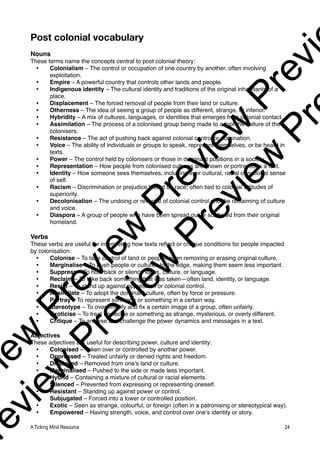
i
e
w
P
r
e
v
i
e
w
P
r
e
v
i
e
w
P
r
e
v
i
r
e
v
i
e
w
P
r
e
v
i
e
w
P
r
e
v
i
e
w
P
r
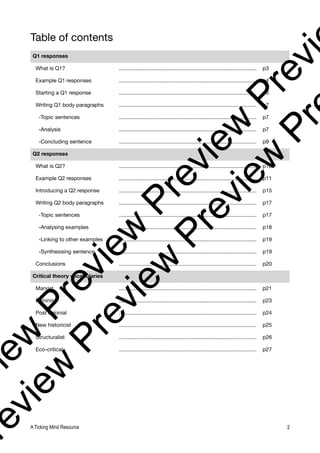
Table of contents
Q1 responses
What is Q1? ............................................................................................ p3
Example Q1 responses ............................................................................................ p4
Starting a Q1 response ............................................................................................ p6
Writing Q1 body paragraphs ............................................................................................ p7
-Topic sentences ............................................................................................ p7
-Analysis ............................................................................................ p7
-Concluding sentence ............................................................................................ p9
Q2 responses
What is Q2? ............................................................................................ p10
Example Q2 responses ............................................................................................ p11
Introducing a Q2 response ............................................................................................ p15
Writing Q2 body paragraphs ............................................................................................ p17
-Topic sentences ............................................................................................ p17
-Analysing examples ............................................................................................ p18
-Linking to other examples ............................................................................................ p19
-Synthesising sentence ............................................................................................ p19
Conclusions ............................................................................................ p20
Critical theory vocabularies
Marxist ............................................................................................ p21
Feminist ............................................................................................ p23
Post colonial ............................................................................................ p24
New historicist ............................................................................................ p25
Structuralist ............................................................................................ p26
Eco-critical ............................................................................................ p27
A Ticking Mind Resource 2
v
i
e
w
P
r
e
v
i
e
w
P
r
e
v
i
e
w
P
r
e
v
i
r
e
v
i
e
w
P
r
e
v
i
e
w
P
r
e
v
i
e
w
P
r
Q1 responses
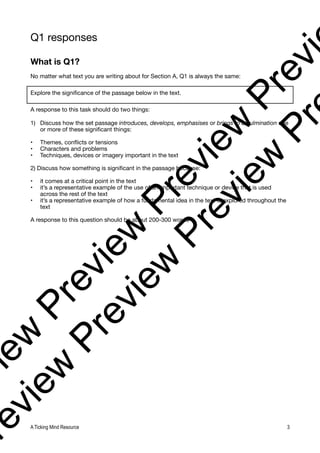
What is Q1?
No matter what text you are writing about for Section A, Q1 is always the same:
Explore the significance of the passage below in the text.
A response to this task should do two things:
1) Discuss how the set passage introduces, develops, emphasises or brings to a culmination one
or more of these significant things:
• Themes, conflicts or tensions
• Characters and problems
• Techniques, devices or imagery important in the text
2) Discuss how something is significant in the passage because:
• it comes at a critical point in the text
• it’s a representative example of the use of an important technique or device that is used
across the rest of the text
• it’s a representative example of how a fundamental idea in the text is explored throughout the
text
A response to this question should be about 200-300 words
A Ticking Mind Resource 3
v
i
e
w
P
r
e
v
i
e
w
P
r
e
v
i
e
w
P
r
e
v
i
r
e
v
i
e
w
P
r
e
v
i
e
w
P
r
e
v
i
e
w
P
r
Example Q1 response
EXAMPLE 1:
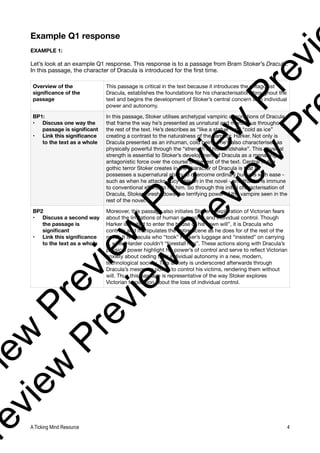
Let’s look at an example Q1 response. This response is to a passage from Bram Stoker’s Dracula.
In this passage, the character of Dracula is introduced for the first time.
Overview of the
significance of the
passage
This passage is critical in the text because it introduces the antagonist
Dracula, establishes the foundations for his characterisation throughout the
text and begins the development of Stoker’s central concern with individual
power and autonomy.
BP1:
• Discuss one way the
passage is significant
• Link this significance
to the text as a whole
In this passage, Stoker utilises archetypal vampiric descriptions of Dracula
that frame the way he’s presented as unnatural and monstrous throughout
the rest of the text. He’s describes as “like a statue” and “cold as ice”
creating a contrast to the naturalness of the narrator, Harker. Not only is
Dracula presented as an inhuman, cold being - he’s also characterised as
physically powerful through the “strength of his handshake”. This physical
strength is essential to Stoker’s development of Dracula as a menacing,
antagonistic force over the course of the rest of the text. Central to the
gothic terror Stoker creates in the character of Dracula is that he
possesses a supernatural ability to overcome ordinary humans with ease -
such as when he attacks Lucy later on in the novel - and that he is immune
to conventional efforts to hill him. So through this initial characterisation of
Dracula, Stoker foreshadows the terrifying power of the vampire seen in the
rest of the novel.
BP2
• Discuss a second way
the passage is
significant
• Link this significance
to the text as a whole
Moreover, this passage also initiates Stoker’s exploration of Victorian fears
about the limitations of human autonomy and individual control. Though
Harker is invited to enter the house of his “own will”, it is Dracula who
controls and manipulates the entire scene as he does for of the rest of the
novel. It is Dracula who “took” Harker’s luggage and “insisted” on carrying
it, while Harder couldn’t “forestall him”. These actions along with Dracula’s
physical power highlight his power’s of control and serve to reflect Victorian
anxiety about ceding their individual autonomy in a new, modern,
technological society. This anxiety is underscored afterwards through
Dracula’s mesmeric power to control his victims, rendering them without
will. Thus this passage is representative of the way Stoker explores
Victorian trepidation about the loss of individual control.
A Ticking Mind Resource 4
v
i
e
w
P
r
e
v
i
e
w
P
r
e
v
i
e
w
P
r
e
v
i
r
e
v
i
e
w
P
r
e
v
i
e
w
P
r
e
v
i
e
w
P
r
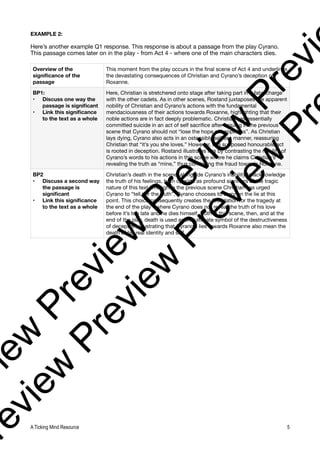
EXAMPLE 2:
Here’s another example Q1 response. This response is about a passage from the play Cyrano.
This passage comes later on in the play - from Act 4 - where one of the main characters dies.
Overview of the
significance of the
passage
This moment from the play occurs in the final scene of Act 4 and underlines
the devastating consequences of Christian and Cyrano’s deception of
Roxanne.
BP1:
• Discuss one way the
passage is significant
• Link this significance
to the text as a whole
Here, Christian is stretchered onto stage after taking part in a fatal charge
with the other cadets. As in other scenes, Rostand juxtaposes the apparent
nobility of Christian and Cyrano’s actions with the fundamental
mendaciousness of their actions towards Roxanne, highlighting that their
noble actions are in fact deeply problematic. Christian has essentially
committed suicide in an act of self sacrifice after arguing in the previous
scene that Cyrano should not “lose the hope of happiness”. As Christian
lays dying, Cyrano also acts in an ostensibly selfless manner, reassuring
Christian that “it’s you she loves.” However, this supposed honourable act
is rooted in deception. Rostand illustrates this by contrasting the nobility of
Cyrano’s words to his actions in this scene where he claims Christian’s
revealing the truth as “mine,” thus continuing the fraud towards Roxanne.
BP2
• Discuss a second way
the passage is
significant
• Link this significance
to the text as a whole
Christian’s death in the scene, alongside Cyrano’s inability to acknowledge
the truth of his feelings, both operate as profound signifiers of the tragic
nature of this text. Though in the previous scene Christian has urged
Cyrano to “tell her the truth”, Cyrano chooses to carry on the lie at this
point. This choice consequently creates the foundation for the tragedy at
the end of the play - where Cyrano does not reveal the truth of his love
before it’s too late and he dies himself. Both in this scene, then, and at the
end of the play, death is used as the ultimate symbol of the destructiveness
of deception, illustrating that Cyrano’s lies towards Roxanne also mean the
death of his real identity and self.
A Ticking Mind Resource 5
v
i
e
w
P
r
e
v
i
e
w
P
r
e
v
i
e
w
P
r
e
v
i
r
e
v
i
e
w
P
r
e
v
i
e
w
P
r
e
v
i
e
w
P
r
Starting a Q1 response
Your Q1 response should begin with a one sentence ‘mini’ intro. This intro should identify two
ways the passage is significant in the context of the whole text. Here a basic way you can write
this introductory sentence:
Now, try practising a different way to write this introductory sentence:
And another way:
This... is... because... it...
passage
moment
scene
critical in the text
significant to the development of the text
a critical moment in the text
a turning point in the narrative
significant in its placement (at/near/during)
because
as
in the way
introduces
foreshadows
develops
escalates
emphasises
highlights
illustrates
is the climax of...
the culminations of...
Here,...
In this passage,...
At this critical point in...,
[author name]
highlights
establishes
emphasises
depicts
introduces
develops
the importance of
the important role of
the significance of
the critical conflict between
the way
Coming as it does at...,
Situated at...,
Depicting the critical moment
where...,
Portraying the...and the...,
this...
moment
passage
scene
introduces
foreshadows
develops
escalates
emphasises
highlights
illustrates
is the climax of...
the culminations of...
A Ticking Mind Resource 6
v
i
e
w
P
r
e
v
i
e
w
P
r
e
v
i
e
w
P
r
e
v
i
r
e
v
i
e
w
P
r
e
v
i
e
w
P
r
e
v
i
e
w
P
r
Writing Q1 body paragraphs
A Q1 body paragraph consists of four elements:
TOPIC SENTENCES
Let’s have a go writing each part of a body paragraph, starting with topic sentences. Have a go using the
words and phrases in each column below to focus on an important feature or idea in a passage:
ANALYSIS OF WHAT’S SIGNIFICANT IN THE PASSAGE AND HOW THIS LINKS TO THE TEXT AS A
WHOLE
As a rule, the bulk of a body paragraph should be taken up with referring to evidence from the
passage to analyse its significance and then linking this to other parts of the text. The example
below shows a few important things to do in this part of the body paragraph:
He’s described as “like a statue” and “cold as ice” creating a fundamental contrast to the naturalness of the
narrator, Harker. Not only is Dracula presented as an inhuman, cold being - he’s also characterised as
physically powerful through the “strength of his handshake”. This physical strength is essential to Stoker’s
development of Dracula as a menacing, antagonistic force over the course of the rest of the text. Central
to the gothic terror Stoker creates in the character of Dracula is that he possesses a supernatural ability to
overcome ordinary humans with ease - such as when he attacks Lucy later on in the novel - and that he is
immune to conventional efforts to hill him.
• Analyse evidence from the passage first and then link it to other parts of the text.
• Use close analysis skills to analyse evidence from the passage
Topic sentence In this passage, Stoker utilises archetypal vampiric descriptions of Dracula that
frame the way he’s presented as unnatural and monstrous throughout the rest
of the text.
• Analysis of what’s
significant in the
passage
• Analysis of how the
significance of
something in the
passage links to
the text as a whole
He’s described as “like a statue” and “cold as ice” creating a contrast to the
naturalness of the narrator, Harker. Not only is Dracula presented as an
inhuman, cold being - he’s also characterised as physically powerful through
the “strength of his handshake”. This physical strength is essential to Stoker’s
development of Dracula as a menacing, antagonistic force over the course of
the rest of the text. Central to the gothic terror Stoker creates in the character
of Dracula is that he possesses a supernatural ability to overcome ordinary
humans with ease - such as when he attacks Lucy later on in the novel - and
that he is immune to conventional efforts to hill him.
Synthesising sentence So through this initial characterisation of Dracula, Stoker foreshadows the
terrifying power of the vampire seen in the rest of the novel.
Here...
At this point...
At this point in the narrative
where...
In this moment
In this moment of...
In this passage
During this moment of...
Having already...
As a prelude to...
Through...
Through this depiction of...
By...
Through the technique of...
[author name]...
illustrates
contrasts
depicts
portrays
utlises
in order to
and
as a way of
, revealing...
, highlighting...
, depicting...
, underlining...
, representing...
, creating...
A Ticking Mind Resource 7
v
i
e
w
P
r
e
v
i
e
w
P
r
e
v
i
e
w
P
r
e
v
i
r
e
v
i
e
w
P
r
e
v
i
e
w
P
r
e
v
i
e
w
P
r
• Use a range of words to identify and analyse how the passage is significant (as the words in
bold in the example do)
Have a go analysing some evidence in the passage, explaining its significance and linking the
examples to the text as a whole. Use some of the words and phrases in the tables below to help
you:
Phrases to analyse how a passage
demonstrates the author’s use of techniques or
focus on ideas
Words to describe the importance of features in
a passage
exemplifies the [author name’s] use of...
exemplifies the [author name’s] exploration of...
typifies author name’s] utilisation of...
is an archetypal representation of the way
[author name]...
is emblematic of [author name’s] focus on....
relects the [author name’s] stylistic emphasis
on...
complex
critical
crucial
central
pivotal
revelatory
poignant
profound
distinctive
Words and phrases to link the passage to...
things that happen later things that happened earlier
later
throughout the rest of the text
over the course of the later narrative
subsequently in the text
is further developed when
establishes
foreshadows
foregrounds
frames how...is presented over the rest of...
presages
is a prelude to...
creates the foundation for
initiates
this builds on from
this extends the earlier
develops the previous
reinforces
emphasises
continues to develop
operates as a full stop to
is the climax of
is the end to
serves as the culmination of
recalls
echoes
intensifies
A Ticking Mind Resource 8
v
i
e
w
P
r
e
v
i
e
w
P
r
e
v
i
e
w
P
r
e
v
i
r
e
v
i
e
w
P
r
e
v
i
e
w
P
r
e
v
i
e
w
P
r
CONCLUDING SENTENCE
There are two aspects to a concluding sentence:
Your concluding sentence should add insight to your paragraph that goes beyond what has
already been said in your topic sentence. In this final sentence of your paragraph, you should be
synthesising what the evidence in your paragraph shows when taken as a whole. These sentence
starters will help you frame your concluding sentence. Use a different sentence starter for each
concluding sentence in your two paragraphs:
• Through this use of..., [author name] then creates a sense of...
• This use of...ultimately underscores...
• Thus the passage contributes to...
• Thus the passage exemplifies the way...
• Thus the passage serves as a...
• In this way the passage...
• As a result, the reader is...
• This moment signals then...
• So by the end of this moment...
LINKING POINTS
Your paragraphs will need to be connected with a linking a phrase. Try using one of the phrases
below to connect your second paragraph to your first one:
• A further significant aspect of this passage is that...
• Moreover, this passage functions as a significant demonstration of...
• Moreover, this passage operates as a powerful example of...
• This passage is also significant as...
• A further significance of this passage is that...
• In addition to the way [author name]...in this passage, [she/he] also...
Concluding phrase Statement about a key achievement or outcome of the
passage
So through this initial
characterisation of Dracula,
Stoker foreshadows the terrifying power of the vampire seen
in the rest of the novel.
Thus this passage is
representative of the way
Stoker explores Victorian trepidation about the loss of
individual control.
A Ticking Mind Resource 9
v
i
e
w
P
r
e
v
i
e
w
P
r
e
v
i
e
w
P
r
e
v
i
r
e
v
i
e
w
P
r
e
v
i
e
w
P
r
e
v
i
e
w
P
r
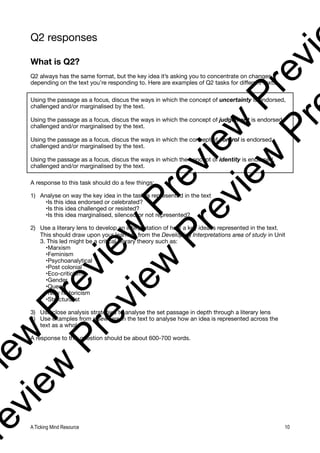
Q2 responses
What is Q2?
Q2 always has the same format, but the key idea it’s asking you to concentrate on changes
depending on the text you’re responding to. Here are examples of Q2 tasks for different texts:
Using the passage as a focus, discus the ways in which the concept of uncertainty is endorsed,
challenged and/or marginalised by the text.
Using the passage as a focus, discus the ways in which the concept of judgement is endorsed,
challenged and/or marginalised by the text.
Using the passage as a focus, discus the ways in which the concept of control is endorsed,
challenged and/or marginalised by the text.
Using the passage as a focus, discus the ways in which the concept of identity is endorsed,
challenged and/or marginalised by the text.
A response to this task should do a few things:
1) Analyse on way the key idea in the task is represented in the text
•Is this idea endorsed or celebrated?
•Is this idea challenged or resisted?
•Is this idea marginalised, silenced or not represented?
2) Use a literary lens to develop an interpretation of how a key idea is represented in the text.
This should draw upon your learning from the Developing Interpretations area of study in Unit
3. This led might be a critical literary theory such as:
•Marxism
•Feminism
•Psychoanalytical
•Post colonial
•Eco-criticism
•Gender
•Queer
•New historicism
•Structuralist
3) Use close analysis strategies to analyse the set passage in depth through a literary lens
4) Use examples from elsewhere in the text to analyse how an idea is represented across the
text as a whole
A response to this question should be about 600-700 words.
A Ticking Mind Resource 10
v
i
e
w
P
r
e
v
i
e
w
P
r
e
v
i
e
w
P
r
e
v
i
r
e
v
i
e
w
P
r
e
v
i
e
w
P
r
e
v
i
e
w
P
r
Example Q2 response
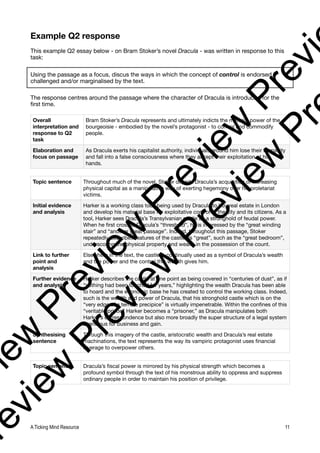
This example Q2 essay below - on Bram Stoker’s novel Dracula - was written in response to this
task:
Using the passage as a focus, discus the ways in which the concept of control is endorsed,
challenged and/or marginalised by the text.
The response centres around the passage where the character of Dracula is introduced for the
first time.
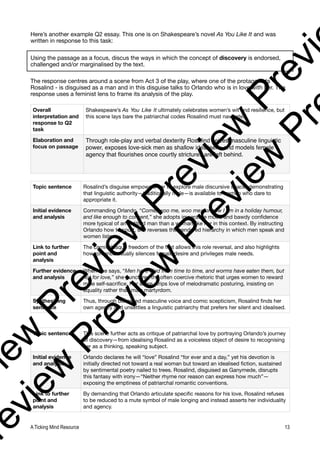
Overall
interpretation and
response to Q2
task
Bram Stoker’s Dracula represents and ultimately indicts the material power of the
bourgeoisie - embodied by the novel’s protagonist - to control and commodify
people.
Elaboration and
focus on passage
As Dracula exerts his capitalist authority, individuals around him lose their humanity
and fall into a false consciousness where they accept their exploitation at his
hands.
Topic sentence Throughout much of the novel, Stoker depicts Dracula’s acquisition of increasing
physical capital as a manipulative way of exerting hegemony over his proletariat
victims.
Initial evidence
and analysis
Harker is a working class tool, being used by Dracula to buy real estate in London
and develop his material base for exploitative control of the city and its citizens. As a
tool, Harker sees Dracula’s Transylvanian castle as a stronghold of feudal power.
When he first crosses Dracula’s “threshold”, he is impressed by the “great winding
stair” and “another great passage”. Indeed, throughout this passage, Stoker
repeatedly describes features of the castle as “great”, such as the “great bedroom”,
underscoring the physical property and wealth in the possession of the count.
Link to further
point and
analysis
Elsewhere in the text, the castle is continually used as a symbol of Dracula’s wealth
and the power and the control this wealth gives him.
Further evidence
and analysis
Harker describes the castle at one point as being covered in “centuries of dust”, as if
“nothing had been touched for years,” highlighting the wealth Dracula has been able
to hoard and the economic base he has created to control the working class. Indeed,
such is the wealth and power of Dracula, that his stronghold castle which is on the
“very edge of a terrible precipice” is virtually impenetrable. Within the confines of this
“veritable prison” Harker becomes a “prisoner,” as Dracula manipulates both
Harker’s correspondence but also more broadly the super structure of a legal system
avaricious for business and gain.
Synthesising
sentence
Through this imagery of the castle, aristocratic wealth and Dracula’s real estate
machinations, the text represents the way its vampiric protagonist uses financial
leverage to overpower others.
Topic sentence Dracula’s fiscal power is mirrored by his physical strength which becomes a
profound symbol through the text of his monstrous ability to oppress and suppress
ordinary people in order to maintain his position of privilege.
A Ticking Mind Resource 11
v
i
e
w
P
r
e
v
i
e
w
P
r
e
v
i
e
w
P
r
e
v
i
r
e
v
i
e
w
P
r
e
v
i
e
w
P
r
e
v
i
e
w
P
r
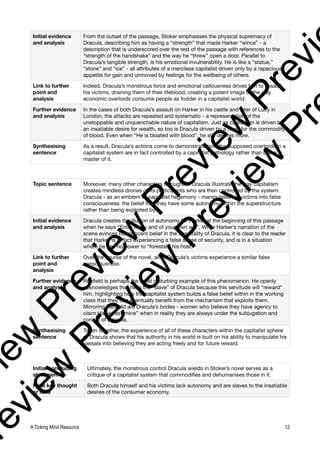
Initial evidence
and analysis
From the outset of the passage, Stoker emphasises the physical supremacy of
Dracula, describing him as having a “strength” that made Harker “wince” - a
description that is underscored over the rest of the passage with references to the
“strength of the handshake” and the way he “threw” open a door. Parallel to
Dracula’s tangible strength, is his emotional invulnerability. He is like a “statue,”
“stone” and “ice” - all attributes of a merciless capitalist driven only by a rapacious
appetite for gain and unmoved by feelings for the wellbeing of others.
Link to further
point and
analysis
Indeed, Dracula’s monstrous force and emotional callousness drives him to assault
his victims, draining them of their lifeblood, creating a potent image of the way
economic overlords consume people as fodder in a capitalist world.
Further evidence
and analysis
In the cases of both Dracula’s assault on Harker in his castle and later of Lucy in
London, the attacks are repeated and systematic - a representation of the
unstoppable and unquenchable nature of capitalism. Just as capitalism is driven by
an insatiable desire for wealth, so too is Dracula driven by a need for the commodity
of blood. Even when “He is bloated with blood”, he still desires more.
Synthesising
sentence
As a result, Dracula’s actions come to demonstrate how the supposed overlords in a
capitalist system are in fact controlled by a capitalist pathology rather than being
master of it.
Topic sentence Moreover, many other characters throughout Dracula illustrate the way capitalism
creates mindless drones of its participants who are then controlled by the system.
Dracula - as an emblem of capitalist hegemony - manipulates his victims into false
consciousness: the belief that they have some autonomy within the superstructure
rather than being exploited by it.
Initial evidence
and analysis
Dracula creates the illusion of autonomy for Harker at the beginning of this passage
when he says “Enter freely and of your own will”. While Harker’s narration of the
scene evinces his innocent belief in the hospitality of Dracula, it is clear to the reader
that Harker is in fact experiencing a false sense of security, and is in a situation
where he has no power to “forestall” his host.
Link to further
point and
analysis
Over the course of the novel, all of Dracula’s victims experience a similar false
consciousness.
Further evidence
and analysis
Renfield is perhaps the most disturbing example of this phenomenon. He openly
acknowledges that he is the “slave” of Dracula because this servitude will “reward”
him, highlighting how the capitalist system builds a false belief within in the working
class that they can eventually benefit from the mechanism that exploits them.
Mirroring Renfield are Dracula’s brides - women who believe they have agency to
claim Harker as “mine” when in reality they are always under the subjugation and
control of Dracula.
Synthesising
sentence
Taken together, the experience of all of these characters within the capitalist sphere
of Dracula shows that his authority in his world is built on his ability to manipulate his
vassals into believing they are acting freely and for future reward.
Initial concluding
statement
Ultimately, the monstrous control Dracula wields in Stoker’s novel serves as a
critique of a capitalist system that commodifies and dehumanises those in it.
Final key thought
or idea
Both Dracula himself and his victims lack autonomy and are slaves to the insatiable
desires of the consumer economy.
A Ticking Mind Resource 12
v
i
e
w
P
r
e
v
i
e
w
P
r
e
v
i
e
w
P
r
e
v
i
r
e
v
i
e
w
P
r
e
v
i
e
w
P
r
e
v
i
e
w
P
r
Here’s another example Q2 essay. This one is on Shakespeare’s novel As You Like It and was
written in response to this task:
Using the passage as a focus, discus the ways in which the concept of discovery is endorsed,
challenged and/or marginalised by the text.
The response centres around a scene from Act 3 of the play, where one of the protagonists -
Rosalind - is disguised as a man and in this disguise talks to Orlando who is in love with her. The
response uses a feminist lens to frame its analysis of the play.
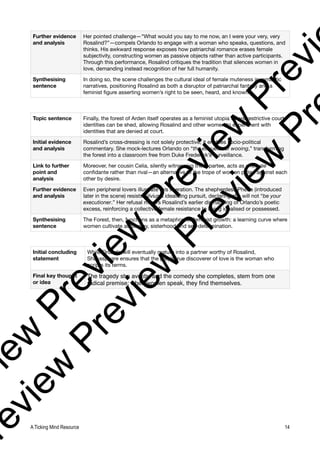
Overall
interpretation and
response to Q2
task
Shakespeare’s As You Like It ultimately celebrates women’s wit and resilience, but
this scene lays bare the patriarchal codes Rosalind must navigate.
Elaboration and
focus on passage
Through role‑play and verbal dexterity Rosalind seizes masculine linguistic
power, exposes love‑sick men as shallow idealisers, and models female
agency that flourishes once courtly strictures are left behind.
Topic sentence Rosalind’s disguise empowers her to explore male discursive space, demonstrating
that linguistic authority—traditionally male—is available to women who dare to
appropriate it.
Initial evidence
and analysis
Commanding Orlando, “Come, woo me, woo me; for now I am in a holiday humour,
and like enough to consent,” she adopts imperative mood and bawdy confidence
more typical of an entitled man than a woman like her in this context. By instructing
Orlando how to court, she reverses the gendered hierarchy in which men speak and
women listen.
Link to further
point and
analysis
The carnivalesque freedom of the first allows this role reversal, and also highlights
how romance usually silences female desire and privileges male needs.
Further evidence
and analysis
When she says, “Men have died from time to time, and worms have eaten them, but
not for love,” she punctures the often coercive rhetoric that urges women to reward
male self‑sacrifice. Her satire strips love of melodramatic posturing, insisting on
equality rather than male martyrdom.
Synthesising
sentence
Thus, through borrowed masculine voice and comic scepticism, Rosalind finds her
own agency and unsettles a linguistic patriarchy that prefers her silent and idealised.
Topic sentence This scene further acts as critique of patriarchal love by portraying Orlando’s journey
of discovery—from idealising Rosalind as a voiceless object of desire to recognising
her as a thinking, speaking subject.
Initial evidence
and analysis
Orlando declares he will “love” Rosalind “for ever and a day,” yet his devotion is
initially directed not toward a real woman but toward an idealised fiction, sustained
by sentimental poetry nailed to trees. Rosalind, disguised as Ganymede, disrupts
this fantasy with irony—“Neither rhyme nor reason can express how much”—
exposing the emptiness of patriarchal romantic conventions.
Link to further
point and
analysis
By demanding that Orlando articulate specific reasons for his love, Rosalind refuses
to be reduced to a mute symbol of male longing and instead asserts her individuality
and agency.
A Ticking Mind Resource 13
v
i
e
w
P
r
e
v
i
e
w
P
r
e
v
i
e
w
P
r
e
v
i
r
e
v
i
e
w
P
r
e
v
i
e
w
P
r
e
v
i
e
w
P
r
Further evidence
and analysis
Her pointed challenge—“What would you say to me now, an I were your very, very
Rosalind?”—compels Orlando to engage with a woman who speaks, questions, and
thinks. His awkward response exposes how patriarchal romance erases female
subjectivity, constructing women as passive objects rather than active participants.
Through this performance, Rosalind critiques the tradition that silences women in
love, demanding instead recognition of her full humanity.
Synthesising
sentence
In doing so, the scene challenges the cultural ideal of female muteness in romantic
narratives, positioning Rosalind as both a disruptor of patriarchal fantasy and a
feminist figure asserting women’s right to be seen, heard, and known.
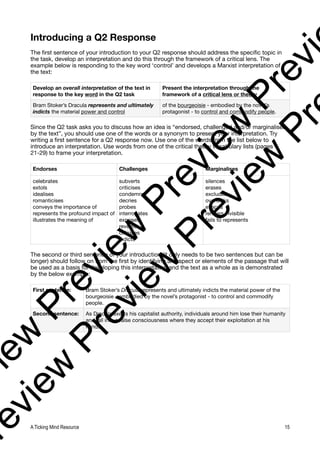
Topic sentence Finally, the forest of Arden itself operates as a feminist utopia where restrictive court
identities can be shed, allowing Rosalind and other women to experiment with
identities that are denied at court.
Initial evidence
and analysis
Rosalind’s cross‑dressing is not solely protective; it enables socio‑political
commentary. She mock‑lectures Orlando on “the etiquette of wooing,” transforming
the forest into a classroom free from Duke Frederick’s surveillance.
Link to further
point and
analysis
Moreover, her cousin Celia, silently witnessing the repartee, acts as a female
confidante rather than rival—an alternative to the trope of women pitted against each
other by desire.
Further evidence
and analysis
Even peripheral lovers illustrate this liberation. The shepherdess Phebe (introduced
later in the scene) resists Silvius’s idealising pursuit, declaring she will not “be your
executioner.” Her refusal mirrors Rosalind’s earlier dismantling of Orlando’s poetic
excess, reinforcing a collective female resistance to being idealised or possessed.
Synthesising
sentence
The Forest, then, functions as a metaphor for feminist growth: a learning curve where
women cultivate autonomy, sisterhood and self‑determination.
Initial concluding
statement
While Orlando will eventually mature into a partner worthy of Rosalind,
Shakespeare ensures that the play’s true discoverer of love is the woman who
scripts its terms.
Final key thought
or idea
The tragedy she avoids, and the comedy she completes, stem from one
radical premise: when women speak, they find themselves.
A Ticking Mind Resource 14
v
i
e
w
P
r
e
v
i
e
w
P
r
e
v
i
e
w
P
r
e
v
i
r
e
v
i
e
w
P
r
e
v
i
e
w
P
r
e
v
i
e
w
P
r
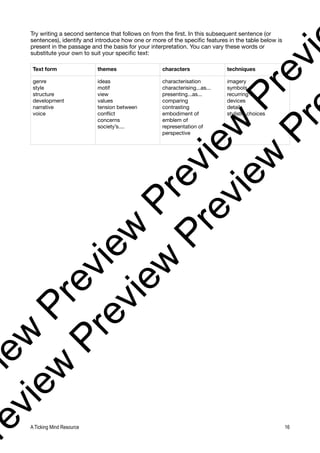
Introducing a Q2 Response
The first sentence of your introduction to your Q2 response should address the specific topic in
the task, develop an interpretation and do this through the framework of a critical lens. The
example below is responding to the key word ‘control’ and develops a Marxist interpretation of
the text:
Since the Q2 task asks you to discuss how an idea is “endorsed, challenged and/or marginalised
by the text”, you should use one of the words or a synonym to present your interpretation. Try
writing a first sentence for a Q2 response now. Use one of the words from the list below to
introduce an interpretation. Use words from one of the critical theory vocabulary lists (pages
21-29) to frame your interpretation.
The second or third sentence of your introduction (it only needs to be two sentences but can be
longer) should follow on from the first by identifying an aspect or elements of the passage that will
be used as a basis for developing this interpretation and the text as a whole as is demonstrated
by the below example:
Develop an overall interpretation of the text in
response to the key word in the Q2 task
Present the interpretation through the
framework of a critical lens or theory
Bram Stoker’s Dracula represents and ultimately
indicts the material power and control
of the bourgeoisie - embodied by the novel’s
protagonist - to control and commodify people.
Endorses Challenges Marginalises
celebrates
extols
idealises
romanticises
conveys the importance of
represents the profound impact of
illustrates the meaning of
subverts
criticises
condemns
decries
probes
interrogates
exposes
reveals
critiques
indicts
silences
erases
excludes
overlooks
effaces
renders invisible
fails to represents
First sentence: Bram Stoker’s Dracula represents and ultimately indicts the material power of the
bourgeoisie - embodied by the novel’s protagonist - to control and commodify
people.
Second sentence: As Dracula exerts his capitalist authority, individuals around him lose their humanity
and fall into a false consciousness where they accept their exploitation at his
hands.
A Ticking Mind Resource 15
v
i
e
w
P
r
e
v
i
e
w
P
r
e
v
i
e
w
P
r
e
v
i
r
e
v
i
e
w
P
r
e
v
i
e
w
P
r
e
v
i
e
w
P
r
Try writing a second sentence that follows on from the first. In this subsequent sentence (or
sentences), identify and introduce how one or more of the specific features in the table below is
present in the passage and the basis for your interpretation. You can vary these words or
substitute your own to suit your specific text:
Text form themes characters techniques
genre
style
structure
development
narrative
voice
ideas
motif
view
values
tension between
conflict
concerns
society’s....
characterisation
characterising...as...
presenting...as...
comparing
contrasting
embodiment of
emblem of
representation of
perspective
imagery
symbols
recurring
devices
detail
stylistic choices
A Ticking Mind Resource 16
v
i
e
w
P
r
e
v
i
e
w
P
r
e
v
i
e
w
P
r
e
v
i
r
e
v
i
e
w
P
r
e
v
i
e
w
P
r
e
v
i
e
w
P
r
Body Paragraphs
Each of your body paragraphs should include these things:
• A topic sentence that links to the Q2 task and identifies a analytic focus for the paragraph
• Analysis of evidence from the passage through the lens of a critical theory
• A link to evidence from elsewhere in the text that supports the analytic focus for the paragraph
• A synthesising sentence
Let’s look at these elements one at a time.
TOPIC SENTENCES
A topic sentence for a Q2 response should have two basic elements:
Have a go writing a topic sentence. Try using one of the phrases below to begin your sentence
then use a word to refer to the Q2 topic and vocabulary that also signposts the critical lens you
are using to develop your interpretation.
Identify an analytic focus for the paragraph Link to the Q2 topic
Throughout much of the novel, Stoker depicts
Dracula’s acquisition of increasing physical capital
as a manipulative way of exerting hegemony over
his proletariat victims.
Phrases to begin any topic sentence Phrases to introduce topic sentences for
subsequent paragraphs
[Author’s] use of [technique] here constructs a
discourse of...
[Character’s] behaviour exemplifies the effect
Throughout the text, [author] presents... as a means
of...
Throughout..., [author] depicts....in order to
By foregrounding [character/idea], the text
[Author’s] representation of [group/idea] reveals..
In this moment, the text explores the consequences
of...
A key feature of the text is its portrayal of...
The text critiques/reinforces/challenges the notion
that...
This concern intensifies elsewhere in the text as/
when...
Moreover,....
Similarly, [another character/event] reflects...
This idea is reinforced through...
In contrast, [author] later presents...
This progression illustrates a shift in...
Building upon this, [author] uses... to emphasise...
This pattern is also evident in the characterisation
of...
A Ticking Mind Resource 17
v
i
e
w
P
r
e
v
i
e
w
P
r
e
v
i
e
w
P
r
e
v
i
r
e
v
i
e
w
P
r
e
v
i
e
w
P
r
e
v
i
e
w
P
r
ANALYSING EVIDENCE
When analysing evidence throughout your body paragraph, the key thing is to analyse how the
evidence illustrates the idea the Q2 task is asking you to focus on. Here’s a typical example:
Here are some sentence elements you can experiment with using to analyse evidence and what it
shows about an idea:
Evidence analysis link to topic (control)
Renfield openly acknowledges
that he is the “slave” of Dracula
because this servitude will
“reward” him,
highlighting how the capitalist
system builds a false belief within
in the working class that they can
eventually benefit
from the mechanism that exploits
them.
Characters Connection to ideas
[Author name’s] characterisation of...
[Character name]’s....
[Character name]’s actions....
[Character name] views... as...
[Character name] sees... as...
In this scene where..., [Character name]’s....
[Character name]’s belief in...
When [Character name] says..., it
embodies
typifies
illustrates
demonstrates
symbolises
manifests
evokes
is a representation of
is an emblem of
operates as a metaphor for
signals to readers that...
, highlighting
, revealing
, exposing
, emphasising
, underscoring
creates
underscores
parallels
foregrounds
Technique
[Author name’s] use of...
[Author name] emphasises the...by...
By creating..., [Author name]...
Through the imagery of...., the reader sees....
Through the technique of... [Author name]....
Words and phrases
The description of...as “...”
By describing.... as... “...”, [Author name]....
The reference to “...”
The allusion to “...”
The connotation of....
The recurring use of....
[Author name] highlights the importance of... by....
The image of “...”
A Ticking Mind Resource 18
v
i
e
w
P
r
e
v
i
e
w
P
r
e
v
i
e
w
P
r
e
v
i
r
e
v
i
e
w
P
r
e
v
i
e
w
P
r
e
v
i
e
w
P
r
LINKING TO OTHER EXAMPLES
During your Q2 response, you will need to not only closely analyse examples from the focus
passage, but show your understanding of how a key idea in the task is demonstrated across the
text as a whole. This means you need to link examples in the passage to the wider text, such as in
this example:
Elsewhere in the text, the castle is continually used as a symbol of Dracula’s wealth and the power
and the control this wealth gives him.
These are some sentence starters are parts you can use to connect your discussion of a passage
to other examples in the text or the text as a whole:
• Moreover, elsewhere in the text..
• Similarly...
• Mirroring this...is...
• Paralleling this...is...
• In other moments in the text...
• In contrast....
• This idea of...is emphasised elsewhere in the text...
• Previously in the text, this....has been developed through....
• ...mirrored later in the text when...
• ...underscored in other parts of the text where...
• ...as happens also when...
• Just as in this passage..., so too does...when....
• This characterisation is sustained in...
• This moment echoes...
• This pattern builds on...
• This pattern recurs when...
SYNTHESISING SENTENCES
At the end of a body paragraph, an effective synthesising sentence will outline the cumulative
impact of the evidence that has been analysed throughout the preceding sentences and link this
impact to the key idea in the Q2 task. This sentence demonstrates this:
Taken together, the experience of all of these characters within the capitalist sphere of Dracula
shows that his authority in his world is built on his ability to manipulate his vassals into believing
they are acting freely and for future reward.
Have a go using or adapting one of these sentence starters to write a synthesising sentence at
the end of a body paragraph:
• These... crystallise a recurring concern in the text: namely, that...
• Collectively, these examples suggest that...
• Through this..., [author name]....
• As a result of..., [author name]....
• Cumulatively, these...merge to underscore the text’s central concern with...
• When seen alongside other instances in the text, this reinforces...
• The pattern here of... points to...
• Taken together, these... build a larger commentary on...
• Taken together, these examples demonstrate...
• Read in parallel, these...reveal that...
A Ticking Mind Resource 19
v
i
e
w
P
r
e
v
i
e
w
P
r
e
v
i
e
w
P
r
e
v
i
r
e
v
i
e
w
P
r
e
v
i
e
w
P
r
e
v
i
e
w
P
r
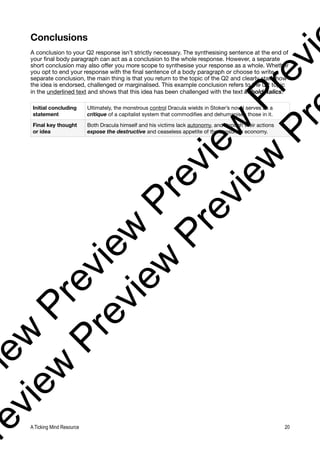
Conclusions
A conclusion to your Q2 response isn’t strictly necessary. The synthesising sentence at the end of
your final body paragraph can act as a conclusion to the whole response. However, a separate
short conclusion may also offer you more scope to synthesise your response as a whole. Whether
you opt to end your response with the final sentence of a body paragraph or choose to write a
separate conclusion, the main thing is that you return to the topic of the Q2 and clearly state how
the idea is endorsed, challenged or marginalised. This example conclusion refers to the Q2 topic
in the underlined text and shows that this idea has been challenged with the text in bold italics.
Initial concluding
statement
Ultimately, the monstrous control Dracula wields in Stoker’s novel serves as a
critique of a capitalist system that commodifies and dehumanises those in it.
Final key thought
or idea
Both Dracula himself and his victims lack autonomy, and through their actions
expose the destructive and ceaseless appetite of the consumer economy.
A Ticking Mind Resource 20
v
i
e
w
P
r
e
v
i
e
w
P
r
e
v
i
e
w
P
r
e
v
i
r
e
v
i
e
w
P
r
e
v
i
e
w
P
r
e
v
i
e
w
P
r
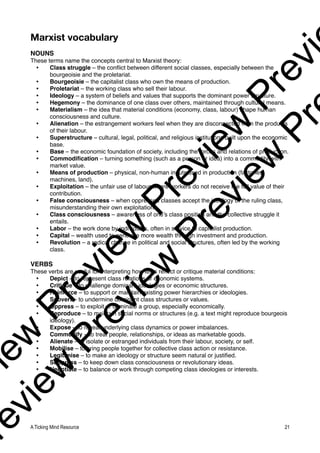
Marxist vocabulary
NOUNS
These terms name the concepts central to Marxist theory:
• Class struggle – the conflict between different social classes, especially between the
bourgeoisie and the proletariat.
• Bourgeoisie – the capitalist class who own the means of production.
• Proletariat – the working class who sell their labour.
• Ideology – a system of beliefs and values that supports the dominant power structure.
• Hegemony – the dominance of one class over others, maintained through cultural means.
• Materialism – the idea that material conditions (economy, class, labour) shape human
consciousness and culture.
• Alienation – the estrangement workers feel when they are disconnected from the products
of their labour.
• Superstructure – cultural, legal, political, and religious institutions built upon the economic
base.
• Base – the economic foundation of society, including the forces and relations of production.
• Commodification – turning something (such as a person or idea) into a commodity with
market value.
• Means of production – physical, non-human inputs used in production (factories,
machines, land).
• Exploitation – the unfair use of labour where workers do not receive the full value of their
contribution.
• False consciousness – when oppressed classes accept the ideology of the ruling class,
misunderstanding their own exploitation.
• Class consciousness – awareness of one’s class position and the collective struggle it
entails.
• Labor – the work done by individuals, often in service to capitalist production.
• Capital – wealth used to generate more wealth through investment and production.
• Revolution – a radical change in political and social structures, often led by the working
class.
VERBS
These verbs are useful for interpreting how texts reflect or critique material conditions:
• Depict – to represent class relations or economic systems.
• Critique – to challenge dominant ideologies or economic structures.
• Reinforce – to support or maintain existing power hierarchies or ideologies.
• Subvert – to undermine dominant class structures or values.
• Oppress – to exploit or dominate a group, especially economically.
• Reproduce – to maintain social norms or structures (e.g. a text might reproduce bourgeois
ideology).
• Expose – to reveal underlying class dynamics or power imbalances.
• Commodify – to treat people, relationships, or ideas as marketable goods.
• Alienate – to isolate or estranged individuals from their labour, society, or self.
• Mobilise – to bring people together for collective class action or resistance.
• Legitimise – to make an ideology or structure seem natural or justified.
• Suppress – to keep down class consciousness or revolutionary ideas.
• Negotiate – to balance or work through competing class ideologies or interests.
A Ticking Mind Resource 21
v
i
e
w
P
r
e
v
i
e
w
P
r
e
v
i
e
w
P
r
e
v
i
r
e
v
i
e
w
P
r
e
v
i
e
w
P
r
e
v
i
e
w
P
r
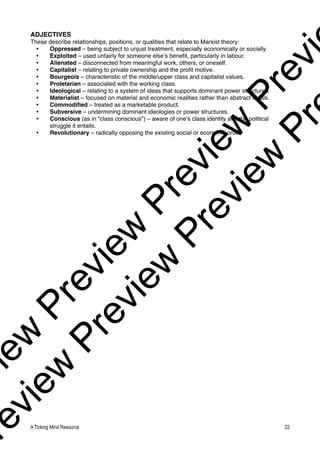
ADJECTIVES
These describe relationships, positions, or qualities that relate to Marxist theory:
• Oppressed – being subject to unjust treatment, especially economically or socially.
• Exploited – used unfairly for someone else’s benefit, particularly in labour.
• Alienated – disconnected from meaningful work, others, or oneself.
• Capitalist – relating to private ownership and the profit motive.
• Bourgeois – characteristic of the middle/upper class and capitalist values.
• Proletarian – associated with the working class.
• Ideological – relating to a system of ideas that supports dominant power structures.
• Materialist – focused on material and economic realities rather than abstract ideals.
• Commodified – treated as a marketable product.
• Subversive – undermining dominant ideologies or power structures.
• Conscious (as in "class conscious") – aware of one’s class identity and the political
struggle it entails.
• Revolutionary – radically opposing the existing social or economic order.
A Ticking Mind Resource 22
v
i
e
w
P
r
e
v
i
e
w
P
r
e
v
i
e
w
P
r
e
v
i
r
e
v
i
e
w
P
r
e
v
i
e
w
P
r
e
v
i
e
w
P
r
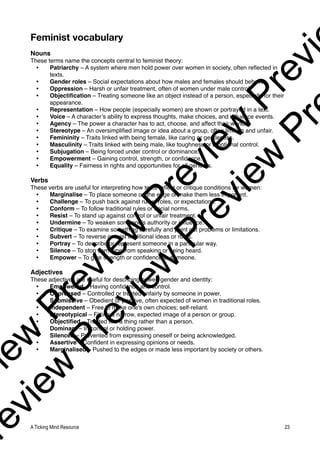
Feminist vocabulary
Nouns
These terms name the concepts central to feminist theory:
• Patriarchy – A system where men hold power over women in society, often reflected in
texts.
• Gender roles – Social expectations about how males and females should behave.
• Oppression – Harsh or unfair treatment, often of women under male control.
• Objectification – Treating someone like an object instead of a person, especially for their
appearance.
• Representation – How people (especially women) are shown or portrayed in a text.
• Voice – A character’s ability to express thoughts, make choices, and influence events.
• Agency – The power a character has to act, choose, and affect their world.
• Stereotype – An oversimplified image or idea about a group, often limiting and unfair.
• Femininity – Traits linked with being female, like caring or gentleness.
• Masculinity – Traits linked with being male, like toughness or emotional control.
• Subjugation – Being forced under control or dominance.
• Empowerment – Gaining control, strength, or confidence.
• Equality – Fairness in rights and opportunities for all genders.
Verbs
These verbs are useful for interpreting how texts reflect or critique conditions for women:
• Marginalise – To place someone on the edge or make them less important.
• Challenge – To push back against rules, roles, or expectations.
• Conform – To follow traditional rules or social norms.
• Resist – To stand up against control or unfair treatment.
• Undermine – To weaken someone’s authority or influence.
• Critique – To examine something carefully and point out problems or limitations.
• Subvert – To reverse or twist traditional ideas or roles.
• Portray – To describe or represent someone in a particular way.
• Silence – To stop someone from speaking or being heard.
• Empower – To give strength or confidence to someone.
Adjectives
These adjectives are useful for describing power, gender and identity:
• Empowered – Having confidence and control.
• Oppressed – Controlled or treated unfairly by someone in power.
• Submissive – Obedient or passive, often expected of women in traditional roles.
• Independent – Free to make one's own choices; self-reliant.
• Stereotypical – Fitting a narrow, expected image of a person or group.
• Objectified – Treated like a thing rather than a person.
• Dominant – In control or holding power.
• Silenced – Prevented from expressing oneself or being acknowledged.
• Assertive – Confident in expressing opinions or needs.
• Marginalised – Pushed to the edges or made less important by society or others.
A Ticking Mind Resource 23
v
i
e
w
P
r
e
v
i
e
w
P
r
e
v
i
e
w
P
r
e
v
i
r
e
v
i
e
w
P
r
e
v
i
e
w
P
r
e
v
i
e
w
P
r
Post colonial vocabulary
Nouns
These terms name the concepts central to post colonial theory:
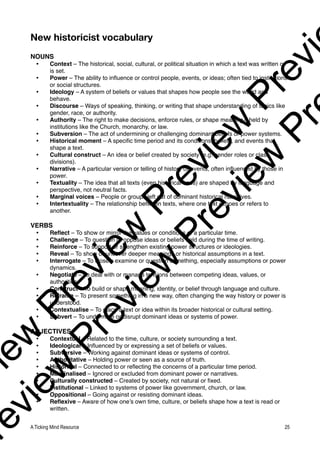
• Colonialism – The control or occupation of one country by another, often involving
exploitation.
• Empire – A powerful country that controls other lands and people.
• Indigenous identity – The cultural identity and traditions of the original inhabitants of a
place.
• Displacement – The forced removal of people from their land or culture.
• Otherness – The idea of seeing a group of people as different, strange, or inferior.
• Hybridity – A mix of cultures, languages, or identities that emerges from colonial contact.
• Assimilation – The process of a colonised group being made to adopt the culture of the
colonisers.
• Resistance – The act of pushing back against colonial control or domination.
• Voice – The ability of individuals or groups to speak, represent themselves, or be heard in
texts.
• Power – The control held by colonisers or those in dominant positions in a society.
• Representation – How people from colonised cultures are shown or portrayed in a text.
• Identity – How someone sees themselves, including their cultural, racial or national sense
of self.
• Racism – Discrimination or prejudice based on race; often tied to colonial attitudes of
superiority.
• Decolonisation – The undoing or reversal of colonial control and the reclaiming of culture
and voice.
• Diaspora – A group of people who have been spread out or scattered from their original
homeland.
Verbs
These verbs are useful for interpreting how texts reflect or critique conditions for people impacted
by colonisation:
• Colonise – To take control of land or people, often removing or erasing original culture.
• Marginalise – To push people or cultures to the edge, making them seem less important.
• Suppress – To hold back or silence ideas, culture, or language.
• Reclaim – To take back something that was taken—often land, identity, or language.
• Resist – To stand up against oppression or colonial control.
• Assimilate – To adopt the dominant culture, often by force or pressure.
• Portray – To represent someone or something in a certain way.
• Stereotype – To oversimplify and fix a certain image of a group, often unfairly.
• Exoticise – To treat someone or something as strange, mysterious, or overly different.
• Critique – To analyse and challenge the power dynamics and messages in a text.
Adjectives
These adjectives are useful for describing power, culture and identity:
• Colonised – Taken over or controlled by another power.
• Oppressed – Treated unfairly or denied rights and freedom.
• Displaced – Removed from one’s land or culture.
• Marginalised – Pushed to the side or made less important.
• Hybrid – Containing a mixture of cultural or racial elements.
• Silenced – Prevented from expressing or representing oneself.
• Resistant – Standing up against power or control.
• Subjugated – Forced into a lower or controlled position.
• Exotic – Seen as strange, colourful, or foreign (often in a patronising or stereotypical way).
• Empowered – Having strength, voice, and control over one’s identity or story.
A Ticking Mind Resource 24
v
i
e
w
P
r
e
v
i
e
w
P
r
e
v
i
e
w
P
r
e
v
i
r
e
v
i
e
w
P
r
e
v
i
e
w
P
r
e
v
i
e
w
P
r
New historicist vocabulary
NOUNS
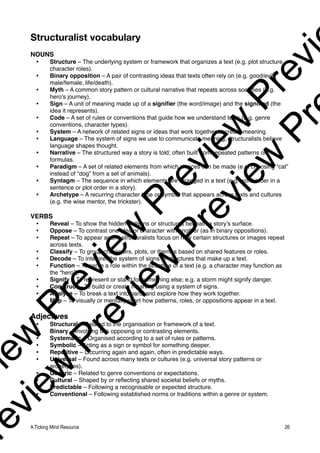
• Context – The historical, social, cultural, or political situation in which a text was written or
is set.
• Power – The ability to influence or control people, events, or ideas; often tied to institutions
or social structures.
• Ideology – A system of beliefs or values that shapes how people see the world and
behave.
• Discourse – Ways of speaking, thinking, or writing that shape understanding of topics like
gender, race, or authority.
• Authority – The right to make decisions, enforce rules, or shape meaning—held by
institutions like the Church, monarchy, or law.
• Subversion – The act of undermining or challenging dominant beliefs or power systems.
• Historical moment – A specific time period and its conditions, beliefs, and events that
shape a text.
• Cultural construct – An idea or belief created by society (e.g. gender roles or class
divisions).
• Narrative – A particular version or telling of history or events, often influenced by those in
power.
• Textuality – The idea that all texts (even historical ones) are shaped by language and
perspective, not neutral facts.
• Marginal voices – People or groups left out of dominant historical narratives.
• Intertextuality – The relationship between texts, where one text echoes or refers to
another.
VERBS
• Reflect – To show or mirror the values or conditions of a particular time.
• Challenge – To question or oppose ideas or beliefs held during the time of writing.
• Reinforce – To support or strengthen existing power structures or ideologies.
• Reveal – To show or uncover deeper meanings or historical assumptions in a text.
• Interrogate – To closely examine or question something, especially assumptions or power
dynamics.
• Negotiate – To deal with or manage tensions between competing ideas, values, or
authorities.
• Construct – To build or shape meaning, identity, or belief through language and culture.
• Reframe – To present something in a new way, often changing the way history or power is
understood.
• Contextualise – To place a text or idea within its broader historical or cultural setting.
• Subvert – To undermine or disrupt dominant ideas or systems of power.
ADJECTIVES
• Contextual – Related to the time, culture, or society surrounding a text.
• Ideological – Influenced by or expressing a set of beliefs or values.
• Subversive – Working against dominant ideas or systems of control.
• Authoritative – Holding power or seen as a source of truth.
• Historical – Connected to or reflecting the concerns of a particular time period.
• Marginalised – Ignored or excluded from dominant power or narratives.
• Culturally constructed – Created by society, not natural or fixed.
• Institutional – Linked to systems of power like government, church, or law.
• Oppositional – Going against or resisting dominant ideas.
• Reflexive – Aware of how one’s own time, culture, or beliefs shape how a text is read or
written.
A Ticking Mind Resource 25
v
i
e
w
P
r
e
v
i
e
w
P
r
e
v
i
e
w
P
r
e
v
i
r
e
v
i
e
w
P
r
e
v
i
e
w
P
r
e
v
i
e
w
P
r
Structuralist vocabulary
NOUNS
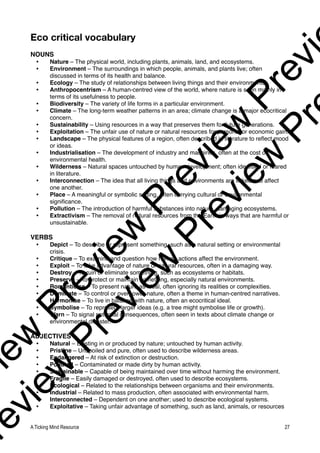
• Structure – The underlying system or framework that organizes a text (e.g. plot structure,
character roles).
• Binary opposition – A pair of contrasting ideas that texts often rely on (e.g. good/evil,
male/female, life/death).
• Myth – A common story pattern or cultural narrative that repeats across societies (e.g.
hero’s journey).
• Sign – A unit of meaning made up of a signifier (the word/image) and the signified (the
idea it represents).
• Code – A set of rules or conventions that guide how we understand texts (e.g. genre
conventions, character types).
• System – A network of related signs or ideas that work together to create meaning.
• Language – The system of signs we use to communicate meaning; structuralists believe
language shapes thought.
• Narrative – The structured way a story is told; often built from repeated patterns or
formulas.
• Paradigm – A set of related elements from which choices can be made (e.g. choosing “cat”
instead of “dog” from a set of animals).
• Syntagm – The sequence in which elements are arranged in a text (e.g. word order in a
sentence or plot order in a story).
• Archetype – A recurring character type or symbol that appears across texts and cultures
(e.g. the wise mentor, the trickster).
VERBS
• Reveal – To show the hidden patterns or structures beneath a story’s surface.
• Oppose – To contrast one idea or character with another (as in binary oppositions).
• Repeat – To appear again; structuralists focus on how certain structures or images repeat
across texts.
• Classify – To group characters, plots, or themes based on shared features or roles.
• Decode – To interpret the system of signs or structures that make up a text.
• Function – To serve a role within the structure of a text (e.g. a character may function as
the “hero”).
• Signify – To represent or stand for something else; e.g. a storm might signify danger.
• Construct – To build or create meaning using a system of signs.
• Analyse – To break a text into parts and explore how they work together.
• Map – To visually or mentally chart how patterns, roles, or oppositions appear in a text.
Adjectives
• Structural – Related to the organisation or framework of a text.
• Binary – Involving two opposing or contrasting elements.
• Systematic – Organised according to a set of rules or patterns.
• Symbolic – Acting as a sign or symbol for something deeper.
• Repetitive – Occurring again and again, often in predictable ways.
• Universal – Found across many texts or cultures (e.g. universal story patterns or
archetypes).
• Generic – Related to genre conventions or expectations.
• Cultural – Shaped by or reflecting shared societal beliefs or myths.
• Predictable – Following a recognisable or expected structure.
• Conventional – Following established norms or traditions within a genre or system.
A Ticking Mind Resource 26
v
i
e
w
P
r
e
v
i
e
w
P
r
e
v
i
e
w
P
r
e
v
i
r
e
v
i
e
w
P
r
e
v
i
e
w
P
r
e
v
i
e
w
P
r
Eco critical vocabulary
NOUNS
• Nature – The physical world, including plants, animals, land, and ecosystems.
• Environment – The surroundings in which people, animals, and plants live; often
discussed in terms of its health and balance.
• Ecology – The study of relationships between living things and their environments.
• Anthropocentrism – A human-centred view of the world, where nature is seen mainly in
terms of its usefulness to people.
• Biodiversity – The variety of life forms in a particular environment.
• Climate – The long-term weather patterns in an area; climate change is a major ecocritical
concern.
• Sustainability – Using resources in a way that preserves them for future generations.
• Exploitation – The unfair use of nature or natural resources for personal or economic gain.
• Landscape – The physical features of a region, often described in literature to reflect mood
or ideas.
• Industrialisation – The development of industry and machines, often at the cost of
environmental health.
• Wilderness – Natural spaces untouched by human development; often idealised or feared
in literature.
• Interconnection – The idea that all living things and environments are linked and affect
one another.
• Place – A meaningful or symbolic setting, often carrying cultural or environmental
significance.
• Pollution – The introduction of harmful substances into nature, damaging ecosystems.
• Extractivism – The removal of natural resources from the Earth in ways that are harmful or
unsustainable.
VERBS
• Depict – To describe or represent something, such as a natural setting or environmental
crisis.
• Critique – To examine and question how human actions affect the environment.
• Exploit – To take advantage of nature or natural resources, often in a damaging way.
• Destroy – To ruin or eliminate something, such as ecosystems or habitats.
• Preserve – To protect or maintain something, especially natural environments.
• Romanticise – To present nature as ideal, often ignoring its realities or complexities.
• Dominate – To control or overpower nature, often a theme in human-centred narratives.
• Harmonise – To live in balance with nature, often an ecocritical ideal.
• Symbolise – To represent larger ideas (e.g. a tree might symbolise life or growth).
• Warn – To signal potential consequences, often seen in texts about climate change or
environmental disaster.
ADJECTIVES
• Natural – Existing in or produced by nature; untouched by human activity.
• Pristine – Unspoiled and pure, often used to describe wilderness areas.
• Endangered – At risk of extinction or destruction.
• Polluted – Contaminated or made dirty by human activity.
• Sustainable – Capable of being maintained over time without harming the environment.
• Fragile – Easily damaged or destroyed, often used to describe ecosystems.
• Ecological – Related to the relationships between organisms and their environments.
• Industrial – Related to mass production, often associated with environmental harm.
• Interconnected – Dependent on one another; used to describe ecological systems.
• Exploitative – Taking unfair advantage of something, such as land, animals, or resources
A Ticking Mind Resource 27
v
i
e
w
P
r
e
v
i
e
w
P
r
e
v
i
e
w
P
r
e
v
i
r
e
v
i
e
w
P
r
e
v
i
e
w
P
r
e
v
i
e
w
P
r

VCE Literature Section A Exam Response Guide

  • 1.
    A Ticking MindResource 1 v i e w P r e v i e w P r e v i e w P r e v i r e v i e w P r e v i e w P r e v i e w P r
  • 2.
    Table of contents Q1responses What is Q1? ............................................................................................ p3 Example Q1 responses ............................................................................................ p4 Starting a Q1 response ............................................................................................ p6 Writing Q1 body paragraphs ............................................................................................ p7 -Topic sentences ............................................................................................ p7 -Analysis ............................................................................................ p7 -Concluding sentence ............................................................................................ p9 Q2 responses What is Q2? ............................................................................................ p10 Example Q2 responses ............................................................................................ p11 Introducing a Q2 response ............................................................................................ p15 Writing Q2 body paragraphs ............................................................................................ p17 -Topic sentences ............................................................................................ p17 -Analysing examples ............................................................................................ p18 -Linking to other examples ............................................................................................ p19 -Synthesising sentence ............................................................................................ p19 Conclusions ............................................................................................ p20 Critical theory vocabularies Marxist ............................................................................................ p21 Feminist ............................................................................................ p23 Post colonial ............................................................................................ p24 New historicist ............................................................................................ p25 Structuralist ............................................................................................ p26 Eco-critical ............................................................................................ p27 A Ticking Mind Resource 2 v i e w P r e v i e w P r e v i e w P r e v i r e v i e w P r e v i e w P r e v i e w P r
  • 3.
    Q1 responses What isQ1? No matter what text you are writing about for Section A, Q1 is always the same: Explore the significance of the passage below in the text. A response to this task should do two things: 1) Discuss how the set passage introduces, develops, emphasises or brings to a culmination one or more of these significant things: • Themes, conflicts or tensions • Characters and problems • Techniques, devices or imagery important in the text 2) Discuss how something is significant in the passage because: • it comes at a critical point in the text • it’s a representative example of the use of an important technique or device that is used across the rest of the text • it’s a representative example of how a fundamental idea in the text is explored throughout the text A response to this question should be about 200-300 words A Ticking Mind Resource 3 v i e w P r e v i e w P r e v i e w P r e v i r e v i e w P r e v i e w P r e v i e w P r
  • 4.
    Example Q1 response EXAMPLE1: Let’s look at an example Q1 response. This response is to a passage from Bram Stoker’s Dracula. In this passage, the character of Dracula is introduced for the first time. Overview of the significance of the passage This passage is critical in the text because it introduces the antagonist Dracula, establishes the foundations for his characterisation throughout the text and begins the development of Stoker’s central concern with individual power and autonomy. BP1: • Discuss one way the passage is significant • Link this significance to the text as a whole In this passage, Stoker utilises archetypal vampiric descriptions of Dracula that frame the way he’s presented as unnatural and monstrous throughout the rest of the text. He’s describes as “like a statue” and “cold as ice” creating a contrast to the naturalness of the narrator, Harker. Not only is Dracula presented as an inhuman, cold being - he’s also characterised as physically powerful through the “strength of his handshake”. This physical strength is essential to Stoker’s development of Dracula as a menacing, antagonistic force over the course of the rest of the text. Central to the gothic terror Stoker creates in the character of Dracula is that he possesses a supernatural ability to overcome ordinary humans with ease - such as when he attacks Lucy later on in the novel - and that he is immune to conventional efforts to hill him. So through this initial characterisation of Dracula, Stoker foreshadows the terrifying power of the vampire seen in the rest of the novel. BP2 • Discuss a second way the passage is significant • Link this significance to the text as a whole Moreover, this passage also initiates Stoker’s exploration of Victorian fears about the limitations of human autonomy and individual control. Though Harker is invited to enter the house of his “own will”, it is Dracula who controls and manipulates the entire scene as he does for of the rest of the novel. It is Dracula who “took” Harker’s luggage and “insisted” on carrying it, while Harder couldn’t “forestall him”. These actions along with Dracula’s physical power highlight his power’s of control and serve to reflect Victorian anxiety about ceding their individual autonomy in a new, modern, technological society. This anxiety is underscored afterwards through Dracula’s mesmeric power to control his victims, rendering them without will. Thus this passage is representative of the way Stoker explores Victorian trepidation about the loss of individual control. A Ticking Mind Resource 4 v i e w P r e v i e w P r e v i e w P r e v i r e v i e w P r e v i e w P r e v i e w P r
  • 5.
    EXAMPLE 2: Here’s anotherexample Q1 response. This response is about a passage from the play Cyrano. This passage comes later on in the play - from Act 4 - where one of the main characters dies. Overview of the significance of the passage This moment from the play occurs in the final scene of Act 4 and underlines the devastating consequences of Christian and Cyrano’s deception of Roxanne. BP1: • Discuss one way the passage is significant • Link this significance to the text as a whole Here, Christian is stretchered onto stage after taking part in a fatal charge with the other cadets. As in other scenes, Rostand juxtaposes the apparent nobility of Christian and Cyrano’s actions with the fundamental mendaciousness of their actions towards Roxanne, highlighting that their noble actions are in fact deeply problematic. Christian has essentially committed suicide in an act of self sacrifice after arguing in the previous scene that Cyrano should not “lose the hope of happiness”. As Christian lays dying, Cyrano also acts in an ostensibly selfless manner, reassuring Christian that “it’s you she loves.” However, this supposed honourable act is rooted in deception. Rostand illustrates this by contrasting the nobility of Cyrano’s words to his actions in this scene where he claims Christian’s revealing the truth as “mine,” thus continuing the fraud towards Roxanne. BP2 • Discuss a second way the passage is significant • Link this significance to the text as a whole Christian’s death in the scene, alongside Cyrano’s inability to acknowledge the truth of his feelings, both operate as profound signifiers of the tragic nature of this text. Though in the previous scene Christian has urged Cyrano to “tell her the truth”, Cyrano chooses to carry on the lie at this point. This choice consequently creates the foundation for the tragedy at the end of the play - where Cyrano does not reveal the truth of his love before it’s too late and he dies himself. Both in this scene, then, and at the end of the play, death is used as the ultimate symbol of the destructiveness of deception, illustrating that Cyrano’s lies towards Roxanne also mean the death of his real identity and self. A Ticking Mind Resource 5 v i e w P r e v i e w P r e v i e w P r e v i r e v i e w P r e v i e w P r e v i e w P r
  • 6.
    Starting a Q1response Your Q1 response should begin with a one sentence ‘mini’ intro. This intro should identify two ways the passage is significant in the context of the whole text. Here a basic way you can write this introductory sentence: Now, try practising a different way to write this introductory sentence: And another way: This... is... because... it... passage moment scene critical in the text significant to the development of the text a critical moment in the text a turning point in the narrative significant in its placement (at/near/during) because as in the way introduces foreshadows develops escalates emphasises highlights illustrates is the climax of... the culminations of... Here,... In this passage,... At this critical point in..., [author name] highlights establishes emphasises depicts introduces develops the importance of the important role of the significance of the critical conflict between the way Coming as it does at..., Situated at..., Depicting the critical moment where..., Portraying the...and the..., this... moment passage scene introduces foreshadows develops escalates emphasises highlights illustrates is the climax of... the culminations of... A Ticking Mind Resource 6 v i e w P r e v i e w P r e v i e w P r e v i r e v i e w P r e v i e w P r e v i e w P r
  • 7.
    Writing Q1 bodyparagraphs A Q1 body paragraph consists of four elements: TOPIC SENTENCES Let’s have a go writing each part of a body paragraph, starting with topic sentences. Have a go using the words and phrases in each column below to focus on an important feature or idea in a passage: ANALYSIS OF WHAT’S SIGNIFICANT IN THE PASSAGE AND HOW THIS LINKS TO THE TEXT AS A WHOLE As a rule, the bulk of a body paragraph should be taken up with referring to evidence from the passage to analyse its significance and then linking this to other parts of the text. The example below shows a few important things to do in this part of the body paragraph: He’s described as “like a statue” and “cold as ice” creating a fundamental contrast to the naturalness of the narrator, Harker. Not only is Dracula presented as an inhuman, cold being - he’s also characterised as physically powerful through the “strength of his handshake”. This physical strength is essential to Stoker’s development of Dracula as a menacing, antagonistic force over the course of the rest of the text. Central to the gothic terror Stoker creates in the character of Dracula is that he possesses a supernatural ability to overcome ordinary humans with ease - such as when he attacks Lucy later on in the novel - and that he is immune to conventional efforts to hill him. • Analyse evidence from the passage first and then link it to other parts of the text. • Use close analysis skills to analyse evidence from the passage Topic sentence In this passage, Stoker utilises archetypal vampiric descriptions of Dracula that frame the way he’s presented as unnatural and monstrous throughout the rest of the text. • Analysis of what’s significant in the passage • Analysis of how the significance of something in the passage links to the text as a whole He’s described as “like a statue” and “cold as ice” creating a contrast to the naturalness of the narrator, Harker. Not only is Dracula presented as an inhuman, cold being - he’s also characterised as physically powerful through the “strength of his handshake”. This physical strength is essential to Stoker’s development of Dracula as a menacing, antagonistic force over the course of the rest of the text. Central to the gothic terror Stoker creates in the character of Dracula is that he possesses a supernatural ability to overcome ordinary humans with ease - such as when he attacks Lucy later on in the novel - and that he is immune to conventional efforts to hill him. Synthesising sentence So through this initial characterisation of Dracula, Stoker foreshadows the terrifying power of the vampire seen in the rest of the novel. Here... At this point... At this point in the narrative where... In this moment In this moment of... In this passage During this moment of... Having already... As a prelude to... Through... Through this depiction of... By... Through the technique of... [author name]... illustrates contrasts depicts portrays utlises in order to and as a way of , revealing... , highlighting... , depicting... , underlining... , representing... , creating... A Ticking Mind Resource 7 v i e w P r e v i e w P r e v i e w P r e v i r e v i e w P r e v i e w P r e v i e w P r
  • 8.
    • Use arange of words to identify and analyse how the passage is significant (as the words in bold in the example do) Have a go analysing some evidence in the passage, explaining its significance and linking the examples to the text as a whole. Use some of the words and phrases in the tables below to help you: Phrases to analyse how a passage demonstrates the author’s use of techniques or focus on ideas Words to describe the importance of features in a passage exemplifies the [author name’s] use of... exemplifies the [author name’s] exploration of... typifies author name’s] utilisation of... is an archetypal representation of the way [author name]... is emblematic of [author name’s] focus on.... relects the [author name’s] stylistic emphasis on... complex critical crucial central pivotal revelatory poignant profound distinctive Words and phrases to link the passage to... things that happen later things that happened earlier later throughout the rest of the text over the course of the later narrative subsequently in the text is further developed when establishes foreshadows foregrounds frames how...is presented over the rest of... presages is a prelude to... creates the foundation for initiates this builds on from this extends the earlier develops the previous reinforces emphasises continues to develop operates as a full stop to is the climax of is the end to serves as the culmination of recalls echoes intensifies A Ticking Mind Resource 8 v i e w P r e v i e w P r e v i e w P r e v i r e v i e w P r e v i e w P r e v i e w P r
  • 9.
    CONCLUDING SENTENCE There aretwo aspects to a concluding sentence: Your concluding sentence should add insight to your paragraph that goes beyond what has already been said in your topic sentence. In this final sentence of your paragraph, you should be synthesising what the evidence in your paragraph shows when taken as a whole. These sentence starters will help you frame your concluding sentence. Use a different sentence starter for each concluding sentence in your two paragraphs: • Through this use of..., [author name] then creates a sense of... • This use of...ultimately underscores... • Thus the passage contributes to... • Thus the passage exemplifies the way... • Thus the passage serves as a... • In this way the passage... • As a result, the reader is... • This moment signals then... • So by the end of this moment... LINKING POINTS Your paragraphs will need to be connected with a linking a phrase. Try using one of the phrases below to connect your second paragraph to your first one: • A further significant aspect of this passage is that... • Moreover, this passage functions as a significant demonstration of... • Moreover, this passage operates as a powerful example of... • This passage is also significant as... • A further significance of this passage is that... • In addition to the way [author name]...in this passage, [she/he] also... Concluding phrase Statement about a key achievement or outcome of the passage So through this initial characterisation of Dracula, Stoker foreshadows the terrifying power of the vampire seen in the rest of the novel. Thus this passage is representative of the way Stoker explores Victorian trepidation about the loss of individual control. A Ticking Mind Resource 9 v i e w P r e v i e w P r e v i e w P r e v i r e v i e w P r e v i e w P r e v i e w P r
  • 10.
    Q2 responses What isQ2? Q2 always has the same format, but the key idea it’s asking you to concentrate on changes depending on the text you’re responding to. Here are examples of Q2 tasks for different texts: Using the passage as a focus, discus the ways in which the concept of uncertainty is endorsed, challenged and/or marginalised by the text. Using the passage as a focus, discus the ways in which the concept of judgement is endorsed, challenged and/or marginalised by the text. Using the passage as a focus, discus the ways in which the concept of control is endorsed, challenged and/or marginalised by the text. Using the passage as a focus, discus the ways in which the concept of identity is endorsed, challenged and/or marginalised by the text. A response to this task should do a few things: 1) Analyse on way the key idea in the task is represented in the text •Is this idea endorsed or celebrated? •Is this idea challenged or resisted? •Is this idea marginalised, silenced or not represented? 2) Use a literary lens to develop an interpretation of how a key idea is represented in the text. This should draw upon your learning from the Developing Interpretations area of study in Unit 3. This led might be a critical literary theory such as: •Marxism •Feminism •Psychoanalytical •Post colonial •Eco-criticism •Gender •Queer •New historicism •Structuralist 3) Use close analysis strategies to analyse the set passage in depth through a literary lens 4) Use examples from elsewhere in the text to analyse how an idea is represented across the text as a whole A response to this question should be about 600-700 words. A Ticking Mind Resource 10 v i e w P r e v i e w P r e v i e w P r e v i r e v i e w P r e v i e w P r e v i e w P r
  • 11.
    Example Q2 response Thisexample Q2 essay below - on Bram Stoker’s novel Dracula - was written in response to this task: Using the passage as a focus, discus the ways in which the concept of control is endorsed, challenged and/or marginalised by the text. The response centres around the passage where the character of Dracula is introduced for the first time. Overall interpretation and response to Q2 task Bram Stoker’s Dracula represents and ultimately indicts the material power of the bourgeoisie - embodied by the novel’s protagonist - to control and commodify people. Elaboration and focus on passage As Dracula exerts his capitalist authority, individuals around him lose their humanity and fall into a false consciousness where they accept their exploitation at his hands. Topic sentence Throughout much of the novel, Stoker depicts Dracula’s acquisition of increasing physical capital as a manipulative way of exerting hegemony over his proletariat victims. Initial evidence and analysis Harker is a working class tool, being used by Dracula to buy real estate in London and develop his material base for exploitative control of the city and its citizens. As a tool, Harker sees Dracula’s Transylvanian castle as a stronghold of feudal power. When he first crosses Dracula’s “threshold”, he is impressed by the “great winding stair” and “another great passage”. Indeed, throughout this passage, Stoker repeatedly describes features of the castle as “great”, such as the “great bedroom”, underscoring the physical property and wealth in the possession of the count. Link to further point and analysis Elsewhere in the text, the castle is continually used as a symbol of Dracula’s wealth and the power and the control this wealth gives him. Further evidence and analysis Harker describes the castle at one point as being covered in “centuries of dust”, as if “nothing had been touched for years,” highlighting the wealth Dracula has been able to hoard and the economic base he has created to control the working class. Indeed, such is the wealth and power of Dracula, that his stronghold castle which is on the “very edge of a terrible precipice” is virtually impenetrable. Within the confines of this “veritable prison” Harker becomes a “prisoner,” as Dracula manipulates both Harker’s correspondence but also more broadly the super structure of a legal system avaricious for business and gain. Synthesising sentence Through this imagery of the castle, aristocratic wealth and Dracula’s real estate machinations, the text represents the way its vampiric protagonist uses financial leverage to overpower others. Topic sentence Dracula’s fiscal power is mirrored by his physical strength which becomes a profound symbol through the text of his monstrous ability to oppress and suppress ordinary people in order to maintain his position of privilege. A Ticking Mind Resource 11 v i e w P r e v i e w P r e v i e w P r e v i r e v i e w P r e v i e w P r e v i e w P r
  • 12.
    Initial evidence and analysis Fromthe outset of the passage, Stoker emphasises the physical supremacy of Dracula, describing him as having a “strength” that made Harker “wince” - a description that is underscored over the rest of the passage with references to the “strength of the handshake” and the way he “threw” open a door. Parallel to Dracula’s tangible strength, is his emotional invulnerability. He is like a “statue,” “stone” and “ice” - all attributes of a merciless capitalist driven only by a rapacious appetite for gain and unmoved by feelings for the wellbeing of others. Link to further point and analysis Indeed, Dracula’s monstrous force and emotional callousness drives him to assault his victims, draining them of their lifeblood, creating a potent image of the way economic overlords consume people as fodder in a capitalist world. Further evidence and analysis In the cases of both Dracula’s assault on Harker in his castle and later of Lucy in London, the attacks are repeated and systematic - a representation of the unstoppable and unquenchable nature of capitalism. Just as capitalism is driven by an insatiable desire for wealth, so too is Dracula driven by a need for the commodity of blood. Even when “He is bloated with blood”, he still desires more. Synthesising sentence As a result, Dracula’s actions come to demonstrate how the supposed overlords in a capitalist system are in fact controlled by a capitalist pathology rather than being master of it. Topic sentence Moreover, many other characters throughout Dracula illustrate the way capitalism creates mindless drones of its participants who are then controlled by the system. Dracula - as an emblem of capitalist hegemony - manipulates his victims into false consciousness: the belief that they have some autonomy within the superstructure rather than being exploited by it. Initial evidence and analysis Dracula creates the illusion of autonomy for Harker at the beginning of this passage when he says “Enter freely and of your own will”. While Harker’s narration of the scene evinces his innocent belief in the hospitality of Dracula, it is clear to the reader that Harker is in fact experiencing a false sense of security, and is in a situation where he has no power to “forestall” his host. Link to further point and analysis Over the course of the novel, all of Dracula’s victims experience a similar false consciousness. Further evidence and analysis Renfield is perhaps the most disturbing example of this phenomenon. He openly acknowledges that he is the “slave” of Dracula because this servitude will “reward” him, highlighting how the capitalist system builds a false belief within in the working class that they can eventually benefit from the mechanism that exploits them. Mirroring Renfield are Dracula’s brides - women who believe they have agency to claim Harker as “mine” when in reality they are always under the subjugation and control of Dracula. Synthesising sentence Taken together, the experience of all of these characters within the capitalist sphere of Dracula shows that his authority in his world is built on his ability to manipulate his vassals into believing they are acting freely and for future reward. Initial concluding statement Ultimately, the monstrous control Dracula wields in Stoker’s novel serves as a critique of a capitalist system that commodifies and dehumanises those in it. Final key thought or idea Both Dracula himself and his victims lack autonomy and are slaves to the insatiable desires of the consumer economy. A Ticking Mind Resource 12 v i e w P r e v i e w P r e v i e w P r e v i r e v i e w P r e v i e w P r e v i e w P r
  • 13.
    Here’s another exampleQ2 essay. This one is on Shakespeare’s novel As You Like It and was written in response to this task: Using the passage as a focus, discus the ways in which the concept of discovery is endorsed, challenged and/or marginalised by the text. The response centres around a scene from Act 3 of the play, where one of the protagonists - Rosalind - is disguised as a man and in this disguise talks to Orlando who is in love with her. The response uses a feminist lens to frame its analysis of the play. Overall interpretation and response to Q2 task Shakespeare’s As You Like It ultimately celebrates women’s wit and resilience, but this scene lays bare the patriarchal codes Rosalind must navigate. Elaboration and focus on passage Through role‑play and verbal dexterity Rosalind seizes masculine linguistic power, exposes love‑sick men as shallow idealisers, and models female agency that flourishes once courtly strictures are left behind. Topic sentence Rosalind’s disguise empowers her to explore male discursive space, demonstrating that linguistic authority—traditionally male—is available to women who dare to appropriate it. Initial evidence and analysis Commanding Orlando, “Come, woo me, woo me; for now I am in a holiday humour, and like enough to consent,” she adopts imperative mood and bawdy confidence more typical of an entitled man than a woman like her in this context. By instructing Orlando how to court, she reverses the gendered hierarchy in which men speak and women listen. Link to further point and analysis The carnivalesque freedom of the first allows this role reversal, and also highlights how romance usually silences female desire and privileges male needs. Further evidence and analysis When she says, “Men have died from time to time, and worms have eaten them, but not for love,” she punctures the often coercive rhetoric that urges women to reward male self‑sacrifice. Her satire strips love of melodramatic posturing, insisting on equality rather than male martyrdom. Synthesising sentence Thus, through borrowed masculine voice and comic scepticism, Rosalind finds her own agency and unsettles a linguistic patriarchy that prefers her silent and idealised. Topic sentence This scene further acts as critique of patriarchal love by portraying Orlando’s journey of discovery—from idealising Rosalind as a voiceless object of desire to recognising her as a thinking, speaking subject. Initial evidence and analysis Orlando declares he will “love” Rosalind “for ever and a day,” yet his devotion is initially directed not toward a real woman but toward an idealised fiction, sustained by sentimental poetry nailed to trees. Rosalind, disguised as Ganymede, disrupts this fantasy with irony—“Neither rhyme nor reason can express how much”— exposing the emptiness of patriarchal romantic conventions. Link to further point and analysis By demanding that Orlando articulate specific reasons for his love, Rosalind refuses to be reduced to a mute symbol of male longing and instead asserts her individuality and agency. A Ticking Mind Resource 13 v i e w P r e v i e w P r e v i e w P r e v i r e v i e w P r e v i e w P r e v i e w P r
  • 14.
    Further evidence and analysis Herpointed challenge—“What would you say to me now, an I were your very, very Rosalind?”—compels Orlando to engage with a woman who speaks, questions, and thinks. His awkward response exposes how patriarchal romance erases female subjectivity, constructing women as passive objects rather than active participants. Through this performance, Rosalind critiques the tradition that silences women in love, demanding instead recognition of her full humanity. Synthesising sentence In doing so, the scene challenges the cultural ideal of female muteness in romantic narratives, positioning Rosalind as both a disruptor of patriarchal fantasy and a feminist figure asserting women’s right to be seen, heard, and known. Topic sentence Finally, the forest of Arden itself operates as a feminist utopia where restrictive court identities can be shed, allowing Rosalind and other women to experiment with identities that are denied at court. Initial evidence and analysis Rosalind’s cross‑dressing is not solely protective; it enables socio‑political commentary. She mock‑lectures Orlando on “the etiquette of wooing,” transforming the forest into a classroom free from Duke Frederick’s surveillance. Link to further point and analysis Moreover, her cousin Celia, silently witnessing the repartee, acts as a female confidante rather than rival—an alternative to the trope of women pitted against each other by desire. Further evidence and analysis Even peripheral lovers illustrate this liberation. The shepherdess Phebe (introduced later in the scene) resists Silvius’s idealising pursuit, declaring she will not “be your executioner.” Her refusal mirrors Rosalind’s earlier dismantling of Orlando’s poetic excess, reinforcing a collective female resistance to being idealised or possessed. Synthesising sentence The Forest, then, functions as a metaphor for feminist growth: a learning curve where women cultivate autonomy, sisterhood and self‑determination. Initial concluding statement While Orlando will eventually mature into a partner worthy of Rosalind, Shakespeare ensures that the play’s true discoverer of love is the woman who scripts its terms. Final key thought or idea The tragedy she avoids, and the comedy she completes, stem from one radical premise: when women speak, they find themselves. A Ticking Mind Resource 14 v i e w P r e v i e w P r e v i e w P r e v i r e v i e w P r e v i e w P r e v i e w P r
  • 15.
    Introducing a Q2Response The first sentence of your introduction to your Q2 response should address the specific topic in the task, develop an interpretation and do this through the framework of a critical lens. The example below is responding to the key word ‘control’ and develops a Marxist interpretation of the text: Since the Q2 task asks you to discuss how an idea is “endorsed, challenged and/or marginalised by the text”, you should use one of the words or a synonym to present your interpretation. Try writing a first sentence for a Q2 response now. Use one of the words from the list below to introduce an interpretation. Use words from one of the critical theory vocabulary lists (pages 21-29) to frame your interpretation. The second or third sentence of your introduction (it only needs to be two sentences but can be longer) should follow on from the first by identifying an aspect or elements of the passage that will be used as a basis for developing this interpretation and the text as a whole as is demonstrated by the below example: Develop an overall interpretation of the text in response to the key word in the Q2 task Present the interpretation through the framework of a critical lens or theory Bram Stoker’s Dracula represents and ultimately indicts the material power and control of the bourgeoisie - embodied by the novel’s protagonist - to control and commodify people. Endorses Challenges Marginalises celebrates extols idealises romanticises conveys the importance of represents the profound impact of illustrates the meaning of subverts criticises condemns decries probes interrogates exposes reveals critiques indicts silences erases excludes overlooks effaces renders invisible fails to represents First sentence: Bram Stoker’s Dracula represents and ultimately indicts the material power of the bourgeoisie - embodied by the novel’s protagonist - to control and commodify people. Second sentence: As Dracula exerts his capitalist authority, individuals around him lose their humanity and fall into a false consciousness where they accept their exploitation at his hands. A Ticking Mind Resource 15 v i e w P r e v i e w P r e v i e w P r e v i r e v i e w P r e v i e w P r e v i e w P r
  • 16.
    Try writing asecond sentence that follows on from the first. In this subsequent sentence (or sentences), identify and introduce how one or more of the specific features in the table below is present in the passage and the basis for your interpretation. You can vary these words or substitute your own to suit your specific text: Text form themes characters techniques genre style structure development narrative voice ideas motif view values tension between conflict concerns society’s.... characterisation characterising...as... presenting...as... comparing contrasting embodiment of emblem of representation of perspective imagery symbols recurring devices detail stylistic choices A Ticking Mind Resource 16 v i e w P r e v i e w P r e v i e w P r e v i r e v i e w P r e v i e w P r e v i e w P r
  • 17.
    Body Paragraphs Each ofyour body paragraphs should include these things: • A topic sentence that links to the Q2 task and identifies a analytic focus for the paragraph • Analysis of evidence from the passage through the lens of a critical theory • A link to evidence from elsewhere in the text that supports the analytic focus for the paragraph • A synthesising sentence Let’s look at these elements one at a time. TOPIC SENTENCES A topic sentence for a Q2 response should have two basic elements: Have a go writing a topic sentence. Try using one of the phrases below to begin your sentence then use a word to refer to the Q2 topic and vocabulary that also signposts the critical lens you are using to develop your interpretation. Identify an analytic focus for the paragraph Link to the Q2 topic Throughout much of the novel, Stoker depicts Dracula’s acquisition of increasing physical capital as a manipulative way of exerting hegemony over his proletariat victims. Phrases to begin any topic sentence Phrases to introduce topic sentences for subsequent paragraphs [Author’s] use of [technique] here constructs a discourse of... [Character’s] behaviour exemplifies the effect Throughout the text, [author] presents... as a means of... Throughout..., [author] depicts....in order to By foregrounding [character/idea], the text [Author’s] representation of [group/idea] reveals.. In this moment, the text explores the consequences of... A key feature of the text is its portrayal of... The text critiques/reinforces/challenges the notion that... This concern intensifies elsewhere in the text as/ when... Moreover,.... Similarly, [another character/event] reflects... This idea is reinforced through... In contrast, [author] later presents... This progression illustrates a shift in... Building upon this, [author] uses... to emphasise... This pattern is also evident in the characterisation of... A Ticking Mind Resource 17 v i e w P r e v i e w P r e v i e w P r e v i r e v i e w P r e v i e w P r e v i e w P r
  • 18.
    ANALYSING EVIDENCE When analysingevidence throughout your body paragraph, the key thing is to analyse how the evidence illustrates the idea the Q2 task is asking you to focus on. Here’s a typical example: Here are some sentence elements you can experiment with using to analyse evidence and what it shows about an idea: Evidence analysis link to topic (control) Renfield openly acknowledges that he is the “slave” of Dracula because this servitude will “reward” him, highlighting how the capitalist system builds a false belief within in the working class that they can eventually benefit from the mechanism that exploits them. Characters Connection to ideas [Author name’s] characterisation of... [Character name]’s.... [Character name]’s actions.... [Character name] views... as... [Character name] sees... as... In this scene where..., [Character name]’s.... [Character name]’s belief in... When [Character name] says..., it embodies typifies illustrates demonstrates symbolises manifests evokes is a representation of is an emblem of operates as a metaphor for signals to readers that... , highlighting , revealing , exposing , emphasising , underscoring creates underscores parallels foregrounds Technique [Author name’s] use of... [Author name] emphasises the...by... By creating..., [Author name]... Through the imagery of...., the reader sees.... Through the technique of... [Author name].... Words and phrases The description of...as “...” By describing.... as... “...”, [Author name].... The reference to “...” The allusion to “...” The connotation of.... The recurring use of.... [Author name] highlights the importance of... by.... The image of “...” A Ticking Mind Resource 18 v i e w P r e v i e w P r e v i e w P r e v i r e v i e w P r e v i e w P r e v i e w P r
  • 19.
    LINKING TO OTHEREXAMPLES During your Q2 response, you will need to not only closely analyse examples from the focus passage, but show your understanding of how a key idea in the task is demonstrated across the text as a whole. This means you need to link examples in the passage to the wider text, such as in this example: Elsewhere in the text, the castle is continually used as a symbol of Dracula’s wealth and the power and the control this wealth gives him. These are some sentence starters are parts you can use to connect your discussion of a passage to other examples in the text or the text as a whole: • Moreover, elsewhere in the text.. • Similarly... • Mirroring this...is... • Paralleling this...is... • In other moments in the text... • In contrast.... • This idea of...is emphasised elsewhere in the text... • Previously in the text, this....has been developed through.... • ...mirrored later in the text when... • ...underscored in other parts of the text where... • ...as happens also when... • Just as in this passage..., so too does...when.... • This characterisation is sustained in... • This moment echoes... • This pattern builds on... • This pattern recurs when... SYNTHESISING SENTENCES At the end of a body paragraph, an effective synthesising sentence will outline the cumulative impact of the evidence that has been analysed throughout the preceding sentences and link this impact to the key idea in the Q2 task. This sentence demonstrates this: Taken together, the experience of all of these characters within the capitalist sphere of Dracula shows that his authority in his world is built on his ability to manipulate his vassals into believing they are acting freely and for future reward. Have a go using or adapting one of these sentence starters to write a synthesising sentence at the end of a body paragraph: • These... crystallise a recurring concern in the text: namely, that... • Collectively, these examples suggest that... • Through this..., [author name].... • As a result of..., [author name].... • Cumulatively, these...merge to underscore the text’s central concern with... • When seen alongside other instances in the text, this reinforces... • The pattern here of... points to... • Taken together, these... build a larger commentary on... • Taken together, these examples demonstrate... • Read in parallel, these...reveal that... A Ticking Mind Resource 19 v i e w P r e v i e w P r e v i e w P r e v i r e v i e w P r e v i e w P r e v i e w P r
  • 20.
    Conclusions A conclusion toyour Q2 response isn’t strictly necessary. The synthesising sentence at the end of your final body paragraph can act as a conclusion to the whole response. However, a separate short conclusion may also offer you more scope to synthesise your response as a whole. Whether you opt to end your response with the final sentence of a body paragraph or choose to write a separate conclusion, the main thing is that you return to the topic of the Q2 and clearly state how the idea is endorsed, challenged or marginalised. This example conclusion refers to the Q2 topic in the underlined text and shows that this idea has been challenged with the text in bold italics. Initial concluding statement Ultimately, the monstrous control Dracula wields in Stoker’s novel serves as a critique of a capitalist system that commodifies and dehumanises those in it. Final key thought or idea Both Dracula himself and his victims lack autonomy, and through their actions expose the destructive and ceaseless appetite of the consumer economy. A Ticking Mind Resource 20 v i e w P r e v i e w P r e v i e w P r e v i r e v i e w P r e v i e w P r e v i e w P r
  • 21.
    Marxist vocabulary NOUNS These termsname the concepts central to Marxist theory: • Class struggle – the conflict between different social classes, especially between the bourgeoisie and the proletariat. • Bourgeoisie – the capitalist class who own the means of production. • Proletariat – the working class who sell their labour. • Ideology – a system of beliefs and values that supports the dominant power structure. • Hegemony – the dominance of one class over others, maintained through cultural means. • Materialism – the idea that material conditions (economy, class, labour) shape human consciousness and culture. • Alienation – the estrangement workers feel when they are disconnected from the products of their labour. • Superstructure – cultural, legal, political, and religious institutions built upon the economic base. • Base – the economic foundation of society, including the forces and relations of production. • Commodification – turning something (such as a person or idea) into a commodity with market value. • Means of production – physical, non-human inputs used in production (factories, machines, land). • Exploitation – the unfair use of labour where workers do not receive the full value of their contribution. • False consciousness – when oppressed classes accept the ideology of the ruling class, misunderstanding their own exploitation. • Class consciousness – awareness of one’s class position and the collective struggle it entails. • Labor – the work done by individuals, often in service to capitalist production. • Capital – wealth used to generate more wealth through investment and production. • Revolution – a radical change in political and social structures, often led by the working class. VERBS These verbs are useful for interpreting how texts reflect or critique material conditions: • Depict – to represent class relations or economic systems. • Critique – to challenge dominant ideologies or economic structures. • Reinforce – to support or maintain existing power hierarchies or ideologies. • Subvert – to undermine dominant class structures or values. • Oppress – to exploit or dominate a group, especially economically. • Reproduce – to maintain social norms or structures (e.g. a text might reproduce bourgeois ideology). • Expose – to reveal underlying class dynamics or power imbalances. • Commodify – to treat people, relationships, or ideas as marketable goods. • Alienate – to isolate or estranged individuals from their labour, society, or self. • Mobilise – to bring people together for collective class action or resistance. • Legitimise – to make an ideology or structure seem natural or justified. • Suppress – to keep down class consciousness or revolutionary ideas. • Negotiate – to balance or work through competing class ideologies or interests. A Ticking Mind Resource 21 v i e w P r e v i e w P r e v i e w P r e v i r e v i e w P r e v i e w P r e v i e w P r
  • 22.
    ADJECTIVES These describe relationships,positions, or qualities that relate to Marxist theory: • Oppressed – being subject to unjust treatment, especially economically or socially. • Exploited – used unfairly for someone else’s benefit, particularly in labour. • Alienated – disconnected from meaningful work, others, or oneself. • Capitalist – relating to private ownership and the profit motive. • Bourgeois – characteristic of the middle/upper class and capitalist values. • Proletarian – associated with the working class. • Ideological – relating to a system of ideas that supports dominant power structures. • Materialist – focused on material and economic realities rather than abstract ideals. • Commodified – treated as a marketable product. • Subversive – undermining dominant ideologies or power structures. • Conscious (as in "class conscious") – aware of one’s class identity and the political struggle it entails. • Revolutionary – radically opposing the existing social or economic order. A Ticking Mind Resource 22 v i e w P r e v i e w P r e v i e w P r e v i r e v i e w P r e v i e w P r e v i e w P r
  • 23.
    Feminist vocabulary Nouns These termsname the concepts central to feminist theory: • Patriarchy – A system where men hold power over women in society, often reflected in texts. • Gender roles – Social expectations about how males and females should behave. • Oppression – Harsh or unfair treatment, often of women under male control. • Objectification – Treating someone like an object instead of a person, especially for their appearance. • Representation – How people (especially women) are shown or portrayed in a text. • Voice – A character’s ability to express thoughts, make choices, and influence events. • Agency – The power a character has to act, choose, and affect their world. • Stereotype – An oversimplified image or idea about a group, often limiting and unfair. • Femininity – Traits linked with being female, like caring or gentleness. • Masculinity – Traits linked with being male, like toughness or emotional control. • Subjugation – Being forced under control or dominance. • Empowerment – Gaining control, strength, or confidence. • Equality – Fairness in rights and opportunities for all genders. Verbs These verbs are useful for interpreting how texts reflect or critique conditions for women: • Marginalise – To place someone on the edge or make them less important. • Challenge – To push back against rules, roles, or expectations. • Conform – To follow traditional rules or social norms. • Resist – To stand up against control or unfair treatment. • Undermine – To weaken someone’s authority or influence. • Critique – To examine something carefully and point out problems or limitations. • Subvert – To reverse or twist traditional ideas or roles. • Portray – To describe or represent someone in a particular way. • Silence – To stop someone from speaking or being heard. • Empower – To give strength or confidence to someone. Adjectives These adjectives are useful for describing power, gender and identity: • Empowered – Having confidence and control. • Oppressed – Controlled or treated unfairly by someone in power. • Submissive – Obedient or passive, often expected of women in traditional roles. • Independent – Free to make one's own choices; self-reliant. • Stereotypical – Fitting a narrow, expected image of a person or group. • Objectified – Treated like a thing rather than a person. • Dominant – In control or holding power. • Silenced – Prevented from expressing oneself or being acknowledged. • Assertive – Confident in expressing opinions or needs. • Marginalised – Pushed to the edges or made less important by society or others. A Ticking Mind Resource 23 v i e w P r e v i e w P r e v i e w P r e v i r e v i e w P r e v i e w P r e v i e w P r
  • 24.
    Post colonial vocabulary Nouns Theseterms name the concepts central to post colonial theory: • Colonialism – The control or occupation of one country by another, often involving exploitation. • Empire – A powerful country that controls other lands and people. • Indigenous identity – The cultural identity and traditions of the original inhabitants of a place. • Displacement – The forced removal of people from their land or culture. • Otherness – The idea of seeing a group of people as different, strange, or inferior. • Hybridity – A mix of cultures, languages, or identities that emerges from colonial contact. • Assimilation – The process of a colonised group being made to adopt the culture of the colonisers. • Resistance – The act of pushing back against colonial control or domination. • Voice – The ability of individuals or groups to speak, represent themselves, or be heard in texts. • Power – The control held by colonisers or those in dominant positions in a society. • Representation – How people from colonised cultures are shown or portrayed in a text. • Identity – How someone sees themselves, including their cultural, racial or national sense of self. • Racism – Discrimination or prejudice based on race; often tied to colonial attitudes of superiority. • Decolonisation – The undoing or reversal of colonial control and the reclaiming of culture and voice. • Diaspora – A group of people who have been spread out or scattered from their original homeland. Verbs These verbs are useful for interpreting how texts reflect or critique conditions for people impacted by colonisation: • Colonise – To take control of land or people, often removing or erasing original culture. • Marginalise – To push people or cultures to the edge, making them seem less important. • Suppress – To hold back or silence ideas, culture, or language. • Reclaim – To take back something that was taken—often land, identity, or language. • Resist – To stand up against oppression or colonial control. • Assimilate – To adopt the dominant culture, often by force or pressure. • Portray – To represent someone or something in a certain way. • Stereotype – To oversimplify and fix a certain image of a group, often unfairly. • Exoticise – To treat someone or something as strange, mysterious, or overly different. • Critique – To analyse and challenge the power dynamics and messages in a text. Adjectives These adjectives are useful for describing power, culture and identity: • Colonised – Taken over or controlled by another power. • Oppressed – Treated unfairly or denied rights and freedom. • Displaced – Removed from one’s land or culture. • Marginalised – Pushed to the side or made less important. • Hybrid – Containing a mixture of cultural or racial elements. • Silenced – Prevented from expressing or representing oneself. • Resistant – Standing up against power or control. • Subjugated – Forced into a lower or controlled position. • Exotic – Seen as strange, colourful, or foreign (often in a patronising or stereotypical way). • Empowered – Having strength, voice, and control over one’s identity or story. A Ticking Mind Resource 24 v i e w P r e v i e w P r e v i e w P r e v i r e v i e w P r e v i e w P r e v i e w P r
  • 25.
    New historicist vocabulary NOUNS •Context – The historical, social, cultural, or political situation in which a text was written or is set. • Power – The ability to influence or control people, events, or ideas; often tied to institutions or social structures. • Ideology – A system of beliefs or values that shapes how people see the world and behave. • Discourse – Ways of speaking, thinking, or writing that shape understanding of topics like gender, race, or authority. • Authority – The right to make decisions, enforce rules, or shape meaning—held by institutions like the Church, monarchy, or law. • Subversion – The act of undermining or challenging dominant beliefs or power systems. • Historical moment – A specific time period and its conditions, beliefs, and events that shape a text. • Cultural construct – An idea or belief created by society (e.g. gender roles or class divisions). • Narrative – A particular version or telling of history or events, often influenced by those in power. • Textuality – The idea that all texts (even historical ones) are shaped by language and perspective, not neutral facts. • Marginal voices – People or groups left out of dominant historical narratives. • Intertextuality – The relationship between texts, where one text echoes or refers to another. VERBS • Reflect – To show or mirror the values or conditions of a particular time. • Challenge – To question or oppose ideas or beliefs held during the time of writing. • Reinforce – To support or strengthen existing power structures or ideologies. • Reveal – To show or uncover deeper meanings or historical assumptions in a text. • Interrogate – To closely examine or question something, especially assumptions or power dynamics. • Negotiate – To deal with or manage tensions between competing ideas, values, or authorities. • Construct – To build or shape meaning, identity, or belief through language and culture. • Reframe – To present something in a new way, often changing the way history or power is understood. • Contextualise – To place a text or idea within its broader historical or cultural setting. • Subvert – To undermine or disrupt dominant ideas or systems of power. ADJECTIVES • Contextual – Related to the time, culture, or society surrounding a text. • Ideological – Influenced by or expressing a set of beliefs or values. • Subversive – Working against dominant ideas or systems of control. • Authoritative – Holding power or seen as a source of truth. • Historical – Connected to or reflecting the concerns of a particular time period. • Marginalised – Ignored or excluded from dominant power or narratives. • Culturally constructed – Created by society, not natural or fixed. • Institutional – Linked to systems of power like government, church, or law. • Oppositional – Going against or resisting dominant ideas. • Reflexive – Aware of how one’s own time, culture, or beliefs shape how a text is read or written. A Ticking Mind Resource 25 v i e w P r e v i e w P r e v i e w P r e v i r e v i e w P r e v i e w P r e v i e w P r
  • 26.
    Structuralist vocabulary NOUNS • Structure– The underlying system or framework that organizes a text (e.g. plot structure, character roles). • Binary opposition – A pair of contrasting ideas that texts often rely on (e.g. good/evil, male/female, life/death). • Myth – A common story pattern or cultural narrative that repeats across societies (e.g. hero’s journey). • Sign – A unit of meaning made up of a signifier (the word/image) and the signified (the idea it represents). • Code – A set of rules or conventions that guide how we understand texts (e.g. genre conventions, character types). • System – A network of related signs or ideas that work together to create meaning. • Language – The system of signs we use to communicate meaning; structuralists believe language shapes thought. • Narrative – The structured way a story is told; often built from repeated patterns or formulas. • Paradigm – A set of related elements from which choices can be made (e.g. choosing “cat” instead of “dog” from a set of animals). • Syntagm – The sequence in which elements are arranged in a text (e.g. word order in a sentence or plot order in a story). • Archetype – A recurring character type or symbol that appears across texts and cultures (e.g. the wise mentor, the trickster). VERBS • Reveal – To show the hidden patterns or structures beneath a story’s surface. • Oppose – To contrast one idea or character with another (as in binary oppositions). • Repeat – To appear again; structuralists focus on how certain structures or images repeat across texts. • Classify – To group characters, plots, or themes based on shared features or roles. • Decode – To interpret the system of signs or structures that make up a text. • Function – To serve a role within the structure of a text (e.g. a character may function as the “hero”). • Signify – To represent or stand for something else; e.g. a storm might signify danger. • Construct – To build or create meaning using a system of signs. • Analyse – To break a text into parts and explore how they work together. • Map – To visually or mentally chart how patterns, roles, or oppositions appear in a text. Adjectives • Structural – Related to the organisation or framework of a text. • Binary – Involving two opposing or contrasting elements. • Systematic – Organised according to a set of rules or patterns. • Symbolic – Acting as a sign or symbol for something deeper. • Repetitive – Occurring again and again, often in predictable ways. • Universal – Found across many texts or cultures (e.g. universal story patterns or archetypes). • Generic – Related to genre conventions or expectations. • Cultural – Shaped by or reflecting shared societal beliefs or myths. • Predictable – Following a recognisable or expected structure. • Conventional – Following established norms or traditions within a genre or system. A Ticking Mind Resource 26 v i e w P r e v i e w P r e v i e w P r e v i r e v i e w P r e v i e w P r e v i e w P r
  • 27.
    Eco critical vocabulary NOUNS •Nature – The physical world, including plants, animals, land, and ecosystems. • Environment – The surroundings in which people, animals, and plants live; often discussed in terms of its health and balance. • Ecology – The study of relationships between living things and their environments. • Anthropocentrism – A human-centred view of the world, where nature is seen mainly in terms of its usefulness to people. • Biodiversity – The variety of life forms in a particular environment. • Climate – The long-term weather patterns in an area; climate change is a major ecocritical concern. • Sustainability – Using resources in a way that preserves them for future generations. • Exploitation – The unfair use of nature or natural resources for personal or economic gain. • Landscape – The physical features of a region, often described in literature to reflect mood or ideas. • Industrialisation – The development of industry and machines, often at the cost of environmental health. • Wilderness – Natural spaces untouched by human development; often idealised or feared in literature. • Interconnection – The idea that all living things and environments are linked and affect one another. • Place – A meaningful or symbolic setting, often carrying cultural or environmental significance. • Pollution – The introduction of harmful substances into nature, damaging ecosystems. • Extractivism – The removal of natural resources from the Earth in ways that are harmful or unsustainable. VERBS • Depict – To describe or represent something, such as a natural setting or environmental crisis. • Critique – To examine and question how human actions affect the environment. • Exploit – To take advantage of nature or natural resources, often in a damaging way. • Destroy – To ruin or eliminate something, such as ecosystems or habitats. • Preserve – To protect or maintain something, especially natural environments. • Romanticise – To present nature as ideal, often ignoring its realities or complexities. • Dominate – To control or overpower nature, often a theme in human-centred narratives. • Harmonise – To live in balance with nature, often an ecocritical ideal. • Symbolise – To represent larger ideas (e.g. a tree might symbolise life or growth). • Warn – To signal potential consequences, often seen in texts about climate change or environmental disaster. ADJECTIVES • Natural – Existing in or produced by nature; untouched by human activity. • Pristine – Unspoiled and pure, often used to describe wilderness areas. • Endangered – At risk of extinction or destruction. • Polluted – Contaminated or made dirty by human activity. • Sustainable – Capable of being maintained over time without harming the environment. • Fragile – Easily damaged or destroyed, often used to describe ecosystems. • Ecological – Related to the relationships between organisms and their environments. • Industrial – Related to mass production, often associated with environmental harm. • Interconnected – Dependent on one another; used to describe ecological systems. • Exploitative – Taking unfair advantage of something, such as land, animals, or resources A Ticking Mind Resource 27 v i e w P r e v i e w P r e v i e w P r e v i r e v i e w P r e v i e w P r e v i e w P r