Frontiers of
Human Activity Analysis

                J. K. Aggarwal
               Michael S. Ryoo
                 Kris M. Kitani
Applications and
  challenges


                   2
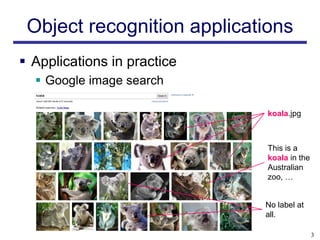
Object recognition applications
 Applications in practice
   Google image search

                             koala.jpg


                             This is a
                             koala in the
                             Australian
                             zoo, …


                             No label at
                             all.

                                            3
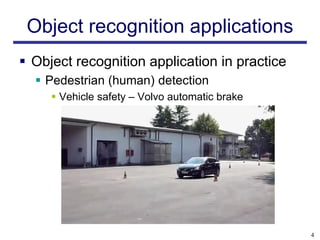
Object recognition applications
 Object recognition application in practice
   Pedestrian (human) detection
      Vehicle safety – Volvo automatic brake


                                                4
Video analysis applications
 We are living in an age where computer
  vision applications are working in practice.
   Surveillance
    applications

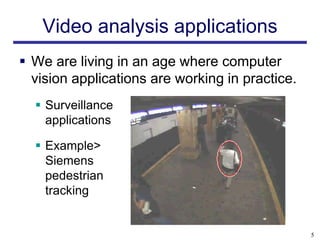
   Example>
    Siemens
    pedestrian
    tracking


                                                 5
Detection of Object Abandonment
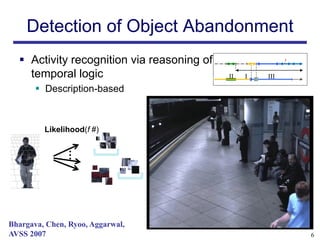
   Activity recognition via reasoning of                  !

    temporal logic                          II   I   III

        Description-based


         Likelihood(f #)
               …


Bhargava, Chen, Ryoo, Aggarwal,
AVSS 2007                                                      6
Illegally parked car detection

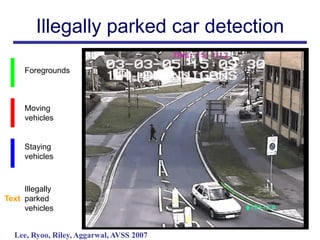
     Foregrounds


     Moving
     vehicles


     Staying
     vehicles


     Illegally
Text parked
     vehicles


  Lee, Ryoo, Riley, Aggarwal, AVSS 2007
Human-vehicle interactions
  Retrieval of videos
   involving humans and
   vehicles
      Event-based analysis
      Surveillance
      Military systems
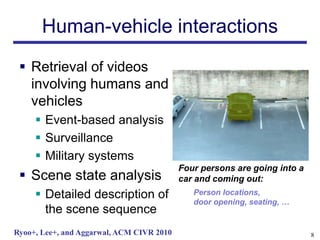
                                           Four persons are going into a
  Scene state analysis                    car and coming out:
      Detailed description of                Person locations,
                                              door opening, seating, …
       the scene sequence
Ryoo+, Lee+, and Aggarwal, ACM CIVR 2010                                   8
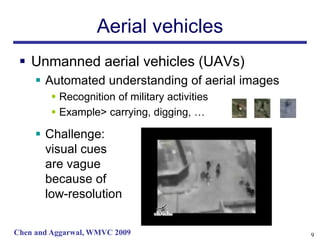
Aerial vehicles
  Unmanned aerial vehicles (UAVs)
      Automated understanding of aerial images
         Recognition of military activities
         Example> carrying, digging, …

      Challenge:
       visual cues
       are vague
       because of
       low-resolution

Chen and Aggarwal, WMVC 2009                      9
Detecting Persons Climbing
        Human contour           Extracting            Detecting            Constructing
         segmentation         extreme points       stable contacts      primitive intervals
                                                                          4


                                                                         3.5


                                                                          3


                                                                         2.5


                                                                          2


                                                                         1.5


                                                                          1


                                                                         0.5


                                                                          0
                                                                               0   50   100   150   200   250   300


An climbing sequence is decomposed into segments based on primitive intervals formed fr
   om stable contacts; the recognition is achieved from searching with HMM


Yu and Aggarwal, 2007                                                                                                 10
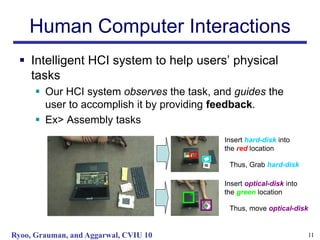
Human Computer Interactions
   Intelligent HCI system to help users’ physical
    tasks
       Our HCI system observes the task, and guides the
        user to accomplish it by providing feedback.
       Ex> Assembly tasks
                                            Insert hard-disk into
                                            the red location

                                             Thus, Grab hard-disk

                                            Insert optical-disk into
                                            the green location

                                             Thus, move optical-disk


Ryoo, Grauman, and Aggarwal, CVIU 10                                   11
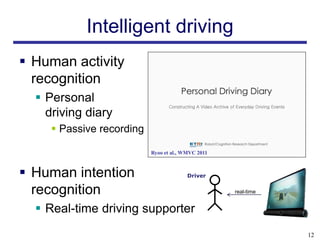
Intelligent driving
 Human activity
  recognition
   Personal
    driving diary
      Passive recording

                           Ryoo et al., WMVC 2011


 Human intention                        Driver


  recognition                                       real-time


   Real-time driving supporter
                                                                12
Future directions
 Future directions of activity recognition
  research are driven by applications
   Surveillance
      Real-time
      Multiple cameras, continuous streams
   Video search
      YouTube – 20 hours of new videos per minute
      Large-scale database
      Very noisy – camera viewpoints, lighting, …


                                                     13
Future directions (cont’d)
 Longer sequences (story, plot, characters)
 3D representation and reasoning

 Complex temporal and logical constraints
   Allen’s temporal logic, context
 Incorporating prior knowledge (Ontologies)
   Data driven high-level learning is difficult


                                                   14
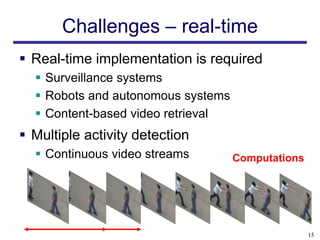
Challenges – real-time
 Real-time implementation is required
   Surveillance systems
   Robots and autonomous systems
   Content-based video retrieval
 Multiple activity detection
   Continuous video streams        Computations


                                                   15
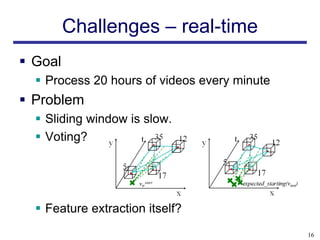
Challenges – real-time
 Goal
   Process 20 hours of videos every minute
 Problem
   Sliding window is slow.
   Voting?


   Feature extraction itself?
                                              16
Real-time using GP-GPUs
 General purpose graphics processing
  units (GP-GPUs)
   Multiple cores running thousands of threads
   Parallel processing

   20 times speed-up of
   video comparison method in
   Shechtman and Irani 2005:


 [Rofouei, M., Moazeni, M., and Sarrafzadeh, M., Fast GPU-based space-time correlation for
 activity recognition in video sequences, 2008]
                                                                                             17
Challenges – activity context
 An activity involves interactions among
   Humans, objects, and scenes


               Running?                                   Kicking?

   Activity recognition must consider motion-
    object context!
 [Gupta, A., Kembhavi, A., and Davis, L., Observing Human-Object Interactions: Using Spatial
 and Functional Compatibility for Recognition, IEEE T PAMI 2009]
                                                                                               18
Activity context – pose
 Object-pose-motion


 [Yao, B. and Fei-Fei, L., Modeling Mutual Context of Object and Human Pose in Human-Object
 Interaction Activities , CVPR 2010]
                                                                                              19
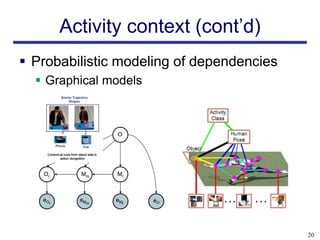
Activity context (cont’d)
 Probabilistic modeling of dependencies
   Graphical models


                                           20
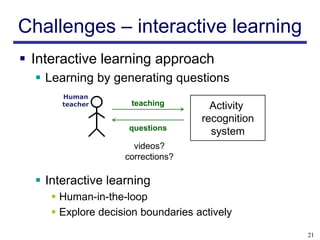
Challenges – interactive learning
 Interactive learning approach
   Learning by generating questions
       Human
       teacher       teaching         Activity
                                    recognition
                     questions
                                      system
                      videos?
                    corrections?

   Interactive learning
      Human-in-the-loop
      Explore decision boundaries actively

                                                  21
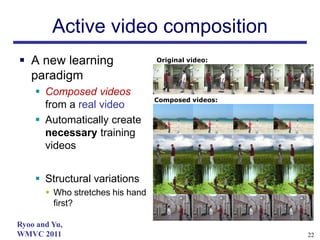
Active video composition
 A new learning                  Original video:

  paradigm
     Composed videos
                                  Composed videos:
      from a real video
     Automatically create
      necessary training
      videos


     Structural variations
        Who stretches his hand
         first?

Ryoo and Yu,
WMVC 2011                                            22
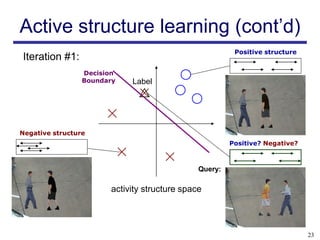
Active structure learning (cont’d)
                                                        Positive structure
Iteration #1:
                 Decision
                 Boundary   Label


Negative structure
                                                       Positive? Negative?


                                              Query:

                       activity structure space


                                                                             23
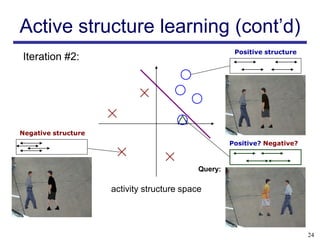
Active structure learning (cont’d)
                                                      Positive structure
Iteration #2:


Negative structure
                                                     Positive? Negative?


                                            Query:

                     activity structure space


                                                                           24
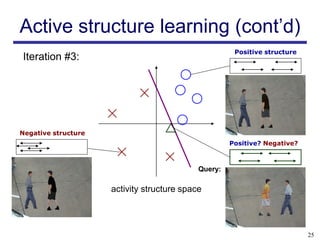
Active structure learning (cont’d)
                                                      Positive structure
Iteration #3:


Negative structure
                                                     Positive? Negative?


                                            Query:

                     activity structure space


                                                                           25
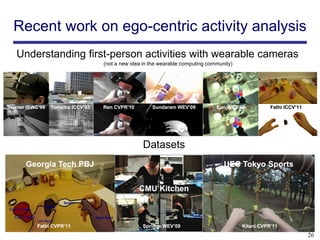
Recent work on ego-centric activity analysis
   Understanding first-person activities with wearable cameras
                                     (not a new idea in the wearable computing community)


Starner ISWC’98   Torralba ICCV’03   Ren CVPR’10        Sundaram WEV’09           Sun WEV’09           Fathi ICCV’11


                                                    Datasets
       Georgia Tech PBJ                                                              UEC Tokyo Sports


                                                   CMU Kitchen


           Fathi CVPR’11                            Spriggs WEV’09                          Kitani CVPR’11
                                                                                                                       26
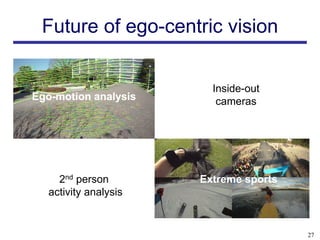
Future of ego-centric vision


                         Inside-out
Ego-motion analysis       cameras


     2nd person        Extreme sports
   activity analysis


                                        27
Conclusion
 Single-layered approaches for actions
   Sequential approaches
   Space-time approaches
 Hierarchical approaches for activities
   Syntactic approaches
   Description-based approaches
 Applications and challenges
   Real-time applications
   Context and interactive learning
                                           28
Thank you
 We thank you for your attendance.
 Are there any questions?


                                      29

cvpr2011: human activity recognition - part 6: applications

  • 1.
    Frontiers of Human ActivityAnalysis J. K. Aggarwal Michael S. Ryoo Kris M. Kitani
  • 2.
    Applications and challenges 2
  • 3.
    Object recognition applications Applications in practice  Google image search koala.jpg This is a koala in the Australian zoo, … No label at all. 3
  • 4.
    Object recognition applications Object recognition application in practice  Pedestrian (human) detection  Vehicle safety – Volvo automatic brake 4
  • 5.
    Video analysis applications We are living in an age where computer vision applications are working in practice.  Surveillance applications  Example> Siemens pedestrian tracking 5
  • 6.
    Detection of ObjectAbandonment  Activity recognition via reasoning of ! temporal logic II I III  Description-based Likelihood(f #) … Bhargava, Chen, Ryoo, Aggarwal, AVSS 2007 6
  • 7.
    Illegally parked cardetection Foregrounds Moving vehicles Staying vehicles Illegally Text parked vehicles Lee, Ryoo, Riley, Aggarwal, AVSS 2007
  • 8.
    Human-vehicle interactions Retrieval of videos involving humans and vehicles  Event-based analysis  Surveillance  Military systems Four persons are going into a  Scene state analysis car and coming out:  Detailed description of Person locations, door opening, seating, … the scene sequence Ryoo+, Lee+, and Aggarwal, ACM CIVR 2010 8
  • 9.
    Aerial vehicles Unmanned aerial vehicles (UAVs)  Automated understanding of aerial images  Recognition of military activities  Example> carrying, digging, …  Challenge: visual cues are vague because of low-resolution Chen and Aggarwal, WMVC 2009 9
  • 10.
    Detecting Persons Climbing Human contour Extracting Detecting Constructing segmentation extreme points stable contacts primitive intervals 4 3.5 3 2.5 2 1.5 1 0.5 0 0 50 100 150 200 250 300 An climbing sequence is decomposed into segments based on primitive intervals formed fr om stable contacts; the recognition is achieved from searching with HMM Yu and Aggarwal, 2007 10
  • 11.
    Human Computer Interactions  Intelligent HCI system to help users’ physical tasks  Our HCI system observes the task, and guides the user to accomplish it by providing feedback.  Ex> Assembly tasks Insert hard-disk into the red location Thus, Grab hard-disk Insert optical-disk into the green location Thus, move optical-disk Ryoo, Grauman, and Aggarwal, CVIU 10 11
  • 12.
    Intelligent driving  Humanactivity recognition  Personal driving diary  Passive recording Ryoo et al., WMVC 2011  Human intention Driver recognition real-time  Real-time driving supporter 12
  • 13.
    Future directions  Futuredirections of activity recognition research are driven by applications  Surveillance  Real-time  Multiple cameras, continuous streams  Video search  YouTube – 20 hours of new videos per minute  Large-scale database  Very noisy – camera viewpoints, lighting, … 13
  • 14.
    Future directions (cont’d) Longer sequences (story, plot, characters)  3D representation and reasoning  Complex temporal and logical constraints  Allen’s temporal logic, context  Incorporating prior knowledge (Ontologies)  Data driven high-level learning is difficult 14
  • 15.
    Challenges – real-time Real-time implementation is required  Surveillance systems  Robots and autonomous systems  Content-based video retrieval  Multiple activity detection  Continuous video streams Computations 15
  • 16.
    Challenges – real-time Goal  Process 20 hours of videos every minute  Problem  Sliding window is slow.  Voting?  Feature extraction itself? 16
  • 17.
    Real-time using GP-GPUs General purpose graphics processing units (GP-GPUs)  Multiple cores running thousands of threads  Parallel processing 20 times speed-up of video comparison method in Shechtman and Irani 2005: [Rofouei, M., Moazeni, M., and Sarrafzadeh, M., Fast GPU-based space-time correlation for activity recognition in video sequences, 2008] 17
  • 18.
    Challenges – activitycontext  An activity involves interactions among  Humans, objects, and scenes Running? Kicking?  Activity recognition must consider motion- object context! [Gupta, A., Kembhavi, A., and Davis, L., Observing Human-Object Interactions: Using Spatial and Functional Compatibility for Recognition, IEEE T PAMI 2009] 18
  • 19.
    Activity context –pose  Object-pose-motion [Yao, B. and Fei-Fei, L., Modeling Mutual Context of Object and Human Pose in Human-Object Interaction Activities , CVPR 2010] 19
  • 20.
    Activity context (cont’d) Probabilistic modeling of dependencies  Graphical models 20
  • 21.
    Challenges – interactivelearning  Interactive learning approach  Learning by generating questions Human teacher teaching Activity recognition questions system videos? corrections?  Interactive learning  Human-in-the-loop  Explore decision boundaries actively 21
  • 22.
    Active video composition A new learning Original video: paradigm  Composed videos Composed videos: from a real video  Automatically create necessary training videos  Structural variations  Who stretches his hand first? Ryoo and Yu, WMVC 2011 22
  • 23.
    Active structure learning(cont’d) Positive structure Iteration #1: Decision Boundary Label Negative structure Positive? Negative? Query: activity structure space 23
  • 24.
    Active structure learning(cont’d) Positive structure Iteration #2: Negative structure Positive? Negative? Query: activity structure space 24
  • 25.
    Active structure learning(cont’d) Positive structure Iteration #3: Negative structure Positive? Negative? Query: activity structure space 25
  • 26.
    Recent work onego-centric activity analysis Understanding first-person activities with wearable cameras (not a new idea in the wearable computing community) Starner ISWC’98 Torralba ICCV’03 Ren CVPR’10 Sundaram WEV’09 Sun WEV’09 Fathi ICCV’11 Datasets Georgia Tech PBJ UEC Tokyo Sports CMU Kitchen Fathi CVPR’11 Spriggs WEV’09 Kitani CVPR’11 26
  • 27.
    Future of ego-centricvision Inside-out Ego-motion analysis cameras 2nd person Extreme sports activity analysis 27
  • 28.
    Conclusion  Single-layered approachesfor actions  Sequential approaches  Space-time approaches  Hierarchical approaches for activities  Syntactic approaches  Description-based approaches  Applications and challenges  Real-time applications  Context and interactive learning 28
  • 29.
    Thank you  Wethank you for your attendance.  Are there any questions? 29