Vienna, Austria
12-13 June, 2023
#FIWARESummit
From Data
to Value
OPEN SOURCE
OPEN STANDARDS
OPEN COMMUNITY
The need of effective data flows for
Machine Learning and Deep Learning;
from Structure, Learning to Performance
on Applications
Miguel González Mendoza
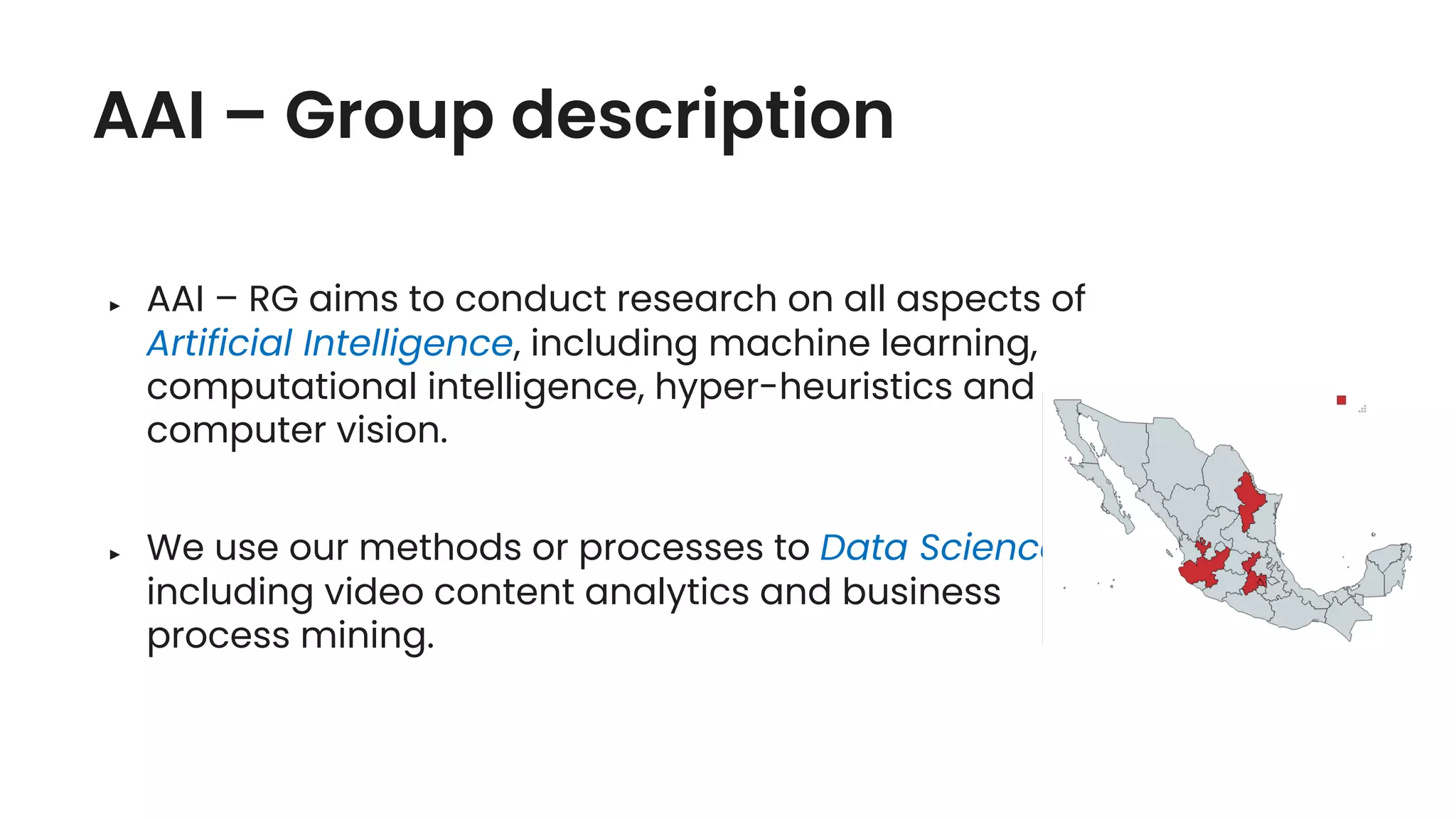
AAI – Group description
► AAI – RG aims to conduct research on all aspects of
Artificial Intelligence, including machine learning,
computational intelligence, hyper-heuristics and
computer vision.
► We use our methods or processes to Data Science,
including video content analytics and business
process mining.
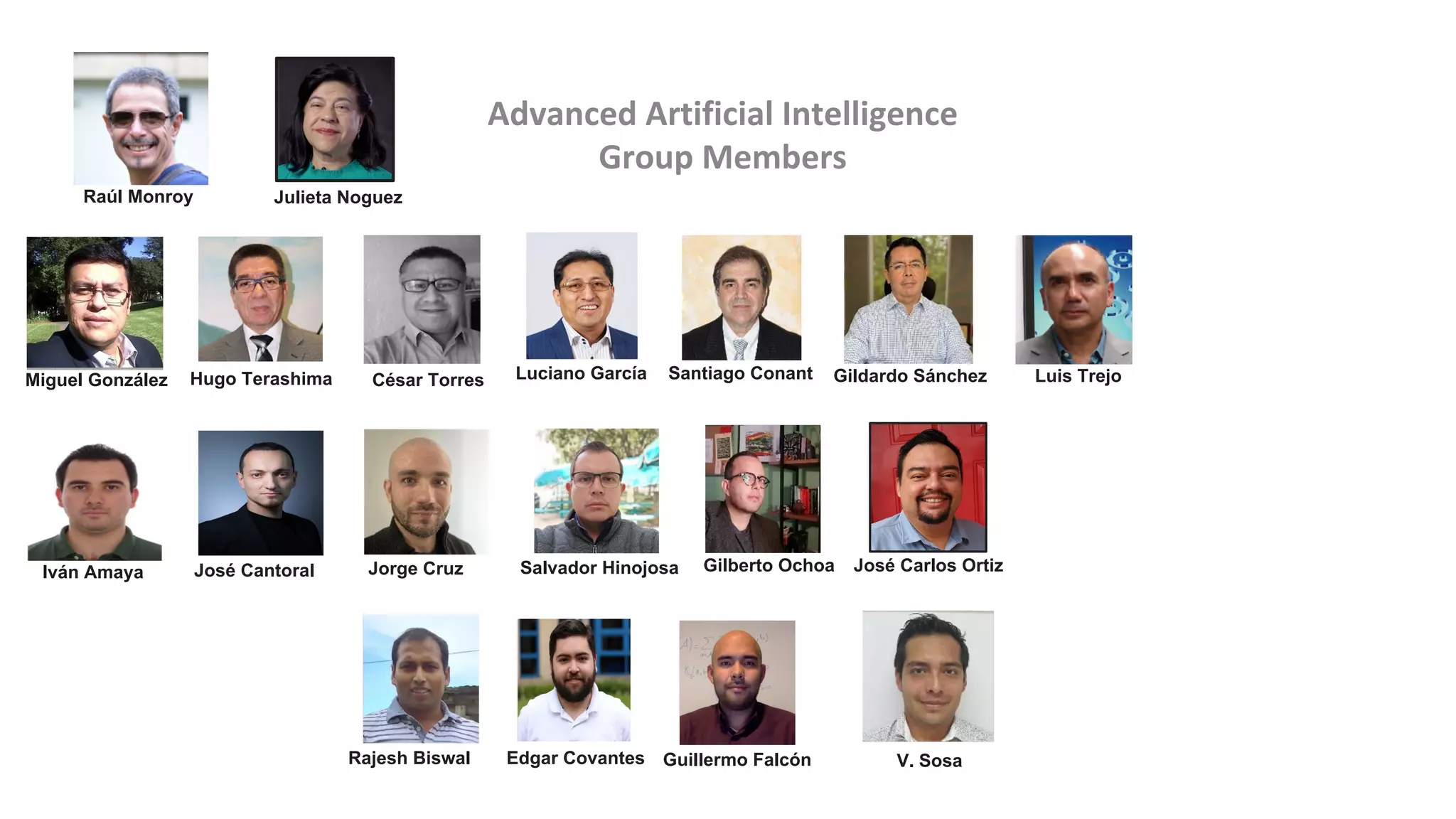
Advanced Artificial Intelligence
Group Members
Raúl Monroy Julieta Noguez
Hugo Terashima
Miguel González César Torres Santiago Conant Luis Trejo
José Cantoral
Luciano García
Gilberto Ochoa
Iván Amaya
Edgar Covantes
José Carlos Ortiz
Guillermo Falcón
Jorge Cruz Salvador Hinojosa
Rajesh Biswal
Gildardo Sánchez
V. Sosa
AAI – RG: Part – Time Members
A. Aguilar M. Alfaro J. Alvarado R. Brena F. Cantú
H. Ceballos L. Falcón J. Miranda L. Neri J. Nolazco
J. Rodríguez C. Santiesteban A. Santos
Why data flows in ML?
Evolution from Scientific to Technical Impact
Only a small fraction of real-world ML
systems is composed of the ML code
As shown by the small black box in the middle. The required
surrounding infrastructure is vast and complex
Sculley, David, et al. "Hidden technical debt in machine learning systems." Advances in neural
information processing systems 28 (2015). https://dl.acm.org/doi/10.5555/2969442.2969519
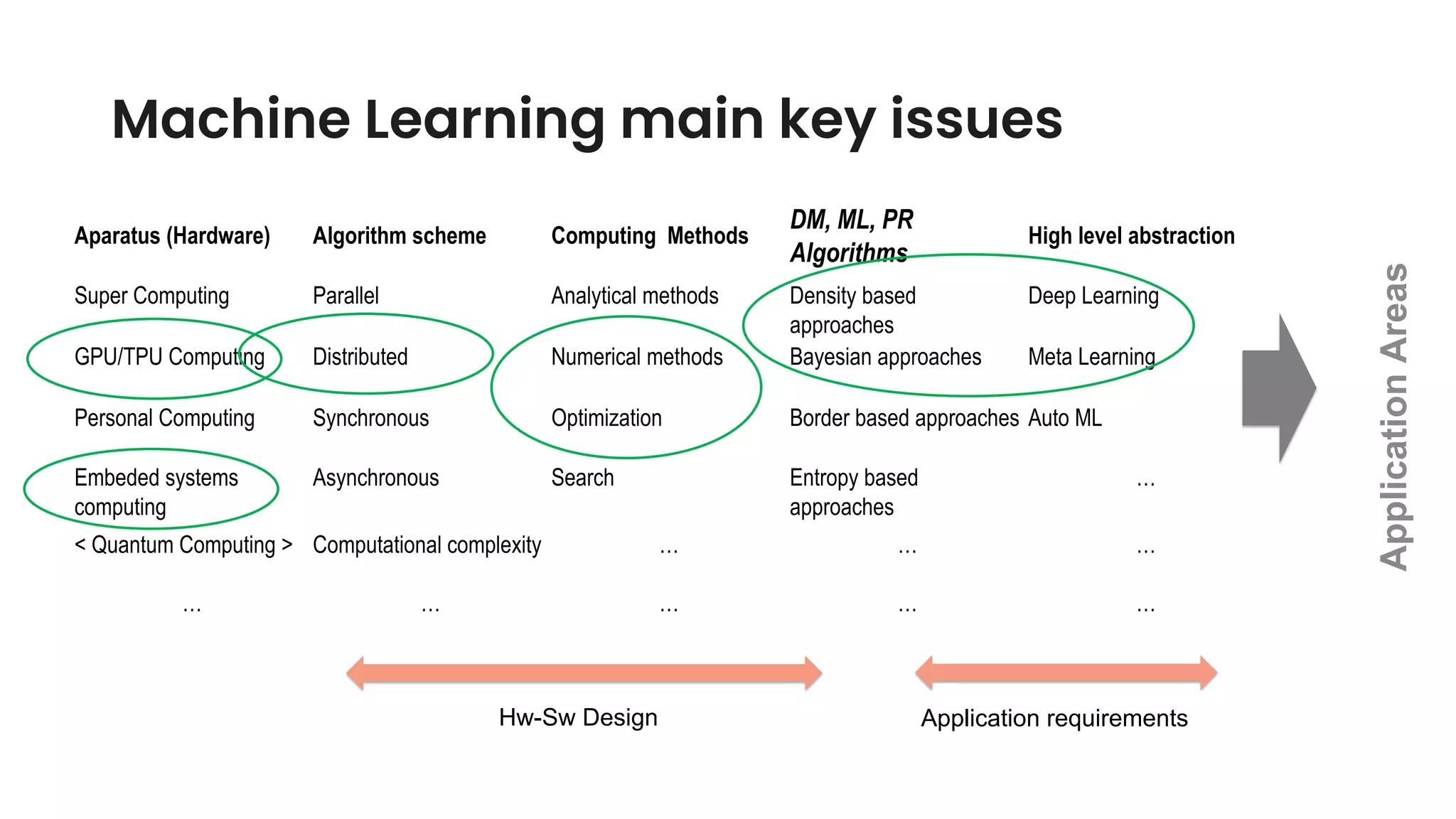
Machine Learning main key issues
Aparatus (Hardware) Algorithm scheme Computing Methods
DM, ML, PR
Algorithms
High level abstraction
Super Computing Parallel Analytical methods Density based
approaches
Deep Learning
GPU/TPU Computing Distributed Numerical methods Bayesian approaches Meta Learning
Personal Computing Synchronous Optimization Border based approaches Auto ML
Embeded systems
computing
Asynchronous Search Entropy based
approaches
…
< Quantum Computing > Computational complexity … … …
… … … … …
Hw-Sw Design Application requirements
Application
Areas
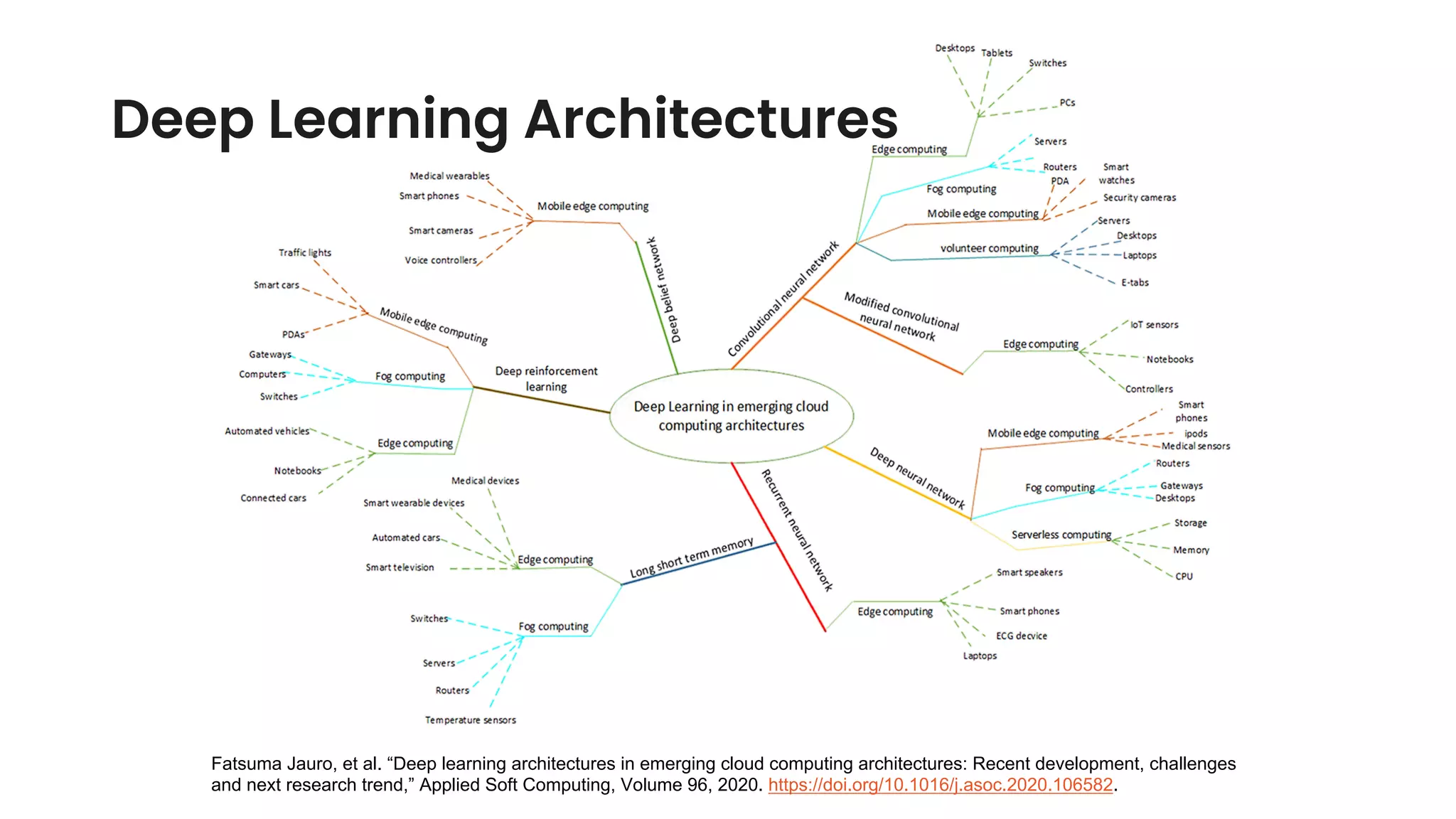
Deep Learning Architectures
Fatsuma Jauro, et al. “Deep learning architectures in emerging cloud computing architectures: Recent development, challenges
and next research trend,” Applied Soft Computing, Volume 96, 2020. https://doi.org/10.1016/j.asoc.2020.106582.
Context of learning in CNN
Learning Algorithms and Aparatus: Case in Image Processing
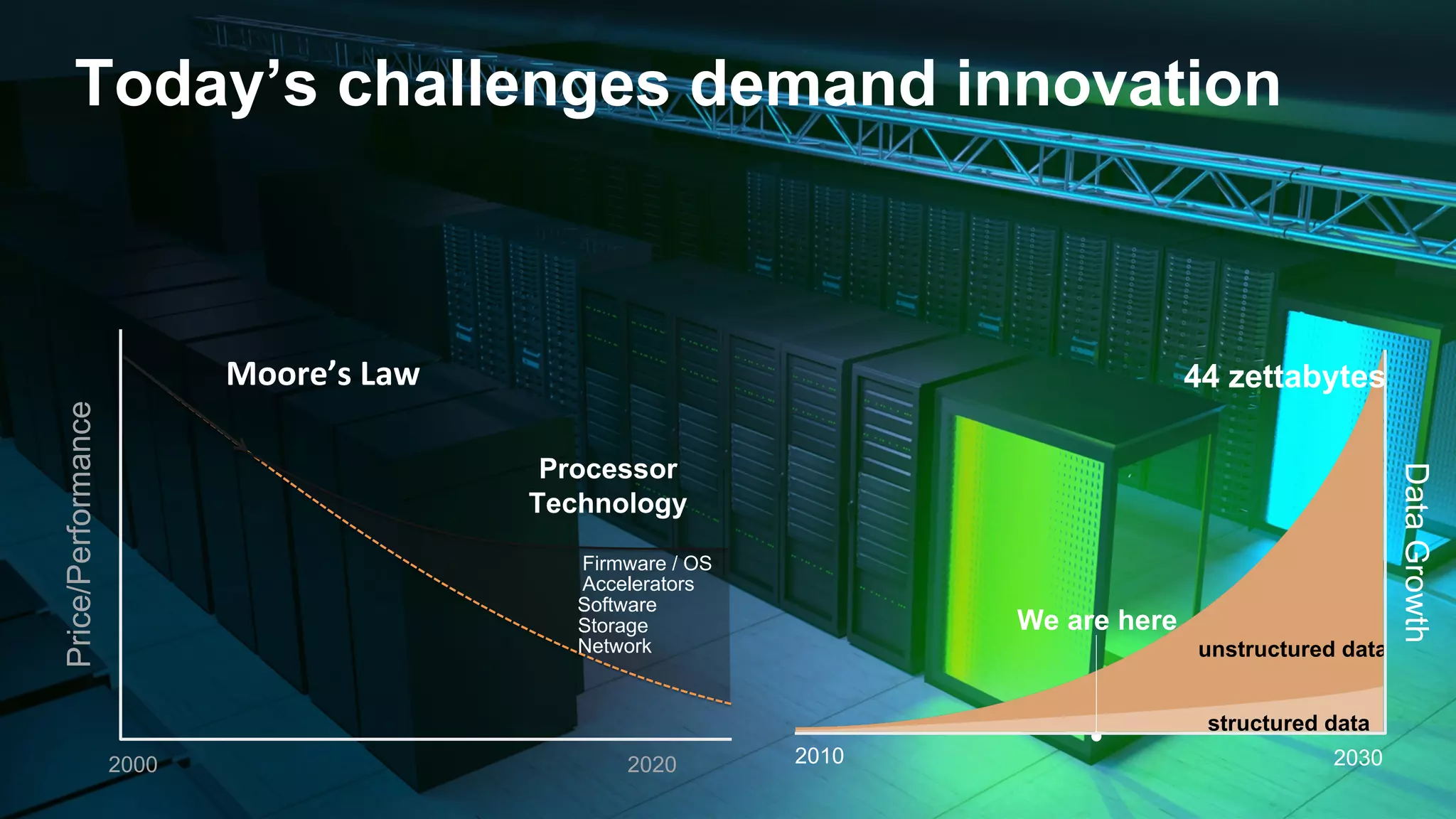
Price/Performance
Moore’s Law
Processor
Technology
2000 2020
Firmware / OS
Accelerators
Software
Storage
Network
We are here
44 zettabytes
unstructured data
2010 2030
structured data
Data
Growth
Today’s challenges demand innovation
Enterprise Deep Learning Distribution
Auto Parameter
Tuning and
Monitoring
Image
Classification
Deployment of
Inference
Image
Labeling
Object
Detection for
Videos
Object
Detection
i.e. IBM PowerAI Vision
Computer Vision applications: expansion of
capabilities
Autonumous Driving
Object Recognition [1] Protein Folding [2]
[1] You Only Look Once: Unified, Real-Time Object Detection, Joseph Redmon et. al, 2015; https://arxiv.org/abs/1506.02640
[2] Highly accurate protein structure prediction for the human proteome, Kathryn Tunyasuvunakool et. al, 2021;
https://www.nature.com/articles/s41586-021-03828-1
Binarization
13
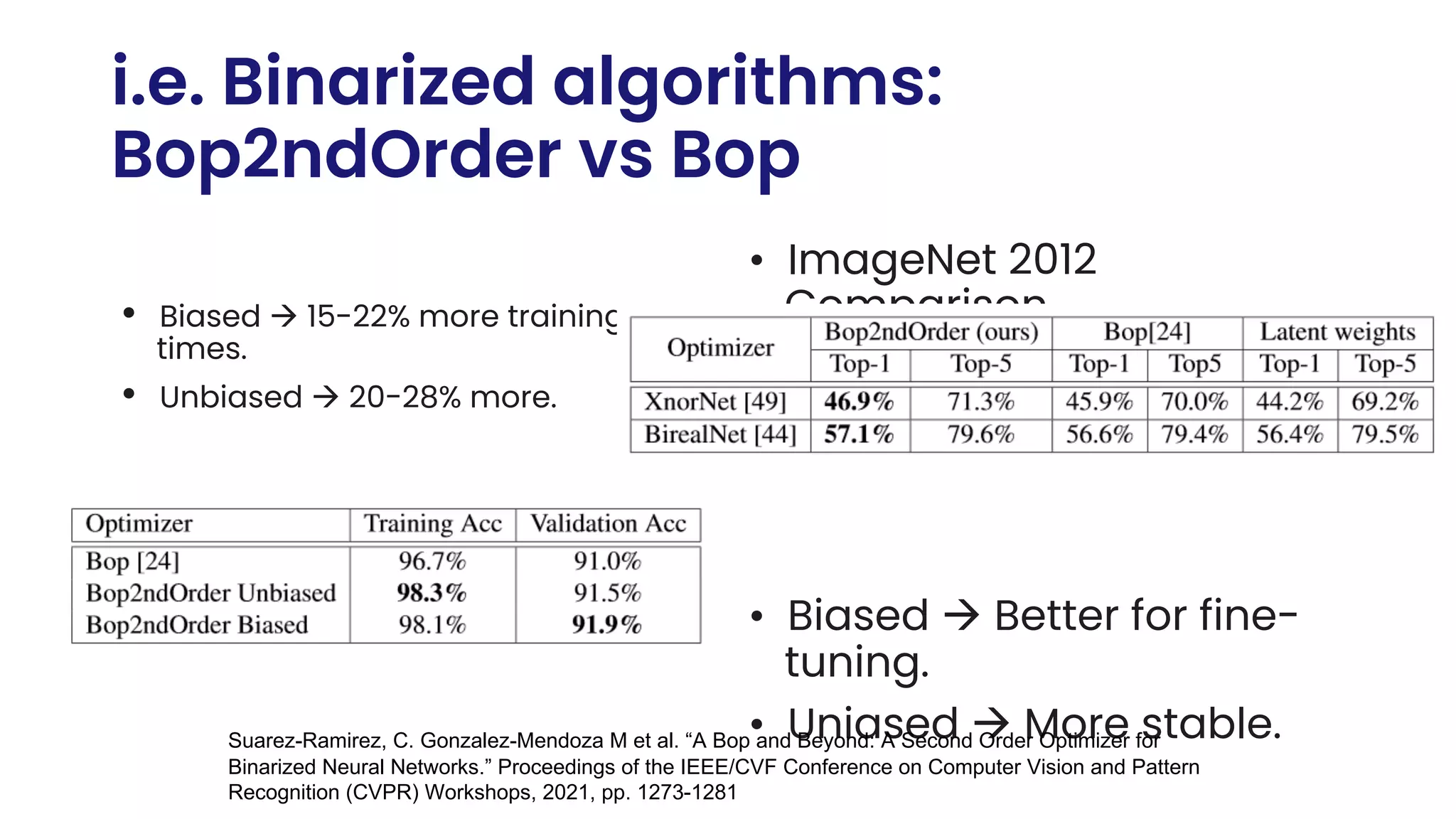
i.e. Binarized algorithms:
Bop2ndOrder vs Bop
• Biased à 15-22% more training
times.
• Unbiased à 20-28% more.
CIFAR10 Comparison
• ImageNet 2012
Comparison
• Biased à Better for fine-
tuning.
• Uniased à More stable.
Suarez-Ramirez, C. Gonzalez-Mendoza M et al. “A Bop and Beyond: A Second Order Optimizer for
Binarized Neural Networks.” Proceedings of the IEEE/CVF Conference on Computer Vision and Pattern
Recognition (CVPR) Workshops, 2021, pp. 1273-1281
Some Applications
Videosurveillance
Smart Security: Facial Recognition
Detection + tracking + identification (State of the art
Techniques, +10 fps)
Video surveillance
1
• realtime dataflow for video and
metadata
2
• low computational cost and
continuous improvement
3
• a complete R&D + DevOps
scenario for students &
professors
i.e. Digital me
• The computer animation industry
has been wanting to capture
facial performance
• keyframe animation to motion
capture the approaches to
expressing emotions
• SoA approaches for:
• Facial recognition
• Landmark detection
• Expression classification
i.e. Towards an Edge Real-Time Detection of
objects and behaviours in Video
MA Duran-Vega, M Gonzalez-Mendoza. “TYolov5: A Temporal Yolov5 Detector Based on Quasi-Recurrent
Neural Networks for Real-Time Handgun Detection in Video” arXiv preprint arXiv
Camarena, Fernando, et al. "Action recognition by key trajectories (Jan, 10.1007/s10044-021-01054-z,
2022)." PATTERN ANALYSIS AND APPLICATIONS 25.2 (2022): 485-485.
Some final toughts
Potential Directions
1. Bridging Data Gaps
• Gap between small data and big data, and non-perfect data
• In the absence of perfectly labeled training data, possible alternatives are to use unsupervised
learning, self-supervised learning
2. Developing Algorithms
• we are still expecting novel ML algorithms or schemes to further improve system modeling and
optimization, with respect to scalability, domain knowledge interpretability, and so on.
3. Improving Implementations and Deployments
• to consider practical implementations, appropriate selection of deployment scenarios, and post-
deployment model maintenance
Vienna, 12-13 June, 2023 | #FIWARESummit www.fiware.org
Hosting Partner Keystone Sponsors
Media Partners
Find Us On Stay up to date Be certified and featured
JOIN OUR NEWSLETTER
Vienna, Austria
12-13 June, 2023
#FIWARESummit
Thanks!

AI-MiguelGonzalez.pdf

  • 1.
    Vienna, Austria 12-13 June,2023 #FIWARESummit From Data to Value OPEN SOURCE OPEN STANDARDS OPEN COMMUNITY The need of effective data flows for Machine Learning and Deep Learning; from Structure, Learning to Performance on Applications Miguel González Mendoza
  • 2.
    AAI – Groupdescription ► AAI – RG aims to conduct research on all aspects of Artificial Intelligence, including machine learning, computational intelligence, hyper-heuristics and computer vision. ► We use our methods or processes to Data Science, including video content analytics and business process mining.
  • 3.
    Advanced Artificial Intelligence GroupMembers Raúl Monroy Julieta Noguez Hugo Terashima Miguel González César Torres Santiago Conant Luis Trejo José Cantoral Luciano García Gilberto Ochoa Iván Amaya Edgar Covantes José Carlos Ortiz Guillermo Falcón Jorge Cruz Salvador Hinojosa Rajesh Biswal Gildardo Sánchez V. Sosa
  • 4.
    AAI – RG:Part – Time Members A. Aguilar M. Alfaro J. Alvarado R. Brena F. Cantú H. Ceballos L. Falcón J. Miranda L. Neri J. Nolazco J. Rodríguez C. Santiesteban A. Santos
  • 5.
    Why data flowsin ML? Evolution from Scientific to Technical Impact
  • 6.
    Only a smallfraction of real-world ML systems is composed of the ML code As shown by the small black box in the middle. The required surrounding infrastructure is vast and complex Sculley, David, et al. "Hidden technical debt in machine learning systems." Advances in neural information processing systems 28 (2015). https://dl.acm.org/doi/10.5555/2969442.2969519
  • 7.
    Machine Learning mainkey issues Aparatus (Hardware) Algorithm scheme Computing Methods DM, ML, PR Algorithms High level abstraction Super Computing Parallel Analytical methods Density based approaches Deep Learning GPU/TPU Computing Distributed Numerical methods Bayesian approaches Meta Learning Personal Computing Synchronous Optimization Border based approaches Auto ML Embeded systems computing Asynchronous Search Entropy based approaches … < Quantum Computing > Computational complexity … … … … … … … … Hw-Sw Design Application requirements Application Areas
  • 8.
    Deep Learning Architectures FatsumaJauro, et al. “Deep learning architectures in emerging cloud computing architectures: Recent development, challenges and next research trend,” Applied Soft Computing, Volume 96, 2020. https://doi.org/10.1016/j.asoc.2020.106582.
  • 9.
    Context of learningin CNN Learning Algorithms and Aparatus: Case in Image Processing
  • 10.
    Price/Performance Moore’s Law Processor Technology 2000 2020 Firmware/ OS Accelerators Software Storage Network We are here 44 zettabytes unstructured data 2010 2030 structured data Data Growth Today’s challenges demand innovation
  • 11.
    Enterprise Deep LearningDistribution Auto Parameter Tuning and Monitoring Image Classification Deployment of Inference Image Labeling Object Detection for Videos Object Detection i.e. IBM PowerAI Vision
  • 12.
    Computer Vision applications:expansion of capabilities Autonumous Driving Object Recognition [1] Protein Folding [2] [1] You Only Look Once: Unified, Real-Time Object Detection, Joseph Redmon et. al, 2015; https://arxiv.org/abs/1506.02640 [2] Highly accurate protein structure prediction for the human proteome, Kathryn Tunyasuvunakool et. al, 2021; https://www.nature.com/articles/s41586-021-03828-1
  • 13.
  • 14.
    i.e. Binarized algorithms: Bop2ndOrdervs Bop • Biased à 15-22% more training times. • Unbiased à 20-28% more. CIFAR10 Comparison • ImageNet 2012 Comparison • Biased à Better for fine- tuning. • Uniased à More stable. Suarez-Ramirez, C. Gonzalez-Mendoza M et al. “A Bop and Beyond: A Second Order Optimizer for Binarized Neural Networks.” Proceedings of the IEEE/CVF Conference on Computer Vision and Pattern Recognition (CVPR) Workshops, 2021, pp. 1273-1281
  • 15.
  • 16.
    Smart Security: FacialRecognition Detection + tracking + identification (State of the art Techniques, +10 fps) Video surveillance 1 • realtime dataflow for video and metadata 2 • low computational cost and continuous improvement 3 • a complete R&D + DevOps scenario for students & professors
  • 17.
    i.e. Digital me •The computer animation industry has been wanting to capture facial performance • keyframe animation to motion capture the approaches to expressing emotions • SoA approaches for: • Facial recognition • Landmark detection • Expression classification
  • 18.
    i.e. Towards anEdge Real-Time Detection of objects and behaviours in Video MA Duran-Vega, M Gonzalez-Mendoza. “TYolov5: A Temporal Yolov5 Detector Based on Quasi-Recurrent Neural Networks for Real-Time Handgun Detection in Video” arXiv preprint arXiv Camarena, Fernando, et al. "Action recognition by key trajectories (Jan, 10.1007/s10044-021-01054-z, 2022)." PATTERN ANALYSIS AND APPLICATIONS 25.2 (2022): 485-485.
  • 19.
  • 20.
    Potential Directions 1. BridgingData Gaps • Gap between small data and big data, and non-perfect data • In the absence of perfectly labeled training data, possible alternatives are to use unsupervised learning, self-supervised learning 2. Developing Algorithms • we are still expecting novel ML algorithms or schemes to further improve system modeling and optimization, with respect to scalability, domain knowledge interpretability, and so on. 3. Improving Implementations and Deployments • to consider practical implementations, appropriate selection of deployment scenarios, and post- deployment model maintenance
  • 21.
    Vienna, 12-13 June,2023 | #FIWARESummit www.fiware.org Hosting Partner Keystone Sponsors Media Partners Find Us On Stay up to date Be certified and featured JOIN OUR NEWSLETTER
  • 22.
    Vienna, Austria 12-13 June,2023 #FIWARESummit Thanks!