PUBLIC HUMAN ASSAULT PREDICTION USING
HUMAN ACTIVITY RECOGNTION WITH AI
• Problem Statement
• Abstract
• Objective
• Motivation
• Existing and Proposed System
• Literature Review
• Proposed System Architecture
• Modules Description
• Hardware Requirements
• Software Requirements
• Application
• References
CONTENTS
PROBLEM STATEMENT
• Inefficient Human activity recognition model.
• Costlier solutions for Human activity recognition due to the use of 3D cameras.
• Difficulty in deploying real time Human activity recognition application due to
costlier models.
4
OBJECTIVE
• To develop a highly accurate Human Activity recognition model.
• To develop a efficient model for real time deployment.
• To make this model as a surveillance solution for road surveillance
• To develop a mobile application for providing alert to the police in case of theft detection by
detecting the human activities.
• To accomplish Live streaming through mobile application.
5
ABSTRACT
• Recognizing human activities from video sequences or still images is a challenging task due to
problems, such as background clutter, partial occlusion, changes in scale, viewpoint, lighting,
and appearance.
• Human activity recognition, or HAR, is a challenging time series classification task. It involves
predicting the movement of a person based on sensor data and traditionally involves deep
domain expertise and methods from signal processing to correctly engineer features from
the raw data in order to fit a machine learning model.
• Human Activity Recognition plays a significant role in human-to-human and human-computer
interaction.
• So this system will not only be cost effective but also as a utility-based system that can be
incorporated in a large number of applications that will save time and aid in various activities
that require recognition process, and save a lot of time with good accuracy.
6
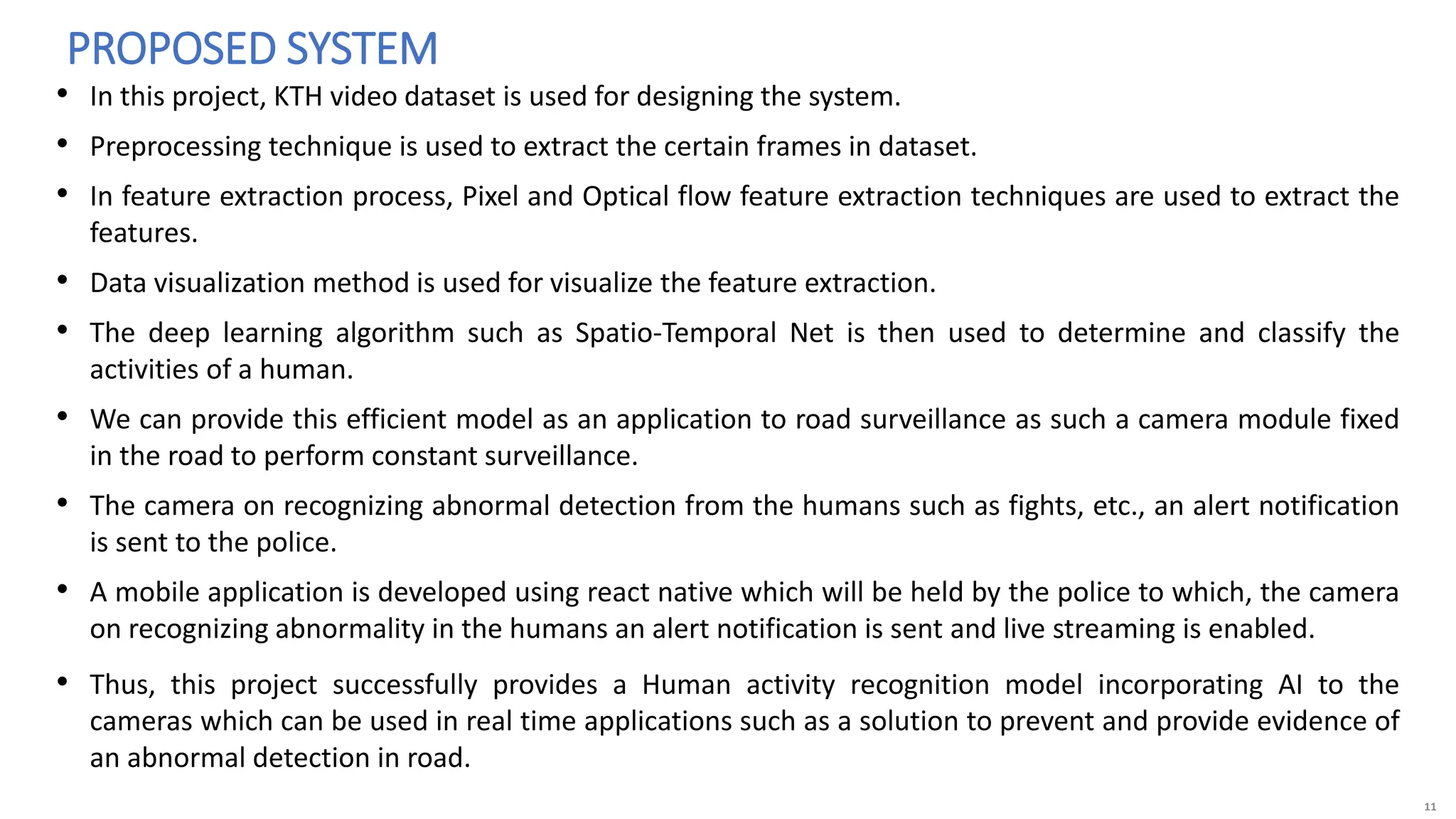
 In the existing system, it proposes a dual stacked autoencoders features embedded clustering
(DSAFEC) and a BOW construction method based on the DSAFEC (B-DSAFEC) to reduce the
computational complexity and to remove the selection restriction.
 The DSAFEC first transforms feature points extracted from a video to a learned feature space and
then probabilities of cluster assignment of feature points are predicted to build BOWs for human
activity recognition.
 A soft clustering is used by assigning each feature point to multiple clusters yielding the largest
probabilities instead of only one in hard clustering.
EXISTING SYSTEM
7
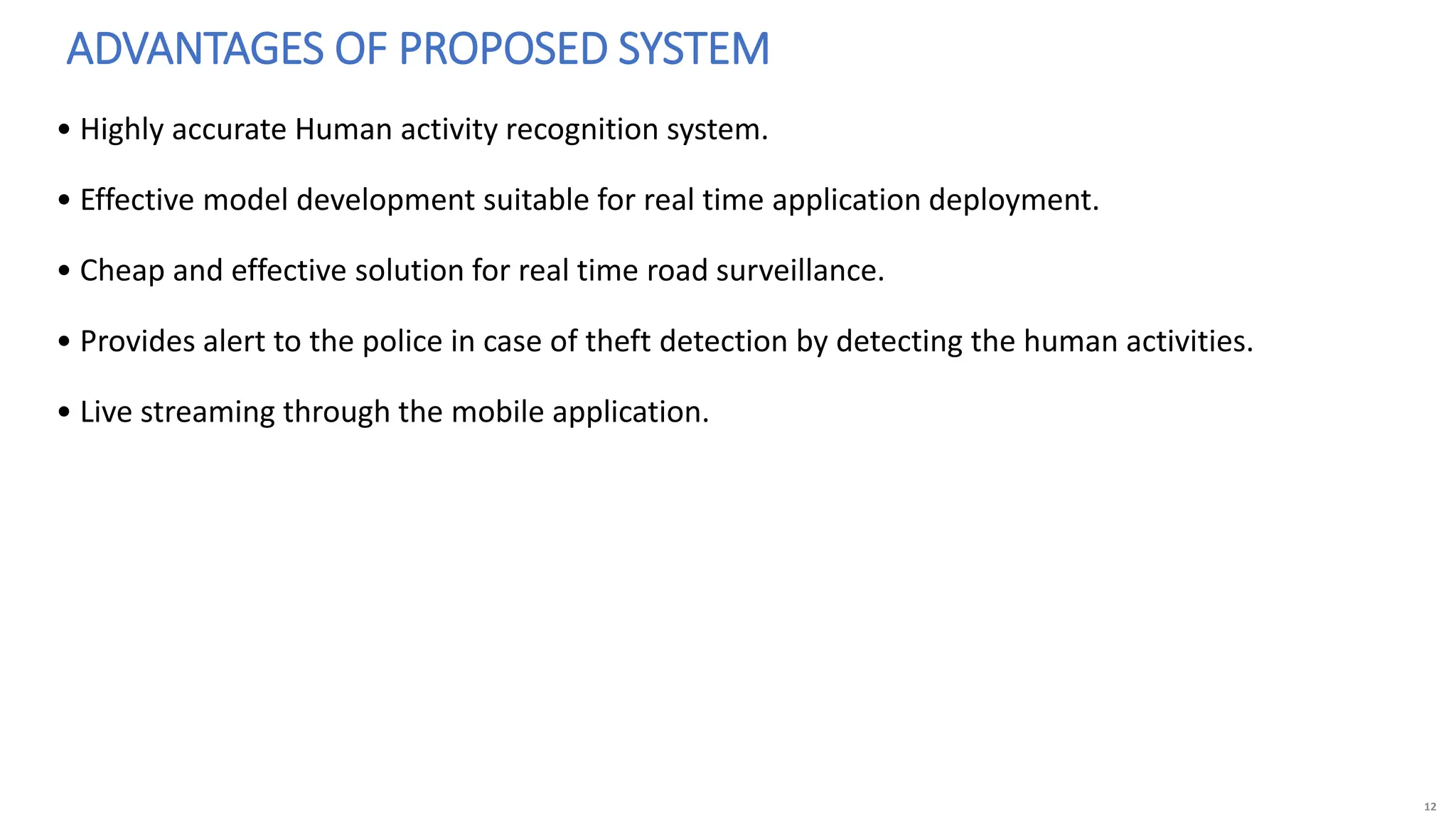
 The system uses dual stacked auto encoders which for video dataset is insufficient to extract the
data.
 Although the training is faster in radial basis function neural network (RBFNN) network but
classification is slow in comparison due to nodes in hidden layer have to compute the RBF
function for the input sample vector during classification.
 The system does not provide an effective technological solution for real time deployment.
DISADVANTAGES OF EXISTING SYSTEM
8
LITERATURE REVIEW
TITLE OF THE PAPER AUTHOR NAME ALGORITHM ADVANTAGE DISADVANTAGE
A Deep Clustering via
Automatic Feature
Embedded Learning for
Human Activity
Recognition[2021]
Ting Wang, Wing W. Y. Ng*,
Jinde Li,
Qiuxia Wu, Shuai Zhang,
Chris Nugent, Colin
Shewell,
dual stacked
autoencoders features
embedded clustering
(DSAFEC)
Used to identify the range of human
pose motion.
The system uses dual stacked
auto encoders which for video
dataset is insufficient to
extract the data.
Presentation Attack
Detection for Face
Recognition using Light Field
Camera
R. Raghavendra Kiran B.
Raja Christoph Busch
Norwegian Biometric
Laboratory, Gjøvik
University College, Norway
Face Presentation
Attack Detection
(PAD)
The light field face artefact database
have revealed the outstanding
performance of the proposed PAD
scheme when benchmarked with
various well established state-of-the-
art schemes.
There exists no superior PAD
technique due to evolution of
sophisticated presentation
attacks
9
LITERATURE REVIEW
TITLE OF THE PAPER AUTHOR NAME ALGORITHM ADVANTAGE DISADVANTAGE
“PrivHome: Privacy-
Preserving Authenticated
Communication in Smart
Home Environment
[2019, VOL. 99, NO. 99]
Geong Sen Poh, Prosanta
Gope, Member, IEEE , and
Jianting Ning
lightweight entity and
key-exchange
protocol, and an
efficient searchable
encryption protocol
A smart home enables users to
access devices such as lighting,
HVAC, temperature sensors, and
surveillance camera. It provides a
more convenient and safe living
environment for users
Less accuracy.
“Continuous Human Motion
Recognition With a Dynamic
Range-Doppler Trajectory
Method Based on FMCW
Radar “
[2019, VOL. 57, NO. 9, ]
Chuanwei Ding , Student
Member, IEEE, Hong Hong ,
Member, IEEE, Yu Zou,
Student Member, IEEE, Hui
Chu , Xiaohua Zhu,
Member, IEEE, Francesco
Fioranelli , Member, IEEE,
Julien Le Kernec , Senior
Member, IEEE, and
Changzhi Li , Senior
Member, IEEE
range-Doppler
trajectory (DRDT)
method based on the
frequency-modulated
continuous-wave
(FMCW)
the DRDT is extracted from these
frames to monitor human motions in
time, range, and Doppler domains in
real time.
Less accuracy.
10
LITERATURE REVIEW
TITLE OF THE PAPER AUTHOR NAME ALGORITHM ADVANTAGE DISADVANTAGE
“PRNU-Based Camera
Attribution from Multiple
Seam-Carved Images ”
[2017, VOL. 20, NO. 5, ]
BSamet Taspinar,
Manoranjan Mohanty, and
Nasir Memon
PRNU Noise Pattern,
Countering
SeamCarving-Based
Anonymization,
Source Camera
Attribution.
seamcarved images from the
same camera, source attribution
can still be possible even if the
size of uncarved blocks in the
image is less than the
recommended size of 50×50
pixels.
Less real time process.
“An Integrated Cloud-Based
Smart Home Management
System with Community
Hierarchy ”, [2016, Vol No:
2162-237X]
Ying-Tsung Lee, Wei-Hsuan
Hsiao, Chin-Meng Huang
and Seng-Cho T. Chou
Smart Home
Management System,
Community Broker,
Cloud Services, MQTT
At the home end, a home
intranet was created by
integrating a fixed touch panel
with a home controller system
and various sensors and devices
to deliver, for example, energy,
scenario information, and
security functions.
Costly kit
11
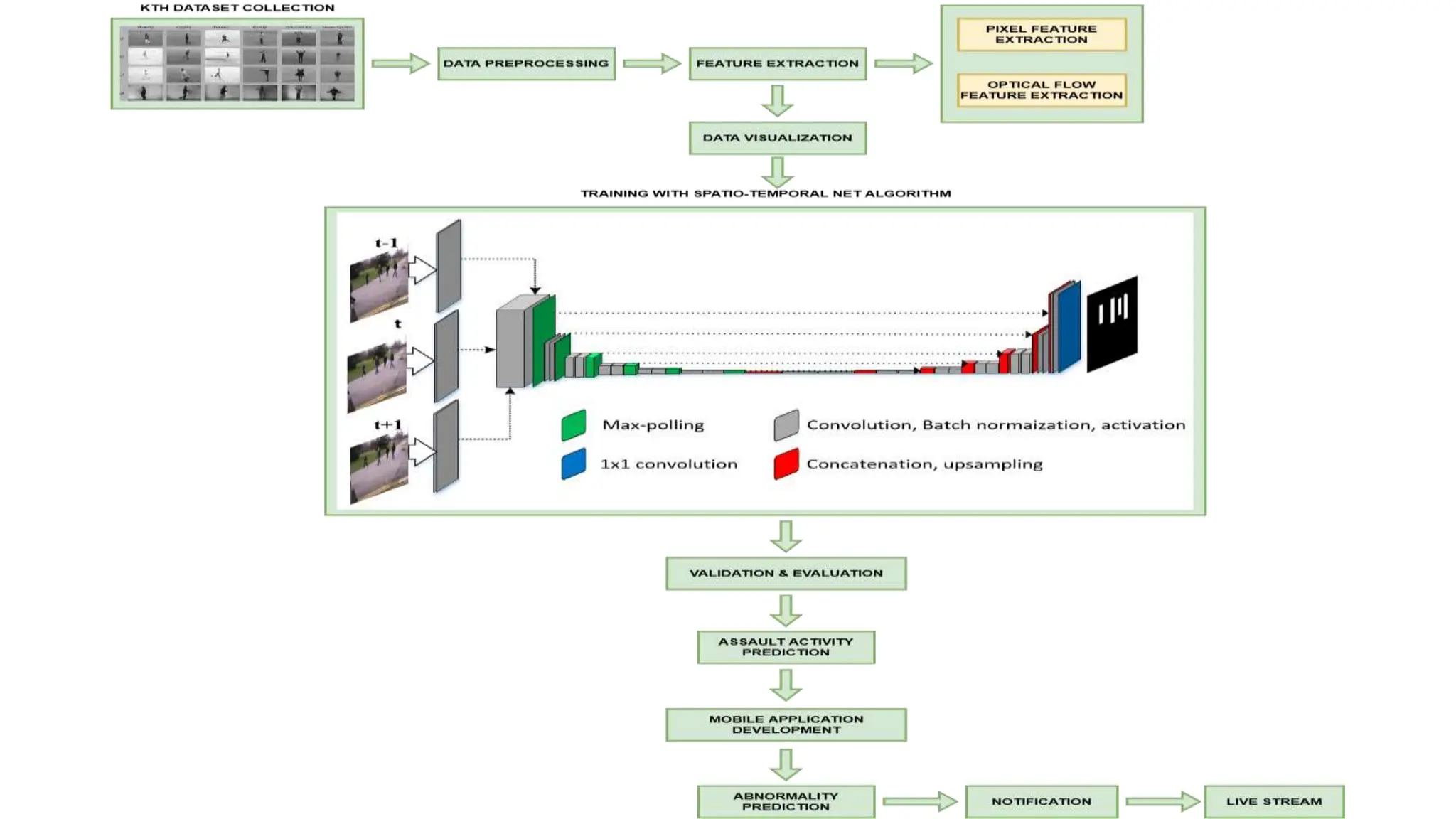
• In this project, KTH video dataset is used for designing the system.
• Preprocessing technique is used to extract the certain frames in dataset.
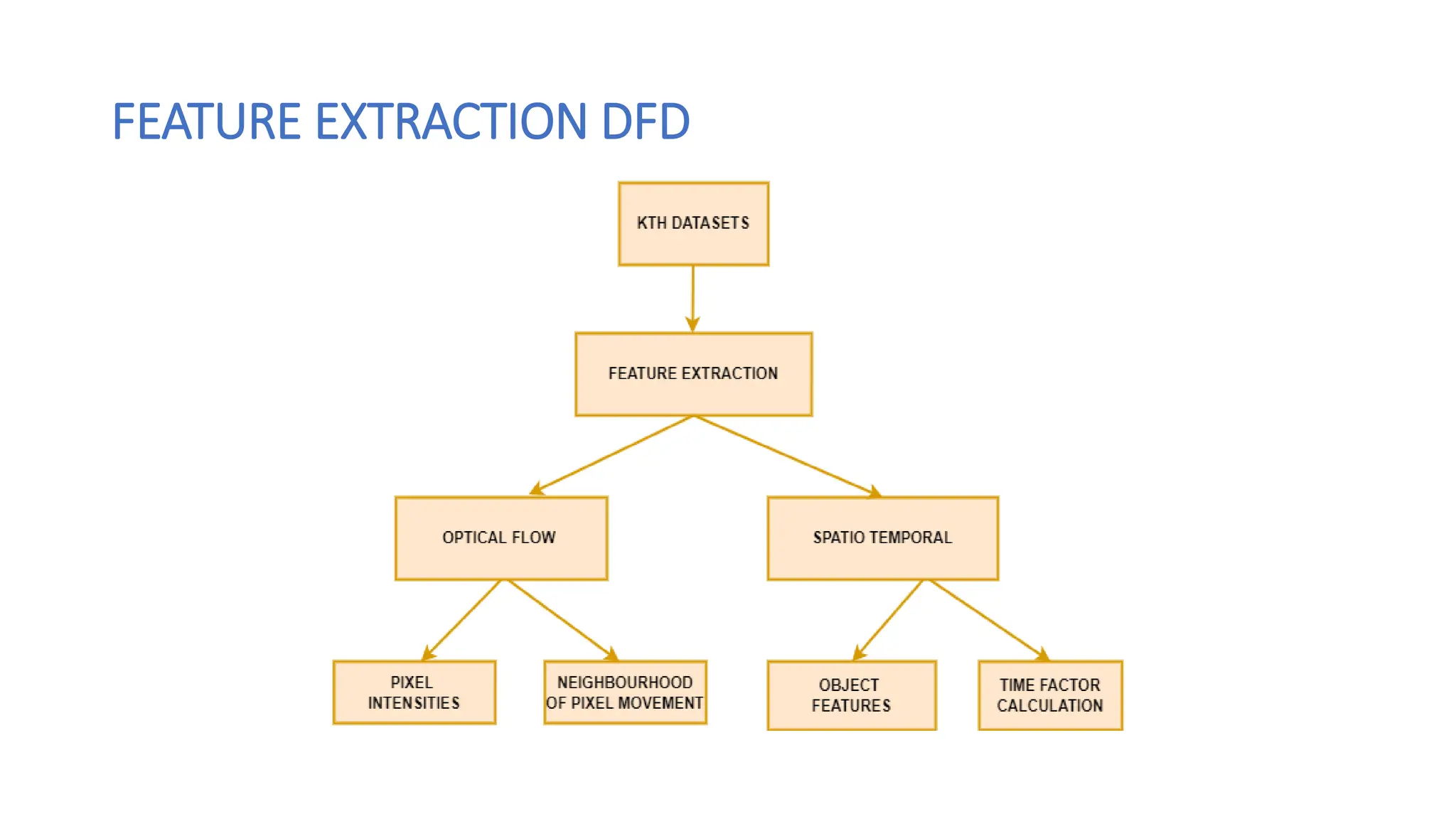
• In feature extraction process, Pixel and Optical flow feature extraction techniques are used to extract the
features.
• Data visualization method is used for visualize the feature extraction.
• The deep learning algorithm such as Spatio-Temporal Net is then used to determine and classify the
activities of a human.
• We can provide this efficient model as an application to road surveillance as such a camera module fixed
in the road to perform constant surveillance.
• The camera on recognizing abnormal detection from the humans such as fights, etc., an alert notification
is sent to the police.
• A mobile application is developed using react native which will be held by the police to which, the camera
on recognizing abnormality in the humans an alert notification is sent and live streaming is enabled.
• Thus, this project successfully provides a Human activity recognition model incorporating AI to the
cameras which can be used in real time applications such as a solution to prevent and provide evidence of
an abnormal detection in road.
PROPOSED SYSTEM
12
• Highly accurate Human activity recognition system.
• Effective model development suitable for real time application deployment.
• Cheap and effective solution for real time road surveillance.
• Provides alert to the police in case of theft detection by detecting the human activities.
• Live streaming through the mobile application.
ADVANTAGES OF PROPOSED SYSTEM
13
ARCHITECTURAL DIAGRAM
15
• Human Activity Collection
• Data Preprocessing
• Feature Extraction
• Data Visualization
• Training with the deep learning algorithm
• Validation and Evaluation
• Assault Activity Prediction
• Mobile Application Development
MODULES DESCRIPTION
HUMAN ACTIVITY COLLECTION MODULE
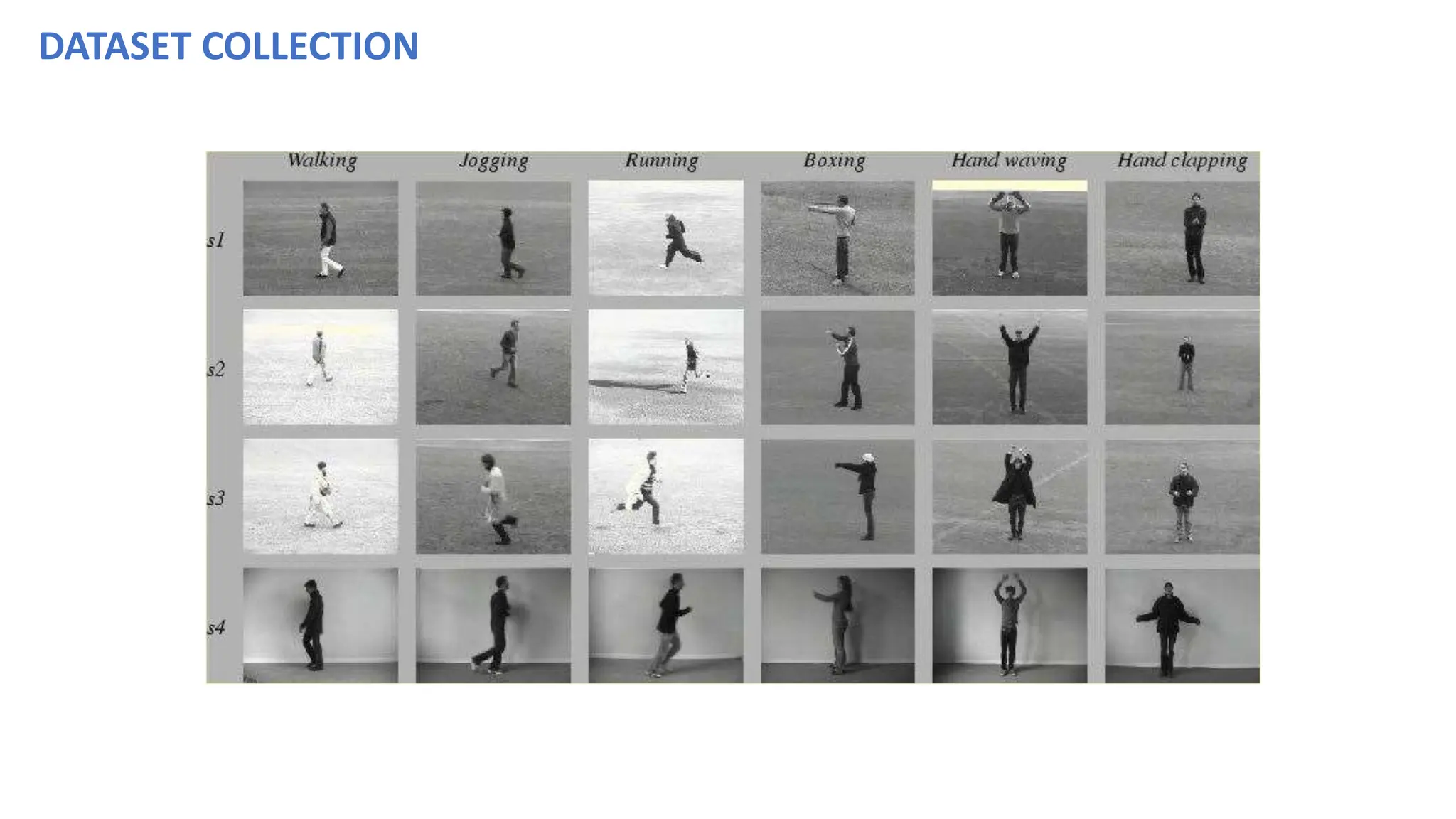
• Human activity collection module is the process of collecting various activities that will be
processed by the system for performing deep learning process.
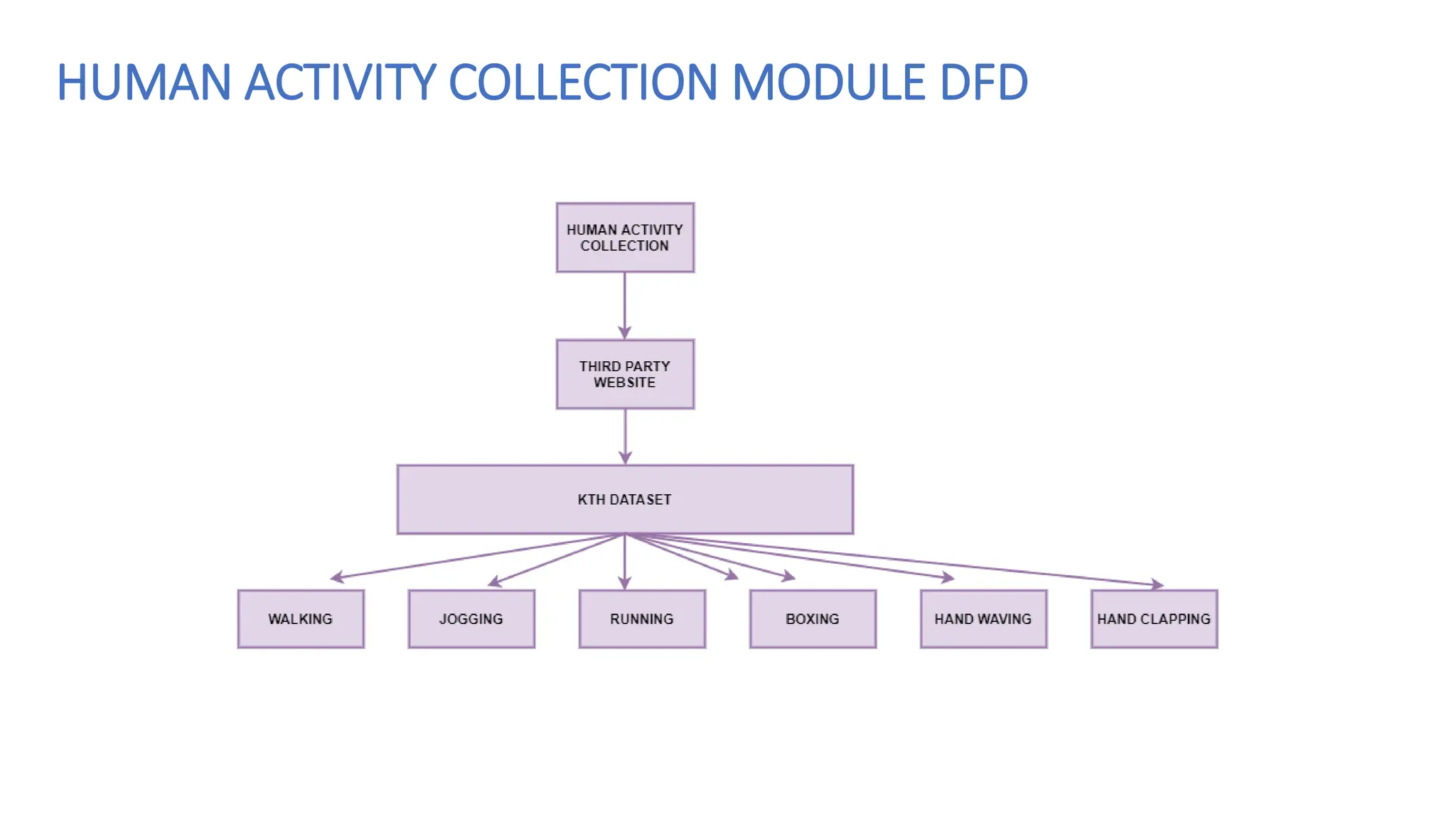
• The KTH video database containing six types of human actions (walking, jogging, running,
boxing, hand waving and hand clapping) performed several times by 25 subjects in four
different scenarios.
• The database contains 2391 sequences. All sequences were taken over homogeneous
backgrounds with a static camera with 25fps frame rate.
• The sequences were downsampled to the spatial resolution of 160x120 pixels and have a
length of four seconds in average.
HUMAN ACTIVITY COLLECTION MODULE DFD
18
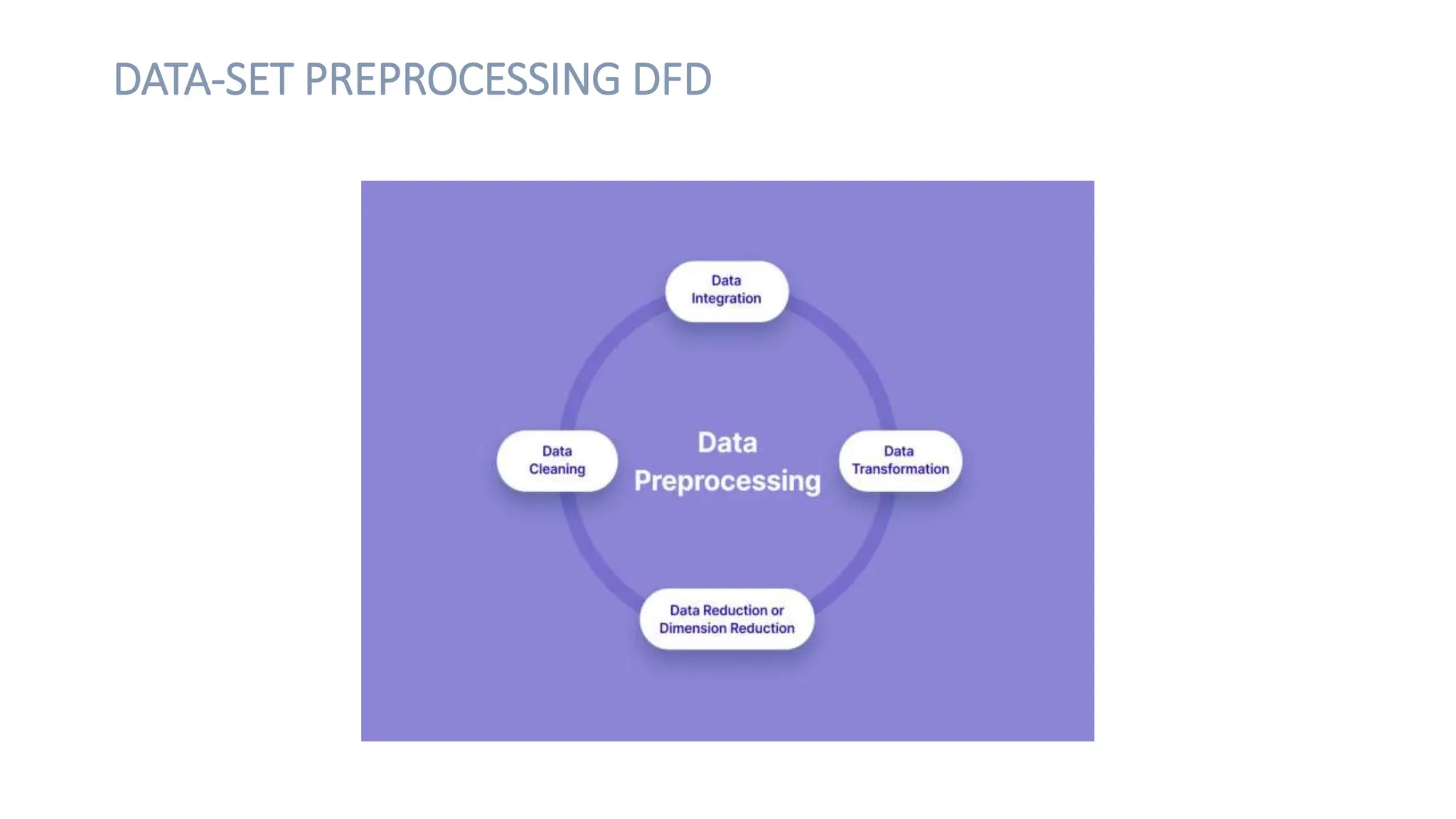
• Data preprocessing is a process of preparing the raw data and making it suitable for a machine
learning model.
• It is the first and crucial step while creating a machine learning model.
• When creating a machine learning project, it is not always a case that we come across the clean
and formatted data.
• And while doing any operation with data, it is mandatory to clean it and put in a formatted way.
So for this, we use data preprocessing task.
• A real-world data generally contains noises, missing values, and maybe in an unusable format
which cannot be directly used for machine learning models.
DATA-SET PREPROCESSING
DATA-SET PREPROCESSING DFD
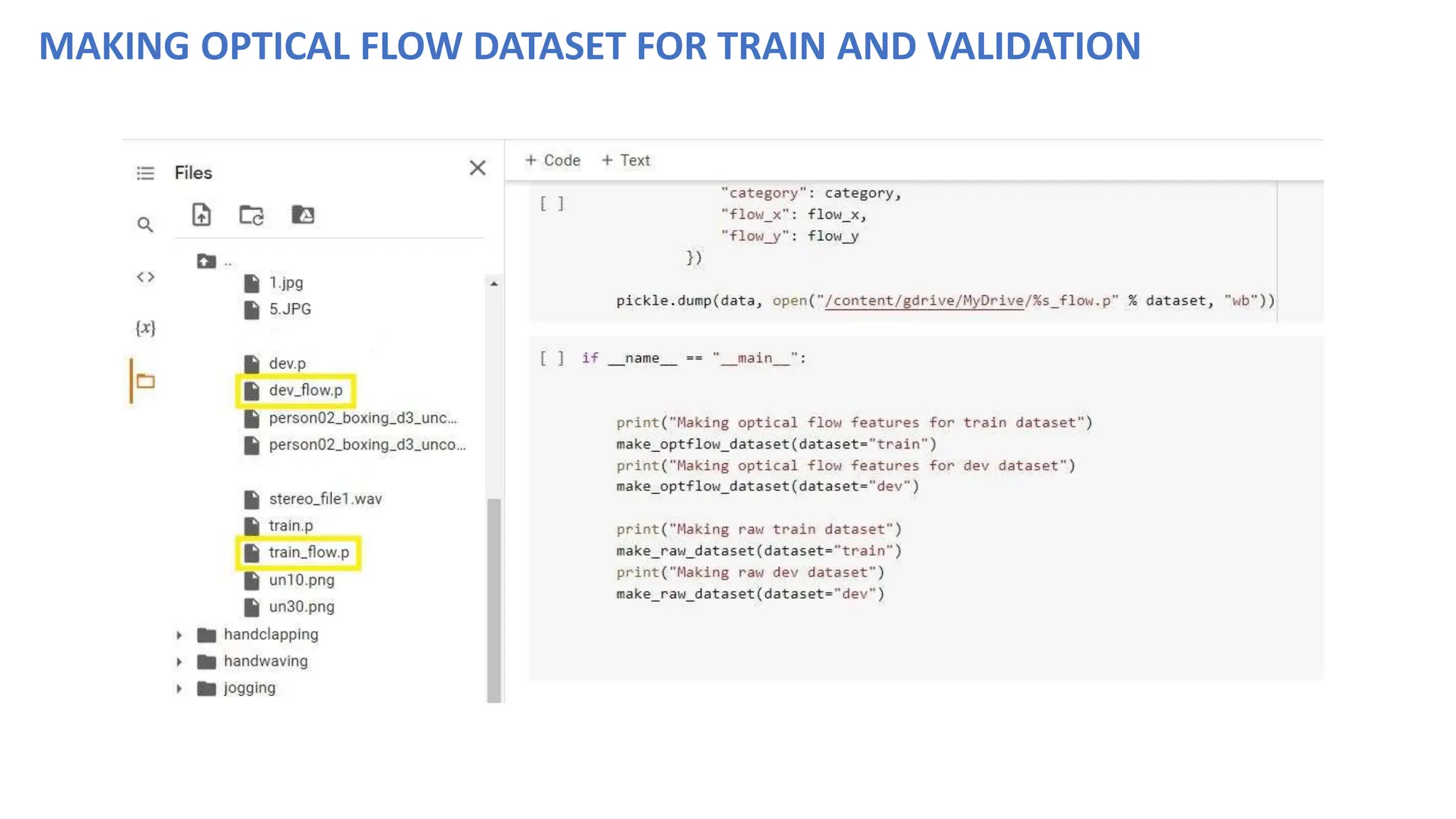
FEATURE EXTRACTION
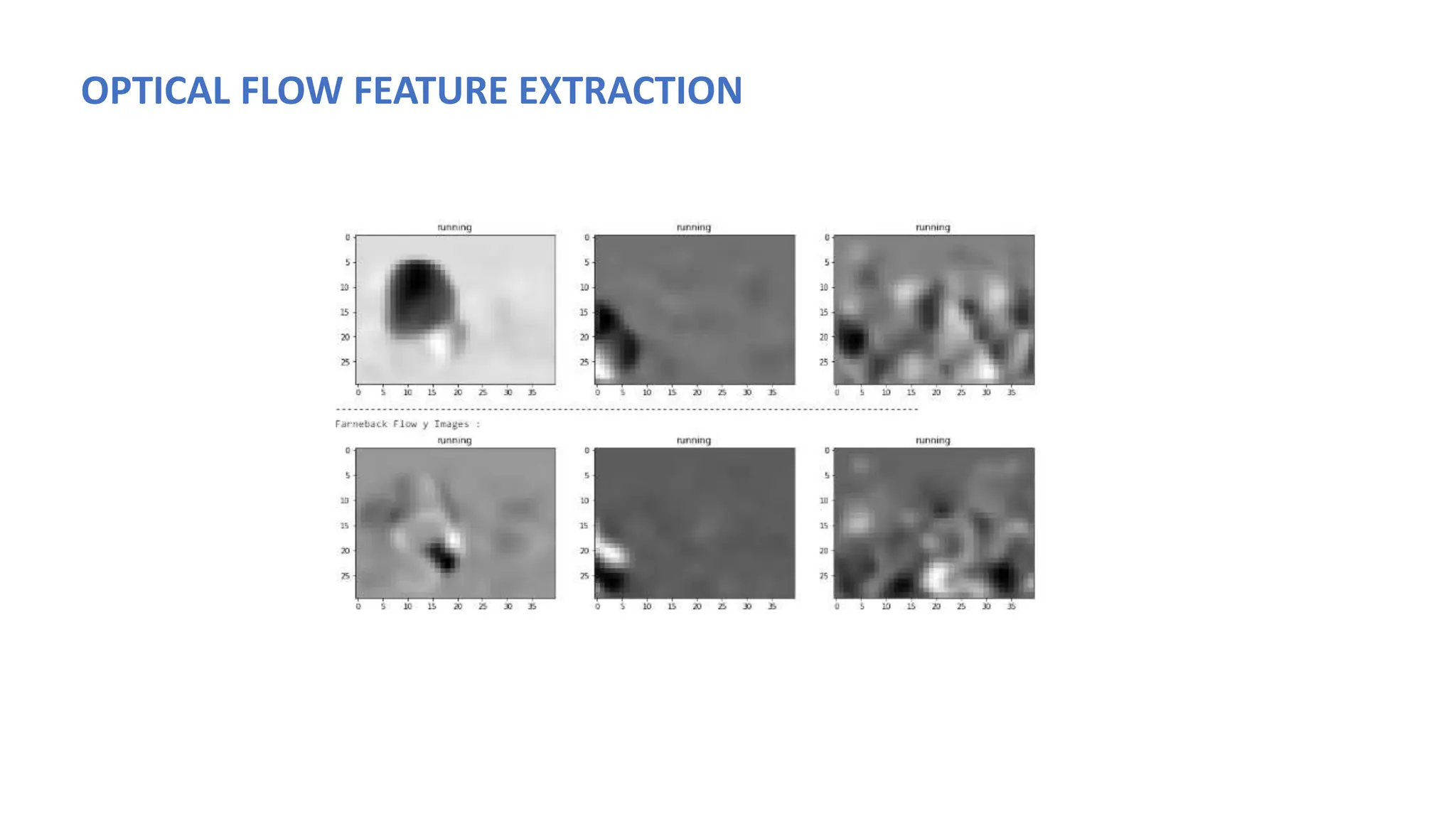
• Optical flow, or motion estimation, is a fundamental method of calculating the
motion of image intensities, which may be ascribed to the motion of objects in
the scene. Optical-flow methods are based on computing estimates of the motion
of the image intensities over time in a video.
• Spatial features capture the change in space due to the movement, whereas
temporal features represent time factors during the movement. The
spatiotemporal features tell us where the object is at a particular instant of time
in the frame.
FEATURE EXTRACTION DFD
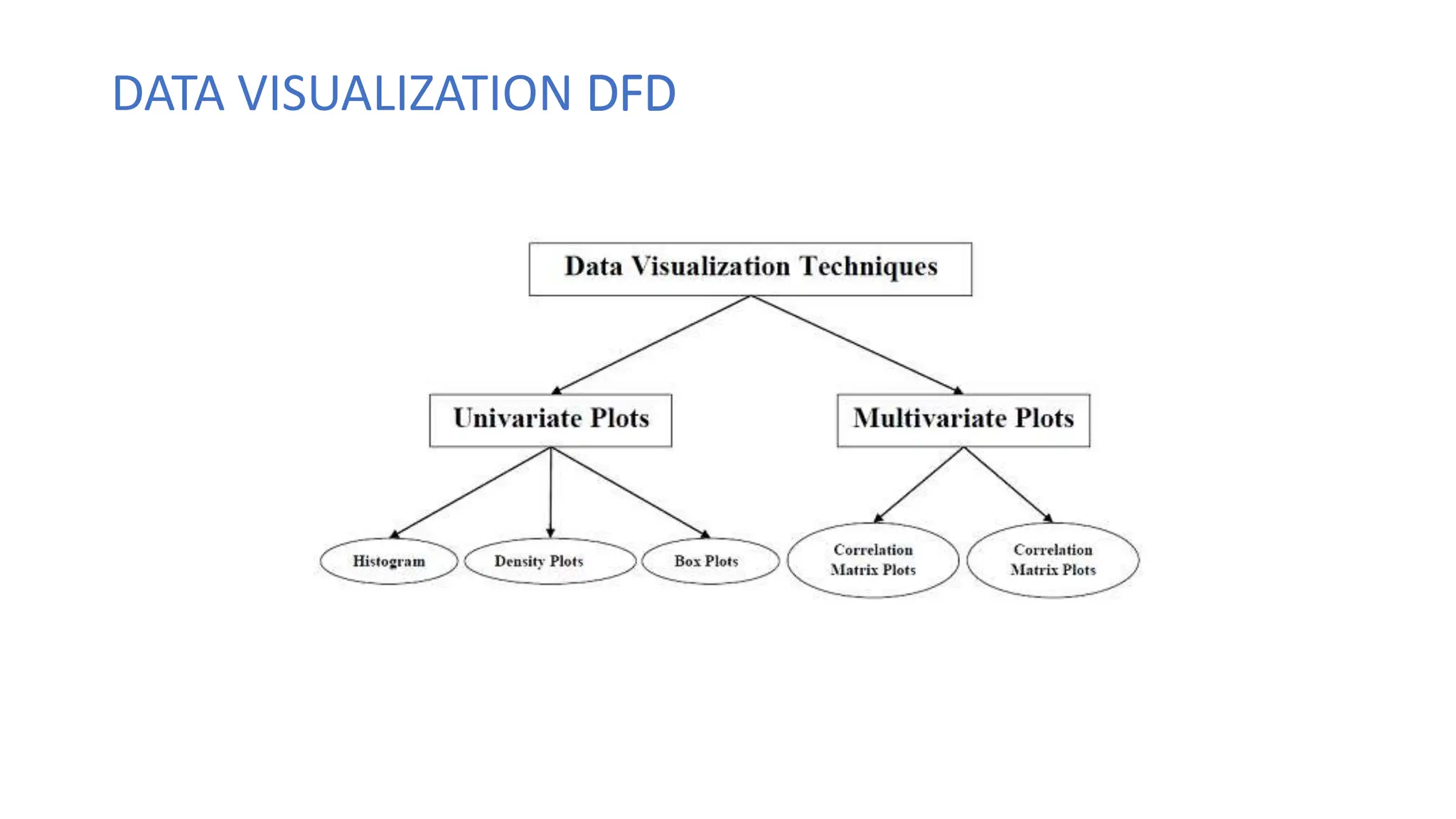
DATA VISUALIZATION
• Data visualization is the graphical representation of information and data.
• By using visual elements like charts, graphs, and maps, data visualization tools provide
an accessible way to see and understand trends, outliers, and patterns in data.
• Additionally, it provides an excellent way for employees or business owners to present
data to non-technical audiences without confusion.
• In the world of Big Data, data visualization tools and technologies are essential to
analyze massive amounts of information and make data-driven decisions
DATA VISUALIZATION DFD
TRAINING WITH THE DEEP LEARNING ALGORITHM
• After Data Visualization, it will be fed for training with the deep learning algorithm such as
Spatio-Temporal Net is used to determine and classify the activities of a human.
• Spatio-temporal graphs are made of static structures and time-varying features, and such
information in a graph requires a neural network that can deal with time-varying features of the
graph.
• Neural networks which are developed to deal with time-varying features of the graph can be
considered as Spatio-temporal graph neural networks.
• Spatio-temporal networks are spatial networks whose topology and parameters change with
time.
TRAINING WITH THE DEEP LEARNING ALGORITHM
VALIDATION AND EVALUATION
• After training with Spatio-Temporal Net algorithm, it will validate and evaluate the
datasets.
• Validation in deep learning is like a authorization or authentication of the prediction
done by a trained model.
• While on the other hand, evaluation in deep learning refers to assessment or test of
entire deep learning model and its performance in various circumstances.
• It involves assessment of deep learning model training process, deep learning
algorithms performance and how accurate is the predictions given in different
situations.
ASSAULT ACTIVITY PREDICTION
• The main purpose of this research work is to find the best prediction model i.e., the best Deep Learning
techniques which will determine and classify the activities of a human.
• We can provide this efficient model as an application to road surveillance as such a camera module fixed in
the road to perform constant surveillance.
• The camera on recognizing abnormal detection from the humans such as fights, etc., an alert notification is
sent to the police.
• A mobile application is developed using react native which will be held by the police to which, the camera on
recognizing abnormality in the humans an alert notification is sent and live streaming is enabled.
• Thus, this project successfully provides a Human activity recognition model incorporating AI to the cameras
which can be used in real time applications such as a solution to prevent and provide evidence of an
abnormal detection in road.
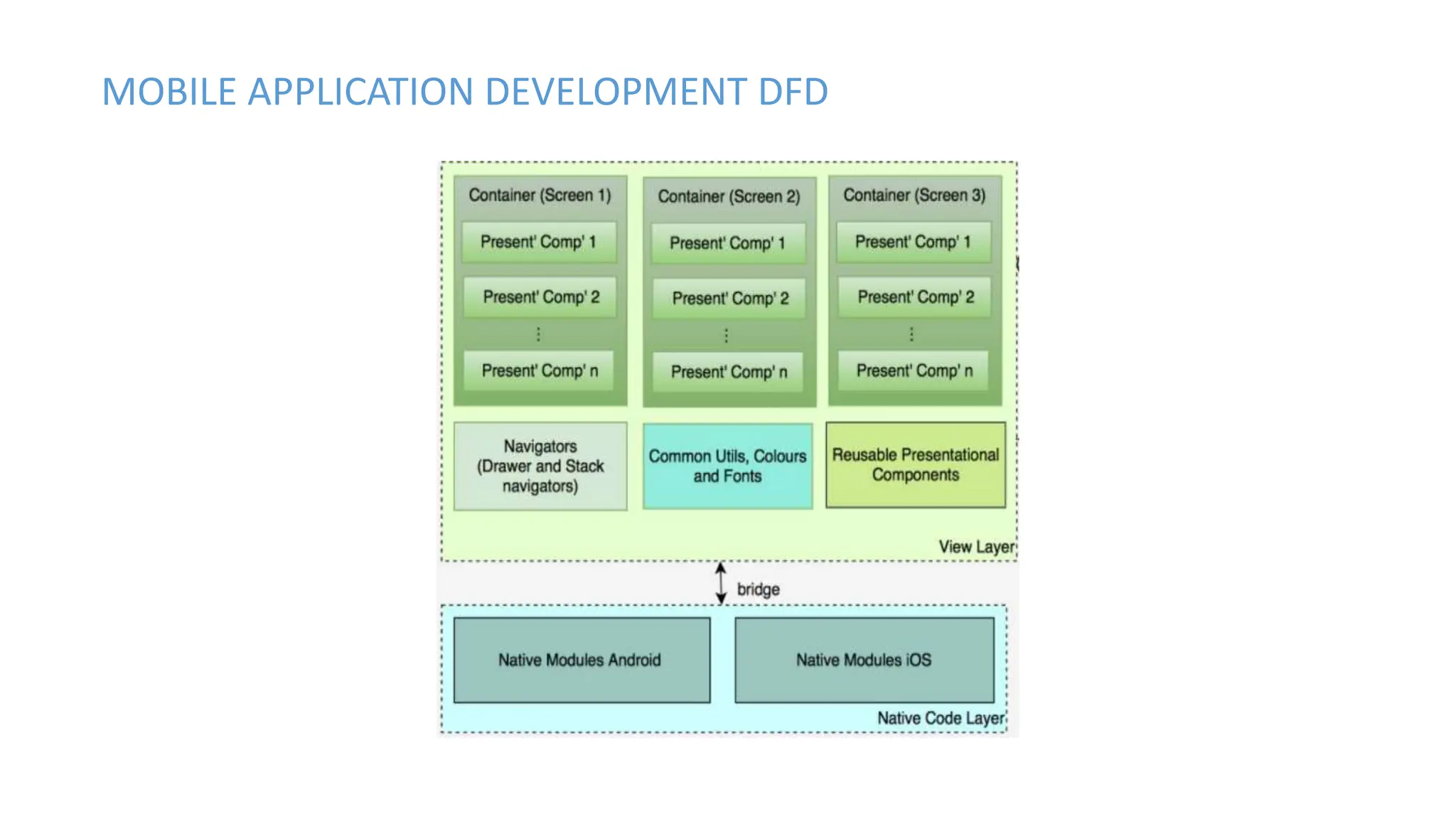
MOBILE APPLICATION DEVELOPMENT
• React Native is a framework that builds a hierarchy of UI components to build the JavaScript
code.
• It has a set of components for both iOS and Android platforms to build a mobile application
with a native look and feel.
• React Native seems to be a viable solution for building high-quality apps in a short time with
the same performance and user-experience standards that native apps provide.
• React Native uses different mechanisms to create an efficient, consistent and reusable visual
identity for the applications.
MOBILE APPLICATION DEVELOPMENT DFD
30
• PC
• RAM : 8 GB
• Processor : i5
• Hard disk : 1 TB
• Camera
HARDWARE REQUIREMENTS
31
• VISUAL STUDIO
• PYTHON
SOFTWARE REQUIREMENTS
32
• Roads
• Banks
• Homes
• Commercial spaces
APPLICATIONS
OUTPUTS OBTAINED
DATASET COLLECTION
LOADING DATASET
MAKING RAW DATASET FOR TRAIN AND VALIDATION
MAKING OPTICAL FLOW DATASET FOR TRAIN AND VALIDATION
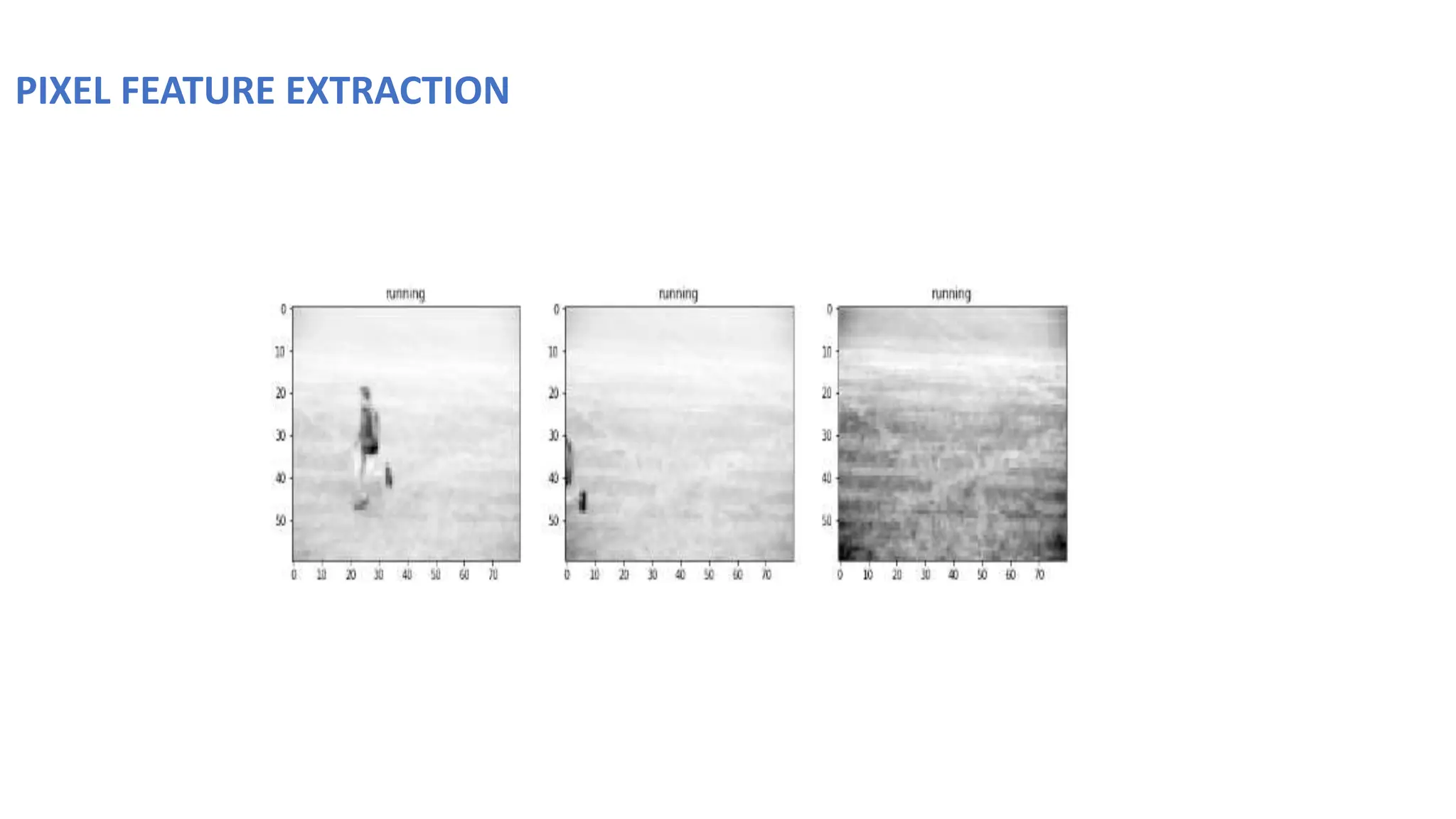
PIXEL FEATURE EXTRACTION
OPTICAL FLOW FEATURE EXTRACTION
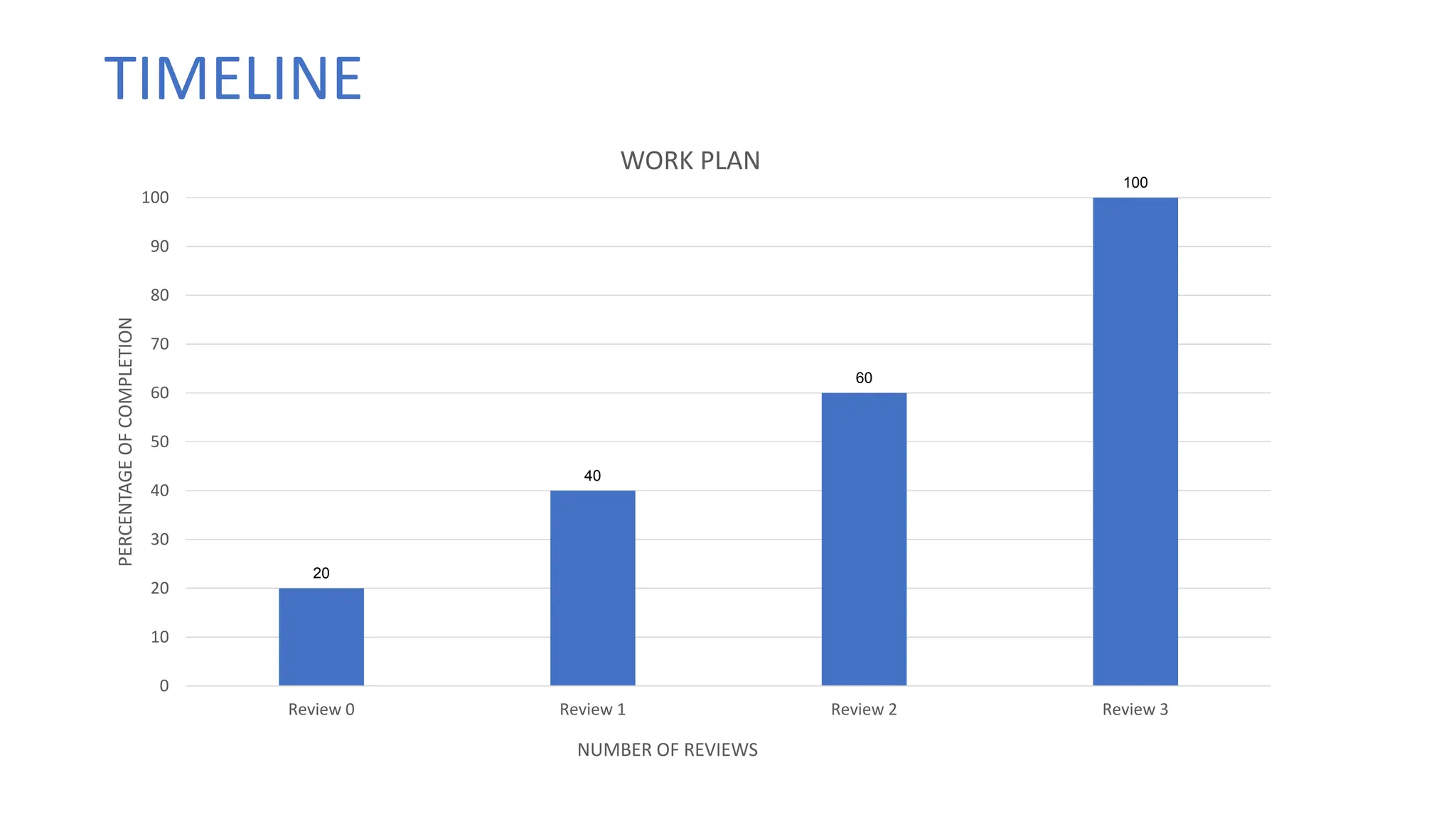
WORK PLAN
Review Work Status
0th • Identifying area of work and problem statement
• Solution provided
• Various study regarding project
Completed
1st • 20-30% of project completion Completed
2nd • 50-60% of project completion Completed
3rd • Entire project completion
TIMELINE
20
40
60
100
0
10
20
30
40
50
60
70
80
90
100
Review 0 Review 1 Review 2 Review 3
PERCENTAGE
OF
COMPLETION
NUMBER OF REVIEWS
WORK PLAN
[1] A Deep Clustering via Automatic Feature Embedded Learning for Human Activity Recognition Ting
Wang, Student Member, IEEE, Wing W. Y. Ng*, Senior Member, IEEE, Jinde Li, Qiuxia Wu, Member, IEEE,
Shuai Zhang, Member, IEEE, Chris Nugent, Senior Member, IEEE, Colin Shewell, Member, IEEE[2021]
[2] PrivHome: Privacy-Preserving Authenticated Communication in Smart Home Environment, Geong Sen
Poh, Prosanta Gope, Member, IEEE , and Jianting Ning [2019, VOL. 99, NO. 99]
[3] Continuous Human Motion Recognition With a Dynamic Range-Doppler Trajectory Method Based on
FMCW Radar, Chuanwei Ding , Student Member, IEEE, Hong Hong , Member, IEEE, Yu Zou, Student
Member, IEEE, Hui Chu , Xiaohua Zhu, Member, IEEE, Francesco Fioranelli , Member, IEEE, Julien Le Kernec ,
Senior Member, IEEE, and Changzhi Li , Senior Member, IEEE [2019, VOL. 57, NO. 9, ]
REFERENCE
REFERENCE
[4] PRNU-Based Camera Attribution from Multiple Seam-Carved Images, BSamet Taspinar,
Manoranjan Mohanty, and Nasir Memon.
[2017, VOL. 20, NO. 5, ]
[5] An Integrated Cloud-Based Smart Home Management System with Community Hierarchy, Ying-
Tsung Lee, Wei-Hsuan Hsiao, Chin-Meng Huang and Seng-Cho T. Chou. [2016, Vol No: 2162-237X]
[6] Presentation Attack Detection for Face Recognition using Light Field Camera, R. Raghavendra
Kiran B. Raja Christoph Busch Norwegian Biometric Laboratory, Gjøvik University College, Norway.
[TIP.2015.2395951]
44

Human_assault project using jetson nano new

  • 1.
    PUBLIC HUMAN ASSAULTPREDICTION USING HUMAN ACTIVITY RECOGNTION WITH AI
  • 2.
    • Problem Statement •Abstract • Objective • Motivation • Existing and Proposed System • Literature Review • Proposed System Architecture • Modules Description • Hardware Requirements • Software Requirements • Application • References CONTENTS
  • 3.
    PROBLEM STATEMENT • InefficientHuman activity recognition model. • Costlier solutions for Human activity recognition due to the use of 3D cameras. • Difficulty in deploying real time Human activity recognition application due to costlier models.
  • 4.
    4 OBJECTIVE • To developa highly accurate Human Activity recognition model. • To develop a efficient model for real time deployment. • To make this model as a surveillance solution for road surveillance • To develop a mobile application for providing alert to the police in case of theft detection by detecting the human activities. • To accomplish Live streaming through mobile application.
  • 5.
    5 ABSTRACT • Recognizing humanactivities from video sequences or still images is a challenging task due to problems, such as background clutter, partial occlusion, changes in scale, viewpoint, lighting, and appearance. • Human activity recognition, or HAR, is a challenging time series classification task. It involves predicting the movement of a person based on sensor data and traditionally involves deep domain expertise and methods from signal processing to correctly engineer features from the raw data in order to fit a machine learning model. • Human Activity Recognition plays a significant role in human-to-human and human-computer interaction. • So this system will not only be cost effective but also as a utility-based system that can be incorporated in a large number of applications that will save time and aid in various activities that require recognition process, and save a lot of time with good accuracy.
  • 6.
    6  In theexisting system, it proposes a dual stacked autoencoders features embedded clustering (DSAFEC) and a BOW construction method based on the DSAFEC (B-DSAFEC) to reduce the computational complexity and to remove the selection restriction.  The DSAFEC first transforms feature points extracted from a video to a learned feature space and then probabilities of cluster assignment of feature points are predicted to build BOWs for human activity recognition.  A soft clustering is used by assigning each feature point to multiple clusters yielding the largest probabilities instead of only one in hard clustering. EXISTING SYSTEM
  • 7.
    7  The systemuses dual stacked auto encoders which for video dataset is insufficient to extract the data.  Although the training is faster in radial basis function neural network (RBFNN) network but classification is slow in comparison due to nodes in hidden layer have to compute the RBF function for the input sample vector during classification.  The system does not provide an effective technological solution for real time deployment. DISADVANTAGES OF EXISTING SYSTEM
  • 8.
    8 LITERATURE REVIEW TITLE OFTHE PAPER AUTHOR NAME ALGORITHM ADVANTAGE DISADVANTAGE A Deep Clustering via Automatic Feature Embedded Learning for Human Activity Recognition[2021] Ting Wang, Wing W. Y. Ng*, Jinde Li, Qiuxia Wu, Shuai Zhang, Chris Nugent, Colin Shewell, dual stacked autoencoders features embedded clustering (DSAFEC) Used to identify the range of human pose motion. The system uses dual stacked auto encoders which for video dataset is insufficient to extract the data. Presentation Attack Detection for Face Recognition using Light Field Camera R. Raghavendra Kiran B. Raja Christoph Busch Norwegian Biometric Laboratory, Gjøvik University College, Norway Face Presentation Attack Detection (PAD) The light field face artefact database have revealed the outstanding performance of the proposed PAD scheme when benchmarked with various well established state-of-the- art schemes. There exists no superior PAD technique due to evolution of sophisticated presentation attacks
  • 9.
    9 LITERATURE REVIEW TITLE OFTHE PAPER AUTHOR NAME ALGORITHM ADVANTAGE DISADVANTAGE “PrivHome: Privacy- Preserving Authenticated Communication in Smart Home Environment [2019, VOL. 99, NO. 99] Geong Sen Poh, Prosanta Gope, Member, IEEE , and Jianting Ning lightweight entity and key-exchange protocol, and an efficient searchable encryption protocol A smart home enables users to access devices such as lighting, HVAC, temperature sensors, and surveillance camera. It provides a more convenient and safe living environment for users Less accuracy. “Continuous Human Motion Recognition With a Dynamic Range-Doppler Trajectory Method Based on FMCW Radar “ [2019, VOL. 57, NO. 9, ] Chuanwei Ding , Student Member, IEEE, Hong Hong , Member, IEEE, Yu Zou, Student Member, IEEE, Hui Chu , Xiaohua Zhu, Member, IEEE, Francesco Fioranelli , Member, IEEE, Julien Le Kernec , Senior Member, IEEE, and Changzhi Li , Senior Member, IEEE range-Doppler trajectory (DRDT) method based on the frequency-modulated continuous-wave (FMCW) the DRDT is extracted from these frames to monitor human motions in time, range, and Doppler domains in real time. Less accuracy.
  • 10.
    10 LITERATURE REVIEW TITLE OFTHE PAPER AUTHOR NAME ALGORITHM ADVANTAGE DISADVANTAGE “PRNU-Based Camera Attribution from Multiple Seam-Carved Images ” [2017, VOL. 20, NO. 5, ] BSamet Taspinar, Manoranjan Mohanty, and Nasir Memon PRNU Noise Pattern, Countering SeamCarving-Based Anonymization, Source Camera Attribution. seamcarved images from the same camera, source attribution can still be possible even if the size of uncarved blocks in the image is less than the recommended size of 50×50 pixels. Less real time process. “An Integrated Cloud-Based Smart Home Management System with Community Hierarchy ”, [2016, Vol No: 2162-237X] Ying-Tsung Lee, Wei-Hsuan Hsiao, Chin-Meng Huang and Seng-Cho T. Chou Smart Home Management System, Community Broker, Cloud Services, MQTT At the home end, a home intranet was created by integrating a fixed touch panel with a home controller system and various sensors and devices to deliver, for example, energy, scenario information, and security functions. Costly kit
  • 11.
    11 • In thisproject, KTH video dataset is used for designing the system. • Preprocessing technique is used to extract the certain frames in dataset. • In feature extraction process, Pixel and Optical flow feature extraction techniques are used to extract the features. • Data visualization method is used for visualize the feature extraction. • The deep learning algorithm such as Spatio-Temporal Net is then used to determine and classify the activities of a human. • We can provide this efficient model as an application to road surveillance as such a camera module fixed in the road to perform constant surveillance. • The camera on recognizing abnormal detection from the humans such as fights, etc., an alert notification is sent to the police. • A mobile application is developed using react native which will be held by the police to which, the camera on recognizing abnormality in the humans an alert notification is sent and live streaming is enabled. • Thus, this project successfully provides a Human activity recognition model incorporating AI to the cameras which can be used in real time applications such as a solution to prevent and provide evidence of an abnormal detection in road. PROPOSED SYSTEM
  • 12.
    12 • Highly accurateHuman activity recognition system. • Effective model development suitable for real time application deployment. • Cheap and effective solution for real time road surveillance. • Provides alert to the police in case of theft detection by detecting the human activities. • Live streaming through the mobile application. ADVANTAGES OF PROPOSED SYSTEM
  • 13.
  • 15.
    15 • Human ActivityCollection • Data Preprocessing • Feature Extraction • Data Visualization • Training with the deep learning algorithm • Validation and Evaluation • Assault Activity Prediction • Mobile Application Development MODULES DESCRIPTION
  • 16.
    HUMAN ACTIVITY COLLECTIONMODULE • Human activity collection module is the process of collecting various activities that will be processed by the system for performing deep learning process. • The KTH video database containing six types of human actions (walking, jogging, running, boxing, hand waving and hand clapping) performed several times by 25 subjects in four different scenarios. • The database contains 2391 sequences. All sequences were taken over homogeneous backgrounds with a static camera with 25fps frame rate. • The sequences were downsampled to the spatial resolution of 160x120 pixels and have a length of four seconds in average.
  • 17.
  • 18.
    18 • Data preprocessingis a process of preparing the raw data and making it suitable for a machine learning model. • It is the first and crucial step while creating a machine learning model. • When creating a machine learning project, it is not always a case that we come across the clean and formatted data. • And while doing any operation with data, it is mandatory to clean it and put in a formatted way. So for this, we use data preprocessing task. • A real-world data generally contains noises, missing values, and maybe in an unusable format which cannot be directly used for machine learning models. DATA-SET PREPROCESSING
  • 19.
  • 20.
    FEATURE EXTRACTION • Opticalflow, or motion estimation, is a fundamental method of calculating the motion of image intensities, which may be ascribed to the motion of objects in the scene. Optical-flow methods are based on computing estimates of the motion of the image intensities over time in a video. • Spatial features capture the change in space due to the movement, whereas temporal features represent time factors during the movement. The spatiotemporal features tell us where the object is at a particular instant of time in the frame.
  • 21.
  • 22.
    DATA VISUALIZATION • Datavisualization is the graphical representation of information and data. • By using visual elements like charts, graphs, and maps, data visualization tools provide an accessible way to see and understand trends, outliers, and patterns in data. • Additionally, it provides an excellent way for employees or business owners to present data to non-technical audiences without confusion. • In the world of Big Data, data visualization tools and technologies are essential to analyze massive amounts of information and make data-driven decisions
  • 23.
  • 24.
    TRAINING WITH THEDEEP LEARNING ALGORITHM • After Data Visualization, it will be fed for training with the deep learning algorithm such as Spatio-Temporal Net is used to determine and classify the activities of a human. • Spatio-temporal graphs are made of static structures and time-varying features, and such information in a graph requires a neural network that can deal with time-varying features of the graph. • Neural networks which are developed to deal with time-varying features of the graph can be considered as Spatio-temporal graph neural networks. • Spatio-temporal networks are spatial networks whose topology and parameters change with time.
  • 25.
    TRAINING WITH THEDEEP LEARNING ALGORITHM
  • 26.
    VALIDATION AND EVALUATION •After training with Spatio-Temporal Net algorithm, it will validate and evaluate the datasets. • Validation in deep learning is like a authorization or authentication of the prediction done by a trained model. • While on the other hand, evaluation in deep learning refers to assessment or test of entire deep learning model and its performance in various circumstances. • It involves assessment of deep learning model training process, deep learning algorithms performance and how accurate is the predictions given in different situations.
  • 27.
    ASSAULT ACTIVITY PREDICTION •The main purpose of this research work is to find the best prediction model i.e., the best Deep Learning techniques which will determine and classify the activities of a human. • We can provide this efficient model as an application to road surveillance as such a camera module fixed in the road to perform constant surveillance. • The camera on recognizing abnormal detection from the humans such as fights, etc., an alert notification is sent to the police. • A mobile application is developed using react native which will be held by the police to which, the camera on recognizing abnormality in the humans an alert notification is sent and live streaming is enabled. • Thus, this project successfully provides a Human activity recognition model incorporating AI to the cameras which can be used in real time applications such as a solution to prevent and provide evidence of an abnormal detection in road.
  • 28.
    MOBILE APPLICATION DEVELOPMENT •React Native is a framework that builds a hierarchy of UI components to build the JavaScript code. • It has a set of components for both iOS and Android platforms to build a mobile application with a native look and feel. • React Native seems to be a viable solution for building high-quality apps in a short time with the same performance and user-experience standards that native apps provide. • React Native uses different mechanisms to create an efficient, consistent and reusable visual identity for the applications.
  • 29.
  • 30.
    30 • PC • RAM: 8 GB • Processor : i5 • Hard disk : 1 TB • Camera HARDWARE REQUIREMENTS
  • 31.
    31 • VISUAL STUDIO •PYTHON SOFTWARE REQUIREMENTS
  • 32.
    32 • Roads • Banks •Homes • Commercial spaces APPLICATIONS
  • 33.
  • 34.
  • 35.
  • 36.
    MAKING RAW DATASETFOR TRAIN AND VALIDATION
  • 37.
    MAKING OPTICAL FLOWDATASET FOR TRAIN AND VALIDATION
  • 38.
  • 39.
  • 40.
    WORK PLAN Review WorkStatus 0th • Identifying area of work and problem statement • Solution provided • Various study regarding project Completed 1st • 20-30% of project completion Completed 2nd • 50-60% of project completion Completed 3rd • Entire project completion
  • 41.
    TIMELINE 20 40 60 100 0 10 20 30 40 50 60 70 80 90 100 Review 0 Review1 Review 2 Review 3 PERCENTAGE OF COMPLETION NUMBER OF REVIEWS WORK PLAN
  • 42.
    [1] A DeepClustering via Automatic Feature Embedded Learning for Human Activity Recognition Ting Wang, Student Member, IEEE, Wing W. Y. Ng*, Senior Member, IEEE, Jinde Li, Qiuxia Wu, Member, IEEE, Shuai Zhang, Member, IEEE, Chris Nugent, Senior Member, IEEE, Colin Shewell, Member, IEEE[2021] [2] PrivHome: Privacy-Preserving Authenticated Communication in Smart Home Environment, Geong Sen Poh, Prosanta Gope, Member, IEEE , and Jianting Ning [2019, VOL. 99, NO. 99] [3] Continuous Human Motion Recognition With a Dynamic Range-Doppler Trajectory Method Based on FMCW Radar, Chuanwei Ding , Student Member, IEEE, Hong Hong , Member, IEEE, Yu Zou, Student Member, IEEE, Hui Chu , Xiaohua Zhu, Member, IEEE, Francesco Fioranelli , Member, IEEE, Julien Le Kernec , Senior Member, IEEE, and Changzhi Li , Senior Member, IEEE [2019, VOL. 57, NO. 9, ] REFERENCE
  • 43.
    REFERENCE [4] PRNU-Based CameraAttribution from Multiple Seam-Carved Images, BSamet Taspinar, Manoranjan Mohanty, and Nasir Memon. [2017, VOL. 20, NO. 5, ] [5] An Integrated Cloud-Based Smart Home Management System with Community Hierarchy, Ying- Tsung Lee, Wei-Hsuan Hsiao, Chin-Meng Huang and Seng-Cho T. Chou. [2016, Vol No: 2162-237X] [6] Presentation Attack Detection for Face Recognition using Light Field Camera, R. Raghavendra Kiran B. Raja Christoph Busch Norwegian Biometric Laboratory, Gjøvik University College, Norway. [TIP.2015.2395951]
  • 44.