SHARED VALUE
Strategic Management Assignment
2014
2/18/2014
Submitted By :
Group 8
Aastha Pandey
Apoorva Singh
Navdeep Singh
Nikhil Salvi
Submitted To:
Dr. S. Dasgupta
INTRODUCTION:
For any individual, there exist four spheres of
morality, as a person, as a company leader, as an
economic agent and lastly beyond the firm’s
boundaries. CEO’s today are taking a hard look at
all of these spheres, trying to ascertain how to
create new business opportunities, facilitate
growth, how to achieve competitive advantage and
at the same time proactively engaging with critical
societal issues as a part of core strategy.
In their report ‘Creating shared value: Redefining
Capitalism and the Role of Corporation in Society’,
Michael Porter and Mark Kramer defined shared
value as corporate policies and practices that
enhance the competitiveness of a company while
simultaneously advancing social and economic
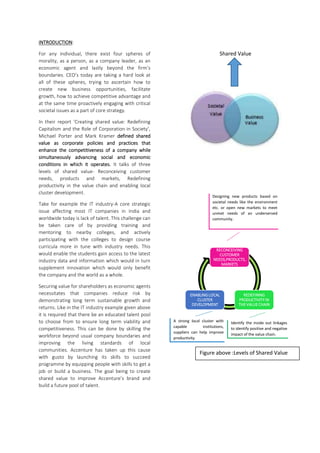
conditions in which it operates. It talks of three
levels of shared value- Reconceiving customer
needs, products and markets, Redefining
productivity in the value chain and enabling local
cluster development.
Take for example the IT industry-A core strategic
issue affecting most IT companies in India and
worldwide today is lack of talent. This challenge can
be taken care of by providing training and
mentoring to nearby colleges, and actively
participating with the colleges to design course
curricula more in tune with industry needs. This
would enable the students gain access to the latest
industry data and information which would in turn
supplement innovation which would only benefit
the company and the world as a whole.
Securing value for shareholders as economic agents
necessitates that companies reduce risk by
demonstrating long term sustainable growth and
returns. Like in the IT industry example given above
it is required that there be an educated talent pool
to choose from to ensure long term viability and
competitiveness. This can be done by skilling the
workforce beyond usual company boundaries and
improving the living standards of local
communities. Accenture has taken up this cause
with gusto by launching its skills to succeed
programme by equipping people with skills to get a
job or build a business. The goal being to create
shared value to improve Accenture’s brand and
build a future pool of talent.
RECONCEIVING
CUSTOMER
NEEDS,PRODUCTS,
MARKETS
REDEFINING
PRODUCTIVITY IN
THE VALUE CHAIN
ENABLING LOCAL
CLUSTER
DEVELOPMENT
Designing new products based on
societal needs like the environment
etc. or open new markets to meet
unmet needs of an underserved
community.
A strong local cluster with
capable institutions,
suppliers can help improve
productivity.
Identify the inside out linkages
to identify positive and negative
impact of the value chain.
Shared Value
Figure above :Levels of Shared Value
Shared Value and CSR
Most companies have always had CSR as a part of
their business model. It is a guide for what the
company stands and an indicator of its promise of
performance for its customers. Most companies
awoke to CSR only after being caught by surprise by
public response to environmental and other social
issues. Like Nike faced consumer boycott after
media reported of labour violations of its workers
in Indonesia. Activists have become highly vocal
and often bring the public attention to larger
corporates merely to focus on an issue even if the
corporate in question has not had much bearing on
the problem. Thus, for a large group of companies
CSR has not been strategic, rather it has been
cosmetic.
CSR initiatives have been justified by the four
following arguments-
1. Moral obligation-As an entity a company
needs to be ethical and moral.
But ethics differ from culture to culture and
something which is moral for one group of
customers may be totally illegal for another.
2. Sustainability-Meeting needs of the
present without compromising future
needs.
But the notion of sustainability can become vague,
transparency can be more sustainable than
corruption. This is true but does not offer basis for
balancing long term goals and short term costs.
3. License to operate-Approval from
stakeholders is needed for the company to
operate.
But sometimes due to this CSR agendas can be
ceded to outsiders.
4. Reputation-Company image improves and
strengthens its brand and stock.
But with this argument the focus remains on
maintaining public relations rather than social and
business results.
All the arguments above focus on the friction
between society and the company instead of
focussing on how the two are related.
Consequently, CSR practices were not aligned with
business practices, this caused a lot of companies
to miss out on opportunities that were potential
new ventures/products as well as benefits to
society. However, the areas of corporate
philanthropy and strategy are converging. Serving
the society is no longer simply an avenue for
charity, it is a chance to attain differentiation and
grow.
‘There’s not enough money that we can give away
to be viewed as a responsible company in 200
countries. And we can’t do it sustainably. So the only
way it can work is to weave responsibility into the
core business of the company’.
-INDRA NOOYI
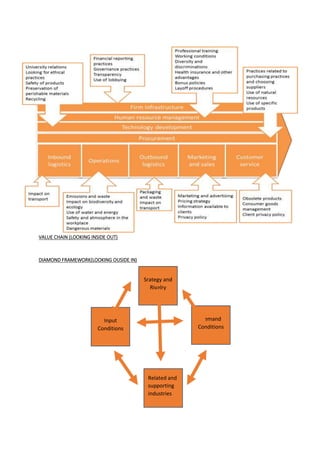
A company can map the social opportunities for
itself by looking at its value chain (i.e. the inside out
linkages) as well as the diamond framework (i.e.
the outside in linkages)
Successful corporations recognise that there needs
to be an interrelationship between the society and
the company such that the societal needs are
within the purview of the company’s strategy. A
healthy society would be beneficial to the
corporation as it would provide good governance,
skilled workforce and strong regulatory standards
One thing that needs to be kept in mind that social
impact differs from place to place and changes over
time. Also, no business can address all needs of
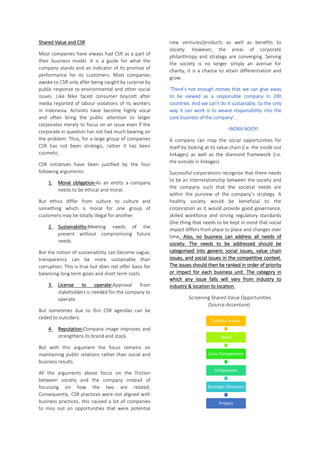
society. The needs to be addressed should be
categorised into generic social issues, value chain
issues, and social issues in the competitive context.
The issues should then be ranked in order of priority
or impact for each business unit. The category in
which any issue falls will vary from industry to
industry & location to location.
Screening Shared Value Opportunities
(Source-Accenture)
Societal Issues
Need
Core Competence
Uniqueness
Strategic Direction
Project
VALUE CHAIN (LOOKING INSIDE OUT)
DIAMOND FRAMEWORK(LOOKING OUSIDE IN)
Srategy and
Rivalry
Input
Conditions
Related and
supporting
industries
Demand
Conditions
Shared Value Implemented-
Source:Accenture
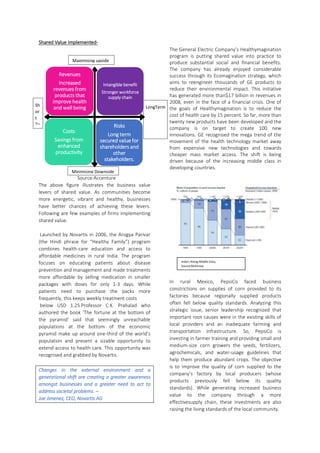
The above figure illustrates the business value
levers of shared value. As communities become
more energetic, vibrant and healthy, businesses
have better chances of achieving these levers.
Following are few examples of firms implementing
shared value.
Launched by Novartis in 2006, the Arogya Parivar
(the Hindi phrase for “Healthy Family”) program
combines health-care education and access to
affordable medicines in rural India. The program
focuses on educating patients about disease
prevention and management and made treatments
more affordable by selling medication in smaller
packages with doses for only 1-3 days. While
patients need to purchase the packs more
frequently, this keeps weekly treatment costs
below USD 1.25.Professor C.K. Prahalad who
authored the book ‘The fortune at the bottom of
the pyramid’ said that seemingly unreachable
populations at the bottom of the economic
pyramid make up around one-third of the world’s
population and present a sizable opportunity to
extend access to health care. This opportunity was
recognised and grabbed by Novartis.
Changes in the external environment and a
generational shift are creating a greater awareness
amongst businesses and a greater need to act to
address societal problems. –
Joe Jimenez, CEO, Novartis AG
The General Electric Company’s Healthymagination
program is putting shared value into practice to
produce substantial social and financial benefits.
The company has already enjoyed considerable
success through its Ecomagination strategy, which
aims to reengineer thousands of GE products to
reduce their environmental impact. This initiative
has generated more than$17 billion in revenues in
2008, even in the face of a financial crisis. One of
the goals of Healthymagination is to reduce the
cost of health care by 15 percent. So far, more than
twenty new products have been developed and the
company is on target to create 100 new
innovations. GE recognised the mega trend of the
movement of the health technology market away
from expensive new technologies and towards
cheaper mass market access. The shift is being
driven because of the increasing middle class in
developing countries.
In rural Mexico, PepsiCo faced business
constrictions on supplies of corn provided to its
factories because regionally supplied products
often fell below quality standards. Analyzing this
strategic issue, senior leadership recognized that
important root causes were in the existing skills of
local providers and an inadequate farming and
transportation infrastructure. So, PepsiCo is
investing in farmer training and providing small and
medium-size corn growers the seeds, fertilizers,
agrochemicals, and water-usage guidelines that
help them produce abundant crops. The objective
is to improve the quality of corn supplied to the
company’s factory by local producers (whose
products previously fell below its quality
standards). While generating increased business
value to the company through a more
effectivesupply chain, these investments are also
raising the living standards of the local community.
India’s Rising Middle Class,
Source:McKinsey
Maximising upside
Minimising Downside
Sh
or
t
Te
r
m
LongTerm
Revenues
Increased
revenues from
products that
improve health
and well being
Intangible benefit
Stronger workforce
supply chain
Costs
Savings from
enhanced
productivity
Risks
Long term
secured value for
shareholders and
other
stakeholders.
We are not trying to solve every issue. Instead, we
are taking on things that are core to our competency
and in geographies we can manage. We do them
where they drive business value, not just because
they sound good.-
Doug Conant, President and CEO, The Campbell Soup
Company
In 2009 Campbell soups committed to a business
agenda of macro targets that included reducing its
carbon foot print, levels of childhood obesity and
hunger in the countries it operated in. Product lines
related to obesity focussed on removing sodium,
transfats and artificial colours. From 2007-2010,
revenue from the nutrition line of Campbell
products soared by $1.2 billion.
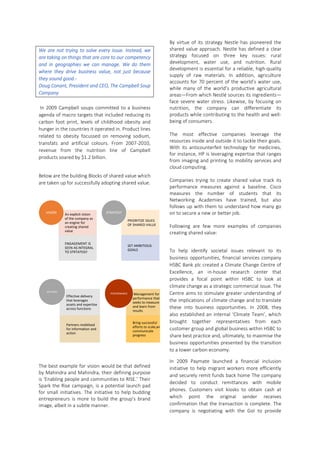
Below are the building Blocks of shared value which
are taken up for successfully adopting shared value.
The best example for vision would be that defined
by Mahindra and Mahindra, their defining purpose
is ‘Enabling people and communities to RISE.’ Their
Spark the Rise campaign, is a potential launch pad
for small initiatives. The initiative to help budding
entrepreneurs is more to build the group's brand
image, albeit in a subtle manner.
By virtue of its strategy Nestle has pioneered the
shared value approach. Nestle has defined a clear
strategy focused on three key issues: rural
development, water use, and nutrition. Rural
development is essential for a reliable, high-quality
supply of raw materials. In addition, agriculture
accounts for 70 percent of the world’s water use,
while many of the world’s productive agricultural
areas—From which Nestlé sources its ingredients—
face severe water stress. Likewise, by focusing on
nutrition, the company can differentiate its
products while contributing to the health and well-
being of consumers.
The most effective companies leverage the
resources inside and outside it to tackle their goals.
With its anticounterfeit technology for medicines,
for instance, HP is leveraging expertise that ranges
from imaging and printing to mobility services and
cloud computing.
Companies trying to create shared value track its
performance measures against a baseline. Cisco
measures the number of students that its
Networking Academies have trained, but also
follows up with them to understand how many go
on to secure a new or better job.
Following are few more examples of companies
creating shared value:
To help identify societal issues relevant to its
business opportunities, financial services company
HSBC Bank plc created a Climate Change Centre of
Excellence, an in-house research center that
provides a focal point within HSBC to look at
climate change as a strategic commercial issue. The
Centre aims to stimulate greater understanding of
the implications of climate change and to translate
these into business opportunities. In 2008, they
also established an internal ‘Climate Team’, which
brought together representatives from each
customer group and global business within HSBC to
share best practice and, ultimately, to maximise the
business opportunities presented by the transition
to a lower carbon economy.
In 2009 Paymate launched a financial inclusion
initiative to help migrant workers more efficiently
and securely remit funds back home The company
decided to conduct remittances with mobile
phones. Customers visit kiosks to obtain cash at
which point the original sender receives
confirmation that the transaction is complete. The
company is negotiating with the GoI to provide
An explicit vision
of the company as
an engine for
creating shared
value
ENGAGEMENT IS
SEEN AS INTEGRAL
TO STRTATEGY
VISION
PRIORITIZE SSUES
OF SHARED VALUE
SET AMBITIOUS
GOALS
STRATEGY
Effective delivery
that leverages
assets and expertise
across functions
Partners mobilised
for information and
action
DELIVERY
Management for
performance that
seeks to measure
and learn from
results
Bring successful
efforts to scale,and
communicate
progress
PERFORMANCE
payments for the National Rural Employment
Guarantee Scheme (NREGS)
In 2003-2004 ICICI Lombard launched a weather
based crop insurance program. The process was
made as objective as possible with third party
agencies monitoring the process. Under ICICI
Lombard’s system, farmers do not file claims.
Rather, payments are triggered by deviations from
normal conditions as measured by certified
weather data collected from independent third
parties. Weather-based products contributed to Rs.
332 crore ($72 million), 7.8 percent of the
company’s direct business
You’re really looking for programs to be win-wins
with your employees and your customers, as well as
being the right thing to do. We found that the only
way to drive our sustainability objectives forward is
by entering into dialogue with stakeholders.-
Irene Dorner, President and CEO, HSBC Bank USA,
N.A.
Shared value would be incomplete if we don’t talk
of catalytic innovation along with it. A catalytic
innovation is a subset of disruptive innovation. The
primary objective of catalytic innovation is social
change.
SELCO, India’s mission itself is to ‘Enhance the
quality of life in underserved households and
livelihoods through sustainable energy solutions’ It
is a ‘for profit’ social enterprise based in Bangalore
and it aims to improve the living standards of the
poor. So far it has done so by creating solar energy
based interventions and low smoke cook stoves.
SELCO India has installed solar light systems in
125,000 houses and plans to aims to reach over
200,000 households by 2014. SELCO started with a
financial model in which each customer would pay
25% of the cost upfront as down payment and will
further pay a monthly instalment which is
affordable and within the average monthly budget
of a family in the region. Along with this, the SELCO
INDIA also provided a year's guarantee to the
warranty of the manufacturer along with free
service for a year and a 90-day money back
guarantee.
Perhaps the most glaring example of creation of
shared value in India is that of Aravind Eye hospital.
It provides free surgeries to the poor while still
earning a profit due to its simple infrastructure. In
addition it keeps its surgical equipment in
operation 24 hours a day which reduces cost per
surgery. A doctor’s time is utilised with highest
effectiveness. Nurses work on pre-op and post-op,
doctors only focus on surgery which improves their
productivity. All of these measures enables the
hospital to perform high volume, high quality
inexpensive eye surgeries to address the needs of
India’s humungous blind population.
Another example in the healthcare sector is that of
,Lifespring Hospitals, a 50-50 joint venture between
$30-million Acumen Fund, a U.S.-based non-profit
global venture philanthropy fund and HLL Lifecare
Limited, a Government of India owned corporation,
is an Indian hospital chain, which
provides maternity care to women from the low-
income group in Hyderabad, India. It is the first
healthcare chain to join the 'Business Call to Action'
(BCtA), an initiative of United Nations Development
Programme (UNDP) and UN Global
Compact amongst others, to reduce poverty,
hunger, disease, and maternal and child deaths by
2015.
The concept of shared value is implementable even
at the minutest of levels, take for example IIM-
Rohtak’s initiative of Swabhav, It combines business
acumen, creativity and a concern for society
creating shared value in a social business model.
How can my work make me a better human being
and make a better world?
-Dr Govindappa Venkataswamy,Founder- Aravind
Eye Hospitals
Conclusion:
Shared Value signifies a deep connection between
companies and their causes, generating value for
each side. Companies must determine causes that
align with the company’s business and work
accordingly. Incorporation of shared value can
enhance a company’s potential to communicate
with consumers, generate better social conditions
and ultimately improve reputation and trust within
communities. A company’s value is not only bound
to the quality of its products and services, but to
relationships built with a long-term perspective
that engages individuals and creates a community
of shared beliefs – in addition to profits.
Significance for the stakeholders
Even consumers expect a company’s investment in
social purpose. According to the most recent
goodpurpose study, consumers are willing to pay
more for products and services that support causes
they believe in.
Social purpose helps a firm identify the needs it
might want to address, but the reverse is also true.
As a company understands social problems more
thoroughly, employees’ commitment to its social
purpose will increase. A deeply held social purpose
is also important for co-creation, forming the basis
for trusted relationships. Understanding a region’s
particular needs helps define what can be
improved and by how much, and the value of that
change to the business.
NGOs can evolve their strategic priorities in order
to more effectively partner with companies on
shared value strategies.
Philanthropic and government bodies can find new
ways to incentivize private sector investment in
solving pressing social issues.
Investors can gain insight into companies’ future
growth and profit potential by understanding how
shared value strategies address social issues that
directly impact performance.
Significance for the Emerging world
Shared value is of high significance for developing
and third world countries. Take India, it faces a host
of unique problems and concerns like poor health
and widespread poverty, sanitation issues. Inclusive
growth is the need of the hour. Partnering
government and private agencies can bring in
benefits of economic development to India. Also,
owing to its huge market opportunity and the fact
that the middle income bracket is gradually
expanding, it bodes well for the future of
businesses.
Developing communities through local cluster
development will encourage innovators and
entrepreneurs to rise who might come up with less
costly and simpler alternatives to existing products.
This will create a systemic social change. It is
required that companies leverage their core
competence and apply it to different markets to
create winning ‘Made for India ’ or ‘Made for
Kenya’ solutions. The causes that a company
supports via shared value should be applicable in
the local context as well. As it has been said- ‘To
succeed in India, think like an Indian and venture
deep into her heartland.’
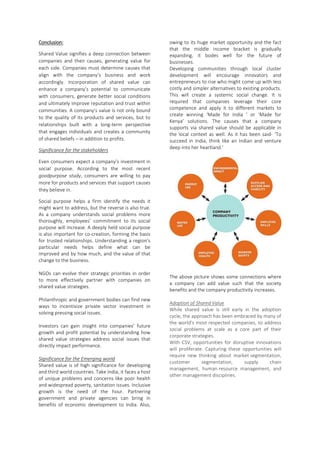
The above picture shows some connections where
a company can add value such that the society
benefits and the company productivity increases.
Adoption of Shared Value
While shared value is still early in the adoption
cycle, the approach has been embraced by many of
the world’s most respected companies, to address
social problems at scale as a core part of their
corporate strategies.
With CSV, opportunities for disruptive innovations
will proliferate. Capturing these opportunities will
require new thinking about market segmentation,
customer segmentation, supply chain
management, human resource management, and
other management disciplines.
References :
1. Creating Shared Value: A How to Guide for
the new corporate revolution-Valerie
Bockstette and Mike Stamp.
2. Shared value in emerging markets-Greg
Hills, Patty Russell, Veronica Borgonovi, Alex
Doty
3. Disruptive Innovation for social change-
Clayton Christensen, Heiner Bauman, Randy
Ruggles, Thomas Sadtler.
4.Business at Its Best:Driving Sustainable
value creation-Accenture
5.Wikipedia

Shared Value

  • 1.
    SHARED VALUE Strategic ManagementAssignment 2014 2/18/2014 Submitted By : Group 8 Aastha Pandey Apoorva Singh Navdeep Singh Nikhil Salvi Submitted To: Dr. S. Dasgupta
  • 2.
    INTRODUCTION: For any individual,there exist four spheres of morality, as a person, as a company leader, as an economic agent and lastly beyond the firm’s boundaries. CEO’s today are taking a hard look at all of these spheres, trying to ascertain how to create new business opportunities, facilitate growth, how to achieve competitive advantage and at the same time proactively engaging with critical societal issues as a part of core strategy. In their report ‘Creating shared value: Redefining Capitalism and the Role of Corporation in Society’, Michael Porter and Mark Kramer defined shared value as corporate policies and practices that enhance the competitiveness of a company while simultaneously advancing social and economic conditions in which it operates. It talks of three levels of shared value- Reconceiving customer needs, products and markets, Redefining productivity in the value chain and enabling local cluster development. Take for example the IT industry-A core strategic issue affecting most IT companies in India and worldwide today is lack of talent. This challenge can be taken care of by providing training and mentoring to nearby colleges, and actively participating with the colleges to design course curricula more in tune with industry needs. This would enable the students gain access to the latest industry data and information which would in turn supplement innovation which would only benefit the company and the world as a whole. Securing value for shareholders as economic agents necessitates that companies reduce risk by demonstrating long term sustainable growth and returns. Like in the IT industry example given above it is required that there be an educated talent pool to choose from to ensure long term viability and competitiveness. This can be done by skilling the workforce beyond usual company boundaries and improving the living standards of local communities. Accenture has taken up this cause with gusto by launching its skills to succeed programme by equipping people with skills to get a job or build a business. The goal being to create shared value to improve Accenture’s brand and build a future pool of talent. RECONCEIVING CUSTOMER NEEDS,PRODUCTS, MARKETS REDEFINING PRODUCTIVITY IN THE VALUE CHAIN ENABLING LOCAL CLUSTER DEVELOPMENT Designing new products based on societal needs like the environment etc. or open new markets to meet unmet needs of an underserved community. A strong local cluster with capable institutions, suppliers can help improve productivity. Identify the inside out linkages to identify positive and negative impact of the value chain. Shared Value Figure above :Levels of Shared Value
  • 3.
    Shared Value andCSR Most companies have always had CSR as a part of their business model. It is a guide for what the company stands and an indicator of its promise of performance for its customers. Most companies awoke to CSR only after being caught by surprise by public response to environmental and other social issues. Like Nike faced consumer boycott after media reported of labour violations of its workers in Indonesia. Activists have become highly vocal and often bring the public attention to larger corporates merely to focus on an issue even if the corporate in question has not had much bearing on the problem. Thus, for a large group of companies CSR has not been strategic, rather it has been cosmetic. CSR initiatives have been justified by the four following arguments- 1. Moral obligation-As an entity a company needs to be ethical and moral. But ethics differ from culture to culture and something which is moral for one group of customers may be totally illegal for another. 2. Sustainability-Meeting needs of the present without compromising future needs. But the notion of sustainability can become vague, transparency can be more sustainable than corruption. This is true but does not offer basis for balancing long term goals and short term costs. 3. License to operate-Approval from stakeholders is needed for the company to operate. But sometimes due to this CSR agendas can be ceded to outsiders. 4. Reputation-Company image improves and strengthens its brand and stock. But with this argument the focus remains on maintaining public relations rather than social and business results. All the arguments above focus on the friction between society and the company instead of focussing on how the two are related. Consequently, CSR practices were not aligned with business practices, this caused a lot of companies to miss out on opportunities that were potential new ventures/products as well as benefits to society. However, the areas of corporate philanthropy and strategy are converging. Serving the society is no longer simply an avenue for charity, it is a chance to attain differentiation and grow. ‘There’s not enough money that we can give away to be viewed as a responsible company in 200 countries. And we can’t do it sustainably. So the only way it can work is to weave responsibility into the core business of the company’. -INDRA NOOYI A company can map the social opportunities for itself by looking at its value chain (i.e. the inside out linkages) as well as the diamond framework (i.e. the outside in linkages) Successful corporations recognise that there needs to be an interrelationship between the society and the company such that the societal needs are within the purview of the company’s strategy. A healthy society would be beneficial to the corporation as it would provide good governance, skilled workforce and strong regulatory standards One thing that needs to be kept in mind that social impact differs from place to place and changes over time. Also, no business can address all needs of society. The needs to be addressed should be categorised into generic social issues, value chain issues, and social issues in the competitive context. The issues should then be ranked in order of priority or impact for each business unit. The category in which any issue falls will vary from industry to industry & location to location. Screening Shared Value Opportunities (Source-Accenture) Societal Issues Need Core Competence Uniqueness Strategic Direction Project
  • 4.
    VALUE CHAIN (LOOKINGINSIDE OUT) DIAMOND FRAMEWORK(LOOKING OUSIDE IN) Srategy and Rivalry Input Conditions Related and supporting industries Demand Conditions
  • 5.
    Shared Value Implemented- Source:Accenture Theabove figure illustrates the business value levers of shared value. As communities become more energetic, vibrant and healthy, businesses have better chances of achieving these levers. Following are few examples of firms implementing shared value. Launched by Novartis in 2006, the Arogya Parivar (the Hindi phrase for “Healthy Family”) program combines health-care education and access to affordable medicines in rural India. The program focuses on educating patients about disease prevention and management and made treatments more affordable by selling medication in smaller packages with doses for only 1-3 days. While patients need to purchase the packs more frequently, this keeps weekly treatment costs below USD 1.25.Professor C.K. Prahalad who authored the book ‘The fortune at the bottom of the pyramid’ said that seemingly unreachable populations at the bottom of the economic pyramid make up around one-third of the world’s population and present a sizable opportunity to extend access to health care. This opportunity was recognised and grabbed by Novartis. Changes in the external environment and a generational shift are creating a greater awareness amongst businesses and a greater need to act to address societal problems. – Joe Jimenez, CEO, Novartis AG The General Electric Company’s Healthymagination program is putting shared value into practice to produce substantial social and financial benefits. The company has already enjoyed considerable success through its Ecomagination strategy, which aims to reengineer thousands of GE products to reduce their environmental impact. This initiative has generated more than$17 billion in revenues in 2008, even in the face of a financial crisis. One of the goals of Healthymagination is to reduce the cost of health care by 15 percent. So far, more than twenty new products have been developed and the company is on target to create 100 new innovations. GE recognised the mega trend of the movement of the health technology market away from expensive new technologies and towards cheaper mass market access. The shift is being driven because of the increasing middle class in developing countries. In rural Mexico, PepsiCo faced business constrictions on supplies of corn provided to its factories because regionally supplied products often fell below quality standards. Analyzing this strategic issue, senior leadership recognized that important root causes were in the existing skills of local providers and an inadequate farming and transportation infrastructure. So, PepsiCo is investing in farmer training and providing small and medium-size corn growers the seeds, fertilizers, agrochemicals, and water-usage guidelines that help them produce abundant crops. The objective is to improve the quality of corn supplied to the company’s factory by local producers (whose products previously fell below its quality standards). While generating increased business value to the company through a more effectivesupply chain, these investments are also raising the living standards of the local community. India’s Rising Middle Class, Source:McKinsey Maximising upside Minimising Downside Sh or t Te r m LongTerm Revenues Increased revenues from products that improve health and well being Intangible benefit Stronger workforce supply chain Costs Savings from enhanced productivity Risks Long term secured value for shareholders and other stakeholders.
  • 6.
    We are nottrying to solve every issue. Instead, we are taking on things that are core to our competency and in geographies we can manage. We do them where they drive business value, not just because they sound good.- Doug Conant, President and CEO, The Campbell Soup Company In 2009 Campbell soups committed to a business agenda of macro targets that included reducing its carbon foot print, levels of childhood obesity and hunger in the countries it operated in. Product lines related to obesity focussed on removing sodium, transfats and artificial colours. From 2007-2010, revenue from the nutrition line of Campbell products soared by $1.2 billion. Below are the building Blocks of shared value which are taken up for successfully adopting shared value. The best example for vision would be that defined by Mahindra and Mahindra, their defining purpose is ‘Enabling people and communities to RISE.’ Their Spark the Rise campaign, is a potential launch pad for small initiatives. The initiative to help budding entrepreneurs is more to build the group's brand image, albeit in a subtle manner. By virtue of its strategy Nestle has pioneered the shared value approach. Nestle has defined a clear strategy focused on three key issues: rural development, water use, and nutrition. Rural development is essential for a reliable, high-quality supply of raw materials. In addition, agriculture accounts for 70 percent of the world’s water use, while many of the world’s productive agricultural areas—From which Nestlé sources its ingredients— face severe water stress. Likewise, by focusing on nutrition, the company can differentiate its products while contributing to the health and well- being of consumers. The most effective companies leverage the resources inside and outside it to tackle their goals. With its anticounterfeit technology for medicines, for instance, HP is leveraging expertise that ranges from imaging and printing to mobility services and cloud computing. Companies trying to create shared value track its performance measures against a baseline. Cisco measures the number of students that its Networking Academies have trained, but also follows up with them to understand how many go on to secure a new or better job. Following are few more examples of companies creating shared value: To help identify societal issues relevant to its business opportunities, financial services company HSBC Bank plc created a Climate Change Centre of Excellence, an in-house research center that provides a focal point within HSBC to look at climate change as a strategic commercial issue. The Centre aims to stimulate greater understanding of the implications of climate change and to translate these into business opportunities. In 2008, they also established an internal ‘Climate Team’, which brought together representatives from each customer group and global business within HSBC to share best practice and, ultimately, to maximise the business opportunities presented by the transition to a lower carbon economy. In 2009 Paymate launched a financial inclusion initiative to help migrant workers more efficiently and securely remit funds back home The company decided to conduct remittances with mobile phones. Customers visit kiosks to obtain cash at which point the original sender receives confirmation that the transaction is complete. The company is negotiating with the GoI to provide An explicit vision of the company as an engine for creating shared value ENGAGEMENT IS SEEN AS INTEGRAL TO STRTATEGY VISION PRIORITIZE SSUES OF SHARED VALUE SET AMBITIOUS GOALS STRATEGY Effective delivery that leverages assets and expertise across functions Partners mobilised for information and action DELIVERY Management for performance that seeks to measure and learn from results Bring successful efforts to scale,and communicate progress PERFORMANCE
  • 7.
    payments for theNational Rural Employment Guarantee Scheme (NREGS) In 2003-2004 ICICI Lombard launched a weather based crop insurance program. The process was made as objective as possible with third party agencies monitoring the process. Under ICICI Lombard’s system, farmers do not file claims. Rather, payments are triggered by deviations from normal conditions as measured by certified weather data collected from independent third parties. Weather-based products contributed to Rs. 332 crore ($72 million), 7.8 percent of the company’s direct business You’re really looking for programs to be win-wins with your employees and your customers, as well as being the right thing to do. We found that the only way to drive our sustainability objectives forward is by entering into dialogue with stakeholders.- Irene Dorner, President and CEO, HSBC Bank USA, N.A. Shared value would be incomplete if we don’t talk of catalytic innovation along with it. A catalytic innovation is a subset of disruptive innovation. The primary objective of catalytic innovation is social change. SELCO, India’s mission itself is to ‘Enhance the quality of life in underserved households and livelihoods through sustainable energy solutions’ It is a ‘for profit’ social enterprise based in Bangalore and it aims to improve the living standards of the poor. So far it has done so by creating solar energy based interventions and low smoke cook stoves. SELCO India has installed solar light systems in 125,000 houses and plans to aims to reach over 200,000 households by 2014. SELCO started with a financial model in which each customer would pay 25% of the cost upfront as down payment and will further pay a monthly instalment which is affordable and within the average monthly budget of a family in the region. Along with this, the SELCO INDIA also provided a year's guarantee to the warranty of the manufacturer along with free service for a year and a 90-day money back guarantee. Perhaps the most glaring example of creation of shared value in India is that of Aravind Eye hospital. It provides free surgeries to the poor while still earning a profit due to its simple infrastructure. In addition it keeps its surgical equipment in operation 24 hours a day which reduces cost per surgery. A doctor’s time is utilised with highest effectiveness. Nurses work on pre-op and post-op, doctors only focus on surgery which improves their productivity. All of these measures enables the hospital to perform high volume, high quality inexpensive eye surgeries to address the needs of India’s humungous blind population. Another example in the healthcare sector is that of ,Lifespring Hospitals, a 50-50 joint venture between $30-million Acumen Fund, a U.S.-based non-profit global venture philanthropy fund and HLL Lifecare Limited, a Government of India owned corporation, is an Indian hospital chain, which provides maternity care to women from the low- income group in Hyderabad, India. It is the first healthcare chain to join the 'Business Call to Action' (BCtA), an initiative of United Nations Development Programme (UNDP) and UN Global Compact amongst others, to reduce poverty, hunger, disease, and maternal and child deaths by 2015. The concept of shared value is implementable even at the minutest of levels, take for example IIM- Rohtak’s initiative of Swabhav, It combines business acumen, creativity and a concern for society creating shared value in a social business model. How can my work make me a better human being and make a better world? -Dr Govindappa Venkataswamy,Founder- Aravind Eye Hospitals
  • 8.
    Conclusion: Shared Value signifiesa deep connection between companies and their causes, generating value for each side. Companies must determine causes that align with the company’s business and work accordingly. Incorporation of shared value can enhance a company’s potential to communicate with consumers, generate better social conditions and ultimately improve reputation and trust within communities. A company’s value is not only bound to the quality of its products and services, but to relationships built with a long-term perspective that engages individuals and creates a community of shared beliefs – in addition to profits. Significance for the stakeholders Even consumers expect a company’s investment in social purpose. According to the most recent goodpurpose study, consumers are willing to pay more for products and services that support causes they believe in. Social purpose helps a firm identify the needs it might want to address, but the reverse is also true. As a company understands social problems more thoroughly, employees’ commitment to its social purpose will increase. A deeply held social purpose is also important for co-creation, forming the basis for trusted relationships. Understanding a region’s particular needs helps define what can be improved and by how much, and the value of that change to the business. NGOs can evolve their strategic priorities in order to more effectively partner with companies on shared value strategies. Philanthropic and government bodies can find new ways to incentivize private sector investment in solving pressing social issues. Investors can gain insight into companies’ future growth and profit potential by understanding how shared value strategies address social issues that directly impact performance. Significance for the Emerging world Shared value is of high significance for developing and third world countries. Take India, it faces a host of unique problems and concerns like poor health and widespread poverty, sanitation issues. Inclusive growth is the need of the hour. Partnering government and private agencies can bring in benefits of economic development to India. Also, owing to its huge market opportunity and the fact that the middle income bracket is gradually expanding, it bodes well for the future of businesses. Developing communities through local cluster development will encourage innovators and entrepreneurs to rise who might come up with less costly and simpler alternatives to existing products. This will create a systemic social change. It is required that companies leverage their core competence and apply it to different markets to create winning ‘Made for India ’ or ‘Made for Kenya’ solutions. The causes that a company supports via shared value should be applicable in the local context as well. As it has been said- ‘To succeed in India, think like an Indian and venture deep into her heartland.’ The above picture shows some connections where a company can add value such that the society benefits and the company productivity increases. Adoption of Shared Value While shared value is still early in the adoption cycle, the approach has been embraced by many of the world’s most respected companies, to address social problems at scale as a core part of their corporate strategies. With CSV, opportunities for disruptive innovations will proliferate. Capturing these opportunities will require new thinking about market segmentation, customer segmentation, supply chain management, human resource management, and other management disciplines.
  • 9.
    References : 1. CreatingShared Value: A How to Guide for the new corporate revolution-Valerie Bockstette and Mike Stamp. 2. Shared value in emerging markets-Greg Hills, Patty Russell, Veronica Borgonovi, Alex Doty 3. Disruptive Innovation for social change- Clayton Christensen, Heiner Bauman, Randy Ruggles, Thomas Sadtler. 4.Business at Its Best:Driving Sustainable value creation-Accenture 5.Wikipedia