Jet Engine
Presented By:
Chetan Garg
B.Tech (Mechanical
Engineering)
8th Semester
CONTENTS
1. How Aeroplane Fly
2. Propulsion
3. Jet Engine
4. Working Principle (Brayton Cycle)
5. Working of Jet Engine
6. Types of Jet Engine
7. Application
8. Merits & Demerits
9. Conclusion
10. Future Vision
How Aeroplane Fly
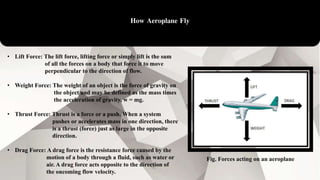
• Lift Force: The lift force, lifting force or simply lift is the sum
of all the forces on a body that force it to move
perpendicular to the direction of flow.
• Weight Force: The weight of an object is the force of gravity on
the object and may be defined as the mass times
the acceleration of gravity, w = mg.
• Thrust Force: Thrust is a force or a push. When a system
pushes or accelerates mass in one direction, there
is a thrust (force) just as large in the opposite
direction.
• Drag Force: A drag force is the resistance force caused by the
motion of a body through a fluid, such as water or
air. A drag force acts opposite to the direction of
the oncoming flow velocity.
Fig. Forces acting on an aeroplane
Propulsion
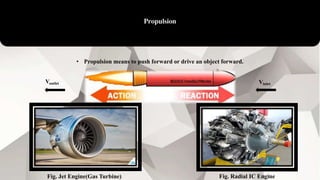
• Propulsion means to push forward or drive an object forward.
VinletVoutlet
Fig. Jet Engine(Gas Turbine) Fig. Radial IC Engine
Jet Engine
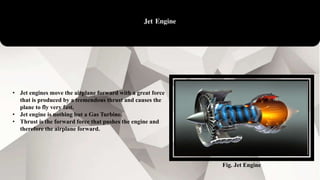
• Jet engines move the airplane forward with a great force
that is produced by a tremendous thrust and causes the
plane to fly very fast.
• Jet engine is nothing but a Gas Turbine.
• Thrust is the forward force that pushes the engine and
therefore the airplane forward.
Fig. Jet Engine
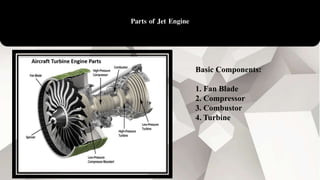
Parts of Jet Engine
Basic Components:
1. Fan Blade
2. Compressor
3. Combustor
4. Turbine
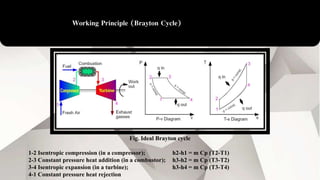
Working Principle (Brayton Cycle)
Fig. Ideal Brayton cycle
1-2 Isentropic compression (in a compressor); h2-h1 = m Cp (T2-T1)
2-3 Constant pressure heat addition (in a combustor); h3-h2 = m Cp (T3-T2)
3-4 Isentropic expansion (in a turbine); h3-h4 = m Cp (T3-T4)
4-1 Constant pressure heat rejection
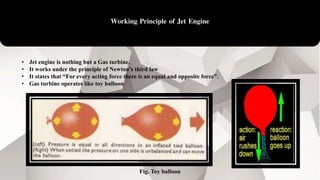
Working Principle of Jet Engine
• Jet engine is nothing but a Gas turbine.
• It works under the principle of Newton’s third law
• It states that “For every acting force there is an equal and opposite force”.
• Gas turbine operates like toy balloon
Fig. Toy balloon
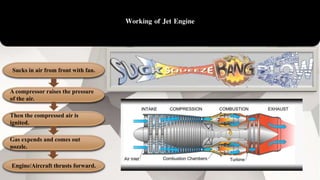
Working of Jet Engine
Sucks in air from front with fan.
A compressor raises the pressure
of the air.
Then the compressed air is
ignited.
Gas expends and comes out
nozzle.
Engine/Aircraft thrusts forward.
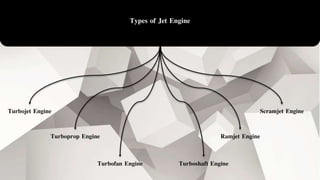
Types of Jet Engine
Turbojet Engine
Turboprop Engine
Turbofan Engine Turboshaft Engine
Ramjet Engine
Scramjet Engine
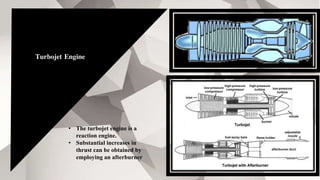
Turbojet Engine
• The turbojet engine is a
reaction engine.
• Substantial increases in
thrust can be obtained by
employing an afterburner
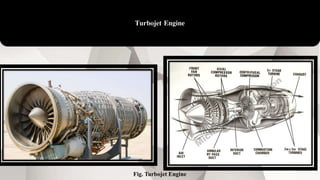
Turbojet Engine
Fig. Turbojet Engine
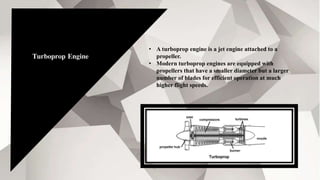
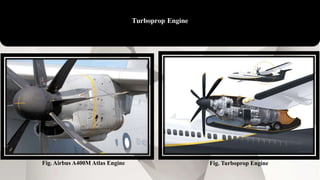
Turboprop Engine
• A turboprop engine is a jet engine attached to a
propeller.
• Modern turboprop engines are equipped with
propellers that have a smaller diameter but a larger
number of blades for efficient operation at much
higher flight speeds.
Turboprop Engine
Fig. Airbus A400M Atlas Engine Fig. Turboprop Engine
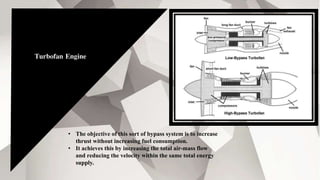
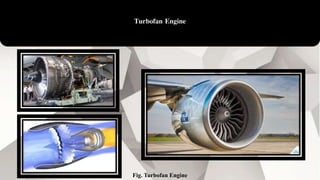
Turbofan Engine
• The objective of this sort of bypass system is to increase
thrust without increasing fuel consumption.
• It achieves this by increasing the total air-mass flow
and reducing the velocity within the same total energy
supply.
Turbofan Engine
Fig. Turbofan Engine
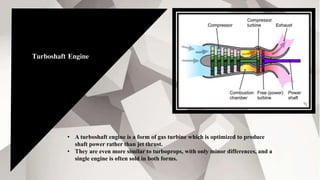
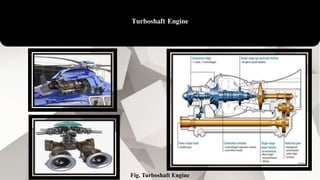
Turboshaft Engine
• A turboshaft engine is a form of gas turbine which is optimized to produce
shaft power rather than jet thrust.
• They are even more similar to turboprops, with only minor differences, and a
single engine is often sold in both forms.
Turboshaft Engine
Fig. Turboshaft Engine
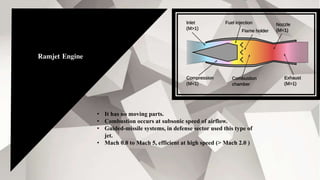
Ramjet Engine
• It has no moving parts.
• Combustion occurs at subsonic speed of airflow.
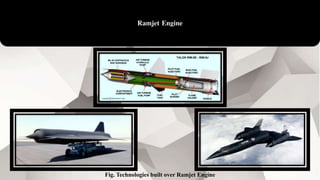
• Guided-missile systems, in defense sector used this type of
jet.
• Mach 0.8 to Mach 5, efficient at high speed (> Mach 2.0 )
Ramjet Engine
Fig. Technologies built over Ramjet Engine
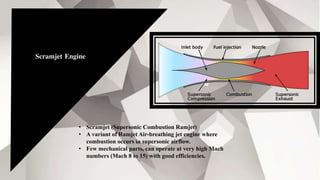
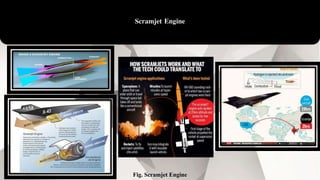
Scramjet Engine
• Scramjet (Supersonic Combustion Ramjet)
• A variant of Ramjet Air-breathing jet engine where
combustion occurs in supersonic airflow.
• Few mechanical parts, can operate at very high Mach
numbers (Mach 8 to 15) with good efficiencies.
Scramjet Engine
Fig. Scramjet Engine
Application
• In Aircraft- Fighter plane, Missiles, Rocket, Airplane.
• Jet propulsion, land and sea transport, racing car.
• The first use of the jet engine was to power military
aircraft.
• The General electric company used a “turboprop” jet
engine to run an electric generator.
• The jet engine is not only used on aircraft but on boats,
where water jets are used to propel the boat forward.
• Normal type of jet engine is used for domestic purpose i.e.
Traveling, carrying goods etc.
Merits & Demerits
Merits
• Mechanical efficiency of jet engine is
high as compared to IC engine.
• Speed of jet engine per HP developed
is higher than IC engine.
• Ignition and lubricating systems are
much simpler in jet engine than IC
engine.
Demerits
• Thermal efficiency of Jet engine is
low compared to IC engine.
• Turbine blades need a special cooling
system due high temperature.
• High fuel consumption.
• It is difficult to design a turbine that
will work in high temperature with
high speed.
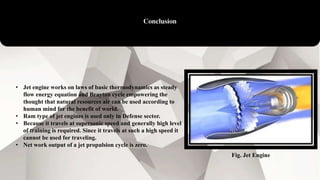
Conclusion
• Jet engine works on laws of basic thermodynamics as steady
flow energy equation and Brayton cycle empowering the
thought that natural resources air can be used according to
human mind for the benefit of world.
• Ram type of jet engines is used only in Defense sector.
• Because it travels at supersonic speed and generally high level
of training is required. Since it travels at such a high speed it
cannot be used for traveling.
• Net work output of a jet propulsion cycle is zero.
Fig. Jet Engine
Future Vision
• To develop materials that can withstand extremely high temperatures and stresses
required by more powerful engines.
• Future engineers will find many opportunities to develop engines with increased
efficiency, reduced mass, and exotic materials.
• New fuels, reduced noise, and reductions in pollution require further study, testing,
and design.
• As NASA seeks to return humans to space, as air travel continues to expand, and
as humans seek to fly higher, faster, and farther, propulsion will play a major role
in the design for the vehicles of the future.
• “Engineers and engine designers are never content to stop “ pushing the envelope”
in aviation propulsion.”
PPT on Jet Engine by Chetan

PPT on Jet Engine by Chetan

  • 1.
    Jet Engine Presented By: ChetanGarg B.Tech (Mechanical Engineering) 8th Semester
  • 2.
    CONTENTS 1. How AeroplaneFly 2. Propulsion 3. Jet Engine 4. Working Principle (Brayton Cycle) 5. Working of Jet Engine 6. Types of Jet Engine 7. Application 8. Merits & Demerits 9. Conclusion 10. Future Vision
  • 4.
    How Aeroplane Fly •Lift Force: The lift force, lifting force or simply lift is the sum of all the forces on a body that force it to move perpendicular to the direction of flow. • Weight Force: The weight of an object is the force of gravity on the object and may be defined as the mass times the acceleration of gravity, w = mg. • Thrust Force: Thrust is a force or a push. When a system pushes or accelerates mass in one direction, there is a thrust (force) just as large in the opposite direction. • Drag Force: A drag force is the resistance force caused by the motion of a body through a fluid, such as water or air. A drag force acts opposite to the direction of the oncoming flow velocity. Fig. Forces acting on an aeroplane
  • 5.
    Propulsion • Propulsion meansto push forward or drive an object forward. VinletVoutlet Fig. Jet Engine(Gas Turbine) Fig. Radial IC Engine
  • 6.
    Jet Engine • Jetengines move the airplane forward with a great force that is produced by a tremendous thrust and causes the plane to fly very fast. • Jet engine is nothing but a Gas Turbine. • Thrust is the forward force that pushes the engine and therefore the airplane forward. Fig. Jet Engine
  • 7.
    Parts of JetEngine Basic Components: 1. Fan Blade 2. Compressor 3. Combustor 4. Turbine
  • 8.
    Working Principle (BraytonCycle) Fig. Ideal Brayton cycle 1-2 Isentropic compression (in a compressor); h2-h1 = m Cp (T2-T1) 2-3 Constant pressure heat addition (in a combustor); h3-h2 = m Cp (T3-T2) 3-4 Isentropic expansion (in a turbine); h3-h4 = m Cp (T3-T4) 4-1 Constant pressure heat rejection
  • 9.
    Working Principle ofJet Engine • Jet engine is nothing but a Gas turbine. • It works under the principle of Newton’s third law • It states that “For every acting force there is an equal and opposite force”. • Gas turbine operates like toy balloon Fig. Toy balloon
  • 10.
    Working of JetEngine Sucks in air from front with fan. A compressor raises the pressure of the air. Then the compressed air is ignited. Gas expends and comes out nozzle. Engine/Aircraft thrusts forward.
  • 11.
    Types of JetEngine Turbojet Engine Turboprop Engine Turbofan Engine Turboshaft Engine Ramjet Engine Scramjet Engine
  • 12.
    Turbojet Engine • Theturbojet engine is a reaction engine. • Substantial increases in thrust can be obtained by employing an afterburner
  • 13.
  • 14.
    Turboprop Engine • Aturboprop engine is a jet engine attached to a propeller. • Modern turboprop engines are equipped with propellers that have a smaller diameter but a larger number of blades for efficient operation at much higher flight speeds.
  • 15.
    Turboprop Engine Fig. AirbusA400M Atlas Engine Fig. Turboprop Engine
  • 16.
    Turbofan Engine • Theobjective of this sort of bypass system is to increase thrust without increasing fuel consumption. • It achieves this by increasing the total air-mass flow and reducing the velocity within the same total energy supply.
  • 17.
  • 18.
    Turboshaft Engine • Aturboshaft engine is a form of gas turbine which is optimized to produce shaft power rather than jet thrust. • They are even more similar to turboprops, with only minor differences, and a single engine is often sold in both forms.
  • 19.
  • 20.
    Ramjet Engine • Ithas no moving parts. • Combustion occurs at subsonic speed of airflow. • Guided-missile systems, in defense sector used this type of jet. • Mach 0.8 to Mach 5, efficient at high speed (> Mach 2.0 )
  • 21.
    Ramjet Engine Fig. Technologiesbuilt over Ramjet Engine
  • 22.
    Scramjet Engine • Scramjet(Supersonic Combustion Ramjet) • A variant of Ramjet Air-breathing jet engine where combustion occurs in supersonic airflow. • Few mechanical parts, can operate at very high Mach numbers (Mach 8 to 15) with good efficiencies.
  • 23.
  • 24.
    Application • In Aircraft-Fighter plane, Missiles, Rocket, Airplane. • Jet propulsion, land and sea transport, racing car. • The first use of the jet engine was to power military aircraft. • The General electric company used a “turboprop” jet engine to run an electric generator. • The jet engine is not only used on aircraft but on boats, where water jets are used to propel the boat forward. • Normal type of jet engine is used for domestic purpose i.e. Traveling, carrying goods etc.
  • 25.
    Merits & Demerits Merits •Mechanical efficiency of jet engine is high as compared to IC engine. • Speed of jet engine per HP developed is higher than IC engine. • Ignition and lubricating systems are much simpler in jet engine than IC engine. Demerits • Thermal efficiency of Jet engine is low compared to IC engine. • Turbine blades need a special cooling system due high temperature. • High fuel consumption. • It is difficult to design a turbine that will work in high temperature with high speed.
  • 26.
    Conclusion • Jet engineworks on laws of basic thermodynamics as steady flow energy equation and Brayton cycle empowering the thought that natural resources air can be used according to human mind for the benefit of world. • Ram type of jet engines is used only in Defense sector. • Because it travels at supersonic speed and generally high level of training is required. Since it travels at such a high speed it cannot be used for traveling. • Net work output of a jet propulsion cycle is zero. Fig. Jet Engine
  • 27.
    Future Vision • Todevelop materials that can withstand extremely high temperatures and stresses required by more powerful engines. • Future engineers will find many opportunities to develop engines with increased efficiency, reduced mass, and exotic materials. • New fuels, reduced noise, and reductions in pollution require further study, testing, and design. • As NASA seeks to return humans to space, as air travel continues to expand, and as humans seek to fly higher, faster, and farther, propulsion will play a major role in the design for the vehicles of the future. • “Engineers and engine designers are never content to stop “ pushing the envelope” in aviation propulsion.”